Wine Tasting

0


You just don’t know what to expect from an outfit that releases a wine called VineAgra. Initially, I noticed Sapphire Hill for the trippy triangles on its labels. Could they be an ad for shamanistic voyaging? But what do you know from a label anyway? Zip. You might as well go and try the wine. You might find yourself rolling into H-town in a rented SUV, with tattooed ladies from Maine and nothing to lose, and do just that.

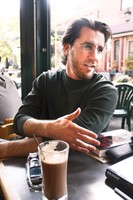
The Sapphire Hill gang established their vineyard west of Windsor, but the winery is located in Healdsburg, half mile or so from the gourmet ghetto. They share a refurbished 1933 winery complex with several other tasting rooms. As we drove up, the folks were outside, enjoying the sun, but retreated into their respective storefronts as we approached. We surveyed our choices. We chose Sapphire Hill, and we chose well. Winemaker Tim Meinken was manning the bar, has a sense of humor and knows the wine. Made the darn stuff.

Not driven by typical market expectation, Sapphire’s lineup includes no Cab and no Merlot. Production is mainly reds, with the exception of the 2003 Estate Chardonnay ($23). This Chard’s lumber and dairy product notes are subtle; it achieves more of a hint of cream soda. “Burgundian,” is how they describe the 2003 Sapphire Hill Vineyard Pinot Noir ($38). It’s tart and plummy, with a firm vegetal character. Green? I’m not saying that. More like roasted red pepper. It’s good. They produce some lots as limited as one barrel, such as the 2004 Bastoni Vineyard Alicante Bouschet ($25). Not available for tasting, the 2005 “Harlot,” a sassy Zinfandel/Syrah blend, could well be worth gambling $18 on a bottle. Also from the Bastoni Vineyard, the 2003 Old Vine Zinfandel ($28) is a toothsome brew of raisins and figs, with thorny tannins. Your bright and brambly Zin would be the 2005 Winberrie Vineyard Zinfandel ($32), juicy and savory, sure to brighten up the gloaming of any dimming day.

Now back to that 2005 VineAgra Zinfandel ($85). Only released in magnums, and containing 17 percent alcohol by volume, the wine got a lot of attention at this year’s ZAP Festival. Cognitive dissonance? Save it. Many a wit has already had a go at that. The real feat of pluck and verve: They got the label approved by the notoriously persnickety BATF. Dude.

Sapphire Hill Vineyards, 51 Front St., Healdsburg. Open Thursday-Monday, 11am to 4:30pm. 707.431.1888.


View All

Film Cheats

0

May 9-15, 2007

I‘ve always liked David Mamet’s 1987 debut film, House of Games, but now I feel like I never truly saw it until I saw it through Simon Lovell’s eyes.

“I’d love to shake David Mamet’s hand one of these days and say what a great movie about con games that is,” says Lovell.

And he would know. Lovell is a former confidence man himself, who now uses his powers for good instead of evil as a magician, most famously in his critically acclaimed off-Broadway show, Strange and Unusual Hobbies.

He still draws on his experiences as a scammer in the show, as well as several books on the subject, and recently I stumbled across his magnum opus, How to Cheat at Everything. The title is a bit of a joke, since most of the book is actually about how to protect yourself from cheating. It’s the most gripping thing I’ve read in quite some time, and I couldn’t stop thinking that, even as nonfiction, it could be the basis for the ultimate con-man movie; Lovell even uses the very cinematic device of following a single hustler and his friends through every con in the book.

He also makes references to movies as illustrative examples of cons in action–if he feels the screenwriters have done their homework. He mentions House of Games and The Sting more than once, which inspired me to go back and watch those movies in an entirely different context.

I was lucky enough to talk to the Manchester, England-born Lovell about these cinematic cheats from his home in New York City, and it turns out he’s quite the film buff. But con flicks that impress him as true to their subject matter are rare.

“There are very few,” he admits. “You’ve got The Hustler, The Grifters; you’ve got The Sting, House of Games, The Color of Money. These are movies that are few and far between, where cons are actually done properly, even within a cinematic sense. Another lovely movie is The Baltimore Bullet with James Coburn, about a pool player. The Sheep Has Five Legs is a very interesting one. It’s very hard to find, but if you can find it, it’s fascinating.”

Of those, the interesting thing about The Sting and House of Games is that they both depict the same con: the “crossed deck” or “cross.” It works on the time-tested principle that a little knowledge is a dangerous thing, hooking the victim into thinking that he or she is actually being brought in on a con, while in reality an even bigger con is being worked on them. In both films, Lovell says, the cons play out with a lot more elegance than your run-of-the-mill scam.

“Most cons just rely on human greed and culpability,” says Lovell. “The high end of cons are the artistic cons. The Sting would be a very good example of an artistic con. And House of Games is a nice artistic con. They’ve got everything planned out, they know what they’re doing right from the start, and it’s really a delightful piece.”

But that alone can lead to some problems with realism, as Lovell points out about The Sting. “Of course, it’s theatrically exaggerated, because the money at the end of it is probably nowhere near what they needed to put in to pull all of that shit off,” he says with a laugh. “So you walk away with $100,000, and what did you put into it, $500,000? Bit of a disaster there, you know?”

There is some poetic license in House of Games, too, like the “tell” that finally gives the cons away–the unwisely parked red car. Lovell estimates the hospital stay for a con who screwed up his part that badly would be minimum 14 weeks, which is why cons in real life rarely make such mistakes.

If you don’t understand the enduring appeal of the con movie, take it from the man who teaches casino operatives about cheating: everyone has the capacity to be a hustler. And a mark.

“People don’t think they’re gullible,” says Lovell, “but you look up the word ‘gullible’ in the dictionary, and you’ll find the entire human population in a photograph there.”


New and upcoming film releases.

Browse all movie reviews.

Band Bads

0

May 9-15, 2007

Names go through cycles. I was born in an era of Saras; at school, only the Jennifers outnumbered us. Today, my heart goes out to the legions of tiny Madisons and Ethans in America. After all, naming is intimidating. The self-image of the future is at stake, something my current data-entry job reminds me of periodically. Today, I encountered one Rod Glasscock, whose coordinates I typed into a spreadsheet with a mixture of pity and marvel. What were his parents thinking?

While expectant parents can look through baby-name books, no such tool exists for new bands, whose names must be utterly unique. And, just as the hierarchy of popular first names has shifted, jettisoning Mary and David for Mackenzie and Dylan, the province of band names has become a bizarre postmodern landscape of calculated irreverence and self-awareness cloaked in faux guilelessness. In other words, bad rock-band names, which have always existed in spades, are more prevalent than ever. I don’t care if Fall Out Boy’s name did originate from a Simpsons episode, it’s still a terrible thing to call a band. So is My Chemical Romance, Taking Back Sunday, My Brightest Diamond and any other construction of words that dangles expectantly as a fragment of an eternally unfinished sentence.

It does not have to be that way. As a public service, here is a 100 percent free band-name style guide. New bands, when you have that all-important meeting to decide what to call yourselves, simply refer to these guidelines and avoid what might be decades of life stuck with a name your thought was cool when you were 15 and easily amused.

  • A simple noun ending with an s is always a good bet; it is classic and elegant. However, after almost six decades of constant popularity, this construction has left very few objects unclaimed: Seeds, Slits, Sundays, Specials, Samples, for example, are all taken. Still, do not forget that the world is full of nouns. Look harder.
  • Spelling words incorrectly on purpose usually results in neither cuteness nor cleverness. What worked in the early 1960s (Beatles, Byrds, Cyrkle, Monkees) will come across as cloying in 2007 unless your band plays very stylized ’60s psychedelic garage rock. (Note that hip-hop is exempt from this particular element of style, as well as from most rock band name guidelines in general.)

  • Letters intentionally set in lowercase or letters set in all uppercase will deeply perturb the grammar/typography nerd at your local alt-weekly newspaper. You want these people on your side. Also avoid abusing punctuation marks. Sun O))) and india.arie and ADULT. feel completely ridiculous to type and look equally ridiculous in the context of, say, a New Yorker profile; they may just go and cover Feist instead. Don’t nip your best press opportunities in the bud just to indulge juvenile notions of nonconformity!

  • Don’t be a jackass and go and name your band something that’s virtually impossible to pronounce, like “!!!” or “OOIOO.” Any name that takes more than five minutes to explain to your mom is a bad idea.

  • Place names–Boston, Europe, Chicago, America, Kansas–aren’t just for power balladeers and soft-rock staples anymore. An atlas is a veritable goldmine of band names, from interstate off-ramps (Sleater-Kinney) to obscure towns in Maryland (Timonium).

  • Don’t name your band after anything that could be construed as a reference to poop or semen. True, both Hot Snakes and Pearl Jam have legions of devoted fans, but come on. Yeech! Likewise, avoid drug references, unless you are in a Black Sabbath cover band, in which case Sweet Leaf is a totally awesome name. So awesome, in fact, that it is taken. Sweat Leaf, however, is not and should remain so.

  • These days, a peek at the originality of a potential band name is only a quick Google away, but lawsuits can strike even the most thorough researcher. Smart bands eschew conflict by altering their names somewhat and emerging, triumphant, with a better name: Dinosaur to Dinosaur Jr., the Champs to the Fucking Champs.

  • Dumb bands change their name midway through their careers for no apparent reason, except for a change of pace. Brooklyn’s Kilowatthours, for instance, switched to Up the Empire a few years ago. Why ditch a perfectly fine name for a perfectly stupid one? Were they put into band witness protection?

  • “Wolf” and “Bear” are the Emmas and Jacobs of today’s band names. Grizzly Bear, Big Bear, Panda Bear, Polar Bears, Peanut Butter Wolf, AIDS Wolf, Wolfmother, Wolf Eyes . . . Just to be safe, your band may want to lay off the mammal names. Reptiles and insects are still a good bet.

    Band names are silly by nature. Go ahead and name your Hot Topic-shoppin’ emo band something like Sally’s Last Nightmare or name your mock-metal band Can Opener. Be serious about the music, but don’t take your name too seriously.

    Somewhere, someone–me, probably–will find a way to make fun of it.


  • Morsels

    0

    May 2-8, 2007

    Nominees for this year’s James Beard Foundation Awards, which recognizes culinary excellence in America, are the usual scullery suspects: carrot-lime ravioli hot shot Wylie Dufresne, Balthazar’s most Very Important Person Keith McNally, and discerning champ of class Thomas Keller.

    But Keller’s just the beginning when it comes to the discriminating papillae of the North Bay, which are catching the drooly attention of the James Beard folks. Here’s our grocery list of the rest of the local nominees, so you’ll know who to ask for an autograph when you pass them in the supermarket:

  • Kenwood food writer Jeff Cox’s Organic Cook’s Bible (John Wiley & Sons; $40) is up for best reference book.
  • John Scharffenberger, who lives in Mendocino and kind of recently sold out to Hershey, co-wrote The Essence of Chocolate (Hyperion Books; $35), which is nominated for the best book on a single subject award.
  • On her KQED program Check, Please! Bay Area, Petaluma’s own Leslie Sbrocco features candid debates by regular Joes who’ve eaten at each other’s favorite restaurants. That’s up for Best Television Food Special.
  • Cyrus’s Douglas Keane is up for best chef in the Pacific region. (You can bet the P.D.’s happy about that one.)
  • Dan Duckhorn of Duckhorn Vineyards, St. Helena; Helen Turley of HTM Consultants/Marcassin Winery, Calistoga; Paul Draper of Ridge Vineyards, Healdsburg and Cupertino are all up for the best Outstanding Wine and Spirits Professional Award.
  • Impressing your linens off, Terra restaurant in St. Helena scored a nomination for most outstanding service.Find out if that autograph will be worth something on May 7, when the Beard Foundation finally spills the haricots verts at a black-tie gala in Manhattan.
  • Quick dining snapshots by Bohemian staffers.

    Winery news and reviews.

    Food-related comings and goings, openings and closings, and other essays for those who love the kitchen and what it produces.

    Recipes for food that you can actually make.

    The Byrne Report

    May 2-8, 2007

    On a rainy night in late April, I sat in the Tomales Town Hall watching a live theater troupe perform a play about the Vietnam war called A Piece of My Heart. Normally, I do not attend live theater. Retread Broadway scripts bore me to curses and commercial actors creep me out. Nor do I watch television shows. (Well, I did rent a video of The Sopranos once and was neither shocked nor amused to see that our violence-sucking society considers murder-for-profit and snarling misogyny to be a humorous form of entertainment.)

    I avoid television news; it gives me gas. But I am marginally well-informed, thanks to the snippets of real life that filter through our thought-controlled Internet. And I read lots of those interesting books that Amazon.com tells me to buy. For example, I recently finished C. Wright Mill’s classic 1956 study of the military-industrial-political complex, The Power Elite. We’ll talk about that in a minute.

    So there I was, sitting on a cold metal folding chair in the drafty town hall of a tiny town on a wet night with a dozen others watching a true-life play about American nurses and soldiers getting the shaft in Vietnam. A Piece of My Heart was first produced in New York City in 1991. The song-filled drama, written by Shirley Lauro, opened for a short run in Point Reyes Station a few weeks ago. But Tina Taylor, the play’s director, tells me that her local newspaper, the Point Reyes Light, owned and operated by Robert Plotkin, did not write a story about the community-produced event nor review it nor print any of several letters to the editor about the play that readers sent in.

    In response, Plotkin told me, “We review almost no plays. Sometimes we run it in the calendar section. When we have an art critic, as we did last summer, our art coverage goes up. But amateur reviews are lousy.”

    I thought the antiwar play was extraordinarily timely, and I applaud the gutsy cast for raising their voices to expose the shame of warring on Vietnam and, by implication, Iraq and Afghanistan. Taylor and her troupe want to tour local high schools with the play. They hope seeing it will discourage North Bay youth from enlisting in the armed forces only to be chewed up and spit out after “serving” their country. My main criticism of the play is that it does not search for–nor find any meaningful analysis of–why the United States killed 2 million Vietnamese civilians before they finally defeated us on the battlefield.

    Playwright Lauro throws a few rhetorical barbs at warlike males as a group, as if American females are not just as bloodthirsty as their mates, and rants a bit about “the brass,” without telling us who “the brass” are. In short, the play has pathos a-plenty, but lacks tragic stature, due, in large part, to its failure to acknowledge that the Vietnamese side of the struggle was a war of liberation against foreign invaders.

    And that brings us back to The Power Elite. In it, Mills systematically lays out how the post-WW II military-scientific bureaucracy, multinational corporations and the “political directorate” combined into a profit-seeking elite that runs America as a permanent war economy. Mills foresaw, several generations ago, that much of American culture, education, journalism and our very thought processes have been militarized: “Peace is no longer serious; only war is serious. Every man and every nation is either friend or foe, and the idea of enmity becomes mechanical, massive and without genuine passion.”

    The military-industrial publicity machine, observes Mills, “plant[s its] metaphysics firmly among the population at large,” relying upon “the absence of opposition to [its program] . . . portraying the armed forces in a manner attractive to civilians” and developing “a cast of mind that defines international reality as basically military.”

    This is a profound broadcast by Mills over the chasm of a half-century. Since then, we have degenerated to the point where we shrug off presidentially ordered torture, officially sanctioned kidnappings, indefinite detentions and the daily slaughter of innocents as merely another installment of The Sopranos. But the Dance Palace’s heart-felt antiwar production stood out in the poisoned cultural atmosphere we breath. Mass media suffocates us intellectually and scorches our hearts with a cultural diet that promotes consumption, narcissism and the blind eye.

    Mills warned us: “American militarism, in fully developed form, would mean the triumph in all areas of life of the military metaphysic, and hence the subordination to it of all other ways of life.”

    I salute Dance Palace for raising a small voice against the tide.

    or


    First Bite

    Have you ever wondered what lies within that huge, posh-looking facade on Sausalito’s Bridgeway Avenue called Poggio? I always have, and one day in early April I found out. White tablecloths, romantic interior lighting, polished wood, maroon velvet, regal arched doorways and a few more of my very favorite things are all found within.

    After I was seated by the hostess, my very kind server followed with a tall crystal carafe of water. To begin, I considered the chicken liver and asparagus crostini ($9) but went instead for the Caprino baked goat cheese and flatbread ($10). The crunchy, wafer-thin flatbread was stuck with pine nuts and grappa-soaked raisins and apricots. I wasn’t sure whether or not the point was to spread the creamy hot cheese over the bread and make a mini pizza, but that’s what I did and I liked it just fine. A dinky pear-and-greens salad dressed in vinaigrette sat meekly beside the crostini. Meanwhile, a hitch-hiking scrap of liver had somehow found its way onto my plate and was a welcome surprise.

    The vinegar and the oil, the goat cheese and the complimentary oven-fresh rolls which I lathered in smooth-whipped butter all conspired to lift me up and away to the hills of Southern France. It wasn’t quite Italy, but that is no fault of Poggio. The excellent food is plainly Italian, and with it I savored a very nice Chianti Superiore ($7.25). Yet there I was in the hills of France. As a kid, I traveled with my family through much of southern Europe. I was only five and couldn’t see any difference between one wine-soaked land and the next, and I think my olfactory transmitters must have gotten a little mixed up with all the baguettes and cheese and the mules and peasants scurrying in every direction.

    The baby beets and arugula salad ($9) bumped me right over the Alps and into Italy. The sliced ricotta on top was fresh and cool, white as snow and pure as the River Po, and it absorbed the color and the faint sweetness of the pink and orange beets just beautifully, while the crunchy arugula cut the flavor like a knife.

    We could talk on and on about the little things: how the droplets of green olive oil lingered like polka dots in the dark burgundy vinegar; how the dry Chianti reflected the Europeans’ confident, no-nonsense approach to winemaking; how the foam of my espresso ($1.95) tickled my upper lip; how many of Poggio’s herbs and garnishes come from the certified organic garden on the hillside out back, but the fact is my food was gone. No airplane could have taken me to Europe and back faster than the food at Poggio did, and I walked out the door and down the street as one who has really been somewhere.

    Poggio has a seasonally changing menu and is open for lunch and dinner daily; the cafe opens for breakfast daily at 6:30am. 777 Bridgeway, Sausalito. 415.332.7771.


    View All

    Quick-and-dirty dashes through North Bay restaurants. These aren’t your standard “bring five friends and order everything on the menu” dining reviews.

    Cottage Industry

    May 2-8, 2007

    Spring Fashion:

    Sebastopol mother of two Alix McCauley has been content to stay at home with her kids for the last seven years, taking special time to raise her son and daughter, now seven and three, be available for play dates and do school volunteering, work on her garden and help renovate the old house she and her husband bought a few years ago. Trained as a painter and photographer at the Rhode Island School of Design, McCauley hasn’t had time to do much fine art, but she has made her children’s clothes and, before that, made her own maternity clothes. And then one day last November, a friend told her about an online marketplace for crafters and artisans, Etsy.com. Never one to turn down an idle moment to shop, McCauley took a look and loved what she saw.

    “I was immediately inspired,” she says. “I’d never seen anything like it; it’s a compilation of so many energies.” Before she went to bed that night, specifically the night of Nov. 19, 2006, McCauley took some photos of clothes she had made for herself and, thinking little of it, posted them to Etsy.

    When she woke up the next day, all of them were sold.

    Now just five months later, McCauley–who taught herself to sew–estimates that she has completed some 700 custom-made pieces through her store, Treehouse28, on Etsy.com. Standing in the airy backyard cottage that literally houses her cottage industry, she still seems a little shocked by her immediate success.

    A tall, willowy strawberry blonde who is also her brand’s only model, McCauley, 38, is an old-fashioned dressmaker in a decidedly new-fashioned world. Working exclusively with cotton-lycra blend fabrics that are stretchy and forgiving and particularly beloved by pregnant women and yoga enthusiasts, McCauley makes earth-tone dresses, headbands, shirts, arm warmers and pants exactly to her customer’s dimensions.

    “It’s all custom work,” she says. “I don’t work from sizing charts. I’m finding that a lot of people of different sizes and shapes want a wardrobe that works for them perfectly.” McCauley posts pictures of herself modestly modeling her designs, customers send in their dimensions–including how long they like their tops to be from shoulder to leg–and in a two-week turnaround, the item appears in the mail, hand-addressed and with a short note from McCauley inside the package.

    A typical dress costs just $60, entirely intended from color choice to breadth to length just for its new owner. And prices don’t change for larger women, whose clothing assuredly uses more fabric than do the size-zero eenie-beanies. “It’s really rewarding making clothing for women who don’t feel like they can pick up a piece of stylish clothing and have it fit,” McCauley says. “A lot of women don’t want to go out shopping or don’t have the time or feel shy trying clothes on in public.”

    The small cottage where McCauley works is immaculate, with clothing samples hanging from the ceiling, and her three sewing machines–two of them commercial sergers that she had to hastily purchase within the first month of her uncanny success–sitting on a white table, quietly at the ready. Even with the flood of orders that come in daily from spots as disparate as New Zealand, England and North Dakota, McCauley still keeps track of her inventory flow on a yellow legal pad.

    A bright orange basket on the floor holds fabric scraps that she uses to hand-tie each garment before packaging it herself for shipping. In less than half a year, she already has large design houses interested in her products and is fielding offers to expand and redirect the very personal nature of her business. And, oh, she has also had to learn how to actually do business.

    “I’m at that point already where I need to consider how big I want to be, how much I want to do,” she says, settling down on an oversized white sofa. “I can make the sales. Now it’s a matter of how to handle a business that’s growing. It’s exciting.”

    She leans forward and smiles. “It’s something I would never have forecast five months ago.”

    To learn more, go to www.etsy.com and search for Treehouse28 under ‘sellers.’


    Fashion Friction

    0

    Photograph by Patricia Lynn Henley
    Much of a muchness: Redwood Middle School students must conform to a dress code or have their records permanently marked for disobedience.

    By Patricia Lynn Henley

    For her first day as a seventh-grader at Redwood Middle School in Napa, Toni Kay Scott wore a denim skirt and a brown shirt with a pink border. The girl, known to her friends as T.K., also sported sensible school shoes and knee-high socks graced with images of the Winnie-the-Pooh character Tigger. Even before classes started on that fall day in 2005, the campus police officer had singled K. and another student out and taken them to the principal’s office.

    “It was kind of awkward,” T.K. recalls, speaking from her napa home via a conference call which included her attorney and her mother. remembering that day, T.K. adds, “I’d never gotten talked to by a police officer before or gotten in trouble.”

    A third student was brought in after classes started. All three presented copies of letters their parents had sent the principal a week before, officially requesting that their children be allowed to “opt out” of the school’s restrictive dress code. According to a recent lawsuit filed by five families–including T.K.’s–representing six students, the principal ignored the requests for exemptions to the dress code and ordered the three youngsters to spend the day in a program called Students with Attitude Problems.

    “I missed the whole first day of school that year,” explains T.K., an honor-roll student who enjoys math and science. “We just had to sit in a room. there was no talking. all we could do was read a book.”

    Because of the lawsuit, principal Michael Pearson declined to comment on specific incidents, but explained that the campus clothing policy started in 1996 as a response to local gang activity. Pearson has been principal of the 1,100-pupil campus for three years, and sees the dress code as a positive influence on a diverse student body that is 50 percent Caucasian and 50 percent Hispanic, with half of all families living on incomes below the poverty level.

    “It’s still a safety issue, although we don’t have near the gang issues that we used to,” Pearson explains. “It’s our way of setting the tone here on campus, that our focus is on education.”

    Currently, students can wear only seven solid colors–blue, white, green, yellow, khaki, gray, brown and black–in cotton twill, chino or corduroy. No pink collar on a white shirt. No pink at all. No purple. No orange. No denim. No prints. No stripes. No logos. No drawings. No Tigger socks.

    “This is a uniform,” says T.K.’s mother, Donnell Scott. “I don’t care how you word it, this is a uniform.”

    Pearson says the simplicity of the rules make them easy to enforce–there is no need for long discussions about whether a stripe is one or two inches wide–so that staff and faculty can focus on safety and education. In the lawsuit filed with the support of the ACLU and a private law firm, the Scotts and other families charge that the code goes too far, creating a de facto uniform policy. Under California law, students must follow a school’s dress code, but families can choose to exempt their children from having to wear a school uniform.

    Donnell Scott says she and the other families want their kids to have more options in dressing appropriately for school. They aren’t demanding an anything-goes approach; they simply don’t see how stripes, a flower print or Tigger socks are disruptive on a middle-school campus. Her younger daughter, Sydni, has also been cited at school.

    “I’m getting sick and tired of schools telling me how to parent my child,” Scott asserts calmly but forcefully. “This is a public school. Your job is to educate my child. I will dress her appropriately.”

    The heart of the issue, says Sonoma State University education professor Jim Fouche, is whether one favors an existentialist approach to teaching young people. Does the administration emphasize freedom of choice and personal responsibility, or a more traditional philosophy that standardized clothing rules creates a calmer classroom atmosphere and a stronger sense of belonging to a large group? There’s also the matter of leveling differences in family incomes by downplaying or eliminating designer labels and logos.

    Strict school dress codes or uniform policies tend to cycle in and out of fashion, Fouche says. With the recent emphasis on basic skills and standardized testing, the concept has resurfaced. Still, it’s all a matter of opinion, advocacy and philosophy.

    “If it was as simple as having kids put on uniforms and seeing a marked improvement in academic proficiency, then you’d see a lot more of it,” Fouche explains. “I’m not aware of any evidence that would, in a casual way, link wearing or not wearing uniforms with academic performance.”

    A bell rings at 10am on the Redwood Middle School campus, and students pour out of classrooms for a 15-minute break. At first impression, the campus is a fairly homogeneous mass of dark and light colors. Everything, including backpacks, is in solid, subdued hues.

    But as the students mix and mingle in the sunshine, subtle differences emerge. There are shorts, crop pants, slacks, skirts, long-sleeve or short-sleeve tops, lightweight hooded sweatshirts, cotton jackets. While initially their outfits seem rather uniform, no two students are wearing exactly the same thing.

    Standing at the side of the swirling social mass of students, Principal Pearson points out a few minor dress code violations. Some are kids he’ll talk to later. One young boy has white stripes down the sleeves of his jacket. Pearson explains it’s the only jacket this kid has and his family can’t afford another one. Rather than cite the boy for violating school policy, Pearson looks the other way and hopes to eventually find him a coat that follows campus policy. The school has a scholarship fund to help families meet the dress code rules.

    “By and large we get amazing compliance from the kids,” Pearson says. He adds that there are a lot of other avenues for self-expression than fashion; students can assert their individual natures through academics, sports, arts, clubs and more.

    “We want our kids dressed four success. We want the focus on education and we want our campus to be safe. We have truly established an environment that provides safety and promotes learning. I truly believe that’s what parents want.”

    Dave Palagi, president of the school’s parent-faculty club, agrees wholeheartedly. “We’re instilling in our kids that when you go into the corporate world, you have to dress appropriately, and school isn’t any different,” Palagi says. The dress policy does increase safety, he avers, by making it easy for yard supervisors overseeing 1,100 students during breaks and lunch to immediately spot a stranger on campus. “If I had my way, there’d be an even stricter dress code.”

    The rules already go too far, says Sharon O’Grady, one of the private attorneys representing the case. “The dress code goes well beyond the legitimate purposes of a dress code,” she says, “which would be school safety, prevention of gang violence–things that are important to keep the school safe. No one has explained to me why stripes or patterns or having one color on the collar and a different color on the body of the shirt has anything to do with safety or gang violence.”

    The district has three other middle schools, none of which has a dress policy as strict as the one at Redwood. The families who filed the lawsuit say they shouldn’t have to transfer away from their neighborhood campus to escape rules that exceed what the state allows.

    T.K. worries that her permanent record will list disciplinary actions without explaining that they were for minor dress-code infractions. “It will show up that I was defying them. I don’t want to go into high school with them thinking that I’m not a good kid.”

    Donnell Scott adds, “For them to say this is a dress-for-success policy, well, success starts after high school. Let me parent my own child. Let me make a decision. It’s a public school. They can have the dress code; just provide me with an opt-out form.”


    Cosmetic Damage

    0

    May 2-8, 2007

    Spring Fashion:

    We all want to be healthy; we want be good to the environment and ourselves. Yet in our ever more health conscious society, a surprising the number of people cover themselves with unhealthful toxins every day. Of course, you’d never do that. Would you?

    Most likely, you do. You may not know it, but an astonishing number of personal care products are full of unhealthy chemicals, including proven carcinogens. The brands of highest concern include, but definitely aren’t limited to, Chanel, Banana Boat, Revlon, Clairol and Gillette. But there are alternatives. Over 500 brands, including Burt’s Bees and the Body Shop, have signed a pledge to replace harmful or dangerous ingredients with more healthful alternatives.

    This sort of voluntary action is needed because little is being done in America to regulate the cosmetics industry. The Marin-based youth coalition Teens for Safe Cosmetics (TSC), which recently held a prom-themed protest against unsafe products, says that the European Union has already banned more than a thousand chemicals from cosmetics due to health concerns, while the United States has only deemed nine ingredients potentially damaging enough to ban them. Right now, one in three of our personal-care products includes possible carcinogens, and only 11 percent of the more than 10,500 chemicals used in them have been tested for safety.

    Last fall, the California legislature passed SB 1379, which requires cosmetic companies to provide a list of potentially damaging ingredients to the Department of Health Services for review. But while the state program is still getting up to speed, the Environmental Working Group, a team of experts who investigate and expose health and environmental threats, is acting. They have posted ingredient lists and “safety scores” for most brands of cosmetics on their website at www.ewg.org. Among the top things they warn against are mercury, thimerosal, lead acetate, formaldehyde, toluene and petroleum distillates.

    Conjuring up images of dead frogs and scalpels, formaldehyde is not exactly reminiscent of lovely scented bathroom products. But in addition to being a preservative, formaldehyde also functions as a disinfectant and a germicide, and can therefore be found in commercial soaps, deodorants and shampoos, among other things. Not only is formaldehyde a suspected carcinogen, it may also trigger asthma and damage DNA.

    Two other pervasive ingredients are sodium laureth and sodium laurel sulfate, which TSC avers can “alter skin structure, allowing other chemicals to penetrate deep into the skin increasing the amount of other chemicals that reach the bloodstream.” Both compounds are found in just about all types of makeup as well as many other products. And, as a short-hand, anything that lists “fragrance” as an ingredient may be using that as a façade for harmful ingredients. But label scanning won’t always protect you; companies are known to leave off some ingredients or disguise them by only printing their Latin names.

    One new alternative to conventional cosmetic chemistry is mineral makeup, which uses naturally occurring minerals as the basis for the products. Not only is mineral makeup free of toxic chemicals, it provides protection from the sun and can even include customized levels of moisturization or oil control.

    With conventional makeup, says Tara Voight, owner of the Always Pampered salon in Novato, “women are trying to cover up instead of work with their skin.” Instead, she advocates using mineral makeup, which doesn’t clog pores and can be customized to complement your skin.

    Voight, who has been working in the skincare business for 14 years, is such a believer in the benefits of mineral makeup that she has developed her own line. She says creating high-quality mineral makeup is just a matter of practice, and her long-term goal for her line is to “make one better than the rest.”

    The cost of these products is greater than their drugstore counterparts, with blush and powders ranging from $25 to $45 and lipsticks and eye shadows somewhere between $20 and $25.

    For Voight, assisting her clients in making the changeover is a source of satisfaction. “It’s great to see people out of their ugly eye shadow and into something better,” she smiles. And it is not only an aesthetic improvement, Voight says, “it makes them feel better too.”

    Is feeling and looking better worth the extra effort? It would certainly seem that way. According to TSC, breast cancer rates are rising rapidly and “sperm counts among men throughout the industrialized world” have already fallen by 50 percent in only 50 years. To reverse these ominous trends, they suggest you “demand your stores stock your favorite safe products, contact manufacturers directly and urge them to replace hazardous ingredients with safe alternatives, or write your state and local officials urging them to support and initiate safe cosmetics legislation.”

    Or we could just allow the great cosmetic chemical cover-up to continue.

    Always Pampered, 818 Grant Ave., Novato. 415.899.8445. To learn more about Teens for Safe Cosmetics, go to www.teens4sc.org.


    Crowded House

    0

    May 2-8, 2007

    Jimmy Tamborello has always gotten by with a little help from his friends. It seems that every project the electro-mastermind behind Figurine and the Postal Service has worked on is packed full of the 21st-century indie-rock elite. Dumb Luck, the new album from his Dntel project, is no different, gathering a glittering crew of guest vocalists and musicians to contribute.

    His most famous collaborator, Ben Gibbard–the voice that made the Postal Service’s Give Up a hit and the “other” album for Death Cab for Cutie fans to own–is conspicuously missing. But Dumb Luck continues to offer Tamborello’s signature blend of sparse yet warm and whimsical electronic textures that convey a sense of the state between sleep and consciousness. The title track kicks off the album, with Tamborello himself speak-singing like Lou Reed over a melody fighting through the synthesized haze, before Sufjan Stevens-like choruses blend with acoustic strumming.

    This trend continues throughout the album, with instrumentation shifting with each verse while retaining cohesion, proving the meticulous five years it took to record was worth it and making a quantum leap over 2001’s more uniformly Eno-like Life Is Full of Possibilities. Highlights include the slow crawling “Rock My Boat,” which evokes late-era Massive Attack, especially with Mia Doi Todd’s ethereal singing. Of course, the superstar spots also satisfy, especially “Breakfast in Bed,” where Conor Oberst returns the favor to Tamborello (who programmed Bright Eyes’ “Take It Easy”) with another gorgeously intimate warbling romantic lament over a propulsive synth slide.

    Most impressive is the organic sense pervading Dumb Luck that extends far beyond the live drums and guitar accompaniment to all of Tamborello’s pulses, blips, bottle taps and jingling keys. The nicest surprise is the cohesion even in the midst of the varying vocalists, something owed entirely to Tamborello’s soulful (yes, really) programming. While electronic music may arguably be the hardest genre in which to establish one’s recognizable identity, Tamborello’s sense of musicianship seems to have sealed the deal.


    Wine Tasting

    Film Cheats

    May 9-15, 2007I've always liked David Mamet's 1987 debut film, House of Games, but now I feel like I never truly saw it until I saw it through Simon Lovell's eyes."I'd love to shake David Mamet's hand one of these days and say what a great movie about con games that is," says Lovell.And he would know. Lovell is...

    Band Bads

    May 9-15, 2007Names go through cycles. I was born in an era of Saras; at school, only the Jennifers outnumbered us. Today, my heart goes out to the legions of tiny Madisons and Ethans in America. After all, naming is intimidating. The self-image of the future is at stake, something my current data-entry job reminds me of periodically. Today,...

    Morsels

    May 2-8, 2007 Nominees for this year's James Beard Foundation Awards, which recognizes culinary excellence in America, are the usual scullery suspects: carrot-lime ravioli hot shot Wylie Dufresne, Balthazar's most Very Important Person Keith McNally, and discerning champ of class Thomas Keller. But Keller's just the beginning when it comes to the discriminating papillae of the North Bay, which are...

    The Byrne Report

    May 2-8, 2007On a rainy night in late April, I sat in the Tomales Town Hall watching a live theater troupe perform a play about the Vietnam war called A Piece of My Heart. Normally, I do not attend live theater. Retread Broadway scripts bore me to curses and commercial actors creep me out. Nor do I watch television...

    First Bite

    Cottage Industry

    May 2-8, 2007Spring Fashion: Sebastopol mother of two Alix McCauley has been content to stay at home with her kids for the last seven years, taking special time to raise her son and daughter, now seven and three, be available for play dates and do school volunteering, work on her garden and help renovate the old house she...

    Fashion Friction

    Photograph by Patricia Lynn Henley Much of a muchness: Redwood...

    Cosmetic Damage

    May 2-8, 2007Spring Fashion: We all want to be healthy; we want be good to the environment and ourselves. Yet in our ever more health conscious society, a surprising the number of people cover themselves with unhealthful toxins every day. Of course, you'd never do that. Would you?Most likely, you do. You may not know it, but an...

    Crowded House

    May 2-8, 2007 Jimmy Tamborello has always gotten by with a little help from his friends. It seems that every project the electro-mastermind behind Figurine and the Postal Service has worked on is packed full of the 21st-century indie-rock elite. Dumb Luck, the new album from his Dntel project, is no different, gathering a glittering crew of guest vocalists and...
    11,084FansLike
    4,446FollowersFollow
    6,928FollowersFollow