Teen Angel

0

music & nightlife |

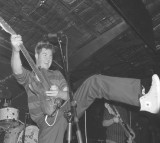
It’s a kick: Vince Lau of Go Kart Mozart catches air.

By Gabe Meline

Even gold, they say, has been discovered in the middle of nowhere. Granted, the small corner of an industrial warehouse on a vast, empty road along the outskirts of Sonoma isn’t likely to cause a nationwide influx of Sutter’s Mill proportions. But this out-of-the-way oasis has changed the climate of this upscale city for the hundreds of teenagers who enter this warehouse’s corrugated steel walls.

It’s called the Shop, and though it has nothing to do with wine, cheese or fancy festivals, it’s one of Sonoma’s crown jewels.

Founded in 1999 as a senior class project for budding garage bands, the Shop has grown into a venerable and largely under-the-radar venue serving the young community in Sonoma. It’s run by teens for teens who every weekend work the door, run the sound board, manage the stage, sell concessions and book the bands, giving the kids a much-needed outlet in a city that caters mostly to adults and tourists.

Co-director Dave Robbins realized the city’s need for a place like the Shop long before he joined colleague John Randall in overseeing the venue’s operations. “It’s terribly difficult to grow up around here,” he says. “I first moved here 24 years ago–my son was one at the time–and my wife and I would look around and think, ‘What the hell’s he gonna do when he gets a bit older? There’s nothing happening here!'”

When he discovered the activity at the southeast warehouse–currently sharing space with auto shops, storage space and a biodiesel outlet–Robbins eagerly came on to help. In the eight years since, the Shop has hosted hip-hop contests, dance nights, performance art and the ever-reliable stream of loud rock bands. On any given night, the performers run the gamut. Some groups consist of local members as young as 12, while others are older touring bands from out of state. (Before their cover-song hit “The Boys of Summer” flooded the airwaves, the Ataris stopped by the Shop on one of their first-ever tours.)

But what makes the Shop special is that it doesn’t feel like a teen center. Like Petaluma’s Phoenix Theater, the walls are covered in murals and spray paint. A few ratty couches and a chain-link fence are its only adornments. And even though other adult-mandated programs exist for the area’s youth, Robbins says the key to the Shop’s success is its decidedly hands-off approach.

“A big factor for teenagers,” he says, “is that they have to feel that most of what they’re involved in is theirs, that they’re a part of it.” Therefore, the Shop is run by a board made up of mostly teens who come to meetings, discuss issues, make decisions and guide the venue on their own terms. There are always older chaperones at the shows, ready to assist if needed, “but there’s not a whole bunch of adults monitoring them,” Robbins says proudly. “We just let them be themselves, and generally, that’s the best way to go.”

Minor mishaps, naturally, do occur. Sometimes the sound equipment breaks and a makeshift PA has to be assembled from a microphone and a guitar cabinet. Sometimes the concession stand runs out of soda during a packed show. Sometimes the band doesn’t show up, or the drummer falls off the back of the stage in the middle of a song. Solving these problems on the spot–and attending meetings to avoid them in advance–offers the “Shop kids” a chance to control their own entertainment and foster their own community.

“We know a number of teens,” Robbins says, “who came having no direction or were just very footloose and maybe lost a little bit.” Being a part of the Shop, he says, gives them a push in the right direction. “All the members are very supportive of each other, and they become good friends because of their association there. It’s very positive reinforcement. We’ve seen huge changes in people who have come and gone, who have made very positive changes in their life.”

The local community has responded in kind. The building’s landlord has been amenable during financially lean months; an outside Port-a-Potty is supplied at a hugely reduced rate; pizza is delivered to the venue at a discount. There’s also a healthy stable of audio technicians who work on the sound equipment “for pretty much nothing,” Robbins says. “We have a lot of parents who just do work for us and don’t ask anything in return. We don’t even have to pressure anybody–there’s a lot of people who just really want to be involved.”

And though the Shop is about as remote as can be, people tend to drive from all over the county to be a part of the action. “Some nights we don’t get a huge crowd,” Robbins admits. “We still have a lot of fun, the kids are great to be around. They’re all cool.”

Go Kart Mozart, Sound and Shape, Forgotten Masterpiece and Radio Suicide perform on Saturday, Aug. 11, at the Shop, 21600 Eighth St. E., Sonoma. 7pm. $8. For more info, visit www.myspace.com/theshopltd.


FIND A MUSIC REVIEW

Hot Biscuits

0

music & nightlife |

By Gabe Meline

A few years ago, when top-notch fiddler and all-around girl-about-town Odessa Jorgensen left the local group John Courage and, subsequently, the state of California, I’d prepared myself to never hear her pull a bow again. But soon after moving to Nashville, Jorgensen wandered into North Carolina and joined a hell of a group called the Biscuit Burners, who make possible Jorgensen’s return to Sonoma County in a home-turf appearance this Sunday in Cotati.

Covering the gamut of bluegrass styles, the Biscuit Burners are as ferocious on shit-kickin’, banjo-driven instrumentals like “Rockville” as they are tender on sweet laments like “Take Me Home.” Jorgensen’s vocals blend wonderfully with bassist Mary Lucey on duets reminiscent of Emmylou Harris and Gillian Welch’s from O Brother, Where Art Thou?, and a left-field highlight of the band’s current set is a long, Middle Eastern-flavored drone with Billy Cardine’s resophonic guitar mimicking a sitar perfectly. Having been spotlighted on NPR, featured onstage at the Ryman Auditorium and booked at the world-famous Bonnaroo festival, the Biscuit Burners have accolades behind them and a bright future ahead–and a touring bus, filled with dogs, to take them there.

The Biscuit Burners perform this Sunday, Aug. 12, at a private house concert in Cotati. 7pm. $15. For directions and more info, call 707.795.6057.


FIND A MUSIC REVIEW

Not a Prayer

0

August 8-14, 2007

You’d think that somebody would have thought of this before. But no one from SNL has ever done it, and neither has anyone from MADtv, SCTV or The Kids in the Hall (although their 1996 feature Brain Candy came the closest). Finally, David Wain and Ken Marino–two of the main minds behind the early ’90s MTV sketch comedy show The State–have called upon their past employment and crafted a feature film with the distinctive format and feel of a sketch comedy show.

Taking their inspiration from the highest source imaginable, the duo’s screenplay (directed by Wain) tells 10 short stories, each based on one of the Ten Commandments. Recruiting all 11 State alumni, as well as an all-star cast (Paul Rudd, Winona Ryder and Oliver Platt, just to name a few), Wain and Marino’s film is irreverent and quirky, with a wholly original style of humor. Each story’s premise takes just about as indirect a way as possible to get to the commandment in question. Half the fun of this extremely enjoyable film is trying to figure out where they’re going with this.

For “Honor thy mother and father,” for example, the story line follows a set of grownup, clearly African-American twins birthed to a white mother and father. Upon their father’s passing, they finally decide to ask Mom who their real Pop is. It turns out Mom was a celebrity reporter back in the day, and she swears that their real daddy is none other than Arnold Schwarzenegger.

Since she can’t haul in the real deal, as he is busy playing Governator, she hires an entirely unconvincing Ahnohld impersonator (Platt) to take over as their father. It doesn’t take her long to realize that who she actually meant to say was Arsenio Hall, but the closest the impersonator can come to that is a bad, half-hearted Eddie Murphy voice. But by then the twins have decided to do what the Bible says and honor their new father, even if he is a piss-poor celebrity impersonator doing a bad impersonation of a man who isn’t even their real father.

The rest of the stories are too entertaining to spoil, not to mention too intricate to actually describe. This is the type of humor where you either get it or you don’t, better compared to the awkward randomness of Strangers with Candy or South Park than to the more conventional Will Ferrell and Ben Stiller vehicles.

Besides being chock-full of over-the-top non-sequiturs, the stories are also equally clever in subtle ways (for example, Ryder is the star of the “Thou shall not steal” piece). The interconnectivity between the stories is likewise understated and provides another layer of humor to the already hilarious film. Characters float throughout the stories, popping up for brief cameos in one commandment before taking center stage for their own.

The Ten is notable for a risky choice on the part of everyone involved; everything and everyone plays it as straight as possible. No matter how strange the goings-on get (and things get very strange), the entire cast play their parts as if this is all just another ordinary day. Some scenarios work better than others, but the constantly changing story lines keep the film from getting bogged down by any of its own shortcomings. At a brisk 95 minutes, the last Commandment feels as fresh as the first.

With the wacky premises and decidedly adult content, there is plenty for religious types hoping for spiritual affirmation to be offended by. Stories of murder, prison rape, puppet sex . . . On second thought, there’s plenty for most everyone to be offended by. And how does one end a sketch-oriented film, one without any real dramatic thrust or rising action? Why, with a musical number titled “It’s Not Crude to Be Nude on the Sabbath” of course.

‘The Ten’ plays at select North Bay theaters.


New and upcoming film releases.

Browse all movie reviews.

Fast Times

0

music & nightlife |

Photograph by Karl Byrn
Axe Man: Jason Lawler learns the basics of dynamics.

By Karl Byrn

Jason Lawler was becoming quite a guitarist after four years of lessons, but he hadn’t yet played with other musicians, so he signed up for the Atlas Studios School of Rock in July. “Before that, I thought that in big recording studios there was only one mic hanging down, and they all just jammed,” the 13-year-old Rincon Valley Middle School student says with a grin. “I had no idea that it was all of this.”

“All of this” is a two-week long session of summer band camp, held at Atlas Studios, a modest downtown Santa Rosa recording facility located behind a video store. Owner Jesse Wickman, who also teaches drums at Stanroy Music Center, says his school “teaches kids how to be in a rock band,” with a focus not on music or the music business, but on rehearsal, recording and performance.

The group dynamic Lawler sought is also Wickman’s goal. In contrast to working with students one-on-one, he says, “the group is instantly rewarding. They come in the first day and choose songs. We rehearse until the songs are tightened up, we record and then they play a concert. How awesome is that?” 

The School of Rock graduation concert takes place this Saturday at the Santa Rosa Skate Park, as the graduates open for experienced local hardcore acts. It’s a perfect debut gig, as the show is one of a recent series of all-ages shows sponsored by Skate Works in Santa Rosa.

Wickman won’t be jumping across the stage like teacher Jack Black in the kids’ beloved School of Rock movie. “Jesse’s not the Jack Black of Santa Rosa”, says 17-year-old drummer Nick Lenchner. “I am!” But Wickman is still a kid himself. When he asked Lawler, “What was the one thing I said to you guys a million times?” the guitarist replied, “You mean besides ‘Sweet!’?”

The real answer is an admonition about getting in tune, which shows that the School of Rock is serious. Ed Lino, whose 13-year-old son Kyle attended both sessions after only six months of guitar lessons, knew this would be a terrific summer activity. “You always want your kids to fall in love with something,” he says. “We’ve tried different sports, which he can do well and sort of likes, but you had to ride him to practice.” With the School of Rock, Lino observes, “No one is saying ‘Kyle, you have to practice that guitar.'”

Kyle contributed an original song to the sessions and says all the kids were “nervous at first, until we heard each other’s skills.” Also attending the two sessions were 13-year-old guitarist Blake Deal, 17-year-old drummer Erica Duck and nine-year-old guitarist Thomas Silva, who learned bass during the recordings with tutelage from musician/actor Paul Hoffman.

“The kids are all really talented, really friendly and they worked hard,” says Ellen Lenchner, whose son Nick has studied drums with Wickman for two years. “It was amazing to watch them learn problem-solving skills and click as a group. Jesse kept them focused, and balanced it in a fun way.”

There’s still some post-graduate work to be done. The students’ disc, a collection of covers ranging from Led Zeppelin and Guns ‘N Roses to My Chemical Romance, is still being completed. Jason is working on a cover image of a sledgehammer smashing a disc in a vise, which Nick jokes should be entitled Demolition Demo. The finished tracks are largely instrumental, though Nick has recorded passionate vocals for the group’s most difficult song, System of a Down’s “Toxicity.”

The kids seem ready to make their band dreams real. Lenchner, who has had experience in local bands, says he’s ready to hire them all. With just the right amount of fatherly advice, Ed Lino tells the kids, “All you guys need is a van.”

School of Rock (the graduates’ chosen band name) open for Snag, Violation and S.K.U.M. on Saturday, Aug. 11, at the Santa Rosa Skate Park, on Piner Road north of Guerneville Road. 4pm to 6pm. Admission is free. Atlas Studios will host its next session in December. For details, contact Jesse Wickman at 707.486.9139.


FIND A MUSIC REVIEW

Age Rage

0

August 8-14, 2007

They are young, they are angry, they speak in iambic pentameter and they have just begun a revolution. Wielding metal pipes, baseball bats and knives, they hack and smack one another with the kind of intensity and enthusiasm that older people assume young folks only have for text-messaging. And they do it to really great music.

They are the cast of William Shakespeare’s Julius Caesar, recently opened in Santa Rosa by the Narrow Way Stage Company (named for the Pink Floyd song and acting coach Sanford Meisner’s famous assertion that the theater should be a dangerous, narrow way, like walking a tightrope without a net).

Envisioned by director Rush Cosgrove as a “remix” of Shakespeare’s futility-of-war epic, the show features a cast of young North Bay actors, and blasts a rocking soundtrack with the likes of Marilyn Manson and Rage Against the Machine doing covers of famous songs like “Sweet Dreams” and “Imagine.” The armies carry spray-paint cans to mark their territories in Shakespearean graffiti, and when Caesar’s ghost appears to torment his murderer Brutus, he does so as a booming, distorted projection cast Big Brother—like onto a nearby wall.

The show is notable in that it is designed to appeal to an audience under the age of 35, a demographic that the Narrow Way crew—and a lot of other young theater fans—believe is virtually ignored by most of the 50 or so theater companies operating this side of the bridge.

Whether those younger audiences will show up for the three-weekend run of Caesar—or David Rabe’s edgy comedy The Dog Problem, which Narrow Way is staging in repertory with the Shakespeare show—is beside the point. According to Chris Ginesi, the company’s co-founder and artistic director, this show is an example of a nearly invisible subculture of the North Bay theater scene, as marginalized young actors and directors attempt to carve out a place in a theater community that for years has been aimed primarily at subscription-holding older folks (who, by the way, are eventually going to die, leaving a whole lot of empty seats in local theaters).

“If anyone besides us wants theater in this county to survive,” Ginesi says, “and for young people to be the audiences of the future, then they have to support the young companies. We can rock it really hard on stage, but if no one comes, it’s kind of a waste of time.”

Narrow Way, with its rowdy refusal to behave as if they were indeed marginalized, is the most aggressive of the local youth-run theater groups, but they are not alone. A group called the Actor’s Basement, which performs occasionally at the Phoenix Theater in Petaluma, had some success with last year’s rock ‘n’ roll transformation of A Midsummer Night’s Dream, and plans this fall to produce Darrow Come Home, an original play by Dan Farley about American soldiers returned from Iraq.

Actor-writer Lito Briano last year formed Jade Dragon Theatre Company in order to produce The Heart Bleeds Blue, his raw original drama about rape and AIDS, which drew an audience at the SRJC based mainly on its actors’ astonishingly committed performances. Local writer Merlyn Sell has been developing original material, such as her popular, experimental comedy-drama Circus Acts, which has been staged at SSU, SRJC and by the Actor’s Basement.

Though little more than a blip on the local scene, such companies have arisen precisely because, short of taking a trip to San Francisco, many young theater fans believe there is nowhere to go where they are truly wanted.

“When I go to the theater,” says Nick Christianson, co-founder of Narrow Way and Brutus in Caesar, “it’s so disheartening to see so few young people in the audience. They’ve been burned too many times by being dragged to see Damn Yankees or something. So now they just assume that whatever is being presented on stage around here is not going to appeal to them.”

Daniel Thompson, co-founder of the Actor’s Basement, agrees.

“Look, theater is a marginal art,” he says. “In this county, it’s an art that has become totally based on fear. Everyone is so afraid to do something new and courageous. The established theater companies are so afraid of ticking off their subscriber base that they might schedule one edgy or experimental piece in a season and fill the rest of the schedule with stuff everyone has seen a hundred times. If you start doing things that younger people want to see, you will get them into the theater, but it may take a while, because at the moment, they don’t trust you.”

‘Julius Caesar’ and ‘The Dog Problem’ run through Sunday, Aug. 18, at the Glaser Center, 547 Mendocino Avenue, Santa Rosa. $10-$15. For information visit www.myspace.com/narrowwaystage.


Museums and gallery notes.

Reviews of new book releases.

Reviews and previews of new plays, operas and symphony performances.

Reviews and previews of new dance performances and events.

First Bite

How delectable does this appetizer sound: fritto misto composed of squid, tiger prawns, scallops, sea bass, asparagus, broccoli, bell peppers and sage? Can’t you just picture yourself nibbling crispy nubbins of all that lightly fried goodness, savoring it long and lovely alongside a great glass of wine and good conversation with a witty partner?

The dish seemed like it would be pretty perfect at Piazza D’Angelo, a Mill Valley favorite for 25 years. Though the place is old, the menu reads like a modern dream in today’s rush to rustic Italian cooking (take a gander at this luscious-reading entrée, for example: house-made ravioli stuffed with pear, asparagus, ricotta, truffle and mushroom relish, asparagus sauce, crème fraîche and shaved Asiago). I’d been compelled to come here because executive chef Nicola Nieddu specializes in Sardinian cuisine, which is generally a celebration of true, simple Italian ingredients.

Perhaps something went wrong on the late Sunday afternoon mom and I visited. Bad scheduling perhaps; in that lonely time between the end of brunch and the beginning of dinner service, it seemed all kitchen talent had gone home to take a nap.

So had the supervisors. Our fritto platter ($11.50) never should have made it to table, arriving with none of the promised scallops, a single floret of broccoli charred so black that it crumbled like dust, no sage and ramekins of thoroughly dull tartar and marinara sauces. (What fine restaurant serves such tired condiments these days anyway?) The moist shrimp and sea bass showed potential, even under the odd potato-y batter, but we left most of the dish uneaten.

Mom got the soup du jour ($6.95), a nicely described lentil and vegetable ostensibly composed of herbs, vegetable stock, ham hock and pastina. Prettily arranged, it had no flavor beyond an ample pile of grated cheese atop. A caesar salad ($8.50), minus its promised shaved Parmesan, was just a mound of limp romaine leaves, stale croutons and a thankfully tangy dressing. It didn’t help that all three appetizers arrived en masse, unceremoniously crowded on our table with a basket of what was to be the best part of the meal: crusty bread and a dish of excellent, thick olive oil.

The elements of my risotto con tonno ($15) were very nice–crisp peas, tender carnaroli rice, chunks of ahi and niçoise olives–but the only oomph to the garlic-saffron-red pepper vegetable stock was its jarring hot yellow color. Mom’s ravioli ($13.25) was better but still snoozy, the thickish pockets stuffed with sweet butternut squash and pine nuts under a buttery tomato-Parmesan-sage sauce. I appreciated the sparing drizzle of balsamic, and the fresh sage leaves atop. (Aha! The sage that had gone missing from the fritto!)

I rarely skip dessert when it’s offered, but mom and I simply didn’t have it in us to try. We slipped out into the warm Mill Valley sun, then paused to look again at the menu posted at Piazzo’s doorway.

“Roasted chicken breast stuffed with fontina, spinach, whole grain mustard and sage,” one entrée wooed. “Served with Sardinian fregola, asparagus, shallots, honey, mushrooms and balsamic-honey reduction.” Wow, it sure sounded good.

Piazza D’Angelo, 22 Miller Ave., Mill Valley. Open for lunch and dinner, daily; brunch, Sunday only. 415.388.2000.


View All

Quick-and-dirty dashes through North Bay restaurants. These aren’t your standard “bring five friends and order everything on the menu” dining reviews.

Wine Tasting

0


It was a dark night as I rolled into a supermarket parking lot on the outskirts of Santa Rosa. I needed a bottle for a session with my partner-in-wine, a dame with a good heart in bad straits. Two Buck Chuck would be on the menu, and I needed something to punch it up. Times like these, there’s a quick fix: Ravenswood Vintner’s Blend Zinfandel. Sure enough, I called her number on the Two-Buck. When I’d had enough of that, I popped the Ravenswood. What was this? A thin wine, with weedy tannin, and fruit that had already called it a day. In a word: wimpy?

This was bad news. Ravenswood is something like the lodestar of Zinfandel. Winemaker Joel Peterson cut his teeth some 30 years back, and created probably the most widely recognized brand of the varietal, as well as a whole cult of Zin. “No Wimpy Wines.” Sure, the VB (Vintner’s Blend) is the bottom of Ravenswood’s 3.4 million gallon barrel. It’s a cuvée of bulk wines, with some house-made thrown in. But it’s 75 percent of that barrel. What’s more, it’s the first hit that’s supposed to get a Merlot drinker hooked on the spicy side of the aisle. Never on the bottom shelf, this robust, reliable standby meets you squarely at chest level. This wine is tested and sampled daily, and sampled again if the half-empties are left outside the lab at the end of the day. Having worked three crushes there, I can personally attest to that. So what went wrong?

I drove down solo to Sonoma to ask some questions. Maybe this raven would sing. Had corporate meddlers at Constellation, Ravenswood’s corporate overlord since 2001, gotten greedy and pushed it too far in pursuit of a little extra coin? Not all that glitters is bird-scare flash tape.

I dropped in on “G-Road,” nice little place with wooden cellar doors and stonework, tucked into a hillside. This ain’t where VB is made. But it’s a good tasting room. Still holding the line between quirky and touristy, I’ll hand that to them. More ravens than in a scene from The Birds and practically overstaffed, with a variety of unstuffy, friendly professional folks. One older gentleman leaned an arm on the counter, holding forth colorfully on some point. A visitor came to taste with a parrot on his shoulder. Not a problem. But they got cagey on the subject of the VB. Seems they don’t serve it there. Big wonder. Closest thing is the new Zen of Zin, a juicy beverage with the character of a lollipop, as tame but more fun than the VB.

I moved on to the reserve bar. I stuck to the Zins. A darker question begged. What about the signature wines that made Ravenswood and Peterson famous? Is the resveratrol still keeping him in the game? I went through the Big River, the Barricia, the Teldeschi. The bright Lodi, the balanced Sonoma County. Good brambly Zins, all of them. Pumped up on tannin, maybe, but not wimpy. Not wimpy, but not taking chances. In the big picture, I guess that’s best left to the upstarts–and the old farts. The Vintner’s Blend, still a riddle unwrapped. Who knows, maybe the old birds have got some decent vintages to come. Let’s just hope that doesn’t become few and far between.

Ravenswood Winery, 18701 Gehricke Road, Sonoma. Tasting room open daily,10am to 4:30pm. Tasting fees: Not for wimpy wallets, but largely worth it. 707.933.2332 or (888.NO.WIMPY).


View All

Ashes to Art

0

the arts | visual arts |

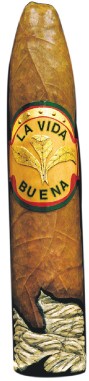
Ashes to ashes: When is a cigar not a cigar? When it’s an urn.

By Gretchen Giles

On a beautiful summer morning in western Sonoma County, Maureen Lomasney sits by a window, her hands clasping a warm mug of coffee, the sunlight falling upon her softly, a rustic bowl of pistachios placed artfully before her. “I am trying,” she says in measured tones, “to gently introduce the concept of dying.”

The sentence is so patently absurd that she breaks into peals of laughter.

Assuredly, death is no laughing matter. And just as assuredly, it comes to us all, hard to believe as that might be. But with the baby boom generation of some 76 million Americans aiming toward life’s final chapter, death may be changing.

And that’s whether the funeral industry likes it or not.

Lomasney, 57, is the proprietor of an unusual business, one often at loggerheads with the extremely powerful funeral lobby. Based in Graton, she is the founder and director of Funeria, an arts agency and exhibition organizing company that deals exclusively in funeral urns as fine art. Her brick-and-mortar outlet, Art Honors Life, is poised for its grand opening on Aug. 18, coincidentally the last day of the Cremation Association of North America’s (CANA) massive San Francisco conference. Exhibition space at the conference is sold-out, but unlike previous years, Lomasney won’t be there.

“My rose-colored glasses have come off,” she says. “This isn’t a priority for big corporations, and big corporations are who provide resources to funeral homes. Their interest is not in providing art for grieving families.”

A fine-arts photographer whose background is in marketing and ad agencies, Lomasney at first envisioned that inviting artists to create funerary items would appeal to funeral directors eager to introduce new products to their clients. She figured wrong. Because what she hadn’t figured into her equation is that, by and large, funeral directors don’t like cremation. It simply doesn’t cost enough. They even invented a word to make it sound bad.

“‘Cremains’ is a term that I never use,” she says. “It’s a term invented by the funeral industry to denigrate cremation because it’s cheaper. The industry doesn’t like the term ‘ashes,’ because they think it confuses people. Cremains is a contraction of ‘cremated remains’ that manages to suggest that they are less than full human remains.

“The industry,” she laughs shortly, “is very creepy.”

Embalming became popular during the Civil War and reached an apex of interest when President Lincoln’s body was witnessed by thousands of mourners. Slowly, the funeral industry grew, bolstered by chemical companies and even automobile manufacturers as increasing numbers of cabinetmakers switched their skills to casket-making, and the public became more enamored with the idea of a preserved, viewable corpse. Today, however, the CANA estimates that some 52 percent of Californians would prefer cremation, and so the pendulum slowly swings back.

Not surprisingly, artists are already there. When Lomasney put out a call for urns for her first exhibition, titled “Ashes to Art” and held at Ft. Mason in 2001, she remembers that many artists wrote to her in thanks. “They were already making [reliquaries], but didn’t have any acknowledgement for their work.” And next year, she will exhibit art by two artists whose work is a radical departure from the norm.

British product designer Nadine Jarvis, for example, recently won a substantial award from London’s Design Museum for her work with ashes. The remains of one ordinary person can result in 250 pencils exactly, which Jarvis packages with a specially constructed box that holds the shavings once the utensils are sharpened. More thoughtful are Jarvis’ bird feeders. In one, human remains are mixed with suet and wax and seed and other avian delicacies. The feeder is hung in the forest and nature takes over, the birds diminishing the feeder, slowly distributing the remains into the world.

In another, ashes are placed inside a delicate ceramic egg that is hung by a string designed to last only a few years. Secured to a tree limb, the string will one day break, the egg drop and the ashes scatter. Again, the modus focuses on the random inevitability of the distribution, a lovely mimic of the random inevitability of death.

American artist Patrick Marold is another working with larger conceptual issues. His proposal is an outdoor structure composed of boxes made from the silky strength of unfired clay. Ashes are placed inside one of the boxes, multiples of which are stacked upon each other to form a “corridor.” (He intends the empty boxes to suggest communal loss.) Notes or other small objects may be inserted into the clay boxes, which will over time relinquish themselves to the elements, the ashes mixing down with the mementos and the clay in a manner undetermined and chaotic and in perfect reflection of natural forces.

“I don’t know of any other artists who are creating such elegant solutions,” Lomasney says. “Nadine’s concepts integrate other forms of nature: wind, time, animals. She’s providing people with the access to create new rituals for themselves.”

And then there’s Darin Montgomery’s Urn-A-Matic, which will be a part of the Aug. 18 grand-opening show. It uses a vintage vacuum cleaner lined with slate-colored velvet to hold human ashes just above where the ordinary vacuum bag would go. A video screen can show home movies and, sardonically, a music loop continues repeatedly with the syrup of “Seasons of the Sun.”

“For Darin, it’s a philosophic stance. I wouldn’t say that it’s whimsical. It’s a wry approach to death and how we perceive the importance of ourselves and our ashes after we’re gone,” Lomasney explains, agreeing that there are few mothers who would like to be interred in a vacuum cleaner.

Some artists are working with biodegradable cardboard, the kind that many plants come home from the nursery in, ready to be planted directly into the ground. But the majority of the work Lomasney exhibits is ceramic. “Many people come in not knowing what they’re even walking in to,” she smiles. “After a while they realize, ‘Hey, all of these vessels have lids.'”

Made of clay and steel and glass, her urns are intended to be taken home and placed among the other beautiful objects one collects. They look to house jewelry or perfumes; some are so clever that it’s difficult to tell where they might come un-joined at all. Some honor pets, and so are sculptural depictions of a dog, say. Michael Creed’s La Vida Buena is a witty celebration of vice, a cedar and paper cigar that comes apart under its band.

An advocate of land trusts offering natural burials on their preserved land, Lomasney is as passionate about changing the state of today’s funeral lobby as she is about offering art as a last destination for the human body.

“Funeral homes are in the catbird seat and they recognize that,” she says passionately. “I know that it’s a business, but it’s also a mind shift that needs to happen. What should come about? What could make the end-of-life experience more nurturing for the masses? The industry is so entrenched that if there was a new model and more people who were in engaged in a more thoughtful and caring approach, we could see a radical shift.”

The much-lauded boomers, the generation that made adolescence important, young adulthood rampant and middle age young again, are going to redefine death, too. “We are all learning that we need to be advocates for our own healthcare,” she recounts. “We have seen our parents unquestioningly following doctors’ orders. That experience of being an advocate for our parents and our own healthcare will transfer to our death experiences.

“But we need to work on it. Now.”

Art Honors Life celebrates its grand opening with the “(Bee) Here Now” exhibit on Saturday, Aug. 18, from 6pm to 8pm. 2860 Bowen St., Graton. 707.829.1966.


View All


Museums and gallery notes.


Reviews of new book releases.


Reviews and previews of new plays, operas and symphony performances.


Reviews and previews of new dance performances and events.

Above and Beyond

0

August 8-14, 2007

Normally, I wouldn’t let a few downed trees get in the way of a good bushwhack. But as I surveyed the wall of redwood trunks lying across the creek that had been my pathway into the mountains, I had to consider the possibility that I had met my match. Each of these trees was at least 10 feet in diameter, and more than 250 feet long. Piled up like pick-up sticks hurled by a livid giant, the fallen trunks created a formidable barrier to further ascent.

My two companions and I sat down on mossy rocks to assess the situation. Going over the wall of wood was likely impossible without climbing gear, which is not allowed in the park. Going under might have worked, had we brought along snorkels and wetsuits. Going around would entail a battle with head-high nettles that ran up and down the 50 percent grade at creekside. From recent experience, we knew that the climb could take hours and several pints of our blood.

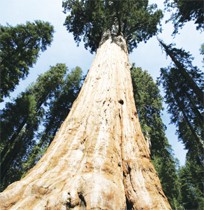
We had come to this remote basin in northern California’s Redwood National Park to hunt for the world’s tallest living tree, a coast redwood nearly 380 feet in height. Explorers had discovered it last summer, in a remnant stand of old growth in the southern section of the park. Growing quietly on a mountainside for centuries, the newly crowned giant is some 70 feet taller than the Statue of Liberty, or about as tall as a 40-story building. Its discoverers christened it Hyperion, after the Titan of Greek mythology who fathered the sun.

The news was followed, as these things must be nowadays, by a press release. E-mailed from the tourism people in Humboldt County, the message claimed that Hyperion “is too far from any trail to visit.” But, it consoled, “adventurers piqued by the discovery have plenty of other opportunities to explore old-growth redwood groves in Humboldt County, the tallest, largest and most pristine in the world.”

Having spent time in Humboldt, I knew the superlatives were well-deserved. But among my several inveterate weaknesses is an attraction to extremes. I’m a sucker for the biggest and tallest and fastest, the super-jumbo jets and Everests and top-fuel dragsters. I hit the reply button and typed a message to Richard Stenger, author of the press release. “Why couldn’t an ambitious hiker visit Hyperion?” I asked.

A few minutes later, Stenger was on the phone. “I gotta tell you,” he said, “this one is really off the beaten path. They say it’s on an incredibly steep slope with thick underbrush that you’d have to bushwhack through. If you knew where to go. But the park folks aren’t telling anyone where it is. Everyone who knows anything about this tree is sworn to secrecy.”

All of which sounded, to me, like a pretty good challenge. And so a few weeks later, I found myself driving up the Redwood Highway with photographer Mark Katzman and photo assistant Derek Southard. We overnighted in Eureka. There, in an Irish pub, Katzman revealed that he was less than confident about our mission. “So we’re just going to show up,” he asked, “with no credentials and no notice, and try to find this tree that no one wants us to find?”

That was essentially the plan–although I had put a call in to the parks’ interpretive specialist, Jim Wheeler. Chief ranger Pat Grediagin was supposedly the only Park Service employee who knew the exact location of Hyperion. The New Yorker magazine had quoted Grediagin as saying “there’s been a lot of talk about this discovery. I’m just worried that someone will get a wild idea to try to find this tree.”

That would be us.

But I reassured Wheeler, on a drizzly Thursday morning when we met him at park headquarters in the town of Orick, that ours was a responsible quest. If we managed to find the tree, we wouldn’t reveal its location, either in print or in conversation. But Wheeler, and the other rangers we would meet, didn’t seem overly concerned about our intentions.

“Mostly,” Wheeler shrugged, “nobody around here thinks you have any chance of finding it.”

According to the rangers and tree researchers, Hyperion’s location needed to remain secret for the tree’s own protection. In the past, vandals and over-adoring fans had injured other champion trees whose locations had been publicized. In the early 1960s, rangers signposted what was then believed to be the world’s tallest tree, making it the centerpiece of the park’s Tall Trees Grove. Ten years and thousands of visitors later, names had been carved in the trunk and the top of the tree had died–an outcome attributed, by at least one scientist, to soil compaction around the roots. Researchers found damage in the crown of another champion redwood, the Mendocino Tree, that suggested it had been clandestinely climbed. Even Luna, the redwood made famous by Julia Butterfly Hill, was deeply gouged by a chain saw a year after Hill had saved it from loggers.

But those trees are near roads and populated areas. Hyperion, by contrast, is far off-trail. Along the Redwood Highway, motorists will happily pay to drive through a tree, but only a small percentage will actually get out of the car and hike more than a few yards from a road, no matter what the attraction. I reiterated to Wheeler that Hyperion’s secret would remain safe with us, if we managed to find it.

“You won’t,” he said.

That night, the Lumberjack Tavern beckoned, its neon sign depicting an axe-carrying logger eyeing a pink martini glass. During boom times, locals apparently stood three and four deep at this bar just north of Orick. But on this night, maybe 15 patrons were inside, most drinking beer through thick beards. Bartender and owner Mark Rochester greeted us warmly. I asked him if he knew anything about Hyperion.

“That *#*&# tree!” he bellowed, setting down a pitcher of local microbrew in front of us. “Don’t get me started!” Rochester had recently purchased the tavern, and was changing its name to Hawg Wild to attract more bikers.

“The Park Service won’t tell us where it is. They’re sitting in their multimillion-dollar headquarters made of redwood that they can cut down and we can’t, and they don’t want us to know where the tree is, even though we supposedly own it. And you know what? When the liberals get in power, there’s going to be even more rules.”

Rochester popped a packaged chicken pie in the microwave, then came back over. “We had no decision in anything the Park Service has done,” he said. “They have systematically choked the life out of this town.”

As he grabbed a Budweiser for another patron, a woman waiting for her shot at the pool table came over to our end of the bar. “I got a different take on it,” she said. “I’m pro-park, and I love trees. But I work at the mill. Sometimes it feels like working in a graveyard. But it pays the rent. And, no, I don’t know where that tree is.”

Moments later, a woman in the corner of the room caught my eye. She came over and leaned close to my ear. “I work for the parks,” she whispered. “And I know too much to even talk to you.”

The next day, I sat down to breakfast with Katzman, Southard and Jerry Rohde, an educator and author who’s written several hiking guides to redwood country with his wife, Gisela. Thin, bearded and bright-eyed, Rohde had agreed to accompany us on our tree hunt, though he cheerfully warned us that the bushwhacking would be “brutal.”

We pushed aside coffee mugs and laid out Rohde’s collection of maps. Triangulating various rumors and hunches, we narrowed our focus down to a few sections of old growth that flanked a couple of small streams that empty into Redwood Creek.

We drove to a trailhead, then hiked down to Redwood Creek. The seasonal bridge had been removed for the winter, so we pulled off boots and gaiters to wade barefooted through the frigid water. On the other side, we put them back on again–only to soak them almost immediately as we headed up a feeder stream.

As we waded upstream, the trees on either side got larger, and the notch that the creek had cut into the mountain got deeper. After an hour of sloshing, Katzman spotted a small piece of orange loggers’ tape, attached to a bush. We scrambled up the steep bank and found that the tape marked the beginning of a short trail, still fairly fresh. It led through thick stands of rhododendron into a grove of redwoods.

We were surrounded by tremendously tall, thick-trunked redwoods–trees that you really have to see to believe. Though the bases were spread across the hillside, the crowns were intertwined in a nearly unbroken canopy, starting about 150 feet above our heads. From the ground it was impossible to tell if any one tree was taller than any other.

On one tree, Southard found a metal tag stamped with three digits. We had assumed that Hyperion would have a tag on it, to mark it as a research specimen. This trunk did seem fatter than the rest, but it was hard to tell whether it was taller. I had brought along a laser range-finder, which uses a laser beam to calculate the height of a target object. But without a clear shot at the top of the tree, the device was useless.

Rohde, who had heard there was a clear cut within a few hundred feet of Hyperion, headed up the slope to try to find a vantage point. He returned and confirmed that there was indeed a clear cut but that it offered no unobstructed sight line to the tree.

Could we have found Hyperion? It seemed too easy. Would the researchers have marked their path with something as obvious as loggers’ tape, visible from a creek–even a creek as little-traveled as the one we were on? Probably not, we concluded as we hiked back to the trailhead.

Santa Rosa amateur naturalist Chris Atkins first visited the redwoods in the 1980s. “I was in awe of their size, their beauty and their longevity,” Atkins says. He found himself drawn back to redwood country again and again. In time, Atkins teamed up with Michael Taylor, who shared his craving for fresh air and biological extremes. Eventually, Atkins and Taylor blew $3,000 apiece on high-end laser range-finders. (Atkins described our range-finder, which cost only $500, as “pretty much useless.”)

Prior to the advent of these devices, measuring a redwood could take all day–if you could even manage to get surveying gear into position. The range-finders allowed Atkins and Taylor to focus their energies instead on the logistics of getting deeper into the parks, to explore the patches of old growth hidden in remote basins.

In the late 1990s, the pair decided to search the entire range of the coast redwood, to document every living tree taller than 350 feet. When they began, only about 25 such trees were identified. As of early 2007, their database contained 136 individual redwood trees exceeding that height–most of which had been discovered by the men. In 2000, Atkins made it into the Guinness Book of Records when he found the 369-foot Stratosphere Giant in Humboldt Redwoods State Park.

“After the discovery,” Atkins says, “someone asked me if we might ever find a taller one. I said the odds were pretty low. We thought we had pretty well mopped it up.”

Redwood National Park has no car-camping sites, and backcountry camping is allowed only on gravel bars in Redwood Creek–not a good idea during rainy season. So we bedded down at the Palm Motel, a seen-better-days place that’s one of two lodging options in Orick. Owner Martha Peals, a Tennesseean whose card introduces her as “pie-maker, entertainer, bed tucker,” said she hadn’t had “too many up here looking for that tree, but I’ve had people from all over the world come here to see Bigfoot.”

Still, she offered to help. “I’ll tell the waitress in the morning,” Peals said. “Her husband works for the park. Her name is Betsy.” As we headed to our rooms, she called out, “Don’t you worry, I’ll find out where that tree is for ya.”

The next morning dawned sunny and calm. As I sat at the counter in the Palm Diner, Betsy came over with a coffeepot and met my hopeful eyes. “I wouldn’t have a clue,” she said. “And my husband doesn’t know, either. They won’t tell him where it is.”

I was halfway through my lumberjack omelet when Rohde called to say that his knee, which he had tweaked yesterday, couldn’t take another day of bushwhacking. He was staying home.

Indeed, our party had taken a few good hits. Katzman, recovering from rotator-cuff surgery, had jerked his shoulder while hoisting himself over a behemoth log. I had dislodged a waterlogged burl that was my foothold while climbing over a downed tree, and fallen through a brittle web of branches, bruising my hip. Only Southard was unscathed.

“I hope you boys find that tree,” Martha Peals sang out to us as we packed up the truck. “But it’d be even better if you ran into Bigfoot out there. Then you could bring me lots of customers and make me lots of money.”

We stopped by the park’s information center to grab a better map. Wheeler, who was raising the American flag, saw us and shouted out. “Did you find the tree?”

I told him about the tree with the metal tag. Wheeler just smiled and said that there are several trees tagged with numbers, identifying them as subjects of various studies by experts at Humboldt State University.

Before crossing Redwood Creek, we reviewed our clues and concluded that we had probably been up the correct drainage, but on the wrong side of the feeder stream. A green-shaded area on the map identified an extensive grove of old growth on the other side, a little farther upstream. But judging from the bunched-up contour lines, Hyperion’s potential location would be steeper. Much steeper.

The day before, Redwood Creek had been up to our ankles. Now, after a night of rain, it was knee-high. If we got more rain, we would need to hightail it back before the rising water cut off our retreat. As we plunged in, a salmon jumped next to Katzman. I followed him, scanning the mountainside above us. Somewhere up there, the world’s tallest living thing was quietly growing ever taller.

Sixty million years ago, redwood forests covered much of the Northern Hemisphere. But as a result of climate change, and then harvesting, the three species of redwood are now found in only three small areas. The giant sequoia, the world’s largest tree in terms of total volume, grows in 70 isolated groves in California. The dawn redwood, once thought to have been extinct for 20 million years, has been discovered in remote valleys in central China. The object of our quest, the coast redwood, is found along a 40-mile-wide, 470-mile-long strip in northern California and southern Oregon.

The coast redwood is no mere mortal tree, and I mean that in the most literal sense. Its scientific name, Sequoia sempervirens (“forever-living sequoia”), refers to its ability to regenerate. Under the right conditions, a single tree can live for 2,000 years or longer, protected by a foot-thick bark layer that is fire- and insect-resistant. Like other conifers, a redwood can regenerate from seeds. Should it topple, it can also regenerate from sprouts that shoot up from fallen trunks, thereby keeping its genetic line unbroken over millennia.

But the coast redwood has an Achilles’ heel: a shallow root system that grows only a few feet under the surface. The trees that blocked our ascent up the creek had most likely been on the losing end of an epic wrestling match with the wind. As a gust levered one tree’s roots free of the earth and sent it hurling toward the ground, the falling giant would have bumped into one or more of its neighbors, setting off a domino effect that would, within a few seconds, bring millions of pounds of wood down across the creek.

As Katzman, Southard and I sat on the mossy rocks, we could see small green shoots coming up at intervals along the trunk, making tentative forays into the misty air. We considered our options. The prospects of going over, under or around looked equally unpalatable. We decided to go through the middle.

Then we continued climbing up the stream until, at a bend, we began ascending the steep bank. We pushed through sword ferns seven feet high, getting soaked in the insanely humid environment. We struggled through fields of brambles, scrambled over the debris of more fallen trees, and found little solid ground to stand on.

I tried my luck at walking atop the inclined trunk of a downed redwood. It had looked like a viable route up the hill, but halfway along I was reduced to shimmying, riding the slippery tree like a horse. Eventually, the tree bucked me off and sent me sliding sideways down a carpet of moss and decaying slime. I fell through a mat of sticks and leaves and into a hidden void. After thudding to the ground, it occurred to me that if Hyperion really was anywhere nearby, it was in little danger of being overrun by bushwhacking throngs.

In the late 1970s, as the U.S. Congress debated expanding Redwood National Park, the pace of logging picked up dramatically. Pushing ever deeper into the area that would soon be off-limits, timber crews set up floodlights powered by mobile generators, allowing around-the-clock work. By the time President Carter signed the expansion legislation, about 80 percent of the soon-to-be-annexed land had been logged. On March 27, 1978, the chainsaws finally fell silent, less than 200 feet from Hyperion. The tallest known tree on earth had been two weeks, maybe less, from its demise.

It would take three decades for anyone to notice the tree. On Aug. 25, 2006, Atkins and Taylor were bushwhacking through a remote basin that neither had previously visited. They had recently found two huge trees–371.2-foot Icarus and record-breaking 375.3-foot Helios–in a nearby grove.

After many years of tree-hunting, Atkins and Taylor had developed a keen intuition. They knew with a glance which trees might be worth a two-hour bushwhack; they knew how to find the “sweet spots,” as Atkins describes them, from which a laser shot might be possible.

Taylor was walking about 100 feet ahead when Atkins noticed a redwood crown looming above its neighbors. Atkins recalls that he got his range-finder out of his backpack and shot at a point just below the top of the tree. He couldn’t see the base, but he estimated that the tree had to be at least 360 feet tall.

“Michael!” Atkins yelled. “Get over here! This tree’s incredibly tall.”While Atkins crossed the creek to bushwhack up the slope, Taylor went to the tree and began calculating the elevation of the base. Atkins eventually found a window through the foliage and lay down to get the laser as steady as possible. From that position, he shot the tree’s top. Then he began working his way back to Taylor, adding and subtracting the elevations of intermediate targets along the way. After all that, they would come up with a preliminary height–377.8 feet–that would make the tree the tallest living thing on earth.

Katzman, Southard and I spent an hour struggling through a maze of brambles and downed trees to reach our target grove. Then we labored farther to rise above the redwoods, hoping that the clear cut would provide a good vantage point. But it turns out that a 30-year-old clear-cut in a rainforest isn’t a smart place to go for visibility or mobility. Amid the dense saplings and underbrush, we quickly lost our bearings and momentum. We decided to head back down into the old growth.

Our own cheap range-finder was proving fickle, due partly to limitations of the technology, mostly to user inexperience. Trees that were obviously well over 250 feet were showing up as 82 feet. The GPS, too, was useless. Under the dense canopy, I could pick up only one satellite. I stowed the devices in my pack, where they would stay for the rest of the trip.

Among the first people Atkins and Taylor told of their discovery was their friend Stephen C. Sillett, a professor of botany at Humboldt State University. Sillett was the first scientist to climb into the redwood canopy, and he is considered by many to be the world’s foremost authority on the redwood forest.

When Taylor told Sillett that he and Atkins had found a tree that they estimated to be higher than 378 feet, Sillett was floored. Having been out in the forest many times with Atkins and Taylor, the botanist had total confidence in their measurements. But, Sillett says, “nobody expected a tree that tall to be growing that far up the mountainside, in conditions that were less than optimal.” It was, Sillett said, “the most significant discovery in tree height in 75 years.”

The only absolutely accurate method of measuring a tree’s height is to climb into its crown and drop a tape measure from the top. Sillett delayed his ascent for two weeks, until the end of the nesting season of the marbled murrelet, an endangered seabird that inhabits the area. Then he assembled a team to climb Hyperion and verify its status as the world’s tallest tree.

With Atkins, Taylor and Sillett’s wife, Marie Antoine, beside him, Sillett tied fishing line to an arrow. Using a crossbow, he shot the arrow over a branch in the lower crown of the tree. Then he tied a nylon cord to one end of the fishing line and, pulling on the other end, hoisted the cord over the branch. Finally, he attached a climbing rope to the cord and pulled the rope over the branch. After tying off one end to a nearby tree, Sillett attached mechanical ascenders to the hanging end of the rope, and began to pull himself up toward the first branch.

“The lowest branch in a big redwood,” Sillett says, “is higher than the tallest branch of almost any other tree in any other forest on earth. And once you get up there, you realize you’ve got almost another 200 feet to reach the top.”

The crown of such a giant is a gnarled mass of limbs, with bridges of living and dead wood running horizontally from branch to branch, forming a natural structure of struts and girders. Upon reaching the first branch, Sillett set up an elaborate rig of ropes and carabineers, which he used to pull himself up from limb to limb, into the heart of the crown. There, Sillett found blackened chambers in the trunk, hollowed out by an ancient, high-reaching forest fire.

“It’s another world, almost another planet up there,” Sillett told me. “There’s a lot of biological diversity that’s unexpected. On limbs and in crotches, you get these huge accumulations of rich, wet soil, hundreds of feet off the ground. We found salamanders, earthworms, aquatic crustaceans, huge huckleberry bushes, even other trees growing on soil mats. It’s literally a hanging rainforest garden.”

Before Taylor and Atkins began finding exceptionally tall specimens high on mountainsides, Sillett and most other experts believed that the tallest redwoods would grow only in alluvial flats, the silty flood plains near creeks.

“There were taller trees up higher all along, of course,” Atkins says. “But the ones in the low, flat areas were what people happened to see, because getting onto the remote mountainsides was so challenging.”

The fact that Hyperion is located in such an unlikely place suggests to researchers that its height is not such an anomaly. Of particular interest to Sillett is the question of the physiological limits of a tree’s height. In other words, how high can a redwood grow?

Trees suck water upward through microscopic pipes called xylem. As water molecules evaporate from the pores of leaves at the top of the tree, other molecules are pulled up from the roots to replace them, in a journey that takes a few weeks from root to treetop. Redwoods, more than any other tree, can move water to great heights, against tremendous forces of gravity and frictional resistance. But at a certain height, the tension of the water column begins to overstress the tree.

Sillett’s team has used centrifuges to artificially create tension in xylem, and has demonstrated that the limit to a redwood’s height is about 410 feet in southern Humboldt County. In the wetter, cooler northern part of the county, where Redwood National Park is located, Sillett’s preliminary research indicates that the limit may be considerably higher.

“What we’ve discovered about the redwoods’ physiology indicates that they can grow a lot higher than the ones we’ve found,” says Sillett. “Which brings up a sobering thought. Now that 96 percent of the old-growth redwood landscape is lost, we understand that, even in our lifetimes, we almost certainly had trees over 400 feet. And we cut them down.”

According to Sillett’s measurements, Hyperion’s height is 379.1 feet. Chris Atkins believes that the chance of finding an even taller tree is less than 1 percent. “There are so few places we haven’t been through,” he told me. “Then again, there are a couple of basins we haven’t seen yet, and there are rumors of tall trees up there. We’re hoping to get in there in the next few months.”

We were talking over the phone, a couple of weeks after my trip to Humboldt County. Toward the end of a long conversation, Atkins asked me where we had hiked. I named the creek basin we had explored on our last day.

“Wow,” he said. “You managed to find your way into one of the most spectacular groves on earth.” He asked a few more questions, regarding how far up the creek we went, which side we climbed, how high we went. After I described the location, Atkins was silent for what seemed like a long time.

“You were in the right place,” he said finally. “You probably walked right past it.”

I shivered when I heard that. Later, as I looked at some of Katzman’s pictures, I recalled that final day when, pausing to rest on a bed of pine needles, I was overcome by a feeling of insignificance that grew until it became strangely ecstatic.

For all I know, I was sitting in Hyperion’s shadow. But at that moment, the pursuit of a single tree–even the tallest one on earth–seemed inconsequential. The real object of my quest was all around me, a mass of immortal columns strong and generous enough to support the sky.

I’d come here looking for a tree, and discovered a forest.


Growing Diversity

0

August 8-14, 2007

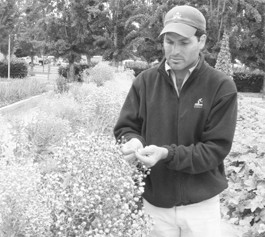
Ranging from two to four feet high, the ragged plants offer up thousands of tiny, off-white puffs of rapidly fading blossoms. They look more like weeds than like the average person’s concept of lettuce–but that’s what they are, a mixture of different varieties of lettuce plants. They’ve been deliberately allowed to go to seed, which next year will be used to grow a salad mix for Julia’s Kitchen, the acclaimed restaurant at COPIA, Napa’s food and wine center.

From a small mound of dirt, corn stalks soar skyward. A flowering bean vine with bright red-orange blossoms winds its way upward around the stalks. The wide green leaves of a squash plant hug the ground. The corn serves as a trellis for the bean vine, letting it flourish. The bean plant adds nitrogen to the soil, giving added nutrients to the corn. And the squash is a living mulch, protecting the roots of all three from the moisture-robbing sun. This is a traditional and popular Native American gardening technique called the Three Sisters, and it’s one of the many living displays in COPIA’s Edible Garden, says head gardener Geoff Palla. The neat square illustrating the Three Sisters growing pattern contains several mounds, each one planted with different varieties of corn, beans and squash.

“If you have just one variety and it fails, then all your food has failed,” Palla explains. “Whereas if you planted five different varieties and two fail and three make it, you still have food. Every variety has its little nuances of what it can resist as far as disease and what kind of weather and soils it can withstand. Diversity is really much stronger in the end.”

In the pursuit of diversity, COPIA not only gathers its own seeds, it buys from a range of suppliers, such as Seeds of Change, Native Seed Search and conventional seed catalogues. It is also a member of the Seed Savers Exchange, a national network of gardeners who swap seeds with each other at a minimal cost.

“This is a large group of people who are really preserving diversity. Actively preserving it,” Palla enthuses. “Growing the seed, saving it, telling everyone else they have it and sharing it.”

These scraggly-looking plants are an integral part of COPIA’s multipronged approach to gardening. Its 3.5-acre Edible Garden is informative and educational, illustrating both long-term traditions and new trends. The site is also productive, supplying 60 percent to 70 percent of the fruits and vegetables used in COPIA’s kitchens. And the Edible Garden is focused on stewardship–drawing seeds and plants from a variety of sources, saving a diverse range of seeds and nurturing not just the plants but soil health as well.

It’s an overall view rather than the neatly organized but fundamentally limited corporate approach to gardening, and COPIA is one of the many sites nationwide where nature’s untidy diversity is being nurtured rather than discouraged.

All this will be celebrated Aug. 11-12 at COPIA’s fourth annual Edible Gardens Festival. The event is appropriately diverse, featuring cooking demonstrations, food, wine, live music, art, kids’ craft activities, presentations by gardening experts and, of course, the chance to relax, enjoy and learn in COPIA’s Edible Garden. The seedy lettuce plants are just a part of the whole.

“A neat and tidy garden may look good, but it isn’t what nature intended and you will have a hard time keeping it up,” explains Marc Cool, seed director for Seeds of Change, one of the sponsors of this weekend’s festival. Growing more than 1,000 varieties of plants and selling over 600 different organically-grown seeds, the New Mexico-based Seeds of Change is aimed at preserving biodiversity and promoting sustainable, organic agriculture. Cool will be at COPIA this weekend, talking about biodiversity in the garden. Just as people benefit from and adapt to diverse experiences in life, so too do plants.

“The interrelationships between all the different plants are really interesting to me,” Cool explains. “It’s a lot like people living together. Plants do interact and they adapt genetically to those interactions.”

Diversity, Cool asserts, is what nature intended. “A vegetable will grow better if there’s a certain flower nearby, because it attracts pollinators. Mixing up different species is important.”

“You shouldn’t be afraid to let your garden teach you what it does best,” Cool adds. “When you have a garden and things grow, what does best is what works there.”

In a back corner of the garden, some tomato plants are struggling. They’re struggling on purpose, because Palla and the other four members of the garden staff aren’t giving them much water. “We’re stressing the heck out of them, giving them very little water, and what we’re getting is a much smaller yield, much smaller fruit but the flavor is so intensified,” he explains.

These particular tomato plants are the popular Early Girl variety, which is grown commercially in California’s Central Valley. A lot more fruit is produced by the well-irrigated plants in these commercial fields, but it’s nowhere near as flavorful as what’s being grown on those dry-farmed at COPIA.

The average home gardener doesn’t necessarily need a high yield, so it could be worthwhile to set aside one tomato plant, carefully underwater it and see what happens. Or let the lettuce or some other crop go to seed, and use those same seeds next year.

“I like to let things take their whole life cycle all the way to seed and then back down,” Palla says. “Then what you get is a lot of volunteer stuff, and you can literally manage patches of things. It’s a great concept for home gardeners.”

This might not create a picture-perfect garden, but it will make it a healthy one.

“A lot of things that we think look neat and tidy and perfect–well, the plant doesn’t know anything about what we think is neat and tidy and perfect, nor does it benefit from a lot of that stuff.”

One of the things Palla enjoys about gardening is that there is no one golden rule that all must follow. “Everyone comes up with their own little nuance or truth that they think works for them, and it does for them. That’s what I love about it.”

“It’s kind of like baking,” he adds enthusiastically. “Everyone does it a little bit differently, and yet it still comes out great.”

Edible Garden Festival runs Saturday-Sunday, Aug. 11-12, at COPIA. 500 First St., Napa. 11am to 6pm. $10-$15 (children free); wine tasting $10. 1.888.512.6742.

Quick dining snapshots by Bohemian staffers.

Winery news and reviews.

Food-related comings and goings, openings and closings, and other essays for those who love the kitchen and what it produces.

Recipes for food that you can actually make.

Teen Angel

music & nightlife | It's a kick: Vince Lau...

Hot Biscuits

music & nightlife | By Gabe Meline ...

Not a Prayer

August 8-14, 2007You'd think that somebody would have thought of this before. But no one from SNL has ever done it, and neither has anyone from MADtv, SCTV or The Kids in the Hall (although their 1996 feature Brain Candy came the closest). Finally, David Wain and Ken Marino--two of the main minds behind the early '90s MTV sketch...

Fast Times

music & nightlife | Photograph...

Age Rage

August 8-14, 2007They are young, they are angry, they speak in iambic pentameter and they have just begun a revolution. Wielding metal pipes, baseball bats and knives, they hack and smack one another with the kind of intensity and enthusiasm that older people assume young folks only have for text-messaging. And they do it to really great music.They are...

First Bite

Wine Tasting

Ashes to Art

the arts | visual arts | Ashes to ashes:...

Above and Beyond

August 8-14, 2007Normally, I wouldn't let a few downed trees get in the way of a good bushwhack. But as I surveyed the wall of redwood trunks lying across the creek that had been my pathway into the mountains, I had to consider the possibility that I had met my match. Each of these trees was at least 10...

Growing Diversity

August 8-14, 2007Ranging from two to four feet high, the ragged plants offer up thousands of tiny, off-white puffs of rapidly fading blossoms. They look more like weeds than like the average person's concept of lettuce--but that's what they are, a mixture of different varieties of lettuce plants. They've been deliberately allowed to go to seed, which next year...
11,084FansLike
4,606FollowersFollow
6,928FollowersFollow