
Highlighting the plight of our ocean’s resources in the most delicious way, the Slow Food Russian River chapter holds its second annual Sustainable Seafood Salon and Feast on Sunday, July 29, in Bodega Bay. Mixing education with pleasure, the day includes an afternoon panel on the state of sustainable fisheries from the perspectives of an ecologist, chef, biologist, Native American tradition, business and even the kitchen. Speakers include Davis prof Susan L. Williams, Monterey Bay Aquarium’s Sheila Bowman, Native American author Jacquelyn Ross, oyster farmer Kevin Lunny, Bon Appetit chef Joe McGarry, Barndiva owner Jil Hales and Brock Dolman of the OAEC. Far be it for the stomach to go untended: panel attendees will enjoy sustainable seafood and wine pairings. The panel is followed at 6pm by a special feast at the nearby locavore kingdom of the Seaweed Cafe.
Panel, at the UC Davis Bodega Marine Lab, 2099 Westside Road, Bodega Bay, from 1pm to 4:30pm; $10. Feast, at the Seaweed Cafe, 1580 East Shore Drive, Bodega Bay, at 6pm; $125 ($50 is tax deductible). For details and tickets, go to www.slowfoodrr.org or call 707.824.8448.
Quick dining snapshots by Bohemian staffers.
Winery news and reviews.
Food-related comings and goings, openings and closings, and other essays for those who love the kitchen and what it produces.
Recipes for food that you can actually make.
News Briefs
Making news
Covering a Napa County brush fire on Wednesday, July 11, turned out to be anything but routine for ABC 7 news reporter Wayne Freedman and photographer Craig Southern. Their television station has filed an official citizen’s complaint against two Napa County Sheriff’s deputies who confiscated Southern’s TV camera, broke Freedman’s cell phone when he tried to use it to videotape their actions, and handcuffed both men and detained them in the back of a squad car for 15 minutes. No charges were filed, and Freedman and Southern were released after Napa County Sheriff’s Capt. Gene Lyerla arrived on the scene.
Southern began filming as soon as they arrived at the fire, meaning that the station has a recording of the initial encounter, says ABC 7 news director Kevin Keeshan. “It was 43 seconds from the time our reporter and photographer got out of their vehicle to the time one of the deputies starts trying to wrestle Craig’s camera away from him.”
With a few exceptions, state law allows the media access to disaster scenes. Keeshan says that when emergency personnel think a news crew shouldn’t be in a certain area, usually there’s a discussion about what is or isn’t allowed. In this case, Keeshan says, that never happened. In less than 60 seconds the deputies went from “code green to code red,” he asserts. “While there may be disagreements about where we should and should not go, never have our employees been handcuffed and put in the back of squad car.” He adds emphatically, “We had a legal right to be where we were.”
In his blog, Freedman acknowledges that after the deputy slapped the cell phone out of his hand, surprise prompted Freedman to call the deputy by “an unflattering description” and later he added “a few more choice words.”
Napa County sheriff Doug Koford and Napa County risk manager Kerry Whitney met with Keeshan and the station’s manager on Friday, July 13. Also present was Napa County Sheriff’s Department captain John Robertson, who says that after the July 11 incident, county personal were sent a memo outlining the specific state law governing media access and asking employees to report any unprofessional behavior by media representatives. An internal investigation of the incident is underway and should be completed within 21 days, Robertson says. He adds that the Napa County Sheriff’s Department has always had extremely good relationships with all media sources–local, Bay Area and nationwide. “We depend on the media to assist us in all kinds of public safety matters.”
The Write Stuff

Just call him ‘Mac’:Hiatt credits the computer with changing his songwriting craft.
By Bruce Robinson
Who says an aging dog can’t learn new tricks? After writing hundreds of songs, crafting 17 albums, enduring decades of touring and hearing countless covers of his compositions (including two separate tribute anthologies), John Hiatt, at 55, has embraced a new process for his songwriting.
“About four months ago, I stopped writing by hand on yellow legal pads,” he explains by phone from his new home studio at a ranch outside Nashville. “I got glasses and I started writing on a word processor. It’s amazing.
“I resisted the change for so damn long,” he mutters, half to himself. “I had cheap reading glasses, but I was always losing ’em, so half the time I couldn’t see. And when I was writing on the legal pads, I couldn’t read my own damn handwriting. It was so bad. And then I would make changes, scribble and cross shit out, and by the end of the process, I couldn’t even read what I’d written half the damn time. So, I got a little 12-inch Mac and I just started writing on the word program in the Mac, and the songs started coming.
“It’s revolutionized my songwriting.”
That’s a remarkable statement coming from a man whose first commercially successful song, “Sure As I’m Sittin’ Here,” was carried into the Top 20 by Three Dog Night back in 1974. Over the intervening years, his songs have been recorded by, among others, a host of such notable songwriters as Willie Nelson, Rodney Crowell, Nick Lowe, Roseanne Cash and the artist formerly known as Bobby Zimmerman.
“There’s been a lot of nice versions of my tunes, and I’m always flattered,” Hiatt says. “Some stand out. I was certainly honored to have Willie Nelson cut a song. Emmylou Harris did a real nice version of ‘Icy Blue Heart.’ Bonnie Raitt, of course. Buddy Guy did ‘Feels Like Rain.’ I was real flattered by that. B. B. King and Eric Clapton doing ‘Riding with the King’ was quite a thrill. There’s been a bunch that really tickled me.”
But asked if he has his own favorites from the extensive Hiatt catalogue, he immediately replies, “Oh, no. I like ’em all for one level or another.”
Hiatt began writing at the ripe old age of 11, shortly after getting his first guitar, and never stopped. Even so, he finds his own creative process somewhat mysterious. “I get surprised a lot by what gets written, because I hardly ever know what the hell is going on in the process,” he chuckles. “It’s strange how it works. I get surprised and delighted, and that’s what keeps me coming back.”
Now, with a new batch of material emerging, “I’m gonna be starting a record in a couple of weeks–or whatever they call ’em these days,” he says. “Gonna do some recording, let’s put it that way.”
That process, too, will be different this time. “I’ve been collecting gear for years and I finally set it up in what used to be my office/race car shop, so I’m going to be recording out at the farm here,” he says. “There’s not going to be any producers involved, or even any engineers. We’re just kinda winging it.”
But first there’s a series of summer concerts to perform, a modest solo acoustic tour co-billed with singer-songwriter Shawn Colvin that stops off at Santa Rosa’s Wells Fargo Center on July 27. “We just did some shows last year and had a great time, so we’re gonna do it again,” Hiatt explains. He waits a beat. “We’re single-handedly bringing back folk music.”
But Hiatt knows the itch to rock out will return, too, and he’s been playing his songs both ways since his teens. “I’ve been doing it back and forth, between solo and the band, for so long I really don’t make the distinction between the two,” he reflects. “The difference, I guess, is that playing solo, my repertoire expands. When you have a band out, you pretty much can only play what they know. The nice thing about coming out solo is that I can play a lot more stuff, different stuff every night, and I know all my songs. At least if I brush up on them, I do.
“The trade off is, you don’t have the interplay with the other musicians. But then, I get all the spotlight, so it’s not so bad.”
John Hiatt joins Shawn Colvin on Friday, July 27, at the Wells Fargo Center. 50 Mark West Springs Road, Santa Rosa. $35–$60. 8pm. 707.546.3600.
What Women Want
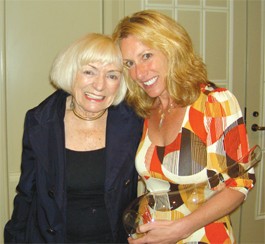
Since the 1980s, the wine industry has become an increasingly bright and hospitable place for a woman to make a living, and on June 23 in downtown San Francisco, hundreds of women and even several men gathered at the Four Seasons Hotel to celebrate the promising future of women and wine.
Hosted by Women for WineSense, a national 12-chapter organization founded in 1990, the event took the name of “Wines Women Want,” and for a man, it was a good place to spend the day. Women swarmed. They tasted wine, congratulated one another on various achievements, gossiped and exchanged rumors like there wasn’t a fellow in the house.
In fact, I feel it’s my duty to warn the captains of the industry that these women are plotting big things for the future. Among several morning seminars was a panel discussion in which five women moguls in various fields told personal success stories and advised the mostly female audience on political ploys and tactics for power-grabbing. Jacki Covello, a young face of success who in 10 years ascended from sweet young naiveté to a tier of power as a high-ranking New York City wine sales professional, bravely flaunted her philosophy of kissing ass when mingling with crowds of wine biz leaders.
“It’s all about networking,” she said. “Say hi to everyone you can, get their cards, send thank you notes–and make sure they know who you are.”
Out in the lobby, I warily traded business cards with a handful of the women. Oh sure, they smiled and firmly shook my hand, and several audaciously stated that it was “nice” to meet me–the words of cunning politicians if I ever heard them.
Dr. Ann Noble, a sensory scientist and flavor chemist at UC Davis, hosted another morning seminar. For an hour she tutored us in the art of mentally connecting wine aromas and flavors to our vocabulary. In the course of the session, I was nearly devastated to learn that the illustrious wine aroma wheel was not invented by a man, but by Noble herself, who engineered this handy circle of descriptors in 1990.
An awards ceremony followed, at which four women received distinction as rising stars in the wine industry. Petaluma author, journalist and television host Leslie Sbrocco took the Northern California honor. Author of Wine for Women, Sbrocco joked that she had tentative plans for a new book. “I’d like to write one called Men Who Whine, but I don’t have time to write a book that large.”
Carol Meredith, a retired professor of viticulture and enology at UC Davis, won the Lifetime Achievement Award. Among other things, Meredith has helped to discover the origins of Zinfandel and other grape varietals. And then there was Margrit Mondavi, that truly charming and vivacious bundle of energy. She was inducted into the Women for WineSense Hall of Fame, and allies of the Mondavi family took to the podium and spoke gracious words while Mondavi received it all with smiles, jokes and theatrical body postures before the kind compliments at last reduced the matriarch to tears.
Lunchtime arrived, and we made for the grand ballroom and found four food stations and scores of winetasting tables. The featured wineries had all received medals at the first ever National Women’s Wine Competition in March. I focused on a series of sweet fruit wines from Adams Point Winery in Berkeley. These were women’s wines–or so you’d think–but as I daintily sipped my mango dessert wine, women to the left, right and center filled up on big Zins and Cabs, and piled their plates high with intimidating portions of beef. They bantered conspiratorially, exchanged cards and discussed market trends. They ate more meat and poured still more wine and went out to the balcony to gnaw on cigars. I trembled. I’ve never seen so many women, all of them smiling so easily as they plotted their routes of attack into the 21st century and deeper into the world of wine and men.
Quick dining snapshots by Bohemian staffers.
Winery news and reviews.
Food-related comings and goings, openings and closings, and other essays for those who love the kitchen and what it produces.
Recipes for food that you can actually make.
Such Problems
By Gabe Meline
Cavorting among the perfectly coiffed and expensively dressed elite in the Napa Valley is not something I generally make a habit of, though with another year of attracting world-class talent to its credit, the Festival Del Sole may make a pearl-twirling debutante of me yet. Last year, it was lyric soprano Renee Fleming who inspired the winding, precipitous Trinity Road drive into Yountville, and though she called in sick at the last minute, Fleming’s fill-in, Christine Brewer, appeared ably up for the task. Strauss’ Don Juan was an extra bonus, but the real treat of the evening was cellist (and Festival Del Sole artistic director) Nina Kotova, undertaking Dvorák’s Cello Concerto with all the fire and determination of a daredevil matador–in a stunning red dress, I should add. (When you go to gala affairs, you take note of things like stunning red dresses.)
It’s Festival Del Sole time again, and red dresses both stunning and otherwise will flock to the breathtaking Lincoln Theater for the likes of flutist extraordinaire James Galway; conductor (and son of Sophia Loren) Carlo Ponti Jr.; and PBS staple Joshua Bell. (In an endearing experiment, Bell played on the streets of Washington, D.C., earlier this year. A 45-minute performance at a subway station yielded $32.17 in change, dumped into the violin case of his $4 million Stradivarius.) But as for me, I’ve got my Napa Valley chips on Jean-Yves Thibaudet.
An openly gay French pianist who commissions his concert attire from post-punk designer Vivienne Westwood, Thibaudet is noted mostly for his recordings of impressionist composers such as Debussy and Ravel; it’s no surprise, then, that he has also dabbled in the work of jazz pianist Bill Evans and completed an exhaustive five-CD set of underperformed Erik Satie compositions. His latest recording, Aria–Opera Without Words, transcribes some of his personal favorite arias and overtures for the piano. “I don’t have a voice, and I will never sing, because I am not a singer,” Thibaudet has remarked, “but it was really the love of the human voice and the opera repertoire that made me do the project.”
Opera has been transformed into a variety of muted (and mutated) forms, and robbing it of its libretto is risky business. Luckily for us, Thibaudet’s love of the human voice translates not only into a fine recording, but also into what will surely be a lovely night out for Napa’s finest with the Versace gown, the Vuitton heels and the lingering hint of caviar on the breath.
Jean-Yves Thibaudet performs on Friday, July 20, at the Lincoln Theater, 100 California Drive, Yountville. Tickets $45-$125. For more info and full schedule, visit www.festivaldelsole.com.
Letters to the Editor
Disaster district
(“Hitting the Funding Vein,” July 11) quite rightly notes that syringe-exchange programs (SEPs) are gaining wider support in the fight against HIV/AIDS.
But Hahn’s characterization of SEP spending in the District of Columbia missed an essential point. Hahn wrote that “Washington, D.C., may relax its longtime ban on public money for exchange programs.” In fact, the ban on spending locally raised tax dollars on SEPs in the District was imposed by Congress in 1998 over the continuing objections of the city’s elected leaders.
Certain members in the House of Representatives attached the spending ban to a D.C. appropriations bill, guaranteeing that the city with the highest HIV/AIDS rates in the country couldn’t use its own local funds on one proven strategy for fighting the spread of the disease.
This tragic result occurred because D.C.’s nearly 600,000 residents have no vote in the House or the Senate. Instead, representatives elected by people who have never set foot in the nation’s capital have oversight of the city’s budget. Congress can even veto any legislation passed by the D.C. Council addressing purely local D.C. matters.
Fortunately, the tide is turning in the district, both in the battle against HIV/AIDS and on democracy in general. House legislation that would repeal the congressionally imposed SEP spending ban passed June 28. A bill to give District residents one vote in the House of Representatives also cleared the House this summer and is now being considered by the Senate.
Walter Smith, executive director, DC Appleseed Center, Washington, D.C.
Do they sell their sausages?
Avid reader here. I don’t know the name of the author of (“Music, Mayhem and Meat” by Amanda Yskamp, June 6), but I felt it was outstanding and worth some feedback.
Man! If every article were as articulate, interesting and entertaining as that Cat article, I’d read more articles and not remain a book addict. Seriously, I’m not related to the author, I’m just a simple and thoroughly impressed subscriber wondering why she isn’t writing for Rolling Stone?
Also, would love to read more about that band Stiff Dead Cat, because those are the people-oriented articles that bohemians love to read about. And what interesting fellas! (By the way–I’m not related to any of them, either.)
Do they sell their sausages?
Wendi Tibbets, San Jose
Latest model in bamboozle
The article by Stett Holbrook (July 11) has overextended its stay. The belief in Bigfoot has the same credibility as the existence of “compassionate conservatism.” Both are totally unreal and, as your article explained about Bigfoot, very lucrative–the latest model in bamboozle. So why is the Bigfoot phenomenon greeted within the realm of plausibility? The answer is the mainstream media. The article’s title itself is self-explanatory. There’s money to be made in publishing and in films. The very idea of Tom Biscardi’s organization pursuing Bigfoot is self-explanatory; it’s his nationwide cottage industry.
But regardless of the players in the game and the layers of deception, one demand has not been made, a demand that true Americans make when confronting dilemmas and mysteries: “I’m from Missouri. Show me!” After thousands of years of Bigfoot sightings, not one of its toes has been found, let alone a live one captured and exhibited in public. It took six years for Americans to get over with compassionate conservatism; it’s time for the rest of us to get over with Bigfoot.
Armando Gomez, Santa Rosa
Some Coffee Pots Were Dropped
Nothing new about Bigfoot. Not a new species, either. Nor are they animals like Biscardi claims. Nor are there only 3,500. They are highly intelligent, interdimensional people that number in the millions in the U.S. alone. Benevolent, cautious, curious, polite, easily frightened spirit people who are eager to make new friends. They were studied at UC Berkeley by Stephen Hawking and others during his sabbatical there in ’74-’75. Two were held in captivity at Lawrence Livermore National Lab in the ’60s. Both escaped by outwitting their captors, by changing dimensions in their holding cell, thus leaving them to believe that they had escaped. When the janitor came into clean up, the creatures glided right by him in another dimension and were then loose in the facility for several weeks. Nobody was hurt. Some coffee pots were dropped. Both eventually left the building.
George Plaut, San Jose
Euro Vision
Toward the end, after he’d become a national joke, Errol Flynn commented that he’d wanted people to take him seriously, even if he’d never given them a reason to do so. Sienna Miller’s Katya in the new film Interview has the same problem. As star of Killer Body IV and TV’s City Girls, Katya doesn’t need a last name and is better known for her liaisons and her boob-reduction surgery than for her acting.
The Interview of this indie-film’s title is Katya’s long, up-close and personal session with dour and hard-drinking Newsworld magazine journalist Pierre Peders (a dick by any other name–and twice in this case). The film’s director, Steve Buscemi, plays him, with glasses on and with a gruff, cut-the-crap-sister take on his evening with the famous lady.
The interview begins in a restaurant but soon moves to Katya’s apartment after the starlet accidentally injures the journalist. Internal and external scarring, and a taste for too much bourbon, complicates the game between hunter and quarry inside Katya’s vast loft. Meanwhile, her cell phone keeps whimpering all night long–literally, since she put a whining puppy’s voice on her ring tone.
There’s something interesting going on here, and it’s the bigger background, not what they’re discussing. Pierre is a bitter ex-foreign correspondent busted down to the celebrity beat; from one angle, he’s a casualty of the trend away from hard news and toward fluff. But the specifics of this particular dance don’t have much believability to them; the unscrupulousness is too thick even for celebrity journalism. (They have lawyers and they have handlers, so where’s the photographer?)
We’re supposed to accept his lack of professionalism and his refusal to have tried to find out a little something about her before the interview begins. But one’s sympathy goes to Katya and stays there: she’s an imposed-upon hostess. Once you’re in your own home, being bothered by a guest, can’t you tell any lie about yourself that you please?
In a really equilateral movie, the balance between these two–the glamorous non-actress and the bruised, angry hack–would seem just about even. It tries to stay even with a matched set of lines: “I don’t fuck celebrities.” “I don’t fuck nobodies.” Interview insists that in every relationship–even in every interview–there’s a winner and a loser. I won’t argue the point, even though the journalists I care about work very hard to be symbiotes instead of parasites.
Maybe I’m focusing too hard on the specifics of this battle of wills, and that it’s supposed to be about all men and all women. Even so, this contest is too one-sided for continued interest. It’s clear where the chips will fall. And Interview also makes clear the division between a movie and what is essentially a filmed play. Compared to the limitless scope of a film, we know the action in Interview can’t leave, that the two characters have to stay until they kill each other, fall sobbing into each other’s arms or get naked. And wouldn’t you know it, Buscemi is the one who ends up baring his chest.
Buscemi shows his class as actor, his “funny-looking” man’s dignity, his comedy within drama. He is among the best we have, and it’s his presence that redeems this remake of a film by the martyred Dutch director Theo van Gogh. Known as the “Triple Theo,” a triptych of American remakes of van Gogh’s films is underway, Interview being the first, a project the director planned to undertake before his assassination in 2004.
Miller, whose fault Factory Girl wasn’t, is rising fast; she’s easy on the eyes with her tattooed shoulders and a surfer-girl, grown-out-blonde dye job. She has too much firepower for the role of Katya. No one would ever confuse an actor of Miller’s quality with a slasher-movie flooze.
‘Interview’ opens on Friday, July 20, at the Century CineArts at Sequoia, 24 Throckmorton Ave., Mill Valley. 415.388.4862.
New and upcoming film releases.
Browse all movie reviews.
Letters to the Editor
Settin’ the stage
Regarding (June 6): It’s Sonoma County, the 1960s and a local Santa Rosa band, the Rob Roys, press a couple hundred 7-inch vinyl records. I have one. The Bronze Hog own it. They set the standard for professionalism and accomplishment. They used to do a song called “Time Runs Backwards,” and as a teen, I danced to it many times. I was on a dance committee for the Analy High School class of ’69, and somehow convinced my fellow students to spend almost our entire class budget to hire the Hog for a class dance.
I have eight to 10 mint-condition copies of the singles referred to in Gabe Meline’s article and its discussion of Freestone and the Fans. Both of those bands were solidified by the drumming of Ed Bale, who also drummed for the Cunning Stunts and the Ego Slaves, drummed on the Sonoma Soundtrack album and pushed his ’70s band, Starfire Express.
Joseph Brinkman recorded an album with a hippie band that played in Camp Meeker from time to time called Feather. Years later, he presented the Defectors. I have all his work on vinyl.
Less than a year ago, I finally had a chance to meet Johnny Campbell, drummer for the always-working band the Pulsators. I was in awe as he autographed a 45 from an earlier band of his: the Imposters. That three-piece unit is one of the best ever.
Kate Wolf’s albums will echo through the hills forever.
Eighties new wave bands? Bring it on with the Citizens, Cohesion, Bliss Blast, the Wild Brides and Sheik Vasolino & the Zealots.
Country-music lovers could always play the records of Bush Hog or Osage. Osage even had a TV record offer that I bought over the phone.
Oddest local disc? Someone pressed a 45 of the sound of frogs croaking by a pond. The artist and song title was “The Oak Creek Frog Serenade.”
The oldest Sonoma County disc? Maybe it’s my copy of a radio ad for Stanroy Music Center. When did radio stations put their advertiser’s ads on vinyl instead of 8-track or CD, as is done now?
Metalheads stand proud with Vicious Rumours. They rolled over Japan via Santa Rosa with their several albums. Jeff Thorpe, guitarist for the band, worked his ass off.
I take only one exception to the wonderful stories and comments by Steve Nelson, bassist for $27 Snap On Face. $27 was very professional. Bob O’Connor’s insistence on proper copyrighting, BMI publishing (which resulted in two royalty checks) and proper business status for the band’s record label were always a top priority. I always believed it was his admiration for Frank Hayhurst and the Bronze Hog that inspired and motivated Bob. Remember, the Hog did an album on a major label; $27 did not.
I have over 250 different records that are geographically Sonoma County, along with hundreds of posters, business cards, drumsticks and other bits of memorabilia.
Does Gabe Meline want to do a book together with me?
Rock on.
David Petri, Lead Singer, $27 Snap On Face
Dept. of Corrections
In our raging hot of June 20 (curiously titled “Kelp Cuisine”), errors were indeed made. What’s unfathomable is that none of them were made by the freelance writer. This points darkly to editorial staffers. Surely, such is not possible!
While we slept, it appears that fairies came and misspelled the deathless word “kombu” in one of our raging hot captions. Furthermore, gnomes or trolls or icky flying things evidently thwacked out the riveting sentence affirming that sea palm can only be harvested with a commercial license in tow; fines and other nastiness are reported to ensue for those unlicensed.
And finally, it is certain that little dancing brownies neglected to note that BARBARA STEPHENS-LEWALLEN shot that riveting picture of kombu featured in its four-color splendor on p23 (“Beano of the Sea”). Man, we could just look at that shot forever.
The Ed., Feeling salty
Wicked Chris
By Garrett Wheeler
Chris Isaak is one of those lucky few musicians who hit the big time without ever having to become part of the freak-show circus. You won’t see him prancing around stage in tight leather pants, and his face doesn’t grace the cover of trashy tabloid magazines every six months. No, the down to earth retro-rocker is perfectly content crooning his ballads free of all the gimmicks that most pop stars seem utterly reliant upon.
Well, there is one gimmick that Isaak won’t pass up: sex. Who can forget that steamy music video that accompanied the ’90s megahit, “Wicked Game”? As my girlfriend says, “It’s like, hot.” Yes, hot. A dripping wet Helena Christianson (who is also topless, I might add) squirms around on a beach while Isaak, looking like an all-American model himself, lures her in with his drawling vocals. In the end, the two half-naked hotties find themselves in a sultry embrace, giving us all a very good reason to fall in love with Isaak’s luscious, umm, melodies. With nine chart-topping albums to his credit, it’s no wonder the Bay Area native calls himself lucky. We just wish he’d release another music video.
Catch the handsome balladeer on Saturday, July 14, as part of the Rodney Strong Summer Music series. Rodney Strong Vineyards, 11455 Old Redwood Hwy, Healdsburg. 6pm. $65-$95. 866.779.4637.
Wine Tasting
Qu’est-ce que c’est? Doesn’t look much like a French winery on the outside? True, there’s no chateau at the end of the short, winding drive through recently replanted vineyards, but the modest reddish-brown, 1970s barn is quite French on the inside. The funny thing is, neither the name nor the trademark fleur-de-lys has got anything to do with it. In the 1970s, Cecil DeLoach established this pioneering producer of Russian River Zinfandel and Pinot Noir par excellence. Such was the DeLoach success story that in expanding upwards of 300,000 cases, they wrote themselves right into Chapter 11.
It took a French intervention to turn it around. One of France’s largest wine exporters bought out DeLoach in 2003. The Boisset family, featured in the 2004 film Mondovino, were on a worldwide buying spree, adding to their ensemble of Burgundy vineyards. It happens that they share a fortuitous fraternité with the DeLoach family (who still make wine at Hook & Ladder down the road) and their values, including biodynamic farming. But in terms of Old World winemaking, they go a little further.
After the purchase, Jean-Charles Boisset was seen the very next harvest demonstrating an ancient Burgundian technique of pigeage, stripped down darn near au naturel, jumping around in small oak vats of warm purple grapes. Supposedly, this is a more gentle, authentic way to reintroduce the chapeau of grape skins to their juice. Fortunately for Francophobes who grimace at the thought of–quelle horreur–wine laced with the gymnastics of sweaty men, whom they imagine smelling of Gitanes and aged cheese, this was more of a stunt than an everyday occurrence. (Or so I was once told.)
You might expect such ancient vinicultural regimens to result in, well, historic aromas. Quelle surprise–no bracing soup of barnyard, no nose of truffles lurking in the fertile humus of a forest floor. The wines are as clean and bright as any contemporary Pinot Noir nurtured in Glycol-chilled stainless steel. But don’t be too disappointed.
I preferred the 2006 Russian River Sauvignon Blanc ($14), with its mineral lemon-honey tones, to the astringent grapefruit-pineapple of the limited release 2005 O.F.S. Sauvignon Blanc ($22). Au contraire, the 2004 O.F.S. Pinot Noir ($38) is more complex, bright cranberry-cherry and fermented garden trimmings, with a glossy mouth-feel, than the 2005 Russian River Valley Pinot Noir ($20). Happily continuing the ancien régime‘s old-vine Zin tradition, the 2005 Nova Vineyard Zinfandel ($32) has aromas of dry cocoa, blueberry flavors and a certain je ne sais quoi. 2005 Forgotten Vines Zinfandel ($32) is not forgettable–lush and plummy, with an elegant finish.
Cabernet Sauvignon, the king of grapes, is still on the menu but being chased out by the Boisset sans-culottes. As for the ever-popular DeLoach White Zinfandel, it’s still in production, but there’s none of that hoi polloi stuff at the tasting bar. Let them drink Chardonnay.
DeLoach Vineyards, 1791 Olivet Road, Santa Rosa. Tasting room open daily from 10am to 4:30pm. Fees vary. 707.526.9111.
News of the Food
News Briefs
What Women Want
Letters to the Editor
Euro Vision
Letters to the Editor



FOLLOW US
Copyright © Weeklys All rights reserved.
Our Publications
