Still Standing

0

10.10.07

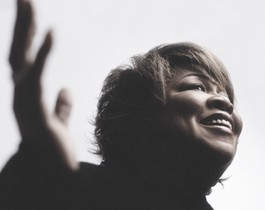
The record-buying public has recently been faced with a welcome quandary, what with the recorded re-emergence of classic soul singers like Bettye LaVette, Howard Tate, Solomon Burke and Koko Taylor. The background stories are touching—a talented singer with a few hits long ago is forgotten by the major record labels for decades and stages a successful comeback aided by a tasteful, purity-capturing producer—and the music is almost overwhelmingly enjoyable, if not top-notch. Acknowledging the richness and artistic wealth of the soul resurrection, one album stands alone in a field growing ever crowded: the incredible We’ll Never Turn Back by gospel singer Mavis Staples. She appears with Charlie Musselwhite Oct. 11 at the Napa Valley Opera House.

Recent events in Mississippi and Louisiana have brought civil rights issues back to our front pages, and Staples, more than any other singer, is intensely qualified to bring it back to our ears. Her family group, the Staple Singers, exemplify the beautiful confluence so common to the climate of the 1960s. Mixing gospel soul with the political bent of the folk scene, the Staples emboldened the Civil Rights movement with songs like “Long Walk to D.C.” and “When Will We Be Paid?” that dug far deeper than Joan Baez or Peter, Paul & Mary. When Stax Records signed the Staples with Booker T. & the MG’s as a backing band in 1968, the message came out of the churches and streets and onto the airwaves, helping change, or at least alter, the attitudes of millions.

Mavis Staples has stayed active, but it took musicologist Ry Cooder to convince her to return to her roots. We’ll Never Turn Back revisits songs of the Civil Rights struggle—many of which actually precede the 1960s—and in the hands of Staples, the Freedom Singers, Ladysmith Black Mambazo and Cooder’s own band, they are transformed from important but no less dusty artifacts (“This Little Light of Mine”) into powerful new statements of hope and cultural revitalization.

On the album’s title track, amid a looming ambiance, Staples inflects an urgent reminder of how far the movement for racial equality has marched and how imperative it is to continue undeterred. Every breath between phrases, every vibration, every tic in the back of her well-worn throat is nakedly presented. Her conviction is overwhelming. Against all odds, it could reduce even a certain district attorney in Jena, La., to tears.

Mavis Staples performs with Charlie Musselwhite and the North Mississippi All-Stars on Thursday, Oct. 11, at the Napa Valley Opera House. 1030 Main St., Napa. 8pm. $40&–$45. 707.226.7372.
Napa’s Festival del Sole

0

the arts | visual arts |

Photograph courtesy of Barrett Wissman
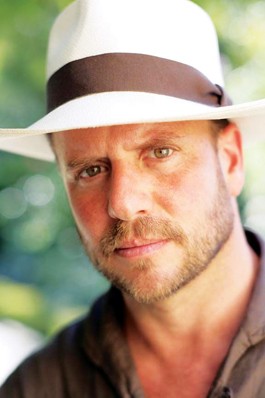
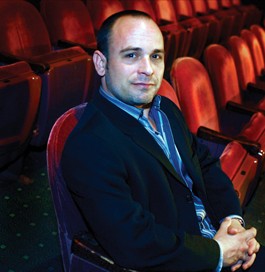
Sun King: Festival del Sole founder Barrett Wissman

By Gabe Meline

For two years now, Festival del Sole has impacted our small region like a 10-ton asteroid of the arts. Suddenly, an unparalleled summertime festival offers appearances by top names in the classical field, the food world, the fine arts and the winemaking profession, interwoven together by a weeklong program in the Napa Valley. Picking and choosing which events to attend can be deliciously overwhelming, but in the vision of Festival del Sole founder Barrett Wissman, there’s no scaling back on excellence.

“My dream was always to have a festival that could really reinvigorate communities with the arts,” says Wissman from his home in Texas. “That’s the basic purpose. People ask me why I don’t go a little bit slower, why I don’t do just three concerts in the first couple of years, but then you don’t establish quality and depth.”

With past appearances by such fine-art music superstars as Joshua Bell, Jean-Yves Thibaudet, James Galway, Sarah Chang, Anne Sophie von Otter, Samuel Ramey and Frederica von Stade, the festival also hosts culinary demonstrations, winetastings, wellness clinics and high-society gala events. Because of this ambitious scope of global culture descending on the North Bay, it’s a natural to honor Festival Del Sole for a Boho Award this year.

The idea for a multi-artisan festival first came to Wissman while walking around the small village of Cortona, Italy, with his newlywed wife, Russian cellist Nina Kotova. “We were in the town,” he says, “and one day, looking at the old theater—it was hardly used for anything—we thought to ourselves, wouldn’t it be clever and interesting to enliven the town by doing something like this? I like several different art forms, not just music, and I find that they complement each other. I think these days, everything is going so fast in the world that people take little time to enjoy these sorts of things.” Thus, the first incarnation of Festival del Sole was begun in a small Italian town.

Wissman himself started out as a concert pianist before a lucrative run in hedge funds and venture capital in the 1990s; he recently acquired a majority share of IMG Artists—a talent agency with a huge roster of classical talent—positing him as the perfect initiator of such an undertaking. After three successful years of Festival del Sole in Cortona, Wissman happily turned his eye to establishing a sister festival in Napa.

“Napa is the perfect place,” he enthuses. “It’s close to a metropolitan area, there’s a lot going on, there’s an audience, it’s a national and international destination. And though there’s lots of wonderful things going on in the North Bay, arts-wise, there’s nothing that’s a concentrated event like this.”

With Kotova as artistic director, the Festival del Sole utilizes a variety of stunning venues in the Napa Valley, including winemaker Daryl Sattui’s $30 million, 121,000-square-foot Castello di Amarosa. Festival events are also held at the Lincoln Theater, French Laundry, COPIA, Villa Mille Rose, the Napa Valley Opera House, the Culinary Institute of America, Mondavi Winery and the Napa Valley Museum. Ever aspiring, Wissman says he’s still looking for the perfect, “magical” outdoor venue.

“We’ll always use the Lincoln Theater—it’s a perfect space—but eventually, to do some things outside in the evenings would be wonderful,” he says, adding suggestively that he “may have to build it.” But Wissman is especially fond of the ability to give classical artists a world-class reception in Napa; they appear for small fees, Wissman says, but “the important part is that they have been embraced by the community, and that they love coming.”

Wissman plans on continuing Festival del Sole for years to come, and hopes to attract more local residents from the Bay Area with each season. He admits that the process of maintaining and expanding an already staggering festival is hard work. “But if it were easy,” he says with trademark determination, “then it wouldn’t be high quality.”


View All


Museums and gallery notes.


Reviews of new book releases.


Reviews and previews of new plays, operas and symphony performances.


Reviews and previews of new dance performances and events.

First Bite

0

10.10.07

Editor’s note: First Bite is a new concept in restaurant writing. This is not a go-three-times, try-everything-on-the-menu report; rather, this is a quick snapshot of a single experience. We invite you to come along with our writers as they—informed, intelligent eaters like yourselves—have a simple meal at an area restaurant, just like you do.

Khoom Lanna, the new Thai restaurant in Railroad Square, certainly lives up to its name. Khoom was the former residence of the Thai royal family; Lanna, the isolated kingdom considered a cradle of Thai culture. Khoom Lanna feels like an oasis in the middle of Santa Rosa, and it certainly is a place where you’re given the royal treatment.

When we stepped inside one afternoon, my guy, Doug, and I were carried away on a calming veil of color, sound and delicious smells. The place is really gorgeous, with two tones of dusty and deeper rose on the walls, elaborate tapestries of boats and dancing women and slow ceiling fans with broad petals, like giant spinning frangipani blossoms. They proudly play original jazz composed by His Majesty the King, Phumiphon Adunyadet, which Pookie, one of the owners, told us one patron had found “not Thai enough,” whatever that means. Now they play traditional Thai music, too.

All the standard favorites are served, along with some surprises. If you stick to the lunch menu, all options (satay, pad Thai, chili basil, curry, etc.) are $7.95 and include salad, appetizer and jasmine rice. You can specify chicken, pork, beef or vegetables, and your desired level of spiciness on a scale of one to 10. We chose green curry chicken ($7.95), which was just about as good as it gets, with chunks of zucchini, green beans, green and red bell pepper, and a taste of kaffir lime, basil and just the right amount of heat.

The grilled Bangkok fish ($12.95) is breaded tilapia cooked crunchy on a flavorful beside a bed of julienned red onions, carrots, green apples, cilantro, and accented by a beet cleverly cut into a flower. The duck breast with honey ($17.95) was luscious: tender, smoky meat with layers of sweet (honey? molasses?) and savory spinach. The pumpkin was cooked to such a smoothness, it dissolved in the mouth. The Singha beer (a necessary accompaniment to Thai food) was a tad dear at $4.50 a bottle for an otherwise affordable lunch.

Between courses, Pookie came to our table to chat about the food cooked by chef Yee, the ups and downs of running a new restaurant and the changing face of her hometown of Bangkok (see Bangkok’s SkyTrain). Although we were quite full, she ignored our demurrals about dessert, saying she’d already prepared us two to try. Whisking back from the kitchen, she brought a platter on which a perfectly ripe mango was sliced thin and arranged in the shape of a baby whale. At the center, a mound of sticky rice was drizzled with coconut milk and sprinkled with sesame seeds. I don’t even like dessert, but I loved that one. On another dish were skewers of fried panko-covered banana with honey and served with coconut ice cream, which stayed on Doug’s side of the table. Both of these were offered on the house. Talk about being treated like royalty.

Khoom Lanna, 107 Fourth St., Santa Rosa. Open for lunch and dinner daily. 707.545.8424.


Quick-and-dirty dashes through North Bay restaurants. These aren’t your standard “bring five friends and order everything on the menu” dining reviews.

Marin Theatre Company

0

the arts | stage |

Photograph by Nina Zhito
Stage Craft: MTC’s artistic director Jasson Minadakis.

By David Templeton

We really want to be one of the major cultural attractions for the North Bay, and we are well on our way to achieving that goal,” says Jasson Minadakis, artistic director of Mill Valley’s Marin Theatre Company. “Developing and nurturing the artists who live right here in the North Bay is something of huge importance to us,” he says. “Of course, we expect a lot from the artists who work with us, because the community expects a lot from us.”

As the North Bay’s only full-time, all-professional theater company (it’s an Equity house that runs its plays Tuesday through Sunday—just like in San Francisco!) the 41-year-old MTC has a lot of high expectations to live up to. With an annual operating budget of over $2 million, there is always enormous pressure to produce popular and profitable shows. Given that MTC is also pretty much the only theater company north of the Golden Gate that ever gets reviewed by the San Francisco newspapers, it has the additional pressure of being the North Bay’s sole theatrical representative to the rest of the Bay Area. With all that pressure, it would be reasonable for MTC to stay focused on a very simple goal: to stage plays that pack the houses and please the critics—and nothing more.

But there is more to MTC than what happens beneath the proscenium arch. Largely under the radar, with little fanfare or public awareness, the company has been operating one of the most ambitious and expansive culture-education outreaches in the region. Under the direction of Josh Costello, MTC’s artistic director of expanded programs, who works closely with Minadakis, the venerable nonprofit throws much of its effort into a large and growing number of community outreach programs: MTC in the Schools augments the curriculum of Marin County schools by placing drama teachers, playwrights and actors in classes, either after school or as part of existing arts, culture and literature courses; SceneFest gives young actors the opportunity to perform scenes and monologues in a safe, education-oriented acting competition; MTC’s ingenious Teen Advisory Board assembles middle and high school students to act as theatrical diplomats between MTC and the Marin teen community; with Teachers Night Out, educators are invited to attend free preview performances of new plays, where they can pick up study guides and discuss ways to incorporate the plays’ themes into class curriculum; the Me and My Shadow program pairs young students with MTC staff members in order to learn about theater operation from the inside; plus, there are numerous scholarship programs and frequent projects, such as the recent Canal Project, in which students develop original plays based on experiences taken from their own lives.

“The nurturing of an appreciation of theater among nontraditional audiences, and the development of local talent, is a huge part of what we do,” Minadakis says. This results in a large number of local actors and writers being given opportunities to develop fresh plays through such programs as the annual Nu Werks showcase, and the brand-new workshop series presenting such works-in-development as Marin County playwright Kenn Rabin’s Found Objects, which kicks off the workshop series Oct. 10.

“We believe that these kinds of programs are one of the reasons why we’re here,” says Minadakis, “not just to produce vital and entertaining theater, but to develop local theater artists and give them a place to practice their craft in a professional environment, with high artistic standards. Then, our outreach programs are designed to cultivate a generation of new theatergoers, to spread the love of the theater, so that our artists always have someone smart and appreciative sitting out there in those seats.”


View All


Museums and gallery notes.


Reviews of new book releases.


Reviews and previews of new plays, operas and symphony performances.


Reviews and previews of new dance performances and events.

White Collar Guffaws

0

10.10.07

You got your Kings, your Queens, your Redneck and your Blue Collar comedy tours, so why not the middle-class white guys from the suburbs, too? After all, the only ones laughing at them with any regularity are their wives and kids; clearly the audience could be wider than just that seated at the dinner table.

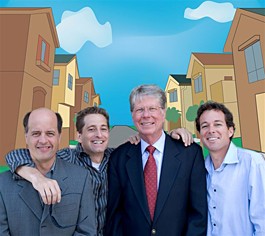
Enter the Suburban Comedy Tour. Featuring four decades of college-educated white guys—Andrew Norelli (28), Dave Burleigh (36), Mickey Joseph (46) and Ken Koskella (over 50)—this troupe focus their comedic foibles on the backyard, the bedroom, the kitchen table, the neighbor’s house, the soccer field and other places frequented by the suburban family.

Koskella, a former CEO who retired early but remains exactly the kind of executive who will simply call a journalist up if he thinks that an interview is warranted, has wanted to do comedy since he was a kid. Now that he can afford such, Koskella hired someone to teach him how to write sketches and perform standup. He soon found that audiences in theaters, as opposed to drunkards in comedy clubs, reacted favorably to his schtick about spending his kids’ inheritance and dealing with the cop who lives next door. Reading the Wall Street Journal one day, he came upon an item stating that today’s suburbans like to stay in the suburbs when they have fun, and not venture to the urban wilds. Why not, he wondered, give them exactly that?

Almost two years later, the Suburban Comedy Tour swings through what should be its spiritual home, Rohnert Park, on Saturday, Oct. 13. “We don’t particularly set aside the show for just suburban humor,” Koskella assures warmly. “It’s really about ourselves.”

Spreckels Performing Arts Center, 5409 Snyder Lane, Rohnert Park. 8pm. $21&–$24. 707.588.3400.


Museums and gallery notes.

Reviews of new book releases.

Reviews and previews of new plays, operas and symphony performances.

Reviews and previews of new dance performances and events.

Santa Rosa’s Dance Center

0

the arts | dance |

Photograph by Michael Amsler
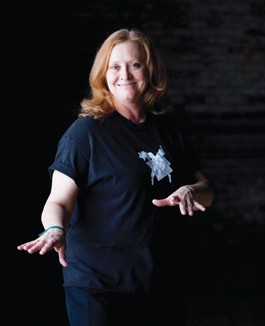
Hoofin’ It: The Dance Center’s director Vicky Suemnicht.

By David Templeton

Inside the lobby of Santa Rosa’s 30-year-old Dance Center, located in an old warehouse near Railroad Square, there stands a massive display case, crammed with trophies and ribbons awarded to the studio and its dancers over the course of its three decades of existence in the community. According to Vicky Suemnicht, director, founder and owner of the Dance Center, the case contains only about one-third of the awards the studio has won.

She also says that while awards are nice and everything, they’re not what the Dance Center—or dance itself—is all about.

“Compared to a lot of studios, we are really not about competition. It’s not a huge part of my philosophy,” Suemnicht says. “If a young dancer wants to win a lot of trophies, this is not the studio for them. I feel strongly that what’s important is the training, the development of technique—and competition can be a distraction. We compete on occasion, and we usually do well, but our focus is on having fun, on developing the students as dancers, and preparing them for whatever it is they want to do next.”

Suemnicht, a longtime dancer, teacher and choreographer whose choreography work is often seen onstage at the neighboring Sixth Street Playhouse, started the Dance Center in 1977 (it was known then as the Tap Studio), establishing the studio in a corner of the Lincoln Arts Center, just around the corner from where she is now. On a weekly basis, hundreds of students, from four-year-olds on up to senior citizens, walk through those doors and past those trophies, dispersing into classes that cover the spectrum of modern American dance: tap, jazz, ballet, musical theater, hip-hop and modern. Suemnicht cannot give an exact number of the people who have learned to dance at the Dance Center, but, including the hundreds who’ve grown up dancing there (every year the Center gives out scores of 15-year pins to longtime students), one could safely put the number in the thousands.

The attraction, aside from the primal appeal of dance and the lure of a comfortable, friendly place to practice, is Suemnicht herself, a tireless advocate for the art of coordinated physical expression, and a first-rate teacher whose positive attitude and supportive approach have made the difference in coaxing plenty of young people to give their all to the craft of dance.

“Dance is such a great activity, for kids and adults,” she says. “It’s a great skill to have, and it feels good. Tap dancing is an especially helpful thing to know. I tell our students all the time, whenever I’m having a stressful day, or when I’m uptight about something, if I just let loose and tap dance for five minutes, I feel a lot better. We see kids tap dancing their way out of bad moods here all the time. Dance is very therapeutic.”

In addition to the classes, staffed by a small army of instructors, the Dance Center boasts seven dance companies that perform around the Bay Area. Each year since 2003, Suemnicht has taken a company of dancers to Jeju City, Santa Rosa’s sister city in South Korea, to perform at the annual Fire Festival. While most of her students learn dance for the sheer pleasure of it, the Center has had a fairly high percentage of students who, after graduation from high school, continue taking dance in college, or go out and get jobs as dancers in touring companies or on cruise ships.

“Dance is a challenging career, it’s a challenging life,” she says. “Yes, some of our students choose to go on and make dance their profession, but most of them, the kids who grow up dancing here, don’t go that direction. But dance is still in them, it’s in their hearts and they tend to find ways to keep dance as a part of their lives.”


View All


Museums and gallery notes.


Reviews of new book releases.


Reviews and previews of new plays, operas and symphony performances.


Reviews and previews of new dance performances and events.

Winery profile: Papapietro-Perry

0


On every attempt to visit to this winery, some limousine or touring van pulls up and a big group swarms the tasting room. It’s either bad luck on my part or an indication of the winery’s critical success and popularity. Perhaps people just find it pleasing to say “Papapietro-Perry Pinot.”

Founded in 1998, the boutique winery is the fruition of a decades-long passion for wine. Ben Papapietro and Bruce Perry met in the newspaper business, made premium garage wine for some time and went commercial starting with 75 cases, picking up gold medals ever since. Named among the top 30 Pinot Noir producers by the Wine Spectator, Papapietro-Perry consistently score in the 90s. And they produce Zinfandel. Tasting here looks like a promising prospect.

So this time, after taking a walk around the Timbercrest Farms block, we brave the crowds to stand for a while at the oak barrel stave and copper-topped bar, behind which glimmer the distinctive bronze-printed bottles. Upon receiving a taste of something unnamed, I fetch my companion who, not one for chattering crowds, is enjoying the afternoon sun and Dry Creek Valley panorama on the patio. The tasting fee is $5 for four pours of four wines, making it easy to choose among them. A fifth, the 2005 Russian River Valley, Pommard Clones Pinot Noir ($68), was tantalizingly offered to look at. It’s available for tasting if one first signs up for the wine club, the three tiers and other details which are explained at length. Pours are slim, and comparing my notes to theirs on the 2005 Leras Family Vineyards RRV Pinot Noir ($48), I am puzzled. I had scribbled, “Tight, clean and varietal, feral vegetation; astringent, with little fruit center of interest”; their notes read, “Velvety on the palate with rich flavors of cherry, cassis and hints of strawberry giving way to earthy minerals, spice and toast . . . with a long, persistent fruit-driven aftertaste.” But none of the verbiage matters; this and most of the 2005 Pinots are sold-out.

Papapietro-Perry makes Zinfandel in the style of its Pinot, and the tart and spicy cherry aspects of the 2005 Russian River Valley Elsbree Vineyard Zinfandel ($36) show a refreshing restraint and balance. Our host explains that this is the result of their vinting practices, something about cold soaks replacing high-temperature fermentations that result in those high-alcohol big Zins. While that is complete nonsense, understand that they are naturally a bit frazzled by the crowds at the end of the weekend. It’s all just words, anyway, and words, as we learned from another tasting room this year, are funny things. I won’t eat my words–but I will swirl and spit them. All in all, we weren’t particularly partial to Papapietro-Perry Pinot, although it is clear that the wine is well-crafted and fine. Everybody says so.Papapietro Perry, 4791 Dry Creek Road, Healdsburg, at Timbercrest Farms. Tasting room open daily, 11am to 4:30pm. $5 fee. 707.433.0422.


View All

Letters to the Editor

September 26 – October 3, 2007

ICE-breaker

I was interested to see this article (“Yo Soy el Army,” Aug. 29) finally published, having worked months ago with the author, Deborah Davis, to correct some of the misinformation that she had initially been given by others. I’m disappointed, however, to see many factual inaccuracies in the final version.

Among the most egregious errors is the repeated reference to ICE, or Immigration and Customs Enforcement, being responsible for military naturalization applications. In fact, military personnel file their citizenship applications with the same agency as every other citizenship applicant: the United States Citizenship and Immigration Services (USCIS). USCIS is not ICE. ICE is responsible for deporting immigrants, not naturalizing them, and no one files citizenship applications with ICE.

The process for applying for citizenship has been well-publicized on the Internet and in military units, and there’s a brochure that explains the process on the USCIS website.

USCIS also recently publicized its new hotline for helping military personnel with their immigration and citizenship applications. Rather than relying on the inaccurate information contained in your article, I suggest contacting a good immigration attorney or at least the hotline.

Lt. Col. Margaret Stark, Professor of military law, West point

Nothing Escapes Peta

We are rightfully outraged by visiting Iranian president Mahmoud Ahmadinejad’s taunting denial of the Holocaust. Yet at every meal, we deny the daily abuse and slaughter of millions of cows, pigs, and other innocent, feeling animals in U.S. factory farms and slaughterhouses.

There is no life before death for these animals. From birth, they are caged, crowded, deprived, drugged and mutilated. At the slaughterhouse, they are frequently dismembered, skinned or scalded, while fully conscious. Although 93 percent of consumers condemn such abuses, no state or federal law prevents them.

Like the “good Germans” of the 1940s, we have a fair idea of what goes on behind those walls, but we reject any reality checks. We fear that the truth might offend our sensibilities and perhaps even force us to change our diet.

This is why, on Oct. 2 (Gandhi’s birthday), 400 communities in all 50 states and two dozen other countries observed World Farm Animals Day with public education events. The purpose was to expose and memorialize the tragic use of animals for food and to promote an animal-free diet.

So the next time we are outraged by Ahmadinejad’s taunts or other injustices, let’s refuse to subsidize animal cruelty with our food dollars. Let’s observe our own World Farm Animals Day every day at the supermarket.

Steven Alderson, Santa Rosa

Girl Power

The Bohemian rocks! A big thank you from the members of Connections: A Forum for Women in Business, for getting out the info for our third annual gala fundraiser Sept. 11 that benefited the Circle of Sisters self-esteem-building girl’s programs (girl power!), local women’s shelters, and additionally provides funds to set up a new SSU scholarship fund.

Thanks again from Connections, the most fun women’s nonprofit organization in the North Bay.

Ilona Lea, Public Relations Director

Riverine

The Sonoma County Water Agency (SCWA) is seeking millions of dollars from the Bureau of Reclamation to build a huge pipe and pumping network in order to export treated wastewater from their contractor cities to southern Sonoma and Napa valleys for more agricultural irrigation. This would put added demands on SCWA water sources, including the Eel River, to supply new growth rather than maximize the reuse of treated wastewater to first displace potable water demands for landscaping, toilets, industrial and commercial uses.

Senate bill 1472 (Feinstein, Boxer) and HR 236 (Thompson, Woolsey) are funding bills requested by SCWA for this purpose, and they have already been heard in subcommittees in both the House and Senate. Friends of the Eel River urges you to write to Sen. Bingamen, D-N.M., expressing your opposition, as soon as possible: Sen. Jeff Bingaman, Chairman, Senate Energy and Natural Resources Committee, 703 Hart Senate Office Building, Washington, D.C., 20510.

Ellen Komp, Friends of the Eel River, Redway

The Ed.,
Covered in cardboard cuts and odd bits of tape


‘Peanuts’ Fashion

10.03.07

Last month, sinewy models swarmed into midtown Manhattan’s Bryant Park for fall fashion week. High-stepping it down temporary runways, their skinny shoulders bore the velvety weight—of the nation’s most important style event. But in at least one tent, the mood was anything but heavy.

In fact, this particular show began with a model hoofing it down in a sexy yellow number by Isaac Mizrahi. The dress looked vaguely familiar, its short hem sporting the iconic brown zigzag pattern on Charlie Brown’s T-shirt.

A few minutes later, another model strutted down the catwalk in a belted black frock. Sophisticatedly sucking her thumb—if such a thing is possible—the model wore as her key accessory a grayish scarf-cum-security-blanket slung over her shoulder, Linus-style. The comic-strip backdrop and Vince Guaraldi soundtrack made it unmistakable. This show was the fashion world’s homage to “Peanuts.”

Fittingly, Jeannie Schulz attended this first-ever MetLife Snoopy in Fashion show. “Snoopy was back [stage], greeting people and hugging people both before and after the show,” she said. “The models are all business, but Frederique [the Victoria’s Secret supermodel] had her daughter in the show, and her daughter loved it,” Schulz said.

On Oct. 6, the stylish effects from the show will be on view at the Charles M. Schulz Museum and Research Center in Santa Rosa. Among the attractions are five couture gowns, including the Mizrahi dress, sketches, video documentation of the shows and interviews.

Shuttled straight from New York, the garments recently arrived in a FedEx truck to Santa Rosa. Speaking together by phone from the Schulz Museum, curator Jane O’Cain and marketing director Gina Huntsinger described the experience.

“It was like Christmas,” O’Cain gushed.

“In a really nice house!” Huntsinger interjected.

“It took a morning to unpack them,” said O’Cain, who noted that each garment had been swaddled first in an interior dry-cleaning bag, then a garment bag, then bubble wrap and finally an outer box. Unlike their boxy ancestors, these outfits were body-conscious and elegant. Sex appeal and Charlie Brown? That’s a combination that only the psychiatrist’s booth might be able to explain.

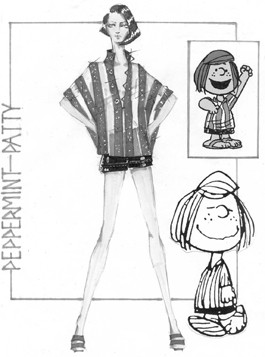
O’Cain and Huntsinger’s faux Christmas morning includes a full-length sequined gown and tulle cloak that Laura Bennett (a finalist on season three of Bravo’s Project Runway) had designed, somehow inspired by Pig Pen; an exuberant wedding dress by the hip duo Heatherette; Pamella Roland’s shiny red and white blouse evoking Peppermint Patty; and a fairy princess take on Sally by the Broadway actress Kristin Chenoweth.

Had they tried anything on?

“I think there was one dress I could have probably gotten one leg into,” joked O’Cain.

So what if high-fashion seems incongruous in the North Bay. Just the opposite happened in New York, when Huntsinger, who had been observing backstage, prepared to change in time for the show. She couldn’t find her dress, a sale purchase from Macy’s. (“Cuz what do suburban housewives wear to a New York fashion show?” she asked. “She’s not really a suburban housewife,” O’Cain interrupted.) Huntsinger eventually wrapped herself in a sheet and found her dress. Someone had hung it on a rack of clothes the models wear during the show.

Sponsored by MetLife, the fashion show benefits Dress for Success, which helps disadvantaged women prepare for the job market, when the couture fashions are auctioned off on eBay this month. We’re just thankful that the Snoopy samples aren’t going directly to these job seekers. Wearing Betsey Johnson’s teensy-weensy “Peanuts” dress to an interview might give the wrong impression.

Snoopy in Fashion’ is on view Oct. 6&–Nov. 9 at the Charles M. Schulz Museum, 2301 Hardies Lane, Santa Rosa. 707.579.4452. While you’re there, peek in the gift shop to see some examples of high fashion’s first marriage to ‘Peanuts.’ In 1984, Vivienne Westwood, Bill Blass and others designed little wearables for Snoopy and Belle plush animals. Bidding on this fall’s designer creations runs through Wednesday, Oct. 31, on eBay to benefit Dress for Success.


Opinion: Marin Countywide Plan

0

On Sept. 11, the Marin County Board of Supervisors unanimously agreed to include maps in the countywide plan with proposed trails through working ranches and farms without landowner permission. The plan calls for 126 miles of new trails. There are already 840 miles of public trails in the county, and the proposed trails in the plan put an unrealistic burden on ranchers.

It mattered not that environmental groups, including the Environmental Action Committee of West Marin, Sierra Club and Marin Audubon, spoke against the proposed trails. It mattered not that the 50 or so ranchers present spoke out against trails through their land. Not one person spoke in favor of having trails go through working ranches and farms.

Public access through working agricultural properties can disrupt operations, introduce animal disease, degrade sensitive wildlife habitat, increase the chances of theft and vandalism and could lead to insurance claims against landowners if accidents occur.

The majority of the supervisors seemed inclined to remove the language in the plan that would allow the county to obtain public trails through eminent domain. However, District 4 supervisor Steve Kinsey insisted that the language remain in the plan, as he did not want to tie the hands of future supervisors. What is a rancher to think of that?

If the county wants to dedicate a trail, the threat of eminent domain hangs over ranchers heads like a guillotine.

All who testified were against the trails, for one reason or another. So why do we have ranch trails on maps for inclusion in the Marin countywide plan? Who wants them? And more to the point, how is the decision made to approve something that most people are strongly opposed to?

One argument made by Supervisor Kinsey was that the 1994 plan included many of these trails, so they had to include them. In this case, we wonder why we have an update to the countywide plan at all. If a part of the plan does not make good sense, is this not the time to remove or change it?

There is another way. We support voluntary agreements between the county and agricultural producers on a case-by-case basis, the proverbial willing seller and willing buyer. If a rancher wants to dedicate a loop trail on his property, great, but his neighbors should not be pressured into dedicating a trail as well, no matter how many trails it would link up.

We support improved trail access for Marin’s citizens, but it shouldn’t come at the expense of local farmers and ranchers, especially when we have better trail access in Marin County than any other in the Bay Area.

We ask the supervisors to re-examine the county’s approach to improving trail access in Marin County. Please remove the proposed trails going through ranch and farmland from the maps unless approved by the landowners, and change planning direction toward a system that encourages voluntary trail easement dedication rather than coercion.

At the Sept. 11 meeting, the Board of Supervisors chose to ignore the public’s overwhelming opposition to the county trails plan. We ask them to listen more closely and reconsider their decision.

If you agree that the trail maps should only show trails that landowners have agreed to and that all agreements should be voluntary, please contact the Board of Supervisors at 3501 Civic Center Drive, Room 329, San Rafael, CA 94903, bo*@*********ca.us or call 415.499.7331.

Remember, we will only get the plan we want if we ask for it.

Mike Gale is the president of the Marin County Farm Bureau. Frederick Smith is the executive director of the Environmental Action Committee of West Marin. The Bohemian welcomes feedback. Write ed****@******an.com. The Byrne Report returns next week.


Still Standing

10.10.07The record-buying public has recently been faced with a welcome quandary, what with the recorded re-emergence of classic soul singers like Bettye LaVette, Howard Tate, Solomon Burke and Koko Taylor. The background stories are touching—a talented singer with a few hits long ago is forgotten by the major record labels for decades and stages a successful comeback aided by...

Napa’s Festival del Sole

the arts | visual arts | Photograph courtesy of...

First Bite

10.10.07Editor's note: First Bite is a new concept in restaurant writing. This is not a go-three-times, try-everything-on-the-menu report; rather, this is a quick snapshot of a single experience. We invite you to come along with our writers as they—informed, intelligent eaters like yourselves—have a simple meal at an area restaurant, just like you do.Khoom Lanna, the new Thai restaurant...

Marin Theatre Company

the arts | stage | Photograph by Nina Zhito Stage...

White Collar Guffaws

10.10.07You got your Kings, your Queens, your Redneck and your Blue Collar comedy tours, so why not the middle-class white guys from the suburbs, too? After all, the only ones laughing at them with any regularity are their wives and kids; clearly the audience could be wider than just that seated at the dinner table.Enter the Suburban Comedy Tour....

Santa Rosa’s Dance Center

the arts | dance | Photograph by Michael Amsler Hoofin' It: The Dance Center's...

Letters to the Editor

September 26 - October 3, 2007ICE-breakerI was interested to see this article ("Yo Soy el Army," Aug. 29) finally published, having worked months ago with the author, Deborah Davis, to correct some of the misinformation that she had initially been given by others. I'm disappointed, however, to see many factual inaccuracies in the final version. Among the most...

‘Peanuts’ Fashion

10.03.07Last month, sinewy models swarmed into midtown Manhattan's Bryant Park for fall fashion week. High-stepping it down temporary runways, their skinny shoulders bore the velvety weight—of the nation's most important style event. But in at least one tent, the mood was anything but heavy.In fact, this particular show began with a model hoofing it down in a sexy yellow...
11,084FansLike
4,446FollowersFollow
6,928FollowersFollow