The Shop in Sonoma

0

ISSUEDATE


To the casual passerby, the Shop doesn’t look like the crown jewel that it is; it’s pretty much a dingy warehouse in the middle of nowhere. But for almost 10 years now, it’s served as a haven for the area’s teenagers, providing a stage for budding young bands and a drug- and alcohol-free hangout on weekend nights. Far from the stifling environment of a city-run, adult-mandated “teen center,” the Shop is run almost entirely by its own teenage volunteers.

For this reason, we honor those known as “the Shop kids”—past, present and future—who work extracurricular hours creating an environment with lasting effects to benefit not just the kids who frequent its corrugated steel walls, but also the entire community at large.

On a recent Saturday night on the outskirts of Sonoma, outside the warehouse before the show, the kids pass the time by reminiscing about the craziest things that have gone down at the Shop.

“This one band—I don’t wanna say the band name—but the drummer is just fuckin’ crazy!” says soundman Will Wedell, 16. “It was their last song, and he was just really riled up, so he started playing the cymbals with his snare drum, and totally just punched over his whole set! And then another time, they came back, and the same guy started to play cymbals with his head, and got a big cut on his head, and there was blood everywhere!”

Other hijinks abound: “I went to sit on the couch once,” adds Jessica Grimm, also 16, working the door, “and about 20 people piled on top of me.” Fifteen-year-old events booker and concession manager Will Doran chimes in. “We had a big rap show once,” he explains, “with a costume contest for whoever could have, like, the most old-school kinda outfit, and there was some 60-year-old lady with a clock around her neck!”

With its emphasis on wine, food, and festivals, Sonoma isn’t exactly the most stimulating city for a teenager; both Doran and Wedell speak the words “wine country” in the same sort of resigned tone that baseball fans reserve for the Yankees. Opportunities to get involved locally usually require serving the adult community, either by volunteering at festivals or working retail jobs for tourists. For the kids, the ability to create their own community is vital.

“A big factor for teenagers,” says Shop co-director Dave Robbins, a bona fide grownup, “is that they have to feel that most of what they’re involved in is theirs, that they’re a part of it.” There’re always older chaperones at the shows, ready to assist if needed, “but there’s not a whole bunch of adults monitoring them,” Robbins stresses. “We just let them be themselves, and generally, that’s the best way to go.”

In addition to the way the Shop has changed local attitudes toward youth in general, the kids of Sonoma themselves are all obviously better off. “I like being able to come out here,” says Doran. “I like music a lot, and now I can get into shows for free, even if I have to work outside all night.”

Grimm says if she weren’t working the door tonight, she’d be listening to music and talking on the phone with friends; instead, she’s listening to music and talking to people in person, “which I like a little bit better.”

Perhaps Wedell has seen the most positive change. “Right now,” he testifies, “if I didn’t have the Shop, I would probably be sitting in a corner crying about how there’s nothing to do in Sonoma.

“Because there really is nothing to do in this town.”


The Green Zone

10.10.07

On Sept. 21, I attended the Climate All Stars Conference in San Francisco. Organized by the Climate Protection Campaign (CPC), a nonprofit located in Sonoma County’s small town of Graton, this conference was an ambitious effort to bring together a lineup of resources and individuals actively working to save the planet from the effects of global warming. The CPC is a stunning example of the type of organization that just might, when everything else seems to be failing, rescue the world from its no-uncertain doom.

Climate Protection Campaign president Ann Hancock and her host of committed volunteers and few staff members are perhaps best known for their work in implementing the adoption of a plan by all nine Sonoma County cities and the county government to reduce greenhouse gas emissions to 25 percent below 1990 levels by 2015. This fall, the CPC will release the results of an extensive study which will lay out in detail its findings on CO2 emissions, as well as a detailed plan for what must be done in order to meet the 2015 goal.

I spoke with CPC development director Barry Vesser about this huge undertaking and what it will take to get the action plan out into the community and into effect. Among other things, we discussed the importance of semantics. When it comes to green issues, Vesser encouraged me to think about the environment not in terms of “carbon constraints” and “sacrifice,” but in terms of a “green renaissance” and “new possibilities.” Vesser, perhaps sensing my dark side, reassured me that Sonoma County is rich in progressives, human resources, talent and business economy. He believes that Sonoma County is perfectly poised to be the forerunner in climate control, and that it can meet its goal of emissions reduction.

With over 300 participants, the All Stars Conference is an example of exactly the type of widespread engagement Vesser was referring to. To be surrounded by so many people who not only care deeply about climate change but who are motivated enough to take action was both inspiring and educational.

My first stop was a break-out session, sponsored by the Cool Schools program, which is just one more program developed by the CPC. High school students were scattered throughout the group, and when one student raised his hand and asked the room full of adults when the last time was that any of them had actually ridden the bus, I felt a flicker of hope for humanity.

When I was in high school, all I knew about global warming was that it could be a myth, but if it wasn’t, it was my best friend’s fault because she used too much Aqua Net hairspray. Thanks to Cool Schools, which provides materials to high schools like Analy and Windsor, students have the chance to study their school’s carbon footprint, and figure out ways to minimize it. Youth awareness is obviously on the rise.

One of the most memorable moments of the day, other than the surprisingly excellent food, was when keynote speaker Ed Mazria stepped up on the stage and began to work a “fear of the end of the world” spell. The lights went down, and so began a slide show of what the United States will look like in 2035, when the oceans finally begin to swallow us up. This is it, I found myself thinking, of all the ways to go, death by drowning.

Mazria informed the crowd that there are currently 151 new coal-fired power plants in various stages of development in the United States In China, Beijing will have to shut down its coal plants prior to the Olympics in a desperate attempt to make the air clean enough to breathe, at least while jogging. Even if we all start riding the bus every day, we may be helping, but the coal plants will negate our efforts, and then some. In just 10 days of operation, the CO2 emissions from one medium-sized coal-fired plant will negate the planting of 300,000 trees.

Just as I was about to relinquish that splinter of hope brought on by the youth action and the composting bins that were placed next to all of the dish-busing stations, Mazria gifted us with a solution. By reducing the amount of energy used by buildings, we can negate the need for coal plants. Our future lies not just in how we ride but, most importantly, in how we build. The answer to global warming is no more coal. Up until now I had secretly considered the entire situation rather hopeless, because most of us would rather die than not drive, or at the very least, die while driving. There are times when I love being wrong. This was one of them.

For an All Stars toolkit, as well as videos of the conference and a plethora of other resources, visit www.climateallstars.org. For more information on the Climate Protection Campaign, as well as the Cool Schools Program, visit www.climateprotectioncampaign.org or call 707.823.2665. For more information on getting rid of coal and the 2030 challenge, go to www.architecture2030.org.


Essay: Rock and Roll Hall of Fame 2008 choices

0

10.10.07

In August 2006, some 200-plus KISS fans massed at the Rock and Roll Hall of Fame museum in Cleveland, protesting the classic rock band’s eight-year-long omission from the Hall’s annual induction ballot. The KISS Army didn’t protest this year, when the Hall recently announced the nominees for its spring 2008 induction ceremonies, which include Madonna, the Beastie Boys, Donna Summer and Leonard Cohen. But there’s already blog talk of a KISS Army protest next year, as if fans have already accepted future neglect.

Why are certain acts consistently ignored by the Rock and Roll Hall of Fame? The present list of snubbees includes big names like Neil Diamond, Chicago, the Spinners and King Crimson. Like any modern institution, the Hall sets a standard that’s subject to the slippery area between personal tastes and historical truths. With its committee of powerful industry insiders (the likes of Rolling Stone publisher Jann Wenner and major patron Bruce Springsteen), the Hall has so far successfully created a rich preserve for our tremendous 20th-century American tradition of blues, gospel and folk-based music. But the Hall currently stands at a crossroads, where its solid track record of acknowledging known boomer-based critical favorites is at odds with the very expansiveness that ongoing rock culture has created.

As the Hall begins to recognize newly eligible punk and hip-hop acts (the rule is 25 years since an act’s first released recording), every fan of this or that older artist is bound to feel snubbed—or, in correct punk fashion, will make a point of choosing to not care. This year’s Beastie Boys nomination seems like a pick that tries to cover all bases. It’s more noticeable than ever that the Hall’s bias toward American roots music and industry tradition has found it consistently ignoring trailblazers of metal, progressive rock and indie punk.

The loudest outcry to this year’s nominees has come from Metallica fans, who feel incensed by the omission of the thrash titans in their first year of eligibility. I don’t have much sympathy here; most great artists don’t make the ballot in the first year they qualify. Besides, once a band inducts a forefather, as Metallica did with Black Sabbath at the 2007 ceremonies, they’re a future shoe-in.

Rush fans are the next most vocal anti-Hall group. They feel the bile of the missed nominations for both metal and prog. But no worries. Rush are Canadian and had ’80s pop-rock hits, so they stand a much better chance with the Hall than snubbed British classical concept-rockers like Yes and Jethro Tull. Indie-rockers shouldn’t worry about upcoming props, either. This year’s nomination of the Dave Clark Five, who made last year’s ballot but weren’t inducted, shows that the Hall is willing to go back and pick up marginal acts who had a damn bright 15 minutes of fame.

Can you or I or the Rock and Roll Hall of Fame really say what is great? I recently posed this question to a friend at a local bar, insisting that some rock music is obvious, objective Hall of Fame material. I asserted that the Rolling Stones, for example, absolutely must be in the Hall of Fame. “Or not,” he responded.

Which brings us back to KISS. I didn’t really care for them in high school, growing up in Arizona in the ’70s, when they were a current band. But I experienced them as a potent piece of culture. We used to ditch seventh period and take a 12-pack and as many joints as we could roll down to the Gila River in Leo Mercado’s truck, and we always blasted out KISS Alive and Destroyer. But I only really learned to love KISS later in college, during their decline, when I purchased a used vinyl copy of KISS Alive, complete with all the posters, for a mere 25 cents.

While a nominating committee in Cleveland decides which rock musicians it will honor this year or next year, KISS, like prog and punk, are already a part of rock’s continuum of historical fame because they have contributed to and spurred this great musical debate in the first place.


Everyone’s a Winner, Pt. II

0

the arts | visual arts |

By Gretchen Giles

Wow. Even on a year when we are not throwing the kind of plugged-in hootenanny that the North Bay music scene deserves, 1,027 people took the time to vote in the third annual NORBAY Awards. Very cool. While we’re sorry that events conspired against our hosting a live music awards ceremony this year, Blues category winner Volker Strifler has decided to throw an ad hoc NORBAYs celebration at his Friday, Oct. 26, gig at the Last Day Saloon (120 Fifth St., Santa Rosa; 9:30pm, $10. 707.545.2343), welcoming other NORBAY winners as well as North Bay music fans to come on down and raise a joyful noise to our vibrant music scene. Next year, we’ll be back and ready again to do it ourselves! First place winners are indicated in bold; second place, in italics. Thanks for voting.

Elvin Bishop

Eric Lindell

Roy Rogers

Angela Strehli

Volker Strifler

Classical

American Philharmonic

Marin Symphony

Napa Valley Sympohny

Santa Rosa Symphony

Young People’s Chamber Music Orchestra

Country /Americana

David Grisman

Hot Buttered Rum

Poor Man’s Whiskey

Stiff Dead Cat

Trailer Park Rangers

Dance / DJ

Zack Darling

DJ Amen

DJ Dragonfly

DJ Guacamole

DJ Malarkey

Folk / Acoustic

John Courage

Ramblin’ Jack Elliot

Nina Gerber

Kevin Russell

Solid Air

Hip-Hop

Ant D.O.G.

DJ Shadow

Smoov-E

Truthlive

Wisdom

Jazz

Jason Bodlovich

Mel Graves

Julian Lage

Stephanie Ozer

Ian Scherer

Latin

David Correa & Cascada

Banda Sangre Azteca

Mark Taylor-Aire Flamenco

Ramon Trujillo & His Mariachi Caporales

Saul Rayo and Cocina del Mundo

New Age /Spiritual

Steve Gordon

Steve Halpern

Sukhawat Ali Khan

Suzanne Sterling

Jai Uttal

Alt / Punk /Hardcore

Ashtray

Lemon Lime Lights

The New Trust

Polar Bears

Resilience

R&B / Funk

Lydia Pense & Cold Blood

Tony Lindsey

Pride & Joy

Vinyl

Narada Michael Walden

Rock

5 A.M.

Madera Humana

New Monsoon

The Sorrentinos

Zepperella

World

Luna Angel

Dgiin

Groundation

Hot Frittatas

Markus James

North Bay Legends

Mickey Hart

Ali Akbar Khan

Phil Lesh

Sly Stone

Tom Waits


View All


Museums and gallery notes.


Reviews of new book releases.


Reviews and previews of new plays, operas and symphony performances.


Reviews and previews of new dance performances and events.

Review: ‘My Kid Could Paint That’

10.10.07

On camera, Marla Olmstead is one of the cagiest abstract expressionists artists ever interviewed. Olmstead makes a chronically tight-lipped painter like Jackson Pollock seem like a chatterbox. Facing queries about her work habits, the meaning of her paintings or her technique itself, she demurs and tries to turn the microphone over to her brother. When pursued by questions she’d rather not answer, she retreats and gives the camera wide yet shut-off eyes and a thin, enigmatic smile. Even at four years of age, Olmstead knows the right way to deal with the press.

In the documentary My Kid Could Paint That, director Amir Bar-Lev tries to crack the case of the four-year-old artist, whose canvases sold for over $300,000 on the New York art market. Instead, it is Bar-Lev who ends up cracked, baffled by two contradictory propositions.

One is that Marla is a genius who can’t be seen at work, whose true creative process is as hidden from view as Schrödinger’s cat. The other is that Marla is the point-child in a delicious fraud that hoodwinked everyone from the New York Times art page to NPR, as well as serious connoisseurs beguiled by the notion of a pure child working in the cynical and egomaniacal art world.

Maybe we should take Marla’s guidance and concentrate on the art. They are good paintings, whoever did them. Trying to make an abstract painting is an instructive process. After such an attempt, one tends not to echo the philistine comment Bar-Lev uses as his title. Moving paint around is a technical challenge; making the paint do what you want takes time and learning. The canvases we see toward the film’s end are the work of someone with a fine sense of color, depth and motion. They have some value outside of the hysteric and status-driven art market.

But is it all a fraud? The investigative program 60 Minutes 2 suggests so, causing a huge crisis in the Olmstead’s life. The broadcast spurs a flurry of disgustingly vicious hate mail aimed at Marla’s apparently guileless mom, Laura, a dental hygienist, and father, Mark, the night manager at a Binghamton, N.Y., Frito Lay plant. There is a whiff of rat here. Mark does some figurative painting and is seen urging Marla on and Marla keeps insisting that her little brother Zane does paintings as well.

One feels for Bar-Lev, who took on the project as an innocent and ended up as forlorn as Albert Brooks expelled from the family unit in Real Life. Meanwhile, this utterly fascinating and naturally colorful enigma gives one as much to talk about as any movie this year. On a simpler level, one is charmed by the little artist.

My Kid Could Paint That opens on Friday, Oct. 12, at the Smith Rafael Film Center, 1118 Fourth St., San Rafael. 415.454.1222.


New and upcoming film releases.

Browse all movie reviews.

Letters to the Editor

September 26 – October 3, 2007

Lamb dressed as lamb

Hannah Strom-Martin’s points about the bias of the fashion industry against the well-endowed (“My Two Breasts,” Oct. 3) are well taken. The designers have decided that bodies should fit their clothes, not the other way around. Shame on them. Women don’t really have to put up with that, and yet, for some reason, we do.

But do you get the idea, based on the perceived accusing looks that Strom-Martin says she receives, that she may dress somewhat . . . well, have you heard the phrase “mutton dressed as lamb”?

Strom-Martin may be seen as less a slut than as a case of badly misguided taste. Nobody but skinny teens look good in skinny-teen outfits. Everybody else runs the risk of coming across as kind of pathetic.

And while it is true that modern fashion may hold little for Strom-Martin in terms of flattery and prettiness, it was not always so. Clothing used to be designed with a more realistic woman’s body type in mind. I’m thinking that perhaps a vintage shop might be a good resource. And talk about a chance for real style, nobody ever called Lana Turner tacky. (Well, nobody classy did, any way.) They called her sexy.

And one final word: don’t be mean. The flat-chested are not losers any more than are the well-endowed, so don’t call names. Be nice.

Definitely mutton,

Andi PerrySanta Rosa

Hannah Strom-Martin, who first wrote to us offering to be our movie critic when she was 14, is now perhaps all of 28. She’s still firmly on the “fluffy lamb” side of the fence.

Tough love

Regarding the article on Community Pulse, “Doing the Math” (News, Sept. 19): I find these sorts of articles rather useless, a bunch of feel-good BS.

Would people like to help the environment? For starters, stop overpopulating. Stop building and stop paving over the land. If you want a family, have only one child or, better yet, don’t have any and adopt or become a foster parent. Teach your children about their local watersheds, how many species we have lost in the last 200 years, what we lose each year and why.

Stop illegal immigration. Get the churches in Latin America to stop supporting oppression and support economic justice, women, human rights and family planning.

Repeal NAFTA.

There are around 1 billion people in the world currently living in total crowded squalor, and more are being born into, or moving into, wretched slum life every year. The question is, will so-called self-appointed environmentalists quit trying to convince people to put bandages on a broken leg or will they aggressively address the issues of overpopulation and economic disparity that many religions and political systems choose to ignore?

Lynn RockholdSanta Rosa

Interfaith thanks

Last year, a small group of concerned people gathered to put together an emergency winter shelter for the homeless in Guerneville. There are no shelter facilities at the river for when it gets really cold. Several people in the past did not survive the temperatures below 35 degrees F.

St. Elizabeth’s Church was generous enough to make the St. Hubert Hall available and are considering doing that again for this coming winter. Some members of this initial group decided to make sure that funds would be available early on for a winter shelter for this year so that resources were in place by the time the shelter was needed. Several other people joined this initial group, putting together a spaghetti dinner with a silent auction on Sept. 22. Proceeds were to go to the Russian River Interfaith Coalition to be used specifically for winter shelter. The event was held at the Guerneville Community Church, which kindly donated the space and utilities.

The evening was a great success because of the incredible effort of Mindy, Betty, Jan, Ila, Nancy, Kathy and Ed, Zach and many others. More then 200 tickets were sold as the local community showed their support for this endeavor. The Love Choir from Sebastopol came to sing, there was a raffle and door prizes and people had a wonderful time. The winter shelter committee raised over $4,500! The Russian River Interfaith Coalition wants to thank the committee for their tenaciousness and passion in putting together this first annual spaghetti dinner for the homeless. Thank you on behalf of the community and on behalf of those who really need the shelter. You have done an amazing job in bringing the resources and the community together in raising this much money.

the Rev. Elisabeth Middelberg Co-Chair, Russian River Interfaith Coalition

The Ed.,
Covered in cardboard cuts and odd bits of tape


News Briefs

10.10.07

missing wire

Recently, someone stole a PG&E truck out of the company’s Petaluma yard, making off with its cargo of 2,000 pounds of copper wire worth around $7,500. Steadily increasing prices paid for scrap metal have sparked an ongoing series of metal thefts, with copper wire an appealing target. “It’s a nationwide problem that we’re experiencing here,” explains PG&E spokeswoman Jane Schuering. She notes that from January to June of this year, $900,000 worth of metal was stolen from PG&E. Thanks to close cooperation with local law enforcement, about $600,000 worth of the metal was recovered. “Since 2006, we’ve helped in the making of more than 2,000 arrests associated with metal theft,” Schuering says. The vehicle stolen from the Petaluma yard is a white 2006 Ford F-250 with a PG&E logo, license plate 8C16700. PG&E officials have received several tips regarding the theft and are working with the Menlo Park Police Department on a possible arrest.

wine to go

Want to buy a case of vino without leaving home? In Napa County, American Canyon’s planning commission recently approved a Safeway Inc. proposal to sell wine over the Internet to California residents. The national grocery story chain wants to open a small Internet office in a large American Canyon warehouse occupied by wine distributor New Vine Logistics. According to planning commission documents, New Vine Logistics will assist Safeway with warehousing and fulfillment for this new project. An adult’s signature will be required for all deliveries, which will be made by FedEx. Sales tax will be charged—with American Canyon credited as the point of sale. Safeway officials could not be reached for comment on this new venture.

working-class marin

Not everyone is rich in high-priced Marin County. “There’s this perception that there is no poverty and there are no poverty issues,” says Antonia Hollander of the Grassroots Leadership Network of Marin. “That’s not accurate. There are communities where people are struggling day by day. The issues that affect everyone affect them even more—healthcare, crime and violence, transportation.” The yearlong Equal Voices for Healthy Communities campaign will raise awareness of the issues facing Marin County’s working-class families. Kick-off activities start Oct. 13 with a Right to Housing and Tenants’ Voice Forum in San Rafael, followed by a forum with San Rafael City Council candidates and a dialogue with Marin City leaders. Details are online at www.maringrassroots.org.


The Byrne Report: Station Casinos and the Rohnert Park casino—what stinks

10.10.07

Trail of Cash

[The casino is] going to happen, and there’s nothing anyone can do to stop it.
—Greg Sarris, chairman, Federated Indians of Graton Rancheria

The Graton Rancheria casino-hotel project lumbers through the bureaucratic maze constructed to make it appear that some consideration, however slight, is being given to weighing the environmental, sociological and economic costs to the community of building and operating the gigantic, aquifer-destroying, sewage-spewing, gridlocking, crime-generating, flood-causing, marriage-breaking, profit-extracting Tuscan-style ugliosity . . .

Stop, Byrne! Consider this: Isn’t it racist to object to the casino? It is being built by Indians, after all. And our community owes the Indians for the genocide that white settlers committed upon their ancestors.

Heck, even wine-grape pickers owe SSU professor Greg Sarris, who is part Indian. A lot of them are from Mexico. And the Mexican general Mariano Vallejo enslaved thousands of Pomos and Miwoks. OK, so let all of us North Bay non-Indians make reparations to our Native American neighbors. Let us require, as starters, that the North Bay Labor Council’s white-dominated construction unions accept only Indian apprentices. Let’s build houses (on stilts) for homeless Indians on the wetlands that Sarris wants to pave over for his off-reservation emporium. What the heck, let’s pass a $100 million bond to give every registered member of the Federated Gratons $100,000—that’s only $50 a year per parcel for five years.

Absurd? Why? Since cold cash speaks most convincingly to Sarris and his tribe, let’s bribe them to dump the casino. Then the Gratons can finance the non-evil businesses they claim to have wanted all along, having been driven, so they say, into fronting Station Casinos due to lack of indigenous capital.

Let’s be frank. Who is benefiting from this ill-intentioned project that, according to a report on Indian-owned casinos by the California Attorney General, is guaranteed to increase crime, misery, mental illness and loss of productive jobs?

Winner numero uno: Sarris. In 2003, Station Casinos funneled $1.5 million through the tribe to SSU to establish a chair in Native American studies. According to public records, the prof soaks up nearly $200 grand a year for a “reduced” teaching load which frees him up for “community work.”

In his job application, Sarris acknowledged the stinkiness of the deal. “I feel awkward,” he wrote, “because I am the chairman of the tribe that donated the money for the chair. Inability, it seems, mingles with a nagging notion of impropriety.” Listen to that nagging notion, Prof. Sarris, because it is incredibly improper. “Still I write,” he continued, “thinking that you—and my tribe—want me there, want me home.” Uh, not exactly.

Station Casinos’ cat’s paw, the tribe, has its own front group: Friends of Federated Indians of Graton Rancheria. The Station Casinos/tribe-funded “nonprofit” has spent at least $150,000 marketing the casino to the populace as long overdue reparations and a boon to the economy. The board is composed of local business people (who have an obvious eye toward eventually swimming in a lake of slot-machine silver) and representatives of building and construction trades (who hope to build the European-themed complex). Santa Rosa attorney and political fixer Dan Lanahan sits on the board. And then there is Dan Schurman, director of the Laguna de Santa Rosa Foundation, which took a $100,000 payment from Station Casinos and the tribe, and then shut up about environmental concerns.

But the biggest winner of all is Redwood Equities, composed of Clem Carinelli, James Ratto and Dennis Hunter who own North Bay Corp., aka the garbage company. In late 2005, they sold 279 acres of soggy land to Station Casinos’ development subsidiary for $100 million, booking a $89.6 million profit. Carinelli, Ratto and Hunter are the three biggest players in local real estate previously “owned” by Indians. To state the painfully obvious, Sarris and a few wealthy white guys are floating in long green while ordinary members of the Graton tribe have yet to benefit from Sarris’ “self-determination” charade.

History shows that rank-and-file members of casino-owning tribes (such as the Dry Creek tribe in Healdsburg) most often get the short end. Casino jobs are seldom staffed by Indians, and self-selecting tribal leaderships typically prune membership roles to inflate their own dividend for sitting around doing nothing while Las Vegas corporations hide behind their heritage. In fact, even if you can prove that your ancestry qualifies you for membership in the Graton tribe, you are flat out of luck because Sarris—who has bought a $1.5 million residence in Penngrove—put a moratorium on membership applications.

It is not racist for liberal and progressive people to oppose casinos built by poverty-pimping. Nor is the ending of this story written in stone.

or


Marin activists fight for a free Tibet

10.10.07

San Francisco is scheduled to be the only North American city hosting the Olympic torch as it winds its way to China next April. Several local residents are already making plans for the torch, but their energies aren’t aimed at cheering as this symbol of international unity is carried through the city. They hope to convince the Bay Area that the 2008 Olympic torch should not be welcome here—or anywhere.

Most particularly, they don’t want it in the occupied territory of Tibet, where China intends to run its Olympic flame up and down Mount Everest. China’s hosting of the 2008 Olympics, they argue, is political propaganda fodder, and cheering as the Beijing torch passes will put a worldwide seal of approval on the status quo, including China’s 50-year occupation of Tibet.

“The Chinese torch is already being called the ‘torture’ torch. These are already being called the ‘genocide Olympics,'” asserts Shannon Service of S.F. Team Tibet, an alliance of groups that includes the New York&–based coalition Students for a Free Tibet.

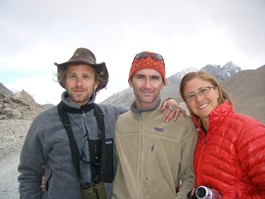
Service, 32, is one of three Sausalito residents who recently put their beliefs on the line in carefully orchestrated protests on Mount Everest and China’s Great Wall. She and Laurel Sutherlin, 30, helped stage an April protest at the Mount Everest base camp where the Chinese Olympic team was practicing for a torch run up the mountain. And in August their colleague Duane Martinez, 26, was videographer for a group raising a 450-square-foot banner reading “One World, One Dream, Free Tibet 2008” on the Great Wall of China.

Tibetan-independence advocates argue that in attempting to use the Olympics to legitimize their country and its tactics in the eyes of the world, Chinese leaders have created an opening for incredibly effective nonviolent protest.

“Right now the Bay Area has an enormous opportunity that we really need to leverage,” Service explains.

She adds, “If the torch comes through [San Francisco], it’s going to be a smear on the city.”

The first jail where Service and Sutherlin were detained was like something “out of a poorly funded Hollywood movie,” Sutherlin says. “It was a cement cell with yak meat hanging from the ceiling and bars on the windows.” Their April 25 nonviolent protest had gone smoothly, which was surprising given all the obstacles.

“There was a lot of cloak-and-dagger shenanigans and high-stakes maneuvering, and a lot of serious effort put into not endangering any Tibetans along the way,” Service says.

Although they’re both gay, Service and Sutherlin posed as an engaged couple eloping to Mount Everest with a high-tech satellite broadcast system so they could share their “big moment” live with the folks back home.

That’s just one of the ways they got the necessary technology into Tibet. But initially most of the cold-sensitive gear didn’t work in the high altitude. So they erected a bright yellow tent (illegally, but nobody stopped them) at the base of Mount Everest. They stayed up all night shoveling yak dung into a fire, heating water and filling hot water bottles which they then snuggled into sleeping bags cradling their equipment. The next morning they walked an hour and a half uphill at 17,000 feet, lugging everything to the protest site.

“It was completely mystical, with the sun rising over Everest and the chorus of bells of the yaks waking up,” Sutherlin recalls. “It was absolutely sublime.”

They unrolled their “One World, One Dream, Free Tibet 2008” banner. Team member Tenzin Dorjee lit a torch and sang the Tibetan national anthem—a brave act in a region where it’s legally considered treason just to say the words “Free Tibet.” The group marched their banner into the Chinese Olympic team’s camp, where they were arrested. They waited to see what would happen next.

“We knew that the Beijing higher-ups wouldn’t want to have injured Americans on hand to create an international incident, but we weren’t sure the field commandos would have gotten that memo in rural Tibet,” Sutherlin explains with a rueful laugh. He adds thoughtfully, “It was a pretty terrifying experience.”

They were detained 55 hours. For the first 30 hours, they weren’t allowed to eat, drink or sleep. And even when they were allowed to sleep, they were frequently shaken awake, keeping them sleep-deprived.

Each was hustled into a separate SUV for the nine-hour drive from Everest to the town of Shigatze, with several stops at local police compounds where the captives were made to walk around in the dark before getting into another vehicle and speeding off again. They only caught glimpses of each other, and were never sure if one of them might have been driven off in a direction from the rest.

Not having been fed for hours, they were led into a huge banquet hall with large round tables, red velvet chairs and a chandelier overhead. Each team member sat at a separate table, surrounded by guards and officials. When they started eating, the room filled with cameramen capturing how well they were being treated. The nightmarish experience ended with a nine-hour, 15-car caravan to the border, sirens blaring all along the way.

“They made a massive pomp and circumstance out of expelling us from the country. It was surreal,” Service says.

It’s likely, she adds, that Chinese officials believe the protesters were treated well.

“The tactics we experienced are just a mild version of what is used throughout Tibet on a regular basis. To them, their treatment of us was gentle, but it actually meets the legal definition of torture. This is the kind of ruthlessness we are talking about in Tibet.”

The one image that videographer Duane Martinez can’t get out of his mind is the windowless brown conference room with buzzing fluorescent lights where his six-member protest team was confined for most of their 36-hour detention after flagging the Great Wall this August.

“If we put our elbows on the table, they’d say no elbows on the table. Or don’t cross your legs. Stand up. Sit down. Any way of keeping us out of a comfortable physical space.”

Occasionally a guard would point at one of them and grunt, “You, now,” and that person went away to be interrogated.

Martinez also remembers the moment on Aug. 8 when the group unfurled their banner on the Great Wall, at a site near the town of Huirao. “I thought my heart was going to fly out of my chest when we started going. It’s a nervousness and an excitement. A lot of that adrenaline was knowing that a live feed was going out. I kept telling myself to think about the ripples that were spreading.”

Security guards jailed the protesters in the rustic cell at the base of the Great Wall. From there they were taken to a nearby town, then to a police compound in Beijing, where they spent about 20 hours. The team members—three from the United States, two from Canada and one from the United Kingdom—refused to answer any questions, asking instead to speak to a representative from their embassy. They never did meet any embassy officials, but after 36 hours of sleep deprivation, interrogation and disorientation, the protesters were told they were being sentenced to five days in jail and ordered to sign Chinese papers. They refused, and all were put on a plane to Hong Kong.

Now back in Sausalito, Martinez, Service and Sutherlin are working to ensure that the Beijing torch won’t receive an unquestioning positive reception in the Bay Area. Sutherlin notes, “This is really a make-or-break moment for the Tibetan people and the Tibetan culture.”

Singer-songwriter Peter Rowan performs at a fundraiser for Students for a Free Tibet, including an auction of work by local artists on Sunday, Oct. 21, in a private home in Mill Valley; $25-$300. For details, go to www.studentsforafreetibet.org/peterrowanbenefit.



Essay: Porto isn’t the same as port

0

10.10.07

The most famous fortified wine of all, Porto is as Portuguese as a Lodi Zinfandel is Californian. So how must the Portuguese feel now that wineries around the world have seized the word—which is, of course, the name of a city in northern Portugal—dwarfed the p, amputated the o and slapped the four remaining letters onto millions of bottles of a very sticky, ruby-red fortified dessert wine?

Raul Riba D’Ave, sales and marketing manager for Fladgate Partnership, a conglomerate of four respected Portuguese wine brands in Vila Nova de Gaia, across the Douro River from the city of Porto, is just amused.

“Your wine is an imitation,” he laughs good-naturedly during a recent phone conversation. “It’s actually forbidden to use that name outside the Douro region. You guys are breaking the law.”

Porto originated as an export product for the British in the late 1600s. Vintners along the Douro River began supplying the wine, which often embarked on a second bout of fermentation in transit, leading to popped corks and cracked bottles. To alleviate this problem, shippers began adding brandy before bottling to kill the active yeasts and prevent further fermentation. As time wore on, this fortification process began to occur before shipment, often upstream in the wine country. This alcohol boost stopped all fermentation of the natural sugars in the grape juice, and the earlier this process was enacted, the sweeter the wine. The British liked the trend, winemakers never looked back, and today Portugal churns out 10 million cases of Porto per year.

Porto and port come in two major styles, tawny and ruby. The tawnys have been aged in barrels for years, have oxidized, evaporated, turned brownish-orange and exchanged most of their original fruit qualities for such delicious flavors as caramel, vanilla, tobacco, hazelnut, dried figs and velvet. (I’ve had velvet before, and it’s quite good.)

Ruby ports are bottled-aged. Oxidation and other barrel effects do not occur, and thus these wines retain their brilliant colors and massive fruitiness. Vintage ports, made only in exceptional grape seasons, are rubies, bottled up as soon as they’re ready so as to encapsulate the essences that defined that particular season.

Since tawnys bear a less terroir than rubies, they are easier to imitate, says D’Ave. But is anybody in California really imitating the Portuguese?

“Portugal has set the standards for port, and so it makes great sense to watch them and taste what they make,” says Marco Cappelli, dessert winemaker for Swanson Vineyards in Rutherford. “But we’re like the Australians, and we’re making our own unique style of fortified wines. Port from Portugal and port from here are different animals entirely, and we should appreciate each for what it is.”

Andrew Quady, owner and winemaker at Quady Winery in Madera, produces a line of dessert wines, including two that are red, fortified, sweet and strong. Quady calls them Starboard, a trademarked name.

“One of the great things about the wine business is that we mostly respect what others are doing,” he says, “and nomenclature is very important for those who have been doing something for a long time. Over here, we haven’t, and we can’t just go and call some wine that we began making a few years ago ‘port.'”

In fact, Quady feels that even comparing port to Porto is pointless. “Californian port makers need to look at their wine for what it is,” Quady says. “The only things our fortified wines have in common with real port is that they’re red, sweet and 20 percent alcohol. They’re usually not even made with Portuguese grapes.”

Actually, Quady does make one of his Starboards from four traditional Porto grapes, yet he admits that the wine is nothing like the product from Portugal—terroir at work—and he says that for a California producer to come out with a product that matches a true Porto in flavor, body and aroma is nearly impossible.

Mick Schroeder, winemaker at Geyser Peak in Geyserville, makes two fortified red wines which brazenly go around calling themselves “port.”

“If it’s not port, then what do you describe it as?” Schroeder asks. “If you had to call it a ‘California fortified red dessert wine,’ I’m not sure consumers would even know what it is.”

A native of South Australia’s Barossa Valley, Schroeder makes wine by subtle stylistic methods that he picked up back home, and he finds it fascinating to compare his ports—one, a tawny made from Zinfandel and Shiraz, the other, a Shiraz ruby—to those of other regions.

“It’s not to be critical or to try and make them the same, but just to understand the differences between the regions,” he explains. “That’s what makes wine so interesting to so many people. We definitely don’t want to emulate Portuguese port, but we certainly can incorporate some tried and true techniques and possibly modify them to fit our own climate and conditions.”

Dixie Gill, director of marketing and communications for Premium Port Wine, attributes some of the characteristics of true Porto to the production methods: when the brandy is added; the proof of the brandy, which may range from 140 to 200; and, perhaps most importantly, the pressing of the grapes, which still involves bare feet in parts of the Douro Valley. But grape-stomping is no longer the esteemed career that it once was, and the Symington family, a leading Porto producer in Porto, has invented a machine that mimics the work of the human foot. The mechanism presses the grapes for hours, and a set of silicon toes does the crushing. Like the pads of the human foot, the silicon does not break the seeds of the grapes, which contain bitter tannins.

Producers in Portugal are pushing the E.U. to tighten restrictions on outsiders calling port “port,” and this bugs Peter Prager of Prager Winery. “Porto is a place on a map, but you can’t show me ‘port’ on a map. It’s not a place. It’s a word and a style of wine, and we make it in California.”

Quady may have struck gold with the name Starboard, but, he concedes, it’s just a name.

“Whether it’s sparkling wine or Rhone style, people in California need to start thinking about what the wine we make is and stop comparing it to places in Europe,” he says smartly. “Life is too short to spend it bickering about terms and names.”

Quick dining snapshots by Bohemian staffers.

Winery news and reviews.

Food-related comings and goings, openings and closings, and other essays for those who love the kitchen and what it produces.

Recipes for food that you can actually make.

The Shop in Sonoma

ISSUEDATETo the casual passerby, the Shop doesn't look like the crown jewel that it is; it's pretty much a dingy warehouse in the middle of nowhere. But for almost 10 years now, it's served as a haven for the area's teenagers, providing a stage for budding young bands and a drug- and alcohol-free hangout on weekend nights. Far from...

The Green Zone

10.10.07 On Sept. 21, I attended the Climate All Stars Conference in San Francisco. Organized by the Climate Protection Campaign (CPC), a nonprofit located in Sonoma County's small town of Graton, this conference was an ambitious effort to bring together a lineup of resources and individuals actively working to save the planet from the effects of global warming. The CPC...

Essay: Rock and Roll Hall of Fame 2008 choices

10.10.07In August 2006, some 200-plus KISS fans massed at the Rock and Roll Hall of Fame museum in Cleveland, protesting the classic rock band's eight-year-long omission from the Hall's annual induction ballot. The KISS Army didn't protest this year, when the Hall recently announced the nominees for its spring 2008 induction ceremonies, which include Madonna, the Beastie Boys, Donna...

Everyone’s a Winner, Pt. II

the arts | visual arts | ...

Review: ‘My Kid Could Paint That’

10.10.07On camera, Marla Olmstead is one of the cagiest abstract expressionists artists ever interviewed. Olmstead makes a chronically tight-lipped painter like Jackson Pollock seem like a chatterbox. Facing queries about her work habits, the meaning of her paintings or her technique itself, she demurs and tries to turn the microphone over to her brother. When pursued by questions she'd...

Letters to the Editor

September 26 - October 3, 2007Lamb dressed as lambHannah Strom-Martin's points about the bias of the fashion industry against the well-endowed ("My Two Breasts," Oct. 3) are well taken. The designers have decided that bodies should fit their clothes, not the other way around. Shame on them. Women don't really have to put up with that, and yet, for...

News Briefs

10.10.07 missing wireRecently, someone stole a PG&E truck out of the company's Petaluma yard, making off with its cargo of 2,000 pounds of copper wire worth around $7,500. Steadily increasing prices paid for scrap metal have sparked an ongoing series of metal thefts, with copper wire an appealing target. "It's a nationwide problem that we're experiencing here," explains PG&E spokeswoman...

The Byrne Report: Station Casinos and the Rohnert Park casino—what stinks

10.10.07Trail of Cash going to happen, and there's nothing anyone can do to stop it.—Greg Sarris, chairman, Federated Indians of Graton RancheriaThe Graton Rancheria casino-hotel project lumbers through the bureaucratic maze constructed to make it appear that some consideration, however slight, is being given to weighing the environmental, sociological and economic costs to the community of building and operating...

Marin activists fight for a free Tibet

10.10.07San Francisco is scheduled to be the only North American city hosting the Olympic torch as it winds its way to China next April. Several local residents are already making plans for the torch, but their energies aren't aimed at cheering as this symbol of international unity is carried through the city. They hope to convince the Bay Area...

Essay: Porto isn’t the same as port

10.10.07The most famous fortified wine of all, Porto is as Portuguese as a Lodi Zinfandel is Californian. So how must the Portuguese feel now that wineries around the world have seized the word—which is, of course, the name of a city in northern Portugal—dwarfed the p, amputated the o and slapped the four remaining letters onto millions of bottles...
11,084FansLike
4,446FollowersFollow
6,928FollowersFollow