News Blast

0

08.13.08

Don’t Tase Me, Bro

The fuzz is getting a bad rap lately. Witness YouTube, where thousands tuned in to watch a rogue New York City cop shove a cyclist or the tasing of a young Florida man at a 2007 John Kerry speech. Police and law enforcement officer brutality has come to the forefront of national attention lately, prompting activist groups to form around the country, and the North Bay is no exception.

The Police Accountability Crisis Hotline (PACH) is a recent volunteer effort to make police forces accountable to the community after a spate of killings of unarmed citizens in Sonoma County last year. Volunteers for PACH take turns monitoring calls day by day, interviewing callers and recording the complaints, says member Marty McReynolds, which are then filed in order to establish patterns involving specific agencies or officers.

McReynolds says the fledgling hotline does not work directly with police stations—at least not yet—and though PACH does not function as a legal referral service, it tries its best to put callers in touch with a lawyer if needed.

“We’re still in the process of learning how to take in reports and deal with callers involved in stressful situations,” McReynolds says. “The main thing PACH can do is act as the public’s ear—listen to complaints and record them so they don’t get lost in the bureaucratic shuffle.

“Plus, it often helps someone to be able to talk with a sympathetic listener after a traumatic experience with law enforcement,” he continues.

Protest groups like the Coalition to Stop Police Brutality, based in both San Francisco and Sonoma County, are plentiful in the North Bay and supported by handfuls of unnerved citizens. The Coalition’s March and Rally to Stop Police Brutality, Repression, and the Criminalization of a Generation on Oct. 22 of last year drew crowds dressed in black all over the streets of Santa Rosa. The crisis hotline prefers a quieter approach, providing a support system for those affected by law enforcement abuse instead of picketing police stations.

Currently, PACH is seeking nonprofit status and hopes to be able to solicit tax-free donations once the process is complete, says McReynolds, but it also has a long road ahead to consider.

“My personal opinion is that it’s too early to consider PACH a success,” McReynolds says. “We have a lot of work to do, but we have people who are excited about what we’re doing and willing to donate their time and money to make it work.”

For more information on PACH, or to report an incident, call the hotline at 707.542.7224.

The Bonehead Chronicles

0

08.13.08

Upon breaking my clavicle in my senior year of high school, I was instantly aware that I had, in fact, broken my clavicle. It happened during a bike ride to the YMCA with some friends. We were all going swimming, and I had offered to carry all of the swimsuits and whatnot in my backpack, to make things easier on everyone. Little did I know. (I think that’s called “foreshadowing.”)

I had borrowed a bike from my then-girlfriend, and it was one of those racer-style street bikes that I’ve only ever seen Lycra-wearing serious bicycle enthusiasts riding. The handlebars curved down in the front, so you had no choice but to bend down quite far into what I’m sure must be the best possible position for racing down a hill at breakneck speeds. It was, however, for me, just the best testicle-crunching position I’ve ever contorted into.

It took me a block or two to get the hang of the bike, but before long, I was going along at a pretty good clip. I was at the front of the pack and someone behind me called out my name. For what reason, I do not know. I whipped my head around to the left, and my momentum caused my backpack full of their bathing suits to whip out to the right, which threw me right off of the bicycle, down to the ground, and hard on my right shoulder. I heard a crisp snap! and skidded for a few feet, finally coming to rest on my back, on top of my backpack.

Concerned I might look funny lying there like that, not unlike a turtle on its back with its legs waving in the air, I literally jumped to my feet, trying to look natural and cool. Instantly overcome with nausea and nearly blacking out, I nonchalantly vomited into the gutter.

My bicycling friends arrived moments later, having doubled back. I wiped my mouth on my sleeve.

“Jeez, man! That was a nasty-looking fall! Are you cool?” They all agreed that it looked very bad.

“Yeah. I broke my collarbone. I’m fine, though.” I played it off and sat down on the curb, making sure I was well away from the vomit. (I know it sounds strange, but my primary concern was keeping myself composed and looking good.)

“Do you want us to call an ambulance?” one of them asked.

“No, I’m good.” I gently moved my right arm, and the pain shot through my right side like a bolt of lightning, causing me to black out. When I came to, one of my male friends was (for lack of a better word) cradling my upper body, having caught my head before it cracked open like a ripe casaba on the sidewalk. “Seriously, you guys,” I continued casually, “I’m cool. I’ll take care of this. Go on ahead to the Y, and I’ll call a cab.”

“Yeah, right. Nothin’ doin’.”

Ah, friends.

After a quick trip to the ER, and a few weeks, I was good as new. Until I broke my collarbone. Again. Riding a bike. Again.

“You’re joking.” My wife said when I told her this story. Sadly, I wasn’t. I rebroke it again within one month of the first break.

“I was feeling a lot better, no pain really, and I decided to ride a different bike down to the gas station, to, well, make sure I could still ride. You know how, if you want to gain some speed really quick on your bike, you’ll kind of stand up and pedal? Well, I was doing that and I missed the pedal, and my right foot hit the ground, causing my handlebars to come up toward me quickly, and my arms to jerk back quickly. I heard a snap and, yeah, it broke again.”

“Did you learn something from this?” she asked me, in a tone that didn’t quite suggest confidence that I had, in fact, learned something from this.

“Yes, I did.” I replied matter-of-factly. I learned not to tell my wife stories that make me look like a bonehead.

 Open Mic is now a weekly feature in the Bohemian. We welcome your contribution. To have your topical essay of 700 words considered for publication, write op*****@******an.com.


Wine Tasting Room of the Week

0

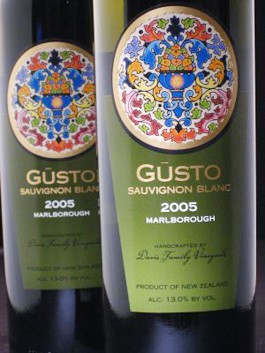
California Sauvignon Blanc sure has improved over the past decade, hasn’t it? I’d like to think that it has to do with improved management techniques and trellis design, not just the fact that I used to drink really cheap Sauv Blanc. Some are as sharp and lean as a blade of grass; others, sweet and round as a melon from sitting lazily on their lees in the barrel. But Guy Davis was not having it. The Healdsburg winemaker has given up on making California Sauvignon Blanc altogether, and now imports it from New Zealand.

After working the harvest during our off-season, the down-under on-season, Davis decided that only kiwi fruit could deliver what he was looking for. The flying family winemaker makes two trips a year to shepherd the wine through harvest and bottling. There’s no question that his “Gusto” 2006 Sauvignon Blanc ($20) is a tight package of tropical zing and zest, a dry but mouth-watering pineapple-pear cocktail, the likes of which are rare. But that’s not all. When he’s, you know, in the area, Davis also makes a Malbec in Argentina (to be released).

Located in a few unshowy Healdsburg buildings, the winery is easily recognizable for the big recycled material sculpture out front, created by Sebastopol artist Patrick Amiot. Davis was our fourth stop in a recent excursion, and was the most relaxed and real tasting room of the day. The visitor area is only a moderately duded-up portion of the barrel room; the wave-shaped bar is made of smooth riverbed pebbles covered with epoxy—and they’re not “rocks from the vineyard” whose unique mineral notes express the wine’s terroir, for a change. They’re just rocks.

Besides the Sauv Blanc, I particularly enjoyed the light and dry 2006 Côte Rosé ($25), like a picnic cooler full of strawberries and cheese. A perfume of violets and paint precedes flavors of blueberries and dry cocoa in the 2005 Guyzer Block Syrah ($38). There’s nothing like a generous helping of blackberry sweetness; a wild touch of spicy flora adds interest to the 2005 Rapport Zinfandel Port ($30).

So there are plenty of local grapes Davis hasn’t given up on—plus apples. The winery’s unique Apple-ation brandy ($35) is fermented from heirloom Dutton Ranch apples, then distilled. It’s a bit like a bracing hit of grappa, but tasting of this spirit is not allowed on the premises (otherwise, my notes might be even more unreadable). The 2003 Napa Valley Cabernet Sauvignon ($50) is nice, but I don’t think I meant to say that it has a “big, fun aroma of liquor and Chevys.”

Davis Family Vineyards, 52 Front St., Healdsburg. Open Thursday–Sunday, 11am–5pm. $5 tasting fee, refundable. 707.433.3858.


View All

Card Sharp

0

the arts | stage |

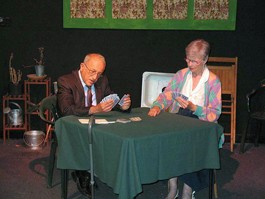
FLUSH: Joe Cicio and Karen Stern spar over cards.

By David Templeton

The problem with so many community theater companies is that, in the drive to be taken seriously, most of them want ticket-holders to overlook the fact that they are community theater companies. Somewhere along the way, “community theater” has become a dirty word, a synonym for “amateur,” “awkward” and “bad.” In reality, there has always been something beautiful about community theater in its purest form.

When theater-loving folks from throughout the community come together to put on a show, to risk their reputations and egos as friends and family line up to watch, it can be as thrilling and magical as a skirmish between two high school football teams, as moving and dramatic as a valedictorian speech by a graduating senior. One need not be a professional to work wonders on a stage, and the fact that the actors are less polished than they will be in the future only adds to the fun. Dreamweavers Theatre in Napa is one of the few local companies that has embraced the word “community,” boldly collecting together local actors and directors, most of whom have full-time day jobs doing something else, and putting on a play for their neighbors.

Is it as good, tight and polished as what you’d find at an Equity house with full-time professional directors? No, and it’s not supposed to be. If we only allowed pros to play, we’d be cheating ourselves and the many talented folks brave enough to tread the boards for our entertainment. Such companies deserve our support, and Dreamweavers—a lovely flashback to a time when community was not a dirty word—is a prime example of why.

D. L. Coburn’s The Gin Game, which won the Pulitzer Prize in 1978, just opened a three-week run at Dreamweavers’ 30-seat black box theater, hidden away in the rear of the River Park Shopping Center in Napa. As directed by June Alane Reif, it is a spirited and entertaining effort, though frequently uneven and occasionally a bit confused—like the characters portrayed in the play.

Fonsia Dorsey (played with brittle primness by Karen Stern) is a new resident at a seedy retirement home where she apparently receives no visitors. When she meets surly but charming Weller Martin (Joe Cicio) on the cluttered back patio, he invites her to play a hand of gin rummy, and an apparent friendship is born. Described by the author as a “tragic-comedy,” it is only a matter of time before the cordial twosome turn on each other.

Played with a kind of courtly vulgarity by Cicio (last seen in Pacific Alliance Stage Company’s Wonder of the World), Weller’s catalyst for his developing rage is Fonsia’s apparent inability to lose a single hand of gin, despite never having played the game before. “Lord knows I’m no expert,” she coldly teases him. “I just play like an expert.”

For Fonsia, it’s Weller’s coarse language and bad temper (and eventual similarity to her ex-husband) that peels away her carefully crafted veneer, revealing a cruel, calculating, judgmental side that Weller begins to use against her as the game turns decidedly unfriendly.

All of these layers are difficult to play, and Cicio and Stern aren’t quite up to the challenge, so their characters exist much more on the surface than when more experienced actors take on this production. As a result, the character shifts are a bit confusing, and Fonsia and Weller come off as simpler people than written to be. But under Reif’s spare direction, that works most of the time. Instead of hinting early on at the meanness each has developed after so many years of regret and loneliness, each character surprises us when they suddenly throw a low blow, as when Weller tells Fonsia, whom he’s recently learned has a son who despises her, “You know what’s wrong with most of the people in the world? They have a mother who’s just like you.”

With language strong enough to peel the paint off the set, this Gin Game won’t be for everyone, but for the opportunity to see two gutsy actors taking huge chances, and mostly succeeding, community-theater supporters will definitely want to be dealt in on this one.

‘The Gin Game’ runs Friday–Sunday through Aug. 24. Friday–Saturday at 8pm; Sunday at 2pm.  Dreamweavers Theatre, in the River Park Shopping Center, 1637 W. Imola Ave., Napa. $18–$20. 707.255.5483.


View All


Museums and gallery notes.


Reviews of new book releases.


Reviews and previews of new plays, operas and symphony performances.


Reviews and previews of new dance performances and events.

Letters to the Editor

08.13.08

Speaking Spoiler

On Sunday, Aug. 3, Ralph Nader spoke at the Sebastopol Community Center, among other venues in Sonoma and Marin counties.  I had a long exchange with him about the 2000 election and his role as the spoiler.  Of course, he denies this and has his obscure sources to support a not very coherent defense.

The fact is Nader ignored a letter by 25 of his most trusted and oldest advisers pleading with him to capitulate and to back Gore.  Further, he reneged on  his own promise not to compete in any state that was close. Nader was campaigning in Florida days before the election with the help of Republican money. Ninety-two thousand votes went to Nader in that election, to say nothing of the drag his constant attacks put on Gore’s campaign.

As his aide was prodding me to finish because, he said, “We’re running out of time,” Nader glibly recounted an obviously polished story about meeting Al Gore in Washington six months after the election. “I said,” Nader recounted, “‘Isn’t it a relief, Al?’ and he just smiled.” Well Ralph, maybe it was a relief for Al, but how about the rest of us? How about the 500,000 dead Iraqis? How about the festering environmental issues that have been ignored and suppressed for the last eight years? How about the Supreme Court that, as a lawyer, you should be keenly concerned about?

If you want to blunt Nader’s impact on the current election, make a point of attending his fundraisers and take advantage of the question-and-answer period  by confronting him on these issues. It’s very therapeutic.

Bruce Kranzler

Tomales

Faster, Pussycat!

I find it highly ironic that your paper did a story on credit card debt among Generations X and Y (“Generation Debt,” July 30) and yet on page 3 of that issue, there is a whole page devoted to advertising for a Visa credit card! Advertising is also part of the problem! Our generation’s demand for bigger and faster products and the rise of an elite class keeps these new products on the market. It is no longer about keeping up with the Joneses; now, it is about keeping up with a forever changing technology that gets faster and smaller and more powerful with each phase of the techno evolution. Face it, today things have become more expensive with each passing day. Food, gas and living are at an all-time high and could hit an all-time record high. We live for now and deal with tomorrow when tomorrow comes.

Nicole Generation X

Santa Rosa

Pursuit of Empire

Regarding John Sakowicz’s “To America, with Shame” (Aug. 6), the premise of most U.S. writers is that the United States was once a great nation and promoter of liberty for all, but that has never been true. There were the Indian wars and the maintenance of slavery long after most of the rest of the world had abolished it.

There is still the widespread use of capital punishment, long after most other countries have abolished that.

There is the fact that the United States has been involved in foreign wars—in pursuit of empire—for well over a century, whilst other (former) imperial powers have largely given up on trying to have global economic and military dominance.

It is sad that U.S. critics of the U.S.A. do not recognize their own history, but instead believe that the current state of affairs is an aberration, whereas it is actually the norm and just winding out in much the same way that the Roman Empire wound out, due to overreach, overambition, corruption and whatever else accounts for the end of any empire.

Gerry Hiles

South Australia

Calling Bob Canard

I enjoyed your articles about local farmers, community gardens and the new trend toward growing more food locally (“Arcadia,” July 23). I’ve been wondering aloud recently if Sonoma County could strategize effectively and become totally self-sufficient for food and perhaps other things like fuel and energy, as well.

I remember that Bob Canard used to teach organic agriculture at SRJC.  Perhaps he could be a valuable resource for starting such a large-scale project. Sonoma County could be a model community for the world, especially if a comprehensive, compassionate population-control program was included.

How about it?

Barbara Dougherty

Cotati


&–&–>

Oh, Nellie!

0

08.13.08

Nellie McKay may have artistic ADD. The singer-songwriter, who performs at the Mystic Theatre on Aug. 18, doesn’t just write songs. Recently, McKay has acted on Broadway and in the movie P.S. I Love You, shown up in rap videos on YouTube and written book reviews for the New York Times. This is on top of recording three albums of her own music, most recently Obligatory Villagers, released last September.

“I’m jack of all trades, master of none, you know,” she said in a recent phone interview. “I have a short attention span. I wish it wasn’t so, truthfully. But there are two ways to approaching something creatively. One is to focus on the good stuff and aspire to be like that. That’s the depressing way. The other is to focus on all the bad stuff and pat yourself on the back when it comes out OK. That’s my approach.”

Musically, McKay jumps around in style as much as she jumps around in projects, touching on jazz, Broadway, pop, lounge and even hip-hop. The connecting tissue throughout, aside from her jazzy voice, is her sense of humor. McKay is rarely serious, even when she’s addressing serious issues like sexism or gay marriage. Sometimes her songs are downright silly, like “Zombies,” about, well, zombies. Others are sarcastic, like “Mother of Pearl,” which starts out, “Feminists don’t have a sense of humor / Feminists just want to be alone (boo-hoo) / Feminists spread vicious lies and rumor / They have a tumor on their funny bone.” Though the song is about how people stereotype feminists, McKay’s tongue-in-cheek delivery can confuse people into thinking she’s being sincere.

“When we did [that song] on Garrison Keillor’s Prairie Home Companion, he got so many angry letters,” she says. “And when I played a NOW concert, the lady who was introducing me read some of the lyrics of that song out loud and people in the crowd went, ‘Oh, that’s terrible.'”

At 26, McKay dyes her hair silver-screen-movie-star blonde, wears vintage clothes and talks fast, mixing hard-boiled wisecracks with breathless girlishness. (“Oh!” she exclaims in the middle of the interview. “There are people singing on the street right now!”) There are contradictions even in the people she emulates. One of her heroes is the 1950s ever-virgin Doris Day, an odd choice for an outspoken feminist. McKay, a vegan and member of PETA, admires Day’s commitment to animal rights.

“And musically, I loved listening to her,” she says. “She had a lovely, lovely, lovely voice. It’s an underrated voice. And she had a freshness and an innocence that is projected in her image and all her movies that is lacking culturally, nowadays.”

Given McKay’s distinctiveness, it’s no wonder that her stint with a major label was doomed. In 2003, she signed with the Sony/Columbia label to record her first album, Get Away from Me. McKay lobbied aggressively for a double disc CD instead of the 13 tracks Sony wanted. The label gave in, but when the next album came along, they were adamant that she stick to a 16-track disc. McKay wanted to record a 23-track double disc, and a standoff ensued. In the end, Sony dropped McKay from the label and the album, Pretty Little Head, came out on the independent Black Dove label.

“So many difficult artists you hear about aren’t really being that difficult,” McKay says. “The only reason I wanted a 23-track is because there is such a length of time between releases, you have to sit on stuff. It would have been years before I would be releasing another album, and by then there would be more songs piled up. I wanted to get it out there.”

In addition to touring, McKay is writing the music for the Broadway musical version of Election, the 1999 movie with Reese Witherspoon and Matthew Broderick. But her approach to writing the music is haphazard, she claims.

“Generally, I’m more and more clueless [about writing songs],” she says. “Mostly, you hope that when something comes in part, it will develop into something full. Then when it only develops in part, I kind of give up. I don’t have a working process. It’s a problem. Some people turn to liquor.”

This isn’t just modesty. When asked, McKay can only name a handful of her songs that she likes. Whatever she does, it seems, McKay is her own worst critic.

“But the songs seem to mean something to some people, which is one reason to keep making records,” she says. “There’s a lot of schlock that gets put out there, you know. I have written some schlock, too, and people seem to like it. I guess that means I have some schlocky friends.”

 Nellie McKay appears on Monday, Aug. 18, at the Mystic Theatre. Solid Air opens. 23 Petaluma Blvd. N., Petaluma. 8pm. $20; 21 and over. 707.765.2121.


Four-Sided Triangle

08.13.08

Something Mediterranean has gotten into Woody Allen, and it’s about time. Vicky Cristina Barcelona is Allen’s strongest film in years, his most affable and least haunted. The sneaky sensualist in Allen has evolved into something less tentative; there’s a Henry Miller quality to the romantic misadventures here.

The film starts with a splash of mosaics at the Barcelona airport as a narrator (Christopher Evan Welch) describes two arrivals for a summer holiday, and they’re as unlike each other as Snow White and Rose Red. Chronic dissatisfaction syndrome sufferer Cristina (Scarlett Johansson) has just dumped her New York boyfriend and disowned the 12-minute film she’s worked on for months, while her more staid traveling companion, Vicky (Rebecca Hall), is destined to settle down to a life of dull safety with her fiancé as soon as she gets back to the United States.

At a restaurant, the two young women are simultaneously picked up—gently but bluntly—by Juan Antonio (Javier Bardem), a successful artist. He wants to fly the two of them into a nearby town, and thence into the space of one large bed. Few actors can carry off the double-seducer role as well as Bardem, and his smokiness keeps the film far away from lecherous ickiness. Also, Juan Antonio has his own cross to bear: his violent yet needy ex-wife, Maria Elena (Penélope Cruz), who is also a painter. She once perforated him with a knife, and she’s not completely out of the picture yet.

There are some performers in Vicky Cristina Barcelona who seem especially handicapped by having to speak English. Let’s blame the treacherous language instead of them. Cruz is ravishing here, even in awkward poses, as when she’s seen from a high angle shot with her pant legs wadded up to her knees, straddling a canvas she’s working on. Johansson’s hair is dyed a convincing gold, and fine as she is, she is just part of the four-sided triangle. She doesn’t distract from Cruz, nor the fascinating Hall, a dark, handsome physical type who doesn’t get idealized in the movies very often.

Naturally, Barcelona does its stuff, with feast-day fireworks, the Gaudi tour and the bird market at Las Ramblas. Over these scenes, the narration can sometimes Rick-Steves-it up. When it describes feelings and apprehensions, it also seems unnecessary. There’s no need for a Flaubert tone when there’s so little space between the way the characters act and the way they’re thinking.

There’s also a certain flatness in the background characters. On one hand, the other members of the cast aren’t schticking relentlessly; on the other, they’re also not doing much of anything else, and at times one starts to miss the flow of jokes (there’s a good one about the obscene sound of the word “snorkeling”—leave it to a longtime comedy writer like Allen to not neglect the funny k sound).

American movies tend to suggest sexual freedom and then ringingly endorse monogamy as if it’s something they just invented. While Allen comes to his usual conclusion that anhedonia rules the world, he’s on the side of the libertines in his new film. That makes all the difference.

‘Vicky Cristina Barcelona’ opens Friday, Aug. 15, at Rialto Cinemas Lakeside, 551 Summerfield Road, Santa Rosa. 707.525.4840.


New and upcoming film releases.

Browse all movie reviews.

Wine of the Season

0

08.13.08

Auctions can be dangerous. So many tantalizing options and all that money flying about triggers the compulsive inner consumer. Numbers are scratched, paddles are lifted, and suddenly a 3-by-4-foot acrylic nude painting in bright swirling metallics gloats gaudily from the bathroom wall, a constant reminder of bad decisions made.

Yet some occasions are worth the splurge. Folks with money to burn in pursuit of fun and philanthropy will find just that at the Sonoma Valley Harvest Wine Auction, now in its 16th year, which takes the prize as far as North Bay auctions go. The event is the finale to cap off the inaugural Sonoma Wine Country Weekend, which runs Aug. 29&–31.

After raising $1.3 million last year and over $8 million in the previous 15 years overall, the auction is expected to rake in the bucks this year with more than 50 lavish lots, live music and a slew of local celebrity chefs to guide attendees through various food and wine tastings. Among the contributing wineries are Sangiacomo Vineyard, Schug Carneros Estate, Gloria Ferrer Winery and Ravenswood Winery. Proceeds go to 13 local charities, including Hanna Boys Center, Operation Youth of Sonoma Valley and WillMar Center for Bereaved Children.

The tagline “You’re not hallucinating, you’re in Sonoma Valley!” and a ’60s theme give the event an irreverent, festive tone, with one of the groovier highlights being a Lava Lamp Lounge where guests can sip wine and relax beside a Volkswagen-bus-turned-refreshment-stand. Rockin’ throughout the day, a live band will serenade auction-goers with throwback Rolling Stones tunes and other ’60s favorites.


Forget the Bath and Body Works baskets and Best Buy gift certificates. The seriously sumptuous auction lots are enough to make any hedonist drool, with options including a French culinary arts trip to Washington, D.C., and Paris and a week for four in Florence at the Petroni family’s elegant two-bedroom apartment on Piazza dell’Olio. For those who don’t feel like flying overseas, a fully loaded 2008 Toyota Prius is just waiting to save one lucky driver a lot of gas money. Those who can’t make it to the event or who need a head start on bidding can now do it online at www.sonomawinecountryweekend.cMarket.com.

But folks interested in low-budget revelry should look elsewhere for a good time—”high rollers only” seems to be the memo. A single ticket to the event costs a whopping $750 on Sunday, Aug. 31, at Cline Cellars, 24737 Arnold Drive, Sonoma. 11am&–6pm; bidding begins at 1pm. 800.939.7666. [ http://www.sonomawinecountryweekend.com/ ]www.sonomawinecountryweekend.com.

Quick dining snapshots by Bohemian staffers.

Winery news and reviews.

Food-related comings and goings, openings and closings, and other essays for those who love the kitchen and what it produces.

Recipes for food that you can actually make.

Art at the Fair

0

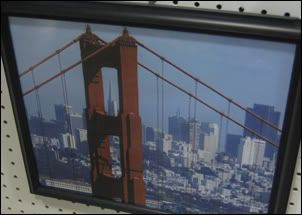
The closest thing we get to a football pool around here at the Bohemian offices is our annual “Art at the Fair” pool. Or, to be more precise, we take bets on how many photographs of the Golden Gate Bridge there will be in the “fine art” pavilion in E.C. Kraft Hall at the Sonoma County Fair.
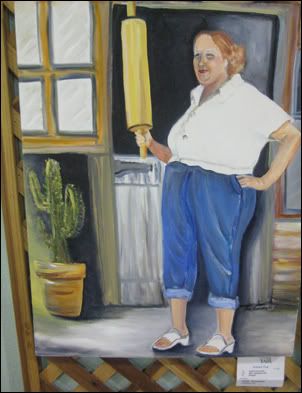
This year, we expanded on the idea. Gabe started the betting by predicting there would be five, count ’em five photos of the Golden Gate Bridge. Sara’s prognosis was that at least one of them would have a ribbon, and Gary went out on a limb by betting there’d be a series of Golden Gate Bridge photos—that is, more than one photo in the same frame—and furthermore, that one of the photos in the series would be a close-up of one of the bridge’s huge cables.

The totals:

Six, count ’em six photos of the Golden Gate Bridge.

Three photos of the Golden Gate Bridge with ribbons.

One series, titled “The Many Faces of the Golden Gate Bridge,” featuring three photos.

No closeups of the cables though. We still think Gary wins. And in a notable tangent, there were three paintings of the Golden Gate Bridge.

Kraft Hall enthusiasts can each year also count on. . . a pencil drawing of a famous celebrity! In the past, charcoal likenesses of Michael Jackson, Eminem and Marilyn Manson have graced the walls. What could it be this year? Let the betting begin! Gabe predicted Zac Efron, Sara guessed Obama and Gary went for Ian McKellan as Gandolf.

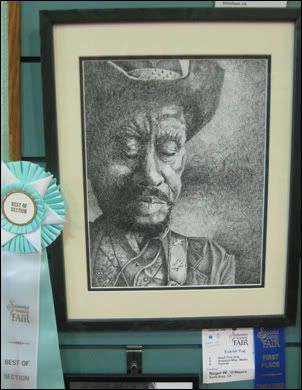
Alas, none of us were correct. Still, no one could have guessed there would be this impressive portrait, by Roger O’Meara, of Clarence “Gatemouth” Brown:

And I was especially amazed to find a painting by Heidi Snowden of my personal celebrity, Juanita Musson, who owned a series of restaurants in Sausalito and the Sonoma area in the 1950s-1970s:

Juanita’s favorite two phrases were “pour your own coffee!” and “eat it or wear it!” Diners who left food on their plate would find themselves chased out into the parking lot, where Juanita would viciously chuck the plate of leftovers at their head. My kinda gal. There’s an excellent book by Sally Hayton-Keeva about her life in restaurants, and anyone interested in the way restaurants ought to be operated should read it.

The Boys are Back in Town

0

Riding with our good Irish correspondent Fionnan Sheridan around the city of Dublin—where, as you can imagine, U2 are revered—my brain settled on a perfectly reasonable question. “Do any members of U2,” I asked, “still actually live in Dublin?”


I say “perfectly reasonable” because in 2006, U2 notoriously moved their enormous assets out of Ireland and into a Dutch tax shelter once the famous Irish tax exemption for artists was capped. I’d say that constitutes a pretty big “up yours” to Ireland, especially when just months before, Bono had loudly appealed to Irish Prime Minister Bertie Ahern to increase Ireland’s overseas aid. Following the money, wouldn’t the band’s members leave Ireland behind and move to France, New York, or—in Bono’s apparent wishes—a mansion in Heaven next door to Jesus?
“Some of them still live here,” said Fionnan. “Right up here a ways is Larry Mullen’s house, actually.” And in minutes, we were driving down a narrow street of large houses with big front yards, stone fences, and locked gates. Fionnan continued: “Phil Lynott’s mother lives somewhere on this road, as well.”
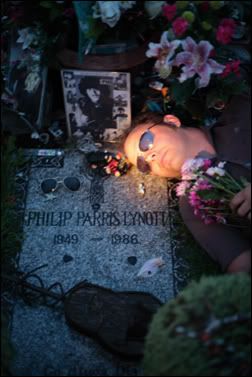
My heart skipped. Really? “Oh, sure,” he replied, like he was talking about the shopkeeper down the way, or the guy who sells newspapers on the corner. He then pointed out the church in Howth that was the site of Lynott’s funeral, and quickly thereafter we were driving by Saint Fintan’s Cemetery, where the great Thin Lizzy frontman is buried.
Anyone who knows me knows that I can’t pass up a celebrity grave—and certainly not the one of Phil Lynott. So we hoofed it across the long, flat cemetery with flashlights, trying in the dark to locate where he’s buried. Like most celebrity graves, it was easy to spot from far away: flowers, guitar parts, leather necklaces, steel bracelets, and handwritten and photocopied tributes piled all around.
I reflexively sang the riff to “The Boys are Back in Town,” which is naturally the first Thin Lizzy song I ever heard. But then I remembered the vast catalog of great Thin Lizzy songs I’d discovered about five years ago, thanks largely to my friend Josh, and so I hummed one of my favorites: “Dancing in the Moonlight.” Sort of apt, actually, under the dwindling Dublin skies.
I talked with Fionnan’s brother a little bit about Phil Lynott, and what it was like growing up in the same neighborhood. “When I was little,” he told me, “you’d see ’em walking on the beach here together, Phil and his mom. And you’d just think, ‘wow.'”
“He’s got a pretty unmistakable profile,” I offered.
“Oh, yeah. An’ in that time especially, seeing a black person in Dublin was unheard of. It’s still rare now, but back then you really noticed it.”
On this graveyard expedition with us was my 15-year-old niece Qiana, who had never heard of Thin Lizzy at all. So I tried to explain that they were this total kickass rockin’ band that was known for these crazy rockin’ songs, and I air-guitared the solo to “I’m a Rocker” to demonstrate, but that they also had this really tender side, too, with tortured pleas like “I’m Still in Love With You,” and come to think of it, their first album was pretty weird and psychedelic and had this great song called “The Friendly Ranger at Clontarf Castle.”
Qiana just laughed at me. I guess I can’t blame her. She’s into Zac Efron and Kanye West.
When we got back to the house and to a computer, I showed Qiana some Thin Lizzy videos, but I’m pretty sure it only cemented my looniness—especially when I showed her the video for “Sarah,” a.k.a. the most amazingly dorkiest video ever made. Seriously. Watch it, and try to imagine any 15-year-old in the world today thinking that it’s at all cool.

News Blast

08.13.08 Don't Tase Me, BroThe fuzz is getting a bad rap lately. Witness YouTube, where thousands tuned in to watch a rogue New York City cop shove a cyclist or the tasing of a young Florida man at a 2007 John Kerry speech. Police and law enforcement officer brutality has come to the forefront of national attention lately, prompting activist...

The Bonehead Chronicles

08.13.08Upon breaking my clavicle in my senior year of high school, I was instantly aware that I had, in fact, broken my clavicle. It happened during a bike ride to the YMCA with some friends. We were all going swimming, and I had offered to carry all of the swimsuits and whatnot in my backpack, to make things easier...

Card Sharp

the arts | stage | ...

Letters to the Editor

08.13.08Speaking SpoilerOn Sunday, Aug. 3, Ralph Nader spoke at the Sebastopol Community Center, among other venues in Sonoma and Marin counties.  I had a long exchange with him about the 2000 election and his role as the spoiler.  Of course, he denies this and has his obscure sources to support a not very coherent defense.The fact is Nader ignored...

Oh, Nellie!

08.13.08Nellie McKay may have artistic ADD. The singer-songwriter, who performs at the Mystic Theatre on Aug. 18, doesn't just write songs. Recently, McKay has acted on Broadway and in the movie P.S. I Love You, shown up in rap videos on YouTube and written book reviews for the New York Times. This is on top of recording three albums...

Four-Sided Triangle

08.13.08Something Mediterranean has gotten into Woody Allen, and it's about time. Vicky Cristina Barcelona is Allen's strongest film in years, his most affable and least haunted. The sneaky sensualist in Allen has evolved into something less tentative; there's a Henry Miller quality to the romantic misadventures here.The film starts with a splash of mosaics at the Barcelona airport as...

Wine of the Season

08.13.08Auctions can be dangerous. So many tantalizing options and all that money flying about triggers the compulsive inner consumer. Numbers are scratched, paddles are lifted, and suddenly a 3-by-4-foot acrylic nude painting in bright swirling metallics gloats gaudily from the bathroom wall, a constant reminder of bad decisions made. Yet some occasions are worth the splurge. Folks with money...

Art at the Fair

The closest thing we get to a football pool around here at the Bohemian offices is our annual "Art at the Fair" pool. Or, to be more precise, we take bets on how many photographs of the Golden Gate Bridge there will be in the "fine art" pavilion in E.C. Kraft Hall at the Sonoma County Fair.This year, we...

The Boys are Back in Town

Riding with our good Irish correspondent Fionnan Sheridan around the city of Dublin—where, as you can imagine, U2 are revered—my brain settled on a perfectly reasonable question. "Do any members of U2," I asked, "still actually live in Dublin?" I say "perfectly reasonable" because in 2006, U2 notoriously moved their enormous assets out of Ireland and into a Dutch...
11,084FansLike
4,446FollowersFollow
6,928FollowersFollow