I had been wondering how Zach Hill would pull off his solo album, Astrological Straits, in a live setting. With over a dozen guest musicians on his album, would he hire a pick-up band? Would he try to play more than just the drums? Would he call up Les Claypool and ask if he’d mind driving down to Santa Rosa to fill in?
The Casbar is the new joint in town, located inside the Days Inn way down on Santa Rosa Avenue, near Todd Road. It’s a funky location for a funky room—black lights up in each corner, an absinthe green light emitting from the bar, a hazy red near the stage. It’s dark, dank, and seemingly underused, but as Ian told me out in the parking lot— referencing the eternal need for another venue—”Everyone’s gonna pounce on this place.”
After Epiphany Music was shut down in 2007, the former owner, fresh out of jail, somehow convinced the Days Inn to let her put on a show here, calling it the “New Epiphany.” It went rather poorly, and the folks at the Days Inn (they used to run the Los Robles Lodge, putting on the Liquid Lounge nights there and a few in-over-their-heads rap shows at the Fairgrounds) apparently waited a year and a half to try again. I’m glad they did.
The best thing about the Casbar? Those not old enough to drink get a handstamp. Those old enough to drink get a wristband. Everyone wins. Why this hasn’t been done before in Santa Rosa is beyond me, and I sincerely hope that it doesn’t become an issue for the litigation-happy City Attorney’s office, because it makes perfect sense.
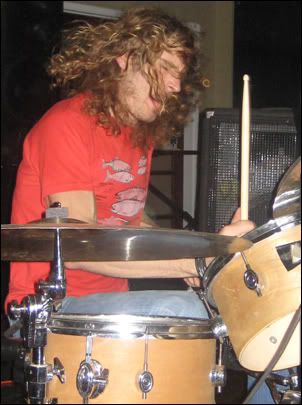
Hill and I talked a little bit about Cecil Taylor before the show (“he’s a big inspiration”), and it foreboded his set. Setting up two large speakers on either side of his small drum kit, Hill played the entire 33-minute-long piano-driven bonus track from Astrological Straits, “Necromancer.” Marnie Stern’s spoken word bookended the fierce, pounding piano attack by Marco Benevento, and it didn’t sound at all unlike Taylor’s famous 1979 set with Max Roach at Columbia University.
How the hell does Zach Hill play drums so quickly, so fiercely, so insanely?
Here’s the thing. Sure, Hill played the shit out of the drums nonstop for a half hour, never letting up at all, but it wasn’t unnecessarily violent. Every piece of the puzzle made some kind of sense, and every riptide fill had its place. Like a cross between Dave Lombardo and Philly Joe Jones, Hill exhibited stamina and taste, with a sense of actually communicating something in his playing. I was never bored through the entire volcanic set.
Afterwards, there were literal puddles of Hill’s sweat on the floor beneath his kit.
Now in its 26th year, SFJAZZ has been key in bringing both older jazz legends and younger jazz luminaries to San Francisco audiences in a number of venues around the city. The fall season of SFJAZZ lasts over a month, but to highlight the festival’s diversity and taste, I chose to attend three consecutive nights showcasing the breadth of talent available in a short span. Two older stalwarts of the avant-garde, Archie Shepp and Cecil Taylor, and two younger stars of the new breed, Eldar and Sophie Milman.
Oct. 23 – Archie Shepp at Herbst Theatre
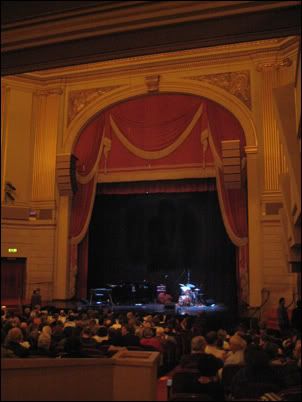
On the first night, Archie Shepp gave a rare U.S. concert appearance at the Herbst Theatre. The Herbst Theatre is one of the finest locations utilized by SFJAZZ—it’s just the right size, the sound is good, and the theatre itself beautiful—and it befits legends like Dewey Redman or Andrew Hill, both of whom have played there in recent years. This was, it must be said, a very special treat for Shepp’s Bay Area fans, many of whom have waited years to see him in person, sustaining instead on repeated listenings of landmark albums like Fire Music, Attica Blues, and—appropriately—Live in San Francisco.
Shepp will probably live forever unfairly in the shadow of John Coltrane, who took the young saxophonist under his wing and signed him to Impulse Records. I say unfairly because it’s hard to imagine Coltrane, would he have lived, to be as carefree as Shepp has been after Coltrane’s death. In the years since, Shepp has played R&B, sung standards, and dabbled in funk.
Shepp is now 71, but right from the start of Thursday night’s show, he displayed that he is still in command of his horn. He also showed that after 40 years, he’s still not immune to Coltrane’s shadow; nearly every song had its own Coltrane counterpart.
A quick-paced opener placed Shepp in explorative sheets-of-sound mode, while his band drove a pounding modal form with intensity and skill; it could have easily fit on Meditations. Shepp then sang a relaxed “Don’t Get Around Much Anymore,” which could have found a home on John Coltrane and Johnny Hartman. Other moments throughout the night drew inevitable comparisons to Kulu Sé Mama, Coltrane Plays the Blues, Coltrane’s Sound,and Lush Life.
But another essential way that Shepp has carried on Coltrane’s legacy is that his appearances are inseparable from the full emotional palette of the black experience in America. Beauty, fury, jubilation, humor and sorrow all play key roles in Shepp’s music. Shepp explains the unexplainable through his music; the feelings that words cannot contain. To hear him is to know a history of civil struggle and racial injustice.
Not everyone is a fan of this. During “Mama Rose,” which contained an intense poetic recitation about motherhood, love, riots, banana pudding, ex-cannibals, dreams and revolution, including the line “Your vagina split asymmetrically between the east and the west,” a group of people sitting in the balcony leaned in, consulted each other, and bailed. After “Trippin’,” a 12-bar blues in which Shepp channeled James Brown’s epic wail in singing about canceling his email and cutting off his cell phone, Shepp announced that his contract with SFJAZZ called for an intermission. Any folks who might have left missed the best portion of the evening.
Opening his second set with “Ujamaa,” an incredible composition, Shepp gave his most intense solo of the concert while his first-rate band kept apace. Clutching the microphone and crooning in an Earl Coleman style, Shepp’s “Lush Life” was rendered with a wide-open verse, with Shepp conducting the band into a Latin-rhythm chorus. Billy Strayhorn famously wrote the ode to weariness when he was just 16, but Shepp turned it around and sang it giddily, at 71, as if he was a teenager. Switching to saxophone, he quoted “Well You Needn’t” in a solo that sometimes reached for high notes that didn’t come.
Shepp continued with a song written for his cousin, who was murdered in a street fight when he was 15—a rather happy song, actually—and closed with “Burning Bright,” containing an impeccable solo by the song’s composer, pianist Tom McClung.
The rush of applause was too strong to deny, and Shepp returned to center stage—minus drummer Ronnie Burrage—to play a breathy “In a Sentimental Mood,” the closing track of Live in San Francisco. Serene and delicate, it closed the evening perfectly, with a solo tag of dancing runs.
In the brief moment between the song’s end and the cascade of applause, an audience member yelled out, “You’re beautiful, Archie!” Simple and perfect.
Oct. 24 – Cecil Taylor at Grace Cathedral
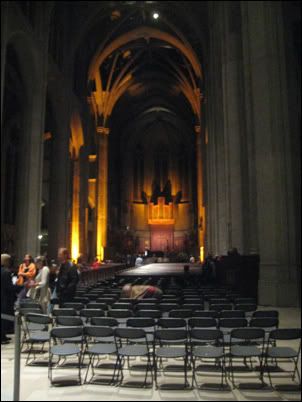
The next night, it was Cecil Taylor at Grace Cathedral. Consecrated in 1965 by Duke Ellington, the massive church was blessed with jazz from the start, and for 22 of the past 26 years, SFJAZZ has been using it for concerts they call “Sacred Space.” Pharaoh Sanders is among those who’ve performed solo inside the cathedral, using no amplification whatsoever. The effect is stunning.
Taylor was announced to the stage, but for the first few minutes, all that could be heard was his voice over a loudspeaker.
“A.”
“A S.”
“A S B M. A S B M. In Canal. In Canal You. In Canal You Long.”
It was Cecil Taylor, all right, doing his crazy Cecil Taylor thing and slowly making his way toward the piano.
“A Gene. A Gene Splits Into 28 Paragraphs. One Second Is Equal To 28.10 Electrons Equaling One Volt Is The Electric Motive In Proportion To Rhythm,” he continued, occasionally making long, gurgling sounds like a constipated alien.
When I last saw Cecil Taylor, at an SFJAZZ appearance at the Palace of Fine Arts in 2001, he held a similarly scattered conversation with himself; I thought, at the time, that he might have been studying some new form of chemistry. But no. Apparently he just likes to ramble.
Well-known for celebrating sharp bursts of percussive staccato passages, Taylor sat at the piano and instead drove straight into full-bodied, cascading playing, like he simply had too much music in his head gushing forth all at once. Inside the church, with sculptures of the crucifixion on the walls and a general atmosphere of reverence, the juxtaposition of religious tradition against fevered chaos was weird and funny.
Alas, the performance was stellar. What might have been choppy and percussive in any other venue came further together by Grace Cathedral’s natural seven-second reverb, and Taylor played off this effect, often hammering as many notes as possible into those seven seconds. His usual stabs in the gut became deep punches; his abrasive pelts of hail multiplying upon themselves into thunderstorms. His audible moaning and breathing echoed across the vault.
Taylor stopped playing, and the crowd applauded. A 40-something guy in a Hawaiian shirt sitting in front of us took a shot from his flask, and offered it to his considerably younger girlfriend, wearing a beret. She shook her head. Taylor then began playing again, in what sounded like a continuation of the exact same song. When Cecil Taylor speaks in a foreign musical language of constant discord, are there ears enough to make out what he’s saying? The show was sold out, but it was unavoidable to contemplate just how many in the crowd viewed Taylor simply as a cultural curiosity. Between each of five pieces, Taylor shuffled and rearranged his sheet music, and it was hard to figure out why he even had it in the first place. He couldn’t possibly have been following it.
All of this sounds like a total dis, but it’s not. I’ve long loved Cecil Taylor—possibly because I can’t put into words exactly why—and even after a spate of souring on him as of late, he won me back into his world on Friday night. His total expressiveness, his thundering command, his emotional presence and his singular, powerful musical vision on display reawakened me to his brilliance. The venue certainly helped.
At the end of the set, Taylor tried to leave the stage but the applause was too strong. He sat down and played again, another short minute-and-a-half chapter in the neverending song, and finally shuffled his hunched, frail body to the back room of the church.
He stayed there for over an hour after the show was over, muttering in one giant monologue to a small group of assembled fans.
Oct. 25 – Eldar and Sophie Milman at Herbst Theatre
Back to the Herbst Theatre on Saturday night, for a decidedly younger lineup: 21-year-old piano prodigy Eldar and 24-year-old chanteuse Sophie Millman.
Eldar is famous for sounding like Art Tatum—rapid-fire runs, mind-boggling changes in key and tempo mid-song, a strong left hand—and his first number, “I Should Care,” demonstrated this in dazzling fashion. Everything that is great about Eldar was encapsulated in this first number; he played it antagonistically but respectfully, tackling the standard to the ground and working it over with hyperactive stride, incessant and precise runs, left-hand jabs and full-fingered clusters.
Though he could never possess Tatum’s swing, Eldar makes up for it in technical command; this is why he’s more Vladimir Horowitz than Oscar Peterson, and indeed, he has a very classical touch on the keys. But his mind is that of the explorer, the improviser who steps through every possibility at an unbelievable pace. Were it not for the opening melody, no one could have recognized “I Should Care” as imagined by Eldar.
This is what’s great about jazz: taking something old and making it new again. Unfortunately, Eldar’s focus shifted into presenting something new and making it sound old: his next song, “Insensitive,” was an original composition marked by unprovoked chord changes, a plodding form and little to no melody. This is how things stayed, as Eldar performed solely original compositions in the same vein for the rest of the set.
The third song, for example, featured nonstop busy drumming, jabbing bass lines, and a chaotic Eldar flying all over the piano. But the overall presentation was that of a garbled, very academic attempt, including the use of a 1970s-sounding synthesizer on top of the piano. If this is the way Eldar’s career is moving—away from dazzling standards and into post-post-fusion gobbledygook—then Sony must be nervous about their young star. Perhaps they’re trying to replace the Bad Plus. Maybe they’re trying to win over Rush fans. Who knows? Up next was Sophie Milman, who, like Eldar, was born in the former Soviet Union. Moving to Israel at age 7 and then to Canada at age 16, Milman lived an upended youth in areas of global tumult, discovering solace in listening to American jazz records. This is her history, which she tells in magazine articles, on radio shows, and from the stage.
Luckily, she’s not just a good NPR story. She’s also a wonderful singer.
Opening with “It Might as Well be Spring” in a strapless leopard-print dress, red leather heels and gold earrings, Milman immediately hit all the right Anita O’Day-June Christy-Chris Connor notes with enough of her own style to warrant the comparison. Her appealing voice, airy but not overly husky, took on adventurous trills and jumps. She conducted her band, whooped at their solos, snapped her fingers and constantly jittered her arms and tapped her heels.
Milman had just spent a week at the Blue Note in New York with Eldar—they really are a curious co-billing, other than the “young” and “Soviet” angle—and she was glad to finally have some time in San Francisco. “You guys are very, very lucky,” she remarked at one point. “We’re going home to Toronto to blizzards.”
“People Will Say We’re in Love” was delightful, and a subtle vibrato eked into Milman’s voice during “I Concentrate on You.” Then Milman told the story of her life, and how she never fit in with the other kids in Israel who couldn’t understand her obsession with jazz, and dedicated the next number “to all the kids growing up who used to pick on me.” It is a song, she explained, that she sings at every performance.
“Bein’ Green,” as made famous by Kermit the Frog, is not a terrible song. But it is essentially a sad song, and despite Milman’s familiarity with the tune, it showed her emotional limitations. “Bein’ Green” is one of those curiosities that works in the hands of, say, Frank Sinatra when he’s 63—but not so much in the young, peppy hands of Milman.
“Here’s a great Bruce Springsteen song,” Milman then announced, and “I’m on Fire” continued the feeling that Milman might occasionally be in over her head. “I’m on Fire” is a creepy song—the pleading of a tortured stalker to ravage the untouched beauty of a young girl. Completely changed from the original, with minor-key chords, the arrangement brought out that creepiness. But it felt like Milman let the arrangement do all the work—she sang it sultry rather than tormented.
But these were unimportant diversions from what Milman does best. Redemption was found in a soulful, “Maiden Voyage”—esque arrangement of “Love for Sale,” and Milman once again had the crowd in the palm of her hands. After all the sleepy Norah Jones tranquilizing on the “jazz” charts for the last eight years, it’s nice to see an inventive young singer bringing back flair and pizzazz to jazz singing. Here’s hoping more folks discover her talent.
—
So there you go—three days of the SFJAZZ festival. The complete schedule for SFJAZZ, including teasers for their upcoming Spring season, can be found at their official website.
The insane circumstances surrounding Sly Stone’s bizarre appearance in Santa Rosa last Friday, Oct. 18, were told to me by several people involved with the show. Crazy doesn’t begin to describe it. Here’s how it went down.
The morning of the show, Sly Stone is in Los Angeles. He fires his business manager. Sly tells the promoter that he’s his own boss now, that he’s the one who’s going to get paid at the show, and that he needs $3,000 wired to the bank account of an Iranian BMW saleswoman before he’ll even get on the plane to San Francisco.
And about that plane: it was supposed to arrive from Los Angeles at 11:30am. No Sly. The limo waits at the airport. Sly’s next flight becomes 1:30pm, then 2:30pm, 3:30pm and 5:30pm. No one can get a hold of him at all. The promoter drives to the airport in the slim hope that Sly might walk through one of the gates.
Finally, at 7:30pm, with his young Japanese girlfriend in tow, the 65-year-old Sly shows up at the airport. He’s an hour and a half away from the show—which starts in a half hour—and he demands to go to the hotel. The young girlfriend finally talks him out of it, and he agrees to go to the show, but he’s still talking about getting paid.
He sleeps all the way to Santa Rosa.
Sly doesn’t hit the stage at the Wells Fargo Center until 10:30pm, during the fifth song of the set. He walks off the stage 25 minutes later, in the middle of “I Wanna Take You Higher,” telling the crowd, “I gotta go take a piss. I’ll be right back.”
But Sly never comes back. The band continues on without him, killing time for 30 minutes. During the last song, a man appears on the stage, whispering into band members’ ears.
Meanwhile, backstage, Sly is demanding to be paid. The show is still going on, and the promoters are telling his handlers to get him back out to perform more. But his handlers know the drill. It’s been this way for years. What can they do?
Before the show is over, Sly is out in the parking lot, still in his white suit, trying to get into the promoter’s car. All the doors are plainly locked, but he keeps trying. Finally, a woman drives by, picks him and his Japanese girlfriend up, and they whiz away. Word of his departure gets inside.
It’s not too hard to figure out what the man on the stage was whispering to the band. How about: Sly’s making a getaway? How about: Sly’s driving off right now? How about: You’d better chase after him if you want to get paid?
And after quickly finishing the song and exiting the stage, that’s exactly what they do.
The band members pile in their cars and find Sly precisely where they thought he’d be—at the Fountaingrove Hilton. Except he’s not in his room. All the rooms are reserved under the business manager’s name, who Sly fired that morning. So Sly’s there, fuming about not being able to get into his room, when the rest of his band suddenly pulls up.
“Get me out of here,” he’s heard telling his driver, and they peel out.
It is not an uncommon sight to see cars racing down Mendocino Avenue on a Friday night. But it’s a different story altogether when the lead car giving chase contains an absolute funk music legend, pursued by five more cars driven by band members, some of whom have played with him for 40 years and are actual, literal family members. Six cars race down the street, weaving in and out of lanes.
Finally, past midnight, Sly’s car is cornered at a gas station. A long stand-off ensues between him and the band while the young Japanese girl cries hysterically in the car. A gas station on Mendocino Avenue in Santa Rosa. That’s where it all falls apart.
At press time, no one can get a hold of Sly Stone—not his management, not his band mates, not his family. The last anyone sees of him, he’s headed south on Highway 101. Everyone’s got a pretty good idea how he’s spending the money, but no one knows where he is.
And no one ever wants to play with him again.
——
To read a review of the Sly Stone show, click here.
At grocery stores nationwide, the canned-beer department is getting better by the day. Craft breweries around America have begun packing their beers in aluminum, and this summer several breweries joined the game. Locally, the fastest distribution has come from 21st Amendment, based in San Francisco, with the sweeping July release of its IPA and a watermelon wheat beer, each in crumply cans.
Why cans? Aluminum holds multiple virtues over glass. Canned beer will not be damaged by light, and unlike corked or capped bottles, cans are 100 percent airtight, eliminating all risk of oxidation damage. Aluminum cans are also far less energy-intensive to recycle than glass. But perhaps most convincing is the weight factor. A standard 12-ounce empty can weighs approximately six-tenths of an ounce, whereas a standard 12-ounce empty bottle weighs about 10 ounces. That means big savings in shipment costs and tremendously reduced carbon emissions in transport.
Of the roughly 1,300 craft breweries in the nation, some 30 of them are dabbling in aluminum. One of the most outlandish presences in this genre of beer makers may be that of the Bay Area’s newest brewery, Uncommon Brewers, based in Santa Cruz. In May, a release of several thousand cans of Siamese Twin, a Belgian double ale brewed with coriander, Kaffir lime leaves and lemongrass, put the brewery on the map. That beer and the Golden State Ale have been sporadically available at select North Bay locations, including Mondo Restaurant and American Beer Garden and the Sonoma Wine Exchange, both in downtown Sonoma.
Owner Alec Stefansky has been negotiating sales with restaurants and bars throughout the Bay Area while perfecting in the brewhouse several more recipes for some of the strangest beers that bubble, all of them certified organic. The Baltic Porter, scheduled for release in December, is fermented with licorice, pours a thick inky black and tastes of chocolate mousse and coffee. The initial goal for this monster was an ABV of 9.2 percent, but Stefansky has downsized it to 7.8 to make the beer more compatible with the standard bar culture, in which not all proprietors have a ready supply of specialty low-capacity glassware.
Still pending approval by the federal government is the Maple Red Ale, a 7.3 percent creation brewed with candy cap mushrooms, a fungus frequently baked into desserts. Slated for a late-winter release is a barleywine fermented with redwood branches. Stefansky is aiming for a staggering 15 percent ABV.
Other breweries to join the canned-beer parade include Ukiah Brewing Company, Caldera Brewing in Ashland, Ore., New Belgium Brewing Company in Fort Collins, Colo., and Maui Brewing Co. The latter recently began distribution of several brews, including a coconut porter, to California.
But Oskar Blues in Lyons, Colo., was the first microbrewery in America to brew and can its own beer six years ago. The brewery’s in-can menu consists of four beers, and distribution includes 22 states, though the Northwest still remains out of the loop.
“We first did this just because we thought it would be hilarious to put our big, strong pale ale into a can,” says Marty Jones, public relations director for Oskar Blues. Soon enough, though, the good sense of canning beer became apparent. The beer was immune to becoming “light-struck,” a skunky condition caused by excessive exposure to light. Oskar Blues beers also became preferred thirst-quenchers for many Rocky Mountain backpackers tired of Coors and leery of heavy bottles. As the company’s distribution radius increased, the savings in shipment costs escalated.
“Forty percent of a bottled beer’s weight is the bottle itself,” Jones says. “So we were cutting our shipping costs and carbon footprint almost in half.”
And though a tall, glass wine bottle on a white tablecloth in the light of candles may be one of the most evocatively romantic images in our culture, even wineries are now putting their product into cans. Francis Ford Coppola’s Sofia Mini, a can of about six ounces filled with a blend of Pinot Blanc, Sauvignon Blanc and Muscat Cannelli is a sparkling Blanc de Blanc suggestive of pear, honeysuckle and passion fruit on the nose and green apple and citrus in the mouth.
First canned in 2004, the wine comes in a pink four-pack case containing pink cans accompanied by a straw, and some critics have decried the product as a vulgarization of the wine experience. Others have proclaimed it to be an innovative, sexy alternative to the old-fashioned standard of a heavy magnum plugged with a potentially dangerous cork.
Iron Wine, based in Argentina, released two wines in 2007, a Malbec-Cabernet blend and a Chenin Blanc. The wines come in cans of two sizes, 8.5 and 12 ounces, and have been touted as bold innovations in a carbon-costly industry ruled by archaic tradition.
Fetzer Vineyards has also taken heed of the carbon impact of heavy glass, though the winery has thus far steered clear of cans. Instead, Fetzer recently lightened the company’s various bottle types by an average of 16 percent each, from over 20 ounces to 17, which will save approximately 2,100 tons of glass annually through the molding of thinner bottles and banishment of the punt, the bottle’s bottom indentation.
The romance of the bottle persists, and mavericks in the world of wine remain few and far between, but at 21st Amendment, cofounders Shaun O’Sullivan and Nico Freccia believe that most craft breweries in the nation will be canning their beer within 10 years, and the pair have big plans for their own cans. They are tentatively considering a future release of a Christmas spiced ale in a 24-ouncer, a direct nod toward the extravagant magnum-style bottles released by many breweries for the holidays. Freccia and O’Sullivan have also considered releasing a massive barleywine in a six-ounce can. Watch for it beside a towering brute of a beer that boasts of redwood on the label. Watch, also, for a long line of others encased in aluminum, for in craft brewing the future just might dwell in the can.
Quick dining snapshots by Bohemian staffers.
Winery news and reviews.
Food-related comings and goings, openings and closings, and other essays for those who love the kitchen and what it produces.
Editor’s Note: Help us welcome Patricia Dines to the Green Zone this week. A seasoned environmental writer, Patricia will be helming this column following Gianna De Persiis Vona’s decision to retire in order to focus on her fiction. We’re pleased to have Patricia join us, and anticipate that you will be, too.
As summer’s spacious sunlit days fade and the cold air hints of winter, I start to feel a little melancholy. This year’s economic drama sure isn’t helping much. Still, I’ve learned that I’m more sane when I embrace rather than resist the changing seasons. So it’s probably no coincidence that my inner child has requested a visit to a pumpkin patch.
Of course, given my eco-proclivities, not just any patch will do. Yes, I want the trifecta: local, small and organic. But is that just a fantasy, when some patches actually populate their fields with cheaper imports? Thankfully, after discovering one closed organic patch, my journey takes a happier turn, and I actually find two local organic farms offering home-grown pumpkins and a farm experience for children of all ages. Remembering my vow to enjoy our local treasures, I decide to visit both.
After wandering Petaluma’s back roads, admiring the unpretentious farmhouses and weathered slat fences, I arrive at my first destination, Ryan O’Shannan Farms. Large pumpkin signs, then hay bales, guide me into the bumpy, mowed parking lot. The main tent attractively displays the farm’s bounty of pumpkins, gourds, tomatoes, strawberries and preserves.
Here I meet the farm’s co-owner, Linda McDowell, who shows me where visitors can milk a cow, make butter and buy sometimes-organic snacks. We continue over the bridge, past the hayride wagon and sunflower maze, to the field where I can pick from mini-pumpkins, sugar (pie) pumpkins, larger (jack-o’-lantern) pumpkins and beautiful decorative gourds.
When we return, Linda’s husband Mike zooms up in his ATV, and we all chat. My first question: Is there a Ryan O’Shannan? No, Mike named the farm after his two children, Ryan and Shannan, now young adults. Mike’s family has owned this 400 acres for a century, running a dairy farm until the 1970s, then renting pasture land. Mike started his 15 acres of organic produce in 1995, after neighbors said they were “making a million” at it. He laughs, describing his trial-and-error “learning curve.” Linda joined the project in 2002. Though not raised on a farm, he kids that she’s become “quite a farm girl.”
Why do they grow organically, I ask, and make the effort to be certified? Because there’s a market for it, they reply, and they like not using toxic pesticides. Linda says she can taste the difference in the food. Plus, if farmers aren’t certified, she advises, you really don’t know their methods. Organic is more than “no spray”; it’s a program of practices that includes cover cropping and avoiding GMOs and synthetic fertilizers that can carry hidden toxics.
“Ag is a tough business,” Mike shrugs. “You roll the dice every day. There are so many variables that you can’t control.”
Traveling down the road, I find my second stop, Andersen Organic Vegetables. In October, this farm stand adds pumpkins, melons, expressive squash varieties and Halloween décor. I talk with owner and Petaluma native Rodney Andersen, still active in his 70s. For 11 years, he’s worked these 16 leased acres, enjoying both farming and offering people healthy food. I ask his trick for survival and he answers, “To learn a little each year, and not make the same mistake twice.”
Out in the field, Rodney tells me the names of various pumpkins, including giants up to 150 pounds. The farm’s activities include a corn maze, hayride and mini-train ride with cheerful homemade wooden cars. Although he’s also opened a farm store near town, Andersen says folks still like coming here for the farm atmosphere and seasons’ changing colors.
As I head home with my farm-fresh produce, I feel gratitude for the farmers who treat the earth kindly while creating nurturing delights. But I also feel soothed from touching beneath this culture’s ever-shifting craziness to the true source of my well-being and survival. Filled by this autumn moment, I start imagining ways to carve my organic jack-o’-lantern into a smile.
Both Petaluma patches are open through Friday, Oct. 31, have free entry (with rides and mazes costing $3–$4) and offer group tours. Ryan O’Shannan Farms, 5360 Bodega Ave.; 707.762.4895. Andersen Organic Vegetables, 4588 Bodega Ave.; 707.529.1279. Also, Marin’s LaFranchi Pumpkin Patch offers local organic pumpkins and activities. 5300 Nicasio Valley Road, Nicasio. 415.662.9100.
SHOE NUFF? At it’s core, the debate concerns what might be a ‘bedroom essential.’
The term “bedroom essentials” is the center of conflict between the city of Santa Rosa and Spice Sensuality Boutique, a new women-oriented sex store on Fourth Street. The owners of Spice say that the term accurately describes what they sell in their store, while the city says it’s so misleading that Spice either has to stop selling intimate items or move to another location. The situation is stirring up controversy as only sex issues can.
Chuck and Moira Freese opened Spice in Santa Rosa two months ago. Their Rohnert Park store has been operating for two years. Spice sells lingerie, oils, lubricants, sex toys and pornographic DVDs, among other things. Their customers are 95 percent women, most of whom are over 30. The idea was to give women a place to buy personal items that wasn’t on the Internet or in a threatening environment.
“In the past, if a woman wanted to buy intimate products, she had to go to an adult bookstore with the peepshows and the open-browsing magazine racks,” says Chuck Freese. “The kind of place where your feet stick to the floor when you go into it. We wanted to provide women with a comfortable environment to shop.”
Freese says that when they applied for a business license, they discussed the adult products with the Santa Rosa Planning Department. They were told that as long as they were discreet in displaying the adult items, they could sell them. Freese described the items as “bedroom essentials” on the application, and Spice was classified as a lingerie store.
Then someone complained. The next thing Freese knew, the city handed him a letter saying that the store was in violation of an ordinance because it sold pornographic DVDs and toys depicting genitalia. Freese says that the city reclassified Spice from lingerie to adult entertainment and gave them two choices: They could move to a shopping center like Santa Rosa Plaza or drop the sex-related items and just sell lingerie.
“They had a litany of everything we had to get rid of, and it was anything to do with sex all the way down to condoms,” says Freese. “You can buy those at Safeway.”
However, the city says it didn’t reclassify the store—Spice was just too vague about what it was selling in the first place.
“They misrepresented themselves on their application,” says council member Jane Bender. “They listed bedroom essentials as well as things like lingerie and lotion. I haven’t a clue what bedroom essentials means. It can mean sheets and pillowcases. They needed to be explicit, and they were not.”
The city will not reveal who made the complaint against Spice, but admits that it wouldn’t have noticed the store if someone hadn’t drawn attention to it. Freese believes the complaint was made by one of the neighboring businesses.
“There is a small group of people who are biased and prejudiced,” he says. “They are afraid that a sex store would attract transients and drug abusers. But those are the kind of people that my customers are trying to avoid.”
Other women-oriented sex stores in the North Bay include the Sensuality Shoppe in Sebastopol and Pleasures of the Heart in San Rafael. Jennifer Islas, who owns Pleasures of the Heart, hasn’t had a complaint in nine years of running the store. Maintaining a woman-friendly atmosphere has meant making choices about what to sell. For example, Pleasures doesn’t sell most DVDs.
“We have had porn stars come into the store and talk,” Islas says. “And there is definitely a positive part of the porn industry, but it also has a bad part. The people are not protected even though they are supposed to be by law, and drugs are a main impetus. It’s not portraying a positive sexuality.”
Meanwhile, other stores in downtown Santa Rosa carry pornography, such as Sawyer’s News, owned by Santa Rosa mayor John Sawyer. However, unlike Spice, Sawyer’s News is categorized as a bookstore and newsstand, which is allowed to carry a limited amount of porn.
Freese says he would be happy to go over objectionable items with the city, but officials don’t want to negotiate. He has now hired an attorney. “I’m not trying to stir up trouble,” he says. “I just want it to be equitable and fair so that we can sit down and explain why I have to lose my livelihood.”
For its part, the city says that Spice is not being picked on because of the nature of the business. It’s simply a matter of a violated ordinance. “They can fight it the way anyone else fights it,” Bender says. “They can have a Zoning Administration Hearing and after that, they could hire an attorney if there is a ruling against them.
“Or,” she adds. “They could just sell their lotions and lingerie and sell the other stuff online. Or they could move to one of the shopping centers. They do have options.”
Zach Hill isn’t one to fall back on career moves out of the rock ‘n’ roll handbook. After all, he’s from Nevada City. He plays broken cymbals on purpose. He wraps his face in Play-Doh and swallows frogs.
But with his main band, Hella, in “a real gray area right now,” the intensely skilled drummer has done the unthinkable: made a solo album. But don’t expect to file it in the pile of self-absorbed solo-album waste next to Mick Jagger or Scott Stapp. Astrological Straits, which boasts 12 guest musicians, from Les Claypool to No Age, is a dream culmination of Hill’s unlikely musical journey thus far, one that’s seen him backing Mike Patton, Joanna Newsom and members of Sun Ra’s Arkestra.
The main realm in which Hill resists clichés, of course, is his music, a coherence of melody and spazz, reigned over with electronic clangs, white noise and vocal manipulations. In many ways, he’s the Frank Zappa of the laptop generation, applying ideologies from avant-garde jazz to the current noise-rock underground; in fact, Astrological Straits’ bonus disc boasts a 33-minute piano-drum excursion with Brooklyn’s Marco Benevento and narrator Marnie Stern. How he’ll perform all of this live is anyone’s guess, which fits his unpredictable aesthetic rather well.
Opening the show is Goodriddler, aka 22-year-old Nick Wolch, who rides a similar individualist streak; his most recent songs, for example, were recorded inside the dark, algae-strewn concrete creek tunnels beneath downtown Santa Rosa. In a post&–Kid A world, Goodriddler’s piano-drums-and-software music is ambient sound of the best variety, simultaneously soothing and challenging. Like Hill, he’s a solo act, with bonus points: no one smokes a hand-rolled cigarette while playing drums with such loose, detached style.
Also on the bill is the Iditarod, whose synthesizer flourishes and trumpet blasts herald the dawning of a new instrumental victory, and the Highlands, a group of young experimentalists who unreel their genre-traipsing songs with both the untamed abandon of Captain Beefheart and the intellectual curiosity of Can. Factor in that there’s a band called What’s Up playing and that it’s taking place in the lounge of a hotel, and you’ve got a show that defies comparison even before it’s started.
Zach Hill, What’s Up, the Iditarod, Goodriddler and the Highlands perform Sunday, Oct. 26, at the Casbar of the Days Inn, 3345 Santa Rosa Ave., Santa Rosa. 8pm. $7; 18 and over. 707.568.1011.
Writing, for Petaluma poet Terry Ehret, has been quite a balancing act. In a busy household, in which she and her husband raised three daughters, it wasn’t often possible to find uninterrupted time. Rather than fighting the situation, Ehret says that she “embraced the aesthetic of interruption,” as a way of mirroring her reality and honoring the fragmentation common to women’s lives.
A native Californian and graduate of Stanford University and the MFA program in creative writing at San Francisco State, Ehret moved to Petaluma in 1990 with her growing family. Her first book, Lost Body, was selected as part of the prestigious National Poetry Series and published by Copper Canyon Press. Here’s a prose poem from that collection.
“At the End of the Season the Apples” At the end of the season the apples droop over the lobelia. They make room for themselves in my flower boxes. It’s OK with me. The time for pruning and sweeping the yard clear of debris is coming. Waiting patiently allows the disorder of my life a kind of grace, the natural desire of all things. Sometimes late at night I fall asleep on the couch deliberately, avoiding the rituals of going to bed: brushing my teeth, buttoning my nightgown, clearing the air of arguments to make room for two separate lives in the same room, to make peace with the darkness we are about to trust ourselves to. This is all so much work, and it is late, and the sleep I allow to rush over me, completely unprepared, is rich and dream-laden and satisfying, as if I had come back to my native language.
A conversation with Ehret is peppered with the word “authentic.” That’s how she measures her work’s value—is it authentic? In order to achieve authenticity, to not have the writing descend into self-consciousness, she balances the conscious with the unconscious, “to try and find out what’s on my other mind.”
Ehret’s third book, Lucky Break, published earlier this year by Sixteen Rivers Press, is a dazzling collection, both accessible and challenging. It contains a suite of poems, “The House That Held Me Dreaming,” inspired by Gaston Bachelard’s landmark work The Poetics of Space, which operates at the imaginative intersection of philosophy and psychology, where so much poetry resides. Here’s the final poem of the suite, which also seems to channel a bit of Whitman’s energy. I recommend reading the poem out loud, a few times, as I did, to capture its cadence and power.
“Intimate Immensity” Say the sky. Say the wind galloping across the grass. Say the grass by the sea by the sea waves and their own rising and falling
eternity. Say the turning planet. Say the fall of the most recent evening. Say lie down now and say much sooner than you thought
the stars have all rearranged themselves in the night while I was—What was I doing? What? Say then the darkness behind the stars, wherever it is going, back to the first moment
the tiny weight shifted toward my body or yours, and the intimate explosion of love. Say in all this immensity, who.
A former Sonoma County poet laureate, Ehret is an invaluable resource in the local writing and intellectual community. She’s taught for years at the Petaluma campus of Santa Rosa Junior College and at the Sitting Room in Cotati, where her workshops on everything from Beowulf and Grendel to Yeats have become legend. Ehret also compiles an excellent monthly newsletter of local literary happenings, available at www.literaryfolk.wordpress.com. For more on Ehret and her work, see her website, [ http://www.terryehret.com/ ]www.terryehret.com.
Novelist Bart Schneider was the founding editor of ‘Hungry Mind Review’ and ‘Speakeasy Magazine.’ His latest novel is ‘The Man in the Blizzard.’ Lit Life is a new biweekly feature. You can contact Bart at [ mailto:li*****@******an.com” data-original-string=”LnlAh0t6bx3UBE0ugX813g==06auH5PME+yTGJRs8uJKGTZWm0oJcoL9GVrGYiUTaigz+cBsSwiKW9VJJ6BnmEUy7orZ14665C2f9wEu4wj/h4nViuOCeZ5V+Dr2CSuApxKhGw=” title=”This contact has been encoded by Anti-Spam by CleanTalk. Click to decode. To finish the decoding make sure that JavaScript is enabled in your browser. ]li*****@******an.com.
Museums and gallery notes.
Reviews of new book releases.
Reviews and previews of new plays, operas and symphony performances.
Reviews and previews of new dance performances and events.
Hankering to bear witness to our next president’s inaugural address, with a behind-the-scenes D.C. jaunt through this year’s historic presidential sweepstakes to boot? Sonoma State University political science professor David McCuan invites students and interested community members to sign up for Campaign 2008: The Presidential Inauguration Seminar. One of several universities across the country participating in this innovative short course, SSU expects at least 2,000 participants across the country to take part in a 10-day election fest in our nation’s capital. The Campaign 2008 program, sponsored by the nonprofit Washington Center, offers major player presentations regarding this year’s presidential campaign, emphasizing the role various media have and will continue to play as a new administration assumes the reins of power and ends with a chance to witness the presidential inauguration first-hand.
The 44th president will be inaugurated on Tuesday, Jan. 20, 2009; but on Jan. 10, Campaign 2008 attendees will begin a 10-day round of lectures, site visits, tours and special events focusing on the presidential races. Previous seminar speakers have included the Washington Post’s Bob Woodward, independent presidential candidate Ralph Nader, Supreme Court Justice Antonin Scalia, Chicago Trib columnist Clarence Page, C-Span’s Brian Lamb, Cokie Roberts of ABC News, as well as five former presidential press secretaries.
In addition to these lectures, SSU’s McCuan will lead the North Bay contingent in small morning group discussions, while afternoons will be devoted to touring D.C. landmarks, climbing Capitol Hill and visiting foreign embassies, think tanks and other organizations. Evenings feature such events as a reception at the U.S. Chamber of Commerce and the performance insights of renowned political humorist Mark Russell’s power satire.
The Campaign 2008’s $960 registration fee, plus a $60 nonrefundable application fee, doesn’t include travel, housing or meals, so McCuan says one should expect to drop about three grand for the experience. Considering the unique program offered, matched with a historic inauguration of either our nation’s first African-American president or woman VP, Campaign 2008: The Presidential Inauguration Seminar, will, no doubt, afford its participants a rare and uniquely American political experience.
Sign-ups are limited and early registration recommended. However, should McCain surprise at the polls, McCuan admits that he doesn’t “expect many people will sign up.” Interested persons should contact David McCuan at da**********@****ma.edu or 707.664.3309.
Azazel Jacobs’ dry, droll film Momma’s Man is about a little birdie who won’t leave the nest. The film speaks to that large audience who has been beaten up badly by current events and would prefer to go home and let Mom take care of them.
Jacobs’ purpose is threefold: First, to explore the unusual space he grew up in. Second, to commemorate his famous, enigmatic, even otherworldly parents through a fictional film. Third, to celebrate and gently lampoon a dropout.
Jacobs’ keen, almost somber observational skills make Momma’s Man more than the usual shoe-gazer indie. With very few words, Jacobs establishes one kind of story. When we think we understand what’s going on, Jacobs flips the film around. Momma’s Man comes into focus on a subway car grinding into the end-of-the-line stop for Howard Beach and the JFK shuttle. Mikey (Matt Boren) is on his way back to his wife and infant child on the West Coast. But the discount airline bumps him from the flight. He’s forced to spend the night in his old room at his parents’ downtown New York City loft.
The plump, Josh Kornbluth&–like Boren tries to call the airline for a new flight but gets put on hold. A giant wave of futility overcomes him. He decides to take Oblomov’s path. Digging up old poems, love letters and comic books, he stalls, taking meals served by his mother.
Flo Jacobs, the director’s mom, is a strangely angelic figure as Mikey’s mother. She has a fixed gaze of such sympathy that it almost looks like deep grief. She is very lean, very hushed, with an aura of loving kindness that certainly doesn’t mean that she’s a mothering bucket of slop. She’s the kind of almost daffy mother that Louise Lasser used to parody. (In Frankenhooker, for instance, Lasser played the mom of a suburban New Jersey mad scientist who raved, “I’m antisocial. I’m becoming dangerously amoral. I feel I’m looking into a black pit,” to which Lasser’s character replied, tenderly, “Y’wanna sandwich?”)
It is this saintliness that makes us suspect that Mom is an invalid—that, as well as significant mentions of doctor visits and tests. She repeats herself a bit, at first sweetly and then alarmingly; she might have a touch of senility. But then she has a normal conversation about a museum for abstract expressionist art going up in Denver. And then, again, in that almost tonelessly consoling voice: “Anything I can get you, coffee, tea . . . ?”
The father, the eminent underground filmmaker Ken Jacobs, is just as mysterious a presence as his wife. He’s a tinkerer in this loft kingdom, stuffed with 40 years of film reels, toys, musical instruments and objets d’art. He works on his light shows and studies their effect gravely with his wife at his side. He isn’t a big smiler or a laugher. At one point, he shows his son a wind-up baby without a head; it skitters across the table, and Ken looks up questioningly. It’s perhaps a significant gesture, a way of reminding Mikey of his responsibilities.
Almost 40 minutes go by before Dad gives his loitering son that Old Testament look every Jewish father knows how to give his offspring. He can’t understand why Mikey won’t head home to wife and child. Instead, Mikey goes to see an old friend, Dante (Piero Arcilesi), who is back after a year and a half either in jail or the military. Dante is also living at home with his mother and also caught in the past, gloating over a pile of videotapes.
A few shots of dew-dropped bottlebrush plants represent L.A., where Mikey’s wife, Laura (Dana Varon), tends their child. Her neighbor (the goofy Richard Edson from Jim Jarmusch’s Stranger Than Paradise) offers to help, with the same clueless consolation that the Mom in New York offers: “Do you need some of that mash stuff, mashed carrots, I dunno . . .”
The only movie I can think of that is similar to Momma’s Man is the 2001 movie World Traveler, directed by Bart Freundlich. I’ve never met anyone who didn’t hate World Traveler, even though I was bowled over by Billy Crudup as a husband who heads for the hills, leaving wife and child behind. Momma’s Man may be a little more lovable, since it shows us clearer motivation for Mikey’s nervous breakdown (or long wallow, take your pick). Boren is smooth and childish, lolling in his pine-board loft bed that still has glow-in-the-dark star stickers pasted on the ceiling.
The lack of friction in the first half of Momma’s Man makes the movie seem a little too smooth and lovable. But the sense of time passing and of a world starting to end darkens things. This is the kind of movie you wish you had made about your childhood home.
‘Momma’s Man’ opens on Friday, Oct. 24, at the Smith Rafael Film Center, 1118 Fourth St., San Rafael. 415.454.1222.
I had been wondering how Zach Hill would pull off his solo album, Astrological Straits, in a live setting. With over a dozen guest musicians on his album, would he hire a pick-up band? Would he try to play more than just the drums? Would he call up Les Claypool and ask if he'd mind driving down to Santa...
Now in its 26th year, SFJAZZ has been key in bringing both older jazz legends and younger jazz luminaries to San Francisco audiences in a number of venues around the city. The fall season of SFJAZZ lasts over a month, but to highlight the festival's diversity and taste, I chose to attend three consecutive nights showcasing the breadth of...
The insane circumstances surrounding Sly Stone’s bizarre appearance in Santa Rosa last Friday, Oct. 18, were told to me by several people involved with the show. Crazy doesn’t begin to describe it. Here’s how it went down.
The morning of the show, Sly Stone is in Los Angeles. He fires his business manager. Sly tells the promoter that he’s his...
10.22.08At grocery stores nationwide, the canned-beer department is getting better by the day. Craft breweries around America have begun packing their beers in aluminum, and this summer several breweries joined the game. Locally, the fastest distribution has come from 21st Amendment, based in San Francisco, with the sweeping July release of its IPA and a watermelon wheat beer, each...
10.22.08Editor's Note: Help us welcome Patricia Dines to the Green Zone this week. A seasoned environmental writer, Patricia will be helming this column following Gianna De Persiis Vona's decision to retire in order to focus on her fiction. We're pleased to have Patricia join us, and anticipate that you will be, too.As summer's spacious sunlit days fade and the...
10.22.08SHOE NUFF? At it's core, the debate concerns what might be a 'bedroom essential.' The term "bedroom essentials" is the center of conflict between the city of Santa Rosa and Spice Sensuality Boutique, a new women-oriented sex store on Fourth Street. The owners of Spice say that the term accurately describes what they sell in their store, while the city...
10.22.08Zach Hill isn't one to fall back on career moves out of the rock 'n' roll handbook. After all, he's from Nevada City. He plays broken cymbals on purpose. He wraps his face in Play-Doh and swallows frogs.But with his main band, Hella, in "a real gray area right now," the intensely skilled drummer has done the unthinkable: made...
10.22.08Writing, for Petaluma poet Terry Ehret, has been quite a balancing act. In a busy household, in which she and her husband raised three daughters, it wasn't often possible to find uninterrupted time. Rather than fighting the situation, Ehret says that she "embraced the aesthetic of interruption," as a way of mirroring her reality and honoring the fragmentation common...
10.22.08 Hankering to bear witness to our next president's inaugural address, with a behind-the-scenes D.C. jaunt through this year's historic presidential sweepstakes to boot? Sonoma State University political science professor David McCuan invites students and interested community members to sign up for Campaign 2008: The Presidential Inauguration Seminar. One of several universities across the country participating in this innovative short...
10.22.08Azazel Jacobs' dry, droll film Momma's Man is about a little birdie who won't leave the nest. The film speaks to that large audience who has been beaten up badly by current events and would prefer to go home and let Mom take care of them. Jacobs' purpose is threefold: First, to explore the unusual space he grew up...

 I had been wondering how Zach Hill would pull off his solo album, Astrological Straits, in a live setting. With over a dozen guest musicians on his album, would he hire a pick-up band? Would he try to play more than just the drums? Would he call up Les Claypool and ask if he’d mind driving down to Santa Rosa to fill in?
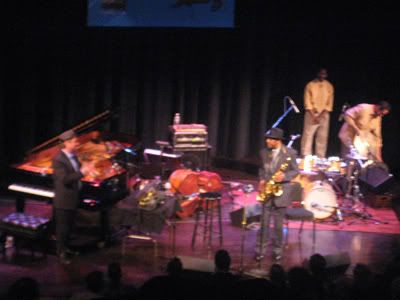 On the first night, Archie Shepp gave a rare U.S. concert appearance at the Herbst Theatre. The Herbst Theatre is one of the finest locations utilized by SFJAZZ—it’s just the right size, the sound is good, and the theatre itself beautiful—and it befits legends like Dewey Redman or Andrew Hill, both of whom have played there in recent years. This was, it must be said, a very special treat for Shepp’s Bay Area fans, many of whom have waited years to see him in person, sustaining instead on repeated listenings of landmark albums like Fire Music, Attica Blues, and—appropriately—Live in San Francisco.
 After “Trippin’,” a 12-bar blues in which Shepp channeled James Brown’s epic wail in singing about canceling his email and cutting off his cell phone, Shepp announced that his contract with SFJAZZ called for an intermission. Any folks who might have left missed the best portion of the evening.
 The next night, it was Cecil Taylor at Grace Cathedral. Consecrated in 1965 by Duke Ellington, the massive church was blessed with jazz from the start, and for 22 of the past 26 years, SFJAZZ has been using it for concerts they call “Sacred Space.” Pharaoh Sanders is among those who’ve performed solo inside the cathedral, using no amplification whatsoever. The effect is stunning.
 When Cecil Taylor speaks in a foreign musical language of constant discord, are there ears enough to make out what he’s saying? The show was sold out, but it was unavoidable to contemplate just how many in the crowd viewed Taylor simply as a cultural curiosity. Between each of five pieces, Taylor shuffled and rearranged his sheet music, and it was hard to figure out why he even had it in the first place. He couldn’t possibly have been following it.
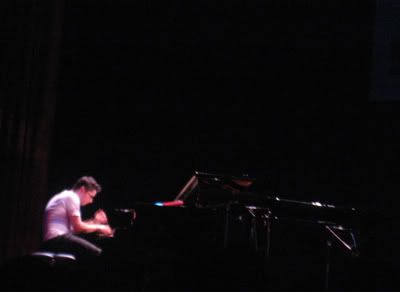 Back to the Herbst Theatre on Saturday night, for a decidedly younger lineup: 21-year-old piano prodigy Eldar and 24-year-old chanteuse Sophie Millman.
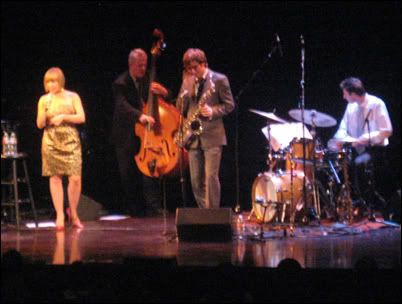 Up next was Sophie Milman, who, like Eldar, was born in the former Soviet Union. Moving to Israel at age 7 and then to Canada at age 16, Milman lived an upended youth in areas of global tumult, discovering solace in listening to American jazz records. This is her history, which she tells in magazine articles, on radio shows, and from the stage.
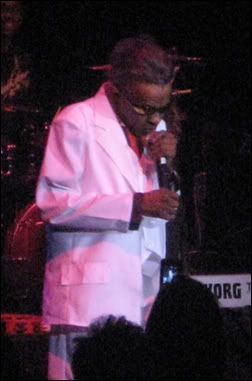 The insane circumstances surrounding Sly Stone’s bizarre appearance in Santa Rosa last Friday, Oct. 18, were told to me by several people involved with the show. Crazy doesn’t begin to describe it. Here’s how it went down.