Party Like It’s 1932

11.05.08

The 2008 presidential campaign turned into quite an ordeal. Even the most tangential observer was apt to get sucked into a vortex of media spin. But despite all the superficial aspects of the nonstop spectacle, the election became genuinely emotional for many people. It represented a huge fork in the national road.

As much as anything else, the election became a referendum on “spreading the wealth.” In the last weeks, John McCain and Sarah Palin kept denouncing the idea that government should reduce the huge economic gaps between the rich and everyone else. The duo’s logic would eliminate any vestige of a graduated income tax.

From the top of the GOP ticket, the battle cry was a recycled attack on the principles of the New Deal. McCain’s oratory peaked as regressive defiance. Two days before the election, he had the message down: “Redistribute the wealth, spread the wealth around—we can’t do that, my friends!”

Initially, I’d been a bit wary of the Obama campaign’s sloganeering about “hope,” but I felt some real resonance for optimism at the convention in late summer. Delegates often seemed to embody a progressive direction for Democrats overall. And when sometimes I would wince at the center-hugging, corporate-oriented rhetoric coming from the podium, I’d tell myself, “Party like it’s 1932.”

Comparisons are sometimes made between Barack Obama of 2008 and John Kennedy of 1960, both of them roundly criticized as young senators too inexperienced for the presidency. But during the last few months, in historic terms, I’ve often seen more parallels between Obama and Franklin Delano Roosevelt.

Obama and FDR ran as centrists in eras of great economic distress. During the ’08 campaign, as I looked ahead, reasonable hope indicated that grassroots activism for progressive change during an Obama presidency might accomplish great things reminiscent of the New Deal, with its safety-net guarantees and its mammoth commitment to public works programs that created jobs.

Increasingly, John McCain seemed like a kneejerk cartoon as he railed against taxes with simplistic boilerplates from the GOP canon. In contrast, Obama was actually capable of expressing helpful nuances and facilitating national introspection.

While Obama had shown himself to be overly cozy with corporate power and all too willing to call for escalation of warfare in Afghanistan, some kind of humanistic rationality could become thematic and maybe programmatic during his administration—a prospect that was virtually inconceivable in the event of a McCain victory.

And, politics aside, another aspect of Obama’s behavior held out genuine promise for elevating public discourse and government decisions: he was less inclined to insult our intelligence than almost any other “major” presidential candidate in living memory.

This article goes to press on Election Day, so I write these words without knowing who the next president will be. If it’s Obama, we’ll have our hands full to move his administration in a progressive direction. In the unlikely event of a McCain presidency, we’d have our hands full trying to limit the damage. Either way, given the problems of the world and the power of the U.S.A.’s military-industrial-media complex, the challenges will be immense.

As a practical matter, the best-case scenario involves widespread activism in our communities, determined to shape the future by illuminating good reasons and building political muscle to pull President Obama toward policies for civil liberties, peace, environmental protection, labor rights and economic justice. People in the North Bay should help to lead the way.

 Norman Solomon, founder and coordinator of North Bay Healthcare Not Warfare, is the author of many books including ‘War Made Easy: How Presidents and Pundits Keep Spinning Us to Death.’ Starting in January, he will teach a course at Sonoma State University on war and the news media, offered by the Osher Lifelong Learning Institute.

Open Mic is now a weekly feature in the Bohemian. We welcome your contribution. To have your topical essay of 700 words considered for publication, write [ mailto:op*****@******an.com” data-original-string=”LlJJruzSKi1GXpJTuG3tzw==06aoqTLqUFVc+pHjjzwZLfNJcgWTSZx/tnnx4GfvAevJJS22TfIjk2fJXdk/87a4Ws5pyG6FSyHy5R8d9WCzyJN9I23ekb9bE1D/F9ORiT+HlQ=” title=”This contact has been encoded by Anti-Spam by CleanTalk. Click to decode. To finish the decoding make sure that JavaScript is enabled in your browser. ]op*****@******an.com.



Form Over Function

0

the arts | stage |

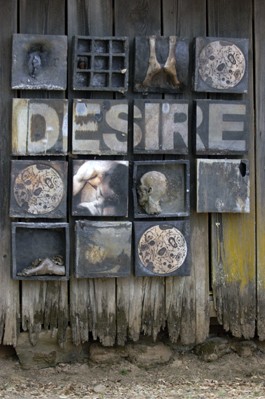
‘DESIRE’: The disparate clay pieces that Richard Carter brings together draw from his ‘Life After Life’ series as well as his own personal longings.

By Gretchen Giles

Like drawing, it is possible to see ceramics as a “mother” art, one that is necessary to claim proficiency in before moving on to exploring other media. At least, that appears to be the case at the Quicksilver Mine Co., which is currently exhibiting a show drawn from the workings of a ceramic studio, much of which has very little to do with clay.

Titled “Richard Carter Studio: Past and Present,” this collective exhibit showcases the work of some 20 students who have done residencies with sculptor Richard Carter. Formerly housed along the Napa River, Carter now oversees some 85 acres in the rural Pope Valley area near Angwin, running an in-house residency program centered on wood-fired kilns and community. Students may stay for extended, even open-ended periods of time during which Carter, a former French Laundry sous chef, finds them restaurant work in tony Napa eateries to help pay their artistic stipends, cooks for and with them, and helps them learn to live on his rural ranch.

Carter, 49, estimates that some 30 students have so far passed through his program, a strenuous life experience modeled after the teachings of his own mentor, Kansas City Art Institute instructor Ken Ferguson, as well as the Bauhaus-informed strictures of the late Pond Farm artist Marguerite Wildenhain. During their tenure, students live together, work collaboratively and, most importantly perhaps, tend the wood fires necessary to heat the Korean- and Japanese-style kilns that must burn ceaselessly for seven to 10 days at a time in order to get hot enough that they not only melt their own ash, they also puddle steel.

But to judge from the Quicksilver show, most of what emanates from Carter’s kilns is not adequate to make tea, serve tea or sip tea; few of the artists who train with him end as “functional” ceramicists, those who produce items for the table or hearth. Rather, those such as Brooklyn-based artist Paige Pedri have moved on to create, huge white corporeal figures, abstract and recognizable both, fashioned from burlap, plaster and wire that splay in reminiscence of Rembrandt’s Slaughtered Ox or the biomorphic hanging figures of Eva Hesse.

Needing to complete an apprenticeship under a mentor, German artist Kathinka Willinek came to Carter after finishing a rigorous study in functional ceramics in Berlin. After her time in Pope Valley, she went to Carter’s alma mater in Kansas City, but soon switched from the ceramic department to the sculpture department. The work she sent to Quicksilver consists of long filaments threaded through with short pieces of colored string that when looked at from a small distance reveal a quick sketch of a face and figure.

A current Los Angeles darling, sculptor Nathan Mabry came to Carter when he was still a high school student in Napa. Under Carter’s tutelage, Mabry also went to the Kansas City Art Institute, subsequently receiving his MFA from UCLA and his own show within the month. Mabry takes found objects and ready-mades and alters them with masks and other surprising additions as well as casting his own minimalist molds and models.

Guy Michael Davis, who shows slip-cast tree limbs and faux nests at Quicksilver, has founded a Midwest design firm; the singularly named Granite uses oil paint, garish cartoon figures and plenty of sequins to wreak satiric nudges; Jayson Taylor uses beading and white silk organza to reflect on God.

While many of the artists collected in the Quicksilver show did send functional pottery, as many did not. “I really question college ceramics departments,” Carter says crisply by phone from his Pope Valley ranch, “because if you’re making three-dimensional objects that aren’t functional, you need to be in the sculpture department; otherwise, you need a design education, and that is lacking in most ceramic programs.”

Ken Ferguson, Carter’s mentor, died four years ago after having made a laughable attempt at retirement in 1996, continuing on with KCAI as an emeritus professor and remaining a towering figure both on campus and on the national clay scene. With his passing, Carter also sees the efficacy of a ceramics program having passed, too. “Clay has always wanted to be accepted in the fine art world and it’s so stuck in its past and its function,” he says. “You end up with a teapot that’s trying to be a sculpture that’s not accepted by the fine art world and doesn’t function either. What’s being made is really reflective of what’s happening in that world.”

Carter’s own career is most hugely defined by a mammoth “Life After Life” series he completed in the late 1990s. Returning to the Bay Area from his education at KCAI, he was caught up in a sad swirl of AIDS and HIV-related deaths among his friends and contemporaries. He created a series of ceramic slabs studded with nails that he now says worked as a sort of emotional barrier, the nails a protective artifice. And then a friend stricken with AIDS came to him and asked to be an actual part of Carter’s work. “Troy came to me and asked me if I would cast his body because he wanted to be part of a piece that would help educate, he wanted to be immortalized,” Carter says simply. “He died 10 years later.”

The day after Troy’s death, Carter cast his body, creating a mold. He later filled the mold and recreated Troy’s person, eventually filling the vessel with Troy’s ashes so that it is both urn and testament. For years, Carter made work based on the memory of Troy Simon Burdine III, much of the work eponymously titled. “I did the whole grid series using pieces of his body, and it was compartmentalizing, it was the way that I was processing and then that became much less about him and more about me and my sexuality and fears,” Carter says with characteristic honesty.

After much self-reflection and striving, Carter finished with the series based on Troy’s body and moved back into his own emotional frame, gradually moving to the work he creates today, in which he wood-fires ceramic slabs studded with steel nails until the nails dissolve, informing the surface texture and color of the pieces. “I went back to that nail series [from college],” he says, “and fired those pieces so that they would melt. Now the barrier was gone and love came into my life. The barrier, the nails, were keeping me from what I wanted. It probably saved my life.”

Curiously, stepping back to old work has prompted a fresh vision. “These pieces are not as narrative as the ‘Life After Life’ series,” Carter reflects, “they’re not as content-driven. For me, what I walk away with is what’s most important. Rothko could paint a canvas just red or black and evoke feelings and emotions. It all connects to the feelings. This is a relatively new series, but for me it feels very current, because I think that art and craft need to reflect the time in society that it’s made.”

Having spoken with a very eloquent frankness about his work and his emotional life, Carter sighs. “I hate giving interviews,” he says. “I express myself so much better in clay.”

  ‘Richard Carter Studio: Past and Present’ continues at the Quicksilver Mine Co. through Dec. 7. 6671 Front St., Forestville. Open Thursday–Monday, 11am to 6pm. 707.887.0799.


View All


Museums and gallery notes.


Reviews of new book releases.


Reviews and previews of new plays, operas and symphony performances.


Reviews and previews of new dance performances and events.

Climate Healing

11.05.08

No matter who’s elected president, global warming will certainly be a key issue for the next administration. We’ve surely all seen the evidence that our culture has overshot our global ecosystem’s carrying capacity, risking catastrophic climate destabilization. In response, many of us are making individual changes, which is essential but, sadly, insufficient.

Thus, it’s vital that we as citizens also understand the community-level changes being discussed, then join with others to encourage truly wise plans. Certainly, the polluters will be angling for approaches that serve their interests, and the recent financial-system breakdown highlights the folly of letting powerful interests call the shots.

What is our climate change goal, exactly? According to Santa Rosa’s Climate Protection Campaign (CPC), scientists say that we must reduce emissions a stunning 80 percent by 2050. Currently, each Californian’s average annual greenhouse gas output is 14 tons. The 2050 target, given our population projections, is a breathtaking 1.5 tons per person.

How will we get there? That’s the question CPC explores both in its work and at its Nov. 6 Climate All-Stars Conference. Ann Hancock, CPC’s executive director and cofounder, says that the answer won’t be just one solution but many combined. However, she counsels, “We really need to focus on the high-leverage ones. That’s what we’re trying to showcase at the conference: the real solutions for speed and scale.”

Significant options now being explored include market-based approaches. Because current prices for carbon-polluting energy don’t reflect their environmental harm, higher usage levels are encouraged. Therefore, an increase in carbon prices should give consumers a more accurate price signal, making alternative energy and conservation more attractive, speeding up our vital transition and allowing the free market to determine the specifics.

How would increased carbon prices be implemented? There are two basic methods: a carbon tax and a cap-and-trade system. The benefit of a carbon tax, preferred by economists, is its simplicity. The tax is merely calculated per ton of carbon the first time that carbon-containing fuel (coal, oil or natural gas) comes out of the ground or off the ship. The tax can start low and increase over time.

The second method, cap-and-trade, is significantly more complex. It sets various emission caps then provides permits that are traded by corporations. Lowering the caps progressively over time reduces net pollution. Although this approach is currently seen as more politically viable because of its indirectness, critics call Europe’s attempt at it a failure and are concerned that it creates a complex bureaucracy that is easily “gamed” by polluters to profit themselves, not the planet.

At this point, I often get lost among the various capping approaches, so I was happy to find Peter Barnes’ booklet Carbon Capping: A Citizen’s Guide (www.capanddividend.org), which is helpful for understanding the key design options and elements. He also offers his proposed variation, cap-and-dividend, which distributes cap-permit income directly to citizens, reducing the economic impact and rewarding those who conserve.

Building on this idea is NASA climate expert James Hansen’s proposed tax-and-dividend system, which combines a carbon tax’s simplicity with the balancing effect of direct citizen dividends. To me, this starts sounding sensible. Plus, I feel empowered as I start catching on to the fundamental distinctions in how these proposals are structured.

I’m glad that CPC’s conference will help us all explore systemic solutions like these. I’ll also be interested to hear one of their keynote speakers, Adam Kahane, who wrote Solving Tough Problems: An Open Way of Talking, Listening and Creating New Realities. Watching environmentalism go mainstream, I’ve felt that successful green implementation will require we avoid dogmatism, and instead encourage exploratory conversations that bring forward our synergistic wisdom and empower democratic decisions about our future lives.

I hear that notion echoed when Kahane writes, “Simple problems, with low complexity, can be solved perfectly well—efficiently and effectively—using processes that are piecemeal, backward looking and authoritarian. By contrast, highly complex problems can only be solved using processes that are systemic, emergent and participatory.”

Our current financial crisis reminds us that the economic rules of the game determine our cumulative behavior. The question then for all of us is: How can we modify our economic system so that it’s truly healthy for ourselves and the planet?

 The Climate Protection Campaign’s Second Annual Climate All-Stars Conference is slated for Thursday, Nov. 6, at Saint Mary’s Cathedral, San Francisco. 707.537.1679. [ http:-/www.climateallstars.org- ]www.climateallstars.org.


Go-To Girl

11.05.08

Mike Leigh’s new film, Happy-Go-Lucky, celebrates the sort of figure he usually crushes in the last reel. Sally Hawkins’ Pauline Cross, nicknamed Poppy, is as intoxicated by London as David Thewlis in Naked was poisoned by that city. Leigh and his cinematographer, Dick Pope, start with a tour of the city by bicycle. Throughout the film, we end up pottering around bookstores, lounging at pubs where they keep the aspidistra flying, stopping for a walk at the Camden Lock market and then pausing for a final luxurious crane shot of a rowboat in the Serpentine.

What kind of movie is Happy-Go-Lucky? Leigh takes his characters to the seaside, and he even finds happiness instead of squalor there, stopping for friendly glances at the locals and lingering over a pair of chummy bearded men perched like silent shorebirds.

The merry and bright heroine Poppy is an elementary school teacher who lives off of Finsbury Park Road. Poppy is 30 and single, and seemingly unconcerned about it. She’s a low-rent, neo-hippie version of those exuberantly skinny girls Audrey Hepburn used to play, with a charming overbite and a wardrobe of patterned tights and circus-colored wool sweaters.

She goes out dancing with her mates to Pulp’s “Common People,” bounces on a trampoline for exercise, boozes it on weekends, stays up late and talks trash with her girlfriends. For kicks, she takes a class in flamenco. In these scenes, Karina Fernandez’s dance instructor demonstrates a Monty Python&–worthy Castilian accent. One lesson deteriorates into a hell rant about the kind of man “who runs off with a Swedish beetch who is 22 jears old.”

The L.A. Weekly‘s film reviewer Ella Taylor was miffed at the extremity of the pro-choice argument in Leigh’s last film, the tragedy Vera Drake. Taylor quoted Pauline Kael about Leigh being “a good hater.” Well, so what? So were Dickens, Beethoven, Picasso. The point is that a good hater is a good lover. Maybe the most alarming scene in Happy-Go-Lucky has Poppy burbling like Ned Flanders and lying on a table as a chiropractor snaps her spine.

The mirth and sparkle in Poppy’s hazel eyes, the good, simple heart and the girl’s delight in double-entendres got past my resistance. But the way Leigh films this cheery stork-girl it seems as if her cheer will turn out to be an end in itself. That’s why this film takes some sticking with. The point becomes clearer when Leigh adds some bitterness to complement the sweetness.

Poppy takes lessons so that she can drive the car of her flat mate Zoe (Alexis Zegerman). This starts her regular encounters with a more traditional Leigh figure in the form of one Scott (Eddie Marsan), a frowning, alienated driving instructor, essentially Nietzsche reincarnated—down to the brushy mustache. Scott has a conspiratorial worldview. It seems to have something to do with the Illuminati, but he’s also very worried that the Washington Monument is actually 666 feet high. He can’t bear to be touched, let alone flirted with. In his company, Poppy learns that not everyone can be cheered merely by a pert girl.

The early driving lessons with Scott evince the prime comedy of teaming a cheerful person with a growling grouch—Laurel and Hardy, for example. But Scott starts to lose his own fragile grip. Poppy sees into him, asking good, pertinent questions like a psychiatrist, and she’s also shrewd enough to discover that one of her elementary school students is being beaten by his mother’s boyfriend. Poppy isn’t as silly as she looks. The wide, jack-o’-lantern grin might be a kind of wince, even a way of keeping people at arms’ length.

Since almost everyone in Happy-Go-Lucky is a teacher, you could suppose Leigh is mulling over the proper way to pass on learning. This is commonly a way filmmakers trip themselves up; audiences are resistant if they think a movie is trying to teach them something. Fortunately, Leigh is so subtle that his film about the importance of passing on tenderness may not seem like a lesson. The density of his characters is the result of rehearsal, improvisation and a lack of emphasis over whom the film centers on.


There’s really no such thing as a supporting character in Leigh’s films, and that’s especially true of Happy-Go-Lucky. The characters are so deep that you could have made a number of movies out of this film. But chances are Hawkins would have stolen every one of them.

  ‘Happy-Go-Lucky’ opens on Friday, Nov. 7, at the Rialto Lakeside Cinemas, 551 Summerfield Road, Santa Rosa. 707.525.4840.


New and upcoming film releases.

Browse all movie reviews.

Not Just Another Berry Beer

0

A merica: Meet the acai berry, the newest rock star among high-end exotic health foods. The pea-sized fruit (pronounced “ah-sigh-ee”) grows naturally in great, heavy clusters on jungle palms in the Amazon rainforest, where indigenous cultures have reportedly eaten the berries for centuries. Literature cites the many health benefits of the acai as an attraction to those who have pursued it; it’s a source of energy, fiber, vitamin E, iron, omega acids and antioxidants, those incorrigible yet mysterious compounds we all love. The berry is also said to assuage cholesterol levels, boost prostate health and slow the effects of aging, and it has been billed as the “fountain of youth.”

The acai berry was introduced to the Western world in the 1990s. It has since made a strong presence in teas, smoothies and juices, but in September of 2007 the acai berry came to full fruition and found its way into booze. VeeV Acai Spirit is a 60-proof, deliciously perfumey liqueur draped with the essence and elements of the acai. Its makers have wisely never claimed that their product is necessarily healthy, but the unrefined berry is added to the grain alcohol after distillation and some of the acai’s supposed anti-aging powers likely remain in the drink.

Thirteen months later, another acai tippler has appeared: Eel River Brewing Company’s Organic Acai Berry Wheat. The new brew’s recipe has been a year in the making, according to brewery president Ted Vivatson. Test batches went on tap at the Fortuna brewpub and took criticism from patrons until a satisfactory product was achieved this summer. The beer is a straw-colored, atomic fruit bomb brewed with undisclosed loads of acai berries, a “proprietary blend” of more ordinary berries and a balance of pomegranate juice. More traditional ingredients like grain malt, hops and even a little bit of alcohol (4 percent ABV) give this beverage the leverage to retain its status as a beer.

Like VeeV, Eel River takes a cautious approach to advertising its acai beer as a health food. “I don’t like to make health claims when it comes to ale,” says Vivatson. “I just make this beer because it tastes good, and I don’t want people to go drink three cases for the health benefits.”

Yet the in-print marketing for the beer has touted its “high antioxidant properties” as reason to “drink on!” We’re not getting any younger, so it’s worth a try.


View All

Dead Again

11.05.08

I‘ve never been satisfied with the way I’ve seen Hamlet played onstage,” admits actor Brent Lindsay of the Imaginists theater company. Recently relocated from Healdsburg to a tiny new theater space in Santa Rosa, the company just opened a three-week run of Lindsay’s original one-man show Hamlet: Ghost Machine.

 “I think, as actors and directors,” Lindsay continues, “we often look for too many easy ways out in doing Shakespeare, we try to show the black and white, we avoid giving audiences the choice to decide for themselves who is right and who is wrong, and instead we try to serve up the answers. Hamlet, to me, is about the questions, not the answers, so in this play, what I am serving up is the mystery.”

To give a sense of the impact of the play, after opening night local performance artist and former NEA auditor Eliot Fintushel (auditors visit grant applicants across the country reporting on theater company quality for the National Endowment for the Arts) wrote: “Brent Lindsay does Hamlet as if it had never been done before, as if the audience were imagining it with him for the first time.”

The best way to describe Hamlet: Ghost Machine is to start where the piece begins. Hamlet is poisoned, he’s mortally wounded, and, in the last moments of his life, he attempts to make peace with all of his ghosts.

“He exorcises all of those ghosts,” says Lindsay, “by playing out his life for them. He plays out his life in the form of theater, which we know he loves so well.” The astonishing thing about the piece is that Lindsay, with director Amy Pinto, has reworked and reoriented the original script without adding a single new word. “It’s all Shakespeare’s text,” he says. “I just reconstruct it. I had to pull apart some of the meter in order to make sense of some of it, but that’s as radical as I get in making changes to the text. Everything is taken directly from the play.”

This is taking the concept of the play-within-the-play to a whole new level. One has to wonder, in focusing on Hamlet’s dying thoughts as he slips in and out of consciousness, does Lindsay’s Hamlet regret any of his choices—or his avoidance of choices?

“It is undeniable that Hamlet is one of the privileged class, but he is also an exceptional human being,” Lindsay says. “As an actor, I really enjoy truth . . . the truth in all of us, the dark and the light, the positive and the negative. The way I approach playing Hamlet in this piece is the same way I would approach Richard III or Iago or any of the other so-called villains.

“I’d get nowhere as an actor if I played them as bad,” he continues. “The whole point of theater is to open your heart to the heart of the character, and hopefully to leave a changed person, both the audience and the actor. In playing Hamlet, yes, I recognize his many weaknesses, but I have to focus on his strengths, I have to focus on what he has to reach in order to gain that final peace for himself. For me, Hamlet is the hero of consciousness.”

The hero of consciousness?

“Here is a guy who never lets go of the questions,” Lindsay explains. “What are we here for? Who do we put in power? Am I going to let it happen? What am I willing to give to this world, to what I think is right? Hamlet stands at the balancing point between consciousness and change. In terms of physical action, he may be wanting, but in terms of his intellectual willingness to grapple with the meanings of life, Hamlet is a hero.

“Is he sorry for the things he did, or didn’t do?” Lindsay asks rhetorically before giving a short chuckle. “I’m still figuring that out.”

‘Hamlet: Ghost Machine’ runs Thursday-Sunday, Nov. 6&–9, and Friday&–Saturday, Nov. 14&–15, at the Imaginists Theater Collective, 461 Sebastopol Ave., Santa Rosa. 8pm. $10&–$15; Nov. 6 is pay what you can. Email [ mailto:ti*****@***********ts.org” data-original-string=”IfODrJbMRNxWyn2N4535dQ==06aQyAPyP33yfNYH2hR6CxkiFEOqBKN7G+BmjvpwgN0LkJC6R1c2OUZ773UxVhgtb6fdR2vHtmcFz3FWn58g4j5l14htwm7+gx2WU3Umh7VC0XivRTrhpx5sguoGkfXqCGb” title=”This contact has been encoded by Anti-Spam by CleanTalk. Click to decode. To finish the decoding make sure that JavaScript is enabled in your browser. ]ti*****@***********ts.org.


Museums and gallery notes.

Reviews of new book releases.

Reviews and previews of new plays, operas and symphony performances.

Reviews and previews of new dance performances and events.

Letters to the Editor

11.05.08

Wrong Planet?

To the presenters of Maitreya’s teachings (see last weeks insert in the Boho), this is a time when we all need guidance. How nice that Maitreya and the Elder Brothers are coming to “evoke in man a desire for change and betterment.” And I’m glad to hear that “men will know afresh the joy of full participation in the realities of Life.” As a woman, I’ll wait for Elders or Wise Ones who speak to humankind. Those who speak to humankind know that exclusive, patriarchal language and social structures are a thing of the past. If a better future is to be created by man with the help of a brotherhood, I’m on the wrong planet.

G. Haley 

Sebastopol

The Brilliant Gabe Meline

I read the Bohemian because of the brilliant writing style of Gabe Meline. I was hoping he would write about not the Sly Stone concert itself, but the mess that is Sly himself (“Runnin’ Away,” Oct. 22). Gabe rocked it. I laughed out loud at his description of the events before and after. Beyond cool.

David Petri

Middletown

Don’t Mock Love to Death

“You see, Life on this Earth isn’t separate from any social justice struggle. It’s too late in the game to separate these things. Issues will not be isolated from each other when the Earth is extinguished. . . . In that last gasp all the progressive issues are simply Love, and all the advertisements are simply Love mocked to death.”

—Reverend Billy, What Would Jesus Buy?

Judy Helfand

via email


Corporate Welfare: Socialism

Socialism is alive and well in this country in the form of corporate welfare! In the Corporate States of America, during boom times profits are privatized but losses, naturally, are socialized. Conservatives tout “free markets” as the world’s panacea, but apparently its supposed ability to regulate itself is no match for unmitigated greed of this latest sanctioned Ponzi scheme.

The objective of Republicans for decades has been to emasculate government to the point that what’s left can be drowned in a bathtub. Consider the increasing privatization of the military, of schools through vouchers, attempts to privatize Social Security accounts, Faith Based Initiatives, etc. If we allow them to succeed in their final coup, there will be little left for social, welfare, health and educations programs—which is exactly what the gut-the-government freaks want.

Working folks who simply yearned for a slice of the American dream will unlikely see real assistance from Washington. The fat cats with their $15 million homes in the Hamptons and Greenwich will inevitably bounce back; the vilified poor will just get poorer. Meanwhile, families being foreclosed on should, rather than skulk away from their homes, ignore eviction notices. Band together, contact the media and refuse to leave; local police surely won’t be able to enforce all the foreclosures. And if it does happen, seeing families dragged from their homes and dumped in the street will not play well on national television. And it will give strength to others to resist the greed that has pillaged the heart and soul of our country. 

Bill Strubbe

Occidental


&–&–>

Bohemia’s Timeless Harvest

I want to be evocative of either the past or the future. I thought it’d be amusing writing about observing what was going on as if I were a ghost very much alive.

—M. F. K. Fisher 

The beloved culinary writer and novelist Mary Francis Kennedy Fisher was born exactly one century ago. Fisher believed that the food we eat speaks to and reflects upon our human condition. Food anchored her prodigious, exacting prose, serving as example and metaphor through which to explore, critique, chronicle, inspire and muse over love, sex and relationships, philosophy, history—and both the mystery and the mundane essence of life itself. W. H. Auden once said of her, “I do not know of anyone in the United States today who writes better prose.”

Fisher spent the last four decades of her life in the North Bay. She moved to a cottage on the Bouverie Ranch, near Glen Ellen, in 1970. Prior to that she called St. Helena her home for 17 years.

It’s harvest season, when life transforms itself. Here we imagine that Fisher, who passed some 16 years ago, has come along with long-gone others to journey with us in celebrating seven courses of North Bay Bohemia’s timeless abundant harvest.

Starters

Where: COPIA. When: today. What’s served: assorted hors d’oeuvres. Libations: Carneros sparkling wines and M. F. K. Fisher’s “One Two Three”—Campari, gin and dry vermouth. Hosts: contemporary North Bay chefs.

Our harvest feast begins in Julia’s Kitchen at COPIA. The appetizing array of finger foods was prepared by some of our most acclaimed North Bay chefs. Hello to Sondra Bernstein of Sonoma’s Girl and the Fig, Douglas Keane, owner and executive chef of Cyrus up in Healdsburg, Mark Franz of Nick’s Cove, and, of course, the French Laundry’s Thomas Keller.

Before we get back to Fisher, we’re first joined by Food Network personality and local restaurateur Guy Fieri.

What do you make of the appetizers, Guy?

“This stuff’s clean out of bounds. Nothing but flavor town.”

Well, seems our guests have polished off the starters. The tables are bare. What say we take these folks off for a bowl of soup next?

“It’s on like Donkey Kong. Time to go.”

Soup du Jour

Where: a choice acorn grove in the Valley of the Moon. When: long before recorded history. Hosts: local Coastal Miwok. What’s served: nupa acorn soup with spicy hazelnut and peppernut relish. Libation: madrone berry punch.

We’re here to partake in the hospitality of the Miwok who, each harvest season, travel here from throughout the region. Wood smoke and the musky aromas of autumn are everywhere. A dance has ended. The Miwoks call this place tso-noma, the earth village. General Mariano Vallejo once said this translates into Valley of the Moon. Vallejo claimed the Miwoks believed the moon would rise as many as seven times in a single evening here, leading one to conjecture that our Miwok hosts may have partaken of substances rather more potent than the vine. But then again, this may be another of the general’s well-spun tales.

What a lovely grove of black and tan oaks. We’ll be walking past the cha’ kas, the raised acorn granaries. Now come steaming bowls of nupa acorn soup. Plain fare, but nourishing. What’s your take on it, Ms. Fisher?

“I think I have always liked the basic things. Good seasonal foods. Now it’s called California cuisine or something ridiculous like that. It’s all very betraying, how we eat.”

Seafood Course

Where: Fort Ross, on the Sonoma Pacific coastline. When: 1821. Hosts: Russian immigrants, Kashaya Pomos and Aleutian tribesmen. What’s served: raw oysters and fire-roasted king salmon atop seaweed salad. Libations: manzanita cider and icy Russian vodka.

Ms. Fisher instructs, “An oyster lives a dreadful but exciting life. He—but why make him a he, except for clarity? Almost any normal oyster never knows from one year to the next whether he is he or she, and may start at any moment, after the first year, to lay eggs where before he spent his sexual energies in being exceptionally masculine. Oysters, being almost universal, can be and have been eaten with perhaps a wider variety of beverages than almost any other dish I can think of . . . and less disastrously. They lend themselves to the whims of every cool and temperate climate, so that one man can drink wine with them, another beer and another fermented buttermilk, and no man will be wrong.”

I see some of our fellow travelers are already engaged in games of chance. Careful now, these Pomos are masterful gamblers.

Meat Course

Where: The Petaluma Adobe. When: 1840. Host: General Don Mariano Guadalupe Vallejo. What’s served: a Spanish-style barbacoa, featuring whole spit-roasted longhorn, elk and black bear, as well as goose and wild turkey. Libations: Vallejo’s own Mission Grape wine and brandy, along with a barrel of latter-day Sonoma Valley Zinfandel.

“I get pretty peeved about being called things like ‘past mistress of gastronomical pornography’ and so on,” Ms. Fisher fumes, taking a delicate bite of elk. “I believe in living fully, as long as we seem to be meant to live at all. This implies the deliberate use of all our senses. We must eat, just as we must breathe, in order to exist. Eating demands the use of several of our senses in order to attain plain physiological success: taste, touch, smell and so on. But I think it is Puritanical rubbish to say that the enjoyment of freshly picked green peas cooked over hot coals on a hillside is ‘pornographic.’ I really do not understand this seeming confusion of lascivious sensuality and real innocence. I think we should enjoy what our senses can give us, and not twist and hide that enjoyment—and one of the best ways we can do it is to eat good food with good people.”

Cheese Course

Where: Pt. Reyes pastoral zone. When: anytime. Hosts: multiple generations of Pt. Reyes dairy folk, including local Miwoks, Azore Island Portuguese, Irish, Swedes and Swiss Italians, as well as Chinese, Filipinos, Mexicans and Germans. What’s served: assorted North Bay breads and cheeses, house-cured olives, fruits and roasted chestnuts. Libations: Gravenstein cider and Jersey cream egg nog.

“‘The proof of the pudding is in the eating,’ it says in Don Quixote,” Ms. Fisher tells those gathered as she scoops up a slice of Red Hawk triple crème. “I believe it, myself, and would as soon have a hollowed ring of cold cooked cereal, Roman Meal or Wheatena of hallowed memory, with the hollow filled with grated maple sugar and a fat pot of cream waiting, as I would cherries jubilee. But then, in spite of Cervantes and a host of awesome authorities, I would rather have some ripe grapes or a little properly selected cheese than any of their artful messes. Or nothing . . . wolf or no wolf.”

Salad

Where: a solar/wind/geothermal hothouse. When: some distant future. Hosts: enthusiastic farmer-disciples. What’s served: a tossed mixture of lightly dressed heirloom and recently hybridized greens folded together with crisp raw succulents.

“I must say that ‘following the seasons’ doesn’t mean today what it once meant,” Ms. Fisher laments. “Now so much is picked green, put into controlled rooms with all these mirrors and lights, injected with chemicals and colorings, and sprayed with God knows what-all. It’s horrible. But those willing to make the effort can still find naturally grown vegetables and fruits, picked in the morning, purchased at noon and eaten in the evening.” But all is not lost.

“Here in the Sonoma Valley,” she says, “I see young people growing their own food and making their own bread. And, of course, the American people seem to be demanding so much more and, with exposure, choosing more wisely what they put in their stomachs.”

Dessert

Where: Christian Brothers Winery at Greystone in St. Helena. When: 1950. Host: Brother Timothy. What’s served: black walnut cake and Cloverdale lemon and purple basil sorbet. Libations: Christian Brother ports and brandies.

“There is a communion of more than our bodies when bread is broken and wine drunk,” Fisher toasts. “It’s like religion. If you have a glass of water and a crust of bread with somebody and you really share it, it is much more than just bread and water. I really believe that. Breaking bread is a simile for sharing bread.”


To end the day, Fisher tells us that the trick to polite exiting is “mainly a question of withdrawing to the vanishing point from the consciousness of people one is with, before one actually leaves. It is invaluable at parties, testimonial dinners, discussions of evacuation routes in California towns, and coffee breaks held for electioneering congressmen.” And with that, she bids us all adieu.

Conversations on M. F. K. Fisher with renowned chef John Ash, Kathleen Hill and Sylvia Crawford will take place on Nov. 9 at the Sonoma Valley Women’s Club, 574 First St. E., Sonoma. 1pm. $20; admission includes a taste of cassoulet and a glass of wine. Purchase tickets at Readers’ Books or at the door. 707.935.7960.

All Over But the Drinking

0

It’s all over but the shouting. Like a bad fermentation, it seems that political contests start with sour grapes and go south from there. Credulous voters have punched their choices into retooled video poker machines or marked Scantron cards, and what’s done is done. As we go to press, the results are yet unknown. Since prognostication of the future is above my pay grade, I offer the following wine recommendations with which to either celebrate victory or mellow the sorrow of defeat:

Celebrate Measure Q with Hart’s Desire 2006 “Ponzo Vineyard” Zinfandel ($24). The tasting room is only a brief walk from the Cloverdale train station—or a vigorous, traffic-free ride on the adjacent bike path. On the other hand, opponents of 21st-century transportation may enjoy Q’s defeat by cracking a bottle of NightTrain down by the desolate railroad. Go ahead and lay down on the tracks. You’re safe.

California high-speed-rail fans can toast Proposition 1 with Siduri 2006 Gary’s Vineyard Pinot Noir ($49) from the Santa Lucia Highlands down in the southland. (Actually, the bullet train to L.A. will pass through the Central Valley—hey, it’ll all be a blur at 200 miles per hour, anyway.)

Those cheering the defeat of Proposition 8 may pop the cork on—what else?—Iron Horse Wedding Cuvée ($38), while jubilant supporters of the same-sex marriage prohibition would best hark back to that earlier Prohibition: You toast with an empty chalice.

Proposition 11? Redistricting is confusing enough when sober. Enjoy the 2005 Frediani Vineyard Charbono ($30) from On the Edge Winery, a champion of the proposed Calistoga AVA that’s stalled in red tape. Who knows, maybe they’ll finally carve out their district, too!

If the plucky McCain-Palin ticket has prevailed against odds, pop the tab on a Coors, the non-elitist drink of the everyman. Proceeds benefit only a few wealthy families. Those who mourn a vanquished McCain can reach for a veteran bottle from your collection. It may have been a respected, venerable vintage back in the day, but now it’s clear you wouldn’t want to have hung on to it for another four years. Still say it ain’t so? Mix with Diet Pepsi and shake with half-melted ice cubes.

With all the high hopes raised, if the electoral map’s blue turns to red in some perverse, reverse véraison, and Obama-Biden goes down, I cannot in good conscience recommend a spirit strong enough to salve your sorrow. And while a victorious Obama camp may be tempted to celebrate with abandon, perhaps sober reflection is in order. Grab a glass of new wine, and imagine going for a walk through a poorly maintained vineyard in the fall. Some vines grew rank, while many others have already lost their leaves. Yet it stands on some of the best soil, and could produce a great vintage in 2009 and beyond. Sure, there’s no telling what inclement weather might test it, but the next harvest could lift field workers, vintners and owners alike into better times. We’ll see. Even if you’ve chosen a promising new vineyard manager, there’s still a lot of work to be done.


View All

Bikes for All

0

11.05.08

A bicycle shop stocked by Bay Area donations appears to be thriving in Botswana, says Mike’s Bikes co-owner Ken Martin. Jonmol Bicycle Services opened in July of this year in the Botswanan city of Gabarone and has since provided hundreds of affordable bicycles to the residents of the city, where private car ownership is rare and public transportation is unreliable and expensive. Mike’s Bikes worked with owner Jon ‘Bones’ Moletsane to open the shop in Botswana after seeing the dire need for bicycles in the country.

“This was a pretty unique way for us to put our money where our mouth is,” Martin says. “We spend a lot of time talking here at home about how great bikes are, how they’re great for the environment, great for your health. And we saw in sub-Saharan Africa a place where those benefits could have a hundred times the impact on peoples’ lives than they have here.”

Earlier this year, Martin and Mike’s Bikes co-owner Matt Adams collected 406 bikes in a large donation drive and sent them to Botswana. They traveled to meet and unload the large shipping container and to assist Moletsane in starting his shop. Moletsane was “exactly the kind of guy we wanted,” says Martin. “He was an aspiring African entrepreneur, he loved bikes, he loved the idea of bikes helping his own hometown community and he was willing to open a shop with our help.”

Botswana is unique, Martin says, in that there are bicycle suppliers in the region but no maintenance shops; a bicycle might be discarded for problems as simple as a flat tire or a bent rim. Jonmol Bicycle Services not only repairs and maintains bikes, but sells used bikes to residents at an affordable price, only 300–600 pula, or about $40–$80. Community support in Gabarone has been overwhelmingly positive.

“We hear from Bones every day,” Martin says. “He’s got a big target audience, and people love the idea of bikes. I think they’re something that people would have been on years ago had they had a place to source them. He’s got a big market, a lot of customers.”

Mike’s Bikes is currently looking to open another shop next year in Winhoak, the capital of nearby Namibia, for which Martin predicts another bike donation drive most likely in the spring. “We enjoy the heck out of it,” he enthuses. “It’s very rewarding to leave the country with something operational and self-sustaining like this.”


Party Like It’s 1932

11.05.08The 2008 presidential campaign turned into quite an ordeal. Even the most tangential observer was apt to get sucked into a vortex of media spin. But despite all the superficial aspects of the nonstop spectacle, the election became genuinely emotional for many people. It represented a huge fork in the national road.As much as anything else, the election became...

Form Over Function

the arts | stage | 'DESIRE': The disparate clay...

Climate Healing

11.05.08No matter who's elected president, global warming will certainly be a key issue for the next administration. We've surely all seen the evidence that our culture has overshot our global ecosystem's carrying capacity, risking catastrophic climate destabilization. In response, many of us are making individual changes, which is essential but, sadly, insufficient. Thus, it's vital that we as citizens...

Go-To Girl

11.05.08Mike Leigh's new film, Happy-Go-Lucky, celebrates the sort of figure he usually crushes in the last reel. Sally Hawkins' Pauline Cross, nicknamed Poppy, is as intoxicated by London as David Thewlis in Naked was poisoned by that city. Leigh and his cinematographer, Dick Pope, start with a tour of the city by bicycle. Throughout the film, we end...

Dead Again

11.05.08I've never been satisfied with the way I've seen Hamlet played onstage," admits actor Brent Lindsay of the Imaginists theater company. Recently relocated from Healdsburg to a tiny new theater space in Santa Rosa, the company just opened a three-week run of Lindsay's original one-man show Hamlet: Ghost Machine.  "I think, as actors and directors," Lindsay continues, "we often...

Letters to the Editor

11.05.08Wrong Planet? To the presenters of Maitreya's teachings (see last weeks insert in the Boho), this is a time when we all need guidance. How nice that Maitreya and the Elder Brothers are coming to "evoke in man a desire for change and betterment." And I'm glad to hear that "men will know afresh the joy of full participation...

Bohemia’s Timeless Harvest

I want to be evocative of either the past or the future. I thought it'd be amusing writing about observing what was going on as if I were a ghost very much alive.—M. F. K. Fisher The beloved culinary writer and novelist Mary Francis Kennedy Fisher was born exactly one century ago. Fisher believed that the food we eat speaks...

Bikes for All

11.05.08 A bicycle shop stocked by Bay Area donations appears to be thriving in Botswana, says Mike's Bikes co-owner Ken Martin. Jonmol Bicycle Services opened in July of this year in the Botswanan city of Gabarone and has since provided hundreds of affordable bicycles to the residents of the city, where private car ownership is rare and public transportation is...
11,084FansLike
4,446FollowersFollow
6,928FollowersFollow