Very Tiny Songs

0

12.10.08

In 1951, a young, half-deaf bisexual epileptic named John Alvin Ray entered Columbia Studios on 30th Street in New York City and recorded one of the greatest pop singles ever. “Cry,” released over a half-century ago by Johnnie Ray, is a breathtaking example of what magic can be wrought in the length of one side of a 45 rpm record. Laying out in elongated consonants and voluptuous vowels the crippling depths of emotional despair, the song levels the heart of the tortured teenager in three minutes flat.

The masterpiece of “Cry” is not just in its economy of time but its economy of resources; Johnnie Ray paints the entire weight of his heart onto the thinnest of canvases, with just a small group of singers and a guitar-based quartet playing all but invisibly to back up his flamboyant wails. The recording succeeds primarily because its absence of production is as innocent as Ray’s emotion. Recorded well before the stripped-down rock-and-roll era, “Cry” is razor-thin pop minimalism of the most pioneering and effective kind.

Fifty-seven years later, an addictively bizarre song reached the top of the charts. “A Milli” by the New Orleans rapper Lil’ Wayne confounds like a 4am drug binge, its lyrical content a scattershot explosion of random ideas tossed off with the occasional excuse that you, the listener, are a motherfucker, and that he, Lil’ Wayne, is ill. How the song went from one of hundreds of tracks that Wayne recorded in 2007 to a fan favorite on Internet leaks to the unlikely B-side of his first single to an even more unlikely No. 1 hit on its own is essentially the defining story of the unpredictable music industry in 2008.

Even more left-field than the song’s rise to prominence, however, is the song’s miniscule production, a direct descendant of Johnnie Ray’s 1951 small studio band. Everyone who hears “A Milli” immediately notices the song’s namesake vocal loop, which repeats through the track like a nag so incessant that it becomes easy to ignore, but the rest of its sounds are far less blatant: a bass drum; a sluggish, sparse snare fill that sounds like it’s played by a robot on dead batteries; and stray handclaps. That’s it.

Cue to the post&–”A Milli” landscape of 2008, and other artists have obviously taken the hint. These days, razor-thin pop production is a way for a track to stand out against the tidal wave of software plug-ins that overdecorate most 21st-century music, and while there have been traces of it in the past—the electronic blips of Ciara, the hi-hat hyphy of the Pack, the “snap music” of the Ying Yang Twins—it’s gaining in prominence. The future hits next year very well may be more about curating from, rather than condensing down, the outer reaches of the technological infinite.

What makes razor-pop production so perfect is the illusion of humanity it presents—the sensation that the artist is singing on a street corner, standing around a burning trash can, with friends as accompanists. It may sound like a small party, but everyone’s invited. Anybody can clap their hands and stomp their feet.

Earlier last month, for example, Beyoncé—whose first solo hit was a cluttered production overworking a full-bodied horn sample from a Chi-Lites song—released her take on the razor-pop single. “Single Ladies (Put a Ring on It)” is a classic celebration of freedom; a juvenile admonishment to a loser ex-boyfriend who couldn’t find it in himself to buy a ring and get down on bended knee.

But the song’s effectiveness lies in its sparseness. Beyoncé doesn’t need anyone to tell her how to feel about losing her man, just as she doesn’t need to wait for the band to show up. Thus, “Single Ladies” rides along with handclaps, foot stomps and the sometime sound of a spaceship starting to land. End of story. At the end of the song’s video—an astonishing juxtaposition of a grim black-and-white studio and a livelier-than-life dance routine by a leotard-clad Beyoncé and two cohorts—the camera focuses closely on Beyoncé’s face, her exhausted breathing faintly audible. The sound could have easily been added to the bridge, and it’d have blended in perfectly.

Fellow hitmaker T-Pain, whose legacy is instantly dated by the rampant robot-voice effect he achieves with Auto-Tune software, is the walking definition of a “showy performer.” He arrived at the MTV Video Music Awards this year on an elephant, a publicity gimmick for his circus-themed album, Thr33 Ringz. He performs in an oversized top hat, and his videos are colorful, busy expositions of quickly changing fantasy vignettes.

But T-Pain’s recent hit single, “Can’t Believe It,” glides along with a floor thump, finger snaps and a keyboard you might find at the local drugstore with its tone knob turned all the way down. Like all the other razor-pop singles of 2008, it feels as if it’ll crash in with an epic chorus, which, of course, never arrives. Four and a half minutes later, the vacuum is something internal in the listener, an uncommon small-plate feeling in pop music of perfection done slight. Clicking to listen to the song again is the inevitable, calculable response.

Who will be the razor-pop sensations of the future? The performers, interchangeable thanks to Auto-Tune, are impossible to predict, but the producers are likely to be a 23-year-old from Atlanta named Terius Nash, aka the Dream, and his 34-year-old partner, Chris “Tricky” Stewart. Nash and Stewart hit it big last year penning and producing Rihanna’s mammoth hit “Umbrella,” and have since gravitated toward the whispering power of the tiny, producing both “Single Ladies” for Beyoncé and another very tiny song, “High Price” for Ciara. The pair was also behind Mariah Carey’s smash single “Touch My Body,” constructed solely from a bass sound of kicking a cardboard box, hi-hats, finger snaps and two-note chords played on an analog synthesizer.

Nash has a new album due out in February, Love vs. Money, that can’t help but make more of a splash than his first effort. Last year, Nash’s debut Love Me All Summer, Hate Me All Winter was released to absolutely no fanfare in the week before Christmas, and currently has an unimpressive Amazon sales rank of 20,712. It’s also an overlooked harbinger of hits to come. “Music is uninspiring right now,” Nash remarked at the time of the album’s release. “The bar needs to be raised; a creative standard should be set in music. I’m hoping that the real quality in these songs shines through.”

Quality over quantity—such an idea. In the razor-pop future, it may be all we need.


Annals of Optimism

0

12.10.08

It was a moment made for television. Just minutes before,Barack Obama had been officially named president-elect of theUnited States. Countless millions watched as he assured us that,yes, we can do this and that. And then he caught us all bysurprise. He turned to his daughters and said that they would begetting a new puppy to take to the White House.

A puppy. Sitting in a Sonoma County home that was deflating invalue like a leaking bicycle tire, I thought, “A puppy?”Numb from the horrors of an endless war, not to mention the image Ican’t shake of all our schoolchildren nationwide holding hands andslowly circling the drain, and he’s talking about a puppy?

Lately, I haven’t had to go much farther than my own block tofind problems. At the corner market, I ran into a young man in histwenties who tried to sell me his food stamps so that he could makethe rent. At that same market, I gave a dollar to a homeless womanand found that she was Hispanic like me, over 70 years old,couldn’t speak a word of English and was carrying what was left ofher life hanging in bags from a creaky old bicycle that she pushedalong the side of the road.

But I was surprisingly comforted at Barack’s casual comment, andI can thank an old Texan professor for providing me the neededperspective.

While attending college in Texas, I took a film-appreciationclass. One day, the professor asked us to name our all-timefavorite movies, and the titles came spilling out. When HarryMet Sally sat next to Cool Hand Luke.Casablancaand Pretty Woman suspiciously eyed Road Warrior andA Fistful of Dollars. The majority of the gals enjoyed warmand cuddly films, and the majority of the guys enjoyed the smell ofspent gunpowder on celluloid. The professor asked us to considerwhy this was, and gave us a week to think about it. I finallystumbled on an answer, but it’s taken me 55 years, some marriagesand a couple of kids to spell it out. I probably still have itwrong, but here goes.

I unapologetically pay homage to Sergio Leone films. I taught mywife to shoot a rifle, and I’ll teach my girls when they’re older.For the time being, I play fairy king and storm the castle that thegirls build in the living room. I dutifully marvel when they enterwearing tiaras and gowns, and I’m still slipping shining dimesunder their pillows and sneaking away with their tiny lost teeth.And while they sleep, I watch mixed martial arts.

If a woman is lucky, she gets to freely choose whether or not tobring a child into her personal circumstances and into this world.After all, who wants to bring a helpless child into a hopelessworld? A quick look at history shows that when a new day is dawningin various parts of the world, bringing hope and a brighter future,the birth rate rises like yeast on a sunny day.

Maybe cuddly films are a reflection of our wanting the best forour children. My guess is that even Santa Claus wants to believe insomething. In a Harry Met Sally world, free-range love withno artificial dyes or colors really does carry the day. HumphreyBogart sends the woman he loves into the arms of the man that sheloves. We revere the nobility of King Arthur, and perpetuate thegiving spirit of Christmas and the Tooth Fairy. We find hope andstrength in the words of Mohammad and the Torah and the Bible. Andwe want to believe, truly believe, that a man with the weight ofthe globe’s darkening problems on his slender shoulders issincerely talking to his daughters about getting a puppy.


That was a Harry Met Sally moment. I know this because mywife turned to me and said, “I’ll bet women are feeling betterabout having babies after tonight.” I stared at her. I only wish Icould cut and paste that moment to share with my oldfilm-appreciation professor. Who would’ve believed that that a fewwords about getting a fragrance-free or hairless hound was enoughto spread a little hope? So I guess we should give a hang about thepuppy. Our world can use a good dose of hope.

  Open Mic is now a weekly feature in the Bohemian. Wewelcome your contribution. To have your topical essay of 700 wordsconsidered for publication, write [ mailto:op*****@******an.com” data-original-string=”KVb/+dTz0sy7gZC9Q2+cSw==06a3fMPPCLviAC0znK/lDc5LZB9OfD5cZ96UP2ckixpWy80zj+PYT/HQJXitaD36xpKY2LepTOH6fUVyxrPkvZi+6fxu90omnzN8oLSPvuJ2KC0YLhOR9rZFRvZ8mvit441ztuuP2X4jPhHYCwJHwcFDA==” title=”This contact has been encoded by Anti-Spam by CleanTalk. Click to decode. To finish the decoding make sure that JavaScript is enabled in your browser.]op*****@******an.com.


to theeditor about this story.


Letters to the Editor

12.10.08

Sako Satire

I want to thank the Bohemian for granting its progressive imprimatur to John Sakowicz’s stock recommendations (“Dancing with the Bear,” Nov. 19). There’s no point pretending that anything is more important than my personal financial aggrandizement, so now I feel much better about investing in socially and environmentally responsible corporations like Freeport McMoRan and Rayonier. Clearly the biosphere is irrelevant to my profiting from carbon-age giants like Petrobras, Chesapeake Energy, Ultra Petroleum, AEP and Duke Energy. I look forward to building my mega-mansion somewhere 300 feet above sea level and watching the ocean roll up to my valuable acreage. I’d also like to recommend that people who still have cash invest in private prison corporations, private military companies, weapons manufacturers and anything else that will be making big money from security and repression. Thanks again, Bohemian!

Jay Williamson
 Santa Rosa

Compassionate Banking

Yes, folks, it’s true—you saw it here first! One huge banking corporation has found a simple way to channel some of those funds back into the economy! They are suing a homeless, penniless person I know who owes them around $5,000 on a credit card. They are using three lawyers and a subpoena to do this. I’m imagining they will spend roughly twice as much as he owes them on court costs in order to sue him for nothing, of which he has plenty. Brilliant!

Perhaps our taxes will fill in the blanks, or they have some granting organization helping them out due to their great misfortune of late. I don’t know about you, but this fills me with deep compassion for our trembling banking system. How can we help our noble banks give this slacker his well-deserved and expensive slap on the wrist?

N. Morris
Sebastopol 

Truth-telling

Re P. Joseph Potocki’s article on bankruptcy (“Jubilee! It’s Bankruptcy,” Nov. 19): Thanks so much for writing and printing what most of America just doesn’t want to acknowledge.

Wendy
Santa Rosa

Vintage Vitriol

Although I admire your detective work to uncover what from the outside appears to be exploitation of employees of WDS and other sampling companies, I believe the proof is in the pudding (“We Are Family?” by P. Joseph Potocki, April 30). Shopping is an experience, not just about the product or price. Costco employees are high-caliber, often educated, professionals. Most of the “Demo Dollies,” as your many quotes from them prove, are uneducated, unhappy and unable to articulate properly. Many of the people whom I have encountered in Costco sampling areas are a very negative reflection of a great company, and do not deserve the $8 per hour they receive.

BTW, have you had the tzatziki dip with pita chips? Or the goat cheese logs? Or the Campari tomatoes? Gosh, how I love Costco and living on the Carolina coast!

miss Powell
Wilmington, N.C.  

We wouldn’t normally print a letter in response to an eight-month-old story but this particular feature has some weird Internet legs that we can’t quite reckon, and prompts weekly letters from around the country, this being the most unintentionally amusing example for its glib intolerance and enthusiastic culinary and geographic recommendations.


Dept. of Thanks

By 6pm on Dec. 3, the cake was baked, the candles lit, the many copies of the Boho laid out, and some 20 writers assembled to read their Jive Turkey submissions. A fine time was had by all, particularly the five winners, who each received a $20 gift certificate from Copperfield’s Books for their efforts. And that would be: Copperfield’s Books whom we neglected to thank earlier. Thanks, Copperfield’s!

The Ed.
Still Learning Basic Manners


&–&–>

Healthy, Wealthy and Wise

0

12.10.08


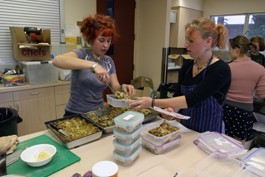
Cathryn Couch stands on the back deck of a professional kitchen on a recent chilly December afternoon while partygoers stream past her. As guests arrives, Couch hails each by name and offers hugs. “Do you still need lemons?” one woman asks. “Oh, my goodness, yes!” Couch exclaims. “Can you drop them off at my house?”

“No problem,” the woman says. “I have so many! I’ll stop by tomorrow.” She gives Couch another hug before going into the warm, fragrant kitchen, party sounds and good smells spilling out behind her onto the deck.

This party is a twofold celebration of chef Patti Stack’s new catering venture, Capers & Co., and an informal launch for Couch’s nonprofit, the Ceres Community Project. As with so many things in Couch’s professional life, the two intertwine to support each other perfectly. Stack can’t yet afford the full rent on the space that formerly housed the Patty James Cooking School in Sebastopol, and Couch needs a place for her team of some 100 teen volunteers to cook three days a week preparing nutritionally dense organic meals for 34 area cancer patients and their families. Also natural in Couch’s web of good karma, an “angel” has paid Ceres’ share of the rent in Stack’s kitchen for the next year, taking that one necessity off her plate as she moves her project forward.

A professional chef with over 15 years of experience, Couch is also an avid horsewoman. When her dressage instructor asked her to mentor her daughter in the kitchen, Couch cast about for a way to make the young woman’s time at the stove of wider benefit. Couch took the girl on one afternoon a week for seven weeks, and they cooked for a Sebastopol family in which the mother had breast cancer. Then they added another family where the mother was battling breast cancer. Then they added a man felled by a stroke. “The gratitude that people showed when they came to pick up the food really touched us,” Couch says. It also led to a terrific idea. “I woke up two weeks later and had a vision of the whole project. Nine months later, it was complete.”

On March 29, 2007, Ceres began. They had four families to feed and four students to help them do it. Drawing students from the Summerfield Waldorf high school simply because Couch knew some of the families there, they served 4,500 meals in 2007. By the end of 2008, they expect to have cooked, packaged, delivered and cleaned up some 20,000 meals. Today, students from 12 different schools ranging from homeschool programs to traditional area high schools to high schools for at-risk youth to culinary students from Santa Rosa Junior College participate.

Not that the Ceres Project isn’t a work in progress; it certainly is. Couch dreams large, and her dreams tend to vigorously come true.

In this instance, the dream is a reality with three goals. “We’re looking for foods that are maximally healing, organic and whole grain,” Couch says. But this is no sorry salad of broccoli and bulgur. Ceres’ recent Thanksgiving menu featured free-range turkey tenderloins with a plum sauce, stuffed portobello mushrooms and chard, filet of soul with mushrooms and greens, puréed kabocha squash with apples, and numerous other gourmet treats. Recipients indicate whether they’re able to eat dairy or other complex foods on a given day, as cancer treatments wreak havoc on appetites and retention.

Area businesses have been extremely supportive of Ceres, Andy’s Produce extending a $5,000 line of credit to get them started, Oliver’s Markets offering half-price discounts on meat and seafood, Gourmet Mushrooms providing free fungi, Redwood Hill Farms giving storage facilities and three Sebastopol farms donating produce: Dan Smith, the retired software entrepreneur who with his wife owns the French Garden Restaurant and Brasserie; the Lynmar Estate, an organic and sustainable family winery that maintains seven separate garden plots unrelated to winemaking as well as a head gardener in order to enhance their own lives and those of their guests; and Sebastopol’s biodynamic First Light Farm, a new west Sonoma County CSA.

“The only thing we need to buy at this point,” Couch says, “are onions and sweet potatoes. Everything else comes to us.” The Bread for the Journey granting nonprofit gave Ceres $1,000 to buy pots, pans, knives and other kitchen necessities.

But the emotional necessities mean almost as much to Couch. “The food needs to be beautiful, delicious and nourishing,” she says, remembering a story from a client who had lain in bed one night running down her day’s diet and wondering if she had eaten enough vegetables for good health. She went down to the fridge, opened the Ceres containers there, and took a forkful of each. The next day she told Couch, “Every bite sang an aria in my mouth.” That’s not a compliment easily forgotten.

“We’re also here to empower young people about healthy bodies, healthy foods and leadership,” Couch continues, speaking quickly in the cold afternoon air. “I also want them to see how simple it is to contribute. You can be 14 and still give something.

“Thirdly,” she asks rhetorically, “how can we make a maximum impact that’s creative and led in a way that’s truly sustainable?”

Couch would eventually like to form a teen speaking bureau. She envisions a two-acre land plot for growing, a teaching kitchen and Ceres Projects in other areas. There’s already a burgeoning model coming up in Marin. Its needs and aims will be slightly different than the Sonoma County nonprofit, but that’s OK with Couch, as long as they focus on the big three.

Eager to return to the party and the warmth inside, Couch stops her rapid-fire delivery for a moment and pauses. “It’s been astonishing to me,” she says, “to bring this into existence. It’s required so little other than the willingness to say yes.”

 The Ceres Community Project hosts a series of four healing food cooking classes Jan. 16&–27. Four hours each, these free classes are aimed at cancer survivors and their families. For details, call nutrition director JoEllen DeNicola at 707.824.2906. For more info on the Ceres Community Project, go to www.ceresproject.org.

Quick dining snapshots by Bohemian staffers.

Winery news and reviews.

Food-related comings and goings, openings and closings, and other essays for those who love the kitchen and what it produces.

Recipes for food that you can actually make.

Downtown Wine

0

Up and down Plaza Street I tramped in search of Healdsburg’s newest tasting room. MapQuest might have helped, but I would have preferred to have seen some old hobo signs pointing me to the Hobo Wine Company. In the last century, these crudely scratched hieroglyphics helped the footloose navigate the open road. For instance, a kitty cat signified “kindhearted lady here,” while an upside-down cup warned “this town allows no alcohol.” Healdsburg, of course, is competing for a world record in winetasting rooms. If many more pour into town, they’ll have to set up a wine country Hooverville of sorts—the plaza filled with cardboard shacks plastered with wine labels for wallpaper, and staff, humbly garbed in barrels, offering tin-handled tasting cups . . . Sounds like fun!

When I stopped by the Russian River Wine Company’s digs to ask for directions, I found winemaker Kenny Likitprakong behind the bar, and I knew I’d found it. Called Downtown Wine, the storefront is now a venture of Branham Estate Wines as well as Likitprakong’s Hobo, Banyan and Folk Machine labels, while the RRWC continues mail-order operations in the back room. The soundtrack here is likely to be Elvis or another LP played from a small record collection, not Wine Country Lite; hoodies are appropriate apparel. After all, the proprietor is a skateboarder-turned-winemaker, an H-town local who grew up in the wine business. While he set out in the world hoping to do anything but, Likitprakong eventually found his way back to the grape. Now hardly older than 30, he’s both settling down and making a precipitous leap, leaving his day job as winemaker at Moshin Vineyards to make a go of it on his own.

Likitprakong’s Banyan Wines, which he cofounded with his father, is aimed at pairing with Asian cuisine, a market where varietals like Gewürztraminer are too often simple and sweet. The refreshingly dry 2007 Santa Lucia Highlands Riesling ($17) displays a mild Alsatian whiff of petrol, a complexity rare in this state (and a treat, Likitprakong says, that’s not for everybody), with tropical, floral notes and a palate-cleansing, juicy lime finish. Although the pool of California Rieslings is a small one, this one’s in the top four among those I’ve tasted.

The unusually wordless Folk Machine labels depict a murky, industrial American wasteland. “Factories and Smoke” 2007 Potter Valley Pinot Noir ($28) sports Dr. Seuss–inspired artwork. Unfiltered, with a rose petal hue, it’s bright with sweet-and-sour cherry flavors and a faint hint of what may become a bouquet of sweet dry hay. A great wine for cheese plates and charcuterie—or green eggs and ham. Bearing the Hobo label, the 2006 Rockpile Zinfandel ($28) is intense, rustic and brambly, perfect for a can of beans toasted over a campfire.

To find Downtown Wine, tramp on up to the Healdsburg Plaza. Town allows alcohol. Head northeast toward the sign of the goat. Hot coffee here. Turn right, past the lighthouse, walk two doors up. Hobos welcome.

Downtown Wine, 132 Plaza St., Healdsburg. Open Thursday–Monday, 11am to 6pm. Tasting fee, $5. 707.473.0337.


View All

To Market

12.10.08

Not all is wailing and tearing-of-hair in the culinary loams of Napa. While COPIA is (perhaps) temporarily closed for restructuring, the adjacent Oxbow Public Market remains a robust commercial force with the Hog Island Oyster Company having last month opened its new tasting bar there. A sister to its Ferry Building outpost in San Francisco, the Napa raw bar brings the bay to the valley in a big way. In addition to sliders on the half-shell, look for Hog Island to serve up grilled cheese sannys, salads, old-fashioned hot oyster dishes and other seafood specialties.

Already established in the Oxbow is the Santa Barbara&–based Kanaloa Seafood, a purveyor devoted to sustainably harvested ocean produce. This launch brings the market’s tenant stores up to a healthy 21 outlets, including a charcuterie (the Fatted Calf), butcher (Five Dot Ranch), artisanal coffee roaster (the fierce folks at Ritual), ice cream vendor (Three Twins) and Venezuelan food (Pica Pica). Also doing well at Oxbow are the in-house wine merchant and cheese shops, the world’s tiniest winery (Folio), a bakery (Model), mobile rotisserie come to stay (Rôtisario), a chocolatier (Anette’s) and olive press and spice shop (the Olive Press and Whole Spice, respectively), a tea stand (Tillerman Tea), boffo burgers (Taylor’s Automatic Refresher) and several entertaining-extras stalls (Fête, Heritage Culinary Artifacts and the Kitchen Library).


Beginning mid-December, look for the Oxbow Produce and Grocery stand, which has suffered a midmarket float between Pica Pica and Folio, to take over the window space fronting First Street, immediately gaining higher viz. By March, the S.F.-based high-end cupcakery Kara’s Cupcakes will be in the other storefront window. To which we can only say, yum!

Oxbow Public Market, 610&–644 First St., Napa. Open Monday&–Friday, 9am to 7pm; Tuesday, until 8pm for local’s night with free live music; Sunday, 10am to 5pm. 707.226.6529.

Quick dining snapshots by Bohemian staffers.

Winery news and reviews.

Food-related comings and goings, openings and closings, and other essays for those who love the kitchen and what it produces.

Recipes for food that you can actually make.

Not a Drop to Drink

0

12.10.08

We who have worried that Barack Obama wouldn’t win the election need worry no more. We who have worried about the course of the United States are cheered by Mr. Obama’s fledgling efforts to change it. We who have worried about Bush’s nefarious reign are seeing that end. We who have forgotten to worry about so many things have so many things to worry about after all.

French documentary filmmaker Irena Salina’s newest work, Flow: For the Love of Water, is a stark reminder of our many worries, many of them brought to us by the Bad Old Guys from the Bad Old Days. Remember Nestle? Their actions in tricking breast-feeding Third World mothers into using their expensive synthetic formulas still burns hot. And the biggest rub in Nestle’s campaign against poor mothers? The women’s lack of access to fresh, safe drinking water with which to mix that damnably expensive infant formula.

Nestle and the water wars haven’t gone away. Indeed, the company has just quietly gotten stronger, as it and Coca-Cola and large lesser-known corporate entities like Suez and Vivendi team up with two other names from the Bad Old Days, the World Bank and the International Monetary Fund, to corner one of the earth’s last fleeting resources: water. In 84 long minutes, Salina shows how water is being privatized in some of the poorest reaches of the world, trickling out for tokens to people in undeveloped regions of South Africa, blooming crimson with slaughterhouse blood in Bolivian creeks and being dammed for per-pay use along the great swollen Ganges.

But according to the experts in Flow, one needn’t travel to the marigold-strewn shores of India to cluck a tongue. California is estimated to have a 20-year supply of fresh water available. Twenty years. Arizona has just 10 years, and with the golf-course boom teeing off in that state, experts give them really only five years of freshwater access.

We can live without love, W. H. Auden counsels in a quote shown in the film’s opening credits, but we can’t live without water. In Bolivia, one-tenth of all children under five can’t live with the water, so contaminated is it that the infant mortality rate has soared, particularly as the government, intimated by the World Bank and IMF, sold its water rights to the gigantic Suez company in the mid-1990s rather than face the threat of losing its international financing. Founded in the 1800s to construct the Suez canal, the company is now one of the leading water and waste corporations in the world, controlling the water supply in some 34 U.S. cities and in hundreds of international municipalities.

Water itself is the third biggest commodity in the world, a $400 billion global industry that ranks right after oil and electricity. Naturally, Flow shows white men with haughty French accents in chic rumpled suits telling indigent protesters, “You have insulted me so I will not talk to you,” as if hurt manners were all that’s at stake. The scenes move from South Africa where dire poverty prevents villagers from paying for clean water, having to instead risk cholera and death in the polluted channels of their local streams; to Bolivia, where offal has so fouled the main waterway that the river has been covered with cement; to India, where the great “mother” Ganges is siphoned down for sale to Delhi residents; to the United States, where citizens of a Michigan town tragically lost their suit against Nestle, which is still pumping out the surrounding aquifer to bottle free water to the estimated tune of $1.8 billion in profits per day.

Indeed, bottled water becomes the most immediate focus for those itching to act after watching this disturbing doc. Repeated studies have shown that, because the EPA does not regulate water contaminants, it is often less sanitary than municipal tap water, can contain high levels of arsenic and has sometimes been pumped from such unsavory “natural” wells as found at superfund sites.

But the overarching philosophical argument here concerns the notion of ownership and rights. Can one own the sun? The fresh morning breeze? The night sky? Water ranks among the most prized of the “commons,” resources vital to all to be shared by all, yet as Flow so deftly points out, its very preciousness is what puts it so at risk.

  ‘Flow’ screens on Wednesday, Dec. 17, at 7:15pm. Rialto Cinemas Lakeside, 551 Summerfield Road, Santa Rosa. $6.75&–$9.75. 707.525.4840.


New and upcoming film releases.

Browse all movie reviews.

Made in the North Bay

0

Very Tiny Songs

12.10.08In 1951, a young, half-deaf bisexual epileptic named John Alvin Ray entered Columbia Studios on 30th Street in New York City and recorded one of the greatest pop singles ever. "Cry," released over a half-century ago by Johnnie Ray, is a breathtaking example of what magic can be wrought in the length of one side of a 45 rpm...

Annals of Optimism

12.10.08It was a moment made for television. Just minutes before,Barack Obama had been officially named president-elect of theUnited States. Countless millions watched as he assured us that,yes, we can do this and that. And then he caught us all bysurprise. He turned to his daughters and said that they would begetting a new puppy to take to the White...

Letters to the Editor

12.10.08Sako SatireI want to thank the Bohemian for granting its progressive imprimatur to John Sakowicz's stock recommendations ("Dancing with the Bear," Nov. 19). There's no point pretending that anything is more important than my personal financial aggrandizement, so now I feel much better about investing in socially and environmentally responsible corporations like Freeport McMoRan and Rayonier. Clearly the biosphere...

Healthy, Wealthy and Wise

12.10.08Cathryn Couch stands on the back deck of a professional kitchen on a recent chilly December afternoon while partygoers stream past her. As guests arrives, Couch hails each by name and offers hugs. "Do you still need lemons?" one woman asks. "Oh, my goodness, yes!" Couch exclaims. "Can you drop them off at my house?" "No problem," the...

Downtown Wine

To Market

12.10.08Not all is wailing and tearing-of-hair in the culinary loams of Napa. While COPIA is (perhaps) temporarily closed for restructuring, the adjacent Oxbow Public Market remains a robust commercial force with the Hog Island Oyster Company having last month opened its new tasting bar there. A sister to its Ferry Building outpost in San Francisco, the Napa raw bar...

Class Act

Not a Drop to Drink

12.10.08We who have worried that Barack Obama wouldn't win the election need worry no more. We who have worried about the course of the United States are cheered by Mr. Obama's fledgling efforts to change it. We who have worried about Bush's nefarious reign are seeing that end. We who have forgotten to worry about so many things have...
11,084FansLike
4,446FollowersFollow
6,928FollowersFollow