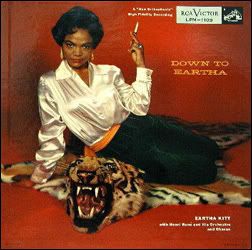
Au Revoir, Eartha Kitt

2

She was a bad-ass who didn’t complain very often but also didn’t take any shit. Fled the States. Demanded equal treatment for women in the industry. Got stuck with some industry-branded Cruella DeVille-type nympho image. An incomparable cabaret singer.
“There’s no cabaret around the world that I know of,” she said in a recent interview. “It’s all gone the way of business, too much business, therefore the soul of the business has gotten really very lost. Greed is so destructive. It destroys everything.”
She taught James Dean dance lessons. Stood up to Lyndon B. Johnson over Vietnam at the White House. Was spied on by the FBI. Orson Welles called her the most exciting woman in the world. When asked which records she’d want on a desert island, she always said her own.
Eartha Kitt died today, joining an esteemed list of other entertainers who shuffled off on Christmas Day: W.C. Fields, Charlie Chaplin, Dean Martin and James Brown. So long, sweetheart. We’ll spin “I Wanna Be Evil” over Tofurky and pumpkin pie tonight.

[display_podcast]

Live Review: Lil’ Wayne, T-Pain and Keyshia Cole at the Oakland Arena

2

Lil’ Wayne, the sandpaper-throated New Orleans rapper with the top-selling album of 2008, attracts one hell of a draped-up, chipped-out crowd. Attendees to the sold-out show filed into the Oakland Arena through metal detectors, and you never saw so many plastic baskets filled with expensive watches and rhinestone belt buckles in your life. It was like Oakland’s own regal Prom Dance, with even higher prices: Parking was $25, beers were $12, and hoodies were $60.
Not everyone was dressed to the nines, I soon found out, as one of the first groups of people I ran into inside were a staggering group of drunk blonde girls, one with her silver miniskirt sloppily bunched up entirely around her waist, weaving her hootin’ and hollerin’ way down to their seats to see the Gym Class Heroes. The Gym Class Heroes, I might add, were the worst pile of shit in the land.


Keyshia Cole was completely goddamn dominating, just a nonstop firestorm of talent and amazement. I saw her last year, before she got her teeth fixed, and though I liked the gap in her teeth I’ll accept the dental work as a metaphor for her whole career right now. Her albums have become more commercial since her amazing first record, They Way It Is, but damn if she hasn’t stepped up her live show. Twelve months ago, opening for R. Kelly, she was all energy and empty hyperactivity; last night she retained the energy and tempered it with elegance and grace, like fine cocaine.
Keyshia Cole is from Alameda originally, and the Bay Area love was definitely in the house. If you ever in your life pine for the sound of 20,000 girls screaming their lungs out at the highest available volume, go to a Keyshia Cole show and wait for the opening chords to “Love.” Cole is my Queen of R&B right now, the new Mary J. Blige, and that’s conceding that she didn’t even do “I Should Have Cheated.” Apparently she has a reality show. I’m scared to watch it.


From the onset, T-Pain slouched at the front of his stage bedecked in his trademark top hat, and shoved his hands in his pockets, looking bored with himself.
T-Pain had breakdancing midgets dressed in whiteface and camoflauge. He has three tents, one of them inflated to 20 feet tall, with his name and likeness at the top. He had a woman in daisy dukes and a bikini top walking on stilts. He had a blonde tattooed midget gyrating around the stage in her bra and panties. He had a fire swallower with flaming pastied nipples. He had a calliope, a bazooka, a vaudeville wagon, an elephant stand, and a backup yes-man in Marilyn Manson makeup who lip-synched along to T-Pain’s hits while T-Pain moonwalked, badly, across the stage.
“I got one word for you…” said T-Pain’s DJ, early on in the set: “Bay Area!!!”
Almost every song T-Pain played was a hit, and almost every song T-Pain played was chopped off by the incessant thundercrash from his DJ. He was very comfortable with the fact that the audience knew all his songs, and turned the singing duties over to them much of the time, not even bothering to hold the mic out to the crowd. While they sang his hits, his prerecorded vocals continued to play in the background.


There were significant moments in Lil’ Wayne’s set where there was absolutely no applause after his songs. Just empty silence. There were other moments that elicited frenzied anarchy, as when he took off his shirt. His vocals, already quiet and growly, were drowned out by his rock band, who hung from large cages and who served for the most part to uselessly thicken up his pared-down hip-hop into heavy metal jams.
“Dere’s three important things I gotta say,” announced Lil’ Wayne. “One: I believe in God, do you? An’ two: I ain’t shit wit out you, so make some noise. An’ three: I ain’t shit wit out you!”
T-Pain, riding circles around Lil’ Wayne on a Segway, argued about who had done more guest verses on songs by other artists this year. They decided to perform some of these songs, an experiment which if comprehensive could have gone on for approximately 83 hours, 31 minutes. The DJ played “Swagga Like Us,” but Lil’ Wayne cut it off, saying that he didn’t remember his own verse. This happens when you have 1,000 songs and are blasted on drugs most of the time.
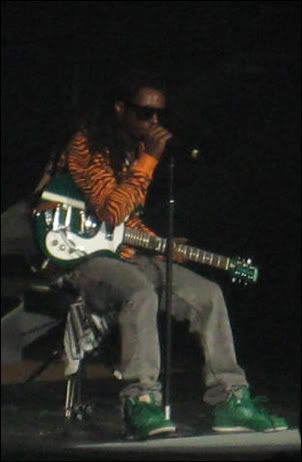
“Y’all got the mixtapes?” Lil’ Wayne shouted, hypothetically, since his mixtapes have replaced albums as the listening format of choice for his fans; he did “I’m Me” and “Prostitute,” during which he sat holding a green electric guitar that he did not play. He then turned the stage over to a string of unknown friends to bore the crowd while he went backstage to get dressed for “Lollipop.”
Near the end of the set, Lil’ Wayne’s laptop DJ killed ten minutes by cuing up other people’s songs—“Single Ladies,” “Peter Piper”—while Wayne was nowhere to be seen. When he reemerged, he dissolved into a spiritual communion with stained-glass windows on the jumbotrons, spending an entire song on a spinning platform out of view of the audience. He bid farewell, the music ended, and the crowd was expected to applaud. No one did.
He popped back onto the stage to sing “A Milli,” its minimalist brilliance abandoned in favor of a heavy-metal wankfest, and left the Oakland Arena with a James Brown cape act and a run-through of Whitney Houston’s “I Will Always Love You.”
And that’s the top-selling artist of the year. I was blown away when I heard “A Milli,” into the mixtapes, kinda underwhelmed by Tha Carter III, and after last night I don’t think Lil’ Wayne has the stamina to live up to his reputation. He’s got flashes of lyrical gold, oozes style and is a born ruler of the game; my guess is he’s toast in 2009. Riding out a tidal wave can be an art in itself, especially when you start counting up the $110 tickets head by head, and you realize that it is generating more motherfucking money than you or I could ever imagine. The tide can only go out from here.


More Photos Below.

antsy mcclain and the trailer park troubadours mike marshall and caterina lichtenberg peppino d’agostino white album ensemble snoop dogg

0

| nightlife

Click here for club locations.

the expendables

No one is going to mistake what the Expendables do for high art, but you’d be hard-pressed to find a better party to ring in the new year—even if you end up celebrating a night early, during the show on the 30th. Melding reggae, heavy-metal riffage and a slight surf twang that befits their local roots, the band (Adam Patterson, Geoff Weers, Raul Bianchi and Ryan DeMars) take the post-Sublime rock-reggae amalgamation to another level. Part of the band’s appeal is its utter and gleeful shamelessness; to quote Slightly Stoopid singer Miles Doughty, “The Expendables are the best thing to happen to metal since the ’80s, the rise of hair metal dub,” and he may not be lying. You can’t help but feel that the band is doing it all for the laughs, and that infectious spirit shines through during its live sets. Catalyst; $20 Wednesday; $25 advance/$30 door Thursday; 8pm. (PD)

tuesday30   youssoupha sidibe

Walt Whitman once sang the body electric. Through his masterful kora playing, Youssoupha Sidibe sings the body unchained, wrested from its mortal bonds through sheer, beatific joy. Western listeners are largely aware of Sidibe through his work with the likes of Bela Fleck, Michael Franti and india.irie, but in his native Senegal (and among savvy listeners of African music) he is recognized as a contemporary master. Sidibe’s signature—integrating traditional Sufi devotional chants with reggae rhythms—is an inspired artistic choice, one that moves both body and soul. Moe’s Alley; $10 advance/$12 door; 9pm. (PD)

wednesday31Sourgrass

Jay Palmer of Sourgrass is best known as the one-man funk machine that steals shows like O.J. steals sports memorabilia. What Mick Jagger did for the Rolling Stones, Palmer does for his crew by igniting the stage with a fervent, sex-soaked performance that bleeds over into the crowd and always adds up to a good time. And with a killer band of groovy funksters backing him up and no less an occasion than New Year’s Eve on which to unleash its full fury, this band is intent on proving why it’s one of Santa Cruz’s most adored local acts. Moe’s Alley; $12 advance/$15 door; 9pm. (CC)

 wednesday31harry and the hit men

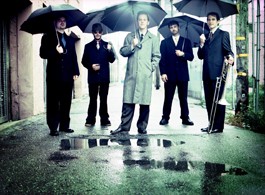
Motor City might be in a bad way these days, but Motown hangs in there, and Harry and the Hit Men are its most zealous local ambassadors. Busting out tight, highly danceable R&B standards like “Signed, Sealed and Delivered,” “You Keep Me Hangin’ On” and “Heatwave,” the Santa Cruz sextet features a trumpet, trombone and bass trombone—proof positive of its commitment to the form. Not to say Harry and the Hit Men is trapped in any single genre. The band also occasionally indulges its penchant for psychedelia in drawn-out improvisational jams that keeps the audience wondering what will come next. Crepe Place; $5; 9pm. (Traci Hukill)

wednesday31the sun kings

Here’s a Beatles tribute band just the way you want it—focused on the music of the lads from Liverpool, not the suits and haircuts. The Alameda five-piece (Paul’s keyboard and bass duties are divvied up between two members) renders spot-on covers of tunes spanning every Beatles era from Please Please Me to Abbey Road, with an emphasis on the latter-day music that gets the Bay Area’s Beatle fans all happy inside. Between Drew Harrison’s Lennon vocals, Michael Barrett’s McCartney impersonation and sterling musicianship by the rest of the band, it’s a party in the making. Tonight’s fete at Don Quixote’s includes free champagne at midnight and more than enough good cheer to go around. Don Quixote’s; $25; 9pm. (TH)

—————BOX TicketWindow

ORGONE
JAN. 2 AT MOE’S ALLEY

THE TUBES
JAN. 3 AT CATALYST

I WAYNE and CHEZIDEK
JAN. 4 AT MOE’S ALLEY

PHAROAH SANDERS
JAN. 5 AT KUUMBWA

ELLIOT MURPHY
JAN. 8 AT DON QUIXOTE’S

FINN RIGGINS
JAN. 9 AT CREPE PLACE

3 INCHES OF BLOOD
JAN. 14 AT CATALYST

MEAT PUPPETS
JAN. 16 AT RIO THEATRE

AMY RAY
JAN. 30 AT RIO THEATRE

NOFX
FEB. 17 AT CATALYST 


FIND A MUSIC REVIEW

View All


Concert notes and news.

Versatile Vignettists

0

12.24.08

Adam Theis is always in the middle of a never-ending work schedule. The last time I called him up, he was headed out the door of his Mission district apartment to collaborate with Mos Def, working out hip-hop horn arrangements for a joint performance together at the Golden Gate Park band shell. On this day, he’s writing charts for “Beats, Bows & Brass,” his hour-long hip-hop-electro-modern-symphonic-jazz-suite, commissioned by SFJAZZ, to be performed in 2009 by a 60-piece ensemble and guest MC Lyrics Born at the Palace of Fine Arts. The night before, he led a marathon jazz tribute in North Beach to the original breaks sampled by De La Soul, Tribe Called Quest and the Jungle Brothers until the wee small hours.

Does the dude ever sleep? “Oh yeah, I get eight hours every night,” Theis laughs over the phone, having just woken up—at noon. “People are like, ‘Hey, can you rehearse at 10 in the morning?’ And I’m like, ‘No!'”

Even when new challenges crowd Theis’ schedule, he hangs on to his myriad projects. Case in point: the Shotgun Wedding Quintet, who for nearly 10 years have perfected their trademark blend of jazz and hip-hop fronted by charismatic MC Dublin. Atop a funky blend of saxophones, turntables, keyboard, flute, bass, trombone, drums and sometimes even electric violin, the crowd-rocking Dublin freestyles off-the-cuff stories in a vocalese style, doing with rapping what King Pleasure and Babs Gonzales did with jazz singing.

“He’s just one-of-a-kind,” Theis testifies. “He appeals to a lot of people who are the kind of people that I want to have come in to see music—the people who aren’t expecting a certain, exact thing. The people who are kind of fed up with the normal styles and sounds. He allows us to go in whatever direction we want. He’s totally versatile with whatever we throw at him. There’s never been anything he couldn’t do.”

With DJ Nick “Aspect” McCarthy, Mitch Marcus, John Monahan, Evan Francis and a drummer with ever-rotating names (“Pat? Gerald? Corky? He changes it every week,” Theis sighs), the Shotgun Wedding Quintet is sure to make the last weekend of 2008 one to remember, ugly Christmas sweaters and all. Count on nonstop breakbeats and a crowded dance floor when they headline the Third Annual Ugly Christmas Sweater Party on Friday, Dec. 26, at the Hopmonk Tavern, 230 Petaluma Ave., Sebastopol. 9:30pm. $10. 707.829.7300.


American Pie

0

12.24.08

Winter squash is a well-named fruit. It keeps all winter long and makes great cold-weather comfort food. The warm, buttery flavor adds to almost any dish, sweet or savory.

While summer squash varieties are harvested when the fruits are tender virgins, winter squash are harvested when the fruits are mature, with fertilized seeds, a hard, shiny shell and dense glowing flesh that casts much-needed light in these cold dark days.

First cultivated from wild squash by Central American Indians 10,000 years ago, this authentically American food was initially valued for its seed, as the bitter flesh was unpalatable. Today in Central America and Mexico, recipes based on squash seeds, like mole, are still popular.

It took many generations of indigenous seed savers to craft the sweet-fleshed squash we know today. That some Indians were buried with a squash stash to feed them in the next phase of their journey speaks to the importance of this crop, which migrated north and reached the East Coast before the colonizers, who survived harsh winters on it and shared it with Indians on Thanksgiving, according to American lore.

Since then, squash has found its way to most parts of the world, where winter squash is widely known as “pumpkin,” a name that in American English is reserved for but one variety of winter squash.

Thanks to its high carbohydrate content, winter squash can serve as the base for the meal. Like rice, bread or pasta, it can be the substance to which the saucier elements are applied. Or it can be the sauce itself, either as a bit player in, say, a coconut curry, or as the body of the sauce —like the sauce in the enchilada recipe below.

Squash can be made into soup, spread, dip or salad dressing; it can be baked into a cake, or baked with custard inside. It can be incorporated into almost anything, or it can be left entirely alone. A baked delicata on the half shell, left to cool on the stovetop, needs nothing at all, not even a utensil. Hold it like a piece of pizza and eat it, skin and all. It could be your entire meal.

For a side dish, cut a winter squash into one-inch chunks and drizzle with olive oil, salt and pepper. Bake at 350 degrees, stirring occasionally, until the chunks are crispy on the outside but still creamy on the inside. Eat these chunks with whatever’s for dinner. The next day, toss them in your lunchbox. Toss them in your salad. Toss them into a hot pan with bacon grease, fresh garlic, prebrowned meat, and serve over rice with soy sauce. Or brown them in olive oil, push them to the side of the pan and scramble in a few eggs.

And then there’s pumpkin pie, which can be made from any winter squash. Years ago, some friends and I had a pumpkin-pie business. We were always testing different recipes and always had tons of half-eaten pies lying around. That’s when I proved, scientifically, that it’s possible to live for days, happily, on nothing but pumpkin pie.

We made pies from blue hubbard, kuri, buttercup, pumpkin, kabocha, acorn, delicata and sweet meat squashes, and we had a different recipe for each variety. Starchy kabochas require more eggs and cream, for example, while the sweet and buttery delicatas need less. Sometimes we used classic pumpkin pie spices, like mace, cinnamon, nutmeg, allspice or cloves. Sometimes we mixed in chocolate chunks.

Here is a basic squash pie recipe, which you can use as a template and doctor to your own specifications:

Cut the squash in half, scoop out the seeds and guts, saving seeds for roasting with salt, pepper and olive oil. Place the halves face down on a baking tray with a quarter-inch of water on the bottom, and bake at 375 degrees until a fork easily pierces the flesh, about 45 minutes. Remove from the oven and cool.

For each pie, scoop out two cups of squash flesh and combine with half a cup of cream and 3 to 4 eggs. Sweeten to taste. The average recipe calls for about a cup of sugar per pie; maple syrup works, too. Add the pie spices of your choice, up to a half-teaspoon per spice. Add nuts, chocolate or whatever else you think will taste good. Taste often to make sure it’s right. For a fancy variation, separate the eggs, mix the yolks into the filling, beat the whites stiff and fold them into the final filling.

If you want a savory pie, skip the sweetener. Brown your meats, cook and season greens, potatoes or whatever other items you want. Add a layer of squash, then the filling, maybe some cheese. Cover with more squash filling and bake.

Sweet or savory, bake your pie about an hour at 300 degrees, until the filling is firm.

Because teaching the art of crust making benefits from visual aids, I’m going to steer you to an online video for a simple butter crust, like what I made when I was a pro: [ http://www.chow.com/stories/10196 ]www.chow.com/stories/10196.

 Now here’s that recipe for green chicken enchiladas with squash sauce:

Bake a squash as for pie. Sauté one shallot, minced, and three cloves garlic, chopped, in olive oil. Add a cup of squash, season with a teaspoon each of nutmeg and paprika, and salt and pepper to taste. Stir often. Whenever it starts to stick, deglaze with Madeira or sherry. After 15 minutes on medium heat, add a cup of chicken stock. Cook until thick. Turn off the heat and let it cool, then purée the sauce in a food processor.


In another pan, brown a half-pound of chicken meat. Add a quarter-cup pine nuts, 4 chopped kale leaves and 2 chopped, oven-roasted green chiles. Season with salt and pepper.

Roll or fold the chicken mixture into corn tortillas and pack into a baking pan. Pour the sauce over them, and bake for 15 minutes at 350 degrees.

You could make these enchiladas with leftover turkey the day after Christmas, or any day, really. As far as I’m concerned, when squash is in the house, every day is Christmas.

Quick dining snapshots by Bohemian staffers.

Winery news and reviews.

Food-related comings and goings, openings and closings, and other essays for those who love the kitchen and what it produces.

Recipes for food that you can actually make.

Top 10 Torn Tickets

0

12.24.08


As the calendar rapidly runs out of pages, cultural critics across the country are taking part in the odd annual cultural observance known as the Top 10 list. From coast to coast and border to border, those of us who are privileged to be public witnesses and explorers in the abundant realms of cinema, music, fine arts and theater—and to report our findings in the form of regular reviews—see the month of December as an opportunity to look back on the ending year and, with the cool hindsight and trained observation of our craft, pick the 10 concerts, movies, records, exhibits or plays that most fully floated our boats, knocked off our socks and blew our brains.

As the Bohemian’s dutiful theater reviewer, and a member of the Bay Area Theater Critic’s Circle, I have seen close to 70 shows over the last 12 months, each ticket stub ritually stuffed away in the same cigar box I’ve been using for years. With the New Year fast approaching, I have painstakingly sorted the stubs according to my personal preference, employing this yearly ritual to relive the joys, thrill, tears—and occasional deep disappointments—of the entire spate of shows I have attended, notebook in hand.

Sadly, with so much theater offered by so many companies in the North Bay, I have not been able to see everything that has trod the myriad stages of the region. There are a number of much-discussed shows that cannot be part of my favorites list, since I was unable to experience them: February’s now-legendary Shirley Valentine, starring Mary Gannon-Graham, at the Sonoma County Repertory Theater; Brett Lindsay’s innovative Hamlet: Ghost Machine presented by the Imaginists; and the Pacific Alliance Stage Company’s luminously reviewed production of Tennessee Williams’ Glass Menagerie.

I grieve every great show I missed as deeply as I regret the ones I did see that turned out to be brain-deadening wastes of time. Of the shows I did attend, many are worthy of inclusion on somebody’s Top 10 list but failed to make mine for the simple reason that something else moved me more deeply or surprised me more completely. As a person who prefers to be inspired and delighted rather than shocked and appalled, I tend to favor the shows that present an optimistic, though honest, view of our species. These, then, offered with humility, are the plays on which I look back most fondly. They’re not necessarily the best, but they are definitely my favorites: my Top 10 torn tickets of 2008.

1. ‘The Cocktail Hour’ A. R. Gurney’s ingenious comedy-drama about an on-the-wagon playwright visiting his New York family during their nightly ritual of pre-dinner self-medication, The Cocktail Hour is nearly impossible to stage properly and has thus thwarted legions of community and professional troupes. One amazing thing about my favorite show of the year is that it was produced last January, by Marin County’s oldest community theater company, the Ross Valley Players. The second amazing thing is, well, pretty much everything else about the production.

Compassionately directed by Mary Ann Rodgers, the playfully perfect cast—Eric Burke (charmingly wounded as the writer wrestling with his family’s demons), T. Louis Weltz as the dad, Beth Deitchman as the sister and Christine Macomber as the increasingly tipsy mom—hit all the right notes, tickling funny-bones and breaking hearts, often in the very same breath. I knew when I saw it that this would be the play to beat all year, and while my No. 2 pick came within an Irishman’s whisker of doing that, RVP’s The Cocktail Hour remains my most treasured and memorable theatrical experience of the year.

2. ‘The Seafarer’ Connor McPherson’s Faustian holiday fable The Seafarer, which just ended a held-over run at Mill Valley’s Marin Theater Company, is similar to The Cocktail Hour in that it deals with a man returning home with a desire to stay sober, while all around him, the people he knows and loves are getting plastered. What is different is the setting, a small coastal town in Ireland, and the fact that when Sharky (Andy Murray) wrestles with his demons, they appear in the form of the Big Demon himself, Lucifer, aka Mr. Lockhart (a superb Robert Sicular). Masterfully directed by Jasson Minadakis, this Christmas Eve card game for the possession of Sharky’s soul was both hilarious and fundamentally heart-stirring.

3. ‘Boston Marriage’ Another cordially caustic show that opened early in the year and made a lasting impression was Sixth Street Playhouse’s wickedly screwball production of David Mamet’s Boston Marriage, cleverly directed by Sheri Lee Miller. (This is a strong year for Miller; see below.) Featuring Danielle Cain and Bronwen Shears as longtime lovers trying to make ends meet in turn-of-the-century Boston, with Anna Tess Coughlin as Anna’s wise but not-too-bright Scottish maid, this was both a send-up of social mores and (ultimately) a believable love story, its lesbian-powered homage to the parlor comedies of Oscar Wilde joyously, jubilantly entertaining.

4. ‘Transformations’ Conrad Susa’s experimental 1960s opera Transformations, adapted from the book of the same name by Pulitzer Prize&–winning poet Anne Sexton, is almost never performed, so Cinnabar’s fall production of the show, based on Sexton’s personal reimagining of several Grimm’s fairy tales, was welcome, if only for the opportunity to catch a glimpse of this dark, psychologically challenging work. In the hands of director Elly Lichenstein and musical director Nina Shuman, this fantasia on themes of madness, abuse, murder and cannibalism was not just an interesting museum piece, it was riveting and unpredictable, truly transformative theater.

5. ‘On the Road’ Based on Jack Kerouac’s counterculture epic, On the Road was one of the biggest surprises of the year, featuring a trio of powerhouse performances. Ryan Schmidt played Kerouac stand-in Sal Paradise, Miyaka Cochrane was the Ginsberg-esque holy man Carlo Marx, and the usually sedate Ben Stowe turned in an expectation-shattering, stage-burning explosion as the hedonistic beatnik wildman Dean Moriarty. Directed for the Sebastopol Shakespeare Festival’s outdoor stage by Sonoma County Rep’s Scott Phillips, this fun, frisky, poetry-packed show was, to borrow words from Carlo Marx, “Crazy, cock-eyed and extremely strange.”

6. ‘True West’ Actor Eric Burke (who appeared in four of the shows mentioned on this list, including Cocktail Hour, On the Road and Death of a Salesman, below), formed Double E Productions with fellow thespian Ed McCloud just so they could appear together in a production of Sam Shepard’s True West. With director David Lear at the helm, the self-financed effort played three weeks at Spreckels Center for the Arts, playing to small but stunned audiences who knew they were watching one of the finest demonstrations of no-holds-barred acting in the North Bay. There are rumors afoot that this show will be reprised with the same cast and director at a local theater in 2009. May those rumors be true!

7. ‘Death of a Salesman’ Sixth Street Playhouse lured Los Angeles actor Daniel Benzali to Santa Rosa to play the lead role in Arthur Miller’s bleak drama about a deteriorating salesman in the 1950s. What was so amazing about the production, directed by Sheri Lee Miller (of Boston Marriage), was not that Benzali was so good, but that the rest of the cast, a who’s-who of North Bay actors, some professional, some not, were every bit as riveting.

8. ‘Private Lives’ Director Carol Mayo Jenkins’ production of Noel Coward’s enduring comedy-drama about marital instability had a cast that appeared to have transported from the 1930s. Funny, smart and oh-so-classy, this was Cinnabar’s other great show of 2008.

9. ‘Taming of the Shrew’ A piratical staging of Shakespeare’s battle of the sexes, with Mary Gannon-Graham as the strong-willed Kate and Dodds Delzell as the overconfident Petruchio, this swashbuckling show was not just a record-shattering achievement for the Sonoma County Rep and the Sebastopol Shakespeare Festival, it was a brilliant idea, brilliantly executed.


10. ‘Always Patsy Cline’ Boldly structured as a cross between a one-woman-show and a high-spirited musical review, this year-ending love-bomb from Sixth Street Playhouse (what, them again?) was another unexpected box-office blockbuster, and another triumph for actress Mary Gannon-Graham, who played legendary country singer Patsy Cline almost entirely by singing her way through Cline’s most famous songs. Grounding the proceedings, Liz Jahren played Cline’s “biggest fan,” the Houston-based single mom Louise Seger, as a larger-than-life force of nature. The friendship between this soulful Texan and the soul-sick singer was palpably real, a testament to the power of exceptional acting.

With that, I empty my cigar box, and prepare for another year of theater in the North Bay and beyond. If 2009 is anything like 2008, I may have a hard time finding a seat.


Museums and gallery notes.

Reviews of new book releases.

Reviews and previews of new plays, operas and symphony performances.

Reviews and previews of new dance performances and events.

Old Love

current reviews |

Photograph by Merrick Morton
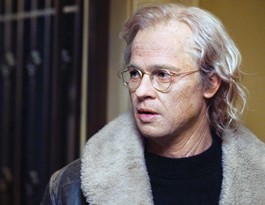
Calling All Botox: Brad Pitt shows his age in ‘The Curious Case of Benjamin Button.’

By Richard von Busack

It seems that The Curious Case of Benjamin Button was made because the technology was finally there to make it. F. Scott Fitzgerald’s short story of the man who lived backward—born as an old man and regressing to babyhood in his dotage—has been in development for decades. Likely Fitzgerald’s Pat Hobby was trying to crack the story in the 1940s.

Over the years, other writers stumbled on the same idea. The Twilight Zone–like tale has an ending that might have been summed up by the finale of The Incredible Shrinking Man. I thought of Hamlet’s taunt to old Polonius: “Yourself, sir, should be old as I am, if like a crab you could go backward.”

This vast and chilly film would have been timely around 1999, to pick up on end-of-the-century nostalgia. In his introduction to a collection of Fitzgerald’s short stories, Malcolm Cowley notes, “Those who were lucky enough to be born … in the years around 1895–1900 [felt] that the new century had been placed in their charge. … Its teens were their teens, its world war was theirs to fight, and its restless twenties were their twenties.”

Fitzgerald himself was just such a child. This Benjamin Button is born later, in New Orleans on the night that World War I ends. The holocaust of Katrina is the real end of his story, though, since the film is bracketed by the hospital deathbed of Daisy (as in “Buchanan”), played by Cate Blanchett. Daisy’s estranged daughter, Caroline (Julie Ormond), hears her bizarre family history.

Benjamin is played in most of the movie by Brad Pitt, sometimes as a head cybergrafted onto dwarfish bodies. Abandoned as a freak by his parents, he was raised as a foundling in an old-folks home. Growing older—and yet, younger and stronger—Benjamin meets Daisy, a little girl who has dreams of being a dancer.

As a child, Benjamin looks a bit like Popeye, that cartoon character who was both burbling child and froggy-voiced old man. No surprise then that he heads off to sea with a colorful tugboat captain (Jared Harris), who is still skippering when World War II breaks out. They sail to Murmansk. (Crossing the Pacific in a tugboat is no minor nautical feat.) In the USSR, at a depopulated hotel, Benjamin meets a married English lady (Tilda Swinton). She feeds him caviar and vodka and makes a man out of him.

Later, in New York, after the war, Benjamin reconnects with Daisy, now a dancer in the “If I Loved You” ballet sequence of Broadway’s Carousel. She’s enjoying a flirty life with the men around her. Dejected, Benjamin leaves. Back in New Orleans, the old/young man comes into money; his birth father (Jason Flemyng) reconnects, passing on to him a button factory that apparently runs itself.

It might be clear by now that Benjamin Button is a man who doesn’t really do anything, except during one naval battle. Some vocation would have shaped this life, but Benjamin drifts. His life takes place in the passive voice we use when we talk about what events did to us: “And then the war broke out, and I found myself in the Solomon Islands.”

Pitt has his moments: rising out of the water, hair slicked back, he looks like the Jay Gatsby he never got to play. The gradual unveiling of Pitt’s handsomeness is a neat trick; he grows more like himself as the years pass. The last stages use digital erasure that makes him look 20. Some of the women in the audience will feel a severe pang. They’ll remember how young they were when they first saw Pitt take off his shirt in Thelma & Louise.

But in repose, Pitt starts to look like a vacant lot, and Blanchett’s airy-fairy Daisy isn’t as intense as she might be, or as this actress has been in the past.

The real poignancy of time’s arrow flying backward isn’t felt in this film, even in a Tom Tykwer–style passage about the long pedigree of a traffic accident: the mundane choices leading to the fateful occurrence. That sort of speculation is flabby writing. And while Benjamin Button isn’t as screamingly retrograde as Button scriptwriter Joe Roth’s Forrest Gump, it offers the same idea of a bohemian life as something one gets over in time. Benjamin and Daisy’s life in New Orleans in the 1960s is so staid it might as well have been spent in Costa Mesa. 

In maturity, Benjamin is finally revealed as a holy man who can touch impure things like alcohol and prostitutes without becoming impure himself. He eventually travels to Benares, even. The passage of a century hasn’t marked him physically or mentally.


This rich, tasteful and leaden movie uses the chill of Alzheimer’s at the end. Many viewers have seen their all-wise parents turn to infants, and the movie works those feelings with a vengeance. Thus The Curious Case of Benjamin Button ought to have been a heart wringer. I sure didn’t feel myself getting any younger watching it.

THE CURIOUS CASE OF BENJAMIN BUTTON  (PG-13; 159 min.), directed by David Fincher, written by Eric Roth and Robin Swicord, photographed by Claudio Miranda and starring Brad Pitt and Cate Blanchett, opens Thursday countywide.


Silicon Valley | Santa Cruz County |


New and upcoming film releases.


Browse all movie reviews.

Give and Let Live

0

santa cruz |

IT’S A WONDERFUL LIFE: Rowland Rebele takes a break at the River Street homeless shelter he helped fund.

Interview by Paul Wagner
Photographs by Curtis Cartier

Rowland Rebele has always seemed to know what he wanted. After rising from the role of student journalist to the position of editor at the Stanford Daily in 1951, he went on to purchase and sell three newspapers in the growing suburbs south of San Diego with business partner Lowell Blankfort. As the two purchased and improved other papers as well, Rebele discovered a significant obstacle to the objective reporting he desired: namely, public agencies’ refusal to conduct their business publicly. When his Northern California publication, Paradise Post, asked for police officers’ salaries and was refused, Rebele took the city to court and won. Thus began a campaign for government transparency.

In subsequent years Rebele sued Gov. Pete Wilson all the way up to the state Supreme Court to get the names of applicants for a vacant county supervisor’s appointment. That one he lost, but the crusade continued. He went on to serve as president of the California Newspaper Publishers Association and from there headed the California First Amendment Coalition. He served as executive director and board member of the California Freedom of Information Committee, infusing it with $300,000 to fund its nonstop campaign to keep public information available to the public. He and his wife, Patricia, gave a $300,000 endowment to the California Weekly Newspaper Internship Program at Stanford, which funds the salaries of Stanford journalism students so they can intern out in the real world.

The press wasn’t the only beneficiary of Rebele’s drive and vision. The arts flourished as well. The couple used $250,000 to establish UCSC’s Patricia and Rowland Rebele Chair in Art History to bring in visiting professors and provided two new rooms for Stanford’s Cantor Arts Center. They’ve supported the Museum of Art and History of Santa Cruz County, the Cabrillo Music Festival, New Music Works, radio station KUSP, Santa Cruz Actors’ Theatre and Tandy Beal–and, of course, the Homeless Services Shelter, which bears their names. Rebele has served on the shelter’s board for 11 years.

GAME PLAN: Rebele and wife,Patricia, anticipate ‘giving it all away before we die.’

What is it, we wondered, that makes this unusual gentleman–born in San Francisco just a year after the crash of 1929 and a lifelong challenger of mediocrity, defender of the whole truth and frequent contributor to the presidential run of John McCain–keep on churning like a controlled burn? What is it like to still radiate this constant heat even in an economy drowning in buckets of cold water? What drives his giving, and what advice does he have for nonprofits seeking benefactors during a downturn?

We picked up the phone one day last week and Rebele, 78 years old and smart as a whip, told us what he thought.

METRO SANTA CRUZ: What is the organizing principle of your giving? What do you look most for in a cause or an application?

REBELE: The organizing principles are education, the arts and human services. We give small amounts to many agencies because so many are doing worthwhile work. But overall, our giving tends to go to those we have strong feelings about. We’re also involved in a multimillion-dollar building project at St. John’s church in Capitola and committed to [faith-based community action group, focusing on affordable housing] COPA. Our goal overall is to empower people to be all they can be.

The main thing we look for is a return on investment. Not a financial return, although that sometimes follows; we’re looking for a human return–evidence that the giving works. We look into giving pretty thoroughly. After all, it’s the follow-up, the efficacy, that matters. That’s been a big problem in Africa.

How has that, and does that now, change during downturns–after 9/11, after the high-tech bust or now?

It really doesn’t change. Since I’ve retired–I’m now 78, and my wife is a similar age–I’ve built a body of mature, profitable investments. We’re blessed enough to own three businesses–a health club, motel and mini-storage facility–that have been doing pretty well. The returns have been reduced a bit, but overall, our principles are the same. And so are the rewards. Giving keeps you young.

Do downturns change your strategy for management?

Not really, no. I’m as busy now with giving as I was when managing newspapers. It’s our life’s work. It’s good for the mind, good for the soul, we’re blessed, so why not do it? Besides which, It’s important to give now–more fun to give it away now, while we’re alive.

What do recipients, most importantly nonprofits, need to know about approaching philanthropists during a downturn? Should they drop capital improvement plans and just focus on operational costs? Should they partner with other nonprofits to share expenses? Show fiscal discipline by cutting personnel?

All of the above–they should redouble their efforts to save money. That’s always important, but especially now.

Do you have thoughts about the bigger picture, such as the balance between addressing the needs of our safety net through philanthropy and through government-sponsored programs?  

I believe service to our fellow human beings needs to be shared by government and private philanthropy. Take our homeless shelter: 35 percent of our funding comes from private sources, 65 percent from government. And that’s the way it should be. Private giving provides the human touch; public sources the accountability and insistence on good outcomes.

In short, the responsibility has to be shared. We, realistically, all make up our government, all make up our police force and all make up our fire fighting force and our welfare force.

Is philanthropy, overall, working well now? What could make it work better?

It’s working well in that it induces a consciousness–the joy of giving and the need for giving. We need to encourage others to get involved. It’s a consciousness-raising we all need to do. A lot of people don’t know this, but some 500 homeless folks get mail there, as well as get fed, housed and counseled. They also get lockers to put their stuff in. They can do laundry, take showers. It’s a one-stop service to those who are homeless, but they have to leave in midmorning to work on their lives, then come back in late afternoon for the evening meal. … And while people complain this produces a “magnet effect,” we know from several studies that some 60 to 70 percent of our clients have lived in Santa Cruz for at least six years. So we’re serving primarily whom we should–our own residents who are homeless.

What is the most discouraging moment you’ve had in your charitable career? And what is the most gratifying?

The most discouraging times are when I’ve received a “no” from people I know have the capacity to give, and seem willing to give, but won’t. I’ll take them on a tour of the Homeless Services Center, and they’ll see all that’s being done there, but they just walk away and I don’t hear from them. That can be disappointing.

The most gratifying? Seeing the money well spent. Seeing it make a real difference.

For example, there’s the Stanford journalism internship program Pat and I started 23 years ago which supports 20 to 30 students every year. … To see those kids really blossom and grow and develop a consciousness about providing the public what it needs to know about government–through reporting and writing for the newspaper–is very gratifying.

If you could change anything about social relations in our nation, what would it be?

We have to make sure the estate tax does not go away. I just hope Congress lets this cut in that sunset and reestablishes the tax–maybe exempting two or three million dollars so people don’t have to sell farms or businesses–but let the money recycle. That’s very important.

How do you feel about the recent change in political direction nationwide?

We do need a national conversation about the importance of giving, and I think we’re going to see that in the new administration.

What are you most looking forward to in your work for the future?

Giving it all away before we die.


Volunteer

0

12.24.08

A west Sonoma County nonprofit group is seeking volunteers tohelp plant redwood trees in four separate locations throughout theWest County area. Forest Unlimited, a 501c3 based in Cazadero, isplanning two planting days, Friday–Saturday, Jan. 9–10.Volunteers are encouraged to attend, regardless of their plantingskills, and even if they can only help for half the day.

Approximately 1,500 two-year-old bare-root redwood seedlingswill be planted over the course of both days for reforestation anderosion control. The sites for planting include Sunset BeachRegional Park, Steelhead Beach Regional Park, Shone Farm and St.Dorothy’s Rest. On each day, volunteers will meet at 9am, with abreak for lunch, and with work ending around 4:30pm. At leasttwo-dozen volunteers are needed.

Forest Unlimited Board president Larry Hanson says thatvolunteers require no special skills, although navigating steepterrain is a plus. “We had a great turnout last year,” Hanson says,”and it’s a wonderful thing to do for the New Year. It’s some verybeautiful property, and there’s usually a nice little mist in themorning.”

The Jan. 9 planting will focus on St. Dorothy’s Rest, anEpiscopal retreat center and camp of the Diocese of Californialocated near Camp Meeker. Jan. 10 will see planting at the countyparks and at Shone Farm, the agricultural educational facility ofthe Santa Rosa Junior College. Lunch is provided to volunteers,with vegetarian options available.

The redwood seedlings, about 18 inches high, come from theCalifornia Department of Forestry and are easy to plant. Alllocations are protected by either an easement or land trust, so”after we spend all this time and effort to plant trees,” Hansonsays, “we can be sure they’re going to be around for a while.” Tovolunteer, call project manager Carl Wahl at 707.874.9268.

Volunteers are also needed for the annual gala benefit for anonprofit that serves the mental health needs of Sonoma County.Moon Over Mardi Gras raises funds for Family Service Agency, whichprovides low-cost mental health services to families andindividuals. The Family Service Agency has been in existence since1966.

Moon Over Mardi Gras features live music and both a live andsilent auction. Young volunteers are needed to help set up andserve food. It takes place March 28 at the Friedman Center in SantaRosa. To volunteer, call Shan Magnuson at 707.545.4551, ext.211.

to theeditor about this story.


Au Revoir, Eartha Kitt

She was a bad-ass who didn't complain very often but also didn't take any shit. Fled the States. Demanded equal treatment for women in the industry. Got stuck with some industry-branded Cruella DeVille-type nympho image. An incomparable cabaret singer. "There’s no cabaret around the world that I know of," she said in a recent interview. "It’s all gone the way...


Live Review: Lil’ Wayne, T-Pain and Keyshia Cole at the Oakland Arena

Lil’ Wayne, the sandpaper-throated New Orleans rapper with the top-selling album of 2008, attracts one hell of a draped-up, chipped-out crowd. Attendees to the sold-out show filed into the Oakland Arena through metal detectors, and you never saw so many plastic baskets filled with expensive watches and rhinestone belt buckles in your life. It was like Oakland's own regal...

antsy mcclain and the trailer park troubadours mike marshall and caterina lichtenberg peppino d’agostino white album ensemble snoop dogg

| nightlife Click here for club locations.the expendables No one is going to mistake what the Expendables...

Versatile Vignettists

12.24.08Adam Theis is always in the middle of a never-ending work schedule. The last time I called him up, he was headed out the door of his Mission district apartment to collaborate with Mos Def, working out hip-hop horn arrangements for a joint performance together at the Golden Gate Park band shell. On this day, he's writing charts for...

American Pie

12.24.08Winter squash is a well-named fruit. It keeps all winter long and makes great cold-weather comfort food. The warm, buttery flavor adds to almost any dish, sweet or savory.While summer squash varieties are harvested when the fruits are tender virgins, winter squash are harvested when the fruits are mature, with fertilized seeds, a hard, shiny shell and dense glowing...

Top 10 Torn Tickets

12.24.08 As the calendar rapidly runs out of pages, cultural critics across the country are taking part in the odd annual cultural observance known as the Top 10 list. From coast to coast and border to border, those of us who are privileged to be public witnesses and explorers in the abundant realms of cinema, music, fine arts and theater—and...

Old Love

current reviews | Photograph by Merrick Morton Calling...

Give and Let Live

santa cruz | IT'S A WONDERFUL LIFE:...

Volunteer

12.24.08A west Sonoma County nonprofit group is seeking volunteers tohelp plant redwood trees in four separate locations throughout theWest County area. Forest Unlimited, a 501c3 based in Cazadero, isplanning two planting days, Friday–Saturday, Jan. 9–10.Volunteers are encouraged to attend, regardless of their plantingskills, and even if they can only help for half the day.Approximately 1,500 two-year-old bare-root redwood seedlingswill...
11,084FansLike
4,446FollowersFollow
6,928FollowersFollow