Shakedown Street

0

01.21.09

Visitors are forgiven for indulging in a quiet chuckle while driving through the large, arced sign above Monte Rio’s main intersection conferring “Vacation Wonderland” status on the once-hopping but now tiny and still hamlet of West Sonoma County. Come through town on a Thursday night, however, and Monte Rio becomes a vacation wonderland of an entirely different color—or colors—as a weekly band packs the venerable Pink Elephant bar to assist partygoers on their own internal trip.

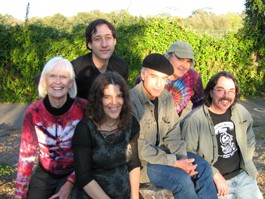
Tribal Hippie UnderGround Zone, more commonly known as the Thugz, have packed in everyone from hippies to farmers to chefs to real estate agents to the local Sheriff at their Thursday-night engagement at the Pink Elephant, and they’ve responded with “Monte Rio Town,” an ode to the city’s colorful culture where all walks of life, by choice or necessity, come together. “It seems like there’s more of an appreciation for music out there, in certain ways,” says guitarist Andre de Channes. “It’s a very friendly crowd, and for us, it’s like having a paid rehearsal every week.”

There’s a common misconception that the Thugz are a Grateful Dead cover band, and though they do play a wide selection of the Dead’s catalogue, a cursory glance of their set lists, posted on their website, reveal covers of Neil Young, Bob Dylan, the Beatles, Leonard Cohen and Gillian Welch—in other words, the music that de Channes plays on the radio at his day job on KRSH-FM. (Some of the Thugz’ covers are Jerry Garcia standbys, too: “How Sweet It Is,” “Blue Yodel #9,” “Dancing in the Streets.”)

Founded by Mike Campbell, who moved to the area in the days when the Dead would play the Rio Nido dance hall, the Thugz have a smattering of original songs woven into their 150-song repertoire. “It’s almost like a jazz band, since there’s such a high level of musicianship and improvisation to make it our own,” says de Channes. “With the Grateful Dead stuff, we tend to stay pretty close to the arrangements. None of us sound or play like Jerry; it’s more of getting the feeling of it than mimicking what they were doing.”

The Thugz have a new album of all-original songs due in the summertime, and have increased their out-of-town presence; this week, they play a noontime concert on Thursday, Jan. 22, at the Russian River Brewing Company (725 Fourth St., Santa Rosa; 12pm; Free; 707.545.2337) and on Saturday, Jan. 24 at Smiley’s (41 Wharf Rd., Bolinas; 9pm; Free; 415.868.1311). They continue to play every Thursday night at the Pink Elephant, 9895 Main St., Monte Rio. 8pm. Free. 707.865.0500.


Earth and Water

0

01.21.09

In 2007, California passed legislation barring energy companies from doing business with the state if they were also pursuing new coal contracts. O, pure, clean California! Not exactly. While we do not produce coal or have any coal-fired power plants, Californians still use coal to generate electricity and, according to the coal industry itself, the Golden State benefits from some $14 billion of economic swell either directly or indirectly from that black lumpen stuff that comes from the ground.

Pure, clean California, therefore, needn’t truck with such as having whole mountain tops sliced off, completely extracted of fuel and then replaced, generally 7,000 feet shorter than before and “landscaped” back to a faux-natural state by truckers whose aesthetic sensibility was evidently honed at Costco. West Virginia, on the other hand, is not so lucky, so pure or so clean. While only 1 percent of California’s electricity is generated by coal, a full 99 percent of West Virginia’s electricity is powered right from the ground beneath them, and the ancient Appalachian forests—not to mention the state’s citizenry—are paying a heavy price.

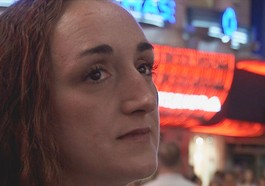
Screening Jan. 24 as part of the Sonoma Environmental Film Festival, writer-director David Novack’s authoritative documentary Burning the Future: Coal in America, shows exactly how heavy that price is by centering on accidental activist Maria Gunnoe. A waitress and mother of two, Gunnoe and her family have lived in the same “holler” for generations. She shows the camera how to peel poke limbs and describes their celery-like disposition when added to salad. She reminisces about spending her childhood in the creek that cuts through her large lot and foraging daily in the forest for the family’s dinner table.

Today, Gunnoe’s children cannot even shower in the water piped into their home, let alone roam the nearby forest or risk a dunk in the creek. When the mountaintop above their holler was surface-mined, everything changed. With the mountain’s vegetation gone, a regular rainstorm turned into a flood that devastated Gunnoe’s property and home, prompting her to quit her restaurant job and become a full-time activist, the Erin Brokovich of big coal. Let’s hope that a big-time Hollywood star like Julia Roberts decides to make her plight public, because as Burning the Future so aptly shows, there ain’t nothing clean about coal.

Burning the Future is just one of some 30 films showing this year at the SEFF that explore the various planetary woes mankind has conjured. Like a skewed Chinese medicine chart, the films divide fairly neatly between earth and water, closing with the acclaimed documentary Dirt! coming clean off the Sundance Film Fest circuit.

Troubled Water, a product of Arkansas public television screening Jan. 23, looks at what happens to a state so wet that rice is a primary crop when population and industry grow to unsustainable heights. As one artisan sitting at an unvisited table selling duck calls at a local fair explains, when the streams are pumped down, the fish go. When the fish go, the birds go. When the birds go, the hunters go. When the hunters go, he’s done for. All of which is where Arkansas is currently going.

Much happier fare is filmed close to home with Hidden Bounty of Marin: Family Farms in Transition screening on opening night, Jan. 22, with a special oyster and cheese and wine reception. Hidden Bounty centers on West Marin’s pioneering farm and ranch families, nearly all of them familiar names to local foodies. Dairy is a $36 million economic annual engine in Marin, with some 28 ranches providing primarily organic milk to niche markets.

In fact, “niche” is the magic word for the 52 family farms in Marin; the county has not only managed its open space brilliantly but has managed its brand with even more agility, the Marin Agricultural Land Trust reportedly being the oldest and most successful organization of its kind in the nation. Standing amid the reliable pleasures of his stunning Bolinas pasture, Star Route Farms owner Warren Weber beams into the camera. “I’m farming,” he says, “because I can’t help myself.” If only all the films at the SEFF were so organically optimistic.

 The Sonoma Environmental Film Festival runs Thursday&–Sunday, Jan. 22&–25, at the Sonoma Valley Women’s Club. Look for postfilm discussions and special panels. Lilith Lynn Rogers performs her one-woman show, ‘Rachel Carson Returns,’ on Jan. 23. 574 First St. E., Sonoma. $8&–$10; $85 for the whole festival. For details, go to www.seff.us or call 707.935.3456.


New and upcoming film releases.

Browse all movie reviews.

The Day Duke Ellington Came to Santa Rosa

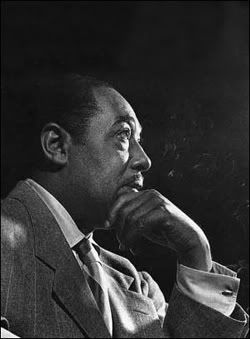
I’ve retold this story numerous times to friends and always found it funny. Today, I look at it with deeper meaning. Duke Ellington came to Santa Rosa and no one knew who he was. This, to me, is a sad part of our history, that we denied the most famous composer in a predominantly black art form even the dignity of recognition.
Think about this story, and then think about the exemplary man recognized, elevated and inaugurated as our President this morning.
—–
From Duke Ellington’s 1973 autobiography, Music is My Mistress:
Half the time on our trips Harry Carney and I arrive at the city or town where we are going to play that night thinking the other knows the place where the gig is, or has an itinerary in his pocket. Every now and then it appears that neither of us knows nor has an itinerary with him. “No sweat, baby!” I say, and we drive into a gas station, where Harry says, “Fill it up.” After I’ve stretched my limbs, I ask the attendant, “Do you know where Duke Ellington is playing tonight?” Usually the man answers, “Oh, over at the auditorium, three blocks down this way to the red light, turn left, then first right, and straight ahead—you can’t miss it.” So we just go and follow the directions, and we’re cool, but feeling it was a good thing we picked that gas station for information. We had been doing this sort of thing with good results down though the years until one night, a couple of years ago, we arrived in, I think it was, Santa Rosa, California. We pulled into the gas station with the same routine up to, “Where’s Duke Ellington playing tonight?” The cat with the gas hose turned and said “Who? Who’s he?” When we explained, he said, “I don’t know anything about a dance or a concert here tonight.” And there we were, standing there, feathers peeling off one at a time.
“Oh, no,” Harry said, “you don’t suppose we goofed on the name of the town?”
“There’s only one way to find out,” I said. “Call Ruth or Cress Courtney.” So I went to the telephone to call my sister in New York.
All this time, cars were coming and going, and as they stopped for gas we’d ask them the same question: “Where’s Duke Ellington playing tonight?” Most of their responses were something like, “Duke Ellington? I didn’t know he was playing here tonight.” Then Ruth answered the telephone and we got the directions. So I turned to the cat at the gas station and said, “We’re playing at the Fairgrounds.” “Oh, that’s it, is it?” he said. “Right catty-corner across the street.” What a relief!
But the Fairgrounds were very dark—no lights in sight. After finally finding an entrance gate, we drove in, and around, and around, and around. Nobody, but nothing, until eventually we were about to pass another car going in the opposite direction. Both cars honked their horns, stopped, let their windows down.
“Do you know where. . . ?” Harry began.
“That’s what we want to know, Harry,” the other driver interrupted. It was Ralph Gleason, of the San Francisco Chronicle at that time. We laughed, turned around, and both cars continued their search until suddenly—there it was!
Duke Ellington? Who’s he? Duke who?

Will Oldham in Santa Rosa March 29; Tickets Go On Sale This Wednesday!

2

Will Oldham has a penchant for playing out-of-the-way places around these parts. In 2002, he played at Pegasus Hall in Monte Rio; in 2003, he dropped in at the Old Western Saloon in Point Reyes Station.
As previously reported, everyone’s lovable scruffy indie-folk hero Will Oldham, a.k.a. Bonnie ‘Prince’ Billy, is adding Santa Rosa as one of his out-of-the-way-stops on his upcoming tour. I’ve been given the green light to spill the details about the show, and most importantly, about how to get tickets.
Will Oldham will play on Sunday, March 29 at the Orchard Spotlight, the best little church-turned-house in Santa Rosa. The venue is very beautiful and very small, holding just over 100 people. Tickets, at $28.50 each, go on sale this Wednesday, Jan. 21, at noon. 100 tickets will be available at www.folkyeah.com, while a scant 25 tickets will be available in-person at the Last Record Store in Santa Rosa.
You can either take your chances with the rest of the Internet-connected world online, or if I were you, I’d start lining up outside the Last Record Store on Mendocino Avenue at 9am. There’s a two-ticket limit; cash only. Needless to say, it’ll basically sell out immediately.

Songsmith: F’Real? No, really. F’Real?

4

I’ll never buy a PC, but if there’s one thing that bugs me about Macs is how supremely pompous the company is about their alleged ability to replicate human creativity. I used to think that the “Genius” feature on iTunes was the most egregious example of this, but now Microsoft has taken back the prize. Behold: Songsmith. Its commercial wins in some other category, too, though I’m not sure which. Horrible? Comically absurd? Scariest thing to watch while on LSD?

[display_podcast]

The key problem with this dumb-in-the-first-place idea is that one still needs to come up with an engaging melody, which, as Jimmy Van Heusen or Johnny Mercer could tell you, is the entire game. And even then, it’d be interesting to sing “Caravan” into Songsmith and see what sort of bullshitty crap comes out—probably, if the above commercial is any indicator, it’d be no different than pushing the “Demo” button on a Casio in 1986.
All of this reminds me of those just-add-water foam dinosaurs, where you add something pure and natural to something synthetic and get something overblown and gaudy.

Update, thanks to Eric: This is the fucking most awesome cohesion of blog memes in the universe. David Lee Roth’s acapella track run through the Songsmith. Listen and weep.
Oh Shit: This One’s Even Better.

Jeremiah Chass: Attention and Outrage

0

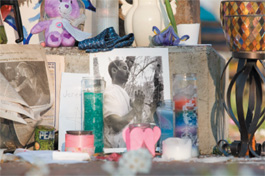
An impromptu memorial arose in Sebastopol Plaza after Jeremiah Chass’ March 2007 death. Photo by Michael Amsler.

The tragedy of Jeremiah’s Chass’ murder by two Sonoma County sheriff deputies comes to an uneasy close with the news today that the Chass family has settled out of court with the county of Sonoma for $1.75 million. A good portion of that will go to fund their youngest son’s college costs; a good portion of course to attorney Pat Emery; none of it will bring 16-year-old Jeremiah back to life.

On March 12, 2007, Jeremiah’s parents knew that their 127-pound son, the product of a black father and white mother, was having an episode of mental decompensation. They had tried to find mental health help for him the night before to no avail. That Monday morning, they tried the old-fashioned method of getting their son some help. They called the fire department. Which routed it to the police department. Which routed the call to the sheriff’s department. Which officers shot their son 11 times, beat him around the head, neck and buttocks, killed him, and then handcuffed him, put electronic paddles to his heart and attempted to restart his breathing by inserting a tube down his throat. They then stripped him nude and transported him to the hospital, dead dead dead. His autopsy and my thoughts prompted by it are here.

Work/Life

01.14.09

At the moment of Barack Obama’s inauguration, American workers find themselves in deep trouble. With more and more businesses downsizing or closing their doors, it’s become clear that our jobs provide not only economic security but a sense of who we are.

In 2001, Sonoma County writer Daniel Coshnear published a collection of stories titled Jobs & Other Preoccupations. If the book, which won the 2000 Willa Cather Fiction Prize, isn’t already a cult classic, it certainly should be. Clearly, the collection is even more relevant now than when it was published.

Coshnear’s stories drop readers into the lives of characters whose jobs and employment prospects are at the center of their existence. That makes these characters pretty much like the rest of us.

Work is a subject that American writers traditionally steer clear of, yet film and television have long recognized the comic and dramatic value of the workplace. In literature, from Kafka on, the job only seems to hit pay dirt when the inhumanity and/or bureaucracy of the enterprise is pushed to the level of absurdity.

The revelation of Coshnear’s book is that the jobs and the humanity go together. This may be because a number of the jobs in his stories are in the lower-paying social-service realm, serving clients who are teetering toward oblivion. Here are the addicts, the mentally unstable, the chronically homeless—in other words, the fastest growing demographic in America.

Coshnear was born and raised in Baltimore. He spent 10 years working social-service jobs in New York before moving to California in 1992. After finishing his undergraduate work at the New School in San Francisco, he earned his MFA in creative writing from San Francisco State University. He teaches regularly in the Bay Area through extension programs at SFSU, UC Berkeley and at the Sitting Room in Cotati. Coshnear lives in Guerneville with his wife, Susan, and their children, Circe and Daedalus.

One of the things I admire about Coshnear’s stories is that his characters, whether in self-awareness or delusion, display an introspection and humanity that remind us of ourselves.

Here’s Kash, from the beginning of Coshnear’s story “Where’s Fran Hayes?”:

It’s Tuesday, which is my Sunday, and I’m entering The Shannon Arms to share a liquid lunch with one of my oldest friends, Dorfman. A while back I thought I was on the death slope, the sensation of a blade twisting under the ribs on my lower right side that left as mysteriously as it came, but not without implications, resolutions. I resolved to be the worker of the month at my job. I resolved to catch up with my old friends.

The bar is long and dark with a low ceiling. Dorfman has his boot heels hooked in the rung of his barstool, his head down. He looks like a wet long-haired dog with glasses. He’s reading the cover of a matchbook. I want to be eager to see him and I might give him a slap on the shoulder, the big handshake, but the sight of him drains me. I take the matchbook out of his fingers and read an ad for the One Way Truck Driving School—areligious vocational program. He downs the remainder of his stout.

“You’re going to drive a truck?” I say.
“Why not?” He’s sullen because I’m two beers late.

In “Custodian,” a story from a new collection awaiting a publisher, Manny, a school janitor, is quizzed by his high school son Cesar for a school project.

“How did you choose your career?”
Manny smiles. “Well, when I finished medical school and law school, top of my class—”
“Come on, Pop.”
“I felt I had many choices, but—”
“Be real. How’d you get started?”
“I had a passion for picking strawberries.”
“The whole life story?” Cesar exhales.
“And I loved the ladies, the way they filled their baskets, ah, the way they bent over. Yes indeed, my first choice was love.”
“Tell me about your education. I’m kind of in a hurry. We could start there.”
“Did you get that down about my first choice?”


Dan Coshnear’s first choice is to allow his characters to be themselves. His stories embody the kind of compassion we need for these times.

Novelist Bart Schneider was the founding editor of ‘Hungry Mind Review’ and ‘Speakeasy Magazine.’ His latest novel is ‘The Man in the Blizzard.’ Lit Life is a new biweekly feature. You can contact Bart at [ mailto:li*****@******an.com” data-original-string=”NyJhq/zb21RGYONYWGdD0g==06aG5RXfWF9b2iLmXhzKGeLLgS5s8Ahcowg0Sxxa5lmrAeGJgBEcZWHP7vH6lPJb5awGmksFetSwQ9qey72s+dn6MY5etAsMWBTyG+/uXr/Cp4=” title=”This contact has been encoded by Anti-Spam by CleanTalk. Click to decode. To finish the decoding make sure that JavaScript is enabled in your browser. ]li*****@******an.com.


Museums and gallery notes.

Reviews of new book releases.

Reviews and previews of new plays, operas and symphony performances.

Reviews and previews of new dance performances and events.

Triangulated Presidency

0

01.14.09

The mosaic of Barack Obama’s cabinet picks and top White House staff now gives us an overview of what the president-elect sees as political symmetry for his administration. While it may be too early to gauge specific policies of the Obama presidency, it’s not too soon to understand that “triangulation” is back.

In the 1990s, Bill Clinton was adept at placing himself midway between the base of his own party and Republican leaders. As he triangulated from the Oval Office—often polarizing with liberal Democrats on such issues as free trade, deregulation, welfare reform and military spending—Clinton did well for himself. But not for his party.

During Clinton’s presidency, with his repeated accommodations to corporate agendas, the progressive base became frustrated and demobilized. Democrats lost majorities in the House and Senate after just two years and didn’t get them back. Along Pennsylvania Avenue, numerous liberal causes fell by the wayside, victims of a Democratic president’s too-clever-by-half triangulation.

Now, looking at Obama’s choices for key posts, many progressive activists who went all-out for months to get him elected are disappointed. The foreign-policy team, dominated by strong backers of the Iraq invasion, hardly seems oriented toward implementing Obama’s 2008 campaign pledge to “end the mindset that got us into war.” On the domestic side, big-business ties and Wall Street sensibilities are most of the baseline. Overall, it’s hard to argue that the glass is half full when so much is missing.

The progressives who remain eager to project their worldviews onto Obama are at high risk for hazy credulity. Such projection is a chronic hazard of Obamania. Biographer David Mendell aptly describes Obama as “an exceptionally gifted politician who, throughout his life, has been able to make people of wildly divergent vantage points see in him exactly what they want to see.”

But in the long run, an unduly lofty pedestal sets the stage for a fall from grace. The best way to avoid becoming disillusioned is to not have illusions in the first place.

There’s little point in progressives’ faulting Obama, because so much of their vital work remains undone at the grassroots. A longtime Chicago-based activist on the left, Carl Davidson made the point well when he wrote after the November election that “one is not likely to win at the top what one has not consolidated and won at the base.”

With 2009 underway, disappointed progressives shouldn’t blame Barack Obama for their own projection or naiveté. He is a highly pragmatic leader who seeks and occupies the center of political gravity. Those who don’t like where he’s standing will need to move the center in their direction.

Obama has often said that his presidential quest isn’t about him nearly as much as it is about us, the people yearning for real change and willing to work for it. If there’s ever a time to take Obama up on his word, this is it.

Crucial issues must be reframed. The healthcare reform debate, for instance, still lacks the clarity to distinguish between guaranteeing healthcare for all and mandating loophole-ridden insurance coverage for all.

With the exception of Rep. John Conyers’ single-payer bill to provide “enhanced Medicare” for everyone in the United States, each major congressional proposal keeps the for-profit insurance industry at the core of the country’s medical-care system.

As for foreign policy, the paradigm of a “war on terror,” more than seven years on, remains nearly sacrosanct. Among its most stultifying effects is the widely held assumption that many more U.S. troops should go to Afghanistan. Rhetoric to the contrary, Obama’s policy focus appears to be fixated on finding a military solution for an Afghan conflict that cannot be resolved by military means. The escalation is set for a centrist disaster.

During his race for the White House, ironically, Obama was fond of quoting Martin Luther King Jr. about “the fierce urgency of now.” But King uttered the phrase in the context of what he called “the madness of militarism,” a mindset that Obama has yet to clearly reject.

Barack Obama never promised progressives a rose garden. His campaign inspired tens of millions of Americans, raised the level of public discourse and ousted the right wing from the White House. And he has pledged to encourage civic engagement and respectful debate. The rest is up to us.

Norman Solomon was elected as an Obama delegate to the Democratic National Convention from the Sixth Congressional District in Sonoma and Marin counties. He is the author of ‘War Made Easy: How Presidents and Pundits Keep Spinning Us to Death’ and co-chair of the national Healthcare Not Warfare campaign.Open Mic is now a weekly feature in the Bohemian. We welcome your contribution. To have your topical essay of 700 words considered for publication, write op*****@******an.com.


Cautious Optimism

0

01.14.09

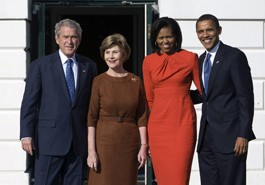
OUT WITH THE OLD: The president-elect and Mrs. Obama met with President and Mrs. Bush on Nov. 10 to get their first look at their new digs.

When Barack Obama is inaugurated as the 44th president of the United States of America, he does so in the role of steward to the millions of hopes of a fractured nation. The Bohemian asked a wide swath of people in the North Bay, from community leaders to bluecollar workers to the homeless, the same question: What are your expectations for Barack Obama as president?

The Rev. James Coffee, Community Baptist Church “My greatest hope would be that he will be able to be different and unique, and listen to more of the common man, the people he represents. Not just the powerful people. I expect him to bring this war, at least in Iraq, to a close. And my hope is that he’d be able to work on a universal basis to the universal problems, like the disinherited people in every country, especially with jobs, and the way people are one paycheck away from being homeless. These are the things he ran on, and what the people voted him for. And I hope he’d be inclusive, bring more diversity into the government. Especially including women.”

John Ash, chef “With so many issues on the table, the economic one being the most pressing, my hope for his presidency in the near term is that he and his team can prioritize their activities and not get caught up in trying to be and do all things for all people. I’d love to see a ‘hit list’ of issues published right after he takes office. We’ll then be able to measure progress and it could help him to focus.”

Jill Techel, mayor of Napa “As mayor, my hope is that he continues to support and, in fact, invest more in infrastructure projects for our community, and that we see the funding for the flood-control project increased so we can get it completed.”

Bruno Ferrandis, conductor, Santa Rosa Symphony “From an artist’s point of view, Barack Obama will have to prove that he is interested in arts emancipation in the U.S., starting with music education at school and in the near future study the European approach about art. Finally, the great majority of Europeans (like me) wanted to see a change in American politics; now a vast majority of Europeans want to see it in the arts.”

Rick Dean, executive director, Face to Face “Working in the public healthcare system for the past 20 years, I’m hopeful that the new administration will generate real change in the way we treat people who are sick, without health insurance and isolated from quality care. This includes the 1.1 million men, women and children living with HIV-AIDS across the nation.”

Ky Boyd, owner, Rialto Cinemas “I hope that thoughtful, compassionate leadership will bring about change that benefits Americans at every level and in every part of our great nation. Change that puts people, food, shelter, education, affordable healthcare and the arts ahead of corporate profits and pork barrel politics. Change that restores our country’s reputation around the world. . . . And as a gay American, I hope that President Obama will stand up for the rights of all minorities, including LGBT Americans, by ending policies such as ‘don’t ask, don’t tell,’ and take a leadership role on the issue of gay marriage. Change is in the incremental steps forward. I don’t expect a miracle, but I hope for progress as we journey forward as a nation.”

Joseph Von Mertam, homeless “I’m expecting all the money he’s got. If he wants to send me over a bunch of money, that’s cool with me. I know damn well he’s gonna change things for the better. And then he can give me a hunk of money.”

Charlie Musselwhite, blues musician “I feel like Obama will restore America’s dignity. He’ll put America back on track, back on the high and honorable road. The eight years of Bush have been like a return to the Dark Ages, and now somebody has opened a window and let in the light and fresh air. I hope that with the coming light of the Obama presidency, the people that need to will wake up and realize how they were bamboozled by Bush and learn from what happened to them.”

Shawn McConlogue, barber, the Barber Shop “I expect it’s gonna get worse before it gets better. He’s got a big hill to climb, but so far he’s picked a lot of smart people. He seems like a very smart, competent guy, so if there’s anyone to help us out if it, it’s him. I think we’re definitely gonna see a shift from Iraq to Afghanistan, and I think we’re gonna see something very similar to FDR’s Public Works program.”

Old Man, getting his hair cut, interjecting “That’s what we need! All these young people out of work with no direction, put ’em in the CCC. I’m a child of the Depression, and it worked for us then. It’s what we need now. He can’t be any worse than the last eight years.”

Man, nearby, waiting in a chair “I think he’s gonna get all different races working together like never before.”

F. Scott Chilcott, MD “It certainly would be nice to see if we could be incredibly more efficient in our dispensing of medical care in this country, because we do a terrible job. There’s so much wastefulness going on here, and one of the very big factors is the legal profession making everybody so antsy. You end up getting an awful lot of unnecessary and redundant things that are expensive and sometimes hazardous only so you won’t get sued. The lawyers have an incredible influence on how medicine gets practiced. So I would expect him to help, but in terms of saying that I’m going to be frantically, disastrously angry and think he’s an evil rotten SOB if he doesn’t do it, again, I find myself being very careful about my expectations.”

Robert Pixton, air tanker pilot, Cal Fire “I didn’t vote for him, so maybe I’m not the right person to ask. Obama’s got a tiger by the tail, there’s no doubt about it. Especially with the latest escalation, the war over in the Gaza Strip—it’s not going to be an easy one. But every president, when they first take over, they have some major crisis they have to deal with. I always think, ‘OK, how would somebody else have handled it?’ You know? We’ll see.”


Tom Gaffey, house manager, Phoenix Theater “You know, it’s not what I expect of Barack Obama, but what I expect from the American people, to give this man a chance to do the job. But, oh man, do I expect he’s going to come and solve the economic problems? How could I possibly expect that? I hope he can. Do I expect he’ll have the right answers in Afghanistan and Iraq? I can’t expect that. But I hope he does. It’s just a lot of hope and very few expectations, and such a huge hope for a third party. I will vote for any third party that looks like they have a chance.”

Joe Carr, refrigerator repairman, A-1 Refrigeration “If nothing else, at least the rest of the world knows that we see them. Most of the people in the world are of color; many of the people in the world are Muslim. And we elect a man named Barack Hussein Obama? To let the rest of the world know that we don’t have this single-minded, ‘we’re right’ attitude, with our middle-aged white leaders all the time—that alone is going to speak volumes about who we are.” 


Sunshine Crimes

01.14.09

The latest local green crime? Stealing solar panels. In Sonoma, Napa, Marin and beyond, thieves with enough electronics knowledge to disassemble a solar panel without ruining it are trespassing by night and even by day to rip off panels worth tens of thousands to hundreds of thousands of dollars. Solar panels have been stolen from wineries, elementary schools, homes—even from a church and an organic farm. Is nothing sacred? Welcome to the solar portion of our new green economy.

A key selling point of solar power has always been that no one can own the sun. An upbeat consequence of sunlight being ubiquitous is that no one has to kill or be killed for any market control disguised as patriotic duty. Three cheers for Brother Sun. I see a Nobel Prize looming.

Our planet’s star ignores political boundaries and economic status, dishing out radiance and free vitamin D to all. Yet all that energetic brightness needs to be concentrated in order to create electricity, and for that you need photovoltaic cell technology. No one can own the sun, but some can own solar panels. And others can steal them. The fact that anyone would steal solar panels is evidence enough that we have established a green economy around here.

Solar power has been harnessed for centuries, and sophisticated solar technology has existed for over a hundred years. The first solar steam engine was built in 1861. But not until the 1970s did solar technology get a federally assisted nudge toward mainstream. During the feigned “oil crises,” while we were hostages of an oil embargo, consumers waiting in long lines at gas stations became suddenly interested in alternative energy sources.

During that time, regional solar buff Allan Book studied the technology and eventually built his own off-the-grid home which still runs on the solar system he installed in 1986. “In those days, each panel was 53 watts and cost $375,” Book explains. “They don’t make those anymore.”

Back then, getting a solar panel stolen was about as likely as getting an accordion ripped off—you know the old joke: Lock your truck with an accordion (solar panel) in the cab, and when you come back, the windows will be broken and there will be three more accordions (solar panels) on the front seat.

Not so in this economy. Witness the forbidding wire wrapped around the municipal solar panels recently installed in downtown Sebastopol. The next green industry will be a solar panel night watch service, followed by new, theft–proof solar systems.

Among the emerging green collar jobs are so-called maid services for solar systems. “If you can wash a window,” one recruiting service claims, “you can clean a solar panel.” Entrepreneurs are creating green industries where none existed before.

And let’s not forget the contributions of honest citizens, doing what they’ve always done to turn in the bad guys. In Napa, a resident who had read in the newspaper about the recent thefts of solar panels picked up the phone one evening and reported the license plate and travel direction of a suspicious-looking, tarp-covered truck. Police caught up with the truck, pulled it over and found it loaded with stolen panels. The thwarted thieves were arrested and the panels returned.

 In other parts of the country, citizens may be expecting a new green economy to launch with drum rolls next Wednesday in Washington, D.C. Sure, we can all look forward to intelligent policy that will shift the country away from the self-destructive course we’ve been on. But here in the North Bay (where, incidentally, the number of inauguration parties per capita suggests enthusiasm on the far side of wild), no one is looking to the new administration to kick-start a green economy for us—we’re already living it.

Green is a community-based economic model, and solar is only a portion of ours. We can look at the other portions later. Right now, I’ve got to run. I need to start picking out inauguration-party outfits for next week. One for each party.

 Award-winning journalist Juliane Poirier Locke is a sustainability writer and the author of ‘Vineyards in the Watershed: Sustainable Winegrowing in Napa County.’ Poirier Locke has been reporting on socio-eco issues in the North Bay for over a decade and joins us this week as our new Green Zone columnist.


Shakedown Street

01.21.09Visitors are forgiven for indulging in a quiet chuckle while driving through the large, arced sign above Monte Rio's main intersection conferring "Vacation Wonderland" status on the once-hopping but now tiny and still hamlet of West Sonoma County. Come through town on a Thursday night, however, and Monte Rio becomes a vacation wonderland of an entirely different color—or colors—as...

Earth and Water

01.21.09In 2007, California passed legislation barring energy companies from doing business with the state if they were also pursuing new coal contracts. O, pure, clean California! Not exactly. While we do not produce coal or have any coal-fired power plants, Californians still use coal to generate electricity and, according to the coal industry itself, the Golden State benefits from...

The Day Duke Ellington Came to Santa Rosa

I’ve retold this story numerous times to friends and always found it funny. Today, I look at it with deeper meaning. Duke Ellington came to Santa Rosa and no one knew who he was. This, to me, is a sad part of our history, that we denied the most famous composer in a predominantly black art form even the...

Will Oldham in Santa Rosa March 29; Tickets Go On Sale This Wednesday!

Will Oldham has a penchant for playing out-of-the-way places around these parts. In 2002, he played at Pegasus Hall in Monte Rio; in 2003, he dropped in at the Old Western Saloon in Point Reyes Station. As previously reported, everyone's lovable scruffy indie-folk hero Will Oldham, a.k.a. Bonnie 'Prince' Billy, is adding Santa Rosa as one of his out-of-the-way-stops on...
Songsmith: F’Real? No, really. F’Real?

I’ll never buy a PC, but if there’s one thing that bugs me about Macs is how supremely pompous the company is about their alleged ability to replicate human creativity. I used to think that the “Genius” feature on iTunes was the most egregious example of this, but now Microsoft has taken back the prize. Behold: Songsmith. Its commercial...

Jeremiah Chass: Attention and Outrage

An impromptu memorial arose in Sebastopol Plaza after Jeremiah Chass' March 2007 death. Photo by Michael Amsler.The tragedy of Jeremiah's Chass' murder by two Sonoma County sheriff deputies comes to an uneasy close with the news today that the Chass family has settled out of court with the county of Sonoma for $1.75 million. A good portion of that...

Work/Life

01.14.09 At the moment of Barack Obama's inauguration, American workers find themselves in deep trouble. With more and more businesses downsizing or closing their doors, it's become clear that our jobs provide not only economic security but a sense of who we are. In 2001, Sonoma County writer Daniel Coshnear published a collection of stories titled Jobs...

Triangulated Presidency

01.14.09The mosaic of Barack Obama's cabinet picks and top White House staff now gives us an overview of what the president-elect sees as political symmetry for his administration. While it may be too early to gauge specific policies of the Obama presidency, it's not too soon to understand that "triangulation" is back.In the 1990s, Bill Clinton was adept at...

Cautious Optimism

01.14.09 OUT WITH THE OLD: The president-elect and Mrs. Obama met with President and Mrs. Bush on Nov. 10 to get their first look at their new digs. When Barack Obama is inaugurated as the 44th president of the United States of America, he does so in the role of steward to the millions of hopes of a fractured nation. The...

Sunshine Crimes

01.14.09The latest local green crime? Stealing solar panels. In Sonoma, Napa, Marin and beyond, thieves with enough electronics knowledge to disassemble a solar panel without ruining it are trespassing by night and even by day to rip off panels worth tens of thousands to hundreds of thousands of dollars. Solar panels have been stolen from wineries, elementary schools, homes—even...
11,084FansLike
4,446FollowersFollow
6,928FollowersFollow