War’s Silence

0

02.04.09

My father, Patrick Loughran, a gregarious Irishman from County Tyrone, and Chuck Morrison, my taciturn uncle from Albany, N.Y., were united by much more than the fact that they’d married sisters. They were members of Tom Brokaw’s “greatest generation”—my father, a SeaBee; my uncle, a Marine. Both veterans of WW II, they had been beaten and battered by the world in precisely the same way. They’d been through the Depression and then the war and had shared in the freedoms and economic booms that followed. They knew the rules. They knew what was expected of them. They knew how to live without doubt or regret.

Or so I thought.

In 1987, I was diagnosed with testicular cancer. Following the surgery, radiation was necessary to zap any remaining possibility of cancer. Even though Redwood Radiology in Santa Rosa was near my house, my father insisted on driving up from Petaluma to chauffeur me to my appointments. As often as not, my uncle Chuck would accompany us.

It wasn’t only a kindness that they provided for me; it was something for them to do. They were both retired from busy and active careers, and there is a limit to how much weeding, watering and gardening a tract-home-sized piece of earth will endure. And so every Thursday for a few months I sat in the car, more worried about my health than the banter, listening to stories about things that mostly occurred before I was born: the virtues of the Studebaker vs. the Buick; the wild times they used to have in Monterey with my uncle Mario; how America had gone to hell in a hand basket.

Then one day, my father asked Chuck why he never talked about the war. Chuck didn’t answer. He waved away the question and stared out the window.

My father had pictures of himself in the Aleutians and South Pacific; I’d seen pictures of other uncles in uniform. But I don’t recall any pictures or memorabilia of Chuck. He had fought with the Marines in WW II and Korea; I couldn’t tell you where or with what battalion, company or unit. He simply never spoke about it.

On this day, as well, Chuck just shook his head and didn’t answer the question. It was not unusual for Chuck to be quiet. He was the most quietly sociable man I’d ever known. He never missed a party (after all, they were usually at his house) or a joke. His interjections into conversations were always terse, telling, funny and conclusive.

But I’d never before seen him so discomfited as he was by my father’s question, “Why do you never talk about the war?”

My uncle Chuck was a generous and gracious man. A success in business. A loving father. A respected, substantial and beloved cog in a large, extended family. A veteran of probably the last popularly supported and undoubtedly necessary war this country will ever wage. And yet even an interloper from another generation could see that while he had survived that war successfully, he was not unscathed. A portion of his life, years of it, had been ruined to the point that he refused to recall or speak about them.

There are the KIA, the MIA and the wounded, but every war also produces a more restrained casualty. For every reminiscing veteran that Tom Brokaw or Ken Burns interviews, there is another survivor, another hero, another victim whose wartime experience is simply unspeakable. They can’t and don’t talk about it.

There is a generation at war now who will return to have children, attend college, buy houses and live “good” American lives. We can explore the reasons for Gulf War II and the reasons against it. The costs in political clout and world credibility are important and debatable. But we cannot forget that beyond the obvious expense in dollars and lives, as with every war, there is another toll, a mute and tragic carnage.


The tragedy of silent lives forever changed.

 Rob Loughran’s novel ‘High Steaks’ won the 2002 New Mystery Award. His collection of short stories ‘What Happens When the World Doesn’t End?’ will be published sometime in 2009. He lives in Windsor.

Open Mic is now a weekly feature in the Bohemian. We welcome your contribution. To have your topical essay of 700 words considered for publication, write [ mailto:op*****@******an.com” data-original-string=”zIwErT+ZNbTqzYO8okUrZg==06aMmoXKU4KGHhDKlObKPj2rftXDSEbDnqLPn5TDNYyrNpxy877uT3+5A3o18d+2GoqMxExuOeyf7K5e/ynlqKABxec0vbCLNcxC727E4bu1H4=” title=”This contact has been encoded by Anti-Spam by CleanTalk. Click to decode. To finish the decoding make sure that JavaScript is enabled in your browser. ]op*****@******an.com.



Wonderwall

02.04.09

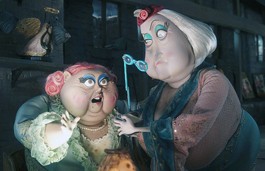
Children under five might want to be elsewhere, but everyone else with a fanciful streak should love Coraline, a stop-motion animated masterpiece by Nightmare director Henry Selick.

Adapted from the Neil Gaiman book, the story contains elements from Alice in Wonderland and E .T .A. Hoffmann’s “The Nutcracker and the Mouse King”; there’s even a spot of help from Keats’ poem “La Belle Dame Sans Merci.” In 3-D, this is a fascinating and strangely beautiful tale.

A bright-blue-haired Oregon girl discovers a magical portal and takes up a chimerical parallel existence just on the inside of her new house’s wall. Coraline, voiced by Dakota Fanning, could use some escape. Her blue hair is the sharpest color in a muddy landscape soaking in the worst of the spring rains. Coraline’s house is a pale-pink Victorian in the outskirts of Ashland. The plumbing is bad, and water bugs and centipedes wriggle out of the woodwork. Her parents work at home, drudges chained to their computer keyboards.

Coraline pays little attention to her neighbors, theatrical retirees who were likely drawn to Ashland by the Shakespeare Festival. In the basement apartment lives a pair of broken-down English burlesque artists (Jennifer Saunders and Dawn French). The ladies live with a horde of Scotties, most of whom are dead. The tenant above Coraline’s place is a bulgy Russian acrobat (Ian McShane). Nearby, a boisterous kid named Wybie roars around in the mud on a minibike. He’s adopted a beat-up stray cat. Coraline has little use for the boy and his pet.

Exploring her house, Coraline finds a locked crawl space. When she at last breaks through, she discovers a glowing blue tunnel. At its other end, her Other Parents are waiting for her. They’re sweet and attentive, and there are no dismal computers in sight. They load Coraline’s plate with cakes, flatter her and tend an animated garden of plants celebrating her existence. The only hitch is that this Other Mother and Other Father have shiny black Raggedy Ann-style buttons for eyes. Coraline’s help in the trouble to come is the skeptical feral cat, voiced with lovely insinuation by Keith David, who goes as he pleases between worlds.

If Selick has something in common with Tim Burton, it’s the Burton of Beetlejuice. Troubling changes of size occur in the fantasy world, in the same way that the zebra-striped demon Beetlejuice was sometimes man-size, sometimes a scuttling mouse. The revelation of the Other Mother’s true self comes with a startling change of size and proportion. Selick’s plays on both sides of the line between the uncanny and the cute; asymmetry and strange angles rule the creatures in the fantasy world.

Coraline is girl-centric. Perhaps it was the thousands of Goth (or merely off-beat) girls out there who responded the most deeply to Skellington and Sally. The changing rapport between mom and daughter (as well as between the not-mom and not-daughter) makes this a very womanly tale. The men are off to the side in a power struggle among maiden, mother and very bad crone.

Watching fairy-tale films, too often you’re tensed up, worrying that you will be fed a trite motto that will spoil the pleasure. Coraline has its moral, an Old Country one: Those who gorge us on sweets may not have our best interests at heart.

But Coraline‘s symbolism seems artful and troubling, rather than simple. As in the Grimm Brothers stories, there’s something very pagan in Coraline, something that doesn’t jibe with our feelings that good always defeats evil. Rather, it insists that cleverness and a little treachery is always needed to save our skins.

‘Coraline’ opens Feb. 6 at select North Bay theaters.


New and upcoming film releases.

Browse all movie reviews.

Saints & Spells

02.04.09

Love is the exploding cigar we willingly smoke.

—Lynda Barry 

Legend has it that St. Benedict (480&–547 A.D.) was one horny fellow. Sources attest to this, citing young Benedict’s three years of perpetual arousal while still a struggling hermit. Deliciously lewd fantasies, it’s said, surged through Benedict’s pre-saintly loins, while electrifying, intoxicating and lubricious passions lay waste to his pre-holy soul.

Birthed of a single furtive glance at some now-forgotten lovely, these tribulations constituted unending rounds in Benedict’s lifelong wrestling match with provocations of the flesh. Persistent visions of the woman continued to fire up his equipment, even in the sparse, cool depths of his hermetic digs. Just as he set to uttering a Dark Ages version of “Fuck it,” thereby condemning himself to frolicking his life away in ecstatic, orgasmic and joyfully unfettered sin, God Himself (or so says the saint’s chronicler, Pope Gregory the Great), came to Benedict’s rescue by fashioning for him the wilderness equivalent of a cold shower.

Gregory writes that Benedict purged himself through a “wallow” in thick briers, staying “so long that, when he rose up, all his flesh was pitifully torn: and so by the wounds of his body, he cured the wounds of his soul.”

According to social critic and Simpsons creator Matt Groening, love has nothing to do with other people but lots to do with pain. “Love,” Groening says, “is a snowmobile racing across the tundra and then suddenly it flips over, pinning you underneath. At night, the ice weasels come.”

To burrow deep inside this, we turn to modern science and biological chemistry. Most everyone knows the yoni-yin of estrogen, testosterone’s wang-yang, and what each means to our sexual identities. Perhaps you’re acquainted with dopamine and its role as the so-called pleasure chemical, which, upon release, sails us gently amidst clouds of sensual bliss.

Add to these the stress hormone cum neurotransmitter norepinephrine. Norepinephrine exhibits adrenal similarities to cocaine. But it’s legal, and it’s free.

Now ponder the hyperhorny alkaloid phenylethylamine, one crazed-monkey substance if ever one existed. Phenylethylamine produces such an unreflective “let’s ball whoever you are” methlike euphoria that it’s labeled “the love drug.” In fact, some studies suggest that the drug Ecstasy, which is also called “the love drug,” obliges the dosed body to produce massive quantities of phenylethylamine. Fall in love this very moment, and your body mainlines you a maxi-load of phenylethylamine.

It’s the stuff of love legend, producing the rarified state actor John Barrymore addressed when noting that “love is the delightful interval between meeting a beautiful girl and discovering she looks like a haddock.” Phenylethylamine is so addictive that some race from one lover to the next just to keep their high going. The reason, of course, is that the chemical’s effects inevitably attenuate. Those of a more monogamistic disposition mostly just grin and bear the emotional letdown. But others suffer severe postpartum depression with phenylethylamine’s waning.

Could it be that Benedict dived into his briar patch while sky-high on phenylethylamine? Like the dendrophiliac, who gets his jollies by engaging orgiastically with trees, perhaps Benedict’s phenylethylamine rush bulldozed him into some roughly equivalent state, though he engaged briars and nettles instead, sparing the poor defenseless hickory its innocence.

Just as phenylethylamine jolts our body-beast into dopamine production, likewise dopamine stimulates the creation of oxytocin. Oxytocin can and does cause sexual arousal, but it’s a safe bet that this “cuddle” hormone wasn’t Benedict’s challenge, nor his cup of tea. His was likely a more highly charged, urgent, and perhaps pathological state, more akin to classic priapism.

Some will, no doubt, suggest human sex pheromones lie at the root of Benedict’s crisis of faith. Indeed, his meals were likely wrapped in cloth before being lowered into his cave. Said cloth was oft touched and perhaps worn too as a garment. Contact with bodily excretions that enhanced and stiffened it over decades when to bathe or wash clothes was verboten might indeed have driven an otherwise saintly Benedict stark raving horny. Problem is, there’s not much peer-reviewed material to back up this suggestion.

Which brings our chemistry quest to endorphins, nature’s way of saying “morphine.” Could be, had Benedict engaged a challenging regimen of exercise, his condition might be chalked up to the release of endorphins into his system. First problem with this scenario, though, is that the endorphin rush is one of opiated contentment and a sense of well-being, not the anxious, turgid need to screw. Besides, Benedict was still living in his cave and eating very little. It’s doubtful he had much energy or inclination for the extended aerobic output endorphin release requires.

But regardless his impulses, or the whys and hows that led to such behaviors, St. Benedict’s tribulations illustrate what’s been true since humankind first attempted to make sense of love and the libido—that no matter our enormous body of speculative, hearsay and scientific evidence, when it comes to these sweet things, we don’t know squat from Sasquatch.

Extract the chaff from human existence and what’s left are three simple essentials: eat, sleep, procreate. The eat and sleep stuff’s easy, but we’ve yet to get a handle on our procreate thing. Some religionists insist it’s our sacrosanct imperative to exclusively engage in coitus as though the process were merely some planned-obsolescent assembly plant meant to crank out cherub flesh. You know, do your duty, shut down the operation, and then keep the equipment quietly zipped up in your pants. Forever. If so, then why did this God design us so as to make intimate explorations of the flesh so continually desirable, stimulating and fulfilling long after our gardens have gone fallow?

When it comes to sexual genetics, do physiological responses to body chemical shifts determine where libido takes us, or does plain wanton desire need to be cultivated in order to access pure unrestricted pleasures our species is so handsomely designed to offer? Clearly, we clueless barbarians, eager but stupid, don’t yet really know .

It may be that old-time religion, the kind Benedict helped to create, and today’s scientific notions of love and the libido reflect upon one another, squeezing us into a deeper understandings of the nature and power of solo, mutual, hetero, gay, omni and still-to-be-conceived sexual conundrums.

Perhaps the poet Dorothy Parker best expressed our human love condition in appropriate poesy rhyme:
“Oh, life is a glorious cycle of song,
A medley of extemporanea;
And love is a thing that can never go wrong;
And I am Marie of Romania.”


Letters to the Editor

0

02.04.09

Like we wouldn’t print this

Loved the “Field Trippin'” article by John Moss (Jan. 21), and it made me so nostalgic that I just had to write you about the many incarnations of the Bohemian that I’ve observed over the years.

Your birth was in Monte Rio around 1979 as The Paper and I still have many articles saved from that time. With Nick Valentine as editor and Tom and Elizabeth as publishers, this brave little weekly with beautiful graphics and extraordinary layout (before computers) became must reading for all us counterculture types. It replaced Bliss Buy’s previous paper, the Sonoma County Stump as the activist publication, and was one of the reasons that we were so successful in 1980, the first year that we protested at Bohemian Grove. It took us through the early 1980s protests at Rancho Seco, Diablo Canyon and the Livermore labs as well as covering all our doings here at home.

The only problem was that it lost money in droves as it leaned much more to covering the resistance than advertising for the establishment. I won’t go into why Tom and Elizabeth gave it up and left for Australia, but it’s a great story. Then you moved to Freestone and later Forestville under new management, and somewhere along the line you became the Sonoma County Independent. You were still doing a good job of covering the community, but unfortunately, in order to survive, your focus started leaning more toward economic reality and the radical edge began to tarnish. When you moved into Santa Rosa and became county-oriented as opposed to West County&–oriented, a lot of us old timers were a bit miffed. When you changed to the North Bay Bohemian, I really got pissed.

I gave up on you for a while and then, lo and behold, Gretchen Giles took over and slowly you have been pulling it back from the abyss. You still have way too much advertising, but in my head I do understand.

I appreciate Peter Byrne, P. Joseph Potocki and John Sakowicz’s reports; they bring back that edge I have so missed. And John Moss’ acid trip was just what I needed to put it all in perspective. So thanks for that, and let us never forget our roots.

Mary Moore
Occidental

Slow Going

Clark Wolf made some great suggestions for things we can all do for small family farmers during these hard times (“Change We Can Eat,” Jan. 28). Our local Slow Food chapter has been putting a lot of time and energy into alerting people to the very real danger of losing the Gravenstein apple. There are now only 900 acres of Gravs left, and if our farmers don’t get some help, more of them will destroy their orchards and plant wine grapes. And now, besides the economic catastrophe, we have a drought. The good news is, most local apples are dry-farmed!

Here are few things you can do to help save our apples and the biodiversity of our community: (1) Buy Gravensteins and happily pay a few cents more per pound this year so our farmers can afford to keep growing and tending their orchards. Buy them direct from the growers or at local farmers markets, or ask your favorite market to be sure to stock local Gravs this season. (2) Get involved in our movement. Go to www.slowfoodrr.org or email us, [ mailto:in**@********rr.org” data-original-string=”K6ROJyMsLU0ATsvc4R7w1w==06aKRwacdM/Iz8B9ptrc90WMVUvC2Lxb91IUdVddoJa8MhfG90LWpnQalbcPFfe/EPKE1xTgNe4bABRPguYPMMwhkER0gRD/tG/zc+fK8p1ScMVU8rpOT8X/LhU1UL/xua5uwZ47pv0kC9ZfoPkpsNciWrD3cLvit6xjrWzGGRtIET0WMxU5jkkAcFnb+wGso+4n8/WOCMhGEJzHZdonK6EnWRRL2CADodUeJJJNtIrxDsjLJlHPCddWozTZVT9zmsPoA61XURGnctz6xcU2Z4wNQ==” title=”This contact has been encoded by Anti-Spam by CleanTalk. Click to decode. To finish the decoding make sure that JavaScript is enabled in your browser. ]in**@********rr.org.

Paula Shatkin, Slow Food Russian River
Occidental


Thanks, we think

I do hope you are not considering cutting “This  Modern World.” I have to say that personally, it is often the most cogent and interesting thing I find in the paper.  And I leaf through the rest as a result. 

L. B. Williams
Guerneville


&–&–>

The 411 on 211

0

02.04.09

Marin and Napa counties already have a one-stop number for volunteer opportunities, questions about health insurance and information on food stamps, but on Wednesday, Feb. 11, the newest three-digit number phone line finally launches in Sonoma County. The number is 211, and the fact that it debuts on 2-11 is no coincidence. Unlike its counterparts 911 and 411, 211 is not for life-or-death emergencies or to be used as simply a directory.

“Two-one-one is an easy-to-remember health and human service number, so that when you have a need—let’s say that you just got evicted or your PG&E is going to be turned off—they’ll refer you right on the spot to the correct person or agency that can help,” explains Stacy Ruppert, the communications manager at United Way of the Wine Country. “Right now, people have to make an average of nine calls before they get to the right number; this cuts it down to two.”

Instead of reaching an automated message or someone in India, calls to 211 will be directed to real people in the community. “Right now it’s located in county center and staffed by real people who live here, 24 hours a day,” Ruppert says. “After-hours and on the weekends, it will be sent down to another 211 call center, but during the day it will still be here in Sonoma County.” United Way agencies across California are taking on 211’s launch. United Way of the Wine Country is launching the number not only in Sonoma County, but also soon in Mendocino and Lake counties.

“Sometimes, 911 is fielding calls that aren’t relevant to it,” Ruppert continues. “In times of disaster, you can call 211 and whatever you need, it’s right there.” This new support line is also important in reducing calls to 911 when natural disasters occur. Last summer during Southern California’s ravaging wildfires, 911 call centers in many areas went down from the influx of calls, but 211 was still up and ready to help people trace family members and find important resources.

Cell phones cannot dial 211, but can reach its services at 1.800.325.9604. Walk-in clients are welcome at Human Services Dept., 8:30am–5pm. 2550 Paulin Drive, Santa Rosa.


Let the Sun Shine

0

02.04.09

Some time ago, in the not-so-distant past, a waitress at an upscale Cuban restaurant decided to put down her serving tray and pick up a guitar. “I would have something that gave me endless vitality, something that helped me through joys and sorrows, a constant through inconsistency and a blessing to pass on to everyone else,” says Philadelphia-based singer-songwriter Birdie Busch of her decision to leave behind the world of steaks and platters for the world of songwriting and creativity.

Busch makes a stop at the Orchard Spotlight on Feb. 7 as part of her U.S. tour. Joined by a full backing band made up of local Philly musicians and friends, Busch’s songs exude a classic, warm living-room Americana-sound—think Lucinda Williams without all the whiskey and cigarettes. In an Auto-Tune pop universe, the Collingswood, N.J.&–bred musician provides an honest dose of solid, simple songwriting. Listen to the charming hooks on the song “Mystical,” from the 2007 release Penny Arcade, whistle along with the sunny chorus and be cleansed of any residue left from 2008’s gagtastic proliferation of robotic, dead vocals.

A buzzed-about artist in Philadelphia, Busch has opened for Regina Spektor, Amos Lee and Dar Williams. She’s just wrapped up recording on her third album, with the help of band member and producer Craig Hendrix. “I love witnessing the quality of music that comes about when people are thrown together because they are neighbors and friends, believers and musicians,” says Busch on her MySpace page, “all able to have this dialogue that somehow seems more intimate.”

With such bright horizons, it’s no surprise that the woman who has received critical praise from the Village Voice, Harp and No Depression is an optimist. “I want to be like sunflowers and not a midnight rose,” she sings on “Go Go Gadget Heart,” a sweet little ditty about love and yearning, and those of us who tend to seethe glass as half empty can join Birdie Busch for a second in believing wholeheartedly that it might be half full.

Birdie Busch performs with the Spindles and Joni Davis on Saturday, Feb. 7, at the Orchard Spotlight, 515 Orchard St., Santa Rosa. 8pm. $10. 707.542.7745.


Grey’s Anomaly

0

02.04.09

Plenty of fresh-faced girls enter the adult industry at a young age, following the common adage that most resort to porn after they realize their mainstream Hollywood ambitions have failed. But 20-year-old Sasha Grey, who has been variously described as the future of porn and “the next Jenna Jameson,” came to the industry knowing exactly what she wanted. At 17, she studied porn vigorously for a year in her hometown of Sacramento and moved to Los Angeles when she turned 18. In the two years since, she’s made over 150 films and routinely defended her career—on The Tyra Banks Show, for example—as performance art, as self-expression and as catharsis. Sometimes she simply says it’s fun.

Grey is out of the ordinary in porn not only in that she’s got normal-sized, unimplanted breasts and has sternly controlled her business affairs (she represents herself through her own agency), but also in that she’s got unpredictable, avant-garde tastes. The majority of her own films are the usual low-production, no-plotline porn fare, but she’s declared a curious inspiration in directors like Jean-Luc Godard, Werner Herzog, Pier Paolo Pasolini and Catherine Breillat. Likewise, her iPod is filled with experimental bands like Throbbing Gristle, Faust and Tape Recorder. It’s easy to find porn stars who rock out to AC/DC—but Squarepusher and Behemoth, not so much.

Grey, a left-handed guitarist, has joined the experimental music arena this month by releasing a limited-edition clear-vinyl 7-inch with her noise duo, aTelecine. She calls it an “experimental-death-dub-orgasm kind of project.” With six tracks and collage artwork by Grey herself, the record’s first run of 300 copies sold out quickly in preorders. The Brooklyn-based Pendu Sound, who released the 7-inch, also sells LPs and cassettes by art-noise groups equally influenced by John Cage and Slayer; they plan a cassette-only release with aTelecine in the near future.

Grey’s got a hectic schedule of sex in front of a camera, but says that aTelecine are planning to play live and to release more mixed-media material in the future. She’s also been cast in a Steven Soderbergh movie, The Girlfriend Experience, crossing the famous firewall between adult film and mainstream film, and two more independent films in which she appears, Quit and Smash Cut, are in post-production now. Recently she shot music videos both by the Roots and Smashing Pumpkins, as well as contributing vocals to a Lee “Scratch” Perry album. A renaissance porn star? It’s possible.


Improv This

02.04.09


The scene: the recent presidential inauguration, out on the mall. The situation: 5 million people and only 5,000 Port-a-Pottys. “Suddenly,” explains Bridget Palmer, barely containing her laughter, “It was suggested that President Obama was in one of those Port-a-Pottys, and everyone was running around opening doors to see which one he was in so they could, you know, meet the new president. And then there was this Secret Service agent, but he wouldn’t tell us which potty Obama was in.”

Though this anecdote sounds like either the best untold news story of the 2009 inauguration or some kind of twisted delusion, it is in fact the highlight moment of the night during a recent performance by Sixth Street Improv. Since the beginning of January under Palmer’s direction, the quick-thinking team of actors and comedians has taken over the Playhouse’s Studio theater, landing twice a month to open the dams of improvisational comedy. Sixth Street Improv employ a combination of classic improv games and live spontaneous songs, invented on the spot with the help of a live accompanist on piano. According to Palmer, the goal is higher than just earning some quick laughs.

“Well, we definitely are aiming to be funny,” she says, “but our primary emphasis is on story, so a lot of our improv bits are like little tiny plays, based on suggestions tossed out by the audience. Fortunately, most of the time the stories we get from the audience are pretty hilarious, and if they’re not obviously humorous, like the inauguration thing, our cast is pretty good at finding the humor in it and taking it as far as we can go.”

Since opening the series, the group has proven surprisingly popular, selling out their first night and threatening to turn people away ever since. As an art form, improvisation is on the rise in Sonoma County, with more and more improv acts appearing on the lists of local entertainment events. Palmer thinks it has to do with a growing need for laughter and a desire for community.

“Our purpose,” she says, “is to create a place where people know there will be improv in a theatrical setting on a regular basis. There really is a certain community that develops around these kinds of comedy series, and that’s what we’re hoping to build over at Sixth Street.”

Catering to a somewhat less refined, decidedly younger crowd is the World’s Largest Comedy Duo, a team of some eight insanely quick-on-the-uptake actors performing every Thursday night at Santa Rosa’s Black Rose Irish Pub. Formed two years ago by Adam Aragon, the group has developed a strong local following, in part through their presence on YouTube and through their website ([ http://www.biggestcomedyduo.com/ ]www.biggestcomedyduo.com).

Says Aragon, “Our goal is to just be as funny as we possibly can, to hopefully make the audiences laugh so hard they hurt. We practice that, making people laugh so hard they hurt, and we’re getting better and better at it.”

The group really does practice. Each week brings a different theme to the evening’s activities—science fiction, politics, vacations, bad literature and drunkenness—and the troupe meets weekly to plan out games and routines specific to the theme.

“We find that, in doing improv, the more you do it, the quicker you get,” Aragon says, “and timing is as important in improv as any other comedic form.”


The group took the drunkenness theme to hilariously improper levels, demanding that every member of the company have at least a couple of beers in them before they could take the stage.

“We probably weren’t as quick as we usually are, I admit that,” Aragon laughs, “but the audience understood the theme, and since all of the routines were about different aspects of drunkenness, it turned out to be one of our funniest shows. Everyone wants to know when we’re planning to do another one like that.”

 Sixth Street Improv play the second and fourth Saturday of each month, with the exception of April, when the group appear the second and fourth Sunday night, through June 6. Sixth Street Playhouse, 52 W. Sixth St., Santa Rosa. 8pm. $12. 707.523.4185. The World’s Biggest Comedy Duo play every Thursday night at 8pm at the Black Rose Irish Pub, 2074 Armory Drive, Santa Rosa. $3. 707.546.7673.


Museums and gallery notes.

Reviews of new book releases.

Reviews and previews of new plays, operas and symphony performances.

Reviews and previews of new dance performances and events.

Sex in the Suburbs

0

Cold Start

02.04.09

D ear American Auto Industry:

You’ve heard our good news—the free-at-last EPA is reconsidering our federal waiver request (you know, the one Bush denied a few years ago). If California gets that waiver, we will be allowed to lower tailpipe emissions, and 13 other states will follow our lead. We’re very excited about this, but I am not writing to gloat.

I’m writing to help you out. No, you won’t find a check enclosed. Instead, I’m offering you something that’s plentiful in our part of the country even during economic slumps, and frankly more valuable in your situation than money: creative thinking. It can guide the use of resources and inspire profitable, responsible innovation.

We know you are not celebrating with us. We can tell from what your lobbyist said on National Public Radio last week, just after President Obama directed the EPA to jump on this matter. I understand that state-by-state emissions standards will present a challenge for your industry, but your rep said it might cause “confusion and chaos.”

His choice of words drove me to the NPR website to review his comments. I had to make sure someone at the station hadn’t mistakenly played an old tape from the Cold War years. Look, no offense, but since that guy is on your payroll, and since you’re using our bailout money to keep him fighting us, you really ought to send him to a workshop or two in the North Bay where he can learn the language and functional worldview of these times.

While he’s here, he can absorb some of our progressive culture. Let him stroll the streets of Marin, Sonoma and Napa counties and mingle with those who look at fear-based rhetoric in the same way they look at Hummers—as amusing and so last-century. He might even visit the North Bay’s Anti-Hummer Humor Center, more commonly known as Kelley’s No Bad Days Cafe in downtown Napa. Kelley is a chef who serves California cuisine in a restaurant adorned with eclectic tchotchkes and Hummer-bashing artifacts. Her business is doing great. Yours isn’t.

See, it’s not just your rhetoric that’s stuck in the past; your cars can use a push, too. That’s why I’m writing to offer some help. Before you use up all that borrowed money trying to stop citizens from protecting the air they breathe so you can go on with business as usual, pause and consider the innovative thinking of other car manufacturers.

Nissan decided to experiment with the way it makes and sells cutting-edge vehicles, and as a result is bringing electric cars to Sonoma County in 2010—a whole fleet of them. The Japanese auto industry is partnering with the county’s cities, water agency, transportation authority and Open Space District to provide no-emissions electric vehicles. It is also working with the county to plan the vehicle-recharging stations to keep the cars running.

Sonoma County has the goal of reducing carbon emissions in the next six years to 25 percent below 1990 levels, possibly the most ambitious community climate goal in the country. Nissan stepped forward to work with the county, and is forging similar partnerships with jurisdictions elsewhere in the United States. It has created a model that works for the car business and for the environment.


Meanwhile, your industry put a spokesperson on NPR to say, “What we need is certainty and consistency.” Is that last-century lingo for maintaining the status quo? Actually, what we need is creativity. Ponder this: You, Detroit, could have been a contender. The county of Sonoma’s existing fleet of hybrids is roughly half Japanese-made (Toyota and Honda) and half American-made (Ford). But as that community moves toward its emissions-reduction goals, it has chosen to broker a vehicle deal with the more innovative players. Maybe if American automakers weren’t investing so much time and brainpower trying to block California from defending our air quality, you could be working and thinking creatively, too. Then you’d drop your Cold War rhetoric and expensive lawsuits to become a successful industry again. Good luck. We hope you join us soon in our climate-protection efforts.

Sincerely,
A California Driver


War’s Silence

02.04.09My father, Patrick Loughran, a gregarious Irishman from County Tyrone, and Chuck Morrison, my taciturn uncle from Albany, N.Y., were united by much more than the fact that they'd married sisters. They were members of Tom Brokaw's "greatest generation"—my father, a SeaBee; my uncle, a Marine. Both veterans of WW II, they had been beaten and battered by the...

Wonderwall

02.04.09Children under five might want to be elsewhere, but everyone else with a fanciful streak should love Coraline, a stop-motion animated masterpiece by Nightmare director Henry Selick. Adapted from the Neil Gaiman book, the story contains elements from Alice in Wonderland and E .T .A. Hoffmann's "The Nutcracker and the Mouse King"; there's even a spot of help from...

Saints & Spells

02.04.09Love is the exploding cigar we willingly smoke.—Lynda Barry Legend has it that St. Benedict (480&–547 A.D.) was one horny fellow. Sources attest to this, citing young Benedict's three years of perpetual arousal while still a struggling hermit. Deliciously lewd fantasies, it's said, surged through Benedict's pre-saintly loins, while electrifying, intoxicating and lubricious passions lay waste to his pre-holy soul....

Letters to the Editor

02.04.09Like we wouldn't print thisLoved the "Field Trippin'" article by John Moss (Jan. 21), and it made me so nostalgic that I just had to write you about the many incarnations of the Bohemian that I've observed over the years.Your birth was in Monte Rio around 1979 as The Paper and I still have many articles saved from that...

The 411 on 211

02.04.09 Marin and Napa counties already have a one-stop number for volunteer opportunities, questions about health insurance and information on food stamps, but on Wednesday, Feb. 11, the newest three-digit number phone line finally launches in Sonoma County. The number is 211, and the fact that it debuts on 2-11 is no coincidence. Unlike its counterparts 911 and 411, 211...

Let the Sun Shine

02.04.09Some time ago, in the not-so-distant past, a waitress at an upscale Cuban restaurant decided to put down her serving tray and pick up a guitar. "I would have something that gave me endless vitality, something that helped me through joys and sorrows, a constant through inconsistency and a blessing to pass on to everyone else," says Philadelphia-based singer-songwriter...

Grey’s Anomaly

02.04.09Plenty of fresh-faced girls enter the adult industry at a young age, following the common adage that most resort to porn after they realize their mainstream Hollywood ambitions have failed. But 20-year-old Sasha Grey, who has been variously described as the future of porn and "the next Jenna Jameson," came to the industry knowing exactly what she wanted. At...

Improv This

02.04.09The scene: the recent presidential inauguration, out on the mall. The situation: 5 million people and only 5,000 Port-a-Pottys. "Suddenly," explains Bridget Palmer, barely containing her laughter, "It was suggested that President Obama was in one of those Port-a-Pottys, and everyone was running around opening doors to see which one he was in so they could, you know, meet...

Cold Start

02.04.09D ear American Auto Industry:You've heard our good news—the free-at-last EPA is reconsidering our federal waiver request (you know, the one Bush denied a few years ago). If California gets that waiver, we will be allowed to lower tailpipe emissions, and 13 other states will follow our lead. We're very excited about this, but I am not writing to...
11,084FansLike
4,446FollowersFollow
6,928FollowersFollow