Big-Box Health

05.06.09

I know I am not alone. I know that many of you are just like me: you work hard at a job you love for a paycheck you don’t. Still, I have learned to live on my meager compensation, am even grateful for the opportunity to be not trendily but necessarily frugal. True, I haven’t had health insurance since college, but I am young and healthy, and other than the occasional Pap smear or inexplicable face rash, I am deftly able to avoid doctors and their offices.

And yet despite my reverence for grapefruit, flax seeds and Pilates, I do sometimes find myself feverish, congested, achy, bronchially inflamed, bed-bound. Sick. Miserable. I float on a fluid sea, I double-fist echinacea, vitamin C and yin chiao, I seek out every homeopathic remedy Community Market can offer, and I dutifully turn down all social engagements. But I’m just not getting better. And after my fourth night waking up with a mouth dry as desert sand because I can’t breathe through my nose, I’m ready to cross that most daunting Rubicon: going to the doctor without insurance.

I start by calling the low-income community health facilities, even though it means a trip out to Guerneville or Occidental. They have no openings. An experience at the Santa Rosa walk-in clinic listening to a little girl scream about her broken misshapen leg for over an hour resulted in a firm vow never to return. I’m ready to pound another liter of water and head back into a hot shower when the woman on the phone at the new Sebastopol Health Clinic (whose hours I can’t make) informs me that there is a clinic at Wal-Mart.

“Oh, well, thanks,” I say, eager to rinse out that bad-tasting suggestion as quickly as possible. “Well,” she answers doubtfully, “they’re probably your best bet.”

Half a bottle of all-natural nasal spray later, I find myself next to Wal-Mart’s in-house McDonald’s, in a waiting area the size of my bathroom, checking out the menu of services that, like its neighbor, are alarmingly cheap. A flu shot for only $19. Strep-throat test for a mere $29. An entire STD screening for the bargain price of $199. And what I’ve come for: a visit with the doctor for—drum roll, please—only $59! It’s not a typo. It’s real. And it’s the best deal I’ve seen in a doctor’s office since free lollipops.

Still, I feel that familiar anger turning my stomach. Why does Wal-Mart have to force its way into yet another sector of human life? They already sell products cheaper than any other retailer can ever afford to. They develop your film, fill your eyeglass prescription, feed you Big Macs, French-manicure your nails, even provide organic produce. Is nothing sacred?

The release form explains that the relationship between Wal-Mart and the clinic, aptly called Quick Health, is one of “landlord and tenant.” Wal-Mart simply loans its reputation and real estate. Since people have caught on to having their oil changed at Wal-Mart, why not have a wart or two removed? Enough people make use of the clinic that they, too, can afford to offer rock-bottom prices that no health facility can rival. As I fill out my chart, I can’t help but feel that I am not only privy to, but an agent for, corporate dominance.

After reading the ingredients in the Valentine’s candy on display 10 feet from my chair, I am ushered in to see a jovial doctor who takes his time listening to my symptoms, my lungs and my heartbeat. He nods understandingly as I gently plea for no additional tests. He tells me I have a mild case of bronchitis and explains how to use the inhaler. He prescribes an antibiotic and, when I lament the inevitable yeast infection, he instructs me on how to make my own yogurt.

And here is where I experience the guilt. I realize that I bear judgment in my psyche the way children bear dirty hands. Given the circumstances of crisis capitalism and curiosity, respectively, maybe it’s only natural. I’d assumed that a doctor who worked for a clinic associated with Wal-Mart couldn’t have progressive ideas. Perhaps I am justified in condemning the store as an emblem of exploitation, but surely I must remember that the human experience is not plastic, but organic, nuanced, complex. After all, might someone be judging me for coming here in the first place, despite my informed objection?

An hour after arrival, I’ve been seen by a doctor, had my prescription filled, and even picked up a pack of pens—all for less than a brand-new pair of Nikes.

As I head out into the brightly lit parking lot, I realize that this has been the easiest, most gratifying (and sociologically fascinating) trip to the doctor I’ve ever experienced. I realize that when it comes down to it—it being my thin wallet, of course, and, well, my health—there is really no way of getting around the truth. Wal-Mart did not save my life. But damn if it didn’t give me what every hard-working American deserves. And damn if I didn’t feel, dare I even say it, lucky.

Jessica Dur teaches English and history at Nonesuch School in Sebastopol and is looking forward to traveling around Turkey this summer.

Open Mic is now a weekly feature in the Bohemian. We welcome your contribution. To have your topical essay of 700 words considered for publication, write op*****@******an.com.



Raw Fish

05.06.09

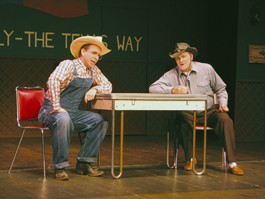
Greater Tuna, an outrageously goofball, darkly tinged satire set in the rustic burg of Tuna (the third smallest town in Texas), successfully manages to be two opposing things at once: smart as a whip and dumb as a post. Actually, that sounds like something that Tuna’s smut-fighting Rev. Spikes might say in one of his hilariously cliché-packed sermons. As in the scene in which Spikes improvises a eulogy crammed with words entirely devoid of meaning (“He was a fine, upstanding citizen who practiced what he preached, put his best foot forward and his money where his mouth is!”), Greater Tuna, and its three popular sequels, appeals to people with the taste and tolerance for extremely broad comedy, but has also won the loyalty of higher-brow folks who happen to have escaped from the kind of gleefully racist, homespun, semi-illiterate Southern town that Tuna is a simultaneous love letter to and savage skewering of.

The award-winning, 28-year-old, two-actor comedy, covering several days in the life of the denizens of Tuna, Texas, is the second Tuna play in six months to be presented by the Pacific Alliance Stage Company. Last December, PASCO delivered A Tuna Christmas, technically the second in the popular series by authors Jaston Williams, Joe Sears and Ed Howard. Once again, actors Stephen Klum and Michael Storm do brilliant work under the direction of artistic director Hector Correa. In a tradition that started with the first performances of Greater Tuna in Austin, Texas, in 1981 (with authors Williams and Sears the original performers), all 20-plus roles, male and female, are performed by two actors, requiring Zenlike concentration to keep all the characters distinct, and some rapid-fire costume changes, many of them taking less than 15 seconds.

Both Storm and Klum admirably tackle the challenges with inventive performances, incredibly detailed physicality and some truly ingenious voice work. Storm displays a talent for defining characters through a series of well-defined body languages, giving each one a peculiar limp, twist, hunch, stroll or strut. Storm’s characterization of Pearl Burras, an elderly woman addicted to killing the town’s dogs with poison; the imperious Bertha Bumiller, a leading member of the Smut Snatchers of the New Order; the aforementioned Rev. Spikes; and Thurston Wheelis, one of two unflappable talk-show hosts on Tuna’s decidedly rural OKKK radio station (“Beef is up, pork is down, chickens are vacillating”), are particularly strong.

Klum (known to regular PASCO audiences for his fine performances in Proof, Sylvia and others) does stunning work as well, showing a skill for falsetto-voiced children and women never hinted at in his other performances at Spreckels. Notable are Klum’s portrayals of overweight teenage poetess Charlene Bumiller, who dreams of becoming a cheerleader; adolescent Joey Bumiller, who loves dogs as much as Aunt Pearl hates them; soft-hearted Petey Fisk, whose efforts on behalf of the local SPCA include his frequent appearances on OKKK to sing the praises of the un-adoptable Yippee, a hyperactive Chihuahua; Arles Struvie, the other talk-show host on OKKK; and Stanley, a reform-school sociopath who is Aunt Pearl’s dog-killing accomplice and who may have been the not-so-accidental cause of a local judge’s untimely recent demise.

As Klum and Storm leap in and out of character, the shenanigans of Tuna’s small-minded townsfolk are certainly funny, but for all of the first-rate acting, there is something strangely uneven about this production. Perhaps it’s the leisurely pace determined by the director. This sort of entertainment is best served fast and furious, like a Mel Brooks spoof or one of those Airplane-type comedies.

When Greater Tuna is funny, the show is a certified side-splitter, and that is reason enough to recommend it. Unfortunately, there are a few too many moments when the satire just sits there, as the with the local radio station’s regular KKK reports, delivered by a benign Klansman who is so casual and upbeat about announcing upcoming Klan activities he could be describing the annual Rotary crab feed.

Brilliant? Sure. Funny? Not really. And yet, for a night of solid, off-beat amusement with big dose of strychnine, PASCO’s Greater Tuna is a whole lot better than OKKK.

‘Greater Tuna’ runs Thursday&–Sunday through May 17 at the Spreckels Performing Arts Center. Thursday at 7:30pm; Friday&–Saturday at 8pm; Sunday at 2:30pm. 5409 Snyder Lane, Rohnert Park. $17&–$24. 707.588.3400.


Museums and gallery notes.

Reviews of new book releases.

Reviews and previews of new plays, operas and symphony performances.

Reviews and previews of new dance performances and events.

News & Culture in The North Bay

05.06.09

JAILHOUSE BLUES

To Tom Mariani (Open Mic, “Words Fail,” April 22): Quit your whining. We spend way too much money on the prison system for all the “innocents” serving time. You’ve got two strikes by accident? Why spend more money on lifetime losers and less on the real innocents, the children? You did the crime, and you shall forever pay the time. Whether or not you get a job is your problem, not mine. If memory serves me right, we spent about $45,000 a year on you and maybe $5,000 a year on students. Don’t you think enough has been wasted on you?

Let’s just forget about this generation that screwed up and put the money into education. Get rid of the teacher’s union, hire only teachers who want to work and pay them more than the prison guards. If we spend more on educating children, we’ll spend less on “rehabbing” felons like you. Have you looked at the tuition for a junior college? Pretty cheap. But you, like most other “innocents” and falsely convicted felons, took the easy route. Too bad. I think you owe me $495,000 for the time you spent in jail. When I see that check, I’ll think about rehab in jail.

Thomas M. Harrigan
ROHNERT PARK

QUALITY OF LIFE

The crash of 312 South A Street’s artists and gallery (Blast, “End of A Street?,” April 1) was indeed a blow to the finer growth within Santa Rosa.

The hope is to return, reengage, continue where we left off. We certainly are capable of our individual pursuit, yet the beauty of our togetherness equaled more than the sum of our acts—it worked quantumfold! There was nothing like this unique group of artists to bring about beneficial social reshaping within our neck of civilization. In our time together, we spanned outward into the community in novel, healthy ways that will not be forgotten, and it continues ever outward.

I miss this group I was privileged to be part of. I grew from our shared endeavors. To have been a part of this history has been an honor. May we all continue to give and receive and never forget this time in our lives where we worked together and participated in creating the concept and practice of the amalgamation of talents.

With heartfelt warmth to my friends and hope that our ideas continue.

Max DuBois
SANTA ROSA

VINEYARD EMPLOYMENT

Your article “Grapes and Class Warfare” (April 29) seems a bit inaccurate. While the writer bemoans the injustice of the migrants and their average salary of $9 an hour working in the grape fields, the article seems to neglect the various taxpayer-funded social services available to these workers that are not available to the average working citizen.

In Napa County, there are special farmworker homes and special reduced-rate rents available. There are also low-cost health clinics that cater to the low-income, non-English-speaking population. Contrast this to a single mother who has been a U.S. citizen her entire life, working at a big-box retailer for the same pay, and the inequities begin to show.

We have record high unemployment in California. Maybe the incentive to hire illegal, under-the-table workers should be taken away?

Tobedawg
NAPA

I HOPE YOU ARE NOT IN HELL

Oh mother dear, I love you.
I love you for all you did,
guiding me through my youth,
telling me to always be true.
Forgiving me when I erred,
discussing life, with an open mind.
As well as allowing me to stumble
when I thought I knew what I didn’t.
Which in turn, taught me to be humble.
For it is not always what you know
but who you know really knows you.
I miss you. I wish you were here.
Wish you could have lived forever.
Seeing me as I aged, carrying on
living your positive words.
Words that have echoed in my head.
“If there is a will, there is a way.”
As I enter into the unknown, I have no fear
You taught me well, I hope you are not in hell!

S. Edward Matheson
SANTA ROSA


Saddening Symbiosis

0

05.06.09

As another spring takes hold and edges into the onset of summer, Bay Area chanterelle hunters have rarely been so let down. Due in part to the tardiness of the autumn rains as well as the bone-dry January, the harvest this year, especially in Marin County, was among the worst on record, according to veteran collectors.

But in some regions, low rainfall is the least of the problems affecting chanterelle output. If there is one thing Cantharellus californicus—only recently named as such—needs more than water, it’s oak trees, but the oaks are vanishing. The disappearance comes at the hands of humans as well as a microscopic pathogen, Phytophthora ramorum, which causes the infamous sudden oak death in three species of oaks and their relative, the tanoak.

Sudden oak death has hit Marin County particularly hard. David Campbell of San Rafael, who once sat as president of the Mycological Society of San Francisco, has hunted chanterelles every season in Marin for 25 years. In those decades he has isolated scores of favorite patches in which the mushrooms reliably fruit, but about five years ago Campbell first observed a lag in chanterelle production. About the same time, he began noticing sick trees on his regular mushroom hikes. Two to three years ago, he recalls, they appeared to be dying.

“I got zero,’ he says. “Virtually all my patches are now done.’

There is little hope of developing a cure for sudden oak death, according to Matteo Garbelotto, a UC Berkeley professor and specialist in forest pathology and mycology.

 “We’re looking at something that’s not going away,’ says Garbelotto. “The number of infected trees is so huge that we have almost no chance of stopping this.’

In California, the epidemic is most severe in western Marin and in the hills of the Big Sur coast, says Garbelotto, if only because the bacteria appeared in those regions first, but eventually all oak country may become infected. Or maybe not. A wide swath of oak country between central Napa County and Humboldt County has gone mysteriously uninfected, according to Janice Alexander, an outreach coordinator at the UC Davis extension office in Novato. She and other researchers have their eyes on the region, wondering if clues toward developing a treatment lie somewhere within. Meanwhile, a common foliar spray called Agri-Fos can fend off infection, but the manual application is only a preventative measure not a cure.

Commercial hunters made pocket change off the 2009 chanterelle crop. Connie Green, a Napa-based harvester of 30-plus years and the proprietor of Wine Forest Mushrooms, says that, although her favorite chanterelle patches are still uninfected by sudden oak death, this winter was the second worst in her memory. She reeled in only a quarter-ton, what is essentially a crop failure compared to her long-term seasonal average of 3,000 pounds. She attributes the meager harvest to the dry spring of 2008, the late fall rains and a rainless January.

But while drought conditions simply put mushroom appearance on hiatus, land development outright kills it, and in the past decade Green has watched roughly 200 acres of Northern California chanterelle country—including some trees as old as 400 years—go under to the progress of the wine industry. Other mushroom lovers also point the finger at the wine industry. Ken Litchfield, an organic farmer in the East Bay hills and a mushroom hobbyist and lecturer, feels that sudden oak death is an easy culprit at which to point the finger, but grapevines, he says, are far deadlier.

 “Bulldozing oak trees for subdivisions and vineyards,’ Litchfield quips, “now that is literal ‘sudden oak death.”

But Green has observed a recent deceleration in North Bay vineyard plantings, and, sure enough, according to data provided by the Wine Institute, growers in Marin, Sonoma and Napa counties planted over 1,300 acres of vines in 2006. Some almost certainly replaced oak groves, but in 2007 the conversion slowed; in the same region, just 400 new acres of wine grapes took root.

 “Our economy seems to be taking care of the development problem,’ Green notes.

As the blazing North Bay summer approaches, Green hopes for one last deluge of rain to dampen the soil and give the dormant chanterelles one final shot of juice to pull them through the dry season. Ironically, however, in regions affected by sudden oak death, rainfall in the warmer months like May is exactly what Phytophthora ramorum needs to spread outward to new hosts, experts say.

And for chanterelles in parts of Marin County, it seems they’re damned if it rains and damned if it don’t.


Quick dining snapshots by Bohemian staffers.

Winery news and reviews.

Food-related comings and goings, openings and closings, and other essays for those who love the kitchen and what it produces.

Recipes for food that you can actually make.

Hid Wit

0

04.29.09

Writers are among the most fragile creatures. A couple of weeks ago, I had lunch with a novelist friend who’s published numerous books. After a wide-ranging conversation, we returned to our favorite topic: our obscurity as writers.

We try to one-up each other with our post-publication misfortunes. That day my buddy thought he had the topper. He fixed his large, sad eyes on me. “My friends,” he said, “don’t even read my books. They may buy ’em, but they don’t read ’em.”

I didn’t blink. “Hey,” I said, with a measure of truth, “my friends don’t even buy my books.”

The poet and critic Randall Jarrell sang a similar song in a famous essay in the early ’50s. “When I was asked to talk about the Obscurity of the Modern Poet I was delighted, for I have suffered from this obscurity all my life,” he wrote. “But then I realized I was being asked to talk about . . . the difficulty, not the neglect, of contemporary poetry.”

It is this sense of neglect that makes the writer’s condition so comic or harrowing, depending on your point of view.

The trouble for me is that I started out as a star. Sort of. I won the San Francisco Public Library’s High School Poetry Award as a senior. It’s all been downhill since.

My early taste of fame came at a price. I woke the morning after the award ceremony to my mother screaming at me. She showed me my photo in the Chronicle with the winners from the other grades. Then she pointed to my poem, italicized in the body of the story.

I had no idea that the Chronicle was going to print a poem, let alone one I’d addressed to my mother.

Judgment

I don’t mind
that you spend your days
baking bourbon balls,
but when you slam
the refrigerator door,
barely missing the fingers
of my friend Wayne,
who’s thirsty and pours
himself a glass of milk,
you’ve gone too far.

The other day, I drove into the city to attend the 28th Annual Northern California Book Awards at the main library, a block from the library of my high school glory. I was particularly interested in the ceremony. I’d been a longtime board member of the National Book Critics Circle and regularly participated in their awards ceremony in New York. I’ve also been a finalist for a few regional awards and know the importance of these ceremonies to writers as, in most cases, their books are about to fade away. Unfortunately, it’s easy for nominated writers to delude themselves with the belief that their obscurity’s about to end.

It was great to see a large standing-room crowd, but the ceremony itself was a clunky affair. The nominees were invited, one category at a time, onto the stage while the host, NCBA board member Mark Singer, fumbled with names and publishers and was at a loss to say anything about a few of the nominated books.

His most grievous error was to read long emails, meant to be award acceptance speeches, from nominees who weren’t able to attend. The trouble was that these weren’t the writers who won the awards. It was bizarre when Singer presented Michael Pollan’s five-minute acceptance speech as if it were a literary gem, while the other finalists, and eventual winners, stood awkwardly through Singer’s oration.

It also seemed odd to have the winners read from their work right after their award had been announced, without proper introduction, like runners forced to make flat-footed starts.

I prefer the National Book Critics Circle model. Finalists participate in a reading the night before the ceremony and the winners get a well-crafted introduction from the chair of each committee.

In Minnesota, where I lived for years, finalists give a month of readings preceding the award ceremony at public libraries throughout Minneapolis and St. Paul. That creates a climate of excitement among the literati and the nominated writers get their due.

The one shining moment was when novelist and playwright Dorothy Bryant received the Fred Cody Lifetime Achievement Award. After a fine introduction by poet and novelist Mary Mackey, Bryant graciously accepted the award for all writers. She then read a chapter, “Writing the First Draft,” from her much admired method book, Writing the Novel, reminding us that the joy of creation is in these early imaginative markings, before editors and critics and outward concerns invade our psyches and make us confront obscurity.

Novelist Bart Schneider was the founding editor of ‘Hungry Mind Review’ and ‘Speakeasy Magazine.’ His latest novel is ‘The Man in the Blizzard.’ Lit Life is a biweekly feature. You can contact Bart at [ mailto:li*****@******an.com” data-original-string=”nI3xPbnmoDgKKx3UOvnShQ==06aqTg4Nb/7ZAQn+JwuPW6EjNSV8f9MjYiaEjBZ6js5f7KVAEmWB468WhYVE3XfPbqq9Opd3UQIqrD2rXQh1U1bUVX4w2bXaFu4MWfOghMCZQLXUXkkrNODM9AOODoWaoCQwGdr0VH6pTpApKV/tCD4sAImeWtsLIBCXCBhDuZBwO+eKo7El9SueyK24GNBdCM3AlGuf/bEIbmjVT4a7cvvBZR0LVG4yuyHVAkx01VkXlC6quX9pu1jatfqTOs7hCiPETdPzw5tEEx8y5IDauh01IYCzRZHGtXdKmhEHLvY0no=” title=”This contact has been encoded by Anti-Spam by CleanTalk. Click to decode. To finish the decoding make sure that JavaScript is enabled in your browser.

Museums and gallery notes.

Reviews of new book releases.

Reviews and previews of new plays, operas and symphony performances.

Reviews and previews of new dance performances and events.

Late-Night Dining

0

05.06.09

This is a reprise of our Sept. 3, 2008, roundup of local restaurants open later than 10pm providing something for all budgets, from coffee shops to fine-dining establishments. Many stay open later on Fridays and Saturdays, but only offer an abbreviated menu.

Sonoma County

Adel’s Restaurant Coffee shop. $. Breakfast served all day. Open daily until midnight. 456 College Ave., Santa Rosa. 707.578.1003.

Barndiva California. $$–$$$. Slow Food. Open Sunday, Wednesday–Thursday, until 11pm; Friday–Saturday, 11:30pm. 231 Center St., Healdsburg. 707.431.0100.

Black Bear Diner $. Full menu, two locations. Open Sunday–Thursday until 10pm; Friday–Saturday, midnight. 6255 Commerce Blvd., Rohnert Park. 707.584.8552. Same hours except Friday–Saturday, 11pm. 201 W. Napa St., Sonoma. 707.935.6800.

CoCo’s American. $. Coffee shop. Open Sunday–Thursday until 11pm; Friday–Saturday, midnight. 1501 Farmer’s Lane, Santa Rosa. 707.5452626.

Flavor California. $–$$. Fresh and organic. Open Monday–Thursday until 10pm; Friday–Saturday, 11pm. 96 Old Courthouse Square, Santa Rosa. 707.573.9695.

Hikuni Sushi Bar & Hibachi Japanese. $$$. Chefs grill at table. Daily until 10:30pm. 4100 Montgomery Drive, Santa Rosa. 707.539.9188.

Hopmonk Tavern Pub. $$. Upscale pub. Dinner daily until 9:30pm; bar menu, Thursday–Saturday, midnight. 230 Petaluma Ave., Sebastopol. 707.829.7300.

Humble Pie California. $$. Made from scratch at the Black Cat Bar. Open Wednesday–Sunday until midnight; Friday–Saturday, 2am. 10045 Main St., Penngrove, 707.664.8779.

La Hacienda Mexican. $$. Family-style Michoacán. Open until 10pm daily. 134 N. Cloverdale Blvd., Cloverdale. 707.894.9365.

Mary’s Pizza Shack Italian. $–$$. Local pizza chain. All locations open Sunday–Thursday until 10:30pm; Friday–Saturday, 11pm. Those with full bars open until midnight. www.maryspizza.com.

McNear’s Sports bar. $–$$. Big appetizers, burgers. Open daily; bar menu to midnight. 21 Petaluma Blvd. N., Petaluma. 707.765.2121.

Odyssey Restaurant California-Mediterranean. $$$–$$$$. Fine dining. Open Tuesday–Thursday until 10pm; Friday–Saturday, 11pm. 426 Emily Rose Circle, Windsor. 707.836.7600.

Risibisi Italian. $$–$$$. Upscale and urbane. Open Sunday-Thursday until 9:30pm; Friday–Saturday, 10:30pm. 154 Petaluma Blvd. N., Petaluma. 707.766.7600.

Russian River Brewing Co. Brewpub. $$. Pizza and brews. Open Monday–Thursday until 11:15pm; Friday–Saturday, 12:15am. 725 Fourth St., Santa Rosa. 707.545.2337.

Semolina Italian. $$–$$$. Old favorites. Open Sunday–Thursday until 10pm; Friday–Saturday, 11pm. 600 E. Washington St., Petaluma. 707.766.6975.

Star Restaurant Diner. $. Huge menu. Extra cops. Open daily until midnight. 8501 Gravenstein Hwy., Cotati. 707.795.8836.

Starlight Wine Bar Naw’lins. $$. New Orleans flair in a former train caboose. Open Tuesday–Thursday until 10pm; Friday–Saturday, 11pm. 6761 Sebastopol Ave., Sebastopol. 707.823.1943.

The Girl & the Fig Bistro. $$$. Country French. Open for dinner daily until 10pm; short menu Friday–Saturday, 11pm. 110 W. Spain St., Sonoma. 707.938.3634.

Underwood Bar & Bistro Bistro. $$. Classy bistro menu. Open Sunday–Thursday until 10pm; bar menu, Friday–Saturday, 11pm. 9113 Graton Road, Graton. 707.823.7023.

Marin County

Benissimo Ristorante & Bar Italian. $$. Neighborhood-style Italian restaurant. Open Sun.–Thurs. until 10pm; Friday–Saturday, 11pm. 18 Tamalpais Drive, Corte Madera. 415.927.2316.

Buckeye Roadhouse American. $$–$$$. Stellar. Sun. until 10pm; Monday–Thursday, 10:30pm; Friday–Saturday, 11pm. 15 Shoreline Hwy., Mill Valley. 415.331.2600.

Left Bank French. $$–$$$. Authentic French cuisine. Open Sunday–Monday until 10pm; Tuesday–Saturday, 11pm. 507 Magnolia Ave., Larkspur. 415.927.3331.

Marin Brewing Co. Pub. $–$$. Excellent pub grub. Open daily until 11:45pm. 1809 Larkspur Landing Circle, Larkspur. 415.461.4677.

Piatti Italian. $$–$$$. Seasonal Italian. Open Sunday–Thursday until 10pm; Friday–Saturday, 11pm. 625 Redwood Hwy., Mill Valley. 415.380.2525.

Poggio Italian. $$–$$$. Authentic Italian. Open Sunday–Thursday until 10pm; Friday–Saturday, 11pm. 777 Bridgeway, Sausalito. 415.332.7771.

Sushi Ran Japanese. $$$$. Fresh catches. Open Sun. until 10:30pm; Monday–Saturday, 11pm. 107 Caledonia St., Sausalito. 415.332.3620.

Yet Wah Chinese. $$. Yum. Open Monday until 10pm; Tuesday–Sunday, midnight. 1238 Fourth St., San Rafael. 415.460.9883.

Napa County

Bistro Jeanty French. $$$. Rich, homey cuisine. Open daily until 10:30pm. 6510 Washington St., Yountville. 707.944.0103.

Bouchon French. $$$. French classics. Open daily until 10:30pm; short menu to 12:30am. 6540 Washington St., Yountville. 707.944.8037.

Brannan’s Grill California. $$–$$$. Creative cuisine. Open Sunday–Thursday until 10pm; Friday–Saturday, 10:30pm. 1347 Lincoln Ave., Calistoga. 707.942.2233.

C.C. Blue Japanese. $$–$$$. Sushi. Open Tuesday–Sunday until 10pm; Thursday–Saturday, 11pm–2am. 1148 Main St., St. Helena. 707.967.9100.

Hydro Bar & Grill Grill. $$. Live music on weekends. Sunday–Thursday until 10pm; Friday–Saturday, 11pm. 1403 Lincoln Ave., Calistoga. 707.942.9777.

Zuzu Tapas. $$. Food of the Americas. Open Monday–Thursday until 10pm; Friday–Saturday, 11pm. 829 Main St., Napa. 707.224.8555.


More Summertime Madness

0

05.06.09

Music bookings just keep pouring in these days, and the Napa Valley Opera House’s just-announced season is full of legends who rarely play such small venues. The intimate theater hosts the Wallflowers (June 18), Joan Baez (July 6), Sarah Chang (July 18), Bruce Hornsby (Aug. 15) and a double dose of New Orleans with the Neville Brothers and Dr. John together (above, Sept. 7). The Opera House’s annual fundraising gala, a full-blown affair with tickets starting at $350, features the biggest booking score of them all: Pink Martini, direct from Carnegie Hall (Oct. 3).

The Opera House also sponsors Motown legend Smokey Robinson at Robert Mondavi Winery, in a series across the valley that marks the 40th anniversary season of the Mondavi’s Summer Festival Concert series. Debuting in 1969 with a ticket price of $3, the festival has since included such greats as Ella Fitzgerald, Tony Bennett, Buena Vista Social Club, Benny Goodman, Sarah Vaughn, Lena Horne, Stan Getz and many, many more. This year, it’s Robinson (Aug.1), a 4th of July celebration with the Preservation Hall Jazz Band (July 4), Natalie Cole (July 18), Ozomatli (July 11), the indefatigable B-52’s (June 27) and KC & the Sunshine Band (July 25).

The Wells Fargo Center continues its hot streak with a stellar season including Tears for Fears (July 14), Madeleine Peyroux (Aug. 5), Huey Lewis and the News (Aug. 13), Elvis Costello (Aug. 21), Diana Krall (Aug. 25), Sheryl Crow (Sept. 1) and, in a rare onstage conversation sponsored by Copperfield’s Books, Broadway legend Stephen Sondheim (Oct. 24). Coming in 2010: Anthony Bourdain (Jan. 13) and Dave Brubeck (March 24).

Up in Healdsburg, the Rodney Strong Vineyards Concert Series tips the smooth jazz scales with Peter White and Mindi Abair (June 27), the Rippingtons and Craig Chaquico (July 11), and Euge Groove, Jeff Golub, Jeff Lorber and Jessy J (Aug. 8). Blues torcher Susan Tedeschi stops in with JJ Grey & Mofro (Aug. 22), and the whole series wallops to a rock ‘n’ soul finale with AM hit makers Hall and Oates (Sept. 7).

The Sausalito Art Festival, an annual event of art and music since 1952, celebrates the 40th anniversary of Woodstock with “The Heroes of Woodstock 40th Anniversary Tribute” (Sept. 6). Among the love-in rockers resurrecting the old spirit are Jefferson Starship, Canned Heat, Big Brother and the Holding Co., Quicksilver Messenger Service and Tom Constanten. The whole thing’s hosted by Country Joe McDonald, who’ll no doubt reprise his famous “fish” cheer. Other highlights at the festival include Night Ranger (Sept. 5) and Johnny Winter (Sept. 6).

Just north of Sausalito, the Novato Art and Music Festival turns Grant Avenue into a city-wide block party with wine, art booths, craft areas and a kids’ zone. Among the bands playing are the Unauthorized Rolling Stones, the Edgeand Tommy Castro (June 13), and Tom Rigney and Flambeau, Shana Morrison, Poor Man’s Whiskey and Wonderbread 5 (June 14).


Takin’ It Back

0

05.06.09

CHUB LOVE: Being a mother needn’t mean just giving up on looking good.

Nothing takes a young, hip girl out of her low-rise jeans and into her tired sweatpants faster than the advent of motherhood. At no time in a woman’s life is it less easy to stay fashionable than when the baby’s been wailing into the wee hours, your 10-month-old is throwing peas, and the breast-milk police are insisting that you can’t even have a decent glass of wine to drown your stress. Yep, definitely not a super-stylish time.

In midfashion crisis, it’s wise to get advice from an impartial party (say, someone who doesn’t have Cheerio dust in her hair and bottles of formula in her purse). Enter none other than Ru Scott, owner of Punch in Santa Rosa. Scott has been bringing fashion to the people for 12 years, and as the head honcho of a thriving retail business, definitely knows about keeping it stylish under a time crunch. Here are a few gems of wisdom that just might get you to throw your husband’s T-shirts back into his drawer and move into the wonderful world of sexy momma.

“Get a babysitter!” Scott admonishes. “Take one hour of the day, and make an appointment with a personal shopper.” Boutiques like Punch offer personal shoppers, meaning that you will get the benefit of a trained eye who knows which clothing will look good with your body type. Personal shoppers will gently guide you into the understanding that just because those jeans looked good on Rihanna in People magazine doesn’t always mean they will be a knockout on you. But some other pair definitely will be perfect for you, and the personal shopper makes it her mission to find them. “People are afraid to ask for help,” Scott says, “but that’s the point of a boutique, that one-on-one service.”

OK, but what about the mom who prefers to go the independent route and shop privately? Scott has tips for the five basic items that every woman needs in her clothing repertoire. The first is no surprise: jeans. Everyone loves jeans. Dressy jeans, casual jeans, ripped jeans—but no one should love the dreaded “mom jeans.” You can be a mom without the ‘mom jeans,'” Scott says. (The dreaded “mom jeans” usually consist of an extraordinarily high waist and tapered legs, accompanied with socks and an unflattering pair of Keds. This simply will not do for the fashion-conscious mom, and designer jeans are here to save the denim day.)

According to Scott, baggy jeans deemed “boyfriend jeans” are raging into style now made popular by such fashionistas as Katie Holmes. Boyfriend jeans are perfect for the new mom with baby weight still hanging on for dear life. If boyfriend jeans aren’t your thing, there are other styles of jeans casual enough for daily wear that still have the necessary touch of style to keep you current.

Must-have no. 2: the maxi-dress. Think long, flowing bohemian dress with an interesting print. Not all maxi-dresses need to be tentlike. Many are fitted snugly on top and through the middle, giving a flirty feminine look that can be dressed up or down depending on shoes and accessories. Throw on some ballet flats and a dainty necklace, and you’ve got the perfect outfit for a play date with friends. Cowboy boots lend the maxi-dress a trendier air and flip flops give a “straight-from-the-beach-sexy” look.

No. 3: tank-tops. Every mom who calls California home needs a steady stack of well-fitting tank-tops at hand. A nice quality tank-top can be a layering tool worn under a long-sleeved T-shirt or camisole, or can be worn alone with pants or a skirt.

No. 4: flowy shirts. Very versatile, very flattering, very comfortable, which really is all you can ask from a piece of clothing. Flowy shirts have made many a preggo sigh with delight, not to mention the postpartum moms who are a little curvier than expected.

No. 5: cute flats. Flats can be worn with practically anything. Jeans, shorts, dresses, skirts, you name it and an adorable pair of flats in a bright color will make it just that much better.

Not all moms can afford the “must-have” items. Some women find it a personal accomplishment to throw a couple of T-shirts into their cart while at Target buying baby wipes. Some scoff on principal at paying designer prices at trendy boutiques.

For these moms, good news is here. The economy, though crappy in a lot of ways, brings with it the little unexpected treat of lower clothing prices. According to Scott, many stores are offering large discounts on merchandise, and designers are actually lowering the original price of clothing to fall more in line with what people are willing to pay. “We have a whole line of price-conscious jeans,” Scott says. “[You can get jeans at] practically Gap prices, but still wear designer brands.”

Some moms have the funds but are lacking the fashion inspiration. Scott encourages moms to stay tuned into fashion, and believes that when you do, the inspiration will come. Paying attention to fashionable women with eye-catching style is a great place to start. Deconstruct their clothing to figure out what you like about it and how you can emulate it. At your favorite coffee shop, at a restaurant, in magazines, on television, these are all places to get ideas.

“Some women get into ruts or they’re afraid to try new things,” Scott says. “You can dress conservatively and practically and still be current and in style.” Sometimes a well-fitting tee, jeans and a sweet little pair of flats can be just the thing.


Spiritual Shopping?

05.06.09

Shopping is a religious experience in the United States. In fact, it may be the biggest drink-the-Kool-Aid church of them all. Sadly, it ignores the parable attributed to Jesus of Nazareth, the one about the Pearl of Great Price, which is something inside you that you cannot buy at a mall. But let’s not get preachy. We all have to go to the store now and then.

Commercial enterprise is a helpful thing; it just happens I am someone who despises corporate greediness and also hates to shop in multi-acre stores offering styrofoam-packed stuff made with exploited labor in China and bearing environmental footprints bigger than San Bernardino and New Jersey combined. Give me instead a farmers market and a few little mom-and-pop places where there seems to be some real personality and environmental thinking expressed. This is why I am so happy to know that like-minded people across the country are organizing commerce groups that strengthen communities and weaken bad-boy corporations—they are intentionally going local.

In Sonoma County, the hub of this movement is a nonprofit group unambiguously called the Sonoma County Go Local Cooperative (http:-/sonomacounty.golocal.coop). It works as an empowering organization for county residents and for businesses that are at least 51 percent locally owned. This means that bullies can’t join. For example, you will not find among the membership any of the following, recently blacklisted by Green America: Wal-Mart, ExxonMobil, Coca-Cola, Nestle, Monsanto, General Motors, Dominion, Citigroup, Shell Petroleum or McDonald’s.

Instead, Go Local has a membership that includes the likes of Redwood Hill Farm, the Post Carbon Institute, Zazu Restaurant and Farm, Village Art Supply and a host of other reasonably sized, mostly locally owned enterprises, most of which have some claim to sustainability. What jumped off the list for me was the Sonoma County Meat Buying Club, a cooperative within a cooperative that will no doubt get a huge boost in membership if this swine flu epidemic is in fact linked to the unsanitary conditions of hog farms that supply meat to chain stores. But this is what going local is all about—knowing where your food comes from and getting services from people who live in your community and want to keep it a nice place.

I was a co-op member in Arcata, before food co-ops in the Bay Area were abandoned in favor of gourmet grocery stores. I perceived it to be a kind of social unraveling, which went along with the Reagan years. And so it was. But in these times the fabric is being mended. I’m encouraged—prompted perhaps by this economic down-spiral—that people are beginning to see all the benefits of boosting togetherness.

“Since cooperatives are organized for the benefit of their members rather than to earn profits for investors,” says the Go Local purpose statement, “they tend to take a longer term view with respect to their operations. That is not to say that cooperatives don’t look at the bottom line, but rather that they have additional objectives that focus more on the long-term survival of the business and their members.”

There’s a kind of folksy sweetness to the pledge that coop members are encouraged to make when they join Go Local: “I pledge to become more aware of my impact and contribution to the community, economy and environment. I understand the importance of supporting our independent, locally owned businesses and will ‘think local first’ when making daily purchasing decisions.”

Presently, about 800 million people in 85 countries are served by cooperatives, nongovernment groups presently focusing on recovering from economic crisis around the globe. The localization movement is not only good for business; it’s good for community spirit. And maybe it’s good for the soul as well. Because when you go local and shop responsibly, you also care for your own community, and you chip away at the corporate superpowers whose unsustainable business practices result in making life so miserable for so many people. Sure, you get stuff, but you also get a better glimpse of the Pearl of Great Price, which is really not for sale.


Big-Box Health

05.06.09I know I am not alone. I know that many of you are just like me: you work hard at a job you love for a paycheck you don't. Still, I have learned to live on my meager compensation, am even grateful for the opportunity to be not trendily but necessarily frugal. True, I haven't had health insurance since...

Raw Fish

05.06.09Greater Tuna, an outrageously goofball, darkly tinged satire set in the rustic burg of Tuna (the third smallest town in Texas), successfully manages to be two opposing things at once: smart as a whip and dumb as a post. Actually, that sounds like something that Tuna's smut-fighting Rev. Spikes might say in one of his hilariously cliché-packed sermons. As...

News & Culture in The North Bay

05.06.09JAILHOUSE BLUESTo Tom Mariani (Open Mic, "Words Fail," April 22): Quit your whining. We spend way too much money on the prison system for all the "innocents" serving time. You've got two strikes by accident? Why spend more money on lifetime losers and less on the real innocents, the children? You did the crime, and you shall forever pay...

Saddening Symbiosis

05.06.09As another spring takes hold and edges into the onset of summer, Bay Area chanterelle hunters have rarely been so let down. Due in part to the tardiness of the autumn rains as well as the bone-dry January, the harvest this year, especially in Marin County, was among the worst on record, according to veteran collectors. But in some...

Hid Wit

04.29.09 Writers are among the most fragile creatures. A couple of weeks ago, I had lunch with a novelist friend who's published numerous books. After a wide-ranging conversation, we returned to our favorite topic: our obscurity as writers. We try to one-up each other with our post-publication misfortunes. That day my buddy thought he had the topper. He fixed his large,...

Late-Night Dining

05.06.09This is a reprise of our Sept. 3, 2008, roundup of local restaurants open later than 10pm providing something for all budgets, from coffee shops to fine-dining establishments. Many stay open later on Fridays and Saturdays, but only offer an abbreviated menu.Sonoma County Adel's Restaurant Coffee shop. $. Breakfast served all day. Open daily until midnight. 456 College...

More Summertime Madness

05.06.09Music bookings just keep pouring in these days, and the Napa Valley Opera House's just-announced season is full of legends who rarely play such small venues. The intimate theater hosts the Wallflowers (June 18), Joan Baez (July 6), Sarah Chang (July 18), Bruce Hornsby (Aug. 15) and a double dose of New Orleans with the Neville Brothers...

Takin’ It Back

05.06.09 CHUB LOVE: Being a mother needn't mean just giving up on looking good. Nothing takes a young, hip girl out of her low-rise jeans and into her tired sweatpants faster than the advent of motherhood. At no time in a woman's life is it less easy to stay fashionable than when the baby's been wailing into the wee hours,...

Spiritual Shopping?

05.06.09Shopping is a religious experience in the United States. In fact, it may be the biggest drink-the-Kool-Aid church of them all. Sadly, it ignores the parable attributed to Jesus of Nazareth, the one about the Pearl of Great Price, which is something inside you that you cannot buy at a mall. But let's not get preachy. We all have...
11,084FansLike
4,446FollowersFollow
6,928FollowersFollow