
08.26.09
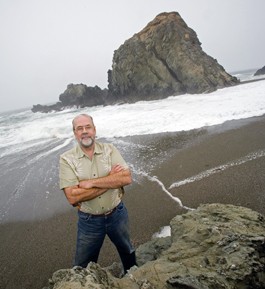
DEFENDER OF WILDLIFE: Richard Charter feels that the MLPA serves both the natural world and those who rely upon it.
Environmentalists are applauding the implementation of the Marine Life Protection Act on the local coastline as a victory for conservationists, for the oceans and for coastal communities. But some North Coasters are calling the North Central Coast MLPA a land-grabbing scheme that was steered by illegitimate politics and private money lending.
The MLPA was first passed in 1999 by former governor Gray Davis and, advancing slowly ever since, was finally realized on Aug. 5 when the California Fish and Game Commission voted to establish a network of marine reserves between Pigeon Point, 50 miles south of San Francisco, and Point Arena in Mendocino County in which harvest of marine life will be partially or entirely prohibited.
These off-limits swaths of sea are intended to promote recovery of damaged ecosystems and to produce outward dispersal of marine life. Conservationists assure that fisheries, ecotourism businesses and coastal economies will ultimately thrive. But many North Coast locals are pissed.
The MLPA will entirely restrict fishermen and other consumptive users from roughly 10 percent of state waters in the “North Central Coast” region (the MLPA slices the California coast into several regions). Some of these no-go zones are traditional favorites of recreational, commercial and subsistence fishermen, while some of the regions left open consist largely of barren sand habitat or are made inaccessible by cliffs or are a long boat ride from port.
John and Barbara Lewallen, operators of the Mendocino Sea Vegetable Company in Philo, claim that their own concerns for preserving access to favorite kelp-collecting spots were disregarded by the Fish and Game Commission and by groups that supported the MLPA process. John Lewallen has harvested sea palms and other kelp at Sea Lion Rock for almost 30 years. The closures, which may take effect in February 2010, will cut 40 percent of his income, he says.
But Richard Charter with Defenders of Wildlife insists the deal represents a fair compromise. Point Arena wound up with the closures it did because locals influenced the negotiations.
“There were studiously negotiated, scientifically based compromises in the [closures], and it was based on the full consensus of the people who participated at the table in this process,” Charter says. “We came to Point Arena to negotiate, and this is what they agreed upon.”
Not so, says Point Arena resident and ex–commercial fisherman Craig Bell. “In the beginning, I supported the concept of marine protected areas,” says Bell, “but then they just steamrolled this thing right into the best fishing areas on the North Coast. All our input went nowhere. They could have taken reefs five or six miles north of us for their reserves, but that wasn’t good enough. They left those open and took the reef just one mile north.”
While mainstream media gave substantial coverage to the MLPA proceedings in the days before and after the vote was cast three weeks ago at a public meeting in Woodland, few reporters explained that, by the end of the North Central Coast phase, there were two proposals on the table.
Each included the marine protected areas required by the 1999 initiative, and each called for a ban on all fishing and kelp collecting in roughly 10 percent of the region’s waters. But one of the most substantial differences between the two alternatives was how each would respectively have impacted the financial livelihoods of North Coasters who subsist or otherwise depend on marine resources.
Swing Vote Mystery
Bell, the Lewallens and many others who live along the Sonoma and Mendocino coast supported proposal 2XA, which was ultimately rejected by the five-person California Fish and Game Commission. 2XA placed no-fishing zones in areas less crucial to the livelihoods of locals, say residents of Stewarts Point and Point Arena. The other proposal was the Integrated Preferred Alternative, or the IPA, supported in large part by the National Resources Defense Council, the Ocean Conservancy, Defenders of Wildlife and many other nonprofit conservation groups. The IPA passed into law despite an outpouring of pleas from the people it would impact.
“There’s a difference between being part of a process and being processed,” says Bell, who calls himself an environmentalist and has volunteered with Sierra Club, Earth First and the Salmonid Restoration Federation. “They can say it was a public process, that everyone had input, that it was all fair, that they listened to both sides before choosing how to proceed, but they didn’t, and now that’s how we feel—like we’ve been processed.”
Charter assures that the MLPA was “the most transparent process in the history of the state,” but murky waters created indisputable confusion in the latter days of the MLPA proceedings. Yet not even a week before the final meeting and the vote, heads spun when Fish and Game Commission president Cindy Gustafson abruptly resigned from the five-person panel on which she had been sitting since June 2005. Gustafson had appeared to be shaping up as a sympathetic party to the fishing communities of the Sonoma and Mendocino coasts—especially to the Lewallens and to recreational abalone divers.
“She was the swing vote, and why she resigned four days before is a mystery,” says John Lewallen.
Bell has his suspicions. “I think there might have been concern that she would waffle and vote for 2XA,” he says. “It’s very possible that she received a phone call from someone in Sacramento encouraging her to step down. The timing of it is just so suspicious.”
Gustafson, in fact, wrote in a July 31 letter to the governor explaining that she was resigning out of concerns that an issue of “incompatibility” might arrive in the future between her position with the Fish and Game Commission and her job as general manager of the Tahoe City Public Utility District. But her job in Tahoe City was not a new one. She received her last promotion 17 months ago, in March 2008. In her resignation letter Gustafson wrote, “While no past, present or currently foreseen issues have presented any concern whatsoever, there is a hypothetical possibility that a future issue may arise.”
In fact, Gustafson told the Bohemian that she has little idea how an issue of incompatibility might have occurred between a community on Lake Tahoe and communities on the North Central Coast, but the very possibility required her to step down.
“It certainly wasn’t my choice,” she says.
“I certainly didn’t want to leave.”
With Gustafson gone, the governor appointed Donald Benninghoven to replace her the very day before the meeting. Benninghoven served last year on the Blue Ribbon Task Force. In doing so, he participated in drafting the IPA. In June 2008, Benninghoven, as a task force member, recommended the IPA to the Fish and Game Commission for approval. Then he joined the commission.
“It was the sleaziest thing I’ve ever seen in 20 years of attending Fish and Game Commission meetings,” Bell says. “Here he is, the chairman of the Blue Ribbon Task Force now sitting on the Fish and Game Commission. How could he possibly have voted for anything other than the IPA that he recommended?”
Gualala abalone diver Jack Likins also thinks Benninghoven may have been appointed to assure a win for the IPA.
“As soon as [Gustafson] resigned and they appointed Benninghoven, I knew the IPA was going to win. I know him personally, and he was on the Blue Ribbon Task Force, for God’s sake. What else was the guy going to vote for but the proposal he helped make?”
Benninghoven would ultimately cast his vote to implement the IPA, as would commissioners Richard Rogers and Michael Sutton, and by a 3-to-2 majority, the IPA passed into law.
The Sea Ranch Element
Game wardens say they aren’t even sure they can handle the job of protecting the new reserves of the Marine Life Protection Act. Todd Tognazzini, a Department of Fish and Game warden who testified during the final meeting, is president of the California Fish and Game Wardens Association. He says that MLPA reserves on the Central Coast, established in 2007, are already failing to properly do their job. Illegal fishing occurs on a weekly basis, he guesses, and Tognazzini feels that placing more marine protected areas should be put on hold until California lifts furloughs from the state’s 200 wardens.
While many private groups have promised to assist with enforcement, Tognazzini says that in the two years since the Central Coast’s new marine reserves took effect he has seen little to no assistance. The Gulf of the Farallones National Marine Sanctuary, for one, has made promises to help with placing demarcation buoys along the reserves’ boundaries and with aerial patrols, but their promises have fallen short of reality.
“These reserves are depending on voluntary compliance, but without visible boundaries that’s not even possible,” says Tognazzini.
Law enforcement duties for the MLPA will fall especially heavily on the wardens north of Salt Point, where the IPA places reserves in disproportionate density. On average, the MLPA affects 20 percent of state waters, but between Salt Point and Point Arena more than 30 percent of the sea will be included in full or partial reserves. One of these, the newly created six-mile-long no-fishing zone at the north end of Salt Point State Park, will bar the Kashia tribe of indigenous people from traditional gathering zones, says tribal member Lester Pinola, who lives among a hundred other Kashia in Stewarts Point and regularly collects abalone and kelp in waters that will soon become part of the Stewarts Point State Marine Reserve. Though the waters off the Sea Ranch coast will remain open for harvest, this is an empty gesture to the Kashia.
“That doesn’t do us a damn bit of good,” Pinola says. “We can’t go to Sea Ranch at all. It’s a rich community of retired people and vacationers, and they don’t want no Indians on their land. Unless you own a house there or have permission to be there, they’ll call the police on you for trespassing or have your car booted.”
Likins, who says he lobbied for the IPA largely because it left open the southern end of Sea Ranch, where he owns property and dives regularly, assures that Sea Ranch offers “excellent public access” through six parking lots along nine miles of highway, plus a coastal foot trail along the property’s north end. Well-known among divers for his accomplishments in collecting trophy-sized abalone, Likins wrote letters to the state asking that the Sea Ranch coast be left open as a matter of preserving a public resource.
But Sean White says Likins had personal motives. “Jack Likins only cared about Sea Ranch because he has a place there and dives there,” alleges White, a diver and kayak fisherman from Ukiah who prefers to dive the north end of Salt Point State Park, now slated to be closed. “He’s a famous diver who gets big abs in Sea Ranch, and the conservationists brought him onboard to make it look like they had support from the diving community, but [Likins] wasn’t concerned about other divers or public access. Public access at Sea Ranch sucks.”
The Sea Ranch access consists of undersized parking spaces, long treks to the coast and a notoriously high risk of receiving a sheriff’s citation for trespassing, White says. “They call the sheriff on you constantly if you dive there, just to make life miserable so you don’t want to go,” he alleges. “To say there’s public access [at Sea Ranch] is bullshit, but they knew it, and by leaving open the crappy access at Sea Ranch and closing the public access at Salt Point, they got twice the bang for their buck.”
Pinola says that nobody told Kashia representatives about the MLPA and its two alternative proposals, and it wasn’t until May 2009 that Pinola learned through a friend that the IPA’s harvesting bans would close traditional collecting sites south of Sea Ranch. The Lewallens also did not learn until late in the game of the MLPA’s approach, though they claim that Defenders of Wildlife and NRDC knew very well a cottage-sized kelp industry operated near Point Arena.
Beginning in October 2008, the Lewallens began attending meetings and voicing their concerns and suggesting alternative boundaries for proposed reserves, but the lines on the maps had already been drawn. Those already engaged in the process were reluctant to rewrite anything—except ex-commissioner Gustafson—and the powers that be seemed poised against the Lewallens. For Point Arena’s Bell, that was the tipping point.
“That’s what set the local environmentalists off. We said, ‘Who are these outside environmentalists to come in here and tell us where we can go and what we can do?’ Why in the world can’t a person pick seaweed? The Lewallens are two of the most respected environmentalists on the coast. They fought offshore oil. They’re hardcore, frontline environmentalists, and the MLPA shut them down in the name of conservation.”
Gustafson tells the Bohemian that she was ready to support a motion that would have left the Lewallens and abalone divers with free access to their favorite harvest zones, and she acknowledged that her mind was not made up as the meeting neared. She was, she says, the swing vote.
“We knew it was probably going to be a 3-to-2 vote, and I was going to be a deciding factor. One of the concerns I had was causing an effort shift of abalone diving pressure, and whether that would then affect other areas of abalone, maybe cause them to suffer and even have to be closed.”
Abalone divers share her concern. They worry that closing productive abalone holes will put increased pressure on the remaining zones where harvest is legal. Some divers are even afraid they could lose their fishery entirely. Adam Wagschal, director of conservation for the Humboldt Bay Harbor, Recreation and Conservation District in Arcata, is a recreational abalone diver. Like others in small North Coast communities where the local phase of the MLPA is now beginning, Wagschal has been cautiously watching the MLPA proceedings just to the south.
“I’m familiar with that stretch of coastline, and I’m concerned with how the closures might concentrate resource extraction into smaller areas, especially with the abalone fishery. We need to be really clear about what we’re doing here before we do it.”
Likins expects to see a significant effort shift of abalone divers who, barred from parts of Salt Point State Park, will now dive at Fort Ross State Historic Park to the south, already very heavily picked, perhaps even to the threshold of sustainability. Lance Morgan, scientist with the Marine Conservation and Biology Institute, also believes an effort shift in abalone harvest is inevitable, but he says that careful scientific monitoring will catch any adverse effects before they devastate Fort Ross.
Charter, too, is confident that should abalone populations in legal fishing zones begin to suffer from unsustainable harvest levels, reducing the limit of three abalone daily and 24 per year could alleviate such an effect of the new reserves—which is exactly the outcome of which Gustafson and many divers are leery.
It was the regional stakeholder group that drew the lines on the maps. This group of several dozen included Sean White and Richard Charter. Francesca Koe, a SCUBA instructor and abalone diver from San Francisco, was another. An IPA supporter, she feels that abalone diving has received more stage time than it should have in a process that is about ecosystems, not individual species. Koe also believes the disagreements between sides have been overemphasized.
“We share a lot of common ground, and we all want the same thing at the end of the day, that being healthy marine resources so that we can continue to have a vibrant California economy.”
Likins, too, says the differences between the IPA and 2XA are minimal, though 2XA would have prohibited abalone diving in the waters just steps away from his Sea Ranch vacation home. But he concedes that the outside forces steered the MLPA.
“Appointing Benninghoven just shows us now the ability that people outside the MLPA process had to come in and determine the whole outcome. If they’d appointed a fisherman instead, he would have voted the other way. They had the whole thing decided once Gustafson was gone.”
Elsewhere on the Fish and Game Commission, outside money allegedly influenced the outcome. Commissioner Sutton, for instance, works for the Monterey Bay Aquarium. The aquarium advocates “the strongest possible network” of marine protection measures, has collected signatures to influence the MLPA and receives substantial annual funding from Resources Legacy Fund Foundation, the very nonprofit which is also paying $18 million to the MLPA process.
The Political Reform Act of 1974 says plainly that state officials must perform their duties “in an impartial manner, free from bias caused by their own financial interests or the financial interests of persons who have supported them.” Commissioner Sutton, critics say, has violated this act. In response to a complaint in early May, the Fair Political Practices Commission investigated Sutton’s private financial interests. Sutton was ultimately found free of any conflict two days prior to the Aug. 5 MLPA vote, but White maintains that the commissioner’s background bound him to vote for the IPA.
“Sutton was put on the Fish and Game Commission to do exactly what he did,” White charges. “He’s an employee of the aquarium, and the aquarium’s practically paying for the whole [MLPA]. Of course he voted for the IPA.”
No One’s Happy
After roughly five hours of hearing public comments on Aug. 5, the five commissioners deliberated at their respective microphones. Commissioner Richards observed a discrepancy between the opposing sides that he felt had been ignored.
“Generally, those that are directly affected by the MLPAs are for 2XA, and then, generally speaking, those who don’t earn a living there or who don’t live there are for the IPA,” he said. “It’s fascinating to me that we’re not listening to that, recognizing that both of [the proposals] meet the criteria that we’re supposed to be adopting. It disappoints me.”
Richards and Kellogg voted to implement 2XA on the North Central Coast, while the three remaining commissioners voted for the IPA, and so it became law. Crabbers, divers and other North Coasters quietly left the room while the IPA’s supporters swelled into applause. Charter observes in hindsight that in a compromise “no one’s happy.” He says he would have liked to see Duxbury Reef near Bolinas included as a no-fishing zone. Morgan also feels sacrificing Duxbury was a great loss. Koe says that the proposal she supported closes some of her own favorite abalone spots.
John Lewallen fears the upcoming North Coast MLPA phase could finally kill the remaining half of his seaweed business, and he swears the battle is still on.
“This isn’t over. We cannot accept private interest takeover of the public regulatory process or we’ll be defying the people of California.”
Craig Bell also has alternative plans for the future. “It’s time for civil disobedience.”
IPA Proposal
The proposal slated to go into effect in 2010, the IPA will leave Duxbury Reef open—a concession made to the fishing community—but otherwise the IPA has lacked support from the fishing, diving and tribal communities for its inclusion of several easily accessible shorelines in no-fishing reserves. Environmentalists gave strong support to the IPA in part for its stringent approach to the Point Arena region, placing reserves on rich near-port fishing grounds.
Proposal 2XA
The proposal preferred by fishing groups and many, if not most, North Coasters, 2XA would have placed marine protected areas in locations less favored by consumptive users of the sea and, according to its backers, offered the most reasonable balance between ecological benefits and economic impacts. 2XA would have left Duxbury Reef, the waters off of Salt Point State Park and Sea Lion Cove open to fishing and diving, while it would have closed part of the coast flanked by Sea Ranch.
 Elvis Costello opened his show at the Wells Fargo Center in Santa Rosa Friday night with an absolutely rollicking version of “Mystery Train,” complete with a showbiz ending that had the short, bespectacled leader kicking his heels, pumping his arms and conducting his diesel-engine band to a chugging, smoke-spewing halt.
 It began all the way back in February, right after their West Coast tour and a recording session with J Robbins that apparently didn’t go smoothly. Friends of friends delivered the news that
 What do a left-leaning country rocker, a poet turned chiropractor, the “Japanese Joni Mitchell” and the founder of one the country’s first rock music magazines have to do with each other? Well, they make up a unique kind of family. Paul Williams was just 17 in 1966 when he put out the first issue of Crawdaddy!, a pioneer publication committed to rock journalism. Besides being one of the first rock critics in America, a poet and an early Philip K. Dick enthusiast, Williams has also had a full love life—he married three times. First, there was singer-song writer Sachiko Kanenobu, a leading figure in Japan’s ’60s folk boom, whose 1972 album Misora became a Japanese sleeper hit in the ’90s. Then came Donna Grace Noyes, a one-time poet and actor who now practices a unique brand of chiropractics in Sonoma. Cindy Lee Berryhill Williams is a country music songstress with politically liberal ditties like “When did Jesus Become a Republican?” and is Williams’ current wife. Due to Williams’ early onset of Alzheimer’s, these three distinguished and distinct women will perform a benefit concert for the husband they evidently all still love.
  Accordions ain’t just for your eccentric Romanian uncle—it seems like everybody from the Decembrists to Styx have picked up the squeezebox and are letting loose. As it has for so many years, the
  If he were alive today, iconic bluesman
  Santa Rosa’s Railroad Square is one of those rare marvels of urban redevelopment in which an abandoned site of a past age (i.e., a former depot for the Northwest Pacific Railroad) can reemerge as a unique and vibrant cultural space. Rather than gather rust when the trains stopped coming, the square has sprouted numerous restaurants, coffee shops, galleries and performance spaces. To celebrate, we’ve got the
  For many people, works of visual art fall into two categories: those that look like stuff and those that don’t. Ceramicist


