Family Plot

0

The biggest threat to family farms in the North Bay isn’t urban sprawl, the rise of industrial agriculture or even climate change. It’s inheritance taxes.

“Estate taxes can be crushing,” acknowledges Jamison Watts, executive director of the Marin Agricultural Land Trust (MALT). Because the tax code determines the worth of inherited farmland based on its value for potential development rather than agricultural use, “heirs can be forced to sell just to pay the tax bills.”

For the past 33 years, MALT has offered a buffer, buying up the development rights for 72 family ranches in West Marin—46,000 acres of dairy and ranchland that comprise roughly half of the privately owned farmland in the county.

Purchased at a cost that averages $1,500 per acre over the years, these conservation easements permanently prohibit subdividing or building new non-agricultural development on the farms. But with MALT’s more recent purchases costing up to $3,000 per acre, it was agreed that stronger measures were needed.

The nonprofit’s response has been to begin incorporating a Mandatory Agriculture Use provision in their new development-rights purchases.

One of the first landowners to accept this additional restriction was Loren Poncia, a fourth-generation beef and lamb rancher whose family already had a lengthy, supportive relationship with MALT.

“What that says is, basically, no matter what we do with the property—if we sell it to an estate buyer, we sell it to somebody else down the road—it’s required on the title that agriculture is continued,” he explains. “We thought as a family, this is a great way to protect this ground and make sure that it stays productive in perpetuity. It might be vines or trees or row crops, but there will be agriculture there on that property forever.”

It also helps keep young farmers on those lands, adds Watts. “It will make it more affordable, either for the heirs to keep owning it as the generations go forward, or having new agriculturalists come in and purchase the property.”

While the Poncias were enthusiastic early adopters, others are more cautious. This approach is “a really personal decision” for property owners, notes Bill Keene, executive director of the Sonoma County Agricultural Preservation and Open Space District. “A lot of people, their land is their biggest asset, and so restricting that is something that they think real hard about,” he explains.

“It’s not that they’re opposed to agriculture so much as they want to make sure they leave their options open.”

While there is usually some additional compensation for the landowner in the short term, Keene says these “affirmative agricultural easements” require taking a long view.

“The market will change over time, and you have to think, not what’s happening today, but what might be happening 20, 30, 40, 50, a hundred years from now,” he elaborates. “You want to be careful not to dictate what goes on the land, but just to have it be in agriculture.”

To date, the Sonoma County agency has made only one such purchase, which was initiated by the Cotati-area property owner. But more may be coming.

“We do ask landowners that we’re working with who are actively involved in agriculture whether they’re interested in that,” Keene says, but “it’s still a new concept to most of them.”

MALT has so far completed four easement purchases with the ag-use requirement, and intends to apply it to all new deals. And that’s not all.

“Phase two is looking to go back and amend all of our old easements,” says Watts. “It would be voluntary on the part of the landowners. We wouldn’t be forcing this on anybody; there would be some compensation involved. And we’re still working on that number.” An answer is expected by next summer.

By applying the Mandatory Agricultural Use provision to more—maybe even most—of the land MALT has already protected, the agency hopes to also help sustain the entire ag sector of the local economy.

“It works both ways,” explains Watts. “The producers rely on the supporting infrastructure—the veterinarians, the truck drivers, the markets—and those supporting services rely on the production of agriculture. When you start taking pieces out of the puzzle, 500- to 1,000-acre ranches, and you have this fragmented agricultural landscape, you’re diminishing and weakening that critical mass.”

Or, as Loren Poncia sums it up: “It won’t just be open space that sits there and is unproductive.”

Portals of the Past

0

‘This is the way the universe begins.” So pronounces a congenially mysterious narrator (the dependably excellent Jeff Coté) in
the opening moments of Craig Wright’s 2000 drama The Pavilion, now playing at Cinnabar Theater.

A bittersweet morsel about fate, love and the choices we cannot undo, The Pavilion establishes from the start that we are always in the act of creating and destroying our own universes. As the narrator—sharing DNA with the stage manager from Thornton Wilder’s Our Town—guides the scenes, stepping in and out as a number of supporting characters, it is clear that we, the audience, are meant to think about our own choices, to recognize them as part of the grand neverending dance party of time and space. It is a poetic and ambitious goal, and at times, The Pavilion actually succeeds.

Unfortunately—unlike in Our Town, where a run-of-the-mill morning in Grover’s Corners really does become a metaphor for the lifespan of the entire human race—little that takes place in The Pavilion feels as earthshakingly profound as it clearly wants to, frequently bogging down in static predictability and simplistic character development. Despite this, there is an honest aching heart beating beneath Wright’s lyrical dialogue, and at times the power of the prose overcomes the script’s other weaknesses.

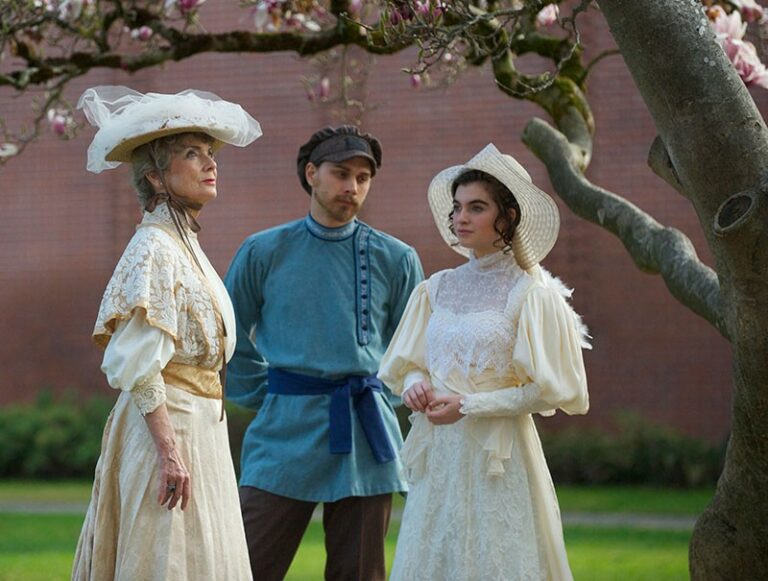
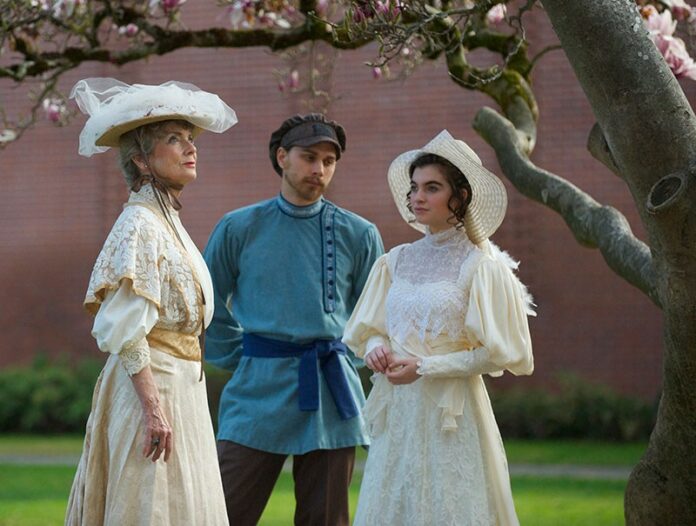
Directed by Tara Blau, the play is set during a 20-year high school reunion in the fictional town of Pine City, Minn. Peter (Nathan Cummings) and Kari (Sami Granberg) were once the cutest couple at school. Twenty years ago, Kari got pregnant, and Peter, frightened by the prospect of losing control of his life, fled Pine City, leaving Kari to deal with her crisis alone.

Now, after years of regret, he appears at the reunion—at the Pavilion, a soon-to-be demolished local landmark—with hopes of rekindling the relationship, but Kari, still seething with resentment, initially has no interest in seeing him or discussing the pain of those experiences so many years ago.

Cummings and Granberg, though fine actors clearly working at the top of their game here, have little fire or chemistry together, and both read far younger onstage than the 38-year-olds they are supposed to be, robbing the tale of much of its intended world-weary pathos. There is much that is moving and memorable about The Pavilion, but just like Peter and Kari’s hopes for their lives, I somehow expected a little bit more than I got.

Rating (out of 5): ★★★½

Letters to the Editor: Sept. 11, 2013

All the Help We Can Get

Will Durst has a great line, “The Left circles the wagons and shoots inward.” Which is funny-but-true, and is exemplified in the snarky subtext on your most recent cover.

Rachel Dovey’s article is excellent, by the way, and notably absent of snark.

A big factor in the Left’s aforementioned self-defeatism is the perennial competition of “More Committed Than Thou,” in which there is always a new wave of alpha martyrs poised to rise up and break in righteous fury, now or never, sneering at the complacence and laziness of all others, including their allies. I know this game because I’ve participated in it, along with countless others.

We absolutely need Bill McKibben and that screaming kid pictured on your cover, but we also need the very hybrid driving, recycling outcasts you deride, who make environmentalism “normal.”

Don’t flip off your allies, kids, you may need someone to post bail.

Agua Caliente

More Syria Questions

Interesting article, and some good points about Syria (“Rush to War,” Sept. 4). Also interesting that the liberal left and Sarah Palin essentially agree that the United States should not become more involved in this. While I understand the resistance to military action, it is clear that more discussion doesn’t get anywhere: we simply have to stop assuming that everyone on the world thinks and reasons the same as we do. Our logic and arguments don’t work with many of the leaders in other countries. But military action generally includes innocent civilians (and children) who become “collateral damage,” which is little different than their killing by corrupt regimes. Clearly this is not an easy choice, and people will not agree on whatever outcome is finally implemented.

Another sad result is that we will never know which option is the path to the quickest solution (end to the innocent deaths of people who happen to live in harms way). Do you believe that the rebels/resistance would massacre their own people and their own children with poison gas? Do you believe that lower-level military people in Assad’s forces have the ability to launch an attack without Assad’s knowledge? Do you believe that anyone else in the free world would assume the responsibility for responding to the situation other than the United States? If no one responded, what do you think would happen?

These are not meant to be flippant questions, but to inspire serious long-term thought about our options. What alternatives are there that would engage all the parties in this fiasco?

Via online

Drawing a Line

Bombs and guns are chemical weapons. Chemicals explode bombs and propel bullets and missiles. The body doesn’t care whether it dies quickly from trauma or more slowly from gas. Either way, it still dies.

Make peace, not lines.

Sebastopol

Thanks, Teach!

Thank you, Mark Perlman (“The History of Thinking,” Sept. 4). You really inspired all of us students and taught us how to look at mark making and line quality and composition in a way that continues to make sense. I still go back to so much of what you taught us about structure and purpose and hard work, and your teaching still informs my current work. Thank you for an excellent educational experience.

Congratulations on your much deserved retirement!

Via online

Write to us at le*****@******an.com.

Cult Beer Fans Rejoice

0

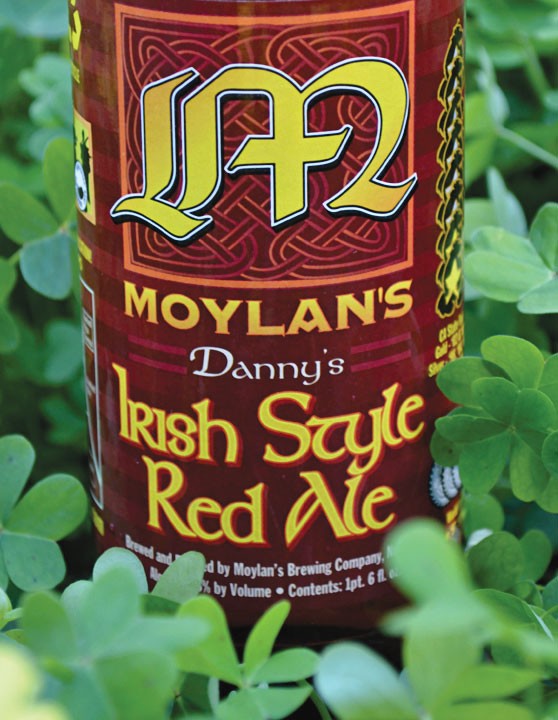
Sept. 14 is an auspicious day for day for beer in Sonoma County. The Petaluma River Craft Beer Festival kicks off its first year, with a focus on new and under-the-radar breweries—and Lagunitas, of course. Attendees can drink beers by the downtown waterfront while sampling food from Cordoza’s Catering, Belly Left Coast Kitchen, Tres Hombres and others. Participating breweries include Henhouse, Petaluma Hills, Lagunitas, St. Florian’s, Headlands Brewing Co., 101 North, Sonoma Springs, Moylan’s, Woodfour, Marin Brewing Co., Dempsey’s, Bear Republic, Baeltane and Carneros. The Fossils, the Dixie Giants and more round out the entertainment on Saturday, Sept. 14, along Water Street near the Petaluma River, downtown Petaluma. 1–6pm. $30 advance; $40 door, includes souvenir glass and 10 tastings; designated driver, $15. 707.762.2785. www.petalumacraftbeerfest.org.

There may be long lines at Russian River Brewing Co. as Zwanze Day 2013 unleashes cult beer fans. Straight out of Cantillon brewery in Belgium, this year’s limited batch is based on recently excavated recipes brewed hundreds of years ago by monks at the Abbey of Cureghem, at least according to Cantillon’s website. But keeping in mind that “zwanze” means “joker” in Brussels dialect, anything is possible. Whether Blair Witch–style mythology or true, one thing’s for sure: this beer—with its long fermentation period, lambic blend and wild yeasts—is going to be a hell of a thing to experience. No wonder they’ve made a day out of it. Celebrate Zwanze Day on Saturday, Sept. 14, at the Russian River Brewing Co. 725 Fourth St., Santa Rosa. 707.545.2337.

Blow the Whistle

0

Whistleblowing is a courageous act. Just ask Chelsea Manning, who faces a sentence of 35 years in prison for supplying classified information in the Wikileaks case, or Edward Snowden, who can’t even set foot in his home country after leaking information about the NSA’s widespread spying program. Daniel Ellsberg, who famously leaked the Pentagon Papers, speaks this week at the Petaluma Progressive Festival in support of the two courageous Americans, along with Green Party presidential candidate Jill Stein, author and activist Norman Solomon and many others. The Progressive Festival gets serious on Sunday, Sept. 15, in Walnut Park. Petaluma Boulevard South at D Street, Petaluma. 12:30pm–5pm. Free. www.progressivefestival.org.

PAYWALLED PRESS

Mimicking attempts by newspapers around the country to begin charging for online content, the Press Democrat implemented a long-rumored paywall on its website last week. Readers will now be able to access only 15 free articles per month, after which a nominal $10 per month “digital subscription” will be enforced. (Existing print subscribers receive online access at no additional charge.) The New York Times, which owned the Press Democrat for 27 years until 2012, has been successful with a similar system in place for about six years, while the San Francisco Chronicle recently abandoned its online paywall after only four months. Workarounds to the paywall include utilizing simple advanced Google searches and being savvy with social media links, but it appears the Press Democrat hopes $10 per month is worth saving the extra keystrokes.

Fall Book Fever

It’s a banner season for book fans. Smarty Marty’s Got Game, by San Francisco Giants reporter Amy Gutierrez, tells the story of how older sister Marty teaches the game of baseball to her younger brother, Mikey.

Gutierrez will be at Book Passage (51 Tamal Vista Blvd.) on Tuesday, Sept. 11, at 6:30pm. Daniel Handler—Lemony Snicket to those in the know—introduces acclaimed writer Tom Barbash (his story collection Stay Up with Me comes out this month) at Book Passage on Sept. 10. Then Daniel Handler‘s back in town on Sept. 12 for “An Unfortunate A-List Conversation with Lemony Snicket’s Alter Ego” at 142 Throckmorton (142 Throckmorton Ave., Mill Valley).

Have you dreamed of reading a novel based around Skinny Bitch, the vegan cookbook empire developed by Kim Barnouin? Well, this is your lucky day: Skinny Bitch in Love is a kitchen rom-com about a twenty-something chef who “loses her dream job—only to find happiness after she launches a vegan cooking school and falls for a sexy carnivore.” Barnouin appears at a $55 Book Passage Literary Luncheon on Saturday, Sept. 14.

Back for round two, the astounding Junot Diaz (above, whose liberal use of the word “motherfucker” caused more than one Monti’s customer to choke on her oysters at a Montgomery Village appearance last year) will be at Book Passage on Sept. 15 in support of the paperback release of his award-winning short story collection This Is How You Lose Her.

That same day, poets Kay Ryan and Jane Hirshfield appear in an afternoon conversation and reading at the Dance Palace (503 B St., Point Reyes Station) as a benefit for the West Marin Review. And finally, Michael Chabon‘s latest novel, Telegraph Avenue, takes Oakland as its setting, and kung fu, Blaxploitation films, vinyl LPs and soul music as its ephemera. The author appears at Book Passage on Tuesday, Sept. 27, at 7pm.

You Are the Product

Santa Rosa author, speaker and entrepreneur Andrew Keen isn’t interested in becoming your Facebook “friend.” He’s interested in saving your digital soul.

A CNN columnist and host of the TechCrunch chat show Keen On, the British-born transplant brandishes a mordant, simmering wit that blooms to full ire when discussing issues of personal privacy in the age of Web 3.0. In his most recent book, Digital Vertigo: How Today’s Online Social Revolution Is Dividing, Diminishing, and Disorienting Us, Keen contends that Facebook and its ilk aren’t the utopias of interpersonal transparency much ballyhooed by their makers, but rather a kind of exhibitionistic self-enslavement that precludes privacy and solitude, which Keen believes are prerequisite to living fully developed lives.

The notion that “social” media makes us less social isn’t entirely a unique one, and Keen is the first to admit it. Thus, to frame his ideas, he interweaves themes from the classic film Vertigo.

“It’s a remix of Hitchcock’s movie, which is about a man who fell in love with a rich blonde who turned out to be a rather poor brunette who was also a murderess. I fear that with social media, the blonde is, of course, Facebook—we’ve all fallen in love with it—but just as in Hitchcock’s Vertigo, the ‘everyman’ Jimmy Stewart got ‘dressed up’ and taken advantage of,” he says drolly. “We’ve all been taken advantage of. We’ve all been turned into the product.”

As a read, Digital Vertigo is a galloping, reference-jammed, personal essay that explores privacy in the age of social and indicts everyone from a 19th-century prison architect to a certain bottle-blonde along the way.

“When you use Facebook, you are the product and they’re profiting from you,” observes Keen. “If you want to know what Facebook’s business model is, look in the mirror. You’re paying for Facebook and none of that revenue is coming back to you.”

In Digital Vertigo, Keen points to how the culture of “sharing” advocated by Mark Zuckerberg and other social-media titans is tantamount to a wet dream for intelligence agencies. We willingly reveal tons of private data, our present locations, what we had for lunch and other miscellany comprising our lives, that, when aggregated, produces an accurate and predictive portrait of who are, who we know and what (and even who) we’re doing.

“We should be paying for our content on the internet,” Keen argues, “and until we figure that out—and consumers grow up and understand that they need to pay for online content—they’re going to continue to be abused and exploited by data-mining companies like Facebook and Google.”

Keen, 53, grew up in North London, studying history at the University of London. After moving to the United States, he earned a master’s degree in political science from UC Berkeley. Still keeping a house in Berkeley, he moved to a modest 1939 bungalow in the JC area of Santa Rosa in 2010 to be with his two children. On a recent morning, they fiddle around on iPads in the living room, while Keen, in shorts and a plain black T-shirt, offers tea and discusses his place in Silicon Valley.

“I see my role in the Dawkins-Hitchens tradition,” says Keen. “Some of these people take themselves so seriously.”

Naturally, Keen is not without his critics. As Sebastopol-based tech publisher and open-source advocate Tim O’Reilly opined in the 2008 documentary The Truth According to Wikipedia, “I think [Keen] was just pure and simple looking for an angle, to create some controversy and sell a book. I don’t think there’s any substance whatever to his rants.”

Keen is aware of his reputation, and in fact seems to relish it. On his Twitter profile he describes himself as “the Anti Christ of Silicon Valley.”

As for O’Reilly, “I think he’s a little oversensitive,” says Keen. “I respect him, politically. And I think O’Reilly is a decent guy. I think he’s a good person. But his response to The Cult of the Amateur was such an outrage—that I was only doing it to make money or get attention.”

[page]

Cult of the Amateur: How Today’s Internet Is Killing Our Culture, Keen’s 2007 bestseller that’s since been translated into 15 different languages, begins with Keen’s epiphany at O’Reilly’s FOO Camp, in 2004, while listening to a bunch of wealthy Silicon Valley types talk incessantly and religiously about “democratization.” Media, entertainment, business, government—nearly everything, went the rallying cry, would be “democratized” by what O’Reilly had famously christened Web 2.0.

“The more that was said that weekend, the less I wanted to express myself,” Keen writes in the book’s introduction. “As the din of narcissism swelled, I became increasingly silent. And thus began my rebellion against Silicon Valley.” (O’Reilly declined comment when contacted for this story.)

Current targets of Keen’s scorn and ridicule run the gamut from Sean Parker and his lavish wedding ceremony in Big Sur (“I’m interested in this idea of Silicon Valley trying to engineer serendipity”) to Google Glass, which Keen sees as the beginning of an inevitable migration of personal computing off of our desktops and out of our pockets and onto—and eventually into—our bodies.

Sitting near the television at Keen’s house is a DVD, rented from the video store down the street, of Minority Report. Steven Spielberg’s 2002 film foresaw graphical user interfaces, gesture-based navigation and ultra-thin transparent screens, technological advances now part of modern life. But one prediction in the film eerily rings far truer than the others: when Tom Cruise walks through the city, retinal scans pick up his individual information, and targeted advertising suddenly appears, keyed to his personal data.

This seemed intrusive and insidious just 11 years ago. In Keen’s view, it’s something in which we now willingly participate. Except it’s not called a retinal scan—it’s called a “status update.”

“We go on the internet and we use these services, and we’re not willing to pay for them. We use Google and Facebook without really understanding that their business model is acquiring our data so that they can sell more and more advertising,” says Keen. “If you’re not paying for your content, check your pockets, because you’re being taken advantage of.”

Keen’s sentiment echoes that of his friend Nicholas Carr (author of The Shallows: What the Internet Is Doing to Our Brains), who argues that Facebook and its ilk represents a form of “digital sharecropping.”

“One of the fundamental economic characteristics of
Web 2.0 is the distribution of production into the hands of the many and the concentration of the economic rewards into the hands of the few,” wrote Carr all the way back in 2006. “It’s a sharecropping system, but the sharecroppers are generally happy, because their interest lies in self-expression or socializing, not in making money.”

Keen concurs. “We’re all back in the antebellum South here in terms of working in the fields, guaranteeing massive profit for a small group of people who are laughing all the way to the bank.”

What is the cultural mechanism that brought us to this place of full disclosures, and what pan-global personality tick is it exploiting?

“We’re all desperate to express ourselves. We all think we have something interesting to say about ourselves, so we feel we have almost a moral or aesthetic obligation to go on Facebook and tell the world what we’re having for breakfast, what we’re wearing or, all too often, what we’re not wearing,” says Keen.

“I don’t think we can blame the social networks; we have to blame ourselves,” adds Keen. “We’ve fallen in love with ourselves, we think that our narrative is interesting, and actually, it’s incredibly boring to everyone except ourselves and the advertisers who are profiting from us,” he continues.

[page]

Keen doesn’t identify himself as entirely anti-Facebook. “When a grandmother uses it to connect to her grandchild or when we catch up with friends from school or college we haven’t seen in years—those aren’t bad things,” says Keen, who, noting he owns an iPhone, iPad, Macbook Air, iMac and Canon 5DII, insists that he’s not a Luddite, either.

But call him an elitist, as Stephen Colbert did on
The Colbert Report in 2007, and Keen will wholeheartedly agree.

“I’m unashamedly elitist in the sense that I believe there’s only a small group of people that are talented and hardworking enough to create great books, movies and songs, and the vast majority of us are much better off actually consuming that stuff, paying for it and enabling a viable cultural economy than wasting our time blogging or putting our worthless photos, songs or movies up,” Keen says.

Since the majority of social networks originate in the United States, it’s suggested there might be something endemic to the American psyche, some kind of hybrid of our can-do spirit and guarantee of free speech that causes us to believe that since we can share our amateur efforts, we should share our amateur efforts.

“We’ve fallen under this sort of uber-democratic illusion that everyone has something interesting to say,” asserts Keen, “and they don’t.”

For many, Keen’s acerbic manner and proclivity for blunt statements (e.g., “Most of the stuff on the internet is either biased or bad”) might disqualify him as a spokesperson for the world of working media professionals. In reality, Keen is among a media professional’s fiercest allies. In Cult of the Amateur, Keen essentially argues that people should leave media-making to the pros.

Of course, as a maker of content, online and off, Keen has a vested interest in professionals being compensated for their work. It’s a difficult point to counter, especially when one considers that consumers seem happy to pay for everything in the world except online content. (Keen applauds institutions like The New Yorker and the New York Times, which have paywalls around their content, and asserts that more creators should do the same.)

Why we should start paying for online content is best illustrated by paying attention to the ads in a browser’s sidebar. You might have noticed that after a Google search for a specific item, advertisements for the item seem to follow you around the internet for days afterward. This is an example of how your ostensibly private online behavior is being used to both market you and market to you. This, asserts Keen, is part of the price of free content.

For those with paranoid dispositions, privacy is merely the gate fee. What other personal costs might be levied? Consider the fact that college admissions offices routinely review the social media accounts of new applicants to gauge their suitability for campus life. Then, of course, there are the recent revelations of the NSA’s social snooping, courtesy of Edward Snowden, which link companies like Facebook, Google, Microsoft and Yahoo to the agency’s PRISM program.

“It did in some ways predict this giant panopticon where everything we do on the internet is being watched,” says Keen of Cult of the Amateur. “I didn’t predict it was the NSA, but the relationship between the NSA and some of these tech companies is very dodgy, too, and very troubling.”

Dodgy as it may be, we’re caught in a bit of cultural shift, one in which Keen’s suggested remedy for our privacy concerns—simply paying for content—isn’t necessarily the fix. The fact is, Facebook and Google don’t want you to pay for content, at least not with real dollars. A fair amount of social engineering has transpired in the past decade to bring “radical transparency” into the personal sphere. And that is vastly more valuable to data-driven entities than your 99 cent download.

What Americans should really stop doing, says Keen, is giving away their data in a misguided effort toward posterity.

“What we need to teach the internet is how to forget. At the moment, the internet is lacking a human quality—all it knows is how to remember. Forgetting is much more human than remembering.”

And for Keen, he’ll know humanity has triumphed and reclaimed its privacy when someday we ask, “Remember when the internet was free?”

Andrew Keen appears with over 70 media and tech professionals speaking at C2SV, a three-day conference of tech and music running Sept. 26–29 in San Jose. Along with tech discussions and presentations, more than 60 bands perform in a lineup headlined by Iggy and the Stooges. For details, see
www.c2sv.com.

Andrew Keen is at ajkeen.com and tweets as @ajkeen.

Daedalus Howell is at dhowell.com and tweets as @daedalushowell.

Bohemian editor Gabe Meline (@gmeline) contributed reporting to this piece.

Sep. 11: Grand Opening of the Napa Valley 9/11 Memorial Garden

0

index.jpg

Avid Bohemian readers may remember our 2011 cover story on Napa artist Gordon Huether’s creation of a 9-11 memorial using steel from the fallen World Trade Center towers. Six pieces of steel from the buildings, totaling 30 tons, now make up the memorial in Napa. When he received the steel, “It was caked with concrete. There were coffee cups in it. It was quite a moment,” says Huether. Despite the public relations disaster when a group made flyers announcing the completion of “Napa’s 30-Ton Erection,” emotions are sure to run high at the grand opening of the Napa Valley 9/11 Memorial Garden on Wednesday, Sept. 11, on Main Street between First and Pearl, Napa. 7pm. Free. 707.226.7372.

Sep. 10 and 13: Tom Barbash at Book Passage and Copperfield’s

0

index.jpg

The characters in Tom Barbash’s new short story collection, Stay Up with Me, are tied together by their navigation of a new world, entered into either by poor choices or loss of some kind. How do we connect to each other? How do we connect to the world around us? These are the questions Barbash explores in his excursion into the heart of humanity. The Marin-based author of the New York Times bestseller 9/11: A Story of Loss and Renewal is introduced by Dave Eggers for a reading on Tuesday, Sept. 10 at Book Passage. 51 Tamal Vista Blvd., Corte Madera. 7pm. Free. 415.927.0960 and Friday, Sept. 13 at Copperfield’s Petaluma. 140 Kentucky St., Petaluma. 7pm. Free. 707.762.0563.

Sep. 8: Robert Walter’s 20th Congress at Sweetwater Music Hall

0

RobertWalter.jpg

“The Hammer of the Hammond,” the “Pulverizer of the Piano,” the “Razer of the Rhodes”—no matter what nickname Robert Walter is given, he shines as one of the heaviest jazz-funk keyboardists this side of Philadelphia. The founding member of the Greyboy Allstars now plays with his own group, Robert Walter’s 20th Congress, known for their funky shows bursting with energy. This is the kind of funk that hurts not to dance to. They play with openers the Heavy Guilt on Sunday, Sept. 8, at the Sweetwater Music Hall. 19 Corte Madera Ave, Mill Valley. 8pm. $17. 415.388.3850.

Family Plot

The biggest threat to family farms in the North Bay isn't urban sprawl, the rise of industrial agriculture or even climate change. It's inheritance taxes. "Estate taxes can be crushing," acknowledges Jamison Watts, executive director of the Marin Agricultural Land Trust (MALT). Because the tax code determines the worth of inherited farmland based on its value for potential development rather...

Portals of the Past

'This is the way the universe begins." So pronounces a congenially mysterious narrator (the dependably excellent Jeff Coté) in the opening moments of Craig Wright's 2000 drama The Pavilion, now playing at Cinnabar Theater. A bittersweet morsel about fate, love and the choices we cannot undo, The Pavilion establishes from the start that we are always in the act of...

Letters to the Editor: Sept. 11, 2013

All the Help We Can Get Will Durst has a great line, "The Left circles the wagons and shoots inward." Which is funny-but-true, and is exemplified in the snarky subtext on your most recent cover. Rachel Dovey's article is excellent, by the way, and notably absent of snark. A big factor in the Left's aforementioned self-defeatism is the perennial competition of "More...

Cult Beer Fans Rejoice

Sept. 14 is an auspicious day for day for beer in Sonoma County. The Petaluma River Craft Beer Festival kicks off its first year, with a focus on new and under-the-radar breweries—and Lagunitas, of course. Attendees can drink beers by the downtown waterfront while sampling food from Cordoza's Catering, Belly Left Coast Kitchen, Tres Hombres and others. Participating breweries...

Blow the Whistle

Whistleblowing is a courageous act. Just ask Chelsea Manning, who faces a sentence of 35 years in prison for supplying classified information in the Wikileaks case, or Edward Snowden, who can't even set foot in his home country after leaking information about the NSA's widespread spying program. Daniel Ellsberg, who famously leaked the Pentagon Papers, speaks this week at...

Fall Book Fever

It's a banner season for book fans. Smarty Marty's Got Game, by San Francisco Giants reporter Amy Gutierrez, tells the story of how older sister Marty teaches the game of baseball to her younger brother, Mikey. Gutierrez will be at Book Passage (51 Tamal Vista Blvd.) on Tuesday, Sept. 11, at 6:30pm. Daniel Handler—Lemony Snicket to those in the know—introduces...

You Are the Product

Santa Rosa author, speaker and entrepreneur Andrew Keen isn't interested in becoming your Facebook "friend." He's interested in saving your digital soul. A CNN columnist and host of the TechCrunch chat show Keen On, the British-born transplant brandishes a mordant, simmering wit that blooms to full ire when discussing issues of personal privacy in the age of Web 3.0. In...

Sep. 11: Grand Opening of the Napa Valley 9/11 Memorial Garden

Avid Bohemian readers may remember our 2011 cover story on Napa artist Gordon Huether’s creation of a 9-11 memorial using steel from the fallen World Trade Center towers. Six pieces of steel from the buildings, totaling 30 tons, now make up the memorial in Napa. When he received the steel, “It was caked with concrete. There were coffee cups...

Sep. 10 and 13: Tom Barbash at Book Passage and Copperfield’s

The characters in Tom Barbash’s new short story collection, Stay Up with Me, are tied together by their navigation of a new world, entered into either by poor choices or loss of some kind. How do we connect to each other? How do we connect to the world around us? These are the questions Barbash explores in his excursion...

Sep. 8: Robert Walter’s 20th Congress at Sweetwater Music Hall

“The Hammer of the Hammond,” the “Pulverizer of the Piano,” the “Razer of the Rhodes”—no matter what nickname Robert Walter is given, he shines as one of the heaviest jazz-funk keyboardists this side of Philadelphia. The founding member of the Greyboy Allstars now plays with his own group, Robert Walter's 20th Congress, known for their funky shows bursting with...
11,084FansLike
4,446FollowersFollow
6,928FollowersFollow