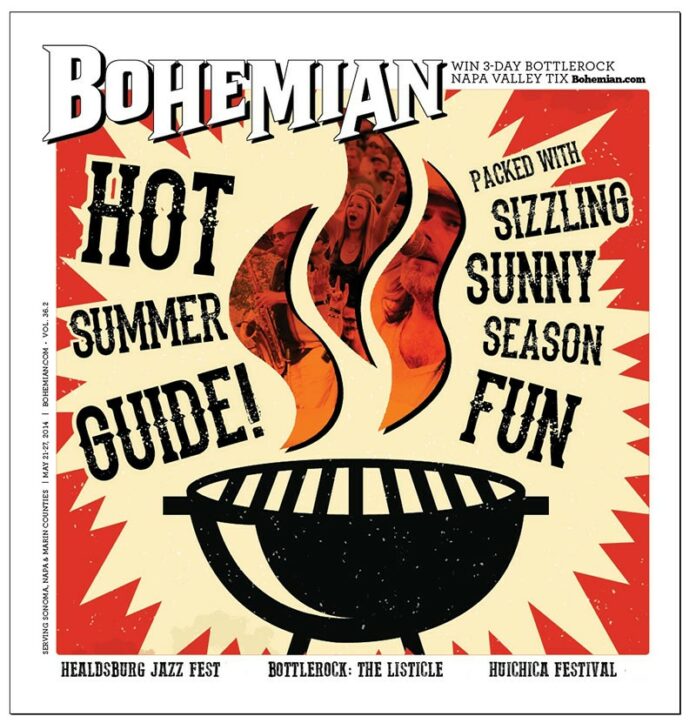
Summertime and the living is easy. Yeah, but given how much there is do this summer, figuring out how to make the most of the those sweet, warm weather days and nights is not so easy. So call up your calendar with one hand and page through our annual Hot Summer Guide with the other to peruse the multitude of shows, events, happenings and sunny-day doings. Summer passes quickly, but we’re here to help make sure you make the most of what the North Bay has to offer. See you out there.
MAY
PlumpJack’s ‘Ultimate Wine Country Experience’
A trip to Napa Valley usually involves wine, food and, if you’ve got the time, a night or two in the high-thread-count sheets of a plush hotel or lodge. Because the PlumpJack Group is something of a vertically integrated company with wineries, restaurants, hotels and resorts they can offer an inclusive package that includes a little something from all the above. The company is offering resident tourists and out-of-area visitors a posh package they call the “ultimate wine country experience”: a night in a “harvest cottage” at the Carneros Inn (complete with a fire pit, alfresco showers and a soaking tub for two), a private tour and tasting of either PlumpJack Winery, the LEED gold-certified CADE winery or the Stags Leap District’s new Odette Estate Winery (which features 18,000 square feet of caves) and a six-course tasting menu for two at FARM restaurant.
The cost starts at $1,285 and runs on Wednesdays and Thursday from now through December, excluding August and September. So for a summer getaway, that means now through July.—Stett Holbrook
Matsuri Japanese Arts Festival Celebrate the art of Japan with clothing, food, crafts, music, dancing, origami, kamishibai theater, taiko drumming, tea presentations and more. May 24 at Juilliard Park. Downtown Santa Rosa. 11am–5pm. Free. www.sonomamatsuri.com.
Passport to Pinot The Russian River Valley is know for its excellent Pinot Noir, and this wine weekend celebrates that legacy with library tastings, food pairings and more. Over 30 wineries in the region open their doors for unlimited tasting on May 24–25. 11am to 4pm. $55. rrvw.org.
Oysterpalooza Celebrate the bivalve by eating everything oyster. Live music by Frankie Boots & the County Line, Mr. December, Church Marching Band and Arann Harris & the Farm Band makes this an event to remember. May 25 at Rocker Oysterfellers. 14415 Hwy. 1, Valley Ford. Noon. $15 (does not include food). 707.876.1983.
Healdsburg Jazz Festival Sound the trumpets and walk that bass right on up to Healdsburg for the 16th annual Healdsburg Jazz Festival. There are over a dozen concerts scheduled, and this year celebrates the great blues harmonica player Charlie Musselwhite, who will be playing with a host of great musicians like Elvin Bishop, Guy Davis, John Santos and Joshua Redman. Other highlights include Bill Charlap and Renee Rosnes performing with Bobby Hutcherson, and Charles Lloyd and Zakir Hussain giving an interactive workshop. The festival closes with the Poncho Sanchez Latin Jazz Band and the Claudia Villela Trio. Concerts take place May 30–June 8 at various locations in and around Healdsburg. Prices vary. 707.433.4633. www.healdsburgjazzfestival.org.
Friday Night Live The “little town that could” really does when it comes to its summer live music series. Hosted in conjunction with Cloverdale’s farmers market, this season’s lineup features Chuck Mead & His Grassy Knoll Boys (May 30), Steve Riley & the Mamou Playboys (June 13), Southern Culture on the Skids (June 27), Pacific Mambo Orchestra (July 25), Tab Benoit (Aug. 1), Eric Lindell (Aug. 22) and many other top–notch musical groups. May 30–Aug. 29 in Town Square. Main Street, Cloverdale. Market begins at 5:30pm, music starts at 6:30pm. Free.
www.cloverdaleartsalliance.org.
Forestville Youth Park Celebrate this great park with plenty of barbecue, community spirit, a parade, a carnival and live music. May 31–June 1 at Forestville Youth Park. 7045 Mirabel Road, Forestville. Parade, Saturday at 10am; festival, Saturday–Sunday. Free. www.forestvilleyouthpark.org.
Marin Home & Garden Expo Exhibitors, lectures and demos showcase all things for house and yard in Marin County at this annual event sponsored by the Marin Builders Association. May 31–June 1 at the Marin Center Fairgrounds and Exhibit Hall. 10 Avenue of the Flags, San Rafael. Saturday, 10am–7pm; Sunday, 10am to 6pm. Free. 415.507.1537.
Art at the Source More than 160 artists in dozens of studios throughout west Sonoma County are open to the public during two weekends, May 31–June 1
and June 7–8. Celebrating its 20th anniversary. Maps can be found at www.artatthesource.org or at the Sebastopol Center for the Arts, 6780 Depot St., Sebastopol. Free. 707.829.4797.
Ten Things to Know About BottleRock Napa Valley 2014
1. New promoter L38, which bought the rights to BottleRock from the bankrupt BR Festivals group, is made up of local Napa investors who have pledged to make good on old debts.
2. Speaking of local, a full one-third of the bands playing this year are from the Bay Area, with nearly a dozen North Bay bands representing the local scene.
3. That said, festival headliner the Cure are making their first Northern California appearance in six years, and their only U.S. live date this year until September. This could be the last time Robert Smith’s hair appears in Napa.
4. The festival this year is partnering up with local hotels and offering free shuttles to and from parking lots to help ease congestion. There will also be plenty of bicycle parking on hand.
5. Another step L38 is taking will mean that everyone needs to get there early. Shows end at 10pm, to accommodate noise complaints that followed last year’s event.
6. The event is going to get a new layout. Stages and vendors will be placed in different areas throughout the expo center and grounds, to allow for quicker crowd flow and less cross noise between stages.
7. The best of the North Bay’s local food scene, from Morimoto Napa to Three Twins Ice Cream, is on hand once again to offer bites and libations through the weekend. Craft beer gardens, wine cabanas and spirited full bars will also be dotted around the grounds.
8. Fewer VIP passes are being sold this year, but reportedly there are more perks that come with them. Sadly, a meet-and-greet with the Spin Doctors is not included. If you do want the meet-and-greet treatment, there are always Platinum level tickets for $3,000.
9. If you don’t have cash to burn, discount tickets are becoming available, but you have to search them out on sites like Livingsocial.com. Prices on the festival’s site are still fixed.
10. Bring the kids! Up to two children under eight are admitted at no charge with each ticketed adult. www.bottlerocknapavalley.com.—Charlie Swanson
[page]
JUNE
North County Fairs: Take Your Pick
To be fair, there are a lot of reasons to go to every county fair in the North Bay. In Napa County, it’s the brightness of the sky in a one-day Fourth of July extravaganza in Calistoga. In Marin County (July 2–6), there’s the classic rock of Huey Lewis and the News and Joan Jett to hear in San Rafael. In Sonoma County (July 24–Aug. 10), there are monster trucks, horse races (with betting), bands like Lifehouse and Los Hurricanes del Norte, a rodeo and tons more in Santa Rosa. And at the Sonoma-Marin cross-county spectacular in Petaluma (June 18–22), Eddie Money serenades his fans after they’ve ridden the Tilt-a-Whirl and helped judge the world’s ugliest dog contest. —Nicolas Grizzle
Sonoma County Pride Celebration What’s not to love about a party whose theme is “Free to Be”? Dance parties take place the night before, and a parade strolls through Main Street in Guerneville on Sunday, followed by an event on the plaza with vendor booths and, hopefully, spontaneous dance parties. There’s also a commitment ceremony, family pool party and an interfaith service on Sunday. Parade and vendor fair take place June 1 on Main Street in Guerneville. 11am. Free. www.sonomacountypride.org.
Auction Napa Valley This is the huge auction your friends always talk about. It’s raised over $100 million for local nonprofits since 1981. Welcome parties take place June 5 at various locations throughout the Napa Valley, with the barrel auction at Charles Krug on
June 6 and the main auction scheduled for June 7 at the three-Michelin
starred Meadowood. 707.963.3388. www.auctionnapavalley.org.
Beerfest: The Good One! Say “Be Here Now” really fast and it sounds like “beer now.” That’s the idea behind the 23rd annual Beerfest to benefit the Face to Face-Sonoma County Aids Network. Tickets include all food and beer tastings and a souvenir glass. With more than 60 microbreweries and more than 120 different beers, this event is a who’s who of Northern California artisans. June 7 at the Wells Fargo Center for the Arts. 50 Mark West Springs Road, Santa Rosa. 1–5pm. Twenty-one and over (alcohol till 4:30pm). $45. 707.546.3600. www.f2f.org.
DjangoFest Mill Valley With only two fingers on his left hand, Gypsy-jazz guitarist Django Reinhardt could play circles around just about anyone in the world in the 1920s. His groundbreaking musical career is celebrated in Mill Valley with a three–day festival of fans and players presenting concerts, workshops and, yes, “djam” sessions to honor his spirit and inimitable sound. June 6–8
at 142 Throckmorton Theatre.
142 Throckmorton Ave., Mill Valley. Times vary. $35–$50. 415.383.9600.
Peggy Sue’s All-American Cruise Four days of classic Ameri–car–na in Santa Rosa begins Thursday with a cruise-in at 4pm followed by a chili and pasta cook-off Friday at 6pm, with entertainment that includes the Hot Rods Band and Peggy Sue’s Pin–Up Contest. Saturday starts with a pancake breakfast and continues with classic cars on display. Music by the Poyntless Sistars fills the afternoon before the cars take to the streets for a cruise through downtown. June 12–15. at A Place to Play Park. 2375 W. Third St., Santa Rosa. Times vary each day. $6–$30. www.peggysuescruise.com.
Huichica Festival David Longstreth of the terrific band Dirty Projectors headlines this year’s festival. Bunk Sandwiches, Salumeria, Rancho Gordo and Q Craft highlight the culinary options. June 13–14 at Gundlach Bundschu Winery. 2000 Denmark St., Sonoma. June 13, 6pm; June 13-14, noon. $30–$120. 707.938.5277.
Film Night in the Park Sometimes things are just more fun outdoors—like cooking, exercise and watching movies. Now in its 23rd year, Film Night in the Park, presented by APPLE Family Works, brings the big screen to parks around Marin County. This year’s selections include Monsters University, Moneyball, I Am Sam, The Fifth Element and Frozen. Bring blankets, pillows, backrests and low–seated chairs. June 13–Sept. 27 in parks in Fairfax, China Camp, Peacock Gap and San Anselmo. Free. 415.272.2756. www.filmnight.org.
Novato Festival of Art, Wine & Music Two–day live music fest features area crafters, good things to eat and drink, a wine garden and live music on two stages. A children’s area, delicious food, boutique wines and art line the streets of Novato June 14–15. Old Town Novato, on Grant between Redwood Avenue and Seventh Street. Free. 415.472.1553.
Cotati Jazz Festival The town with bumper stickers that read “Keep Cotati Weird” celebrates the 34th anniversary of the Cotati Jazz Fest with music, food, beer and dancing. This event encompasses musical and nonmusical venues in downtown Cotati with the main acts slated for La Plaza Park. Check individual venues for other bookings. La Plaza Park, downtown Cotati. June 15. Noon–5pm. Free.
www.cotatijazz.com.
Long Meadow Ranch Concert Series This music series leans toward folk and Americana, with a lineup that includes Hot Buttered Rum (June 15), Holly Williams (July 20), Goodnight, Texas (Aug. 3), the Brothers Comatose (Aug. 24) and the Mother Hips (Sept. 14). June 15–Aug. 24 at Long Meadow Ranch Winery. Concerts at Long Meadow Ranch also feature chef Stephen Barber’s barbecue, horseshoes and, of course, local wine. Bring a lawn chair and blanket and make a day of it. 738 Main St., St. Helena. 3:30pm each day. $25–$45. 877.963.4555.
Sundown Music Series Extended park hours and an open barbecue make this a great summer getaway. Music lineup includes Jami Jamison Band (June 19), Acoustic Soul (July 17), Hugh Shacklett & Possible Friends (Aug. 21) and Tudo Bem (Sept. 18). June 19–Sept. 18 at Jack London State Park. 2400 London Ranch Road, Glen Ellen. 5–9pm. Free. www.jacklondonpark.com/sundown.html.
Sierra Nevada World Music Fest The world is a big place, so a world music festival, by default, must also be big. This festival doesn’t disappoint, with dozens of musical acts and a summer solstice celebration. Artists at this year’s festival include Rebelution, Barrington Levy, Tarrus Riley, Mykal Rose, Horace Andy Ozomatli and many others, plus late-night dancehall with Mighty Crown, Adrian Sherwood and Comanche High Power. June 20–22 at the Mendocino County Fairgrounds, Boonville. All three days, $60–$170; limited camping available. 916.777.5550. www.snwmf.com.
Napa NASCAR Night The first–ever NASCAR night in a city known for wine brings the fastest stock cars on the planet downtown. The inaugural event gives fans a chance to meet the drivers, see the cars up close and maybe even change a tire with the pit crew. Live music and concessions, too. June 21 at Veteran’s Park. Main and Second streets, Napa. 3–9pm. Free. www.donapa.com/events.
San Anselmo Art & Wine Festival More than 40,000 folks converge on downtown San Anselmo each year—hungry, thirsty, craft-starved folks. As usual, a section of the fest will include over 200 artists and their various works. There will also be food booths, wine, a merchant marketplace, live music and a kids’ area. June 21–22. San Anselmo Avenue between Bolinas and Tamalpais streets. 10am–6pm. 415.454.2510.
Rodney Strong Concert Series The 24th annual Summer Concert Series in the sunny grasslands behind vineyard features adult contemporary favorites and music legends. This year’s lineup includes Jazz Attack (June 21), Chris Isaak (July 13), Mindi Abair with Elliot Yamin (July 26), Chris Botti (Aug. 16) and Tower of Power and Jonathan Butler (Aug. 31). Rodney Strong Vineyards, 11455 Old Redwood Hwy., Healdsburg. $50–$115. 707.869.1595.
Mill Valley Wine & Gourmet Food Tasting Organizers predict the 33rd year of this festival will break attendance records, with more than 1,000 people expected to peruse the latest food trends and fine wines Mill Valley has to offer. Live music, too! Proceeds benefit local nonprofits.
June 22 at Depot Plaza. Downtown
Mill Valley. 1–4pm. $50–$60.
Age 21 and over only. 415.388.9700. www.millvalley.org.
Kate Wolf Memorial Music Festival This festival always draws excellent musical acts to honor the work of late singer-songwriter Kate Wolf. This year includes performances by Joan Baez, the Indigo Girls, Los Lobos, Garth Hudson, Darlene Love, Jackie Greene, Beausoleil avec Michael Doucet and many others. Camping is the best way to experience this festival. June 27–29 at Black Oak Ranch, Laytonville. $40–$230. Children under nine admitted free. www.katewolfmusicfestival.com.
Broadway Under the Stars Presented each year by Transcendence Theatre Company, some of the brightest stars in Hollywood and on Broadway come to perform in the affable night air in Jack London State Park. On the schedule this year are “One Singular Sensation” (June 27–29, July 2, 3, 5), “Fantastical Family Night” (July 25–26), “The Music of the Night” (Aug. 14–16, 22–24) and the Gala Celebration
(Sept. 5–6). June 27–Aug. 16 in the outdoor winery ruins at Jack London State Park. 2400 London Ranch Road, Glen Ellen. Pre-show picnic at 5pm; concerts begin at 7:30pm. $29–$125. 877.424.1414.
Days of Wine and Lavender Sip whites and reds among the blooming fields of lavender at a hillside winery. Food pairings and live music, too. June 28 at Matanzas Creek Winery. 6097 Bennett Valley Road, Santa Rosa. Noon–4pm. $75–$95. www.matanzascreek.com.
Mondavi Winery Summer Music Fest After 45 years, you’d think this concert series would slow down. Well, you’d be wrong. The series kicks off with the Preservation Hall Jazz Band (June 28) and continues with swing revivalists Big Bad Voodoo Daddy (July 5), pop group Five for Fighting (July 12) and smooth saxophonist Dave Koz (July 18), then wraps up with pop diva Colbie Caillat (July 19). June 28–July 19
at Robert Mondavi Winery.
7801 St. Helena Hwy., Oakville. Dinner available. $55–$225. 888.769.5299.
www.robertmondaviwinery.com.
California Beer Festival
The annual California Beer Festival puts on a quartet of quaffing events throughout the state through September, led this year by the June 28 event at Stafford Lake Park in Novato.
Seventy craft beers, a whole lotta beef sliders—and bands? Sign us up. There’s a Stones tribute act, reggae from IrieFuse and the 85’s, a band that’s strictly ’80s and offers crafty sampling from the English Beat to Van Halen.
It’s a beer festival, so here are a bunch of the brews you’ll get to sample from 1–4:30pm: Altamont Beer Works Bicycle Brustop, FreeWheel Brewing, New Belgium Brewing, Big Sky Brewing, Bear Republic brewing, Broken Drum, Iron Springs, Stone Brewing, Six River Brewers, Hopmonk Tavern, Alaskan Brewery, 21st Amendment, Mendocino Brewing Company, Strike Brewing—and, of course, mighty Lagunitas (and more).
www.californiabeerfestival.com.—Tom Gogola
[page]
JULY
Fourth of July with Santa Rosa Symphony Judy Collins (“Both Sides Now,” “Send in the Clowns”) and the Santa Rosa Symphony bring America’s spirit to life with this program of patriotic mainstays. The indoor-outdoor concert concludes with fireworks and offers a kids’ zone with games and carnival attractions. July 4 at the Green Music Center at Sonoma State University. 1801 East Cotati Ave., Rohnert Park. 7:30pm. $25–$50. 866.955.6040.
Festival del Sole Ten days, 100 wineries and over 60 events make up this celebration of fine arts in liquid, food and music in the Napa Valley. This year features the return of violinist Joshua Bell, opera superstar Maria Agresta, soprano Julia Bullock, ballet dancers Herman Cornejo and Guillaume Côté, conductor Alondra de la Parra, mezzo-soprano Carla Dirlikov, Latin music producer and drummer Gregg Field, bassist Xavier Foley, jazz trumpeter Arturo Sandoval and many other world famous artists. July 11–20 at various venues in the Napa Valley. $45–$150. www.festivaldelsole.com.
Petaluma Art & Garden Festival The festival celebrates its 13th year of downtown art, music, food, and fun on Kentucky and Fourth streets. Presented by the Petaluma Downtown Association, the festival will feature two stages of music with Luv Planet Exposed, Danny Click and the Hell Yeahs, Zebop! and Reckless in Vegas. Look for local eats, beer and wine.
July 13. 11am–5pm. 707.762.9348.
www.petalumadowntown.com.
Rivertown Revival goes down at Petaluma’s David Yearsley River Heritage Center. This year will feature five stages of music. Also look for the return of $5 weddings, a family area, and good food and drink, and even a dog and pony show, and more. July 19, 11am–8pm. Ten dollars to get in
($5 for kids 18 and younger).
www.rivertownrevival.com.
Catalan Festival With live flamenco guitarists and dancers, authentic Spanish food and plenty of bubbly, the Catalan Festival is the most affordable ticket to Spain you’ll ever find. July 19–20 at Gloria Ferrer Champagne Caves. 23555 Carneros Hwy., Sonoma. $65–$120. 707.933.1931. www.gloriaferrer.com.
Pacific Islander Festival The third annual celebration of islander culture includes food, music, hula and craft booths. Hosted by the Rohnert Park Warriors Youth Football and Cheer, proceeds from the event benefit the organization. July 26 at City Center Plaza. 475 City Center Drive, Rohnert Park. 10am–7pm. Free. www.rpwarriors.org.
15th Annual San Rafael Twilight Criterium Downtown San Rafael is transformed into a bike racetrack as pros take over the main downtown streets. No waiting for hours to see cyclists pass in seconds, here—this 1km loop brings the action back around right away while a DJ pumps fat beats and your beer disappears faster than you thought it would. Several races with different age groups. Register to ride by July 25, or just show up and watch. Fourth and C streets, San Rafael. July 26, 2–8pm. www.srtwilight.com.
Seghesio Family Vineyards Zin & BBQ Festival Now in its 11 year, Healdsburg’s Seghesio winery will offer a day of summer fun with barbecue and barbecue’s favorite wine, Zinfandel. The event will pit local pitmasters against each other in the “battle of the BBQs.” Live music by Zydeco Magic will make it all go down smoothly. July 26, 1–5pm at 700 Groove St., Healdsburg. 707.433.3579. Tickets $60 at http://cart.bloyal.com/Seghesio/WineShop/WS/Event.
Reggae on the River Presented by the Mateel Community Center, the 30th annual incarnation of this laid–back festival features Jimmy Cliff, Alpha Blondy & the Solar System, Gentleman & the Evolution, Iration, Israel Vibration and many others. No ganja allowed. Just kidding! July 31–Aug. 3 at French’s Camp. Highway 101, Piercy. $190 (three–day) to $250 (four–day) 707.923.3368. www.reggaeontheriver.com.
[page]
AUGUST
Cochon Heritage Fire
If I had to pick one food event to attend this summer it would be the fourth annual Cochon Heritage Fire on Aug. 3. There is nothing like it. This meat orgy at St. Helena’s Charles Krug Winery will feature more than 30 chefs and 40 winemakers, breweries and cider makers in a celebration of fire-grilled, responsibly sourced meat—beef, chicken and pork, but also goat, lamb, squab, duck, thresher shark and spit-roasted sturgeon. A portion of ticket sales will benefit the St. Helena Farmers’ Market and the American Institute of Wine & Food. A pop-up butcher shop will donate all proceeds to students of the Culinary Institute of America at Greystone. Be sure to fast for a few days before the event so you’ll be ready for a full day of eating. Tickets start at $100. Go to www.cochon555.com for more information.—Stett Holbrook
West of West Wine Festival Celebrating the wines of the Sonoma Coast, this fourth annual festival takes place this year at the Barlow in Sebastopol. Winery-hosted dinners, seminars and, of course, tastings highlight this three-day festival. Aug. 1–3 at various wineries and locations around Sebastopol. $100–$475. 888.878.9645.
Music in the Vineyards Now kicking off its 20th season, this chamber-music festival brings together nearly 40 renowned classical musicians from around the world. This year features soprano Dawn Upshaw, the Escher Quartet, the Pacifica Quartet and several returning string players.
Aug. 1–24. Various locations in
the Napa Valley. $50–$534.
www.musicinthevineyards.org.
Petaluma Music Festival The seventh annual festival features a healthy mix of national and local artists on three stages: Galactic, the Mother Hips, Brokedown in Bakersfield, Sister Sparrow & the Dirty Birds, David Luning, T Sisters, Andre Thierry
and Zydeco Magic, Adam Theis
& Jazz Mafia, the Highway Poets, the Pine Needles, the Market Farmers Band, Ariel Garcia and others.
Aug. 2 at the Sonoma Marin Fairgrounds. 175 Fairgrounds Drive, Petaluma. Noon. $35–$85.
www.petalumamusicfestival.org.
San Rafael Food & Wine Festival Wine, art, smooth jazz and classical music are the major players in this Marin County event. Chef demonstrations from local restaurants and pours from 25 local wineries too. Aug. 9, 1–5pm, at the Falkirk Cultural Center, 1408 Mission Ave., San Rafael. $25–$30, all–day food and winetasting. 800.310.6563.
Gravenstein Apple Fair Billed as the “sweetest little fair in Sonoma County” the fair will feature local food (like Gravenstein apples, of course), live music and crafts. Look for the new cheesemakers’ tent. Aug. 9–10.
10am–5pm at Ragle Ranch Park.
www.gravensteinapplefair.com.
Main Street Reunion Cruise in and check out the pre-1976 classic cars
and trucks at this rain-or-shine event. Music by Juke Joint on Friday. Aug. 15–16 in downtown Napa, First and Main streets. Friday, 5–8pm; Saturday, 10am–3pm. Free. www.donapa.com.
Napa Valley Art Festival A celebration of fine visual art continues for a seventh year in the heart of downtown Yountville. Works by over 25 artists will be on display, and Bryan Mark Taylor gives a painting demonstration at noon. Sip Napa Valley wines and taste other delicacies while listening to live music. Aug. 16 in downtown Yountville. 10am–4pm. Free.
www.napavalleyartfestival.com.
Cotati Accordion Festival An international cavalcade of stars takes the stage at the 24th annual Cotati Accordion Festival, including acts from Russia (Trio Voronezh, Miroslav Lelyukh), Brazil (Lulinha Alencar, Matuto), China (Jianan Tian) and the U.S. (Dick Contino). Other acts include Andre Thierry & Zydeco Magic, Alicia Baker, Motordude Zydeco, Polkacide, Due Zighi Baci, the Mad Maggies and many others. Aug. 18–19 in La Plaza Park. Old Redwood Highway, Cotati. 9:30am–8pm. $15–$25; under 15, free. www.cotatifest.com.
Blues, Brews & BBQ Three stages, more than 30 microbrews and enough barbecue to fill a pickup truck. There’s a rib-eating contest, kids’ area and live music. Aug. 23 at First and Main streets, Napa. Noon–6pm. Free, beer tasting tickets available for purchase. www.donapa.com.
Seafood Art & Wine Festival Over a dozen culinary companies come together to offer delicious seafood specialties at the 20th incarnation of this annual event. Three stages of entertainment and don’t forget the duck races. Aug. 23–24. 16855 Bodega Hwy.. Saturday, 10am–6pm; Sunday, 10am–5pm. $8–$15; under 12, free.
www.winecountryfestivals.com.
Sonoma Wine Country Weekend Taste of Sonoma is the big food
and wine event in Sonoma County
with samples from over 200 wineries and chefs on Aug. 30 at MacMurray Ranch. 3387 Dry Creek Road, Healdsburg. 11am–4pm.
www.sonomawinecountryweekend.com.
SEPTEMBER
Solfest The 16th annual solar-power festival’s theme is “Beyond the Grid.” Speakers this year include author and founder of clean-energy marketplace Mosaic, and Solar Energy Industries Association president Rhone Resch. Music and vendors also included. Sept. 6 at the Solar Living Center. 13771 Hwy. 101, Hopland. 10am. 707.472.2450.
Napa Artisan’s Festival Formerly known as the Napa Wine and Crafts Fair, over 200 artists show their wares in the park with wine and music to entertain the aristocratic crowd. More than a dozen food vendors and local wineries are also on hand to please the palate. Sept. 6 at Veteran’s Park. Main and Second streets, Napa. 10am–5:30pm. Free. www.donapa.com.