Quirky Quaffs

0

Some wines try hard to charm you with their uniqueness and their quirks; others just win on charm without trying too hard.

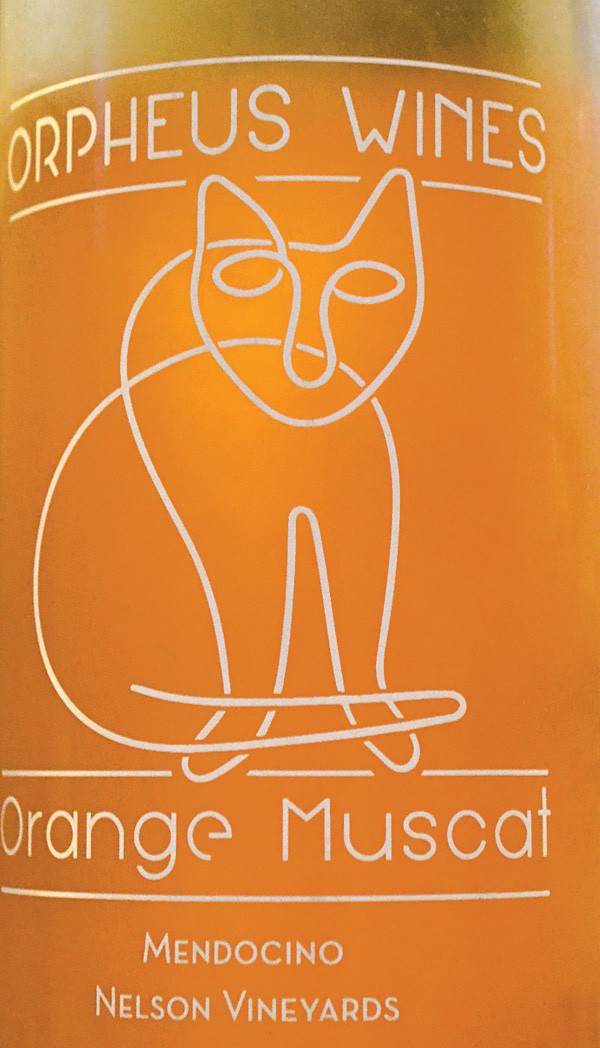
Orpheus Wines 2013 Mendocino Orange Muscat ($26) Our top qualifier this week is a basket case in a bottle. This wine showed up at our doorstep with its own, improvised warning label—besides the usual government one. Enclosed with a goofy spiral plastic cork called a Zork, this cat-themed wine (Muscat, anyone?) actually hisses when opened. Seems it was not done partying when put to bed, and woke up to the sound of bubbles. This “frizzante” character was a surprise even for its makers, an artsy, Kenwood-based family winery—hence, the warning label. Not really orange, it’s a light, medium-dry wine with a hint of pine spicing up an aroma that’s precisely like Orange Julius. A breakfast wine if there ever was one, sub it for mimosas. If this review is too quirky-ironic, here’s the takeaway: this is a thoroughly enjoyable, deliciously different wine, a unique and quirky find that’s actually earned those stripes. Meow.

Barrymore by Carmel Road 2013 Pinot Grigio ($14.99) If you think like me, you might have expected a Chardonnay for actress Drew Barrymore’s first co-branded wine, but if you like drinking the juice of canned fruit cocktail, you’ll be happy with this wine.

Cherry Tart by Cherry Pie 2013 California Chardonnay ($14.99) If you want to know if there’s a Rainier cherry character to this wine, the answer is no—and you are way too gosh darn clever for this wine lineup. This is a smoky, perfunctorily singed Chard with fresh apple flavors and few malolactic thrills.

Verse & Chorus 2012 Napa Valley Red Blend ($20) In this blend, purring with domesticated tannins, Merlot plays its natural part. With plush, sweet and plummy flavors, it’s fun to drink. Recording artist Mat Kearney has something to do with this wine, made in concert with Peju and John Anthony Vineyards.

Layer Cake 2012 Sea of Stones Mendoza Red Blend ($14.99) Smoky, meaty, a little sweaty, this Malbec-based blend inspires a picture from an old cookbook—you know, that thickly crusted roast surrounded by baked fruits, apples and carrots?

Educated Guess 2012 Napa Valley Merlot ($21.99) My educated guess about this wine turns out to be wrong: it’s not a sweet style. There’s more leather and bitter baking chocolate than plum sauce here, and the sticky tannin is lonely for want of more fruit extract. My second guess is, this is another post-Sideways Merlot that’s trying too hard to beef up and not be Merlot. Be yourself.

Pop Unplugged

0

Electro pop duo the Blow describe their sound as “intimacy made tangible.” Though their music has long been laptop-centric, the duo of Khaela Maricich and Melissa Dyne, currently based in New York City, are shaking up the format of their performance in a big way with a series of “unplugged” concerts.

“For us, this is really radical,” says Maricich (pictured, left) by phone while on tour in New Mexico. “We wondered what would it be like if we started playing instruments. It felt crazy at first.”

At a time when electronic music is becoming ever more prevalent, the Blow’s bold new direction is about as punk as it gets, stepping away from the familiarity of the laptop and exploring the openness of spontaneous live performance.

Covering the group’s entire catalogue, the unplugged shows are only increasing the intimacy and presence of the pair onstage. Working in tandem at their rig of synths and instruments, the pair put on a show that is anything but acoustic.

“There are actually about a hundred plugs going in, but this time we are making it happen live,” explains Maricich. “Melissa and I really have to tune into each other on the most delicate mental levels. We have to be present in that moment of the music’s inception.”

The Blow unplug the laptops on Wednesday, Feb. 4, at City Winery,
1030 Main St., Napa. 8pm. $13–$18. 707.260.1600.

Letters to the Editor: January 28, 2015

Strikingly Uninformed

I’d like to respond to Tom Gogola’s article concerning the expansion of the Rohnert Park Walmart (“Walmart Über Alles” Jan. 21) in which he cites Liza Featherstone as a source of insight into Walmart. For someone who wrote a book about Walmart, Liza Featherstone clearly has no clue about what the company offers its associates. It’s striking how uninformed she is on the topic of Walmart.

Walmart provides more opportunities for employment and advancement than other company in America. We provide people the opportunity to start at entry-level positions and advance. Approximately 75 percent of our store management teams started in hourly positions, and now make between $50,000 and $170,000 a year. This kind of opportunity is available to associates throughout the company. Last year, we promoted about 170,000 associates to jobs with higher pay and more responsibility.

Walmart pays competitive wages and offers benefits. Our average hourly wage for full-time associates in California is $13.31, and we offer both full- and part-time associates a variety of benefits, including quality healthcare starting around $22 per pay period for associate-only coverage, 401(k) with a 6 percent company match, 10 percent merchandise discount, education assistance and bonuses based on store performance.

Expanding the Rohnert Park Walmart will create 85 jobs. We currently employ more than 81,000 associates in California, and we’re on track to create hundreds of more jobs this year in communities across the state.

Walmart collected more than
$957 million in taxes and fees in
2014 on behalf of California and paid
$244 million in state and local taxes.

We are committed to meeting the needs of our Rohnert Park customers and providing a comfortable and convenient shopping experience. After 23 years in Rohnert Park, it’s time to make a change that will serve our customers and this community even better.

Walmart Director of Communications

Tiny Tom No More

Thank you, thank you, thank you, for finally making This Modern World big enough to read without a magnifying glass!

Sonoma

American Exceptionalism

Looks like American Sniper probably had a better week than you (“Shot Down,” Jan. 14). Here’s hoping anyway. Time for you to toss a few fusillades at the intelligence of the American public. I would imagine that’s right in the “wheelhouse” of you, Michael Moore, Seth Rogan and other soon-to-be-forgotten haters of American exceptionalism.

Mill Valley

Write to us at le*****@******an.com.

Words in Motion

0

Live storytelling backed by interpretive dancers might sound like bad performance art, but Ira Glass insists it’s a winning combination.

“It’s something nobody wanted to combine but us,” says Glass, host of NPR’s This American Life and co-creator of the traveling spoken-word-meets-dance show.

“I know it sounds awful, but it’s not pretentious at all.”

The touring show, “Three Acts, Two Dancers, One Radio Host,” comes to the Well Fargo Center for the Arts on Feb. 7. In it, Glass tells stories from his radio show while the dancers add an element of movement you’ll never get from the radio. The dancers are from New York’s Monica Bill Barnes & Co.

Glass saw the company once and said they were doing just what he does on his radio show, but without words—telling stories about human moments and having fun. After the show he approached Barnes about collaborating, and she immediately said yes. She had been looking for ways to expose dance to a wider audience.

“I approached her at exactly the right moment,” Glass says.

In May 2012, the two collaborated on three short dances, which were part of a This American Life variety show that played movie theaters nationwide. It was such a hit they decided to do a full show together. Some are performed together onstage by Glass, Barnes and dancer Anna Bass; others feature just the dancers or just Glass.

Glass says the hardest part was figuring out which stories to do. The natural choice was those that had movement in them, like, say, a story about an airport shuttle bus driver who goes and around and around. But that didn’t quite work, says Glass.

In the end, it’s personal stories and ones about being a dancer that worked best, he said.

While he used to create a new show every week for This American Life, he’s performed the storytelling-dance show about 30 times now. (He does it on weekends to allow him to continue doing the radio show). Bringing energy and humor to the same material for each night’s performance is new territory for him. But with his dance partners, they’ve developed a well-honed night of entertainment, Glass says.

“Everywhere we go, it kills.”

A Chef in Need

0

I wrote a profile of Mark Malicki a few years ago (“Hit the Jackpot,” Oct. 12, 2011) after becoming a fan of his cooking at Casino Bar and Grill. The restaurant-within-in-a bar was my favorite place to take friends from out of town for a slice of West County food and style. But as much as Malicki’s food, I was struck by his humble and gracious manner.

So last week I was sad to hear he’s suffering from late-stage Crohn’s disease and undergoing extensive surgery. But it’s been great to see Malicki’s friends and supporters in the food and wine industry rally around him to help. There’s a benefit dinner Jan. 31 at Casino. The three-course meal is being catering by chefs Brian Anderson (Bistro 29), Josh Silvers (Jackson’s) and Jenny Malicki (Zazu). Donors read like a who’s who of Sonoma County restaurants and wineries: Acre Coffee, Backyard, Farmhouse Inn, Atascadero Creek Winery, Guayaki, K&L Bistro, Peter Lowell’s, Merry Edwards Winery and many others.

For more info, go to www.facebook.com/events/1543325869241895.

If you can’t make the dinner, consider donating to his medical fund at www.gofundme.com/ka1iyg. Malicki is a generous spirit. Let’s give back to him.

Fair Share

0

Thanks to Airbnb, it’s easier than ever to find a room for the night in the North Bay. But local county governments have taken different approaches to the online short-term rental site. They’re eager for the additional tax revenues in Marin and Sonoma counties, and anxious to preserve housing in Napa County.

Sonoma and Marin counties have tried to level the playing field so that renters who register their business and pay the transient-occupancy tax (TOT) are allowed to do business.

But Napa County isn’t buying into the Airbnb model. The county limits vacation rentals of less than 30 days. The rationale has been to preserve the agriculture by keeping a lid on excessive short-term rentals—and to preserve the limited stock of affordable housing for the people who live and work in Napa County.

“Rental homes and Airbnb homes take up stock that can otherwise be used for working families,” says David Morrison, Napa County’s director of the county Department of Planning, Building And Environmental Services. Short-term rentals, he says, throw the county’s ratio of jobs-to homes ratio out of balance (it’s currently 1.4 jobs for every home).

“We are exactly where we need to be,” says Morrison “For us, it’s not a revenue issue, it’s a land-management and housing issue. In Napa County, our primary concern is housing, and that’s the driver here.”

Still, there are hundreds Airbnb listings for Napa County. Morrison says that since October, county code enforcement officers have been identifying “10 to 20 a week in terms of tracking them down and trying to discourage them.”

Sonoma County has meanwhile embarked on an audit of existing vacation rentals, and has identified, to date, 580 outliers in its midst. The county is working with landlords in order to get those much-desired TOT dollars.

The Airbnb climate is also amenable to short-term renters in Marin County. In 2013, Marin County offered amnesty to any persons operating an under-the-radar vacation rental and said they had to come forward or face sanctions that ran all the way to jail time.

The amnesty ran for a couple of months in late 2013 and yielded an initial 60 new operators on top of the 324 that had been registered by that point. By Nov. 2014, the number was up to 457 registered operators, “largely due to the continued effort of staff to enforce TOT compliance measures,” says Roy Given, director of finance for Marin County.

The Bohemian tallied at least a thousand listings on Airbnb in the county. Many are established and licensed players who are jumping on the Airbnb site to maximize their marketing. And those
include all the rentals in cities
like Sonoma, which set their own TOT rate.

Given’s office reports that TOT lodging across the county “generated tax of $2,632,324 in 2013–14, a jump of some $400,000 from the year before; $2.1 million was collected in District 4, aka the coastal wonderland of West Marin, in 2013–14.

Ramon Cadiz, president of the West Marin Chamber of Commerce says the Airbnb phenomenon is likely a net-positive for the county, which has experienced a huge uptick in tourism—and that most of the concerns he’s heard from hospitality businesses are about fairness.

Fairness in this case means: pay the 10 percent county occupancy tax that out-front operators pay.

“I don’t hear a clamor from anyone who’s saying this is undercutting my business because they’re not paying the 10 percent TOT,” says Cadiz. “None of those people seem to be howling for blood.”

Cadiz is a lifelong West Marin resident who recalls a time when the area was a tourist wasteland. “People couldn’t wait to get out of there. That’s changed.”

The Airbnb phenomenon, he adds, “coincides with several trends that have intersected—the foodie phenomenon, the bicycle phenomenon. The bicycle numbers are just off the charts here. People couldn’t get out of Marshall fast enough 30 years ago, but if you go there now, it’s just a traffic jam—bicycles, cars going to the oyster companies, the kayaking thing.”

Cadiz adds that the so-called golden age of the bed and breakfast has come and gone. “Now kids don’t want to stay in a traditional B&B. They just want the keys for the house, and they’ll pay the premium. They don’t need someone to make breakfast—’We just want to ride our bikes out to the point.'”

Sonoma County started taking a hard look at short-term vacation rentals last September, just as an annual report on tourism identified it as an emerging trend.

Paul Cocking, an official in the county’s investment and debt office, explains that county supervisors have worked to embrace the new economy legislatively.

Sonoma County wants to collect its share of the TOT from off-the-books operators, which is 9 percent in the unincorporated parts of the county.

The county reports that “Sonoma County’s transient occupancy tax receipts totaled $27.5 million in 2013 after adjusting for inflation. This is the highest level of TOT receipts that Sonoma County has ever received.”

And they want more.

The tourism report noted that “an increasing number of individual owner-operated short-term rentals are appearing in Sonoma County, and are being promoted through travel websites such as VRBO.com and Airbnb.com. Within these sites, individual owners are able to solicit travelers by listing their properties as either entire-home or private-room rentals, despite not being registered for TOT collection within Sonoma County.”

Cocking identified a two-fold push by county supervisors in coming months as they continue to work with the issues raised by the advent of Airbnb.

“First, how much of this is enough, or too much? We do have areas, Healdsburg and Sonoma, that have high areas of VRBOs, and that is definitely causing problems. Also, they are looking at the impact on affordable housing.”

Another issue is overall compliance with county regulations. The county gives its imprimatur to a vacation-home renter when the renter registers and the county collects the TOT—but there’s a gray area whereby in doing so, Airbnb listers may not be following the same health and safety guidelines required of, say, the Marriott Hotel.

“We do have a vacation-rental ordinance that covers that,” says Cocking, though he adds that the concern is “spot on—the rules and regulations that apply to a large establishment are definitely not being enforced, they may not be enforceable.”

The Sonoma County supervisors, he says, are looking to change the vacation-rental ordinance to include the “health and safety side of it.”

“It’s bigger than we thought,” Cocking says of the Airbnb phenomenon. “We’re looking to create as level a playing field as possible at this point.”

Cocking says he’s seen a big uptick in the number of people coming forward to comply. But he says the county is not ready to identify any gap between the collectible TOT and what’s actually been collected. The numbers are fluid and the audit is ongoing.

And he cautions that it’s unclear whether people coming in out of the cold were longstanding scofflaws, or if there’s that many new short-term landlords out there who are eager to take advantage of a booming tourist economy.

“The scofflaws we’ve caught, we’ve talked to, they either self-report or a neighbor rats them out,” he says. Eighty to 90 percent of the time they are unaware of the TOT, and they are usually very good about it. There is a small percentage seriously trying to undermine” efforts to bring everyone into compliance.

Cadiz in West Marin says Airbnb’s intersection with affordable housing isn’t problematic, as is the case in Napa.

The bigger issue, he says, are second homes that are unoccupied for much of the year. “The problem isn’t Airbnb, it’s empty houses,” he says.

Airbnb, he adds, “seems to be used by young, well-funded, tech-savvy smart people. These kids are younger than 30, and they maybe don’t know until Thursday where they are going to spend Friday night. ‘It’s not going to be foggy out in Bolinas this weekend, let’s see what we can book. And we’re going to book it right now.’ That’s the revolution.”

This is a big deal in West Marin. Last year the county collected $2.1 million in TOT revenues; the year before, it collected $1.8 million.

“They are clamoring for some of this money out here, because unincorporated West Marin costs more to the county than it earns for the county,” Cadiz says. Those costs include county money spent on civil service jobs, police and fire. “We spend more than we get, even given the property tax.”

Marin County takes in a half-billion in taxes a year, he says, “but two-thirds is already allocated. That’s why they are so interested in this TOT, this $1.8 million—this was an amount of money that never existed before.”

Airbnb is also just getting up to speed in the TOT collection game. “We have begun collecting and remitting these taxes on behalf of our hosts and guests in Portland and San Francisco and will take the lessons we learn there and move forward,” says an Airbnb spokeswoman via email, referencing those two cities recent TOT victories.

“We’ve had good conversations with officials in cities all over the world about these types of taxes, and even though this is a complicated challenge, we want to work together to ensure that tax rules for home sharing are clear, fair and easy to follow.”

Bloody Good

0

Director and producer William Lustig broke out on the horror film scene in 1980 with his gritty and gory debut feature, Maniac.

Hailed at the Cannes film fest, and reviled by American film critics, Lustig’s violent and stylized film remains a landmark in the genre for its unflinching performance by actor Joe Spinell (The Godfather, Taxi Driver) and special effects by Tom Savini (Dawn of the Dead). On Jan. 29, Lustig appears in Santa Rosa to screen all-new digital prints of Maniac and his follow up, Vigilante.

Speaking from his home in Hollywood, Lustig talks about how his passion for grindhouse translated into a lifetime of filmmaking and film preservation. Growing up in New York City, Lustig took in the spaghetti Westerns and Italian zombie flicks that played at grindhouse theaters on 42nd Street.

“I started working in the industry when I was in my teens, so there wasn’t really a long transition between fandom and actually working on movies,” says Lustig.

He first met Spinell while working as a production assistant on 1973’s The Seven-Ups. “We started talking about horror films,” says Lustig, “and like any horror film fan will know, when you meet a fellow horror film fan, you immediately bond.”

That bond led Lustig and Spinell to conceive and co-write Maniac, a film that mixed the pair’s love of horror films and fascination with serial killers. “The ’70s are what I call the golden age of the serial killer. We had Ted Bundy, we had David Berkowitz—you know, all these people that were really colorful and flashy. We had the idea that the central character would be a compilation of these killers,” recalls Lustig.

Lustig remembers Spinell’s commitment to the role and the film even during the dark days.

“He would say, ‘Bill, we’re making a happening. You don’t know it, but this movie is going to be an event.’ And he was right,” says Lustig.

With subsequent films like Vigilante and Relentless, Lustig made the movies he wanted to see. “I think of myself as being a pro-active fan. If it’s not out there, I make it,” he says.

In the past 20 years, Lustig has transitioned into film preservation with his company Blue Underground, considered by many to be the Criterion Collection of pop culture. This week, Lustig unveils new prints of both Maniac and Vigilante.

“I just made them literally last month. The quality should be outstanding. I haven’t even seen them yet, so I’m going to be watching with everyone else.”

Policing the Police

0

The Sonoma County Community and Local Law Enforcement Task Force met on Monday as part of an ongoing attempt to reform and retool law enforcement protocols in the wake of the October 2013 shooting death of Andy Lopez.

Much of the work of the task force—created by Sonoma County officials—has dealt with perceived shortcomings in the way the Lopez death was handled, and to study a set of issues put to them by Sonoma leaders: the feasibility of an independent citizen review body; recommended options for “community policing”; a deep-dive on the subject of whether the coroner’s office should be split from the purview of the sheriff’s office; and community concerns not otherwise included in the county to-do list.

Lopez, a young Santa Rosan, was shot and killed by Sheriff’s Deputy Erick Gelhaus, who believed the Airsoft rifle the 13-year-old was carrying was a real gun.

The state and now Sen. Barbara Boxer have taken up the issue of gun safety and toy guns. Last year, legislation mandating better identification markings on these guns was sponsored by State Sen. Noreen Evans and signed into law by Gov. Jerry Brown. Boxer’s bill follows on with a call to broaden the Evans bill to a national standard for fake-gun safety.

“No child should ever die because a police officer or anyone else mistakes a toy gun for a real weapon,” Boxer said in a statement. “This legislation will protect our kids and help law enforcement by making sure that imitation firearms cannot be mistaken for real firearms.”

Boxer said that she asked the Federal Consumer Product Safety Commission to review the Evans bill, designed to make sure that “toy guns are clearly distinguishable from real guns by requiring that all imitation firearms sold in the state be painted a bright color or feature bright fluorescent stripes.”

She asked the federal agency to adopt the California standard on toy-gun safety.

The task force’s job is of a different sort—concerned less with fake guns than with changing procedures in Sonoma County. One of its early recommendations sought to have Gelhaus removed from his job, but Sonoma District Attorney Jill Ravitch exonerated the deputy last July following an internal investigation of the events surrounding the tragic encounter with Lopez.

A core issue in the task force’s work: Who should investigate officer-involved shootings? The task force found the civil grand jury process not up to the task of investigating officers: “While [it] may investigate officer-involved fatalities, it does not have the resources to perform in-depth reviews or lengthy investigations
of every officer-involved fatality. . . . Find another mechanism for accountability in law enforcement other than the Grand Jury.”

The task force said on Monday that the Sonoma Coroner’s Unit should be divested from the Sonoma County Sheriff’s Office. The Coroner’s Unit is an investigative arm of the department; its staff is primarily Sonoma County law enforcement.

The task force cited the implicit conflict of interest: “Among the Coroner’s general duties, the Coroner is charged with the specific responsibility of determining cause of death in incidents where an individual dies while in the custody of the Sheriff or by actions taken involving employees of the Sheriff.”

They suggested a county office of the medical examiner could provide independence the necessary to ensure an unbiased evaluation of an officer-related shooting.

It will be up to the county supervisors to decide which, if any, of the recommendations are taken up legislatively.

An Interview with Grindhouse Director William Lustig

Director and producer William Lustig broke out on the horror film scene in 1980 with his gritty and gory debut feature, Maniac. Hailed at the Cannes film fest, and reviled by American film critics, Lustig’s stylized and violent film remains a landmark in the genre for its unflinching performance by actor Joe Spinell (The Godfather, Taxi Driver), special effects by Tom Savini (Dawn of the Dead) and its unique look inside the mind of a killer. On Jan. 29, Lustig appears in Santa Rosa to screen all-new digital prints of Maniac and his directorial follow up, Vigilante.

Speaking by phone from his home in Hollywood, Lustig talks to the Bohemian’s Charlie Swanson and Sonoma County-based blogger and horror film aficionado Eric Ritz about Maniac and how his passion for the grindhouse translated into a lifetime of filmmaking and film preservation.

Charlie Swanson: Talk to me about how you went from a fan of grindhouse movies to working in the industry.

William Lustig: Well, I started working in the industry when I was in my teens, so there wasn’t really a long transition between fandom and actually working on movies. I’d been a horror fan for as long back as I can remember, and I sort of started working in the business at the time when the ‘70s grindhouse movies were being released.

CS: How did you meet and befriend Joe Spinell?

WL: I met Joe Spinell when I was working as a production assistant on a movie called The Seven-Ups, and Joe was playing one of the thugs, and he was one of the most approachable actors on the set. We started talking about horror films, and like any horror film fan will know, when you meet a fellow horror film fan you immediately bond. So for many years, my goal was to be a filmmaker, and Joe and I stayed in contact.

We wanted to work together, and had tried to raise money from investors and were always frustrated, so we pulled our money together-myself, Spinell and Andrew Garroni- a grand total of $48,000¬–and we went out and shot Maniac.

CS: What first drew you to the story of Maniac?

WL: Well, first thing was I always believed in Joe and his talent. Having a horror film where he’s the focus of the movie is exciting to me. And Joe was fascinated by serial killers.

You see the ‘70s are what I call “the golden age of the serial killer.” Now a days serial killers are kind of boring, you see them on ‘Investigative Discovery,’ and it turns out to be the next door neighbor, or the creep down the street, but back in the ‘70s we had Ted Bundy, we had David Berkowitz, you know all these people that were really colorful serial killers. They were flashy for their day, so we had the idea that the central character would be a compilation of these killers.

Eric Ritz: I have a question regarding Spinell. At this point he was–not a star–but he was a recognizable face…

WL: Oh definitely, he was making serious coin as a character actor. In fact, what really showed me Joe’s commitment; obviously we weren’t taking salaries out of this movie, but Joe turned down $10,000 a week doing a Spielberg-produced movie, directed by Robert Zemeckis, called Used Cars. And it was because he was committed to Maniac.

ER: Was there any concern, because Maniac is a pretty harrowing movie, was there any worries that this would ruin anything he had going?

WL: You mean was he concerned for his image? The answer is no, and back then, you know Maniac might be a little extreme, but it wasn’t that much more extreme than Friedkin’s Cruising. People were making movies that were kind of out there. It was not a conservative period as far as filmmakers were concerned. In the public there was the rise in conservatism, but not in the industry.

ER: So Spinell just wanted to double down and be in Cruising and Maniac.

WL: He was! Literally, his check from Cruising went to finance his portion of Maniac. He signed it over, it right into our bank account.

CS: When you were shooting Maniac, did you have any idea it would go to Cannes and be this lasting, controversial film?

WL: Joe Spinell had an expression while we were making the movie. Now, Joe was very respectful of me as the director, he would also smoke pot and have some vodka, but he never was difficult or out of control. He was always there and present. And what he used to say to me in my darkest days making the film, because when you’re making a movie for $48,000 there are plenty of dark days, he would say, ‘Bill, we’re making a happening. You don’t know it, but this movie is going to be an event.’ I would be going ‘Yea Joe that’s great. Let’s just play 42nd St and Texas drive-ins and I’ll be happy.’ Sure enough, he was right. He really saw it, he saw that this movie would become, I have to say, a classic.

[jump]

CS: You followed up Maniac with Vigilante, can you tell me how that came about?

WL: I’ve always had a passion for the European spaghetti westerns and crime thrillers. I always thought they had an edge to the American crime thrillers post- French Connection/Dirty Harry/ Death Wish period. The films in Europe were rougher and more violent, more aggressive and very stylized; versus the American films that in many instances were almost TV-movie like. So, I decided to make an urban retribution film in that style and kind of thought of it as a cowboy and indian movie, with blue-collared people trying to survive in their neighborhood fighting against gang members.

ER: Did you have actors Robert Forster and Fred Williamson in mind for the movie?

WL: Actually both those guys were replacements for actors that either we let go or who dropped out, and it turned out to be the best thing that ever happened.

ER: That’s huge!

WL: I know! It was one of those things.

ER: And working with Robert Forster would be a continuing theme with both you and Larry Cohen (writer of Lustig’s Maniac Cop) for the next 15 years or so.

WL: Well you know Bob is a dear friend. And it came from working on the film together. I always love working with Bob. You know I introduced him to Quentin (Tarantino) and Quentin used him in Jackie Brown. It’s all interconnected.

CS: Let’s move on to your company Blue Underground, restoring and releasing cult films. Tell me about the passion you have for that now.

WL: Almost in the same way I made Maniac, I think of myself as being a pro-active fan. If it’s not out there, I make it to be able to see it. Maniac was the result of that, Vigilante was the result of that; all of these were movies I wanted to see, so how about we just make them?

What happened with Blue Underground was there were a bunch of movies that I felt were neglected. There was Criterion giving tender loving care to the Fellini movies, the Truffaut films. And rightfully so. But there was nobody who was giving that same kind of attention and care to pop culture. And that’s where I saw my niche, giving pop culture movies that same attention and respect.

CS: Can you tell me a little about the process of restoring these films, are you finding them in poor shape and starting from scratch?

WL: Yea, it’s sad because, the negatives-all these movies were shot on film- the negatives are deteriorating. In one instance, a negative was completely destroyed during Hurricane Sandy, and now it is gone forever.

ER: Which film?

WL: Fight for Your Life, with William Sanderson. I’m currently doing the restoration for that, and I’m doing it with what materials exist. After I did a first digital transfer of the film, I sent the negative back to the licensor and they put it in their basement, and that negative was washed away.

The thing about it is, at least the studios have started doing this “burn on demand” service. We’re fortunate that studios are digging deep in their catalogue, probably because of TV stations like TCM, which support the cost. I think Warner does it correctly, and so does Sony; but FOX is an abomination. I hate FOX for this; with all their money they can’t really preserve their catalogue movies? It’s just terrible.

CS: Are you all right with us printing that?

WL: Yes! I hope you do, and I hope it resonates with them. I think they really need to get it right.

ER: Well I love that Blue Underground as a company has lit a fire under this movement. Has it gotten more difficult to secure the rights to these films you want to release?

WL: Well, definitely I spawned competition. I know I did. Shout Factory, Kino Lorber. But I’ve come to realize they’re in a different business that I’m in. They secure rights to studio films, and I honestly don’t know how they make any money doing that. They are short term, high royalty license deals, but I guess they get their releases into the big box stores and make money. I’m not in the big box store business. I’m in the collector business.

CS: So, you’re bringing Maniac and Vigilante to Santa Rosa…

WL: I’m so excited for it, I don’t know if you guys know, but I’ve been vacationing there two or three times a year for the last five years. I go to the Summerfield and the Raven. I love it; I go there all the time. I’ve also been to the Rio Theater a few times, I love that place. I love it up there, man. I want to give a shout out to some of my favorite restaurants. Hole in the Wall in Sebastopol, and Howard’s Station in Occidental. People can find me there, either one, for breakfast.

CS: What are you most excited about for the screening itself?

WL: This is the premiere screening of the new Digital Cinema Package (DCP) of Maniac and Vigilante. This is not going to be some DVD playing, we actually made full blown DCPs of both films, I literally just made them this month, and this is the very first time they are being shown. I’m going back and making DCPs of my films. DCPs are optimum quality and it makes the movies more accessible for theaters to afford to play them. The quality should be outstanding; I haven’t even seen them yet so I’m going to be in the audience watching with everyone else.

‘Maniac’ and ‘Vigilante’ screen with Lustig in Q&A on Thursday, Jan 29, at Roxy Stadium 14, 85 Santa Rosa Ave, Santa Rosa. 7pm.

Black Map to make their debut at Phoenix Theater Jan. 23

By Eddie Jorgensen
If you haven’t heard of Black Map, chances are you’ve never listened to the members’ former bands which all have distinct fan bases of their own. Drummer Chris Robyn played with Far which released two albums through Immortal/Epic records, guitarist Mark Engles has played with Dredg since the band’s inception, and bassist/vocalist Ben Flanagan played with The Actual and Trophy Fire.
Black Map shows some immense musical depth with their latest album on minusHEAD records, ‘…And We Explode.’ And while the album was released in October 2014, the band is just starting to play out live.

Black Map is Chris Robyn, left, Ben Flanagan and Mark Engles

Even before the release of the band’s album, the group landed a coveted slot on a national tour with Chevelle. “The experience with Chevelle was better than anything I could have hoped for,” said Robyn. “Chevelle are great. They are genuine and were incredibly generous to provide a stage for us to share. Far (Robyn’s previous band) fans did come out and it made me incredibly proud of what I spent so many years doing. It has been a good while since those years and people who witnessed it then, or did not get a chance to, came out and it was an extra reward for me to hear from them and talk with them.”
The songwriting process, as well, has been very organic and the members are already starting the writing process for a follow-up.
“Typically Ben and/or Mark have a piece of music that they introduce. I just try to empty my head of any predetermination, find the base/core rhythm of the piece, dive in full on, and allow myself to find a pattern that is musical, exciting, and purposeful” said Robyn. “Sometimes it comes quickly. Sometimes it takes a little bit. I try not to over think parts or beats, as history has taught me that if I over think something it will usually, in the end, be the most stale part or parts of a given piece of music. It’s a fine line, but that’s the rewarding part of writing music.”
However, personal interests can get in the way of a song structure but rolling with the changes has made Robyn’s life in Black Map easier.
“Ben and Mark will always chime in on where I am going with something, whether it be minor tweaks or to let me know I am way off base,” he says. “I welcome any and all of their input. We constantly feed off one another during the writing process.”
And while most bands would readily assume signing to a major label deal is still where it’s at, Robyn knows otherwise.
minusHEAD (band’s current label) has been great. They have been incredibly supportive and we have a shared vision on the exploitation of Black Map” he said. “Although it is substantially less expensive now to record and people can experience music in so many different ways, I don’t see things for a band much different than back in the day. You just have to go out there and do the work no matter who you are. Label support, whether indie or major, is great but never a guarantee for success, whatever you deem success to be.”
Black Map play Friday, Jan. 23 at the Phoenix Theater in Petaluma with The Iron Heart, French Girls, and We Are Invisible Monsters. 8
pm. $8. All ages are welcome. 201 Washington Street, Petaluma. 707.762.3565.

Quirky Quaffs

Some wines try hard to charm you with their uniqueness and their quirks; others just win on charm without trying too hard. Orpheus Wines 2013 Mendocino Orange Muscat ($26) Our top qualifier this week is a basket case in a bottle. This wine showed up at our doorstep with its own, improvised warning label—besides the usual government one. Enclosed with...

Pop Unplugged

Electro pop duo the Blow describe their sound as "intimacy made tangible." Though their music has long been laptop-centric, the duo of Khaela Maricich and Melissa Dyne, currently based in New York City, are shaking up the format of their performance in a big way with a series of "unplugged" concerts. "For us, this is really radical," says Maricich (pictured,...

Letters to the Editor: January 28, 2015

Strikingly Uninformed I'd like to respond to Tom Gogola's article concerning the expansion of the Rohnert Park Walmart ("Walmart Über Alles" Jan. 21) in which he cites Liza Featherstone as a source of insight into Walmart. For someone who wrote a book about Walmart, Liza Featherstone clearly has no clue about what the company offers its associates. It's striking how...

Words in Motion

Live storytelling backed by interpretive dancers might sound like bad performance art, but Ira Glass insists it's a winning combination. "It's something nobody wanted to combine but us," says Glass, host of NPR's This American Life and co-creator of the traveling spoken-word-meets-dance show. "I know it sounds awful, but it's not pretentious at all." The touring show, "Three Acts, Two Dancers, One...

A Chef in Need

I wrote a profile of Mark Malicki a few years ago ("Hit the Jackpot," Oct. 12, 2011) after becoming a fan of his cooking at Casino Bar and Grill. The restaurant-within-in-a bar was my favorite place to take friends from out of town for a slice of West County food and style. But as much as Malicki's food, I...

Fair Share

Thanks to Airbnb, it's easier than ever to find a room for the night in the North Bay. But local county governments have taken different approaches to the online short-term rental site. They're eager for the additional tax revenues in Marin and Sonoma counties, and anxious to preserve housing in Napa County. Sonoma and Marin counties have tried to level...

Bloody Good

Director and producer William Lustig broke out on the horror film scene in 1980 with his gritty and gory debut feature, Maniac. Hailed at the Cannes film fest, and reviled by American film critics, Lustig's violent and stylized film remains a landmark in the genre for its unflinching performance by actor Joe Spinell (The Godfather, Taxi Driver) and special effects...

Policing the Police

The Sonoma County Community and Local Law Enforcement Task Force met on Monday as part of an ongoing attempt to reform and retool law enforcement protocols in the wake of the October 2013 shooting death of Andy Lopez. Much of the work of the task force—created by Sonoma County officials—has dealt with perceived shortcomings in the way the Lopez death...

Black Map to make their debut at Phoenix Theater Jan. 23

By Eddie Jorgensen If you haven't heard of Black Map, chances are you've never listened to the members' former bands which all have distinct fan bases of their own. Drummer Chris Robyn played with Far which released two albums through Immortal/Epic records, guitarist Mark Engles has played with Dredg since the band's inception, and bassist/vocalist Ben Flanagan played with The...
11,084FansLike
4,446FollowersFollow
6,928FollowersFollow