(Flu) Free Birds

0

Since the start of the current U.S. avian flu outbreak in December, more than 46 million chickens, turkeys and ducks—about one-third of the processed egg supply—have been culled to fight the virus.

“Because of the outbreak in the Midwest, people are on their toes and there’s a heightened sense of urgency because these are very virulent viruses,” says Sonoma Country agricultural commissioner Tony Linegar.

But so far the North Bay has avoided the problem.

Wild birds spread the virus to domestic flocks through contact or contamination in shared waterways. The Centers for Disease Control says the risk for human infection is low, and no human cases have been reported.

“We have two fairly good-sized egg-laying operations in Petaluma,” says Linegar. “We’re increasing our biosecurity measures now just as a precaution.” Precautions include egg inspections, footbaths for those who enter facilities, and washing vehicles.

Prices of larger egg brands have already increased as the supply of hens has dropped. To help baking industries, the USDA allowed pasteurized egg imports from the Netherlands, the only country other than Canada from which the United States imports eggs.

Though most avian flu cases are in the Midwest, one reached a Foster Farms turkey ranch in Stanislaus County in January. “California is much more experienced at dealing with these sorts of outbreaks,” says Linegar. “It’s good that we don’t have clusters of large poultry operations all together.”

At Sunrise Farms in Petaluma, which more than 1 million hens call home, managing partner Arnie Riebli says they’re taking extra precautions in washing down the facility.

“If a chicken gets it, she’s going to die,” he says. “It has nothing to do with eggs.”

Riebli says chickens and other poultry are less susceptible to the virus than turkeys. The largest concentration of turkeys are in the Upper Midwest—Michigan, Minnesota and Wisconsin.

Decentralized poultry operations limit the threat of flock-to-flock spread, but wild birds still pose a threat. “It just takes one bird to get in the pens,” says David Marson, a sales clerk at Western Farm Center in Santa Rosa, where they incubate eggs and inspect backyard chickens brought in by the public.

The store also put up a net to protect its birds from interacting with wild species. Marson speculates that climate could play a role in the severity of the outbreak in the Midwest, where winter temperatures are much lower and favor the virus. The USDA predicts the hot, dry summer months will help kill off the rapidly mutating virus.

At Salmon Creek Ranch in Bodega Bay, the threat of wild birds passing along the virus has raised concern. Jocelyn Brabyn, daughter of owners John and Lesley Brabyn, says that since the recent outbreak they’ve built a prototype flight pen to keep their ducks safe from contact with wild birds. The ducks aren’t crammed into pens and have room to roam the pasture and supplement their feed with bugs.

“Our ducks are eating worms out there in the grass,” Brabyn says. “Places that are raising birds naturally have better immunity.”

Dark Matter

0

‘We’ve been signing things left and right,” says author and publisher Ross Lockhart, describing the terrifying process of buying a house in Petaluma. “Tomorrow, we’re signing something else—and then we wait until we get the word the house is empt,y and we can finally move in.”

Buying a home, for most people, is always a bit scary and more than a little stressful. For Lockhart, who’s been living with his wife in a slightly gothic and gabled rental that used to be a church, the move marks a shift in identity.

“‘Lives in an old church’ has been part of the professional bio I’ve run in books and things for so long,” he says, “it feels a little boring and mundane to say I’m moving to a ‘normal’ house.”

Adds Lockhart, “I can only hope it turns out to be haunted!”

The distinctively goateed and pony-tailed Lockhart, who works part-time as a bookseller at Copperfield’s Books, has been writing stories about ghosts, werewolves, monsters, time travelers and ethereal netherworlds pretty much since he learned to write his ABCs. His colorful and imaginative fiction has appeared in various magazines and book anthologies.

Two years ago, after several years spent working as an editor for small but high-profile genre publishers, Lockhart made a truly scary move and started his own company, the Petaluma-based Word Horde. With a name taken from the epic poem Beowulf—”The eldest one answered him, leader of the troop, unlocked his word-horde”—the boutique publisher (www.wordhorde.com) was founded, as the website proclaims, “to fight the continuing battle against monotony, mundanity, and the forces of darkness and illiteracy.”

“Basically,” Lockhart explains, “I wanted to create the kind of company I would want to be published by—a company that would be upfront about reporting numbers to authors, that would be honest and above-board, and would put as many resources as possible into making the book look as good on the outside as it reads on the inside.”

Word Horde launched in 2013 with just one book that year, Tales of Jack the Ripper, an anthology of stories inspired by the world’s most famous serial killer. Critically acclaimed, the delightfully grisly paperback was followed in 2014 by two more titles, which included the juicy horror anthology The Children of Old Leech: A Tribute to the Carnivorous Cosmos of Laird Barron.

Last month, Old Leech—which Lockhart co-edited with Justin Steele—was nominated for a prestigious Shirley Jackson award for best edited anthology. The nomination thrusts the fledgling company alongside some of the best-known publishers of horror, science-fiction and fantasy around.

The increased attention couldn’t be better timed, as Word Horde moves through its most ambitious year, with plans to publish five new titles by the end of 2015.

The first, Molly Tanzer’s Vermilion, a fantasy novel best described as a “steampunk Western,” was released earlier this year, and is already easily the company’s biggest hit.

Another collection—the Lockhart-edited Giallo Fantastique: Tales of Crime and Terror—has been garnering strong reviews since being released last month. With three more titles lined up to hit stores before the end of the year, including August’s much-anticipated H. P. Lovecraft homage The Cthulhu Fhtagn!, tiny little Word Horde, like many of the monsters loved by Lockhart’s growing stable of authors, has been making a large and conspicuous uproar.

Vermilion, in particular, is exciting for us,” says Lockhart, “because it was just released at the beginning of the year, but it’s already finding a large audience. NPR did a feature on it. It’s gotten other major coverage. It’s been getting great reviews, and people have been flocking to it… I immediately wanted to put it out in front of people and say, ‘Hey! Look at this. You’ve never seen anything like this.'”

Tanzer, it should be noted, has a short story in the aforementioned Cthulhu anthology and another in Old Leech. Laird Barron, whose writing style inspired Old Leech, has stories in several of Word Horde’s collections, starting with Jack the Ripper. The list of repeat players illustrates a major part of Lockhart’s vision: to build relationships among a team of writers whose names will become intimately associated with the dark subject matter and general literary quality of Word Horde.

“Part of the fun of being a publisher,” says Lockhart, “is being able to say, ‘Look at this cool stuff my authors are doing.’

“Artists are fragile creatures,” he adds. “So being a publisher is a lot about reassuring them, telling them over and over that, come hell or high water, their hard work has been worth it, that we are going to get their book out in front of an audience that doesn’t yet
even know it’s been waiting to read it.”

Giant Steps

0

Formed a little over two years ago, the locally grown jazz ensemble the Dixie Giants have won a vibrant fan base in the North Bay with their busking style and ability to start a party under any condition. A popular sight everywhere from foodie fests to standup showcases, the young group kicks off a summer tour at HopMonk Tavern in Sebastopol with music from a new album.

Formed by banjo plucker Dan Charles, clarinetist Casey Jones and sousaphonist Nick Pulley, the Dixie Giants are a strong septet of music students, educators and the requisite winemaker, who emphatically embrace the boisterous and raucous aspects of New Orleans jazz.

Pulley first fell in love with the sound when, as a student music teacher, his class came back from a trip to the Big Easy and begged for some funky Dixieland. “When I sunk my teeth into it, I thought it was the greatest thing ever,” says Pulley. “It was fantastic.”

“It’s hard to sit and play this music,” Pulley continues. “The tunes are geared for a parade atmosphere.” To that effect, the Dixie Giants have made a name for themselves with hyperactive live shows that involve improvisation and dancing with the crowd.

Now the group takes its music into uncharted territory when they pile into a van and head to the Pacific Northwest. “We’ve played as far south as San Diego,” says Pulley, “but I don’t think we’ve ever gone north of, gosh—Cloverdale?”

This summer the Dixie Giants embark on a six-state tour that will see them hitting hot spots like Portland and Seattle as well as towns like Missoula and Spokane, where they’ll be playing the streets as much as the clubs. And just in time for the tour, the group has their sophomore album, A-Salted, available for download.

“It’s a pretty bad pun,” laughs Pulley. The story goes that the band was playing alongside a burlesque dancer at Lagunitas last year when a disgruntled audience member threw a salt shaker in protest. “What’s crazy is that she got arrested for assault. You can’t make this up.”

A-Salted features 10 terrific tracks with six original compositions alongside the band’s kinetic take on classic standards. Vinyl pressings will be on the way soon; for now, the group will have downloads available when they get the send-off treatment this week. Folk-rock friends Trebuchet open the show.

The Dixie Giants perform on Friday, June 12, at HopMonk Tavern,
230 Petaluma Ave., Sebastopol. 9pm. $10–$12. 707.829.7300.

Airbnb Bill Shelved

0

Now, don’t be sad. Two out of three ain’t bad.

Freshman State Sen. Mike McGuire’s office sent us a trio of emails late last week with updates on bills he introduced. The man has definitely taken on some big-ticket issues of statewide concern in his short time in Sacramento—omnibus bills covering medical cannabis, short-term vacation rentals, offshore drilling—but that middle one didn’t make it out of the Senate last week.

We wrote about McGuire’s short-term vacation rental bill, SB 593, a couple of weeks ago (“Short-Term Solution,” May 27) and reported that the Healdsburg Democrat had to contend with the California Association of Realtors (CAR) and their push to be excised from the bill.

The bill aimed to set a statewide template that would compel Airbnb and other short-term-rental platforms to supply the state with basic information about their users’ home-business: How many people did you host, how much did you charge per night?

The idea seemed simple enough: SB 593 set out to “assist local jurisdictions in their regulation of local laws and collection of tourist taxes,” says the press release.

This paper couldn’t help but note that CAR was one of the top-tier contributors to McGuire’s 2014 senate campaign, at $16,750, and that the organization would oppose the bill unless Realtors were eliminated from the reporting requirements—on the logic that they’re already licensed by the state and shouldn’t get lumped in with the next-door neighbor who uses Airbnb to help make the monthly nut.

McGuire told us he would offer an amendment to scrub Realtors from the scope of his bill by
June 5, the deadline for such things in the Senate. On June 4, he said he’d reintroduce SB 593 in January as a two-year bill. That’s where the story ended, at least for now.

Meanwhile, support for SB 593 had grown. Sen. Dianne Feinstein supported it, as did more than 100 organizations from around the state with various dogs in the hunt: affordable housing advocates wanted it; lots of city and municipal leaders wanted it; police organizations wanted it—business, labor, you name it.

The bill had also been passed out of the Senate Transportation and Housing Committee, and the Governance and Finance Committee.

McGuire recently told us that CAR would support SB 593 with the amendment; the Realtors’ lobby told us it would push for the amendment as a condition of not opposing it.

One SB 593 opponent on the Governance and Finance committee vote was Sen. John Moorlach, R-Costa Mesa, whose office gave some perspective on why it may have stalled. Moorlach chief of staff Tim Clark says the McGuire bill “didn’t have a chance in the Assembly. It didn’t feel baked all the way. On the Assembly side, it probably wouldn’t make it out of committee.”

Clark says the pushback on SB 593 was around over-regulating a homegrown business, such as Airbnb, that represents the best of the sort of techno-innovation that lawmakers should support.

McGuire’s press release emphasized that he was “unable to find common ground prior to the Senate’s legislative deadline.”—Tom Gogola

Tanked

0

At first, it was a hassle with a jammed bottling line, not the environment, that inspired Jordan Kivelstadt to go into the wine-on-tap business. Seeing one of the stainless steel kegs that winemakers use to store barrel-topping wine, the 30-something entrepreneur thought, why not just put it into one of those? Today, Free Flow Wines puts wine in over 80,000 of those.

Restaurant patrons also have some good, self-interested reasons to order wine by the glass from a keg: busy restaurant staff don’t always place the highest priority on properly storing open bottles. Serving fresh wine from a pressurized keg, much like beer is served in bars and restaurants, eliminates that problem.

But it creates another problem for wineries: how to get your kegs out to—and back from—an industry that only knows glass.

“In our world, we signed up to take that pain,” says Kivelstadt. “Most wineries didn’t make that deal.”

From their warehouse in Napa, Free Flow fills and distributes kegs for its clients in a streamlined supply chain that started with an improvised $450 keg filler on a sawhorse in 2009—Kivelstadt stashed the first 80 kegs of Merlot and Sauvignon Blanc in co-founder Dan Donahoe’s San Francisco garage. Key to their success is that this isn’t another way to sell jug wine. Customers who feel iffy about drinking wine from a tap may be reassured to find familiar Napa Valley names like Peju Province, Hall and Frog’s Leap on offer.

Critics of the wine industry’s environmental impact often point to the vineyard, but 70 percent of the wine industry’s carbon footprint comes from the packaging, according to Kivelstadt. “So far,” he says, “we’ve taken over 5 million bottles out of landfill.” Over the life of a keg, which is 30 years, Free Flow claims a 96 percent reduction in CO2 emissions.

Already on the favorable side of the heroes-to-zeros spectrum, one question dogged them: What about all the water they use to wash and sanitize the kegs? Kivelstadt and his director of operations implemented a wastewater system that recycles 99.5 percent of their water—over a million gallons a year they’re not drawing from the municipal system.

Now, if some genius can just get restaurants to stop serving good wine in little glasses that are filled to the brim . . .

Free Flow Wines, Napa. 415.626.1215. Restaurants serving Free Flow clients’ wine on tap include El Dorado Kitchen, Santé at the Fairmont Sonoma Mission Inn, Oso, Solbar, Sam’s Social Club, R&D and Kitchen Door. www.trywineontap.com.

Hot Pockets

Government efforts to slow climate change have been so ineffectual that the call has gone out to overhaul the American political and economic system—before global warming renders the planet, and the North Bay along with it, uninhabitable.

The writer Naomi Klein has argued that rightward-leaning citizens resist climate-change policies because they recognize them as a threat to unfettered consumption and capitalism. Climate change is a direct consequence of this. But the grim face of climate change glowers over the banquet table. The party’s over, and that’s not easy to accept.

And so this spring a group of academics launched the Next System Project. Gar Alperovitz, author of What Then Must We Do?, called on think tanks, activists and grassroots visionaries for ideas. Hundreds of writers, scientists and activists signed the Washington, D.C.–based organization’s petition, among them North Bay peak-oil author Richard Heinberg (find the petition at thenextsystem.org; see sidebar for more on Heinberg).

Heinberg, a senior fellow at Santa Rosa’s Post Carbon Institute and author of 12 books, does not mince words: “If we were going to arrest climate change, we would have started two or three decades ago.”

Instead, we now face spiking temperatures, weird weather, rising sea levels, species die-offs and ocean acidification. Capitalism as a system has failed to address climate change—because capitalism is premised on the idea of unlimited growth and easy credit, says Heinberg.

“We built our economic institutions around consumption based on cheap energy and stoked it with advertising,” says Heinberg. “We just can’t continue to grow.”

The economy is in crisis, says Heinberg, and collapse looms. “We’re not very far away from it,” he says. “Two or three years.”

Sustainability as currently practiced is of no use, Heinberg argues, unless “we move toward deep sustainability rather than fake sustainability. Fake sustainability asks, ‘How can we sustain what we’re doing right now?’ The answer is: ‘We can’t.’ Resilience is a more important term than sustainability. Resilience is being able to absorb shocks and continue functioning.”

Americans are used to getting what we want, and many among us have trouble facing the implications of climate change. But while he acknowledges the perils of the climate crisis, Michael Shuman does not think the economic system is not about to unravel.

Shuman is an economist and also a fellow at the Post Carbon Institute. He’s the author of Local Dollars, Local Sense, his eighth book. Like Heinberg, he is a committed proponent of localism. But Shuman does not believe all is lost under the remorseless yoke of capitalism.

“Yes, many features of doing business-as-usual will have to change. But there’s a lot to be said for a healthy private marketplace with government setting the rules, and a high degree of decentralization.

“I think scenarios of economic collapse are the Y2K of the environmental movement,” Shuman adds, referring to the turn-of-the-last-century panic over the computer glitch that wasn’t. “People predict catastrophes that just never happen. We’re a big economy with many working parts. Chances are things are going to go wrong slowly rather than all at once. More self-reliant local economies will make life easier and safer.”

Local business is the core driver of our economy, and Shuman says that the more self-reliant our local economies can become, the better able we’ll be to weather whatever climate-change calamities loom around the bend.

As Shuman explains, the vast majority of local businesses
(about 99 percent) have fewer
than 500 workers—yet they provide 90 percent of all jobs.

“Over the last 20 years, if local businesses were really becoming less competitive,” says Shuman, “we should have seen a shift from small to large, and while many people believe this is the case, empirically it’s not true.”

Locally directed spending more than doubles the number of dollars that circulate among community businesses. Economists call it the multiplier effect. The Sonoma County Food Action Plan noted that if an additional $100 million of locally produced food were consumed in the county, local economic activity would increase by $25 million.

And localization nurtures diversity as it fosters accountability. “If a CEO of a company behaves badly, he is exposed to the ire of the community,” says Shuman. Shame is a powerful motivator. He adds, “Localization is the ticket for expanding global wealth and even global trade, so long as it is less intensive in nonrenewables.”

[page]

There are local enterprises all over the place in the North Bay, poking up like mushrooms in fecund soil. But the localism movement in Sonoma County is so decentralized that it’s hard to describe, says Marissa Mommaerts, who works with the Sebastopol-based Transition U.S.

The Transition Town movement began in Ireland in 2005. Its core tenet is to build resilient person-to-person networks in communities. Irish neighbors worked together to install organic gardens, share skills and tools, and enjoy the fruits of their labor in community get-togethers. The movement is now global.

Mommaerts keeps the dismal specter of climate change firmly in view. She gave a talk recently at Chico State University and said, “If we act alone, it will be too little. If we wait for government to act, it will be too little too late. But if we come together to act as a community, it could be just enough, just in time.”

Mommaerts is 28 years old and hails from Wisconsin. Her main goal is to “slow climate change, adapt to impacts and have something left standing on the other side.”

She says the American economy is “at the root of our ecological and economic crises” and says a growing movement is redefining investment so it is about more than profit, and that “extra profit is reinvested in the community.”

The North Bay is fertile ground for this kind of work. Kelley Ragala is a cofounder of GoLocal, a point-earning network of local businesses. Now she’s now engaged in a new project, North Bay Made, to promote Northern California products. Oren Wool, another inspired North Bay visionary, coordinates the Sustainable Enterprise Conference, now in its 10th year with 160 participating companies.

“Companies that are sustainably run are our best community citizens,” says Wool. The Sustainable Enterprise Conference is intended, he says, “to help people find new ways to keep their money active locally. In America, one of our biggest problems is economic stratification. A sustainable community would be addressing that. If we had built companies to address environmental problems, we wouldn’t have climate change.”

Farms remain the heart of the local network. Petaluma Bounty is a small urban farm which has helped start eight other farms that are now independent. The group partners with the Petaluma Health Center to host an eight-week program that serves youth at risk of obesity. The program starts with an invitation to the farm so young people can see how their food is grown. There’s also a “produce prescription program” for needy patients, which lets practitioners write a prescription for $10 of organic produce, to be filled at the farm.

Suzi Grady is the director of programs at Petaluma Bounty, which along with dozens of other organizations is a member of the Sonoma County Food System Alliance. “You can talk until you’re blue in the face about how things aren’t working,” she says, “and until you put your energy into an alternative that does work, you’re just blowing hot air.”

Grady is not blowing hot air—Bounty’s programs reach deep into the community. The alliance has endorsed Sonoma County’s Food Action Plan, a landmark collaboration of stakeholders throughout the county food system, which is funded by the Health Action Initiative, a county-wide effort to “develop a framework for a community engagement effort to get people involved in creating a healthier Sonoma County.”

[page]

“The [Sonoma County] health department had great foresight in seeing the link between diet and health,” says Grady. “Sonoma County is considered the foodie destination of the U.S. We’re selling this image, but how do we make it work for everyone? I think we’re ready to have that conversation.”

It’s fitting that an emergent localized economy started around food. The entire purpose of an economy is to provide for needs, as “slow money” investment specialist Marco Vangelisti explains in presentations for Transition US.

Our economy is in trouble and its precarious condition is largely due to its reliance on debt. “People think that the government creates money,” Vangelisti says, “but it’s the banks that create money, and they create it from debt.”

Food, yes. But what of wine?

Back in 2011, the Napa Valley Vintners (NVV) association ordered a study on climate change in Napa Valley, to figure out what the actual impact could be for winemakers. It found that there was a slight uptick in nighttime temperatures for part of the year.

“We can all agree that something is going on with the climate in our world,” says Patsy McGaughy, communication director at NVV. “In Napa Valley, we are trying to figure out what that means.”

The Napa Green Winery and Napa Green Land programs predated the organization’s climate change study by a few years—and set out to help Napa wineries reduce energy use, water use and waste, McGuaghy explains.

Michelle Novi works in industry relations at NVV and is known as the “queen of green” there. She helps participating vineyards get the coveted certification from Napa Green Winery or Napa Green Land. Vineyards and wineries get a three-year certification from Napa Green Winery only after the county Public Works Department does its own audit. It’s a tough and coveted designation, and a vineyard that wants to re-certify has to “do even better than you just did,” says McGuaghy.

The organization hopes to get all its members certified by 2020 (there are more than 500 of them). This April, it highlighted several vineyards for work they’ve done to take up the climate-change call. Among them was Honig Vineyard & Winery in Rutherford, which installed solar fields and got hooked into Marin Clean Energy. And the winery bought a company car for errands—a Nissan Leaf, natch.

Enter the next-economy movement, where optimism splashes forth from all quarters—a refreshing and diverse development. But if governments and big corporations continue to push policies that contribute to climate change, will local efforts do any good?

Trathen Heckman is the founder of Daily Acts, best known for its annual Community Resilience Challenge in which folks make pledges to save water, grow food, conserve energy, reduce waste or build community. The program has grown from 628 pledges nine years ago to 6,500 this year, and has spread to Humboldt and the East Bay through Transition US (Heckman is on the board).

“People say, ‘What if climate change is a hoax?’ If people are healthier, happier, living in community, growing food like this,” says Heckman, “it’s just the best and the right thing to do either way.”

Heckman advocates for the Gandhian idea to “be the change you want to see in the world.” He boasts the first permitted graywater system in Sonoma County and worked with a local group to change state policy on graywater. Daily Acts (see the Bohemian, “Beat the Heat,” June 11, 2014) is as engaged as can be with agencies at every level to further the lifestyle Heckman models with his family: low consumption of water and energy, growing food instead of ornamentals and, naturally, building community.

The folks at Sustainable Fairfax recently hosted a panel discussion with Heckman where he gave the good word on graywater systems, says executive director Jennifer Hammond.

“We need to look at how we localize, prioritize and manage water,” she says. “As climate change accelerates, we expect the drought to continue to worsen.”

Sustainable Fairfax has been around for over a decade and was founded by two women whose main concern was climate change. Those women, Rebekah Collins and Odessa Wolfe, had a big role in getting the county’s landmark community-choice-aggregate Marin Clean Energy (MCE) off the ground.

Climate change “has been a driving force in everything we do,” chimes in Fairfax vice mayor and Sustainable Fairfax voluneer Renee Goddard at the nonprofit’s office in downtown Fairfax.

Rather than eco-shame luxe Marin County residents, Sustainable Fairfax leads by example. As the organization was prepping for an upcoming rollout on a big transportation initiative to get people to leave their cars at home a couple days a week, Hammond and Collins took their bikes, and then public transportation, from Marin to Sacramento for a transportation conference. “We had to make a lot of connections,” says Hammond. “It was kind of a blast.”

Goddard ticks off the trip: “Bike, bus, BART, train, walk, run.”

The emphasis, says Goddard, is in getting people to take stock of the very small things they can do—simple things, such as which disposable coffee cups are compostable? It’s tricky.

“We are big on educating people to affect and mitigate impacts of the climate crisis,” says Goddard, “but we don’t take positions that alienate people. We are not here to advocate a politics. We advocate collaboration.”

The stakes could not be any higher. “In the rocky future we have already made inevitable,” Naomi Klein wrote in last year’s This Changes Everything: Capitalism vs. the Climate, “an unshakable belief in the equal rights of all people, and a capacity for deep compassion, will be the only things standing between humanity and barbarism. Climate change, by putting us on a firm deadline, can serve as the catalyst for precisely this profound social and ecological transformation.”

Tom Gogola contributed to this story.

Railroad Square Music Festival Makes Its Mark

John Courage rocks at the Railroad Square Music Festival.

It seemed like an improbable dream; organize a music festival in downtown Santa Rosa with multiple stages and a stellar lineup of the Bay Area’s hottest folk and revival acts, and make it free for all to attend. Yet, this year’s inaugural Railroad Square Music Festival was an outstanding success that brought together a friendly, communal and musical vibe that was positive as it was invigorating.
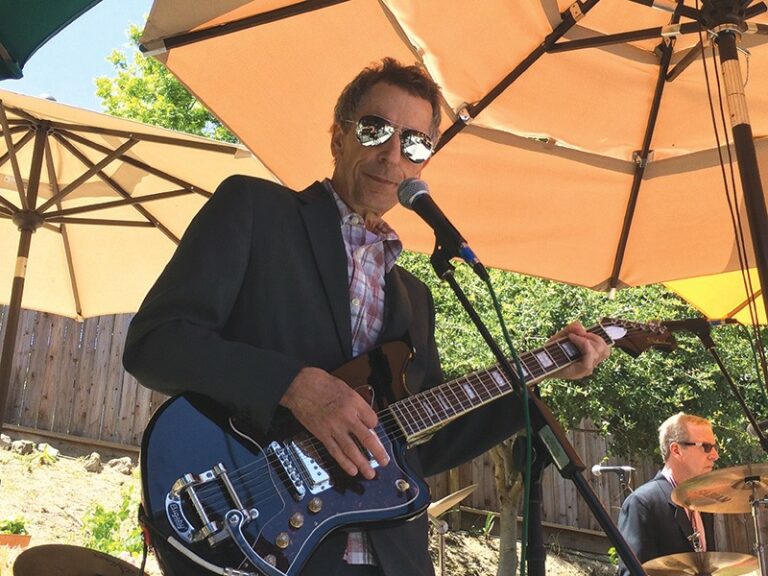
The all-day lineup of bands featured a host of performers who are beloved in the North Bay and beyond with headliners like the Brothers Comatose, T Sisters and the Sam Chase all on hand. I arrived just in time to see Santa Rosa’s own John Courage fronting his blues rock trio the Stone Cold Killers and playing an electrified set of sizzling solos and groovy jams on the Traveling Spectacular Stage, a vaudeville-inspired mobile set up that transforms from a truck into a full-on stage experience.
The main stage, donated by the city of Santa Rosa, saw Santa Cruz’s Marty O’Reilly and the Old Soul Orchestra perform the slowest burning set of the day. The young, but experienced group took traditional rhythms and infused them with a emotional and strained energy for supremely satisfying pay offs. The Old Soul Orchestra will be back in the North Bay on Saturday, June 20, performing at the Big Easy in Petaluma to raise funds for a European tour they have planned in the coming months.
The neighborly feeling at the festival extended from audiences to the bands, with special appearances and pairings; such as when enchanting singer Sally Haggard jumped in with Frankie Boots and the County Line for a ditty, or when the main stage was packed full of performers at the close of the show. The Brothers Comatose held crowds captive with their fast fiddling and multi-part harmonies, and many attendees stayed past the 7pm end time to contribute to an ebullient sidewalk chalk jamboree.
The Festival’s ultimate success was due to the tireless work of the North Bay Hootenanny’s Josh Windmiller and an army of volunteer staff who made the whole thing a smooth and easy experience. Food and drink lines moved quickly (even as 32 kegs of Lagunitas beer sold out in the early evening), kids and families hung out in the shade of the Big Tree kids area, and Wilson Street turned into an art walk with live art sessions by Luddart artists and wares from local vendors. Kudos to all involved. Here’s hoping the Railroad Square Music Festival returns next summer. If you’d like to contribute to the local music scene and events like this, you can donate to the North Bay Hootenanny, a nonprofit group, by clicking here.
 

Looking Back on BottleRock 2015

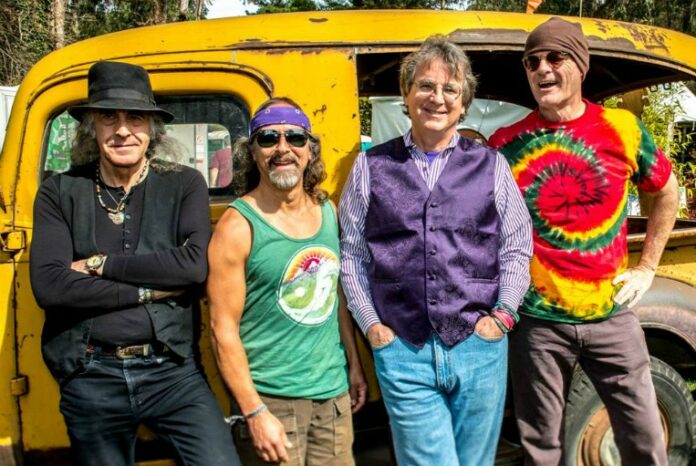
The Chris Robinson Brotherhood

BottleRock Napa Valley Music Festival was one wild weekend, and our intrepid photographer Jamie Soja was there to capture it. From Snoop Dogg and Iron Chef Masaharu Morimoto rolling sushi, to the eclectic assortment of headliners that packed crowds to maximum capacity, here’s a  look back on all the music and antics from this year’s fest.

Interview with Eric Lindell

photo courtesy of Sparco Records.

Written by Eddie Jorgensen:
Eric Lindell was a Sonoma County resident long before he moved to the South. Already a household name here and a veritable headliner everywhere he played, it only made sense to venture out of town to see what kind of musical influences he could soak up.
Fans of both blues, Americana, country, and anything in between will enjoy his live show which, at times, far eclipses anything he can do on record. Lindell is also one of the biggest sellers on his previous label, Alligator records. Today, he’s doing things on his own and just recently released a new EP on his Sparco records label.
Your latest release, ‘The Sun And The Sea,’ only has seven songs. Was there a conscious decision to make a shorter record?
Definitely. We recorded a bunch more songs but I wanted to narrow it down to make a more cohesive set. I’m not concerned with releasing a ton of material as I am good material.
What was different about this album than your other releases?
This album was made with live drums that were sampled rather than using a live drummer as I usually do. They are organic drums sound but just pieced together where applicable. When we played this project to my drummer and friend, Will, he thought it sounded amazing. It was recorded by one of my bass players, Sean Carey, and I’m very proud of what we made.
You weren’t always Eric Lindell, the solo artist, correct?
Besides playing in Grand Junction (local funk band) for awhile, I even sang with Accolades (local heavy metal band from the mid-80’s) with my buddy, Tim Solyan (of Victims Family fame). I ran into guys from both bands not long ago and it reminded what a great music scene we had in Sonoma County.
What are some of your favorite places to play?
I get so excited every year when I come to Sonoma County I can’t even explain it. It’s also lots of fun to bring friends who’ve never been here as well since they can’t believe how beautiful the place is. I also love other cities like Baltimore, New York, and San Francisco.
The lead song on the new record is “Going To California.” Sounds like you’re aching to be back.
For sure. However, I come and play here pretty regularly. I moved to New York in 1998 and left to Louisiana just a little bit later. I pretty much come here every Summer with my band and every December with my band Dragonsmoke (with Ivan Neville, Robert Mercurio, and Stanton Moore). I always come back.
Eric Lindell plays on Sunday, June 21, at the Forestville Club, 6250 Front St, Forestville. Oyster Feed starts at 5pm. $20. 707.887.2594. The next night, Monday, June 22, he appears at The Big Easy, 128 American Alley, Petaluma. 6:30pm. $20. 707.776.4631. For more info and tickets, visit www.ericlindell.com

Jun. 5-7: Equality Everywhere in Guerneville

0

Made up of a diverse group of local residents unified with one voice, Sonoma County Pride is dedicated to promoting and supporting the LGBT community. Each summer, the group hosts a weekend-long party, and this year the Sonoma County Pride Festival returns to Guerneville for three days of art, music and events centered on the theme “Equality Everywhere.” There will be art walks and LGBT history exhibits, a beach party along the Russian River, film screenings at the Rio Theater and music by dance band Rumors, the SF Gay Men’s Chorus, Bobby Jo Valentine and many others. The parade and afternoon festivities on Sunday cap off the celebrations. The Sonoma County Pride Festival runs Friday, June 5, to Sunday, June 7, throughout downtown Guerneville. $5. www.sonomacountypride.org. 

(Flu) Free Birds

Since the start of the current U.S. avian flu outbreak in December, more than 46 million chickens, turkeys and ducks—about one-third of the processed egg supply—have been culled to fight the virus. "Because of the outbreak in the Midwest, people are on their toes and there's a heightened sense of urgency because these are very virulent viruses," says Sonoma Country...

Dark Matter

'We've been signing things left and right," says author and publisher Ross Lockhart, describing the terrifying process of buying a house in Petaluma. "Tomorrow, we're signing something else—and then we wait until we get the word the house is empt,y and we can finally move in." Buying a home, for most people, is always a bit scary and more than...

Giant Steps

Formed a little over two years ago, the locally grown jazz ensemble the Dixie Giants have won a vibrant fan base in the North Bay with their busking style and ability to start a party under any condition. A popular sight everywhere from foodie fests to standup showcases, the young group kicks off a summer tour at HopMonk Tavern...

Airbnb Bill Shelved

Now, don't be sad. Two out of three ain't bad. Freshman State Sen. Mike McGuire's office sent us a trio of emails late last week with updates on bills he introduced. The man has definitely taken on some big-ticket issues of statewide concern in his short time in Sacramento—omnibus bills covering medical cannabis, short-term vacation rentals, offshore drilling—but that middle...

Tanked

At first, it was a hassle with a jammed bottling line, not the environment, that inspired Jordan Kivelstadt to go into the wine-on-tap business. Seeing one of the stainless steel kegs that winemakers use to store barrel-topping wine, the 30-something entrepreneur thought, why not just put it into one of those? Today, Free Flow Wines puts wine in over...

Hot Pockets

Government efforts to slow climate change have been so ineffectual that the call has gone out to overhaul the American political and economic system—before global warming renders the planet, and the North Bay along with it, uninhabitable. The writer Naomi Klein has argued that rightward-leaning citizens resist climate-change policies because they recognize them as a threat to unfettered consumption and...

Railroad Square Music Festival Makes Its Mark

It seemed like an improbable dream; organize a music festival in downtown Santa Rosa with multiple stages and a stellar lineup of the Bay Area's hottest folk and revival acts, and make it free for all to attend. Yet, this year's inaugural Railroad Square Music Festival was an outstanding success that brought together a friendly, communal and musical vibe...

Looking Back on BottleRock 2015

BottleRock Napa Valley Music Festival was one wild weekend, and our intrepid photographer Jamie Soja was there to capture it. From Snoop Dogg and Iron Chef Masaharu Morimoto rolling sushi, to the eclectic assortment of headliners that packed crowds to maximum capacity, here's a  look back on all the music and antics from this year's fest.

Interview with Eric Lindell

Written by Eddie Jorgensen: Eric Lindell was a Sonoma County resident long before he moved to the South. Already a household name here and a veritable headliner everywhere he played, it only made sense to venture out of town to see what kind of musical influences he could soak up. Fans of both blues, Americana, country, and anything in between...

Jun. 5-7: Equality Everywhere in Guerneville

Made up of a diverse group of local residents unified with one voice, Sonoma County Pride is dedicated to promoting and supporting the LGBT community. Each summer, the group hosts a weekend-long party, and this year the Sonoma County Pride Festival returns to Guerneville for three days of art, music and events centered on the theme "Equality Everywhere." There...
11,084FansLike
4,606FollowersFollow
6,928FollowersFollow