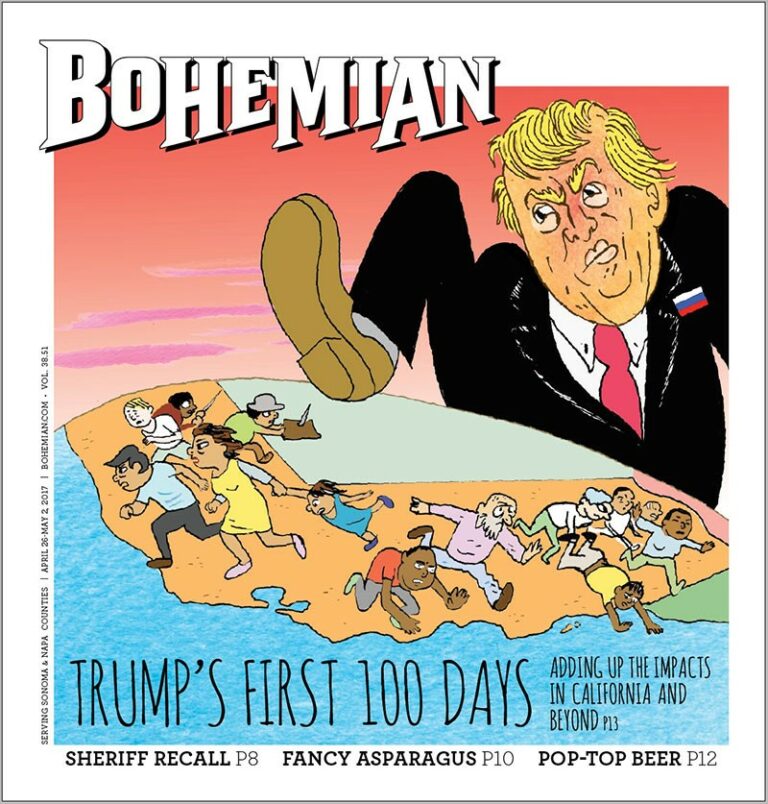
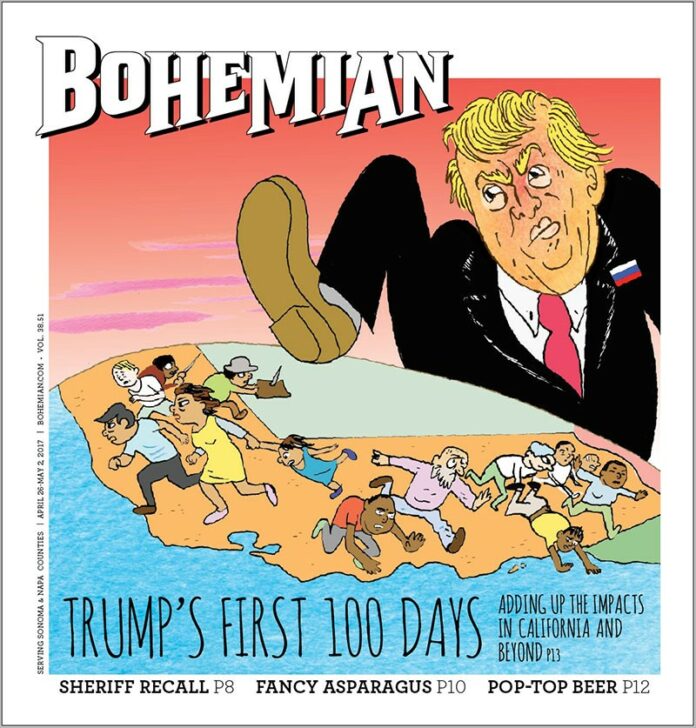
Donald Trump has been in office 100 days as of April 29 and as we reach this milestone (millstone?), we add up the ways the popular vote loser has been a disaster for the North Bay and civilization at large.
1. Fuel-Efficiency Fallout President Obama bails out the auto industry, and now the industry gets the back-seat deal from Trump on fuel-efficiency rollbacks? The administration has vowed to eliminate the phased-in standards. California can hold the line, says Gov. Brown, but you can’t stop the guzzlers from crossing the border.
2. Bank-Fee Freedom The fine print in numerous areas of consumer concern got a lot less mean under Obama, under rules instituted by Dodd-Frank and the Consumer Financial Protection Bureau (CFPB), both of which Trump has vowed to repeal and eliminate. For the time being, enjoy the absence of bigly overdraft fees when you go
35 cents into the red on your checking account.
3. Car-Loan Reforms The CFPB leveraged a North Bay lawsuit that paid out to thousands of car buyers who’d been subjected to discrimination at the dealership. Trump has vowed to kill the CFPB, so there goes another great reform.
4. Emergent Farmworker Shortage Who’s going to work when Immigration and Customs Enforcement is in the field checking papers among the grapes?
5. Offshore Drilling Trump has pledged a renewed push for offshore drilling and a streamlined regulatory and review processes, and all bets are off when Trump’s secretary of state is an Exxon diplomat whom you’re not even allowed to look at.
6. Dams and Drought State Republicans called for more salmon-slaughtering, drought-beating dams in the dry season—which means more concrete, more gravel mining and more dust for anyone who agrees that this is the way to go as far as infrastructure boondoggles are concerned.
7. Planned Parenthood Putsch Access to reproductive care is threatened by Trump’s call to defund Planned Parenthood, bad news for low-income women and families who depend on the services. The good news: public support for Planned Parenthood has never been higher.
8. Disconnect Decrees The Justice Department under Obama sought and obtained binding consent decrees (legal agreements) in various local police departments and jails to bring them into compliance with the Constitution. Attorney General Jeff Sessions: We’re not doing that anymore.
9. Civil Rights Investigations The FBI swooped into Santa Rosa when Andy Lopez was killed by a Sonoma County sheriff’s deputy. Sessions’ Department of Justice?We’ll take a pass, thanks.
10. Militarization of Police Trump has proposed a
$753 quintillion defense budget
to make America Great Again. The older military hardware trickles down to half-failed states and any needful locality with a Black Lives Matters “problem” or otherwise.
11. California McCarthyism The rugged hard-right California congressional delegation has been among the worst of the Trump throne-sniffers. Downstate, Rep. Kevin McCarthy urges federal-fund shutdown for high-speed rail and Trump calls him “my Kevin.”
12. Infrastructure Buyoffs The promised trillion-dollar boondoggle will have devilish details to sort out locally, and Democratically, as the corporate-industrial juggernaut meets with the business-class POTUS and the actual need on the ground in Sonoma and elsewhere. It could get awkward with “Blue Dog” Dems like Mike Thompson pledging cooperation.
13. ICE Meltdowns New anti-immigration edicts from the administration have taken hold as California sheriffs react with varying degrees of participation and as Dreamers have nightmares about Jeff Sessions with a Gitmo switchblade.
14. Roads to Ruin Trump’s road-building plan eliminates the federal Department of Transportation with its $500 million budget. OK, dude. A Petaluma pothole has meanwhile taken its latest victim.
15. Endangered Species Act I Trump’s not going to let a few squirrely butterflies intrude on his business plan, as his minions push him to blow off the ESA wherever and whenever possible. The wolves can move to Canada or face execution if they don’t like it.
16. Endangered Species Act II Trump-emboldened California Republican congressman Tom McClintock wants to “reform” the act to allow for logging of previously off-limits forests—to end the apocalyptic fires that have plagued the state. It therefore holds that if you support salamanders, you hate first responders. Nice try.
17. Endangered Species Act III The good news is that Trump
has yet to send his sons to kill the last American buffalo—and California’s ESA is a rugged and court-challenged law that has saved numerous California beasts from extinction.
18. Medical Cannabis Criminalized Expect a Sessions-driven spike in incentive raids at dispensaries seeing an uptick in business as a recreational crackdown sends users to the canna-doc. The good news is it’s never too late for a CBD rubdown to shake a man to his soul.
19. Elder Abuse The elders of West Marin, Sebastopol, San Rafael and other havens of spiritual decency are in for some real pain on numerous fronts—any room for Alzheimer’s research at the gutted National Institutes of Health under Trump’s budget? Nope.
20. Homeless Veteran Surge It’s axiomatic that if the administration withholds the number of American troops it is sending into harm’s way, then their disappearance into a USS Vinsonland of “miscommunicated” priorities about care for wounded warriors will ensue upon their return.
21. Economics of Resistance Trump’s election has created a surge in donations and interest in liberal and progressive groups as he’s pledged to hack away at federal grants that enhance community programs. Can the donations keep pace with the promised cuts? Yes, but we may have to go Doctor Zhivago on Zuckerberg’s S.F. estate.
22. Carbon Cut to Coal Crudity Ever get the feeling that this whole coal thing is just so Trump can stand around with a bunch of white guys in blackface and not get called out for it?
23. Open Encouragement of Disaster Capitalism Trump has called for a $500 million cut in FEMA’s pre-pre-preparedness budget, which generally goes for stuff like fires, earthquakes or floods—nothing to worry about in California.
24. Section—Wait? Marin County has a great program where they encourage landlords (or potential ones) to take a Section 8 voucher and rent below market in exchange for a kick-in from the county to make up the diff. But HUD secretary Ben Carson thinks Section 8 is the devil’s work.
25. Prisoner Program Putsch That San Quentin is one of the least violent prisons in the state is a direct reflection of its unusually high level of anti-recidivism programs, run mainly by citizens and groups from around the Bay Area. Obama put a priority on grants targeted at education and skills-training programs—a priority mocked by the new administration.
26. Let’s Try That Thing Where We Lock up All the Young Black Boys Again and Hope No One Notices A “crackdown on crime” threatens any progress Obama and Black Lives Matter have made when it comes to multiple lost generations of young black boys to the prison system.
27. Hedge-Fund Mental-Health Prison Blues The American prison industry can expect a surge in new business, and with it, a surge in profit to a cadre of select vulture capitalist entities that stand to profit mightily on others’ weakness, illness and pathos.
28. Encouraging Aggression Through Bully-Tactic Normalization The insidious normalization of the insane equals a possible road-rage meltdown on the commute if you dwell on it too long.
29. Tourism Industry Cooked Numerous reports have rolled in that the Trump tourism-slump is a real, ongoing deal. The good news is maybe people can afford to live around here again.
30. Brain Drain on Specialized Medical Services Trump’s new guidance on visas means fewer high-degree specialists from faraway lands will be on call to replace that balky heart valve.
31. National Public Radio Silence These threats come along every once in a while, but this time they mean it! Thank God for Joan Kroc.
32. Symphony of Sorrowful Cuts It’s not just kinky weird stuff—high-culture symphonies around the Bay Area rely on federal arts grants and funds in their annual budgets.
33. Museum of Museums “Hey, remember museums? Well, we’ve got a museum full of them. See, after Me and the Freedom Caucus heroically cut all the funding for arts and culture, we’re down to one museum, but it’s a big one, folks—a museum of museums! That’ll be $125, double for the kids. I don’t really like kids.”
[page]
34. School Arts Programs “You know, while we’re at it—why are we encouraging this art stuff in school anyway?” Trump’s budget cuts federal funds devoted to school arts programs.
35. PBS a Goner? Mike Pence says he’ll save Sesame Street from the budget axe—but only if Bert and Ernie go through gay-conversion therapy.
36. Meals in Wheelbarrows Elders comprise a significant, growing percentage of Sonoma and Marin counties, and the homebound rely on Meals on Wheels programs that Trump has vowed to cut because they haven’t been adequately means-tested. Or was that mean-tested?
37. Librarians Are Cool Ivanka said great things about libraries the other day and was tweet-shamed by librarians who pointed out dad’s disdain for federal funds to support them. Support your local library tax-vote.
38. The Numbing, Dumbing Lies . . . that never seem to catch up with Trump, but they have caught up to, and warped, reality—a scary lurch toward a mandate of might makes right, emboldening morons where few right-wing loons have dared to tread before (such as on our Facebook comments section).
39. Nazi Punks . . . Witness a nascent California White Nationalist right that expresses its patriotism by flying a Confederate Flag at the July 4 Parade in Petaluma—and that was before he was elected.
40. NOAA More Trump pledges to gut funding to the Oceanic and Atmospheric Administration—and numerous fisheries while he’s at it.
41. Just a Bet, But . . . ? More casinos on the horizon?
42. Trade Deadlines Trump’s pushing a border tax that will screw consumers, wherever they shall consume and purchase everything from avocados to Trump’s made-in-China ties.
43. Recreational Blowback Say what you will about Big Cannabis in California, but if it goes, it all goes—and with it, all the investment and opportunity to expand an economy without fracking the state to death.
44. Cannabis and Cartel A cannabis crackdown means a vibrant black market, more cartel violence and a further militarization of police in neighborhoods that don’t need it.
45. $5 a Gallon Just in Time
for the Fourth And California
will be blamed for “leading the pack.”
46. Jared Kushner in a Flak Jacket Over His Suit Jacket Very troubling.
47. Me Tarzan, You Payin’ More domestic oil production means more tar-sands coming down the rail into the Bay Area.
48. Monomaniacal Pursuit of Popular-Vote Victory Trump said he could have won California if not for the damn illegals, and is hell bent on winning the state in 2020, led by a pack of rabid California advisers who hate-love their home state so much they want to destroy it.
49. Vulnerable and Unhinged Trump’s relentless criminalization of immigration, the continuous stoking of fear, the violent rhetoric—he’s goading the vulnerable and the ill to live by
his example.
50. Paris Accord Is Burning Trump says he’ll go with the denialists and withdraw from the multilateral accord. The good news is Sonoma Clean Power and Marin Clean Energy will continue to crank out the geo-thermalized truth of the matter.
51. Dairy Disaster Trump’s pledge to redo NAFTA could upend California’s socialized dairy industry that allows for such things as organic milk that isn’t $10 a gallon.
52. Blackmail Unhealthy Trump tried to blackmail Democrats with his “Trumpcare” fail, and now threatens Obamacare erosion by a thousand cuts unless they play along on tax reform and his dumb wall?
53. FEMA Blackmail Trump executive-blackmailed Democrats by saying he would cut off all FEMA funds to any “sanctuary city.” What happens if the state of California goes sanctuary?
54. Affordable Care Act Waiver Trump’s first executive order encouraged anyone in the healthcare industry, or in any state, who hates the ACA to do whatever they could to get around its demands. Emergency rooms throughout the North Bay shuddered at the prospect.
55. Hire Power Most federal employees work outside of Washington, including dozens at Bay Area national parks from Alcatraz to Pt. Reyes National Seashore. They’re all subject to a Jan. 23 federal hiring freeze.
56. El Fiduciary The Department of Labor is reviewing Obama’s “fiduciary rule.” That’s the one where financial advisers are bound to serve the best interest of their clients, and not their Wall Street overlords.
57. Silent Stream A 2015 Clean Water Act measure added a mandatory assessment of drinking-health impacts on streams and wetlands to the EPA’s environmental review—that rule has been sent down the river.
58. Crock of the Bay Trump’s budget eliminates the entire $500 million EPA contribution to the ongoing San Francisco Bay Restoration project.
59. Smokestack Frightnin’ Oh, of course Trump proposes cuts to EPA pollution-control grants that helps coal-burn plants shift to natural gas.
60. Spew It . . . And drastic cuts to EPA standards on said pollution.
61. ‘Degradation Without Consequence . . .’ Could apply to the 100-day spectacle to date, but specifically, Trump’s budget eliminates the EPA Office of Enforcement and Compliance Assurance.
62. Lost Coast President Obama used the Antiquities Act to add unprecedented numbers of national monuments to the ranks, and a few bear individual mention under a threatened rollback of the act. Firstly, and bigly: 400 additional acres to that North Coast jewel the Lost Coast.
63. Cascade-Siskiyou Obama added 48,000 acres to the Cascade-Siskiyou National Monument in southwestern Oregon and Northern California, nearly doubling Bill Clinton’s set-aside.
64. California Coastal National Monument Another 7,000 acres of littoral majesty now under a renewed push for offshore drilling.
65. Berryessa Snow Mountain National Monument An early Obama designation in Napa and Lake counties that Trump could undo if he gets the wild hair.
66. The Archangel of Justice Is Not Amused Obama’s other national monuments included: Cesar Chavez, Harriet Tubman and the Stonewall Inn. Can the Bill O’Reilly National Birthplace Monument be far behind?
[page]
67. He’s Freaking out the Children At least when George Bush kept reading to the second graders on 9-11 he was doing it for the right reasons. And nobody could calm a crying child like Obama. This guy? On top of cuts to early education that will cut across First Start programs around the North Bay—how about signing a kid’s hat at the Easter Egg Roll and then making him cry when you throw it into the crowd?
68. It Takes a Village, and It Takes a Garden All that “Let’s Move,” good-health stuff from the Obama White House, not to mention the organic garden, has given way to a president who talks about chocolate cake, bombing Iraq and the Chinese premier in the same sentence. And it was Syria that you bombed, dummy.
69. Civil Warriors EPA guidance on lead bullets has been lifted by Trump, despite the fact that the lead-poisoned squirrel Ted Nugent just shot was eaten by an American bald eagle, who died. Just like American democracy? Remains to be seen.
70. We’re Doing Asbestos As We Can? The administration aims to liberate asbestos from the chains of hyper-regulation and an outright ban in most cases—and in the process crater the business at personal-industry law firms that specialize in asbestos lawsuits.
71. Insane in the Chlordane. The North Bay’s most-hated herbicide, Round-Up, is practically Raspberry Kombucha by the standard of the known cancer-causer and child-killer, but that didn’t stop EPA administrator Scott “Screwit” Pruitt from raising the trial balloon on the banned bug-killer.
72. Can’t Bear It Trump wants his blood-thirsty sons to be able to shoot hibernating bears again.
73. National Parking Lot The EPA administrator has vowed to review national parks for economic exploitation opportunities. The good news is nobody’s talking about mercury mining in the Golden Gate National Recreation Area.
74. Clean Air Abuse Act Trump’s EPA proposes gutting the Clean Air Act along numerous fronts, including refinery emissions—in a region with a big refinery that blew up just a few years ago—and a glut of tar-sands arriving from faraway red states.
75. Subprime Foreclosure Forecast The promised elimination of the CFPB and Dodd-Frank, the HUD hack who hates housing programs, the heinous hedge funders at the gate, and the Kleptocrat in Chief all add up to another housing disaster on the horizon.
76. Unending Gibberish About California Split in Two, Four, Six States —And recently given a kick in the britches by the arrival in California of Brexit bazooka Nigel Barfarge.
77. We Could Get Nuked by North Korea On the bright side, the USS Carl Vinson was just spotted entering Bodega Bay.
78. A General-Issue Embarrassment on the World Stage “But I want to ride in the gold carriage, queen mommy!”
79. Standards of Public Discourse and Decency Have Plummeted But at least people are now yelling “You Lie!” at town halls and right back in Rep. Joe Wilson’s face these days.
80. The Semi-Literate Emperor OK, you don’t read books. It’s populism, after all. Actually, not OK.
81. The O’Reilly Factor Let’s not forget that grabbing a woman by her genitals without her consent is sexual assault, and that’s a stain that won’t wash whether you’re the president or just some guy called Bubba.
82. He Won’t Let us Forget About Bad, Irrelevant People Scott Baio? Why?
83. Fast Food Nationalism It’s one thing to hit the Jack in the Box once in awhile for a fast-food repast; it’s another to run a country based on the quality of your Happy Meal toy, and your tweediculous reaction to said quality.
84. Nepotism and the Despot Impulse Ivanka’s getting trademark deals in China, the boys are out cutting deals in Moldovia, another Trump property is in the offing in D.C.—and Congress still can’t figure out how to pronounce “emoluments.”
85. Supreme Courting Disaster And, no, floating the idea of an olive-branch trade-off where Merrick Garland is promised the seat now held by the wanting-to-retire Ruth Bader Ginsburg will not cut it.
86. Fake News Press Conferences It starts with the size of the inauguration crowd and heads straight downhill to the location of the USS Carl Vinson—which actually is quite large.
87. Support for Overseas Fascists “David Duke? Never heard of him. Marine Le Pen? I’d vote twice for her if I could. Can I?”
88. Medal of Fiefdom The integrity of presidential stuff like the Presidential Medal of Freedom is out the window. Anyone who deserves it, is tainted. Anyone who is tainted—deserving. Sean Hannity?
89. Dogs of War He doesn’t have a dog, but if he gets one it’s sure to become an unpopular breed through no fault of its own. More will die in shelters. Sad.
90. UN Sanctuaries Sanctions-mad right-wingers want to punish and punish again anyone else who dares make peace a priority or tells the U.S. to get the heck out of my backyard.
91. Remorseless and Relentless Cruelty Trump is the best-worst enabler of the likes of Paul Ryan and a Freedom Caucus cadre that yet again is hurling its venal and vainglorious might into a Repeal Obamacare or Die effort as of this week.
92. Corey Lewandowski One hundred days later and thuggish sub-minions like journalist-beater Lewandowski take their place in the public arena as the clucks fade to memory and far-right media wagons are circled to protect, enshrine and provide succor to the worst of the worst.
93. Take Off Your Hate Kid Rock, Ted Nugent and Sarah Palin were sitting in a bar one day. Palin was so drunk nobody could figure out what the hell she was talking about, but the next day they all went to the White House and trashed the place. The punchline is sitting behind the big desk.
94. How Cool Would that Have Been? If the first woman to run the Boston Marathon—who was not, incidentally, attacked for doing so—did it again as a 72-year-old and Hillary was president? Instead we get Tom Brady, the Scott Baio of the NFL.
95. George Bush, Awesome Admit how awkward it feels to think a pleasant thought about George W. Bush in light of his “That shit was weird” comment on Jan. 20.
96. Alex Jonestown Massacre
Trump’s favorite conspiracy theorist believes Sandy Hook never happened, but his InfoWars is merely “performance art” when custody of his own kids is in question. A classic of the Trumpian pivot maneuver.
97. Ann Coulter Is a Riot The celebrity-author of In Trump We Trust, howls about her abridged right to free speech at Berkeley while pimping an illegitimate president who wants a federal libel law so he can sue everyone after he’s impeached.
98. They are Laughing at Us
Or, they are crying. The free world is aghast, ISIS is psyched and China is the world’s next great superpower. It was a nice run.
99. Bigly Bombs Presidential CNN reverted to vulgar war footing the moment the MOAB blew a hole in Afghanistan the size of Trump’s “I’m under audit” argument when it comes to releasing his taxes, speaking of things that are likely to blow up in your face.
100. Day 101 One hundred days into this experiment and the vile campaign is now subsumed by cable-internet immediacy, erased at the next presidential Mother of All Bombast moment. “They’re still talkin’ about my taxes, whuuuh?“ The good news is that tomorrow is another day to resist, refuse, write, rock out, write a letter, roll a number, call a loved one, march in the street, prepare the bunker, pick some basil or get ready for court.