Full House

0

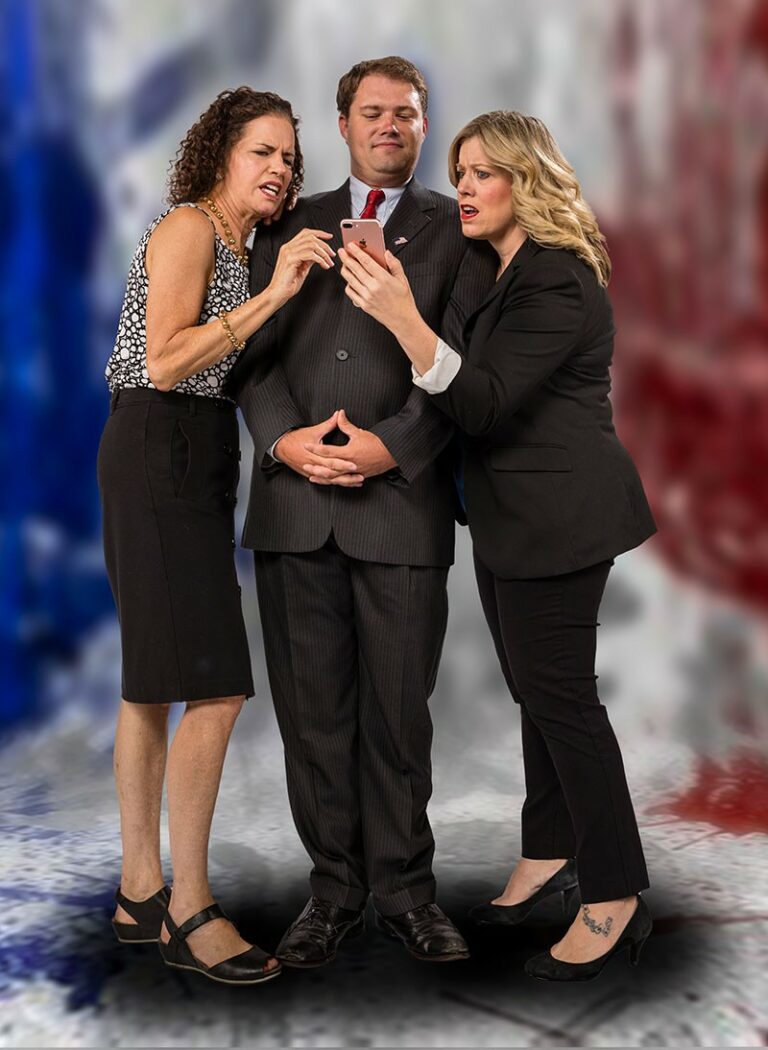
September marks the opening of the new artistic season for many North Bay theater companies. Here’s some of what they have in store for local audiences:

Petaluma’s Cinnabar Theater (cinnabartheater.org) transforms itself into Berlin’s Kit Kat Club and bids you willkommen, bienvenue, and welcome to the classic John Kander and Fred Ebb musical Cabaret. Broadway veteran Michael McGurk and Petaluma native Alia Beeton take on the roles that won Joel Grey and Liza Minnelli their Oscars.

The Spreckels Theatre Company of Rohnert Park (spreckelsonline.com) opens its season with the multiple Tony Award–winning Curious Incident of the Dog in the Night-Time. Fans of the Mark Haddon novel about a young boy on the autism spectrum investigating the death of a neighborhood dog will find that it’s been somewhat reworked for the stage, but Tony voters liked it enough to name it 2015’s Best Play.

Sebastopol’s Main Stage West (mainstagewest.com) opens its season with the world premiere of an original comedy by local playwright Bob Duxbury. Savage Wealth examines the impact of the sale of a Lake Tahoe home and the vacant lot next to it on a pair of brothers and their childhood friend. John Shillington directs.

Dancing and singing New York “wiseguys” take over Santa Rosa’s 6th Street Playhouse (6thstreetplayhouse.com) as it presents Guys and Dolls. Summer Repertory Theatre artistic director James Newman moves to Railroad Square to helm what has been called “the greatest of all American musicals.”

Santa Rosa’s Left Edge Theatre (leftedgetheatre.com) continues to provide North Bay audiences with recently written plays never before seen in the area with the U.S. premiere of a hit British comedy. Dave Simpson’s The Naked Truth involves charity fundraising, female empowerment and pole dancing. Argo Thompson directs a cast that includes former Bohemian theater critic David Templeton.

In Guerneville, the Pegasus Theatre Company (pegasustheater.com) presents its 12th annual Tapas: New Short Play Festival. The seven short plays by Northern California playwrights will be the first production overseen by new artistic director Rich Rubin.

Healdsburg’s Raven Players (raventheater.org) open with two contemporary dramas that deal with a host of complex issues including war, PTSD, gun violence, politics and religion. Time Stands Still and Church & State will run in repertory.

Napa’s Lucky Penny Productions (luckypennynapa.com) invites you Into the Woods, where director James Sasser has apparently added another layer of fun to the musical fairy tale mashup.

Plenty of options for the avid theatregoer.

Joy of Singing

0

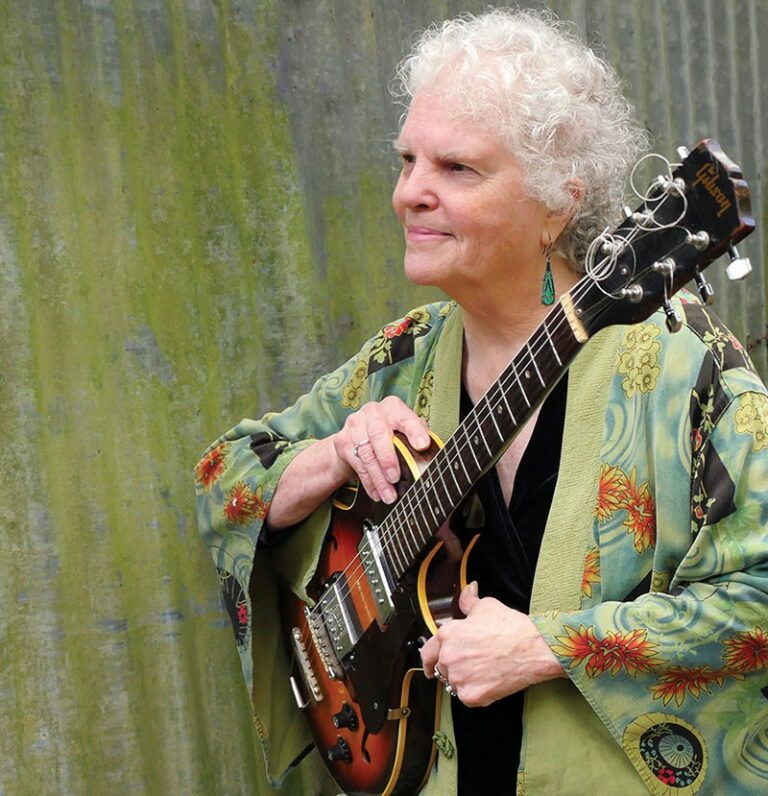
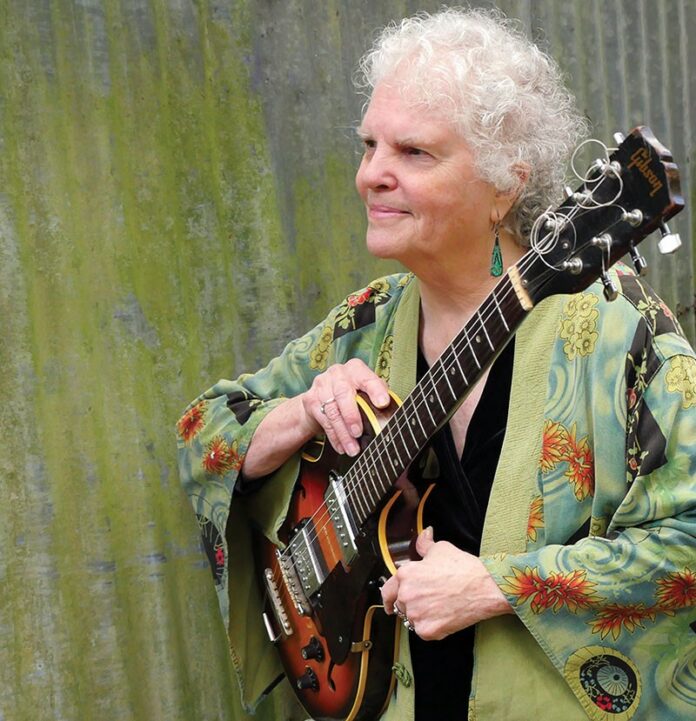
Internationally known singer-songwriter, producer and teacher Terry Garthwaite has lived a life of music that dates back to the late 1960s, when she co-formed and fronted Berkeley rock group Joy of Cooking.

With an inspiring musical spirit, Garthwaite has recorded dozens of albums over the years, delving into jazz, blues and folk along the way. Garthwaite recently turned 80, and is throwing a massive birthday concert on Sept. 16 at the Sebastopol Community Center that will also act as an official record-release party for her most recent album,

Shine On.

“The album came out last year, but I never did a release party,” Garthwaite says. “And I just turned 80, so I decided, OK, I’m going to celebrate the fact that I’m still making music.”

Garthwaite’s first release in over a decade, Shine On features 19 tracks that span her songwriting career, including tunes originally written in the 1970s as well as brand-new compositions. “I just don’t stop writing songs, so I had a lot of new stuff to put down,” says Garthwaite, who recorded the album at Sebastopol’s Studio E.

Garthwaite’s 45 years living in West Marin is reflected in many of the songs, and all of her tracks feature positive messages, a staple of her songwriting since the beginning.

Dating back to her time in Joy of Cooking, who regularly opened for headliners like Van Morrison, the Band and the Grateful Dead at venues like the Winterland Ballroom in San Francisco, Garthwaite says music was always a joyous experience, “with people dancing because the rhythm was compelling and the lyrics were uplifting—that’s where I like to go with my music,” she says.

Garthwaite also uses her music as a teaching tool, leading songwriting workshops such as her annual Women Singing in Circle retreat, where she joins singers like Threshold Choir founder Kate Munger for a weeklong outing in the mountains of New Mexico. “It’s a perfect environment for my songs, a lot of people who come to the retreat need songs of comfort and joy,” she says.

This month’s birthday concert will be another joyous experience, as Joy of Cooking bassist David Garthwaite (Terry’s brother) and drummer Fritz Kasten join Garthwaite, along with her favorite guitarist Nina Gerber, Studio E owner Jeff Martin, vocalist Chris Webster and others.

“I wanted to have a mix of musicians on the show,” Garthwaite says. “There’s going to be a real feeling of community onstage.”

Harmony Returns

0

There was a moment last October, in
the immediate aftermath of the Tubbs fire, that Santa Rosa’s Luther Burbank Center for the Arts was thought to have been completely lost to the blaze that destroyed thousands of other homes and businesses.

While the center’s main theater ultimately survived the disaster and reopened for events within a month, an estimated 30,000 square feet of the campus was destroyed, including the musical-instrument lending library and the outdoor sculpture garden.

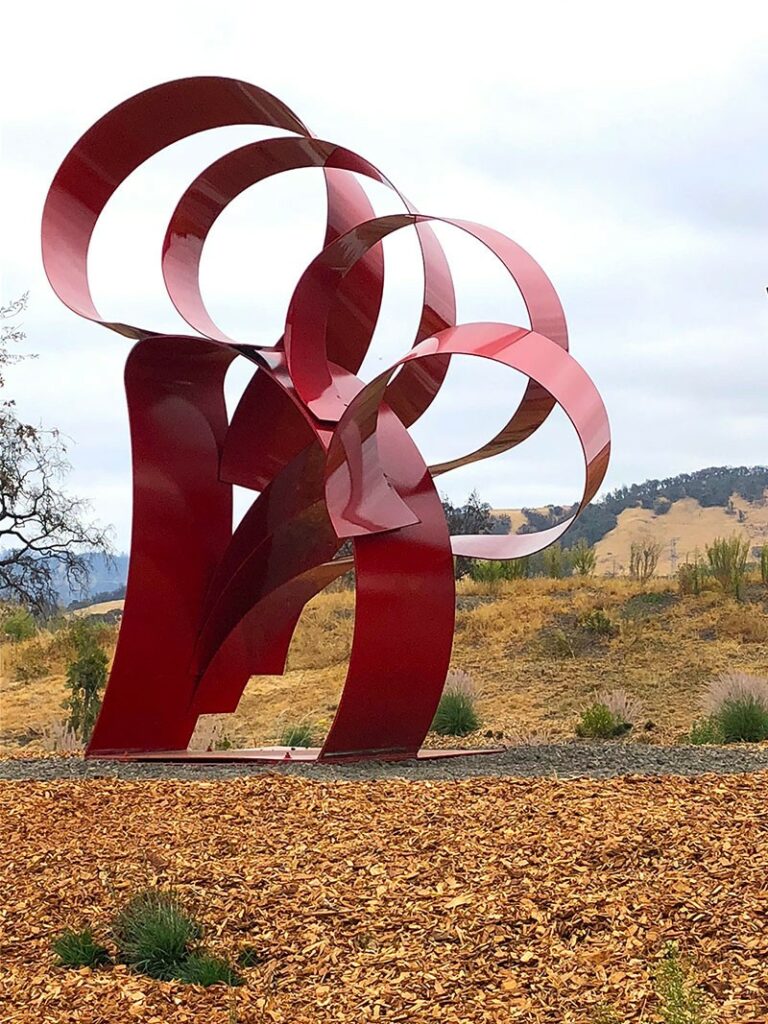
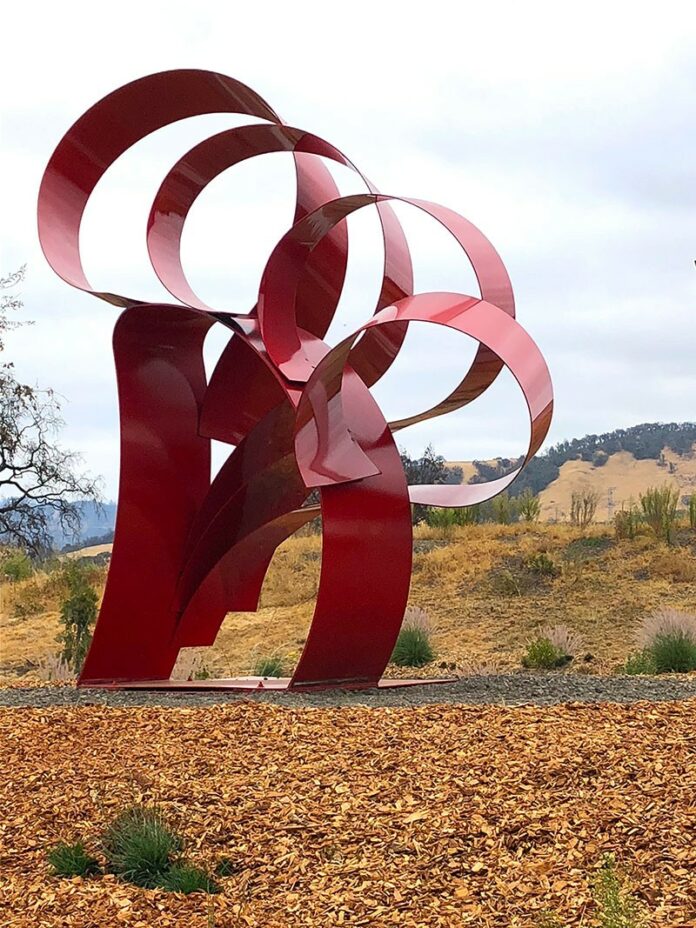
This month, the Luther Burbank Center marks another milestone in its recovery with the reopening of the sculpture garden on Sept. 13 with a new group exhibit, “Harmonies,” that features large-scale works from three women artists.

Curated by Kate Eilertsen and LBC programming director Anita Wiglesworth, “Harmonies” brings a new lyrical sense of nature, movement and light to the garden, whose landscape was entirely decimated along with many old-growth redwood sculptures by artist Bruce Johnson on display last October.

“Women are rarely seen in public art,” Eilertsen says. “I proposed that there were several local female artists that deserved to be seen together.”

Formerly the director of the Sonoma Valley Museum of Art, Eilertsen was approached by the center to curate a show for its garden meant to follow Johnson’s exhibit.

She and Wiglesworth visited many artists in the Bay Area and ultimately selected Kati Casida, Catherine Daley and Jann Nunn to display in the show. Daley and Nunn are both North Bay residents, and Casida is based in Berkeley.

Each artist has four pieces in the show that boast eclectic ideas and materials. “We titled it ‘Harmonies’ because the sculptures are very different from each other, but they go together very nicely,” Eilertsen says.

While the show’s concept and selection process happened before October’s fire, Eilertsen acknowledges that the show has taken on a new meaning over the last 11 months. “It became even more important after the fires to have something lighthearted and beautiful,” she says.

Scheduled for a two-year run, “Harmonies” invites the public to experience the garden with fresh eyes. “Something that I love about sculpture is that it looks so different as you walk around it,” Eilertsen says. “You can see the world in such a different way by looking at the same image from a different angle.”

All three artists will speak at the opening reception, with food and live music on hand. “It’s a chance to meet the artists,” Eilertsen says, “and see the center coming back to life.”

Aug. 30: Pizza Life in Sonoma

0

A selection at last year’s Mill Valley Film Festival, North Bay writer-director Matteo Troncone’s irresistible documentary ‘Arrangiarsi (Pizza . . . and the Art of Living)’ takes audiences on an immersive trip to Naples, Italy, which Troncone visited nine times over five years to learn about the art of pizza making. There, he also discovered the artistic tradition of arrangiarsi, meaning to make something from nothing. Foodies, history buffs, art appreciators and everyone else can enjoy the documentary, screening with pizza from Ca’ Momi and winetasting on Thursday, Aug. 30, at Sebastiani Theatre, 476 First St. E., Sonoma. 7pm. $20–$25. 707.996.9756.

Aug. 30-Sept. 2: Gypsy Jazz Jam in Mill Valley

0

Belgian-French guitarist Django Reinhardt is one of the most influential players in Europe’s Gypsy jazz movement, and is still celebrated more than 60 years after his death. This month, the 14th annual DjangoFest Mill Valley features Dutch violinist Tim Kliphuis and his trio, who open the festival, French guitar duo Antoine Boyer & Samuelito, Gypsy jazz prodigy Henry Acker and many others. Thursday to Sunday, Aug. 30–Sept. 2, at Throckmorton Theatre, 142 Throckmorton Ave., Mill Valley. $35–$65; $199 weekend pass. 415.383.9600.

Sept. 1: Art Dreams in Yountville

0

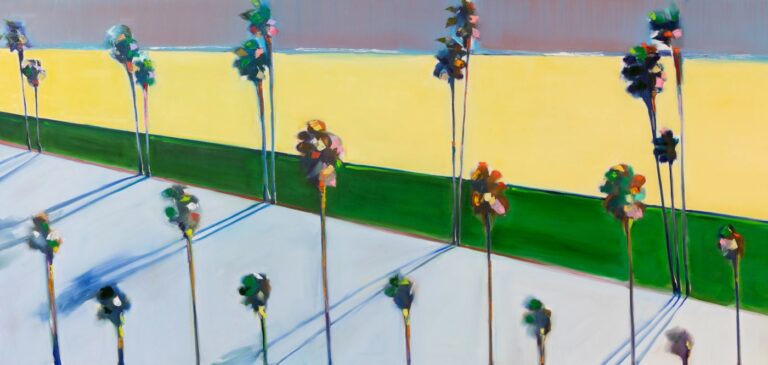
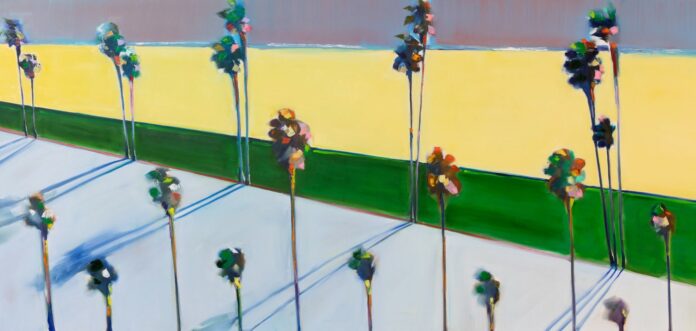
Celebrating the idyllic scenery of the Golden State, Napa Valley Museum’s new joint exhibition, ‘California Dreamin’,’ features paintings by Melissa Chandon and Matt Rogers and surfboard art from Timothy Bessell. Chandon’s pop-art inspired work is evocative of the carefree West Coast vibes of the 1960s, when woodie-style station wagons dotted the beaches. Rogers’ landscape paintings turn palm trees into cotton candy while thematically reflecting on the state’s history of natural disasters. Rounded out by Bessell’s handmade and hand painted boards, “California Dreamin’” opens with a reception on Saturday, Sept. 1, at Napa Valley Museum, 55 Presidents Circle, Yountville. 5pm. $20. 707.944.0500.

Sept. 1: Speak Up in Sebastopol

0

Growing up in Santa Rosa, hip-hop artist Tru Lyric began on his songwriting path with parodies in high school, though in the last decade his music has taken on a significantly more personal and emotionally impactful tone, and the MC now openly talks about struggles with depression and anxiety in his multifaceted music. Sometime labeled as Christian rap, Tru Lyric preaches positivity on his new album, Beautiful Imperfections, out last month, and he takes the stage with support from Run with Patience and DJ Sticky on Saturday, Sept. 1, at HopMonk Tavern, 230 Petaluma Ave., Sebastopol. 9pm. $10. 707.829.7300.

Remembering John McCain

0

I watched you walk with difficulty down the aisle to the podium in the Senate chambers last year, your face, scarred by past and current surgeries, now confronting brain cancer. Formally recognized, you held up your arm, and with a fist and thumb, motioning downward, voted against the Republican attempt to amend the healthcare program, then quietly returned to your seat.

We have been at the opposite ends of the political spectrum for most of our lives: you, a naval aviator from a military family; I, an anti-war activist, with deep left-wing roots. But in that moment of truth, when you voiced your independence from your own party, a bond was forged between us, and many others across the political landscape.

People viewed you politically as a maverick, a rebel. I did not. I saw the wounded warrior who had come home—a humane, honest and compassionate person who had shed his armor and led not with sword, but with decency and heart. Your thoughts and feelings and actions that day spoke volumes to the basic belief that all Americans have regardless of party affiliation. Americans do not like being cheated and lied to; nor do they appreciate being ignored and kept in the dark on issues impacting their lives.

Make no mistake, Sen. McCain: Despite derisive comments
about your past military status, you were and are a war hero. You nearly gave your life for our country some 50 years ago, serving our country in an increasingly unpopular war that took an exacting toll on your mind and body, whose scars, both visible and not, you carried with you.

It’s abundantly clear when a human being faces his mortality, the ascension up the mountain summit grows steeper with every exhausting step; time and breath become more precious commodities to savor. But looking down, Senator, over the landscape of your life, will afford you a grand view.

E. G. Singer lives in Santa Rosa.

Open Mic is a weekly feature in the ‘Bohemian.’ We welcome your contribution. To have your topical essay of 350 words considered for publication, write op*****@******an.com.

Letters to the Editor: August 29, 2018

Legacy of Abuse

After two years of investigation, a Pennsylvania grand jury report has brought to light over a thousand cases of abuse of children by 300 Catholic priests over the last 70 years. In the words of the president of the United States Conference of Catholic Bishops, it is a moral catastrophe. This type of abuse never falls on just one state or one faith; much more remains undiscovered. The grand jury report covered six of Pennsylvania’s diocese. There are 177 diocese and archdiocese in the United States. These acts and the failure of church authorities to respond betrayed our most sacred trust. When that happens, we must respond by supporting each other as a community. Our brothers and sisters, daughters and sons in Sonoma County have been victims too. Providing the compassion and services they need is an absolute necessity.

Many of these crimes happened decades ago. They may be buried but their damage lingers, festering within. So often the truth of what happened is denied to victims. Verity, Sonoma County’s rape crisis center, provides a 24/7 crisis line that victims of sexual violence and their loved ones can call at any hour of the day and receive support from a trained advocate. The term “crisis line” can be deceiving; a crisis doesn’t need to be recent or active to deserve care. Historical reporting is an important part of what the line offers. It’s never too late to have the truth heard and recognized. You may feel that law enforcement, your pastor or priest, even members of your family, will not respond the way you need, will not support you in that moment. Verity will. There is good in speaking the truth when you are ready.

Along with dealing honestly with the past, we should respond to these horrors by protecting the future. While children are still very young, six, seven and eights years old, we should teach them about their bodily rights, boundaries and how to be assertive when faced with inappropriate behavior. We should teach teenagers that they have a right to consent (or not) to any sexual activity. We should openly discuss why people don’t report and teach them how they can respond and get help if they are abused.

Verity provides these lessons in free educational programs for any school in Sonoma County that wants them. Contact your children’s school and tell them it is time to take action, or contact us at pr********@*******ty.org or 707.545.7270 for help in bringing this information to your community. Verity also works with our local faith community to bring education and resources to your place of worship. Our legacy can be one of prevention instead of abuse.

Verity Prevention Specialist

Taking Aim

The latest mass shooting that took place in Jacksonville proves at least one thing: the NRA is right. Guns do not kill people. People who buy guns in Maryland, with the express intention of using them at a Madden tournament in Florida should they lose big, kill people. The only thing that will stop the carnage is to arm all Madden players wherever they may go.

Sebastopol

Write to us at le*****@******an.com.

Underground Ag

0

Olamae Combellack was four years old in 1924 when she arrived in Napa from Grand Prairie, Texas, with her mother and 10 siblings. The family pitched a tent along the banks of the Napa River, across from Chinatown, and picked prunes for 25 cents a box in Mackenzie’s orchard. Napa was synonymous with prunes, and prunes were everywhere, even in the heart of Napa city, on Jefferson Street, where the Grape Yard Shopping Center now sits, about halfway between Pizza Hut and McDonald’s.

I thought about Combellack over the course of the month that I roamed across Napa by car and on foot, met farmers and tasted local fruits and vegetables in fields and in restaurants. I ate at Farmstead, which is owned by Long Meadow Ranch, and at Clif Family Bruschetteria—the nifty food truck whose vegetables come from Clif Family Farm—where chef Magnus Young, who is half-Swedish and half-Chinese, makes extraordinary salads, such as the one with kale, cabbage, apples and pecorino.

In Napa, where people either love grapes or hate them—and where vegetables are a part of an underground agricultural enterprise—I didn’t meet anyone like Green String Farm’s Bob Cannard, who has supplied Chez Panisse with produce since the 1970s. Nor did I meet anyone like Paul Wirtz at Paul’s Produce, who grows year-round a wide variety of vegetables that make their way, thanks to Tim Page and his distribution company, Farmers Exchange of Earthly Delights, to restaurants across the Bay Area.

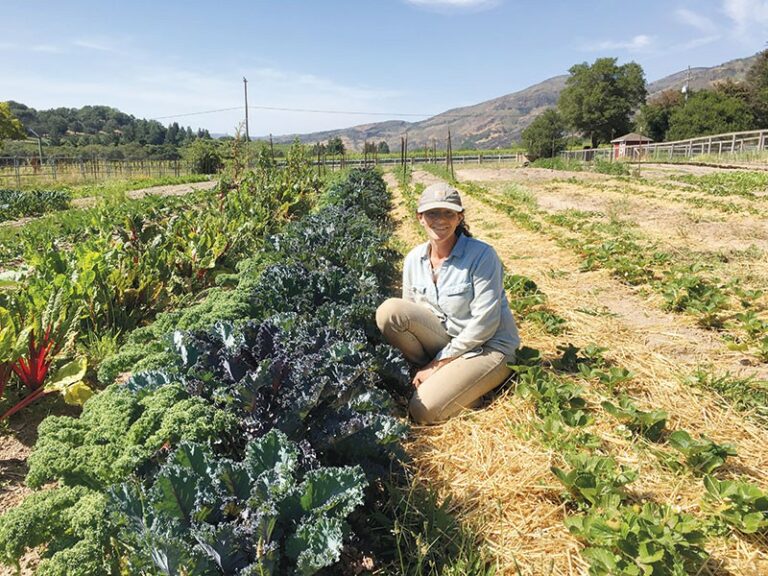
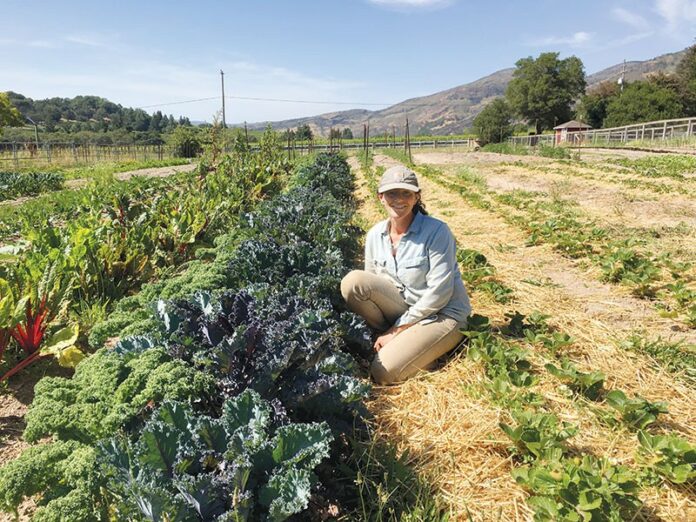
Napa doesn’t have superstar farmers, but it has young, savvy, impassioned farmers like Rachel Kohn Obut, who recently moved from Glen Ellen, where she grew vegetables at Flatbed Farm, to Napa, where she currently grows vegetables on leased land and sells them directly to members of her CSA (community supported agriculture). The owners of the land where she has carved out a garden made money in grapes and got out. Now they can afford to float Obut’s enterprise.

Like Obut, many of Napa’s young farmers have figured out how to grow lettuce, potatoes, corn, flowers and more in a place where investors insist that land is too expensive and wine way too lucrative to do anything except grow grapes and make wine.

In 2001, the year Combellack died, grapes were the No. 1 crop. Napa Valley Cabernet sold for $100 a bottle and more, and very few residents remembered the prune orchards and the Sunsweet processing plant on the corner of Jackson and Yajome. In 2018, Napa has far less agricultural diversity than it had in the 1920s, or even in the 1980s, which troubles Napa beekeeper Rob Keller, who says that “vineyards are a desert for bees,” and tells vineyard managers, “Give us some land back.”

Assistant Agricultural Commissioner Tracy Cleveland, who commutes to Napa from Vacaville, says she couldn’t imagine a day when grapes and wine would not dominate the valley. Still, the website for her agency insists that the “climate and the soils are capable of producing many types of exceptional agricultural products.” It’s just that the Napa Agricultural Commission and the Napa County Farm Bureau do little if anything to translate that capacity into a reality. They’re too busy helping the grape and wine industries, where money is to be made more reliably than on the volatile New York Stock Exchange.

When I email the Napa Farm Bureau—the voice of the wine and grape industry—and ask for help with a story about vegetables in Napa, Debby Zygielbaum, who sits on the board of directors, replies, “Contact CAFF/The Farmers Guild. They might have information for you.”

Cleveland took over the reins at the commission when the board of supervisors recently declined to renew the contract for Greg Clark, who had run the agency since 2014. Many citizens argued that the county needed a fresh outlook, given the loss of oak woodlands and watersheds and the growth of the monoculture.

“My passion is to create a healthy farming community and to diversify ag,” says Seth Chapin, founder of the Napa branch of the Farmers Guild, a small farmer advocacy and education organization. “Diversity can be a hedge against catastrophic collapse.”

[page]

Chapin thinks total collapse is unlikely, though Napa agriculture has collapsed and then rebirthed itself again and again over the past 100 years. Wheat gave way to walnuts and then to olives, oranges, apricots and, more recently, grapes as far as the eye can see, with little if any habitat for bees and birds.

Chapin grows flowers and makes floral arrangements that he sells for weddings and “private parties in the hills.” His garden is located in the Coombsville neighborhood, a short drive from the Soscol Avenue office of the agricultural commissioner. Mary “T” Beller, a feisty Alabama-born woman and Stanford grad, owns the three-and-a-half acres where Chapin grows over a hundred different kinds of flowers. Beller is famous for her “curated wine country tours” that take visitors “behind the scenes in Napa Valley”—which means she doesn’t lead them to wineries. She also cultivates vegetables, fruits and berries, and makes jams, pickles and preserves, much of which she gives to friends.

“Grapes are sexy, but vegetables are sexier,” says Beller one hot day during a walking tour of her gardens. She adds, “I will never put in grapes.”

Under the shade of a luxurious Indian blood peach tree, Beller laments the dominance of grapes. “When I got here in the 1980s, there were orchards, dairies, pastures and oak trees. I thought they would stay.”

Tourists who come for the wine and the food are hard-pressed to name the valley’s “exceptional agricultural products.” So are many Napa residents, though field workers like Jesus Pizano, who was born in Jalisco, Mexico, grow tomatoes, peppers, pears and nopal cactus in backyards and cook them in their own kitchens—a sort of farm-to-table movement for the rest of us.

Vicky Bartelt of Rusty Rake Farming Co., located in a suburban Napa neighborhood, has grown vegetables for much of her adult life. Not long ago, she pulled out her “hobby vineyard” and expanded the rows of garlic and potatoes, and the herbs that she uses to make teas.

“I originally started to grow vegetables out of necessity,” she says. “We were poor and broke, and I had to find a way to feed my family.”

Olamae Combellack would have understood.

“Rusty Rake is my little piece of heaven,” Bartelt says. “It got me through cancer. Growing vegetables is therapeutic.”

The produce department at the Napa Whole Foods Market in the Bel Aire Plaza boasts a large sign that reads, “We support local farmers,” but the store offers no fruits and vegetables from Napa Valley growers. Much of the produce, whether organic or not, comes from Mexico and California, though most of the signs don’t say where in the Golden State. On a recent summer morning, the table grapes were from Mexico and the strawberries from Washington. The label on the cauliflower read, “Distributed by Earth Bound,” and didn’t say where it was grown.

The Napa Farmers Market doesn’t have much local produce either, which disappoints Seth Chapin and his friends, though growers arrive from Stanislaus, Sacramento and Santa Cruz counties. Rebecca lives in St. Helena and works 60 hours a week, some of the time in fields planting and harvesting. She sells produce at the Saturday morning market.

“On the whole, people in Napa are growing fewer vegetables than they were in the past,” she says. “Land is so expensive; vineyards and wineries are pushing out farms.”

In fact, according to the 2017 Napa County Agricultural Crop Report, only 25 acres were given over to vegetables, including artichokes, fennel, rhubarb, tomatillos and turnips. That was down an acre from 2016, while red wine grape acreage increased slightly from the previous year.

From 2016 to 2017, the value of red grapes grown in Napa County rose from $624 million to $656 million. In 2017, the gross value of winegrape production was a record-setting $751 million up nearly 3 percent from 2016. Vegetable crops were valued at $249,000 in 2017, down from $294,900 the year before. It’s no wonder that farmers market maven Paula Downing, who has managed markets in Napa and Sonoma counties, and who helped to start markets in Cotati and Occidental, says, “If you make money in vegetables, you are a smart fucking cookie.”

Robert and Carine Hines live in Yolo County and sell their vegetables at the Saturday market in the parking lot of the South Napa Century Center. “It’s hard to find land that’s more expensive than in Napa,” Robert Hines says. “We own our own place. For us, farming isn’t primarily about money; it’s a lifestyle we’ve chosen. You can be outside and your own boss, and you can do something good for the world.”

Napa wines leave the county and travel around the world. The bulk of Napa fruits and vegetables stay in Napa where they’re consumed in restaurants like the French Laundry and Meadowwood, which have their own gardens. Napa vegetables are also devoured at by-invitation-only events where food and wine are paired. Then, too, they leave as pickled cucumbers, jams and dried persimmons and pears. As in Tuscany, the best that Napa has to offer in the way of food stays in Napa and is consumed by locals and by tourists who want the farm-to-table experience they’ve read about.

[page]

Eighty-five percent of the vegetables grown at Long Meadow Ranch go to Farmstead, its American restaurant in St. Helena, where as many as 900 meals are served a day. Fifteen percent of Long Meadow vegetables go to farmers markets. Jeff Russell, the farmer at Long Meadow, works closely with Farmstead chef Stephen Barber, who walks the fields on Friday mornings. Together, they talk about the crops in the ground and the food prepared in the kitchen.

“I wanted to be a farmer starting at the age of five,” Russell says. “I was in Luther Burbank’s greenhouse. He struck a chord with me.”

Russell, who commutes from Santa Rosa to St. Helena, plants cover crops, makes compost, aims for zero waste, keeps the crew working year-round, planting, cultivating and harvesting, and aims to get produce from the farm to the restaurant in 24 hours or less after it’s picked.

Degge Hays manages the gardens at Frog’s Leap, where the grapes are dry-farmed. Born in Illinois, and educated at UC Berkeley and UC Santa Cruz, he has a crew of able workers and help from Jeremy Benson, the winery’s products coordinator, who is also Napa’s poet laureate. Most of the vegetables that Hays grows year-round at Frog’s Leap, where he has worked for 17 years, go to the members of the wine club, the winery owners and to the workers themselves who take produce home at the end of the day.

“I came to Frog’s Leap in part because there was already an orchard here,” Hays says. “When I arrived, I planted an acre of fruit trees. Every July there’s a peach festival attended by hundreds of visitors.”

Tessa Henry worked at Frog’s Leap for 10 years and learned about farming from Hays. Now she grows vegetables and fruits in Napa’s Pope Valley at Clif Family Farm.

“My grandfather ran tractors through grape vines,” Henry says one Friday morning, offering a tour of the farm and talking about her family history. “I grew up hearing about prunes and walnuts, before the valley was just grapes, but I didn’t think I’d become a farmer.”

Now she cultivates cucumbers, zucchini, okra, Padrón peppers, melons, tomatoes, several kinds of basil and much more. Elementary school kids, students from the Culinary Institute of America and Clif Bar employees have visited and learned from Tessa about terroir, garden design and organic farming practices.

Most Napa vegetable farmers know one another. Most of them share the values expressed by Laddie Hall, a baby boomer from Texas, who bought Long Meadow Ranch with her husband, Ted, in 1989 and then brought it back to health after years of disrepair. Laddie doesn’t have to work at the St. Helena Farmers Market, but she does every Friday morning.

“There’s a sense of community here,” she says. “It’s a social event. Customers become friends.”

She lifts a box of freshly picked corn and stacks it in front of the stand. “There’s already too much of a monoculture in Napa. At Long Meadow, we’ve made a big commitment to diversify.”

The economics of grapes and wine will keep all other crops on the fringe of Napa Valley. Here’s hoping Napa’s hearty farmers will continue to thrive—but the valley will never again resemble the world where Olamae Combellack, the girl from Texas, grew up, came of age and learned to love the prunes, the oaks, the meadows and the grapes that pushed almost everything else out of the ground.

Jonah Raskin is the author of ‘Field Days: A Year of Farming, Eating and Drinking Wine in California.’

Full House

September marks the opening of the new artistic season for many North Bay theater companies. Here's some of what they have in store for local audiences: Petaluma's Cinnabar Theater (cinnabartheater.org) transforms itself into Berlin's Kit Kat Club and bids you willkommen, bienvenue, and welcome to the classic John Kander and Fred Ebb musical Cabaret. Broadway veteran Michael McGurk and Petaluma...

Joy of Singing

Internationally known singer-songwriter, producer and teacher Terry Garthwaite has lived a life of music that dates back to the late 1960s, when she co-formed and fronted Berkeley rock group Joy of Cooking. With an inspiring musical spirit, Garthwaite has recorded dozens of albums over the years, delving into jazz, blues and folk along the way. Garthwaite recently turned 80, and...

Harmony Returns

There was a moment last October, in the immediate aftermath of the Tubbs fire, that Santa Rosa's Luther Burbank Center for the Arts was thought to have been completely lost to the blaze that destroyed thousands of other homes and businesses. While the center's main theater ultimately survived the disaster and reopened for events within a month, an estimated 30,000...

Aug. 30: Pizza Life in Sonoma

A selection at last year’s Mill Valley Film Festival, North Bay writer-director Matteo Troncone’s irresistible documentary ‘Arrangiarsi (Pizza . . . and the Art of Living)’ takes audiences on an immersive trip to Naples, Italy, which Troncone visited nine times over five years to learn about the art of pizza making. There, he also discovered the artistic tradition of...

Aug. 30-Sept. 2: Gypsy Jazz Jam in Mill Valley

Belgian-French guitarist Django Reinhardt is one of the most influential players in Europe’s Gypsy jazz movement, and is still celebrated more than 60 years after his death. This month, the 14th annual DjangoFest Mill Valley features Dutch violinist Tim Kliphuis and his trio, who open the festival, French guitar duo Antoine Boyer & Samuelito, Gypsy jazz prodigy Henry Acker...

Sept. 1: Art Dreams in Yountville

Celebrating the idyllic scenery of the Golden State, Napa Valley Museum’s new joint exhibition, ‘California Dreamin’,’ features paintings by Melissa Chandon and Matt Rogers and surfboard art from Timothy Bessell. Chandon’s pop-art inspired work is evocative of the carefree West Coast vibes of the 1960s, when woodie-style station wagons dotted the beaches. Rogers’ landscape paintings turn palm trees into...

Sept. 1: Speak Up in Sebastopol

Growing up in Santa Rosa, hip-hop artist Tru Lyric began on his songwriting path with parodies in high school, though in the last decade his music has taken on a significantly more personal and emotionally impactful tone, and the MC now openly talks about struggles with depression and anxiety in his multifaceted music. Sometime labeled as Christian rap, Tru...

Remembering John McCain

I watched you walk with difficulty down the aisle to the podium in the Senate chambers last year, your face, scarred by past and current surgeries, now confronting brain cancer. Formally recognized, you held up your arm, and with a fist and thumb, motioning downward, voted against the Republican attempt to amend the healthcare program, then quietly returned to...

Letters to the Editor: August 29, 2018

Legacy of Abuse After two years of investigation, a Pennsylvania grand jury report has brought to light over a thousand cases of abuse of children by 300 Catholic priests over the last 70 years. In the words of the president of the United States Conference of Catholic Bishops, it is a moral catastrophe. This type of abuse never falls on...

Underground Ag

Olamae Combellack was four years old in 1924 when she arrived in Napa from Grand Prairie, Texas, with her mother and 10 siblings. The family pitched a tent along the banks of the Napa River, across from Chinatown, and picked prunes for 25 cents a box in Mackenzie's orchard. Napa was synonymous with prunes, and prunes were everywhere, even...
12,121FansLike
4,936FollowersFollow
6,928FollowersFollow