
Double Down

0

It is truly right and just to go full Huell Howser on Cotati and its bigger sibling Rohnert Park, my own gateway to Sonomaphilia in 1976.

Visiting from L.A., I was taken around the place by an old girlfriend who was about to go to Sonoma State University. Out of the dust-dry south, I was dazzled by the leafiniess, the fractaled branches of the oaks, the river (“Where’s the concrete?”) and the then-free winetastings.

At night, she took me to the New Albion brewery in Penngrove. Though it burned down years ago, the sign, a sacred relic of this very early California brewpub, hangs in a place of honor behind the bar at the Russian River Brewery. Since my idea of what a brewery looked like was Busch Gardens, it was astonishing to see beer could be made in a space lacking five-story steel yeast tanks and monorails.

We met interesting locals, such as a female shade-tree mechanic who operated on the old girlfriend’s Volvo from inside a dugout that she used in lieu of a gas station’s pit. We watched SNL in the Belushi age, in a late-night cafe on the Old Redwood Highway. My love for the area continued long after the girl in question kicked me to the curb, having correctly realized that the curb is the proper place for moist, spaniel-eyed young schmucks.

While now Cotati and Rohnert Park are more or less one big amoeba, in the old days, there was a bit of rivalry between the funky college village and rapidly built housing tract that filled up Waldo Rohnert’s farm. “Robot Park,” the counterculturites called it.

Cut to 1990, a red-letter year for Cotati, the first year of the Cotati Accordion Fest. I’ve been to about 20 of them, fueling up on Lagunitas in the lawn chair, hauling up Little Red, the 12-bass Communist East German-made Bandmaster I got from Sears in 1988. As long as I can, I’ll be joining the “Lady of Spain” ring underneath a wheeling flock of confused-looking wedding doves.

The minor-key waltzes on stage complement the slight melancholy of the event; the buckets of bubble-gum-scented amaryllises scattered around are a sign of time passing. They’re called “pink naked ladies,” but could just as easily be called “farewell to summer,” since the school sessions start up the day after the accordions are silenced.

Scott Goree and Linda Conner of the Cotati Accordion Fest are busy with this coming summer’s ruckus, searching for more agony-box virtuosos from around the world. Goree says he has a large library of potential guests, augmented by YouTube, club dates he checks out and recommendations from previous guests.

This August’s fest has its theme and its poster ready: Honoring Our First Responders. The caption: “We honor the First Responders past, present and future. The future part is the most important, since we’re not out of the woods yet . . .”

Such is life in this valley, first plagued by fire and then by water.

The day may come when you’ll have to explain a “Use an Accordion—Go to Jail” bumper sticker to a kid. Accordions have lost the stigma they once had. Last year, a young crowd mobbed the second stage at the Cotati fest for the Travelling Spectacular caravan.

But not everyone in Cotati is crazy about the crowds and the amplified wheezing. “Some people love us, some people hate us,” Goree says. “The merchants complain that the people who come in don’t patronize their businesses, and that their regular customers can’t come in because of the traffic.”

Both Goree and Conner are proud of the fact that the fest has, over its history, donated $500,000 to local nonprofits. They’re the largest yearly donors to the Education Foundation. They’re the sole supporters of the music program at Thomas Page Academy, annual donors to the Boy Scouts Troop 4 camping trip, a major supporter of the outdoor programs at Penngrove Elementary—and the fest gave enough money to the Penngrove-Rohnert Park Co-op for them to acquire a playground on the premises. “It’s been a windfall for the community, and it’s really put Cotati on the map.” Goree says.

Even in galaxies far away, they’ve heard of Cotati. Avengers: Infinity War had Gamora ogling the unconscious Thor’s muscles and likening their strength to Cotati fibers. This is no reference to the weavers at Cotati’s Fiber Circle Studio, but rather to the technology of that super-intelligent race of trees, the Cotati of the Kree homeworld. They were introduced into The Avengers comics by Steve Englehart and Sal Buscema, in 1975.

“Mike” from Santa Rosa’s Batcave comic shop got me in touch with Jon Athens, a long-time local comics fan, who explained how that happened: “Back in 1972, we actually had a comic con in Cotati, the Cotati Con. That was back before almost anyone did comic cons. It was at the Inn of the Beginning” (the saloon is now known as Spancky’s and in its day hosted Janis Joplin, Etta James, the Jefferson Airplane . . . ). “Two of our biggest guests were Steve Englehart and Frank Brunner. Steve was a cool guy. He liked the area so much that he honored it.”

It’s my virgin visit to the Graton Resort and Casino. I’d waited for the traffic to die down since it opened; six years seems to have done the trick—a little, since there were careening psychos in oversized trucks on the Congressman Don Clausen overcrossing. How many times driving by had I promised myself that act of rebellion: to run off, drive up, and make some real money for a change? And
now at last . . .

Out past the Reading Cinema, the center looms. A large structure the size of a convention center at the end of an expressway, patrolled by restless security guards. At the gate, a line of somber, perhaps cleaned-out elders are ready for the busses back to San Francisco or San Jose.

At noon, the action is mostly with the slots; dogged players are sometimes rewarded with an electronic tintinnabulation that simulated a jackpot. Strange licensing abounds, including Lord of the Rings. I never thought of conflating Middle Earth and Las Vegas, but Arwen and Aragorn pose on his-and-hers slots. Señor Tapatia, the sombrero-wearing Gomez Addams–lookalike on the hot sauce bottle, is the theme of another one-armed bandit.

Wait! There’s a Diamonds Are Forever slot machine with Sean Connery looking aged but formidable. For sure, a portent of good luck.

I’d seen that cheesy movie on opening day and three times after that, in the dashed hopes that it would become better on a new viewing. Sadly, the Bond machine is out of order, as the technicians work on it, as are the Thunderball and Casino Royale slots, the latter with a large screen montage of Daniel Craig thumping a bunch of deserving henches. I find something with Chinese dragons spinning around it, evaporate $15, and head off to the car like a Hemingway hero, vanquished yet defeated.

I do my gambling at thrift shops, anyway. One breaches the door, electrified: this will be the day that I find something that will change my life, an original Miro some chump got rid of because it wigged him out. And the St. Vincent de Paul on Redwood Highway is a four-out-of-five-star thrift shop. Everything 40 percent off for seniors and students on Wednesdays. Used books are less expensive than toilet paper these days, but they had a lot of Australiana as well as a CD soundtrack for Trainspotting for 25 cents. Such a deal.

I get out of the car to recheck the loot in my trunk, and lock myself out. Thanks Yarbrough Towing, and the ebullient guy they send to use a couple of klaxon horn-like air pumps and a slim jim to pry the door open and rescue me from my stupidity.

Lunch in Cotati means the Washoe House. It’s officially in Petaluma, which is nonsense. The historic two-story inn is one or two miles north of Railroad Avenue, and Railroad Avenue is the gateway to Cotati. The vicinity doesn’t look like Chickentown at all—it’s out among the Holsteins. And would a bar in Petaluma be able to orate about itself? Hardly.

Inside, the Washoe House menu is a first person prose-poem history of the hotel, reminiscing about the cowboys and the fancy women whose feet trod the very boards where your Crocs rest today.

U.S. Grant once came and spoke from the balcony of this weathered inn that served as slaughterhouse, Post Office and hostelry. The poor bastard was stationed five months in the freezing fog at Fort Humboldt—it’s amazing he ever came back to Northern California.

Like the Graton Resort and the St. Vincent’s, I’d passed the Washoe House forever on drives, and always wanted to go in. No disappointment. Dawdled a little over a horseradish-laden Bloody Mary and a reuben (they had marble rye, yet). A good crowd of 1pm sippers, and a well-picked musical program of sobbing vocalists and steel guitars. Sade’s “The Sweetest Taboo” gave way to Jerry Jeff Walker singing about Mr. Bojangles and his sad dead dog.

A ceiling tinted an autumn-leaf color—from decades of nicotine—features thousands of thumbtacked dollar bills, scribbled with black-markered messages, hanging like bats. Clearly throwing away money had been the order of the day. Always a compulsive graffiti reader, I saw the back of a vandalized $1 bill “stONEr”—God, I wish I’d thought of that in high school. And on a squandered fiver “This Is for White Bird.”

The cryptic messages, the old photos of couples giving each other a squeeze, the handcuffs and boxing gloves over the beer taps—all signs meant to be read by some passerby, to reassure them of some form of permanence in this part of the world, flotsam to cling to in the flood of time.

Lost Time

Fyodor Dostoevsky—who poured blood, sweat and tears into the pages of Crime and Punishment—would feel at home in John Beck’s splendid, searing new documentary, Invisible Bars, which runs 56 minutes and packs a wallop every step of the way.

“The degree of civilization in a society can be judged by entering its prisons,” the great Russian novelist Dostoevsky exclaimed. Jailed by Czar Nicolas I for reading “dangerous” literature, he was lined up before a firing squad and pardoned at the proverbial last minute. Dostoevsky only served six years in a Siberian prison, a grim yet redemptive experience that fueled Crime and Punishment.

Beck’s Invisible Bars, which he worked on intermittently for five years, suggests that a society ought to be judged not only by what goes on inside prisons, but also by what happens on the outside to kids who suffer the loss of an incarcerated parent. As Invisible Bars argues, those kids grow up with the stigma of a mom or a dad locked up in places like San Quentin.

Invisible Bars spits out facts as hard and as cold as the walls of the state’s famous Marin County prison. California has only 5 percent of the world’s population, but 25 percent of the world’s inmates. In California every year, half a million kids grow up with a parent in prison. In the United States, 5 million kids have parents behind bars.

Those figures come near the start of Beck’s movie, along with the trenchant comment that America is the most “incarcerated country in the world.” More men and women are in prison here than in Putin’s Russia.

Invisible Bars doesn’t analyze why this country has the world’s most highly developed “prison-industrial complex.” That’s the responsibility of students of criminal justice. Beck set out to raise awareness about mass incarceration and what he does exceeding well is put inmates and their children in front of the camera and provide a space for them to talk about the pain, the suffering, the shame—and the enduring love that isn’t snuffed out by prisons bars. Beck showcases two San Francisco public defenders, Jeff Adachi, who died in February, and Chesa Boudin. At the start of Invisible Bars, Adachi explains, “When it comes to children, the California criminal justice system is cold-hearted.”

Boudin takes over from there. The child of parents who belonged to the Weather Underground, he was raised by Bernardine Dohrn and Bill Ayers after his biological mother and father, Kathy Boudin and David Gilbert, were jailed following a botched robbery of a Brinks vehicle in 1981. Three men died; two of them police officers.

Gilbert is still in prison. Kathy Boudin was released after 22 years behind bars. Looking back at his traumatic childhood, Chesa says he blamed himself for the incarceration of his parents. Now he’s running for San Francisco District Attorney to, he says, inject justice into the criminal justice system.

Invisible Bars shows how punishing prisons can be on kids like Chesa, but it doesn’t punish viewers. Rather, it uplifts and inspires by showing families as they break down barriers, tell stories and focus their hurt and anger.

Because of kid protesters, Marin County now boasts a Children of Incarcerated Parents Bill of Rights.

Filmmaker Beck walked away from his job at Santa Rosa’s Press Democrat in 2009, after 12 years as a staff writer. Since then, he’s made documentaries, including one about ugly-dog contests and another about a Trappist monastery near Chico. Filming Invisible Bars took him to places he had never been before.

Surprisingly, San Quentin wasn’t the prison where Beck heard what he calls the most “honest heartfelt stories.” That was Solano State Prison in Vacaville, where he witnessed the workings of the Long Term Offender Program—which aims to rehabilitate and not punish, a rare thing these days.

“When I went to Solano, I never felt unsafe,” Beck says. “Rather, I knew I was getting a rare opportunity to go behind the curtain and hear real dialogue.”

Last year, Beck joined Fred Stillman’s seven children when they traveled by van from Santa Rosa to Solano—a 90-minute drive—to meet and greet their father, who was released after serving 23 years. Stillman, now 60, and his daughter, Jessica, 32, saw Invisible Bars behind bars at Solano, where Beck arranged for the film to have its world premiere.

“That was heavy, watching the film on the inside with my dad and other prisoners,” Jessica says.

For much of her childhood, Jessica rarely saw her father. When she did, it was through a glass partition. Stillman’s mother raised her. Now she has a BA from the University of San Diego and an MA from the University of San Francisco.

On a rainy Saturday morning, Stillman—who lives in San Francisco in transitional housing—visited Jessica in Santa Rosa, where she works at the Rape, Crisis Trauma and Healing Center. She’s trying to persuade Sonoma County to adopt a Children of Incarcerated Parents Bill of Rights, similar to Marin’s.

Stillman explains that, over the course of more than two decades, prison authorities moved him from Pelican Bay, where he was in solitary, to Susanville and then to New Folsom, followed by a string of penal institutions in Salinas Valley, Jamestown and Soledad, which was, he says, “a picnic compared to the other places.” It wasn’t until he was housed at Soledad that he was allowed to touch his children and they were allowed to touch him.

“For a long time, I was a monster in prison,” Stillman says. “Then I learned to accept responsibility for my own actions.” He figures it cost the state of California $1.15 million to warehouse him for 23 years. He was convicted of murder in 1995. As he points out, the prison-industrial-complex is big business. “I almost gave up on myself,” Stillman says. “But my kids never abandoned me, and once I joined the Long Term Offenders Program at Solano, I knew I had a chance to get out.”

One of Stillman’s biggest challenges was juggling gang membership. To survive, he says he had to join a gang while, at the same time, denying gang affiliation when authorities accused him of membership in one. To guards, who insisted he belonged to a white gang, he replied, “That’s not possible. My mother was Mexican and no white gang would want a Mexican.”

On Aug. 6, 2018, the day of his release, Stillman walked around Fisherman’s Wharf, admired the Golden Gate Bridge and enjoyed the view of the bay from Sausalito.

Despite its heavy topic, Invisible Bars has an upbeat soundtrack that includes music by the rap group E-Dub and the Grateful Dead, who performed at San Quentin in 1968, shortly before Johnny Cash sang there.

“Invisible Bars was about as DIY as you can get,” Beck says. “The only way I could make the film was to wear a lot of different hats as cinematographer, editor and sound recorder, as well as writer, producer and director. They all add up to storyteller.”

In the last scene, Stillman faces the camera and says he would still be in prison “if it wasn’t for my kids.”

“It took decades,” Beck says, “but the Stillmans got past the stigma, the shame and the guilt, and rebuilt their family.”

Letters to the Editor: March 13, 2019

Floating Away

I’m glad to see the Bohemian begin to introduce your readers to the fast-approaching floating offshore wind industry (“Full Tilt,” Feb. 27).

Going forward, it would be useful to see a more balanced coverage of something that may well permanently industrialize significant portions of California’s coastal waters, rather than a reprint of the industry’s own public relations while failing to mention its sometimes adverse impacts on our natural world.

One of the key entities behind the emerging PR blitz for floating wind cited in the Boho story says it exists to help the oil and gas offshore oil and gas drilling industry “diversify” its portfolio of projects. Not surprisingly, since one of the most probable dominant bidders for offshore tracts in California waters being offered by Trump’s Bureau of Ocean Energy Management (BOEM) recently dropped the word “oil” from its corporate name. And unfortunately, the recent federal government shutdown cut short the public comment period for the Humboldt and Morro Bay coastal wind lease offerings so severely that even key agencies were unable to comment, while requests for an extension of the comment deadline went unheeded by BOEM.

As with any major irreversible planning decision, sound science should be guiding the public and our decision makers, but a lot of the relevant scientific questions about stray electrical fields in ocean waters from unhooked “plug and play” power cables; about whale entanglements amid the virtual net of seafloor anchor cables; about attraction of—and potential damage to—sensitive species of at-risk seabirds; and about how to ensure safety where commercial fishing overlaps (or is displaced by) the proposed wind leases, still remain unanswered.

Offshore wind projects would inevitably have onshore impacts if they are to deliver power to sites on land, meaning more transmission lines and infrastructure. Any rational energy strategy for the future of our state should include energy-efficiency and energy-conservation implementation, rather than blithely ignoring that part of the equation.

When we know that the industrial supply chain for floating offshore wind is comprised almost exclusively of some of the biggest firms in the global offshore oil drilling complex, when so many of the wind bidders here will be oil companies, and in a world where fracked natural gas is being wastefully burned off and thrown away at record rates by “flaring” in various states, a PR-fueled rush to exploit our most productive coastal upwelling waters might benefit from being just a bit more precautionary and science-based than is presently being suggested by its paid cheerleaders.

Bodega Bay

Air It Out

I am once again disappointed with Will Carruthers’ lazy reporting on the fire-debris-removal scandal involving AshBritt and other contractors (“Dirty Business,” March 13). There is a real story here: the excessive charges for debris removal are scandalous, and the statement by state’s emergency services director that debris-removal contractors defrauded the state demands real investigation. The issues raised in the new lawsuit against AshBritt and Tetra Tech demand investigation. But instead of real investigation, Carruthers gives us another loosely woven house of straw built on innuendo and implied (but never documented) collusion.

The latest article implies something is amiss with the county’s new emergency manager, Christopher Godley, because he didn’t update his LinkedIn profile and because other employees working for a separate division of Godley’s prior employer (Tetra Tech) evidently falsified hazardous materials testing results on a San Francisco development project. What kind of guilt-by-association hokum is that? I worked with Chris during his prior employment with Sonoma County, and he was a model of professionalism and integrity.

And, of course, the article concludes with another of Carruthers’ obligatory swipes at Darius Anderson for reasons that remain unclear. If there’s really “something” there, let’s air it out. Our community deserves better reporting on these issues.

Santa Rosa

Write to us at le*****@******an.com.

Mill Valley private-equity exec named in college-admissions criminal scam

William E. McGlashan, a Mill Valley resident and executive at the private-equity giant TPG, has been named in a sweeping set of indictments issued this that allege that he and dozens of other parents paid off college admissions off…..  

The Good Seeds

Today’s pot is hardly the skunkweed of the ’80s. While this won’t be news to many, I wonder if people realize the complexities involved in growing today’s designer weed, medicinal or recreational. I certainly didn’t when I set out to write a novel featuring a medical-marijuana operation.

The Wolf Tone takes place in 2011 Montana, ancient history by industry standards. These were the days of the cannabis caravan, a roving convoy of RVs and trailers that traveled the state, setting up in box-store parking lots to offer patients a one-stop shop. State law was hazier back then. One of the FAQs on the state health and human services website was whether a tenant had to tell his landlord if he was growing weed. The answer? The law was “ambiguous on the matter.”

Banks were willing to issue business loans to providers, so long as they were in compliance with the state laws, murky as they may be. Private equity backers were interested in Montana commercial growers. Providers were interviewed on television, allowing the public to scrutinize this new form of entrepreneur.

Through extensive interviews with my brother, who had a small grow in Oregon, I learned the mathematical side of plant cultivation. He had three plants under two high-pressure sodium (HPS) lamps that yielded close to three pounds of product every harvest. I learned the difference between indica and sativa strains—indica will put you on the
couch, while sativa can offer a functioning high.

I filled a notebook with equations: X number of HPS lamps could take this number of plants, which would equal a predictable yield. A lot could go wrong. Spider mites, for instance. Plant mold. Like most specialized growers, one who concentrates on a particular strain, my brother had his own brew of nutrients and products he used to combat mold and pests.

Growing cannabis is complex. The flowering females need a period of 12 hours in darkness to begin forming buds. Once the plants are ready for harvest, they must be cured. Cure time effects THC levels, and thus the quality of the product.

My brother believed in a long, slow cure at room temperatures between 60 and 70 degrees. Three weeks total, give or take. He could tell when his flowers were ready to be cut by the feel of the buds and the crispness of the branches. After trimming, he would pack the flowers in large glass jars for the final weeks of cure, airing them out multiple times a day.

People have gotten better at growing dope, just as we’ve gotten better at cultivating organic apples and designing energy efficient homes. Getting better at stuff is what our species does.

Source: Alternet.

Space Force

Expert script-flippage gives texture to the heartfelt female empowerment message within Captain Marvel. It begins as a war-on-terror movie, with an extraterrestrial military gearing up for a mission against the shape-shifting Skrulls, hiding among the locals on a planet that looks like Afghanistan. Later, we arrive at our more current malaise when the film’s true villain starts talking of aliens who “threaten our borders.”

Brie Larson’s brown-eyed and appealing underplaying sells this material, which isn’t the freshest. She is called “Vers,” an amnesiac soldier of the outer space Kree empire, with the ability to blast photon rays from her fists. After a skirmish, Vers falls to earth like a comet into 1990s North Hollywood.

The ruckus summons America’s top secret agent Nick Fury (Samuel L. Jackson, digitized to a younger form and still possessing both eyes). The corpse of a dead Skrull convinces Fury of Vers’ story. As they try to round up the aliens, the jagged bits of Vers’ past keep flashing back: she recalls her former life as an air force fighter pilot, and she recalls her lifelong friendship with her fellow pilot Marie Rambeau (Lashana Lynch).

Larson and Jackson have a smooth rapport. If Larson brings in a great deal of feeling to the role, she also brings some playfulness. Our heroine can be slightly bratty, pestering Fury at a bar about why he thinks everyone should call him by his last name—an echo of all the raffish word-bandying that went on in Pulp Fiction. “And what will your kids call you?” “Fury.”

Despite some starchy Louisiana heartland sequences, this is an effective fantasy of power used with grace and without arrogance. Captain Marvel isn’t as supermacha as GI Jane or Starship Troopers, however; the movie is not about Vers becoming a good, disciplined soldier. She finds her independence at last.

When Captain Marvel is over, one notes that a conventional romantic lead isn’t here, and also wasn’t missed. Directors Anna Boden and Ryan Fleck, and the five credited writers give this heroine’s journey the same attractive solitude that male heroes—super and otherwise—have enjoyed in the movies forever.

‘Captain Marvel’ is playing in wide release in the North Bay.

Dark Matters

0

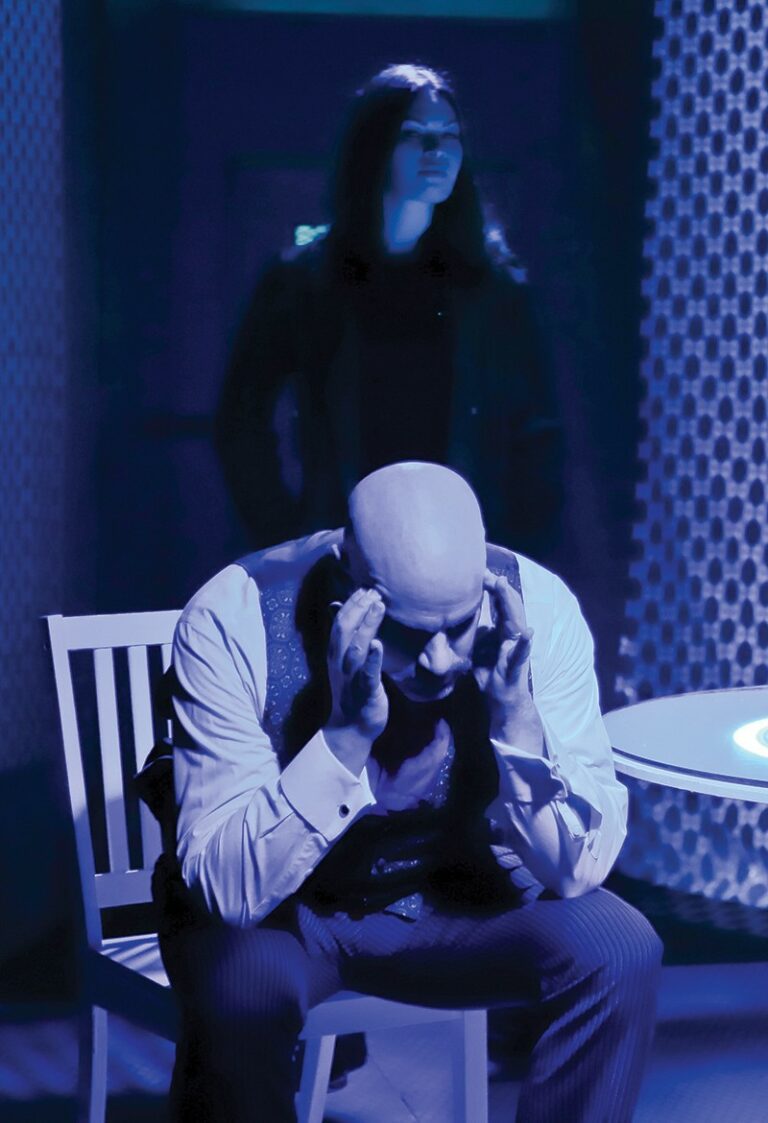
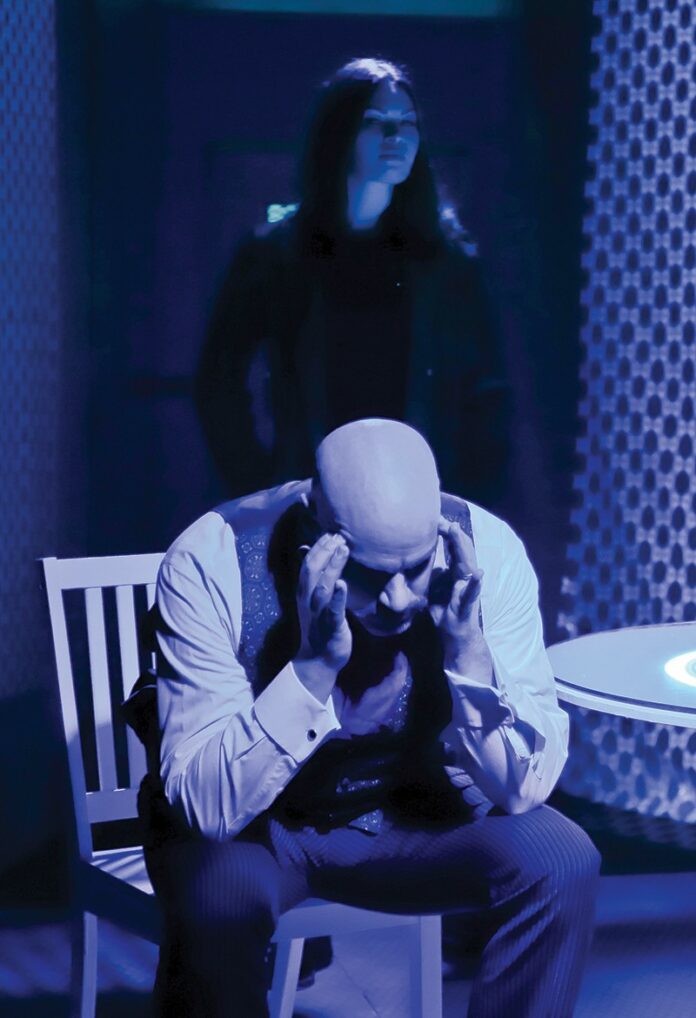
In a Feb. 27 letter to the editor of this publication, a theater patron decried one North Bay company for its tendency to program shows with dark themes that portray men and women at their worst. The letter writer went on to suggest attending a then-running show at Santa Rosa’s Left Edge Theatre. That patron may want to skip what’s running there now through March 24.

The Nether is playwright Jennifer Haley’s look at a not-too-distant future where the internet has evolved into a virtual realm that is rapidly replacing components of the real world. Students don’t go to schools anymore. Vacationers don’t travel anywhere. They all just “plug in.”

Within the Nether, there’s a deeply hidden place called, appropriately enough, “the Hideaway,” where visitors can indulge in their every whim and lead “a life without consequence,” because it all just happens in the participant’s minds. It’s the invention of a man named Sims (Chris Schloemp) who designed it as a way to deal with his pedophilia. If he can satisfy his urges through avatars created by other consenting adults, is anyone really hurt?

An investigator named Morris (Leila Rosa) seems to think so, and a great deal of the play involves her interrogation of Sims and a weary Hideaway visitor named Doyle (David Yen). The rest of the play takes place in that virtual world, a Victorian home whose main occupant is an 11-year-old girl named Iris (adult Lana Spring). The arrival of a new visitor (Jared N. Wright) brings both worlds crashing down.

“Policing the internet” is a phrase we hear often these days, and Haley takes that thought and runs with it in provocative and challenging ways. I’ve revealed little of the details and direction that this show eventually goes, but enough in the hope that you won’t feel the need, as several audience members did at the performance I attended, to exit at intermission.

I’m not sure why director Argo Thompson inserted that intermission in this originally 80-minute show, but I think it suffers for it. This is a show best experienced in a single, uninterrupted and, yes, uncomfortable sitting.

It’s got a generally strong cast handling very difficult material, though Rosa’s investigator seemed to be channeling Jack Webb at times.

Theater doesn’t get any tougher than The Nether. It’s not for everyone, or maybe anyone, but if you do attend, prepare to be bothered.

Rating (out of 5): ★★★½

Still Bleeding Blues

0

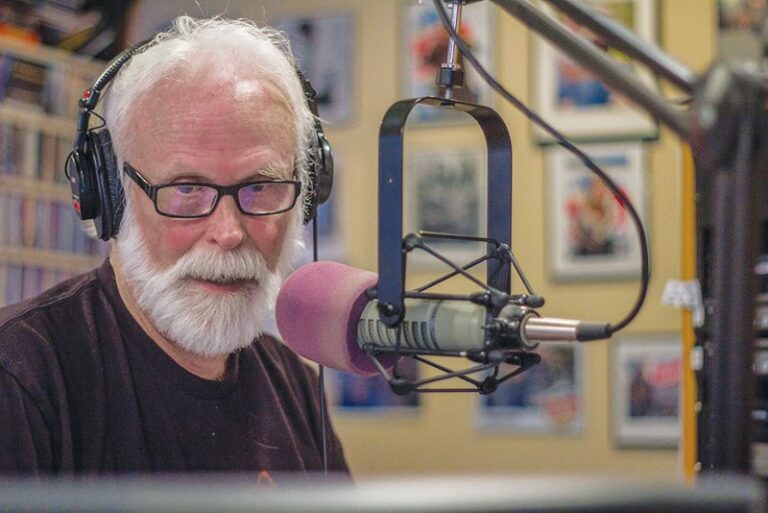
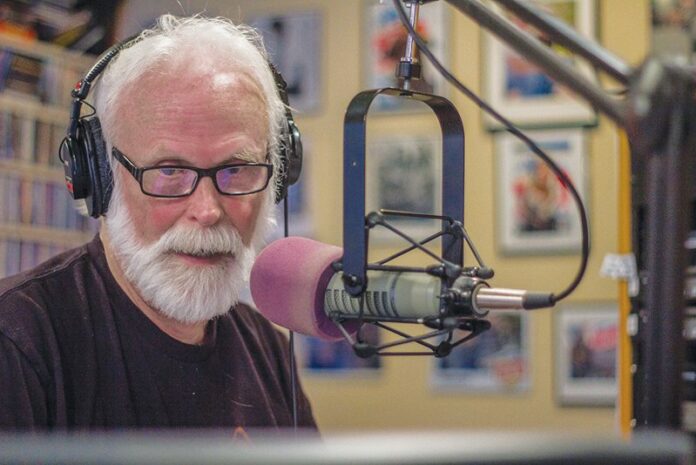
Bill Bowker: it’s a name that’s fun to say, and one familiar to residents across Sonoma County. His voice is just as familiar, and contributes to the longevity of his show, Blues with Bowker, celebrating 40 years on the radio March 16.

Bowker has been involved in radio longer than that, though. “As a young kid with my folks, I came out to Southern California, and in 1961 is when I went to radio school,” he says. “I heard Howlin’ Wolf do a song called ‘Evil,’ and it was pretty scary to me as a kid, but what was crazy was that a song could affect me so much.”

It was after hearing this rough, gravelly blues song that Bowker really began delving into the world of blues and radio. After getting his license from broadcasting school, he went to work for a country station in 1969. “That weekend was Woodstock, that weekend when I first got hired,” Bowker laughs.

During this same time, FM radio was developing as a creative space. “What we called ‘freeform radio’ was emerging. It allowed us to play whatever we wanted, because it was so new and unexplored,” he says.

In 1979, the station he worked for expanded to KVRE in Sonoma County, and Bowker traded Los Angeles for Northern California. “When we came up here it was like freedom again, it was a place where we could make something happen. It gave us a chance to do something here,” Bowker says.

What he did was take part in a radio show that has kept from succumbing to the world of mainstream music. Bowker eventually moved from KVRE to the Krush, 95.9-FM, where Blues with Bowker broadcasts weekdays from 3pm to 7pm and Sundays from 7pm to 9pm.

“Blues music is initially how I realized my affection for music,” Bowker says. “The music is so free—I like that freedom.” Though he has a fondness for the blues, what he really has an affection for is the song. “It’s about quality, not genre,” he says.

This is evident on his weekday show, which plays music stretching from rock to Americana, and often features local artists. “I just think, this is something I like, and I hope I can expose it and I hope it works,” he says.

Forty years later, it’s safe to say it does.

Surfin’ Curds

0

By late January, it was clear that I was not on track to meet my New Year’s dietary goals, so I cast about for any possible culprit besides my own self-discipline.

My eyes landed on the plate of cheese I’d enjoyed almost nightly with crackers, maybe a little secchi salami, and maybe a little wine. No, not the cheese! Suppose it was the crackers?

“A small amount of fat is better than a slice of bread,” Maureen Cunnie tells me. Cautioning that she is not a nutritionist, but operations manager at Cowgirl Creamery, Cunnie affirms that I’m behind the times if I feel guilty about indulging in their double-cream cheese products because of the bad rap on fat.

“Well, that trend is actually changing very rapidly. There’s high demand for high-protein, high-fat foods, and away from overly processed foods.” Matter of fact, says Cunnie, a nationwide cream and butter shortage is looming as a result.

Cheese is definitely part of an everyday diet, says Cunnie. “Cheese is very nutritious, it has fat and protein. If you’re athletic or into working out or doing cross training, you need both that fat and protein to retain muscle.”

I’m getting an idea, since the endless steak-scarfing of low-carbohydrate diet schemes like Atkins, or various “paleo” concepts, just feels a bit tedious. Why not, instead of gnawing on ribs in some spurious version of the Upper Paleolithic, move the clock forward a few thousand years to the pastoral era?

Pastoralism is more than a pretty picture. For thousands of years pastoral societies in Africa, Asia and Europe have herded goats, sheep, yaks—you name it, it’s got milk, they herd it—and made various fermented products. Borrowing a page from controversial “keto” diets, where the idea is to focus the body’s attention on fat, I’ll go further and bastardize food philosopher Michael Pollan’s “eat food” precept: Eat cheese. Lots of it. Go nuts.

A rigorous survey of online resources—or the first page of Google results, where any modern chump gets his healthcare information—turned up just one mention of pastoralism writ as fad diet, and trademarked, no less: “The Pastoral Life—Home of The Pastoral Dietâ„¢ & Movement Plan.” (Consult the digital influencer of your choice, or better yet, a doctor, before beginning any new diet.)

Unfortunately, the author let the site’s hosting expire shortly thereafter, but from what I remember it goes like this: I can eat plenty of cheese if I mimic the active lifestyle of a wiry herdsman leading his flock around the mountains. And oh yeah, a little goatskin flask of wine is absolutely OK.

That’s it. I’m sold.

Soon, I’m pushing my herd uphill to greener pastures on Point Reyes-Petaluma Road. Though it’d be a kick to run a bunch of bleating sheep down D Street, my herd is actually two wheels on a steel-frame road bike. But I’m climbing hills in cow country, all right, and the cars that pass me do exhibit curious herding behavior, following each other almost nose to tail on this well-worn trail.

My first stop is Marin French Cheese, founded in 1865 when, apropos, a sudden demand for a high-protein egg alternative was filled with the Petite Breakfast Cheese. The hot tip here is to get the discounted off-weighted samples. I catch a round of Schloss that’s still sliceable and move on.

I learn from my friendly cheesemonger at Cowgirl Creamery that their aromatic Red Hawk is only made in Point Reyes Station because it wouldn’t ripen the same in another environment. I opt for Wagon Wheel, which is like a fontina but more rich and buttery.

A detour to Nicasio Valley Cheese nets a rare hunk of aged San Geronimo—fine-textured, less buttery but almost smoky, with a meaty umami quality. Cheesemaking at this creamery, which has Swiss-Italian heritage, can be viewed through a window while one nibbles on samples.

Back in town, I find something besides cheddar and ice cream at Petaluma Creamery—a dry Jack goat cheese that’s flaky and tangy.

Midway up a treacherous path in the hills of West County—Occidental Road—the tiny shop at Bohemian Creamery is packed with artisan treats like Bo Peep. Now this looks like something an old shepherd pulled out of his rucksack, but it’s creamy under the rustic-looking rind, like Toma. In town, Sebastopol’s Wm. Cofield Cheesemakers specializes in English-style cheddar and a Stilton-style cheese called Bodega Blue that’s got a hint of cheddar, in contrast to Point Reyes Bay Blue.

Finally, a long lonely trek down Llano Road is rewarded with wholesale-priced St. George at Joe Matos Cheese Factory. The farmstead and its population of phlegmatic farm cats is charmingly unimproved, but the dependable St. George cheese has lately been joined by two extra-aged versions.

OK, by month’s end I’ve gained five pounds. But I don’t blame the cheese, the beautiful cheese, and let us not speak of the wine. I blame the weather—seems the shepherd took shelter for much of this rainy February.

See if you can do better at next weekend’s Artisan Cheese Festival, where the curds are mounded high at Sunday’s walk-around tasting. Go ahead, climb every mountain. Need more exercise, do another lap.

California Artisan Cheese Festival, March 23–24. Tickets, $25–$150. Sonoma County Fairgrounds, 1350 Bennett Valley Road, Santa Rosa. 707.545.4200. artisancheesefestival.com.

Core Values

In recent articles, the Bohemian did not include important facts when reporting about AshBritt Environmental’s involvement in last year’s wildfire debris cleanup in Sonoma and Napa counties (“Dirty Business,” March 6; “Cleanup Crew,” Feb. 13). Thank you for the opportunity to set the record straight.

AshBritt started as a small, family operated landscaping firm that assisted as a subcontractor in debris recovery efforts in 1992 after Hurricane Andrew. Since then, we have successfully served more than 500 clients and been directly involved in the recovery efforts of more than 60 federally declared disasters in 19 states as a prime contractor. Our work has led to collaboration with many federal and state agencies, including FEMA, CalOES, CalEPA and the U.S. Army Corps of Engineers (USACE). The greatest assurance we can provide is that during our 25 years in the emergency-response industry, we have never failed to complete a project.

Recently, the Bohemian reported that AshBritt and Tetra Tech were listed as defendants in a lawsuit over excavation of properties that were subject to cleanup under the USACE contracts after the 2017 wildfires in Sonoma County. What the paper failed to tell readers is that the same law firm had launched a parallel lawsuit against AshBritt and Tetra Tech, as well as ECC Contractors, for their role in cleanup work in Napa County, and those claims have already been dismissed, specifically against AshBritt.

In the lawsuit reported on last week, AshBritt’s role is limited to work performed on a single property, for which we strenuously deny the claim. In fact, ECC Contractors performed work on the majority of properties in that suit. ECC is currently one of the prime contractors for CalRecycle’s Camp fire and Woolsey fire in Paradise and Ventura, respectively.

AshBritt maintains the highest levels of safety, quality and integrity in conducting all of our services and operations. In this instance, our work was closely supervised by the USACE and was in strict compliance with its specifications. Furthermore, our excavation is consistent with the work of other prime contractors, and with previous state-managed and supervised CalRecycle debris-removal projects.

Another misleading item in the Bohemian‘s reporting is the implication about the company’s relationship with state lobbyist Darius Anderson. The emergency-response work mentioned in the article is a federal project for which he had no involvement or role. Other state contracts mentioned are competitively awarded or were not won by AshBritt. Simply put, he has had no role procuring or representing AshBritt in any of the work cited in several of the Bohemian‘s stories.

AshBritt is proud to have been a USACE contractor, and we stand by our work on the project and that of our over 30 local and California contractors that performed debris-removal on properties.

Now as the nation’s leading disaster-recovery firm, our core values about paying it forward are ever present—whether that is hiring local, small business contractors, as we did in Sonoma and Napa counties, or finding community-identified recovery projects like the Hopper Wall reconstruction project. We are there when communities need us.

Gerardo Castillo is chief of staff for AshBritt Environmental.

Open Mic is a weekly feature in the ‘Bohemian.’ We welcome your contribution. To have your topical essay of 350 words considered for publication, write op*****@******an.com.

Double Down

It is truly right and just to go full Huell Howser on Cotati and its bigger sibling Rohnert Park, my own gateway to Sonomaphilia in 1976. Visiting from L.A., I was taken around the place by an old girlfriend who was about to go to Sonoma State University. Out of the dust-dry south, I was dazzled by the leafiniess, the...

Lost Time

Fyodor Dostoevsky—who poured blood, sweat and tears into the pages of Crime and Punishment—would feel at home in John Beck's splendid, searing new documentary, Invisible Bars, which runs 56 minutes and packs a wallop every step of the way. "The degree of civilization in a society can be judged by entering its prisons," the great Russian novelist Dostoevsky exclaimed. Jailed...

Letters to the Editor: March 13, 2019

Floating Away I'm glad to see the Bohemian begin to introduce your readers to the fast-approaching floating offshore wind industry ("Full Tilt," Feb. 27). Going forward, it would be useful to see a more balanced coverage of something that may well permanently industrialize significant portions of California's coastal waters, rather than a reprint of the industry's own public relations while failing...

Mill Valley private-equity exec named in college-admissions criminal scam

William E. McGlashan, a Mill Valley resident and executive at the private-equity giant TPG, has been named in a sweeping set of indictments issued this that allege that he and dozens of other parents paid off college admissions off.....  

The Good Seeds

Today's pot is hardly the skunkweed of the '80s. While this won't be news to many, I wonder if people realize the complexities involved in growing today's designer weed, medicinal or recreational. I certainly didn't when I set out to write a novel featuring a medical-marijuana operation. The Wolf Tone takes place in 2011 Montana, ancient history by industry standards....

Space Force

Expert script-flippage gives texture to the heartfelt female empowerment message within Captain Marvel. It begins as a war-on-terror movie, with an extraterrestrial military gearing up for a mission against the shape-shifting Skrulls, hiding among the locals on a planet that looks like Afghanistan. Later, we arrive at our more current malaise when the film's true villain starts talking of...

Dark Matters

In a Feb. 27 letter to the editor of this publication, a theater patron decried one North Bay company for its tendency to program shows with dark themes that portray men and women at their worst. The letter writer went on to suggest attending a then-running show at Santa Rosa's Left Edge Theatre. That patron may want to skip...

Still Bleeding Blues

Bill Bowker: it's a name that's fun to say, and one familiar to residents across Sonoma County. His voice is just as familiar, and contributes to the longevity of his show, Blues with Bowker, celebrating 40 years on the radio March 16. Bowker has been involved in radio longer than that, though. "As a young kid with my folks, I...

Surfin’ Curds

By late January, it was clear that I was not on track to meet my New Year's dietary goals, so I cast about for any possible culprit besides my own self-discipline. My eyes landed on the plate of cheese I'd enjoyed almost nightly with crackers, maybe a little secchi salami, and maybe a little wine. No, not the cheese! Suppose...

Core Values

In recent articles, the Bohemian did not include important facts when reporting about AshBritt Environmental's involvement in last year's wildfire debris cleanup in Sonoma and Napa counties ("Dirty Business," March 6; "Cleanup Crew," Feb. 13). Thank you for the opportunity to set the record straight. AshBritt started as a small, family operated landscaping firm that assisted as a subcontractor in...
12,119FansLike
5,007FollowersFollow
6,928FollowersFollow