Taking Stock

0

A proposed class action lawsuit brought by shareholders has been filed against the Pacific Gas & Electric Corporation (PG&E) in federal court.

Suits were filed by PG&E shareholders John Paul Moretti and David C. Weston on June 12 in the United States District Court, Northern District of California, alleging violations of federal securities law by the utility. The law firms representing the plaintiffs note in their court filings from early June that there are potentially hundreds of thousands of shareholders in the proposed class-action suit.

The two suits charge that between April 29, 2015, and June 8, 2018, PG&E executives engaged in what amounted to an ongoing pattern of deceptive statements concerning the utility’s vegetation-removal policies. Those statements and the subsequent wildfires that tore through California last year are the fulcrum of the suit, as recent official investigations into last year’s wildfires have identified the culprit in a number of fires: PG&E power lines coming into contact with tree limbs during a high-wind event last October.

The class period dates back to April 29, 2015, because that’s the day, charge lawyers for the plaintiffs, that then–PG&E CEO Christopher Johns, during a conference call with investors to discuss the company’s performance during first quarter of fiscal year 2015, “assured investors of the company’s commitment to step up vegetation-management activities to mitigate wildfire risk.”

Those assurances, the suit alleges, were made to shareholders for the next several years leading up to the 2017 fires—which, the suit argues, make a compelling case that the utility had not stepped up its efforts at managing vegetation.

Johns is named in the suit along with company vice presidents Jason Wells, David Thomason and Dinyar Mistry; Geisha Williams, the current CEO and president of the utility, is also named in the suit.

The defendants, charges the suit, by reason of their position as executive officers within the company, “possessed the power and authority to control the contents of PG&E’s quarterly reports, press releases and presentations to securities analysts, money and portfolio managers, and institutional investors.”

The suit alleges that the executives “knew that the adverse facts specified herein had not been disclosed to and were being concealed from the public, and that the positive representations being made were then materially false and misleading.”

Along with the April 2015 reassurances about vegetation removal, the suit charges that the company’s media-relations department maintains a website which “repeatedly touts the safety of its network and the company’s proactivity in fighting wildfire risk.”

Those claims were also made in filings that the utility submitted to the Securities and Exchange Commission in 2016 and 2017, which stated that the utility had “upgraded several critical substations and reconductored a number of transmission lines to improve maintenance and system flexibility, reliability and safety.”

The events of October 2017 and subsequent inquiries by Cal Fire into the cause of the fires has rendered those statements “materially false and/or misleading” because they misrepresented and failed to disclose to investors that the utility hadn’t maintained electrical lines under state law.

The suit alleges violations of two sections of the Securities Exchange Act of 1934 and seeks a jury trial to determine the utility’s culpability.

The plaintiffs in the current suit, Moretti and Weston, both purchased shares in the investor-owned utility, the largest in the state of California, only to see shares in PG&E stock decline in value in the aftermath of the 2017 infernos that tore through the North Bay.

Moretti purchased 280 shares
of PG&E common stock between Oct. 12 and Oct. 13, 2017. On Oct. 12, he purchased 95 shares at $66.15 per share. By the next day, the shares were selling for between $57 and $58 a share, and Moretti purchased 195 additional shares.

According to court records, Weston purchased 1,000 shares just a few days before the fires broke out, on Sept. 27, 2017. He paid $68.75 per share. Weston then sold 1,000 shares on Oct. 13 when they were trading at $57.96 per share. The plaintiffs are being represented by law firms in New York, Beverly Hills and San Francisco.

At the time of the fires, which scorched some 250,000 acres in the Northern California, PG&E shares were trading at $69.15. By Oct. 16, they’d dropped to $53.43 and would continue to slide throughout 2018. By May of this year, shares were trading at $42.34. On June 8, PG&E shares were trading at $41.45 per share. Three days later, June 11, shares of PG&E common stock closed at $39.76.

In December 2017, the company announced the suspension of a 2018 cash dividend for investors, and two weeks ago the utility said it would take a $2.5 billion charge this year in order to deal with mounting insurance and legal issues related to the fires that had driven down its common-stock value. PG&E has not admitted to any culpability in the fires.

In public statements and media interviews, the company has repeatedly stressed that global warming has coaxed forth a “new normal” in California wildfires, and that at the time of the fires, it believed it was in compliance with its obligations to state law.

As fire-related class action lawsuits mounted this year, and as Cal Fire investigations started to conclude that power lines coming into contact with tree limbs had been a predominant cause of the wildfires, the utility hired heavyweight Sacramento lobbying firm Platinum Advisors in May. The firm was founded by Sonoma County developer Darius Anderson.

On June 8, Cal Fire reported that PG&E power lines coming into contact with trees were the culprit in a dozen Northern California fires in Mendocino, Humboldt, Butte, Sonoma, Lake and Napa counties

The precipitous devaluation of the common stocks in PG&E, to the plaintiffs, are a sign that executives at the utility “engaged in a scheme to deceive the market and a course of conduct that artificially inflated the company’s stock price, and operated as a fraud or deceit on acquirers of the company’s common stock.”

As of April of this year, the suit notes, PG&E had 516,427,502 shares of common stock, which are held by “thousands if not millions of individuals located throughout the country and possibly the world.”

In a statement, the utility did not directly address the substance of these latest, shareholder-led lawsuits as it highlighted its commitment to its customers.

“Nothing is more important to us than the safety and well-being of our customers and communities we serve,” says Paul Doherty, a San Francisco–based marketing and communications specialist with the utility. “Our thoughts are with everyone impacted by these devastating wildfires. We are aware that lawsuits have been filed. We’re focused on doing everything we can to help these communities rebuild and recover.”

Gap Gear

0

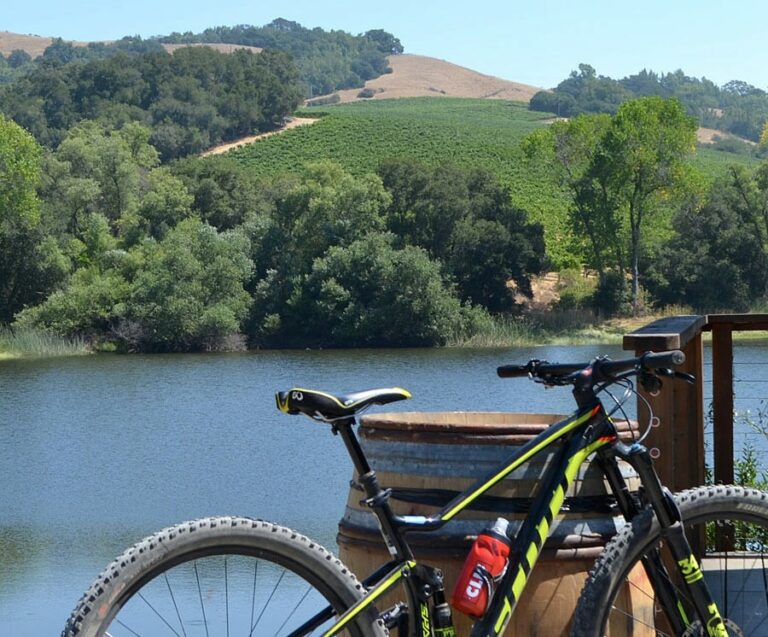
The sparsely distributed vineyards of the Petaluma Gap region are perhaps best explored on a bicycle. The sights, the smells and, of course, the wind inform a terroir experience that’s rewarding even without opening a bottle—but we will open that bottle.

A ride to the all-but-hidden Stubbs Vineyard southwest of Petaluma, paired with wines sourced there by DeLoach Vineyards, starts this new series of great rides to great vines. My ride begins at free, four-hour parking in downtown Petaluma, which turns out to be just enough for this 42-mile loop. Passing the Petaluma Creamery, Western Avenue becomes Spring Hill Road, and the scent from eucalyptus windbreaks hangs in the air. A long-horned bull looks up, deep in dry grass, then resumes his determined munching. There are a few vineyards along this road, but I spy more Angus than Pinot Noir.

On this side of the hill, patches of green still tint the yellowing hills at the end of June, and green blades stick up around hay bales drying in fields. Here comes the reason why: the sky clouds over and I’m fighting a chilly breeze as ocean air makes one last run inland in late morning. This must be the gappiest place in the Petaluma Gap. For a spell, it might as well be February.

It’s a left at Bodega Avenue and the Coast Guard training center, but then, forgetting my own route map, I push on up Valley Ford Road instead of taking an immediate left on Tomales. But a left turn on little Carmody Road provides a nice add-on climb, steep but brief, and makes me think about the fine cheese named after it by Bellwether Farms. The pavement, as if taunting Sonoma, turns abruptly smooth at the Marin County line.

Turn left on Fallon-Two Rock Road for a stretch, then right on Alexander, a quiet country lane for half the week until the shooting range fires up from Thursday to Sunday. At last, a left turn back to Petaluma-Tomales Road takes me to Chileno Valley Road on the right. A moderate climb through an oak forested ravine opens to a view of a swan-graced lake.

Right on Wilson Hill Road—now this is a climb. At the summit is the goal: a splendid view of Stubbs Vineyard, nestled in a little valley and sheltered from the harshest winds.

After enjoying a steep descent, I watch my speed on the left at Hicks Valley Road, which leads to Petaluma-Point Reyes Road. Marin-bound bikers can make a pit stop at Marin French Cheese Company to the right; otherwise turn left toward Petaluma. The road is busy but provides a wide, smooth shoulder after passing the vineyards and olive groves of McEvoy Ranch. The sudden shift from country back into town is made gracious by the grand old houses of Petaluma’s D Street.

DeLoach 2014 Stubbs Vineyard Chardonnay ($50) This wine’s oak aroma is fresh, not toasty, from time spent in just 20 percent new barrels, and doesn’t overwhelm its delicate scent of lemon tartlet and Golden Delicious apple. The creamy characteristics of malolactic fermentation, too, merely wrap and soften the tingly core of cool climate acidity, detailed with more lemon and spice in the aftertaste. A Chablis fan’s Chardonnay?

DeLoach 2014 Stubbs Vineyard Pinot Noir ($55) The Pinot, too, is light and spicy, its appearance like strawberry jam, perhaps, informing my palate impression, spiced up with crushed raspberry seeds, late summer Pennyroyal and cardamom, deepening in the glass with overtones of milk chocolate. An enticing wine, well worth the climb.

In the Family

0

Keyboardist Scott Guberman’s story has all the elements of a Hollywood film, with big risks, dramatic pay-offs and an all-star supporting cast of musicians.

When Guberman first discovered the Grateful Dead as a teenager, he says his whole view of music completely changed. “I think it came along at the right time for me,” Guberman says. “I was looking for something that was psychedelic, that was rock and roll and yet was modern.”

Three years ago, Guberman went from Grateful Dead fan to Terrapin Crossroads regular, and he now performs several times a month with the Terrapin Family Band and Grateful Dead founding bassist Phil Lesh at the venue, which Lesh owns and operates.

Guberman also performs regularly throughout the Bay Area in his own band and as a solo performer. He appears July 6 in Sonoma at the Reel Fish Shop & Grill with guitarist Grahame Lesh, drummer Pete Lavezzoli (Jerry Garcia Band) and bassist Robin Sylvester (RatDog).

After studying classical piano at the Hartt School in Connecticut, Guberman found success in Grateful Dead tribute bands on the East Coast for several years. He even toured briefly with two former Grateful Dead keyboardists, Tom Constanten and Vince Welnick.

After learning about Lesh’s involvement with Terrapin Crossroads and hearing stories about people meeting him or Grateful Dead guitarist and Sweetwater Music Hall co-owner Bob Weir in and around Marin, Guberman took a trip to see for himself.

On that trip, Guberman saw Phil Lesh and friends recreate a Grateful Dead setlist from 1965. Afterwards, he met Lesh and gave him a business card.

“I simply said, ‘It’s my lifelong wish to play with you,'” remembers Guberman. “And he said, ‘Well, stranger things have happened.'”

That initial vacation turned into an extended stay, and Guberman found himself on the stage at Terrapin, playing with musicians he met along the way. Soon after, he and his wife made the move and relocated to the North Bay permanently. “Everything’s been a dream come true,” he says.

In addition to jamming with Lesh at Terrapin, Guberman has played alongside Weir at Sweetwater and with just about everybody else in the extended Grateful Dead family throughout the North Bay.

“Playing with them, at some point it feels like the guys I’ve been playing with forever, because that’s what I did forever, listen to their recordings and play along,” says Guberman. “It’s always a surreal moment.”

Harbor Haven

0

Unless you’re a fan of Cap’n Platters’ fried fish and oceans of too-thick clam chowder, I find that most food at harborside restaurants doesn’t live up to the views.

But in Bodega Bay, the Fishetarian is a notable standout and my go-to pick for out-of-town visitors who want a briny taste of what the burg by the bay has to offer—literally and figuratively.

Co-owner Shane Lucas grew up in the seafood business. His parents opened Lucas Wharf Restaurant next door more than 30 years ago, and he has spent more than 20 years selling seafood. He knows his fish. And he knows his crab.

Hands down, my favorite item on the menu is the crab sandwich. The burly sando goes for $15.99—not cheap, for sure, but the thing is loaded with sweet, Dungeness crab. It’s mixed with a bit of creamy mayo, but it’s really just a whole lot of crab, no filler. The only knock on the sandwich is the bread—there’s too much of it. It’s an excellent ciabatta roll, but thin slices of toasted sourdough would be a better showcase of the crab.

My second choice is the rockfish sandwich ($13.99). Available grilled or fried (go for the grilled), the fish is sourced from local waters—Ft. Bragg on my visit. Then there are the rockfish tacos ($12.99). Like the sandwiches, the twin tacos are bulging with fresh fish. Chipotle mayo, avocado and pico de gallo seal the deal.

I love a good clam chowder, but not when it tastes of nothing but heavy cream and potatoes. That’s not the case here ($6.50 for a bowl). The soup has a lighter, thinner consistency, and the briny bite of clams comes through. The addition of chopped cilantro and green onions on top seems like a small thing, but it works as a foil against the richness of the soup. I also had an excellent bowl of curried crab and corn chowder (a daily special) on a recent visit.

Not in the mood for fish? The “adult grilled cheese sandwich” is for you. Loaded with Estero Gold and Highway One cheese made at Valley Ford Cheese & Creamery just down the road, the molten concoction combines the gooey cheese with grilled onions and fig jam ($11.99). Damn!

As good as the seafood is, the beverage program at Fishetarian is far from shabby. There are half a dozen local beers on tap, as well as kombucha and row upon row of bottled beer in the help-yourself reach-in refrigerator. If you’re an artisanal soda geek, this is your place. The number of shelves dedicated to root beer alone is astounding.

Fishetarian gets extra points, too, for its choice of plates and cups. Everything is compostable and biogradeable. No styrofoam clamshell boxes here. Given the long lines that stretch out the door most weekends, the amount of landfill-bound trash that would be generated here would be voluminous if Lucas and company weren’t conscientious. Thumbs up to Fishetarian for doing its part in not contributing to the gyre of plastic trash spinning in the Pacific Ocean. Think about that as you gaze into Bodega Bay, enjoying your lunch.

Sing It, Bill

0

In a world of musicals based on movies and TV shows, why not Shakespeare? Such is Illyria, a musical adaptation of Twelfth Night first produced Off-Broadway in 2002 and now running at 6th Street Playhouse.

Don’t let the words “Shakespeare” and “musical” alarm you. Peter Mills, who wrote Illyria‘s book and score, takes the plotline of this 17th-century comedy, modernizes its speech and time period, sets it to music and come ups with a terrifically entertaining piece
of theater.

Shakespeare’s tale involves shipwrecked and separated twins Viola (Carmen Mitchell) and Sebastian (Lorenzo Alviso); Duke Orsino (Burton Thomas), the lovelorn leader of the isle of Illyria; Olivia (Tracy Hinman), the in-mourning object of his affection; Andrew Aguecheek (Stephen Kanaski), a silly suitor for Olivia’s hand; Sir Toby Belch (Seth Dahlgren), Olivia’s soused uncle; Malvolio (Larry Williams), a stuffed-shirt steward; Maria (Gillian Eichenberger), a servant with eyes on Sir Toby; and Feste (Tim Setzer), a fool who narrates the tale. Impersonation, mistaken identity, gender confusion and trickery all come into play before things get sorted out and everyone ends up with his or her intended.

More than the usual suspension of belief is required in a couple of areas. One must accept Ms. Mitchell being regularly mistaken for a male, and Ms. Hinman is a more mature Olivia than one usually sees in the role, but just go with it.

Mills’ 20-plus songs vary in style from a lilting ballad (“Save One”) to English music-hall numbers like the hilarious “Cakes and Ale.” Musical director Lucas Sherman has a six-piece band delivering the beguiling score flawlessly, while director Craig Miller’s cast provides superb vocal talents. This may be the best sounding musical 6th Street has produced.

Mitchell charms as the gender-bending Viola and is matched by Burton’s flustered Orsino. Orsino’s musical confession of love to Alviso’s Sebastian (whom Viola was impersonating) shows Shakespeare was a couple of centuries ahead of society when it came to same-sex relationships. Ample comedic support is provided by Dahlgren, Williams and Kanaski, with Setzer’s clowning as Feste rakishly amusing.

Craig Miller ends his tenure at 6th Street Playhouse on a high note with this delightful production.

Rating (out of 5): ★★★★

City of Mystery

0

Healdsburg is known for its quaint downtown, galleries, wineries and a plaza that draws locals and tourists.

Yet under the surface of the town’s attractions lies puzzling mysteries and hidden treasures, ready to be uncovered in the new “mystery missions” offered by the Sonomist, the alter-ego of local writer and mystery enthusiast Bethany Browning.

“My whole life, I’ve been into puzzles, riddles, anything that has me unearthing or finding something that nobody knows about,” Browning says. “I’ve always sought out these experiences, like the San Francisco treasure hunts they do on Chinese New Year. I’ve always been involved in this world.”

After noticing several small points of interest in and around the Healdsburg Plaza, Browning conjured up her own mystery mission as a one-time corporate team-building experience, which then sat in a drawer for years, before being revived as the Sonomist last year.

Drawing on old-school spiritualism and a bit of steampunk in its aesthetic, the Sonomist’s clue-based scavenger hunts capture the imagination and provide a new perspective on the North Bay, even for locals.

When would-be detectives sign up for one of two Healdsburg mystery missions, which can be played in groups of up to six or competing teams of two or more, they are directed to a secret bunker somewhere near the plaza that contains a folder of clues, rules, maps and other materials.

Each mission takes around 90 minutes, though these missions are also a chance for visitors to explore the plaza. There’s no penalty for winetasting or window shopping.

Some of the hidden gems that the mystery missions reveal to participants include historical artifacts, plaques and art.

“I think once people start playing this game, they’ll start seeing these things too in their daily lives, and not just Healdsburg, but all over,” says Browning. You “get in tune to the smaller, tinier details of what’s happening around you when you start thinking this way.”

Browning is already planning to expand her games to Sonoma and Windsor.

“Sonoma is a treasure trove. I think I can get about three different missions out of downtown Sonoma,” says Browning. “There’s so much history, so many things people walk past without noticing on every corner there.”

While Windsor is a newer and smaller area to explore, Browning envisions a kid-friendly mission there. (The current mystery missions are family-friendly, but geared toward adults.) “It might be fun for younger kids to get their feet wet with this kind of off-screen, analog play,” she says.

Maple Spliffs

Canada, our quiet neighbor to the north, now has something to boast about other than having a better head of state: the full legalization of cannabis.

Last November, the Canadian House of Commons voted overwhelmingly in favor of Bill C-45, known as the Cannabis Act. And on June 19, 2017, the Canadian Senate approved of the legislation, 52 to 29, with two abstentions.

On June 20, Prime Minister Justin Trudeau announced that recreational marijuana would become legal on Oct. 17. Our northern neighbor will be the second country in the world to legalize both medial and recreational marijuana. Uruguay was the first. Then–Uruguayan President José Mujica signed legislation to legalize recreational cannabis in December 2013, though the transition from illegal to legal has been tough. Banks have been reluctant to take pot dollars, and many pharmacies don’t want to carry cannabis. Uruguay has only 17,391 registered cannabis users, out of a total population of 3.4 million.

Canada has about 37 million people in an area that’s slightly bigger than the United States. According to New Frontier Analysts, a cannabis think tank, Canada “is fast becoming the world’s leading cannabis market.” An Israeli medical cannabis company, Globus Pharma, recently signed an agreement to supply cannabis to Canada. The Israeli company wants the revenue; the Canadians need the product for a rapidly expanding market that can’t be fulfilled by domestic sources.

According to Marijuana.com, Trump pressured Israeli Prime Minister Benjamin Netanyahu not to export cannabis. But the Israeli minister of public security—with additional state funding—agreed to increase surveillance of cannabis exports that will be heavily taxed by the government. If all goes according to plan, Canadians will smoke cannabis cultivated by Israelis.

Trudeau’s endorsement of recreational cannabis will not likely change Trump’s view of him, and Californians are not likely to look to Canada as a model for the development of its own cannabis industry. We like the way we do things. We tend to think our way is way better than the way other countries, including Canada, do them, though for years Vancouver in British Colombia has produced high-quality cannabis.

Vancouver’s “Kush tourism” has attracted travelers from the States and elsewhere. Vancouver’s liberal pot laws encourage visitors to leave their paranoia at the border. In February 2016, a federal judge in British Columbia ruled that medical-marijuana patients have the constitutional right to grow their own marijuana.

Maybe the North Coast cannabis industry should send a delegation north to learn a few things from those Canucks.

Jonah Raskin is the author of ‘Marijuanaland: Dispatches from an American War.’

Leave It to . . .

0

Bill Ostrander was showing his brother-in-law around his Kenwood vineyard one summer day last year when the tour turned totally horror-show, from the perspective of a grape grower: suddenly, they came upon a patch of grapevines with wilted leaves, desiccated grapes and trunks cut in two. Ostrander had suspicions about who the culprit might be.

Ostrander’s vines, planted as Syrah in 1997, had already suffered a severe pruning once before, when they were cut in half and re-grafted onto another variety, “because Syrah wasn’t possible to sell,” the Kenwood resident says. The vineyard is just two-and-three-quarters acres, but it provides him a little income. And his new Malbec vines had attracted some unwanted customers: beavers.

When grape growers in Sonoma and Napa wine country encounter such a problem with beavers, as rare as that is, they are legally entitled to apply for a permit to have that animal trapped and killed. Yet Ostrander hesitated. He set up a digital “critter cam” to catch the culprit in the act, tried out various methods of fencing them out of the vineyard and documented his efforts in a light-hearted email series to friends and family that he called “Wet Caddyshack.” Clearly, there was something about this determined rodent that was different than, say, a common pocket gopher, which Ostrander says he would be happy to get rid of.

There’s something different about the beaver, indeed, as Ostrander learned from his interaction with a local cadre of “beaver believers” who are on a mission to help property owners live with the beaver, encourage their habitat and ultimately change the game plan for what they say is a woefully underappreciated keystone species in the state of California.

The first step is getting past California’s “beaver blind spot,” as the Occidental Arts & Ecology Center’s Brock Dolman puts it. Dolman is co-director, with Kate Lundquist, of OAEC’s WATER Institute (Watershed Advocacy, Training, Education and Research), established in 2004 to study and promote watershed issues. The award-winning duo’s “Bring Back the Beaver” campaign, started in 2009, went back on the road in the North Bay last month with a talk in connection with a screening of the environmental documentary Dirt Rich in Novato; appearances continue through June in Napa, Sonoma and Marin counties.

“A lot of people just don’t know that we have beaver in California,” says Lundquist, who says that their current presentation is an update on a 2015 talk they gave in Sonoma to help answer the question: “That’s an East Coast thing, right?”

Despite the Canadian-sounding name, charismatic Castor canadensis is native to all of North America, and is a close relative to the Eurasian beaver, Castor fiber, which Europeans exploited to near extinction for its castor oil and the fine hat-making properties of its dense fur. The discovery of beaver and other hapless, furry critters in the New World inspired a “Fur Rush” long before the Gold Rush. Turns out, according to Lundquist, when the Russians founded Fort Ross in 1812, it was actually kind of late in the game—and trappers had been exploiting the West Coast for decades before the legendary “mountain men” trappers descended on the Golden State from overland to clean up the rest.

Although a historical account from General Mariano Vallejo found the Laguna de Santa Rosa “teeming with beaver” in 1833, by 1911 California had about 1,000 beavers left before legislators passed a law briefly protecting the aquatic rodents. Following a quarter-century-long campaign to reintroduce beaver to erosion-threatened habitat (the highlight of the “Bring Back the Beaver” show is the parachuting “beaver bomb” developed during the time), they were determined non-native and invasive for decades thereafter.

Today in California, trapping beaver is permitted in 42 of 58 counties, and there is no bag limit to the number taken. While Napa, Sonoma and Marin counties are excluded, beaver are considered a nuisance species everywhere, meaning that farmers, landowners and government agencies that encounter beaver problems may apply for depredation permits to have them removed.

And the only option is lethal removal, as longtime Napa grape grower Andrea “Buck” Bartolucci found when he asked the California Department of Fish and Wildlife about his beaver problem in 2013. One day while driving down the half-mile driveway of his 160-acre Madonna Estate Vineyard in the Carneros, Bartolucci noticed a similar problem to Ostrander’s: a string of grapevines cut down at the trunk. It was so methodically done that he initially wondered if an employee had become disgruntled, but he found it was beavers from nearby Huichica Creek. “They knocked down a couple of trees and had a party with the grapevines,” Bartolucci says.

Fish and Wildlife recommended contracting the county trapper, and at the time, Bartolucci was impressed with the 60-pound creatures that were trapped. “They’re fierce!” Bartolucci says. “It’s not like Bucky Beaver.” Yet Bartolucci says the environment is important to him, having farmed his vineyard certified organically since 1991, and now laments that it was the only option that was given to him at the time. “I’m not the kind of guy who wants to do in an innocent animal,” he says, “and if there was an alternative, I’d certainly look into that.”

The sticking point is that Fish & Wildlife abides by a “shall issue” code when it comes to beavers. That is, if a landowner can verify property damage from beaver, the responding officer shall issue a depredation permit. Unlike some other Western states, California does not allow live trapping and relocation of beaver, or many other animals.

Those permits numbered some 3,300 in 2016, according to beaver advocate Heidi Perryman. Though California does not require records of depredations completed, the U.S. Department of Agriculture’s Wildlife Services does for its separate permits; it counted 836 in 2016. According to the local office for Sonoma and Napa counties, one permit was issued for beaver in 2018, but it was not verified that any were actually taken under that permit.

[page]

This business as usual for beavers started to change after a pair of them wandered into Alhambra Creek in the middle of the city of Martinez in 2006. They built a dam and had yearlings, called kits, but the city’s application for a permit to make them go away did not sit well with locals who could see the kits playing as they drank their coffee. Resident Heidi Perryman formed the beaver advocacy group Worth a Dam, which holds its 11th annual Beaver Festival on June 30 in downtown Martinez.

A few years later, a somewhat less celebrated pair of beavers set up house on Tulocay Creek, which passes under Napa’s Soscol Avenue at the Hawthorn Suites hotel. An otherwise unimpressive urban drainage, this section of Tulocay sprang to life after the beavers set up a serviceable little barrier of sticks and mud: numerous species of birds, amphibians and mammals like otter and mink have been observed by wildlife watchers keeping an eye on the pond, including wildlife photographer Rusty Cohn, who has photographed and made videos of beavers swimming, munching on cattails and even falling asleep in mid-munch while trying to rebuild the dam after the rains of 2017.

Luckily for the beavers, advocates have convinced the hotel to wrap the trees on their landscaped grounds with wire to deter the animals from gnawing on them, and a new hotel project now under development on the other side of the creek is not now affecting the beavers, who are rebuilding their dam after the higher water flows of last winter.

The Napa County Flood Control and Water Conservation District, however, is responsible for the bank of the stream, not the proposed Cambria Hotel, under development by Southern California–based Stratus Development Partners. Lundquist praises the Napa agency as pro-beaver, saying, “I’m grateful that there are flood-control agencies that recognize the beavers, and I encourage all of our flood agencies to learn from the Napa district, because they’re doing a great job.”

With the OAEC as consultants, the county plans to lower the water level of the beaver pond temporarily, to facilitate shoring up the bank, thus avoiding a number of potential pitfalls, according to Kevin Swift, who’s contracted to do the pond-leveling work.

Swift is the proprietor of Swift Water Design, a one-man, “non-lethal beaver-management” startup that, Swift says, would require 10 of him if even a fraction of the agencies and individuals currently trying to manage their beaver problems would call him. Swift assesses problems and implements solutions that, while relatively simple, require a different way of thinking about beavers. He speaks eloquently, if colorfully, about the rodents’ role in the environment.

“They’re ignored, underappreciated, reviled and mismanaged in equal measure,” says Swift, who emphasizes that beavers, for all their engineering abilities, are not intellectual powerhouses. “It’s got a brain the size of an acorn. If you can’t work it out with them, could be you’re the problem.”

Currently, Swift is working with a property manager in Glen Ellen who’s got a beaver that’s blocking a spillway in an old stock pond located near a confluence of streams. “It looks like, way back when, a rancher went and put in a dam,” he says, “just where a beaver would, really.” It’s not in use, but the property owner can’t risk being responsible for a failure of the old dam, either. The solution lies in understanding the beaver’s simple needs.

A beaver’s “programming set is very small,” says Swift, “but profound in its implications. It’s like, if you hear running water, and you feel like you’re going to get eaten, make the running water stop making that noise. As soon as it stops making that noise, punch a hole in a creek bed somewhere and make more of yourself. And you’re good.”

Beavers build dams mainly to stay safe from predators, such as coyotes. Secondarily, the flooded area around the dam encourages felled riparian tree species, like willow, to sprout back and create more beaver food. “I mean,” says Swift, “it’s just this tiny, tiny little sliver of code, out of which falls an entire ecosystem.”

Swift makes no claims to sentimental concern for the animals, joking, “If you want to shoot a beaver in the head and make a hat, I’m OK with that.” More seriously, he points to the waste of potential environmental services the current policy promotes.

“It seems to me that all the laws are backwards,” he says. “You don’t need a permit to destroy a beaver dam that makes critical habitat for rare, threatened and endangered species—but you might need a permit to put in a flow-control device that’s hydrologically invisible and maintains the habitat for rare, threatened and endangered species. How does that work?”

Coho salmon, chief among those threatened and endangered species, first inspired the OAEC’s Dolman and Lundquist to think about beavers. Coho, which experienced a sharp decline in population in the 20th century, as well as other salmonid species, require cool water, complexity of habitat and water flow in summer and fall. “And our sense was, we need all the help we can get,” says Dolman. “We kept coming across these papers, especially work out of Oregon and Washington state,” he says, that showed “a positive correlation . . . between beneficial beaver habitat and a support for coho salmon, specifically—also steelhead and Chinook.”

[page]

“And it just got us thinking,” says Dolman in his 2015 presentation in Sonoma. “We ought to bring another tool in the toolbox here. And so we began really looking at beaver as an additional component to how we could recover these endangered species.”

In Sonoma County’s Russian River watershed, a host of agencies contributed to a salmon release and the construction of an expensive beaver pond analog in 2013, touted to promote the return of coho that, ultimately, would not be dependent on a hatchery. Beaver believers say that this, and much more, could be more cheaply achieved by simply letting the beavers alone. No beavers have been documented in the Russian River watershed, but there is an unsubstantiated report of a beaver being killed in reputedly environmentally conscious west Sonoma County—perhaps the “disperser” that had previously been observed moving west from Spring Lake in Santa Rosa.

Some cattle ranchers in Nevada, in fact, are moving further ahead in beaver consciousness than landowners in California wine country, according to Lundquist. “They stopped shooting them, and suddenly they have more water,” Lundquist says. Some have gone on record as saying they wouldn’t be in ranching now if it weren’t for the beaver.

Perhaps wine country has some catching up to do in this regard, when a property like Napa County’s Domaine Chandon, which is certified Fish Friendly Farming for one of its vineyards, can claim on its website, “We embellish waterways with native vegetation, maintain wildlife corridors, preserve forested areas in the vineyard and employ clean water protection to encourage fish habitat and spawning,” while applying for a 2013 permit to kill beaver in that very same fish-spawning habitat.

And if the beaver believers are right, as the numerous scientific studies they point to suggest, there is no better way to be fish-friendly than to be beaver-friendly. The beavers are not going away. There are some intractable parties, such as the absentee landowner on Sonoma’s Leveroni Road who, according to state records, refuses to consider alternative options to repeated depredation permit requests. But ultimately this approach is doomed to fail, says Swift.

“A story you often hear in California,” says Swift, “is, ‘I’ve been going down to that place for an hour every day for X number of years, and I’ve shot and trapped Y number of beavers, and they’re still there!’ Yeah, you’re in beaver habitat! Geology drives beaver habitat. Unless you can literally move mountains, you’re not changing anything about beavers’ attraction to
your site.”

Lundquist says killing beavers is neither a viable nor economical strategy. “For one, people hold candlelight vigils, like they did in Tahoe. And it can be really bad press if you’re trying to do the right thing—or be seen as doing the right thing, anyway.”

Thus far, few Sonoma and Napa wineries seem to have any clue as to what that right thing may be. The 427-page California Code of Sustainable Winegrowing Workbook, for instance, on which the Sonoma County Winegrowers bases its initiative to make Sonoma County 100 percent sustainable by 2019, only mentions beavers incidentally in a section on “often overlooked” aquatic habitats.

Meanwhile in Kenwood, grape grower Bill Ostrander has found a way to live with the beavers. After consulting with Dolman, he installed a fairly inexpensive, single-strand electric fence that only had to reach four inches off the ground—beavers can’t jump, and since they’re generally covered in water, they’re highly conductive.

Ostrander had thought about the usual option. “Yeah, I thought about it,” he says, “but it was fairly straightforward and inexpensive to put up the electric fence, and not a lot of trouble as far as impacting the operations in the vineyard.”

Although he hasn’t seen the rodents personally, it does seem that Ostrander enjoys observing them, as well as the other animals caught on camera, like the surprise appearance of a family of otters.

It should be no surprise if the mere “life support” activities that various agencies employ to keep salmonids and other threatened species won’t cut it through the upcoming challenges of climate change, says the outspoken Swift. “Until we can coexist with beavers, those of us in the restoration movement, those of us that want to move the dial in a positive direction, are hamstrung by a regulatory environment that’s solely focused on doing less bad less often.” Swift looks forward to a day when the state can start turning the beaver’s tail in the other direction. “If you’re headed south, it doesn’t matter how slowly you go south—you’re never getting north.”

Denied

0

The United States Supreme Court on Monday denied a petition filed by lawyers representing Sonoma County and Sgt. Erick Gelhaus of the Sonoma County Sheriff’s Office (SCSO).

The court rejected a petition for the court to issue a rare writ of certiorari that attorneys hoped would hold up a qualified immunity claim for Gelhaus in an ongoing federal civil rights lawsuit stemming from the 2013 police shooting death of 13-year-old Andy Lopez of Santa Rosa.

The Supreme Court ruling appeared to come as a surprise to some court watchers and reporters, who expected that the court might follow on from a recent writ it filed in another use-of-force case from earlier this year, Kisela v. Hughes, that was appealed to the high court—and grant Gelhaus qualified immunity.

A report in the Los Angeles Times from June 10 said the county’s lawyers “stand a good chance of prevailing” before the Supreme Court, despite very low odds that greet any petition that comes before the court.

The county lawyers did not prevail.

Noah Blechman, outside counsel for Sonoma County, says he’s disappointed but not especially surprised in the court’s decision, given that “only 2 percent of cases sent to the Supreme Court get reviewed and actually get rulings.”

The ruling this week, he says, was disappointing but clarifying. In rejecting the petition, the court left open the issue of qualified immunity for Sgt. Gelhaus, Blechman says and, in doing so, also “leaves open legal and policy questions that impact law enforcement locally and nationwide.”

The Supreme Court did not reject the county lawyers’ call for qualified immunity, but sent the case back to the U.S. District Court in Oakland for a potential trial, which would determine whether the Lopez shooting was justified under the Fourth Amendment and whether Gelhaus ought to be held personally responsible for the death of Lopez, who was carrying a replica AK-47 when he was shot. The fake weapon was an Airsoft rifle whose orange safety tip had been previously removed by a friend of Andy’s who owned the fake weapon.

Attorneys for the county and the officer have argued that Gelhaus was justified in the tragic and divisive shooting.

The SCSO was not surprisingly disappointed with the outcome, says Assistant Sheriff Clint Shubel. “We want to get clarity and guidance from the courts on the legal issue because it impacts community safety across the nation,” says Shubel. “This legal issue can affect the decision-making ability of peace officers under split-second, life-or-death situations. Every use-of-force situation is unique and can be very difficult. When faced with a perceived deadly threat, peace officers need to know when and how they are legally allowed to protect the public they serve. They can only know this through clearly established law.”

Blechman notes that when officers are involved in a situation where they “reasonably perceive” that their or their partner’s life, or the lives of nearby citizens, are at risk, and the officer is forced to make a split-second decision, “normally the officer is granted qualified immunity for being forced to make that difficult decision.” That principle has been upheld in numerous court decisions.

One of the sticking points in the case is the position of the fake AK-47 itself when Gelhaus shot Lopez seven times, fatally wounding him.

In previous testimony, the officer indicated that the replica rifle was pointed downward but swinging up toward him as Lopez turned around to face the officers after Gelhaus commanded him to drop the weapon.

“I haven’t found any similar cases that had that high degree of danger that deputy Gelhaus faced,” Blechman says—where the officers involved didn’t receive qualified immunity for their role in a use-of-force incident involving a firearm, whether it was fake or not.

Local activists in police-accountability circles were gratified by the decision from the conservative Supreme Court to send the case back to the lower court, and called on the county to settle the suit with the Lopez family.

“The county’s unsuccessful appeals to the U.S. District Court, U.S. Court of Appeals and now the U.S. Supreme Court have already cost taxpayers some $4 million in attorney’s fees,” charges Santa Rosa activist Kathleen Finigan.

“Attorneys representing the Lopez family have shown that the county’s filings include false statements about the shooting,” says Finigan, “most notably that it was ‘undisputed’ that Andy brought his plastic toy up in the direction of the officer.”

Blechman says he doesn’t know and won’t speculate on what factors in the Lopez case compelled the Supreme Court to reject the petition.

A Supreme Court decision from earlier this year to accept a separate petition for a writ of certiorari had given rise to the possibility that the Supreme Court would rebuke the 9th Circuit Court of Appeals for overreaching in the Gelhaus case—as it argued had been the case in Kisela v. Hughes earlier this year.

That use-of-force case involved an officer who shot and killed a woman who was brandishing a knife, and the officer involved in the incident was granted qualified immunity.

Contemporary police use-of-force guidance at the constitutional level stems from a landmark 1989 court decision, Graham v. Connor, which established a general rule of thumb for qualified immunity as being in play if an officer reasonably believes that his life, or others’ lives, may be at risk during an encounter with a perpetrator. The Graham decision set what’s known as an “objective reasonableness standard” to determine whether police activities are constitutionally chary.

In its 2–1 ruling on the Gelhaus appeal, the Ninth ruled that there were issues at hand that could only be resolved through a jury trial, given that there were strands of testimony previously given that were at apparent odds with one another. The judges cited Lopez’s young age as a factor in their ruling. Blechman wouldn’t say whether he believes Lopez’s age was a factor in the Supreme Court decision to not issue a writ of certiorari, as he notes that there’s no evidence on the record to indicate Gelhaus had any idea how old he was.

In denying the writ of certiorari, the Supreme Court passed on the opportunity to take another swing at the Ninth—which is often singled out for its purported liberal bias by conservatives—as it had done in an April 18 ruling when a majority of the justices ruled on Kisela and noted that “this Court has repeatedly told courts—and the Ninth Circuit in particular—not to define clearly established law at a high level of generality.”

As the local police-accountability community repeats its ongoing demand that the county settle the suit, Blechman says “we are going to continue to evaluate all available options to move this forward toward final resolution.”

There are only two of them: settle with the family or go to trial.

“This could end up in a trial jury situation,” Blechman says, noting that even if the Supreme Court didn’t want to hear the qualified immunity argument from Sonoma County, “we can still raise the qualified immunity issue. It is still viable.”

The attorney for the Lopez family, Arnoldo Casillas, says he’s looking forward to a jury trial as he calls the high court’s decision “bittersweet for the family. They are certainly happy that every time any judicial officers have evaluated the shooting, they found that the facts did not support immunity and that there were very significant issues that a jury has to decide. But ultimately, they still lost a son.”

The Uncivil War

0

Late last week, State Sen. Mike McGuire was among a chorus of the outraged to tee off on the Trump immigration policy that separated children from their families and continues to do so despite the presidential flail-fest over the weekend. McGuire called the policy heartless and cruel, inhumane and indecent, “even by Trump standards.” He called the policy “barbaric.”

Those are strong words, which do not in themselves indicate that the state senator is a big fan of the “civility” argument being bandied about by Trump-intimidated politicians such as Nancy Pelosi. That’s because there is a big difference between the civility argument and everything that the Trump administration stands for.

So why would high-profile Democrats such as Pelosi pile on to the bandwagon of hand-wringing that surrounded a recent spate of citizen-driven ejections of Trump officials from various restaurants around the D.C. area? Who knows, but Pelosi needs to be next on the list of officials worthy of public shaming.

This ongoing food fight reminds one of another food-related act of resistance, which is now pretty much outlawed in this country because of, you know, terrorism. The 1960s in America were replete with instances of food-shaming politicians by, for instance, smashing a banana cream pie in their faces.

As historical artifact, there is a delightful sense of theater around those pie-shame episodes of yore, and while it would be dreadfully irresponsible to suggest a return to this all-American form of protest . . . no, don’t do it. It’s terrorism!

The updated pie-shaming approach to resistance is a far superior strategy in any event. These efforts to shame the otherwise shameless could fairly be described as “burrito shaming.” Two of the ejected Trumpians were forced out of Mexican restaurants, and both of them are shills for the worst of the worst of the deplorables who landed this lunatic in the White House.

You want to eat in peace, Stephen Miller, Kirstjen Nielsen, Sarah Sanders? Here’s a suggestion: There’s plenty of available seating at Chick-fil-A and Papa John’s. Nobody will bother you there.

Yes, I’m with Maxine Waters on this one. That’s not an incitement to violence, just as it’s not an act of terrorism to smash a banana cream pie in someone’s face—it’s justified resistance to policies that are cruel, inhumane, barbaric, indecent and inhumane.

Tom Gogola is the news editor for the ‘Bohemian’ and the ‘Pacific Sun.’

Taking Stock

A proposed class action lawsuit brought by shareholders has been filed against the Pacific Gas & Electric Corporation (PG&E) in federal court. Suits were filed by PG&E shareholders John Paul Moretti and David C. Weston on June 12 in the United States District Court, Northern District of California, alleging violations of federal securities law by the utility. The law firms...

Gap Gear

The sparsely distributed vineyards of the Petaluma Gap region are perhaps best explored on a bicycle. The sights, the smells and, of course, the wind inform a terroir experience that's rewarding even without opening a bottle—but we will open that bottle. A ride to the all-but-hidden Stubbs Vineyard southwest of Petaluma, paired with wines sourced there by DeLoach Vineyards, starts...

In the Family

Keyboardist Scott Guberman's story has all the elements of a Hollywood film, with big risks, dramatic pay-offs and an all-star supporting cast of musicians. When Guberman first discovered the Grateful Dead as a teenager, he says his whole view of music completely changed. "I think it came along at the right time for me," Guberman says. "I was looking for...

Harbor Haven

Unless you're a fan of Cap'n Platters' fried fish and oceans of too-thick clam chowder, I find that most food at harborside restaurants doesn't live up to the views. But in Bodega Bay, the Fishetarian is a notable standout and my go-to pick for out-of-town visitors who want a briny taste of what the burg by the bay has to...

Sing It, Bill

In a world of musicals based on movies and TV shows, why not Shakespeare? Such is Illyria, a musical adaptation of Twelfth Night first produced Off-Broadway in 2002 and now running at 6th Street Playhouse. Don't let the words "Shakespeare" and "musical" alarm you. Peter Mills, who wrote Illyria's book and score, takes the plotline of this 17th-century comedy, modernizes...

City of Mystery

Healdsburg is known for its quaint downtown, galleries, wineries and a plaza that draws locals and tourists. Yet under the surface of the town's attractions lies puzzling mysteries and hidden treasures, ready to be uncovered in the new "mystery missions" offered by the Sonomist, the alter-ego of local writer and mystery enthusiast Bethany Browning. "My whole life, I've been into puzzles,...

Maple Spliffs

Canada, our quiet neighbor to the north, now has something to boast about other than having a better head of state: the full legalization of cannabis. Last November, the Canadian House of Commons voted overwhelmingly in favor of Bill C-45, known as the Cannabis Act. And on June 19, 2017, the Canadian Senate approved of the legislation, 52 to 29,...

Leave It to . . .

Bill Ostrander was showing his brother-in-law around his Kenwood vineyard one summer day last year when the tour turned totally horror-show, from the perspective of a grape grower: suddenly, they came upon a patch of grapevines with wilted leaves, desiccated grapes and trunks cut in two. Ostrander had suspicions about who the culprit might be. Ostrander's vines, planted as Syrah...

Denied

The United States Supreme Court on Monday denied a petition filed by lawyers representing Sonoma County and Sgt. Erick Gelhaus of the Sonoma County Sheriff's Office (SCSO). The court rejected a petition for the court to issue a rare writ of certiorari that attorneys hoped would hold up a qualified immunity claim for Gelhaus in an ongoing federal civil rights...

The Uncivil War

Late last week, State Sen. Mike McGuire was among a chorus of the outraged to tee off on the Trump immigration policy that separated children from their families and continues to do so despite the presidential flail-fest over the weekend. McGuire called the policy heartless and cruel, inhumane and indecent, "even by Trump standards." He called the policy "barbaric." Those...
11,084FansLike
4,446FollowersFollow
6,928FollowersFollow