Lifesaver

0

When Bob Dylan won the Nobel Prize for literature in 2016, the news was greeted by some with the retort that, if the Swedes were going to go in that direction, they should have given the prize to Joni Mitchell.

It would have been both a smart choice and a sentimental one, given the premature report of Joni’s death to a brain aneurysm in 2015. In recent years, she’s suffered other maladies. The cigs caught up with that crystalline voice, and a mysterious skin condition made her shun daylight.

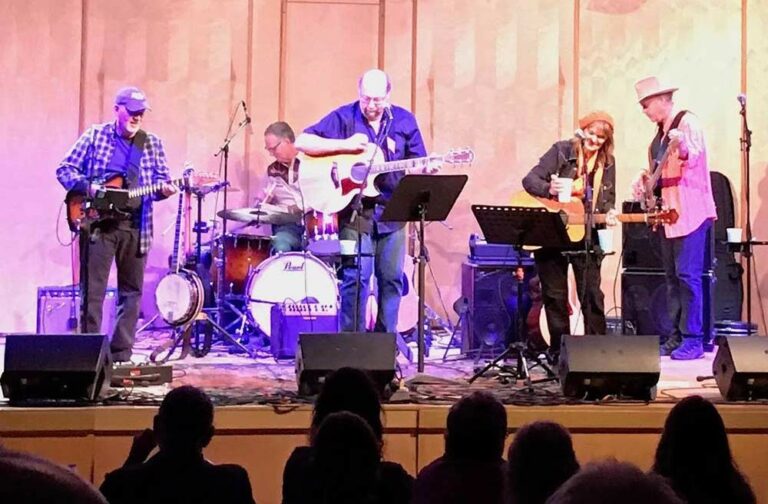
Yet the party for her in Joni 75: A Birthday Celebration shows both the range of her music and the affection that the world of music has for her.

The concert film compiles a two-night-long show last November at the Dorothy Chandler Pavilion in Los Angeles, the city she analyzed in verse for years.

Not everyone gets Joni Mitchell: the strange guitar tunings, the high blue yodel or the throaty intimacy of her confessional mode. Writing about Mitchell, who was one of only two female performers in 1978’s Last Waltz, Roger Ebert said that he didn’t know what her song “Coyote” was supposed to be about. (It’s easy: it’s about Sam Shepard, or somebody like him.)

While Mitchell’s modes changed, from lissome folkie to thick-skinned blueswoman to jazz artist, one point stayed as constant as a northern star: both in age and in youth, Mitchell insisted on a woman’s privilege of traveling alone, sleeping with whom she pleased and holding firm to independence.

Lyrically, Mitchell’s viewpoint changed from hippie naiveté to embittered realist. If once she thought people were made of stardust, she came to fear they’re all just meat in a dog-eat-dog world, where “sex sells everything / and sex kills.” Always in her songs are diagrams of traps waiting for women. One side is the grim one-night-stand in “Down to You”; the other is a different kind of discontent in “Harry’s House/Centerpiece.” There, Mitchell imagines the Scarsdale angst that could have been hers, lolling around waiting for the husband to return from the indelible cityscape she painted (“A helicopter lands on the Pan Am roof / like a dragonfly on a tomb”).

The concert is something for any Mitchell fan, from tricky jazz to the kind of crowd-pleasing material that any semi-competent street busker can make sound good. Glen Hansard, whose busking style was visible in the movie Once, does “Coyote” here. (Maybe the sainted Ebert would have understood the lyrics if a man sang them?)

Graham Nash sings “Our House,” about the Laurel Canyon place he and Joni shared once upon a time. Mitchell’s fellow Canadian Diana Krall covers perhaps the bleakest song Mitchell ever did, “Amelia,” about a woman’s search for freedom, what it costs and what it’s worth. James Taylor and Seal collaborate on a tune I cannot abide, “Woodstock”; if it seems particularly airy-fairy, remember that Mitchell actually didn’t play the Woodstock fest.

The vocally craggy Kris Kristofferson takes on “A Case of You” with Brandi Carlile, right before Carlile solos to cover “Down to You,” a startling sound-alike version of a very complicated song. Emmylou Harris (the other woman in The Last Waltz) covers Mitchell’s terrifying slide-guitar lament about heroin, “Cold Blue Steel and Sweet Fire.” Los Lobos perform the obscure but fine “Nothing Can Be Done.” The congas in the original must have attracted the Wolves.

Making a rare appearance, but not joining in on the music, is Mitchell herself. Buffeted by the years, she’s still everything Chaka Khan calls her here: a lifesaver.

Double Exposure

There they are, waiting for you. Super-models and Instagram vixens splashing in the Caribbean with the famous swimming hogs of Big Major Cay. Maybe they should have called it the Circe Festival instead of the Fyre Festival. The swindled victims weren’t literally turned to swine. But they weren’t treated much better than pigs.

Most of the world knows what happened, and moreover has had a real good laugh at it. The dueling documentaries Fyre Fraud (Hulu) by Jenner Furst and Julia Willoughby Nason, and Chris Smith’s Fyre: The Greatest Party That Never Happened (Netflix) take slightly different stances on the dreadful fest.

Both tell of how Jersey go-getter Billy McFarland made his name by selling the Magnises credit card to millenials, with a $250 annual fee. There were certain club benefits, disputed by the two docs; Netflix’s doc admires the Magnises lounge and club nights. The Hulu version snipes that the Magnises bennies were getting to rub shoulders with guys from Murray Hill, one of NYC’s most boring neighborhoods.

These Magnises (was it meant to be short for “Magnificent Penis”?) got McFarland got enough fame in the right places to fund the development of a band-booking ap called Fyre. It was to be promoted with an awesome music festival on a private Caribbean island in spring 2017. Rapper Ja Rule endorsed it to give it street cred. McFarland hired PR, which in turn used “Influencers”—professional inducers of online FOMO.

Everything went wrong. There was inadequate prep time, several changes of location, a surprise rainstorm and the especially bad idea to have the fest during a regatta weekend when there was no rental properties available. The elite arrived to find used disaster relief tents waiting for them, with windows that didn’t keep out the mosquitoes. They rushed back to the states, complaining into their iPhones every step of the way.

There’s more than a little overlap between these documentaries—both featuring the same viral video showing Ja Rule chased by the schoolboys from Lord of the Flies. The Netflix account, in which Vice media participated, has the most scandalous material: event planner Andy King tells of how McFarland begged him to fellate a certain Bahamian minister to get a planeload of Evian water released from customs’ duties.

Hulu’s Fyre Fraud has personal access to McFarland—in fact, the producers paid him to talk—when the grifter was on bail and secretly cooking yet more scams. Here we get childhood legends of McFarland’s hustling youth from his mom, in communications hilariously read out loud by text-to-speech software.

If Netflix’s Fyre:TGFTNH is more fair, it’s less fun. The title says it all—it doesn’t question the necessity of the fest. The Fyre Festival didn’t work, but wouldn’t it have been insanely cool if it had? Marc Weinstein, one of McFarland’s assistants who is still on hook for some of the unpaid wages, still argues “there was definitely a chance to pull it all together.” Thus Netflix’s Fyre:TGFTNH may be a stepping stone to the inevitable exculpatory whitewashing feature film with Jonah Hill or Leonardo Dicaprio playing McFarland. It’s inevitable, an on-screen pity party for a showman who dreamed too big.

By contrast, Hulu’s Fyre Fraud suggests a larger picture, in it’s account of how McFarland’s scams were hot air sucked up and made forceful by the Venturi effect of the internet envy-machine. One prefer Fyre Fraud’s sense in exploring the sleaziness of McFarland’s dream, with supermodels jiggling in slow-mo, posing and grinning—images that are, to borrow critic David Thomson’s phrase, “an advertisement for advertisement.”

It’s not going out into the weeds to suggest that this mirage called the Fyre Festival mirrored the way America fell for a charismatic figure, who cared less for truth than what his guts tell him. Was the Fyre Festival a merry distraction from the Trumpster Fyre, or do they parallel each other?

Fyre Fraud
convincingly identifies the fraud-fest as just one more chimera of modern times, a 24 hour game of ‘let’s pretend,’ in which one cannot tell if someone is a delusional liar or the smartest person in the room.

Cal Fire: Tubbs caused by private electric system, not PG&E

Cal Fire issued a statement and report today identifying a private power system—and not PG&E—as being the culprit in the deadly 2017 wildfire. Sen. Bill Dodd released a statement of his own saying that the Cal Fire finding shows that everyone needs to up their fire-prevention game in the “new normal.” For PG&E this is a rare bit of good news; the utility was found to be the culprit in a dozen of the 2017 fires that swept through California and has recently been swept up in bankruptcy talk over its estimated $30 billion insurance exposure associated with the fires. Here’s the press release from Cal Fire and a link to their investigation:

Sacramento – After an extensive and thorough investigation, CAL FIRE has determined the Tubbs Fire, which occurred during the October 2017 Fire Siege, was caused by a private electrical system adjacent to a residential structure. CAL FIRE investigators did not identify any violations of state law, Public Resources Code, related to the cause of this fire.

The Tubbs Fire in Sonoma County started on the evening of October 8th, 2017 and burned a total of 36,807 acres. Destroying 5,636 structures and resulting in 22 civilian fatalities and one firefighter injury.

In total, the October 2017 Fire Siege involved more than 170 fires and burned at least 245,000 acres in Northern California. Approximately 11,000 firefighters from 17 states and Australia helped battle the blazes.

CAL FIRE investigators are dispatched with the initial attack resources to the wildfires in CAL FIRE jurisdiction and immediately begin working to determine their origin and cause.

Californians must remain vigilant and take on the responsibility to be prepared for wildfire at any time throughout the year. For more information on how to be prepared, visit www.readyforwildfire.org or www.fire.ca.gov.

Link to the redacted Tubbs Fire Investigation Report here:

http://calfire.ca.gov/fire_protection/fire_protection_2017_siege

Jan. 24: Return to Roots in Rohnert Park

0

Musician and vocalist Martha Redbone is a melting-pot performer of American Roots music who often conjures up images of blue-collar workers and small-town values. Now Redbone looks to her own roots in a new theatrical experience, “Bone Hill: The Concert,” that mixes her father’s gospel voice and her Cherokee/Choctaw mother’s culture in a show about a young woman returning to the Kentucky coal mines of her youth to explore a rarely seen piece of American history. Redbone performs in concert on Thursday, Jan. 24, at Green Music Center, 1801 E. Cotati Ave., Rohnert Park. 7:30pm. $25 and up. 866.955.6040.

Jan. 25: Field Notes in Occidental

0

Cannes award-winning filmmaker Rob Nilsson (Northern Lights) is in the North Bay to present a remarkable series of short documentaries—Prairie Fire, Survivor and Rebel Earth—that makeup ‘The Prairie Trilogy.’ The trilogy of films tells the story of North Dakota’s Socialist Nonpartisan League, who fought a hard-won battle in 1916 to regain voting rights that had been taken from them by those in power. See the three short docs and engage in a discussion on the films’ continued relevance in our current political climate on Friday, Jan. 25, at Occidental Center for the Arts, 3850 Doris Murphy Court, Occidental. 7pm. Free. 707.874.9392.

Jan. 26: Parks Art in Petaluma

0

Sonoma County artist and gallery owner Mary Fassbinder spent over three years and traveled more than 70,000 miles to create her latest collection of paintings. Now she displays her works in a new exhibit, ‘The National Parks Painting Project,’ that features dozens of plein air paintings of each of the U.S. National Parks. Showcasing the vast natural beauty in the United States, this timely show aims to promote preservation and conservation of the country’s resources. Running through March, “The National Parks Painting Project” opens with a reception on Saturday, Jan. 26, at Petaluma Arts Center, 230 Lakeville St., Petaluma. 5pm. Free. 707.762.5600.

Jan. 27: Fire Patrol in Santa Rosa

0

The devastating Tubbs fire sparked many heartfelt stories in 2017, but few are as wild and inspiring as the story of the Pointe Patrol, in which nine residents of Fountaingrove’s Viewpointe Circle snuck back to their homes to save their neighborhood from fires and looting. Local author Earik Beann recounts the ordeal in a new book, Pointe Patrol, which he reads from and signs to help raise money for fire victims and families of fallen first responders on Sunday, Jan. 27, at Copperfield’s Books, 775 Village Court, Santa Rosa. 1:30pm. Free. 707.578.8938.

The Power to Protect

0

Hey you, Mr. Big Shot. You know who you are. You get off on power and accumulating wealth and feeling important and successful. Por favor: do me a favor. It could change your life. Take a little child in your arms. If it’s your own kid, all the better, but if not, borrow a little dude.

Take the child in your arms. Hold it close. Feel its tiny heart beat against your chest. Don’t be afraid.

Give your head a rest from Dow Jones or that Rolex watch that graces your wrist. What’s that you say? “It’s starting to drool over my expensive suit. Someone take the kid back!” No way, buddy. You need to spend some time at this. The drool comes with the territory.

Look at its tiny fingers; feel the soft, perfect skin. Yeah, you’re a guy, but you’re a human being. Let yourself go soft and squishy for a moment. See how vulnerable this little dude is? Wow! The protector in you is calling from the depth of your belly. Mama and Papa Bear are one.

You feel for the moment almost godlike power—power mixed with weakness and vulnerability. You hold in your arms all that matters most in life (even more than the beemer in your garage).

You are transformed into the person who is both lover and loved, the kind of man you really want to be.

And the trust. Good Lord, we are so afraid to trust anyone anymore, but this little child trusts you. The baby trusts you, weak and flawed human being that you are. Suddenly, from deep within you comes the power that only trust and love can bring you. You will use your power to protect and defend the little dudes in the world. They trust you.

Now you can let the child in your arms go to someone else. What’s that you say? You want to cuddle it just a little longer? Yeah, I was hoping that would happen. Kids have a way of reaching you, don’t they? Way more than the latest “stuff” you accumulate. You go, dude. Love ya!

Hank Mattimore lives in Windsor.

Letters to the Editor: January 22, 2019

Too Many Vineyards

Since the October fires, I have read periodicals and listened to the news regarding accounts of the catastrophic fires and the tragic aftermath, but nowhere has there been any mention of water use by the wine industry. Vineyard owners sink wells hundreds of feet into aquifers, divert water from rivers, streams, creeks, and seem not to care about how their practices affect the environment. If wineries keep extracting groundwater and diverting water from natural sources, the environment will become drier leading to more extensive, catastrophic fires than the North Bay fire.

Since so many people have to start over, it is time for people involved in the wine industry to become introspective, to take a long, hard look at their practices and change them in a way that respects people, animals and the natural world—it’s time for the wine industry to be accountable to the people who live in Sonoma County and to stop catering to tourists.

While I understand that the county needs the revenue that is generated by the wine industry, too much is too much. Too many vineyards, wineries, tasting rooms, event centers. Too many mountains, hills, woodlands, meadows and fields destroyed in order to plant grapes. Too many animals dead on our roads because what once was their habitat is fenced off to protect vineyards. Too much traffic and inebriated people driving county roads that they do not know.

Due to the tragic fires, thousands of people have lost homes, belongings, businesses and animals, so I say to the people in the wine industry, “Slow down.” People in this county are suffering and will be in shock for a while. Nothing is normal in Sonoma County, and no one will ever be the same. We are a changed people. Please change your winery practices to something that involves the whole, not just the few.

Occidental

The Hard Cell

0

When the chips were really down for Jason Rezaian, the Washington Post reporter and former Iranian hostage says he’d reflect on one of his late father’s Yogi Berra–type malapropisms.

His father, Taghi, an Iranian émigré to Marin County in the 1950s was “filled with jokes,” says Rezaian, “He had these sayings that didn’t make 100 percent sense, but when you thought about it, they did.” His dad, well-known in the community, ran a Persian rug emporium in San Rafael for decades, and Rezaian says he still has lots of relatives in and around the Bay Area, though he hasn’t lived here for years.

While reporting on Iranian life for the Post in 2014, Rezaian and his Iranian wife, Yeganeh Salehi, were arrested by Iranian security forces and accused of espionage.

He spent 544 days in the country’s most notorious prison, known as Evin—around six months of those in solitary confinement. His ordeal is recounted in Prisoner, a memoir just published on the late Anthony Bourdain’s imprint at HarperCollins, Ecco Books. He’s back in his hometown for several readings scheduled around the Bay Area.

The Marin County native, a graduate of Marin Academy High School, is in his early 40s and lives in Washington, D.C., now with his wife. Before their hostage crisis, they’d decided that they’d never have kids—now he says they’re considering it, though with a laugh he adds that the nine-month window has not yet opened.

Rezaian was subjected to intense psychological torture during his ordeal, which ended when he was freed as part of President Barack Obama’s negotiation of the Iran nuclear deal in 2015. His detainment included multiple threats that he’d be executed. He was repeatedly told to sign a confession as a condition of his release but heroically held the line against his captors and only ever admitted to doing his job at the Post, which was to report on Iranian life from the street-side and culturally engaged perspective of a returning son.

One of his dad’s Yogisms came in very handy, he says. “If you worry, you’re going to die,” he would advise his son. “If you don’t worry, you’re going to die. So don’t worry.”

He tried to not worry, despite his guards’ numerous threats that they’d cut off his fingers and toes, that he’d be executed. He spent months in a solitary confinement cell in the prison, and even there, he says, his natural optimism helped him to deal with the soul-crushing conditions.

“You have to keep separate sets of mental books,” he says by way of explaining how he survived long periods in solitary. (As his plight unfolded, Rezaian would eventually spend significant time with other inmates in a two-person cell.) “On the one hand, the fear and anxiety is omnipresent. But you learn that if you let that take everything over, it takes everything over. This is not a place where I or anybody wants to be, and I looked at my situation as always: I’m in this prison, considered one of the worst in the world. But just around me, I could see people who were in worse situations, cellmates who were more isolated, who couldn’t speak to the guards.”

Rezaian would come to look forward to his interrogations, he says in his book, because they would at least afford him human contact. He eventually came to appreciate that he was a player in a big unfolding negotiation between the United States and the Rouhani regime. He thought: “This is horrible, but it could be worse and worse and worse. Some days, it did get worse. Other days, there were glimmers of hope. I’m optimistic by nature.”

The first few weeks of Rezaian’s confinement were filled with fear and bewilderment. “I didn’t know what to think,” he says, and in his book writes how he repeatedly claimed his innocence and that this was all a big mistake. That was the first few days, he says. “Then the reality sets in.” His guards told him that the whole world already thought he was dead anyway, that the Washington Post didn’t care, and neither did the Obama Administration.

“Then the fear of influences on your thinking comes in,” he says. The guards would take him out of his “tiny vacuum sealed cell,” and then at least he’d be having interactions with people, even if they were threatening to cut off his fingers. Now Rezaian saw his captors let down their guard a bit. They threatened him with physical violence but never beat him. “Then you start to see—this is a hostage-taking. This particular moment in this country’s trajectory is not going to be served by killing an American.”

Still, he did fear that he’d be left behind in the Iran nuclear deal since scrapped by Donald Trump. Rezaian feared it might be a long time before he was released.

What he could not and did not know while in prison was that his older brother, Ali, his employers at the Post, officials in the Obama Administration—not to mention Marin Congressman Jared Huffman—were working on his release from the day he was arrested. “I can’t say it because I’m a journalist working for the Washington Post,” he says with a laugh, “but vote for Huffman!” He credits the pol for his dogged efforts on his behalf; Huffman was at a German airport to meet Rezaian when he was released.

Upon his release, Rezaian recalls that it was encouraging to him to know, in hindsight, that every time then-Secretary of State John Kerry met with his Iranian counterparts during the nuclear negotiations, Rezaian’s name came up in the negotiation.

That was encouraging. “What’s disheartening,” he says, “is that several [Americans] have been taken hostage since I was released, and there is no conversation going on with the United States and Iran right now, and for those people who are saying, ‘Don’t talk to evil, don’t negotiate with evil,’—well, that’s shortsighted,” and of no comfort to the hostage’s families.

[page]

The brutal murder of Rezaian’s colleague, Jamal Khashoggi, hangs over our conversation, as does the gourmet ghost of the late Anthony Bourdain, who filmed Rezaian for his Parts Unknown show in a segment about Persian cuisine, before the hostage-taking, and urged him to write Prisoner after his release.

First, Khashoggi, a Washington Post columnist who was murdered by Saudi Arabian officials last year: “The one thing in which the murder of Jamal and what happened to me are connected, or have in common: both are two instances of authoritarian regimes using extraordinary means to silence journalists who were writing about them. Full stop. Not even writing about them in ways that they didn’t like—in my case it was taking the pen out of my hand, and getting leverage with America. In Jamal’s case, it was simply, we are going to silence this person in an audacious and horrifying way so that other people are silenced too.

“I don’t want to compare and contrast the Iranian and the Saudi regime, they are both terrible,
but I will say that this act by the Saudi regime, along with the war with Yemen, the crackdown on dissent within their own borders—I don’t think this is something that most Americans can wrap their minds around. They routinely behead people.”

He says that the disconnect between the American posture toward Iran and Saudi Arabia is an “incredibly disheartening” thing to behold in Washington, D.C. Trump has reportedly been trying to figure out a way to go to war with Iran for the past two years, instilling fear and propping up the “Death to America” rhetoric that Rezaian says woefully misreads the Iranian mindset toward America. “Juxtapose that with the way that this administration has responded to the death of my colleague, someone I was getting to know.”

“The most noteworthy thing about Iran is its people,” Rezaian adds and highlights an ancient culture with rich musical, literature, poetry, film and food traditions. “My money is always on the Iranian people,” he says. “They are resilient, they are smart, and over time they’ve made it clear that they are dissatisfied, the majority of them, with the rulers of this country.”

He suggests that the United States, as it promotes policies advertised as good for fomenting democracy and good for Iran, should take a look at whether travel bans and crippling sanctions are accomplishing the mission. “How can we say we support your quest for freedom when we’re not going to let you come here?”

Rezaian recalls a time in the 1960s and ’70s, before the Iranian hostage crisis, when Iranian students comprised the highest percent of foreign-born university students in America—many of them receiving their education in the Bay Area, long a destination for Iranian immigrants. “I don’t think there is hatred of America,” he says.

Rezaian’s time spent reporting on the streets of Iran left him with a clear impression that, instead, “Iranians are probably one of the most pro-America populaces” in the Middle East. “People are tired of the ‘Great Satan’ state media stuff.” Despite the longstanding Friday ritual of burning American flags in Tehran, he insists, “there is not rabid anti-Americanism in Iran.”

And then there’s Bourdain. Rezaian says the author and TV host’s 2018 suicide “remains, continues to be, the hardest thing that my wife and I have to grapple with.” He’ll get stopped on the street, he says, by Bourdain fans who saw Rezaian and his wife on his show during an episode filmed in Tehran six weeks before he was arrested. Rezaian says of himself that he’s not a gourmand but is a big lover of food (he lost lots of weight in prison, he recollects in the book), and in an interview, recalls a Marin youth filled with visits to the bustling multi-ethnic food scene on Fourth Street in San Rafael. “It was one of the great culinary destinations that nobody knew about where you could find food from all over the world,” he recalls.

During his ordeal in Iran, Bourdain’s celebrity status, he says, “gave a spotlight to our imprisonment that nothing else could.” The episode aired numerous times during his imprisonment and Rezaian says with obvious emotion that he “had no idea the lengths to which [Bourdain] was advocating for me publicly and privately while we were there.”

A few weeks after their release, Rezaian and his wife met with Bourdain for a meal in New York City. “This is a guy we are meeting for the second time, 20 months after the first time. It was an incredible roller coaster ride for us in the meantime—and it turned out he had been an incredible friend to us while we were in trouble.”

Bourdain encouraged Rezaian to write his story, and he did the “traditional thing,” he says—wrote a proposal, shopped it around to 14 publishers, six of whom made offers, including Bourdain’s Ecco imprint at HarperCollins. Rezaian then got an email from Laos, from Bourdain. “It was more like, whatever you decide, I’m going to be there for you,” Rezaian recalls. Bourdain added, “‘I’ll be a vocal and spirited advocate no matter what. Give my offer some consideration.’ When you get something like that, how can you say no?”

Rezaian sighs and reflects on his interactions with the late Bourdain. “We’re doing this for Tony.”

Lifesaver

When Bob Dylan won the Nobel Prize for literature in 2016, the news was greeted by some with the retort that, if the Swedes were going to go in that direction, they should have given the prize to Joni Mitchell. It would have been both a smart choice and a sentimental one, given the premature report of Joni's death to...

Double Exposure

Failed Fyre Festival gets taken down by competing Netflix and Hulu documentaries.

Cal Fire: Tubbs caused by private electric system, not PG&E

Cal Fire issued a statement and report today identifying a private power system—and not PG&E—as being the culprit in the deadly 2017 wildfire. Sen. Bill Dodd released a statement of his own saying that the Cal Fire finding shows that everyone needs to up their fire-prevention game in the "new normal." For PG&E this is...

Jan. 24: Return to Roots in Rohnert Park

Musician and vocalist Martha Redbone is a melting-pot performer of American Roots music who often conjures up images of blue-collar workers and small-town values. Now Redbone looks to her own roots in a new theatrical experience, “Bone Hill: The Concert,” that mixes her father’s gospel voice and her Cherokee/Choctaw mother’s culture in a show about a young woman returning...

Jan. 25: Field Notes in Occidental

Cannes award-winning filmmaker Rob Nilsson (Northern Lights) is in the North Bay to present a remarkable series of short documentaries—Prairie Fire, Survivor and Rebel Earth—that makeup ‘The Prairie Trilogy.’ The trilogy of films tells the story of North Dakota’s Socialist Nonpartisan League, who fought a hard-won battle in 1916 to regain voting rights that had been taken from them...

Jan. 26: Parks Art in Petaluma

Sonoma County artist and gallery owner Mary Fassbinder spent over three years and traveled more than 70,000 miles to create her latest collection of paintings. Now she displays her works in a new exhibit, ‘The National Parks Painting Project,’ that features dozens of plein air paintings of each of the U.S. National Parks. Showcasing the vast natural beauty in...

Jan. 27: Fire Patrol in Santa Rosa

The devastating Tubbs fire sparked many heartfelt stories in 2017, but few are as wild and inspiring as the story of the Pointe Patrol, in which nine residents of Fountaingrove’s Viewpointe Circle snuck back to their homes to save their neighborhood from fires and looting. Local author Earik Beann recounts the ordeal in a new book, Pointe Patrol, which...

The Power to Protect

Hey you, Mr. Big Shot. You know who you are. You get off on power and accumulating wealth and feeling important and successful. Por favor: do me a favor. It could change your life. Take a little child in your arms. If it's your own kid, all the better, but if not, borrow a little dude. Take the child in...

Letters to the Editor: January 22, 2019

Too Many Vineyards Since the October fires, I have read periodicals and listened to the news regarding accounts of the catastrophic fires and the tragic aftermath, but nowhere has there been any mention of water use by the wine industry. Vineyard owners sink wells hundreds of feet into aquifers, divert water from rivers, streams, creeks, and seem not to care...

The Hard Cell

When the chips were really down for Jason Rezaian, the Washington Post reporter and former Iranian hostage says he'd reflect on one of his late father's Yogi Berra–type malapropisms. His father, Taghi, an Iranian émigré to Marin County in the 1950s was "filled with jokes," says Rezaian, "He had these sayings that didn't make 100 percent sense, but when you...
11,084FansLike
4,446FollowersFollow
6,928FollowersFollow