Stephanie Hartwell-Mandella was taken aback recently when she was checking messages on behalf of the Marin County Free Library’s Corte Madera branch and saw a note about a first-grader who had failed to return a checked-out book.
There’s nothing unusual about a kid who borrows a book for too long. But in this case, too long was 48 years.
Even more unusual was that the now-grown man’s friend wanted to rectify the situation.
“Obviously, it was almost 50 years ago and has been lost to time, but I was wanting to pay the late fee or replacement cost for the book as a joke and giving him a confirmation receipt for Christmas,” read the message.
The note came from Kenny Newell, who lives and works in the Dallas area. Newell outed the thief as his boss, Tony Goodman, CEO and president of PeopleFun, one of the world’s biggest developers of mobile word games.
Goodman spent just one of his “wonder years” living in Corte Madera and attended Neil Cummins Elementary School. The book he checked out in the summer of 1972 was Look Out For Pirates!, by Iris Vinton.
On Friday, December 11, Newell presented a note to Goodman at their workplace with a receipt for $58 paid to Marin County Free Library. That accounted for a $48 late fee—a dollar for each year overdue, playfully agreed to by the library—and the estimated $10 cost of replacing the book in 1972 dollars.
Marin County Free Library did away with fines on children’s materials in 2015 and followed by eliminating fines on adult materials in July 2019.
Just for fun, the library decided to calculate how much the late fee would’ve been back in the day. Ten cents per day at 17,865 days is 178,650 cents, or $1,786.50. “Although,” Hartwell-Mandella said, “we would’ve capped the final at the original cost of the book, which was probably no more than $5 or $10 back in 1971.”
This Open Mic was submitted on behalf of the Marin County Free Library. Find more information about how to make a donation and support the Marin County Free Library at Marinlibrary.org.
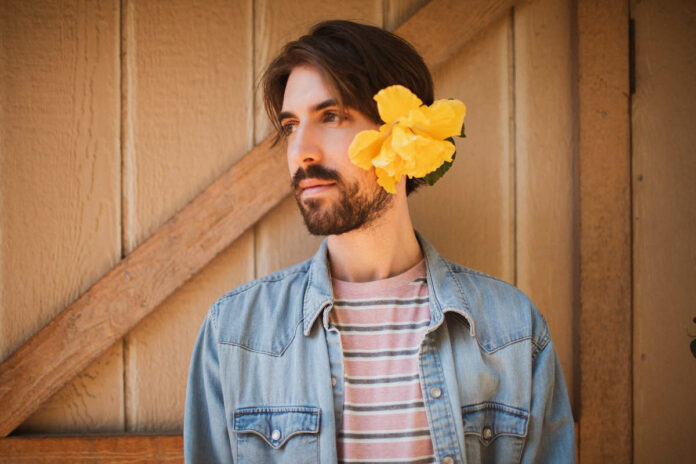
Former Santa Rosan Ben Greenberg recently felt nostalgic and homesick for Sonoma County from his home in Los Angeles, so he wrote a song about it.
Living in the “City of Angels” since 2016, Greenberg is making his mark on the indie-folk singer-songwriter scene in the city, crafting heartfelt tunes about self-acceptance, love, loss and home. He recently recorded his forthcoming debut album Son of the Hills, from which several singles have been released; including that homesick song, “Northern Pines.”
This week, Greenberg shares those songs with the North Bay audience in the latest installment of “Luther Locals,” the streaming concert series hosted by Luther Burbank Center for the Arts. Greenberg’s performance streams on Friday, Dec. 18, at 8pm.
For Greenberg, it’s a virtual homecoming of sorts, since he grew up attending concerts and performing on the LBC’s stage and elsewhere in Sonoma County.
Greenberg first found the guitar as an emotional outlet at age 11 after his parents’ divorce and a change in schools. “Music started being a way I could connect with other kids and forge friendships,” he says. “Those are friendships that carried me through and that I still have today.”
In high school, Greenberg split his time between singing in the school choirs and recording his garage bands, a prog-rock outfit in the vein of Dream Theater and an acoustic pop duo. After Greenberg attended UC Santa Cruz, friend and Blue Summit band member Jesse Fichman introduced him to the California bluegrass scene.
“That pushed me in my songwriting and my musicianship,” Greenberg says. “It got me headed in this folky direction.”
Greenberg took his new indie-folk direction to Los Angeles to pursue music there, and last year he connected with alternative-folk producer Jordan Ruiz.
“Working with him cemented that sound for me,” Greenberg says. “I met him at exactly the right time, and having a friend come along and say, ‘I see what you’re doing and there is worth to what you’re doing,’ catalyzed me into making an album.”
For the past year, Greenberg has shared that album by digitally releasing several singles from it. It is tentatively set for a January 2021 release.
Recorded with a full band before the pandemic hit, the songs are musically lush and rhythmically tranquil, with contemplative lyrics that address Greenberg’s emotional and physical journey from Santa Rosa to Los Angeles.
Greenberg scrapped plans to tour this year due to the pandemic, but he regularly performs virtually to raise funds for California wildfire relief and other good causes.
For the upcoming “Luther Locals” streaming performance—which is previously recorded at the request of the LBC—Greenberg re-created the full band recordings on video with the help of editing and his socially distant collaborators, and he will interact with the audience in the virtual show’s live chat.
“I hope people like it,” he says. “I had a good time putting it together, and I’m looking forward to seeing how it goes.”
I don’t think a clearer nor more concise history has ever been linearly printed … including the F-A-C-T that ranchers were paid for their lands and agreed to leases based on a term OR the life of the original signer … (as I understand it).
No matter, they were shown the check book and they said “yes.” Then they agreed to vacate the lands and let the mandate of the original intention of the park be fulfilled. But no …? NO !
Why the discussion is even happening is well illustrated in this article. Thank you for having the chutzpah to tell it like it is. Everyone out here knows the power of the dairy and farming community … to the detriment of the bought-and-paid-for park lands. And of course the Elk … now just an indigenous bit player.
Joseph Brooke
Point Reyes Station
More Cow Talk
In his recent investigative report, “Apocalypse Cow,” (Dec. 9), Peter Byrne shows how campaign contributions and political interests shape environmental statements that legitimize short-term gain and corporate ripoff that ultimately make for a world profoundly out of balance, all at the expense of true stewardship of the land, in ways practiced by the original inhabitants of Point Reyes, the ancestors of the Federated Indians of Graton Rancheria.
Byrne connects the dots in fine-grained, compelling detail. We have a lot for which to be thankful for such high-quality reporting. That’s the good news. The bad news is that the Good Guys have a ton of work to do to undo the graft and corruption practiced by such unscrupulous politicians as Sen. Dianne Feinstein and Rep. Jared Huffman.
The company behind a luxury resort and residential project near Healdsburg is facing a $6.4 million fine over dozens of alleged water quality violations involving streams that feed into the Russian River, according to state water officials.
Sonoma Luxury Resort LLC, the company behind the Montage Healdsburg resort – formerly called Saggio Hills – is alleged to have violated state and federal water rules 38 times in 2018 and 2019 and to have discharged “9.4 million gallons of highly turbid water into Russian River tributaries,” according to officials with the North Coast Regional Water Quality Control Board.
“This fine reflects the substantial violations found over a wide area after multiple storms,” Board Chairperson Valerie Quinto said in a news release Monday.
Investigators found that during construction, the company failed “to prevent or minimize pollutants from discharging off site, resulting in egregious violations over many months and threatening the well-being of salmon populations,” according to the news release.
Water Board officials first shut down work on the project in December 2018, after which the company made “modest improvements” to its construction practices, officials said.
Work was again halted in February 2019, although “unauthorized discharges to waterways continued to occur from the site through May 2019 and after the developer removed best management practice from many active construction areas,” according to the Water Board, which approved the fine last Thursday.
The resort is described in Water Board documents as consisting of a 130-room hotel along with housing, including some affordable housing, a public park, a fire substation and 142 acres of private open space on a 258-acre piece of land in the hills north of Healdsburg in unincorporated Sonoma County.
Representatives from Sonoma Luxury Resort LLC did not respond to a request for comment.
Sixty million years ago a chunk of granite located near Los Angeles began moving northwards. Propelled by the energy of earthquakes over eons, Point Reyes slid hundreds of miles along the San Andreas fault at the divide between two colliding tectonic plates.
During the last Ice Age, 30,000 years ago, much of the Earth’s waters were locked up in glaciers, and the Pacific Ocean was 400 feet lower than it is today. “The Farallon Islands were then rugged hills rising above a broad, gently sloping plain with a rocky coastline lying to the west,” according to California Prehistory—Colonization, Culture, and Complexity.
Humans migrated from Asia walking the coastal plains toward Tierra del Fuego. Then, 12,000 years ago, the climate warmed and glaciers melted. Seas rose, submerging the plains. A wave of immigrants flowed south from Asia over thawed land bridges. Their subsequent generations explored and civilized the Americas, coalescing into nations, including in West Marin and Point Reyes.
Novelist and scholar Greg Sarris is the tribal chair of the Federated Indians of the Graton Rancheria. The tribe’s ancestors are known as Southern Poma and Coast Miwok. In The Once and Future Forest, Sarris tells the story of how the first people came to be in Marin and Sonoma counties. “Coyote created the world from the top of Sonoma Mountain with the assistance of his nephew, Chicken Hawk. At that time, all of the animals and birds and plants and trees were people. … The landscape was our sacred text and we listened to what it told us. Everywhere you looked there were stories. … Everything, even a mere pebble, was thought to have power … Cutting down a tree was a violent act. … An elder prophesied that one day white people would come to us to ‘learn our ways in order to save the earth and all living things. … You young people must not forget the things us old ones is telling you.’”
It is 2020. California is burning, beset by plague, violence and cultural dysphoria. It’s way past time to start listening to lessons encoded in the land. But can we still hear?
If so, Point Reyes has a story to tell us.
Ecological Turning Point
The North Bay community is divided by conflicted views on whether commercial dairy and cattle ranching should continue at Point Reyes National Seashore. This reporter has hiked the varied terrains of the 71,000-acre park for decades. Initially, I had no opinion on the ranching issue. Then, I studied historical and eco-biologic books and science journals. I read government records, including the Environmental Impact Statement (EIS) on Point Reyes released by the National Park Service in September. The 250-page report concludes that the ranching industry covering one third of the park should be expanded and protected for economic and cultural reasons. This, despite acknowledging that the park ranches are sources of climate-heating greenhouse gases, water pollution, species extinctions and soil degradation.
The Bohemian/Pacific Sun investigation reveals that the EIS is deeply flawed scientifically, culturally and ethically. It is politicized.
Since 2013, Sen. Dianne Feinstein and Rep. Jared Huffman have pressured the Park Service to prioritize the preservation of private ranching profits over environmental concerns. In 2017, the Park Service hired a contractor with a record of defrauding the federal government to produce the EIS. The study is structured to support the Park Service’s prior commitment to expanding commercial ranching, retailing and hoteling at the expense of endemic wildlife and plant life and regional water safety. It ignores the cumulative impacts of climate change. It minimizes and ignores the benefits of eliminating greenhouse gas- and pollution-producing ranching and transforming the park into a carbon sink.
The EIS’s privatization plan is also wildly unpopular. Members of the public and environmental organizations submitted 7,627 comments on the EIS, many of them factually detailed and consequential. The Park Service has not published an analysis of the comments. But, a statistically robust analysis by the Resource Renewal Institute determined that 91 percent of the comments called for eliminating ranching and restoring degraded lands.
The Park Service disregards these public concerns. It greenlights the further ecological destruction of Point Reyes National Seashore. Lawsuits will most likely be filed by environmental groups to challenge that action; the Park Service may not prevail.
How did we arrive at this juncture?
The Weight of Water
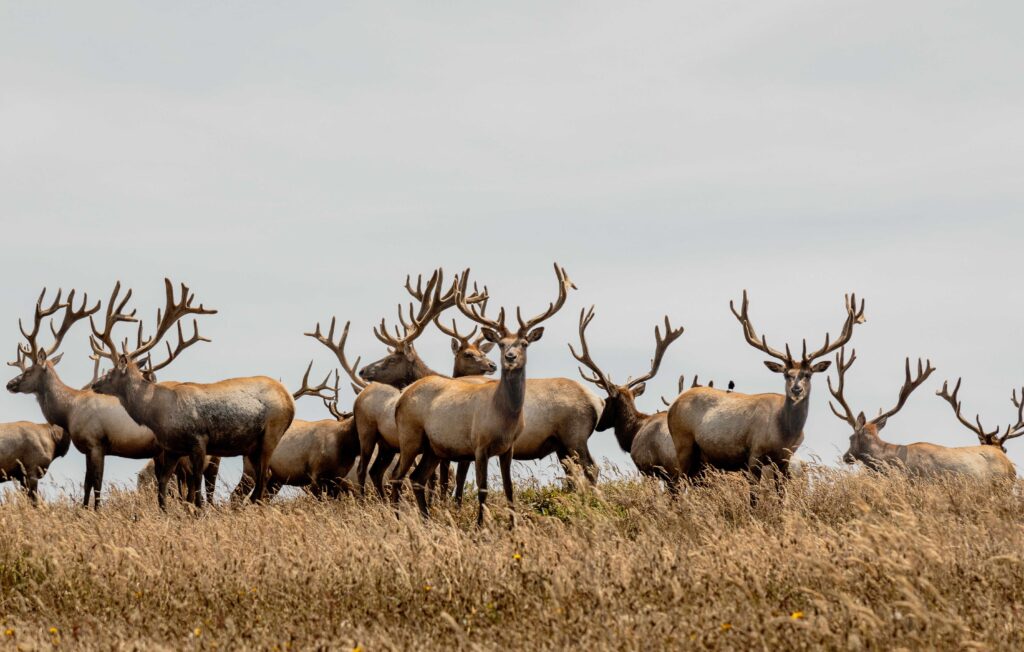
It’s a blue-sky Saturday, I’m hiking the bluffs of Tomales Point at the northern tip of Point Reyes. It’s hot and drought-dry. The hard-packed trail edges a fenced preserve for the world’s few remaining tule elk, a federally protected species. Small bands of the creatures chew near the trail. Sloe-eyed, meditative, they trade curious looks with socially-bubbled hikers crowding the trail, pixelating the elk with phone snaps.
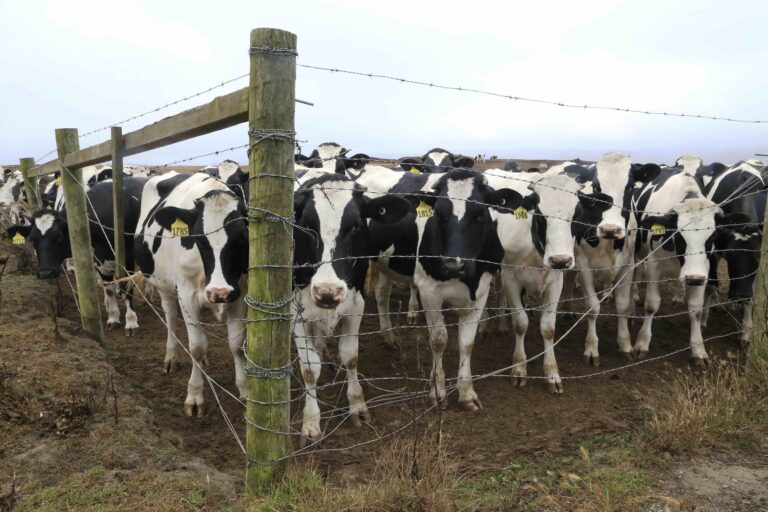
Five years ago, several hundred tule elk perished of thirst during a drought that dried up the seeps inside this enclosure, according to the Park Service. But the Park Service did not come to the aid of dying elk then, nor will it now. The only water in sight is bottled and Camel-backed. There is a wire barrier between the thirsty elk and the park’s many ponds and streams, which are reserved for use by about 6,000 privately-owned cows.
There are smaller herds of tule elk in other areas of the Point Reyes. These free-rangers are the bane of ranchers. They drink water and eat grass that would otherwise fatten cattle. The Park Service favors controlling elk-herd size with bullets, but it needs permission from an EIS to justify draconian culling. Fortunately for the tule elk, people all over the world adore them. The national media publishes stories about their plight. Protesters demonstrate to free them. Kayakers deliver jugs of water to them.
Elk-worshipping aside, it is the nature of the terrains divided by the fence that illuminate the most pressing ecological issues at stake. On the elk side, native grasses and deeply rooted ground covers grow thickly, harboring birds, lizards and small mammals. This wild and perennially green foliage builds the planet’s carbon storage capacity, pulling globally heating carbon dioxide out of the atmosphere, emitting oxygen and slowing the rate of climate doom.
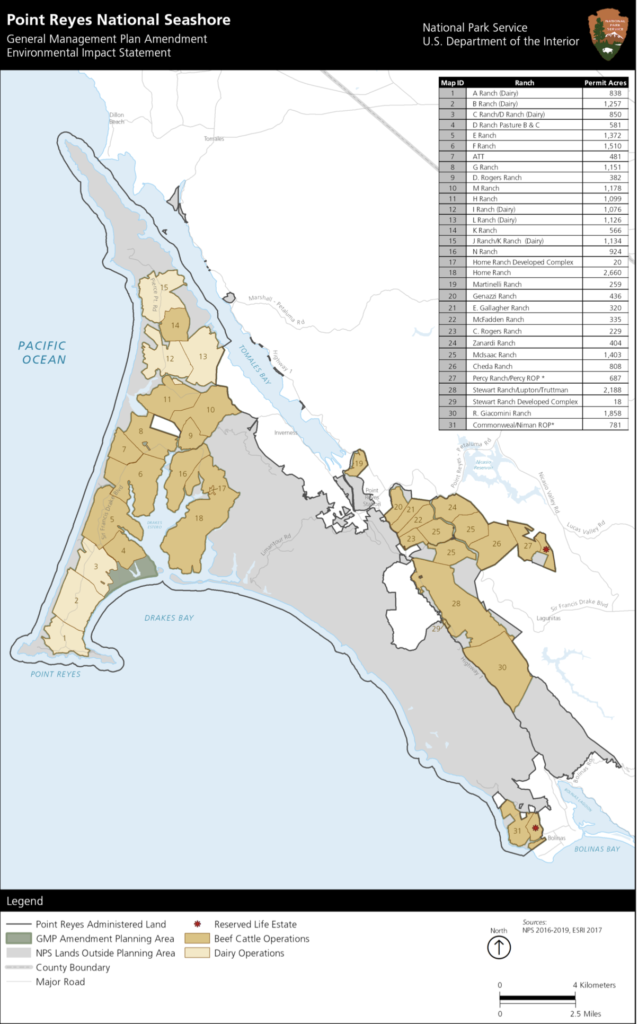
A National Park Service map shows the boundaries of the 31 existing dairies and cattle ranches in the Point Reyes National Seashore.
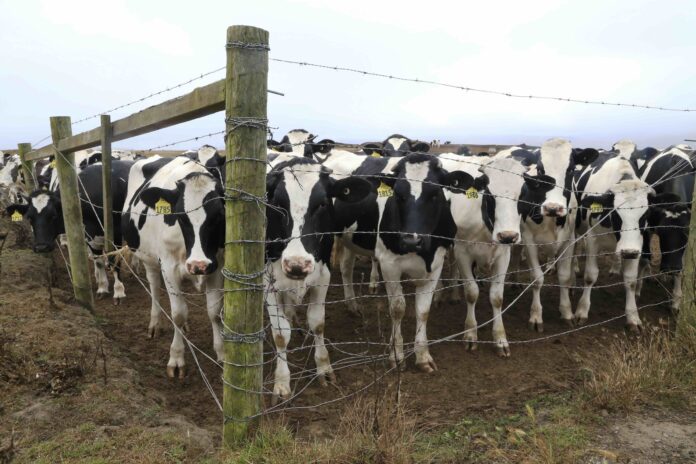
On the cow side of the fence, the land is barren, churned into a gray dust by hooves and crusted with methane- and nitrogen-emitting manure. When first emitted, methane is 80 times worse than carbon dioxide as a global warmer. According to the U.S. Department of Agriculture, “The manure from a dairy milking 200 cows produces as much nitrogen as is in the sewage from a community of 5,000-10,000 people.” The cow herds at Point Reyes annually excrete 130 million pounds of nitrogen-laced manure into pastures, ponds, streams and loafing barns, according to USDA statistical methods. Park Service studies show that this decomposing waste releases harmful chemical elements into the park’s streams, ponds, wetlands, estuaries, Tomales Bay and the Pacific Ocean. Polluted ground waters carry loads of nitrogen, ammonia, phosphates, phosphorus and fecal bacteria. Aquatic and plant life of estuaries is choked to death by oxygen-depleting algae, by opportunistic lily plants feasting on excess nitrogen.
The EIS acknowledges that removing the pollution produced by the ranches would save federally protected or threatened species from extinction, including Coho and Chinook salmon, steelhead, red legged frogs, California freshwater shrimp, Myrtle’s silverspot butterflies and snowy plovers. Local species of insects, birds and plants would thrive in the absence of commercial ranching. As would globe-trotting flocks of birds that shelter at the seashore.
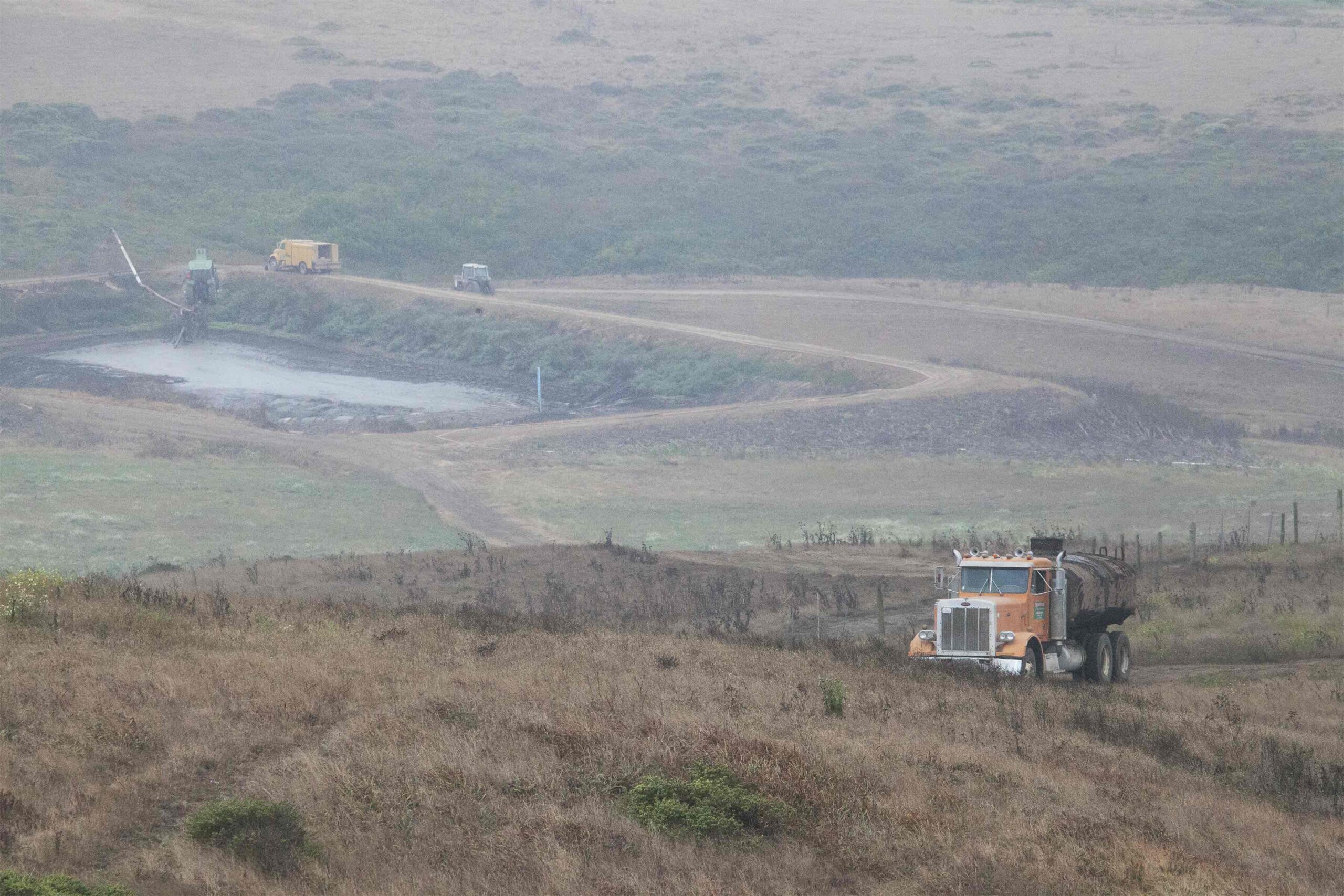
During the winter wet season, the ranchers sow muddy, lifeless pastures with shallow-rooted, non-native grasses grown as silage to feed calving cattle in the spring. Tanker trucks pump liquified manure seething with nitrogen and E. coli out of holding ponds and spray it as fertilizer on the cow food. Mainlining the nitrogen, invasive thistles swoop into the fields. Rare native plants, such as the coastal marsh milkvetch and the checkerbloom, lose the struggle for existence.
A 2013 study by U.S. Department of Interior scientists determined that California’s highest reported E. coli levels occurred in wetlands and creeks draining Point Reyes cattle ranches near Kehoe Beach, Drake’s Bay, Abbotts Lagoon and Tomales Bay. E. coli is an animal-waste bacteria that can be lethal to humans. Notwithstanding, the directors of the California Regional Water Quality Control Board regularly grant Point Reyes ranchers waivers from complying with water safety regulations that limit discharges of fecal matter and pesticides. In the EIS comments, the board’s lead scientist criticized the EIS for failing to advocate realistic remedies for curing the expected increases in toxic discharges from extending ranching operations. But the politically-appointed directors proceeded to “strongly” support the expansion of cattle ranching, telegraphing that the board will continue to waive pollution problems. And those problems are guaranteed to increase.
Ranchers regularly bulldoze tons of manure gathered from loafing barns into holding ponds called lagoons. The rotting, liquifying pools puff methane into the atmosphere. According to a 2010 Park Service climate study, Point Reyes–based cows belch thousands of tons of the poison gas into the atmosphere. Studies claim that one billion cows pose a clear and present danger to the continuance of oxygenated life on Earth. While eliminating the gases produced by commercial herds in the seashore park is not going to cure the global problem, we must start somewhere. It makes sense to tackle the issue on public lands that are supposedly dedicated to conserving natural resources. But, since 2012, the Park Service is on record as intending to expand ranching at Point Reyes no matter what scientists and the public say. That regressive attitude was not always so.
Cow herds at Point Reyes annually excrete 130 million pounds of nitrogen-laced manure, according to USDA statistical methods. Some is gathered in ponds before being sprayed on fields for fertilizer. Photo by Jocelyn Knight.
The Miwok Way
In 2009, the Park Service published an environmental history of the Tomales Bay region by historian Christy Avery. It relates how the Miwok nation scientifically tended the natural environment for thousands of years. By contrast, the EIS liquidates Miwok history, choosing instead to idealize a few hundred European settlers who immigrated to the region after the 1850s. Those tenant farmers and their three-legged milking stools, elk-tallow candles and 19th century social practices ruined the native ecology of the seashore lands with overgrazing, mono-cropping and 150 years of agricultural pollution. Oddly, the Park Service prioritizes conserving the “farming culture” of the “founding families,” whose descendants are still ranching in the park using thoroughly modern technologies.
In a more harshly historical view, the Irish, Croatian and Italian immigrant farmers were squatters on Indian land stolen centuries before by Spanish priests and Mexican militarists and eventually deeded over to a firm of San Francisco lawyers.
According to Avery, “The Coast Miwok were a semisedentary people who … depended on the fish, wild plants, and waterfowl of the estuary [and used fire and pruning and seeding] to manage and modify the land surrounding the bay.” On Tomales Bay, the Miwok families lived in villages protected by coves near freshwater streams. They “netted eel, sturgeon, flounder, perch, and herring … from rafts and boats made with tule reeds.” They fished for smelt, dove for abalone and hunted wild fowl. Seasonally, the Miwok “set fires to suppress disease and pest. … Fire turned older and dead plants into organic materials that fertilized the soil, and encouraged the growth of plants and grasses whose seeds were made into pinole, a staple, flour.” Point Reyes was a carbon sink of interdependent animal, plant and human life.
Sarris was told by elders that such was the abundance of the land and sea that the Miwok’s working day left time for making medicine and singing and dreaming about the spirit worlds and weaving the baskets for which the Miwok culture is world-renowned. “Often a person never traveled more than 30 miles from their home place during a lifetime,” Sarris told me. “If you lived on the coast, you might go as far inland as Lake County to trade for obsidian. But most people stayed in place, cultivating a mutually beneficial relationship with the landscape. Our ancestors knew the animals, they knew the trees. They pruned the oaks and burned to kill acorn-eating worms. They did not question their responsibility to keep the waters clean and free-running.” Miwoks shaped the present to preserve the future of life. “Most tribes had legends that vividly told of the consequences that would befall humans if they took nature for granted or violated natural laws,” writes M. Kat Anderson in Tending the Wild, an ecological account of how California’s first peoples engineered their surroundings.
The Rancher Way
The Europeans did not learn from the ways of the Miwok. They overgrazed lush pastures on the fog-watered coastal ranges. They did not systematically burn land, nor prune it. They killed vastly more game than they needed for sustenance. The tap-rooted grasses went extinct, replaced by stubby-rooted silage, imported ryes, oats and alfalfa that require annual re-seeding. The ranchers dammed the waters. They sprayed chemical fertilizers and pesticides. Thistle, wild oats and mustard displaced plants that had co-evolved with animals. Elk, wolves, lions, bears and, yes, humans were hunted toward extinction. Cattle churned fields of moss and grass into infertile slurry. Concrete scabbed the land. It is this exploitative version of Point Reyes’ ecological and cultural history that the Park Service intends to preserve, promoting the worst sort of profit-driven environmental depredations.
In the 1850s, dairy and meat ranches owned by the law firm Shafter & Howard exported products to San Francisco and beyond. Chinese and Indian laborers did the heavy lifting. The bodies of non-white men, women and children were violated by Europeans, both sexually and as sources of cheap labor. Overgrazing caused catastrophic flooding, eroding the peninsula. The silting of Tomales Bay from agricultural run-off destroyed the habitats of sea creatures. Entrepreneurs constructed railroads on top of bayside levees, reconfiguring ecologies. (A few Miwok families held onto bay lands such as Laird’s Landing; lands that incubated the revival of the tribe in the 1990s, when the Miwok and Pomo people succeeded—against great odds—in reclaiming their sovereignty.)
As dairying expanded throughout California at the turn of the 20th century, milk and cheese prices plummeted. The lawyers sold their Point Reyes farms to tenants. Investors developed a tourist trade. Newly constructed residences, hotels and restaurants spewed raw sewage into a Tomales Bay slick with oil spilled from boats. Dairy-industry effluvia killed fish and stank. Point Reyes became hellish.
Starting in the 1960s, environmentally minded Marin residents had had enough. They passed zoning and environmental laws to stifle further commercial development of the county’s rural areas. Congress legislated Point Reyes as a national park, “protected” from further environmental degradation. During the 1970s, the feds paid the park’s ranching families a fair market value of $57 million ($382 million in today’s dollars) for their properties. Most of the ranchers signed below-market value leases and agreed to vacate in 25 years. The bold idea was to phase out ranching and allow native flora and fauna to regenerate; the park’s undeveloped beaches were set aside for recreational picnics, swimming and fishing.
But instead of leaving by the millennium, the ranchers formed the Point Reyes Seashore Ranchers Association. The group has lobbied Feinstein, Huffman and the Park Service to keep the cheap rents in perpetuity; to expand livestock and agriculture operations; to run bed and breakfasts and retail stores on the ranches; and to “extirpate” the park’s free-ranging Tule elk, effectively signing their death sentence. Environmentalists fought back with lawsuits.
Promises, Promises, Politics
In 2012, Obama’s Secretary of the Interior, Kenneth Salazar, a cattle rancher, intervened in the dispute over commercializing the park and cut the baby in half. He ordered the removal of a rancher-owned oyster farming and retail operation from Drakes Estero because it “violated the policies of the National Park Service concerning commercial use” and its removal “would result in long-term beneficial impacts to the estero’s natural environment.” Then, Salazar directed the Park Service to “pursue” the possibility of offering the ranchers 20-year commercial leases in accord with applicable laws. Salazar’s direction was not a law, nor a regulation, nor an order binding upon future governance. Nor could the leases be legally extended without first assessing the environmental consequences; although, at the urging of two members of Congress, the Park Service pursued extending the leases without first doing an EIS.
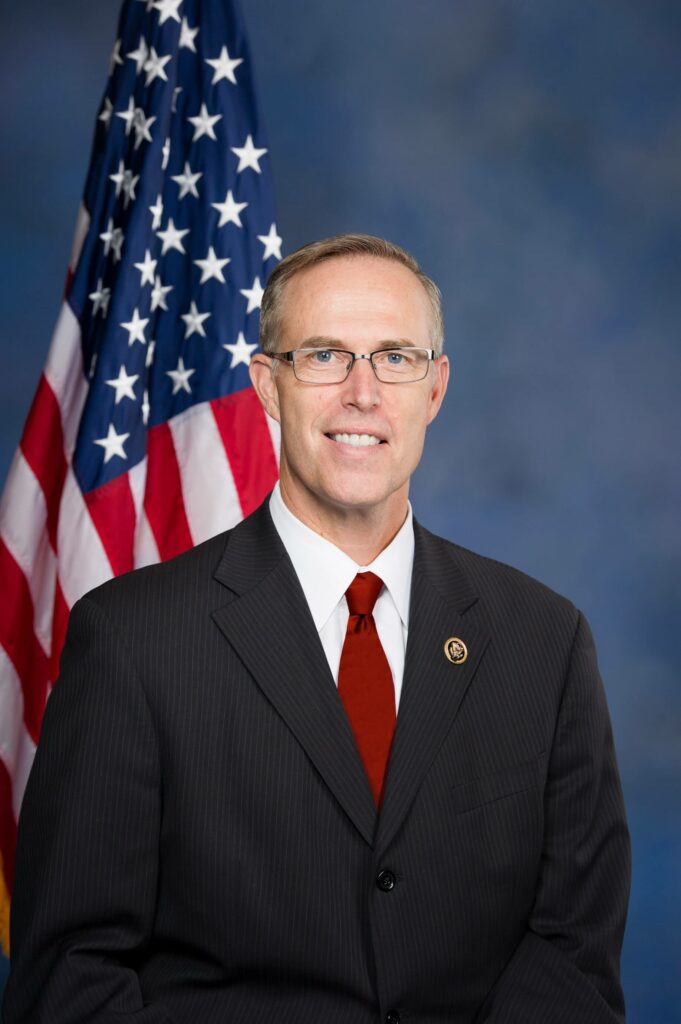
In 2013, newly elected congressman Jared Huffman lobbied the Park Service to extend the leases. Although he calls himself a “progressive” and an “environmentalist,” Huffman accepts major campaign donations from the dairying, logging, sugaring, real estate and weapons industries. (See “Where Jared Huffman Gets His Campaign Money” below.)
In 2014, Feinstein, who also accepts donations from agribusiness, urged Salazar’s successor, Sally Jewell, to “renew the leases for at least twenty years as Secretary Salazar promised.” Feinstein did not mention the many promises the federal government has broken with the Coast Miwok.
Rep. Jared Huffman has pushed the National Park Service to extend rancher’s commercial leases in the Point Reyes National Seashore.
Derailing the politically-powered rush to renew the leases without an environmental review, the Resource Renewal Institute, Center for Biological Diversity and Western Watershed Project won a federal court order in 2016. The court required the Park Service to produce an EIS laying out the environmental pros and cons of continuing commercial ranching versus requiring the ranchers to vacate as they had promised.
Then, undoing a century of environmental protections, the Trump regime moved to massively privatize parks and forest service lands for exploitation by logging, mining, energy and cattle industries. In 2018, Huffman attempted an end-run around the EIS process. He authored a House bill ordering the Park Service to sign perpetually renewable 20-year leases. The bill passed with enthusiastic support from anti-environmental regulation Republicans, but died in a Senate committee.
Since 2012 there has never been any doubt about the outcome preferred by the Park Service—the granting of ranching leases in perpetuity. But the EIS was not principally researched and written by Park Service employees. The $559,000 job was contracted to Louis Berger Group, Inc. despite the engineering firm’s shadowed past. In 2010, Louis Berger Group paid $69 million in civil and criminal fines for defrauding the federal government in war-zone contracts in Iraq and Afghanistan. Adding to its ethically troubled record in 2015, the firm paid “a $17 million criminal penalty [for] bribing foreign officials [to] secure government construction management contracts,” in India, Indonesia, Vietnam and Kuwait, according to the U.S. Department of Justice. The World Bank debarred the firm “for engaging in corrupt practices.”
The Park Service hired the Louis Berger Group in 2017, despite wide reporting of the group’s transgressions by the media, and despite the existence of any number of environmental firms able to conduct an impartial, scientific investigation.
Attorney Dinah Bear has served the White House through successive administrations as an expert on the National Environmental Policy Act (NEPA) which governs the EIS process. In a telephone interview, Bear excoriated the practice of outsourcing an EIS to consultants who are easily incentivized to deliver results desired by political decision makers. “Trump has eviscerated the scientific legitimacy of the EIS process,” Bear said. For example, an EIS is no longer required to examine the long-term impacts of climate change. Regardless, said Bear, “The courts are inclined to invalidate an EIS if it ignores the cumulative impacts of climate change.”
Climate Change?
The EIS barely mentions climate change, except to dismiss it as a serious threat. Despite ample scientific research demonstrating that Point Reyes’ ecological health is and will continue to be distressed by extreme heat, rising seas and dramatic shifts in weather patterns, the EIS claims the impacts of climate change are “difficult to predict,” and in any case the effects will be negligible, because “all ranches in the planning area are at an elevation where sea-level rise would not have a direct impact.”
Contradicting the benign climate future postulated in the EIS, the California Coastal Commission predicts regional sea levels to rise catastrophically, as much as 12 inches by 2030, and up to 66 inches by 2100. In the short term, “Beaches, estuaries, marshes, wetlands, and intertidal areas on the Marin Coast … will experience inundation, erosion, and the potential for complete loss.” The stability of water, septic and sewage pipelines serving Point Reyes are threatened. Entire species of animal and vegetative life could be extinguished. Expected flooding from heavier rains will worsen erosion and increase ground pollution from agricultural activities throughout the park and along Tomales Bay. While ocean waves are not likely to roll over bluff-top ranches, that does not mean that climate-induced catastrophes will not vastly worsen the peninsula’s already-untenable ecological situation.
According to Avery’s environmental history, “Dairy waste management became one of the most problematic issues for ranchers in the late twentieth century. Dairy farmers had typically sought properties with creeks that would provide water for their stock, but these same creeks carried animal wastes into the bay. When manure washed into the estuary, the high levels of ammonia in the waste poisoned fish and posed threats to human health. In rainy weather, sewage ponds overflowed, and waste material washed into the nearby waterways. The 10,254 dairy cows and beef cattle in the watershed produced 1,066,574 pounds of manure per day in 2000. Cattle also increased erosion as they trampled streambanks, causing [48,000 tons of] silt to wash into the bay [every year].
“By the late twentieth century, Tomales Bay exceeded federal limits on fecal coliform more than ninety days each year. … In addition to dairy wastes and human sewage, the waters of Tomales Bay have also had to absorb excessive amounts of mercury—one of the most toxic metals.” Mercury mined at the Gambonini ranch was sold to manufacture dental fillings, thermometers, and fluorescent lights.
The good news, according to Avery, is that the bay can be regenerated by “restoring wetlands and wildlife populations [and eliminating] unwanted outcomes of human activities.” Avery praises the Park Service’s restoration of a wetland on the decommissioned Giacomini Ranch at the head of Tomales Bay as an example of responsible land management and of human agency allowing the land to heal.
Ranchers have lobbied federal officials to “extirpate” the park’s free-ranging Tule elk, an action which would effectively condemn the animals to death. Photo by Hari Nandakumar/Unsplash.
Greenhouse Gas Doom
The EIS acknowledges ranching will “continue to emit pollutants and greenhouse gases associated with cattle grazing, manure management on dairies [and] combined with the impacts from past, present, and reasonably foreseeable actions, the total cumulative impact on air quality would be adverse.” In dire fact, methane generated by dairying and cattle ranching contributes at least 30 percent of the globe’s greenhouse gas load.
Investigative reporter Christopher Ketcham’s This Land: How Cowboys, Capitalism, and Corruption are Ruining the American West notes, “In 1991, the United Nations reported that 85 percent of Western rangeland was degraded with overgrazing … the impact of countless hooves and mouths over the years has done more to alter the vegetation and land forms of the West than all of the water projects, strip mines, power plants, freeways, and subdivision developments combined.” That statement is worth pondering.
Influential groups such as the Marin Agricultural Land Trust (MALT) and Marin Conservation League pride themselves on stopping strip mall-type development in rural areas. But their advocacy of ecological damaging commercial ranching development on private and public lands is a sign of cognitive dissonance—believing what you prefer to believe even when the facts rebut.
For instance, the belief that eating grass fed beef is a “sustainable” practice is a misnomer when it comes to stopping global warming. Multiple studies show pasture-bred cattle emit substantially more methane than penned-up, grain-fed cattle who move about and burp less. Transitioning consumers to buying only grass-fed beef products would require increasing the national cattle herd by 30 percent, nearly doubling the amount of methane emissions and greatly exacerbating the stresses of global heating, according to a 2018 study by the Animal Law and Public Policy Program at Harvard Law School.
There are huge economic benefits to keeping our public lands cow-free, Ketcham explains: “Photosynthesis and biomass production, carbon sequestration, climate regulation, clean air, water retentions and filtration, fresh water, soil retention, nutrient cycling, pollination—all [are] products of public lands” valued in trillions of dollars, worldwide.
The relatively small portion of the EIS devoted to Alternative F, the option to remove commercial ranching from the park, acknowledges that eliminating ranching would “end ranching-related emissions,” including methane, carbon dioxide, nitrogen, and ammonia, four of the main drivers of global heating. The EIS notes that Point Reyes ranches account for 22 percent of the greenhouse gases generated by agricultural activities in Marin County. Eliminating dairy and cattle ranching in the park would significantly reduce its contribution to the hockey-stick curve of global heating. Dodging that inconvenient fact, the EIS suggests ranchers could combat global heating by “voluntarily” practicing carbon farming.
While carbon farming is an effective way of slowing global heating, the EIS does not lay out a plan for implementing the practice. In fact, quite the contrary.
The Ins and Outs of Carbon Farming
In October, Science published a plan to conserve one-third of the world’s potential farmlands as wildlife havens and carbon sinks, without diminishing the food supply. The Global Safety Net is a blueprint for sucking carbon out of the atmosphere and trapping it in non-agricultural vegetation. It would reverse the rate of global heating. It makes an empirically grounded case for returning nutrient-depleted, over-grazed public lands to carbon-storing native plantings. The scientists acknowledge, “The tools and designations will vary by place and must be locally appropriate. … to be politically achievable [the plan] requires broad engagement from civil society, public agencies, communities and indigenous peoples.”
Half of California’s land area is grassy rangeland, much of it overgrazed or farmed without regard for carbon sequestration. Restoring Point Reyes National Seashore is a logical place to start the healing. The EIS references a local non-profit called the Marin Carbon Project as its carbon-farming expert. That organization is not calling for reducing or eliminating cattle ranching. Rather, it calls for spreading manure-based “compost” on silage crops; the solid compost emits methane and nitrogen, just less of it than liquid waste. Looking for a technological fix, the Marin Carbon Project calls for installing methane digesting machines on top of lagoons of putrefying poop. The suggestion is that if the ranchers buy barn-sized digesters for construction on top of the holding ponds, then the explosive hydrocarbon can be usefully transformed into electricity. Digesters of this type cost $1.5 to $5 million dollars apiece, plus tens of thousands of dollars a year to operate, and require cow herds numbering in the thousands to be cost effective. Why not just get rid of the methane’s source—the cows?
Dr. Jeffrey Creque directs the Marin Carbon Project. He farmed in the seashore for decades and favors extending the leases at Point Reyes. Creque wrote, controversially, in Point Reyes Light that “methane from ruminants, whether cattle or elk, is essentially, irrelevant in the global warming equation.” In an interview, Creque said he had meant that carbon dioxide is more dangerous than methane in the long run. He agreed that methane heats up the atmosphere faster. Methane eventually morphs into carbon dioxide, adding to the long-term greenhouse gas load. Creque then argued that we have to keep the thousands of cows on Point Reyes because the ranches are vital to the local economy.
Local Economics
The ranches support 64 full-time jobs—out of 124,700 jobs in Marin County—and generate $16 million in annual revenue. By contrast, park-related tourism revenue dwarfs this agricultural output. According to the EIS, “In 2018, visitor spending [in the park] supported 1,150 jobs in the local area and had an aggregate benefit to the local economy of $134 million.” Visitors do not come to Point Reyes to watch cows. And the park’s contribution to the $260 million regional dairying and cattle raising economy is fractional.
The ranching businesses are also an economic burden on taxpayers. Public records reveal that ranch rents are fifty percent below market; the Park Service spends $500,000 a year on ranch maintenance and capital improvements; the ranchers have received $2.2 million in federal farming subsidies since 1995. Without receiving millions of dollars in government handouts, the Park Service argues, these ranchers would likely go out of business. Or not.
Many of the Point Reyes–based ranching clans operate cattle and dairy spreads outside the park in West Marin which are capitalized by tens of millions of dollars in conservation easements (“Malted Millions,” Sept. 30).” While the loss of the seashore-based ranches might negatively impact some private profit margins, the effect to the regional and state economies would be negligible. Contrast that to the social, economic, ecological and educational gains to be made from allowing the Miwok lands to regenerate as carbon sinks that are of incalculable value to life in this age of burning ecosystems. If we cannot save our once-vibrant seashore park from further ecological destruction, how can we save ourselves and our planet?
Weaving the Future
Sarris tells me a story:
“It was around 1988 and I was driving up the coast with Mabel McKay, the last of the medicine dreamers. And she looked out the window of the car. And she said, ‘This is my dream. It’s all going to burn. Everything’s going to go dry. And there’s no stopping it. The ocean is going to get warm. Everything’s going to burn and go dry.’
“And I was a younger man, and I excitedly said, ‘Oh, Mabel, what do I do? What do I do?’
“And she started laughing. And she said, mocking me, ‘That’s cute. What do I do? What do I do? How cute.’
“And I said, ‘No, seriously, what do I do?’
“And she took a silent beat. And she turned to me and she said, ‘You live the best way you know how, what else? The earth will be replanted, it will be replanted. There will be people here. But we don’t know who they’re going to be.’”
Where Jared Huffman Gets His Campaign Money
Northern California Rep. Jared Huffman is on record as supporting legislative acts to reduce greenhouse gas emissions. Which is why his 2018 bill to protect the expansion of cattle ranching at Point Reyes surprised his environmentally minded supporters. Data provided by OpenSecrets.org shows that during the course of Huffman’s congressional career he has accepted large sums of campaign money from corporations whose environmental and health agendas may not reflect the political wishes of his more greenish constituents.
Dairy Farmers of America ($5,000). DFA donated to Huffman’s campaign shortly after the congressman lobbied the U.S. Department of Interior in 2013 to extend cattle ranching leases at Point Reyes.
American Crystal Sugar Company ($40,000). Based in the Midwest, the United States’ top sugar manufacturer and distributor markets millions of barrels of high-fructose corn syrup to breakfast cereal brands and bags of white sugar to households. It chops sugar beets into feed for cows.
Honeywell International ($39,000). The Environmental Protection Agency lists the weapons and chemical manufacturing behemoth as one of the most toxic corporations in the United States, with more than 100 Superfund sites.
Berkshire Hathaway ($37,999). Billionaire Warren Buffet’s holding company is heavily invested in environment- and health-destroying corporations, including Barrick Gold, Coca-Cola, Apple, Bank of America and a portfolio of carbon-spewing railroads and airliners.
Green Diamond Resources ($18,384) Huffman has received regular contributions from this clearcutting logging company throughout his time in Congress, according to federal campaign finance records. In the Nov. 2020 election, Huffman was the top recipient of campaign donations from the company ($6,500), which also gave money to the anti-environmentalist, pro-fossil fuel campaigns of Sens. Susan Collins (R-Maine) and Lisa Murkowski (R-Alaska).
Huffman’s campaign portfolio of global heaters includes Sierra Pacific Industries, PG&E, Goldman Sachs, Carnival Corporation, Bechtel Group and General Motors.
Huffman commented, “I receive contributions from hundreds of groups and thousands of individuals, including far more from the environmental community than from the groups [your newspaper] portrays, and none of these donations has ever influenced my policy decisions.”
Huffman’s congressional career donations total $138,529 from environmental groups and $189,477 from agribusiness, according to Open Secrets. He gets 27 percent more money from agribusiness than from environmental interests.
As social distancing remains the order of the day in Sonoma County, several planned holiday concerts and other musical celebrations are taking to the Internet for virtual programs that feature seasonal cheer and performances by local and international artists.
On Friday, Dec. 11, Santa Rosa Junior College music students bridge the gap when SRJC Choirs, Symphonic Band and String Quartet perform virtually in “Music Across the Distance.” Under the direction of Jody Benecke, SRJC Choirs director, and Dr. Jerome Fleg, SRJC Director of Bands, SRJC musicians celebrate the musical connections among people of different cultures from around the globe with a program that includes music from North America, Europe and Africa, with composers ranging from Mozart to Pete Seeger. The recorded video performances were mixed and edited by Nancy Hayashibara, SRJC Choirs accompanist, and Dr. Jerome Fleg; and will include special small ensembles of students who have worked on their own in collaboration to prepare, perform, and record some extra special features. Watch for free at Music.santarosa.edu/events.
Also in Santa Rosa, the Luther Burbank Center for the Arts annually hosts a full season of holiday concerts featuring both cultural performers and modern pop artists. This year’s season is all happening virtually, though the schedule is no less packed with cheer. On Friday, Dec. 11, Northern California-based Mexican folk and contemporary dance company Calidanza performs the virtual Posada Navideña, a holiday tradition in Mexico that features Latin dance and song traditions. The next day, Dec. 12, the center hosts two holiday-themed concerts, as saxophonist Dave Koz & Friends present “The Greatest Hits of Christmas!” live-streaming concert at 5pm, and Pink Martini pianist Thomas Lauderdale and vocalist China Forbes appear for a holiday concert as part of the LBC’s ongoing “Muse Hour” virtual series at 7:30pm. Later this month, the center also hosts the Blind Boys of Alabama in their annual Christmas show, live-streaming on Dec. 23 at 6pm. Get tickets to all of these shows at Lutherburbankcenter.org/events.
In Cotati, an annual summer tradition is making a new seasonal debut when the Cotati Accordion Winter Virtual Festival commences on Saturday and Sunday, Dec. 19 and 20. The second virtual offering–coming after this summer’s successful online accordion affair–will once again feature a lineup of internationally-acclaimed virtuosos from eight different countries such as Cory Pesaturo, Jenny Conlee-Drizos, Matthias Matzke, Pietro Adragna and Erica Mancini. These global stars will be performing live throughout the weekend festival, which will also be streaming chats, interviews, The Lady-of-Spain-a-Ring, The Grand Finale, raffles and more. Get all the details at Cotatifest.com.
In Petaluma, the Phoenix Theater is decking its stage out once again for a virtual holiday concert boasting several North Bay rock bands. “A Very Phoenix Theater Christmas” streams for free on Dec. 24 and features holiday hits performed by Trebuchet, Royal Jelly Jive, Schlee, Matt Jaffe, John Courage, One Armed Joey, Gio Benedetti, Bad Thoughts, Down Dirty Shake, Ismay, The Happys and others. Tune in on Christmas Eve at Phoenixchristmas.com.
One of the best parts of the holidays is the food. From sweet treats to sumptuous dinners, this season can’t be beat. Yet, in a pandemic, finding those foods that make the holidays special can seems like a daunting task. Here’s a few places to start your search for seasonal culinary favorites.
For the bread guy or gal in your life, there is The Model Bakery, an artisan mainstay in St. Helena since 1908. The Model Bakery will be spending its holidays preparing traditional favorites and special treats both for gift-giving and to help the home chef enjoy more time with family.
Now with locations in both Napa and St. Helena, as well as a curbside spot in Yountville, the Model Bakery is offering everything from breakfast to dessert, beginning with it’s famous morning pastries and English Muffins that keep ending up on “Oprah’s Favorite Things” List. There’s also the bakery’s signature Pain au Levain Boule and Walnut Sage Levain Batard. Then, there are the pies; Pumpkin and Pecan Pies, plus Apple Pie with Streusel topping.
“The holidays are absolutely our favorite time of year,” says proprietor Sarah Mitchell Hansen in a statement. “As bakers, it’s the one time of year that we love to show off what we can do. 2020 has been such a challenging year, here’s hoping some freshly baked artisan treats will add some comfort for family and friends.”
All of these items can be ordered online for curbside pickup, and the freshly baked goods pair well with The Model Bakery Cookbook, also available online at themodelbakery.com.
Beyond the bread, the best way to find culinary delights in Napa Valley the Holidays in Yountville virtual and in-person offerings, taking place through Jan. 1.
Due to the pandemic, this year’s iteration of the annual Holidays in Yountville offers more than 50 online events, including foodie events such as virtual wine tastings, cooking classes, wine pairings and chocolate seminars and more.
Online visitors can also find the Yountville Holiday Gift Guide, which lists 25 gift packages featuring Napa Valley wine, food, accessories and experiences. There is also the Yountville Community Cook Book, featuring 40 pages of recipes from the town’s wineries, restaurants and residents.
In addition to all the virtual offerings, the Town of Yountville is open and invites visitors and locals alike to safely see the town’s thousands of holiday lights that adorn local shops, tasting rooms, restaurants and hotels.
“2020 has been a challenging year, so the magic of Holidays in Yountville is even more needed to lift our spirits,” says Yountville Chamber President and CEO Whitney Diver McEvoy in a statement. “Whether you are able to spend a few days with us in person, or enjoy the Town of Yountville virtually from afar, we hope Holidays in Yountville brings much joy for family and friends this time of year.” See the full Holidays in Yountville listing at yountville.com.
For the vegan in your life, there’s no better place to begin looking for gifts than North Bay-based Miyoko’s Creamery, and the vegan cheesemakers are partnering with the organization In Defense of Animals to give away a year’s supply ($500) of vegan cheese.
Since launching in 2014, Miyoko’s Creamery has earned its founder, Miyoko Schinner, the title of “Queen of Vegan Cheese.” The creamery, which currently operates out of a 30,000 square-foot state-of-the-art facility in Sonoma, is transforming local and national opinion about vegan cheese, and Miyoko’s products can be found in 1,000’s of stores across the country.
These products include artisanal cheese wheels and shredded and sliced cheeses, spreads, mozzarella, butter and cream cheese that are made entirely from plants, with no fillers, additives, artificial ingredients.
For Miyoko Schinner and other vegans, using these plant-based alternatives supports a compassionate and sustainable food system.
“Miyoko’s Creamery is thrilled to team up with In Defense of Animals to make the holiday season merry and bright for animal advocates and cheese-lovers alike,” says Schinner in a statement.
The giveaway is open to US residents over the age of 18. Interested individuals can enter to win on In Defense of Animals’ Instagram. All entries must be received by December 14 at 12:00 p.m. PT. The winner will be announced on December 15.
Gov. Gavin Newsom announced a new stay-at-home order Thursday that
will be targeted at regions of the state with diminished intensive care
unit capacity as the state attempts to slow its surge of new Covid-19 cases.
Counties with less than 15 percent of their ICU beds open and
available will be subject to the order, according to Newsom, requiring
the closure of nearly all nonessential businesses for at least three
weeks.
Retail stores in areas affected by the order will be allowed to
remain open at 20 percent of their maximum indoor capacity while most
other nonessential businesses like hair and nail salons, restaurants,
wineries and fitness centers would be required to close both indoor and
outdoor operations.
Schools that have already reopened in-person classes will be allowed
to continue and such decisions will be left to county officials, Newsom
said.
“We do not anticipate having to do this again, but we really all need
to step up, we need to meet this moment head-on and we need to do
everything we can to stem the tide, to bend the curve and give us the
time necessary … to get those vaccines in the hands of all
Californians,” Newsom said Thursday in a briefing announcing the new
order.
The stay-at-home order will be enforced at a regional level rather
than by county, as the state’s pandemic-related health restrictions have
been enforced for much of the year.
The regions include the Bay Area, greater Sacramento, Northern
California, Southern California and the San Joaquin Valley. The counties
in each region will be placed in the appropriate tier of the state’s
pandemic reopening system, based on their case and test data, once they
have reduced their ICU patient populations.
Four of the five regions are likely to pass the 15 percent threshold
in the coming days, Newsom said, while the Bay Area is on pace to have
less than 15 percent of its intensive care unit beds available by
mid-December.
The formal details of the order come just days after Newsom and state
Health and Human Services Secretary Dr. Mark Ghaly said California’s
hospital and ICU systems were on track to be overwhelmed, and in some
cases entirely full, by Christmas.
Ghaly said Thursday that the state’s rate of transmission has
increased four-fold over the last six weeks and limiting movement and
social mixing and interaction throughout the state will be key to
curbing the current surge.
“It isn’t about single sector-by-sector and where is that spread
happening,” Ghaly said when asked why some businesses that may not be
responsible for spreading the virus will still be subject to closure
under the order.
“We know that by reducing our overall movement and mixing for a short
period of time, we can get the gains that we need to bend this curve,”
he said.
Newsom framed the order as part of the “final surge” of new
coronavirus cases as the statebegins to receive hundreds of thousands of
vaccine doses in the coming weeks.
The state is expected to receive its first shipment of roughly
327,000 vaccine doses from the pharmaceutical company Pfizer between
Dec. 12 and 15 with more doses of vaccines made by pharmaceutical and
biotechnology companies like Moderna and AstraZenica expected in the
first quarter of 2021, Newsom said.
Given that the state’s first tranche of vaccine doses amounts to
enough for less than 1 percent of California’s population, Newsom said
the state’s working group overseeing vaccine safety and distribution has
separated the first vaccine recipients into three tiers based on risk
of contracting the virus.
Hospital workers, nursing and assisted living facility workers,
paramedics and other emergency service personnel and dialysis center
employees will be in the first tier to receive the vaccine’s two doses,
according to Newsom.
The other two tiers include in-home health care workers, primary care
clinic workers, laboratory workers, dental health clinic employees and
pharmacy staff not working in higher-tier settings. Newsom said the
state will also make a concerted effort to ensure the vaccine is
available to every resident of the state, not just those with means.
“Help is on the way,” he said. “There is a light at the end of this tunnel.”
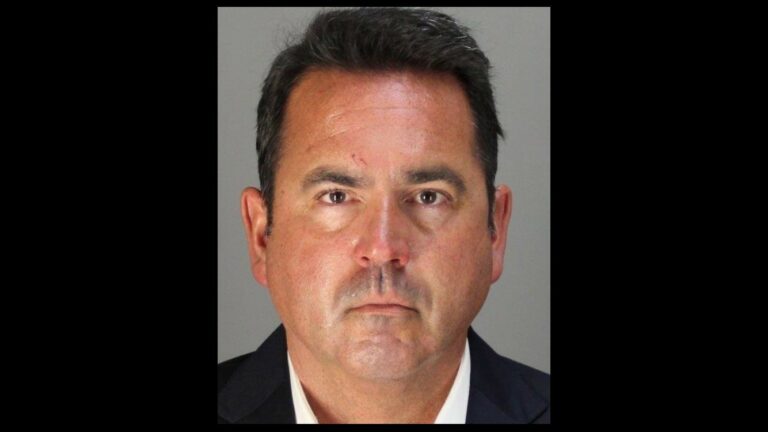
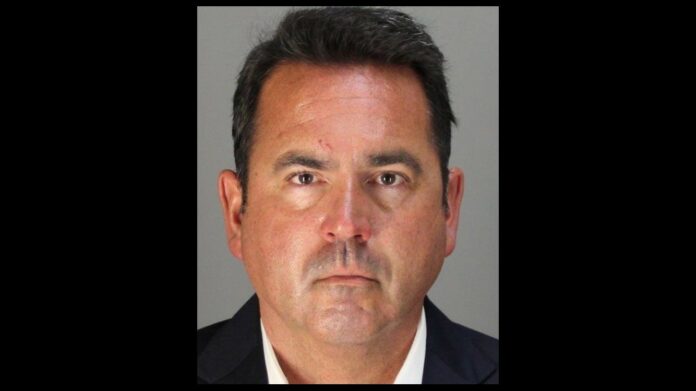
Prominent Bay Area political strategist Nathan Ballard is facing domestic violence and child abuse charges following an alleged attack on his wife and a young child.
The Napa County District Attorney’s Office filed a two-count felony complaint in Superior Court on Thursday alleging child abuse involving willful cruelty to a child with possible injury or death and domestic violence with a minor injury, according to Assistant District Attorney Paul Gero.
Ballard was arrested Oct. 20, two days after Napa County sheriff’s deputies were called to the scene of the alleged attack at the Carneros Resort and Spa.
After turning himself in, Ballard declined to answer questions or make a statement to detectives and was booked into Napa County Jail, according to sheriff’s spokesman Henry Wofford. He was released the same day after posting $75,000 in bail.
The charges stem from an allegation that on the evening of Oct. 17, Ballard charged at and pushed a woman the District Attorney’s Office identified as his spouse into a glass door, leaving her with a bump on the back of her head.
According to the Sheriff’s Office report, the woman alleged that Ballard was under the influence of alcohol and marijuana and that as he pushed her, he also fell, cutting his nose and forehead when he hit the floor.
He then allegedly took a pillow, placed it over a 4-year-old girl “and attempted to suffocate the child with the pillow,” Wofford said.
“The adult victim was able to remove the child victim from the room and locked herself and another child (a 3-year-old boy) in a separate room,” Wofford said.
The woman called the Sheriff’s Office the following morning and by the time deputies arrived, Ballard was gone, according to Wofford.
Online court records show a restraining order was granted to Ballard’s wife on Nov. 11.
“I am confident that my client, Nathan Ballard, will be fully acquitted of these charges after the District Attorney’s Office has a chance to review the facts and learn all sides of the story,” said attorney Anthony Brass in a written statement.
“Nate knows that he is not perfect, but he is facing his own challenges head-on. After nearly eight years of continuous sobriety, Nate resumed drinking in April, after his father died,” Brass said.
“He is now clean and sober again, and he is currently in a residential recovery program to deal with his drinking problem in a responsible, comprehensive manner,” according to Brass.
Ballard is a well-known Democratic strategist who was Gov. Gavin Newsom‘s communications director when Newsom was mayor of San Francisco.
He is the founder and CEO of The Press Shop, a public relations agency, and lists past clients as including John Kerry, Wesley Clark, the Democratic National Committee, the California Democratic Party and the California Labor Federation.
He also sits on the board of The Representation Project, Jennifer Siebel Newsom’s nonprofit “dedicated to ensuring all humans achieve their full potential, unencumbered by limiting gender norms.”
Siebel Newsom is Gavin Newsom’s wife.
Ballard is scheduled to be arraigned in Napa County Superior Court at 8:30 am on Dec. 29.
While the Museum of Sonoma County has closed its gallery space in downtown Santa Rosa to the public due to Covid-19, the museum–a longtime Sonoma County cultural cornerstone–is continuing to engage to community with virtual exhibits and programs.
This month, with the holidays on the horizon, the Museum of Sonoma County unveils two virtual exhibitions displaying local talent; “35: Thirty-Five Artists for Thirty-Five Years” and “Artistry in Wood.”
Originally scheduled to open in-person on December 12, both exhibitions will open to museum members in an exclusive virtual art reception on Wednesday, Dec. 9. Following that, both exhibits will be available for the public to view on the museum’s website beginning Dec. 22.
As the title implies, “35: Thirty-Five Artists for Thirty-Five Years” is a retrospective exhibit celebrating the Museum of Sonoma County’s 35-year anniversary in 2020 with a selection of artworks from the museum’s permanent collection. Founded in 1985, the museum has collected art and historical items with a focus on Sonoma County and the North Bay.
Now the largest comprehensive overview of the history, art, and culture of the region, the museum’s collection features works on paper, photographs, paintings, sculpture, ceramics, and crafts that span from the 19th to the 21st Century. With this in mind, the artworks selected for “35” explore a broad range of media and styles and the exhibit showcases art that depicts the local landscape and the environment, as well as art that offers social commentary and other recurring local interests.
“Museum of Sonoma County’s collection has grown because of the support of collectors, artists, and donors, and we are grateful for their generosity,” says Jeff Nathanson, Executive Director and art curator for the museum. “We are proud of the art we have accessioned to date, and are pleased to share this sampling with the public. We hope these excellent works provoke inspiration, conversation, and creativity.”
Nathanson and the museum also acknowledge that the museum’s permanent collection is in need of broader community representation, and Nathanson is refocusing the collection’s priorities with a keen eye on works by artists of all genders and artists of color to ensure that all members of the community will see themselves reflected in the collection.
For more than 30 of the museum’s 35 years of operation, the Sonoma County Woodworkers Association (SCWA) has collaborated with the museum to present an annual, juried showcase of fine regional woodwork in the “Artistry in Wood” exhibition.
“Artistry in Wood” annually pushes the boundaries of what wood can do as an artistic medium. Additionally, the exhibition educates the public on historical and regional woodworking influences, such as the distinctive woodworking program at The Krenov School at Mendocino College in Fort Bragg.
This year’s virtual version of the exhibit continues the woodworking traditions of the long running show, featuring new and previously completed works crafted by fine regional woodworkers who are affiliated with the Sonoma County Woodworkers Association.
The virtual members-only art reception for “35: Thirty-Five Artists for Thirty-Five Years” and “Artistry in Wood” happens Wednesday, Dec. 9, at 7pm. Both shows open to the public virtually on Dec. 22. Other virtual programs will be added shortly. Museumsc.org.
Stephanie Hartwell-Mandella was taken aback recently when she was checking messages on behalf of the Marin County Free Library’s Corte Madera branch and saw a note about a first-grader who had failed to return a checked-out book.
There’s nothing unusual about a kid who borrows a book for too long. But in this case, too long was 48 years.
Even more unusual was...
Former Santa Rosan Ben Greenberg recently felt nostalgic and homesick for Sonoma County from his home in Los Angeles, so he wrote a song about it.
Living in the “City of Angels” since 2016, Greenberg is making his mark on the indie-folk singer-songwriter scene in the city, crafting heartfelt tunes about self-acceptance, love, loss and home. He recently recorded his...
Wow.
I mean it, I just read the article on the Point Reyes Apocalypse Cow … (“Apocalypse Cow,” News, Dec. 9).
I don’t think a clearer nor more concise history has ever been linearly printed … including the F-A-C-T that ranchers were paid for their lands and agreed to leases based on a term OR the life of the original signer...
The company behind a luxury resort and residential project near Healdsburg is facing a $6.4 million fine over dozens of alleged water quality violations involving streams that feed into the Russian River, according to state water officials.
Sonoma Luxury Resort LLC, the company behind the Montage Healdsburg resort - formerly called Saggio Hills - is alleged to have violated state...
Sixty million years ago a chunk of granite located near Los Angeles began moving northwards. Propelled by the energy of earthquakes over eons, Point Reyes slid hundreds of miles along the San Andreas fault at the divide between two colliding tectonic plates.
During the last Ice Age, 30,000 years ago, much of the Earth’s waters were locked up in glaciers,...
Gov. Gavin Newsom announced a new stay-at-home order Thursday that
will be targeted at regions of the state with diminished intensive care
unit capacity as the state attempts to slow its surge of new Covid-19 cases.
Counties with less than 15 percent of their ICU beds open and...
Prominent Bay Area political strategist Nathan Ballard is facing domestic violence and child abuse charges following an alleged attack on his wife and a young child.
The Napa County District Attorney's Office filed a two-count felony complaint in Superior Court on Thursday alleging child abuse...