Bay Area members of Congress who had to flee from the House chambers Wednesday as supporters of President Donald Trump stormed the U.S. Capitol in Washington, D.C., are among those calling for Vice President Mike Pence to gather Trump’s cabinet in order to invoke the 25th Amendment and deem the president unfit for the office.
Trump gave a speech earlier Wednesday, falsely claiming he won the election and calling for his supporters to march to the Capitol as Congress was holding hearings on the certification of the Electoral College vote following November’s election of former Vice President Joe Biden as president over Trump.
During the insurrection, one woman died in a shooting by police inside the Capitol building and three other people died in the area around the Capitol grounds as a result of unspecified medical emergencies, according to local police. At least 52 people were arrested, and videos went viral on social media of people ransacking congressional offices, including that of House Speaker Nancy Pelosi, D-San Francisco.
Rep. Jackie Speier, D-San Mateo/San Francisco, and Rep. Mike Thompson, D-Napa, both called for the invoking of the 25th Amendment, which states that the vice president “and a majority of either the principal officers of the executive departments” can write to Congress to say the president “is unable to discharge the powers and duties of his office.”
The vice president, in that event, would assume the powers of the presidency, but the president could also write to Congress that no inability exists, and would then resume the powers. The decision would ultimately go to Congress to decide, with two-thirds votes needed in both the Senate and House to remove the president.
Speier wrote on Twitter, “Trump has given us no choice. The 25th Amendment must be invoked NOW. We need to immediately wrest control of the country from him. He is not the commander (in) chief of the US. He is commander (in) chief of the Trump mob & proud boys. @VP Pence must step up & defend our democracy.”
Thompson, also calling for invoking the 25th Amendment, wrote, “On this dark day for our nation, we need to stand up and end this immediately. Nothing less than the future of our democracy is at stake.”
Rep. Jerry McNerney, D-Stockton, and other members of Congress have joined that call, but a local politics professor said such an action is unlikely at this point.
Jeremiah Garretson, associate professor of political science specializing in political psychology and media at California State University East Bay, said given that the president’s cabinet is stacked with loyalists who are unlikely to vote to remove him and that enough Republican members of Congress also support the president, the 25th Amendment seems like a long shot to remove Trump ahead of the Jan. 20 inauguration of Biden.
Garretson said he unfortunately wasn’t surprised by the storming of the Capitol given that the president’s rhetoric about election fraud — which earned Trump temporary suspensions Wednesday on social media platforms like Twitter, Facebook and Instagram — has been spread widely on right-wing media and was preceded last year by similar actions at statehouses, including in Michigan over COVID-19 protective measures.
“It just took a few nudges with these people believing that they are trying to restore democracy to get them to act in a way that is completely contrary to democracy itself,” Garretson said.
On Thursday, other members of Congress, including North Coast Rep. Jared Huffman, D-San Rafael, called for Trump to be impeached, whether or not the 25th Amendment is invoked.
“Good. But let’s be clear: impeachment must happen with or without 25th Amendment action. Hard to imagine this monster ever again inflicting his crimes and abuses on our nation as President, but impeachment is necessary to make sure,” Huffman wrote on Twitter Thursday in response to news that Pelosi called on Pence to invoke the 25th Amendment.
Bay Area congressional representatives reacted Wednesday to the chaos created by supporters of President Donald Trump who overcame police and breached the U.S. Capitol in Washington, D.C.
Both chambers of Congress were holding hearings Wednesday on the certification of the Electoral College vote following November’s election of former Vice President Joe Biden as president over the incumbent Donald Trump.
Some Bay Area representatives took to Twitter to react to the violence at the Capitol or let others know their condition.
Rep. Mike Thompson, D-Napa, said, “I am currently sheltering in place in the Capitol at a secure location. I will give more updates. This is a very sad day for democracy.”
“My staff and I are safe,” Rep. Anna Eshoo, D-Palo Alto, said. “Praying for an end to this violence.”
“Never imagined I would be locked down in the US Capitol trying to ride out a violent coup attempt led by an American President,” Rep. Jared Huffman, D-San Rafael, said, referring to Trump.
Rep. Barbara Lee, D-Oakland, said, “I am horrified that colleagues and staff are on lockdown in House office buildings as I tweet this.
“I am equally horrified that Trump and members of the GOP have called for this blatant attempt to disrupt & undermine our democracy. Please stay safe.”
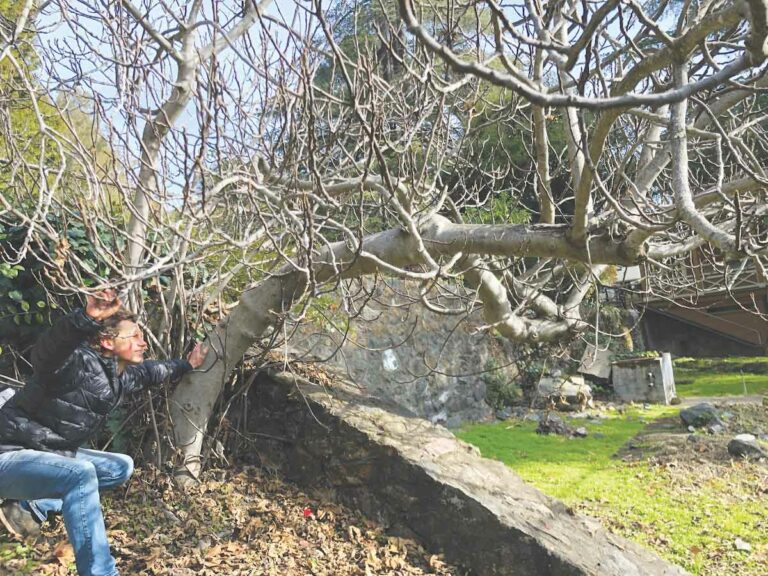
We pedal our bikes through a gray industrial neighborhood in San Rafael, past warehouses, parking lots, shipping containers and auto shops. Vehicles roar by as we stop beside a tree hanging over a chain link fence. Under our feet are the remnants of the year’s crop—splattered figs.
It’s November, and there are no fruits to taste today, but Maria and I have had them before—large black figs filled with sweet raspberry pulp—and today we’ve come for something better: the tree’s wood. With a pair of rose cutters, I take several two-foot branch ends and drop them into my bike pannier.
Turning to my girlfriend, I quip a favorite tagline to outings like these: “We may not have any figs to take home, but at least we have the genes.”
At my home in South Sebastopol, I cut the wood into six-inch sections and stick them into pots of moist garden soil. Within weeks, they’ll sprout roots and leaves—replicate trees being born. Rooting figs is an easy process; cloning for dummies. Eventually, exact genetic copies of the San Rafael tree will be growing in my backyard orchard, along with a few dozen other fig varieties.
People have been doing this same thing for millennia. A native of the Old World, the common fig originated somewhere in the Middle East, and humans have cultivated it since the agricultural crack of daylight. Traders dispersed the species north into the Caspian basin, eastward into Asia and west to Africa and Europe. Figs arrived in North America with the Spaniards, who, along with their guns and cannons, packed along their favorite varieties, and the trees found their way to the West Coast with the missionaries. For many decades thereafter, fig trees grew in the gardens of Catholic mission churches and on small farms.
But Ficus carica has escaped the confines of California’s agriculture industry. Accelerated by birds which eat the fruit and disperse their seeds, figs have gone wild and become a notorious invasive pest. In the Sacramento River valley, they have formed dense thickets along the banks of the river, smothering native plant communities. Conservation groups and agencies have tried with limited success to eradicate figs in several state parks.
But for another community of people, the invasive trees have created a playground for discovery. Driving along rural roads or bushwhacking through riverbed fig jungles, hobbyist fig growers are now tapping this resource for undiscovered treasures. In recent years they have found exceptional edible fruit on wild seedlings growing nowhere else. Propagated from cuttings in home gardens and marketed via online trading platforms, these new, genetically unique varieties have attained star stature and are finding their way into private fig collections nationwide. The Yolo Bypass fig was discovered several years ago in its namesake flood control channel near Sacramento and has become a prized collector’s item on Figbid.com. So have new varieties such as Belmont’s Beauty, found growing along a cliff in the Sierra Nevada foothills; Holy Smokes, first collected from a Santa Barbara churchyard; and a colorful plethora of others from Lake Shasta to San Diego.
Sonoma County permaculture teacher and edible plant collector John Valenzuela discovered a wild fig tree near the Tiburon peninsula while riding a bicycle about 20 years ago. During the next fall fruiting season, he had his first taste of its jet-black figs.
“I was blown away by their beauty, outside and inside, their size, their flavor, and just the miracle of the tree being in that spot—you had to wade across a salty tidal ditch next to the freeway along a fence line,” he recalls. “That was such a magical find.”
Valenzuela began distributing cuttings of the tree, and he keeps potted copies of his own at the Hidden Forest Nursery, where he works. Here, Valenzuela grows about 20 fig varieties.
But Valenzuela’s collection is eclipsed by others. In Napa, Aaron Nelson has about 50 different fig trees. Near Occidental, Gary Pennington has experimented with roughly 200 varieties, sold or discarded many, and now has about 80. A grower near the Delta town of Isleton, perhaps known best by his social media handle “Figaholics,” has an orchard of more than 300 varieties. One Santa Barbara fig hunter, Eric Durtschi, has grown and evaluated roughly 800 varieties, many first collected from wild seedling trees.
Hundreds more collectors, connected via social media, are assembling extensive fig libraries across the continent, from Vancouver Island to Florida, from the Gulf Coast to the Great Lakes. With proper seasonal care, most varieties will produce high-quality edible figs just about anywhere in the Earth’s mid-to-lower latitudes. Fig growers enjoy ripe summer fruits in such boreal regions as British Columbia and even Sweden.
California Fig Hunter
But California is a very special place for fig enthusiasts. That’s because, within the United States, it’s only here that Ficus carica grows wild. This came about through a string of events beginning in the late 19th century, when farmers of the San Joaquin Valley imported a fig from Western Turkey, near Smyrna. A yellow-skinned variety known as the Sari Lop, it was planted in large groves around the Fresno area. After several years, growers observed a disappointing pattern: Each July, their Sari Lop figs swelled to the size of a walnut, then shriveled and dropped without ever ripening.
Through several expeditions to the eastern Mediterranean to investigate local cultivation methods, the United States Department of Agriculture identified and solved the problem: Certain figs—Sari Lop among them—will not ripen unless pollinated by a particular species of wasp, Blastophaga psenes, a miniscule insect native to Western Eurasia. So, the USDA imported the fig wasp to California, as well as the hermaphroditic caprifig trees essential to the insect’s life cycle. The industry promptly took off, the first successful crop of Sari Lop figs hit the market in the summer of 1899, and the variety—renamed locally the Calimyrna—became the state’s signature commercial cultivar alongside the black mission, whose fruits ripen without pollination.
But besides allowing Smyrna-type fig varieties to ripen, the fig wasp does another remarkable thing: It makes fig seeds fertile, thereby enabling populations of figs to sexually reproduce. Thus, as the wasps became established in California, fig trees began sprouting like weeds.
In the Old World, wild figs grow from the cobblestones of ancient architecture, like Roman bridges and castle turrets. In California, their bushy foliage is seen beside parking lots and gas stations, irrigation ditches and chain link fences, train tracks and freeways. I once saw a small fig growing from the top of a palm tree in a San Diego bus station, and a thicket of figs was recently removed from under a highway overpass in San Rafael. Watchful Amtrak riders may see wild figs out the window between Antioch and Martinez.
NOTED Bland’s fig-infused travelogue, circa 2009.
Introducing the wasp to California opened a Pandora’s box of untasted figs, which are now spilling onto the landscape. The fig wasp’s range is limited by an intolerance of harsh winters, restricting them to the United States’ coastal southwest, but wherever they fly, wild figs grow.
This makes much of the state a fig collector’s paradise.
“To have the generation of new varieties right here, I think it’s so exciting,” Nelson, in Napa, says.
The self-generating engine of the fig-wasp partnership makes fig control efforts seem almost hopeless.
“It’s heartbreaking,” says Katherine Holmes, the deputy executive director with the Solano County Resource Conservation District. “Fig is a terrible invader of a very narrow niche—riparian woodland. It doesn’t invade everywhere, but where it does invade is precious habitat, and it totally takes over.”
Holmes has worked on fig eradication programs in the Central Valley, where F. carica is overwhelming the last remnant parcels of native riparian forest. Holmes says she has personally killed thousands of fig trees using a combination of chainsaws and herbicides, and in isolated spots, including Caswell Memorial State Park, she and her colleagues have had success.
However, the species is only tightening its grip on the landscape elsewhere. The trees spread via root suckers and seed dispersal and can overtake large areas and push out native plants. Holmes says just several percent of the Central Valley’s riparian woodlands remain intact, and fig trees threaten their survival.
F. carica is spreading through Southeast Marin County, and fig seeds are apparently sprouting around the East Bay. The Berkeley-based California Invasive Plant Council’s WeedMapper program, a user-generated database, shows wild fig reports from West Oakland’s Willow Street, the Marina Park Pathway in Emeryville, a suburban yard in San Ramon and a hillside just west of Discovery Way in Concord, among more locations.
Pennington says he often sees enormous wild figs while driving in the Central Valley, but he isn’t particularly interested in inspecting or propagating them. Instead, he has focused on established, if still hard to find, cultivars, many of ancient French and Portuguese origins.
“All these new, terrific figs keep coming along, but if you’re chasing new seedlings, you can’t keep up,” he says.
Most wild figs produce fruit that is dry, pithy or simply unremarkable. One in a handful will produce fruit worth pulling off the road to taste, and among these head-turners, a rare few are standouts. When collectors find them, they keep locations secret and, using evocative, drippy names like Cherry Cordial, Raspberry Latte, Crema di Mango, Gold Rush and so on, they can score thousands of dollars in branch cutting sales.
But the hype quickly tails off as cuttings from the mother tree are distributed far and wide. Soon, the variety becomes an established component of the global fig inventory, and the relevance of the original seedling tree as a source of unique genetics is reduced to another blur of roadside shrubbery.
Fig Swap
I spent one summer after another in my 20s and 30s bike camping through Europe and Turkey. I got lost in beautiful mountains, weathered terrible storms, dodged men with guns, learned new languages, saw bears and ran out of food—but the focus of those outings was figs. The roadsides offered an unending buffet, and as I cycled between Portugal and the Black Sea, I ate countless fig varieties, interviewed local growers and observed distinctive regional variations in shape and flavor. I even visited government germplasm collections in Greece and Georgia.
Today, my relationship with figs is more grounded. I began building a potted collection around 2014, mostly sourced from unidentified trees in Marin County. When I bought a property in 2017, the floodgates opened. I purchased a few new varieties, replicated ones I really loved, acquired more from other growers, and eventually built up a potted and planted orchard of more than 50 varieties. Twelve feet between trees seemed prudent when I got started; now I’m making excuses for squeezing them in at six feet.
The attraction of the untasted keeps all of us grabbing up more. The day before Christmas, I pay a visit to Pennington’s home to make a trade. I bring him a small Burgan Unknown while he sets aside for me extras of two of his favorites, Bordissot Blanca-Negra and Del Sen Juame Gran, in five-gallon pots. I offer him cuttings of Black Zadar and Grantham’s Royal. If Pennington is trying to cull his collection, which lines his driveway in plastic pots and half wine barrels, I’m not helping.
Figs, in fact, are not Pennington’s favorite fruit.
“That would be a drop-dead-ripe apricot,” he says.
But figs are a close second, and they’re easier to propagate. Indeed, the willingness of a fig branch to sprout roots makes fig trees appealing plants to grow. This certainly drew the attention of ancient peasants, too, who researchers believe began growing fig trees from cuttings before domesticating any other plant. In a paper published in Science in 2006, three scientists, led by Israeli archaeologist Mordechai E. Kislev, concluded that fig trees were “the first domesticated plant of the Neolithic Revolution.” They analyzed fig residue from an 11,000-year-old village in the Lower Jordan Valley that they determined originated in the fruits of “trees grown from intentionally planted branches.”
The game that started then continues now as California fig hunters search for the next prize. With the nonstop emergence of new genetic variants from wild populations, the hunt may never end. In Southern Europe, I believe it may be possible to travel for weeks without ever losing sight of a fig. They grow almost as rampantly as the Himalayan blackberry does here, and eventually the species will likely naturalize throughout California as firmly as it has in the Mediterranean fig belt.
“My hope has been to draw attention to this and do something before we get to that point,” Holmes says.
But Valenzuela sees a thread of poetry in the spread of the species. To him, the trees—which in a sense are followers more than invaders—symbolize the human quest for security and comfort in harsh environments.
“The fig is part of our paradise garden,” he says. “If you’re in the desert, there’s bad weather and animals, but you build a wall and inside you create a protected garden with aromatic plants and fruits. It’s like the Garden of Eden, where everything was perfect, beautiful and abundant. I see the fig as an integral part of that paradigm.”
More than a metaphor, his words take me back many years, to a craggy volcanic island in the Aegean Sea. Against a howling gale, I pedaled my bike to the top of a mountain, where I entered a beautiful monastery. The monk inside, vowed to silence, nodded his greeting and walked me through the dark stone chambers and into the walled garden. Tomatoes and beans grew in the sun, and from a spigot I filled my bottle with icy water. The monk brought a plate of olives, and for a moment I sat in the shade of an old fig.
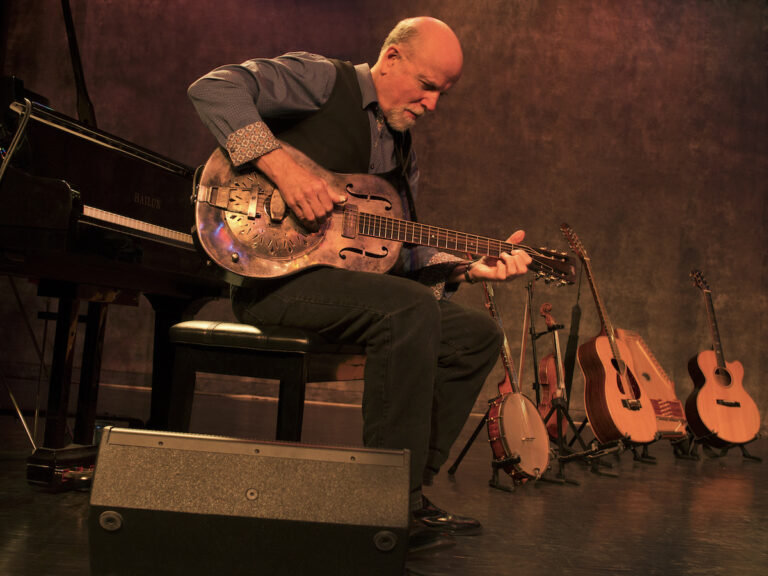
Even though he lives in the city of Smoke Rise, Georgia, veteran folk singer-songwriter and multi-instrumentalist John McCutcheon is a popular Sonoma County fixture.
That is because McCutcheon annually plays at Sonoma’s historic Sebastiani Theatre as part of a self-described “Left Coast Tour” that he’s embarked upon each January for more than 30 years.
This year, McCutcheon could not make the trip out to California due to the ongoing Covid-19 pandemic. So he’s doing the next best thing, performing an online show that will benefit the theater on Saturday, Jan. 9.
That online show is one of two concerts McCutcheon is hosting as part of his Virtual Left Coast Tour, and each show benefits a number of California venues and organizations that McCutcheon regularly works with.
For example, Sebastiani Theatre is sponsoring the Jan. 9 performance alongside co-sponsors The Freight & Salvage (Berkeley), KVMR (Nevada City-Grass Valley), Modesto Peace & Life (www.peacelifecenter.org) and KZFR (Chico).
On McCutcheon’s webpage, virtual concertgoers can purchase tickets to the show through their preferred venue’s link, which will ensure their ticket helps to support that sponsor directly.
“A lot of these presenters have become old friends by now. I want and need them to survive so that we can continue our work together on the other side of all this,” McCutcheon says in a statement. “Each presenter gets a unique ticketing URL and sells tickets to ‘their’ audience. They get a cut of the sales that they sold, just as if I were there live. In fact, it’s a better percentage and they don’t even have to turn the lights on.”
Tickets are available for the virtual concert at three price points to give the show a “Pay what you can” feel, including a five-dollar “unemployed/laid off” ticket.
“Everyone needs music these days, so we want to keep it affordable,” McCutcheon says.
The prolific musician also promises he will have plenty of new songs and stories for the upcoming virtual show, as he does each year that he comes to town. In fact, McCutcheon recently released his 41st album, Cabin Fever: Songs from the Quarantine.
Written over the course of three weeks of self-imposed isolation following an Australian tour in Mid-March, Cabin Fever: Songs from the Quarantine is not the album McCutcheon planned on recording in 2020.
Following his last release, To Everyone In All the World: a Celebration of Pete Seeger, McCutcheon had stockpiled over 30 new songs, but that record went on the shelf once the pandemic-related music and lyrics began pouring out of him while he was in isolation.
Like his upcoming virtual concert, McCutcheon wanted to make the album accessible to everyone, regardless of finances.
“We’re in this together and we need to look out for one another,” McCutcheon says. “It’s the only way, in the music business or in ‘real life,’ that we’re going to make it.”
John McCutcheon performs his Virtual Left Coast Tour in partnership with Sebastiani Theatre on Saturday, Jan. 9, at 4pm. $5–$30. Get tickets at Folkmusic.com.
I read with interest the position offered by Mr. Burnett on the “need” to revise Prop. 13 revenue stream to be more consistent with present property values (Open Mic, Dec. 30).
And I have to say: No.
I am actually one of “those” people now. I bought my house in West Marin 16 years ago and now that I am retired, my income has been reduced to 25 percent of what I made when I was working formerly. Dec. 10th and April 10th are stressful days. Any property owner should know those dates by heart, they are when county property taxes are due.
But just for fun, let’s argue in the alternative; so I can’t afford to pay my property taxes, and then I have to sell my house … how many buyers will there be for people who can afford my home, afford my neighbor’s home, multiply that across the state. What happens to the houses that no one buys? Think it won’t happen? It happened during the Carter years when interest rates on home mortgages were 18 percent—sure people had the down, but they couldn’t afford the cost of money … now replace the cost of money with: the cost of taxes.
Whenever a new CEO comes to a failing company, he or she has basically two tools, sell more widgets (more income) or cut costs. Those are the ONLY two choices for turning a company OR a state to profitability.
So? Why go for the former? California taxes are enough, that Elon guy is moving to Texas … HELLO? Anyone listening? Can I respectfully call him the Canary in the Coal mine? The hotbed of innovation and technical skill (San Francisco, CA) now has become too costly to operate here? Evidently, it’s no different for the homeowner.
I pay plenty of taxes and you know how many kids I have? Zero. I pay enough.
Stop asking for more money, and cut costs. If we can’t afford it, then we can’t have it, and as true as that is, I don’t want that to be the case with me personally and my house!
Joseph Brooke lives in Point Reyes Station.To have your topical essay of 350 words considered for publication, write op*****@******an.com.
In the midst of so much disease and uncertainty, there is something that individuals can do to improve their own well-being, as well as their community’s health. There is no better time to quit smoking or vaping tobacco (or other substances) than during this pandemic.
Studies show that smoking and vaping compromise the immune system and weaken the lungs’ defenses. Sadly, for children and other vulnerable populations, exposure to secondhand smoking or vaping aerosols (including both nicotine and cannabis) increases the risk of respiratory diseases including Covid-19 and makes recovery more difficult.
Those sharing a household or an apartment wall with residents who smoke are also at higher risk. Luckily for smokers and vapers, plenty of free resources are available to help them quit. Many people make health-related New Year’s Resolutions in January. If you know anyone struggling with this type of addiction, please share this with them.
The California Smokers’ Helpline (nobutts.org) offers personal support via phone and text, plus a free two-week starter kit of nicotine patches, while supplies last. Also, the Smoke-Free Marin Coalition (smokefreemarin.com) is launching a county-wide campaign to help people quit smoking and vaping tobacco (and other substances) in the New Year.
Our Tackling Tobacco Team at San Rafael–based Bay Area Community Resources (bacr.org) supports individuals of all ages who want to quit and provides free resources, such as a new YouTube Channel created to help individuals quit during the pandemic.
Back when social gatherings were possible, the Luther Burbank Center for the Arts in Santa Rosa hosted world-class performers and artists as well as nationally-recognized education programs and popular community events such as the Clover Sonoma Family Fun Series.
This year, as Covid-19 keeps forcing live events to go online, Luther Burbank Center for the Arts continues to host events online, and the center recently announced that the Clover Sonoma Family Fun Series is returning in 2021 with five free virtual performances that will entertain and educate children and their families while they stay at home to slow the spread of the pandemic.
“We’re thrilled not only to be able to offer the Clover Sonoma Virtual Family Fun Series this year, but to do so completely free to families. It’s one way we can give back to the community that means so much to us,” Melanie Weir,Luther Burbank Center for the Arts Education and Community Engagement Manager, says in a statement. “This is only possible because of the generosity of Clover Sonoma, Exchange Bank, and the Evert Person’s Youth Access Fund supplied by the Ernest L. and Ruth W. Finley Foundation.”
The series kicks off on Saturday and Sunday, Jan. 23–24, with “Pete The Cat,” a musical adventure based on the book series by Eric Litwin. The song-and-dance show is produced by TheaterWorksUSA, which brings beloved productions to venues across the country–and now online–for schooltime performances.
In February, the series mixes science and comedy with the bombastic “Doktor Kaboom.” The educational and engaging one-man performance showcases the scientific method using humor and explosive experiments that are actually tied directly to curriculum standards. The Doktor goes kaboom on Saturday and Sunday, Feb. 21–22.
Next up, “The Snail & the Whale” tells the heart-warming story of a tiny sea snail hitching a lift on the tail of a giant humpback whale on Saturday and Sunday, Mar. 13–14. The virtual production, inspired by Julia Donaldson and Axel Scheffler’s acclaimed picture book, teaches lessons on friendship while providing live music and fun that is appropriate for audiences ages four and up.
In April, the massively popular “DiNO Light” show streams into homes for a glow-in-the-dark adventure. Kids’ entertainment company CORBiAN Visual Arts and Dance, in collaboration with Lightwire Theater, brings the fan-favorite showcase to life with neon lights and cutting-edge technology. Families are encouraged to watch “DiNO Lights” in the dark for the full experience when the show streams on Saturday and Sunday, Apr. 17–18.
Finally, bilingual kids’ music sensation Sonia De Los Santos shares her cheerful songs about nature, everyday life, and her own Mexican heritage in a virtual concert performance on Saturday and Sunday, May 15–16. Singing in Spanish and English, De Los Santos s musically inspired by various Latin American rhythms from Mexico, Colombia and Peru as well as American folk traditions. For this performance, De Los Santos will also give online audiences a sneak peek into how she and her friends make music, as well as special cultural demonstrations.
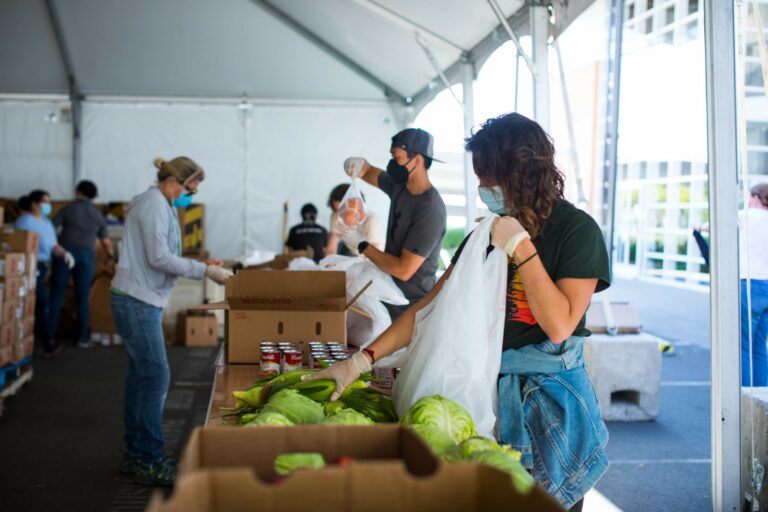
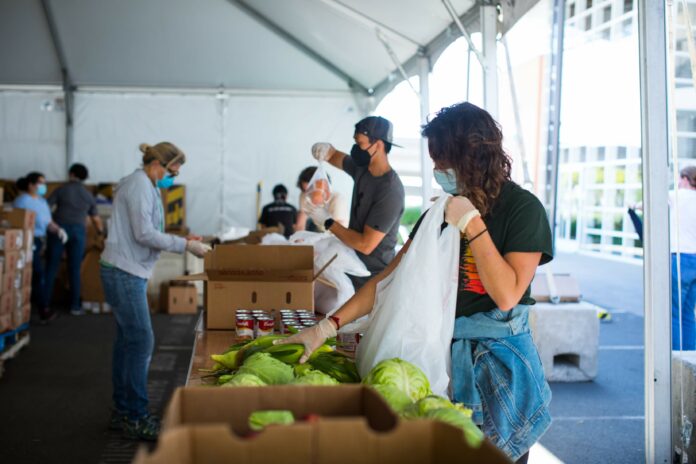
Second Harvest Food Bank Development and Marketing Officer Suzanne Willis remembers when her Watsonville-based food pantry served about 55,000 people monthly, providing them with parcels of fresh produce and pantry staples.
This was early in 2020, before the Covid-19 pandemic hit, prompting widespread business closures in March. After that, the number climbed to approximately 88,000—an increase of 60 percent.
Part of the problem is that each winter, tourism and agricultural jobs dry up. That means families need help to feed themselves and to survive, even in a year without a pandemic.
“If you’re spending everything you have on rent and medical and gas, you don’t have the funds for food,” Willis says. “A lot of the work we’re trying to do is make sure people have access to the fresh produce, the lean proteins and the whole grains they need, but also the knowledge on how to use it.”
Other Bay Area food banks have recorded similar surges in need. The Redwood Empire Food Bank, which serves families from Sonoma County to the Oregon border, reported a 300 percent spike in demand between March and April of last year—from 10,000 to 40,000 meals per month.
Likewise, the San Francisco-Marin Food Bank now serves approximately 60,000 households each week, compared to 32,000 each week prior to the pandemic.
UC Berkeley sociology professor David Harding says that workers in tourist industries often face dueling vulnerabilities: they work in boom-or-bust economies, in areas with a high cost of living.
Harding says the pre-pandemic economy was actually pretty good at the start of 2020, in terms of markers like unemployment. But the U.S. generally has high levels of economic inequality compared to other wealthy democratic countries. So many Californians were already in a precarious spot.
“Our economy is one that, even in the best of times, many working and middle-class families are living paycheck-to-paycheck and aren’t able to prepare for a time like this when the economy goes south,” says Harding, whose research interests include poverty, inequality, urban communities, race and the criminal justice system. “If people have to shelter-at-home and businesses are closed, it doesn’t take long before people are struggling to meet their basic material needs. And we’re seeing that.”
Sure enough, Willis says that during the Great Recession of 2008 and 2009, Second Harvest’s numbers jumped from 30,000 people picking up food per month to 50,000, and they never went down. Then this year, staffers and volunteers watched demand soar past that level. Willis fears that a similar pattern will emerge in the wake of the pandemic—and that demand will remain high for years to come.
Information compiled by the nonprofit Feeding America shows that 9 percent of Sonoma County residents were food insecure, defined as not having reliable access to food, in 2018. The same year, 7.4 percent of Marin County residents and 7.9 percent of Napa County residents were considered food insecure.
And according to state data, the number of households receiving CalFresh food assistance Marin, Napa and Sonoma counties climbed 26.8 percent between February and June 2020.
Needing the Way
The effect of the pandemic on food security came swiftly. In a study released this past spring, researchers at Northwestern University found that food insecurity doubled nationwide in April of 2020 and tripled for families with children.
In subsequent analyses, the two researchers found that the troublingly high levels held steady into the summer and that Black and Hispanic children remained much more likely to be food insecure than white kids were.
In December, an analysis of Census survey data by the Center on Budget and Policy Priorities (CBPP) found that approximately 27 million adults (roughly 13 percent of all adults) reported that they “sometimes or often” didn’t have enough to eat in the past seven days. In 2019, only 3.4 percent of adults said that they did not have enough to eat at some point during the past 12 months, according to the U.S. Department of Agriculture.
Willis says the struggles of hungry families are often intertwined with housing insecurity, job insecurity and all forms of social, racial and economic injustices.
“All of it ties in together, and it all has this snowball effect on a person who maybe is kind of making it, and all of a sudden you throw in a broken car or a cancer diagnosis or something; that is the kind of thing that will throw a family on the edge completely over it,” Willis says.
In general, Harding thinks it can be easy for many Americans to lose sight of what social scientists really mean when they talk about poverty. The typical definition of poverty, whether to a government agency or to an academic, is that someone’s income falls below a threshold, but what that really means is that someone doesn’t have enough money to pay for their very basic needs—food and housing. The resulting consequences can be devastating, especially as they fall on the nation’s kids.
“They’re pretty severe,” Harding says. “If you’re thinking about children, it’s going to be influencing their social and emotional development. It’s going to be impacting their ability to apply themselves in school.” He adds that initial rounds of federal stimulus helped, but the benefits wore off.
These problems extend far and wide, including to students at the state’s public universities, despite California’s efforts to expand services.
According to a report by the University of California Office of the President, between 39 and 47 percent of student respondents from the UC system were found to be food insecure in three surveys since 2016. Those figures were a few percentage points higher than for UC Berkeley alone.
In May, the California Student Aid Commission (CSAC) conducted a survey of more than 70,000 college students and high school seniors to understand how the pandemic had affected them. The survey found that more than seven in 10 students had lost at least some of their income.
In short, the pandemic pushed the everyday crises that many California college students face from “steady” to “extreme,” says CSU East Bay’s Darice Ingram.
Ingram coordinates the Helping Our Pioneers Excel (HOPE) program, which oversees a food pantry and assistance for struggling student renters, while responding to students in crisis. Ingram helps educate low-income students about how they may qualify for CalFresh and also helps them apply. HOPE additionally provides Instacart credits to those who don’t have enough groceries. And the program has been connecting students who moved out of the area for distance learning with resources in their regions.
At least 30 percent of Cal State East Bay students are now food insecure, Ingram says, although she adds that the true states of hunger, poverty and homelessness can all be difficult to measure and track.
“College students just find a way to make it happen, not realizing that they’re in crisis, because they’re college students,” she says. “They’re like, ‘I gotta go to school, so I gotta make this happen. I’ll stay at my friend John’s on Tuesday, and on Wednesday, I’ll stay over here, and on Thursday, I’ll stay in my car.’ But they didn’t identify as being homeless.”
A large Sonoma Coast ranch property with sweeping views and ecological and historical significance has been transferred to Sonoma County Regional Parkswith plans to ultimately open it to the public as a regional park and open space preserve.
The site is primarily coastal grasslands, and features views of the ocean and Bodega Bay, cypress trees, historic buildings, Salmon Creek, coastal hills and coastal prairie.
“Carrington Coast Ranch hosts a diversity of natural habitats, including coastal prairie, coastal scrub, freshwater and saltwater wetlands, and tidal marsh. Several special-status species, such as the Townsend big-eared bat, California red-legged frog and American badger have been identified on the property,” county officials said in an announcement.
Buildings on the former dairy ranch include a homestead built before 1860 and considered to be one of the oldest buildings in Sonoma County.
The district had purchased the property in 2003 for $4.8 million, originally with plans to transfer it to California State Parks, but that plan was never realized due to the state agency’s budget and staff constraints.
“This project has been a long time in the making, so it is extraordinary to see the vision become reality and soon our community will be able to enjoy the rolling grasslands and beautiful vistas that make this property such a gem,” said Sonoma County 5th District Supervisor and Sonoma County Agricultural Preservation and Open Space District Director Lynda Hopkins. “The conservation of our working and natural lands, including this new park and preserve, provides so many benefits to Sonoma County’s diverse communities. These include addressing climate change mitigation and adaptation, offering a place for all people to enjoy nature and showcasing stunning scenic landscapes that define our region.”
Sonoma Regional Parks is developing a master plan to guide development of trails, recreational and educational uses, and stewardship of natural resources, with public outreach for the planning process set to begin next summer.
Opportunities for the public to periodically access the park and preserve will be developed in the interim.
“Full of local history and ecological significance, this striking property, with its sweeping views from Jenner to Salmon Creek, Bodega Dunes, and Bodega Head showcases the southern Sonoma Coast. The gentle coastal terrace will offer accessible trails and diverse nature experiences for residents and visitors,” said Sonoma County Regional Parks Director Bert Whitaker. “We look forward to working with the community and our partners to steward the land and provide new opportunities for people to discover the magic of our coast.”
Even though 2020 is officially done and the New Year is here, the Covid-19 pandemic continues to make in-person gatherings a tricky endeavor in the North Bay. To help start 2021 in a positive way, several local events boasting music, art, history, poetry and other timely communal interests are happening online this week. Here’s a round up of what’s worth looking forward to.
Online Reading
The Rivertown Poets regularly meets twice a month at Aqus Café in Petaluma to share poetry readings from guest writers and the community-at-large with a poetry open mic. In 2020, the group went online to continue the series virtually in the wake of the pandemic, and things are staying online in 2021. Rivertown Poets mark the first of it’s “Amuse-ing Mondays” of the year with a digital gathering featuring readings by published poets Patti Trimble and Robert Eastwood followed by an online poetry open mic on Monday, Jan. 4, at 6:15pm. Free. Aqus.com/online.
Online Event
Marin County residents and organizations resolving to get creative for the New Year can learn how to get on local television at the Community Media Center of Marin Orientation, held virtually in place of in-person events due to the pandemic. The CMCM’s first orientation of 2021 offers insight into the center’s low-cost video production workshops, such as basic camera production and video editing, and how Marin residents can receive the necessary certifications for using CMCM equipment and facilities. Take the first step into television on Tuesday, Jan. 5, at 7pm. Free. Cmcm.tv.
Online Forum
Each month, the Marin County Commission on Aging hosts a meeting to discuss timely topics that directly impact the elder community in the region. This month, the commission hosts a virtual gathering that covers “The Intersection of Race and Age in Marin.” The Zoom meeting will feature several Marin residents sharing their personal stories of how systemic racism in the North Bay has affected the older-adult community, along with expert opinions on the matter from Yashica Crawford, Ph.D., of College of Marin’s psychology faculty. The free forum is open to the public and takes place on Thursday, Jan. 7, at 10am. Get details at Marinhhs.org.
Online Concert
Marin-based multi-instrumentalist and music educator Megan Schoenbohm uses her musical gifts to help children express themselves and to help families creatively connect to each other through interactive music classes. In addition to her classes, she makes acclaimed music for kids. Her debut children’s album, “Bubba & Boo,” won a Parents’ Choice Award and a NAPPA Award, and her second album, “You Are Enough,” won the 2020 Parents’ Choice Award. This week, Schoenbohm is the latest North Bay star to shine online as part of the ongoing “Luther Locals” concert series, hosted by Luther Burbank Center for the Arts on Friday, Jan. 8, at 5pm. Lutherburbankcenter.org.
Online Lecture
In July of 1974, Anita Fagiani Andrews was murdered at Fagiani’s Cocktail Lounge in Napa, which she co-owned with her sister. The case went unsolved until 2011, when DNA evidence led to the conviction of Roy Melanson, who has been linked to several murders. Napa County Superior Court Judge Ray Guadagni oversaw that trial; now he writes about the case in the forthcoming book, The Napa Murder of Anita Fagiani Andrews: A Cold Case That Caught a Serial Killer. Before the book’s release, Guadagni shares his story in an online presentation hosted by the Napa County Historical Society on Friday, Jan. 8, at 7pm. Free. Napahistory.org.
Online Exhibit
The last 12 months have been unprecedented and challenging on many levels, with a medical crisis, ecological disasters and social-justice movements all converging in 2020. Throughout all of that upheaval, local artists and creative folks responded with meaningful works that reflect the current state of affairs and offer a glimpse into a hopeful future. This week, MarinMOCA showcases many of those salient pieces of art in the new exhibit, “Here & Now.” Juried by Bay Area gallery owner and curator Kim Eagles-Smith, the contemporary multimedia exhibit opens on Saturday, Jan. 9, at 500 Palm Dr., Novato, and online at Marinmoca.org.
Online Event
The Sonoma County Climate Activist Network kicks off 2021 with a new vision for progressive and transformative change with the online community summit, “It’s Up To Us.” The interactive presentation includes information on how the activist network is helping the community connect to the land through education and action, and the summit boasts a lineup of guest speakers from local organizations such as The Greenbelt Alliance, The Climate Center, Singing Frogs Farm and the Sonoma Sunrise Movement. Join the summit and learn how you can help the North Bay go green on Sunday, Jan. 10, at 2pm. Free. Sonomacountycan.org.
By Bay City News Service
Bay Area members of Congress who had to flee from the House chambers Wednesday as supporters of President Donald Trump stormed the U.S. Capitol in Washington, D.C., are among those calling for Vice President Mike Pence to gather Trump's cabinet in order to invoke the 25th Amendment and deem the president unfit for the office.
Trump...
We pedal our bikes through a gray industrial neighborhood in San Rafael, past warehouses, parking lots, shipping containers and auto shops. Vehicles roar by as we stop beside a tree hanging over a chain link fence. Under our feet are the remnants of the year’s crop—splattered figs.
It’s November, and there are no fruits to taste today, but Maria and...
Even though he lives in the city of Smoke Rise, Georgia, veteran folk singer-songwriter and multi-instrumentalist John McCutcheon is a popular Sonoma County fixture.
That is because McCutcheon annually plays at Sonoma’s historic Sebastiani Theatre as part of a self-described “Left Coast Tour” that he’s embarked upon each January for more than 30 years.
This year, McCutcheon could not make the...
By Joseph Brooke
I read with interest the position offered by Mr. Burnett on the “need” to revise Prop. 13 revenue stream to be more consistent with present property values (Open Mic, Dec. 30).
And I have to say: No.
I am actually one of “those” people now. I bought my house in West Marin 16 years ago and now that I...
In the midst of so much disease and uncertainty, there is something that individuals can do to improve their own well-being, as well as their community’s health. There is no better time to quit smoking or vaping tobacco (or other substances) than during this pandemic.
Studies show that smoking and vaping compromise the immune system and weaken the lungs’ defenses....
Back when social gatherings were possible, the Luther Burbank Center for the Arts in Santa Rosa hosted world-class performers and artists as well as nationally-recognized education programs and popular community events such as the Clover Sonoma Family Fun Series.
This year, as Covid-19 keeps forcing live events to go online, Luther Burbank Center for the Arts continues to host events...
Second Harvest Food Bank Development and Marketing Officer Suzanne Willis remembers when her Watsonville-based food pantry served about 55,000 people monthly, providing them with parcels of fresh produce and pantry staples.
This was early in 2020, before the Covid-19 pandemic hit, prompting widespread business closures in March. After that, the number climbed to approximately 88,000—an increase of 60 percent.
Part of...
Even though 2020 is officially done and the New Year is here, the Covid-19 pandemic continues to make in-person gatherings a tricky endeavor in the North Bay. To help start 2021 in a positive way, several local events boasting music, art, history, poetry and other timely communal interests are happening online this week. Here’s a round up of what’s...