‘Parallel Lives’ & ‘Playboy’

0

Double Bill


Jane Krensky

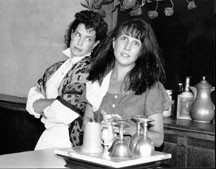
Bar Girls: Priscilla Sanborn (left) and Jennifer King in ‘Playboy.’

‘Parallel Lives’ and ‘Playboy of the Western World’ take bows

By Gretchen Giles

THE FALL THEATER season is in full crackle, with both Parallel Lives at Actors’ Theater and Playboy of the Western World at Main Street Theatre opening last weekend.

It was frighteningly familiar to me, having a tin ear from way back, to sit uncomprehendingly through the first long minutes of Main Street Theatre’s excellent production of Playboy of the Western World. Sporting thick brogues as bushed as spring heather, the cast burred and rolled it through most of the first act until the silent click finally came through, and wonderfully, miraculously, I could understand the fun of this patricidal Irish comedy.

Penned by J. M. Synge at the turn of the century, this is a fresh, silly tale of Christy (Matt Sutherland), a foolish young man who gains strange, admiring notoriety for bashing his father over the head with a shovel and leaving him for dead. He’s particularly appealing to the ladies, especially the Widow Quin (Priscilla Sanford), who comes by her bereavement the honest way: she killed ‘im. Sighing in a romantic aside, “There’s great temptation in a man who’d destroy his Da,” Quin sets a lusty, straightforward mark on poor Christy–poor, because frankly, you come to feel for the simple lad as the women gyrate avariciously around him. Also vying for Christy’s hand is Pegeen Mike (Jennifer King), a barmaid with a drunken Da she’d just as soon see dead, and an ineffectual lover (Anthony Martinez), an eejit who couldn’t bash anyone on the head if his life depended on it. Added to this down-home courting–Sanborn fills the phrase “shearing sheep” with a deadly sexuality–is a Da who won’t quite stay dead (Scott Phillips, of course), and who is able to recognize his son solely by his style of spitting, making Playboy as raucous a farce as any by Feydeau.

MST director Jim dePriest makes his usual sure way through the material, staging for highest comic effect and coaxing the best from his performers. While the cast is uniformly excellent, of particular note are Sanborn’s lust-queen, King’s pursed-mouth sweet shrew, and Matt Sutherland’s Candide of a Christy (though someone should tell him that literally picking his feet is an ugly bit of stage business).

CREATED BY those feminist pranksters Mo Gaffney and Kathy Najimy, progenitors of The Kathy and Mo Show, Parallel Lives is an ambitious ensemble piece that gives a lazy slap to most everything one holds dear. Positing the pleasantly freakish notion that the caprices of the world are controlled by two Ping-Pong-playing deities who casually decide to gift men with huge egos and women with that childbirth thing, Parallel Lives is composed of a series of vignettes featuring four solid, comedic, and affecting actresses: Deborah Luce, Julie Schellin, Janice Ray, and Jennifer Weil.

In a dizzying 14 scenes, this quartet of actresses roll up their sleeves and wade into the material, tackling just about every small issue in modern female life. Often quite funny, Parallel Lives has some wonderful ideas about feminism itself, not shying away from satirizing the deadly serious hear-me-roar aspect of the movement, as in the “Las Hermanas” scene set in a lesbian bar. And then there are those terrific strap-on breasts worn by Lady Ann (Luce) and Lady Anne (Weil) in the “Shakespeare” scene, the agony of an airhead date (who eventually triumphs by ruling Bosnia), and the mute frenzy of “Silent Torture,” in which the cast desperately mimes the morning dressing ritual of hose and horrors.

But funny can’t last forever, and Parallel Lives is simply too long by at least a third. With as many scenes, thoughts, spoofs, and beauty bits as are being offered to the audience, there is a dogged length to the material. Writers Gaffney and Najimy hang deathlessly onto their scenes, and director Brenda Starr can’t quite close her eyes and clip. Which is exactly what needs to be done in deference to the fine actresses she’s got spinning out on the stage, dismayed to find that they are losing audience interest as vignettes stretch well beyond 15 minutes, while sentiments that began funny get mawkish, and we are certainly all more than aware of the point by the scene’s end. Additionally–and please don’t write–making mean fun of men stopped being funny ’round about 1987. Now it’s just mean.

Parallel Lives has the cast, the performances, and the ideas. With a slight trim and tuck, it would provide a full belly of fun.

Playboy of the Western World runs Thursdays-Saturdays through Oct. 12 at 8 p.m. with special performances Sept. 22 at 2 p.m., and Sept. 29 and Oct. 6 at 7 p.m. Main Street Theatre, 105 N. Main St., Sebastopol. $12. 823-0177.

Parallel Lives plays Thursdays-Sundays though Oct. 11. LBC, 50 Mark West Springs Road, Santa Rosa. Thursdays-Saturdays at 8 p.m.; Sundays at 2 p.m. $6-$12. 523-4185.

From the September 19-25, 1996 issue of the Sonoma Independent

This page was designed and created by the Boulevards team.
© 1996 Metrosa, Inc.

Talking Pictures

0

Bad Attitude

By David Templeton

Writer David Templeton takes interesting people to interesting movies in a quest for the ultimate post-film conversation. This time out, he takes notoriously civilized NPR Radio guru Sedge Thomson to see the pessimistic disaster flick The Trigger Effect.

The clock on the restaurant wall shows that it is nearing midnight. The pizza dishes have long since been cleared away, yet we remain ensconced at our table, unwilling after nearly two hours of discussion to leave without having uncovered some little shred of meaning or importance in , a film about a massive power failure that transforms peaceful suburbanites into nasty, gun-wielding maniacs after three long days of no television or cold beer. It is a film that fairly reeks with serious intentions but ultimately says almost nothing at all.

“One thing we can say about it,” offers my guest, Sedge Thomson, host of National Public Radio’s West Coast Live, a quirky and ultra-civilized variety show that is broadcast live from San Francisco every Saturday morning (10 to noon; KCRB 91.1-FM). “It gives the lie to the saying that ‘an armed society is a polite society.’ If anything it shows that an armed society is a society primed and ready to panic.”

“The veneer of civilization portrayed in the movie was pretty thin,” I reply, glancing about for someone to refill our water glasses. “Even without all the gunplay.”

“I would submit that the veneer of civilization is thin everywhere we look,” Thomson laughs. “I was driving down a private city street last week. The traffic was very slow. A guy in a flashy new 4X4 decided he wanted to muscle his way into traffic, which included sort of insinuating his way in front of me. Driving right up on the sidewalk and then cutting in. I slammed on my brakes, and then he started yelling at me. When he ran out of things to say about me, he started attacking my car. ‘Why don’t you get a new car! What an ugly car you’re driving!’ It became very funny and all I could do was laugh.

“What prompted him to suddenly drive on the sidewalk and then call my car names, unless it was some sort of total breakdown of any sense of social structure and order? How else to account for such unprovoked rudeness?”

Thomson, known to thousands of listeners as the laid-back, deep-throated, even-keeled force of nature who holds weekly court over a variety of well-mannered, civilized group of writers, musicians, scientists, and comics, seems the kind of man who would have little patience for such phenomena as unprovoked rudeness and impolite sidewalk procedure. In fact, with an on-air persona that often seems a cross between Ed Sullivan and Mahatma Gandhi, Thomson surprises me tonight when he segues into something of a rant (though a polite one) against the phone company.

“Social structure isn’t all that’s breaking down,” he asserts. “I think the phone company is breaking down. The phones, I predict, are going to stop working in either March or April of 1997. I’ve noticed entropy encroaching on the system. I deal with all kinds of different phone services. Business lines. ITNS lines and so forth. And PacBell is constantly mixing up orders. Cutting things off when they shouldn’t be cut off. Mixing up lines. I’ve reached people after long waits on voice mail who can’t help you and can’t transfer you to the proper department.

“When the phone company starts breaking down,” he asks, “can the rest of civilization be far behind?”

“I was somewhat struck by what somebody once described as ‘the tyranny of neighbors,’ as it was represented in this movie,” Thomson says a bit later. “None of the neighbors seemed at all cooperative or interested in who their neighbors were.”

“I found their behavior believable if it were in a time of no catastrophe,” he goes on. “But in times of catastrophe or a major blackout or something, I believe people would be more helpful than they were in this.

“I remember the aftermath of the earthquake of 1989, here in San Francisco. Power was out for a very long time. There was some fear of looting, but as I recall, most people tried to work together.

“It’s the little things, rather–the tiny courtesies–that are being removed one by one from our interactions, that ultimately do the most harm.

“One of the classic stories is Pacific Bell dropping the “please” from their information lines. They used to say, ‘What city, please?’ and now it’s ‘What city?’ By cutting the “please,” they’ve saved themselves a half a second per call that comes in multiplied by several millions of calls they get per day. They save a lot of money.

“Meanwhile, aren’t we trying to teach our children to be polite? To say “please” and “thank you”? Good manners and the ability to articulate are the lubricants of our society that make it possible for different people to brush up against one another and not get caught on each other’s rough edges. And here, for the sake of expediency, these corporations will barely even talk to you.

“That,” he laughs, “is the breakdown in civilization that I’m most concerned about.”

This page was designed and created by the Boulevards team.
© 1996 Metrosa, Inc.

Short Reviews

Book Leaves

Gretchen Giles, Liesel Hofmann, Sara Peyton, Zack Stentz, David Templeton, and Jenna Templeton (age 10).

Theresa Sheppard Alexander
Facing the Wolf: Inside the Process of Deep Feeling Therapy
New York: A Dutton Book, Penguin Group, 1996, 176 pp.; $20.95

An unusual and moving account about what actually goes on behind the therapist’s door. Over two decades ago, Occidental’s Alexander, then 20, entered an intensive three-week primal therapy program, through the generosity of Dr. Arthur Janov, the developer of the method and author of The Primal Scream. It was the beginning of a profound transformation that forever changed Alexander’s life. She returned to college, studied to become a therapist, and trained at the Primal Institute in Los Angeles. Today she practices what she calls Deep Feeling Therapy, based on many of Janov’s techniques. In her book, Alexander illuminates the therapeutic process from both the patient’s and therapist’s point of view based on her own experiences. We learn about the importance of developing a healing bond between patient and therapist. And we learn about Alexander’s childhood struggles as the daughter of an abusive father who routinely beat his kids. By the end of the book, you will applaud Alexander’s triumphs and may decide it’s time for some deep feeling work yourself.–SP

Dr. Reinhold Aman
Maledicta 12: The International Journal of Verbal Aggression
Santa Rosa: Maledicta Press, 1996, 160 pp.; $12.50

Volume 12 continues in the same iconoclastic, shock-’em-and-shake-’em vein of intellectual brain-porn that Aman established years ago with his first collection of essays dedicated to the examination of verbal aggression. There are 22 essays in all, each one illuminating a different aspect of the dirty little ways that people use words. Catch Gwen Foss’s wild glossary of Domino’s Pizza slang (pepperoni, mushroom, and sausage pizzas, with the acronym PMS, are called “Bitch Pies”; “extra blood” means extra sauce). Other notable entries include Henk Salleveldt’s discussion of graffiti left in latrines by Dutch soldiers, and Aman’s own provocatively titled essay, “Linguistic and Blasphemous Aspects of Bavarian Micturation and American Toilet Names.”–DT

Marsha Arnold
Illustrated by Lisa McCue
Quick, Quack, Quick!
New York: Random House, 1996, unpaged; $3.99

This Step into Reading book by Sebastopol author Arnold (whose Heart of a Tiger last year was an absolute keeper for kids) is short and sweet, just the way young readers like ’em. Designed for preschoolers to first-graders who are struggling out the words themselves, Quick, Quack, Quick! is the simple tale of little Quack the duckling, a dawdler whose slow ways eventually help him save his feathered family from the claws of Cat.–GG

Elizabeth Davis and Carol Leonard
The Woman’s Wheel of Life: Thirteen Archetypes of Woman at Her Fullest Power
New York: Penguin Arkana, 1996, 239 pp.; $22.95

Maiden, mother, crone. For women who run with wolves, strollers, the wind, and with high heels on, these have long been identified as the three stages of female life. Now Windsor-based midwife Elizabeth Davis and her colleague Carol Leonard have identified a fourth stage, the Matriarch. As delineated in The Woman’s Wheel of Life, the Matriarch emerges in that pre-menopausal stage of the late 30s to 40s, when children are becoming more independent, and career and creative efforts become paramount in a working woman’s life. Citing longer life spans and later menopausal onsets as reasons for the new distinction of this stage, the authors depict the phase of the Matriarch–or queen, which has a nice ring to it–as a celebratory time of strength.–GG

Eliot Fintushel
Please Don’t Hurt Me!
Glen Ellen.: Self-published, 1996, 268 pp.; $7

If the makers of Independence Day had been locked in a room for a month with nothing but pen and paper, blotter acid, and a big stack of Thomas Pynchon and Philip K. Dick novels to keep them company, they might have written Please Don’t Hurt Me! instead of the turgid scenario they ended up with. Of course, Fintushel’s bizarre story of the deranged followers of an elderly biker mama and their battle against a cult of fitness nuts led by an exercise guru and the First Lady of the United States might not have grossed $300 million at the box office, but who cares. This is a lot more fun, anyway. As absurdity piles on top of absurdity and the alien Boorfahs make their presence known by pulling the postmodernist trick of manipulating the very book in the reader’s hand, one has no choice but to give up any hope of fitting the pieces together and instead sit back and enjoy the surreal ride. Be warned, though: Please Don’t Hurt Me! isn’t one damned thing after another; it’s every damned thing you could ever think of, all at once.–ZS

Robert W. Funk
Honest to Jesus: Jesus for a New Millennium
San Francisco: HarperSan Francisco, 1996, 320 pp.; $24

Honest to Jesus, Funk’s new book about the subversive Galilean sage so exploited by theologians, presents the historical Jesus rather than the manipulated and controlled Jesus myth. Easy reading, even for unstudied secular humanists, Honest to Jesus is liberation theology for those caught short of breath by unrelenting doctrine and rigid ideology. “Everything is on the table,” writes Funk, whose annual Jesus Seminar event attracts hundreds of the nation’s top biblical scholars to its conferences. “There is nothing . . . in Christian tradition . . . that is immune to critical assessment and reformulation. We cannot put a protective shield around any part of Christian heritage if we aspire to set Jesus free.” Honest to Jesus hits the stands in November with a seven-city author tour and a new highwater mark for Funk’s rejuvenating work about a guy named Jesus.–DB

Michael E. Gerber
The E-Myth Revisited: Why Most Small Businesses Don’t Work and What to Do About It
New York: HarperBusiness, 1996), 268 pp.; $15

Petaluma business guru Gerber says that small business needs a system. Entrepreneurs, writes Gerber, make the fatal assumption that “if you understand the technical work of a business, then you understand a business that does technical work.” Not so, he says. Complete with anecdotes, jargon, and a self-promoting plug–typical of self-help business books–The E-Myth Revisited rings true: Work on your business, not in it; create a business that is systems-dependent, not people- or expert-dependent. –DB

Jean Hegland
Into the Forest
Corvallis, Ore.: Calyx Books, 1996, 193 pp.; $13.95

Something about the California redwood forests brings out a person’s latent survivalist tendencies. My high school biology teacher up in Fort Bragg used to enthrall his students with lurid fantasies of a post-holocaust North Coast reduced to feudalism and lorded over by gun-toting rednecks like himself. Now, my deranged teacher’s dream becomes Hegland’s nightmare in her new novel, Into the Forest.

The Healdsburg writer tells the story of two home-schooled teenage girls living far from the nearest town and their efforts to survive amidst the slow collapse of civilization. Hegland’s fresh twist is to mostly ignore the details of her larger post-apocalyptic scenario and concentrate almost exclusively on the relationship between the two girls as they weather dwindling supplies, their father’s death, and interlopers both friendly and hostile. Into the Forest makes an ideal companion and counterpoint to David Brin’s The Postman (no relation to Il Postino), which also takes place in the Pacific Northwest. While liberal optimist Brin writes of society’s slow rebirth from the ruins, eco-feminist Hegland tells of learning to trust and embrace wild nature. Both visions are compelling, and which one seems most plausible probably depends on the reader’s own views on civilization and its discontents.–ZS

Jan Freeman Long
Illustrated by Kaoru Ono
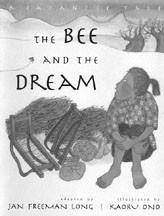
The Bee and the Dream
New York: Dutton, 1996, unpaged; $15.99

There is an old Japanese saying that goes like this: “When you see a bee fly from someone’s nose, good fortune will be yours.” I kind of like that saying, and I was amused by the wonderful book that Petaluma writer Jan Freeman Long has adapted from a Japanese folk tale that begins with a bee and a nose and a curious dream. The Bee and the Dream is written in a fun way that will probably be enjoyed by everyone, not just children. The illustrations by Tokyo artist Kaoru Ono are very colorful and silly. You just might like this imaginative story of Shin, his dream of gold buried under a faraway camellia bush, and his surprising voyage to see if the dream is true. The Bee and the Dream may not be my very favorite new book, but it sure is good. I hope you like it.–JT

Megan McDonald
Illustrated by Peter Catalanotto
My House Has Stars
New York: Orchard Books, 1996, unpaged; $15.95

Local book treasure Megan McDonald (who presides over the register at Rohnert Park’s Treasure Books) follows up her Insects Are My Life with another clever and moving children’s tale. Aimed at grades kindergarten through third, My House Has Stars takes one night in the homes of eight different children situated in such vastly different areas of the world as Alaska and Mongolia. While their homes are hewn from materials as diverse as wool and wood and ice and clay can be, and while the families eat and speak disparately from one another, McDonald wisely narrows the focus down to the one home that we all share equally, the earth, and the heavenly roof of stars that shelters all of humankind.–GG

John A. McDougall, M.D.
Recipes by Mary McDougall
The McDougall Program for a Healthy Heart: A Life-Saving Approach to Preventing and Treating Heart Disease
New York: A Dutton Book, Penguin Group, 1966, 430 pp.; $24.95

Bizarre. That’s what some call Dr. McDougall’s diet. But it’s the American way of eating, he asserts, that’s bizarre, and he has the scientific and historical evidence to prove it. In his unstinting efforts to get the sludge out of the arteries of Americans and help them bypass the bypass surgery that’s rampant, Santa Rosa’s McDougall offers the rudiments of the highly successful program he uses in his clinical practice. This readable, meticulously documented book offers life-saving advice on diet, exercise, lifestyle changes, medical tests, and medications–plus over 100 great recipes.–LH

Jennie Orvino
Heart of the Peony
Rohnert Park: Piece of My Mind Publishing, 1996, 39 pp.; $10

Orvino was a winning contestant in the Independent‘s Java Jive contest last year. Now she shows up again, this time bearing that greatest bugaboo of all: a self-published poetry book. As a rule, we try to shy away from such books when we do our book roundups because quite often there is a reason the writer had to pony up the cash to self-publish it in the first place. Happily, Heart of the Peony is an exception. Toughly erotic (the title refers to female genitals), the book begins with poems to Orvino’s parents and ends with a meal’s worth of recipes, but between family fidelity and kitchen duties lie sex-stank sheets, the feel of worn place mats under the despondent elbows of a woman who’s been left behind, and more honesty than you’ll be lucky to ever get from a lover.–GG

Jim Panttaja, Mary Panttaja, and Bruce Prendergast
The Microsoft SQL Server Survival Guide
New York: John Wiley & Sons, 1996, 432 pp.; $36.95

If you’re a database programmer or developer working with Microsoft SQL Server 6 (and who isn’t these days?), then this book is The New Testament, The Iliad, and Our Bodies/Ourselves all rolled into one. Forget all that trial and error programmers typically encounter–the Survival Guide is a life preserver thrown into the digital sea, teaching you all the tricks of the trade needed to build business applications to die for. And if you’re not a programmer working with Microsoft SQL Server 6? Hell, buy the book anyway. It’s much cheaper than a Halcion prescription.–ZS

Richard Paul Papp
Bear Flag Country
Petaluma: Analecta Publishing, 1996, 220 pp.

Local entomologist Papp weaves together his twin loves of history and stamp collecting into one narrative in which he documents how old mail routes in Sonoma County were the skeleton that shaped the county’s growth and development, with the post offices themselves being the acorns from which sprang the mighty oaks of cities we now live in. Think about that the next time you complain about junk mail or late delivery.–ZS

Joan Price
Yes, You CAN Get into Shape!
Pacifica: Pacifica Press, 1996, 210 pp.; $17.95

Hey, you. Yes, you on the sofa watching Hard Copy, shoveling Pringles and malt balls into your maw, then washing them down your gullet with Diet Coke because, hey, you’re watching your calories. Sebastopol author Joan Price would like a word with you. She wants to help you get up off your well-padded buttocks and turn those plaque-clogged arteries as smooth as a Republican’s cerebellum. How?, you might ask incredulously, pausing between bites of butter-soaked pastry. By making exercise fun, and incorporating it into enjoyable, everyday activities instead of treating fitness like cod liver oil for the muscles.–ZS

Norm Ray
Smart Tax Write-Offs
Windsor: Rayve Productions, 1996, 112 pp.; $12.95

Windsor resident Norm Ray has got to be the kind of accountant with whom it’s a gas to sit up late on the bleary night of April 14, finally figuring out exactly what taxes your small business owes. Norm might lean forward and point a pencil at your purse. “Got a wallet in there?” he could ask. “Keep business credit cards in it?” If the answer is affirmative, Norm might smile slowly. “Write it off!” For in Smart Tax Write-Offs, Norm offers a whopping 600 write-offs that might not have occurred to the average business owner–from the coffee you grind, to the music you play to keep your workers from going berserk and rifling each other down in the hallways, to the aforementioned wallet and its solemn duty to hold and protect your business-aimed plastic. And there’s gotta be a way that you can deduct the cost of the book and the time you spend reading it.–GG

Rayford Clayton Reddell
Illustrated by Lourdes Livingston
Full Bloom: Thoughts from an Opinionated Gardener
New York: Harmony Books, 1996, 276 pp.; $22.50

Don’t expect any sanctimonious guff rhapsodizing about flowers from Petaluma gardener Reddell. This columnist for the San Francisco Chronicle is much too mean and funny for that. He hates gladioli, the smell of too many gardenias, and the very notion of a green thumb–precisely because he doesn’t have one. This collection of his biweekly newspaper writings is segmented into tips, musings, seasonal worries, kitchen gardening, planting for the nose, and his specialty–the care of roses. Reddell, who lives among some 6,500 different rose bushes, knows a bit about this thorny problem. Fresh and funny, Full Bloom is a gardener’s delight, a book that doesn’t make neophyte planters feel simply like vegetation murderers. –GG

Nancy Shipman
Nancy’s Candy Cookbook: How to Make Candy at Home the Easy Way
Windsor: Rayve Productions, 1996,190 pp.

Shipman, the sugar and spice lady of Nancy’s Fancy’s Santa Rosa confectionery, gives easy basics on everything from deciphering the mysteries of chocolate (temperature and the simple eye of attention) to the rotund sugary heights of balled truffles and popcorn, Shipman–who is understandably unable to escape such titles as “yummies”–offers straightforward recipes that utilize few special tools (the microwave is as high tech as it gets) and whose titles promise plenty of “foolproof” results. Hard to beat that.–GG

From the September 12-18, 1996 issue of the Sonoma Independent

This page was designed and created by the Boulevards team.
© 1996 Metrosa, Inc.
Eileen Drew

Into Africa


Far away, so close: Though she writes about the interactions between Africans and Westerners, these days author Eileen Drew makes her home in the hills above Sebastapol.

Photo by Steven Underhill


Eileen Drew spins her Peace Corps experience into fiction

By Zack Stentz

PEOPLE SURE SEEM to love pigment-deprived reptiles. White gator Antoine Le Blanc packed ’em in at San Francisco’s Academy of Science exhibit. Kevin Spacey’s Albino Alligator is one of the most eagerly anticipated films of the fall season. And now Sebastopol author Eileen Drew’s new novel, Ivory Crocodile (Minneapolis: Coffee House Press, 1966; $21.95), is wowing readers across the nation, getting a heavy promotional push from mega-chain Barnes & Noble, and prompting book critics to muse on the mythological significance of the title.

“In the African legend of the ivory crocodile,” wrote the critic for Kinesis in a glowing review, “the white crocodile is prized for its skin color, but is in fact the deadliest reptile of all.”

Oooh, scary. Only one problem. According to Drew, there is no African legend of an ivory crocodile. “I don’t know where the writer got that from,” Drew says bemusedly. “There’s no such legend that I’ve heard of, and it’s not anywhere in the book.”

In an inadvertent way, though, the reviewer did strike an important chord of Drew’s novel. Like her acclaimed 1989 collection of short stories Blue Taxis, Ivory Crocodile takes as its theme the messy, awkward interactions between Westerners and locals in the various nations of west Africa. In writing these tales, Drew was able to draw on her own background as the child of an American diplomat in Nigeria, Guinea, and Ghana, then later as a Peace Corps worker in Zaïre.

So was Drew consciously hunting and gathering fiction material even while living in Africa? “I suppose I did,” she replies. “I kept a journal while I was in Zaïre, so while I wasn’t able to write fiction while I was there, I did go back and use material from my journals when writing stories.”

Indeed, astute readers will recognize more than a touch of the real-life Zaïre (run for the past 31 years as a virtual kleptocracy by the brutal President Mobutu) in Ivory Crocodile‘s fictional setting of Tambala, complete with its corrupt, CIA-backed president and intrigue-filled frontier with Marxist Angola. Drew explains that setting the story in a fictional nation was a boon from a creative standpoint. “It wasn’t that I was trying to hide it, but fictionalizing things gave me a lot of creative freedom,” she says. “I didn’t have to get every custom of every tribe right, and I could use the building of a bridge into Angola as a plot point, when in fact, that never happened.”

Aside from the challenge of fictionalizing a very real setting, Drew also wrote with the full knowledge of those literary titans who had trod the ground before her. Anyone dipping their toe into the Westerner-in-the-Third-World genre is bound to be compared to the likes of Graham Greene and Joseph Conrad, both daunting acts to follow. “They’re my favorite writers–Conrad, especially,” says Drew. “But they weren’t intimidating, because they were writing about a different world than I was–the world of colonialism.”

And speaking of pith-helmeted European empire-builders, it seemed inevitable that despite their obvious differences, book reviewers would seek to link Drew to the grande dame of faded imperial glory herself, Isak Dinesen. “She’s another writer I love,” Drew says charitably, “although she’s a real colonialist, and that paternalist attitude comes out in her writing. Again, she wrote about a very different Africa than the one I did.”

Not that the critics seemed to care. After all, Dinesen was a white woman like Drew, writing about Africa. What are 50 years and 2,000 miles’ difference–particularly in light of memories of Meryl Streep and Robert Redford prancing through the veldt in that extended Ralph Lauren commercial Out of Africa–when readers might actually recognize Dinesen’s name? “There are other writers who are closer to me,” acknowledges Drew, “but she’s a bigger name, so it’s easier for a critic to pull her out of a hat.”

Much closer to Drew’s own work is Anglo-Indian (by way of Trinidad) author V. S. Naipaul, who cast a rather jaded eye upon idealistic Westerners blundering about through developing countries in such novels as Guerrillas. “Naipaul also wrote about Zaïre in A Bend in the River,” Drew says, “and that was a bit intimidating, because he wrote about a Zaïre that’s much closer to my own.”

But whatever the intimidation factor, Drew says she does take her literary predecessors into account while writing about her own, decidedly post-colonialist Africa: “I think about them a lot, and how their Westerners approached the situations they were in.”

The situations in Ivory Crocodile tend to revolve around power and cultural difference, especially the contrast in women’s roles between the America of Drew’s narrator and the tribal culture she finds herself in. Refreshingly absent are the usual nature documentary clichés of lions, cheetahs, and zebras that figure so prominently in most Western views of Africa. “I didn’t go to Africa for the wildlife,” Drew says. “I went for the people. Their lives and culture are what I find interesting and wanted to write about.”

Sitting in her comfy writing room on a typically chilly west Sonoma County morning, this particular Westerner couldn’t be farther from the humid forests and wide alluvial plains that inspired her earlier work. And for now, Drew is content to leave Africa behind as she looks closer to home for inspiration in writing her next book of stories. “I’m less interested in African material than California material now,” Drew says. “But I couldn’t really get out of Africa until I finished that book.”

From the September 12-18, 1996 issue of the Sonoma Independent

This page was designed and created by the Boulevards team.
© 1996 Metrosa, Inc.
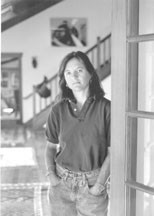
Mavis Jukes

0

Girl Talk

By David Templeton

WHEN I WAS a kid in the late ’50s, early ’60s, most of the information we girls got about reproduction was from those little pamphlets that came along with pads, you know, like Modess,” proclaims author, educator, and lawyer Mavis Jukes, demonstrating with a flash of a smile her customary knack for straightforward talk. “The pamphlets would always talk about ‘The Egg,'” she continues, eyes widening in remembrance of the mysterious phraseology, “and that when The Egg was Fertilized, it would suddenly grow into an Embryo.

“Well, we’d keep turning back to that page, reading, “When the egg is fertilized, and thinking, ‘What is the fertilizer?’ And of course that was never answered at all. It was just some minor detail that was skipped over. But we all wondered about it.”

Jukes, an award-winning novelist and the author of numerous children’s books, is sitting on the front deck of the Cotati farmhouse she shares with her husband and two daughters. She is discussing a subject that she has spent the last several years thinking about, namely, the importance of providing preteen girls with information about the mystifying transformations of adolescence. It’s a Girl Thing: How to Stay Healthy, Safe and in Charge (New York: Knopf, 1996; $12) is the author’s first book of non-fiction, and it is devoted to the demystification of everything from menstruation and reproduction to birth control and sexually transmitted diseases.

There are sections on selecting the proper bra and ways to fight acne, along with info on drug and alcohol abuse, sexual harassment, and all the overwhelming details of personal hygiene. Whimsically illustrated by Debbie Tilley, packed with informative nuggets, and enlivened with anecdotes from Jukes’ own girlhood, this thoroughly researched, affectionately written book has received high marks by critics, health-care professionals, and parents since its release earlier in the year. Ms. magazine has appropriately dubbed the book “A pre-teen Our Bodies/Ourselves.”

“I give kids a lot of credit,” Jukes continues. “If they really know about the health issues associated with alcohol and drug abuse, and also about the health issues associated with having sex with a partner when they are too young, then they can make some healthy choices. But without that information . . .” She waves her hand at the street and, presumably, the country at large.

“In this society, information is hidden,” she remarks. “Our pregnancy rate is triple that of England. According to the most recent statistics, 43 percent of all American girls become pregnant between the ages of 13 and 19. That comes right out of the morbidity and mortality report. It’s not something that’s been trumped up.

“There are also studies that show that the more kids know about sex, the more likely they will be to postpone it. I think parents will be very reassured to know that. I think people are coming around and realizing that keeping kids in the dark about these things is a very bad idea.”

When I comment that her writing voice achieves the comforting tone of a friendly and trustworthy aunt, she grins delightedly. “Well, thank you! I want to be a friendly, trustworthy aunt to my readers, and it took years to get the book that way. I have thought this book upside down, inside out, and backwards. This has been the most carefully thought-out thing I’ve ever been involved in and probably ever will be.

“This book was designed partly by the teacher in me and partly by the lawyer in me,” she continues. Jukes works as a language arts specialist in the Sonoma County School District, and volunteers as an attorney in matters of juvenile defense. “What was important to me was that kids could get all the information they need to be safe, and that there was nothing misleading. There are single pages in this book that I worked on for 30 hours.”

She is especially proud, she mentions, of the section on sexual preference, which reads as perhaps the most humane, open-minded, and uncomplicated explanation of that subject that I have come across.

“A lot of people just don’t know how to approach some of these subjects with their kids,” she says. “And the other thing is that a lot of kids don’t feel like talking to their parents about it. I think that’s fine. I don’t think parents should view that as a failure. Honestly, when was the last time you wanted to talk to your mom or dad about sex?

“But parents should make themselves available,” she insists. “Communication is extremely important, and if they are approached, parents should be honest and open.” She thinks about it a moment, and nods.

“Between books, and school, and parents, and peers, I think we should be able to get everybody straight on this stuff.”

From the September 12-18, 1996 issue of the Sonoma Independent

This page was designed and created by the Boulevards team.
© 1996 Metrosa, Inc.
Green Eggs and Ham

0

Kid Stuff

By David Templeton

THE GREAT CLASSICAL masters of musical history would no doubt raise their terpsichorean eyebrows and shrug in wonder at the unconventional extravaganza that the Santa Rosa Symphony and conductor Jeffrey Kahane have cooked up for their big September social event.

Green Eggs and Ham–yes, you read that right–with a libretto lifted entirely from the classic picture book by Dr. Seuss, will be presented in a staged musical program next weekend as a kickoff to the symphony’s upcoming season, one that will put special emphasis on young musical performers. Though hardly Handel’s Messiah, the short Seuss program, preceded by an audience hopping segment with Kahane, will draw heavily on classical music motifs in an innovative score by Robert Kapilow.

“One of my great passions in life is trying to get kids involved in music,” Kahane said last week, moments after performing a spirited piano concert in Santa Rosa’s Courthouse Square.

“So with this season, what I wanted to do was to salute young performers. Almost all of the guest soloists we’re using this season are under 20. And with Green Eggs and Ham, we know we’ve got a program that will draw people of all ages, some of whom will be going to the symphony for the first time.”

Acknowledging that classical music still has a hard-to-shake reputation for being stuffy and serious, Kahane notes that Green Eggs‘ message is intentionally appropriate.

“It’s about a grouchy guy who won’t try this unfamiliar dish, no matter how it’s served,” Kahane laughs. “It’s about having preconceived ideas about something. It’s a metaphor for making up your mind about something you haven’t yet experienced, which is certainly the case with many people as pertains to classical music.”

The piece will be simply staged, with minimal props and no costumes. The orchestra will be scaled back to a small ensemble, with two singing roles: Maria Jette as the greenaphobic grouch and Gabe Kahane (the conductor’s 17-year-old son) as the tenacious Sam I Am.

And how is it for Dad to work with his own progeny?

“It’s great!” Kahane laughs. “He’s an amazingly talented actor and musician. I thought long and hard about using him, wanting to avoid accusations of nepotism. But we’ve never really worked together before, and this seemed like a good opportunity. He’s certainly more than qualified. And besides–he’s right there in the house so we can work together whenever we want.”

Green Eggs and Ham will be performed on Saturday, Sept. 21, at 3 and 4:30 p.m. at the Luther Burbank Center, 50 Mark West Springs Road, Santa Rosa. Tickets are $15 and $10 for adults, $7 and $5 for children, and $40 for a family (two adults, two kids). 54-MUSIC.

From the September 12-18, 1996 issue of the Sonoma Independent

This page was designed and created by the Boulevards team.
© 1996 Metrosa, Inc.

Night Reading

Well-Read Bed

By Gretchen Giles

PEOPLE DON’T READ anymore, television has taken over our minds with a mush-creating mediocrity that has wrecked the culture, ruined our children–worse, ruined our dinners!–and has flung the humble written word right out the door with all of the ceremony accorded cabbage water and kitty litter.

Bah, bosh, humbug.

Because, oh naysayers, it appears that people are reading, they’re just doing it where no one else can see: in bed. Snuggled down, with tea or wine, alone or accompanied, most of us are going to bed with books. And unless the majority of our below-listed respondents are lying–and we don’t mean vertically–we’re all going to bed with good books.

Do most of these readers know who wrote these terrific works? Of course not–Rodney Dangerfield don’t know nuthin’ about respect compared to what writers get refused. Are the names of these provoking pieces of literature cherished by these readers? Get real. Therefore, take along a big ol’ grain of salt and head off with us to the dog-eared private world of the reading community.

“You caught me at absolutely the best possible time,” laughs Sonoma State University special programs director Bruce Berkowitz. “I’ve just finished a three-book run of real books.” Berkowitz takes the advice of any piece recommended by NPR personality Terry Gross, recently finishing Rivethead, a non-fiction work about the lives of steelworkers on the assembly line. He has also been breaking the spine on that examination of the effects of psychedelic drugs on society, Storming Heaven, and gnashed his way through the latest Patrick O’Brien seafarin’ novel. Nope, he can’t remember it’s title. But he’s certain that it was darn good.

What do the Independent’s writers read in bed?

Spreckels Performing Arts Center director Michael Grice spends most of his nights reading plays, so any diversion from work has to be fueled by Grice’s own unique adjective: “detectivy.” He’s been lost in the shut-up-and-talk world of neo-pulpist James Lee Burke, journalist Carl Hiaasen’s Skintight, and this one terrific book about how the Irish monks saved Western civilization. “I loved that book,” gushes an Independent editor about the latter. But can he muster up a memory of the title?

People, people.

Up in Healdsburg, Raven Theater co-owner Don Hyde offers a trio of alluring books, among them one of the early hard-boiled detective novels of the 1920s, The Adventures of Race Williams by Carrol John Daly. To counterbalance the molls and palls of that, Hyde is also reading short-fiction mistress Gina Berriault’s latest collection, Women in Their Beds, and Norman Mailer’s Oswald. We diss Mailer for a few minutes (this reporter will never forgive Mailer for his nosy speculation in his fictive bio of Marilyn Monroe of how she must have smelled), but Hyde has to admit he likes Oswald. “It’s pretty engrossing. The last couple of times that I tried [Mailer], I couldn’t get through him, but this is different.”

SSU lecturer Sue Carrell will at first admit only to snuggling down with School Girls, Peggy Orenstein’s study of how American girls learn (or don’t learn) in traditional classrooms, tending to be dissuaded by subtle instructional pressure from pursuing careers in science and mathematics. Under mild questioning, Carrell breaks down and offers up the real dirt: The Rainmaker by “that formula lawyer John Grisham,” she admits with a laugh. Carrell lost a few brain cells to that tome on the plane home from the recent Democratic Convention. “That was a party,” she chuckles of the convention.

Blues singer Sarah Baker and English professor J. J. Wilson are (separately) reading The Soloist by Mark Salzman. “It’s a critical thinking exercise,” declares Wilson. “It’s very fascinating, about a musician,” says Baker, who is also lugging The Complete Shorter Fiction of Virginia Woolf off to bed when she’s not entertaining herself lightly with The Musical Experience of the Composer, the Listener, and the Performer by composer Roger Sessions.

Wilson divides her nighttime between the Salzman novel and The 16 Pleasures by Robert Hellenga. “It’s advertised as erotica,” she says of this novel about a conservator working to restore books damaged by a flood, “but the most sensual parts of the book are the descriptions of rebinding.”

Guerneville mail artist Harley reads a perfect quatrain of the gorgeous and trashy before bed, including Nelson Mandela’s inauguration address (“It’s very, very beautiful and incredibly generous, considering that he’s someone who’s spent most of his life in jail”), Pierre DeLattre’s Tales of a Dalai Lama, NPR commentator Bailey White’s comic Sleeping at the Starlight Hotel, and the non-fiction The Romanovs: The Final Chapter. “It gives you an overview of what happened to Nicholas and Alexandria,” Harley says of Final Chapter, “including the finding of their bones. And, surprisingly, one of the Romanov princes now lives in Pt. Reyes,” he remarks, noting that this Romanov–an artist–is easily identified in recent family photos: he’s the only one wearing Birkenstocks. “But he’s a wretched painter,” Harley concludes.

Suzanne da Rosa, the Sonoma-based promoter who helps Readers’ Books stage the annual Poetry Festival, was moving when she came across her long-ago beloved copy of Gabriel Garcia Marquez’s 100 Years of Solitude. Surprised at how much she had forgotten of the plot since her first read, da Rosa is firmly lost once again in the magic and the realism. Copperfield’s Books’ Tom Montan is immersed in Where Wizards Stay up Late, the “down-dirty inside scoop” on the Internet, and Cindi Newman of North Light Books has gone south, recommending Little Altars Everywhere by Rebecca Wells, about a Louisiana family, and Midnight in the Garden of Good and Evil by John Berendt, a true murder mystery in the tradition of In Cold Blood, set in Georgia.

But our favorite is musician Jeff Martin, bassist with Joanne Rand and the Little Big Band. Martin admits to a predilection for Buddhist texts and Mix magazine, asserting however, that “I always read the Independent when I want to go to sleep.”

From the September 12-18, 1996 issue of the Sonoma Independent

This page was designed and created by the Boulevards team.
© 1996 Metrosa, Inc.
Staff Night Reading

Good Books

The Independent’s editorial staff couldn’t bear to be omitted from the I-list of personal bedtime favorites. Therefore we offer some of our favorites, pulled–dust bunnies and all–from our own bedsides.

Greg Cahill, editor

America loves mobsters. Excellent Cadavers: The Mafia and the Death of the First Italian Republic, Alexander Stille’s newly released paperback, plumbs the dark gloom of the mob’s power base in Palermo, Italy. This meticulous crime reporter dissects the recent fatal hits on Judge Giovanni Falcone and prosecutor Paolo Borsellino, two boyhood friends who went after Costra Nostra bosses who infiltrated every level of Italian industry and government, killing 10,000 people in mob-related violence during the 1980s–three times more than in Northern Ireland’s unrest.

Gretchen Giles, arts editor

The paintings of Henri Matisse provide the springboard for the three works in A. S. Byatt’s The Matisse Stories, each taking a portion of painting, execution, or style and manifesting them in the written word. . . . Guerrilla writer Will Self’s The Quantity Theory of Insanity is not sweet bedtime fare, but better for sitting up late slightly nauseous– streamlined and as infectious as giardia. . . . And making most sense of all is East Bay writer Meredith Maran’s What It’s Like to Live Now, a non-fiction muse on raising urban kids, keeping family, and keeping cool.

Liesel Hofmann, copy editor

Physicist Alan Lightman’s exquisite tiny novel, Einstein’s Dreams, conjures up 30 dreams Einstein might have had shortly before he stunned the scientific word with his theory of relativity, catching one up in a whirl of possibilities about the nature of time. . . . The hearty reminiscences of former Washington Post editor Ben Bradlee are gratifyingly candid, free of braggadocio, and irreverently enlightening about the fourth estate in The Good Life: Newspapering and Other Adventures. . . Achingly beautiful, Elizabeth Arthur’s Antarctic Navigation is a sizzling novel about a frozen continent, telling the story of a woman so enthralled by the Antarctic and by Scott’s ill-fated expedition to the South Pole that she undertakes a harrowing adventure to retrace his steps.

Sara Peyton, correspondent

Talk Before Sleep by Elizabeth Berg, a sad, poignant novel about a woman with breast cancer and the friends who love and care for her. . . . Selected Poems by Emily Dickinson, a lovely gift from a dear friend. . . Word Perfect for Windows, a reference book that weighs about 100 pounds and is almost incomprehensible. . . . Paula by Isabel Allende.

Bruce Robinson, correspondent

SRT’s Huck Finn musical, Big River, inspired me to revisit Mark Twain. Huck also narrates Twain’s Tom Sawyer, Detective with delightful understated wit, but the mystery, such as it is, takes a back seat to his lively depiction of life along the Mississippi more than a century ago. . . Of contemporary mystery writers, only Robert B. Parker shares the capacity to make me laugh along the way, but Thin Air is not one of his best. . . . Ticket to Ride is Barry Tashain’s diary of the last Beatles tour, for which his band, the Remains, was the first opening act. Although it’s a little thin, it’s well-illustrated and benefits from the extra-cultural context provided. . . . Finally, Martin Cruz Smith’s Rose, in which the well-plotted mystery is secondary to his remarkable re-creation of life in a gritty coal-mining town in 1870s north England.

Zack Stentz, managing editor

Philip Kenan isn’t a loser. Sure, he lost his father and first wife to suicide, his ex-girlfriend thinks he’s nuts, no one will publish his novel, and he’s drifted through a series of dead-end corporate jobs. But it’s not his fault–it’s those damned alien monsters that keep messing things up. So goes the devilishly funny story of Résumé with Monsters, wherein author William Browning Spencer takes the eldritch terrors of H. P. Lovecraft out of their original jazz-age New England settings and plops them down in the contemporary milieu of high-tech wage slavery, corporate downsizing, and psychoanalysis, where fax machines and copiers are incorporated into unholy rites and fiendish intelligences secretly manipulate companies for their own sinister purposes. On second thought, maybe poor Philip isn’t so cracked after all.

David Templeton, correspondent

By the Shores of Gichee Gumee by Tama Janowitz is the story of a white-trash family that revels in its own lower-rung societal status. It’s “welfare chic,” goofy and unsettling, twisted and often hilarious.

From the September 12-18, 1996 issue of the Sonoma Independent

This page was designed and created by the Boulevards team.
© 1996 Metrosa, Inc.

Talking Pictures

0

Weird Science


The horror, the horror: Marlon Brando spends a pensive moment wondering what he’s doing in this film.

Techno-author bites back at ‘Dr. Moreau’

By David Templeton

Writer David Templeton takes interesting people to interesting movies in a quest for the ultimate post-film conversation. This time out, he calls up scientist and writer Edward Tenner, author of Why Things Bite Back, to discuss the new Frankenstein-esque revenge fantasy The Island of Dr. Moreau.

IT WAS EXACTLY 100 years ago that H. G. Wells published a weird little novel about a scientific genius who cooks up a race of freaky animal-people on an isolated island. The Island of Dr. Moreau has since been translated into cinematic form three times, most recently with Marlon Brando as the mad scientist and Val Kilmer as his assistant. Like such camp-classics as Planet of the Apes, it’s kind of fun, but makes no logical sense whatsoever. Even so, that eerie old theme of science turned back on itself does lend the film a modest touch of philosophical power, despite all the wacky monster-movie trappings.

“It’s a combination of a literary genre and a technological imperative,” says Edward Tenner of the whole mad-scientist plot line. “The technological imperative is to employ the latest advance in special effects, in this case to show monsters, which have been a fascinating thing for people, really since the Middle Ages. There’s also a tradition, starting with Mary Shelley’s Frankenstein, of the scientist, in that case a medical school dropout who inadvertently creates a monster.”

Tenner, who holds a visiting research appointment in the Department of Geological and Geophysical Sciences at Princeton University, is the author of a fascinating new work of scientific theory. In Why Things Bite Back: Technology and the Revenge of Unintended Consequences (Knopf, 1996), the author develops his theory of the “revenge effect,” a phrase that has already begun to be appropriated by the popular culture, as in the recent California-wide power failures, which many newspapers described in terms of “technological revenge.” In a series of wry-humored, mind-boggling examples, Tenner shows how Murphy’s Law (the historical genesis of which he reveals in detail) has taken hold on a vast number of technology’s attempts to improve the world. I reached him at his home in New Jersey.

“I think there was one interesting element of the revenge effect in Dr. Moreau, and it had to do with the pain implants,” Tenner suggests, referring to the little microchips that Kilmer implanted in the flesh of the creatures, causing shocks of pain whenever Mo-reau pushed a button. “His only real means of controlling them was this electronic device, so anything that rendered that device inoperable would expose him to unusual risk. So yes, there was definitely a technological revenge factor there.”

A staple of the mad-scientist genre is the apocalyptic bloodbath where the doctor gets his just desserts. Dr. Moreau is no different, with its jeep-riding, Uzi-wielding beasties celebrating their turn to “be god,” as they blow up everything in sight.

“It’s an old impulse that goes back well before the tension of the master and the servant, or humanity and beast,” Tenner chuckles. “We are definitely very ambiguous about scientists, who in some ways are the victims of the effectiveness of their own propaganda. The other side of talking about your immense power to do good is that people will start to believe in your immense power to do evil, to mess things up.

“There are a certain number of elite scientists who do consider themselves godlike. They do have a certain messianic complex. The question is whether they really have any chance of having power. One of the biggest surprises of the 20th century, certainly one of the biggest since Wells’ day, is how powerless scientists have actually been as a group. I ask you,” he continues rhetorically, “which of the 20th century’s great leaders, for good or ill, has been a scientist? Other than Margaret Thatcher, who was a chemist, but not a Ph.D.

“I do have hope for the future,” he concludes, belying the film’s doomsday warnings. “It’s not that I’m confident that everything is going to be OK, but I feel reasons for hope. The real characteristic problems are not the disasters. They’re matters of the slow degradation of things. Things like gradual declines of biological diversity, the gradual warming of the earth. I think we haven’t been able to address those problems. On the other hand, if you look at all the ways that life really is better as a result of properly used technological access, I think it does a tremendous disservice to say that technology is by its nature anti-human.”

He pauses a split second, then adds, “But I understand that that often seems to be the case.”

From the September 5-11, 1996 issue of the Sonoma Independent

This page was designed and created by the Boulevards team.
© 1996 Metrosa, Inc.

West Side Cafe

0

Go West!


Janet Orsi

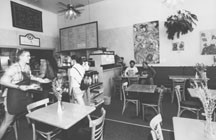
Seventies something: Petaluma’s West Side Cafe combines retro ambiance with up-to-date eating options.

West Side Cafe stays kid-friendly

By Dwight Caswell

IF YOU CAME OF AGE in the ’70s, you’ll feel right at home in the carefully articulated ambiance of the West Side Cafe. Nestled next to a thrift shop on the (what else?) west side of Petaluma, this restaurant is nothing if not unpretentious. I have not applied the Independent’s four-star system to the West Side Cafe, which does not deserve the rating it would receive if compared to more upscale restaurants.

A simple neighborhood eating establishment, the West Side Cafe is a place where you can feed a family of four for the cost of a solo dinner at some other restaurants, and it’s a place to take the kids when you want to feed them something healthy that they’ll actually eat.

The extensive menu has a vast array of vegetarian and “light meat” dishes; Thursdays through Saturdays are sushi nights. We took a proper black saucer of California rolls ($4 for four) to our table.

The sushi, complete with wasabe, ginger, and soy sauce, was good, if a little heavy on the avocado, which I didn’t mind at all. There is a small but adequate selection of juices, waters, and microbrews, but the wine . . . well, you don’t go to the West Side Cafe for the four-bottle “wine list.”

Soup or salad comes with dinner, and the salads were fresh and organic. The honey mustard dressing was on the sweet side, but the poppy seed was properly piquant. There was an odd sameness about the salads, however. The difference between the garden green and the Athenais Greek seemed to be the presence of feta cheese in the latter. All the salads had a palate-confusing number of ingredients.

The big hit of the evening was the tempeh Monterey burger, with jack cheese, avocado, lettuce, tomato, and sprouts ($5.25).The texture and flavor were excellent; don’t tell the kids that “tempeh” is code for soy and they’ll never know the difference. The vegetarian pizzas ($2 a slice) looked delicious, but we didn’t have room. Newly installed ovens and an expanded pizza selection (including dairy-free choices), make these a must-try on the next visit.

The mushroom cashew stroganoff (a special, $5.85; the most expensive entrée is $6.95) had plenty of cashews and pine nuts, and the pasta was perfect, but the overall effect was bland. Vegetarian restaurants usually depend on spices to replace meat flavors, but the food here, though substantial, was underspiced. The chicken burrito ($4.50) had big chunks of chicken, fresh tomato, and enough cheese for flavor without becoming a gooey mess, all wrapped in a whole wheat tortilla generously topped with salsa–with hardly a hint of spice. Not a problem; there were three kinds of hot sauce on the condiment table.

For dessert we had espresso ($1.15) and split a blackberry cobbler ($3) that looked too good to pass up. The crust was a little tough after being nuked to warm it, but the flavor was everything we had hoped for.

The West Side Cafe is a labor of love and an exercise in honesty. The food is healthy and the portions large, though the menu tries to be too many things for too many people. Stick to the basics–Mexican, pizzas, and veggie burgers–and you’ll find good value and taste.

West Side Cafe and Coffee House

Address: 316 Western Ave., Petaluma; 763-2429 (no reservations)
Hours: Monday-Friday, 7:30 a.m. to 9 p.m., weekends, 8 a.m. to 9 p.m.
Food: Eclectically semi-vegetarian
Wine list: Minimal
Service: Friendly, informal
Ambiance: Early 1970s
Price: Extremely inexpensive
Overall: N/A

From the September 5-11, 1996 issue of the Sonoma Independent

This page was designed and created by the Boulevards team.
© 1996 Metrosa, Inc.

‘Parallel Lives’ & ‘Playboy’

Double BillJane KrenskyBar Girls: Priscilla Sanborn (left) and Jennifer King in 'Playboy.''Parallel Lives' and 'Playboy of the Western World' take bowsBy Gretchen GilesTHE FALL THEATER season is in full crackle, with both Parallel Lives at Actors' Theater and Playboy of the Western World at Main Street Theatre opening last weekend. It was frighteningly familiar to me, having a...

Talking Pictures

Bad AttitudeBy David Templeton Writer David Templeton takes interesting people to interesting movies in a quest for the ultimate post-film conversation. This time out, he takes notoriously civilized NPR Radio guru Sedge Thomson to see the pessimistic disaster flick The Trigger Effect.The clock on the restaurant wall shows that it is nearing midnight. The pizza dishes have long since...

Short Reviews

Book LeavesGretchen Giles, Liesel Hofmann, Sara Peyton, Zack Stentz, David Templeton, and Jenna Templeton (age 10).Theresa Sheppard AlexanderFacing the Wolf: Inside the Process of Deep Feeling TherapyNew York: A Dutton Book, Penguin Group, 1996, 176 pp.; $20.95An unusual and moving account about what actually goes on behind the therapist's door. Over two decades ago, Occidental's Alexander, then 20, entered...

Eileen Drew

Into AfricaFar away, so close: Though she writes about the interactions between Africans and Westerners, these days author Eileen Drew makes her home in the hills above Sebastapol.Photo by Steven UnderhillEileen Drew spins her Peace Corps experience into fiction By Zack StentzPEOPLE SURE SEEM to love pigment-deprived reptiles. White gator Antoine Le Blanc packed 'em in at...

Mavis Jukes

Girl TalkBy David TempletonWHEN I WAS a kid in the late '50s, early '60s, most of the information we girls got about reproduction was from those little pamphlets that came along with pads, you know, like Modess," proclaims author, educator, and lawyer Mavis Jukes, demonstrating with a flash of a smile her customary knack for straightforward talk. "The pamphlets...

Green Eggs and Ham

Kid StuffBy David TempletonTHE GREAT CLASSICAL masters of musical history would no doubt raise their terpsichorean eyebrows and shrug in wonder at the unconventional extravaganza that the Santa Rosa Symphony and conductor Jeffrey Kahane have cooked up for their big September social event. Green Eggs and Ham--yes, you read that right--with a libretto lifted entirely from the classic picture...

Night Reading

Well-Read BedBy Gretchen GilesPEOPLE DON'T READ anymore, television has taken over our minds with a mush-creating mediocrity that has wrecked the culture, ruined our children--worse, ruined our dinners!--and has flung the humble written word right out the door with all of the ceremony accorded cabbage water and kitty litter. Bah, bosh, humbug. Because, oh naysayers, it appears that people...

Staff Night Reading

Good BooksThe Independent's editorial staff couldn't bear to be omitted from the I-list of personal bedtime favorites. Therefore we offer some of our favorites, pulled--dust bunnies and all--from our own bedsides. Greg Cahill, editor America loves mobsters. Excellent Cadavers: The Mafia and the Death of the First Italian Republic, Alexander Stille's newly released paperback, plumbs the dark gloom...

Talking Pictures

Weird ScienceThe horror, the horror: Marlon Brando spends a pensive moment wondering what he's doing in this film.Techno-author bites back at 'Dr. Moreau'By David TempletonWriter David Templeton takes interesting people to interesting movies in a quest for the ultimate post-film conversation. This time out, he calls up scientist and writer Edward Tenner, author of Why Things Bite Back,...

West Side Cafe

Go West!Janet OrsiSeventies something: Petaluma's West Side Cafe combines retro ambiance with up-to-date eating options.West Side Cafe stays kid-friendly By Dwight CaswellIF YOU CAME OF AGE in the '70s, you'll feel right at home in the carefully articulated ambiance of the West Side Cafe. Nestled next to a thrift shop on the (what else?) west side of...
11,084FansLike
4,606FollowersFollow
6,928FollowersFollow