Talking Pictures

0

Penis Envy?


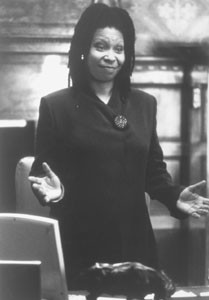
Making Whoopi: Whoopi Goldberg stars as Wall Street whiz Laurel Ayres who, in order to get ahead, passes herself off as the associate of a powerful investment counselor in “The Associate.”

Photo by K.C. Bailey


Karen Salmansohn begs to differ

By David Templeton

Writer David Templeton takes interesting people to interesting movies.. This time out, he discusses the gender-bending big-biz flick The Associate with Karen Salmansohn, the author of an eyebrow-raising new book for women in business.

KAREN SALMANSOHN, a self-described “recovered award-winning senior executive/workaholic,” has just released a smart, subversively motivational book with the deliciously wry title How to Succeed in Business Without a Penis: Secrets and Strategies for the Working Woman (Harmony, 1996). Tremendously funny, it is a bold mix of inspirational messages, knowing tips learned in the trenches, and a veritable parade of potent penis puns.

As I sit by my phone waiting for the author to call from New York, it occurs to me that the film we will be discussing–The Associate, starring Whoopi Goldberg as a Wall Street whiz who invents an imaginary male business partner in order to be taken seriously–might have done well to take a cue from Salmansohn’s savvy sense of namesmanship. It could have been titled “How to Succeed in Business by Pretending to Have a Penis.” As this thought crosses my mind, the phone rings.

“I’m at a pay phone,” Salmansohn explains breathlessly. “My apartment is under construction, so I’ve been locked out. I did see the movie last night, though, with my boyfriend. I liked the pro-women message. And we laughed hysterically at the peeing scene.” She refers to a moment in which Whoopi, pretending to be her partner, Cutty, employs a bottle of mouthwash to simulate urination in the men’s room.

I remark that the movie’s message runs strictly counter to the central idea of her book–that women need not mirror men in order to be successful. Here we have a film where a woman caves in, subverting her own nature in order to get ahead.

“Oh, absolutely,” says Salmansohn. “I say in the book, ‘You don’t need a penis to succeed, you just need balls.’ Whoopi had enough balls to go ahead and do this scam, but if she was clever enough to have come up with this, she would have just faked a phone call from Cutty, and said, ‘Look, I want Whoopi to take over from here on in. She’s the real powerhouse.’ That could have cured everything.”

Of course, then we’d have missed seeing the spectacle of our star in Brando-esque drag, but it certainly would have been more inspiring. Salmansohn has other ideas for the heroine as well, such as taking her prospectus to women CEOs instead of only to men.

“I applauded her initial reaction of using whatever it took to get into the meeting, as long as it didn’t hurt anyone, but there came a point when she just became a wimp,” Salmansohn notes. “Also, once she brought in some money–150 grand!–from that first client, she could have come in and confessed. In the end, you know, money is respected even more than the gender you are. Money is the ultimate power.” Salmansohn pauses a moment.

“Maybe her dreadlocks were part of her problem,” she suggests. “Possibly her stumbling block was that she looked so wild. The medium is the message, right?

“When I was in advertising I would wear a different outfit for different meetings. I was a secret agent girl. I would bring along a bag of my dungarees and a T-shirt and sneaks and stuff, and change in the ladies’ room before going to a pitch session at MTV. Then go back to the office and put on my little business suit to pitch to my other advertising clients, because I understood that people want to be with other members of their tribe. The more that you can make any person feel like they can relate to you, the better chance you have of selling them your product.

“Women are so aware of appearance and packaging from all the women’s magazines out there that we can use that to our advantage,” she continues. “It’s all about seduction. And God knows we’ve read enough articles about that. Women do have the edge on knowing how to seduce. And I don’t mean that in the sexual sense, necessarily.

“I do believe that we all have male and female in us,” she adds, “and we need to find a balance in that. You have to know when to be tough and when to be nice. You can be aggressive, whether you are a man or a woman, without being a jerk. As much as I believe you don’t need a penis to get ahead, I don’t suggest you try it without a heart–or a brain.”

From the November 7-13, 1996 issue of the Sonoma Independent

This page was designed and created by the Boulevards team.
© 1996 Metrosa, Inc.

Coffee on Wheels

0

Latté Lorries


Espresso bars on wheels thunder into Sonoma County

By Dylan Bennett


WHILE SAN FRANCISCO may be the truer birthplace of espresso culture, with its lingering images of Beat poets arguing over small cafe tables strewn with muddy cups and overflowing ashtrays, Seattle is best known for espresso carts and drive-through coffee kiosks. The arrival of an espresso cart in downtown Santa Rosa, then, marks the triumph of the Third Seattle Invasion in Sonoma County. First came Jimi Hendrix, then the power chords of grunge rock, and now, espresso carts–caffeine on casters–filling a fertile niche in the coffee business.

“I think coffee is a cool culinary art,” says Susan Hoffman, the exuberant Sandra Bullock look-alike who owns Centro Espresso in downtown Santa Rosa.

Decked out in smooth, gleaming metalwork, Centro Espresso features espresso in the northern Italian style with a lighter roast that lends a gently nutty bite and a subtle caramel-like flavor. “In the wine country,” Hoffman reckons, “people are open to different tastes and roasts.”

The former kitchen manager of the original Western Caffè in Railroad Square, Hoffman has reinvigorated the coffee scene in downtown Santa Rosa, offering a product with personality and a hands-on business owner you can look in the eye. Because the most remarkable thing about Centro Espresso is that it’s not a coffeehouse at all, but rather a stylized espresso cart on four wheels parked at Sawyer’s News on Fourth Street.

Acting out a “small is beautiful” concept, utilizing coffee beans prepared by “microroasters”–the small-volume, high-quality roasting operations exemplified by such local coffee purveyors as Taylor Maid in Sebastopol and Coast Roast in Tomales–espresso carts offer a fast, high-quality caffeine fix with a personal touch to coffee lovers on the move, as well as a low-cost business opportunity to aspiring food types.

“Carts make people feel good,” offers Steve Powers, the mild-mannered, bearded owner of Cheeko’s Corner, located in front of Sebastopol’s Fiesta Market. “They have a European flavor. You can buy everything off a cart in Europe.” In 1994, to create a decent-paying job for himself after a 20-year gardening career, Powers started his rolling concern as a less expensive option to the sit-down coffeehouse.


Photo by Janet Orsi

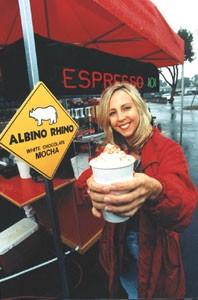
Java Jockey: Susan Hoffman’s Centro Espresso mobile coffee cart brings new libation creations to downtown Santa Rosa.

PRIOR TO 1993, state law prohibited food preparation on carts with the exception of hot dogs. But the growing interest in espresso carts led to a bill sponsored by state Sen. Mike Thompson that allowed for coffee-based drinks prepared with milk. Shortly after the county health department began issuing annual health permits for espresso carts in early 1994, these mobile java wagons started popping up in Sonoma, Sebastopol, and Petaluma; and now they’re in Santa Rosa, with one of them downtown a stone’s throw from the mighty Starbuck’s franchise. To date, 20 espresso carts, drive-through modules, and coffee trucks operate in Sonoma County.

The primary advantage of espresso carts over storefront cafes is the bottom line. “The nice thing is the capital costs can be a lot lower,” says Powers, who named Cheeko’s Corner after his pet parrot. “It takes only about $20,000 to get going, and you have lower operating costs–like less rent.”

Such affordability appeals to Robert Rose, the operator of espresso carts at both Community and Kaiser hospitals. “I always wanted to try my hand at my own business,” he says. “It was very spontaneous. I saw an advertisement in the newspaper, and a few days later I was in business.”

Lest one think espresso carts mean demitasse-sized profits, consider Deaf Dog Coffee in Petaluma, where owner Ron Salisbury’s two drive-through carts and one storefront are merely an advance team for a business plan that calls for a total of six drive-throughs and six storefronts. Salisbury, who credits the coffeehouses of Berkeley for his several graduate degrees and who really does own a deaf dog, is an experienced corporate business analyst. Notably, Salisbury’s drive-through employees stand outside their huts to serve customers in order to overcome the impersonal aspect of a drive-by coffee score.

By 1999, the nation’s specialty coffee market is expected to top $3 billion, with a solid 30 percent of that market in the “to-go” category. This means considerable opportunity for the new wave of “baristas,” those coffee-bar jockeys at the controls of those $6,000 espresso machines. Already, there are about 2,000 espresso carts nationwide.

King County in Washington state is the nation’s classic model of a fully developed coffee market. At its peak of 1,000 espresso carts, the area qualified as the “classic description of a saturated market,” according to Ted Lingle, executive director of the Specialty Coffee Association of America. Today about 400 espresso carts–a more realistic number–serve a population of 1.25 million java junkies. This ratio of carts to residents, factoring in a population of educated, upper-income folks, suggests that Sonoma County could easily gulp down another 100 espresso carts.

If cocaine, nouveau cuisine, and BMWs described the celebratory excess of the 1980s, one of the most common explanations for the espresso coffee boom is the desire for little treats in a more frugal, downsized era. “People are more apt to spend for smaller luxuries,” reasons Susan Hoffman. “Instead of thousands of dollars for a new car, they get a great cup of coffee for $1.35.”

From the November 7-13, 1996 issue of the Sonoma Independent

This page was designed and created by the Boulevards team.
© 1996 Metrosa, Inc.
Smuin Ballets/SF

0

Giant Steps


Don’t Look Back: Smuin Ballets/S.F. dancer Osmani Garcia spins a smile in ‘Heartbreak Hotel.’

Photo by Susan Vogel


Smuin Ballets/S.F. bring their guerrilla troupe to Spreckels

By Gretchen Giles

IF YOU THINK that you’ve never seen choreographer Michael Smuin’s work, think again. Because audiences don’t have to put on fancy clothes and file into darkened concert halls to watch this innovative artist’s ideas enacted in the strong, limbered bodies of the 12 dancers in his Smuin Ballets/SF company.

They can just go to the movies.

Couched in the rigors of classical ballet, Smuin’s dizzying vita ranges from directing the San Francisco Ballet for 12 years, to dancing in and directing the American Ballet Theater, to shepherding ABT’s televised 50th anniversary special, to starting his own company three years ago.

He’s also done just about everything in between, from directing and choreographing Linda Ronstadt’s stunning Mexican folksong and dance production Canciones de mi Padre, to putting his dancers through their paces at the White House, to winning Broadway’s Tony award for choreographing Anything Goes, and finally–to duking it out with Jabba the Hut.

Yep, Jabba. When techno-wizard George Lucas decided to revamp his Star Wars trilogy for a ’97 release utilizing millennium’s-end computer smarts, he called on Smuin to stage a stylized battle between his dancers and that man in the carpeted costume. But that wasn’t half as much fun as teaching actor Jack Nicholson to move like a lobo in the werewolf thriller Wolf, a job he got after filmmaker Mike Nichols saw Smuin’s Peter and the Wolf for American Ballet Theater.

“Of course,” chuckles Smuin of the Prokofiev effort, speaking by phone from his San Francisco home, “that wolf was like a cartoon.”

To prepare for the Nichols film, Smuin learned about alpha and beta wolves and the specifics of pack behavior in order to properly finesse Nicholson to his knees.

With his choreography for the first cinematic production of Broadway’s long-running The Fantasticks due to hit movie theaters early next year, with preparations roaring for his Dec. 6 directorial presentation of Ira Gershwin at 100: A Celebration at Carnegie Hall, and with his company coming to the Spreckels Performing Arts Center Nov. 16-17, one would think that Smuin might slow down.

“Not at all,” he says simply. After all, he is simply doing what he loves best.

Known for his sexy, modern style, Smuin himself has called his lean and muscular innovations “guerrilla ballet,” distinctive for their use of recorded music and borrowing from modern dance and jazz styles.

Audiences won’t see Swan Lake, but they are guaranteed such pieces of reanimation fantasy as Eternal Idol, in which the statues of sculptor Auguste Rodin’s famous “The Kiss” come to life, and the Asian-influenced work of Shinju.

The most classically anchored of his offerings, the Brahms/Haydn Variations, is known for the muscularity with which he explores the formalistic spirit of Brahms’ work, but any highbrow stiflings are quickly elided by the acclaimed Dances with Songs repertoire, which incorporates such pop hits as “Heartbreak Hotel” and “Georgia on My Mind” with the supple renderings of Smuin’s high-heeled and -hatted dancers.

And it is his innovative, common-man approach to the revered art of ballet that has attracted so many to the Smuin style.

“I am interested in the music,” he says. “And I’ll go with anything from the hokey-pokey to the hula if it matches the music.”

Smuin Ballets/SF perform Saturday and Sunday, Nov. 16-17, at Spreckels Performing Arts Center, 5409 Snyder Lane, Rohnert Park. Saturday at 8 p.m.; Sunday at 2:30. Tickets are $22-$25. 584-1700.

From the November 7-13, 1996 issue of the Sonoma Independent

This page was designed and created by the Boulevards team.
© 1996 Metrosa, Inc.
Urban Sprawl

0

Sprawl Bustin’

By Bruce Robinson

SCATTERED AMONG the army of local candidates, various bond measures, high-profile statewide policy initiatives, and local school district elections that jam the upcoming ballot are some key planning decisions that voters are also being asked to make. Those are issues that, both sides agree, will have far-reaching implications for the quality of life here well into the next century.

Urban growth boundaries, often abbreviated as UGBs, are on the ballot in Healdsburg (Measure I), Sebastopol (Measure O), Santa Rosa (Measure G), and Rohnert Park (Measure N), while voters throughout the county face an interlocking vote on Measure D. A related decision awaits the electorate in Windsor, where Measure Q offers local residents a chance to decide the fate of the controversial Wal-Mart development proposed at Highway 101 and Shiloh Road.

If most or all of the UGBs win approval, Sonoma County would become the first county in the United States to have a coordinated, organized network of urban growth boundaries,” says Christa Shaw, the North Bay coordinator for Greenbelt Alliance.

The benefits to such an outcome, she says, include the preservation of agricultural lands and small-town character; economically vigorous downtowns; reduced costs to taxpayers, since urban services would not have to be extended outward; and citizen control over the size of their own communities.

The effort to establish such a precedent is a natural for Sonoma County on several counts, Shaw suggests. Sonoma was “one of the first [counties] in California whose residents voted to tax themselves for open space conservation,” she notes. “This is continuing in that tradition. And because agriculture is so important to our economy, people ‘get it.’ “

Yet the most vocal opposition to the UGB measures so far has come from the Sonoma County Farm Bureau. “Growth is going to occur where there is the least resistance,” says Farm Bureau president John Bucher. He fears that adopting the UGBs will intensify development pressures on ag lands outside the urban areas. “It could be ranchettes or the parcelization of ag lands,” he says, but the result is still a loss of productive farmlands. “Even the proponents acknowledge that this is a problem, but UGBs do nothing to address it.

“It’s really frustrating. The proponents are using agriculture to push their own agenda, no growth in Sonoma County,” Bucher adds. “I don’t want to see this county paved over, but we need a balance in our economy.”

Despite those concerns, initial indications are that most of the UGB measures share broad support, although Shaw expects more resistance to surface in the final days before the election. “I’d be surprised if the Home Builders Association lets these slide,” she says. “This kind of movement is anathema to what the urban sprawl industry has been doing in California for the last 40 years, and they can’t afford to see it continue. The idea is starting to leak out all over the Bay Area,” says Shaw.

Even Fairfield in Solano County is talking about placing a UGB measure on the ballot in its next municipal election, “which is extraordinary.”

Here in Sonoma County, “the domino effect is already in place,” Shaw says, with strong support for UGBs building in both Windsor and Cotati, where a vote was put off until after the city completes the process of updating its General Plan.

ALTHOUGH THE FOUR UGB measures facing local voters share the same general outline–they would set fixed lines beyond which municipalities could not expand for a set interval, usually 20 years–they are not exactly the same. Measures I and O in Healdsburg and Sebastopol hew closely to general plans that have already been adopted in those cities, and mostly seek to reaffirm existing controls on their cities’ sphere of influence.

Exemptions may be granted for new parks, schools, or affordable housing, if for some reason they cannot be accommodated within the urban limits through rezoning or other measures, something that proponents say is highly improbable.

The county’s Measure D is more complicated. It focuses on the community separators defined in the county’s General Plan, and would preclude the “upzoning” of any property in the half of the community separator adjacent to a city that adopts UGBs.

“It should have been [Measure] C, for ‘complicated,'” sighs Shaw, who predicts that the full effects of Measure D will not be felt for another decade. “There are such tight regulations covering the community separators that it’s not going to mean much for maybe 10 years,” she reasons, but by that time, “the development pressure will be 10-fold what it is today in Sonoma County, and we’ll be really glad that Measure D passed.”

The true battlegrounds in this skirmish against urban sprawl are the two cities where the most sprawl has already occurred. Although Measure G in Santa Rosa was ultimately placed on the ballot by a unified City Council, that outcome followed a heated debate over the 450-plus acre Taylor Mountain development proposal at the south end of the city.

Although it remains within the boundary proposed by Measure G, the initiative specifies that it must be phased in and cannot be considered for active development until 2010.

But not everyone is happy with that compromise–witness the aggressive “No on G” campaign that erupted last weekend. Bright orange­on­black signs appeared all over Santa Rosa, with the cryptic slogan, “Don’t Get Tricked. No on G.” The stealth campaign–which emerg-ed in violation of the state’s fair political practice

From the October 31-November 6, 1996 issue of the Sonoma Independent

This page was designed and created by the Boulevards team.
© 1996 Metrosa, Inc.

Talking Pictures

0

Charity Case

By David Templeton

Writer David Templeton takes interesting people to interesting movies in his ongoing quest for the ultimate post-film conversation. This time out, he sees the star-studded Sleepers with marketing executive Jack Nao, the determined fellow who earned a day out at the movies by bidding high at a fundraiser the Carousel Fund, a children’s charity.

JACK NAO is bubbling with enthusiasm. He arrives at the theater bearing gifts: a book of photos of the Grateful Dead, posters and sample prints of a painting of the late Jerry Garcia, and examples of his work as a national marketing executive specializing in rock-‘n’-roll collectibles. Beaming, he says, “I’ve had so much fun talking about seeing this movie today that it’s already been well worth the money I paid for it!”

An explanation: Nao was the winning bidder among several charitable movie fans who competed in early October to win a featured role in this column. The event was a black-tie auction for the very worthy Carousel Fund, an organization that raises money to assist families in which a child is suffering a devastating illness. Carousel not only provides financial support so that parents can remain home with the child, but also helps with medical costs and other vital needs. Nao, national marketing manager for the Petaluma-based Global Internet Inc. is a longtime supporter of the fund. For no particular reason, he bid the film in the contest.

“Let me show you what I’ve been working on lately,” he says, as we wait for the matinee to begin. He unveils a photograph of a bronze bust of Garcia, glasses perched on his nose, hair flying. “Isn’t this beautiful? There were only 50 of these made, and I’ve been designing the marketing campaign. I wanted you to know what I’m playing hooky from,” he laughs.

And speaking of marketing . . . Sleepers, starring Brad Pitt, Robert De Niro, Dustin Hoffman, and Kevin Bacon, has made excellent use of its A-grade cast in selling this bleak, often horrific tale of four boys brutally abused at a Hell’s Kitchen reformatory, and the astoundingly complex revenge that, years later, they take on their perpetrators. Though the “revenge is OK if you can get away with it” message is suspect, the film is compelling and well acted.

After the movie, as we take our seats in a nearby restaurant, the topic of discussion is the depictions of sexual abuse the young men suffered, and how it affected them as adults.

“Remember when the former girlfriend kind of made an overture,” Nao recalls. “You could see that he was totally uncomfortable with that intimacy. I don’t think the scar ever heals. That’s what I got from this.”

“But it can heal,” I counter. “People have experienced even worse things and have gotten on with their lives. I kept wanting them to go out and find a good therapist.”

Nao nods. “That’s one thing that the movie did really well,” he says, “it showed what happens if you don’t talk about your damage. Here they’re saying, ‘Let’s not talk about it. Let’s never bring it up.’ They’re doing just the opposite of what they should be doing. ‘Let’s suppress it. Let’s not worry about it.’ And that’s what I think fosters revenge and hatred and all that stuff that comes up after that.

“I don’t know if we’re going to change anything,” he shrugs. “That’s the thing you gotta recognize. I was a hippie in ’65, and I really believed it. I thought peace and love and understanding were going to happen. And then from ’73 to ’79, I watched the whole thing just disintegrate. We went from trying to get a higher level of consciousness to just getting high. Our society is now so locked into feeling good, we’re not happy unless we have a nice family, a nice shirt, a nice car.

“America is so bloated. The reason that so many countries hate us is that we are really selfish. We’re less than 7 percent of the world’s population and we use 90 percent of the world’s goods.

“My newest pet peeve right now is Bill Gates,” he laughs, “because I think, ‘Bill, you’re worth about a zillion, billion dollars, and you’re doing nothing.’ Even Andrew Carnegie in his day, when he was a world-famous billionaire deluxe, he gave each one of the cities a library. So I say, ‘Bill, how do you sleep at night? You’re making lots of dough, but you’re not giving any of it back.’ I mean, what are we here for? There’s no reason why we can’t share.”

From the October 31-November 6, 1996 issue of the Sonoma Independent

This page was designed and created by the Boulevards team.
© 1996 Metrosa, Inc.
Re-Presenting the Figure

0

Body of Work

By Gretchen Giles

THE LONG, CURVED, female hip of a nude reclining on a sofa, stomach draped, a slight smile playing upon her lips, A woman standing, caught gently soaping down the pinked flesh of her limbs before a mirror. An unclothed model braving the chill of a studio podium as students sit scratching away at pads in a semi-circle before her. These are images familiar to both the viewer and the progenitor of figurative art. The gaze of the artist is predominantly male, staring dispassionately at the innate beauty of the female form. The woman’s body, her surroundings, and the mystery of her face all withhold a secret, a story, one that a viewer can tell privately to oneself.

There is something to guess at beyond the simplicities of a human naked or clothed.

But take that same figure and examine it simply for line and form. Disregard passions and pasts, look for the stark juxtaposition of elbow and knee. Refuse to pity or covet: see the body as a thing, an object of utility uniquely politicized by the very restrictions of focus. And then look again.

“In the ’80s, a lot of artists were looking at the issue of identity, and so the body became this very major motif–especially after the 1970s, when conceptual art reigned supreme and the figurative just didn’t exist,” says Michael Schwager, Sonoma State University art professor and gallery director. “The body came back in as this carrier of identity, sexuality, race, class. You know: What does our own carrier of ourselves mean to the outside world and how can artists use that?”

These questions and others are among those raised by Schwager’s latest curatorial effort, “Re-Presenting the Figure: The Body as Image and Object in Contemporary Art,” opening Nov. 7 at the University Art Gallery.

For this exhibit, featuring works by abstract painters Willem de Kooning and Jean-Michel Basquiat, the dense inversions of painter Georg Baselitz, the photographic self-studies of John Coplans, and the multimedia images of Kiki Smith, Schwager has gathered a roster of 26 artists that each define and reflect a consciousness of body in a radically different manner.

“Kiki Smith was making these latex casts of human bodies that she would hang from hooks so that they would just drape, or she’d cut them up into one-inch squares that had all of these associations–the Holocaust, science, but also just the body as a thing,” says Schwager, seated on a stool in the gallery foyer. Explaining the show’s genesis, he says,“I was thinking that if we looked at the body as an object, as an image, not as a narrative, you might find people who look at the figure and the form in a very different way. I thought, can I do a figurative show without doing a figurative show?

“De Kooning was sort of the defining kind of spirit of the show,” Schwager continues, “because he used the figure as the ultimate starting point. You can see the woman in [his paintings]. I know people have interpreted his figures as angry or misogynist, and I’m not sure that I agree with those interpretations, because the fact is he used the figure to make a painting. The figure became a thing that became the understructure of a beautiful abstract painting. I wanted to investigate that.”

WHILE SCHWAGER may see the New York­based de Kooning as his jumping-off point, it was the figurative work of Bay Area artists that finally coalesced the exhibit into a viable metaphor.

“I wanted a contemporary view of this subject, knowing that we have that tradition in this area and that the world has changed. The issue of the body is a bigger issue than they were grappling with,” he says, referring to local figurative art’s late-’60s crest, spearheaded by such artists as David Parks and Richard Diebenkorn. “I mean, I worship Parks and Diebenkorn, but they’re for my next show,” he smiles. “They’re for a narrative show.

Schwager, who has been curating five gallery exhibits a year since he came to SSU in 1991, came to the “Re-Presenting” exhibit through an interest in mounting a narrative show– one in which the works speak out their mysteries–finally deciding that this kind of a figurative show is more timely.

” I think that anyone who has been aware of the world at large–with its gender and identity politics–knows that a lot of people have been thinking about what it means to be a white woman, an African-American man, or an Asian-American person,” he says. “And that was in the air during much of the ’80s, maybe in response to Reagan and his longing for the world the way it used to be–the way it never was. We’re a melting pot. We’re not melting together–but we’re here together and we can’t ignore each other. I quite frankly hadn’t addressed it in any of my other shows, and this is a way to look at that, because much of it took the form of the body.”

Looking up from the slides and photographs covering the gallery’s desk, Schwager smiles. “I hope that it encompasses a wide range,” he says of the exhibit, “from the political, to the social, to cultural critique, to the really well-done, by artists who have used a singular image to make us look at the body and not its surroundings and not who it is. I hope that politics and power are going to be the subtext. I have no agenda, but the artists do.”

Re-Presenting the Figure opens with a reception from 4 to 6 p.m. on Thursday, Nov. 7, and runs through Dec. 20. University Art Gallery, Sonoma State University, 1801 E. Cotati Ave., Rohnert Park. Gallery hours are Tuesday-Friday, 11 a.m. to 4 p.m. and weekends, noon to 4 p.m. Closed Mondays. Admission is free. 664-2295.

From the October 31-November 6, 1996 issue of the Sonoma Independent

This page was designed and created by the Boulevards team.
© 1996 Metrosa, Inc.

Olive Oil

0

Striking Oil

By David Templeton

A BURST OF MIDMORNING light illuminates the high-beamed, sawdust-strewn, construction-site interior of a 100-year-old former winery in downtown Glen Ellen. At first glance, one would think that this was little more than another wine country gift shop­to­be. Then Ed Stolman arrives.

Within seconds, as he colorfully describes what he’s been up to here on the edge of Jack London State Park, Stolman has all but transported us–and the building site, too–across the sea to the hillsides of Italy, to one of many tiny villages where each family has its own orchard of 500-year-old olive trees, and each village has its fiantoio, the communal olive oil press to which farmers bring their crops each autumn.

“Our press is on the boat now, literally, and by Thanksgiving, Sonoma County will have its own fiantoio,” Stolman enthuses. He unrolls a sheaf of architectural plans, then points to a 1,200-square-foot room in the back. “It will be set up right in there, with big picture windows so everyone can watch the olives being pressed. We pour the concrete tomorrow.”

The project, simply called the Glen Ellen Olive Press, is Stolman’s fanciful brainchild, supported by a cooperative of 14 local business people, all olive growers, eight of them already with their own labels, all with the same notion: to give California olive oil–and Sonoma County olive oil in particular–the same worldwide prestige enjoyed by the local wine industry.

“We’d like to raise the interest level of people in this country to the goodness and health benefits of good, organic olive oil,” says Stolman. “Local makers of olive oil have a product every bit as good as that from Italy or Spain, and we hope to encourage growers here to plant more olives, to expand the industry. Now,” he adds, glancing about the spacious site, “we’ll finally have a press right here in the county. The rest will take care of itself.”

A retired businessman (he founded the Dove Bar), Stolman relocated to Glen Ellen a few years ago, building an elaborate Italianate villa complete with a grove of 1,400 olive trees flown over from Tuscany. In short order, he discovered that Sonoma County has its own thriving olive oil industry. Relatively small, most of these entities are wineries that happened to have olive trees on-site and are just beginning to explore the possibilities of making fine olive oil. With this enterprise still in its infancy, this county is the home of some of the country’s premier extra-virgin olive oil makers–B. R. Cohn, V. G. Buck, and Spectrum Naturals among them.

After a fact-finding trip to Europe, Stolman and some of the other local olive growers hatched their plan for the Glen Ellen Olive Press. Along with the $200,000 state-of-the-art cold press, manufactured by Pieralisi in Gesi, Italy, the prominent site at one end of Jack London Village will feature a gift shop devoted to olive-themed items (“including the ultimate martini glass,” Stolman grins), a mini-hardware store for growers of olives, and a tasting bar where tourists and curious locals will educate their palates while sipping olive oil, a common custom in most olive-producing countries.

Other local brands of this liquid gold–available, of course, along with the Olive Press’ own brand–will be offered in attractive glass bottles or sold by the ounce.

“If they really like it they can bring in a plastic bucket and we’ll fill it up for them,” Stolman says of his prospective customers. He estimates that the press will attract an astounding 100,000 visitors a year to Glen Ellen, while providing a place for local growers to process their crops, which have previously been sent as near and far as Marin and Modesto to be pressed. “If someone has two trees in their backyard, they can bring the olives in here and we’ll process the oil,” Stolman says.

“The press fits in beautifully with the local economy and agriculture,” says Neil Blomquist, president of the Petaluma-based Spectrum Naturals, an oil import/export firm that is one of the largest bottlers of certified organic extra-virgin olive oil in Sonoma County. For two years the 15-year-old company has produced a California-grown olive oil, tapping into the upper Sacramento Valley for its olives, since local growers still produce a quantity far below the international exporters’ needs.

“We have the right climate and geology,” Blomquist points out. “The soil is similar to that of the best olive-producing areas of Europe. Local farmers could produce virtually any olive they grow overseas. As the local industry expands, we will see more and more locally produced brands. That’s good for the entire California industry.”

“There really aren’t that many olive trees in Northern California yet,” allows Stolman, concluding his tour of the location. “But people are beginning to put in the bigger crops.” He lists just a few: Jordan Winery has just planted 8,000 trees, San Francisco Chronicle heiress Nan McAvoy has planted another 8,000 outside of Petaluma, and Glen Ellen Olive Press investor Ridgley Evers has planted 4,000 trees in Healdsburg.

Even so, olive trees grow slowly, taking three to five years to begin producing, and up to 12 years to reach full potential. “Meanwhile,” Stolman smiles, “visitors from around the country will be discovering us. They’ll take our fine olive oil home, and word will spread. And we will be here, showing off our product while trying to make it easy for people to get into the olive business.” He glances around the site and begins to roll up the plans. “This is the fun part.”

From the October 31-November 6, 1996 issue of the Sonoma Independent

This page was designed and created by the Boulevards team.
© 1996 Metrosa, Inc.

Sonoma County Endorsements

0

Where We Stand


President of the United States

BILL CLINTON’S only political challenge comes from the right. Ultimately the Greens would like to change that. But there is a reason that many progressives have united behind Bubba: The Republican alternative would throw California’s 54 electoral votes to a party well-organized by the Ralph Reeds, Newt Gingrichs, and Dan Lungrens of the world. The prospect of a second-term president with a bias for action, who isn’t hobbled by war, old age, or scandal from acts commited in office, will offer the possibility of meaningful political change for the first time in decades. Clinton’s early reformist efforts were derailed by powerful industry lobbies and the ideological zeal of socially conservative Americans who want to turn back the clock with laws regulating personal choices on reproductive rights and sexual preference. Protest votes may not be an affordable luxury this time out.

1st Congressional District

SURE, SHE’S UNPROVEN, but Michela Alioto, 27, has effectively unmasked Rep. Frank Riggs, R-Windsor, the born-again conservative and Gingrich foot soldier, for neglecting the wishes of his constituents–no, not the gun-toting, tobacco growing, clear-cutting special interests, but the regular folks who live in his far-flung district. In recent weeks, both the Republican and Democratic parties–not to mention big labor and others–have flooded the North Coast with cash, since this is one of the most crucial and closely watched congressional races in the country. Alioto is pro-choice, supports the ban on assault weapons (which Riggs, a former cop, wants overturned), and favors environmental policies that benefit the largest number of North Coast residents. Riggs, who has one of the worst environmental voting records in the California delegation, has voted to weaken the Clean Water Act and the Endangered Species Act; to curb the powers of the Environmental Protection Agency’s authority over pesticides, refinery emissions, and sewage runoff; and to downsize the National Park System.

6th Congressional District

LYNN WOOLSEY, the former welfare mom and onetime vice mayor of Petaluma, has grown steadily into her role as the North Coast’s sole liberal voice in Congress. Indeed, Woolsey’s willingness to stand her ground on social issues, even as President Clinton shifts to the right, shows her conviction. This year, the Democratic House leadership is looking to Woolsey to help craft the fix-it bill that may forestall the worst aspects of the welfare “deform” bill signed by Clinton earlier this year. Republican opponent Duane Hughes is a rehashed Gingrich revolutionary with few original ideas.

1st Assembly District

VIRGINIA STROM-MARTIN is a Democrat and elementary school teacher from the tiny west county hamlet of Duncans Mills who is making her first bid for public office against Republican millionaire Marge Handley. In a state Legislature dominated by male lawyers in three-piece suits, a first-hand advocate for California’s beleaguered classrooms would be a breath of fresh air (and make an effective teammate for 6th Assembly District incumbent Kerry Mazzoni). Strom-Martin opposes the controversial plan to create school vouchers, which is supported widely by the Christian Right. As a longtime environmental activist, Strom-Martin supports the debt-for-nature swap to help preserve Headwaters Forest, rather than the land-swap deal cut by Sen. Dianne Feinstein. Her opponent–who is trading on name recognition from her many unsuccessful bids at public office–has been linked to Orange County extremist Kurt Pringle, the Assembly Speaker.

7th Assembly District

THREE GOOD REASONS not to vote for Democratic incumbent Valerie Brown: She abstained on the vote to ban methyl bromide (a dangerous soil fumigant used in the grape-growing industry), choosing not take sides; blatantly supported state control of local money; and showed a lack of vision by failing to address voter discontent. One good reason to vote for Al Liner, a dark horse Peace and Freedom candidate and tireless advocate for social justice: he has emerged as a leading proponent of a brilliant idea to bolster voter participation, infuse new ideas, and reform the electoral system with proportional representation, which would allow minority parties a fair share of the legislative pie.

5th Supervisorial District

THE TWO SURVIVING candidates–Mike Reilly and Eric Koenigshofer–in this seven-way primary race are more alike than different, and either would represent this far-flung, frequently fractious district well. But Koenigshofer’s close ties to Sheriff Mark Ihde are a concern, particularly when the Sheriff’s Department is undergoing such critical scrutiny in the wake of the murder of domestic violence victim Maria Teresa Macias. And Koenigshofer’s campaign style suggests he would do little to soften the aloofness the supervisors often display toward the public. Reilly’s commitment to and command of social issues and his track record in building common ground among disparate interests–including former Bill Dowd supporters–give him a narrow edge.

Measures D, G, I, O, and N

THESE FIVE VARIATIONS on urban growth limits each give local residents vital control over sprawl in their communities–an effective tool to constrain traffic, retain community identity, protect agricultural lands, and limit the demands on municipal services. While they would slow annexations, these are not “no growth” measures, but instead would restrict new development to existing city spheres of influence for up to 20 years. The countywide Measure D freezes zoning in community separators around cities that adopt urban limits, while initiatives in Santa Rosa, Rohnert Park, Healdsburg, and Sebastopol let voters firmly establish their own boundaries. We recommend a yes vote on all five urban growth boundary measures.

Measure E

HOPING TO STOP the flow of red ink at county-owned Community Hospital in Santa Rosa, county supervisors agreed last February to a lease agreement under which Sutter/CHS now runs the venerable public hospital. But widespread discontent with the perceived lack of public participation in that decision, fears that the county’s commitment to provide care for the indigent and the uninsured will not be maintained, and mounting distrust of corporate health-care giants, have fueled this effort to overturn the lease. Sutter’s massive spending to defend its contract (at least $200,000) and the serious state Health Department citations the company has received for deficits in its service in the first few months at Community Hospital reinforce those concerns. Given a second chance, we can–and must–do better. Vote yes on E.

Measure Q

EVEN IF SONOMA COUNTY does need another Wal-Mart, a questionable assumption, is the Shiloh Road site in Windsor the place to put it? This may be the defining decision for our youngest town as it pits cold economic gain against the less tangible considerations of community identity, neighborhood integrity, and the attractive prospect of an industrial employer on the site, rather than another big-box monument to consumerism. Vote no on Q.

Cotati City Council

SIX OF THE SEVEN candidates vying for three seats on the City Council support urban growth limits in a burg struggling to hang on to its small-town charm. Bob Jones and Pia Jensen were in the forefront of the drive to keep a huge Lucky market out of town, and that speaks well for them. Planning Commission member Lisa Moore has stated her opposition to a Lucky store as proposed.

Petaluma City Council

THE COUNCIL MAJORITY, led by Mayor Patti Hilligoss, tried for years to poison the political process during the tumultuous Lafferty Ranch swap debate before the voice of reason prevailed earlier this year. Unfortunately, Hilligoss isn’t up for re-election. But two incumbents are seeking another term: Jane Hamilton, a staunch swap foe who fought the good fight; and Lori Shea, a swap supporter who repeatedly defied the public’s desire to preserve Lafferty Ranch for future generations. Environmental activist David Keller emerged as a leader of the swap foes, but he also scores big points for his insistence that the public retain control over a new sewer treatment plant. Pamela Torliatt is a seasoned Planning Commission member who has shown her dedication to the public’s right to participate in their own destiny. Hmmm. What a concept.

Santa Rosa City Council

WITH TWO NEW seats to fill–plus a pair of expiring terms–voters have more openings than attractive choices in this race. Incumbent Mayor Sharon Wright–with close ties to the Santa Rosa Chamber of Commerce and building trade–and her fellow council members have failed to nurture small businesses in the downtown, which is starting to look like a ghost town. It’s clearly time for a change. Planning Commission members Mike Martini and Noreen Evans bring to the table useful experience, both in and out of government, along with a rational approach to growth issues, despite their links to the Santa Rosa Chamber of Commerce. Of the nine candidates, only two have close ties to the recently annexed Roseland district and its diverse, multicultural population. Of those, Duane DeWitt is a genuine independent, who speaks his mind, but does his homework first. Of the remaining candidates, former Food 4 Less owner Mike Runyan brings a potentially useful business background and encouraging advocacy for youth and schools, despite his links to the Chamber of Commerce/Sonoma County Alliance power grid.

Sebastopol City Council

GROWTH IS RELATIVE in Sebastopol, where the two leading candidates favored the hotly debated O’Reilly project. As an incumbent, Howard Levy has often differed on other issues, notably his desire to allocate city funds to social services and his meticulous scrutiny of development proposals–two qualities that warrant his retention. Planning Commission member Kathy Austin’s views are more consistent with Foley’s, but her inclination to innovate gives her the edge in a close decision.

Rohnert Park City Council

SIX CANDIDATES. Three seats. One big political mess. Growth is the defining issue. In this case, support of Measure N, which would restrict growth for four years–not too much to ask in a rapidly sprawling suburb that can’t afford proper public safety and sewage services–sets the standard. Linda Branscomb, Jake Mackenzie, and Paul Stutrud–a forceful watchdog–would use their terms to push for a 20-year urban growth boundary, and no place needs one more badly.

Santa Rosa City School Board

THESE SUDDENLY sought-after seats should go to those with the best ideas, not the biggest budgets. Sharon Cortez-Dawson’s first-hand experience with gang members and at-risk youth is a resource all too rarely applied at the board level. Steve Thornton’s back-to-basics approach is effectively tempered by his support for teaching conflict resolution. Christopher Wenmoth’s call for district elections and an expanded board make excellent sense, and this young, self-motivated former dropout could be a unique role model.

From the October 31-November 6, 1996 issue of the Sonoma Independent

This page was designed and created by the Boulevards team.
© 1996 Metrosa, Inc.

David Grisman

0

Hot Dawg


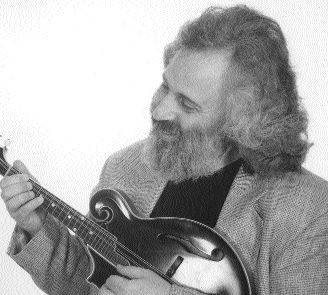
Mandolin marvel: David Grisman’s friendship with Jerry Garcia proved a mainstay to the ailing Grateful Dead guitarist before his death.

Secret of David Grisman’s success

By Greg Cahill

CALL IT SHELTER from the storm. When Grateful Dead guitarist Jerry Garcia–bloated from junk food and racked by heroin addiction–sought solace in 1994 from his demons shortly before years of abuse finally felled him, the rock icon retreated to the cramped basement studio at David Grisman’s Mill Valley home, and the high lonesome bluegrass sound both men revered.

“We just really enjoyed playing together, and it wasn’t something that he’d been doing for 30 years,” says Grisman, whom the New York Times once hailed as the Paganini of the mandolin. “It’s hard to keep a band going that long and not get burned out. I think he needed a rest. He’s got one now.”

Those sessions rank as some of Garcia’s best and are among Grisman’s “fondest musical memories,” he says by phone from his home. The relationship between Grisman and Garcia–the latter had grown up listening on his grandmother’s radio to Hank Williams, Flatt and Scruggs, and other country acts–started 30 years earlier when the two first met at a roadside rest stop on the Pennsylvania Turnpike while returning to New York from a Southern bluegrass festival. “Our collaborations were an ongoing thing over the past five years, and we always got into something interesting from our roots, whether it was bluegrass, jazz, country, or rock,” Grisman explains. “Now they’re memories. It’s a bittersweet thing, but to me he’s still around from listening to these tapes.”

Some of those many basement tapes yielded the newly released Shady Grove, a collection of laid-back acoustic-based tracks, featuring Garcia and Grisman and evoking all the quiet ease of a front-porch summer outing between a pair of old friends.

The stunning Shady Grove is the third disc this year on Grisman’s San Rafael­based Acoustic Disc label, which already had released DGQ20, a three-CD retrospective of Grisman’s classical, bluegrass, and jazz hybrid known as dawg music; and That High Lonesome Sound, a collection of outtakes from the legendary Old and in the Way sessions, featuring Grisman, Garcia, guitarist Peter Rowan, and fiddler Vassar Clement, among others.

That Garcia plays a key role in two of those three releases is only fitting. In the last years of his life, Garcia had grown somewhat weary of playing with the Grateful Dead–or more accurately, of the whole sideshow and cottage industry that revolved around the band–but he lit up in interviews whenever he discussed Grisman and their mutual love for bluegrass. That passion burns brightly on Shady Grove and several other Grisman-produced discs.

Three weeks before his death, Garcia called one last time on Grisman to produce a track for the upcoming Bob Dylan tribute to singing brakeman Jimmie Rogers in what proved to be Garcia’s last recording session.

After Garcia’s death, it fell on Grisman to finish the track. In honor of his friend, he added a New Orleans funeral-style brass band.

A remarkable intimacy–seldom found even in the plethora of “unplugged” sessions–marks all of Grisman’s Acoustic Disc releases. Those include two volumes of Tone Poems, solo and duet instrumentals recorded on a dizzying array of rare and vintage guitars and mandolins. The first teamed Grisman with bluegrass guitarist Tony Rice; the more recent set features the incredible fretwork of Scottish jazz guitarist Martin Taylor.

“Martin is one of the greatest jazz guitar players of all time, and he knows all those tunes!” Grisman marvels.

The heart and soul of those Tone Poem projects is the interplay between producer and instrumentalist Grisman and his various collaborators. “It’s good to be able to identify somebody’s personality and not have lost it because there’s too much stuff going on. That’s just the way those projects were set up,” he says. “And they’re all very special. I mean, playing a duet with somebody is a unique form of expression that allows those two people to lock into whatever they have in common.”

The secret of that success is the very nature of Grisman’s basement studio, which has played host to bluegrass legends from Red Allen to Doc Watson. “It’s a small room and generally most of these albums involve only a few people, which makes for that intimacy. There’s a little secret that the fewer instruments you have on a recording, the bigger they sound. So it’s intimate, but also full-sounding.”

David Grisman and Martin Taylor perform Friday, Nov. 8, at 8 p.m., at the Luther Burbank Center, 50 Mark West Springs Road, Santa Rosa. Tickets are $17.50. 546-3600.

From the October 31-November 6, 1996 issue of the Sonoma Independent

This page was designed and created by the Boulevards team.
© 1996 Metrosa, Inc.

California Propositions

0

Uncompromising Positions

IT COUNTS! Don’t think for a moment that your vote doesn’t matter. You have a chance on Nov. 5 to help decide the outcome of many vital, tight races, including several that will change the social landscape for decades. For example, In the 1st Congressional District, Democratic newcomer Michela Alioto is challenging conservative Rep. Frank Riggs, R-Windsor, in one of the most bitter and closely watched races in the nation. Toppling Riggs–ranked among the Congressional Dirty Dozen for his abysmal environmental record–will telegraph a clear message to the Republican House leadership and could help send Speaker Newt Gingrich packing. The Rev. Jesse Jackson stumped locally this week to stir up opposition to Prop 209–the blatant effort to end affirmative action–a ballot initiative that has lost favor with the public in the recent public opinion polls. The latest figures show 209 five percentage points ahead, but faltering. Similarly, the countywide Yes on E campaign to end the 60-year lease at county-owned Community Hospital, which the Board of Supervisors railroaded through earlier this year, is in Code Blue–locked in a life-and-death fight.

Stay at home Nov. 5? Don’t even think about it.

Proposition 204

Safe, Clean, Reliable Water Supply Act.

This act will provide hundreds of millions of dollars for water habitat restoration in the Bay-Delta and Sacramento Valley, and ensure future water supplies for all Californians, including farmers. Opponents of this Proposition, including libertarians, are in denial. Flashing the admittedly intimidating numbers–this is a billion-dollar bond proposal–and claiming the prop “smells like a boondoggle” benefiting “armies of bureaucrats” trivializes the issue. For generations to come, natural resources need protection and rehabilitation efforts–now. Perhaps California’s most crucial resource is water.

The projects this act would fund are desperately needed. Environmentalists are wary of possible breaks for agribusiness alluded to in 204, and opponents are right to oppose public subsidies for corporate polluters. Nonetheless, Clean Water Action, the Sierra Club and the California League of Conservation Voters agree that citizens have little time to hand-wring over who will pay for restoration when endangered species and their habitats hang in the balance. Yes, agribusiness and corporations should pay for their share of water use and pollution–ultimately, the society as a whole would all end up paying the real ecological costs of the produce and products consumed. In the meantime, this act is a mostly sensitive, remarkably cooperative and ultimately pragmatic response to pressing water and environmental issues in this populous and parched state.

Recommendation: Yes on 204.

Proposition 205

Youthful and Adult Offender Local Facilities Bond Act of 1996.

Oh joy, just what California needs. Another $700 million bond measure to build youth and adult local facilities (read: jails), called for by Proposition 205. The Proposition’s supporters–which include Republican and Democratic elected representatives, law enforcement officials and victims’ rights groups–point toward the already overcrowded lockups that are only getting more packed in the wake of Three Strikes legislation. They claim the majority of criminals serve only a fraction of their jail sentences as a result. What they fail to mention is that Proposition 205 covers only the construction of local jails, the vast majority of whose inmates aren’t rapists and killers, but drunken drivers, petty thieves and nonviolent drug offenders–hardly the rogue’s gallery of hardened predators originally targeted by Three Strikes advocates. And despite the warnings about a new generation of youthful thugs, many of the teens who can’t fit into current facilities have committed the vicious crimes of running away from home or violating curfews. Proposition 205’s few opponents, led by the California Libertarian Party, also warn of the dangers of adding to California’s $25 billion bond debt, the interest on which totals $3 billion a year. But given the public’s Pavlovian conditioning toward voting for anything with the words “cops” or “jails” in it, expect 205 to pass handily.

Recommendation: No on 205

Proposition 206

Veterans’ Bond Act of 1996.

Proposition 206 allows the Cal-Vet program to continue loaning veterans money to buy homes or farms. Supported by Democrats and Republicans alike, the Cal-Vet program has not yet cost taxpayers one dime. Why not vote for it? Because, Libertarians say, if the vets default on their loan, the taxpayers will have to foot the bill. Plus, they argue in the California Ballot pamphlet, “the government should not play favorites and give special privileges to veterans.” Are they kidding? Nope, they maintain that vets have enough special assistance programs as it is. But they rest this “enough assistance” argument on an erroneous claim that Cal-Vet duplicates the federal VA home-loan program. Actually, the VA home-loan program acts only as a co-signer to loans vets must acquire from some other source, while the Cal-Vet program actually purchases homes for veterans and maintains title of the house until they’ve been paid off. Still, libertarian opponents cry, if they default, the electorate will have to pay–and while that hasn’t happened before, California’s real estate market isn’t what it used to be. Well, that’s not a convincing argument.

Recommendation: Yes on 206.

Proposition 207

Attorneys. Fees. Right to negotiate. Frivolous lawsuits.

On first read, Proposition 207 looks like an effort by lawyers to stiffen penalties on colleagues who file frivolous lawsuits. It does take a step in this direction. But 207 hides its needle in a haystack: It also makes it nearly impossible for the Legislature to put caps on attorneys’ fees. Any such caps would require a vote by the electorate.

As in most initiatives, neither side on 207 can claim the moral high ground. The opponents claim to deplore the high contingency fees charged by some attorneys. (Under contingency lawyer arrangements, lawyers are paid a percentage of money awarded if they win a case. If they lose, they get nothing.)

Business interests claim that consumers get shafted when contingency fees are too high. But that’s disingenuous. These companies don’t want to give more money to consumers; they want to stop getting sued by consumers who often harbor legitimate gripes. Contingency cases are often the only way ordinary citizens can afford to take on the big guys. They certainly couldn’t afford hourly lawyers’ fees.

Draconian caps on attorney fees could indeed reduce consumers’ ability to fight back. The measure is being pushed by trial lawyers, but there’s no legislative effort afoot to cap these fees. The lawyers’ lobby is already quite powerful; it doesn’t need help from voters.

Recommendation: No on 207.

Proposition 208

Campaign contributions and spending limits. Restricts lobbyists.

Talk about a catfight. The quest for campaign finance reform has pitted public interest lawyer Barry Commoner’s Common Cause (which backs 208) against the Ralph Nader­inspired California Public Interest Research Group (proponents of 212, a competing campaign finance reform initiative), and the result has been a highly financed (at least on the 212 side) squabble played out between an army of progressive-minded college students armed with fax machines and good intentions.

Indeed, these dueling measures are two good arguments for badly needed change, and two bad examples of how to get it. Unable to reach consensus back when the initiatives were being drafted, the advocates of each have wasted much of their (and the electorate’s) time and resources attacking each other, endangering a huge reservoir of conceptual public support in the process.

Prop 208 sets voluntary campaign contribution limits, including a ceiling of 25 percent from political parties. There is a cap on the amount of political contributions that can be made by any single donor in one election, and a ban on fundraising in non-election years. Also, a spending limit restricts campaign outlay to no more than $1 per resident of the district.

The Achilles heel of 208 lies in its creation of “small contributor committees,” groups meant to allow like-minded individuals to act collectively, but likely to be co-opted by many of the same forces the other provisions of the initiative are seeking to rein in. Nor is there anything to stop a wealthy individual from bankrolling her or his own campaign at amounts far greater than the voluntary limits 208 sets on contributor-financed campaigns.

Still, it should stand up in court, and that’s a good start down that long road toward truly meaningful campaign finance reform.

Recommendation: Yes on 208.

Proposition 209

Prohibition against discrimination or preferential treatment by state and other public entities.

Proposition 209 is a constitutional amendment that would eliminate gender, race, color and ethnicity (but, interestingly, not religion or sexual preference) as factors in school admissions, public contracting and employment. The so-called “California Civil Rights Initiative” makes no specific mention of “affirmative action,” but Proposition 209 will undeniably dismantle the hard-fought efforts of public agencies and schools to diversify their workforces through programs aimed at increasing the pools of qualified women and minority applicants. Quotas are not the issue here; the U.S. Supreme Court ruled quotas illegal a decade or so ago, except when imposed by courts to correct extreme problems. (The U.S. Office of Education cracked down on UC­Berkeley’s Boalt School of Law in the early 1990s over the school’s admissions policy, which amounted to a quota system.)

In the final analysis, voters should ask whether Prop. 209 is voter-mandated social policy or election year politics. According to Southern California dailies, Gov. Pete Wilson, in a private teleconference with Newt Gingrich and business leaders, touted 209 as a partisan issue that “works strongly to our [Republican] advantage.” In other words, milking racial tensions for electoral popularity takes priority over the creation of sound long-term social policy for our multi-cultural state.

Proponents have tried to shake the minority-bashing feel of the anti-affirmative action movement by spinning 209 as something women and minorities want, the GOP’s recent use of Martin Luther King, Jr’s “I Have a Dream” speech in a TV ad notwithstanding.

With the task of making workplaces and schools reflect the diversity of our state still incomplete, Prop 209 is the ballot equivalent of a temper tantrum by those lacking both patience and pride.

Recommendation: No on 209.

Proposition 210

Minimum-wage increase.

For people who work or have worked minimum wage, choosing which hole to punch is simple. For the hard-core economists, and those who employ minimum wagers, a battle is forthcoming.

The argument against raising the minimum wage to $5 in 1997 and to $5.75 in 1998–$1 above the federal government’s recently approved increase to $4.75–can be referred to as the basic Econ 1A scenario. If the minimum wage increases, employers cut back on the number of jobs available and require higher productivity from fewer employees in an attempt to keep costs down. Therefore, raising the wage will pinch small businesses, which will pass on higher prices and spark a hiring freeze.

But this mode of thinking glosses over one important fact: the current minimum wage is chump change.

A higher minimum wage will most benefit families with the least: low-income and lower middle-class families, especially one-income households, women, and minorities.

The top three minimum-wage jobs are retail, grocery and fast food. At the current rate, the multitude of burger-flippers and hourly laborers can’t compete with inflation. A ‘yes’ vote would push the french fry rate to $5 an hour on March 1, 1997 and to $5.75 an hour on March 1, 1998.

Raising the minimum wage is an effective, popular, easy-to-understand, non-bureaucratic policy to help families. The modest boost will generate concrete income gains for precisely those families who need it most.

Recommendation: Yes on Prop 210.

Proposition 211

Attorney-client fee arrangements. Securities fraud. Lawsuits.

Proposition 211 is designed to make it easier for shareholders to file class-action lawsuits against firms after stock prices drop. Shareholders’ lawyers charge that some companies fraudulently inflate their stock prices through earnings projections, product announcements and the like. The suits have had their heaviest impact on the tech industry, with their volatile stocks and optimistic forecasts..

Prop. 211 has received support from seniors’ and labor groups who say that small shareholders choke when public companies blow smoke. But 211 is actually written and mostly funded by securities lawyers who love to harass valley companies any time their stocks drop.

Supporters of 211 portray it as a sort of widows-and-orphans protection act, which is silly. Anyone with a grain of sense knows that investing in technology stocks with high upsides is riskier than passbook savings accounts. Stockbrokers and mutual fund managers who fail to warn their clients of this, incidentally, are unaffected by this Proposition.

Despite recent changes in federal law, when fraud occurs, shareholders can still sue company officials when they can prove they based investment decisions on bad, company-supplied information. Proposition 211 would make it easier for shareholders to recover in those situations. But it ensures that payback in unfair ways. If, for example, company officials are broke, an outside accounting firm could have to pay the full settlement even if it was found to be only 10 percent responsible.

Recommendation: No on 211.

Proposition 212

Campaign contributions and spending limits. Repeals gift and honoraria limits. Restricts lobbyists.

Proponents of Prop 212 have railed at great length against the flaws found in Prop 208. But their own measure contains crucial lapses as well. The most obvious is its repeal of the state law that currently restricts gifts and honoraria to elected officials. Assuming that the legislature would then be honor-bound to enact tougher limits is uncharacteristically wishful thinking. Further, the mandatory financial limits are at odds with prevailing court decisions, which hold that such limits must be voluntary, thus raising the likelihood that the meat of 212 will be tossed out by the courts when those provisions face their inevitable legal challenge.

Finally, there is the “poison pill” clause of 212, which says that if both measures pass but 212 has more votes, the provisions of 212 prevail in their entirety, and the provisions of 208 will be nullified in their entirety. So if 212 passes, 208 goes out the window–even if more voters liked 208’s provisions–all thanks to the poison pill. Prop 208 has no such language, but that means that if both pass and even if 208 gets more votes, 212’s repeal of the gift ban would still be enacted.

And if the courts later shoot down major chunks of 212, which is expected, then the state could end up with less campaign finance reform than it has now. Nifty, huh?

In general, 212 sets more stringent limits on campaign funds, including a requirement that 75 percent of a candidate’s money be raised within the district he or she represents, and a ban on transferring funds between candidates. It sets lower, mandatory limits on individual contributions and would outlaw contributions from unions and businesses. And it gets rid of the tax deductions that lobbyists can claim for their expenses, a provision that the legislative analyst says would increase state tax revenues by about $6 million a year.

Once again, it appears that the initiative process will not give the voters the last word on a critical issue, but may serve merely as an advisory to the courts as they eventually try to sort it all out.

Recommendation: No on Prop 212.

Proposition 213

Limitation on recovery to felons. Uninsured motorists. Drunk drivers.

On the surface, this Proposition–riding the wave of the criminal law reform craze–seems harmless enough. It would make it unlawful to sue for injuries or damages resulting during the commission of a crime, stopping uninsured motorists, drunken drivers and felons from suing because they were hurt when fleeing the scene of a crime. Proponents argue that “illegal behavior should not be rewarded.” Sounds logical. Opponents of this ballot initiative, however, point out convincingly that it’s a wolf in sheep’s clothing–a cleverly disguised effort by the insurance industry to slip “no-fault” auto insurance through the back door, since it would prohibit an uninsured driver or person convicted of driving under the influence from suing someone at fault for an accident for such “noneconomic” losses as pain and suffering. California voters in March rejected a ballot measure that would have instituted no-fault insurance–which in other states has yielded huge profits for insurance companies. Indeed, the list of contributors to state Insurance Commissioner Chuck Quackenbush–who hatched this plan–reads like a Who’s Who of the insurance industry lobby, which has pumped bushels of cash into his campaign. The courts already can deny felons the right to recover damages for their crimes.

Recommendation: No on 213.

Proposition 214

Health care. Consumer protection.

Proposition 216

Health care. Consumer protection. Taxes on corporate restructuring.

These two Propositions were born from essentially the same initiative, an attempt to rein in some of the more egregious excesses of managed care. But, with the inevitable “policy differences,” backers split into two camps, leaving voters with double the opportunity to be confused.

What makes the HMO so beloved by the employers who choose one for their company health coverage is its ability to contain costs. This same virtue has also won HMOs the enmity of front-line workers–nurses and doctors–and patients who have paid the price, sometimes with their lives, of having ailments that don’t quite fit the HMOs’ cookie-cutter template of low-cost health care.

Both 214 and 216 want to ban financial incentives to doctors who delay or deny medical care, ban treatment denials without a second opinion, and prevent gag orders.

The more moderate Proposition, 214, also would require adequate staffing in hospitals and nursing homes and would prevent HMOs from firing health-care workers without just cause. Not surprisingly, the SEIU is the main backer behind this one.

But 216 wants to go further by creating a consumer watchdog panel, making it easier for patients to sue and even going so far as taxing the HMO executives on their obscene stock options gained from successful downsizing efforts. This is particularly tempting when one learns that the nice Mr. Leonard Abramson, chairman of Pennsylvania HMO U.S. Healthcare, will pull down a $1 billion bonus this year for shepherding his company toward a merger with Aetna Life and Casualty.

Something needs to stop this stampede toward “cost containment,” which has surgically amputated patient care from the Hippocratic Oath, replacing it instead with a collagen-enhanced bottom line. But, neither of these Propositions is the answer. The problem lies in expecting the government–again–with its endless miles of red tape and regulations to rein in a 900-pound gorilla. Both of these Propositions suffer from nebulous wording, unclear consequences and, with 216, creating a watchdog agency where three already exist.

The best move is to send the well-intentioned framers back to the drawing board for a better-designed initiative that will do what is so desperately needed.

Recommendation: No on 214 and 216.

Proposition 215

Medical use of marijuana.

Yes, opponents of Prop. 215 are probably correct when they say passage of this Proposition will make it easier to get marijuana. That’s the whole point. With the recommendation of a licensed physician, medical marijuana users will be able to grow a small amount of marijuana on their property. “Growing their own” will save cash-depleted and long-suffering cancer, AIDS and glaucoma patients money and red tape. And patients will be able to self-medicate with less chance of getting arrested and hauled off to jail. Just this summer, Santa Rosa resident Alan Martinez, who smokes marijuana on the advice of his doctor to control seizures, saw his house raided by police–and now faces three years in prison for cultivation.

Marijuana has been tested and found safe, even by a DEA judge, when compared to other, legal drugs. Thus, marijuana–a drug which has less negative impact on the body than alcohol and, according to many physicians, some beneficial effects–may be one of the safest medicines around.

Republican opponents say they support medical use of marijuana, but a simple “doctor’s recommendation” for marijuana use will be too easy to obtain. This likelihood, however, will be tempered by the fact that if a patient is arrested for possessing or growing marijuana, the prescribing doctor must testify in court.

A wide spectrum of people, young and old, liberal and conservative, use marijuana for cancer treatments and relief of asthma and pain–with negligible side effects. Current regulations make access to medical marijuana by doctors and patients, even for research, outrageously difficult. Cancer doctors and the California Nurses Association support this measure. Both physicians and their patients should have access to medicine which can help.

Recommendation: Yes on 215.

Proposition 217

Top income tax brackets. Reinstatement. Revenues to local agencies.

The School and Community Investment Initiative, dubbed the “Soak the Rich” Initiative by its critics, would reinstate the 10 percent and 11 percent tax rate on the state’s highest-income taxpayers that expired in 1995. Despite noises to the contrary, approximately half the money would go to schools, the other half to local government.

Under the measure, an individual would pay 10 percent on taxable earnings between $115,000 and $230,000. Taxable earnings over $230,000 would be taxed at the 11 percent rate. A married couple would trip over the 10 percent line if their taxable income ranged between $230,000 and $460,000. If they exceeded $460,000, they’d pay 11 percent.

Opponents of 217–a coalition of business organizations and anti-tax activists–say that even though the measure would only affect about 1 percent of the taxpayers in the state, the state doesn’t need any more taxes, period. And, they claim the Proposition will hurt the small-business ventures of mom-and-pop businesses, but this is not the case.

Although 80 percent of small businesses pay personal taxes rather than corporate taxes, not all of them calculate their tax liabilities in the top brackets. The Franchise Tax Board’s most recent figures, from 1994, show that out of 2.1 million schedules C and E (filed by people who earned non-salary business income) only 87,000–or 4 percent–exceeded the amount that would be affected by the 10 percent rate.

In other words, only a fraction of small businesses will be hurt by this Proposition. But the shoe will come down hard on the wealthy. No wonder they’re squealing.

The infusion of new money won’t buy California into the middle ranks, let alone the top, of the nation’s per-pupil spending (this state is currently in 42nd place), but it will boost the state up a notch or two. California’s schools need all the help they can get.

Recommendation: Yes on 217.

Proposition 218

Voter approval for local government taxes. Limitations on fees, assessments and charges.

Just forget for a moment that Proposition 218 will slash more than $100 million a year from fire and police protection, libraries and schools–virtually every local government service, according to the legislative analyst. Let’s focus for a moment on that pleasant-sounding name: “Voter Approval for Local Government Taxes,” or as its anti-tax proponents call it, the “Right to Vote on Taxes Act.” The election might be won on that title alone. What could be wrong with voting on taxes?

A little background. Proposition 13 killed property taxes as a significant revenue source for local governments while requiring a two-thirds vote to raise taxes for specific projects. Proposition 62, passed in 1986, mandates majority voter approval of new general taxes by local government.

As a result, local governments now must panhandle the state or federal governments for funds. To try to regain control of their own domains, local governments devised “assessment districts” in which property owners pay for government services that supposedly benefit their property directly, like parks or fire protection. They’ve also constructed “fees” like utility-users taxes.

Are these loopholes? Sure they are. They’re virtually the only alternative localities have to desperately building another strip mall to raise sales tax or ratcheting up developers’ fees. When local politicans can’t loophole, they waste tons of time crafting and pushing ballot measures to raise revenues.

At first glance Proposition 218 seems to be furthering democracy by requiring a vote for all of these taxes, including the “hidden” ones. In fact, it’s a frighteningly anti-democratic measure. Proponents of 218 portray local politicians as devious demons who will find any way to raise money. What they seem to have forgotten is that these are the same people elected to provide services to fulfill the population’s needs. They review budgets; they make plans; they should have the right to raise or cut taxes to promote their coherent vision of what’s good for their constituents. If the electorate doesn’t like these people, they can vote them out.

A better solution might be an initiative that prohibited a vote on local tax increases. Then maybe voters would start paying attention to their local leaders, rather than ignoring them until a tax measure comes up. (After all, citizens don’t vote on federal taxes.)

Proposition 218 requires holding an endless series of special elections, costing several million a year. It demands that even public agencies like schools pay property taxes, a seemingly vengeful act by the Jarvis school-haters that will only create more red tape and further impoverish schools.

It also gives proportional representation to property owners in assessment elections. That means if the big electric plant doesn’t want to pay for a new park, local residents get no new park. They call this power to the people?

Recommendation: No on 218.

From the October 31-November 6, 1996 issue of the Sonoma Independent

This page was designed and created by the Boulevards team.
© 1996 Metrosa, Inc.

Talking Pictures

Penis Envy?Making Whoopi: Whoopi Goldberg stars as Wall Street whiz Laurel Ayres who, in order to get ahead, passes herself off as the associate of a powerful investment counselor in "The Associate."Photo by K.C. BaileyKaren Salmansohn begs to differBy David TempletonWriter David Templeton takes interesting people to interesting movies.. This time out, he discusses the gender-bending big-biz flick The...

Coffee on Wheels

Latté Lorries Espresso bars on wheels thunder into Sonoma County By Dylan BennettWHILE SAN FRANCISCO may be the truer birthplace of espresso culture, with its lingering images of Beat poets arguing over small cafe tables strewn with muddy cups and overflowing ashtrays, Seattle is best known for espresso carts and drive-through coffee kiosks. The arrival of an espresso...

Smuin Ballets/SF

Giant StepsDon't Look Back: Smuin Ballets/S.F. dancer Osmani Garcia spins a smile in 'Heartbreak Hotel.' Photo by Susan VogelSmuin Ballets/S.F. bring their guerrilla troupe to SpreckelsBy Gretchen GilesIF YOU THINK that you've never seen choreographer Michael Smuin's work, think again. Because audiences don't have to put on fancy clothes and file into darkened concert halls to watch this...

Urban Sprawl

Sprawl Bustin'By Bruce RobinsonSCATTERED AMONG the army of local candidates, various bond measures, high-profile statewide policy initiatives, and local school district elections that jam the upcoming ballot are some key planning decisions that voters are also being asked to make. Those are issues that, both sides agree, will have far-reaching implications for the quality of life here well into...

Talking Pictures

Charity Case By David TempletonWriter David Templeton takes interesting people to interesting movies in his ongoing quest for the ultimate post-film conversation. This time out, he sees the star-studded Sleepers with marketing executive Jack Nao, the determined fellow who earned a day out at the movies by bidding high at a fundraiser the Carousel Fund, a children's charity.JACK...

Re-Presenting the Figure

Body of WorkBy Gretchen GilesTHE LONG, CURVED, female hip of a nude reclining on a sofa, stomach draped, a slight smile playing upon her lips, A woman standing, caught gently soaping down the pinked flesh of her limbs before a mirror. An unclothed model braving the chill of a studio podium as students sit scratching away at pads...

Olive Oil

Striking OilBy David TempletonA BURST OF MIDMORNING light illuminates the high-beamed, sawdust-strewn, construction-site interior of a 100-year-old former winery in downtown Glen Ellen. At first glance, one would think that this was little more than another wine country gift shop­to­be. Then Ed Stolman arrives. Within seconds, as he colorfully describes what he's been up to here on the edge...

Sonoma County Endorsements

Where We StandPresident of the United StatesBILL CLINTON'S only political challenge comes from the right. Ultimately the Greens would like to change that. But there is a reason that many progressives have united behind Bubba: The Republican alternative would throw California's 54 electoral votes to a party well-organized by the Ralph Reeds, Newt Gingrichs, and Dan Lungrens of the...

David Grisman

Hot DawgMandolin marvel: David Grisman's friendship with Jerry Garcia proved a mainstay to the ailing Grateful Dead guitarist before his death.Secret of David Grisman's successBy Greg CahillCALL IT SHELTER from the storm. When Grateful Dead guitarist Jerry Garcia--bloated from junk food and racked by heroin addiction--sought solace in 1994 from his demons shortly before years of abuse finally...

California Propositions

Uncompromising PositionsIT COUNTS! Don't think for a moment that your vote doesn't matter. You have a chance on Nov. 5 to help decide the outcome of many vital, tight races, including several that will change the social landscape for decades. For example, In the 1st Congressional District, Democratic newcomer Michela Alioto is challenging conservative Rep. Frank Riggs, R-Windsor,...
11,084FansLike
4,606FollowersFollow
6,928FollowersFollow