Solomon Says

0

Devil’s Advocate

By Norman Solomon

GLORY DAYS are here again! Not that I’m complaining about the last few years. Some great events have made headlines. But, as the Grim Reaper, I’m not easily satisfied. And right now, I can hardly contain my excitement.

With prospects growing for high-tech weaponry to shatter a lot of bodies soon, I deeply appreciate the enthusiasm for such marvels in the American news media. The mood is auspicious for us to get comfortably numb, so that Iraqi people blown up by U.S. bombs won’t seem like real people. Hooray!

To make matters better, reporters and pundits often act as though the bombs are aimed at just one person–Saddam Hussein. When NBC’s Meet the Press aired on Feb. 8, host Tim Russert was in step with questions like “What would an air attack on Saddam really accomplish?” and “Should the United States attack him with a massive attack from the air?”

It helps that the U.S. government has attached natural-sounding names to deadly assaults. Our media have obliged by referring to the 1991 Gulf War as “Desert Storm” –likening the carnage to a force of nature.

And it’s good that very little footage of the human suffering made it onto American TV screens. Sure, I’d personally enjoy watching the gore on television, but that might set off protests from the bleeding hearts.

I’ve been gratified to see the top names of journalism so fully on my team. For instance, when the war ended seven years ago, CBS anchor Dan Rather concluded an interview with a U.S. general by shaking his hand and exclaiming, “Congratulations on a job wonderfully done!”

The human destruction was a media footnote. So, after the war ended, U.S. News & World Report buried the death toll as a one-paragraph item: “Although top U.S. commanders last week estimated that Iraq suffered at least 100,000 military deaths during the war, other sources in the Gulf say the final total–including civilian fatalities–will be at least twice that. These sources say the allied aerial attacks inflicted far more casualties than previously thought.”

Since then, sanctions against Iraq have taken several hundred thousand more lives. According to recent estimates from UNICEF, 4,500 Iraqi kids under 5 years old are dying every month, mostly owing to the continuing sanctions.

Somebody else’s problem!

Happily, the news media haven’t stopped applauding the use of the latest technology to kill Iraqis. President Clinton probably remembers the accolades he won in the early summer of 1993. Time magazine praised his announcement of a U.S. missile attack on Baghdad as “one of his finest moments.”

Of course, there are always some moaners and whiners, like the White House panel that just warned against bombardment of Iraqi chemical sites. Releases of poison gas, even in small amounts, could have severe health consequences–and the victims could include American soldiers as well as Iraqis. Hey, the more the merrier!

One of my favorite pastimes is observing the tortuous efforts to find legal justification for attacking Iraq. Although the U.N. Security Council now refuses to give approval, there are always reporters available to say that old Security Council resolutions gave a blank check for the United States to attack on its own say-so. When there’s a will, there’s a way.

I have fretted that some journalists might take it upon themselves to spread the vile contagion of conscience. But not to worry! The specter of computer-guided missiles raining on Iraqi people seems to mesmerize America’s media professionals. With few exceptions, they’re too dazzled to make trouble.

This kind of glorified warfare against the defenseless provides a lot of secondary gains for me. It sets a fine example for callousness and tacit cruelty in all walks of life. If people are accustomed to hardening their hearts to random Iraqis–a child in bed, say, or a family at the dinner table–then extreme insensitivity can calcify and extend to others, seen and unseen, abroad and at home.

So, as the Grim Reaper, I’m very happy. After all, I hate life. Nothing gives me more joy than to see it extinguished. And, now more than ever, I love the American news media.

Norman Solomon is a syndicated columnist. His most recent books are Wizards of Media Oz (co-authored with Jeff Cohen) and The Trouble with Dilbert: How Corporate Culture Gets the Last Laugh. Bob Harris will return next week.

From the February 19-25, 1998 issue of the Sonoma County Independent.

© Metro Publishing Inc.

Guy Clark

0

Lone Star


Michael Amsler

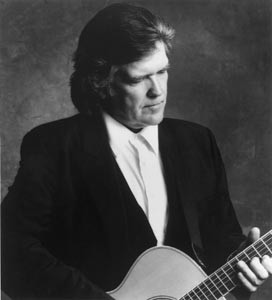
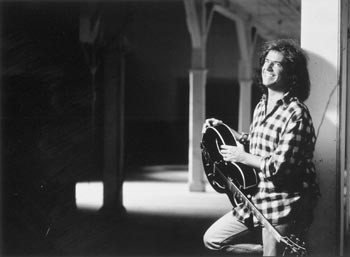
Storyteller: Singer/songwriter Guy Clark performs this week at the LBC.

Texas tunesmith Guy Clark is still livin’ his dream

By Greg Cahill

DURING HIGH SCHOOL, I had a summer job at a shipyard, building the last big wooden shrimp boats that were made before they switched over to steel,” says singer and songwriter Guy Clark, recalling his stint as a carpenter’s helper in the sweltering Gulf coast town of Rockport, Texas. “Those guys were master craftsmen and carpenters. Just to watch them work was a life-changing experience, seeing the finesse and the way they went about it.

“Their attitude was ‘faster is not better.’ I try to take that same approach with my songs, with quality taking precedence over quantity.”

That painstaking approach is evident on the newly released Keepers (Sugarhill), a set of live recordings that showcase Clark’s whimsy and country roots. The album marks a return to the North Carolina label for Clark, who has been hailed as everything from “the common man’s poet laureate” to “the 13th apostle.”

While Clark isn’t exactly a household name, his songs–including “The Last Gunfighter Ballad,” “Desperadoes Waiting for a Train,” “Heartbroke,” and “Oklahoma Borderline”–have scored hits for such country luminaries as Ricky Skaggs, the Highwaymen, Vince Gill, and Rodney Crowell.

Progressive country singers and songwriters like Crowell, Lyle Lovett, and Nanci Griffith often cite Clark as a major influence.

Few in the country genre have the same knack for storytelling as Clark, whose folksy vignettes and character studies often resonate with a gritty realism reminiscent the novels of John Steinbeck.

“A lot of my songs are based on real people, although there’s a certain amount of dramatic and poetic license, which I assume I’m entitled to take,” he explains with a laugh, during a phone interview from his home outside of Nashville.

In the past, those songs often spoke longingly of broken lives and unfulfilled dreams. For instance, “Let It Roll,” from his classic 1975 debut Old No. 1 (Sugarhill), told the story of a flophouse elevator operator and dying wino who had been jilted by a Dallas whore. It was inspired by a salty merchant seaman named Sinbad whom Clark and fellow Texan Townes Van Zandt had once met in a Houston bar.

These days, Clark is living his own dreams, writing some of his most lighthearted material and making the kind of records he wants to hear. The source of that inspiration is the vast West Texas prairie, a spiritual touchstone where Clark visits families and “savors the real barbecue” sold in local rib joints.

“Being a songwriter, there’s a certain independent stance you have to take–you’re not copying other people’s songs, you’re trying to create something of your own,” he says. “That’s the kind of thing you’re raised with in West Texas–or any other part of Texas–that you can do anything you put your mind to. After all, we’re just two or three generations away from being an independent nation in the Lone Star State. You’re imbued with that spirit growing up, and I think it spills over into songwriting as well as a lot of other fields of endeavor.

“You just can’t get rid of that.”

Guy Clark performs with Texas singer/songwriter-cum-sculptor Terry Allen (whose works will be on exhibit at the neighboring California Museum of Art at a special reception at 7 p.m.) on Friday, Feb. 20, at the Luther Burbank Center’s Merlo Theater, 50 Mark West Springs Road, Santa Rosa. 8 p.m. Tickets are $20. Call 546-3600 for information.

From the February 19-25, 1998 issue of the Sonoma County Independent.

© Metro Publishing Inc.

Osake Sushi Bar and Grill

0

Sake Service


Michael Amsler

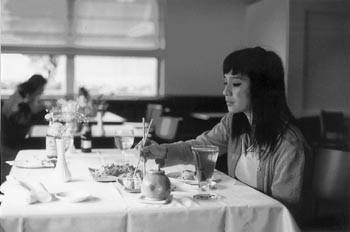
Making It with Maki: While Osake’s sushi is toothsome, the tempura and many of the house specials disappoint.

Osake not much to Chu on

By Paula Harris

GARY CHU’S NAME is synonymous with gourmet Chinese food in Santa Rosa. For years, customers have flocked to sample both traditional and creative dishes at Chu’s downtown restaurant, which projects a classy, pristine atmosphere several steps above many of the more humble ethnic establishments. Having successfully established this format, Chu is attempting to duplicate it in his new restaurant, Osake, which features Japanese and robata cuisine.

The atmosphere at Osake is also upscale, with a starkly handsome dining room. The silvery gray-green decor is sophisticated and cool–bordering on cold; the very low recessed accent lights are so dim that the green exit sign outglows them. There are no candles, totally bare expanses of wall, a long black curved sushi bar, and a large fish tank near the entrance. A cadre of servers is clad smartly in white shirts and black pants.

Osake has been open only for several weeks, so we are hoping that initial kinks can be worked out. Our first visit was a less than stellar experience. A chilled glass of sake smelled nasty (it was the glass, not the wine); an inattentive, unhelpful server seemed keen to rush us out; and our three-course meal left us so unsatiated that we dashed to the supermarket on the way home for cheese and crackers to stave off lingering hunger pangs. Not good. Especially after shelling out $40 for this fancy Japanese dining experience.

Our second venture into Osake faired better. Our server was patient and attentive, and the glasses were sparkling. But the food was still hit-and-miss.

The miso soup ($2), normally so comforting and life-giving in Japanese eateries, tasted watery and lacked substance; and the potato croquettes appetizer ($4.50) consisted of a dark, overcooked bread-crumb coating containing a smooth, mashed potato filling. Even the pool of mild barbecue sauce could not save the dish from tasting bland.

But the wakama salad of seasoned seaweeds ($4.50) was a winner, delightfully refreshing, cool and green, with spicy accents of chopped red chili pepper. The cold seaweed slivers were satisfying, not at all fishy in flavor and almost meaty in texture–like a vegetarian steak tartare.

Osake features a good variety of sushi. Both nigiri (raw or cooked fish atop seasoned rice) and maki (fish or vegetables rolled with toasted seaweed and wrapped in seasoned rice) are well represented. The sushi is ordered as a pair and prices range from $3 for most veggie, egg, and squid varieties to $9 for the spider roll featuring crispy, tasty soft-shell crab. The sushi was enlivened by sweet bites of exceptionally fresh pink slices of pickled ginger served on the side with a mound of wasabi. However, the sushi morsels were held together with an overly gluey rice that still tended to fall apart.

One of the recommended house specialties is the crispy chicken with daikon ($9.50). This was a disastrous mix of acidic daikon radish (which had a sauerkraut flavor) heaped atop chicken coated in more overcooked and greasy bread crumbs. The chicken was stuffed with apple slices and served on a bed of shredded white cabbage. It was a strange, heavy-handed German-Japanese concoction.

Another specialty, the robata vegetables ($7.95), cooked on an open fire grill, was disappointing. Pieces of sweet corn; slices of zucchini, onion, red and green pepper, and carrot; a couple of mushrooms; a single clove of garlic; a tomato; and a small bit of Japanese eggplant, arrived on slim wooden skewers–each holding one or two of the grilled vegetables. It was a less than generous serving, and no better than something you could whip up yourself on the backyard hibachi.

Our favorite dish of the evening was the grilled salmon with miso sauce ($12). Beautifully presented on a distinctive square plate, the fish was grilled so lightly that the coral-hued flesh remained delicate and moist. It came with a flavorful, semi-salty miso sauce and a portion of expertly cooked Japanese wheat noodles–an exotic and inventive combination.

But the vegetable tempura ($10.95) was a letdown. We were expecting light, crisp, and greaseless morsels. What we sampled were heavy, stodgy, and grease-laden. The veggies had no snap and the batter was too cloying; perhaps the cooking oil hadn’t reached an adequate temperature for frying.

The restaurant has a limited dessert selection. Probably the most exotic item is the green-tea ice cream ($2), which had a mild tea flavor and a rich, heavy texture.

Of course, you could always try a glass of sake for dessert. Nigori ($5 a glass) is a cloudy, country-style unfiltered sweet rice wine. Served cool, it resembles a glass of skim milk and tastes smooth and sweet.

There are 11 premium sakes available, each served room temperature in a chilled glass. Tsukasa Botan ($6 a glass; $60 a bottle) was medium-dry and easy to drink. Name Hage, described as “dry, crispy, and smooth” ($6 a glass; $60 a bottle), was sharper and more of an acquired taste. For those who prefer their sake steaming, there is hot Sho Chiku Bai. There’s also a selection of beers and wines. A Benziger 1995 Carneros Chardonnay ($20) made a pleasing partner to our selections.

Osake also has an adjoining karaoke bar open Friday and Saturday nights where you can warble away for $1.50 per song.

Osake Sushi Bar and Grill
2446 Patio Court, off Farmers Lane, Santa Rosa; 542-8282
Hours: Monday-Friday, 11:30 a.m. to 9:30 p.m.; Friday and Saturday, 5 p.m. to 1:30 a.m.; karaoke lounge open Friday and Saturday nights.
Food: Gourmet Japanese; sushi,robata grill specialties
Service: Inconsistent–can be helpful or aloof
Ambiance: Asian chic; cool and sparse with low lighting
Price: Moderate to expensive
Wine list: 25 items; large selection of premium sakes, small selection of beers
Overall: * * (out of four stars)

From the February 19-25, 1998 issue of the Sonoma County Independent.

© Metro Publishing Inc.

Rafael Film Center

0

House of Dreams


Janet Orsi

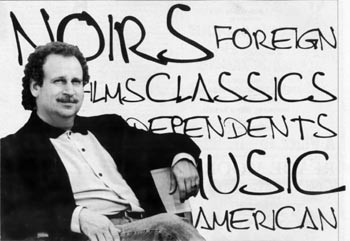
Cinema Paradiso: Mark Fishkin is creating a new North Bay art house.

Rafael Theater stirs after long slumber

By David Templeton

F ROM ACROSS the street, obscured by a gray torrent of rain, the time-worn art-deco marquee of San Rafael’s historic Rafael Theater rises up conspicuously above an unsightly barricade of wet wooden beams and weather-soaked boards, behind which hides the remainder of the building that was once among the most beautiful and popular movie palaces in the Bay Area.

Shut up tight since 1989–when the Loma Prieta earthquake caused the theater to be deemed seismically unsafe–the Rafael’s future seemed as dim as the now-ruined light bulbs still outlining the fading marquee. Thanks to the Film Institute of Northern California–which two years ago renovated the classic Lark Theatre in Larkspur–working with a fierce cadre of North Bay film buffs and some expert fundraisers, the Rafael Theater is just beginning an astonishing transformation: not only is it scheduled to open again by the end of this year, but it intends to do so as one of the Bay Area’s hottest new filmgoing destinations, a living museum of cinematic history that will trace the art of the movies from the silent-film era straight into a high-tech, interactive future.

“It will be a museum of the moving image,” says Petaluma resident Mark Fishkin, executive director of the Film Institute, which also produces the Mill Valley Film Festival. “We’ll be able to greet people in the lobby, saying, ‘Come on in. This is what movies used to be like.’ And they can have that experience, and then we’ll say, ‘Now, let’s show you what movies are becoming.'”

Fishkin is standing in the theater’s lightless lobby–a work crew accidentally disabled the electrical power box–inches away from a curtain of rain leaking onto the broken-tile entryway in an atmospheric chorus of drips and splashes that echo all through the cavernous expanse of the room.

Ann Brebner, project chairperson for the Rafael Film Center, as the new three-screen complex will be called, shines a flashlight around the lobby, illuminating various architectural features of the nearly 100-year-old building, now fully retrofitted to appropriate seismic standards. Brebner points out the sweeping balcony, ornate wooden moldings, and a marvelous faded mural of an unclad female figure rising up out of a swirling mist.

“Silent movies began playing here in 1918,” Brebner relates. “It was the Orpheus Theater then, until it burned down in 1937 and was reopened in ’38 as the Rafael.” She shines the light on the mural again. “She was covered up by mirrors when we found her,” she says, feigning a gasp. “Apparently they hid her in 1961, when the Rafael began showing a lot of Disney movies. It was evidently deemed inappropriate for children to walk in and see a naked lady up on the wall.”

T HE PROJECT IS A long-awaited dream for Fishkin and Brebner. The finished Rafael Film Center will feature a 350-seat theater in the original auditorium–restoring the existing art-deco features–minus the original balcony, which will be converted into a 125-seat theater in the style of the Orpheus’ silent-movie house. A third theater, with 90 seats–reflecting a high-technology film theater of the future–will be established in the adjacent building, directly over the planned cafe that will lead into the main lobby of the complex.

All this was supposed to have opened last fall, but production was halted when fundraising efforts ran out of steam. An expanded board of directors has created a special committee of experienced fundraisers to find the necessary cash to complete the $6.8 million job. At first hoping to avoid taking on debt, the Film Institute has now given in, accepting a $3 million construction loan and taking on an additional $3 million bank loan.

“We hope to raise the remaining monies to pay off the loans sometime during the construction period,” Fishkin says. “But at least we now have the flexibility to continue with the project.”

Donations are actively being sought, and a number of innovative enticements are being offered. For instance, the first donor to contribute at least $1 million will receive the honor of lending the name of their choice, perhaps in memory of a loved one, to the theater complex as a whole. That name will be the official corporate name of the facility, used in all literature and on the letterhead. For smaller donations, naming rights will be given on everything from the individual theaters to the upstairs lobby and the grand staircase.

In addition to the Film Center’s museum status, the complex is expected to serve as a major educational asset–with classes invited in to view films that correspond to the students’ curriculum–as well as to be a desirable environment in which to view small independent movies, and even rare specialty films that will be available nowhere else.

“For instance, some marvelous films are available in several different languages,” Brebner enthuses. “We envision being able to show one film in three different languages, all at the same time, a different language for each screen. We want people to walk by the theater and to be able to say, ‘There’s always something in there for me. There’s something that relates to who I am and where I come from.’

“That,” she smiles, “is part of our dream.”

To contribute to the Rafael Film Center’s fundraising campaign, call 415/383-5256.

From the February 12-18, 1998 issue of the Sonoma County Independent.

© Metro Publishing Inc.

Romantic Wines

0

Blushing Cup


Michael Amsler

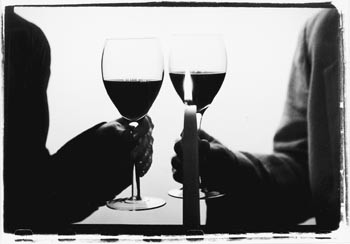
Roses Are Red, Violets Are Blue, This Wine Is Great, and So Are You: You don’t have to be a poet to laud a night of love.

Seeing red is just right for romantic wines

By Bob Johnson

AS A SINGLE DAD for more than a dozen years, it has been a long time since I’ve done any serious dating. When it comes to romance, I’m more than a bit rusty. In order to obtain some truly useful information for a report on romantic wines–in honor of the February romance ritual known as Valentine’s Day–I called upon a female acquaintance for counsel.

“What,” I asked her, “is your idea of the perfect romantic date?”

“Hmm,” she hummed. “We’d get dressed up and go out to dinner–not to eat, but to dine. We’d have some good conversation, some good food, some good red wine, and then, later on … well, you know.”

Of course, I know. I may not have been dating much lately, but I’m not dead. After the dressing up, the good conversation, and the good food would come … good dessert!

But back to the good wine.

Without question, a romantic dinner is one of those occasions that cries out for wine. And not just any wine. If you’re trying to impress a date, this is the time for red wine.

Fortunately, red wine isn’t hard to find. It’s produced in virtually every wine-growing region around the world, although the quality lessens as the climate grows cooler. In Italy, where some of the world’s most romantic men reside (so I’m told by the aforementioned female friend), a red wine is called rosso. In France, it’s rouge. And in Spain, it’s tinto.

The United States makes its fair share of red wine, too, with most answering to the name of a varietal grape: cabernet sauvignon, merlot, zinfandel, and so on. And some of America’s finest red wine is vinified in Sonoma County.

In fact, one of the most highly sought-after cabernets in the world is the Alexander Valley bottling from Silver Oak. Other outstanding Alexander Valley cabs come from Jordan, Geyser Peak, Chateau Souverain, Simi, and Clos du Bois.

In the mood for merlot? You can’t go wrong with Sonoma County bottlings from St. Francis, Matanzas Creek, Chateau Souverain, or Armida.

The Dry Creek Valley is zinfandel country, with excellent renditions provided year after year by Lytton Springs, A. Rafanelli, Quivira, J. Pedroncelli, Alderbrook, and Mazzocco.

No, you don’t have to go “over the hill” to find world-class bottlings. More good news: If you’re a romantic on a budget, red wines of comparable quality from Sonoma County typically cost less–sometimes much less–than their Napa Valley counterparts.

The Sonoma County red wines that follow are rated on a scale of one to four corks, with one cork being equivalent to first base on the “make-out” scale; two corks equaling second base; three corks equaling third base; and four corks equaling a home run. Batter up! …

Field Stone 1994 Alexander Valley Cabernet Sauvignon
($13-$15)
This is a wine that has been on the market for several months, yet for some inexplicable reason can still be found on many wine shop shelves. The nose conjures up images of caramel, cream, and chocolate-covered cherries, while the flavors lean toward black cherry, cocoa, and cassis. As flavorful and satisfying as many cabs costing twice as much. Rating: 3 corks.

Cardinale 1993 Meritage ($60)
The Wine Spectator (referred to simply as “God” by wine geeks) recently panned this bottling from Kendall-Jackson and, frankly, I don’t get it. While it’s not as fruit-forward as the 1992 version and will benefit from a few years in the bottle, this still is great juice. The grapes used in the blend come from both Sonoma and Napa counties, and the resulting wine is a smorgasbord of flavors, ranging from raspberries to plums and from chocolate to vanillin oak. Rating: 3.5 corks.

Stonestreet 1995 Alexander Valley Merlot ($21-$24)
If it didn’t say merlot on the label, one could confuse this wine for a cabernet. It’s big and bold, and the fact that it’s unfiltered allows all the aromas and flavors of the fruit to shine. It smells like a combination of coffee roastery at daybreak and mom’s kitchen when she’s baking a chocolate cake, and it’s loaded with jammy fruit and smoky oak flavors. Certainly a candidate for aging, but why wait? Rating: 3.5 corks.

J. Fritz 1995 Dry Creek Estate Merlot ($15-$18)
If you like the taste of fresh berries, you’ll love this wine. And if you enjoy the floral aroma of cabernet franc, this also is the wine for you; cab franc comprises 20 percent of the blend. Balance is provided by just a hint of vanillin oak. Like the Field Stone cabernet, a true bargain. Rating: 3 corks.

Supplies of these wines vary; the J. Fritz merlot, in particular, could sell out quickly. That’s the bad news. The good news is that wines like these tend to be gobbled up by restaurateurs, who include them on their wine lists. Furthermore, all are wonderful food wines, making them ideal companions to a romantic dinner … no matter how you define “romantic.”

From the February 12-18, 1998 issue of the Sonoma County Independent.

© Metro Publishing Inc.

Pat Metheny

0

Adventures in Guitarland


Through a Looking Glass: Jazz guitarist Pat Metheny performs Feb. 23 at the Luther Burbank Center.

Metheny explores uncharted terrain

By Greg Cahill

ASK PAT METHENY about detractors who have complained over the past 20-odd years that he has bent all the musical rules and the acclaimed jazz guitarist and composer just laughs. “In my case, music is something that goes way beyond job description,” he says. “It’s something that is inside my bones. It’s something that I’ve devoted virtually every waking minute to since I was 11 years old or so.

“The way all of that gets dissected or discussed [by others] is irrelevant to the reality of the music itself.”

These days, the Grammy-winning Metheny–smart, articulate, and eminently likable–is still breaking musical barriers with his trademark blend of experimental technology and melodic improvisation. During a rare 12-month “break” in New York, Metheny reunited last year with his own group, featuring longtime keyboardist Lyle Mays, to record Imaginary Day (Warner), an adventurous, texturally rich set that highlights his own remarkable fretwork on a 42-string guitar, among other instruments. The bold album veers wildly from a bluesy version of Indonesian gamelan music to an edgy techno blast reminiscent of Nine Inch Nails. Last year, he participated in British free-jazz guitarist Derek Baily’s exploratory quartet that resulted in a three-CD live document, The Sign of 4 (Knitting Factory). His 1997 collaboration with bassist Charlie Haden, Beyond the Missouri Sky (Verve), topped the jazz charts last year and is still selling well.

More recently, he contributed to bassist Marc Johnson’s newly released The Sound of Summer Running (Verve), which teams Metheny for the first time with avant-jazz guitarist Bill Frisell. “It was a dream,” he says of the project. “It was like neither one of us could do anything wrong.”

THAT PRETTY MUCH sums up Metheny’s career of late. One of the few young players to emerge with his integrity intact from the experimental ’70s fusion era–a movement that quickly dissipated into a mix of overindulgent wank and pop-lite fluff–Metheny doesn’t mince words when the topic shifts to the media’s love affair with such rebop artists as Wynton Marsalis. “It’s having a really minor effect on the music and virtually no effect on the culture at large,” he says. “Frankly, if I want to hear music that’s in that zone, I’m going to listen to Duke Ellington or Miles Davis or John Coltrane. Unfortunately, I haven’t heard anybody who’s advanced that way of playing or even come close to the level of playing expressed by the original guys.

“The famous Miles quote is, ‘Didn’t we do it right the first time?’ The answer is, ‘Yes, they did.'”

While he apologizes for any disrespect he may show his peers, Metheny feels strongly that improvisational musicians have a duty to chronicle the times in which they live.

“When you listen to a Louis Armstrong record from the ’20s, you not only get this great music, you get this whole vibe, almost a look at how people talked to each other and the clothes that they wore. With Miles Davis in the ’60s, you also got a sense of the instrument technology and the way people heard things. The things that made that particular moment in culture distinctive are very often embodied in the casual, almost offhand narrative playing that jazz players are in the business of doing,” he explains.

“When you’re in the middle of the times, like we are right now, we’re so inside it that it doesn’t seem to us like there’s anything special going on. But there are things about our time that are going on right now that we can’t even see. Because of the improvisational nature of jazz, the sort of documentary quality that a lot of jazz recordings have, there is this extra thing that will be real valuable for people in the future when they go looking for a sense of what was happening in our time.”

AND WHERE does Metheny’s work fit into the overall jazz picture? “My particular relationship with the music has nothing to do with the idiom–I don’t care if it’s called bebop or fusion, and that’s a term that emerged eight or 10 years after I’d already started doing what I was doing. I was just playing what I wanted to play,” he insists.

“As for the word jazz or any of these other words that get thrown around to describe certain idioms, ultimately and with all respect to everybody, I could give a shit. It has no real meaning to me.

“In the same way as whatever was said about Bach or Mozart or Frankie Valli and the Four Seasons, all of that criticism is irrelevant in the face of what they actually did. The music speaks in the language of music perfectly fine. In my case, the thing that will matter is what it all sounds like in the end. How it fits into the jigsaw puzzle of modern contemporary culture is something that it’s fun to sit around and talk about over dinner for a half an hour.

“But ultimately, it’s just that–just a bunch of guys talkin’.”

The Pat Metheny Group performs Monday, Feb. 23, at 8 p.m. at the Luther Burbank Center for the Performing Arts, 50 Mark West Springs Road, Santa Rosa, Tickets are $29.50. For details, call 546-3600.

From the February 12-18, 1998 issue of the Sonoma County Independent.

© Metro Publishing Inc.

The Scoop

Fornigate, Part II

By Bob Harris

HERE’S SOMETHING unexpected: Bill Clinton’s recent troubles may have diminished him in the eyes of some Americans, but opinion polls show that most of us actually couldn’t care less. Even though most think he hasn’t been entirely honest, Clinton’s approval rating is at an all-time high. What exactly does that mean?

Looking more closely, the polls also show that Clinton’s numbers went down only while his denials were carefully worded. “The charges I have seen are untrue” certainly sounds like there might be something we don’t know yet. However, once his denials became absolute, the approval ratings began to increase, rising dramatically after a State of the Union address that refused even to acknowledge the scandal’s existence.

The number of people who believe that illicit sex took place has remained fairly stable. So Clinton hasn’t changed anybody’s mind, though he has changed how they feel about what they think. The only logical conclusion: we really don’t mind when politicians lie. The only thing we do mind is when they do it unconvincingly.

Nixon, for example, was popular when he lied confidently. Look at the old newsreels. In the 1950s, he seemed to truly believe his congressional opponents were communist fellow travelers. Boom, bang, instant VP. But later on–about the time he claimed to have a “secret plan” to end the war in Vietnam (when in fact some of his aides were actually trying to derail peace talks)–he seemed to believe his own baloney less and less. Watch his face. By the time of the resignation speech, you could see in his eyes that even he knew there was hardly any point in pretending anymore. And so off to San Clemente he went.

JFK, on the other hand, was terrific. In the 1960 debates, Kennedy accused Nixon of being soft on Cuba, knowing full well (having earlier received a CIA briefing himself) that Vice President Nixon was in the loop on the CIA’s secret anti-Castro programs. No way could Nixon respond–hey, here, look at all this secret stuff we’re doing–so JFK nailed Nixon with a false charge, looked good doing it, and we’ve loved him ever since.

(That said, the current cottage industry in linking Kennedy to Marilyn Monroe, Sam Giancana, the Sasquatch, and assorted other sordid trysts isn’t to be trusted, either. If you follow the footnotes on these claims closely, you’ll find that they’re mostly facile repetitions of never-proven charges made 30 years ago and claims of “witnesses” like Judith Campbell Exner, whose stories grow larger and more detailed as years pass–precisely the opposite of genuine human recollections. However, following footnotes isn’t something many writers often do.

Similarly, virtually no evidence other than her say-so exists to support Monica Lewinsky’s story, but the press and public continue to act is if everything has already been proven.

Fair enough. Clinton wanted to be just like JFK; he’s finally getting the rest of his wish. If Hillary ever wears a pink pillbox hat, the first thing Bill should do is duck.

Ronald Reagan? Same deal: He could look us right in the eye and claim that 80 percent of air pollution came from trees, that Jimmy Carter never debated Gerald Ford, or that Grenada was a threat to national security–and say it all with such sincerity that it had to be true. Sure, Trident nuclear missiles can be recalled after launch. Sure, the Panama Canal Zone is U.S. soil. Sure, the Contras were the moral equivalent of our Founding Fathers. Sure, the congressional ban on aid to the Contras was never intended to apply to something like, oh, aid to the Contras. …

We loved that lying buffoon so much we’ve renamed Washington National Airport after him.

George Bush broke records for popularity during the Gulf War, when misplaced patriotism allowed him to lie with absolute confidence: Kuwait was a democracy; the U.N. coalition was more than a fig leaf for U.S. policy; Iraqis really ripped babies from incubators; smart bombs and stealth airplanes really work; and the war wasn’t ultimately about oil. We tied ribbons and sang songs and gave people dirty looks if they didn’t play along.

But Bush lost our confidence when he lost his own. He never really seemed to believe that the tax hike he approved wasn’t really a reversal of his “read my lips” pledge; that the best way to create jobs is by cutting the tax on capital gains; or that Dan Quayle was actually qualified for the job. And so off to the golf course he went.

This preference for leaders who can (a) tell us what we want to hear, even if it’s illogical or just plain false, and then (b) seem to be speaking the truth, even when we’re already certain they’re being dishonest, might explain why voters reward not the clearest thinkers but the most delusional.

So what the latest polls actually reveal isn’t anything unique. All it means is that we’ve decided that Clinton is officially in the major leagues. We don’t actually believe what he’s saying is true, but he says it so convincingly that we like having him as our leader.

Which leads me to make you this promise: From this day forward, I promise that I will lie to you on a regular basis. But I also promise to do my personal best to make sure you feel good about the way I do it.

It’s the least I can do to earn your trust.

From the February 12-18, 1998 issue of the Sonoma County Independent.

© Metro Publishing Inc.

Talking Pictures

0

Eccentric Glory


Gemma La Mana

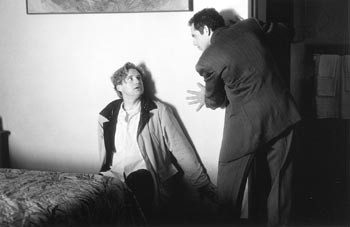
Last Action Heroes: Bill Pullman and Ben Stiller create original characters.

To each his own in ‘Zero Effect’

By David Templeton

David Templeton drops by the home of renowned eccentric Mickey McGowan–a frequent Talking Pix guest–to discuss the delightfully off-the-wall mystery Zero Effect.

FROM THE STREET, Mickey McGowan’s tree-lined San Rafael house is surprisingly indistinct, almost invisible. It is not till you mount the front steps and come face to face with a front porch strewn with old, plastic doll heads and piles of floppy, shockingly weathered teddy bears, and a windowsill lined with weird, staring statuettes, that you realize you’ve entered the world of someone unencumbered by run-of-the-mill notions of standard home decorating.

This, in spirit at least, is the Unknown Museum, a world-renowned holding tank of odd, television-inspired memorabilia from the ’50s, ’60s, and ’70s. Although the museum is currently closed to the public, McGowan is featured along with the museum in the brand-new book Self-Made Worlds: Visionary Folk-Art Environments (Aperture, 1998). McGowan dwells happily with his wife, Finnlandia, here in this off-kilter wonderland of quirky fond remembrances and, in terms of the sheer volume of artifacts, complete sensory overload.

“If we were open, it would be far more chaotic,” says McGowan of the museum, leading the way into a kitchen cluttered with old metal lunchboxes, giant plastic hamburgers, jars containing pickled Pee-Wee Hermans, and open cabinets crammed tight with food products popular 40 years ago. “There’d be hanging mobiles of white sandwich bread, plus bathroom scales laid out like stepping stones to follow.”

I am reminded of a line in the foreword to Self-Made Worlds, describing the featured artists: “Remarkable manifestations of the idiosyncratic; the eccentric glory of the human imagination.”

Which brings us to Zero Effect.

Starring Bill Pullman as Daryl Zero, the world’s most private “private eye,” Zero Effect is a small, loopy film with original ideas and a twisted, emotionally satisfying foundation. Daryl Zero, one of the freshest characters to hit the screen for some time, is a master detective who is terrified of the world outside his heavily guarded apartment, a man whose eccentricities threaten to keep him apart from the woman he suspects is a blackmailer, and with whom he unexpectedly falls in love.

“I loved this movie,” McGowan exclaims. “Real, true, affectionate love. And Daryl! What a wounded puppy. I loved him immediately. You could tell right away that he’s mentally ill, obviously, but he’s a genius. From the moment you first see him, you know that if he didn’t just happen to have it together enough to do the private-eye thing, he’d be out on the streets or in some mental hospital somewhere, like a lot of crazy artists who get into a weird eccentric lifestyle and then can’t channel it into something productive.

“He’s a heart-on-my-sleeve, take-me-or-leave-me, I’m-messed-up, I’m-paranoid kind of a guy, standing there saying, ‘Here I am!’ Someone like me can relate to someone like Daryl Zero completely.” Laughing, he adds, “Well, not completely. Let’s just say I relate on many levels.”

For example, McGowan frequently employs a Zero-like mindset while scouring garage sales and exploring dumpsters in search of artifacts for the museum.

“I like his philosophy of ‘Why be looking for one thing when you can be looking for everything or anything?’ That’s the nutshell of his professional approach,” McGowan says, standing up to make some tea. “That’s the way I am when I go out to a garage sale or an estate sale: I’m looking for whatever happens to be in front of me. I don’t go out with something particular in my head.

“That’s conceptual shopping,” he adds, “and I certainly don’t subscribe to that.”

On the subject of eccentricity, my curator host is a practiced expert.

“Eccentricity is anything deviating from the norm, of course, whatever that norm might be,” he says, and then observes that in the book Incredibly Strange Music (ReSearch, 1993), in which he discusses his immense collection of rare, hard-to-find records, “I defined strange music like this: take Barry Manilow, who is not particularly strange in the United States. Well, all right, true, he’s strange, but he’s mainstream, or was at the time I first said that.

“But if you take a Barry Manilow record into a village in the African wilds,” he insists, “it would seem eccentric, at least certainly odd or strange.

“Eccentricity is not a bad thing,” he continues, returning to the table. “It’s actually very good. I don’t mind it when people label me an eccentric. I’d be surprised if they didn’t at this stage. I mean … ,” he opens his eyes wide and waves his arm in a sweeping circle, “… just look around you.

“There are sometimes unkind assumptions made about eccentric people, though,” he says. “I’ve been visited by reporters in the past who flat-out ask me things like, ‘Was your father as crazy as you are?’

“When the museum reopens, I plan to have a little card to hand out to reporters, with a list of questions I will no longer be bothered with. Or,” he leans forward, having a flash of inspiration, “maybe I’ll attach a pull-string to myself–like many of the great dolls of our time–with 12 standard answers to any dumb question.

“Reporters could simply pull my string and then just quote whatever comes out,” he grins, clearly warming to the idea.

And what answers would he program himself to say?

“Oh you know, the classics,” McGowan replies. “‘I love you,’ ‘Please play with me,’ and, just in case, the ever-popular ‘Go away. I want to be alone now.'”

From the February 12-18, 1998 issue of the Sonoma County Independent.

© Metro Publishing Inc.

A Surprise Party

0

Middle Rage

By Daedalus Howell

IF EVER A WIZ there was, Fred Curchack is one because, because, because, because, because, because–because of all the wonderful things he does. Petaluma’s Cinnabar Theater is host to playwright/performer Curchack’s latest foray into solo theater–A Surprise Party–in equal parts a black comedy for graying baby boomers, a one-act suicide note, and testimony that introspection assists the licking of mortal wounds.

An adroit hybridization of live performance and video projection, A Surprise Party hinges on an emotionally defeated man intending to voluntarily lie down for the dirt-nap on his 50th birthday. Yes, it is reminiscent of Swiss-born Hermann Hesse’s quasi-autobiographical tome to archetypal psychology, Steppenwolf.

In Hesse’s novel, Harry Haller (the scantily camouflaged author) achieves spiritual gestalt after a Jungian-doused venture into his unconscious–symbolized by the Magic Theater, a psychic cabaret of projections, deflections, and divertissements.

Correspondingly, in Curchack’s work, Theo Shmaltzsky (a writer/performer and paper-thin simulacrum of the similarly employed and aged Curchack) is also going to off himself at the half-century mark, but Shmaltzsky’s Magic Theater is not simply a metaphor–you actually pay to sit there, in the dark, in Petaluma. With remarkable poise and humor, Curchack has forged an erudite and tumultuous production that ponders the interrelation of art and artist, the fleeting notion of identity, and a generation’s fear of inconsequence.

But is it autobiography?

Not one liable to libel, Curchack forbids audiences to perceive A Surprise Party as a staged roman à clef and in the program cautions that “any resemblance of any fictional people to any real people is imaginary.” Hmm. One cannot help but scour for a semantic loophole.

The video projection of roughly hewn camcorder footage (the quaint production values bring a deliberate, homemade familiarity to the piece) allow Shmaltzsky to interact with a Fellini-like roster of personalities who arrive to gleefully witness him do himself in.

Curchack portrays an exhausting 17 characters in all, including a cigar-chewing ex-wife, ex-girlfriends (both living and dead), his parents, his children, a mentor, and a cavalcade of friends that boasts a pair of deluded, upscale New Agers and the psychotherapist mother of a suburban cannibal in its ranks.

As writer and actor, Curchack invests each member of this guest list with poignancy and vim–even his less-developed characters, those perceptibly ripe for caricature (the requisite “Guido” and a tattooed punk son), are spared their default settings and effloresce marvelously.

Likewise endowed with dimension and shading is the unseen video-narrator, referred to as Vox, presumably Curchack’s abbreviation of the Latin term vox populi, meaning “voice of the people” but often used to imply judgment. Hence, the omnipotent, tracheotomy-voiced Vox (undoubtedly inspired by the evil computer-intelligence Alpha Soixante in Jean-Luc Godard’s Alphaville) offers a continuum of hypercritical analyses of Shmaltzsky that encompasses such piquant observations like “[He] can’t see his prick past his paunch,” as the video proves with an image of the character’s bare, genital-concealing midsection.

Throughout the show, Curchack evinces his knack for comic hyperbole and pedagogic digression. At one point, he demonstrates the function of phonemes and diphthongs by vocalizing in tandem with a tight shot of his gaping, video-projected mouth. The effect is bedeviling but eerily irresistible.

Compounding the work’s self-referentiality is the fact Curchack shot his video accompaniment in an interior beset by mirrors that often reveal the video camera either mounted on a tripod or suspended by his own grip. Be assured this is not just happenstance: Curchack’s authoring is total; perceived nuisance is nuance.

With no production staff (only Vicki Pesetti provides assistance during the performances), Curchack is not only the director and star of The Surprise Party, but also the designer of the lighting, costumes, makeup, and sound effects. Such totality of effort makes for exquisitely intimate theater, and Curchack refreshingly manages to stifle any issue of narcissism and self-adulation despite the work’s confessional tone.

Empathetic audiences beware: Curchack so convincingly performs the exegesis of Shmaltzsky’s suicide that it is difficult to quell the impulse to discreetly pass him a crisis hotline number after the show.

Theater-lovers should pray that Curchack survives this production.

A Surprise Party bursts forth Friday-Saturday, Feb. 13-14, at 8 p.m. at the Cinnabar Theater. 3333 Petaluma Blvd. N., Petaluma. Tickets are $8-$12. 763-8920.

From the February 12-18, 1998 issue of the Sonoma County Independent.

© Metro Publishing Inc.

Civilian Police Review Boards

0

Deadly Force


Michael Amsler

Mad as Hell: Copwatch organizer Jeff Ott is calling for an independent probe into 8 recent police-involved killings in the county–an unprecedented number. But a civil rights panel formed after the shooting last year of Kuan Kao, pictured on the right, by a Rohnert Park police officer will review only deadly-force policies.

Forum on police-involved deaths sparks hot emotions

By Paula Harris

T HERE’S DEFINITELY a lack of mutual communication and respect,” says community activist and Copwatch organizer Jeff Ott when asked to sum up the state of relations between local law-enforcement officials and social justice groups in the county.

At this point, that strained relationship has become even more awkward as the much-anticipated public hearing by the U.S. Commission on Civil Rights–which has been reviewing eight local police-involved deaths in the past two years–approaches on a swirl of allegations from those on both sides of the issue.

That hearing was prompted by the April 29 shooting of Kuan Chung Kao, 33, by Rohnert Park Police Officer Jack Shields in a late-night incident that drew national media attention and sparked charges by community activists that the killing was racially motivated.

No one knows quite what to expect from the upcoming hearing, but it’s drawing mixed feelings.

By all accounts, the Feb. 20 hearing will be a vastly toned-down version of what the commission had originally conceived. Instead of a joint forum convened equally by state and federal officials, 11 of the commission’s 16-member State Advisory Committee will preside over the meeting, with the feds announcing last week that they will take a diminished role. In addition, the commission has reversed its decision to subpoena witnesses after objections from law enforcement officials led to a letter of protest from Santa Rosa Police Chief Mike Dunbaugh.

Dunbaugh asked the commission to reconsider its involvement because of the concerns of officers who had already been cleared of any wrongdoing in the cases. “Some people have gone through multiple layers of review and have been exonerated and vindicated,” he says. “They’ve been wondering the whole time if they are going to have to go through this again.”

He and other officials will attend voluntarily, Dunbaugh says, adding that he has not yet been informed about the meeting’s agenda or format.

Tom Pilla, a civil rights analyst for the U.S. Commission on Civil Rights, says the forum will include an open session at which individuals can discuss law enforcement policies, practices, and procedures. Within several months, the committee will distribute a report and make recommendations to the U.S. Justice Department. The White House also gets a copy.

“This is going to be a starting point,” says Victor Hwang, a civil rights attorney with the Asian Law Caucus who has been critical of the handling of the Kao case. “We’re not going to solve community issues without open dialogue. The good thing [about the forum] is the recognition of how serious a problem this is. After the forum, it will be up to local folks and law enforcement to work together to build some long-term solutions.”

Mary Frances Berry, chairperson of the U.S. Commission of Civil Rights, has emphasized that the hearing will not focus on individual cases of alleged police brutality. That is upsetting to some victims’ families who say they want impartial, independent investigations. The cases already have gone through internal affairs investigations and, in some instances, through a review by the Sonoma County District Attorney’s Office. All the officers involved in the incidents have been cleared.

It appears that the only outside review of the cases most likely will take place in the civil courts, where there are several wrongful-death lawsuits pending over the police-involved deaths, including a $50 million suit filed last week by Kao’s widow, Ayling Wu, against Rohnert Park officials.

“We’re stuck with the court process, which should be the last resort, but in Sonoma County it seems to be the only resort for these sorts of questions,” says John Crew, director of the Police Practices Project for the ACLU of Northern California.

Still, he believes the upcoming forum will provide “a powerful outside analysis” of the deadly-force policies of the police in the county. “We’ve had too much secrecy about police policies, practices, and procedures in Sonoma County,” he says. “If flaws are identified, the forum can encourage reform. If there are no flaws but some misunderstandings, the forum can help correct or explain them.”


Michael Amsler

Under Review: Santa Rosa Police Chief Mike Dunbaugh says he is willing to consider civilian police review boards–if they’re handled correctly.

NOT EVERYONE AGREES. Some critics charge that local police have engaged in cover-ups, and fear that law enforcement officials are holding themselves above the law. “These people are playing judge, jury, and executioner,” laments Darlene Grainger, the twin sister of Dale Robbins, 40, a local man who was shot dead in the lobby of the Santa Rosa Police Department in January 1996 after allegedly wielding a metal steering-wheel club lock at officers. A federal judge subsequently cleared the officer involved in the shooting, but a Sonoma County grand jury report criticized the department’s own internal investigation of the case.

Dunbaugh says the countywide protocol of investigations is currently being rewritten.

Grainger alleges, however, that questions surrounding the circumstances of her brother’s death have never been answered.

The string of officer-involved deaths of eight men in a two-year period began just days after the March 29, 1995, execution-style shotgun slaying of popular Sonoma County Sheriff’s Deputy Frank Trejo, 58, by state parolee Robert Scully, 38. Trejo was the first officer killed in the line of duty in the county in 20 years, and his murder caused some to speculate about police now having a “payback” motive.

“I don’t think there is a pattern–it would be a mistake to make that allegation,” responds Dunbaugh. “What needs to be looked at is that officers are confronted more often in dangerous situations, so if there’s an increase of those situations, then there’s an increase in the use of force to counteract this. The job is much more complicated and riskier. Officers are confronted weekly with people who want to hurt them.”

The Santa Rosa Police Department hires just one out of every 100 candidates tested, he says. “We do a good job of screening people who want to do this job for the wrong reasons.”

A Sept. 17-23 edition of the SF Weekly noted that statistics show that “police in bucolic Santa Rosa kill more citizens per capita than cops in crime-ridden cities like San Francisco and New York.” But Dunbaugh says the stats don’t support the notion that there are more officer-involved shootings of late. “In the last five years in Santa Rosa, there were seven shootings, but there were 11 the five years before that,” he observes.

As for the criticism, Dunbaugh contends that most of the public support the police. He insists that such local activists as the Purple Berets and Copwatch–which have been highly critical of local law enforcement’s actions–are trying to alter that perception.

“[These groups] have every right to have a point of view and be involved in social issues,” he says, “but there are some misrepresentations and what appears to be a strong political agenda overriding senses of good judgment and honesty.”

DURING THE FALL, a coalition of law enforcement officials and local community groups met to iron out their differences. Talks broke down in November after two surprise announcements by law enforcement officials: a county grand jury would design a new review policy to examine all future officer-involved deaths, and plans were under way to create a new civilian police review panel to study police procedures, but not specific cases.

Activists, who had been pushing throughout the year for county and municipal civilian police review boards, felt betrayed by the announcements because the new policies were formed without their involvement. Law enforcement officials countered that the groups had the mistaken impression that the proposed review panel would include representatives from police agencies.

They argued that the grand jury is a randomly selected group of voters and could serve as a model for the panel.

But Nancy Wang of the Redwood Empire Chinese Association and others complained that this is a poor example, since the grand jury is controlled by the district attorney and holds closed-door meetings.

Dunbaugh says that press reports claiming he was against a citizen’s police review board are inaccurate. He now says he is willing to consider it, but adds, “What I’ve experienced so far has been false information, emotion, political agendas, no concern for money or the people it will impact, and an interest in kangaroo courts by a small group of vocal individuals with significant special interests.”

The U.S. Commission on Civil Rights public hearing will be held on Friday, Feb. 20, from 8.30 a.m. to 5 p.m. in Room 410 of the State Office Building, 50 D St., Santa Rosa.

From the February 12-18, 1998 issue of the Sonoma County Independent.

© Metro Publishing Inc.

Solomon Says

Devil's AdvocateBy Norman SolomonGLORY DAYS are here again! Not that I'm complaining about the last few years. Some great events have made headlines. But, as the Grim Reaper, I'm not easily satisfied. And right now, I can hardly contain my excitement. With prospects growing for high-tech weaponry to shatter a lot of bodies soon, I deeply appreciate the enthusiasm...

Guy Clark

Lone StarMichael AmslerStoryteller: Singer/songwriter Guy Clark performs this week at the LBC.Texas tunesmith Guy Clark is still livin' his dreamBy Greg CahillDURING HIGH SCHOOL, I had a summer job at a shipyard, building the last big wooden shrimp boats that were made before they switched over to steel," says singer and songwriter Guy Clark, recalling his stint as a...

Osake Sushi Bar and Grill

Sake ServiceMichael AmslerMaking It with Maki: While Osake's sushi is toothsome, the tempura and many of the house specials disappoint.Osake not much to Chu onBy Paula HarrisGARY CHU'S NAME is synonymous with gourmet Chinese food in Santa Rosa. For years, customers have flocked to sample both traditional and creative dishes at Chu's downtown restaurant, which projects a classy, pristine...

Rafael Film Center

House of DreamsJanet OrsiCinema Paradiso: Mark Fishkin is creating a new North Bay art house.Rafael Theater stirs after long slumberBy David TempletonF ROM ACROSS the street, obscured by a gray torrent of rain, the time-worn art-deco marquee of San Rafael's historic Rafael Theater rises up conspicuously above an unsightly barricade of wet wooden beams and weather-soaked boards, behind which...

Romantic Wines

Blushing CupMichael AmslerRoses Are Red, Violets Are Blue, This Wine Is Great, and So Are You: You don't have to be a poet to laud a night of love.Seeing red is just right for romantic winesBy Bob JohnsonAS A SINGLE DAD for more than a dozen years, it has been a long time since I've done any serious dating....

Pat Metheny

Adventures in GuitarlandThrough a Looking Glass: Jazz guitarist Pat Metheny performs Feb. 23 at the Luther Burbank Center.Metheny explores uncharted terrainBy Greg CahillASK PAT METHENY about detractors who have complained over the past 20-odd years that he has bent all the musical rules and the acclaimed jazz guitarist and composer just laughs. "In my case, music is something that...

The Scoop

Fornigate, Part IIBy Bob HarrisHERE'S SOMETHING unexpected: Bill Clinton's recent troubles may have diminished him in the eyes of some Americans, but opinion polls show that most of us actually couldn't care less. Even though most think he hasn't been entirely honest, Clinton's approval rating is at an all-time high. What exactly does that mean?Looking more closely, the polls...

Talking Pictures

Eccentric GloryGemma La ManaLast Action Heroes: Bill Pullman and Ben Stiller create original characters.To each his own in 'Zero Effect'By David TempletonDavid Templeton drops by the home of renowned eccentric Mickey McGowan--a frequent Talking Pix guest--to discuss the delightfully off-the-wall mystery Zero Effect.FROM THE STREET, Mickey McGowan's tree-lined San Rafael house is surprisingly indistinct, almost invisible. It is not...

A Surprise Party

Middle RageBy Daedalus HowellIF EVER A WIZ there was, Fred Curchack is one because, because, because, because, because, because--because of all the wonderful things he does. Petaluma's Cinnabar Theater is host to playwright/performer Curchack's latest foray into solo theater--A Surprise Party--in equal parts a black comedy for graying baby boomers, a one-act suicide note, and testimony that introspection assists...

Civilian Police Review Boards

Deadly ForceMichael AmslerMad as Hell: Copwatch organizer Jeff Ott is calling for an independent probe into 8 recent police-involved killings in the county--an unprecedented number. But a civil rights panel formed after the shooting last year of Kuan Kao, pictured on the right, by a Rohnert Park police officer will review only deadly-force policies.Forum on police-involved deaths sparks hot...
11,084FansLike
4,606FollowersFollow
6,928FollowersFollow