Eats

Mmmmm!


Eric Reed

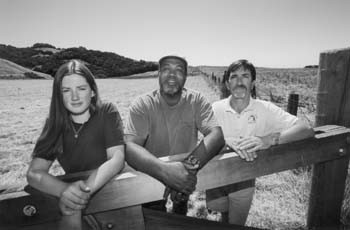
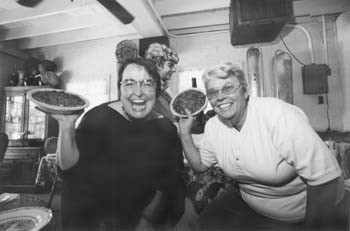
Baked good: Karina’s Mexican Bakery owner Albino Carreno enjoys music and laughter when he works. “We like to be happy,” he says with a smile. So do we.

‘Best of’ local food and drink
–something to chew on

ABUNDANCE. That’s the only way to describe the wealth of local produce available in our neck of the woods. It would take forever to gulp and guzzle your way through the bountiful regional shopping basket brimming with chocolates, eggs, preserves, cheeses, fruits, teas, breads, sauces, vegetables, beers, meats, wines, poultry, ciders, et al.–all conceived, created, and concocted within the county lines. So much and sooo damn tasty. Where does one begin to sample this vast culinary landscape? The sight of acres on acres of vineyards alone is enough to make your head veritably spin–and that’s before you even pop the cork off the bottle. And let’s not forget your dining-out options. Not only is wine country cuisine alive, well, and thriving, but all kinds of other epicurean enticements are here for the ingesting, from steaks to sushi to Sherpa snacks. Is it our imagination or does a brand-new eatery seem to open up somewhere in Sonoma County every other week? Not that we’re complaining, mind you–well, maybe a tad. Even elasticized waistbands stretch only so far.


Best Place to Cha-Cha-Cha and Chew a Churro

The earsplitting rhythmic Latino music is blasting at Karina’s Mexican Bakery in Petaluma. A riotous party, perhaps? Claro que no! Just business as usual. “We have to have music,” laughs owner and master baker Albino Carreno over the din. “We have to have dancing and singing while we work–we like to be happy, and this is a fun place.” Amid all the partying, Carreno and his bakers churn out trays of delicious pastries, cookies, churros, and breads that have become staples at some of the North Bay’s finest restaurants. There are conchas (vanilla or chocolate sweet rolls shaped like seashells and topped with sugar paste); cuernitos (Mexican croissants for breakfast); molletes (long rolls tinged with brown sugar and anise); pallazos (sweet rolls with strawberry, raspberry, or chocolate swirls); and taquitos de coco (cookies filled with coconut). Other specialties include pan fino (large bread loaves from the state of Oaxaca, where Carreno was born), regañadas (crispy sweet toasts), and tres leches cake (moist and light made with three types of milk, vanilla, and a touch of rum flavor). Latino and Anglo customers alike are drawn to the quality and subtle flavors that Carreno has adapted from family recipes. “We don’t make it too much sweet here,” says Carreno. “We’ve cut the sugar and the fat, and we don’t use lard. Other places use a lot of sugar, but people can get sick on too much sugar.” Karina’s Mexican Bakery (named after Carreno’s 9-year-old daughter) is located at 827 Petaluma Blvd. N., Petaluma; 765-2772.
P.H.


Best Local Red Wine, Part I

If you go by national sales figures and the amount of space taken up on supermarket shelves, the two most popular varietal wines in the good ol’ U.S. of A. are chardonnay and cabernet sauvignon. But are chards and cabs the best wines made in America? Not according to judges at the recent New World International Wine Competition, who bestowed “New World Grand Champion” status upon Kenwood Vineyards’ 1995 Nuns Canyon Zinfandel. This bottling was also named best of price class (it retails for $20), best zinfandel, and best red wine. That’s a lot of “bests” in anyone’s book. The grapes for this wine came from a plot of land situated some 1,200 feet above the Sonoma Valley floor in the Mayacamas range–a vineyard that has been planted, pruned, and picked for more than a century. If you like your zin on the spicy side, you’ll love the Kenwood Nuns Canyon. With a name like that, one can’t help but wonder if there may have been some divine intervention in the New World judging. Such intervention would not have been necessary, however; this is great juice. Kenwood Vineyards, Sonoma; 833-1000.
B.J.


Best Way to Butter Your Nut

Because El Niño occasionally renders the Thai Coconut Curried Butternut Squash Soup at Occidental’s Bohemian Cafe inaccessible, chef Mark Miller graciously supplies his recipe: 2 tbsp. vegetable oil; 1 diced yellow onion; 4 cups coconut milk; 1 tbsp. Thai yellow curry paste; 4 cups precooked butternut squash (bake whole squash at 350 degrees for 35 to 45 minutes; remove seed pods and peel); 2 cups chicken stock or water; 3 tbsp. brown sugar; salt to taste (optional); Kaffir lime leaves. In a heavy pot, add oil and sauté onion until transparent. Add coconut milk and curry paste. Simmer for 5 to 10 minutes while stirring. Add squash, breaking it up while stirring. Purée this mixture in a blender and mix. To thin, add chicken stock or water. Add remaining ingredients. Heat. Mmm.
D.H.


Best Place to Scarf a Buck

Two bites for a buck is a bargain when you’re talking sushi. And the long-standing dollar-sushi days at Sushi Hana have helped make Sebastopol’s only Japanese restaurant a thriving enterprise that recently expanded its capacity. Wednesdays and Saturdays are dollar days, when a lengthy menu of popular sushi–sake, maguro, enabi, hamachi, and the ever-popular and more easily pronounced California Roll–are all offered at bargain rates. Predictably, seating gets tight at lunch and dinner, and they don’t bother with reservations, but off-peak-hours service is quick and less stressed. Sushi Hana, 6930 Burnett St., Sebastopol; 823-3778.
B.R.


Best Local Red Wine, Part II

Take a grape varietal that is systematically being uprooted in Australia. Plant it in Sonoma County’s Alexander Valley. Give the resulting crop to a winery that is run by a winemaker with Australian roots. What do you get? Some sort of plonk that only an Aussie winemaker’s mother could love? Nope. You get the “Best Red Wine” at the prestigious Pacific Rim International Wine Competition. That’s the story of Geyser Peak Winery’s 1995 Winemaker’s Selection Malbec, a mouth-filling wine with a deep crimson color, intense fruit flavors, and alluring spice characteristics. “Malbec may not be well known to the masses,” notes Pacific Rim Director James Crum, “but when wineries start winning gold medals and ‘best of show’ awards for their malbecs, you’re bound to see increases in the future. Argentina and Chile have huge malbec plantings, and I think you’ll see more and more California acreage devoted to this varietal. It’s a great blending grape, but it also can stand on its own two legs.” A wine with great legs . . . what more could you ask for? Geyser Peak Winery, 22281 Chianti Road, Geyserville; 857-9463.
B.J.


Best Way to Eat Around the World

The bittersweet Balkan music infuses the heat of an early autumn afternoon. Children dodge full-flavored wafts of smoke and half-hearted grasps of parents. It’s the Glendi International Food Fair, a two-day global village and a gathering of tribes in search of good grub. Started nine years ago to raise funds for a new building for St. Mary’s Orthodox Church in Santa Rosa, Glendi (which means “party” in Greek) has established itself as a rowdy gathering that the whole family can enjoy. On the third weekend of September, Slavs, Greeks, Africans, and Arabs–united by Orthodoxy and culinary zeal–prepare dishes from their homelands that mingle on an overloaded plate like a Buffet of Babel. Come on Saturday for the choicest morsels and longest hours. Though the folk music is almost irresistible, no one will hold it against you if you just kick back into a warm, full-bellied buzz. St. Mary’s Orthodox Church, 90 Mountain View Ave., Santa Rosa; 584-9491.
M.W.


Best Place to Get into a Pickle

“People are pickle-maniacs,” reports chef Bernadette Burlle. “If we run out of pickles, people go pickle-mad.” Burlle, co-owner with her husband, Peter, of Dempsey’s Restaurant and Brewery in Petaluma, speaks from experience, having found herself in this pickle a few times, with as many as 100 pounds of pickled products per week being served in the summer and some 65 pounds a week the rest of the year. Burlle’s vinegar-cured slices of pickle heaven are based on a traditional bread-and-butter recipe enhanced with a jalapeño twist. “I tried to come up with a recipe that would work with any kind of sandwich,” says Burlle, whose upscale pub grub includes elegant salads, comfort foods of the roast pork variety, and a changing chalkboard of specials. Whether we’re just there for a beer, a slice of chocolate torte, or a girth-defying burger, the pickles always start our meals at Dempsey’s. Long may they reign. Dempsey’s Restaurant and Brewery, 50 E. Washington St., Petaluma; open for lunch and dinner daily; 765-9694.
G.G.


Best Place for Sake and Sunblock

Psst! Vegetarians and foodies with a yen for new culinary adventures take heed. This little tidbit isn’t on the regular menu, but ask politely and the chefs at Yao-Kiku Japanese Restaurant can usually slice up a stack of their secret specialty, aloe vera sushi. Order the soothing, medicinal plant, and cool Jell-O-like jade dice will arrive swathed in seaweed and precisely aligned on a small wooden tray. Dab on a little tongue-searing wasabi for a gloriously green “fire and ice” combo that will set your taste buds careening. Banzai! Be sure to wash it down with one of the specialty sakes (such as the sparkly concoction containing real gold leaf) served hot or cold in a miniature cup. Yao-Kiku, 2700 Yulupa Ave., Santa Rosa; 578-8180.
P.H.


Best Way to Get Your Hands on Jane Seymour

Sorry. In these politically correct times, we’d better rephrase that. Chances are, you’ll never get the opportunity to meet the Emmy-winning star of Dr. Quinn, Medicine Woman in person. But you can get your hands on some of this multitalented woman’s artwork, simply by spending $13 on a bottle of Korbel Brut Rose. Following in the footsteps of Nicole Miller, Tony Bennett, and Frank Sinatra, Seymour was commissioned by the Guerneville-based F. Korbel & Brothers Inc. to create a watercolor painting for use on the winery’s artist series of bottlings. The floral-themed Seymour bottle features hibiscus in magenta and teal shades with gold accents. A gold neck label with Seymour’s signature and a teal foil capsule complete the package, which is sure to become a collector’s item among wine fans, art collectors, and Seymour worshipers. Korbel Champagne Cellars, 13250 River Road, Guerneville; 887-2294.
B.J.


Best Place to Discover a Belief in Transubstantiation

Anyone who’s ever bitten accidentally into an uncured olive can testify to the sheer ineffability of olive oil. But you don’t have to remain mystified: just drive to the Olive Press in Glen Ellen, where you can witness the alchemy firsthand. A co-op that boasts V. G. Buck, B. R. Cohn, and Spectrum among its 15 shareholders, the Press has been operating for only two seasons, but already the annual community press draws in more than 70 backyard olive farmers, who pay 30 cents a pound to pool their harvests. A warm, olive-themed gift shop abuts the pressing room, separated from the hum by only a pane of glass. It’s a great place to sample oils and watch the fulsome amber-green liquid issue forth from the gleaming pipeline. Mmm . . . there is a god. Olive Press, 14301 Arnold Drive, Glen Ellen; 939-8900.
M.W.


Best Place to Have It All

This is the true story of how Flavors Unlimited saved my life. OK, it saved my children’s lives. I say now with true sorrow and pity that I would have had to dispose of the unsavory little devils last fall while we were trapped in the endlessly snaking line that led to the Russian River Jazz Festival in downtown Guerneville if the line hadn’t fortunately snaked past Flavors Unlimited. When we neared Flavors’ door, the hideously unhappy creatures–tired from standing in the sun, occupied only by methodically kicking each other in the shins–turned their beseeching faces to me. “In, in, in,” I hissed low, so that good mothers nearby couldn’t hear me. They returned with frosty cups of love–ice cream swirled with macerated strawberries, chocolate, and mints. They were quiet. Their shins began to heal. They, I, and 13 other people in the proximity were happy. Since then, we’ve manufactured other reasons to stop by for the frozen yogurt or ice cream blended with a seemingly unlimited choice of fruits and candies. Store manager Steven Foster knows the score. “People who haven’t been here before stop by and get caught,” he laughs. “We’re addictive.” Flavors Unlimited, 16450 Main St., Guerneville; open daily from 8:30 a.m. to 9:30 p.m.; 869-0425.
G.G.


Best Stickers for Your Pot

A wise woman once said: “Don’t go grocery shopping when you’re hungry.” That’s good advice because pushing your cart around a temple of food while experiencing a blood-sugar crash can ruin your whole day, squeeze your wallet, and strain your spousal relationship. Beat the rap at Santa Rosa’s G&G Supermarket, where a hard-to-find Chinese take-out counter dishes up the vittles of the world’s most populous nation. The family-owned market is the home of the 25-cent pot sticker–a culinary masterstroke and a sacred public trust. G&G Supermarket, 1211 W. College Ave., Santa Rosa; 546-5120.
D.B.


Best Winery for Animal Lovers

It’s not unusual to pull into one of Sonoma County’s wineries and be greeted by a friendly canine as you exit your vehicle. Several tasting rooms and wine-aging caves also are home to pets of the feline persuasion. These animals know how to cajole a table scrap or, at minimum, a brush of their mane. The world champion when it comes to greeting winery guests is a dog of unknown lineage–aptly named Wino–who resides on the Armida Winery property in Healdsburg. When Bruce and Sandra Cousins came to manage and live on the winery property, they quickly learned that Wino was part of the bargain. Armida was his home, and he’d have no part of relocating to some lesser acreage. Wino is a big, lumbering, lovable dog who not only will lead you up the winding trail from Westside Road to the winery’s parking area, but also will escort you to the tasting-room entrance. He has so endeared himself to winery visitors that Armida has named its wine-by-mail club after him–a distinction no other winery pet currently enjoys. Armida Winery, 2201 Westside Road, Healdsburg; 433-2222.
B.J.


Best Side Order East of Bombay

At the mouth of the Russian River, a hungry soul remembers a lesson from her vegetarian friends who so skillfully surf the side dishes of a restaurant’s menu to fill their desires. In Bridgehaven, south of Jenner on Highway 1, Sizzling Tandoor serves marvelous Indian cuisine. Here the hungry coastal traveler can take the edge off a cold day with a few side orders of onion kulcha, a fresh-baked Indian bread prepared by hand and baked in the traditional, upright, barrel-shaped, charcoal-fueled tandoor oven. A little flour, a pinch of salt, a dab of olive oil, a sprinkle of spices, and a handful of chopped onions collectively satisfy our ancient, fundamental love of bread. Sizzling Tandoor, 9960 Hwy. 1, Bridgehaven; 865-0625 (also located at 409 Mendocino Ave., Santa Rosa; 527-5999).
D.B.


Best Place to Comfort Your Carbohydrate-Loving Inner Self

They stand in neat little rows, just out of reach inside the bakery case, like unexpected yet deliriously welcome emissaries from another, better world. It somehow seems a breach of etiquette to call any treat so enticing, so delectably and sensuously rippling with moist, seductive, “eat-me-now” intensity by the relatively mundane name of “bread pudding.” Yet there they are, each cradled in its own crinkly, bright-white paper cup, each overflowing with lightly crusted, soft-yellow and richly browned custard: the elegant, old-fashioned, sweet-but-not-too-sweet bread puddings modestly offered up each day by the dessert masters at the Downtown Bakery & Creamery on Healdsburg Plaza. Though by no means restricted to the culinary classification of “comfort foods,” the offerings there reveal a comfortingly Main Street America influence, with creative modern flourishes. While the friendly counter people are bagging your pudding ($1.50), feast your eyes on the ready-to-bake breads and spicy gingerbread dough. Don’t forget to say hi to the self-dubbed “Bench Bunch” out front; these articulate old codgers are almost as much of an institution as the awesome edibles all lined up and waiting inside. Downtown Bakery & Creamery, 308 Center St., Healdsburg; 431-2719.
D.T.


Best Local Rhone Ranger

Numerous Sonoma County wineries have planted grapes whose roots stretch all the way to the Rhone region of France. A pioneer among the so-called Rhone Rangers is Lou Preston, who bottles sauvignon blanc and zinfandel to help pay the bills, but prefers to focus on “the unusual and surprising, the experimental and tantalizing.” So when you visit Preston Vineyards in Healdsburg, don’t ask for chardonnay! Instead, be pleasantly surprised by the viognier, marsanne, mourvedre, syrah, and various Rhone blends. The winery also is a great place for a picnic, so pack a basket and make an afternoon of it. And if you use your imagination, you may just be able to picture yourself in France. Preston Vineyards & Winery, 9206 W. Dry Creek Road, Healdsburg; 433-3372.
B.J.


From the March 26-April 1, 1998 issue of the Sonoma County Independent.

© Metro Publishing Inc. Maintained by .

The Scoop

Sex, Sausage & Armaggedon

By Bob Harris

OUR TOP STORY: We’re all gonna die! Oops, never mind. Everything’s fine. So I wake up the other morning and settle into my daily breakfast regimen of eating fake soy-based pseudo-sausages while warming my brain with mindless TV channel surfing.

(Disgusting, yes, but how appetizing are you when you first wake up? I once dated a fashion model who burped and scratched like a dockworker, although a dockworker would probably have been in a better mood most of the time.)

So I’m half asleep and flipping through channels, and darn if every time I hit somebody doing news I don’t hear the creepy tail end of a report about some giant thing from space and the possible destruction of mankind. And then they cut over to Jillian with the Surf Report and Steve with a close-up of one of Monica Lewinsky’s gym socks.

Whoa, hold on–what was that thing you were talking about, that thing from space that might kill us? Can you get back to that for a second? I came in late because my soy patty didn’t cook up right away. It was like one of those horror movies where some poor guy glimpses a news report about the zombies just before they rip down his door and eat his brains. When suddenly a passing cloud blocked the sunlight coming through my window, just for that moment I started to wonder if this was The End. Well, as you know, NASA rechecked the numbers and decided that Asteroid VH-1 or whatever it’s called isn’t going to kill us after all. (Besides, that honor is reserved for the Cassini Space Probe.) But what if it was?

We were all just kind of lucky there, if you think about it. The chance that something like that will happen in our lifetimes is astronomically small–literally–but there is that teeny chance.

So how would we react, if suddenly we woke up one morning and we had only about 30 years left? Would there be riots and carnage and Carrot Top movies? Maybe. But I think a lot of us would start doing things we always wanted to do and calling up people we love and saying those words and trying to put ourselves right with the universe.

It may not be a giant asteroid that kills us. It might even be soy patties and cable TV.

But–this just in–we’re all on the clock already.

It probably won’t kill us to act like it.

I SMELL PRETTY . . . oh, so pretty . . . I smell pretty and witty and bright . . .” You’ve probably had this experience: You meet someone and instantly feel an amazingly intense attraction that you can’t explain rationally. If you’re lucky, it’s mutual, and the two of you soon explore the frontiers of yoga while finding furniture uses that Bob Vila never imagined. If you’re unlucky–one of you is spoken for, or maybe you work in the Oval Office–you have to either struggle to forget it or risk being scorned by millions via satellite by Geraldo.

Writers have called this attraction “chemistry” ever since King John codified standard English clichés in the 1624 Banalbook of Midbrow-on-Hackney. And apparently King John’s term is accurate. As scientists have long suspected might occur, last week some University of Chicago guys finally proved the existence and power of human pheromones, the odorless chemicals that influence our mating habits. Now let’s not get carried away here. Smell isn’t the only factor in attraction, although if you’ve spent much time on public transportation, you know it can be the sole cause of repulsion. There are other factors at work, too, most of which are primarily visual. When I was 14, I didn’t put that Farrah poster up because I liked the way the paper smelled.

But assuming that your potential partner is anatomically correct and generally free of obvious personality defects–which can be a tall order–the subtle smells of love can be the deciding factor determining whether the two of you kiss each other good night or good morning. In fact, some research indicates nature knows what it’s doing: The exact composition of your pheromones may be a subtle message containing information about your health, genetic makeup, and immune system, and so the mutual yee-hah of love may just be nature’s way of encouraging us to select partners whose contrasting makeup gives us the best chance to create healthy offspring.

So if you’re talking with someone you’re interested in, and suddenly it feels like there’s something in the air–there probably is. In fact, deep breathing at that point might just lead to, uh, more deep breathing.

From the March 26-April 1, 1998 issue of the Sonoma County Independent.

© Metro Publishing Inc.
Utility Deregulation

0

Power Play

By Nina Schuyler

OTHER THAN taking a few moments to pay their monthly utility bills, most Californians probably don’t think much about electricity. But all that will soon change as California restructures its massive electrical utility industry.

Beginning March 31, consumers will be allowed to select their electricity provider, a drastic change from the monopoly power currently enjoyed by utility companies. As a result, the state’s Big Three utilities–Southern California Edison, PG&E, and San Diego Gas & Electric–are busily plying their existing customers with television and radio ads that promise cheaper rates if they simply “do nothing” and stick with the status quo when it comes to receiving their electricity.

But such complacency could prove harmful to utility customers, say consumer advocates and environmentalists. Indeed, they argue that consumers are the big losers under the plan to deregulate the state’s $23 billion electricity industry. And the three major utility companies are the big winners because of their ability to pass the costs of bad investments on to ratepayers.

A “do nothing” attitude among consumers could also reverberate elsewhere, according to consumer advocates, because Congress and several other states are looking to California’s plan as a possible blueprint for utility deregulation across the country.

“The architects of this deregulation plan never intended residential ratepayers to be the beneficiaries,” says Harry Snyder, executive director of Consumer Union in San Francisco. “It was created to keep industry in the state by providing them with lower-priced energy.”

Cloaked in baffling jargon, the deregulation plan has been difficult for most consumers to decipher. But after analyzing the fine print, consumer groups and some environmental advocates began collecting signatures for a November ballot initiative that would replace the deregulation scheme with a version they say will favor consumers. In particular, they are upset with a provision in the current plan under which consumers will pay a surcharge on their bills to compensate utility companies for bad business investments, including nuclear power plants.

“All we have to say is ‘Read your utility bill’ and voters want to sign the petition,” says Bill Gallagher, who is coordinating the initiative drive for Californians Against Utility Taxes, a group formed by Harvey Rosenfield, the author of a 1988 ballot measure that was supposed to lower auto insurance rates. Proponents of the utility-related initiative say it would lead to a 20 percent reduction in electricity rates for residential customers.

Under the initiative, consumers would not be required to repay the Big Three utility companies an estimated $14 billion worth of investments in nuclear power plants. “Nuclear energy was forced on California consumers with promises that it was safe, clean, and cheap, none of which is true,” says Snyder. “The initiative shifts the burden of these investments to the utilities’ shareholders.”

Underlying both the current deregulation plan and the consumer-oriented alternative is the existing three-part system of bringing electricity to homes and businesses. First comes the generation of electricity, followed by its transmission through power lines. Finally, there is the distribution, via poles, easements, and local wires. In exchange for monopoly status–which has allowed the Big Three utilities to own and operate each aspect of providing electricity–the companies were required by state regulators to supply power within given service areas without having to worry about competitors. For example, the geographic range of San Francisco-based PG&E covers much of Northern California.

In 1996, the Legislature decided to break up the vertically integrated system of manufacturing and selling electricity. Under AB 1890, distribution will still be provided by the three monopoly utilities, but the state’s 30 million customers will now be able to choose which company will provide their electricity.

Theoretically, consumers benefit from competition among utility companies. However, consumer groups were galvanized into drafting their alternative plan because of a provision in AB 1890 that requires customers to help the utilities recoup bad investments, known as “stranded costs,” that total $28.5 billion. Nearly half of that amount is for PG&E’s Diablo Canyon reactors and Southern California Edison’s San Onofre nuclear plant, both of which are running, but, according to consumer groups, are not cost effective.

In December, the state sold $10 billion worth of bonds, with the proceeds going to the three utilities to help pay off their losses. The interest on the bonds will be paid by utility customers regardless of which company they select to provide their electricity. State lawmakers defended the bond sales by arguing that state-issued bonds enjoy tax-exempt status, which results in a lower interest rate.

But consumer advocates say the utility-rescue operation will bolster monopoly utilities’ profits and stymie competition. “This huge stranded-cost bailout creates a large war chest for incumbent utilities, which means it will be more difficult to introduce competition,” says Wenonah Hauter, director of Public Citizen’s Critical Mass Energy Project in Washington, D.C. Hauter and others argue that utility shareholders should be responsible for paying off utility company debts.

Officials at PG&E defend the bond issue by arguing that stranded costs were originally incurred in part because of the federal government’s past requirement that utilities purchase alternative energy.

To make the stranded-cost issue politically palatable, ratepayers were given a 10 percent reduction on their electricity bills. Reduced utility bills supposedly have been made possible by savings associated with the lower interest rates on the state-issued utility bonds. But customers’ bills could end up dropping only some 1+ percent to 2+ percent after repayment for bad investments is factored in, according to Elena Schmid, director of the California Public Utility Commission’s Office of Ratepayer Advocates.

Moreover, Dian Grueneich of Grueneich Resource Advocates says that electricity prices–which run an average of 50 percent higher in California than the rest of the nation–were about to decrease anyway. That’s because many of the utilities’ supply contracts were about to expire, with the three companies projecting rate decreases of 15 to 20 percent by the year 2000 owing to declining costs of generating new electricity.

“In my mind, we gave up a clear certainty of lower rates in the near term for the possibility of greater rate decreases four or five years from now,” says Grueneich, whose consulting firm specializes in energy and environmental issues. “Who knows if this will happen. I think it might, but it’s a risk.”

Significant reductions in utility rates will depend on a vigorously competitive marketplace, say consumer advocates. But there are signs that such competition may not materialize. For example, the added stranded-cost surcharge that consumers will find on their bills regardless of which company they select for their electricity has already discouraged some companies from competing for utility business. Enron, based in Texas, recently canceled plans to build a $60 million electricity-producing wind farm in the state because it would not be able to compete for customers after adding the surcharges to its bills.

While AB1890 includes various environmental incentives, some of the plan’s critics wonder whether the benefits are substantial enough to justify going ahead with the deregulation scheme. The new law provides $872 million for conservation and energy-efficiency efforts and another $540 million in subsidies to boost the renewable-energy industry. But lawmakers voted to end these programs after four years.

THE CONCEPT IS that by then these services will be provided by the private marketplace, but we don’t know if that’s true,” says Hauter.

In an effort to qualify a competing utility plan for the November ballot, the group behind the proposed Utility Rate Reduction and Reform Act Initiative has sent out more than 1,000 signature gatherers–most of whom are volunteers–while also posting petitions on a website (www.nonukebailout.com). Faced with a mid-April deadline, the group is trying to collect some 650,000 signatures in order to ensure the 420,000 valid names needed to send the measure to the voters.

According to Rosenfield, the state legislative analyst’s office waited until the 11th hour to write the title and summary for the initiative, leaving his group only 10 weeks to gather signatures. Rosenfield says petition campaigns normally have five months to collect signatures for ballot measures.

The effort to qualify the utility measure has been complicated further by the refusal of several signature-gathering firms to handle the issue, according to Consumer Union’s Snyder. He also says that some signature gatherers have been approached by utility officials with offers to pay them not to collect names. Each of the Big Three utilities denies any role in such tactics.

The California Chamber of Commerce, meanwhile, has formed a coalition of business interests to defeat the initiative, if it qualifies for the ballot. In forming Californians for Affordable and Reliable Electric Services, chamber president Allan Zaremberg says the initiative “would eliminate the ability to have competition for the generation of electricity.”

Although consumer groups expected opposition from business interests, they did not count on resistance from the National Resources Defense Council, a prominent environmental group that supports AB 1890. Critics of the deregulation plan point to ties between NRDC and Southern California Edison–John Bryson, Edison’s president, is a founding member of the environmental group. NRDC officials say the connection has no bearing on the group’s position on utility deregulation.

“For the first time, you will have the opportunity to decide where your electricity payment goes,” says Ralph Cavanagh, NRDC’s energy program director. “If you don’t want to send it to nuclear suppliers, you have that option. If you’d rather use renewable energy, you can do that. While we don’t suggest that California’s plan is the answer to all world problems, we think it’s a positive thing.”

MOST of California’s nearly 30 municipally owned utility districts are taking a wait-and-see approach toward deregulation. These districts represent 25 percent of the state’s consumers. Under AB 1890, such districts are not required to join the newly competitive marketplace. But the Legislature also offered a carrot to induce them to do so. If they do, the districts will be allowed to pass on their own stranded costs to their customers. “All utilities are sitting on these stranded costs,” says Jan Schori, general manager of the Sacramento Municipal Utility District.

Shori has put together a business plan that promises a five-year freeze in utility rates and a commitment to paying off much of the district’s existing debt by 2002. To pave the way for full market competition by that year, district officials in July approved a pilot program that begins with competition in the generation of electricity. At the moment, four companies are vying for business, but they are targeting larger businesses rather than residential consumers.

“Because the costs of this plan are pretty high, the competitors are targeting the areas where there is potentially the most profit,” says Shori. “That’s not the small consumers.” Such targeting, he adds, also might reflect a general wariness among individual consumers toward deregulation.

Hauter, with Public Citizen, says there’s good reason for such caution. “If you look at the effects of deregulation in other industries, it’s been a disaster for the small consumer,” she says. “With natural gas, there was a reduction in prices, but not for most residential consumers. In the airline industry, there are lower prices in some markets if you buy far enough in advance, but safety and service are problems.

“In telecommunications, long-distance prices went down, but not local prices. The bottom line is deregulation benefits larger [business] consumers.”

From the March 26-April 1, 1998 issue of the Sonoma County Independent.

© Metro Publishing Inc.
Everyday Stuff

Life Styles


Michael Amsler

Hot stuff: Hot Couture manager Sheila Brownlee takes off her hat to the “Best Of.”

‘Best of’ everyday stuff–
finding the extraordinary in the ordinary

ULTIMATELY,” someone once said, “we are not defined by the stuff we accumulate during our lives, but by the stuff we did while we were still living.” Well, God knows, we’ve all got a lot of stuff to do every day, right? There’s the shopping to do, the car to wash, the kids to take somewhere, the local politician to distribute leaflets for–whatever stuff we do, we do a lot of it. Clearly, we’ll all be well accounted for when the grim reaper finally shows up to do his own stuff. Meanwhile, we the busy denizens of Sonoma County–so rich in its recreational and artistic opportunities–are blessed with an outrageously colorful and entertaining spate of stores, services, and suppliers to help us get all that stuff done. Where else can you get your haircut or pick up a bag of nails and get to stare in the eyes of a 10-foot grizzly at the same time? Why go to some boring mall-bound shoe shop when you can have your Hush Puppies resoled while engaging in razor-sharp repartee with one of the county’s greatest living street commentators? What better than shopping for a new skirt while bouncing and swaying to the hypnotic rhythms of piped-in music from Chile, Argentina, Brazil? Why have a quick 10-minute fling in the back seat of your car when you can have the same fling while getting your car’s oil changed, and have a nice fresh cup of coffee bought at a drive-thru coffee shack afterwards? Clearly, if you’ve got stuff to do, this is an entertaining corner of the world in which to get it done.


Best Undercover Business

“It’s all done in the best possible taste,” insists Kristina Bonfield, owner and co-founder (with her husband) of Après Noir, a specialty line of sleek, sometimes lacy undergarments for men. The Santa Rosa-based company began 10 years ago offering more conventional shorts, swimsuits, etc., until customer requests suggested a new direction. “We were getting calls for something a bit more frilly,” Bonfield says. Now they ship their U.K.-made panties, bras, corsets, and other undies all over the world. Most customers “are heterosexual men in stable relationships,” she adds. “We get a lot of women ordering for their men.” Why not?–they know the, uh, intimate details necessary for a proper fit. The designers make some allowances, too, Bonfield notes. “We just put a bit of extra padding in the crotch to accommodate their paraphernalia.” Après Noir/Body Aware, P.O. 2329, Santa Rosa, CA 95405. For a copy of the men’s lingerie catalog, send a check or money order for $3. 538-1749 .
B.R.


Best Place for a Little Sole

Tuesdays at Tate’s Shoe Service in Santa Rosa features a bald old man white as snow, who smokes long, equally white, cigarettes, eyeballs the daily fish wrap, and offers a tersely honest comparison between yesteryear and today. Both the shoe shop and the old man at the front counter are a window to the past–to a time when unions routinely fought for their fair share, Americans fought fascism, and U.S. workers made their own shoes. Pick up your skillfully repaired footwear and learn about the tragic deaths of thousands of U.S. Marines in the strategically pointless September 1944 invasion of Peleliu in the Western Pacific. In the back, watch young Tim Alexander filling one of the last honest jobs in America as he stands at his cobbler’s bench among hundreds of wayward soles–brown, black, and white. Tate’s Shoe Service, 402 Mendocino Ave., Santa Rosa; 545-3859.
D.B.


Best Bolts for Nuts

You won’t hear their ads on the radio. No jingles, no corporate slogans. What you get at a well-run, independent auto-parts store is a familiar face, a considerate staff, and an honest discussion of mechanical issues. Everyone has their favorites, but mine are Dan’s Auto and Truck Parts in Petaluma and Jordan’s Imported Auto Parts in Santa Rosa. Both stores represent small business at its finest. If you so much as change your own oil, an independent store can make a difference–clean oil is the single most important part of a healthy car. At Dan’s, you can get Hastings premium oil filters, a product far superior to the wall of orange Fram filters at a chain store where you’d never guess there was an alternative. Dan’s Auto and Truck Parts, 345 Lakeville Hwy., Petaluma, 795-1707. Jordan’s Imported Parts, 1010 Santa Rosa Ave., Santa Rosa; 527-7070.
D.B.


Best Place to Get a Haircut

“Kids are scared of the bear sometimes, first time they see it,” says barber Paul Prince, commenting on the massive, attack-stance grizzly stuffed and standing in one corner of his small but colorfully atmospheric hair-cutting salon. “But they warm up to it before too long at all.” Known simply as “the bear,” its non-urban life ended in Alaska in 1969. The awesome creature has been charming and alarming men, women, and children since the straight-talking Prince opened the shop eight years ago. Located right off the street at the front end of the equally ambianced bar Gayle’s Central Club, the unapologetically old-fashioned barber shop–spinning barber pole and everything–has another distinction aside from the bear: Patrons can wait in the club if they like and Prince will ring a bell at the bar to announce that his chair is ready for a new customer. Rumors are many that you’d have to look far and wide to get a better haircut in the county, by the way, though many of Prince’s regulars also show up for the articulate verbal sparring the barber is known to excel in. “The only time my customers get mad at me,” he explains, “is when I spend time talking to reporters about the bear instead of cutting their hair–know what I mean?” Petaluma Barber Shop, 106 Petaluma Blvd. N., Petaluma; 762-9027.
D.T.


From the March 26-April 1, 1998 issue of the Sonoma County Independent.

© Metro Publishing Inc. Maintained by .
Kids

Forever Young

Catching air: The new Petaluma skateboard park is among the places that kids can enjoy when they’re done washing the dishes and learning Latin.

Michael Amsler


‘Best of’ local kid stuff–
more than just child’s play

MADELEINE MAY have thrived in a Parisian bed staring at a crack in the ceiling that had the habit of sometimes looking like a rabbit, but city living is most definitely not where it’s at for those children lucky enough to grow up in Sonoma County. With enough open space to put a glow in young cheeks, with a closeness to the earth and its bounty that is reinforced by the proximity of local farms, and with beaches, woods, skateboard parks, hiking trails, storytimes, farmers’ markets, fairs, lakes, and parks galore, Sonoma County offers its youth the opportunity to enjoy the sort of childhood that mimics the leisurely growth that youngsters generations ago simply took for granted. Heck, the town of Sebastopol seems to exist solely for the purpose of raising environmentally aware, empathetic, and curious young citizens. Can the same be said of Detroit? We think not. There are many, many good reasons to land in Sonoma County: the people, the food, the wine, the countryside. There are even more reasons to stay, raise a family, and to put down roots. This soil isn’t good just for grapes.


Best Way to Teach Philanthropy

Last year, 16,000 students at 41 local schools raised $35,000 for 105 non-profit organizations. How? By mastering their curricula and garnering sponsors in the Great Academic Brain Wave. Each participating class chooses the charity it wants to help; students must each answer 100 questions based on their course work to earn the donations. Ten percent of the total goes to the non-profit; most of the rest supports the school. Begun at Sonoma Country Day School in 1992 as a means to teach philanthropy while reinforcing scholastic goals, this innovative program is now poised to go national, even as the school year’s new campaign gets under way. The Great Academic Brain Wave–coming soon to a student near you. 5340 Skyland Blvd., Santa Rosa; 524-2006.
B.R.


Best Place for a Portable Party

First things first: No, you don’t have to be a member to throw a birthday party at the YMCA. Fifty dollars buys a room for 15 kids, but you may need to reserve early, as the rooms are available only on the weekend. You don’t get a lot of frills–the rooms come with carpet, tables, and chairs, and not much more. Set-up and clear­up are your responsibility. But you do get to use the pool, and that makes the Y an attractive option, especially during winter’s uncertain weather. The aquatic exercise also provides a means of burning off the obligatory sugar rush from a kids’ party. Sequencing is the key. Save the swim for last. Your guests’ parents will thank you. YMCA, 1111 College Ave., Santa Rosa; 545-9622.
B.R.


Best Place to Tease the Fish

There’s something Seussian about koi, some sense that they’ve been fed beyond the bounds of normal fishness. Kids naturally gravitate toward them, and even some older types can lose track of time trying to make the fish gape. Oversized goldfish are not for everyone, so it is a fortunate thing that Freestone’s Wishing Well Nursery, where some of the county’s more aggressive specimens dwell, also boasts enough roses, fancy geraniums, and garden art to bemuse the fish-phobes in the party. The immense mossy urns and “Garland Ladies” from San Francisco’s old Palace of Fine Arts are not for sale, but there are more antiques (most of which will fit better in the car trunk) available in the adjoining Freestone House Hotel. Fish feeding is allowed, so go ahead and bring the kids. But keep an eye on ’em: The fountain is deep, and those fish get teased a lot. Wishing Well Nursery, 306 Bohemian Hwy., Freestone; 823-3710.
M.W.


Best Place to Spin Your Wheels

The biggest obstacle to a youngster’s bike-riding hobby can be a simple flat tire that never gets fixed for lack of know-how. At Mud Camp, a mountain-bike clinic for youth ages 7 to 13, kids learn to fix their own bikes, ride safely, and race competitively. The teachers are kids themselves, members of Team Mudpuppy, Sonoma County’s youth mountain-bike team. Team Mudpuppy conducts the clinics under the watchful eyes of adult coaches Yuri Hauswald, a Petaluma schoolteacher, and Matt Nyiri, a bike-industry professional. “It’s an excellent outlet for kids,” says Hauswald. “They’re continuously pushing themselves to get better.” The five-hour workshops take place at Gianni Cyclery in Occidental and in the nearby wilderness. The best part may be that “there aren’t a lot of rules,” as Hauswald says, and kids get to “rip around and have fun.” The price is $30 a day or $80 for three days. Call Yuri Hauswald at 776-2893.
D.B.


Best Place to Flock Together

At the Santa Rosa Bird Farm, the emphasis is on education and the finery our feathered friends display. Bonnie and Waldie Sheffler have collected breeding pairs of dozens of species of exotic birds from around the globe, including numerous types of peacocks, pheasants, parrots, ducks, and cockatiels from South America, Australia, China, and Southeast Asia. The 60-plus varieties range from tiny quail to mighty emus and an ostrich, all housed on the family farm not far from Elsie Allen High School. “Education is what it’s all about for me,” says Bonnie. Senior groups and kids on school field trips are frequent visitors, but smaller groups are welcome, too. There’s even space for picnicking in good weather. Call ahead to schedule any visit, though. Santa Rosa Bird Farm, 1077 Butler Ave., Santa Rosa; 546-1776.
B.R.


Best Place to Foil Your Kids

My grandfather once said, “You should never play with sharp knives; unless, of course, you’re really good at it.” It is in that spirit that we recommend the Sonoma Fencing Academy, an excellent place for pre-teens and hormone-mad adolescents to work out their ya-yas while getting to play with deadly weapons, all while learning the safety precautions necessary for the handling of swords. Seriously, though, in fencing, they are called foils and are always blunt-tipped. The masterful instructors at the growing Petaluma-based club–now in their own brick building on Water Street–do a marvelous job of teaching this highly competitive, energetic sport and hold court over the members’ four-nights-a-week open matches. All ages are welcome. En garde! Sonoma Fencing Academy, 239 Water St., Petaluma; 763-8290.
D.T.


Best Place for Laid-Back Turtle Watching

It’s impossible to visit downtown Sonoma and not see the Mission; it all but dominates the town square and stands as a testimony to the energetic power of the religious domination the Spanish priests once held over the native people in the area. I don’t know about you, but it makes me jumpy to walk past and see the proudly restored cannon and other instruments of military force on display (thousands of Indians, by the way, are buried beneath the adjoining streets). Just down the road, however, is the beautiful, sprawling home of Gen. Mariano J. Vallejo (himself no prince, but he did have excellent taste in living quarters). A few dollars will get you in. After wandering the homestead and chatting with the knowledgeable docents, take a snack up the outside steps and through the garden to the immense fenced-in pond at the top of the hill. A herd of turtles frolic in the laid-back manner of wet turtles everywhere, skimming the surface of the well-vegetated pond. Sit on the shaded benches, feet stretched out in the warm summer sun, and be one with the turtles. Or something. Whatever you do, relax; you’re in one of Sonoma’s least-known anti-power spots. More power to you. Or something. Gen. Vallejo’s residence is located at the corner of Third and Spain streets in Sonoma right off of Highway 128. Admission is $2 adults (12 and older); $1 children, ages 6-11; free under 6. (Tickets are also good for admission to the Petaluma Adobe and Sonoma Barracks on the same day.) 938-1519.
D.T.


From the March 26-April 1, 1998 issue of the Sonoma County Independent.

© Metro Publishing Inc. Maintained by .

Your Town

Best Town Picks for Kicks

Best Place . . .


. . . to raise a stink:
Bloomfield


. . . to not raise a stick:
Rohnert Park


. . . to go wading:
Petaluma


. . . to listen to classical music gratis:
Santa Rosa (Courthouse Square)


. . . to get a mud bath:
Rio Nido


. . . to not rent Total Recall:
Windsor


. . . to find more squeeze boxes than big boxes:
Cotati


. . . to realize that one way is not the only way:
Sebastopol


. . . to pretend you’re a Napa County big spender without crossing the county line:
Healdsburg (Oakville Grocery)


. . . to gourmandize till you gag:
Glen Ellen


. . . to overlook the overpass:
Cloverdale


. . . to find people making a historic plaza pedestrian:
Sonoma


. . . to be flooded with memories:
Guerneville


. . . to help crowd the road to piscatory paradise:
Bodega Bay


. . . to hit the brake before you miss it:
Penngrove


. . . to get, bien sûr, a double olfactory dose–pinot et pesticide:
Kenwood


. . . to flush funds:
Geyserville and environs


. . . to elevate your mind instead of your vine:
Forestville


. . . to be a rebel without a cause (rated for teens only):
Graton


J.A., P.H., L.H


From the March 26-April 1, 1998 issue of the Sonoma County Independent.

© Metro Publishing Inc. Maintained by .
Love

We Love It!

Golden years: The Dimitrioffs, sharing a kiss, above, prove that being in love doesn’t just happen to young folks–it endures.

Benham Studio Gallery


‘Best of’ local romance–
love, Sonoma County style

LOVERS COME FROM near and far to experience the fairy-tale beauty of Sonoma County. Watch them walk, full of wonder, through Armstrong Woods, where the towering redwoods beckon like a sacred open-air cathedral. Or see them share a simple picnic of crusty bread, Jack cheese, and spicy zinfandel wine, purchased from local merchants and enjoyed amid the white ducks and sunshine in Sonoma’s historic plaza. Watch them wend their way through the romantic wineries scattered all around the region, from the scenic mountains to the sparkling ocean. See these lovelorn sweethearts as they marvel at breathtaking scenery, gorgeous sunsets, and magical cricket-chirping nights. Or observe them strolling arm in arm and starry-eyed through a farmers’ market at dusk, intoxicated by the sights, smells, and each other’s company. Yes, lovers come from near and far to this captivating destination, this Eden called Sonoma County. But wait, isn’t that you we spy partaking of these sensory romantic pleasures right here in your own backyard? You, who hails from Graton or Guerneville or Glen Ellen? Yup, you smirk, it sure is.


Best Subterranean Romantic Walk

Wait for dry weather. Acquire love object. Proceed to the 700 block of G Street of Petaluma. Face west in the direction of the Jack W. Cavanaugh Jr. Recreation Center. Pause. Affirm that you and love object are unseen. Turn left 90 degrees. Regard assemblage of brush and thickets. Assure love object that Section 11.36.050 of the Petaluma Muni Code outlawing passage through a drainage tunnel is only passively enforced. Discern pathway through brush. Proceed. Turn left 90 degrees. Regard mouth of large drainage tunnel. Recite canto III of Dante’s Inferno: “All hope abandon, ye who enter here.” Pause while love object is impressed. Kiss. Proceed into tunnel. Exit tunnel on the banks of the Petaluma River at First Street. Kiss again.
D.H.


Best Place to Meet a Blind Date

There is no place better to meet a person you’ve never seen before than a place where he or she cannot be confused with anyone else. At the Church of One Tree at Juilliard Park in Santa Rosa, there never is anyone else, so confusion is virtually impossible. The church, believe it or not, is the home of the offbeat memorial to one-time Santa Rosa resident and “Believe It or Not” newspaper columnist Robert Ripley. It functions as a kind of museum of oddities and weirdness sought after by the single-minded collector of creepy facts and artifacts. The attractively designed, somewhat Gothic church is, as the name implies, built entirely from the wood of a single tree. The county’s least populated tourist attraction, it stands across the street from the second-least populated spot, the grounds and former home of renowned botanist Luther Burbank. Beautifully planted with roses and rare flowers, the Burbank gardens are the perfect place for a get-to-know-you walk with your brand-new date. Ripley Museum Church of One Tree, 492 Sonoma Ave., Santa Rosa; 524-5233. Burbank Home and Gardens, corner of Santa Rosa and Sonoma avenues; 524-5445.
D.T.


Best Unlikely Spot for Romance

The North Bay Area has, among its many delights, no shortage of romantic spots to which enamored lovers can escape for a weekend of smooching and intimate revelry. Cloverdale is not often mentioned as one of them. Out on the far-flung northern edge of the county, the tiny town-that-time-passed-by is, of late, known mainly for the fact that the freeway that once detoured down Main Street now whooshes cars right past without so much as a chance to blink. Therein dwells the romance of Cloverdale: What better place to get away from it all than a town where nobody goes? It is icing on the cake that the sun-baked burg happens to be situated among gorgeous rolling hills and abundantly fertile agricultural scenery. Lake Sonoma lies a scant few miles away; Cloverdale Kayak and Canoe will rent a recreational flotation device and even deliver it to the lake for you. Wineries stand waiting nearby, and restaurant-rich Healdsburg is only a 12-minute drive away. For lodgings, there is the oh-so-romantic Shelford House, a bed and breakfast efficiently and warmly run by Bill and Lou Ann Brenock. With views of early morning hot-air balloons hovering over the surrounding vineyards, the rambling Victorian has cozy, comfortable rooms and a relaxed atmosphere that easily sets the mood for the most pleasurable cuddling that any two paramours could ever imagine. Cloverdale Kayak & Canoe, 1148 S. Cloverdale Blvd.; 894-3078. Shelford House, 29955 River Road, Cloverdale; 894-5956.
D.T.


Best Place for an Indecent Proposal

I knew a guy once who said something I never forgot. “I was dating a woman,” he said, “and when I knew I really liked her, knew I wanted to move the relationship to a more intimate level, I took her out to dinner and popped the question, ‘Would you be my lover?'” Nothing new there; the sexual dance has been commenced in eateries for as long as food was served warm by competent professionals to customers who wanted to get naked together. What was novel about my friend’s approach was his choice of restaurant. “Denny’s,” he explained, “is so plastic, artificial, and grotesquely lighted that she could never accuse me afterwards of bamboozling her into bed with tricks and mere scene-setting. If she said yes, it could only be because she meant yes.” He denied that Denny’s famous low-priced Grand Slam entrées added any subliminal sexual urging. For would-be local lovers, let it be noted that there are three locations to choose from: one in Petaluma (4986 Petaluma Blvd. N.) and two in Santa Rosa (115 Baker Ave. and 1000 Steele Lane). So how did it go with my friend’s proposition? She said yes. “In fact, we didn’t even wait around for our omelets to arrive,” he added. “We couldn’t wait to get back to my place.”
D.T.


Best Place to Feed an Undying Love

Love is timeless. Love is forever. For those romantic souls with a poetic bent–and those with just a touch of the macabre–the ultimate spot for a romantic picnic of cold lobster, French bread, and chilled champagne is the local cemetery. Not only is it quiet and peaceful, but burial grounds are almost always beautiful, with abundant lawns and inspiring sentiments carved in stone all around you. We suggest the Santa Rosa Memorial Park in Windsor. Being on hallowed ground, of course, you must behave respectfully. Other than that, feel free to spread your blanket, feed your undying love, and drink a healthy toast to eternity. Santa Rosa Memorial Park, Shiloh and Windsor roads, Windsor; 542-1580.
D.T.


From the March 26-April 1, 1998 issue of the Sonoma County Independent.

© Metro Publishing Inc. Maintained by .
Life

What’s Happenin’


Eric Reed

Mano a mano: Artist Steve Magliori offers a salutation to one of the characters in his “Petaluma Heritage Mural,” a comfort to four-way traffic jammers stuck at the corner of Washington Street and Petaluma Boulevard North.

‘Best of’ local culture–
a diversity of delights

DEFINING SONOMA County culture is no small task. Our culture is us. We the people of Sonoma County: we brainy book-writers and balloonists and bikers and balladeers; we bead-wearing beachcombers, buying bubbly at the ballet; we body-building backpackers bouncing boyishly in the buff; we beer-bellied bunny-breeders boasting about boating in the Bahamas; we boldly bangled bingo-boosters, buoyantly baking baguettes and brie for the boys in the band; we bungee-jumping beef barons building big, big barbecues while bitching about boycotts and borders and bombs; we baptized believers in Bibles and Buddha; we blaspheming barbarians brandishing broomsticks at boys in blue; we bare-bottomed bards and bright-eyed belchers and beggars and bowlers and bodhisattvas and babes. Put another way: Culture is what you see when you walk down the street. Here are a few of our favorite sights.


Best Profane Band Name

The art to naming a band is like no other. Certainly the Silver Beatles couldn’t have guessed that the punny shortening of their name would rocket with them to stardom; the fame of U2 and UB 40 (dis)honors the dole system in the United Kingdom; and the Mothers of Invention had a perverse necessity to set themselves apart. Most everyone has a favorite name for the band that they can secretly imagine themselves fronting. My own personal pick was Peer Group until I realized that the moniker sounds as if we would have to play some awful kind of fusion-y jazz. And then there’s Lungbutter. Certainly no other local heroes have created a band name as vomitously memorable as this punk outfit. We salute these gruesome lads as they break their mother’s hearts with each new gig.
G.G.


Best Place to Strike out on New Year’s Eve

Forget those kewl clubs and restaurants offering pricey multicourse New Year’s Eve dinner-dance extravaganzas. Ditch the trendy street parties with the scant food and the fireworks display blocked by the city administration building. The stylish place to ring in the new year is Petaluma’s Boulevard Bowl. Open 24 hours, seven days a week, this bustling joint goes to town on New Year’s Eve with unlimited cosmic bowling (strobe lights and illuminated pins) from 9 p.m. till midnight. Employees distribute hats, horns, and whistles, and serve sodas and champagne in plastic flutes. With DJ music, spontaneous dancing on the concourse, free pretzels, a New Year’s countdown on the loud- speaker, and a buffet breakfast at midnight, how can you strike out? Boulevard Bowl, 1100 Petaluma Blvd. S., Petaluma; 762-4581.
P.H.


Best Unknown Cultural Resource

That would be the 3.3 acres of dogbane recently protected by the Sonoma County Agricultural Preservation and Open Space District just south of the Luther Burbank Center. The rare parcel was preserved in December by the county Board of Supervisors as part of a deal allowing a developer to construct several dozen homes in what was previously declared a greenbelt area and after intense lobbying by Native Americans. Dogbane is an indigenous plant traditionally used by Indian people for cordage and net-making. The parcel just off Highway 101 is one of the largest stands of dogbane left in the western United States, according to experts.
S.P.


Best Role Model

Sure, he’s got a day job just like the rest of us, renting canoes and boats to tourists and day-trippers from his Burke’s Canoe Trips launch pad in Forestville. But when he’s not overseeing the intricacies of tying on a life preserver, local hero Bob Burke is preserving life in other ways. A tireless volunteer, Burke is different from those of us who drop a tin of peas in the food bin each holiday season and consider our tithing complete. Burke is the kind of community activist who dispenses holiday treats, joy, and kind words to kids who are fighting for their lives. Dedicating himself to those youngsters who brave leukemia and other cancers, or whose lives are otherwise distressed by extreme illness, Burke hosts holiday parties, finds special gifts that weary parents might not be able to afford, and organizes weekly outings for those children who don’t have a lot of fun between doctors’ visits and chemo treatments. A very special person indeed, Bob Burke is our top pick for best role model. May all those whose lives he touches grow up to be as loving as he is. To donate your time or cash, contact Bob at Burke’s Canoe Trips, 887-1222.
G.G.


Best Place to Tune into Folk and Ethnic Music

Once a month, a remarkable exponent of the Bay Area music scene holds forth in the acoustically inviting, 160-seat hall of the Universalist Fellowship of Sonoma County. The concerts are intimate, eclectic, often ethnic, and highly rewarding. “I just want it to be a place for local performers to play in a concert setting, and try and give some bands some exposure,” says series organizer Robert Lunceford, who also mans the soundboard for the shows. Eleven concerts have been held since the series started in 1996, featuring such diverse acts as Aire Flamenco, Cats & Jammers, Gator Beat, the Westerlys, and Lunceford’s own Celtic band Atlantic Shore. Several more shows will be held before the annual break during the summer months. 3641 Stony Point Road (at Todd Road), Santa Rosa; 584-0511.
B.R.


Best Place to Prolong Christmas

Christmas is hyped religiously for months before the event, so why not extend it a tad afterward when all the holiday pressure has been tossed with yesterday’s gift wrap. Three Kings Day at Gloria Ferrer Champagne Caves, held the first Sunday after New Year’s Day, is a beloved Spanish tradition celebrating the Epiphany. It is a real treat for children. Settle at a table in the cozy tasting room and listen as carolers, accompanied by a rousing piano, perform by the roaring fireplace. Eventually the three wise men, decked out in all their glittering finery, magically appear from parts unseen and present gifts to all the children. There’s free cake and hot chocolate for the kids. Adults can purchase bubbly to sip as the festivities unfold. Gloria Ferrer Champagne Caves, 23555 Hwy. 121, Sonoma; 996-7256.
P.H.


Best Place to Laugh Yourself Silly

Well, you never know who’s going to turn up in Pauline Pfandler’s improvisational acting classes. Perhaps your shrink, hairdresser, personal trainer, or dental hygienist. That’s because the award-winning director has put together a class of theater games that is fast becoming a local phenomenon. And as word spreads, more and more people who never thought they could act are signing up for a hilarious eight weeks of theater classes. What makes improv so much fun? You get to play for hours. You can pretend you’re the president’s girlfriend–and dump him! You can fall in love with a snail, be a chimpanzee, and eat as much chocolate cake as you want. Best of all, you can fall on the floor and laugh yourself silly. So if laughing is what you haven’t had enough of lately, check it out. Pauline Pfandler’s Improv Acting Class is held on the lower level of the United Methodist Church, 500 N. Main St., Sebastopol; 824-9140.
S.P.


Best Place to Pipe in Local Flavor

Step into the tasting room at Johnson’s Alexander Valley Vineyards and you are faced with a rare intersection of history, viticulture, and high technology. Standing majestically against the far wall is an imposing, three-manual pipe organ, a glossy, cream-colored antique first deployed at the Capitol Theater in Sacramento. It arrived at the winery in a series of crates, but is now almost fully functional, with 864 pipes ranging from pencil-sized high notes to booming 20-foot diapasons. In accordance with its theatrical heritage, the remarkable instrument also features an array of percussion and sound effects: cymbals, sleigh bells, a bird whistle, a marimba and a glockenspiel, with the vibraharp still to be installed. Each note can be triggered electronically, and a growing repertoire is recorded on a computer program activated from the winetasting bar. “We play it every day,” says winery owner Tom Johnson. And yes, they take requests. Johnson’s Alexander Valley Vineyards, 8333 Hwy. 128, Healdsburg; 433-2319.
B.R.


Best Place to Watch One Movie and Listen to Another

What is it about the upstairs movie theaters in Sebastopol Cinemas that brings out the worst in its patrons? Is it the small screens or the cushy seats, or is it the sound from the neighboring movie that often seeps in? Take our last outing. Behind us, two middle-aged women were engaged in a loud gossip session through the coming attractions with no letup as the opening credits began. Finally, after our numerous, futile-pointed stares, we politely asked them to hush, earning their scorn. Then the woman next to us unwrapped a several-course meal, including chips, a planet-sized sandwich, a couple of oranges, dessert, and a drink. The crumpling, crunching, and slurping continued through the middle of the movie. That’s when someone near the front began rocking what seemed to be the squeakiest seat in the house. Hey, if we wanted to listen to yakking and finger licking, we’d simply stay home and rent a video. Sebastopol Cinemas, 6868 McKinley St.; 829-3456.
S.P.


Best Place to Stay Grounded

You can let your imagination fly while remaining safely on the ground at the Pacific Coast Air Museum, a collection of working aircraft of varying ages, sizes, and functions, ranging from a 1953 Russian-made twin-engine transport to a Vietnam War-era Huey helicopter. The museum is open four days a week for walk-around inspections and conversation with the knowledgeable volunteer staff, but once a month, they schedule a “climb aboard weekend” and invite visitors to do just that. Housed at the Sonoma County Airport, PCAM is open weekends from 10 a.m. to 4 p.m., and Tuesdays and Thursdays from 10 a.m. to 2 p.m. Pacific Coast Air Museum, Becker Boulevard at North Laughlin Road, off Airport Boulevard, Santa Rosa; 575-7900.
B.R.


Best Place to Curse the Long, Verdant History of Farming

The light is the yellowy golden color that must have filtered through the walls of Peter Peter Pumpkin Eater’s gourd-home; the air is as crisp as the leaves on the sidewalk; the children are excitedly planning their costumes for the upcoming end-of-month candy-gorge; and all you want to do is to get from the northern confines of the county to the southern end. An easy enough job 11 months of the year; the state has kindly provided a freeway for just such a trip. But when southern travelers approach Petaluma on weekend afternoons in October, a terrible thing happens: the traffic stops. And starts again. And then stops. Surely, you think to yourself, there must be some terrible accident. You might even stifle back a tear worrying about the poor innocents lying helplessly on the pavement. And then, as you inch along in first gear over the grade, you realize it is something far uglier than an accident: it’s the maze. The maize maze that has been erected along Stony Point Road just alongside the freeway for the last two years. Yeah, sure, you realize with a bitter acuity, it’s fun when you are lost in the labyrinth crafted laboriously by local farmer Jim Groverman, but when you already have a pumpkin and a happy afternoon memory, it’s galling to slow down so that others can gawk. What’s worse is when you yourself slow down uncontrollably alongside the maze so that you can gawk. Let ’em brake.
G.G.


Best Proof the Drug War Is Stupid

Does the left hand attached to the long arm of the law know what the right hand is doing when weeding out drug criminals? Last September, the Sonoma County Police Chiefs Association adopted a common protocol for the enforcement of Proposition 215, which allows the cultivation and use of medical marijuana. But the same day that the police and district attorney adopted these guidelines, Rambo-like state law enforcement officials in low-flying helicopters swooped down on terrified Cazadero residents as part of a 12-hour CAMP (Campaign Against Marijuana Planting) raid. One legitimate medical marijuana patient spotted gun-toting agents in camouflage gear skulking around her property. After much harassment, she managed to explain the new protocol on marijuana usage to the hapless state officials, who had no idea it existed.
J.A.


Best Place to Be Shocked by the Beauty and Ugliness of Public Art

Like an eye-opening lesson on the best- and worst-case scenarios of small-town public art projects, Petaluma is home to two impossible-to-miss displays of unabashed civic pride: one stirring and nostalgic, the other down right creepy. On the south side of the intersection of Washington Street and Petaluma Boulevard, is the just-completed Petaluma Heritage mural, by the hard-working artist Steve Magliora. Fifty feet long, it is a Cannery Row-style depiction of the people, factories, riverboats, and steam engines that once existed in the former egg capital of the world, beautifully painted by Magliora and rippling with colorful river-town atmosphere. Directly across the street, in the same trash-strewn corner it’s stood on for a decade now, is the memorial sculpture to Bill Soberanes, self-proclaimed “peopleologist,” newspaper columnist, and founder of the World Wrist Wrestling Championship. The statue is a weird, grimacing, intertwined bronze battle between a vein-popping Soberanes–his then-young face contorted in a horrifying expression of effort and pain–and a more sedate, anonymous combatant (modeled after Bill Rhodes, an ex-wrist wrestling champ and former director of the Polly Klaas Volunteer Search Center, who resigned amid allegations of child molestation). The only arms shown are the ones locked in battle, giving the impression of a memorial to some legendary disagreement between two angry amputees. The best thing that can be said about the frightening structure is that it seems vaguely homoerotic, and the hollow heads are, apparently, an excellent place to dispose of cigarette butts and cola cans.
B.L.P.


Best Reason to Go to Church

Once a month or so, the corner of Howard and Western in downtown Petaluma becomes a lively, happy, colorful pageant of youthful enthusiasm and good old-fashioned dress-up showmanship as dozens of predominantly young Latinos (and a number of elegantly mature couples) show up for St. Vincent de Paul Church’s well-attended formal dances. Though the occasional casual dresser does appear–some of the themed dances are intentionally more formal than others–it is charming and heart-stirring to see well-dressed couples and couples-to-be taking the air on the steps outside the church hall on a balmy spring night before returning inside for social mingling and spirited footwork. Ranging in price from $7 to $10, the dances are fundraisers for the Hispanic Youth Group run by the church and have become a staple of Petaluma’s vital Hispanic community. Call the church at 762-4278 for schedule information.
D.T.


Best Convergence of Old and New

For the past 67 years, the Speer family has sold groceries at a bustling corner a block off River Road in Forestville–as evidenced by the well-worn wooden floorboards. Over the decades, the store has expanded 12 times, but the family feeling remains strong, as does customer loyalty. A butcher counter and deli, an in-house bakery, a well-stocked wine aisle, and a heavily trafficked produce department help this local crossroads draw regular shoppers from as far afield as Cloverdale and Bodega Bay. With annual sales of about $5 million, “we’re just big enough that we can still buy right and keep our prices down,” says Stan Speer, whose parents founded the business in 1931. The family’s collection of rare decorative Jim Beam decanters and liquor bottles remains displayed on a long shelf high on the front wall, a colorful link to the store’s past. Speer’s Market, 7891 Mirabel Road, Forestville; 887-2024.
B.R.


Best Radical Historian

Sonoma State University’s best-known media man arrived as an assistant professor of sociology back in 1973, when he was “astounded to discover that the department didn’t offer any media classes.” Carl Jensen changed that in a big way. By 1984, he had established the new Communications Studies Department. But even before that, in 1976, Jensen had introduced Project Censored–his annual effort to spotlight important news stories that deserved wider exposure–which by 1992 had garnered its own PBS special hosted by journalist Bill Moyers, who has served on the project’s advisory board. Frustrated when Project Censored didn’t earn the widespread attention he sought, Jensen countered with a yearly list of Junk Food stories “to see if I could make the media fall into their own trap.” They did. Nowadays, “I get more press out of Junk Food News,” he admits ruefully. Retired since 1996, Jensen remains active on the Project Censored panel of judges and is at work on his next book, Stories That Changed America: Muckrackers of the 20th Century.
B.R.


Best Radio Voice in the Night

From Armstrong to Zawinul, pre-bop to post-fusion, Jerry Dean has heard it all–and so have his listeners, as his conversational steel-wool baritone has been an enduring accompaniment to jazz on the Bay Area’s airwaves. The only master of ceremonies the Russian River Jazz Fest has ever needed, Dean is best known for and through his tenure at the late and lamented KJAZ-FM, the now defunct Alameda-based 24-hour jazz station where “I was the first person on the air when they signed on in August 1959, and the last one when they signed off in September 1995.” Dean now holds forth from a studio in his East Bay home, where he concocts his weekly traditional jazz session for local listeners on Santa Rosa’s KJZY. “What I’m doing is exactly what I did for all those years at KJAZ,” he rumbles. Broader self-syndication is in the works, but for now this regional radio institution is a Sonoma County exclusive. “Jazz with Jerry Dean” airs from 6 to 10 p.m. on Sundays on KJZY 93.7FM.
B.R.


From the March 26-April 1, 1998 issue of the Sonoma County Independent.

© Metro Publishing Inc. Maintained by .
The Scoop

Starr Time

By Bob Harris

HERE’S A NEW and important twist on the whole Fornigate thing, courtesy of our good friends up at Mother Jones magazine: Remember the GM trucks with the side-saddle gas tanks that a bunch of lawsuits alleged were like driving with a Ford Pinto strapped to each door?

Thanks to some newly released documents, it’s now clear that as far back as 1973, one of the company’s engineers actually calculated how much it would cost whenever a customer went up in flames as the result of a traffic accident. And once the lawsuits started, that engineer told GM’s lawyers that he wrote the memo, quote, “for Oldsmobile management.”

Now, since supposedly nobody had any idea there was any real danger, you can see why GM wouldn’t want that public. Well, when the engineer got on the witness stand in 13 various lawsuits, he changed his story–claiming instead that nobody at GM asked him to write the memo, nobody saw it, and he couldn’t remember why he wrote it. Apparently one fine day he just decided to do a bunch of fire-death cost-benefit analyses for his own personal amusement.

And I thought Eddie Murphy had some weird hobbies.

The earlier, more incriminating statement didn’t come out right away because a GM lawyer worked hard to get it suppressed, claiming attorney/client privilege. Thing is, you’re not allowed to do that just to conceal perjury. If that’s what happened, it’s not only unethical, it’s also obstruction of justice.

And who’s the GM attorney? None other than Kenneth Starr, now the special prosecutor accusing Bill Clinton of obstruction of justice.

The Justice Department has received a bunch of affadavits and documents and whatnot, but the current word is that their plate is full for now and they’ll get to it, uh, whenever. You can get the latest updates via the Mother Jones website, but right now it looks like Janet Reno won’t be rolling any eggs at the White House this Easter.

However, one of the lawsuits continues in Florida, and they’re calling at least some of the GM attorneys in to testify. So apparently there’s still a small but finite chance that Kenneth Starr himself might still eventually find himself precisely in Bill Clinton’s shoes. Cool.

In comparing the two cases, it may not be long before Americans have to ask themselves: What’s a worse thing to cover up–Slam-and-Flam or thank you, ma’am?

A CHUNK OF the seating chart for last week’s Time magazine 75th anniversary bash in New York was printed in the Los Angeles Times last week. The president’s table was next to the stage, and the status flowed outward from there. Want to know who the real movers and shakers are? Let’s have a look (and these were the real seating arrangements):

In the wake of the Monica Lewinsky thing, it’s no great surprise almost all of the available women in the room were seated at least five or 10 tables away from the president; the Rev. Billy Graham was right next to Clinton, just in case.

Actress Mira Sorvino was one table over, but even if she got any wild ideas, Kofi Annan was right there to talk her out of them. Raquel Welch was only two tables away, but she was seated right next to the producer of 60 Minutes. No action there.

Sharon Stone sat next to Bill Gates, who didn’t say a word to anyone but kept pointing and clicking all evening long. And Martha Stewart sat behind Sean Connery, whose bald spot now has lovely wainscotting.

Table 2 included Tom Cruise and John Glenn, whose co-workers gave them a lot to talk about: Tom starred with Dustin Hoffman in “Rain Man,” and John Glenn works in the U.S. Senate. Table 7 included Joe DiMaggio and Henry Kissinger, two guys for whom the phrase “Yankee Go Home” have entirely different meanings. And Table 9 included Muhammad Ali and Ted Kennedy, both of whom are famously good at absorbing a punch.

Finally, Kevin Costner was seated alongside Mikhail Gorbachev, who could learn at last what it’s really like to unleash one’s bombs onto a horrified population.

Speaking of which, if Clinton sincerely wants to crack down on terrorism, he should really start with Costner. Waterworld and The Postman are a matter of public record. They execute people in Texas for less.

Kevin, if you’re reading this–for the love of God, just tell us your demands. What is it you want? We’ll give it to you. Just stop what you’re doing, Kevin. Put the camera on the ground and slowly back away.

From the March 19-25, 1998 issue of the Sonoma County Independent.

© Metro Publishing Inc.
Underreported Stories

0

Project Censored


Photo Illustration By Magali Pirard

The 10 most underreported stories of 1997

Edited By Greg Cahill

DESPITE THE END of the Cold War and recent congressional resolutions prohibiting military aid to governments that are undemocratic, involved in human rights abuses, or engaging in aggression against neighboring states, the U.S. share of the global arms sales market has soared from 16 percent to 63 percent in the past decade.

Researchers for Project Censored–a Sonoma State University–based student-faculty media-watch project now in its 22nd year–found that the mainstream media have failed to report the soaring sales of America’s arms merchants.

That activity tops the project’s 10 most underreported stories of 1997, released this week.

The nation’s arms sales policies were the focus of Guns ‘R Us, an article by reporter Martha Honey published last year in the progressive journal In These Times. That story quotes Brookings Institution fellow Lawrence Kolb, an assistant secretary of defense under President Ronald Reagan, as saying, “It’s a money game: an absurd spiral in which we export arms only to have to develop more sophisticated ones to counter those spread all over the world.”

It is the type of story that gets little play in the mainstream media, which reveled last year in seemingly endless coverage of Princess Diana’s tragic death and funeral, the trial of a British nanny accused of murdering an infant in her care, and salacious sex scandals centered around President Bill Clinton.

“Investigative journalists are writing and printing hundreds of important stories that are ignored by a major media too interested in celebrity news, infomercials, and tittilation,” says Project Censored director Peter Philips, an SSU professor of journalism.

Here are the year’s Top 10 most censored stories:

1. Clinton Administration Aggressively Promotes U.S. Arms Sales Worldwide

THE UNITED STATES is now the principal arms merchant for the world. U.S. weapons are evident in almost every conflict worldwide and reap a devastating toll on civilians, U.S. military personnel, and the socioeconomic priorities of many Third World nations.

Most U.S. weaponry is sold to strife-torn regions such as the Middle East, where–instead of promoting stability–they fan the flames of war and put U.S. troops based around the world at growing risk. The last five times U.S. troops were sent into conflict, they found themselves facing adversaries–including Iraq–that had previously received U.S. weapons, military technology, or training. Meanwhile, the Pentagon uses the presence of advanced U.S. weapons in foreign arsenals to justify increased new weapons spending–ostensibly to maintain U.S. military superiority.

Last June, the House of Representatives unanimously approved the Arms Transfer Code of Conduct, prohibiting U.S. commercial arms sales or military aid and training to foreign governments that are undemocratic, abuse human rights, or engage in aggression against neighboring states. Yet the Clinton administration, along with the Defense, Commerce, and State departments, has continued to strenuously promote the arms industry at every opportunity. With Washington’s share of the arms business jumping from 16 percent worldwide in 1988 to 63 percent today, U.S. arms dealers sell $10 billion in weapons to non-democratic governments each year. During Clinton’s first year in office, U.S. foreign military aid soared to $36 billion, more than double what President Bush approved in 1992.

Given that international arms sales exacerbate conflicts and drain scarce resources from developing countries, why does the Clinton administration push them so vigorously? The most plausible motive is the drive for corporate profits. It is no small detail that U.S. global arms market dominance has been accomplished as much through subsidies as sales. In return for arms manufacturers’ huge political contributions, many of the U.S. arms exports are paid with government grants, subsidized loans, tax breaks, and promotional activities.

Sources: The Bulletin of Atomic Scientists, October 1996, “Costly Giveaways,” by Lora Lumpe; In These Times, Aug. 11, 1997, “Gun ‘R Us,” by Martha Honey.

2. Personal-Care and Cosmetic Products May Be Carcinogenic

DO YOU USE toothpaste, shampoo, sunscreen, body lotion, makeup, or hair dye? These are among the personal-care products that consumers have been led to believe are safe but that are often contaminated with carcinogenic byproducts or contain substances that regularly react to form potent carcinogens during storage and use.

Consumers regularly assume that these products are not harmful because they believe that they are approved for safety by the Food and Drug Administration. But although the FDA classifies cosmetics (dividing them into 13 categories), it does not regulate them. An FDA document posted on the agency’s World Wide Web home page explains that “a cosmetic manufacturer may use any ingredient or raw material and market the final product without government approval.” (This is with the exception of seven established toxins, such as hexachlorophene, mercury compounds, and chloroform.) Should the FDA deem a product to be a danger to public health, it has the power to pull it from the shelves, but in many of these cases the FDA has failed to do so, while evidence mounts that some of the most common cosmetic ingredients may double as deadly carcinogens.

Examples of products with potential carcinogens are: Clairol “Nice and Easy” hair color, which releases carcinogenic formaldehyde as well as Cocamide DEA (a substance that can be contaminated with carcinogenic nitrosamines or react to produce a nitrosamine during storage or use); Vidal Sassoon shampoo (which, like the hair dye, contains Cocamide DEA); Cover Girl makeup, which contains TEA (also associated with carcinogenic nitrosamines); and Crest toothpaste, which contains titanium dioxide, saccharin, and FD&C Blue #1 (known carcinogens).

One group of the cosmetic toxins that consumer advocates are most concerned about are nitrosamines, which they claim contaminate a wide variety of cosmetic products. In the 1970s, nitrosamine contamination of cooked bacon and other nitrite-treated meats became a public-health issue, and the food industry, which is more strictly regulated than the cosmetic industry, has since drastically diminished their use in processed meats. But nitrosamines now contaminate cosmetics at significantly higher levels than were once contained in bacon.

The FDA has long known that nitrosamines in cosmetics pose a risk to public health. In 1979, FDA Commissioner Donald Kennedy called on the cosmetic industry to “take immediate measures to eliminate, to the extent possible, NDELA [a potent nitrosamine] and any other N-nitrosamine from cosmetic products.” Since that warning, however, cosmetic manufacturers have done little to remove the compound from their products, and the FDA has done even less to monitor them.

Sources: In These Times, Feb. 17, 1997, “To Die For,” by Joel Bleifuss; In These Times, March 3, 1997, “Take a Powder,” by Joel Bleifuss.

3. Big Business Seeks to Control and Influence U.S. Universities

ACADEMIA IS BEING auctioned off to the highest bidder. Increasingly, industry is creating endowed professorships, funding think tanks and research centers, sponsoring grants, and contracting for research. Under this arrangement, students, faculty, and universities serve the interest of corporations instead of the public–in the process selling off academic freedom and intellectual independence.

Although universities often claim that corporate moneys come without strings attached, this is usually not the case. A British pharmaceutical corporation, Boots, gave $250,000 to the University of California at San Francisco for research comparing its hyperthyroid drug, Synthroid, with lower-cost alternatives. Instead of demonstrating Synthroid’s superiority as Boots had hoped, the study found that the other drugs were bioequivalents. This information could have saved consumers $356 million if they had switched to a cheaper alternative, but Boots took action to protect Synthroid’s domination of the $600 million market. The corporation prevented publication of the results in the Journal of the American Medical Association, and then announced that the research was badly flawed. The researcher was unable to counter the claim because she was legally precluded from releasing the study.

University presidents often sit on the boards of directors of major corporations, inviting conflicts of interest and developing biases that undermine academic freedom and interfere with the ability of the university to be critical or objective. While university presidents and chancellors gain from their corporate activities, industry and business are returned favors. Conversely, university boards of trustees are dominated by captains of industry, who hire chancellors and presidents with pro-industry biases. For instance, New York University’s board includes former CBS owner Laurence Tisch, Hartz Mountain chief Leonard Stern, Salomon Brothers brokerage firm founder William B. Salomon, and real estate magnate-turned-publisher Mortimer Zuckerman.

Federal tax dollars fund about $7 billion worth of research, to which corporations can buy access for a fraction of the actual cost. This is largely the result of two 1980s federal laws that allow universities to sell patent rights derived from taxpayer-funded research to corporations–encouraging “rent-a-researcher” programs. The result of these changes has been a covert transfer of resources from the public to the private sector and the changing of universities from centers of instruction to centers for corporate R&D.

Sources: Covertaction Quarterly, Spring 1997, “Phi Beta Capitalism,” by Lawrence Soley; Dollars and Sense, March/April 1997, “Big Money on Campus,” by Lawrence Soley.

4. Spy vs. Spy: Exposing the Global Surveillance System

FOR OVER 40 years, New Zealand’s largest intelligence agency, the Government Communications Security Bureau, has helped Western allies spy on countries throughout the Pacific region. Neither the public nor the majority of New Zealand’s top elected officials had knowledge of these activities, which have operated since 1948 under a secret, Cold War-era intelligence alliance among the United States, Britain, Canada, Australia, and New Zealand (the UKUSA agreement).

But in the late 1980s, in a decision it probably regrets, the United States prompted New Zealand to join a new and highly secret global intelligence system. Author Nicky Hager’s investigation into this system and his discovery of the ECHELON Dictionary have revealed one of the world’s biggest, most closely held intelligence projects–one that allows spy agencies to monitor most of the telephone, e-mail, and telex communications carried over the world’s telecommunication networks.

It potentially affects every person communicating between (and sometimes within) countries anywhere in the world.

The ECHELON system, designed and coordinated by the U.S. National Security Agency, is meant primarily to gather electronic transmissions from non-military targets: governments, organizations, businesses, and individuals in virtually every country. The system works by indiscriminately intercepting very large quantities of communications and using computers to identify and extract messages of interest from the mass of unwanted ones. Computers at each secret station in the ECHELON network automatically search millions of messages for pre-programmed keywords.

For each message containing one of those keywords, the computer automatically notes time and place of origin and interception, and gives the message a four-digit code for future reference. Computers that can automatically search through traffic for keywords have existed since at least the l970s, but the ECHELON system was designed by the NSA to interconnect all these computers and allow the stations to function as components of an integrated whole. Using the ECHELON system, an agency in one country may automatically pick up information gathered elsewhere in the system. Thus the stations of the junior UKUSA allies function for the NSA no differently than if they were overtly NSA-run bases located on their soil.

The exposure of ECHELON occurred after more than 50 people who work or have worked in intelligence and related fields–concerned that the UKUSA activities had been secret too long and were going too far–agreed to be interviewed by Hager, a longtime researcher of spying and intelligence. Materials leaked to Hager included precise information on where the spying is conducted, how the system works, the system’s capabilities and shortcomings, and other details such as code names.

The potential abuses of and few restraints around the use of ECHELON have motivated other intelligence workers to come forward. In one example, a group of “highly placed intelligence operatives” from the British Government Communications Headquarters came forward protesting what they regarded as “gross malpractice and negligence” within the establishments in which they operate, citing cases of GCHQ interception of charitable organizations such as Amnesty International and Christian Aid.

Sources: Covertaction Quarterly, Winter 1996/97, “Secret Power: Exposing the Global Surveillance System,” by Nicky Hager.

5. U.S. Companies Lead World in the Manufacture of Torture Devices

IN ITS MARCH 1997 report entitled “Recent Cases of the Use of Electroshock Weapons for Torture or Ill-Treatment,” Amnesty International lists 100 companies worldwide that produce and sell instruments of torture. Forty-two of these firms are in the United States. This places the United States as the leader in the manufacture of stun guns, stun belts, cattle probe-like devices, and other equipment that can cause devastating pain in the hands of torturers.

These weapons are in use in the United States and are being exported to countries all over the world. The U.S. government is a large purchaser of stun devices–especially stun guns, electroshock batons, and electric shields. The American Civil Liberties Union and Amnesty International both claim the devices are unsafe and may encourage sadistic acts by police officers and prison guards–both here and abroad.

“Stun belts offer enormous possibilities for abuse and the infliction of gratuitous pain,” says Jenni Gainsborough of the ACLU’s National Prison Project. She adds that because use of the belt leaves little physical evidence, there is an increased likelihood of sadistic, but hard-to-prove, misuse of these weapons. In June 1996, Amnesty International asked the Bureau of Prisons to suspend the use of the electroshock belt, citing the possibilities of physical danger to inmates and the potential for misuse.

Manufacturers of electroshock weapons continue to denounce allegations that use of their devices is dangerous and may constitute a gross violation of human rights. Instead, they are making more advanced innovations. A new stun weapon may soon be added to police arsenals–the electroshock razor wire, specially designed for surrounding demonstrators who get out of hand.

Source: The Progressive, September 1997, “Shock Value: U.S. Stun Devices Pose Human-Rights Risk,” by Anne-Marie Cusae.

6. Space Probe Debacle: Russian Plutonium Lost over Chile and Bolivia

ON NOV. 16, 1996, Russia’s Mars 96 space probe broke up and burned while descending over Chile and Bolivia, scattering its remains across a 10,000-square-mile area, despite claims that the wreckage had fallen harmlessly into the sea. The probe carried about a half pound of deadly plutonium divided into four battery canisters, and no one seems to know where they went.

Gordon Benedict, director of legislative affairs for the National Security Council, states there are two possibilities. Either the “canisters were destroyed coming through the atmosphere [and the plutonium dispersed], or the canisters survived re-entry, impacted the earth, and . . . penetrated the surface . . . or could have hit a rock and bounced off like an agate marble.”

This amount of plutonium has the potential to cause devastating damage. According to Dr. Helen Caldicott, president emeritus of Physicians for Social Responsibility, “Plutonium is so toxic that less than one millionth of a gram is a carcinogenic dose.” She warns that “one pound, if uniformly distributed, could hypothetically induce lung cancer in every person on earth.” Dr. John Gofman, professor emeritus of radiological physics at the University of California at Berkeley, confirms the increased hazard of lung cancer that would occur if the probe burned up and formed plutonium oxide particles.

On Nov. 17, 1996, when the U.S. Space Command announced the probe would re-enter the earth’s atmosphere with a predicted impact point in East Central Australia, President Clinton telephoned Australian Prime Minister John Howard and offered “the assets the United States has in the Department of Energy” to deal with any radioactive contamination. Howard placed the Australian military and government on full alert and warned the public to use “extreme caution” if they came in contact with the remnants of the Russian space probe.

In the first of a series of blunders, the day after the space probe had fallen on South America, the Space Command remained focused on Australia. Later it reported the probe had fallen in the Pacific just west of South America. A Russian news source put the site in a different patch of the Pacific altogether. Major media in the United States reported the probe as having crashed “harmlessly” into the ocean. On Nov. 18, 1996, the Washington Post ran the headline “Errant Russian Spacecraft Crashes Harmlessly After Scaring Australia.”

On Nov. 29, the U.S. Space Command completely revised its account. It changed not only where, but also when the probe fell. The final report placed the crash site not west of South America, but directly on Chile and Bolivia. The date of the crash was also revised from Nov. 17 to Nov. 16. Apparently the U.S. Space Command had initially tracked the booster stage of the Russian craft, and not the actual probe itself.

The New York Times mentioned the incident on page 7 under “World Briefs” on Dec. 14, 1996. The Russian government has been uncooperative, still refusing to give Chile a description of the canisters to aid in retrieval efforts.

Source: Covertaction Quarterly, Spring 1997, “Space Probe Explodes,” by Karl Grossman.

7. Human Tests in Third World Lead to Forced Sterilization in the United States

LOW-INCOME women in the United States and in the Third World have been the unwitting targets of a U.S policy to control birthrates. Despite continuous reports of debilitating effects of the drug Norplant, women here and in the Third World who have received the implantable contraceptive have had difficulty making their complaints heard, and in some instances have been deceived, according to several sources.

Joseph D’Agostino reported on the British Broadcasting Co. documentary “The Human Laboratory,” which accused the U.S. Agency for International Development of acting in conjunction with the Population Council of New York City to use uninformed women in Bangladesh, Haiti, and the Philippines for tests of Norplant. Many of these women were subjects in pre-injection drug trials that began in 1985 in Bangladesh, one of the world’s poorest countries. Norplant is a set of six plastic cylinders containing a synthetic version of a female hormone. It is intended to prevent pregnancy for five years. Surgery is required for removal–at a cost far beyond the reach of low-income women, whether in Bangladesh or the United States, if the removal is not subsidized.

The BBC documentary said the women stated that they had been told that the drug was safe and not experimental. Implantation was free. One woman interviewed in the documentary said that after implantation, suddenly her body became weak, and she couldn’t get up, look after her children, or cook. Other women reported similar problems, stating that when they asked to have Norplant removed, they were told it would ruin the study. The narrator of the documentary, Farida Akhter, recounted that when another woman begged to have the implant removed–saying, “I’m dying. Please help me get it out”–she was told, “OK, when you die, inform us; we’ll get it out of your body.”

Many women who were used in the trials have suffered from eyesight disorders, strokes, persistent bleeding, and other side effects.

Now Norplant devices are figuring in reproductive rights policies in the United Sates as well. Journalist Rebecca Kavoussi reports that the reproductive rights of women addicted to drugs or alcohol have once again become the focus of legislation. Senate Bill 5278, now under consideration in the state of Washington, would require “involuntary use of long-term pharmaceutical birth control” (Norplant) for women who give birth to drug-addicted babies. Under this proposal, a woman who gives birth to a drug-addicted baby would get two chances–the first voluntary, the second mandatory–to undergo drug treatment and counseling. Upon the birth of a third drug-addicted child, the state would force the mother to undergo surgery to insert the Norplant contraceptive.

Jennifer Washburn focuses on Medicaid rejection of Norplant removed in the United States. State Medicaid agencies, for example, often generously cover the cost of Norplant insertion but don’t cover removal before the full five years. Although Medicaid policy may cover early removal when determined “medically necessary,” medical necessity is determined by the provider and the Medicaid agency, not the patient.

Sources: Human Events, May 16, 1997, “BBC Documentary Claims That U.S. Foreign Aid Funded Norplant Testing on Uninformed Third World Women,” by Joseph D’Agostino; Washington Free Press, March/April 1997, “Norplant and the Dark Side of the Law,” by Rebecca Kavoussi; 7, November/December 1996, “The Misuses of Norplant: Who Gets Stuck?” by Jennifer Washburn.

8. Little-Known Federal Law Paves the Way for National I.D. Card

IN SEPTEMBER 1996, President Clinton signed the Illegal Immigration Reform and Responsibility Act of 1996. Buried on page 650 was a section that creates a framework for establishing a national ID card for the America public. This legislation was slipped through without fanfare or publicity.

This law establishes a “Machine Readable Document Pilot Program” requiring employers to wipe a prospective employee’s driver’s license through a special reader linked to the federal government’s Social Security Administration. The federal government would have the discretion to approve or disapprove the applicant for employment. In this case, the driver’s license becomes a “national ID card.” The government would have comprehensive files on all American citizens’ names, dates and places of birth, mothers’ maiden names, Social Security numbers, gender, race, driving records, child support payments, divorce status, hair and eye color, height, weight, and “anything else they may dream up in the future.”

Another part of the law provides $5 million-per-year grants to any state that wants to participate in any one of three pilot ID programs. One of these programs is the “Criminal Alien Identification Program,” which is to be used by federal, state, and local law enforcement agencies to record fingerprints of aliens previously arrested.

The author of the national ID law, Sen. Dianne Feinstein, D-Calif., stated in a Capitol Hill magazine that it was her intention to see Congress immediately implement a national ID system whereby every American would be required to carry a card with a “magnetic strip on it on which the bearer’s unique voice, retina pattern, or fingerprint is digitally encoded.”

Rep. Dick Armey, R-Texas, among others, has strongly denounced the new law, calling it “an abomination, and wholly at odds with the American tradition of individual freedom.”

Source: Witwigo, May/June 1997, “National I.D. Card Is Now Federal Law and Georgia Wants to Help Lead the Way,” by Cyndee Parker.

9. Mattel Cuts U.S. Jobs to Open Sweat Shops in Other Countries

THANKS TO THE NORTH American Free Trade Agreement and the General Agreement on Tariffs and Trade, U.S. toy factories have cut their American workforce in half and sent many of those jobs to countries where workers lack basic rights.

In the past decade Mattel, the maker of “Barbie,” bought out six major competitors, making it the largest toy manufacturer in the world. Employing 25,000 people worldwide, Mattel now employs only 6,000 workers in the United States. NAFTA has freed Mattel to further reduce its American workforce and take advantage of repressive labor laws in other countries.

In the Dynamic factory just outside of Bangkok, 4,500 women and children stuff, cut, dress, and assemble Barbie dolls and Disney properties. Many of the workers have respiratory infections, their lungs filled with dust from fabrics in the factory. They complain of hair and memory loss; constant pain in their hands, necks, and shoulders; episodes of vomiting, and irregular menstrual periods. Metha is a militant woman in her 20s who tried to start a union at the Dynamics plant. She claims the company not only fired her but threatened to shut her up “forever.” She developed respiratory problems and was hospitalized. She expresses her fear of talking to a reporter by saying, “Barbie is powerful. Three friends have already died. If they kill me, who will ever know I lived?”

Though separated by distance, these Mattel workers are intimately connected by experience, as are those of countless other abused workers in toy factories in Thailand and China, where Mattel now produces the bulk of its toys.

Under pressure, the industry adopted a code of conduct, which conveniently calls upon companies to monitor themselves. There’s little evidence, however, according to authors Anton Foek and Eyal Press, of any changes in these abusive practices.

Sources: The Nation, Dec. 30, 1996, “Barbie’s Betrayal: The Toy Industry’s Broken Workers,” by Eyal Press; The Humanist, January/
February 1997, “Sweatshop Barbie: Exploitation of Their World Labor,” by Anton Foek.

10. Army’s Plan to Burn Nerve Gas Toxins Threatens Columbia River Basin

DESPITE EVIDENCE that incineration is the worst option for destroying the nation’s obsolete chemical weapons stockpile at the Umatilla Army Depot, the Oregon Environmental Quality Commission gave the green light to the Army and Raytheon Corp. to spend $1.3 billion of taxpayer money to construct five chemical weapons incinerators.

In the face of strong protests in February 1997, the EQC made its final decision to accept the U.S. Army’s application to build a chemical weapons incineration facility near Hermiston, Ore.

Some examples of the chemicals to be incinerated are nerve gas and mustard agent; bioaccumulative organochlorines such as dioxins, furans, chloromethane, vinyl chloride, and PCBs; metals such as lead, mercury, copper, and nickel; and toxins such as arsenic. These represent only a fraction of the thousands of chemicals and metals that will potentially be emitted throughout the Columbia River watershed and from the toxic ash and effluents that pose a significant health threat via entrance to the aquifer.

Contrary to what incineration advocates claim, there is no urgent need to burn the materials, since the stockpile at Umatilla has small potential for explosion or chain reaction as a result of decay. A 1994 General Accounting Office report estimates that the actual duration for safe weapons storage is 120 years rather than the 17.7 years originally estimated by the National Research Council. Thus the time line for action could conceivably be lengthened until all the alternatives–such as chemical neutralization, molten metals, electrochemical oxidation, and solvated electron technology–are considered.

A delay is supported by a National Academy of Sciences report, entitled Review and Evaluation of Alternative Chemical Disposal Technology, which states that there has been sufficient development to warrant re-evaluation of alternative technologies for chemical-agent destruction.

Source: Earth First, March 1997, “Army Plan to Burn Surplus Nerve Gas Stockpile,” by Mark Brown and Karyn Jones.

From the March 19-25, 1998 issue of the Sonoma County Independent.

© Metro Publishing Inc.

Eats

Mmmmm!Eric ReedBaked good: Karina's Mexican Bakery owner Albino Carreno enjoys music and laughter when he works. "We like to be happy," he says with a smile. So do we.'Best of' local food and drink--something to chew onABUNDANCE. That's the only way to describe the wealth of local produce available in our neck of the woods. It would take forever...

The Scoop

Sex, Sausage & ArmaggedonBy Bob HarrisOUR TOP STORY: We're all gonna die! Oops, never mind. Everything's fine. So I wake up the other morning and settle into my daily breakfast regimen of eating fake soy-based pseudo-sausages while warming my brain with mindless TV channel surfing. (Disgusting, yes, but how appetizing are you when you first wake up? I...

Utility Deregulation

Power PlayBy Nina SchuylerOTHER THAN taking a few moments to pay their monthly utility bills, most Californians probably don't think much about electricity. But all that will soon change as California restructures its massive electrical utility industry. Beginning March 31, consumers will be allowed to select their electricity provider, a drastic change from the monopoly power currently enjoyed by...

Everyday Stuff

Life StylesMichael AmslerHot stuff: Hot Couture manager Sheila Brownlee takes off her hat to the "Best Of."'Best of' everyday stuff--finding the extraordinary in the ordinaryULTIMATELY," someone once said, "we are not defined by the stuff we accumulate during our lives, but by the stuff we did while we were still living." Well, God knows, we've all got a lot...

Kids

Forever YoungCatching air: The new Petaluma skateboard park is among the places that kids can enjoy when they're done washing the dishes and learning Latin.Michael Amsler'Best of' local kid stuff--more than just child's playMADELEINE MAY have thrived in a Parisian bed staring at a crack in the ceiling that had the habit of sometimes looking like a rabbit, but...

Your Town

Best Town Picks for KicksBest Place . . .. . . to raise a stink: Bloomfield. . . to not raise a stick:Rohnert Park. . . to go wading: Petaluma. . . to listen to classical music gratis: Santa Rosa (Courthouse Square). . . to get a mud bath: Rio Nido. . . to not rent Total Recall:...

Love

We Love It!Golden years: The Dimitrioffs, sharing a kiss, above, prove that being in love doesn't just happen to young folks--it endures.Benham Studio Gallery'Best of' local romance--love, Sonoma County styleLOVERS COME FROM near and far to experience the fairy-tale beauty of Sonoma County. Watch them walk, full of wonder, through Armstrong Woods, where the towering redwoods beckon like...

Life

What's Happenin'Eric ReedMano a mano: Artist Steve Magliori offers a salutation to one of the characters in his "Petaluma Heritage Mural," a comfort to four-way traffic jammers stuck at the corner of Washington Street and Petaluma Boulevard North.'Best of' local culture--a diversity of delightsDEFINING SONOMA County culture is no small task. Our culture is us. We the people of...

The Scoop

Starr TimeBy Bob HarrisHERE'S A NEW and important twist on the whole Fornigate thing, courtesy of our good friends up at Mother Jones magazine: Remember the GM trucks with the side-saddle gas tanks that a bunch of lawsuits alleged were like driving with a Ford Pinto strapped to each door? Thanks to some newly released documents, it's now clear...

Underreported Stories

Project CensoredPhoto Illustration By Magali PirardThe 10 most underreported stories of 1997Edited By Greg CahillDESPITE THE END of the Cold War and recent congressional resolutions prohibiting military aid to governments that are undemocratic, involved in human rights abuses, or engaging in aggression against neighboring states, the U.S. share of the global arms sales market has soared from 16 percent...
11,084FansLike
4,606FollowersFollow
6,928FollowersFollow

