
The Scoop

Neck Line

By Bob Harris

BETTER PAY close attention, folks. Unlikely as this sounds, if you accept the faulty reasoning of two New York Times writers, I might be sending secret signals to Monica Lewinsky.

This just in: Tabloid journalism is now completely mainstream.

If you’ll remember, this space predicted six months ago that coverage of this whole Fornigate thing was gonna get desperate. Last week, no less than the New York Times finally put a complete impossibility on their front page, which means pretty much everybody else joined in the tabloid nonsense as well.

Obviously, it’s a lot simpler to report what the New York Times said, even if it’s goofy, than it is to come up with something on your own.

Vicarious journalism is much easier and gets better ratings than the real thing anyway.

Everybody, therefore, wrote that Bill Clinton might have worn a jazzy gold necktie on the morning of Aug. 6 as some sort of secret message to Monica Lewinsky on the date of her grand jury testimony.

Yeah, right–and if you play his speech that day backwards, it sounds just like “The Walrus Was Paul.”

Oh, well.

Unfortunately, the article (which, if you look closely, was based mostly on hearsay and unnamed sources in the prosecutor’s office) managed to de-emphasize an obvious, gaping flaw in the theory. Notably, Lewinsky couldn’t possibly have received any such signal after she went into the grand jury at 8:30 in the morning, and Clinton didn’t wear the tie until more than two hours later.

End of theory.

Which the reporters knew, since they mentioned it in the article–but only as if it was some sort of failure on Bill and Monica’s part, not the actual planned schedule of events.

Too bad.

Hey, so did you catch my secret signal to Monica Lewinsky? If you take the first letter of the first 11 sentences in this piece … they spell out, “But I Love You.” Which obviously I couldn’t possibly be saying, not that reality matters much anymore.

Even if you think I really am sneaking a hidden message in here, keep going and take the first letters of the first 15 sentences in this piece … and they spell out “But I Love You, Newt.”

Not exactly likely either.

Doesn’t mean I’m not expecting a subpoena any minute now.

You might not be hearing from me again for a while. …

ARE YOU WORRIED because you can’t remember things?

Your worry is probably part of why you can’t remember things.

Researchers at the University of California at Irvine have recently proven that there’s a direct link between stress and the inability to remember stuff.

Which I’ve been reminded of a lot lately.

As you’re surely sick of hearing, I once got all the way to the final of the Jeopardy! Tourney o’ Champs, and then got creamed by a professor from Berkeley. I only mention it because they rebroadcast the shows a couple of weeks ago. Which means once again I can’t buy a box of cereal without somebody in line saying, “Hey, you’re that Jeopardy! guy. … Boy, did you get creamed!”

Yeah, thanks for reminding me.

The new study makes sense to me now, however. Stress was one of the main reasons I lost. Stress, and a bunch of categories like:

Things Bob Doesn’t Know. Things Bob Used To Know, but Forgot. Things Bob Never Heard Of. Things Only One Person on Earth Knows, and He Lives in Cambodia. Restaurants in Berkeley.

I’m not even bothering with the buzzer at this point; I’m searching the podium for an Eject button.

Anyway. Stress. It makes you forget things.

Stress makes your body secrete a bunch of hormones called glucocorticoids, which are great for speeding your reflexes–just in case you need to fight off a sharp-toothed predator, for example–but don’t do squat for your memory.

In fact, glucocorticoids pretty much block the whole memory process entirely. Which makes sense from an evolutionary standpoint: You don’t really need to remember John Quincy Adams while you’re wrestling with a puma.

Which means that the more you struggle to remember something–which causes stress–the less chance you have of actually remembering anything.

Take it from one who knows.

But I bet I could still kick a puma’s ass on a Daily Double.

From the September 3-9, 1998 issue of the Sonoma County Independent.

© Metro Publishing Inc.
Recipe

0

Pan-Seared Scallops with
Mango Confit, Arugula,
and Lime-Caper Butter

Frakes’ original recipe calls for “dayboat scallops,” meaning the largest and freshest available from that day’s catch. Your key words: “large” and “fresh.” Serve with sauvignon blanc or fumé blanc.

Mango Confit

1 large mango, peeled and dicedinto small cubes1 small red bell pepper, peeled anddiced into small cubes1/2 tsp. granulated sugar1/4 tsp. champagne or rice winevinegarSalt to taste

Place ingredients in non-reactive pan and bring to a gentle boil. Simmer 30 seconds. Remove from heat and cool.

Sautéed Scallops

12 large scallops Extra-virgin olive oil for sautéeing Salt and pepper to taste4 cups arugula, loosely packed

Season scallops on both sides and carefully place in very hot pan coated with oil. Sauté for about 2-3 minutes or until golden brown. Flip scallops over and cook another minute, or until just firm to the touch. Set aside on a platter and keep warm. Add arugula to scallop pan and toss until wilted.

Lime-Caper Butter

1 lime, juice and zest2 tsp. capers1/4 tsp. honey8 oz. (one stick) softened butterSalt to taste

Place ingredients in stainless steel bowl and mix with wooden spoon until smooth. Just barely melt in pan (so as not to completely break up the butter). Place 1/4 of the arugula in center of each plate, top with three scallops, then surround with confit, butter mixture, and parsley if desired. Serves 4.

From the September 3-9, 1998 issue of the Sonoma County Independent.

© Metro Publishing Inc.
Clockwatchers

0

Temp Terror


Hemmed in: Parker Posey and Toni Collette endure office hell in Clockwatchers.

‘Clockwatchers’ takes a subversive look at the bleak world of the modern office

By

WHAT AN appropriate title Clockwatchers is. Director Jill Sprecher and her sister, co-writer Karen Sprecher, have that usual problem of budding independent filmmakers: How do you stretch out to the necessary hour and a half running time with only one hour’s worth of plot? There’s half an hour of wasted film spent developing the atmosphere of frustration and boredom in a dull business office. And this half hour seems especially redundant, since the best thing about Clockwatchers is its atmosphere.

The film is set almost entirely at Global Credit, an office where four temporary employees are dying a slow death of boredom. The ordeal of the clerical workers here will bring back every humiliating Kelly assignment you’ve endured. Sprecher doesn’t spare us footage of adults playing with Liquid Paper, torturing paper clips, and popping felt-tip markers into a chain to make the world’s largest pen out of them. Jittery fluorescent lights enervate these desk workers. Walls the bilious yellow color of Dijon mustard add to the oppression of the place. Global Credit is patrolled by middle-managers Debra Jo Rupp, Kevin Cooney, and Bob Balaban, authentically depressing martinets, counting the pencils, monitoring the personal phone calls, and using the phrase “It has come to my attention …”

As Margaret, a rebellious, sarcastic career temp, the comic Parker Posey steals the show so thoroughly that the rest of the movie is annoying without her. Posey’s angular frame and tart voice are the edgiest thing in this movie. But the main character and narrator is Iris–Toni Collette, as a big-boned mouse, again. Collette is the Australian actress who played the lead in Muriel’s Wedding and who co-starred as Harriet in Emma. She’s played one too many shy, plain girls. Collette is a large, strong-looking woman, and she could play a real hell-raiser someday. While the Sprechers unleash Collette at the end of the film, most of Clockwatchers has her shuffling through the picture with her hair in her eyes. It may be a quiet performance, but it’s not a subtle one.

The other two temps, in declining order of importance to the story, are Paula (Lisa Kudrow, of Friends), a dim aspiring actress who wants to take the stage-name “Camille LaPlante.” You could pretend Kudrow looks like Teri Garr, but she doesn’t have Garr’s merriment and poise. Kudrow shows all the tendencies of the slumming big television star in an art movie. Her acting is loud and meant to get attention. But Kudrow’s tight, brief clothes, her mugging, her gesticulation, are all easily upstaged again and again by Posey–who will do something scene-stealing like licking her own sleeve to get some barbecue sauce off of it, or commenting that “the smaller the person, the bigger the desk.” Jane (Alanna Ubach) is the last of the quartet, a mild little woman who is about to marry an unlovable cheating man, just for the sake of being married.

In the office where the four are on long-term assignment, a friendship builds. And then it’s shaken by a series of petty thefts; since the temps are the lepers of the office they’re the first blamed. Global Credit hires on a new office assistant–a perm, not a temp–who has all of the earmarks of a spy. (Helen Fitzgerald has the wordless part and she makes a large impression; as the bespectacled peculiar Cleo, she looks like Steve Buscemi’s weak sister.)

It’s a credit to the Sprechers that they don’t bring the film to a strong point–the characters drift apart instead of being driven apart, and the film comes to a delicate finish. But aside from this open ending, Clockwatchers is too cut and dried. Narration is almost always a failing in a film, telling what should be shown, stating what should be suggested. It’s far too apparent what Iris is thinking and what it all means: When she does something especially cowardly, she repents of it on the soundtrack immediately.

Temporary work almost never shows up in the movies. When it did appear–in that risible thriller of a few years ago, The Temp–it reflected the point of management, trembling in dread of the maniac the agency had sent over this time. While the Sprechers stress the boredom of temp work, they don’t give credit to the insouciance of it. There’s usually more than one agency in town. Give Clockwatchers credit, though. It’s talking about the workplace in a current film, and that is as dangerous as talking about sex in a movie was 40 years ago. When the atmosphere of dull-dog office work shows up in a movie (say in LaBute’s otherwise dismissible In the Company of Men), you’re really seeing something positively risqué.

Clockwatchers plays Sept. 4-8 at the Lark Theatre, 549 Magnolia St., Larkspur; 415/924-3311. The screening on Sept. 4 at 7 p.m. will feature Christine Macias from Working Partnership USA speaking about the film and temporary work.

From the September 3-9, 1998 issue of the Sonoma County Independent.

© Metro Publishing Inc.
Open Space District

0

The Party’s Over


Michael Amsler

Open Space District gala gets grilled

Edited by Greg Cahill

AN EXCLUSIVE and swanky soirée dreamed up by the beleaguered Sonoma County Open Space District in recognition of its own members, which would have had taxpayers footing the $10,000 bill for upscale catering, fine wines, and entertainment, became the target of county officials’ ire this week.

Sonoma County supervisors were furious when they learned of the invitation-only party, which was to be held on Sept. 13 at Richard’s Grove and Saralee’s Vineyard on Slusser Road, northwest of Santa Rosa.

“I was aware that the Open Space District was doing an outreach program [which includes public hikes on protected lands and an art show], but the first I heard of a private reception using taxpayer money was on Thursday,” says Supervisor Mike Cale.

“My blood pressure elevated severely.”

A showdown occurred during Tuesday’s Board of Supervisors meeting when an embarrassed Open Space District Chief Dave Hansen apologized to the supes for not informing them of the arrangements.

Hansen said that, in light of recent “negative publicity” about the party, he wanted to postpone the reception until spring and solicit major sponsors and donors for a new event that would be open to the public.

“Seven unsolicited donors have already offered $3,000,” he told the supervisors.

“Publicity should have nothing to do with it,” shot back Supervisor Tim Smith. “Anytime public funds are used, the public should be included. I don’t want that message to be lost. You need to talk to us first.

“Precious public resources need to be spent for the public.”

A visibly angry Cale agreed. “It’s not about media attention; it’s about proper planning,” fumed the supervisor. “Failing to communicate with this body is not an oversight–it’s suicidal. Don’t leave me out of the loop again!”

Preparations had been made to celebrate the work of the Open Space District for some weeks, and 400 invitations had already been mailed out. Almost a third of those who were invited are employees of local or state government agencies.

The guest list also included 40 volunteers from the Open Space Districts’ two advisory boards, 32 appraisers and real estate consultants, 78 landowners, and 17 members of the media.

The tony gala was slated to feature food, wine, and beer catered by Mistral Restaurant of Santa Rosa, plus live entertainment.

County voters created the Open Space District, which is funded by a quarter-cent sales tax, in 1990. So far, the district has protected almost 27,000 acres of land, mainly through the purchase of development rights. That selection process has come under fire in the past. A recent performance audit criticized Hansen’s management of the district.

Hansen says he proposed the reception as part of a month-long effort to enhance the Open Space District’s public image. But supervisors said that holding an invitation-only party at the expense of the public was not the way to go.

Supervisor Paul Kelley told Hansen that although it’s a good thing to give volunteers recognition and show the public the value of the sales tax initiative, he had “serious concerns” about throwing an exclusive party using taxpayer dollars.

Kelley then asked Hansen the date for the party. When Hansen responded that there was no date set as yet, Kelley replied with more than a tinge of sarcasm:

“I expect you’ll let us know. … I’m sure you’ve learned and that we’d see those notifications in the future.”

Ouch!

From the September 3-9, 1998 issue of the Sonoma County Independent.

© Metro Publishing Inc.
Laurie Gwen Shapiro

Pop Culture

By Jessica Feinstein

Rarely can a first-time novelist churn out such an unexpected surprise. Rachel Gannelli, the main character in Laurie Gwen Shapiro’s New York-paced tale The Unexpected Salami, is the quintessential Generation X poster child–overeducated, smart-assed, neurotic as all hell, and overcome with ennui. Her story, rich with hilarious observations, begins in Melbourne, Australia, where her self-imposed exile is about to come to a hairy end.

After chucking her WASPy fiancé and his Hampton summer home for an adventure down under, Rachel has found herself sharing a scummy flat with an aging rock band, the Tall Poppies.

Featuring Phillip (the egomaniacal lead crooner), Stuart (the heroin-addicted drummer), and bass player Colin (cute enough to be Rachel’s lust interest of the moment), the Tall Poppies are over the hill by rock-‘n’-roll standards–in their early 30s. By the end of the first chapter, Stuart has been killed in the middle of a video shoot by mobsters looking for payment, and the Poppies are jettisoned to instant international fame. Rachel, at the urging of her Jewish mother, hightails it back home.

This unexpected turn of events brings our heroine back to her overprotective parents’ Manhattan digs. They’re wintering in Miami, so Rachel bounces from one lame temp job to another, wondering what could have been if she and Colin had been able to let their love flower. Then, one afternoon at her favorite deli, she runs into her dead roommate Stuart, very much alive and still very much an addict. She whisks him back to the apartment and enlists her artist brother and college friend in a Florence Nightingale do-it-yourself detox fiasco, which sounds revolting but turns into a screamingly funny Three Stooges-esque scene as they chain Stuart to the bedpost and watch him withdraw.

Meanwhile, Colin’s narration is interspersed throughout in perfect Australian lilt–Shapiro’s ear for accents and slang is so acute that Colin’s voice echoes while being read. “I woke up once more with a spanking headache. As per my usual cure, I reached for my fags.” Once Rachel discovered the scam Colin has concocted to get famous, she’s furious and writes him off as a twit. Yet Colin’s account of the action renders him sympathetic (as well as pathetic) enough that we root for a happy ending for these lost souls.

Shapiro’s writing is sarcastic, but peppered with truisms only an upper-crust socialite could know–the way the neighborhoods are divided in Manhattan by class, the private-school lingo and the acerbic portrayal of the preppie wardrobe. She makes Rachel half-Jewish and half Italian as she suffers through the post-college, pre-career blues, and through her wit she reveals that her search is for much more than a job or a boyfriend: “I lacked a belief system. Hebrew School Saturdays and Catechism Sundays had long ago canceled each other out. … Atheism, or whatever this was, was damn depressing.” Ah–there’s that ennui that we 20-somethings find so adorable.

Rachel is a complete, autonomous character, though she has obvious autobiographical origins. Shapiro did live in Australia with a band, she did marry the bass player, and she knows New York better than Woody Allen does. The humor of The Unexpected Salami is tinged with discussions à la Seinfeld and hysteria reminiscent of Absolutely Fabulous, two of Shapiro’s favorite television shows. If they’re your favorites, too, you’d best expect to laugh through this one.

Web extra to the September 3-9, 1998 issue of the Sonoma County Independent.

© Metro Publishing Inc.
Talking Pictures

0

Nightmare Jobs

By David Templeton

Writer David Templeton takes interesting people to interesting movies in his ongoing quest for the ultimate post-film conversation. This time out, he connects with business consultants M. K. Key and Terrence Deal to discuss the horrors of corporate culture as portrayed in the hard-to-find indie film Clockwatchers.

For two weeks, M. K. Key and Terry Deal have been hunting for Clockwatchers.

As they’ve hopscotched across the United States, promoting their groundbreaking new book Corporate Celebration: Play, Purpose and Profit at Work, the unceasingly resourceful authors have eagerly examined the movie listings in every town they’ve visited, in hopes of finding the film that everyone seemed to be talking about at last winter’s Sundance Film Festival.

Alas, the low-budget surprise–a dark comedy about temporary office workers (Lisa Kudrow, Parker Posey, Toni Collette) slaving away in an accurately oppressive, monolithic corporation from Hell– s, despite its critical success, being released very slowly, one theater at a time, allowing for word of mouth to spread.

“Everywhere we go, it’s either just been here, or it’s just about to be released,” laments Dr. Key, calling from O’Hare International Airport in Chicago, between planes on her way home to Tennessee. There she runs Key Associates, LLC, a consultation firm specializing in corporate psychology. A clinical psychologist herself, Key has long been interested in the nature of American corporate culture and its effect on the modern workforce. Promising that she’ll still see the movie, swearing that I won’t ruin the experience if I talk about it, Key asks me to describe Clockwatchers.

I comply. As it turns out, I will end up telling the same story to Dr. Deal, also by phone, also in Tennessee, where he teaches organizational theory at Vanderbilt University. Deal is the author of 17 books on the subject of workplace empowerment. The latest, his first with Key, is a hands-on guide, offering specific celebrations and “rituals” to invigorate company morale and inspire workers and managers to work together toward mutually beneficial goals.

The company in Clockwatchers could have used this book.

“A young woman takes a temporary job at a giant credit company,” I explain. “On day one she’s kept waiting in the reception area two hours, then blamed for not speaking up. She ends up bonding with the other temp workers, but their friendship begins to unravel under the increasingly awful working environment. Finally, when things begin to disappear from people’s desks, armed guards are brought in to search everyone’s desk drawers and purses, cameras are positioned above their work spaces, the partitions that gave the temps their own personal space–decorated with meaningful personal items–are stripped away.

“In response to all of these measures,” I sum up, “they basically all go crazy.”

Key and Deal wish they could say that this scenario was far-fetched.

“The bit about the worker’s personal spaces makes me think,” Key says. “I used to watch monkeys for a living. Basic comparative psychology. Animals scent their territories. What workers do to decorate their workspaces is very much like scenting things.

“So when management takes those personal spaces away, it’s as if they are trying to leave their own mark. ‘This is my territory, not yours.’ Taking over somebody’s space, telling them what they can and cannot do to dress it up, is a symbolic way of proclaiming your ownership of people.”

In a late scene, one of the temps–numb with boredom and despair–tears her thumb open while removing hundreds of staples (they were vertical, a direct violation of the company’s horizontal-staple rule), but doesn’t notice she’s bleeding all over the papers.

“People do go numb,” Key agrees, “because they cannot tolerate being so dehumanized. We put a thick wrapper around ourselves, to protect our human core. The unfortunate thing is that sometimes it’s too late; we check our hearts and souls at the door and just give in to the numbness.

“That,” she adds, “is the process Terry and I are trying to reverse.”

“Look at the Saturn Motor Co.,” Dr. Deal says, drawing on the book’s description of companies that have bucked that old “dominate-and-conquer” approach to management. “Saturn is an example of a place where people are hired to think,” he says, “not just go through the motions. The company in Clockwatchers doesn’t appear too receptive to its workers’ ideas.

“The bottom line is, you can’t do a good job if you work in an environment where you are being squelched.”

“So what would you suggest to a company like this,” I ask him, “one that has become so caught up in policing its employees that everyone feels like a prisoner?”

The first thing he would do, Deal says, is tell them about Continental Airlines.

“They were the worst airline in the world,” he laughs. “Rated last in the industry. And then Gordon Bethune took over the company–and he turned it around.”

One of the first things Bethune did, Deal relates, was to round up all of Continental’s old Employee Rule Books, and to have a rousing bonfire in the company parking lot.

“That sure sent a signal to the employees,” he chuckles. “That was just the beginning. The employees that once hated working there now feel empowered. Last Year Continental was voted the airline of the year.”

“What about the stealing issue?” I ask. “In the movie they tried to scare the workers into behaving.”

“And that’s exactly why the thefts increased,” he suggests. “When the surveillance cameras went up, the problem got worse. If it were my company, the first thing I’d do is ask, ‘What am I doing wrong? What’s going on in the workplace that is causing someone to want to get even?’

“This is exactly the thing that more and more companies are now learning,” he confidently states. “If there are morale problems at a bosses’ workplace, it’s not the workers’ fault. It’s the bosses’ fault. Only the bosses can turn it around.”

Web extra to the September 3-9, 1998 issue of the Sonoma County Independent.

© Metro Publishing Inc.

Mickey Hart

0

Hart Beat

John Werner


Mickey Hart returns with
new band, new CD

By Alan Sculley

WHEN JERRY GARCIA, the leader of the Grateful Dead, died in 1995, it may have appeared that drummer Mickey Hart had not been affected very deeply by Garcia’s death and the end of his much-beloved band. After all, immediately after Garcia’s passing, Hart entered the studio to work on what would become his vocal/percussion project, Mystery Box.

But don’t let appearances fool you–Hart was devastated. Diving right into a musical project was simply one way he could deal with his grief. “There’s nothing like music to relieve the soul and uplift it,” says Hart, a west county resident, explaining his decision to immerse himself in the studio. “As soon as Jerry went, that very day, the day after, I was in the studio. Yeah, I went right into the music.

“I was grieving real hard,” he adds. “Jerry was my best friend, you know, and he was the voice. He was always in my ear. That was the music I grew up with my whole adult life. That was the main lead sound. So it was a giant hole. It was ripped away from me.”

The depth of the loss Hart and the surviving members of the Grateful Dead felt was obvious as Hart spoke while taking a break from rehearsals with the Other Ones, a new group that brings together three of the four remaining members of the Grateful Dead–Hart, bassist Phil Lesh, and guitarist Bob Weir (drummer Bill Kreutzmann has retired). The new band, which also includes North Bay guitarist Steve Kimock of Zero, keyboardist Bruce Hornsby, Dave Ellis, Stan Franks, and John Molo, headlined this summer’s Furthur Festival, an annual tour that has served in part as a touring vehicle for such Grateful Dead side projects as Hart’s Mystery Box and Weir’s band Ratdog.

The Furthur Festival marked the first time Hart, Lesh, and Weir have played extensive selections of Grateful Dead material publicly since Garcia’s death.

Hart, in particular, had difficulty revisiting the Dead’s music. “I just gave it up, I hung it up,” he explains. “I didn’t want to hear any more Grateful Dead songs, not after Jerry died. And then Paul McCartney sent me a note and a little video of us back in the ’60s that he and [his late wife] Linda had done. Linda had shot us once at 710 Ashbury [the San Francisco row house where the Grateful Dead first lived together].

“McCartney took the stills and put our music to [the video]. He sent me a beautiful note. It was about a year ago, because I hadn’t listened to Grateful Dead music in almost two years. It was just not played in the house. I just couldn’t hear it. It was just too painful for me, mourning Jerry and everything. And one lifetime I thought was enough. We put the video on in the kitchen and we all danced around. We thought it was beautiful, and the music sounded great, and so that’s when it all started for me again.

“It brought the music back into my home.”

When Hart, Lesh, and Weir got together last Christmas, they took the next step by forming the Other Ones. Hart was clearly excited about how the group sounded in rehearsals. “It’s a different slant,” he says. “The songs sound the same, but they’re different. I mean, you’re going to recognize the songs because we’re going to be playing the signature songs, but the improvisation is completely different.”

In fact, Hart feels the new group has recaptured something the Grateful Dead had lost as the group moved from the ’80s into the ’90s–the spirit of musical adventure. For all of Hart’s respect and fondness for Garcia and the other members of the Dead, he isn’t sentimental about the group’s music and their successes and failings. “I thought the ’60s was the most exciting time and the most vital music, and we were really together as one mind then,” Hart says. “Then afterwards, the songs and the bad drugs, that took its toll. I thought once we started playing songs and not improvising so much that the spirit of the Grateful Dead was muted. … I thought ’93, it was pretty well close to the end.

“I thought the energy was pretty well sapped by then.”

By the early ’90s, the Grateful Dead–if they weren’t as musically vital–were an institution that had become a one-of-a-kind phenomenon. Formed in 1965 as the San Francisco music scene was leading rock into a bold new age of musical experimentation and counterculture lifestyles, the Grateful Dead grew to be much more than a band. For the group’s loyal fans–the Deadheads–Grateful Dead concerts provided a sense of community, a place where they found emotional and spiritual nourishment. By the late 1980s, the Dead had grown into the biggest cult band in rock history, with their tours playing stadiums that held 50,000 or more fans–many of whom continued to follow the band from city to city.

In Hart’s eyes, this huge success, though, didn’t do the Grateful Dead any favors on a musical level. “Every time we released a record, I was always praying that it wouldn’t sell,” Hart said. “I never wanted a hit single, ever. I thought as soon as we stopped becoming hungry, we wouldn’t play hungry. And that’s what happened. The places started getting bigger and bigger and we played stadiums. Nobody was hungry. Everybody had money in the bank. We had cars and houses and we had families and everybody got soft in a way. We weren’t hungry anymore. We weren’t on the edge.”

HART FOUND that edge by stepping outside of the Grateful Dead for side projects during that band’s latter years. He did–and continues to do–extensive research into world music, producing two compilations of rainforest music along the way.

Meanwhile, Planet Drum, Hart’s Grammy-winning group that plays percussion-based, non-vocal music, remains a going concern. The group’s second CD, Supralingua (Rykodisc), featuring an all-star lineup of world music greats, was released last month. “The first Planet Drum [conceived by African drumming master Babatunde Olatunji] was a beautiful record,” Hart says. “This new one is much more advanced, technologically speaking, the grooves are better, it’s just the next step. It’s hard for me to say. They’re all my children. I say this one is better than the last one, always the current one is better. You have to understand, let me qualify this, it’s not to slight the first one. And that was 28 weeks at No. 1 [on the world music charts] and it won a Grammy, so it couldn’t be too bad.

“So if we do as good with this one I will be happy.”

As for future projects for the Other Ones, Hart offers no predictions. But he knows one Grateful Dead member who would endorse the Other Ones’ efforts. “I think he’s riding shotgun with us,” Hart says of Garcia. “I know if we could talk to him he’d be saying, ‘Good going, guys. This is just what I want you to do.’ “

Mickey Hart will discuss Supralingua Wednesday, Sept. 9 at Copperfield’s Books at Montgomery Village in Santa Rosa, and will perform on Sept. 30 with the nine-member Planet Drum ensemble at the Luther Burbank Center, 50 Mark West Springs Road, Santa Rosa. Tickets are $25. 546-3600.

From the September 3-9, 1998 issue of the Sonoma County Independent.

© Metro Publishing Inc.

Chef David Frakes

0

Top Rung


Michael Amsler

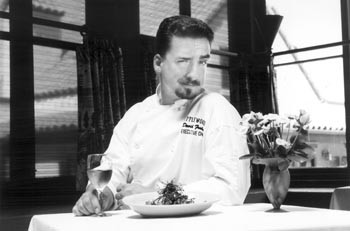
Born to cook: Chef David Frakes draws crowds with a fresh appeal.

Applewood’s youthful chef climbs into the Big Time

By Marina Wolf

THE WALKWAY from the Applewood Inn restaurant to the orchard curves past a burbling fountain, apple trees, and Mediterranean landscaping. The morning sun casts a golden glow over the little Guerneville valley in which the inn rests, and executive chef David Frakes seems pleased with the surroundings. “I’m very happy to be here right now, doing this,” says Frakes, as he squints at the apples, which are almost ripe. “I’m learning where the food comes from, when it’s supposed to be picked and served.”

It’s an interesting contrast to his three-year stint at the prestigious Ritz-Carlton Hotel Dining Room and Terrace Restaurant in San Francisco, where one could get anything, as Frakes says, “flown in from Maine at 2 o’clock in the morning.

“But out here you actually see that you’re not supposed to pick peaches until they’re ripe.”

From the reviews that Frakes has gotten since his arrival at the Inn in January of 1997, it’s clear that he’s got the hang of the harvest thing. Frakes’ snappy creations, based on the wine country sensibility that Applewood owners Jim Caron and Darryl Notter had cultivated for years, have been drawing attention from travel and lifestyle magazines from along the West Coast and across the country.

And yet, as he walks briskly away from the garden, Frakes, 29, offers some perspective on what looks to an outsider like a rather exciting climb up the ladder. “I have 10 years left to prove to myself whether or not I deserve it,” he says. “I feel like I’m on the right path, but I’m at a point where I have a lot of growing to do.”

Growth, in this case, has as much to do with earning potential as artistic genius or culinary skill. “I’m working this hard because eventually I’ll be making enough money to provide a house and all that stuff, maybe have a family,” says Frakes. “But the only way I’m going to do that is if I work my ass off right now.”

In the rarefied world of fine cuisine, Frakes’ manners and ambitions are appealingly straightforward; this Sacramento boy knows his economics from his escargot. But he was raised for life in a toque by his grandmother, a well-to-do gastronome who urged the young Frakes to enter the culinary world from a very early age, and took him to fine restaurants in San Francisco when he was 15 or 16. Grandma also picked up the tab for Frakes’ tuition at the California Culinary Academy in San Francisco, where he fled from the Sacramento wastelands in 1991.

About a year after he emerged from the culinary academy, Frakes landed the first of a series of positions at the Ritz-Carlton, and eventually snared the lead fish station under the famed chef Gary Danko. It would prove to be yet another formative experience for the wide-eyed young Frakes. “I was getting my ass whipped every day by a hard-core chef. Gary was difficult,” Frakes continues in a more careful tone–after all, he is discussing his mentor–“but I appreciate every moment that he ever gave me, because he’s such a perfectionist. He knows his stuff and he goes out of his way to teach it. … That’s something I hope I would eventually be able to give other cooks.

“If I’m lucky, when I’m 45 or 50 I might be able to get a job working for the CCA.”

Forty-five may not seem very advanced in a culture that routinely pushes the envelope of longevity. But Frakes talks sometimes as if he is already hitting middle age. “I feel like I’m going to hit 30, and it’s going to be like Logan’s Run. I’m going to float up to the ceiling and blow up or something,” jokes this young man who just 30 seconds earlier shared his unlikely predilection for the Brazilian thrash-metal band Sepultura and other “aggressive” rock “that probably teenagers listen to.

“My 20s are over; I really do need to have a game plan now. By the time I’m 40 I do want to be able to consider retiring, and that groundwork needs to be laid now, 401(k)s and stuff like that.”

Chef David Frakes’ recipe for pan-seared scallops.

FRAKES LAYS out his next steps methodically: maybe a slightly larger place, or a big house supervising 10 cooks, and eventually owning a small restaurant in the avenues in the west side of San Francisco. This is a man with a game plan. But the next minute he’s talking about his chocolate Labrador retriever puppy or angsting a little about the high divorce rate among chefs. “I have more respect for chefs who are [professionally] successful and are happily married, too,” he says thoughtfully, stroking his brown goatee. “There must be a secret to it, and I’m hoping we’re working on it.’

So far, so good, for his five-year marriage. “I feel like I’m very fortunate to have an understanding wife who knows, or I think knows,” he amends with a grin, “that the reason I’m putting all the effort into this is for us.”

Frakes is not letting the effort go unrecorded, either: He keeps albums of his work at Applewood. After an unsettling interview experience at a famous San Francisco restaurant, he decided that he never wanted to feel empty-handed and open-mouthed in that situation again, so he began assembling recipes, menus, and photographs of his work. “I look back and I’m not happy with it,” says Frakes. “Right now I’m doing the foods I wish I had started out doing when I first came here.”

Nevertheless, he’s finishing up the third album now, and has already given a copy of the first two to his grandmother as a thank-you gift.

“She helped me make a really good decision, thank God. If she hadn’t, who knows where I’d be?”

From the September 3-9, 1998 issue of the Sonoma County Independent.

© Metro Publishing Inc.

Stage Events

0

Balancing Act


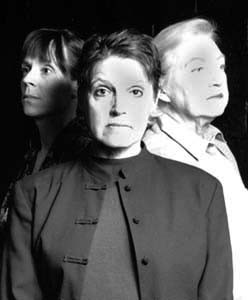
Sheri Lee Miller, Mollie Boice, and Betty Cole-Graham star in Kindertransport, starting Sept. 18 at Actors’ Theatre.

Michael Amsler


Local theaters strive to combine fine art with big receipts for fall season

by Daedalus Howell

WITHOUT an audience there is no theater,” renowned director Viola Spolin once remarked. “They are our guests, our evaluators, and the last spoke in the wheel which can then begin to roll. They make the performance meaningful.”

Audiences also make a performance profitable, which has increasing significance as local theater companies embark on their fall seasons. Many have found themselves walking the razor’s edge that divides artistic integrity and commercial viability.

Will achieving balance leave these companies neutered or noteworthy?

“We still have to get butts on the seats, as they say,” explains Jim DePriest, artistic director of the sister Sonoma County Repertory and Main Street theaters. “But we also have to challenge our audiences, actors, and directors or we’ll die on the vine.”

This year’s lineup underscores the commitment of local companies to staging artistically challenging shows that also appease the grumbling box office gods.

Main Street has already begun mounting Othello in Sebastopol as part of its annual Shakespeare in the Park series, and the theater will stage Charles Dickens’ A Christmas Carol in the dogleg between Thanksgiving and Christmas. Molière’s Tartuffe will usher in the companies’ new year, while Tennessee Williams’ signature work, A Streetcar Named Desire, looms in spring.

Likewise, Santa Rosa Players will follow their fall season’s spate of box office-friendly family fare (Neil Simon’s proven comedy Biloxi Blues book-ended by musical chestnuts Peter Pan and West Side Story) with a musical version of Kiss of the Spiderwoman (an evocative depiction of an imprisoned gay cinemaphile becoming embroiled in the political and amorous intrigues of his cellmate).

“We wanted to reach, we wanted to do something different. We’re using this production as a kind of barometer,” says Players manager Gene Abravaya. “People are always saying, ‘Oh, the Players are always doing such old, run-of-the-mill things.’ Now we’re giving the people the opportunity to see something really contemporary. Let’s see if they come.”

Actors’ Theatre confidently expresses the philosophy that fine art will attract brisk commerce: “We assume that any production that will be aesthetically excellent will be commercially viable as well,” says Sheri Lee Miller, AT’s director of public relations, then wryly adds, “Naïve, perhaps, but that’s how we do it.”

Highlights of AT’s 10th season include the Sept. 18 opening of Kindertransport–a rigorous, emotional portrait of a Jewish girl who, along with 10,000 other children, was rescued from Nazi Germany and placed in English foster homes. To commemorate the 60th anniversary of the Kindertransport, the theater hosts a panel discussion Sept. 24 about the little-known mission that will feature four survivors. November will see the opening of the hit comedy Medea, the Musical, directed by its author, John Fisher. (After its Santa Rosa staging, the production moves straight to New York.) The acclaimed Fisher will also begin instructing playwriting classes in late September. Finally, AT also offers staged readings from its New Plays Festival, interspersed throughout the season.

Petaluma’s Cinnabar Theater celebrates its 25 anniversary with the opening of Christopher Fry’s The Lady’s Not for Burning, featuring a champagne and dessert reception on Sept. 25. In late October, the theater transforms into an “Interactive Halloween Scare House,” followed by theatrical dynamo Lucas McClure’s Eclectic Theater Festival in November. Gian-Carlo Menotti’s holiday opera, Amahl and the Night Visitors, pilots the theater’s Christmas programming, and satirist songwriter Tom Lehrer’s send-ups of contemporary culture cap the year with the return of the musical revue Tom Foolery.

Sonoma State University opens the fall season with the arrival of noted theater critic and playwright Eric Bentley (consult your play anthologies–he’s edited most of them). Bentley will lecture on Bertolt Brecht and perform selections of the playwright’s work on Sept. 29.

“We really are a working theater. This year at Sonoma State we’re introducing a completely revamped theater curriculum which is much more intensive,” says Jeff Langley, chair of Performing Arts. “To some extent we’re trying to model our productions after the curriculum itself. It’s going to change the way we do everything around here. It will be a major shift from what we’ve done in the past… . The performance aspect of our curriculum is being stressed more and more.”

OTHER SSU HIGHLIGHTS include a student production of Thornton Wilder’s The Skin of Our Teeth and the Engelbert Humper-dinck opera Hänsel and Gretel. SSU closes the year with Celebrate the Solstice— tableaus and vignettes created and performed by faculty and students.

The Santa Rosa Junior College Theater Department opens its fall season Oct. 9 with Roosters, Milcha Sanchez-Scott’s explosive drama about a Latino family in the rural Southwest. Then it’s on to Christmas in November as SRJC stages a musical production of Miracle on 34th Street.

Pacific Alliance Stage Company (the resident company at Rohnert Park’s Spreckels Performing Arts Center) begins its season Sept. 17 with playwright Stephen Malatratt’s thriller The Woman in Black, followed in November by Daniel Sullivan’s comedy Inspecting Carol.

Meanwhile, Russian River-based Michael Tahbib’s fledgling Pegasus Productions waits in the wings after its recent production of Taming of the Shrew. The company is on hiatus while establishing permanent digs.

“Because of the move, we’ve basically had to defer our production until next year,” says Tahbib, who intends to “introduce the public to more ancient and modern classic works as well as present new points of view on older classics where that’s needed.”

So, will the new season find theaters packing the seats or falling instead upon the sharp sword of public indifference? There are no foreseeable close calls, but let the high-wire act begin.

From the August 27-September 2, 1998 issue of the Sonoma County Independent.

© Metro Publishing Inc.

Jethro Tull

0

Solid Rock

Tobi Corney


Ian Anderson keeps Jethro Tull classically rolling along

By David Templeton

IAN ANDERSON is a talker. The legendary force behind the equally legendary rock band Jethro Tull–after 30 years, still recording, still touring, still twisting, and still tweaking its eclectic musical style–had agreed to chat by phone from his home in the south of England. A limit of 20 minutes was set (he’s got a lot going on this week, it turns out). Yet Anderson, after chatting amiably for over 40 minutes on what he describes as “this warm English evening in a sparkling English summer,” still has plenty to say.

He’s already given his opinion of “classic rock” radio, the leading format on American airwaves: “The good thing is that classic rock is probably the only place you’ll hear Led Zeppelin, Elton John, Rod Stewart, and, of course, Jethro Tull. The awful thing is that you only hear the same five songs from each artist. I’ve been in some classic-rock stations where I’m amazed that the entire collection is contained on one wall. I have a larger collection of CDs than some classic-rock stations.”

Reissued Jethro Tull.

Anderson also discourses on the lack of attention radio gives to Tull’s newer works: “Listening to the radio, you’d think Jethro Tull had stopped recording in 1977. Our biggest competition when we release a new album isn’t Pearl Jam or Oasis or the Spice Girls–it’s our own back catalog. Though that’s not really something to complain about, I suppose. It’s something to celebrate. It’s really very nice and very flattering to have a bunch of records and a bunch of old songs that people still want to buy.

“It’s just that we aren’t dead yet,” he adds with a chuckle. “We are still making music.”

Indeed. Anderson has recently completed studio work on a new solo album, a follow-up to 1995’s Divinities: Twelve Dances with God. Jethro Tull–named for an 18th-century agriculturist and inventor, the 31-year-old band also includes Martin Barre and Dave Pegg–have been consistently putting out albums, hitting the studio every few years or so since 1969. The group’s last album was 1997’s Roots to Branches, and they will be taking to the studio again this fall, with plans to release a new album next spring. At that time, Jethro Tull–best known for such classic-rock-station standards as “Aqualung,” “Thick as a Brick,” “Locomotive Breath,” “Bungle in the Jungle,” and “Too Old to Rock and Roll, Too Young to Die”–will take to the road on another of the major, high-energy world tours for which they are renowned.

The band swings through Konocti Harbor Spa and Resort on Sept. 3.

Though few know it, and he does little to call attention to it, Anderson keeps himself busy with a number of side businesses, including a fish farm.

For the last 17 years, the rock-and-roller has owned and operated four salmon hatcheries in the highlands of Scotland, making him the third-largest supplier of smoked salmon in the United Kingdom.

“Today’s not a good day to ask about that,” he politely remarks, going on to describe a fire that, just last weekend, burned one of the factories to the ground. “I just received official permission this afternoon to have the remains demolished,” he says. “It’ll take four to six months to rebuild it. On one level, hey, it was just a building, right? But on another level, 160 people were employed there on Friday who on Monday will no longer have jobs.”

As he talks, Anderson hardly sounds like the wild flute-playing madman once known for his outrageous onstage shenanigans–the frantic gestures and airborne leaps, the outrageous neo-Elizabethan costumes with exaggerated codpieces. This Anderson seems, well, proper. And he is.

But in spite of his respectable side, the Anderson audiences love still shows up, though the 51-year-old doesn’t leap quite as high as he once did. “Our shows still have elaborate music,” he remarks, “though the staging is not so elaborate as it once was. No rockets and smoke bombs and crazy costumes. I think people come to hear the music nowadays, to see a real musician on stage doing a real man’s job, not some fellow prancing about in tights and a codpiece.

“Though I can still do that,” he adds, “if the money’s right.”

Jethro Tull performs Thursday, Sept. 3, at 6:30 p.m. at Konocti Field in Kelseyville. Tickets are $29, $39, and $49. Call 800/762-BASS.

From the August 27-September 2, 1998 issue of the Sonoma County Independent.

© Metro Publishing Inc.

The Scoop

Neck LineBy Bob Harris BETTER PAY close attention, folks. Unlikely as this sounds, if you accept the faulty reasoning of two New York Times writers, I might be sending secret signals to Monica Lewinsky. This just in: Tabloid journalism is now completely mainstream. If you'll remember,...

Recipe

Pan-Seared Scallops withMango Confit, Arugula,and Lime-Caper ButterFrakes' original recipe calls for "dayboat scallops," meaning the largest and freshest available from that day's catch. Your key words: "large" and "fresh." Serve with sauvignon blanc or fumé blanc.Mango Confit1 large mango, peeled and dicedinto small cubes1 small red bell pepper, peeled anddiced into small cubes1/2 tsp. granulated sugar1/4 tsp. champagne or...

Clockwatchers

Temp TerrorHemmed in: Parker Posey and Toni Collette endure office hell in Clockwatchers. 'Clockwatchers' takes a subversive look at the bleak world of the modern officeBy WHAT AN appropriate title Clockwatchers is. Director Jill Sprecher and her sister, co-writer Karen Sprecher, have that usual problem of budding independent filmmakers: How do you stretch out to the necessary hour and...

Open Space District

The Party's OverMichael AmslerOpen Space District gala gets grilledEdited by Greg CahillAN EXCLUSIVE and swanky soirée dreamed up by the beleaguered Sonoma County Open Space District in recognition of its own members, which would have had taxpayers footing the $10,000 bill for upscale catering, fine wines, and entertainment, became the target of county officials' ire this week.Sonoma County supervisors...

Laurie Gwen Shapiro

Pop CultureBy Jessica FeinsteinRarely can a first-time novelist churn out such an unexpected surprise. Rachel Gannelli, the main character in Laurie Gwen Shapiro's New York-paced tale The Unexpected Salami, is the quintessential Generation X poster child--overeducated, smart-assed, neurotic as all hell, and overcome with ennui. Her story, rich with hilarious observations, begins in Melbourne, Australia, where her self-imposed exile...

Talking Pictures

Nightmare JobsBy David TempletonWriter David Templeton takes interesting people to interesting movies in his ongoing quest for the ultimate post-film conversation. This time out, he connects with business consultants M. K. Key and Terrence Deal to discuss the horrors of corporate culture as portrayed in the hard-to-find indie film Clockwatchers.For two weeks, M. K. Key and Terry Deal have...

Mickey Hart

Hart BeatJohn WernerMickey Hart returns withnew band, new CDBy Alan SculleyWHEN JERRY GARCIA, the leader of the Grateful Dead, died in 1995, it may have appeared that drummer Mickey Hart had not been affected very deeply by Garcia's death and the end of his much-beloved band. After all, immediately after Garcia's passing, Hart entered the studio to work on...

Chef David Frakes

Top RungMichael AmslerBorn to cook: Chef David Frakes draws crowds with a fresh appeal. Applewood's youthful chef climbs into the Big TimeBy Marina WolfTHE WALKWAY from the Applewood Inn restaurant to the orchard curves past a burbling fountain, apple trees, and Mediterranean landscaping. The morning sun casts a golden glow over the little Guerneville valley in which the inn...

Stage Events

Balancing ActSheri Lee Miller, Mollie Boice, and Betty Cole-Graham star in Kindertransport, starting Sept. 18 at Actors' Theatre.Michael AmslerLocal theaters strive to combine fine art with big receipts for fall seasonby Daedalus HowellWITHOUT an audience there is no theater," renowned director Viola Spolin once remarked. "They are our guests, our evaluators, and the last spoke in the wheel which...

Jethro Tull

Solid RockTobi CorneyIan Anderson keeps Jethro Tull classically rolling along By David TempletonIAN ANDERSON is a talker. The legendary force behind the equally legendary rock band Jethro Tull--after 30 years, still recording, still touring, still twisting, and still tweaking its eclectic musical style--had agreed to chat by phone from his home in the south of England. A limit...
11,084FansLike
4,606FollowersFollow
6,928FollowersFollow