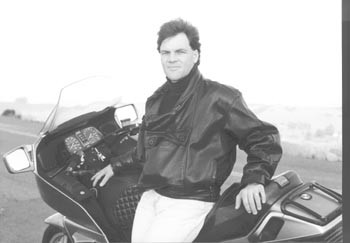
Allen Noren

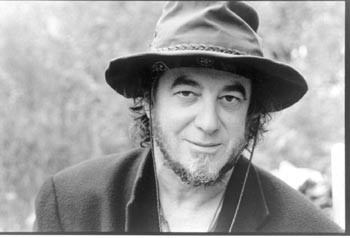
Heart like a wheel: Allen Noren speaks Sept. 7 at Readers’ Books.

‘Storm’ und Drang

A motorcycle trip turns into an endurance contest in local author’s new book

By Yosha Bourgea

WHEN THE IRON CURTAIN fell in 1992, Sonoma County writer Allen Noren and his girlfriend of seven years, Suzanne, seized the new opportunity to travel through a part of the world previously closed to the West. A journey they had spent years planning and saving for was now possible: to ride by motorcycle clockwise around the Baltic Sea, starting and ending in Germany, passing through eight other countries along the way.

Noren recounts that eventful journey in Storm: A Motorcycle Journey of Love, Endurance, and Transformation (Travelers’ Tales; $24), a vividly written book that is recommended reading for any intimate couple considering an extended trip together.

Allen and Suzanne, both seasoned world travelers, start off expecting another high-spirited adventure. But from their first foray onto Germany’s infamous autobahn, where reckless drivers, high winds, and pouring rain bring them to the edge of death, their journey begins to transform into a test of commitment. What ends up being the coldest, wettest summer in recorded history sets the tone for a trip that is decidedly unexpected–and anything but easy.

Like Robert Pirsig’s classic Zen and the Art of Motorcycle Maintenance, this is a travelogue interwoven with scenes from a disintegrating relationship. But while Pirsig’s physical journey is peripheral to the philosophical quest that forms the heart of his book, Storm is as much about the Baltic states as it is about the American couple riding through them.

Noren writes with a lifelong traveler’s enthusiasm for detail. Of course, a travelogue showcasing the cultures along a 6,000-mile path could become didactic after a while. But Noren, who travels without a guidebook, also avoids sounding like one. His delivery is so direct and so assured that it’s easy to forget this is his first book.

“To ride a bike is to be part of the machine,” he writes. “You’re essentially sitting on top of an engine and a raw steering mechanism, and your arms and legs are the linkages that make it all work. To ride well, every part of my body had to work together in minute ways.”

But it’s not just the readiness of his body, or the motorcycle itself, that affects the quality of the journey. While Allen is stimulated by the challenges of the road, Suzanne struggles with her need for comfort and safety in the face of the seemingly endless storms.

At a wild motorcycle rally on the island of Gotland that’s the subject of one of the book’s best passages, the couple watches a crowd of Scandinavian bikers behaving with drunken abandon. Suzanne is appalled, but Allen views it as a fascinating neo-pagan ritual.

“If this trip was a story you were reading about, wouldn’t this be a part you’d stop at and want me to read?” he asks her.

The trip is a story, of course, and what’s fascinating to read about may be unpleasant to experience directly. In that light, Suzanne’s complaints are easy to understand. But Storm is Allen’s story, and we’re sympathetic to his frustration as the one who is expected to shoulder all the responsibility. Allen describes his reaction to Suzanne’s final breakdown in Gdansk, Poland, where her outburst of emotion leaves him feeling helpless and unable to express emotion himself.

“I had to do something, so I decided to wash the bike,” he writes. “I would wash it gently, as if it was wounded. I would go about it the way some people pray.”

As the book comes to a close, so does the trip, with Allen and Suzanne riding back into Bremen, Germany, some three months after leaving it. The story ends there, on a deliberately ambiguous note, with the future of the relationship still troubled and uncertain. Readers may draw their own conclusions, but as the author quietly reminds us, the ending–happy or otherwise–is not what makes a journey. It’s travel itself that matters.

Allen Noren reads from Storm on Thursday, Sept. 7, at 7:30 p.m. at Readers’ Books, 130 E. Napa St., Sonoma. For details, call 939-1779.

From the September 7-13, 2000 issue of the Sonoma County Independent.

© Metro Publishing Inc.

Electrohippies

Steven Verriest


Virtual Vandals

Hacktivism takes to the cyberstreets

By David Cassel

IN EARLY MAY an activist calling himself “Reverend Billy” called for thousands of computer owners to fire up their modems for an assault on Starbucks. From unseen corners of the globe, they’d converge on the company’s website–hoping to overload it. Though the media portray hackers as secretive, destructive intruders, some individuals and groups are openly committing online attacks in the name of furthering specific causes. It can be a symbolic massing on a Web page which, with enough participants, makes it inaccessible to others–or more invasive “monkey-wrenching” to disable a site’s equipment.

Others just want to bypass government restrictions they see as unfair. But they’re all trying to fuse their passions to their technology, using the power of the Internet to discover new forms of social protest.

In December a group called the Electrohippies(www.gn.apc.org/pmhp/ehippies) organized a “WTO virtual sit-in” that overloaded the machines keeping the World Trade Organization’s Web pages on the Internet. The five U.K. activists estimate that over 452,000 people swamped the site. (During the action, the group says, participants sent them up to 900 e-mails each day.) Paul Mobbs, the group’s co-founder and media liaison, says they accomplished their goal–disrupting the World Trade Organization’s online presence for four- to five-hour stretches–and reduced that site’s overall speed by half.

In April the group launched an even more ambitious series of events, protesting genetically modified crops. If you had a computer equipped with a modem, you were already a potential co-activist in their radical action. A surprise “special action” began April Fool’s Day with the media-friendly name “Resistance Is Fertile.” The Electrohippies called for an e-mail campaign from April 3 to April 7 targeting 78 officials listed on the Hippies’ website–including U.S. Department of Agriculture communications official Vic Powell–to build public pressure against genetically modified foods. But the tactics remained so controversial that they called off their main event that had been scheduled for the next week– “an e-mail and client-side denial-of-service extravaganza”–after an online vote for the action failed to muster a simple majority.

Meanwhile, authorities worry that a new international event could become the target.

On Aug. 23, Australian Communications Minister Richard Alston announced that computer experts will work around the clock during the upcoming Sydney Olympics to keep out cyber hackers who might try to vandalize the games’ Web sites, even changing official results and the names of medal winners.

“You can’t assume goodwill. You’ve got to proceed on the basis that there will be people trying to cause difficulties and do your best to avoid these,” Alston told the Associated Press.

“We are not about to telegraph our punches.”

There is good reason to fear virtual vandalism down under: Sydney is being heralded as the first “Internet Olympics,” with more than 275 million Net users worldwide compared to 40 million just four years ago.

Disruption of the games would be a major coup for hackers, computer experts say.

Symbolism vs. Damage

IT’S A NEW BREED of activism–wired and confrontational. Some question whether it’s really a desirable form of protest, but the Electrohippies are hoping to defuse criticism by popularizing not just their tools, but a code of ethics. They publicized their intentions before the attack–and also issued a lengthy paper on the philosophy of it.

“These type[s] of actions are directly analogous to the type[s] of demonstrations that take place across the world,” reads “Occasional Paper No. 1.”

The group has always argued that the large numbers needed to have an impact mean a “democratic guarantee” is inherent in the technique. “One or two people do not make a valid demonstration,” their website argues–“100,000 people do. . . .

“If there are not enough people supporting the action, it doesn’t work.”

They’re seeking nothing less than a world where e-commerce is balanced by e-protest–or at least where cyberspace isn’t immune from public pressure. Henry David Thoreau’s “On the Duty of Civil Disobedience” is displayed prominently on the group’s website–surviving 152 years only to be taken up by Internet activists.

But Mobbs acknowledges that much of the practical theory began with various U.S. groups like the Electronic Disturbance Theatre that were supporting the Zapatista National Liberation Army in 1998. Using tactics hardly more complicated than repeatedly hitting the button on a Web browser to reload a Web page, the group created a form of activism that was also part poetry.

It was often, as one website described it, “a symbolic gesture created to increase awareness about the low-intensity war in Chiapas, Mexico.”

Together, four activists, calling themselves an Internet performance art group, had created a Web interface that would access the page for Mexico’s President Zedillo. After altering the page, the interface would seek bogus addresses, so the browser would return messages like “human_rights not found on this server.”

The project–which they dubbed “FloodNet”(www.thing.net/~rdom/ecd/ZapTact.html)–also filled the page’s access log with the names of people killed by government troops. “In an artistic sense, this is a way of remembering and honoring those who gave their lives in defense of their freedom,” Ricardo Domingo wrote in an online remembrance. There were nine actions between April and December of 1998, adds Carmin Karasic, a Boston-based activist–culminating with a mass action on the website for the Mexican Stock Exchange.

But were the actions effective?

Yes, Domingo argued–measured not by their technical effect on the targeted sites, but by the attention they brought to the Zapatistas. The website for their Electronic Disturbance Theatre points out that their activism tool–which the group released in early 1999 to sow more online activism–“emerged from and serves a community which genuinely requires the development of such attention weapons as a matter of survival.”

Other online documents describe their actions as a show of presence that sends the Mexican government a message: “We are numerous, alert, and watching carefully.”

The technique is now becoming more common. Attackers used a variation in February for overwhelming assaults on several high-profile sites, including Yahoo! and CNN, and in mid-March a similar attack temporarily disabled the website for the FBI. But Karasic argues that, like the protests of the Electrohippies, FloodNet’s action drew its validity only from the number of people showing support.

“It was only actualized through thousands and thousands of participants,” she remembers. “It was meaningless without the masses.” Popular support transforms a random act of vandalism into a show of presence, Karasic argues.

“This is an important difference from the single hacker/hacktivist who takes down a server with a single script,” she says.

For hacktivists, like the two Cloverdale teens who hacked their way into sensitive U.S. government sites a couple of years ago, damage is often less important than symbolism. Hacker Reverend Billy’s early May action against the Starbucks site had almost no noticeable effect, according to some observers.

“Whenever . . . I, myself, went to visit starbucks.com, I did not have any trouble accessing them,” concedes Ricardo Domingo, whose group supported the action. But that’s almost beside the point. “The true goal of the action is to generate focus on the issue of [Starbucks’] policy to take over neighborhoods with its loss-leader branding.” Announcements for the action even included information about Zapatista settlements in Mexico facing an ominous military presence.

“The Zapatista communities now have as many military camps around as we have Starbucks in Manhattan,” says Domingo, who feels the action helped their effort “to spread to levels of information about our world under the signs of neoliberalism.”

A Bad Idea?

THE ELECTROHIPPIES’ Paul Mobbs agrees, cautioning that groups overloading e-commerce sites shouldn’t be overmalicious. “If you want to be effective, it’s more justifiable to disrupt a server for one day and make your point, rather than dragging the action on for a few days and cause more generalized disruption.”

The tactics aren’t universally supported. “The Electrohippies are trying to rationalize Denial of Service attacks and violate the First Amendment privileges of their opponents,” wrote a hacker named Oxblood Ruffin, in an essay that the Electrohippies agreed to display on their website (www.gn.apc.org/pmhp/ehippies/files/op1-cdc.htm). And the discussion continues elsewhere on the Internet.

The Hacktivism mailing list (hacktivism.tao.ca)–an e-mail discussion list started last summer to grapple with this combination of hacking and activism–has carried debate about whether such attacks are nothing more than glorified censorship, with activists simply hampering the opposing side’s right to speak.

But there’s not a clear consensus. “It depends on the target,” one message countered during the list’s first weeks last summer. “In many cases there is not a level playing field, especially when the opponent is a large corporation or government.”

Some even argue that this evolution may have been inevitable. “For us the idea of hackers as activists seemed obvious,” says a spokesman for RTMark, an online collective distributing funds globally for anticorporate activities.

“Too many were becoming experts in defending corporate privacy rights rather than using their skills to fight those rights and others.”

By the fall of 1998, Wired News reported that a group called X-Pilot had even rewritten text on the Mexican government’s website. Such incidents offer evidence that groups and individuals sometimes move beyond overloading the machines hosting Web pages. Attacks can be more technical–more hack than activism–raising again the issue of just how far an online protest should go.

Oxblood Ruffin–whom some credit with coining the word hacktivism–notes that one Hong Kong group of hacktivists, called the Hong Kong Blondes, now numbers over 100 members, many with positions within China’s Communist Party. Reached recently for a comment, he added that he now distinguishes between hacktivism and simple “[h]activism.”

“The former seeks to remedy the Net of bad code, restriction, lack of access, etc.; the latter seeks to use the Net as an agent for social justice on the ground through various protest actions or as a publicity medium.”

He says the distinction is important for assessing groups online. “There is more [h]activism than hacktivism,” he writes.

“The Electrohippies are starting to get into electronic civil disobedience, although I very much disagree with their methodology.”

In contrast, he points out that his own group is currently working on a way to e-mail Chinese Internet users Web pages that are officially banned by their government.

Meanwhile, hacker websites like 2600.com and AntiOnline preserve screen shots of dozens of websites that they’ve learned were compromised and rewritten. Attackers sometimes leave only vain blustering with a pastiche of names–a kind of online graffiti.

But in other instances, there’s an unmistakable message. Earlier in 1998 a hacker broke into the system of the Bhabha Atomic Research Centre in Bombay, India, changing its Web page into a protest of India’s nuclear weapons tests, as well as stealing its e-mail.

The Electronic Disturbance Theatre issued a statement of support for the hacker’s actions, and despite the hands-on approach, even the leader of the Hong Kong Blondes applauded the action in an online interview conducted by Oxblood Ruffin.

“I view the BARC intrusion as something positive,” he told Ruffin, “because it will draw attention to the situation and cause more discussion about a serious issue.”

MAYBE THE NEW technology is just amplifying the impulses of the people who use it now. “The Acteal Massacre in December 1997 moved me to tears,” remembers Carmin Karasic–and her work on the Electronic Disturbance Theatre was the ultimate result.

But her preparations for the demonstrations also harnessed the Net in another way. While the guerrilla army was using the Internet to deliver news of its struggle to an online audience, Karasic’s own contingent was using the Net to develop forms of support.

“Our collaboration was 100 percent Internet-linked,” Karasic remembers–“all e-mail exchanges.” To this day, Karasic notes, “I think I’m still the only Electronic Disturbance Theatre member who has met all of us face-to-face.”

Though it’s hard to measure, it’s possible that cyber-causes may also reach those with the same passions more quickly–allowing political sentiments to be better focused. Online networking has been cited as a factor in the large turnout for the WTO protests in Seattle. And though it’s hard to quantify, the concept of hacktivism itself may be spreading, possibly even evolving.

On the hacktivism mailing list, Bronc Buster announced he was working with human rights groups and hacker groups on a suite of applications, released at the hacker convention “DefCon” this summer.

“It shows that hacktivism is a real way to use the Net to blend activism and technology in a positive way,” he argued, “while helping people at the same time.” And elsewhere, an activist who goes by the name RE:no says he’s developed a “Mail-O-Matic” for use in online actions–“a mail washer, to send extracts from books explaining our state of mind.”

Almost by definition, any pursuit of hacktivism will require a constantly updated set of tools. (The Electronic Disturbance Theatre’s website notes that the Department of Defense wrote a counterprogram to try to thwart one of the group’s actions.) “We must be inventive with each problem which we encounter,” RE:no argues. But even when those tools lie dormant, their potential is felt. RE:no believes activists should keep them in reserve–“as an armed peace tool”–the way the Zapatistas remain armed “as a symbolic gesture of voice.”

And the hacktivism continues. After funding FloodNet, RTMark moved on to other forms of online activism, creating a doppelgänger of the official website for GATT and championing European art group eToy in its fight with toy retailer eToys. Pigdog.org called on network administrators to block Doubleclick ads from reaching its users. Last summer on the Hacktivism list, Ricardo Domingo even announced new online actions in August of 1999 to commemorate the birthday of Emiliano Zapata.

Whether or not hacktivists can stay in the code race, escalating tactics in response to countermeasures, remains to be seen. But their actions have at least raised that possibility–along with the thorny issues that accompany it.

While it may be unclear whether online masses can make a lasting impact on social policy, there are individuals who believe it’s possible and are working to find a way to make it happen–which is, in itself, a kind of first step.

As Thoreau himself once said, “In the long run men hit only what they aim at.”

From the August 31-September 6, 2000 issue of the Sonoma County Independent.

© Metro Publishing Inc.

Sample Menu From a Past Dinner

0

The finest seasonal vegetables and herbs from the OAEC’s organic gardens and orchards are harvested just hours before mealtime, making it impossible to predict the menu beforehand. A great diversity of ingredients, tastes, and colors typifies the center’s fare, as in this sample menu from a past dinner.

Crostini with Fresh Azerbaijani Basil Pesto

Iranian Basil Pesto and Italian Basil Pesto with French Figs

Raspberries and Freshly Picked Roasted Almonds

Harvest Fettuccini with Assorted Runner Beans, French Red Shallots, Portobello Mushrooms, and Roasted Heirloom Paste Tomatoes

Baby Rainbow Chard with Lemon Zest Drizzle

Mother Garden Salad Confetti with Raspberry Vinaigrette

Assorted Breads with Herb Butter

Goldenberry Lavender Tart with Homemade Vanilla Bean Ice Cream

Coffee, Lemon Verbena Tea, and OAEC Honey

From the August 31-September 6, 2000 issue of the Sonoma County Independent.

© Metro Publishing Inc.
OAEC Fundraising Dinners

0

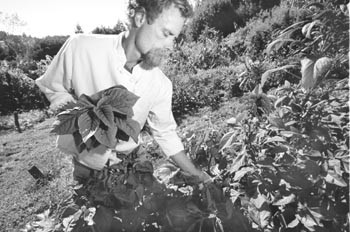
Tending to business: Doug Gosling, head gardener at the Occidental Arts and Ecology Center, doubles as executive chef Sept. 9 at a vegetarian benefit dinner culled from the facility’s extensive selection of heirloom plants.

Humbly Exotic

OAEC dinners offer peek at possibilities

By Marina Wolf

FUNDRAISING DINNERS. The causes are many and worthy–from monkeys for the color-blind to aid for Kabuki- deprived children–but the dinners are often the same: California French food (in intent, if not execution), black-tie attire, and silent art auctions in tents so large as to obliterate any sense of community or connection to the cause.

In that atmosphere of extravaganza and effect, the Occidental Arts and Ecology Center fundraisers stand out by virtue of understatement. A spreading oak tree will likely be both ceiling and decoration at this year’s harvest dinner, held on Sept. 9 at the center’s 80-acre spread in the hills of Occidental in west Sonoma County. The paths surrounding the “dining room” are carpeted with plain old backwoods grass, made slightly treacherous by clumps of composting straw and volunteer vegetables (weeds). In other words, heels are unnecessary and probably hazardous.

And rather than undergoing acrobatic feats of transformation behind kitchen doors, the food is being prepared simply.

Head gardener Doug Gosling also plays executive chef on these occasions, but his gardener’s devotion to the unpredictable rhythms of Sonoma County seasons doesn’t allow him to even outline the menu until the day of the event: he would prefer to build the dinner around what’s really ripe.

That wait-and-see approach sounds a little risky, but Gosling insists that cooking is easier. All the flavors are there in the produce, so complicated sauces and preparations are unnecessary.

Harvest Dinner: A great diversity of ingredients, tastes, and colors typifies the OAEC’s fare, as in this sample menu from a past dinner.

“Ripe, in-season ingredients take care of themselves,” he says, echoing chef-advocates such as Alice Waters and Molly Katzen in their dedication to vibrantly healthy fruits and vegetables. “There doesn’t need to be a lot of processing when you have fresh, organically grown produce.”

These ideals, as well as a commitment to biodiversity, intentional communities, and sustainable food systems, took root at the OAEC site back in 1974, when gardeners of the Farallones Institute first broke ground. Two changes of ownership later, the densely planted main garden, which staff members affectionately call the Mother Garden, is the generous source of plants for the center’s semiannual plant sales, as well as school-garden programs around the county and even an organic garden supplying the Food for Thought food bank for those with AIDS.

OAEC goes beyond organic into heirloom: many of the fruits and vegetables in its gardens are rare or old-fashioned varieties, if not to say almost extinct or simply unheard of in the North American marketplace. Andean fruits and vegetables, some of which have been cultivated in the mountain ranges of South America for thousands of years, form a significant part of the collection.

In the coastal hills, these ancient plants have found a match for their growing conditions at home and thrive so well that Gosling showcases them every spring in a fundraising dinner of their own. Here are squashes, summer and winter, in shapes and colors never seen in the supermarkets; legumes and roots that are distant relatives of the potato and string bean and taste very little like them; and fruits such as the Cape gooseberry that somehow captures a mango-coconut-berry taste in a tomato texture and a tomatillo husk (Gosling is planning to incorporate it in the evening’s dessert).

As exotic as they are, these vegetables and fruits are easy additions to the harvest feast that Gosling plans each summer. Past dinners have featured summer weeds lasagne, sautéed Peruvian fava beans, and bread flavored with popped Aztec amaranth seeds (“under a magnifying glass they look like little tiny popcorn”). For appetizers one year, Gosling set out crostini with three kinds of pesto, made from Azerbaijanian, Italian, and Iranian basil. And the “Mother Garden” salad contains some 40 kinds of greens and flowers.

All these unusual and colorful dishes illustrate one thing clearly: we are starved for variety.

“Before the Second World War, people had much more diversity,” says Gosling. “But now the food supply has been very streamlined and simplified. We might think we have a lot of choices, but in fact, relative to what used to be available, the choices are extremely limited.”

What’s more, he says, the flavors we have access to are limited, too: “Produce grown by agribusiness isn’t grown either for taste or for nutrition. For them, it’s all about transportation, shelf life, and uniformity of size and color.”

Gosling and the other workers at OAEC hope to reverse the trend, planting seeds, as it were, about the other possibilities of food supply.

Clearly, enough patrons have thought the cause worthy to fill up the fundraisers every year. But a few otherwise supportive community members have balked at the suggested sliding scale for donations–$100 to $500 per person.

Gosling acknowledges the complaint; it is a lot of money.

But it’s well within the range for fundraising events, he says, especially considering that the dinner is one of the few sources of money that OAEC relies on. And anyway, fine dining in the Bay Area, even in Sonoma County, can easily top $100 a head.

“I think we’re offering an experience you can’t get anywhere else,” he says.

A vegetarian benefit dinner, “Fall Harvest Dinner: Tastes of Diversity,” will be served on Saturday, Sept. 9, with hors d’oeuvres around 5:30 and dinner at 6:30, at the Occidental Arts and Ecology Center, 15299 Coleman Valley Road, Occidental. Reservations are required. Proceeds benefit the OAEC. Tickets: $100&-$500. 874-1557.

From the August 31-September 6, 2000 issue of the Sonoma County Independent.

© Metro Publishing Inc.

Russian River Jazz Festival

0

Leader of the pack: Roy Hargrove is back with a new album of ballads–with strings–and an upcoming appearance at this year’s Russian River Jazz Festival.

The Lion King

Trumpet player Roy Hargrove still leads the pack of young jazz lions

By Greg Cahill

“I’VE ALWAYS wanted to do a ballad project,” says trumpet player Roy Hargrove, 30, a hard-bop player who has just released his first collection of songs with strings–usually a hallmark of only the most serious ballad players. “Whenever I perform ballads in live sets, people respond. So I thought it would be a good idea to devote a whole album to ballads. I’ve always loved those kinds of albums, especially John Coltrane’s and those ballads-with-strings albums by Clifford Brown and Donald Byrd.”

On Moment to Moment (Verve), Hargrove does indeed evoke the soulful eloquence of Brown’s 1955 classic Clifford Brown with Strings–relaxed mood music with pockets of dim-the-lights romanticism, hushed sentimentality, and quiet dreaminess.

The CD includes covers of such standards as the Sammy Cahn/Jules Styne gem “I Fall in Love Too Easily,” Johnny Mandel’s “A Time for Love,” Jimmy Dorsey’s “I’m Glad There Is You,” and the Henry Mancini/Johnny Mercer&-penned title track. In addition, Hargrove lends his touch to Pat Metheny’s “Always and Forever” and Antonio Carlos Jobim’s “How Sensitive,” as well as the original composition “Natural Wonders.”

His departure from hard bop has drawn mixed reviews. Jazz critic Richard Ginell of the All Music Guide praised much of Hargrove’s playing on the disc–the follow-up to 1997’s highly acclaimed Habana, a foray into Cuban jazz–as “gorgeous.” But he added that the trumpet player’s “undoubted sincerity and musicality go only a limited distance over the 68-minute span of the CD before simply repeating themselves out. CDs like this make one wish that the 10″ LP was back; that time frame was just long enough for some of jazz’s best string albums of the past.”

Hargrove recorded Moment to Moment at Red Barn Studios (owned by Al Jardine of the Beach Boys), just 200 yards from the secluded Pfeiffer Beach in Big Sur. “It’s such a beautiful place, and that added to the vibe of the sessions,” he says.

The Bay Area has become a second home for Hargrove, a Texas native who resides in New York. In recent years, he has performed regularly at the Russian River Jazz Festival (where he returns on Sept. 17), and the Monterey and Big Sur jazz festivals.

On the weeks when Hargrove isn’t on the road, the area has become a favorite vacation destination.

Russian River Jazz Festival Schedule

HARGROVE’S rise on the jazz scene has been meteoric, placing him at the front of the pack of young jazz lions. He grew up in Dallas, an inquisitive kid who read voraciously and once thought of becoming a psychologist. The trumpet changed all that. At age 9, he joined an elementary school band and immediately realized that the horn was something special.

“From the very beginning, I was turned on to improvisation with roots within the blues,” he explains. “I was very impressed that the kids would get up and take improvised solos. When I saw that, I said, ‘Yeah, this is what I want to do.’ I was inspired to practice a lot because I wanted to do better than everyone else.

“I wanted to make a difference and really stand out.”

As a teen, Hargrove attended Booker T. Washington High School in Dallas, a renowned performing arts school. “That’s where I started finding out about trumpet players like Clifford Brown, Lee Morgan, Freddie Hubbard, Fats Navarro, and Blue Mitchell–and, of course, Miles Davis and Dizzy Gillespie,” he says. “That’s also when I really started listening to acoustic jazz, because before that I had a really different sense of what jazz was, since I listened to the radio. And what they call jazz on the radio in Dallas really is electronic music or fusion or whatever you want to call it. But when I started hearing these other cats play on their recordings, it just turned my whole head around.

“I mean, when I heard Clifford Brown, I went insane,” he adds with a laugh.

All that rehearsal paid off. Hargrove met Wynton Marsalis in 1987 when the jazz star visited his high school and allowed Hargrove to sit in with his band. Soon afterward, and with Marsalis’ help, Hargrove began playing with Superblue, as well as with such talented players as saxophonist Bobby Watson.

He attended the prestigious Berklee School of Music in the 1980s.

With his 1990 recording debut, Diamond in the Rough (RCA/Novus), Hargrove unleashed a set of full-blown instrumental chops that rivaled those of Marsalis, Terence Blanchard, Wallace Roney, or any one of the other media darlings mining the same so-called neoconservative vein of acoustic, traditional jazz. A series of hard bop excursions with saxophonist Antonio Hart followed. While Hargrove’s playing may have lacked the polish of his more established peers, he still caught the collective ear of the jazz community with riveting, rafter-rattling solos and a loose, lyrical groove that must leave other Young Turks green with envy.

The years of woodshedding, playing the summer jazz festival circuit (with the likes of Frank Morgan and Art Blakey), and supplementing his after-hours jam sessions in Greenwich Village helped put Hargrove’s career on the fast track. In 1991, Hargrove marked his unofficial coming out at Carnegie Hall, where he played alongside legendary tenor saxophonist Sonny Rollins.

It was a heady experience for the then 21-year-old Hargrove.

“I’d always dreamed of playing with someone like Sonny Rollins, and when I finally got a chance to be up there with him, I just couldn’t believe it,” he recalls with a laugh. “It was very exciting because he’s a real unpredictable player. He throws a lot of curves, and you have to really stay on your toes to hang in there with him.”

Hargrove passed muster. Indeed, his increasing notoriety led to a bidding war–if such a thing exists in the relatively low-budget jazz world–that landed him in 1994 at Verve Records, a seasoned company that after 50 years had re-emerged as the world’s premier jazz label. His first release for Verve, Roy Hargrove Quintet with the Tenors of Our Time, teamed the trumpeter with such heavy-hitting tenor sax players as Joe Henderson, Stanley Turrentine, Johnny Griffin, Branford Marsalis, and Joshua Redman.

“It was a real learning experience,” Hargove says, reverentially. “There’s nothing like actually being there and having the experience of playing with someone you always used to listen to. You never forget that. It stays with you.”

And just what did he learn?

“It’s hard to describe, but playing along with, or even just standing next to, someone like Joe Henderson or Johnny Griffin is astounding,” he says. “You learn a lot listening to how they approach what they play, whether it is where they leave spaces, or where they take a breath, or how they hold the instrument, or even what they choose not to play.

“And, of course, there are all those great stories they tell in between tunes.”

Just a few short years after his discovery, Hargrove was playing with Dizzy Gillespie, being hailed in the press as a young Clifford Brown, and picking up a 1995 Downbeat Readers’ Poll spot as best jazz trumpeter. He’s even being compared to a young Miles Davis. “It’s very flattering, but there will never be another Miles Davis,” he says, modestly. “Still, it’s flattering because these are people I really look up to and try to emulate.”

And where does he think the music is headed now that most of the originators of bebop are dead?

“It’s true that those people are gone from the physical realm, but they still live within our hearts and our souls,” he says. “I think that people like Miles and Dizzy left a long legacy of music for us to continue to study and to learn about. The music itself is timeless, so it will never be gone or get old. I mean, there are recordings by them that I listen to over and over again, and each time I hear something new.”

“What I try to do is apply all the knowledge I’ve gotten from them with my own feeling, my own emotions, and bring that as lyrically as possible through the bell of my trumpet.”

From the August 31-September 6, 2000 issue of the Sonoma County Independent.

© Metro Publishing Inc.
Online Dating Service in Prison

0

Jailbird Lovebirds

Online dating service goes behind prison bars for romance

By Michael Goldman

RONALD BISHOP’S marriage of 20 years collapsed nine years ago. Since then there have been many lonely moments, he says. So when the 53-year-old oil-processing supervisor from Liberty, Texas, hooked up with Carol Sevilla, he was elated. Now he has someone to cherish on Valentine’s Day, someone special to hang up a stocking for on Christmas, and a partner with whom to share life’s disappointments and victories. “She’s the best thing that’s happened to me,” Bishop says. “We’re in love.”

Bishop, however, has never met Sevilla.

That’s because Sevilla, 25, is an inmate at the California Correctional Women’s Facility in Chowchilla, Calif., where she is serving time for second-degree robbery. She and Bishop have corresponded since he obtained her address 10 months ago from an online dating service called Prisonbabes.com. Bishop says that once Sevilla is released, they plan to live together in Texas.

“It’s the best $4.50 I ever spent,” Bishop says of the fee he paid for the address.

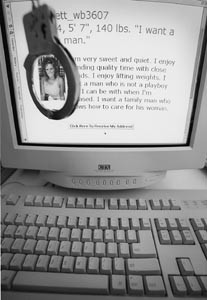
Prisonbabes is one of a handful of online services that match men with young single women behind bars. Most sites include pictures of the women, as well as their biographical profiles and release dates. Criminal records are not provided. Clients choose whom they’d like to correspond with, then pay a small fee for the address. After that, they’re on their own to write letters, make calls, and arrange visits.

Use of the service has led to six marriages and many happy relationships, according to Prisonbabes’ founder, Skip Harris, 36, of Stockton, Calif.

But Kim Gandy, executive vice president of the National Organization for Women, says the sites “attempt to exploit women in difficult circumstances.”

She’s not the only one voicing concern. Some clients complain that they are the ones being victimized by dishonest prisoners, while some psychologists question whether the relationships are healthy.

Lonely Hearts behind Bars

THE INSPIRATION for Jailbabes .com, another online service, came in a flash for its founder, Ken Klein. After being dismissed from his paralegal job, Klein, 63, of Orange County, Calif., was looking for work. When a friend who had been in prison mentioned the loneliness she felt while incarcerated, Klein had his idea. The former inmate offered to round up some prison friends to participate, they passed on the word to other inmates, and in 1997 Jailbabes was born.

The site has since featured more than 3,000 women in 28 states. Klein says it attracts 60,000 to 70,000 hits per day, yielding hundreds of customers.

The site’s success can be explained in part by the glut of young single women in jail, he says. Many women get in trouble early on in their lives, Klein says, because “they come from broken homes and may not have had any place to go after high school, if they went to high school at all.”

That explains the supply. But the demand is fueled by other factors.

Referring to his “jailbabes,” Klein says, “You don’t have to buy them lavish presents or jewelry. That’s not allowed. But you can talk about sex, politics, or religion and have a chance to see if there’s any chemistry.”

Corey Habben, a clinical psychologist in the Chicago area who specializes in men’s issues, says there’s a less elaborate explanation for the attraction: desperation.

“The prospect of going to a club or bar to meet someone,” he says, “is more daunting than having a captive audience.”

Fantasy or real love? The attraction might also have its roots in men’s sexual fantasies, according to John Ross, a clinical professor of psychology at Columbia University’s College of Physicians and Surgeons in New York whose areas of expertise include men’s sexuality and sexual fantasies.

“The whole culture puts a kind of premium on kinkiness and breaking all sorts of taboos,” Dr. Ross says. “This would be one sort of major taboo to be broken, to be involved with a woman who’s a criminal.”

Yet another explanation is offered by Wayne Myers, a professor of psychiatry at Cornell University’s Weil College of Medicine in New York. He says that while women have been known to start romances with murderers and other hardened criminals because of the “danger aspect of it,” the case of men being attracted to women behind bars is an entirely different matter.

“It’s very much rescuing the fallen woman, the damsel in distress,” says Myers, who is a sex addict expert. “You are saving the [woman] from the state she has fallen to and you’re going to bring her back from her fallen state, back to respectability. And therefore you become very manly. There’s a sense of hyperpotency there.”

But according to Gary, a 34-year-old information technology salesman from Anaheim, Calif., who declined to give his last name, a relationship with an incarcerated woman is not very different from any other relationship.

He met “Lisa,” who also is an inmate at the Chowchilla, Calif., prison, a couple of months ago while using the Jailbabes service and has been corresponding with her since.

“It’s something that absolutely just clicked,” he says. “We’re attracted to each other, and I get a good sense that we want the same things.”

Can these women be trusted? Some relationships fostered through the services seem to be on shaky ground.

Bishop, the Texan, says that his girlfriend, Sevilla, told him she is Asian, has only been in prison three years, and is to be released in December of 2001, at which point she will move to Texas to start her life anew with him.

But Margot Bach, a spokeswoman for the California Department of Corrections, which operates the prison in which Sevilla is incarcerated, tells a different story.

According to prison records, Sevilla is an illegal immigrant from Honduras serving an eight-year term. Her earliest possible release date is February 2003.

There’s More

BACH SAYS that California inmates must generally serve a three-year parole period in their counties of residence, which in Sevilla’s case is Los Angeles. But since Sevilla is an illegal immigrant, when she does come up for parole the Immigration and Naturalization Service may deport her, Bach says.

That’s no surprise to David Smith, a 58-year-old computer programmer from Hartford, Conn., who has contacted eight or nine incarcerated women over the past two years using various services. He says that although he has now found a stable relationship using one of the services, he had been lied to repeatedly by other women.

“The big problem,” he says, “is that many of these girls are writing many guys, sometimes between 15 and 20 of them, and promising to marry five or six of them.”

The motivation, he says, is money. Except in the case of his current mate, every woman he has written to has asked for cash in her first letter.

“It starts with $20, which I have no problem sending,” Smith says. “But by the time you write a half-dozen letters, $20 has turned into $200 or $300.”

Harris, the founder of Prisonbabes, says he does not check the accuracy of the claims made by women on the service, but regrets any dishonesty on their part. Klein, the operator of Jailbabes, says he makes inquiries only when he comes across information that appears “suspicious.”

That is of little consolation to Bishop. When told of the discrepancies between what the California Department of Corrections had to say about her records and what Sevilla told him, Bishop says, “Looks like the service ought to have dug a little deeper rather than just taking her word for it.”

But even if Sevilla lied, “I can understand that,” he says. “There are things I haven’t wanted to tell her either. This really doesn’t change nothing.”

Michael Goldman is a Columbia News Service staff reporter.

From the August 31-September 6, 2000 issue of the Sonoma County Independent.

© Metro Publishing Inc.

Usual Suspects

0

How green is your garden? Presidential candidate Ralph Nader.

Party Pooper

Ralph Nader snubs the Green Party

By John Yewell

RALPH NADER’s stump speech drips with contempt for the two major political parties, calling the system a “duopoly” dominated by Tweedledum and Tweedledee. But Nader’s disregard for party politics also appears to extend to the Green Party, under whose banner he is running for president.

Why isn’t Ralph Nader, who spoke Aug. 27 at the Luther Burbank Center, a member of the party he represents? “He’s running with the Green Party because he’s sympathetic with their core principles,” says campaign spokesperson Laura Jones from Nader’s headquarters in Washington, D.C. “He’s always identified himself as an independent voter.”

Jones says the goal is to build up the party into a viable alternative third (or fourth?) party, but Suspects is skeptical. Doesn’t his refusal to become a member of the party show that Nader doesn’t believe enough in what the party stands for?

“It’s kind of immaterial to us,” says local campaign co-coordinator Jeff Shuey. “The Green Party is much more of a loose-knit group.”

Nader has the option to register Green. In Connecticut, his home state, the Green Party has minor-party status. According to Connecticut director of elections Tom Ferguson, if Nader wins he becomes a Green Party member by virtue of being its nominee, regardless of how he is registered.

Meanwhile, Nader has a lot of Democrats worried. Polls show Nader’s presence in the campaign could hurt Al Gore in Minnesota, Ohio, Oregon, Pennsylvania, Wisconsin, Michigan, and California–all key battleground states–and possibly hand the election to the Republicans. While he is sympathetic to Nader’s issues, even Gore supporter Paul Wellstone of Minnesota, the Senate’s most liberal member, has warned against the impact of Nader’s candidacy.

Jones is unmoved. “He’s running with the Green Party to offer people a way that they don’t have to vote out of fear,” she claims. Unless, of course, their fear is of a Bush presidency.

Settlement in Fire District Suit

By Greg Cahill and Paula Harris

WHEN THE 1993 verdict in the Rodney King beating case was announced, Shirlee Ploeger says, Windsor Fire Chief Ron Collier commented to her: “Well, that shows you what we can do to a man. Can you imagine what we could get away with doing to a woman?”

After eight years as a secretary, Ploeger last year filed a lawsuit against the Windsor Fire Protection District, alleging years of sexual harassment that she says culminated in wrongful termination.

Last week, the fire district’s insurance carrier awarded Ploeger a $550,000 settlement in the case, with an additional $50,000 paid by the district workers’ compensation insurer–reportedly the largest settlement of a sexual harassment claim ever paid in Sonoma County.

According to Ploeger’s suit, employees at the district had elevated sexual harassment to an art form, even going so far as to post a vulgar slur on the business card of a company that offers sexual-harassment awareness training. Ploeger’s complaint contained a litany of allegations–including many involving firefighter Troy Collier and his father, Fire Chief Ron Collier, both of whom were named in the suit as the primary persons involved in the sexual harassment which Ploeger says began in 1989.

Included in the complaint were 17 pages of obscene jokes, cartoons, postcards, and other material that Ploeger said were frequently posted on the fire station’s bulletin boards and in the break room. Among the charges, Ploeger claimed the all-male firefighting force screened pornographic movies after mandatory training meetings and often circulated sex magazines during work.

Ploeger also alleged that the firefighters made “comments about women’s and young girls’ bodies, breasts, and buttocks, including about women who entered or passed by the fire station or who were seen on fire or medical calls.”

Chief Collier, who has held the position since 1985, has not commented on Ploeger’s lawsuit and has declined even to discuss the department’s current policy on sexual harassment.

Bill Arnone, an attorney for the fire district, has denied any wrongdoing on the part of Windsor fire officials.

From the August 31-September 6, 2000 issue of the Sonoma County Independent.

© Metro Publishing Inc.
Robert Bradley’s Blackwater Surprise

0

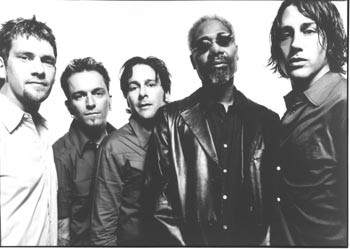
Fast friends: Robert Bradley, second from right, is an unlikely MTV star.

Street Smart

Robert Bradley’s brand-new start

By Alan Sculley

TWO YEARS AGO, the members of Robert Bradley’s Blackwater Surprise figured their 1996 self-titled CD was about to join the legion of albums that are released and disappear without making much of an impact. Then came a most unexpected event. The video for the acoustic soul ballad “Once upon a Time” was aired by MTV on its “12 Angry Viewers” show. Though the song was pitted against some high-profile competition on this record review program, the viewers made it their top pick for that day and later their favorite for the week. This prompted MTV to put the video into heavy rotation.

Suddenly Robert Bradley’s Blackwater Surprise (RCA) had been given a whole new life.

“It was a big surprise, that ’12 Angry Viewers’ thing, because you know, hey, RCA was probably about ready to let us go,” Bradley says. “Most radio stations, programmers, they didn’t know what type of music this was [or what radio format it fit]. What do you do? Well, we don’t know what we do either. That’s why it’s a surprise. That’s how we came up with the name Blackwater Surprise. We didn’t know.

“So I mean, MTV, that was a shock. We went from selling 50 records a week to 3,000. So that kept us on the line at RCA and enabled us to get to the second record. That was really MTV–I can’t thank them enough.”

The arrival of Robert Bradley’s Blackwater Surprise on MTV is only slightly less remarkable than the circumstances that spawned the band itself. One day in 1990, guitarist Michael Nehra, his brother, bassist Andrew Nehra, and drummer Jeff Fowlkes–three musicians who had recently been in a band signed to EMI Records called Second Self–were in the Nehra brothers’ downtown Detroit studio rehearsing. That morning they heard Bradley singing on a street corner outside the studio. Stunned by Bradley’s earthy and soulful vocals and the songs he was singing, the three decided to approach Bradley and invite him up to the studio.

Bradley hesitated at the invitation.

The truth is that being a street musician had become a fairly lucrative pursuit for Bradley, an Alabama native who had been legally blind since birth.

It wasn’t as though this had been Bradley’s original lifestyle. In fact, he had gotten married in 1972 and had five children. But by the mid 1970s, the marriage had begun to crumble and Bradley wasn’t all that thrilled with his job running a store for the blind for the state of Alabama. He decided to move to Detroit, where he had lived with his family as a teenager. There he was introduced to the idea of busking on the streets for money.

“I met this guy on the corner [playing songs],” Bradley explains. “He said, ‘Man, go get you a guitar and get out here and I’ll make you some money.’ So I went and bought a guitar, learned a few chords, and started doing it.”

Soon Bradley was making trips to California and Alabama, playing on the streets whenever he needed to make money along the way and enjoying the life of a gypsy musician. But by the 1980s, he was spending much of his time in Detroit, where he had become a fixture in Detroit’s Eastern Market. In fact, Bradley had become so popular that when the city tried to ban street musicians from playing, citizens successfully pressed a petition allowing Bradley to play his Eastern Market gig again.

“It was like it got to the point where I didn’t work but once a week and I’d make $500 bucks,” Bradley said. “I’d play there for four hours and then go home, and I wouldn’t go back to work until I’d spent it all.”

Part of what made Bradley a unique attraction was that he played nearly all original material. Blessed with the ability to come up with melodies and lyrics on the spot, he estimates that he created around 1,000 songs during his years of busking.

“I know all of them. They’re in my head,” he says. “But there are probably about 250 of them that I can just down and go through one to the other.”

Andrew and Michael Nehra and Keith Fowlkes finally persuaded Bradley to come to their studio and began recording some of his originals. Slowly, over the course of three years, Bradley and his future bandmates built a personal rapport and a musical chemistry that compelled them to form Robert Bradley’s Blackwater Surprise. “We just got together gradually over the four years,” Bradley says. “I would go down there maybe on Mondays, Wednesdays, and Fridays and stuff like that. So it went on like that for a while. And so we got to know each other really before we formed the group.

“That’s what made us friends first.”

THE GROUP’S self-titled debut had plenty of virtues. Leaning heavily on a gritty foundation of 1960s soul, classic blues, and rock–all highlighted by Bradley’s rough, emotional vocals–the debut CD featured a mix of stirring rockers, melodic ballads, and funk.

But Bradley feels the newly released Time to Discover represents a significant step forward for the group, which has added a keyboard player, Tim Diaz, to the lineup. The group members draw on a similar range of influences–pulling a taste of Sly and the Family Stone&-style rock on “Ride” and a grittier brand of Philly-style soul on “Baby.” On the ballad “Take Love and Receive It,” the band evokes the music of Curtis Mayfield, but with some hip-hop&-type sonic flourishes. The title song taps folk and rock influences, creating a sound that would be at home on a Hootie & the Blowfish album.

Part of the cohesion is a product of the 400-plus shows the group has played following the release of the first CD. “We had grown as a group together being out touring,” Bradley says. “So we became a band.”

But for Bradley, 50, one of the biggest differences is that the songs incorporate more of the rock influences of his bandmates–who are all some 15 years younger than he–to create more of a contemporary sound.

“Really what I wanted to do with those guys was put a little more of themselves into it, make it more up-to-date sounding,” Bradley says. “We didn’t want to take it too far away that we would lose the people we had gained at first, but what I figured is, I told them, ‘Look, just try to make it a little bit more radio friendly, like maybe so it could get programmed on radio a bit more.’ ”

Robert Bradley’s Blackwater Surprise perform Tuesday, Sept. 12, at 8 p.m., Mystic Theater, 21 Petaluma Blvd. N., Petaluma. Tickets are $12. 765-2121.

From the August 31-September 6, 2000 issue of the Sonoma County Independent.

© Metro Publishing Inc.

Spins

0

In love again: Greg Brown’s latest touches on affairs of the heart.

Roadhouse Prophet

Greg Brown delivers his most righteous sermon yet

Greg Brown Covenant Red House

AS A FOLK-BLUES SINGER, Greg Brown has earned a well-deserved reputation as “a wickedly sharp observer of the human condition,” to borrow a phrase from Rolling Stone. This, his first album in three years and the follow-up to the road-weary Slant 6 Mind, is perhaps his best. Brown–hailed as Iowa’s Bruce Springsteen and arguably one of America’s best songwriters–just keeps getting better, albeit in a grizzled, life-is-weighing-heavily-on-my-shoulders sort of way.

Indeed, even when Brown is happy and singing about the upside of love, he displays a wry wit and cynical streak. Yet there is a haunting quality to his songs, thanks in no small part to the wistful, bluesy guitar accents of longtime collaborator Bo Ramsey. Whether he’s caressing a restless ballad (“Rexroth’s Daughter”) or spinning a subtle analogy for a well-worn love affair (“Blue Car”), Brown lays bare your soul in a way that only Bob Dylan, Springsteen, and handful of others can.

In the future, this underrated tunesmith should be getting much more attention: word is that Brown will be the subject of an upcoming tribute album, featuring his songs covered by Lucinda Williams, Ani DeFranco, Iris Dement, Stacey Earle, and others. Greg Cahill

Stuck Mojo Declaration of a Headhunter Century Media

Taproot Taproot Gift Atlantic

THE BACKBONE of “nu-metal” still owes a heavy debt to hip-hop, as bands like Papa Roach and P.O.D. find identity and success riding a post&-Rage/Bizkit wave. But an evolving edge has heavy bands echoing alt-rock’s “emo-core” in a quest for expansive melodic expression. Acts like Stuck Mojo and Taproot can’t help but employ rap-metal’s staccato vocal attack and punk-funk base, but they infuse the aggro-groove with reflective change-ups, harmonic bursts, and tuneful choruses.

Stuck Mojo find melody in a classic chunky thrash snarl. Their latest fits neatly with Anthrax’s many catchy, driving works, and the band’s prominent hook-laden, bright, doubled guitar leads recall Iron Maiden and Thin Lizzy. Their insurgent, survivalist lyrical stance aims for Rage Against the Wannabes, but is grounded by self-searching challenges. Taproot are emo-core/alt-rock in the way melodic twists help singer Stephen Richards highlight his pain. They’re nu-metal in the way their clichéd riffs surround those songwriting shifts. And they’re weird like early alt-metal pioneers Faith No More, with a strummed consistency similar to that of recent Filter.

While these current headbangers don’t seek the full structural or emotional freedom that marks pure emo-core, their tweaking of the groove formula helps keep nu-metal new. Karl Byrn

Neko Case & Her Boyfriends Furnace Room Lullaby Bloodshot

Kelly Hogan & the Pine Valley Cosmonauts Beneath the Country Underdog Bloodshot

SOMETIMES alt-country acts don’t mimic or twist classic country styles; they just favor those styles in a blend of rootsy retro-pop. That’s true of two recent efforts by indie gals Neko Case and Kelly Hogan, both from Chicago’s Bloodshot Records, which rightfully calls itself the home of “insurgent country.” Case and Hogan are both spunky singer/stylists who rely on the country-rock chops of their bands, and despite Bloodshot’s claims, they’re more accessible than rebellious. Case is the more involved songwriter and hits a somewhat purer rockabilly-meets-countrypolitan sound, working with indie-rock guys like Evan Johns and Ron Sexsmith. On the waltz-time cut “Thrice All American,” she gracefully describes her hometown of Tacoma as “a dusty old jewel in the south Puget Sound/ where the factories churn/ and the timber’s all cut down.” But she still notices gangs and Wal-Mart. Hogan’s band includes Jon Langford and Steve Goulding of the Mekons, and her interesting choice of covers (Johnny Paycheck, Stephin Merritt, the Band) adds to a disc of colorful folk-pop that echoes ’60s and ’70s hits.

Both Case and Hogan often hit their mark, making alt-country that’s not too daring or derivative but sure is sweet, sad, and sassy. K.B.

James Armstrong Got It Goin’ On Hightone

A KNIFE ATTACK three years ago cut into blues guitarist and singer James Armstrong’s momentum right in the midst of his touring for 1995’s acclaimed HighTone debut, Sleeping with a Stranger. That led Armstrong to record a more vocal-oriented soul album as a follow-up. This time out, the blues is in the house, and Armstrong shows that you can’t keep a good guitar slinger down. While he hasn’t fully regained the use of his left hand, Armstrong sounds strong–just check out his wrenching solo on the ballad “Another Dream”–and has added a stinging slide guitar to his arsenal. Joe Louis Walker’s rhythm section provides the backup, and Robert Cray keyboardist Jimmy Pugh appears on two tracks. But Armstrong sounds confident, and, while he’s not as fast as he used to be, this is one cat who can serve up plenty of soul. G.C.

Spin du Jour

Mike Audridge, Bob Brozman, and David Grisman Tone Poems III: The Sounds of Great Slide & Resophonic Instruments Acoustic Disc

MONDO-MANDOLINIST David Grisman returns with another dazzling display of bluegrass wizardry and a pair of fast-picking friends, master dobro player Mike Auldridge and slide guitarist extraordinaire Bob Brozman. As with past volumes, this recording employs vintage instruments (and stunning photos of the artsy detail that graces these gorgeous guitars, mandolins, ukes, tenortropes, and other stringed wonders). The tunes, mostly classic jazz, get an old-timey treatment as well: “Stomping at the Savoy,” “Limehouse Blues,” “Crazy Rhythm.” Smooth as silk. G.C.

From the August 31-September 6, 2000 issue of the Sonoma County Independent.

© Metro Publishing Inc.
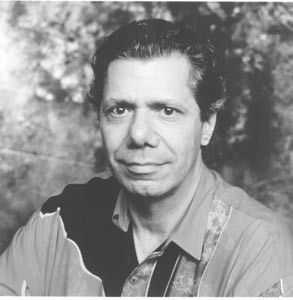
Russian River Jazz Festival Schedule

0

Chick chic: Pianist and composer Chick Corea and his trio co-headline this year’s fest.

Russian River Jazz Festival Schedule

SOMETIMES dreams do come true. A lot of local jazz fans grumbled about the smooth jazz (pronounced “pop”) and chardonnay haze that had come to obscure this venerable event, which in the past has showcased the likes of bebop pioneer Dizzy Gillespie. The people spoke , and the programmers listened. The top acts featured at the annual festival–now in its 24th year at Johnson’s Beach in Guerneville–are mostly rooted in straight-ahead jazz and are far more innovative than recent offerings. The Chick Corea Trio, vocalist Dee Dee Bridgewater, percussionist Poncho Sanchez, singer Kevin Mahogany, and the Mel Martin/Harold Jones 17-piece big band will shine on Saturday, Sept. 9. The Sunday, Sept. 10, lineup features saxophonist Branford Marsalis, trumpeter Roy Hargrove, vocalist Flora Purim and percussionist Airto, and the Omega Aires Gospel Singers. The gate opens at 10 a.m. Advance tickets are $40 each day, $70 for both. 869-3940.

From the August 31-September 6, 2000 issue of the Sonoma County Independent.

© Metro Publishing Inc.
Allen Noren

Heart like a wheel: Allen Noren speaks Sept. 7 at Readers' Books. 'Storm' und Drang A motorcycle trip turns into an endurance contest in local author's new book By Yosha Bourgea WHEN THE IRON CURTAIN fell in 1992, Sonoma County writer Allen Noren and his girlfriend of seven years, Suzanne,...

Electrohippies

Steven VerriestVirtual VandalsHacktivism takes to the cyberstreets By David CasselIN EARLY MAY an activist calling himself "Reverend Billy" called for thousands of computer owners to fire up their modems for an assault on Starbucks. From unseen corners of the globe, they'd converge on the company's website--hoping to overload it. Though the media portray hackers as secretive, destructive intruders, some...

Sample Menu From a Past Dinner

The finest seasonal vegetables and herbs from the OAEC's organic gardens and orchards are harvested just hours before mealtime, making it impossible to predict the menu beforehand. A great diversity of ingredients, tastes, and colors typifies the center's fare, as in this sample menu from a past dinner. Crostini with Fresh Azerbaijani Basil Pesto...

OAEC Fundraising Dinners

Tending to business: Doug Gosling, head gardener at the Occidental Arts and Ecology Center, doubles as executive chef Sept. 9 at a vegetarian benefit dinner culled from the facility's extensive selection of heirloom plants. Humbly Exotic OAEC dinners offer peek at possibilities By Marina Wolf FUNDRAISING DINNERS. The...

Russian River Jazz Festival

Leader of the pack: Roy Hargrove is back with a new album of ballads--with strings--and an upcoming appearance at this year's Russian River Jazz Festival. The Lion King Trumpet player Roy Hargrove still leads the pack of young jazz lions By Greg Cahill "I'VE ALWAYS wanted to...

Online Dating Service in Prison

Jailbird Lovebirds Online dating service goes behind prison bars for romance By Michael Goldman RONALD BISHOP'S marriage of 20 years collapsed nine years ago. Since then there have been many lonely moments, he says. So when the 53-year-old oil-processing supervisor from Liberty, Texas, hooked up with Carol Sevilla, he was elated....

Usual Suspects

How green is your garden? Presidential candidate Ralph Nader. Party Pooper Ralph Nader snubs the Green Party By John Yewell RALPH NADER's stump speech drips with contempt for the two major political parties, calling the system a "duopoly" dominated by Tweedledum and Tweedledee. But Nader's disregard for party politics also appears...

Robert Bradley’s Blackwater Surprise

Fast friends: Robert Bradley, second from right, is an unlikely MTV star. Street Smart Robert Bradley's brand-new start By Alan Sculley TWO YEARS AGO, the members of Robert Bradley's Blackwater Surprise figured their 1996 self-titled CD was about to join the legion of albums that are released and...

Spins

In love again: Greg Brown's latest touches on affairs of the heart. Roadhouse Prophet Greg Brown delivers his most righteous sermon yet Greg Brown Covenant Red House AS A FOLK-BLUES SINGER, Greg Brown has earned a well-deserved reputation as "a wickedly sharp observer of the human...

Russian River Jazz Festival Schedule

Chick chic: Pianist and composer Chick Corea and his trio co-headline this year's fest. Russian River Jazz Festival Schedule SOMETIMES dreams do come true. A lot of local jazz fans grumbled about the smooth jazz (pronounced "pop") and chardonnay haze that had come to obscure this venerable event, which in the past has showcased...
11,084FansLike
4,606FollowersFollow
6,928FollowersFollow