

Jaron Lanier

Artificial Stupidity

Virtual-reality pioneer Jaron Lanier says computers are too dumb to take over the world

By Damien Cave

JARON LANIER entered college at age 15. Before turning 25, he coined the term “virtual reality,” landed on the cover of Scientific American, and subsequently became a hot pop-culture commodity–a dreadlocked, blue-eyed visionary, media darling, and inspiration to geeks everywhere.

But now, in his 39th year, Lanier has turned sour on his own futuristic visions. Lanier, a longtime Sausalito resident, recently published “One-half a Manifesto” at Edge.org, an online intellectual forum. The 9,000-word treatise rebukes the “resplendent dogma” of today’s au courant visionaries: the irrational belief “that biology and physics will merge with computer science.” The essay also takes techno-titans such as the roboticist Hans Moravec to task for working to create thinking, self-replicating machines while ignoring the fact that such research will only “cause suffering for millions of people.”

Lanier’s turnaround is impressive. He is, after all, a man who spent much of the last 20 years telling us that the real world would merge with the virtual, creating new forms of community that would enhance the quality of our lives. The one-time evangelist has suddenly become a skeptic.

“My world has gone nuts for liking computers too much and not seeing them clearly for what they are,” he says in an interview about the essay.

What they are, Lanier argues, is far from the omnipotent engines of destruction envisioned by such other scientists-turned-cautionaries as Sun Microsystems’ Bill Joy. Nor are they saviors, declares Lanier. Neither the evil nanobots of Joy’s nightmare nor the poverty-curing “mind children” that Moravec envisions are possible, says Lanier. Simply put, software just won’t allow it. Code can’t keep up with processing power now, and it never will.

“Software is brittle,” he says. “If every little thing isn’t perfect, it breaks. We have to have an honest appreciation for how little progress we’ve made in this area.”

ON THE SURFACE, Lanier’s stance appears to resemble that of Joy, the influential programmer who used the pages of Wired magazine to condemn Moravec and others for desiring to build sentient machines without acknowledging the apocalyptic dangers. But Lanier ultimately takes quite a different tack. Joy condemned science for what it could do; Lanier condemns it for failing to recognize what it can’t. Lanier’s upstart argument yields a uniquely here-and-now version of computer science ethics and an entirely different, but equally frightening form of what Lanier calls “Bill’s version . . . of the Terror.”

Lanier didn’t always play the skeptic. He was once a believer–convinced that it was possible to create perfect computers and cure software of its tendency to break rather than bend.

“During my 20s, I definitely believed I could crack this problem,” he says. “I spent a lot of time on trying to make something that didn’t have the unwieldiness of software, the brittleness of software.”

He failed. The artificial-intelligence pioneer Marvin Minsky mentored Lanier, but the relationship never led to a breakthrough. Even Lanier’s brainchild–virtual-reality programming language, or VPL–often crashed. VPL may have been the heart and soul of virtual reality, the basis for gloves, masks, games, and more, but it still broke down. It was great code, but it was just code. It wasn’t perfect.

“I ultimately didn’t pull it off,” Lanier says.

The failure didn’t crush Lanier: it just made him wiser. He started to see that Moore’s Law (which dictates that processing power will double every 18 months) is not enough; that processing power without perfect software cannot create AI.

Still, he didn’t speak up. “All ambitious computer scientists in their 20s think they are going to crack it,” he says, relishing their exuberance with a raised voice. “And why shouldn’t they?”

So he watched with simple amusement as his contemporaries continued blindly to believe what Lanier knew to be false; he watched as these futurists–or “cybernetic totalists” as he calls them now–focused on extremes, on experiments in academic labs, or on books of boosterism like Eric Drexler’s Unbounding the Future: The Nanotechnology Revolution.

He remained silent. Even when Thomson-CSF, a French electronics company, stripped him of his virtual-reality patents and ousted him (with good reason, some contend) from the company in 1992, Lanier did not make a fuss. He just went back to work on the electronic music he loved and on other forms of computer science, figuring his contemporaries would eventually learn their lesson, too. Their dreams were harmless, he thought.

Besides, their wild visions “didn’t matter then because there was only this obscure group of people who believed it,” he says.

Then the Internet exploded. Suddenly the technologists Lanier had been indulgently dismissing–his “quirky, weird friends with strange beliefs”–became Zeitgeist heroes. Those wacky ideas suddenly exited the confines of Stanford and MIT and became seeds for attracting venture capital.

LANIER FIRST noticed the dangers inherent in the mass marketing of half-baked AI concepts while using Microsoft Word. All he wanted to do was abbreviate a name he had cooked up–“tele-immersion.” “It’s a cross between virtual reality and a transporter booth,” he says, a strategy for employing the Internet to bring people together in a computer-generated, 3-D space.

Lanier simply wanted to write the word tele-immersion as tele-i. And when Word wouldn’t let him do it, capitalizing the “i” repeatedly, Lanier found himself frustrated, even angry. Though he knows how to turn it off, he claims most users don’t. And he’s still none too pleased.

“This crazy artificial-intelligence philosophy, which I used to think of as a quirky eccentricity, has taken over the way people can use English,” he says. “We’ve lost something.”

And it’s not just Word that spun Lanier into a tizzy. It’s the sheer prevalence of these “thinking” features: the fact that PowerPoint shrinks the font when you add too many words, that browsers add complete URLs after the user puts in three letters, and that there’s little that most people can do about it.

“[Programmers] are sacrificing the user in order to have this fantasy that the computers are turning into creatures,” he says. “These features found their way in not because developers think people want them, but because this idea of making autonomous computers has gotten into their heads.”

Not only do people not want them, suggests Lanier, but they won’t work anyway. In the end, Joy may be saved by software’s failures. Nanobots will not make humans “an endangered species,” as the headline to Joy’s article states; the White Plague–a cloud of nanobot waste called “gray goo” in Eric Drexler’s book Engines of Creation–will not descend on our world and kill us all, as Joy fears.

But that’s not to say the future will be all hunky-dory. Lanier predicts a whole different set of dangers. We won’t be annihilated, we’ll just be further and further divided. It will be a Marxist class-warfare nightmare, a more extreme version of what Lanier considers two of the present time’s dominant characteristics: wild technological innovation and a widening gap between rich and poor.

BIOTECHNOLOGICAL advances, combined with the processing power increases demanded by Moore’s Law, will result in the mixing of genetics, superfast processors, and various levels of flawed software. The rich will get good code and immortality, suggests Lanier. The middle class will gain a few extra years, and the poor will simply remain horribly mortal.

“If Moore’s Law or something like it is running the show, the scale of separation could become astonishing,” he writes near the end of his essay. “This is where my Terror resides, in considering the ultimate outcome of the increasing divide between the ultrarich and the merely better off.”

“With the technologies that exist today, the wealthy and the rest aren’t all that different; both bleed when pricked,” writes Lanier “But with the technology of the next 20 or 30 years they might become quite different indeed. Will the ultrarich and the rest even be recognizable as the same species by the middle of the new century?”

Lanier’s pessimism might seem to contradict his earlier argument that software’s inherent flaws will come to humanity’s rescue. But Lanier says there is no contradiction: he’s simply taking one scenario to its final ending point, an end that acknowledges the weakness of software.

So should we just stop researching controversial technologies, as Joy suggests? Lanier’s critics say no. George Dyson, author of Darwin among the Machines, responded to Lanier’s essay on Edge.org by noting that the glitchy nature of software is just the “primordial soup” of technology “that proved so successful in molecular biology.” Instead of condemning the mess, he writes, “let us praise sloppy instructions, as we also praise the Lord.”

Rodney Brooks, director of the MIT Artificial Intelligence Laboratory, suggests that Lanier abandon the notion “that we are different from machines in some fundamental, ineffable way” and accept the fact that all matter is essentially mechanical. And Kevin Kelly–a founding editor of Wired magazine–wrote in his own response on the Edge Web site that, flawed or not, “right now almost anything we examine will yield up new insights by imagining it as computer code.”

Even Lanier admits that the doom-and-gloom scenario in his essay’s conclusion may not occur. “I’m an optimist,” he says. “I believe we can avoid it.” Indeed, the manifesto is only “one-half” because the other half of Lanier would have to include all the positive aspects of science–the “lovely global flowering of computer culture,” he writes–that can be seen all over the Web. It’s found in the community of Napster, he says, just as it’s visible in the open-source software movement. And it can be seen in his own work on tele-immersion, which he says “will be bigger than the telephone”–in about 10 to 20 years.

IT’S THE NOTION that the computer is inherently superior to humans that Lanier wants to combat. He’s lost his faith in computers, and, like a present-day Nietzsche, he’d like the rest of the world to recognize that this 21st-century God is dead.

“I’d like to address the intermediate people, the ones who are really designing the software that people will use,” he says. “And I would say, please repudiate this notion that the computer could have an opinion and can be your peer. Instead, put the person in charge. . . . [B]ecause if the tools people use to express themselves and do their work are written by people who have a certain ideology, then it is going to bleed through to everyone. When you have a generation who believes that a computer is an independent entity that’s on its way to becoming smarter and smarter, then your design aesthetic shifts so that you further its progress toward that goal. That’s a very different design criterion than just making something that’s best for the people.”

“There should be a sense of serving the user explicitly stated,” he says, his high-pitched voice rising. “There should be a Hippocratic oath. The reason the Hippocratic oath exists is to place the priority on helping individual people rather than medical science in the abstract. As a physician it would be wrong to choose furthering your agenda of future medicine at the expense of a patient. And yet computer science thinks it’s perfectly fine to further its agenda of trying to make computers autonomous, at the expense of everyday users.”

“It’s immoral,” he adds. “I want to see humanistic computer science. You have to be human-centric to be moral.”

This article was originally published on Salon.com. An remains in the Salon archives. Reprinted with permission.

From the March 1-8, 2001 issue of the Northern California Bohemian.
© Metro Publishing Inc.

‘A Good Baby’

0

Bad Attitude

‘A Good Baby’ has a man who needs killing

Writer David Templeton takes interesting people to interesting movies in his ongoing quest for the ultimate post-film conversation.

HERE I AM, sitting in the dark, all alone with Jill Conner Browne. I am a lucky man. Browne is the ringleader and founder of the infamous Sweet Potato Queens, Mississippi’s unofficial grand marshals of Jackson’s annual St. Patrick’s Day parade since 1982. They dress in anatomically augmented green gowns to dance and wave to the ever-increasing crowds. Under Browne’s guidance, they also act as role models for all “fallen Southern belles,” literal or metaphorical.

They have their own website: www.sweetpotatoqueens.com.

Now, the fact that I get to share an otherwise unoccupied movie theater with Jill Conner Browne–we’re here for a private screening of the moody Southern drama A Good Baby–will no doubt cause certain women to drool with unrestrained envy.

After all, ever since the release of Browne’s outrageous self-help guide The Sweet Potato Queens’ Book of Love, the Boss Queen has become an inspiration to thousands of females across the U.S. of A.

On the other hand, since I am a man, my close proximity to Jill Conner Browne may cause a few of my brothers-in-testosterone–those who’ve heard the rumors, anyway–to openly fear for my safety.

Well, fear not, my brothers.

Though SPQBOL does indeed contain a chapter titled “Men Who May Need Killing,” and though Browne is fond of saying things like, “I love men. They taste just like chicken,” the truth is, she’s a card-carrying sweetheart.

It’s a bright pink card with the words “Lick You All Over, 10¢.” Upon arrival, Browne handed them out to the theater operators, then showed off a copy of her new book, the hilarious sequel God Save the Sweet Potato Queens, before distributing Sweet Potato Queen bumper stickers all around, smiling and flirting all the while.

Honestly. There’s nothing the least bit murderous about this woman.

Until the movie starts.

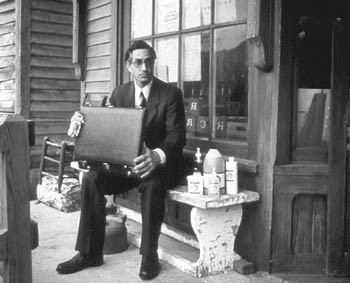
A Good Baby is an eerie melodrama starring Henry Thomas (of E.T. fame) as Raymond Toker, a gentle hunter in rural North Carolina who stumbles upon an abandoned newborn and finds himself almost supernaturally attached to the child. David Straithairn (Passionfish; Dolores Claiborne) plays Truman Lester, a softly psychotic traveling salesman–he’s as crazy as a soup sandwich, and evil to boot–who is hell-bent on getting his good-for-nothing hands on that good little baby.

Lester is bad, bad, bad.

“I hate him,” Browne hisses, at one point. “I hate him. Let’s kill the sonofabitch.”

I agree. But how? Browne consults the screen, where Lester has been making a move on a defenseless country girl (who might have benefited from reading the Sweet Potato Queen books, by the way). Ooh, he’s bad.

“Bludgeoning,” Browne proposes. “One of us should hit him with something real hard.” A few minutes later, after Straithairn has intensified his seduction, I suggest drowning.

“Oh, drowning’s good,” she replies. “Let’s do that.”

Thankfully, we don’t need to. Something even better happens to bad old Lester.

“DAVID STRATHAIRN IS such a good bad guy,” Browne says over a cup of coffee, after the show. “I hated him in Dolores Claiborne, too. You take one look at his face, and you just want to see him dead.” Indeed.

Dolores Claiborne–the book was written by Stephen King–is one in a long line of stories about nasty Southern men who die or suffer at the hands of women who’ve taken a little too much crap. It’s a genre Browne is very fond of.

One true-life example is the story of Curtisene Lloyd, which Browne relates in the first book, taking the details from the audiotape of a court case in which Lloyd testified against the man who tried to rape her.

“Curtisene Lloyd,” says Brown, “is my hero.”

When Lloyd–a middle-aged, African-American Sunday school teacher–woke up one night to find a naked intruder in her bedroom, intent on rape, she took the matter in hand.

“First, she realized that he had no weapon,” drawls Browne, smiling slyly. “So she got his dick in one hand and his balls in the other and she twisted as hard as she could in opposite directions. It worked like a charm.”

It certainly sounds effective. The would-be rapist fought to get away, but Miss Lloyd had the better grip on the situation. Dragging the whimpering miscreant out of the room and down the hall–pulling him along by his ever-shriveling maleness–she yanked him all the way through the house and out to the porch.

“Then,” Browne tells, her expression growing ever fonder, “this itty-bitty woman says to the guy, ‘Now, I’m gon’ go back in the house and get my gun, and I’m gon’ blow your motherfucking head off, you slimy, stanking, lowdown piece of shit!’ ”

The rapist loped off into the bushes, buck naked and barely able to walk. Back on the floor of Miss Lloyd’s room were all his clothes, with his full name written inside every single piece. He ended up going to jail, and the tape of Miss Lloyd describing how she waxed a bad guy’s ass has now been distributed throughout the world.

Stories like this have motivated a large number of men to denounce the Queens as man haters, with Browne being named the worst offender of the Sweet Potato bunch.

“Whenever some interviewer–usually a man–gets in my face and wants to know, ‘What’s this about men who need killing?’ ” says Browne, “I always say, ‘You have any daughters? Do you have a mother? A sister?’ If you’ve ever been close to a woman who was brutalized in any way, you would be the first to want that guy dead.

“Look. I’ve been a victim of domestic abuse myself,” Browne reveals, growing quiet. “And I can tell you, I’m a strong woman. I lift weights. If somebody attacked me on the street, they might just wish they hadn’t. But when it’s in your home, and it’s somebody who’s supposed to love you and take care of you that suddenly attacks you, it’s so stunning that . . . I . . . I . . . just . . . I was . . . I had no . . . ”

Slightly rattled at the memory, Browne stops to compose herself. “Let’s just say it stunned me. And after the fact it stunned me all over again that I didn’t just murder him then and there.

“So women may joke about it,” she continues, smiling once again, “and in the book we do have some fun with the idea of killing some men who really need it, but it’s all done as an act of empowering.

“And listen,” the Boss Queen concludes, “I’ve known plenty of women I’d like to run over in my car, too.”

‘A Good Baby’ opens Friday, March 2, at the Rafael Film Center, 1118 Fourth St., San Rafael. For details, see or call 415/454-1222.

From the March 1-8, 2001 issue of the Northern California Bohemian.
© Metro Publishing Inc.

Usual Suspects

0

Petaluma water policy prompts a complaint

By Greg Cahill

A FORMER Petaluma City Council member and a group of local progressives have filed a complaint over Petaluma City Council’s decision on Jan. 23 to overturn a controversial water contract policy. David Keller, an environmentalist whose decision not to seek re-election in November helped lead to the defeat of the once-green council majority, is among 10 south county residents who have enlisted a San Francisco attorney to challenge the way in which the council reversed its opposition to a controversial 35-year public water contract. That agreement would control the supply and distribution of water between the Sonoma County Water Agency and several municipal water districts in Sonoma and Marin counties.

According to a Feb. 22 letter from attorney Andrew L. Packard, the group wants the Sonoma County Board of Supervisors, the board of directors of the SCWA, and the Sonoma County Counsel’s Office to “correct several significant violations” of the state’s open-meeting law known as the Brown Act, under the threat that the group will file a lawsuit to overturn the vote.

In September, after 18 months of public debate, the Petaluma City Council refused to sign on to the controversial agreement after charging that ratepayers weren’t being given the full story about the cost of the contract, the environmental impact of water diversions on the Eel and Russian rivers, or the need for more extensive water conservation measures.

At the time, Sonoma County and Santa Rosa officials threatened reprisals. But other participating communities soon began warming up to Petaluma’s position, and county officials announced that they were ready for a compromise.

After a pro-business majority regained control of the City Council in November, the issue was reopened. On Jan. 22, Petaluma Mayor Clark Thompson convened a special meeting to discuss the agreement, despite protests from three council members–Matt Maguire, Pam Torliatt, and Janet Cader-Thompson–that the meeting had not been properly announced to the public. The council then reversed its position and voted to sign on to the agreement.

In his Feb. 22 letter to county officials, Packard contends that “the ultimate resolution of these matters will touch upon the lives of hundreds of thousands of Sonoma County residents, as well as the residents of neighboring counties, for years to come. For these reasons, these matters warrant the strictest adherence to the letter and spirit of the Brown Act’s unambiguous mandate that public officials’ actions ‘be taken openly and that their deliberations be conducted openly.’ ”

Napa Police Officer Charged in Rape Case

EIGHT MONTHS after allegedly raping his former sister-in-law, a Napa police officer has surrendered his gun and badge and turned himself in to authorities. Alexander Edgar Mingus, 52, was arraigned Tuesday at Napa County Superior Court on one felony count of forcible rape. Bail was set at $50,000.

The victim, who was identified last Friday in the Napa Valley Register as the suspect’s sister-in-law, has known Mingus for 22 years. She is the estranged wife of Napa’s deputy police chief.

“The kind of relationship we had was . . . I saw [Mingus] like a friend . . . a big brother,” the woman told the Register. “It’s like being raped by your sister’s husband.”

If convicted, Mingus, a 27-year veteran Napa police officer, could be sentenced to eight years in state prison.

According to court documents, Mingus allegedly raped the woman on July 26 at her home. On Aug. 31, the woman filed a complaint with Napa Police Chief Dan Monez, accusing Mingus of sexually assaulting her. Because of potential conflict of interest, Napa law enforcement authorities asked the Santa Rosa Police Department to investigate the case. Mingus remained on duty until Oct. 17, when the SRPD’s Sex Crime and Family Violence Section interviewed the victim and conducted an investigation that resulted in a search warrant.

Mingus was then placed on administrative leave.

In November, the California State Office of the Attorney General was brought into the investigation. At that time, the Sonoma County District Attorney’s Office consented to the appointment of Sonoma County Deputy District Attorney Christine Cook as a special deputy attorney general responsible for case review and prosecution.

From the March 1-8, 2001 issue of the Northern California Bohemian.
© Metro Publishing Inc.

‘The Mexican’

The Mexican.

Wasted Trip

‘The Mexican’ squanders cast with cheap stereotypes

By

IN THE MOVIES, Mexico often serves as a testing ground, a place where the gringo can hazard his manhood in a dangerous country against wily, ruthless, unwashed, gibbering sadists–a land where even God’s good water can’t be trusted. The Mexican spares us not one of these stereotypes.

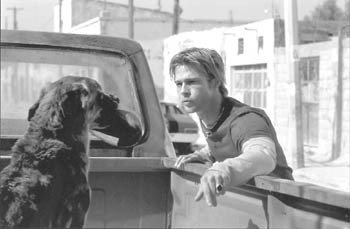
Directed by Gore Verbinski (auteur of Mouse Hunt) in the northern deserts, the film tells the story of a pistol called “The Mexican” that falls in and out of the hands of an inept petty hood named Jerry (Brad Pitt). Since he owes a favor to a crime boss (miscast Bob Balaban), Jerry must go to a small town south of the border to pick up the gun.

Unfortunately, he foolishly leaves the pistol in his car, which is promptly stolen, etc., etc. Meanwhile, Jerry’s angry girlfriend, Samantha (Julia Roberts), whose mind is a mulch of pop-psychology advice books about men who can’t love, has left him to go to live in Las Vegas. Since it’s thought that Jerry ran off with the pistol, the crime boss sends a thuggish kidnapper named Leroy (James Gandolfini, better known as crime boss Tony Soprano on HBO), after Samantha.

The script is by actor J. H. Wyman, who wrote and directed a previous movie titled Pale Saints, which has the same elements of people captive in car trunks, vague poetic dreams of relocating to someplace sunny and magical and small-time hoods with sunglasses. The point of this new potboiler is that lovers have to be put in peril to realize the importance of commitment. There’s something especially irritating about films that try to overcome their cheap-jack fatalism with equally cheap romance. Even Gandolfini can’t really sell a speech in which he says he’s learned the importance of love from the people he’s had to whack along the way. The way Verbinski lingers over the scenes, he thinks he’s found another dimension in Gandolfini. Not hardly–this major actor has been exploring the soulful side of a parasitic killer in one brilliant episode of The Sopranos after another.

Pitt and Roberts have never been able to transcend poor direction, and here they have Gore Verbinski. The impression The Mexican leaves is of one scene at the end where the two leads are sitting side by side on a couch in a hotel lobby, waiting for a phone call–oh, those undependable Mexican phones.

The question is whether Pitt and Roberts have reached the level of stardom where even watching them sitting doing nothing is fascinating. As in Hannibal, the stars don’t connect until the last half hour; and there’s too much connivance to keep them apart as Pitt negotiates the bad Mexican hombres, bad Mexican roads, bad Mexican junkyard dogs, and all the other bad jokes in one botch of a film.

From the March 1-8, 2001 issue of the Northern California Bohemian.
© Metro Publishing Inc.

Edwin Black

An American company stands accused in ‘IBM and the Holocaust’

By Tom Sullivan

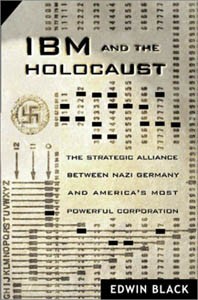
A friend of mine is fond of telling the story of a car trip he took as a boy with his friend’s grandparents, who were Holocaust survivors. As they passed a Ford on the road, the elderly man and woman began cursing the vehicle. When he asked why, he was told of Henry Ford’s anti-Semitism, Nazi sympathies, and alleged Nazi collaboration. Now, Edwin Black argues that another American business giant is deserving of similar infamy in his new book, IBM and the Holocaust (Crown Publishers, $27.50).

Black is the son of Polish Holocaust survivors. He is also the author of The Transfer Agreement, which examines a 1930s scheme between German Zionists and the Nazi regime under which the Zionists helped to lessen the impact of the international boycott of German goods in exchange for the Germans allowing some Jews to emigrate to Palestine.

According to Black’s new book, IBM supplied Hollerith punch-card readers and related technology to the German government, which used the technology to conduct censuses, organize their rail system, organize and bill for slave labor, and coordinate the rounding up of Jews and other victims for shipment to concentration camps.

Without this technology, Black argues, the Holocaust could not have proceeded on as grand a scale, and the roundup of victims could not have been accomplished as quickly or efficiently. And, he argues, without the cooperation of IBM and IBM’s chairman, Thomas J. Watson, the Germans would not have had the machines in sufficient quantities to make them effective.

IBM’s direct involvement with the German government was conducted mainly through its German subsidiary, Dehomag, and Watson had little or no control over the company once war broke out in Europe. However, in the years before the war Watson expanded Dehomag, authorized its managers to develop and expand production facilities in Germany, and positioned them to work closely with the virulently anti-Semitic German government.

None of this was illegal, and Watson had a wide following of international businessmen who also favored increased rather than decreased economic interaction with the Third Reich–a form of constructive engagement similar to President Reagan’s strategy with apartheid South Africa.

However, Black argues, Watson should have been aware and probably was aware that the work Dehomag was undertaking was being done for purpose of identifying Jews in Germany. He also points out that by 1933, when Dehomag first undertook a census for Germany, the extreme anti-Semitic nature of Hitler’s beliefs and programs was public knowledge.

IBM NY essentially lost control of Dehomag in 1940, when Watson was compelled to appoint a Nazi majority to the board of directors. But according to Black, Watson maintained careful surveillance of the company through IBM’s Geneva subsidiary, which continued economic relations with Dehomag throughout the war.

IBM NY did maintain a greater degree of involvement with and control over its subsidiaries in countries occupied by Germany. For instance, Watson personally approved the construction of manufacturing plants in Vichy France and Nazi-occupied France in 1941.

Black also claims that “Millions of punch cards were routinely shipped from IBM in America directly to Nazi-controlled sources in Poland, France, Bulgaria and Belgium.” This information was revealed in a Justice Department investigation of IBM for trading with the enemy. The investigation was eventually dropped, although Black maintains that this was in part because of Watson’s close ties to President Roosevelt and in part because the U.S. government was dependent on IBM equipment and technology for the prosecution of the war.

This book has its flaws. Black tends to overwrite and has included a fair amount of extraneous material. More importantly, it would have been helpful if the book had made some attempt to provide context for IBM’s decision to continue close relations with its subsidiaries. Were there other subsidiaries of American companies that were deemed vital to the German war effort? If so, how did their parent companies handle the situation? Were there similarly situated companies who refused to cooperate with the Nazis? If so, what were their rationales and the effects of their decisions?

It is also unclear what would have happened if the Germans had not had IBM technology and equipment at their disposal. In Rwanda not long ago, nearly a million people were massacred with hoes and similar tools, so probably some version of the Holocaust would have taken place regardless of the sophistication of available technology. It is clear, however, that the technology was deemed highly valuable by the Germans themselves, and was widely used by other countries to conduct censuses and organize information and resources.

Black does establish that IBM benefited tremendously from its subsidiaries’ relationships with the Nazis, both in terms of actual profits during the war years and in terms of the competitive advantage that it derived from being firmly entrenched in newly liberated Europe. Clearly, Watson and his aides acted in the best interests of their company. Black’s book, together with a recently filed lawsuit against IBM, will help clarify the effects of their actions on their species.

Web extra to the March 1-8, 2001 issue of the Northern California Bohemian.

© Metro Publishing Inc.

SUV Driver’s Defense

0

Gimme a Brake

Why I drive a hate crime

By Steven Mikulan

AT A PARTY a while back, the talk, as it usually does these days, turned to the Internet. When I mentioned to some people that Earthlink was my server, a shocked friend exclaimed, “But that’s run by Scientologists!” She was referring to the Hubbardian bent of Sky Dayton, Earthlink’s founder, and continued ribbing me until I replied that I doubted my monthly fees went toward the upkeep of the Celebrity Center or any of the cult’s other enterprises. My friend nodded politely, and the conversation moved on to other matters. We both knew she didn’t really care about the Scientology connection, just as I wasn’t really defending my choice of a server.

The important thing is that she got to partake in the American pastime of Making Friends Feel Bad, and I had not taken offense.

My friend and I are both card-carrying “progressives,” and that morning stood sipping champagne in a room mostly filled with like-minded people. I knew the drill: You admit to a seemingly benign consumer preference; your chums shoot you down for it. Either someone’s read that your favorite marketer of merino-wool sweaters has a side business in the Sudan selling iron slave collars, or it’s pointed out that a cherished neighborhood hardware store peddles old-growth redwood.

Making your pals feel bad (but not so bad as to lose them) is a refined social skill highly regarded in my neck of the political woods. It has roots, ironically enough, in traditional class snobbery as well as in the consumer chauvinism that first spread from the pages of Playboy and Esquire into the popular consciousness of the early 1970s–a belief that the kind of stereo speakers we own or the wine we drink are not merely practical choices but statements of identity.

Evaluations of other people’s tastes tend to be political judgments issued from the bench of one’s own private Nuremberg. No longer content to merely dismiss a friend’s contrarian tastes as gauche, we detect in them nothing less than a threat to the planet–implying that the offender is a kind of consumer criminal. In today’s casual conversations, you run the constant risk of being made to feel guilty (as opposed to merely stupid) for wearing, eating, or driving the wrong product at the wrong time.

A few months ago, for example, a friend commented on the base villainy of sports-utility vehicles and their owners. I politely told him that I was an SUV owner. He looked at me as though I had just admitted to collecting human skulls. His response was not new. “That’s your car?” a horrified colleague had once asked me in my company’s parking lot. “I’m so disappointed–that’s the kind someone in advertising would buy.” I had my reasons for owning my Pathfinder, not the least of which has to do with the fact that I actually use it to go off-road camping. No matter–my choice of transportation was so heinous that, in the morality of the left, it amounted to a hate crime.

Automobiles, those expensive scourges of global climate, are high on the list of possessions that can be used to make us feel bad. Still, most of us nurse some guilty memory of a car or two that we treated as almost human. Mine is of my father’s ’55 Chevy Bel Air, a big gray block of steel that was old the day he drove it off the used-car lot. It wasn’t just a machine that took us from one place to another, it was the largest thing we owned; it had a radio in it, and during winter afternoons it became my own private solarium.

I have an album of mental snapshots of our Chevy that will never fade: my mother pushing the stuck car through snow while my father steered, or her making sandwiches in the back seat on one of our cross-country moves, rain hammering on the roof. And there was one golden afternoon when my father had driven a cousin and me from eastern Long Island into Manhattan to see the American Museum of Natural History and the Hayden Planetarium. We sailed down Fifth Avenue in a ticker-tape parade of my own imagining, everything in that late afternoon becoming lost in the blare of horns and the glint of summery light on the Empire State Building.

THE ONLY journey friends seem to let me take in my Pathfinder is a guilt trip. Guilt, of course, takes the fun out of owning anything and is the torture tool of choice used by people to make others feel bad. Usually this guilt accrues from the suffering of distant peoples or some ecological outrage–sometimes both. I remember the time I invited a man active in Latino cultural politics over to a balcony barbecue. At first he was enthusiastic about the idea, especially when we got to talking about how much we preferred mesquite over chemically soaked briquettes. Then his political conscience kicked in. “But we shouldn’t burn mesquite,” he said quietly, pausing to remember just why. “The environment, you know . . . and Mexico. It’s cutting down their mesquite forests.”

I laugh at all this because I graduated from Berkeley during the Age of Boycotts (the early 1970s), when I learned how to needle people about owning Krugerrands, drinking Gallo wine, or wearing Farrah jeans. But as the 1970s boogied along, the number of boycotts multiplied exponentially until people simply ignored them. (Today, a list for the venerable Nestlé embargo alone proscribes no fewer than 200 products and businesses, from Arrowhead Water to Friskies Cat Chow.) So a funny thing happened on the way to the Finland Station–the Age of Boycotts morphed into the materialistic and narcissistic Me Decade, followed by a kind of ongoing Me Century.

Apparently there was one eternal law of history Marx had forgotten to tell us about: Affluence eventually afflicts all but the most self-destructive radicals, something every generation discovers and that I only dimly perceived some 30 years ago as I sat in on a meeting of the Young Workers Liberation League, the bell-bottomed successor of the Young Communist League. At one point it came up that the CP boss for Northern California, Mickie Lima, would let the group use his Mendocino ranch for a weekend getaway. “He’s got a ranch?” someone sniffed. “Yeah, really! That’s kinda funny,” another remarked tartly.

Lima had been born in the small town of Usal, and got his baptism in radical politics during a 1935 strike of barrel makers in Arcata, in which three strikers were killed. He’d had a pretty tough life up there on the North Coast, and probably didn’t see anything wrong with owning a little piece of real estate during the vexingly prolonged “twilight of capitalism”; but to a group of college radicals still in their teens, the idea of a property-owning Communist was on par with that old gag about anarchists who wear watches.

“I HATED HAVING to visit your family’s place. You were so poor, and I’d think, ‘How can people live like this?’ My cousin–the one who had gone with me to the Museum of Natural History and the Hayden Planetarium–blurted this out some years back, as we reminisced about our childhoods one evening.

Looking back, I suppose I can see why he might’ve considered my brother and me “poor cousins.” We were the ones who ate spaghetti on Thanksgiving, whose mother washed our laundry in the bathtub, and whose family occasionally needed a handout from the Red Cross. Still, we lived like pharaohs compared to some of the kids I knew, with their ketchup sandwiches and homes built into the lofts of abandoned garages. At the time of my cousin’s confession, however, I was stunned. What could have made him think this way?

Of course, I realized–it was the Chevy. And our rented home’s dirt yard and perhaps the derelict graveyard that lay just beyond it. Or possibly, too, it had something to do with the neighborhood drunks who walked through our driveway on their way to sleep things off in that cemetery. But mostly, I figured, it was the ’55 Bel Air, for it had always stuck out when parked next to my aunts’ and uncles’ new Impalas. Forget the blare of horns and the glint of summery light–my cousin had probably cringed in embarrassment when we drove down Fifth Avenue in our old gray car. Not that anyone said anything then, of course, because 35 years ago making those close to you feel bad had not yet come into vogue.

Today, I tell myself that my reasons for driving an SUV are practical ones. With it, I can camp off-road and, on the admittedly rare occasions I need to, I can haul two-by-fours and sheet rock fairly easily. But I suspect part of me also likes owning an automobile that doesn’t get stuck in the snow or stick out next to new Impalas. I figure if Mickie Lima could own a ranch, why can’t I drive a big, shiny car? At least, like Lima, my SUV is red.

This article first appeared in the ‘L.A. Weekly.’

From the March 1-8, 2001 issue of the Northern California Bohemian.

© Metro Publishing Inc.

Open Mic

0

In the Doghouse

By Yosha Bourgea

“THERE’S A LEASH LAW, you know,” snarls the jogger. He speaks without breaking stride, so I don’t even try to respond. By the time my brain has formulated a snappy comeback –“Yeah, I know”–he’s far out of hearing range. Confrontation is not my strong suit. Yeah, I know there’s a leash law. I also know that on this quiet paved path just off Willowside Road, where I take my dogs for their daily walk, I have yet to see the leash law enforced. That’s why we come here, and why we have plenty of company from other canines and their companions.

But while most of the pedestrians, joggers, and bicyclists we pass are the friendly kind, there are some who just don’t want anything to do with dogs, especially ones they don’t know. The fate of Diane Whipple, who was mauled to death outside her San Francisco apartment last month, has added fuel to their fear. In Petaluma, angry complaints have prompted two public hearings by the Parks and Recreation Commission to determine whether city officials should continue to allow dogs without leashes at Oak Hill Park. No dog-related injuries have been reported in the park, but protesters argue that mixing loose dogs with children and elderly people is simply unsafe.

These fears are understandable. Some dogs are too aggressive to be unleashed, and some, like the 120-pound Presa Canario that killed Whipple, should not be allowed in public under any circumstances. But then there are cream puffs like Jennie and Isabella, my two border collie mixes, who either kowtow to strangers or avoid them altogether. They deserve to have a place where they can exercise freely, without the restrictions that justifiably apply to dangerous or untrained dogs.

Some public parks feature enclosed leash-free areas, but most of these are pathetic rectangles of dirt, not much larger than the average backyard. You might as well leave your dog at home–which plenty of folks do. That kind of neglect is unconscionable, but quite legal. On the other hand, you can be slapped with a fine for walking your dog without a leash in a public park–regardless of how much time you’ve invested in training her.

People who want to avoid dogs when they exercise can choose from plenty of locations where dogs are prohibited or restricted. Is it too much to ask that dogs and their friends be given the same consideration?

From the March 1-8, 2001 issue of the Northern California Bohemian.

© Metro Publishing Inc.

Jack London Scholar Susan Nuernberg

London Bridge

Famous writer finds a passionate champion

By Paula Harris

“THE PROPER function of man is to live, not to exist,” Jack London once wrote. “I shall not waste my days in trying to prolong them. I shall use my time.” Sonoma County’s most famous writer may not gain unanimous praise from literary critics, but these defiant words still sound just as vital today as they did in the early 1900s.

“And London did it–he used his time,” declares Jack London scholar Susan Nuernberg, striding through the Special Collections area of Sonoma State University’s Schulz Information Center, surrounded by paraphernalia relating to the controversial writer. “He crammed so much into those 40 years. It’s incredible.”

Nuernberg, an associate professor on a year’s sabbatical from the University of Wisconsin, is working at SSU to help organize the recently acquired Jack London materials–a coup of a donation made to the university library. While she’s in town, she’ll also teach a course on the author.

Nuernberg, 54, can be classed as a true Jack London expert. She was named “Jack London Woman of the Year” in 1995 by the Jack London Foundation. Hell, she’s even visited the original site of the author’s cabin in the Yukon, where he tried to strike it rich in the Klondike gold rush but ended up becoming a writer instead.

Ask Nuernberg anything about the adventurous writer or his wild cronies and the light flashes on in her red-brown eyes as some little-known anecdote springs forth from her vast knowledge.

Nuernberg is quick to defend London (who died in 1916 in Glen Ellen) against his notoriously debauched image. “It’s hard to get beyond the sensational gossipy stuff–that he committed suicide, that he was a womanizer and an alcoholic,” she says, shaking her head.

London’s works, especially such classic novels of wilderness adventure as The Call of the Wild and White Fang, were hugely popular with the mainstream public. But Nuernberg says scholars shunned the author.

“The critical establishment was put off,” she says. “Here was this illegitimate, working-class, socialist, and self-taught author who didn’t fit the Henry James mold. The critical establishment liked the idea of a self-destructive lifestyle–even though London sometimes fanned the flame of that image to sell his books. [But] it worked against critics taking him seriously.”

Nuernberg prefers to view London as an intellectual writer who was ahead of his time. She also subscribes to a new theory about London: a doctor who made a study of London’s medical records believes that the writer suffered for years from undiagnosed lupus.

“This would account for many of [London’s] ailments,” says Nuernberg. “It makes sense.” This theory also concludes that London accidentally overdosed on pain medication, rather than succumbed to kidney failure, according to the autopsy, or committed suicide, according to what Nuernberg dubs “the Myth.”

As she walks around the library racks, carefully pulling London items off the shelves for closer inspection, Nuernberg is clearly in her element. Right now, the new collection is still mostly stashed in cardboard boxes, some unopened, their contents waiting to be cataloged and displayed.

The London collection represents the core of a new Sonoma Writers Room that SSU is establishing in the Schulz Center. The treasure trove of London lore was originally amassed during the past 20 years by the late Philadelphia-based collector Carl Bernatovech. Bernatovech’s collection was then purchased from his family earlier this year by Waring Jones, a Minnesota journalist, writer, and longtime London fan.

Jones asked Sonoma State to provide a home for the material. “[Jones] loved the idea that the ranch was just on the other side of the hill, and wanted all materials to be accessible to the students,” Nuernberg says.

The 50-box collection includes first edition volumes, magazine articles, London’s personal letters and financial records, and movie memorabilia.

Today, several open cardboard boxes line the floor, all crammed with canisters containing reels of early-made films of London’s novels. “How the films got from Hollywood into the hands of a private collector no one knows,” Nuernberg says with a laugh.

The collection also includes some 350 original magazine articles, including many rare turn-of-the-century editions of The Saturday Evening Post, which serialized London’s novels, that are stashed in pristine leather portfolios, courtesy of collector Bernatovech.

In addition, several of London’s personal items (currently in storage) will join the collection, including a silk shirt made for the author in Polynesia and later discovered in one of the barns on the ranch.

The Sonoma Writers Room, located in one corner of the Special Collections area of the library, will feature a glass-walled area with smaller-scale replicas of chairs found at London’s ranch, fabric similar to the cloth London brought back from the South Seas, and lighted shelves with nonreflective glass to display a variety of items.

The room, slated to open in June, will also highlight other local writers, including Richard Henry Dana, M.F.K. Fisher, Alice Walker, Richard Brautigan, and Gary Snyder.

But London will be the main focus. And Nuernberg couldn’t be happier about that.

The scholar says her fascination with London began back in college. “I was curious as to why London wasn’t taught in my graduate courses in American literature, and when I asked the faculty, I was told he was a racist,” she explains.

This led Nuernberg to write her dissertation on the ideology of race and how London’s ideas reflected that. “Of course he was absolutely typical of the period,” she concluded. “It was the height of American expansion abroad.”

While London’s scientifically driven ideas of race, with an emphasis on Darwinism, may be criticized now, Nuernberg says her research of the author shows that his ideas developed and changed throughout the years.

“I would call him an intellectual writer,” she says. “His novels were about ideas, and he speaks directly to people. But in the end, my sense is that his time hadn’t yet come.”

From the March 1-8, 2001 issue of the Northern California Bohemian.

© Metro Publishing Inc.

‘George Washington’

0

Southern Gothic

‘George Washington’ offers haunting tale of small-town life

By Nicole McEwan

GEORGE Washington was the first president of the United States. This is the first fact David Gordon Green learned. Before he knew his ABCs, before he could tell time, the nascent director absorbed the legend of our nation’s founding father.

So it’s no wonder that George Washington serves as the title of the 25-year-old Green’s stunning feature film debut, a haunting picture whose naturalistic performances, astounding cinematography, and rejection of plot structure place it in the company of classics like Terence Malick’s Days of Heaven. Throw in a Cassavettes-like use of the face as a narrative tableau and you have a piece of art that alternately thrills and frustrates–a hallmark of independent film spirit.

“George always knew he’d be a hero,” says Nasia (played by Candace Evanofski), the film’s preternaturally wise narrator. George (Donald Holden) is her new boyfriend. He’s a dreamer–and in the decrepit North Carolina town these kids inhabit, that in itself is an act of bravery.

At 12, the tough-yet-tender Nasia doesn’t know much, but she knows two things for sure. She knows a good catch when she sees one–and she knows she wants to get pregnant. Why? Because no man will ever love her as much as a child will.

This blend of innocence and cynicism is typical of George Washington, which takes a fly-on-the-wall approach as it observes a group of dirt-poor kids stranded in a decaying town.

The film opens in the midst of a seemingly endless summer. Nasia has just dumped Buddy (Curtis Cotton III) for George. In this little group that’s big news. Without distractions like trips to the mall and summer camp, these kids find excitement where they can. Mostly that means just sitting around talking. Their often-improvised musings are the backbone of the film. One kid talks of escaping to another planet, while another wants to be president. Emotions are discussed in earnest because defense mechanisms are still undeveloped. Green’s documentary background and use of non-actors give these scenes true authenticity.

Then, without warning, a freak accident occurs. Everything changes. Suddenly what passes for childhood in this desolate backwater comes to an end. George, already rendered an outsider by the helmet he must wear to protect his underdeveloped cranium, is the most deeply affected. He rebels by taking extraordinary risks and becomes his own version of the TV superheroes every kid is weaned on.

If George Washington is about anything, it’s about growing up into an adolescence that has no discernible end. By the close of the film, these kids are not children, but they’re only one step along the path to adulthood. In the absence of parenting, it’s a self-guided journey–leaving us to wonder: How on earth will they get there?

‘George Washington’ opens Friday, March 2, at Rialto Cinemas Lakeside, 551 Summerfield Road, Santa Rosa. For details, see or call 707/525-4840.

From the March 1-8, 2001 issue of the Northern California Bohemian.

© Metro Publishing Inc.

Peter Carey

Rebel Hearts

‘True History of the Kelly Gang’ brings legend to life

By Patrick Sullivan

A MURDERING bandit to some, he was a folk hero to others. Driven to crime by an oppressive government, he robbed the obscenely rich and gave to the piteously poor. Hunted by hundreds of armed men, he made his brutal pursuers look laughably inept.

Robin Hood? Zorro? The Zapatista’s Subcommandante Marcos? Funny–isn’t it?–how this description seems to fit them all. Born from fact or fiction (or a fertile marriage of the two), the heroic outlaw may be the most potent, persistent figure in popular mythology.

But Peter Carey (Oscar and Lucinda) doesn’t seem interested in myth-making. True, the Booker Prize-winning author’s latest novel, True History of the Kelly Gang (Knopf; $25), tells the story of Australia’s most famous folk hero, a poor Irish farm boy who led a small gang of rebels against the might of Her Majesty’s Government. But the triumph of Carey’s book–narrated in the outlaw’s own unpolished words–is that Ned Kelly comes out looking like a human being instead of a legend.

“Let me read your history,” a prim schoolteacher turned hostage begs, after he realizes Kelly has written down the story of his life. “It is too rough,” the outlaw replies. “It is history, Mr. Kelly,” the teacher responds. “It should always be a little rough–that way we know it is the truth.”

Forget Zorro, forget Robin Hood: Carey’s Kelly has his feet firmly rooted in the clay. True History of the Kelly Gang may be a tale of heroism, but it’s a believable heroism, filled with rebels hooked on opium, bushrangers with bad bowels, and a fearless leader of men who is, at heart, a momma’s boy in the Oedipal sense of the phrase. The outlaw stumbles almost accidentally into his epic conflict with Australia’s ruling class in Carey’s version of events.

Or perhaps we should say Ned Kelly’s version, for this chronicle purports to be written in the outlaw’s own hand. Carey’s attempt to slip into Kelly’s 19th century skin could easily have gone badly wrong. And, at first, there is something precious and artificial about the narrator’s neglect of punctuation and constant use of the word “adjectival” in place of curse words.

But like other tricks of Carey’s craft, these quickly grow on the reader: Kelly’s voice feels so authentic precisely because of Carey’s care with such details.

Despite Kelly’s rough grasp of punctuation and grammar, he proves a skillful narrator, as in this passage about his gang’s failed attempt to bloodlessly capture a band of policemen sent to kill them all: “The 2nd policeman were Scanlon he spurred his horse forward firing at me as he done so. My gun responded and Scanlon lurched on to his horse’s neck and lay there motionless. The Spencer clattered to the ground then Scanlon’s body followed it were as lifeless as a bag of spuds. Events continued without relent Dear God Jesus it were a sorry day.”

Carey, of course, has an agenda–and it goes beyond his obvious sympathy for the outlaw. Carey’s Kelly, it’s clear, is at his most heroic when he attempts to write his own account of the events in which he is enmeshed.

Did Kelly really make such an attempt? Maybe not, but that’s irrelevant: Carey’s aim is to rescue the man behind the myth from both those who revile him as a murderer and those who worship him as a hero. And in that, True History of the Kelly Gang is profoundly successful.

Peter Carey reads from ‘True History of the Kelly Gang’ on Thursday, March 8, at noon at Ross School, Lagunitas Road, Ross. Tickets are $10. For details, call 707/939-1779.

From the March 1-8, 2001 issue of the Northern California Bohemian.

© Metro Publishing Inc.

Jaron Lanier

Artificial StupidityVirtual-reality pioneer Jaron Lanier says computers are too dumb to take over the worldBy Damien CaveJARON LANIER entered college at age 15. Before turning 25, he coined the term "virtual reality," landed on the cover of Scientific American, and subsequently became a hot pop-culture commodity--a dreadlocked, blue-eyed visionary, media darling, and inspiration to geeks everywhere. But now, in...

‘A Good Baby’

Bad Attitude 'A Good Baby' has a man who needs killing Writer David Templeton takes interesting people to interesting movies in his ongoing quest for the ultimate post-film conversation. HERE I AM, sitting in the dark, all alone with Jill Conner Browne. I am a lucky...

Usual Suspects

Petaluma water policy prompts a complaint By Greg Cahill A FORMER Petaluma City Council member and a group of local progressives have filed a complaint over Petaluma City Council's decision on Jan. 23 to overturn a controversial water contract policy. David Keller, an environmentalist whose decision not to seek re-election in November helped lead to the...

‘The Mexican’

The Mexican. Wasted Trip 'The Mexican' squanders cast with cheap stereotypes By IN THE MOVIES, Mexico often serves as a testing ground, a place where the gringo can hazard his manhood in a dangerous country against wily, ruthless, unwashed, gibbering sadists--a land where even God's good water...

Edwin Black

An American company stands accused in 'IBM and the Holocaust' By Tom Sullivan A friend of mine is fond of telling the story of a car trip he took as a boy with his friend's grandparents, who were Holocaust survivors. As they passed a Ford on the road, the elderly man and woman...

SUV Driver’s Defense

Gimme a Brake Why I drive a hate crime By Steven Mikulan AT A PARTY a while back, the talk, as it usually does these days, turned to the Internet. When I mentioned to some people that Earthlink was my server, a shocked friend exclaimed, "But that's run by Scientologists!" She...

Open Mic

In the Doghouse By Yosha Bourgea "THERE'S A LEASH LAW, you know," snarls the jogger. He speaks without breaking stride, so I don't even try to respond. By the time my brain has formulated a snappy comeback --"Yeah, I know"--he's far out of hearing range. Confrontation is not my strong suit. Yeah, I know there's...

Jack London Scholar Susan Nuernberg

London Bridge Famous writer finds a passionate champion By Paula Harris "THE PROPER function of man is to live, not to exist," Jack London once wrote. "I shall not waste my days in trying to prolong them. I shall use my time." Sonoma County's most famous writer may not gain unanimous...

‘George Washington’

Southern Gothic 'George Washington' offers haunting tale of small-town life By Nicole McEwan GEORGE Washington was the first president of the United States. This is the first fact David Gordon Green learned. Before he knew his ABCs, before he could tell time, the nascent director absorbed the legend of our nation's...

Peter Carey

Rebel Hearts 'True History of the Kelly Gang' brings legend to life By Patrick Sullivan A MURDERING bandit to some, he was a folk hero to others. Driven to crime by an oppressive government, he robbed the obscenely rich and gave to the piteously poor. Hunted by hundreds of armed men,...
11,084FansLike
4,606FollowersFollow
6,928FollowersFollow