
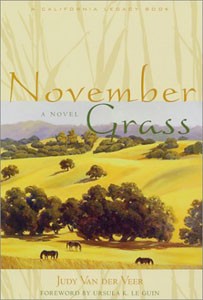
Judy Van der Veer, Ursula K. Le Guin

Ursula K. Le Guin revives classic novel

By Patrick Sullivan

URSULA K. Le Guin is the undisputed grande dame of American fantasy and science fiction. Over some five decades of writing, she’s published more than 80 short stories and 16 novels, including the Nebula Award-winning The Left Hand of Darkness and the National Book Award-winning Wizard of Earthsea series, which surely ranks with Tolkien’s work among the best-loved classics of fantasy literature.

So what the hell is the nation’s premier chronicler of alternate universes doing championing a novel like November Grass, a coming-of-age story set in Southern California farm country and sporting nary a single alien, wizard, or dragon? And why is Judy Van der Veer’s novel, first published in 1941 and long out of print, now being republished by Heyday Books, a press known for nonfiction explorations of California history?

Both questions have simple answers. November Grass (Heyday; $13.95) is very, very good–the kind of hidden literary treasure that makes a reader wonder how many other gems the publishing industry has buried under its mucky pile of bestsellers. And the book’s author, who spent most of her life on a ranch in San Diego County, provides a vivid, authentic glimpse of a slice of California history now forgotten by all but a few.

In a foreword to the new edition, Le Guin explains that she stumbled across a secondhand copy of November Grass years ago. Le Guin, who has a passion for offbeat projects, quickly recognized the book’s virtues. Moved to buy the battered paperback by the painting of hills on the cover, she was hooked by “a prose so direct, plain, pure, and strong that it slowed me down to savor it like the taste of honey or a fine liqueur, a completely unaffected language perfectly fitted to its subjects.”

A young woman stands at the center of November Grass. We quickly discover that she is strong, quiet, and sensitive. But chapters go by before we find out her age (she’s 23). We never learn her name. Working on her parents’ farm, “the girl”–as she’s referred to throughout–herds cows, rides horses, and reflects deeply on life, love, death, and the elemental beauty of the land.

Because of its simple style, because of its young main character, and especially because of the girl’s intimate relationship with animals, a casual reader might at first mistake November Grass for a children’s book–a mistake often made about some of Le Guin’s own work.

But Van der Veer’s novel is actually a subtle, mature study of life’s beauties and cruelties, glories and mysteries. In setting and style, it’s a bit reminiscent of Steinbeck–but without the brutal axe stroke of a work like The Red Pony. Instead, the book brings its main character slowly but surely to grips with the fundamental questions of existence.

November Grass is composed of deceptively low-key episodes. The girl falls passionately in love with the magical sounds of a piano. She sees a tree magically transformed by shadow and sunlight. She rescues a cow and her calf from the banks of a river during a wild rainstorm. She encounters the eccentrics California has always been known for, including John of the Wilderness, a man who lives in the hills with a herd of goats as his only companions.

And, almost without the reader noticing, she falls for a boy with brown eyes, red hair, and the elegant hands of a sculptor.

It all adds up to a simple classic. For making November Grass available to another generation, Le Guin deserves our thanks. At 71, the Oregon author may not have another Nebula winner in her. But this act of literary resurrection would be a superb crowning accomplishment.

From the June 28-July 4, 2001 issue of the Northern California Bohemian.

© Metro Publishing Inc.

Simon Says

0

Making of a band: Mike Johnston, Zac Diebels, Michael Arrieta, and Matt Franks

All the Rage

Simon Says say it louder, faster

By Greg Cahill

ON RECORD, Simon Says are raw, pissed-off, and ornery–one of the youngest and angriest of the angst-ridden rage-rock bands burning up the charts. Onstage–where success is measured by audience participation in stage diving, crowd surfing, and slam dancing–this Sacramento outfit has a reputation for high-energy shows that can leave even the most jaded reviewer in awe. On the phone, calling from a hotel room in Chicago, Simon Says guitarist Zac Diebels is the antithesis of those images–soft-spoken, polite, earnest, and absorbed in the band’s journeyman approach to the music business.

Ya gotta love him.

“We’re never really intimidated [by the business],” the 21-year-old Diebels explains. “This isn’t a competitive band–I mean, this isn’t a race, this is music–but we are excited to show you what we’ve got.”

Now promoting their new album Shut Your Breath (Hollywood), Simon Says swing into the Phoenix Theatre in Petaluma on June 29, during the West Coast leg of the Short End of the Stick Tour, a cheap concert series that is following the massive Ozzfest around the country and playing in nightclubs and small theaters to hard-rock fans who can’t afford $75 stadium seats.

It’s the kind of grassroots, meat-and-potatoes approach that has served this band so well. A couple of years ago, shortly after getting signed to a major label and when bandmembers were barely 18, Simon Says launched an intensive and unusual high school tour that found bandmembers raging in lunchrooms, two shows a day, 12 shows a week. “It was pretty brutal,” says Diebels, “but it was well worth it because we sold a lot of records and let kids know who we are.”

Since then, the road has become a second home. Most recently, the band has built an audience through relentless national and European touring with hard-rock heavyweights Limp Bizkit, Filter, Staind, the Rollins Band, and Type O Negative.

“Touring is our bread and butter,” Diebels says. “If it weren’t for touring, I don’t think our band would gain any ground really. We’ve gotten some radio, but we don’t bank on that kind of stuff–we come from a more old-school mentality that touring is where you develop your hardcore fan base among kids who will stick with you throughout your career, not just from one song on the radio. “When we’re touring, I feel like this is what I was meant to do.”

Once in the studio, the originally punkish band developed a heavier sound, owing in part to producer Mark Needham of Cake. And the band got heard, even among the then-rising din of rage-rock acts. In 1999, the song “Ship Jumper,” from their major-label debut Jump Start, was included on the Varsity Blues soundtrack. A second song, “Slider,” made it to MTVs new artists’ rotation. And a third, “Life Jacket,” surged up the Billboard rock chart. Oddly, the music video for that last tune–a personal account of their experiences in the music biz that exemplifies the band’s dark, in-your-face themes–landed on the Disney Channel, sandwiched between pop princess Britney Spears and boy band 98 Degrees.

Disney owns the band’s Hollywood Records label.

After the release of that album, the All Music Guide hailed Simon Says as “a very young American success story”–sort of a rage-rock Horatio Alger tale.

These days, the band has returned to its angrier roots. “We just went into the studio, threw our hand down, and said, ‘Let’s see where the chips fall,’ ” Diebels says. “It came out heavier because, in our hearts, we’re just naturally a lot heavier band.”

Simon Says perform Friday, June 29, at 8 p.m. at the Phoenix Theatre, 201 Washington St., Petaluma. Also on the bill are Link 80, Darwin’s Waiting Room, and Un Loco. Tickets are $5. 707/763-0225.

From the June 28-July 4, 2001 issue of the Northern California Bohemian.

© Metro Publishing Inc.

‘The Girl in the Sneakers’

Run, Tadai, Run

Iranian teen sprints for freedom in ‘The Girl in the Sneakers’

By

WATCHING the new wave of Iranian films, I’m usually overcome with a sense of nostalgia, which is strange because I’ve never been to Iran. But it all began to make sense after I watched the latest import, The Girl in the Sneakers.

There’s an evening shot of a traffic artery congested with cars. Suddenly it occurred to me: the heavy smog, the dismal light, the shoddy offices, and the crowded traffic of Tehran all mirrored a particularly ugly stretch of Los Angeles’s Wilshire Boulevard that I used to ride the bus through in 1973.

The depressed nostalgia got harder to shake, thanks to Iraj Panahi’s music (Francis Lai- style electric piano) and the opening scenes of a boy and a girl walking in a city park discussing Carlos Castaneda. The boy is temporarily fascinated with the idea of being able to fly away like Castaneda’s sorcerer, Don Juan; he tells his teasing, bratty girlfriend, Tadai (Pegah Ahangarani), that he’s ready to leave Iran and see the world–with her by his side, of course.

This gentle scene is busted up by the police. They suspect that the teens might have been having unlawful carnal knowledge. As the law requires, the cops haul Tadai away to have a pelvic exam (off screen) to make sure her virginity is intact. She’s still a hymen-bearer, so the cops let her off with a warning. And her parents give her a good yelling at.

Director Rassul Sadr Ameli saves the scene from melodrama by putting the camera in the next room, where we overhear the argument along with Tadai’s little brother, who is restlessly watching TV and trying to tune out the noise of his furious parents.

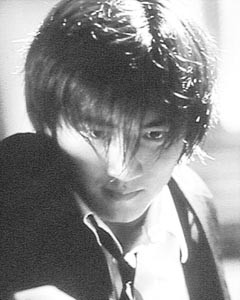
Planning a rebellion, Tadai cuts school the next day and walks the streets trying to use a series of pay phones to call her boyfriend. The story of a city wanderer is the easiest and most successful way to make a neo-realist film. Tadai has adventures; she tangles with an amusingly surly waiter at a hotel restaurant–Basil Fawlty’s Farsi cousin–and entertains herself telling lies to some old ladies on the bus.

At night, when single girls on the street are all considered whores, Tadai becomes a fugitive, hooking up with a tribeswoman (Kurdish?). She takes Tadai back to her camp, a post-apocalyptic dump-side squat alive with predatory men.

The Girl in the Sneakers is very compelling, but it has two flaws. The first is that Ahangarani is an uneven actress, occasionally coy and forced in the role. The second is that director Ameli sometimes plays this story both ways. He officially describes his film as concerning “the subjective preoccupations of a number of the young people in our society.”

This cautious language befits a director working through five different levels of Iranian film censorship. But would it have mitigated things if Tadai’s parents had been more kind to the girl after the state pulled down her pants?

This film could comfort some watchers who think that the problem is that Tadai, with her affection for the Backstreet Boys, should have been guided into submission more tactfully by her parents. Some also could be comforted that The Girl in the Sneakers is a warning to youth of the evil gypsy tribesmen waiting to help themselves to unescorted young girls.

Still, the closing shot at the end of Tadai’s run is a moment rich with implicit protest, encouraging the free to cherish their freedom and encouraging the enslaved to fight for their lives–a strong message in an increasingly moderate nation trying to shake off the shackles of fundamentalist rule.

‘The Girl in the Sneakers’ opens Friday, June 29, at the Rafael Film Center, 1118 Fourth St., San Rafael. For details, see , or call 415/454-1222.

From the June 28-July 4, 2001 issue of the Northern California Bohemian.
© Metro Publishing Inc.

Open Mic

0

Of Boats & Bay Fill

By Julia Gilden

AT A HASTILY CONVENED MEETING last Friday, Assemblyman Joe Nation heard from Sausalito’s floating community regarding his bill to clamshell “derelict” vessels. With 24 hours’ notice, 80 residents from boats, floating homes, and local land-based dwellings packed the Bay Model’s main meeting room to explain basic waterfront facts to the environmental assemblyman.

AB107 would amend an existing state law to control derelict vessel removal. But the new version extends the definition of derelict to include illegally moored and unauthorized vessels. In addition, Nation’s bill would raise the value of “derelict” boats from the existing $300 to $2,000, as determined by unknown persons, charge the owner for the boat’s destruction, and impose a fine, thus creating a new category in the state’s Criminal Code.

According to Richardson Bay Regional Authority administrator Bill Price, harbormasters up and down the state were consulted about the bill’s language, but he acknowledged that vessel owners were left out of the loop. While the bill’s instigator, Tiburon Mayor Andrew Thompson, stressed that the intent of the bill was to clean up beached hulks, the consensus among those attending was that the new law, as written, would give officials global authority to demolish floating communities.

The Bay Conservation and Development Commission’s claim that boats are “bay fill” has put pleasure craft owners, marina managers, and vessel dwellers at war for over 30 years with a state agency whose mandate is to protect the San Francisco Bay’s ecology and to prevent developers from encroaching into tidal areas. Since there are few, if any, “legally moored” or “authorized” vessels throughout the bay, AB107 would provide an enforcing mechanism for the BCDC’s efforts to remove boats at will. But according to the authors of the McAteer-Petris Act, which established the BCDC in 1965, vessels were never intended to be defined as “bay fill.”

Nation says it was a coincidence that his bill’s language matched the BCDC’s new proposal to remove 90 unauthorized vessels anchored or moored in Richardson Bay within a year. But as Waldo Point Floating Homes Association representative Suki Sennett points out, since Waldo Point has not had its permits renewed since 1992, all of Waldo Point’s floating homes could be defined at “unauthorized vessels.” Permit renewal is tied to certain improvements and trade-offs concerning a small co-op of floating homes existing since Sausalito’s heyday of creative houseboats.

Relying on a legacy of waterfront property interests and political deals, both Nation and the BCDC seem uninterested in working with existing federal laws regulating vessel use and navigation, including anchoring. As one boat owner quipped, “When I sail to Mexico, does my boat become ocean fill?”

Julia Gilden is a journalist and photographer who resides anchored out in Sausalito.

From the June 21-27, 2001 issue of the Northern California Bohemian.

© Metro Publishing Inc.

Russian River Blues Festival

0

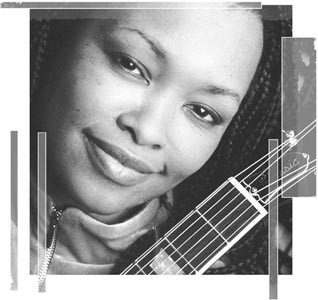
Living her dream: Four-time W.C. Handy Blues Award nominee Deborah Coleman will perform June 24 at the Russian River Blues Festival.

Blue Steel

Deborah Coleman spearheads wave of young female artists

By Greg Cahill

I’VE ENVISIONED myself as a live performer since I was a little girl, since I first saw the Monkees on TV,” says mid-30ish blues phenomenon Deborah Coleman with a laugh. “Blame it on the Monkees–and they didn’t even play their own instruments.”

As a singer, songwriter, and guitarist extraordinaire, the super-talented Coleman has become the poster girl for the new blues woman–a role that brings her June 24 to the sixth annual Russian River Blues Festival’s daylong program spotlighting women making a splash in the traditionally male-dominated genre. Along with such relative newcomers as Shemekia Copeland–the awesome gut-bucket blues singer and daughter of the late blues legend Johnny Copeland–Boston blues belter Susan Tedeschi; guitarists Sue Foley and Debbie Davis; and keyboardist Dona Oxford, Coleman is in the forefront of a wave of young women making their mark on the blues.

USA Today hailed her as “a fiery guitarist . . . who makes the spine tingle with her unbridled raw energy” and noted that Coleman is “one of blues music’s most exciting young players.”

Nominated this year for the fourth time for a W.C. Handy Award, Coleman has a red-hot new album, Livin’ on Love (Blind Pig) that is garnering rave reviews. Produced by Jim Gaines–known for his work with Santana, Stevie Ray Vaughan, and Huey Lewis & the News–the album showcases Coleman’s considerable songwriting talent.

“That’s one of my gifts, and I like to do it,” she says modestly, during a phone call from her home in Virginia, “so I figured I should squeeze a couple of months out of the year to work on songs.”

The effort has paid off. But the real buzz about Coleman these days is her kick-ass guitar playing onstage, which has drawn favorable comparisons to Vaughan’s. “Oh, well, that’s one of my favorite things to do, playing live,” she explains. “I get in the zone, if you will, and who knows how long it will last. It gives me chance to cut loose, whereas I wouldn’t normally on a record.

“I love it.”

HER INTRODUCTION to the blues guitar came via a circuitous route, not through the great Delta bluesmen but rather from ’60s rock icons. At age 15, Coleman began performing with a series of rock and R&B bands. She started out as a bass player but, after hearing Jimi Hendrix, switched to lead guitar.

“Back then, the formats of the radio stations were more diverse,” she recalls. “I remember hearing Joe Cocker, James Brown, Ray Charles, and the Beatles on the same station.”

As her interest in guitar grew, she began listening to British rock groups such as the Yardbirds, Cream, and Led Zeppelin, and followed the roots of their music back to the blues. “Jeff Beck was one of my favorites,” she says.

“I didn’t find out until later that they were doing blues tunes, and I went to find the original artists.”

She hit pay dirt at age 21 while attending a concert that featured Howlin’ Wolf, Muddy Waters, and John Lee Hooker all on the same bill. “I will never forget that show! At the time I was still doin’ rock, but I said, ‘Damn! That is cool, y’know!’ ”

As for the newfound interest in the ladies of the blues, Coleman says it’s about time the blues community–and especially blues promoters–loosened up and began appreciating female performers. “Everyone will get to see these women doing their own brand of the blues or, in my case, blues roots-rock. We’ve had our little affairs with the rock, country, and jazz worlds, so why not the blues?” she asks.

“I mean, you can probably count on one hand the number of women who have made a name as blues guitarists. But it’s finally happening in the blues world. Even in the early 20th century, only Memphis Minnie gained a reputation as female guitar player, and she never got the recognition she deserved. Now here we are 80 years later and I’m just glad to be in a position where I’m allowed to be seen more. So I’m just grateful for that.

“Who knew?

“I just wanted to play guitar, write songs, and make records.

“It’s working and it’s great. It’s beautiful.”

Festival Schedule

The sixth annual Russian River Blues Festival is awash with talent. On Saturday, June 23, the two-day festival kicks off with “Blues Is a Woman,” featuring Etta James & the Roots Band, Shemekia Copeland (triple winner at this year’s prestigious W.C. Handy Blues Awards), Deborah Coleman, Rosie Ledet & the Zydeco Playboys, and Lady Bianca. On Sunday, June 24, the men get their due with an impressive program featuring Keb’ Mo’ (above), guitarist Lucky Petersen, Clarence “Gatemouth” Brown, Roomful of Blues, the Persuasions, and Sy Klopps. The concerts, beginning at 11 a.m. each day and emceed by deejay Bill Bowker, will be held at Johnson’s Beach in Guerneville. Advance tickets are $40 each day or $75 for a two-day pass; tickets at the gate are $45 each day or $85 for a two-day pass. 510/655-9471.

From the June 21-27, 2001 issue of the Northern California Bohemian.

© Metro Publishing Inc.

David Meltzer

Meltzer raps with the Beats, again

By Jonah Raskin

THIRTY years ago, poet-musician David Meltzer published a collection of invigorating interviews with five Beat writers: William Everson, Lawrence Ferlinghetti, Michael McClure, Kenneth Rexroth, and Lew Welch. (Welch coincidentally and mysteriously disappeared just as San Francisco Poets showed up in Bay Area bookstores.)

Now, in his new book, San Francisco Beat: Talking with the Poets (City Lights; $19.95), Meltzer has republished his original material, plus 10 new free-flowing interviews from the 1990s.

This time around he has seen fit to include two women–Brooklyn-born poet Diane di Prima and Vallejo-born poet Joanne Kyger. And he has also been wise enough to include Philip Lamantia, Gary Snyder, and Philip Whalen, all of whom read at the Six Gallery in San Francisco in 1955, when Allen Ginsberg first performed Howl. Jack Hirschman and Jack Micheline round out the circle.

Meltzger’s interviews will probably make more sense to Beat aficionados than to readers encountering these wild poets for the first time. There’s just not enough biographical information about them, and not nearly enough historical background, either, to meet the needs of the uninitiated.

Moreover, newcomers might be puzzled by the curious verbal antics of the Beats. “I have no idea about the Beat movement,” di Prima says. City Lights publisher Lawrence Ferlinghetti insists, “I make up a lot of things. . . . I really don’t see the reason for giving a straight answer.”

Then, too, in one breath Meltzger will argue that the Beats ought to be allowed to die a quiet death, and in the next breath he’ll insist that the world today is dying for lack of the Beat message. Could it be he hasn’t resolved his feelings about the authors he’s been publishing for decades?

Poetry is a recurring theme, and so, too, is the decline and fall of nearly everything on earth. “This is the autumn of civilization,” Ferlinghetti says. Kenneth Rexroth, the godfather–or gadfly as some call him–of the Beats, proclaims, “Civilization is in a state of total collapse.” Michael McClure insists, “We were much more intelligent 30,000 years ago.”

Perhaps so. Still, there are intelligent comments in this volume, especially from William Everson, the Sacramento-born poet, printer, and Catholic priest–and one of the most underrated of all the writers associated with the Beats. Everson emerges from behind his own ego–a feat that eludes other figures in this book–to provide insightful comments about the Beat Generation.

“In San Francisco we were ready for it long before the rest of the country, but we couldn’t have pulled it off alone,” he explains. “It took something outside ourselves, something from the East Coast to make a true conjunction of the opposites. Allen Ginsberg and Jack Kerouac provided the ingredients.”

Kerouac isn’t in this book, but he died in 1969, just as Meltzer was beginning to interview the Beat writers, so his absence is understandable though unfortunate. But Ginsberg’s absence is galling, since he wrote Howl in San Francisco and Berkeley in 1955 and 1956, and then for the rest of his life–he died in 1997–never cut his umbilical cord to the dissident Bay Area culture that gave birth to his best work. Just why he doesn’t appear here, Meltzer doesn’t say.

There’s a lot of Beat bravado in these pages, but now and then a comment cuts to the very bone. “Poetry will come from the most vulnerable, wounded sections of society and one’s own life,” Jack Hirschman says. “It doesn’t come from anything institutionalized.”

Surely all the poets here–men, women, East Coasters, West Coasters, Catholics, Jews, and Buddhists–would rally around that resounding expression of the Beat credo of compassion and defiance.

BOOK NOTES: Attention, local writers! Hoping to get your writing published? Take heart! Writers of short fiction, short creative nonfiction, and poetry have a shot at seeing their work in print in The Dickens, a literary magazine published by Copperfield’s Books, the local bookstore chain that’s about to celebrate its 20th birthday. Better hurry, though: the deadline for submission is June 30. For complete rules, see www.copperfields.net.

Jonah Raskin is the author of ‘More Poems, Better Poems ‘ from Running Wolf Press.

From the June 21-27, 2001 issue of the Northern California Bohemian.
© Metro Publishing Inc.

Jewish Community Free Clinic

0

To your health: Pharmacist Susan Wilmes, left, clinic founder Robin Lowitz, and director of public relations Archie Lewinstein

Health Matters

Jewish Community Free Clinic set to open in Cotati

By Paula Harris

PERCHED on a tabletop, her legs swinging, Robin Lowitz fingers the discreet Star of David glinting at her throat, as, lost in thought for a moment, she ponders her reasons for shouldering this project. This petite woman with the short blond haircut and bright grin first brings to mind an adolescent Mary Lou Retton, rather than a family practice doctor and founder of a new free medical clinic.

But of course looks can be, and mostly are, deceiving.

Since standing up in front of the congregation in her synagogue last August to reveal her longtime dream of assisting the working poor find access to affordable health care and asking for help, Lowitz has been inundated with support to make the volunteer health facility a reality. The nonprofit Jewish Community Free Clinic of Sonoma County is set to open this summer in Cotati.

The organization’s mission is to offer free medical care based on the family practice model and to serve anyone in need–indigent and working poor, regardless of ethnicity, race, or religion. The clinic seeks to locally address the inequities in the current health system, which consigns the poor to little or no health care.

“I happen to believe health care is a right, not a privilege,” avers Lowitz, her gaze level. “In a country as wealthy as this with so many resources, it’s a travesty that people should go without it.”

The doctor adds that the situation is particularly dire in Sonoma County. “There’s a perception that people who work in society can make it today, but that’s not true in this area. In Sonoma County, many formerly insured people no longer are covered due to a convergence of circumstances–people are being forced to choose between buying food and paying energy bills or getting health care,” she continues, adding that those most at risk are those in the service industry and North Bay farm workers.

Lowitz, 40, a west Sonoma County resident, began her career immersed in the community-oriented medical facilities of Berkeley and the San Francisco Free Clinic. After volunteering in local free clinics sponsored by churches, Lowitz began to question her own community’s lack of involvement. “It just reinforced my questions,” she says. “There were a lot of Jews volunteering in clinics, such as the one sponsored by Catholic Charities, and I wondered why my own community wasn’t organizing.”

While the local Jewish community has been involved in civil rights issues such as the Stop the Hate Project and homelessness, the focus on community outreach involving heath care is a whole new direction. “I had an inkling that the Jewish community in general is very liberal-minded as far as social issues go,” Lowitz says, “and I had a sense that were I to throw out the idea, then people in the Jewish community would come out of the woodwork to help.”

SHE WAS RIGHT, and the support has extended well beyond the Jewish community. The Lions Club of Cotati has allowed the use of its building for the clinic site. The Lions Club is down to six members, says Lowitz, but is still used, plus it’s home to various community groups, such as the local sewing club. The new clinic will slot in among these activities.

In addition, local companies and individuals have donated time and materials to revamp the modest 50-year-old building, located in the Rancho Adobe Fire Station parking lot; and community volunteers have transformed the place by taping sheetrock on the walls, installing insulation, and painting inside and out.

A couple of doctors, a nurse, and others have donated equipment, including a much-needed heater for use in the children’s examination room. In addition to the pediatric room, the clinic will house an adult examination room and a nurse’s triage station. There are plans to enhance the lobby­waiting room with educational videos, workshops, storytelling, and toys. To promote literacy, says Lowitz, each child will be given a book to take home.

A volunteer staff of doctors, nurses, social workers, nutritionists, and a pharmacist have agreed to donate their time and services, and some of the medical supplies have already been donated for the clinic’s use.

Lowitz says the clinic will open one evening each week and see patients on a drop-in basis. Organizers hope to raise $10,000 to provide funds for the clinic’s first year expenses and have planned three fundraising events.

A classical-music concert held June 2, and featuring members of the Cotati Philharmonic and the Rohnert Park Community Band, drew some 350 audience members, marvels Lowitz. A rock concert to be held July 1 at the newly opened Last Day Saloon in Santa Rosa and organized by the local medical-aid group Musicians Helping Musicians will feature the Kay Irvine Band, Gator Beat, Fact or Fiction, and other artists and special guests. And an upcoming Latino concert still in the planning stages will feature an afternoon of Latino music and various activities.

“We’re trying to get the people that the clinic will be serving involved,” explains volunteer Archie Lewinstein, “such as farm workers and musicians.” Frank Hayhurst of Zone Music, who is organizing the benefit concerts, agrees. “Musicians and artists are edge-dwellers in our corporate culture and are typically uninsured or underinsured,” he explains. “This is a way to be proactive.”

Lowitz says more than half of the clinic’s board members aren’t affiliated with any religious organizations, and many volunteers are nonpracticing Jews.

“[The project] is drawing people from the Jewish community who aren’t involved in the synagogue and who feel alienated from Judaism, but see this as a way to express their cultural background and to do it outside an organized-religious framework,” she explains. “The issue of health care strikes a chord in a lot of senses.

“I think people are compassionate at the core, and this gives them a chance to give back.”

A rock concert to benefit the clinic will be held Sunday, July 1, from 7 to 11 p.m. at the Last Day Saloon, 120 Fifth St., Santa Rosa. Tickets are $10. Call 707/664-1213, ext. 19.

From the June 21-27, 2001 issue of the Northern California Bohemian.

© Metro Publishing Inc.

‘On the Verge’

0

Victorian adventuresses explore the future in uneven ‘On the Verge’

LADIES! Shall we bushwhack?With these words, exuberantly uttered in the opening minutes of On The Verge, a trio of sharp-witted Victorian adventuresses launch an expedition that will take them to the ends of the known world–and beyond.

Call it a metaphysical comedy. Or a philosophical farce. It’s the tale of three female world travelers, already ahead of their time, who become accidental tourists into America’s future, simultaneously gaining and losing something during their long, strange trip.

Eric Overmyer’s verbally audacious play, directed by Mollie Boice, opens the 2001 season of SRJC’s Summer Repertory Theatre, which is celebrating its 30th year.

Beginning in the year 1888, On the Verge introduces us to Mary, Fanny, and Alexandra, three globetrotting friends who share a mutual scientific curiosity, a heightened facility for language, and an intoxicating sense of wanderlust.

Mary (Holly Jeane), an anthropologist hoping to impress the National Geographic Society into making her a member, and Fanny (Carianne Wrona), an edgy adventurer with a special interest in the foods of other cultures, patiently endure the constant lyrical wordplay of Alexandra (Vanessa Severo).

On their increasingly surreal expedition through a place they call Terra Incognita, the women are good-natured competitors, wittily debating the merits of trousers as compared to petticoats, which Mary has sworn by ever since her own parachutelike petticoats saved her from certain death on a bed of bungee sticks. Or something.

The plot, such as it is, is far less important here than the language, a nearly overwhelming parade of rhymes, alliterations, and metaphors that must be as much fun to speak as they are to hear.

As the friends climb mountains and hack their way through jungles–assisted by the two black-clad “sherpas” (Overmyer’s answer to stagehands) that occupy the stage throughout the play, usually becoming bushes or chairs, dropping ropes, or making animal noises–they begin to experience odd intrusions from the future.

Egg beaters drop from the trees at the women’s feet–“A marsupial unicycle!” declares Alex–and cartons of something called “cream cheese” appear in Fanny’s baggage. Their speech becomes increasingly peppered with odd words and phrases (“Wow!” and “Cool Whip”), as they become channels for the future, fast becoming a part of their consciousness. “Like . . . mustard gas,” suggests Fanny, only to state, a few seconds later (once her consciousness has absorbed what mustard gas actually is), “Oh. Unfortunate metaphor. I withdraw it.”

Soon the women encounter a series of men–a cannibal, a yeti, a gas station attendant, a casino singer, all played by the versatile Richard Wylie–as they move rapidly toward the social innovations and verbal collapses of the 1950s. “I have seen the future,” says Fanny, “and it is slang.”

Dazzled by rock and roll and the miracle of Jacuzzis, the adventurers begin to doubt they will ever find their way back to the past–and wonder if they still even want to.

The cast is uniformly magnificent, with each of the core actresses giving a flawless performance. And some of Boice’s staging is delightfully clever.

But the production, on opening night at least, was marred by technical difficulties and awkward transitions. In one sequence, the piped-in jungle noises were so loud that the actors’ lines couldn’t all be heard, a problem that also occurs when cellophane paper is distractingly crinkled onstage to simulate a campfire. When the sherpas, moving in the dark, produce a dangling snowflake prop from behind the facade, it is done loudly, with bangs and thumps that momentarily ruin the drama taking place elsewhere on the stage.

One hopes these minor problems will be repaired over the next few performances, so that future audiences with discover, without interruption, the many pleasures and treasures awaiting them On the Verge.

‘On the Verge’ continues in rotating repertory with five other SRT productions through Aug. 9 at Santa Rosa Junior College, 1501 Mendocino Ave., Santa Rosa. Call for dates and times. Tickets are $12. 707/527-4343.

From the June 21-27, 2001 issue of the Northern California Bohemian.

© Metro Publishing Inc.

‘The Anniversary Party’

0

Tough Love

Hollywood romances hit the rocks in ‘The Anniversary Party’

By Nicole McEwan

LIVE CLOSE. Visit often. According to screen legend Katherine Hepburn, that strategy is the very simple secret to maintaining a beautiful relationship. She should know. Her 25-year-long love affair with Spencer Tracy is said to be among the most tender and devoted in Hollywood history, despite the fact that these two actors never wed. (Tracy’s rigorously Catholic wife refused to grant him a divorce.)

It’s advice that might well serve the emotionally vacillating couple whose marriage woes lie at the heart of The Anniversary Party, a Dogma 95­style film written and co-directed by actors Jennifer Jason Leigh and Alan Cumming. A biting, insightful peek into the romantic escapades of a group of Hollywood veterans, the film blends elements of The Big Chill and The Player.

The results suggest that interpersonal human dynamics are universal, relationship issues eternal, and happiness as elusive for the rich and famous as it is for the rest of us. These folks may be wearing Galliano and sipping Dom in a Richard Neutra­designed house, but their lives are as marred by addictions, infidelity, and failed dreams as anyone on Jerry Springer.

The party of the film’s title is a celebration of Joe Therrian and Sally Nash’s sixth wedding anniversary. Joe (played by Alan Cumming) is a renowned novelist whose latest book (rumored to be a thinly veiled exposé of his marriage) is about to be adapted as a film. Nash (Jennifer Jason Leigh) is a hugely respected actress whose career (and confidence) is waning.

After a six-month separation, the famous couple have not only reconciled; they have decided to start a family. The soiree, sporting a guest list awash in Hollywood A-listers as well as the couple’s arty friends, is intended to cement their renewed (and hopefully improved) union.

Among the revelers: the couple’s wound-tight married business managers (John Benjamin Hickey and Parker Posey); an Oscar-winning star, his beatific wife, and their two perfectly adjusted children (played by real-life smug-marrieds Kevin Kline and Phoebe Cates, plus their genuine offspring); and the ditzy ingenue cast as Sally in Joe’s movie (Gwyneth Paltrow).

What starts as a jolly celebration soon disintegrates into a wildly baroque soap opera, fueled by Ecstasy and complete with a celebrity skinny-dipping and near-death experiences. And with this cast of real-life friends and lovers, how could it not?

The truth is that Cumming and Leigh tailored the characters, dialog, and situations to match the mannerisms, personalities, and conflicts of the performers–which makes this whole effort a voyeuristic feast for the audience. The result is an intriguing parlor game where half the fun is dissecting fact from fiction.

And there’s much to pick over. For instance, Sally’s jealousy of her young rival throws a nice All about Eve twist to the mix, while highlighting Leigh’s own dismal dealings with a town that has never quite appreciated her brilliance.

Beautifully, invisibly acted, the film’s central flaw is lack of heat between the two leads. Cumming, again playing a sort of Peter Pan­sexual role, doesn’t seem man enough to corral the tempestuous Leigh. Theirs is more of a mutual admiration society than a full-blooded passion.

The Anniversary Party was shot digitally in a mere 19 days by cinematographer John Bailey (As Good As It Gets), who deserves plaudits for the film’s creamy, soft-focus look. Together with Leigh and Cumming, the production team has delivered a digital film that doesn’t look like a home movie. It just feels like one.

‘The Anniversary Party’ opens Friday, June 22, at Rialto Cinemas Lakeside, 551 Summerfield Road, Santa Rosa. For details, see , or call 707/525-4840.

From the June 21-27, 2001 issue of the Northern California Bohemian.

© Metro Publishing Inc.

‘Time and Tide’

0

High Tide

Tsui Hark turns the tide on the action genre

By Jim Aquino

THE FRENETIC action thriller Time and Tide may not be a completely triumphant comeback for Hong Kong filmmaking giant Tsui Hark, who spent the last few years wallowing in so-badly-acted-it’s-campy Jean-Claude Van Damme schlock. But it’s way more tolerable than those stateside Van Damme vehicles.

Time and Tide is classic Hark: it’s offbeat, playful, and exhilarating, as well as mindless. I dare anyone to try and make sense of Time and Tide’s plot, some convoluted, unwieldy nonsense about a reckless young Hong Kong bodyguard (H.K. pop star Nicholas Tse), his older, seen-it-all mercenary pal (Taiwanese rocker Wu Bai), their pregnant loves, and a gang of Brazilian mercenaries that wants both guys dead.

Perhaps there’s a purpose for the plot’s preposterousness. It looks as if Hark is trying to shoot for a critique of the action genre, much like David O. Russell’s Gulf War satire Three Kings, one of the most subversive action movies ever made (and of course, left off the American Film Institute’s inane, muddled “Top 100 Thrilling Movies” list).

There are shots reminiscent of Three Kings, which, in one of its most celebrated and imitated moments, took the camera inside a man’s chest to depict a bullet puncturing his lungs. In Time and Tide, the camera zooms through vents, down skyscraper air shafts, into the chamber of a gun, and, in the film’s niftiest and most memorable shot, inside a bomb explosion in an apartment building.

Hark’s attempt at a satirical actioner doesn’t go as deep as Russell’s Three Kings. Russell employed all those innovative visual and aural effects to indict the Reagan/ Bush-era war genre and the jingoistic mentality that spawned it, as well as to show what movies like Rambo and programs like The A-Team and the G.I. Joe cartoon avoided depicting: the ugliness of gunfire violence and the perspectives of both the enemy and the Third World civilian screwed over by the Americans.

When Hark uses the same effects, he doesn’t seem to have a point of view. It’s similar to how those effects are depoliticized and Jerry Bruckheimer-ized each week on Bruckheimer’s somewhat overrated detective show, CSI; they’re there because they just look cool.

However, Hark sure does know how to stage an inventive set piece. There’s a daring point-of-view shot of mercenaries quickly scaling down the side of a tenement skyscraper along wires, the cinematic equivalent of a roller-coaster drop.

The over-the-top climax juggles a high-wire scuffle on a concert arena skywalk, a gun duel, and a childbirth. For the aforementioned explosion sequence, Hark utilizes that Matrix “bullet time” effect to show objects floating in midair inside the explosion fire, one of which is a safe containing Tse’s character, who seals himself inside to survive.

Only Hark, the man who gave the world the gravity-defying “shadowless kicking” of Jet Li in the Once upon a Time in China series, could come up with an image so bizarre. And only he could concoct a story that’s such a head-scratcher. Time and tide wait for no man, and neither does this movie’s restless plot.

‘Time and Tide’ opens Friday, June 22, at the Rafael Film Center, 1118 Fourth St., San Rafael. For details, see , or call 415/454/1222.

From the June 21-27, 2001 issue of the Northern California Bohemian.

© Metro Publishing Inc.

Judy Van der Veer, Ursula K. Le Guin

Ursula K. Le Guin revives classic novel By Patrick Sullivan URSULA K. Le Guin is the undisputed grande dame of American fantasy and science fiction. Over some five decades of writing, she's published more than 80 short stories and 16 novels, including the Nebula Award-winning The Left Hand of Darkness and the National...

Simon Says

Making of a band: Mike Johnston, Zac Diebels, Michael Arrieta, and Matt Franks All the Rage Simon Says say it louder, faster By Greg Cahill ON RECORD, Simon Says are raw, pissed-off, and ornery--one of the youngest and angriest of the angst-ridden rage-rock bands burning up the charts....

‘The Girl in the Sneakers’

Run, Tadai, Run Iranian teen sprints for freedom in 'The Girl in the Sneakers' By WATCHING the new wave of Iranian films, I'm usually overcome with a sense of nostalgia, which is strange because I've never been to Iran. But it all began to make sense after I watched the latest...

Open Mic

Of Boats & Bay Fill By Julia Gilden AT A HASTILY CONVENED MEETING last Friday, Assemblyman Joe Nation heard from Sausalito's floating community regarding his bill to clamshell "derelict" vessels. With 24 hours' notice, 80 residents from boats, floating homes, and local land-based dwellings packed the Bay Model's main meeting room to explain...

Russian River Blues Festival

Living her dream: Four-time W.C. Handy Blues Award nominee Deborah Coleman will perform June 24 at the Russian River Blues Festival. Blue Steel Deborah Coleman spearheads wave of young female artists By Greg Cahill "I'VE ENVISIONED myself as a live performer since I was a little...

David Meltzer

Meltzer raps with the Beats, again By Jonah Raskin THIRTY years ago, poet-musician David Meltzer published a collection of invigorating interviews with five Beat writers: William Everson, Lawrence Ferlinghetti, Michael McClure, Kenneth Rexroth, and Lew Welch. (Welch coincidentally and mysteriously disappeared just as San Francisco Poets showed up in Bay Area bookstores.) Now,...

Jewish Community Free Clinic

To your health: Pharmacist Susan Wilmes, left, clinic founder Robin Lowitz, and director of public relations Archie Lewinstein Health Matters Jewish Community Free Clinic set to open in Cotati By Paula Harris PERCHED on a tabletop, her legs swinging, Robin Lowitz fingers the discreet Star of David...

‘On the Verge’

Victorian adventuresses explore the future in uneven 'On the Verge' "LADIES! Shall we bushwhack?" With these words, exuberantly uttered in the opening minutes of On The Verge, a trio of sharp-witted Victorian adventuresses launch an expedition that will take them to the ends of the known world--and beyond. Call it...

‘The Anniversary Party’

Tough Love Hollywood romances hit the rocks in 'The Anniversary Party' By Nicole McEwan LIVE CLOSE. Visit often. According to screen legend Katherine Hepburn, that strategy is the very simple secret to maintaining a beautiful relationship. She should know. Her 25-year-long love affair with Spencer Tracy is said to be among...

‘Time and Tide’

High Tide Tsui Hark turns the tide on the action genre By Jim Aquino THE FRENETIC action thriller Time and Tide may not be a completely triumphant comeback for Hong Kong filmmaking giant Tsui Hark, who spent the last few years wallowing in so-badly-acted-it's-campy Jean-Claude Van Damme schlock. But it's way...
11,084FansLike
4,606FollowersFollow
6,928FollowersFollow