Kenneth Cleaver

Consumer Correspondent

Mr. Nathan O. Hatch, Provost University of Notre Dame Notre Dame, IN 46556

Dear Mr. Hatch:

I regret to inform you that your trademark image of a fist-clenched “fighting” Irishman has ceased to be relevant. The image, reminiscent of famous Irish boxer John Sullivan, has been inscribed indelibly on baseball hats, T-shirts, and most of the human anatomy. Unfortunately, the reality of the scrapping, proletarian Irishman has been obliterated through white flight and the selective American class ladder. Even the Irish at home have mellowed. Sinn Fein President Gerry Adams is arguably more comfortable with Armani suits than with Armalite Rifles. Fortunately or not, the Irish just aren’t fighting these days.

As an Irish American, the image does not offend me. I am of a minority opinion that as an ethnic group we are entirely overrated. For every Seamus Heaney or Frank McCourt, there are innumerable hordes of garrulous boors polluting barroom serenity from Indiana to Katmandu.

I understand that “the fighting Irish” is a rugged, hearty, and ironically American name for a football team. But given that the Irish now have the second-fastest growing economy in Europe, perhaps you might consider these slightly more realistic alternatives: the Microchip Irish©; the Stock-Option Irish©; the Badass Western Europeans©.

Best of luck!

Sincerely, Kenneth H. Cleaver

Dear Mr. Cleaver,

I enjoyed your thoughts about the fighting Irishman image at Notre Dame, as well as your suggestions for alternative monikers. I agree with you that the Irish have been well assimilated into American society, and currently are a powerful force, particularly economic, within Western Europe.

There is no plan at this time for Notre Dame to change the image, but you certainly provided food for thought!

Best wishes.

Sincerely, Nathan O. Hatch, Provost

From the August 23-29, 2001 issue of the Northern California Bohemian.

© Metro Publishing Inc.

Arts Etc.

0

Write Stuff!

By Patrick Sullivan

HEY YOU! Yeah, you–the one hunched over that notebook, scribbling away in the dark corner of the coffeehouse. You write. You even write well. And here’s your chance to see your powerful prose in print.

That’s right–it’s time for Java Jive, the Bohemian‘s annual writing contest. This year’s theme: Angst for the Memories. Tell us the source of your existential malaise in no more than 500 words. Be creative, be funny, be bawdy–just don’t be boring.

The Bohemian will publish the best five entries, as determined by our panel of esteemed judges. If you’re the writer of the top entry, you’ll win a copy of Dostoyevsky’s droll Notes from the Underground, a fresh writing journal, and a pound of coffee to pull you out of your funk. The second and third place winners just get the coffee.

Entries must be received by Sept. 24 at 5 p.m. They must be double-spaced and legible and won’t be returned. No more than three entries per person. E-mail to ja******@******an.com, fax to 707/527-1288, or mail to the Bohemian, Attention: Java Jive, 50 Mark West Springs Road, Santa Rosa, CA 95403. Bohemian staff and relatives are ineligible.

From the August 23-29, 2001 issue of the Northern California Bohemian.

© Metro Publishing Inc.

Christo

0

Second Wind

‘Running Fence’ runs again

By Gretchen Giles

THIS IS the story of how more than 2 million square feet of silky, white air-bag fabric ran into the ocean. A tale of how a whole generation of residents came together to argue and then agree about art. A vision that took five years to erect, yet was seen for only 14 days. Divisive, lengthy, and exhausting–it’s curiously mimicking itself through a new tale of community.

Formally known as Running Fence, Sonoma and Marin Counties, 1972-1976, this sinuous run of shimmering white nylon snaked from Cotati to the Pacific, caught the sun, gave music to the wind, and defined the land.

It also dramatically changed many lives. The well-documented instance of Freestone resident and informal town mayor Tom Golden springs naturally to mind.

Then in his mid-50s, Golden became an ardent supporter of and manual laborer on Running Fence and provided his home as ad hoc headquarters to Christo and Jeanne-Claude, the globe-trotting husband-and-wife artistic team that created Fence.

Little did Golden know then that he was to gain a new family in the controversial couple, become the single largest private collector of their work in the United States, start a new career as project director and liaison on several of their projects, and make a major contribution to a new life for the Sonoma County Museum in Santa Rosa.

“I’ve had such a wonderful life,” Golden says with unfeigned satisfaction in the well-filled home he shares with partner, Jim Kidder. “Christo and Jeanne-Claude often say that they do these projects for themselves and their friends. They’re free for everyone to see, and their work is of joy and beauty; they have no purpose whatsoever. And I think that it’s quite a privilege to be able to assist in any of [their] projects.”

A Highway Runs Through It: The history of the ‘Running Fence’ project.

A Guided Tour: Complete schedule of upcoming Christo-related arts events.

Born on Jan. 8, 1921, Golden now possesses many lithographs and other works from Christo and Jeanne-Claude’s studio numbered 8 for his day of birth. His collection began when he refused payment for his work hooking the Fence (there are no volunteers on these projects), requesting studio credit instead. Now 80 and establishing a legacy, he has donated his collection of more than 70 pieces to the Sonoma County Museum; his home and its entire contents will follow posthumously.

To celebrate the 25th anniversary of the Running Fence project, the SCM has made the ambitious decision to exhibit Golden’s collection in four different venues this autumn. The project also features a musical tribute from the Santa Rosa Symphony, a traveling display for middle-school students and educators, and a staged reading of an original play from Sonoma County Repertory Theatre, commissioned just for the occasion.

And just maybe, if Christo and Jeanne-Claude could bring together as many disparate factions as clashed on Running Fence, so can the SCM.

“Very little of our Running Fence–only three pieces–is in Tom Golden’s collection,” says Jeanne-Claude by phone. “It has little to do with the Running Fence.”

“Even if Sonoma County residents know only about the Fence,” unknowingly counters Satri Pencak, visual arts program manager for the Sebastopol Center for the Arts, one of the participating venues, “it will be exciting to see the projects that Christo and Jeanne-Claude did before and after it.”

Titled “Running Fence @ 25,” this far-reaching interdisciplinary exhibit is the “kick start,” according to SCM board president Kevin Konicek, to the “envisioning” process that the SCM will do to envision, for example, sprawling down a full city block and growing well beyond its current means as a small historical repository. And all of this without a museum director.

Outgoing SCM acting director Marlene Ballaine says, “We’re a county museum, not the Santa Rosa museum. Having the [Tom Golden collection] come to us when it did was perfect because it was an opportunity for the museum to put this “envisioning” process together. This is a great start.”

“It’s like we’re a $35 million start-up,” explains Konicek, who is leading the search to fill the director’s chair. “And we’re in the business of experience.” Konicek hopes that the Golden collection will underscore the SCM’s new commitment to “every form of human experience, as long as we tell the story of our culture.”

Sonoma Museum of Visual Art director Gay Shelton is curating the multivenue exhibit, and she’s well in tune. “I wanted to approach this as a cultural anthropologist,” she says, preparing to rhetorically ask, “How did [Running Fence] enter the culture of Sonoma County?”

To that end, Shelton has taken “70 pieces that [she] wanted to put 100 different places,” and instead confined herself to a sober four: her own museum, the new University Library Art Gallery in the Schulz Information Center at Sonoma State, the Sonoma County Museum, and the Sebastopol Center for the Arts.

With area arts groups often scrambling after the same cash or working with fierce independence from one another, “Running Fence @ 25” is a unique undertaking with enormous challenges, owing to scheduling, funding, and orchestration. In fact, no one’s ever tried to do anything like this here before.

“I love the whole idea of collaborative projects in the county,” Shelton says. “One of the great joys has been getting to know other spaces in the county. I’m going to learn from them and they’re going to learn from us. It’s like being a spy with good intentions.

“This,” she stresses of the collective exhibit, “is an initial sign of innovation and life, and we should all watch.”

From the August 23-29, 2001 issue of the Northern California Bohemian.

© Metro Publishing Inc.

Indy Awards

0

For Art’s Sake

The 4th annual Indy Awards

ART HAS AN ENEMY. Its name? Call this waking nightmare the conventional wisdom, or “playing it safe,” or “oh, that’ll never work.” Whatever title it sports, this ponderous bogeyman scares the life out of more creative endeavors than any of us will ever know.

We can only thank our lucky stars that a few bold souls shrug off its grim embrace to make their artistic dreams a reality. Otherwise, life here in the North Bay (and everywhere else) would be a lot less interesting.

Every year, the Bohemian seeks to recognize those independent spirits with the Indy Awards, an annual award ceremony that shines a spotlight on individuals and institutions who make a unique contribution to the North Bay arts scene.

The recipients, selected by the newspaper’s editorial board, are always an eclectic group working in a variety of creative fields, from music to the visual arts to administration.

This year is no different: whether they’re bringing a world-famous playwright to Santa Rosa or opening the doors on Sonoma County’s only movie theater dedicated to independent films, these folks give conventional wisdom a solid sock in the smacker.

In the process, they make our world a funkier, fresher, more creative place to live.

Dream team: Ky Boyd and Ian Price–lords of the North Bay art-house scene

Screen Gems

Rialto Cinemas Lakeside

“If it’s playing everywhere else, it’s definitely not playing here–that’s our unspoken motto,” says Ky Boyd, who with partner Ian Price last year transformed the aging Lakeside movie theater in Santa Rosa into a haven for nonmainstream movie buffs.

The old black decor, neon, and video games are gone–replaced by upgraded sound and projection, Tuscany-inspired colors in the lobby (with a mural, bedecked with golden hills and vineyards, painted by Boyd’s cousin), and a small cafe.

Sticking to their niche of independent, foreign, and classic movies, the two men have proved to skeptics that there is indeed a local audience for a five-screen art house.

“We were amazed at how quickly the whole county embraced our theater and our programming,” says Boyd, adding that attendance is up 40 percent over last year. “People used to drive to San Francisco and Berkeley to see films that tell stories and are a little offbeat.”

Boyd, 36, says he and Price are currently mulling over opening a second theater, in Petaluma. “It’s a kind of down-the-road project,” he explains. “We’re researching whether the county could support it.”

The Rialto also excels in working with community groups. The theater sets up screenings on a regular basis for nonprofit organizations, such as the Jewish Film Series, a KRCB public radio film series, and a Gay Men’s film series with Face to Face. “We’re very much into being part of the community,” says Boyd.

The two men are grateful to the Rialto’s loyal following. “It’s been really rewarding to start a business the community really embraces,” explains Boyd, adding that in the wake of so many theater closures, anxious patrons routinely ask if the Rialto will be next.

“It’s touching,” says Boyd. “But we’re here for the long haul.”–Paula Harris

Touched by an angel: Jean Schulz, the Santa Rosa philanthropist and wife of the late ‘Peanuts’ creator Charles Schulz (with Summer Repertory Theatre artistic director Frank Zwolinski), has blessed a broad range of Sonoma County arts organizations with financial support.

Helping Hand

Jean Schulz

“I don’t like to talk about my work in the community,” says Jean Schulz, eager to dismiss her extensive philanthropic endeavors. “I just do what I do.”

While her late husband, the internationally famous cartoonist and “Peanuts” creator Charles Schulz was no stranger to the limelight, the gracious Jeannie, 62, seems to shy away from it. “I simply give to the arts as I give to other organizations in the community,” she explains. “I enjoy the arts, and I think they are important in the life of the community.”

But the fact remains that Schulz has long lent a helping hand to a myriad of arts organizations and future arts projects. The list runs the gamut. Among other projects, she’s created matching grant programs for both the Summer Repertory Theatre and for the Don and Maureen Green Music Center, worked extensively with the Sonoma County Community Foundation, and extended crucial financial assistance to the Sonoma Museum of Visual Art’s recent Burning Man celebration and exhibit.

“[Schulz’s] interest has allowed me to do my work more deeply and has also helped so many others do theirs,” says SMOVA director Gay Shelton. “She has enhanced the cultural life of the community.”

Schulz, who has lived in Sonoma County since 1962, says she derives great pleasure from helping develop the local arts scene.

“I think Sonoma County is a haven for artists–and for people to understand the life joy that comes to people from doing, performing, and sharing their art,” she says. “We have that here. If we can understand how it enhances their lives, we can also understand how it can enhance our own lives.”–P.H.

At the helm: Argo Thompson, Actors Theatre artistic director–the world’s a stage.

Staging Power

Actors Theatre

“It’s exhilarating to be surrounded by such a vibrant and passionate community of theater artists,” says Argo Thompson, artistic director of Sonoma County’s Actors Theatre, describing the vibe that currently surrounds the North Bay theater scene.

“It makes me think of Paris in the 1920s, a time when art and science were coming together, when the writers and painters and theater artists were conspiring to explore the differentness of the emerging world. There’s something very much like that happening here in the North Bay.”

If so, a lot of it is happening at Actors Theatre.

What began 18 years ago as a band of rogue theater artists eager to sink their teeth into meatier and more challenging material has become a sanctuary for theater lovers on both sides of the fourth wall.

Among the company’s biggest accomplishments of the past year: staging critically acclaimed productions of both halves of Tony Kushner’s epic drama Angels in America. AT also managed to persuade Kushner himself to appear in person at the Luther Burbank Center for a fascinating onstage dialog with talk-show host Michael Krasny.

More than any other company north of the Golden Gate, Actors Theatre has earned a reputation for staging local theatrical premieres (Torch Song Trilogy, One Flea Spare), frequently giving new plays–by writers from around the world–their first staging anywhere.

“Our dream,” says Thompson (pictured above), “is for more and more playwrights to recognize Actors Theatre as a desirable stomping ground, a testing place for the next great plays of the 21st century.”–David Templeton

Stu Blank

Stu Blank was a sweet guy with a rough edge. “He was one of those characters who could bite you now and then,” musician Jim Corbett says of the late, great Blank, who died of cancer earlier this summer. “He was the kind of guy who didn’t always tell you what you wanted to hear, but would always tell you what you needed to know. At the same time, he was also a real spiritual guy. Stu was always looking for the light in people.”

When Stu Blank died–after a long fight that inspired dozens of Bay Area musicians to join forces in a series of medical-bill fundraising concerts–the music world lost one of its most colorful players, a guy known for wild stunts on and off the stage. The night he set a piano on fire, for instance, has become the stuff of rock-and-roll legend.

Less well known were Stu Blank’s efforts to help other musicians, an impulse that, in 1998, led to the forming of the Sonoma County Music Foundation. Co-founded by Corbett, local musician Buzzy Martin, and others, the nonprofit organization–conceived by Blank, named by Corbett–was formed to bring local musicians together and to find ways to help musicians in the local industry. Such help included finding new venues for people to play, giving advice on how to deal with promoters and record companies, and arranging low-cost legal council.

“Stu was looking to do something above and beyond the playing aspect,” says Corbett, “doing something that helped other people.” Apparently the effort was successful. Blank’s memorial service was jammed with musicians sharing stories about the time Stu Blank helped them out.

“It’s amazing,” says Corbett, “how many people he touched.”–D.T.

Paint the Town

Youth in Arts Italian Street Painting Festival

Every June, the streets of downtown San Rafael lose themselves in an Italian affair. Suddenly, pavement that normally groans beneath the load of a hundred sports utility vehicles an hour is freed up to serve a higher purpose.

Artists from across California converge on this upscale mission town to commit hundreds of fantastic visions to the asphalt during the Italian Street Painting Festival. They get company–lots of it. An estimated 50,000 spectators come to watch the work develop over the course of the weekend-long event, which was founded in 1994 by Youth in Arts, a non-profit arts education organization.

“It’s a rare occasion for the average person to see art being created,” explains festival director and founder Sue Carlomagno, 54. “It’s not too often they can watch an artist make creative decisions. People are enthralled by the process.”

Hundreds of artists participate, from school children to weekend-warrior amateur adults to internationally recognized professionals. Carlomagno estimates that about 60 percent hail from Marin and Sonoma counties, though at least one participant this past June came from Italy. It works the other way, too: Several North Bay-based artists who honed their chops in the San Rafael event are now well-respected participants in Grazie di Curtatone, the festival in Italy that inspired Carlomagno to create the San Rafael event.

But young or old, Californian or Italian, the artists work together in teams to create images ranging from reproductions of European masterpieces to cyberpunk goddesses.

And then, just as suddenly, the art is gone.

“We seal coat the street to prepare the surface for the artists and then we reseal coat the street to restore the rough surface,” Carlomagno explains. “By Monday at 4:30 you would never know that anything took place there.” –Patrick Sullivan

The 4th annual Indy Awards take place Wednesday, Sept. 5. Meet the winners, celebrate the North Bay arts scene and enjoy free food and drink. The fun runs from 6:30 to 9 p.m. at the Sonoma County Museum, 425 Seventh St., Santa Rosa. Admission is free. 707/527-1200, ext. 225.

From the August 23-29, 2001 issue of the Northern California Bohemian.

© Metro Publishing Inc.

Fall Movies

0

Fall Flicks

New season offers the good, bad, and ridiculously weird

By Patrick Sullivan

AFTER THIS LONG, cruel summer, Hollywood should have a big scarlet letter pasted firmly onto its collective forehead. “C” for crap, maybe. Or an enormous red “O” for, “Oh my god, we’re extremely sorry about that Pearl Harbor thing.”

But perhaps film fans can expect some relief in the fall, a time when the studios traditionally atone for the grotesque excesses of their summer blockbuster binge by serving up more sophisticated fare.

Would that life was so sweet and so simple. Instead, the fall of 2001 appears to offer a mixed bag of the good, the bad, and the ridiculously weird.

Let’s put the worst first. In Zoolander (Sept. 28), Ben Stiller plays a male model recruited to stop a global conspiracy involving a nefarious fashion cartel. Confused? Everything becomes clear when you learn that Stiller, who directed and co-wrote this baby, based the film on a skit that he and Drake Sather put together for, ahem, the 1996 VH1 Fashion Awards. Here, at last, may be the answer to a very disturbing question: Could anything be less funny than a full-length feature spun out of a Saturday Night Live segment?

“I’ll be back,” Arnold Schwarzenegger once famously remarked. Alas, what he meant was “You’ll never get rid of me.” After reaching dreadful new lows in last year’s abysmal Sixth Day, Arnie tries again with Collateral Damage (Oct. 5), in which he plays a firefighter who loses his family to a terrorist bomb. Wanna guess who takes vengeance into his own hands?

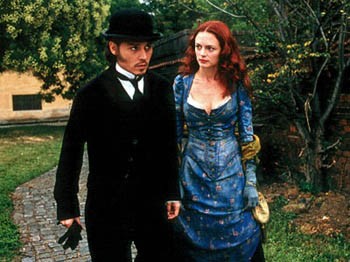
Somewhat more promising is From Hell (Oct. 19). Emboldened by his triumph over the Headless Horseman in Sleepy Hollow, Johnny Depp teams up with Heather Graham to take a stab at bringing down another old-time bad guy–Jack the Ripper. What sets this flick apart is that it’s directed by Albert and Allen Hughes, the talented twins who served up Menace II Society and Dead Presidents. Nineteenth-century London may never be the same.

An even better bet: Steve Martin plays a mild-mannered dentist caught up in a bizarre murder plot in Novocain (Oct. 19). Helena Bonham Carter shucks her ape costume to play a mysterious patient who starts the good doctor’s descent into the dark side of dental hygiene in this blacker-than-black comedy.

Maybe you love films like Eraserhead or Lost Highway, or maybe not. But after the surprisingly gentle The Straight Story, you don’t know quite what to expect from David Lynch anymore. Still, Mulholland Drive (Oct. 12) seems to be a return to the strange old days. Laura Elena Harring plays an amnesiac who tries to uncover her past with the aid of an aspiring actress. Explicit lesbian trysts? Check. Bizarre plot twists? Check. Surreal identity swaps? Check. Yep, Lynch is back.

Fall brings back another offbeat director with the release of Richard Linklater’s Waking Life (Oct. 19). The man who took us from the high of Dazed and Confused to the low of The Newton Boys now serves up this mind-bending animated meditation on the human condition.

And last but hardly least: Could a bad flick be made out of Harry Potter and the Sorcerer’s Stone (Nov. 16)? Of course, and even the worst adaptation of the first book in J. K. Rowling’s fabulously successful fantasy series would break all known box-office records. Yet there’s reason to hope that director Chris Columbus (Bicentennial Man, Monkeybone) won’t completely screw things up.

After all, Warner Brothers has to sell six more Harry Potter flicks to the young wizard’s rabid fans. If Columbus can’t pull this off, he’d better have a fast broomstick in the closet.

From the August 23-29, 2001 issue of the Northern California Bohemian.

© Metro Publishing Inc.

Prescription Drug Advertisements

0

Industry ads an Rx for trouble

By Chris Lydgate

THEY SOUND like superheroes in some postmodern comic book: Claritin; Propecia; Viagra; Prozac. Like comic-book heroes, they can produce miraculous effects. And like comic-book heroes, they often create as many problems as they solve.

How does an allergy drug (or an anti-impotency pill) become a household name? The answer is as close as your TV screen. The pharmaceutical industry spent an estimated $1.8 billion last year on advertising aimed squarely at consumers, not doctors. These so-called direct-to-consumer, or DTC, marketing efforts have had a “tremendous impact” on prescription drug costs, says Dr. J. Bart McMullan, senior vice president for health services at Regence BlueCross/BlueShield. “It really does affect demand.”

DTC marketing has long been a source of frustration for HMOs, but the smoldering resentment burst into flame last month with an article in the Oregon Health Forum, which reported some harsh criticism of drug companies.

Why the palaver? HMO execs say the pharmaceutical marketing machine is the driving force behind a phenomenal surge in prescription-drug costs: most HMOs report that drug expenditures are rising roughly 15 percent per year. “We’re just seeing the beginning,” says Sheela Andrews, regional director of pharmacy services for PacifiCare Oregon.

To be sure, there are other factors at work, including the proliferation of expensive drugs for previously untreatable conditions, a wave of consolidation among generic drug-makers, and a rising number of patent disputes that have kept cheaper generic drugs out of the marketplace. But there is little doubt that drug-makers’ new emphasis on bringing their messages directly to consumers is having far-reaching effects on the business of medicine.

In the past, the question of which drug to prescribe was considered the exclusive domain of the physician. No longer. “Now [patients] are coming in armed and ready for a prescription drug they believe will make their lives better,” says Jack Friedman, president of Providence Health Plans.

Because most insurance plans cover prescription drugs, patients are typically insulated from the true cost of their medication. Instead, the tab is picked up by insurance companies, which pass along the cost in their premiums. Providence Health Plans spends more money on prescription drugs than on primary care.

Popular name-brand drugs put doctors in a bind. In many cases, the new drugs represent significant medical advantages. But often there are cheaper alternative or generic medications that might be just as effective. These often go unprescribed, doctors say, because patients prefer the marquee-name drug–especially when they don’t have to pay for it.

TAKE A DRUG like Prilosec, a new medication commonly used to treat a painful condition known as gastrointestinal esophageal reflux disorder. “For people with this disorder, this is a godsend,” says Dr. Jim Norris, chairman of Kaiser Permanente’s Formulary Committee. But thanks to an aggressive marketing campaign by the drug’s manufacturer, many patients with mild heartburn or dyspepsia are now asking their doctors for Prilosec (cost: $3 a day) instead of similar, cheaper drugs (cost: 55 cents a day) that would be just as effective in treating their milder conditions.

To combat this crippling inflation, Oregon’s HMOs are increasingly shifting the cost to consumers, turning to a solution known as a three-tiered pricing structure. Here’s how it works: Patients shell out a sliding co-pay for all their prescriptions. The co-pay is minimal for generic drugs, larger for older, name-brand drugs, and highest for the marquee drugs.

At PacifiCare, for example, the co-pay for Accupril, a brand-name blood-pressure medication, is $28 a bottle. But an older, similar drug, Zestril, is available for $13, and a generic version, Captopril, costs just $8, says Andrews of PacifiCare. (Members have access to several other blood-pressure medications as well, she adds.)

Although graduated co-pays do help to keep costs low, they are not popular with consumers. “You’re getting a lot of angry members out there,” says Chris Palmedo, public relations manager for PacifiCare, which adopted the new structure in January. “We got a huge influx of calls.”

The situation looks as though it will get worse before it gets better. As pharmaceutical companies continue their aggressive marketing efforts, drug costs are projected to outstrip hospital costs in the next decade, which is certain to leave HMO executives feeling down in the dumps.

Maybe they should take a look at some of those cheery antidepressant ads in the glossy magazines.

From the August 23-29, 2001 issue of the Northern California Bohemian.

© Metro Publishing Inc.

Arts Etc.

0

Birth of an Installation

By Patrick Sullivan

WHAT’S 26 FEET WIDE, 30 feet long, and 15 feet high? Here’s another clue: it incorporates 200 prom dresses, a bunch of yoga balls, and several walk-in fiberglass vaginas. If you guessed The Cradle, the Burning Man installation project created by Sonoma State University art professor Jann Nunn and collaborator Deirdre de Franceaux, you’re half right. That’s what the piece will look like–when it’s done, which is theoretically going to be Thursday, Aug. 16. But like any newborn, this one may or may not arrive on schedule.

“Oh my god, we certainly hope so,” says Nunn, who is doing the steelwork on the piece. “It’s a huge, huge project.”

The Cradle was commissioned by Burning Man, the annual Nevada festival of radical self-expression, as the entry piece to the festival’s “Seven Ages of Man” installation series. If you’re not planning to hit the Black Rock Desert, you’ve got one chance to walk through The Cradle’ s version of the wonder of birth. After completion, the piece will be on exhibit Thursday afternoon and evening only in the courtyard of the SSU sculpture department.

From the August 16-22, 2001 issue of the Northern California Bohemian.

© Metro Publishing Inc.
Jill Watts

New bio highlights sex symbol’s racial ambiguities

By Patrick Sullivan

BEFORE there was Madonna, before there was Angelina Jolie, there was Mae West. Indeed, without West, the first two might not be where they are today.

A working-class girl who went from burlesque dancer to Hollywood’s top box-office draw in such movies as I’m No Angel, West used her bold sexuality like a pair of pliers, tweaking the prim little nose of America’s prudish establishment so hard that she once went to jail for obscenity. “When I’m good, I’m very good,” went her most famous line, “but when I’m bad, I’m better.”

West had plenty of sex appeal. But don’t confuse her with baby-doll sex objects like Marilyn Monroe. There was far more to West’s persona than, as The Chicago Daily Tribune once put it, “hips, hips, hurrah.” What really rocketed West to stardom (and made her a perennial target for social conservatives) was her sly subversion on stage and screen of the rigid rules of behavior laid down for white women in early-20th-century America.

Or so argues California State University history professor Jill Watts. In her new biography, Mae West: An Icon in Black and White (Oxford University Press; $35), Watts puts West’s life under a scholarly microscope and examines “the major themes that long dominated her work: critiques of the dominant culture’s assumptions about class, gender, and race.”

Watts makes a persuasive case that West was, essentially, a talented mimic who appropriated African-American cultural forms to satirize and subvert sexism and racism. Borrowing from the likes of vaudeville performer Bert Williams and female blues singers, West put together a provocative persona that entertained the masses and scared the crap out of way-too-decent types everywhere.

Like Elvis Presley after her, West made her fame and fortune from this cultural appropriation. But unlike Presley, Watts argues, West acknowledged her debt to black culture and generally supported–in her art and in real life–the struggle for civil rights.

There’s even some cause to believe that West may have been racially mixed herself. Some confused critics have taken issue with Watts for overstating the evidence for this. But in fact, the author is careful to indicate that one of West’s grandparents may or may not have been a light-skinned black passing for white.

There are weaknesses in Watts’ work. She is certainly no master stylist. While better than that of 90 percent of academic authors, her prose ranges from serviceable to tedious to torturously convoluted. The first chapter, which describes West’s family life in turn-of-the-century Brooklyn, is especially slow, but the narrative picks up speed.

Of course, the author has great material to work with–West’s colorful, incredibly dramatic life, from her strange childhood growing up in a family connected to New York’s criminal underworld to a late-in-life appearance on Mister Ed.

Some of the funniest passages in the book describe West’s wrangles with the Hollywood censorship office over risqué scenes in I’m No Angel. Paramount tried to dodge the censor, a man named Will Hayes, by submitting incomplete scripts.

Watts describes what happened next: “But the Hayes office held its ground. Receiving only the title to a song called “No One Does It Like That Dallas Man,” it immediately declared the number unacceptable. The studio appealed and sent lyrics. Discovering such lines as “He’s a wild horse trainer, with a special whip; gals, you’ll go insaner,” the censors refused to reconsider. Studio executives persisted, claiming that all “the Dallas man does is kiss, hug the ladies, and ride a horse.”

West lost that battle. But, as Madonna can attest, she won the war. There’s no question that, by the time she died at the age of 87 in 1980, she’d helped make America a rather different place.

From the August 16-22, 2001 issue of the Northern California Bohemian.

© Metro Publishing Inc.
Thelonious Sphere Monk

0

Music in Monk Time

New CD collections capture jazz pianist in his prime

By Greg Cahill

MILES DAVIS has managed to steal the jazz-world limelight this year, thanks to a series of festival tributes, as well as impressive CD anthologies, reissues, and extended editions marking the 75th anniversary of the legendary trumpeter’s birthday.

But pianist Thelonious Monk–whose oddly angular chordal patterns and jumpy melodies were canonized in the hard bop and post-bop era, and were heralded again this week in a San Francisco Chronicle critics’ poll as “the essence of cool”–is the subject of several equally impressive new CD sets that are essential recordings for any serious jazz fan.

Earlier this year, the Berkeley-based Fantasy label, which controls Monk’s breakthrough Riverside and Prestige recordings, released three expanded, limited-edition 20-bit digitally remastered reissues: Monk’s Music with saxophonists John Coltrane and Coleman Hawkins; the eponymous Thelonious Monk Trio disc; and Thelonious Monk/Sonny Rollins (evidently album titles were a simple affair in those halcyon days), a red-hot set with hard-bop giant Rollins in sharp contrast to the cool sax accompaniment of longtime Monk collaborator Charlie Rouse.

Last month, Sony Records released to great acclaim Thelonious Monk: The Columbia Years: 1962-1968, compiled by Bay Area producer Orrin Keepnews, who helped guide Monk through his formidable years at the Riverside label during the 1950s. That three-CD collection of concert and studio sessions showcases Monk as a soloist, in a trio, in a quartet, and in a big-band format, and includes several glorious nuggets mined from the vaults. As the All Music Guide has noted, that set also spotlights Monk “as not only an instinctual presence on the keyboard, but as a craftsman of timeless melody, harmony, and rhythmic counterpoint.”

Yet the proverbial icing on the cake is a pair of newly released two-CD sets featuring live material recorded at the peak of Monk’s long career: Live at the Jazz Workshop–Complete and Monk in Tokyo (released for the first time on CD in the United States and vastly superior to the import version), both on the Columbia/Legacy label.

The complete 26-track version of the legendary Jazz Workshop sessions, recorded in San Francisco in 1963 with Rouse and the rhythm section of bassist Larry Gales and drummer Ben Riley, is a jazz juggernaut. It now features 13 previously unreleased tracks and three newly restored tracks. The 24-bit digital remastering alone is enough to recommend this set–the sound just booms from the speakers, revealing every nuance of the players right down to Riley’s light-handed brushwork.

Monk in Tokyo, recorded that same year with a different rhythm section (bassist Butch Warren and drummer Frankie Dunlop), includes some of the same material but interpreted in radically different ways. For instance, the Monk composition “Blue Monk” gets an unusually up-tempo treatment on the Jazz Workshop sessions until Monk deconstructs this blues-based number and throws a series of artistic curve balls at his accompanists, including a rhythm section that had only recently joined with Monk. On the Tokyo sessions, that same melody starts out as a wistful solo piano piece that gives way to an explosive tenor sax solo by Rouse.

More evidence that you could listen to Monk for a lifetime and never fail to be amazed by his creativity. On track after track, Monk’s inventive genius–a seemingly inexhaustible swirl of ideas–is showcased on these collections.

From the August 16-22, 2001 issue of the Northern California Bohemian.

© Metro Publishing Inc.

Kenneth Cleaver

Consumer Correspondent

Ms. Margaret E. Kozan Holland & Knight Consulting 200 South Orange Avenue, Suite 2600 Orlando, FL 32801

Dear Ms. Kozan:

A dear friend is slated to be wed this fall, and while arrangements are set to her satisfaction, she finds herself ensconced in an unusual crisis. The maid of honor, one Sarah R. Dinffler, has staged a highly effective coup d’état amongst the bride’s party. What started as an overbearing personality asserting her self-professed expertise on floral decoration, table setting, and limousine service has now mutated into an unfounded demand for a “producer credit.” While not previously known as an upstart, Ms. Dinffler has used her political cunning to recruit three of the four bridesmaids into her camp, voicing their newfound demands for union representation.

I have advised the bride not to concede the credit. To my knowledge, a title credit of this significance sets lifelong precedence. Should it be granted to Ms. Dinffler, it may prohibit the bride from attaining it in future nuptials. In any event, legal counsel appears inevitable, and on the bride’s behalf I would be most grateful if you could promptly respond with a summary proposal of your firm’s services.

Sincerely, Kenneth Cleaver

Dear Mr. Cleaver:

Thank you for your inquiry. Holland & Knight LLP is not able to provide legal assistance to you at this time. Please be advised that my receipt of your letter and this response has not established an attorney-client relationship between you and Holland & Knight and that you should not consider yourself a client of the firm.

We wish you well in your search for an attorney to represent you!

Very truly yours, HOLLAND & KNIGHT LLP Margaret E. Kozan

From the August 16-22, 2001 issue of the Northern California Bohemian.

© Metro Publishing Inc.

Kenneth Cleaver

Consumer Correspondent Mr. Nathan O. Hatch, Provost University of Notre Dame Notre Dame, IN 46556 Dear Mr. Hatch: I regret to inform you that your trademark image of a fist-clenched "fighting" Irishman has ceased to be relevant. The image, reminiscent of famous Irish boxer John Sullivan, has been inscribed indelibly on baseball hats,...

Arts Etc.

Write Stuff! By Patrick Sullivan HEY YOU! Yeah, you--the one hunched over that notebook, scribbling away in the dark corner of the coffeehouse. You write. You even write well. And here's your chance to see your powerful prose in print. That's right--it's time for Java Jive, the Bohemian's annual writing contest....

Christo

Second Wind 'Running Fence' runs again By Gretchen Giles THIS IS the story of how more than 2 million square feet of silky, white air-bag fabric ran into the ocean. A tale of how a whole generation of residents came together to argue and then agree about art. A vision that...

Indy Awards

For Art's Sake The 4th annual Indy Awards ART HAS AN ENEMY. Its name? Call this waking nightmare the conventional wisdom, or "playing it safe," or "oh, that'll never work." Whatever title it sports, this ponderous bogeyman scares the life out of more creative endeavors than any of us will ever know. ...

Fall Movies

Fall Flicks New season offers the good, bad, and ridiculously weird By Patrick Sullivan AFTER THIS LONG, cruel summer, Hollywood should have a big scarlet letter pasted firmly onto its collective forehead. "C" for crap, maybe. Or an enormous red "O" for, "Oh my god, we're extremely sorry about that Pearl...

Prescription Drug Advertisements

Industry ads an Rx for trouble By Chris Lydgate THEY SOUND like superheroes in some postmodern comic book: Claritin; Propecia; Viagra; Prozac. Like comic-book heroes, they can produce miraculous effects. And like comic-book heroes, they often create as many problems as they solve. How does an allergy drug (or an...

Arts Etc.

Birth of an Installation By Patrick Sullivan WHAT'S 26 FEET WIDE, 30 feet long, and 15 feet high? Here's another clue: it incorporates 200 prom dresses, a bunch of yoga balls, and several walk-in fiberglass vaginas. If you guessed The Cradle, the Burning Man installation project created by Sonoma State University art professor Jann...

Jill Watts

New bio highlights sex symbol's racial ambiguities By Patrick Sullivan BEFORE there was Madonna, before there was Angelina Jolie, there was Mae West. Indeed, without West, the first two might not be where they are today. A working-class girl who went from burlesque dancer to Hollywood's top box-office draw in...

Thelonious Sphere Monk

Music in Monk Time New CD collections capture jazz pianist in his prime By Greg Cahill MILES DAVIS has managed to steal the jazz-world limelight this year, thanks to a series of festival tributes, as well as impressive CD anthologies, reissues, and extended editions marking the 75th anniversary of the legendary trumpeter's...

Kenneth Cleaver

Consumer Correspondent Ms. Margaret E. Kozan Holland & Knight Consulting 200 South Orange Avenue, Suite 2600 Orlando, FL 32801 Dear Ms. Kozan: A dear friend is slated to be wed this fall, and while arrangements are set to her satisfaction, she finds herself ensconced in an unusual...
11,084FansLike
4,606FollowersFollow
6,928FollowersFollow


