Sculpture Jam

0


Photograph by Michael Amsler

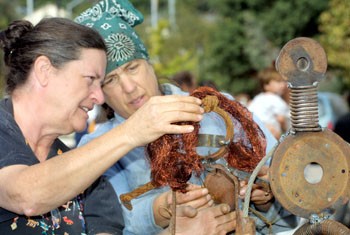
Jam band: Arleen Place and Virginia Harrison work with scrap metal at Sculpture Jam 2001.

Piece Process

Sculpture Jam transforms Sebastopol

By Gretchen Giles

PUNCTUATED by the loud whine of chain saws, the burr of marble-cutters, the hiss of welding torches, and the rhythmic, measured, metallic twang of pounding hammer heads, the recent three-day Sculpture Jam in Sebastopol was anything but quiet–though peace was the point.

The intensely physical action of making sculpture was evident in all its messy glory as the defunct lumberyard adjacent to the Sebastopol Center for the Arts became an ad hoc outdoor studio for some 23 artists for the fourth year in a row.

Literally shadowed by Running Fence–whose silky white car air-bag panels draped a shade for those working in the center of the yard–the Sculpture Jam was planned and organized long before the events of Sept. 11 changed all our lives.

Originally envisioned by coordinators Warren Arnold and Daniel Oberti as a way for artists to collaborate in a setting less lonely than the private studio, Sculpture Jam went off in a new direction after the World Trade Center and Pentagon disasters of last month. Based as it is in Sebastopol, a city that recently debated an official referendum to inform President Bush of its opposition to retaliatory attacks, the event took on a new tone as works that might have been merely artful became politically charged.

Most dramatically altered was Oberti’s contribution. A sculptor of international renown, Oberti lugged pounds of wet clay to the Jam, exhorting visitors and fellow artists to create weapons of mass destruction from the damp stuff. PVC piping outlined the small, cordoned square established for the “exhibit,” phallic missile shapes arising unsteadily from the dirt in its middle, clay guns pointing blindly at the sky.

On Sunday afternoon, the piping was transformed into a sprinkler system, its cool waters melting the beautiful wickedness as surely as Dorothy dumping a bucket. “It will be,” Oberti gaily predicted on Saturday, “a big mess!”

COMPLETELY COVERED in a fine film of limestone dust, stone sculptor Warren Arnold pulled off his earmuffs and goggles. “Where’s my red crayon?” he asked. Once it was retrieved from the rubble below his saw table, Arnold deftly drew fast upward strokes on the limestone flame he had just released from its block. “My goal is to make readable imagery as you walk by quickly,” he explained.

This flame was added to a growing pile of stone, metal, wood, and glass objects jumbled together near Arnold’s workstation. An impromptu shrine to the attack victims, this physical thought-process is destined to find a place in town.

In fact, the Sebastopol City Council has pledged to find sites to install most of the works created at this year’s event. The new pieces, which will be installed for a two-year period, will join works from previous Jams, including last year’s controversial “Door,” which now graces the town’s plaza. After this year’s additions, the town’s public places will be playing host to 16 Jam-created sculptures, according to Linda Galetta, Sebastopol Center for the Arts director.

Acknowledging the council’s commitment to public art, Arnold gestured across the street to another Jam alumnus, the “Split Rock.” Two imperfect halves of one whole, the “Rock” was fashioned during a previous year’s art confab and also stands in the plaza. “It’s become an instant shrine,” Arnold explained. “A place for the community to gather.”

And indeed, sun-warmed candle wax scents the ground around the “Rock,” piles of fresh loam are scattered at its base, orchard apples rot gently among pine needles and gourds and bits of homemade collage. “Peace,” anonymous hands have written on torn bits of notebook scrap, paper-clipped to a stand of dead oak branches. “Peace.”

From the October 11-17, 2001 issue of the Northern California Bohemian.

© Metro Publishing Inc.

High Speed Rail For California

0

Ticket to Ride

High-speed rail is the answer to California’s clogged roads and airports, but will the politicians get it?

By Jeff Kearns

ON A HOT, smoggy Monday afternoon in August, Gov. Gray Davis quietly forecast the end of freeway building in California. Standing on a freshly built eight-lane roadway in Southern California’s Inland Empire, he was surrounded by orange Caltrans trucks, TV cameras, and a passel of state and local officials sweating in their suits. The noon ribbon-cutting ceremony in the middle of farmland attracted about 2,000 onlookers, who gathered beneath the new green highway signs pointing the way east to San Bernadino and Barstow.

The opening of the first phase of a 28-mile, $1.6 billion extension of Interstate 210 from La Verne to San Bernadino isn’t exactly big news, except to frustrated Inland Empire commuters and Vegas-bound Angelenos. But in his remarks, Davis said this freeway will be one of the state’s last for the foreseeable future, because California’s transportation spending policies have been changed by economic necessity. On a cost-per-mile basis, freeways don’t pencil out.

Instead, in the March primary, Davis will ask voters to back a proposition that would redirect state gas tax revenues to other kinds of transportation projects. If it passes, the state would raise $36 billion over 20 years. This is a sum of money that could, if the state gets its act together, build an environmentally clean and viable alternative to today’s gridlock–high-speed steel rail.

A modern version of a nearly 200-year-old technology, high-speed rail runs through almost all of the major cities in Europe and Japan. The United States has managed to ignore the idea for decades. The state of California may change that.

Proponents are working on a 10-year, $25 billion plan to link population centers in San Jose, San Francisco, Los Angeles, San Diego, and Sacramento with a 220-mph train, redirecting millions of travelers away from clogged freeways and airports. The trains could be up and running within a decade–if our elected officials ever get on board.

The barrier to high-speed rail in the United States isn’t, as some might assume, technology–it’s politics. State-of-the-art rail systems are there for the taking, but elected leaders generally won’t support anything on rails.

Choo on This

The California High-Speed Rail Authority is a tiny agency that can’t get the time of day from state lawmakers, who created the agancy in 1998 and never gave it the power inherent in its name. It remains in the embryonic stage, with four employees and nine appointed board members.

This year, Gov. Davis axed the authority’s entire $14 million budget request for environmental studies, leaving just the $1 million operating budget intact. Although the energy crisis zapped the budget surplus, what should be an important policy initiative wound up with crumbs: less than a hundredth of 1 percent of the state’s $80 billion budget.

Where It Will (and Won’t) Go: Although a final route hasn’t been selected yet, the high-speed rail line would serve all of the state’s major population centers.

Local Motion: Fasten your seatbelt. The merry-go-round that is North Bay public transit is coming back around.

Because it is still struggling to obtain even small amounts of state funding, the High-Speed Rail Authority employs just a handful of workers who, to cut costs, oversee a hired army of environmental and engineering consultants. So far, much of the early work has been contracted out to six teams, five of which are concentrating on a specific region. They have spent the last few years working on the extensive $25 million environmental impact report that the authority needs to complete before it secures funding.

And while Sacramento and Washington both lack the political will to support the high-speed rail effort, even one that could pay off in decades instead of months–politicians don’t like to look down the road past their next election–the choking off of its small budget risks major setbacks for the efforts already under way.

At the same time, the state continues to grow: The U.S. Census Bureau predicts that the state’s 34 million residents will number nearly 50 million by 2025–close to the current population of Italy.

And all of them won’t fit on freeways.

Speed Freaks

California’s high-speed train proponents, on the other hand, offer up a vision of quick, easy travel. In their alternate future, North Bay residents could board a train in San Francisco and find themselves at Los Angeles’ Union Station just two hours later–faster, in total trip time, than any airline flight. On express trains, there would be no advance ticket purchase needed, no check-in, no seat assignment, no baggage check, and no FAA restrictions. The highly automated, lightweight trains would run on dedicated tracks, fenced off, with no at-grade crossings. Because of safety and track maintenance, high-speed trains would not use the same tracks as existing passenger and freight trains. High-speed trains use continuously welded rails that are precisely aligned by laser equipment.

Planners forecast that the system could be carrying 42 million passengers a year by 2020, and even as many as 60 million a year. Segments of track could be carrying passengers–and producing revenue–by as early as 2011. Longer segments could be up and running in 10 years, with the entire 700-mile system open by 2016. Their vision is that in about 14 years, a bullet train will be solving California commuters’ woes and addressing a critical environmental and quality-of-life issue: helping Californians travel to work from the places they can afford to live.

Further down the tracks, if the system proves successful, profits could be used to extend service to other parts of the state.

Sounds great, right? So what’s the holdup?

The first holdup is: getting someone to notice.

“Unless we kill a busload of nuns, we don’t get network airtime,” rail advocate James RePass said in a speech last year. At the authority’s Aug. 1 meeting in San Jose, board members complained that the media were ignoring the issue. As Executive Director Mehdi Morshed updated board members on the authority’s near-empty bank account, one fed-up board member interrupted.

“Those of us who have been serving on this board are extremely frustrated,” fumed board member Jerry Epstein, a Los Angeles developer and Pete Wilson appointee. “It is absolutely a travesty that we have already spent so many millions of dollars, and for them to cut us off now is unbelievable.

“We should invest money in a proper PR firm that will force the legislators to come up with some money,” Epstein proposed. “We are absolutely living in the dark ages here. We must do something to wake up the people of California. Unless we have a rail system, we are going to be just mired in traffic.”

This, of course, is the understatement of the century so far.

Board members are scheduled to take some big steps forward at their November meeting in Bakersfield, when they will eliminate many of the routes under study and get significantly closer to choosing the final alignment that the system will use. “This is a critical milestone for the authority,” Deputy Director Dan Leavitt says.

But at the same time, the authority is staring down a funding crisis that could halt progress on the environmental studies unless state or federal lawmakers can come through with a new source of funding.

Not Amtrak

Perhaps in part fostered by the lack of media coverage on rail and mass-transit issues, the other hurdle for high-speed rail backers is the public perception that rail isn’t profitable because it isn’t popular–and vice versa.

Actually, extensive marketing studies commissioned by the authority show that not only is the potential ridership higher than first thought, but these riders are willing to put their wallets where their butts would go. According to Morshed, two thirds of the respondents polled said they would support the train and would be willing to support a quarter-cent or half-cent sales tax to finance its construction.

But the dismal reality of the issue is that government transportation dollars in the United States go to subsidize expensive highway and airport projects, not rail, and that lack of support from shortsighted elected officials is one of the main reasons that rail hasn’t caught on. In turn, U.S. rail service is generally slow, infrequent, expensive, and decades behind.

Ask most people about rail, and they’ll think of Amtrak, the company that gives trains a bad name. Amtrak’s new Acela (the name’s supposed to sound like acceleration and excellence–talk about unintended irony) connects Boston, New York, Philadelphia, and Washington at speeds up to 135 mph. However, unimproved tracks limit Acela to slower speeds for many of those miles, and it continues to disappoint. Acela’s on-time record is poor, barely better than the shuttle flights it competes against, and ridership and revenue both sag below target levels. Nonstop service from Washington to New York was dropped, and a nonstop from New York to Boston never started.

Morshed wants to emphasize that what California has planned isn’t something like a clunky Amtrak upgrade.

“The main thing that is important to know is that when we talk of high-speed rail, we are not talking about anything that we have in this country,” he says. “This is a very fast train that’s comfortable and luxurious and safe and as fast as an airplane.”

Meanwhile, Amtrak flounders.

Nationwide, service is slow, often slower than driving. The trip from San Francisco to Los Angeles takes 12 hours, and costs more than airfare. Trains can cruise at 79 mph, but unimproved track (owned by freight train companies) often forces them to creep along at slower speeds. The rail network got a boost in ridership after the terrorist attacks, but will likely lose it again.

The heavily subsidized rail network is a private corporation that was formed when the federal government merged four dying passenger rail companies in 1971. Congress has demanded that it start operating in the black by 2003 or face big cuts or even defunding. Amtrak has pocketed $23 billion in federal funds since its creation. According to its 2000 Annual Report, even with ridership and revenues on the rise, Amtrak operated at a loss of $944 million.

But while Congress continues to push Amtrak to get its act together, lawmakers won’t give it the money it needs to succeed.

Amtrak Chairman and CEO George Warrington, quoted in the National Journal, grumbled that the United States, ranked by rail capital spending as a percentage of total transportation spending, is somewhere between “Estonia and Tunisia.”

Tokyo Go Go

Contrast Japan: The country unveiled its first 125-mph Shinkansen just before the opening games of the 1964 Olympics in Tokyo. Since then, the national rail system has been privatized, and the network continues to expand.

A few blocks from the Imperial Palace, Tokyo Station is the hub of the network. White and blue trains glide into the station on tracks elevated above the streets of the Ginza District every couple of minutes. They sidle up to the platform almost silently, with an electric hum and a whoosh of air. Delays are nearly nonexistent, and the average deviation from schedule can be measured in seconds, not minutes. Except for the large seats and abundant legroom, the interior resembles a plane. Cruising at 186 mph, the train sways only slightly.

The technology evolves through continual research and development. The Japanese have tested Shinkansen at 300 mph. In Europe, France opened its first TGV (Train à Grande Vitesse) line in 1981, and is also continuing to expand service. Germany’s ICE (Inter-City Express) trains kicked off service in 1991. Spain, Italy, and Sweden have also followed. A handful of other European countries, plus South Korea, Taiwan, China, and Australia, are in various stages of planning or building fast trains. Even cash-strapped Russia is building a high-speed line from Moscow to St. Petersburg.

But while high-speed rail has been unquestionably successful in Europe and Japan, where it connects almost every major city, those parts of the world have much higher population densities–Japan’s is about four times California’s–and also have governments willing to fund development and expansion. Japanese and European motorists also pay big bucks–$3 to $4 a gallon–for gas, which generates tax revenues used to fund mass transit.

Still, California’s growing pains have begun to push transportation planning into the public consciousness, and voters are becoming more receptive to using tax dollars to fund transit solutions. Sales tax increases passed last year in Santa Clara and Alameda counties would support this. Presumably, the greatest support for the system would come not from transportation planners and rail advocates but rather from L.A.-to-Bay Area travelers who have endured delays longer than the flight itself, or made the drive on I-5 without air conditioning in summer.

If We Build It . . .

From a small office on the top floor of a tall building across the street from the Capitol, Dan Leavitt points to the Sacramento train station, near the river. That’s where the northernmost terminus of the high-speed rail system will probably be built. According to projections, it will serve 7 million passengers a year, depositing them a short walk from the Capitol. (The station is in roughly the same location as the original terminus of the Transcontinental Railroad, which was completed in 1869. Ironically, though the Irish and Chinese immigrants who built that first cross-country rail link worked only with hand tools and dynamite, construction took just six years.)

In phrases honed from hundreds of presentations, Leavitt drops facts and explains background as if he’s reading off a printed paper placemat.

Planners are currently officially considering two technologies: Steel wheel on steel rail (the same as conventional trains and the bullet trains in Europe and Japan), and maglev, which uses electric currents to propel trains that levitate about an inch above a track.

Though both options are under study, maglev almost certainly won’t get the nod. Japan and Germany have built test tracks, and Japanese tests have hit 340 mph, but maglev still hasn’t carried paying passengers. On the other hand, high-speed rail technology has been available for decades and continues to improve.

Leavitt predicts the system could carry 32 million intercity passengers a year, plus 10 million commuters, while operating at a surplus–a boast almost no existing public transportation system in the United States can make. In addition to passengers, rail planners believe a statewide high-speed rail network could make additional money by carrying high-value and time-sensitive freight at night.

Morshed says the authority expects to operate at a surplus of more than $300 million a year, at a conservative estimate, and potentially as much as $1 billion a year. The hard part, however, is funding the $25 billion initial capital investment, especially after the electricity crisis deflated the state’s budget surplus. It may sound like a lot, but that’s only about a tenth of how much local, state, and federal cash will go to fund transportation projects in the state over the next 20 years. (To put the cost in perspective, Los Angeles city officials are planning a $12 billion expansion of LAX. SFO is proposing a $3 billion runway expansion.)

Former Santa Clara County Supervisor Rod Diridon Sr., a longtime rail evangelist, recently became a key figure in the drive to create the rail network, a move that may bode well for the project.

Diridon was appointed to the High-Speed Rail Authority board by Gov. Davis in June, and elected chair by board members in August. The son of a Southern Pacific engineer, Diridon himself worked as an SP brakeman in college. After a long career in politics, Diridon was named director of the Mineta Transportation Institute, a publicly funded transit think-tank at San Jose State. He was also a member of the state high-speed rail commissions that preceded the formal creation of the authority. (As perhaps further proof of the longevity of his obsession, Diridon is the only board member with a train station named after him.) Diridon’s appointment to the board could be an important shot in the arm for the program because of his political connections in Sacramento.

It doesn’t take much to get Diridon started on the subject of how the United States trails Europe and Japan in the mass transit department. “Europe spent $11 trillion upgrading an already superior transit system, and most of that was spent on high-speed rail,” he says. “We’re all bogged down in our commitment to outdated technology. They’re more advanced in using transit tools than we are. We’re developing transit systems that are bound by petroleum.”

But Diridon is confident that, although Americans lag, California’s system is far from doomed. “When it’s built, it will undoubtedly pay for itself,” he says, “and if we build it, I know that the public will embrace it.”

From the October 11-17, 2001 issue of the Northern California Bohemian.

© Metro Publishing Inc.

Bob Dylan

0

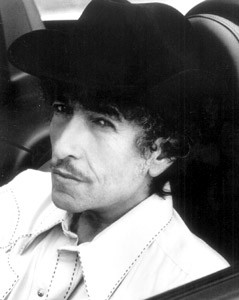
Big Wheel Bob Dylan: Driven to distraction?


Photograph by David Gahr


American Pie

Dylan’s new album preaches to the choir

By Gina Arnold

BOB DYLAN’S career has had its unfortunate anomalies, but with two good albums in a row, could it be too much to hope that he’s back in a groove? Time out of Mind, his last record, sold more than any of the last 20, suggesting that–despite evidence to the contrary–quality is still recognizable, and crap is shunned. While it wasn’t the greatest record since Highway 61 Revisited, it was the best “new” Dylan album in decades, leading one to believe that if Aerosmith or the Rolling Stones–or R.E.M. for that matter–actually put out a good album it would sell by the trainload.

It’s a heartening realization–and even better news is the fact that Dylan’s latest record, Love and Theft, is another good one. Like Time out of Mind, it contains strong songwriting and good playing–by a crack band led by young guitar whiz Charlie Sexton–as well as Dylan’s trademark voice and unique take on American folk music.

If you’re a Dylan fan, you’ll definitely want to get this one. If not–well, if you’re not a Dylan fan, then this record won’t turn you into one.

And therein lies the rub. At this point in his career, what could Bob Dylan do to win over new listeners? Nothing short of another generational anthem–and we sort of need one right now–would reinstate him in our good graces, and though this is a fine record, it doesn’t carry that sort of strength.

That said, these days Love and Theft seems like a good title for a record about America: what is capitalism, after all, if not the ultimate outcome of both?

This record is about America, although not the America I know, with its jet-setting young people, its bellbottoms and hip-hop and high-tech and extreme sports. This is an older America, the one that folksingers like to sing about, full of mysterious highways and noxious nighttime alleys and sleepy Southern landscapes and summer days. It is an America that people like Dylan have been romanticizing for years–and it is one that, dare I say, is totally irrelevant.

That doesn’t mean it isn’t musically dynamic, however. On this album, Dylan fools around with every possible musical style–from blues (“Lonesome Days Blues”) to vaudeville (“Bye and Bye”) to ballad (“Mississippi”) to, for lack of a better word, Dylanesque cynicism (“Tweedledum and Tweedledee”). On all these songs, Dylan’s voice is the same braying horn it’s ever been, but if it doesn’t bug you by now, it never will.

Love and Theft is the 60-year-old Dylan’s 43rd album. With that amount of tunes and words under his belt, it’s hard to believe he could pull off something unique–and indeed, there is something strangely familiar about everything on here.

Part of the familiarity should be attributed to his voice, which is as cozy and as easy to caricature as that of Homer Simpson. But it’s also something embedded in every other aspect of his work: the way he phrases a lyric, for example, and the point of view he brings to life, which is inevitably cranky rather than sweet (“Poor boy in a hotel called the Palace of Gloom/ Called down to room service, says, ‘Send up a room’ “).

STILL, although it may not be a fair expectation to have about any artist, the question that comes up with every new Bob Dylan release is not “Is it good?” but “Is it relevant?”

Perhaps more to the point: is anyone relevant anymore? Relevancy in rock music is, after all, the currency that Dylan invented with his early works of laser-sharp social critique, but he hasn’t really dealt in it in years. Dylan’s records, with their emphasis on Americana, are perhaps even more inward than most. That doesn’t make them bad records, but they’re not exactly where I’d go to look for understanding or relevance in times of crisis anymore.

From the October 11-17, 2001 issue of the Northern California Bohemian.

© Metro Publishing Inc.
Proprosed Rout For California High-Speed Rail

0

Where It Will (and Won’t) Go

By Jeff Kearns

Although a final route hasn’t been selected yet, the high-speed rail line would serve all of the state’s major population centers.

From San Diego, trains will speed north to Los Angeles and Bakersfield and Fresno. Near Merced, the route will split: One track will continue north through Stockton to Sacramento, the other to San Jose and a downtown San Francisco terminus.

Though Oakland lobbied extensively for service, if the East Bay does get a high-speed line, it is likely to come only later in the development of the system, or in the form of a faster conventional rail line. Orange County is in the same boat.

However, on top of dedicated high-speed rail, the authority also hopes to upgrade service on two other busy corridors by helping to plan and finance faster, more frequent service. The conventional rail service on the San Jose-Oakland-Sacramento line and the coastal Los Angeles-San Diego route, both busy and growing today, would be targeted for upgrades under the plan.

The busiest high-speed rail station, Los Angeles Union Station, would serve 9 million passengers per year, and may be connected to Los Angeles International Airport. Today, LAX is the third busiest airport in the world, serving 68 million passengers a year, and may hit 100 million by 2010. Though SFO would be served by a high-speed rail stop in Millbrae, LAX is miles away from downtown LA and nowhere near Union Station.

While it’s essential that Union Station and LAX be linked, and governmental and business groups are already studying how to make it happen, the link will likely be eliminated from the study in November. Local agencies may instead build their own cross-town links.

From the October 11-17, 2001 issue of the Northern California Bohemian.

© Metro Publishing Inc.

Give War A Chance

0

Yesiree, I say, bombs away! Rockets red glare! We are all white with foam!

By Michael Moore

Oh, don’t get me wrong–I deplore war and killing and violence. But, hey, I’m a pragmatist, I know where I live, this is America and dammit, somebody’s ass had to get kicked!

Our Leader, a former baseball club owner, could have at least had the decency to wait one more day until the baseball season was over. Poor Barry Bonds–will anyone even remember what he did a month from now? At least Fox had the good grace to get the football game back on the tube within an hour of the war’s start! They KNEW none of us could stomach looking at Stepford Drones from Fox News for the rest of the day.

Fellow liberals, lefties, Greens, workers, and even you loveable Gore voters and recovering Democrats–let me tell you why I think this war on Afghanistan is good for all of us:

1. Network unanimity in naming the war.

It has been so confusing the past four weeks, what with all the networks calling this thing we are in by so many names: “America’s New War,” “America Under Attack,” America Fights Back,” “War on Terrorism,” etc. Now, nearly every network has settled on “America Strikes Back.”

I like this because, first of all, it honors George Lucas. We’re a humble people, we Americans, so we can’t quite bring ourselves to call it “The Empire Strikes Back.” “Empire” sounds a little scary, and there’s no use reminding the rest of the world that we call all the shots now. So “America Strikes Back” is appropriate (and, as Sunday was the last day of baseball, “strikes” has the necessary sports metaphor we like to use when bombing other countries).

2. The citizenry can now go back to what they were doing.

I don’t know about you, but nearly four weeks of anxious and tense anticipation of what would happen next was starting to wear me down. I thought nothing could top what spending the whole summer agonizing over whose baby it was on “Friends” did to me.

But the last four weeks was worse than a bad classic rock extended drum solo. NOW we have resolution. NOW we know the ending–the bombing to smithereens of a country so advanced it has, to date, laid a total of 18 miles of railroad tracks throughout the entire country! How very 19th century of them! I hope our missiles were able to take them out. I don’t want this thing going on forever. Best that we obliterate them before they come up with some smart idea like the telegraph.

3. Dick Cheney has been moved into hiding again.

This can only help. The farther this mastermind can be kept from young Bush, the better. He’s like that creepy friend of your dad’s who has taken a bit too much of a shine to you. Wait–he is that creepy friend of his dad’s! Anytime I hear they have transported Cheney out of town and into a bunker in the woods, I feel safe. And don’t worry about him having any workable form of communications with Bush–remember, this is a government which discovers that a known terrorist is taking flying lessons in Florida and does nothing.

4. Rush Limbaugh, Bill O’Reilly, Orrin Hatch will all be fighting this war for us!

These are all honorable men, men of their word, men who would not expect someone else to fight their battles for them. They have all called for war, revenge, blood–and, by God, it is blood I want them to have! Now that we are at war, let us insist that those who have cried the loudest for the killing be the first to go and do just that!

I would like to see, by the end of the day, Rush and Bill, Orrin and the rest of their colleagues down at the recruiting station signing up to join the U.S. Army. Sure, I know they are no longer young, but there are many jobs they will be able to do once they get through the Khyber Pass. Surely these men would not expect our sons and daughters to die for something that they themselves would not be willing to die for.

Get your butts over there to Afghan-istan and defend a way of life that allows companies like Boeing to get rid of 30,000 people while using the tragedy in New York as their shameful excuse.

5. Really cool war footage.

It’s been way too long since we’ve been able to watch those cruise missiles and smart bombs with their little cameras on them sail in and blow the crap out of a bunch of human beings. This time, let’s hope the video is in color and that it’s attached with a miniature set of Dolby speaker microphones so we can hear the screams and wails of those Afghanis as our shrapnel guts them into strips of bacon. Oh, and let’s pray the video can be loaded into my Sony Playstation!!

6. Better a quickie war than a permanent war.

Orwell warned us about this one. Big Brother, in order to control the population, knew that it was necessary for the people to always believe they were in a state of siege, that the enemy was getting closer and closer, and that the war would take a very long time.

That is EXACTLY what George W. Bush said in his speech to Congress, and the reason he said it is because he and his buddies want us all in such a state of fear and panic that we would gladly give up the cherished freedoms that our fathers and those before them fought and died for. Who wouldn’t submit to searches, restrictions of movement, and the rounding up of anyone who looks suspicious if it would prevent another September 11?

In order to get these laws passed that will strip us of our rights, they have been telling us that we are in a LONG and PROTRACTED war that has no end in sight. Don’t buy it! We are bombing Afghanistan, and THAT is the only war in progress. It should be over anywhere from a few days from now or in about nine years (Soviet-style). Either way, it will end. The good guys will win. And, if George II is anything like George I, then the bad guy will win, too, getting to live and go on doing what he enjoys doing (what were we, like, 40 miles from Baghdad?) while we continue to bomb the innocents (540,000 Iraqi children killed by U.S. in the last 10 years from bombs and sanctions).

As I’m sure you must agree, there are many upsides to this war. Sure, The Emmys got cancelled again, and, as a nominee this year, I already found out that I wasn’t getting one of those little gold people so who cares if I can’t walk down the red carpet in my Bob Mackie gown? I don’t even wear a gown–I wear pants, ill-fitting pants at that! Yesiree, I say, BOMBS AWAY! Rockets red glare! We are all WHITE WITH FOAM!

And please, let’s look at the bright side for once: The last time a Bush took us to war and got a 90 percent approval rating, he was toast and a ghost the following year. You can’t get better than that.

Author and filmmaker Michael Moore is the creator of ‘The Awful Truth’ and ‘Roger and Me.’

From the October 11-17, 2001 issue of the Northern California Bohemian.

© Metro Publishing Inc.
Exotic Poultry

0


Illustration by Magali Pirard


Duck & Cover

Shake off that fear of flying (over to the exotic poultry section)

By Marina Wolf

THE DUCK with dirty rice and eggplant-sweet potato gravy was a simple menu, as far as Cajun food goes: only five or six subrecipes, sweet potato cut up and cooked three different ways, three quarts of homemade stock added a half a cup at a time and then simmered down to one tenth of its original volume. Three ducks for two people seemed a little extreme, but when working from a recipe I always follow a simple, yet important, precept: Don’t mess around with the measurements until you’ve done it right one time by the book. (“Don’t feed anything untested to people who don’t share your bed” is Commandment No. 2).

So, three ducks it was. Actually obtaining them wasn’t a problem. I knew our local independent food market would have them. G&G (Grand & Grotesque? Gritty & Gratifying?) looks like the shlumpiest of supermarkets, with a logo and shopping carts left behind from the ’50s, but in fact it has a well-deserved reputation for stocking obscure (to the typical Western palate) foodstuffs. Headcheese? Check. Organic St. John’s wort energy drink? Check. French cookies hand-rolled by rosy-cheeked virgins in the Alps? Check. The G&G supermarket is much like a Middle Eastern marketplace, without the dirt and the flies: anything you might want to ingest is there.

The ducks lay in the refrigerator case, as tamely wrapped as the turkey breasts on the next shelf over. It was only when I picked up one package and turned it over looking for an expiration date that I understood how much work really lay ahead. I made eye contact with the duck.

Now, I am not easily spooked by dead animals and their body parts. I have paused next to cows’ heads and bargained for bits of beef at some of the best and busiest farmers’ markets in Russia. I actually like beef tongue sandwiches, and have wrestled with gristly pig haunches on more than one festive occasion. But somehow, staring at those opaque black beads that peered out through a double layer of plastic wrap, my stomach twitched and I had to pause. The duck, being dead, didn’t even blink.

Obviously my response had something to do with eyes, a response that I probably share with many middle-class Americans. For example, we tend to be disturbed by the eye in Chinese whole-fish dishes, even though the condition of the eyes is the best measure of the fish’s freshness.

But I also think it’s representative of a larger problem of how disconnected Americans tend to be from the source of their food and its original state. The other night I overheard a conversation at a restaurant. Someone was apparently putting a lot of cream in his coffee, so a tablemate suggested that they bring a cow to the table and he could help himself. The cream-lover’s reaction was swift and strong: “Milk from a cow? Disgusting!”

Even produce, which has no eyes or bodily fluids to gross us out, seems somehow excessive, obscene, or dirty unless it’s been processed, cleaned, and chopped up as much as possible first. The first time I made a recipe that called for beet greens, I looked and looked in a Safeway for them. The beets there were invariably shorn of their crowns, sitting lumpy and crimson with no indication that they had ever reached through the ground toward the light.

Of course, beets are not birds. I could rationalize my unease with some sort of post-industrial hyperhygienic angst, or run over it with a cynical postmodern hedonism, but it was still there, the moral muddle that underlies the consciousness of any thinking meat-eater. The eyes of a dead animal are windows to our hungry souls.

The funny thing is that I still harbor some vague fantasies about getting my girlfriend and me a few acres out in the country someday, with space for a big garden and some chickens. What happens to the chickens in my fantasy looks a lot like that scene in Babe, where Farmer Hoggett strides firmly to the slaughtering room, passing over our porcine hero for an at-first nameless duck. The camera cuts away, we hear a flutter of wings and some frantic quacking, and then he heads back to the house, an unidentified bundle dangling from his hand.

TO FILL in the blanks in my imagination, I recently asked friends with chickens to invite me over the next time they kill one. If I can’t watch it, perhaps I don’t deserve to eat it. They haven’t called me yet, so these ducks were simply the next step down that path. They were already dead; my job was just to take off the bits that would remind us too much of that fact.

I thought about these things all the way home, ducks sitting at the bottom of bags in the back. Well, of course I bought them. What could I do? I had talked up the recipe for days to my sweetie, and had invested in a five-pound bag of cayenne pepper for the event. And the actual preparation wasn’t as bad as I had feared (or hoped). My prime piece of German cutlery seemed very dull as I cut the neck, but some minor thug on the poultry farm had taken the trouble of breaking the bird’s legs for me, so the feet came off easily.

I duly plastered the ducks with a pungent paste of spices and salt, roasted them for hours, and let them cool, then prepared the rest of the dishes. After only 10 hours (I did mention this was an easy menu, right?), the food was ready. The dirty rice fluffed up nicely, forming a perfect cradle on my plate for the rich spicy gravy, with the half-duck lying in state on the side, crackling brown. Before I dug in I paused again, looking over the edge into my omnivorous heart. I knew more about duck now than before; my innocence, my ignorance was gone. I was a more culpable cook.

But I will say this: it was delicious.

From the October 11-17, 2001 issue of the Northern California Bohemian.

© Metro Publishing Inc.

Haiku Tunnel

0


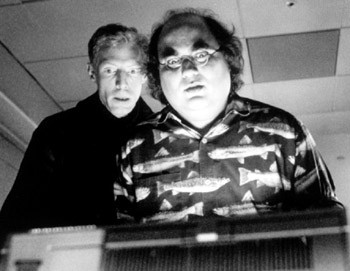
Job slob: Josh Kornbluth (right) weathers work in ‘Haiku Tunnel.’

Ego Trip

Insecure novelist Arthur Bradford digs ‘Haiku Tunnel’

By David Templeton

Writer David Templeton takes interesting people to interesting movies in his ongoing quest for the ultimate post-film conversation. This is not a review; rather, it’s a freewheeling discussion of art, alternative ideas, and popular culture.

SOME PEOPLE are just more secure than others. They walk this earth in a cocoon of calm assurance, all but glowing with self-worth. Their conspicuous confidence is inspiring. And dynamic. And oh-so-attractive.

On the other hand, insecure people are much more fun to watch.

“This Josh Kornbluth guy, for example, is so funny exactly because he’s so uncertain and insecure,” observes author-
filmmaker Arthur Bradford, shortly after taking in Kornbluth’s new comedy Haiku Tunnel.

Bradford, tall and lanky, blue-eyed and tangle-haired, is no stranger to insecurity himself, as he’ll happily tell you.

He is also a very busy guy, right in the midst of two different cross-country tours. One is to promote his first book, Dogwalker (Knopf; $20), a collection of outlandish short stories. The other is to attend screenings of his HBO documentary How’s Your News?, based on Bradford’s work at a camp for adults with disabilities.

Despite his full calendar, Bradford accepted my invitation to see Haiku Tunnel, a Sundance hit based on Kornbluth’s popular one-man show about a quirky office temp (and would-be writer) whose neuroses are strained when he “goes perm” at a big law firm.

This is a guy so insecure about being a law secretary that when a gorgeous lawyer from across the street falsely assumes Kornbluth is also a lawyer–and shows romantic interest–he helplessly plays along. Ironically, he actually starts to feel good about himself. Then bad things happen. Funny things.

“This movie, Haiku Tunnel, is about that period of time when you’re trying to figure out what you want to do with your life,” Bradford suggests. “There’s something really wonderful about that time, but there’s also something . . . I don’t know . . . unsettling.

“When Josh asks his attractive black co-worker, ‘Would you ever see me as man material?’ and she says, ‘You’re poor, you’re unstable, and you’re white’–that’s true! That’s real!

“That,” Bradford confesses, “is exactly how I always felt before I finally got published. As an unpublished writer, I knew I wasn’t a good bet for someone.”

“Well, now you do have a book out,” I remind him. “Feeling better?”

“Yeah,” he says, “A little.”

Fortunately, Dogwalker is a good book. It’s strange. Outrageous even. But it’s getting great reviews. Bradford may have to get used to feeling less like Kornbluth before he pretends to be someone he’s not, and more like Kornbluth the self-confident fraud.

“It’s interesting that Josh talks about wanting to be a writer,” Bradford mentions. “I think a lot of people want to be writers. So many people want to be writers that it’s always kind of made me not want to be a writer. Sometimes.”

Once, after having just won a fellowship at the Stanford Writing Project, Bradford met an attractive female in Golden Gate Park. She was also a writer. An unpublished writer. So he attempted a Kornbluth-like deception, passing himself off as a literary failure. It didn’t work out. “I was always afraid she’d find out I was published, that I was writing at Stanford, and that she wouldn’t like me anymore,” Bradford explains.

“Sounds like a love-hate relationship with success,” I therapeutically mention.

“Yeah. Maybe that’s why I’m not a very driven writer,” he allows. “I mean, I’m 31 years old, and this is my first book, and it is a pretty thin book.”

“But it is a book,” I argue. “And it is published. And you’ve made a movie.”

“Oh, I agree,” he nods. “Relatively speaking, my self-confidence is up right now.”

‘Haiku Tunnel’ opens Oct. 12 at Rialto Cinemas Lakeside, 551 Summerfield Road, Santa Rosa. For details, see Movie Times, page 27, or call 707/525-4840.

From the October 11-17, 2001 issue of the Northern California Bohemian.

© Metro Publishing Inc.

David Schmahmann

South African exile mourns lost love in ‘Empire Settings’

By Patrick Sullivan

THINK OF IT as the world’s largest prison–a horrific political edifice of laws and lies and brutality that caged a nation of millions. And when the grim walls of South African apartheid came tumbling down, it was a liberation of biblical proportions, the end of one world and the birth of another.

It’s a slice of history that’s hard to beat for drama. So it’s ironic that Empire Settings (White Pine Press; $21.95), a novel set before and after South Africa’s tumultuous transition to freedom, should be so quiet, so reserved in tone.

Ironic, but probably for the best–especially given the book’s plot, which involves lost loves, political passions, and a family beset by more troubles than Job. In lesser hands, this story might have gone melodramatically awry. But first-time novelist David Schmahmann employs a deftly understated approach to telling the story of a protagonist who strongly resembles the author himself.

Like Schmahmann, Danny Divin is a white South African now living in Massachusetts. Danny has found financial success and is married to a beautiful Latina, but he’s haunted by his African past–specifically by a lost love. Long ago, as a teenager, this son of a wealthy Durban merchant and a liberal politician braved apartheid’s strict interracial romance laws to conduct a brief but potent affair with Santi, the mixed-race daughter of a Zulu maid.

The two met by chance, as Danny explains: “I was seventeen when I first saw her and I had no idea where she came from or where she belonged. She wasn’t white but she wasn’t black either, rather a coppery brown that seemed to make irrelevant any thought of what she might be and to make who she might be all that seemed of interest.”

After Danny worked up the nerve to approach Santi, the two began the only kind of dating possible: late-night meetings in the garden. The result was instant infatuation, as Santi explains: “How can there not be love when you start with forbidden things in the dead of the night right under the noses of all those sleeping people?”

But Danny’s father discovered the romance and ordered the boy to break it off. Soon after, financial disaster and the rage of the apartheid regime broke Danny’s family like a cheap toy, ending his father’s life, shattering his strong-willed mother, and imprisoning his politically active sister. The boy fled to a new life in America. But of all Danny’s loves, his relationship with Santi–those few stolen moments in the moonlight–seems the only one with meaning.

Forbidden love may be the most frequently used plot device in literary history, employed by authors from William Shakespeare to Arundhati Roy. But while the idea isn’t new, Schmahmann brings a compelling specificity to the topic, powerfully conveying the dangers and thrills of love across South Africa’s color line.

And while both Danny and Santi possess an almost uncanny purity in their motives, Schmahmann shows other, less lovely possibilities. After all, lust mingled with racism can produce incredible ugliness, as the author demonstrates in a deftly sketched scene of Santi’s experience with a train full of white schoolboys: “Show us your tits,” one of the boys said. “We’ll give you one rand.”

Perhaps the most ambitious aspect of Empire Settings is the author’s decision to narrate this tale in the voices of five different characters, including Danny himself, Santi, and Baptie, Danny’s family’s black maid.

Surely the biggest challenge here is Baptie: How many times have white authors reduced such a person to an ugly caricature? Too many to count, even if one had the stomach for the task. And if one feels Schmahmann doesn’t quite do justice to Baptie, doesn’t quite capture the ambiguities of her remarkable life, he does far better than most.

While the voices and perspectives differ, the tone of Empire Settings is one of constant, quiet nostalgia. Schmahmann’s characters endure pain, loss, and heartbreak, but even their worst experiences are wrapped in a soft blanket of distance that makes their suffering all the more poignant. And while none of them mourn the end of apartheid, they all suffer an exile’s ache for a time and place lost beyond all recall.

David Schmahmann reads from ‘Empire Settings’ on Tuesday, Oct. 16, at 7 p.m. at Copperfield’s Books, 140 Kentucky St., Petaluma. Some proceeds from the sale of the book go to fund an AIDS hospital in Durban. For details, call 707/762-0563.

From the October 11-17, 2001 issue of the Northern California Bohemian.

© Metro Publishing Inc.
News Bites

0

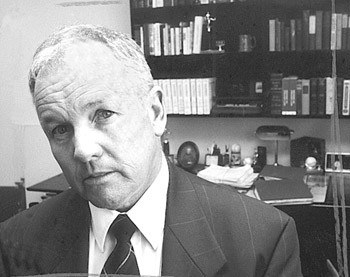
Under fire: Mike Mullens

Case Law

DA harassment trial set to start

By Greg Cahill

IN A CIVIL TRIAL that will be watched closely by local women’s advocates and longtime critics of Sonoma County District Attorney Mike Mullens, a female employee of the DA’s Office soon will have her day in court after charging that she was sexually harassed by a prosecutor and that Mullens retaliated against her for filing a complaint.

April Chapman, a top investigator at the DA’s Office, claims that she was sexually harassed by prosecutor Bruce Enos, who reportedly made unwanted overtures. In the complaint, Chapman further alleges that Mullens retaliated against her by demoting her.

Mullens, who is preparing to run for his third term in the March 5 election, has declined to comment on the case. But in a published statement County Counsel Steven Woodside has rebutted Chapman’s charges, saying that Mullens took undisclosed personnel action against Enos when the sexual harassment complaint came to light.

“The ultimate, most important part of the case is Mullens’ reaction [to the allegations of sexual harassment and misconduct],” said Gary Moss, the attorney for Chapman. “Frankly, this case is not here but for Mullens’ reaction. April did not want to sue Enos for his conduct and never would have if her report of the conduct, which was made in an effort to get away from Enos, had been handled the way it should have been handled under the laws and the rules, the regulations, and the procedures.

“But Mullens, for reasons he’ll have to explain, through his denial acted in a way that we believe is retaliatory under the law.”

According to Moss, Mullens made several “ill-conceived” moves. First, Chapman asked for a transfer and was denied that right even after she informed Mullens about Enos’ allegedly inappropriate misconduct. Then Mullens sent Chapman–a former sheriff’s deputy with a reputation as a top criminal fraud investigator–back to the front office to handle case-prep work, maintaining her salary but exposing her to humiliation in an entry-level position handling paperwork and serving subpoenas.

“We consider that to be an adverse business decision,” said Moss, “the equivelent of a demotion.”

The trial, which will be presided over by a retired Alameda County judge, will begin Oct. 22 at the Petaluma Municipal Court at the Petaluma City Hall. Jury selection started this week.

This is not the first time Mullens has been on the firing line over his terse management style and his handling of women’s issues. The DA’s Office has been criticized repeatedly in the past for its mishandling of cases related to women’s issues, specifically the investigation and prosecution of rape, sexual assault, and domestic violence cases. In 1999, a deputy district attorrney was removed from a rape case after the Women’s Justice Center of Santa Rosa complained about “lying,” “demeaning” behavior, and “prosecutorial misconduct” in the handling of the case. In 1996, Maria Teresa Macias, a Sonoma Valley mother, was murdered by her estranged husband after the DA’s Office and Sheriff’s Department failed to act on numerous complaints and botched the woman’s restraining order. The family of Macias has filed a wrongful-death suit against Sonoma County law enforcement agencies that were involved in the case. That trial is scheduled to begin next spring.

MOSS, who has deposed more than two dozen witnesses in the Chapman case, said he will present evidence that shows Mullens’ mishandling of the Chapman complaint is consistent with his past management decisions. “His management style is very much an issue here,” Moss said. “His decision was made very impulsively, in almost a rash manner. And we have other evidence that it is not unusual for him to make ill-considered decisons without conferring with staff.

“He’s a strong-willed person, and that serves him well as a DA in the types of decisions he has to make, but it certainly worked against him and my client in this instance.”

From the October 4-10, 2001 issue of the Northern California Bohemian.

© Metro Publishing Inc.
Morsels Bowled Over

0


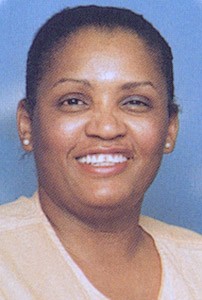
Celebrity status: Annie R. McCarter.

Morsels

Bowled Over

By Greg Cahill

DO YOU LIKE SOUP? Great bowls of steaming hot soup? Refreshing cups of chilled gazpacho? A hearty minestrone? Shrimp bisque? Purée of roasted eggplant and garlic soup? Creamed chestnut soup with fresh ginger? How about a nice posole-poblano soup with smoked pork and jalapeno jack cheese?

The CIA at Greystone in Napa County has them all, ready for those cool fall days and nights, in The CIA Book of Soups (Lebhar-Friedman, 2001), edited by Mary D. Donovan and S. Armentrout: broths, cream soups, cold soups, chowders, and puréed soups, plus accompaniments (croutons, buttermilk biscuits, palmiers with prosciutto, et al.). That’s 130 tasty and surprisingly simple recipes from the kitchens and classrooms of the nation’s premier cooking institute, along with a few pointers on soup basics.

Just in time for soup season (hey, that’s year round, buddy!). Hmmmm. Dive in . . . . .

On the Shelf

A COOKBOOK of favorites from Wal-Mart staff? Believe it. And while most of the recipes in the Wal*Mart Family Cookbook (Try-Foods Int’l, 2001) fit the church potluck mold, there is a scrumptious-sounding entry from Annie R. McCarter of Santa Rosa dubbed Annie & Tyrone’s Illusional Rocky Road Brownies. Sounds cosmic and deelish: made from scratch, loaded with chocolate and nuts, and at 248 calories per serving, these have just got to be good! McCarter becomes the star at her store at a book signing on Saturday, Oct. 6, from 1 to 3 p.m., at Wal-Mart, 4625 Redwood Drive, Rohnert Park.

From the October 4-10, 2001 issue of the Northern California Bohemian.

© Metro Publishing Inc.
Sculpture Jam

Photograph by Michael AmslerJam band: Arleen Place and Virginia Harrison work with scrap metal at Sculpture Jam 2001.Piece ProcessSculpture Jam transforms SebastopolBy Gretchen GilesPUNCTUATED by the loud whine of chain saws, the burr of marble-cutters, the hiss of welding torches, and the rhythmic, measured, metallic twang of pounding hammer heads, the recent three-day Sculpture Jam in...

High Speed Rail For California

Ticket to RideHigh-speed rail is the answer to California's clogged roads and airports, but will the politicians get it? By Jeff Kearns ON A HOT, smoggy Monday afternoon in August, Gov. Gray Davis quietly forecast the end of freeway building in California. Standing on a freshly built eight-lane roadway in Southern California's Inland Empire, he was surrounded by...

Bob Dylan

Big Wheel Bob Dylan: Driven to distraction?Photograph by David GahrAmerican Pie Dylan's new album preaches to the choir By Gina Arnold BOB DYLAN'S career has had its unfortunate anomalies, but with two good albums in a row, could it be too much to hope that he's back in a groove? Time out of Mind, his last record, sold more...

Proprosed Rout For California High-Speed Rail

Where It Will (and Won't) GoBy Jeff KearnsAlthough a final route hasn't been selected yet, the high-speed rail line would serve all of the state's major population centers.From San Diego, trains will speed north to Los Angeles and Bakersfield and Fresno. Near Merced, the route will split: One track will continue north through Stockton to Sacramento, the other...

Give War A Chance

Yesiree, I say, bombs away! Rockets red glare! We are all white with foam! By Michael MooreOh, don't get me wrong--I deplore war and killing and violence. But, hey, I'm a pragmatist, I know where I live, this is America and dammit, somebody's ass had to get kicked! Our Leader, a former baseball club owner, could have at...

Exotic Poultry

Illustration by Magali PirardDuck & CoverShake off that fear of flying (over to the exotic poultry section)By Marina WolfTHE DUCK with dirty rice and eggplant-sweet potato gravy was a simple menu, as far as Cajun food goes: only five or six subrecipes, sweet potato cut up and cooked three different ways, three quarts of homemade stock added a half...

Haiku Tunnel

Job slob: Josh Kornbluth (right) weathers work in 'Haiku Tunnel.'Ego TripInsecure novelist Arthur Bradford digs 'Haiku Tunnel'By David TempletonWriter David Templeton takes interesting people to interesting movies in his ongoing quest for the ultimate post-film conversation. This is not a review; rather, it's a freewheeling discussion of art, alternative ideas, and popular culture.SOME PEOPLE are just more secure than...

David Schmahmann

South African exile mourns lost love in 'Empire Settings' By Patrick SullivanTHINK OF IT as the world's largest prison--a horrific political edifice of laws and lies and brutality that caged a nation of millions. And when the grim walls of South African apartheid came tumbling down, it was a liberation of biblical proportions, the end of one world and...

News Bites

Under fire: Mike MullensCase LawDA harassment trial set to startBy Greg CahillIN A CIVIL TRIAL that will be watched closely by local women's advocates and longtime critics of Sonoma County District Attorney Mike Mullens, a female employee of the DA's Office soon will have her day in court after charging that she was sexually harassed by...

Morsels Bowled Over

Celebrity status: Annie R. McCarter.Morsels Bowled OverBy Greg CahillDO YOU LIKE SOUP? Great bowls of steaming hot soup? Refreshing cups of chilled gazpacho? A hearty minestrone? Shrimp bisque? Purée of roasted eggplant and garlic soup? Creamed chestnut soup with fresh ginger? How about a nice posole-poblano soup with smoked pork and jalapeno jack cheese? The CIA at...
11,084FansLike
4,606FollowersFollow
6,928FollowersFollow


