Sharon Boorstin

Sharon Boorstin examines the ties that bind in ‘Let Us Eat Cake’

By Sara Bir

Light and pleasing as angel’s food, Sharon Boorstin’s Let Us Eat Cake is a food memoir that’s shorter on meaty substance than it is on heartfelt sweetness. Former restaurant critic for the Los Angeles Herald-Tribune, food writer Boorstin’s album of recollections, recipes, and reconnections with close friends of bygone days is remarkable for its utter lack of remarkability. Boorstin’s own journey through baby-boomer life has a nostalgic, Everywoman gleam whose details are easy to cozy up to: the huge freezer her parents kept in their kitchen with almost everything, from marshmallows to salmon, inside; the fancy French dinner parties she fumbled through to impress dates as a young co-ed.

Even though Let Us Eat Cake is a book about food, it’s more about friendship. The food forms links in the chain of friends Boorstin fuses together. Even though Boorstin and the women she’s become close with over the years have moved through career changes, decaying relationships, and growing children, the food they’ve cooked together has remained a touch point.

Boorstin begins with her middle-class childhood in Seattle, growing up in a close family that loved food but who were far from gourmets–her mother fed them a steady stream of ground beef casseroles.

She then recounts becoming a woman just before the cusp of women’s lib and flower power, in that generation of women who still adhered to the pre-WWII ideals of their parents though were willing to cautiously explore the newly relaxed cultural atmosphere. After marrying, elaborate red-meat-oriented dinner parties with Liebframilch and Chianti came to be the prevailing social activities.

Throughout this all, Boorstin recalls her best friends at the time, from giggling girls in the go-go ’60s to affluent, educated couples in the ’70s. Once Boorstin wraps up covering the more pivotal moments of her life, she switches the focus from herself to her close friends, and their own personal–and diverse–experiences and associations with food.

The second half of the book loses its momentum once Boorstin begins straying from the path of her life story and relating the tales of other women on the periphery of her story in short, choppy chapters that have the breezy tone of a magazine article. (Let Us Eat Cake, in fact, sprouted from a series of articles Boorstin wrote for More magazine.) Even though it’s fun to flutter through anecdotes of such big names as Julia Child, Nancy Silverton, and the Food Network’s Too Hot Tamales, Boorstin writes most convincingly when she focuses on tales of her own old friends and how their paths come to intersect through the years, the bonds only growing stronger as they face life’s challenges.

The recipes at the end of the chapters drive home the women’s connection through food; it’s sort of like meeting someone after you’ve heard so many good things about them. Even though many of the recipes offer a retro appeal (Moonshadow chicken, Grandma’s blintzes, and a very ’50s Canlis salad), Boorstin wisely includes only dishes that can still whet the appetites of cooks in 2002 (she shrewdly omits Aunt Myra’s pickled salmon).

However, the recipes tacked on to the chapters profiling famous women who never figured prominently into Boorstin’s life somehow don’t ring as true, even if they do sound tasty. Which just goes to prove the whole point of the book: when you really examine the stories and trials that bind a friendship together–including the foods shared–it transforms a recipe from a mere list of ingredients to an album of memories come to life.

One of the book’s pluses is that even though Boorstin was a restaurant critic and avid cook, she’s no kitchen professional–just as the rest of us aren’t. Like most home cooks, she’s simply enthusiastic about exploring new foods and reminiscing about classic ones. Let Us Eat Cake offers no voyeuristic thrills of life on a frantic, demanding line in a high-profile restaurant. Instead, Boorstin assembles a casual gallery of kitchen follies that many of us have gone through ourselves: foiled batches of brownies, dinner-party pheasants that refused to brown. It’s what infuses the book with the breezy yet affirming tone that makes it an amiable quasi memoir.

Boorstin’s writing may not be as elegant as M. F. K. Fisher’s or as enchanting as Ruth Reichl’s, but Let Us Eat Cake infuses just enough warmth and reflection into its chatty reminiscences to make it a worthwhile read.

From the July 4-10, 2002 issue of the North Bay Bohemian.

© Metro Publishing Inc.

Open Mic

Visiting Castro’s Cuba the legal way

By Christian Kallen

Castro is the devil,” said the baggage handler at Miami International Airport when I told him where we were going. “He is ruining my country.” The baggage handler looked to be about 40, which means he had probably never been to “his country,” where Castro came to power in 1959. So how could he know? For that matter, how can any of us know if we cannot see for ourselves?

That’s why I went, and that’s probably why anyone travels to Cuba, legally or otherwise. For despite what you may have heard, it is legal to visit Cuba–but not as a tourist. If you follow all the rules–engage in sponsored people-to-people exchange; are involved in educational, religious, or humanitarian projects; work as a journalist or athlete; or fall into any one of a handful of categories–you can get permission from the U.S. Department of the Treasury to enter Cuba. Just stick to your itinerary and don’t spend too much money. You can even fly out of Miami, LAX, or JFK–Continental jets are chartered daily to take legal travelers to Havana, perhaps a foretaste of things to come.

Last month I traveled to Cuba as one of these legal visitors, attending a conference on sustainable tourism co-sponsored by the city of Habana Vieja, or Old Havana. The buildings of Old Havana are architectural curiosities, many dating from the 18th and 19th centuries, in some cases falling apart and in many cases being renovated to preserve the qualities that led UNESCO to declare Habana Vieja a World Heritage site in 1982.

Our trip lasted five days, and we saw what we were supposed to: renovation projects in Habana Vieja, the historic forts of Havana Bay, and the pervasive musical energy that saturates the atmosphere in this most musical of islands. After all, Cuba is the birthplace of the mambo, the rumba, and the cha-cha, making the senior citizens of the Buena Vista Social Club relative latecomers.

We also saw tired, undernourished men selling 50-cent newspapers for a dollar, old women posing for photos by smoking cigars, and beautiful, young women available al fresco. It’s a country with a literacy rate of well over 99 percent, with the highest doctor-to-population ratio in Latin America, with 55 universities, of which 11 are in Havana–where the broken city streets often smell like sewage. But it sure didn’t feel like a police state–the uniformed officers we saw were young, easy-going, and unarmed.

These contrasts are as much a part of Cuba as syncopation is of its music. The busy street in front of our hotel was filled with Chevies, Fords, and Oldsmobiles from the pre-Revolutionary 1950s. They circulated smoggily around the Parque Central, the green square half a block from the opulent Capitolio, former home of Cuba’s legislature. Within the park, all paths converged on the statue of José Martí, the original Cuban revolutionary, who seemed to helpfully point out Ernest Hemingway’s favorite bar, the Floridita.

Many in our group were U.S. travel agents, and we arrived a couple weeks after Richard Copland, president of the American Society of Travel Agents, put out a statement critical of the official ban on tourism to Cuba. “We believe it is a constitutional right of Americans to have freedom to travel anywhere in the world. . . . [T]ravel promotes peace and understanding among peoples,” he said. Not surprisingly, what most of the group was really interested in was learning how to navigate the bureaucracies and legalities in order to bring their clients to Cuba legally, now and in the future.

Of course, it’s not just travel that’s banned, but doing business as well–“trading with the enemy,” in the official terms of the 1917 act that set up these outdated restrictions. Our rice farmers cannot sell rice to Cuba, our pharmaceutical companies cannot sell medicine to Cuba, and obviously our car companies cannot sell the latest models.

These and other industries are calling for an end to the embargo, seeing in Cuba a lucrative market and willing trading partner. Even U.S. legislators are increasingly frustrated with being held hostage by a small group of anti-Castro Cuban nationals in Miami. A bill to end the Department of the Treasury’s stranglehold on visitation to Cuba easily passed the House last year, only to disappear in the avalanche of jingoism following Sept. 11.

We left just a week before Jimmy Carter visited Cuba at Fidel Castro’s personal invitation. It was a visit that set off a public debate about our Cuba policy, which resulted only in President Bush hardening his commitment to the embargo–possibly, just possibly, to solidify his brother’s base of support among Florida’s anti-Castro minority.

It remains an irony, if not a puzzlement, that the United States allows travel to former Cold War enemies such as China, Vietnam, and even North Korea, all of which are still Communist states. Why not Cuba?

From the July 4-10, 2002 issue of the North Bay Bohemian.

© Metro Publishing Inc.

Sparks

0

Sparks, Flying

Sparks lights a fire under tired old vegetarian cooking

By Davina Baum

With all the mad cowboys and fast-food nationalists singing the gospel of knowing your food, it makes sense that vegetarianism should be getting its just desserts by way of increased food awareness. Meat–whether it’s grass-fed Niman Ranch or corn-fed Anonymous Ranch–remains a staple in the American diet. However, as ravenous Americans have widened their food scope, meatless eating has ceased to be a novelty, moving from the domain of food activists into wide acceptance.

Ten years ago, a meatless request might send a kitchen scrambling for a bland plate of rice and mixed grilled vegetables that had to be doused in olive oil and salt to become palatable. If a “vegetarian” option didn’t contain chicken broth or some sort of hidden gelatin, it was surely a pasta doused in heavy cream sauce, veganism being a relatively new addition to the food lexicon. Since then, everything has changed.

California cuisine has done wonders for the vegetarian lifestyle. With an increased value placed on individual flavors and freshness, the typical restaurant patron has learned to expect interesting textures, flavor combinations from all over the globe, and tastes that sing. Fleshless cuisine–as well as eggless and dairyless cuisine–relies on individual flavors and creative combinations rather than fancy footwork in the kitchen, making vegetarian cooks tomorrow’s celebrity chefs.

But today, a vegan restaurant smack in the middle of Main Street, USA (albeit Guerneville’s Main Street–not exactly the national heartland) attracts lifelong vegetarians and dedicated carnivores alike. Patrons who on another night might enjoy a pork tenderloin or roast chicken will happily munch their way through a phyllo roulade with spinach and miso-cured tofu–which, in fact, is what my companion and I had on a recent visit to Sparks–and dedicated vegans and vegetarians can be assured that there are no animal products hidden in their risotto.

In the year that Sparks has occupied this storefront on Guerneville’s Main Street–after a six-month stint at the Inn of the Beginning in Cotati–it has proven itself a comfortable, reliable haven for people looking for a slightly upscale though decidedly unpretentious paean to the pleasures of the meatless table.

The pretension level at Sparks is so low as to be almost a detriment. A customer presented with an amuse-bouche and a $14 entrée has come to expect a slightly more formal atmosphere, but that is part of Sparks’ charm–and part of its inherent dissonance. There’s an underlying tension between the beautifully plated dishes featuring additions like rich truffle oil and the slightly shabby blue chairs and faded cloth napkins. The overall aesthetic of the space just doesn’t match up to the aesthetic of the plates, while at many more expensive restaurants, the opposite is true–which is even more disappointing.

Unidentified snapshots on the wall by the door greet customers as they come in. The restaurant closes at 9pm, but when I called ahead at 8pm on a Friday night, I was told that we would surely be accommodated even if we arrived after the witching hour. And we were: in fact, when we left a little before 10pm, customers were still dining happily.

Once seated, we were brought glasses of water garnished with a mint leaf and a slice of lemon, and the aforementioned amuse-bouche–in this case, a small plate with a mixture of Golden apples, celery, and raisins in a garlicky olive oil dressing dashed with curry. Service throughout the meal was friendly and unobtrusive.

We started off the meal with wine–a glass of sweetly dry Badger Mountain 2000 Johannesburg Reisling ($5.75) for me and a glass of well-balanced 1999 Barra of Mendocino Pinot Noir ($6) for my companion.

The wine was shortly followed by our appetizers. Rice-paper spring rolls filled with sunburst squash, apples, carrots, basil, and mint were drizzled with a mango sauce ($6.95). The colors were beautiful: the brilliantly orange julienned carrots tumbling out from their white wrappers, the peachy-hued mango sauce suavely trickled over. The dish was cool and crisp and the tangy sauce contrasted nicely with the lightly steamed carrots, though something–perhaps the filling–was overly spiced, the flavor of coriander masking that of the vegetables.

The phyllo roulade ($6.95) won me over at first glance, because it was garnished with a beautiful sprig of lavender. It tasted good, too–the nicely herbed and flaky-crispy phyllo encasing firm miso-cured tofu (approximating the consistency of feta) and tender spinach.

Our entrées continued to tempt the eye but didn’t win over the palate. A spinach and herb polenta with pesto, caramelized onions, and carrots ($10.95) was a riotous combination of colors, the yellow polenta flecked with green and sitting on a richly red marinara sauce. But the polenta tasted bland, and the marinara sauce didn’t go the distance in perking up the dish.

The morel and corn risotto ($13.95) was rich and comforting. The truffle oil sprinkled over it added a luxurious richness, and the morels shone through with their trademark nutty earthiness. Lightly steamed broccoli added contrasting color and texture. The dish would be hard-pressed to explain its risotto moniker, though. The familiar pearly, creamy grains of arborio rice were nowhere to be found; the dish was more of a porridge than a risotto.

Despite how full we were, desserts have to be sampled in a food review. So with you, the reader, in mind, I dug my spoon into the apricot upside-down cake ($5.50), a moist, richly spiced cake topped (or bottomed) with fruit that had stewed in its own juices. It was accompanied by a scoop of cinnamon soy ice cream. With the dessert, we drank a Barra of Mendocino muscat ($3.25)–less cloyingly sweet than most muscats, with a tangy fizz. Along with our check came small bites of palate-cleansing crystallized ginger and a big cocoa-macadamia nut cookie that accompanied us home.

It’s not only the food that makes Sparks a phenomenon; it’s also the philosophy. Run by five locals, the restaurant has a grass-roots business model that embraces community spirit. From using local organic produce to paying their staff above minimum wage, Sparks works with a commitment to be a sustainable and progressive business–in farming and in support of the community.

Furthering the idea of food as community celebration, Sparks offers seasonal gala dinners like the recent summer solstice celebration, which featured a seven-course gourmet organic experience for $35 (beverages and gratuity excluded). In addition, an array of cooking classes (see below) seeks to train the novice chef in the ways of the good life, the organic life, the meatless life. It’s a great way to participate in Sparks’ own little slice of revolution.

Sparkful Cooking

For information on Sparks’ classes and to reserve a spot, call the restaurant at 707.869.8206 or e-mail sp***************@*****il.com. Classes must be reserved and prepaid. Classes are usually $65 (discounted if you sign up for an entire series).

July 8 and 9: Appetizers, soups, and salads July 15 and 16: Tofu and tempeh cookery July 22 and 23: Vegan desserts July 29 and 30: Ethnic cooking Aug. 5 and 6: Mexican cuisine Aug. 12 and 13: Cooking with chocolate Aug. 19 and 20: Thai cuisine Aug. 26 and 27: Wine and food pairing

16278 Main St., Guerneville. Dinner, Thursday- Sunday, 5:30-9pm; brunch, Saturday-Sunday, 10am-3pm. 707.869.8206.

From the July 4-10, 2002 issue of the North Bay Bohemian.

© Metro Publishing Inc.

Literary Trends

The God of Literary Trends

The language of culture, writ large on bookstore shelves

By Noy Thrupkaew

You know, you really should be looking for the next Arundhati Roy.” I plucked at the phone cord wrapped around my neck, sighed, and said, “Oh, absolutely.” It was 1998, and I was working at a publishing company that had just launched an imprint featuring “the writing of women of all colors.” It was my internly task to call independent booksellers across the country to find out what and whom they thought we should publish. Their advice inevitably boiled down to variations on one response: “That Indian subcontinent is really hot. Oh–oops–do you say ‘South Asia’ now?”

“Nah, our customers don’t really like stuff in translation. But have you read that Jhumpa . . .”

Yes, yes, yes.

Literary brown ladies were the new new thing. Arundhati Roy’s poetic, multilayered novel, The God of Small Things, had just been awarded the Booker Prize. Jhumpa Lahiri would debut in 2000 with Interpreter of Maladies, her collection of elegantly written short stories that went on to win a Pulitzer. But Roy and Lahiri were just the beginning of what was to become a craze for South-Asian and South Asian- American women’s writing.

Of course, this wasn’t the first time the publishing world had found its newest darlings in female writers of color. And it wasn’t the first time bookstores would create pretty displays of books by authors of a “hot” ethnicity, or the first time readers would strip those displays as neatly as ants eating a sandwich at a picnic. The early ’90s saw an explosion of Latina narratives à la Laura Esquivel’s Like Water for Chocolate. And Terry McMillan’s success with Waiting to Exhale in the mid ’90s ushered in a rash of books in which middle-class black women griped about their no-‘count men.

Color has become a marketing boon.

Interviewers probe into a writer’s upbringing, seeking out ethnic factoids for a voracious public. Details about unusual foods, struggles with immigrant parents, and cultural oddities are all fair game. And in the case of attractive authors, whose images are emblazoned all over magazines and poster-size publicity photos, one can hardly be sure what is for sale anymore–the “company” of a beautiful, exotic woman or the power of her words.

The Importance of Being Exotic

What is it that makes a certain ethnic genre hot? If I could nail that one down for sure, I’d be rolling around in a room filled with nothing but money. But one can hazard some guesses.

Many of the Asian-American and Latina books contain lots of incense and spirits–“ancient Asian wisdom” and religious tidbits, or mystical realism in the form of pissed-off ghosts and fantastic visions. They also feature nearly pornographic discussions of food; Isabel Allende’s Aphrodite: A Memoir of the Senses even had recipes. The mystical stuff and the food seem to reflect the reasons why some white people are drawn to different cultures–either in search of religious or spiritual enlightenment or to exhibit their open-minded adventuresome selves by eating our food. Our cultures are tagged as better somehow–closer to the earth, purer, more attuned to sensory pleasure–but in nice, nonthreatening ways, wrapped up neatly in fortune-cookie wisdom or duck tamales.

The doyenne, the matriarch, the empress dowager of all women-of-color literary trends is Amy Tan. The success of The Joy Luck Club prompted a flood of Asian-American novels, whose “exotic” content was mirrored in their titles. Asian-American women’s fiction titles often featured either (a) some nature-related motif to show that we are in touch with the elements (Gail Tsukiyama’s The Samurai’s Garden, Mia Yun’s House of the Winds); (b) a familial relationship that displays how wonderfully traditional we are (Tan’s The Bonesetter’s Daughter, The Kitchen God’s Wife); (c) or the number “100” or “1,000,” which demonstrates that we are an ancient, wise people fond of the fairy-tale trick of enumerating knowledge (Mako Yoshikawa’s One Hundred and One Ways, Tan’s The Hundred Secret Senses). Some titles even double up on these themes, such as Mira Stout’s One Thousand Chestnut Trees.

Two other Asian-American minitrends emerged in the late ’90s. One comprised novels like Mei Ng’s Eating Chinese Food Naked and Catherine Liu’s Oriental Girls Desire Romance. Instead of Tan’s bickering kitchen wives, here were hard-bitten, angst-ridden Asian-American protagonists who had ostentatious sex by page 30. Hot-pants Asian books seemed to fulfill readers’ appetites for sex that was extra spicy for being ethnic.

But if Asian women weren’t screwing, the publishing world wanted them suffering (and maybe bravely triumphing after they got themselves to the United States). The Asian historical memoirs were based on a simple formula: Asia was hell; the United States was a hell of a lot better. This is not to disparage the truly awful circumstances of many of the authors’ lives. Being abandoned, purged, “reeducated,” jailed, tortured, chased, hunted, raped, and/or nearly murdered in Cambodia, Vietnam, or China would leave scars on anyone’s soul. But the Asian-hell-to-Western-heaven motif leaves a U.S. reader in a nicely complacent spot, reclining in a La-Z-Boy and thinking, “Well, thank God for America!”

Attack of the South-Asian Women

Despite all this doom and gloom, literary trends can be good for women writers of color. At least more voices are finding their way onto the store shelves. And one can’t protest the fact that Americans are expanding their reading horizons or that female authors of color are receiving much-deserved attention. I’m not advocating a return to the color closet for authors. Why shouldn’t ethnicity be ripe for novelistic exploration? And even if the books are published as part of a trend, they are often far from formulaic.

While Ruth Ozeki’s My Year of Meats fits the multigenerational aspect of Asian-American women’s writing, this tale of a feminist documentary filmmaker who uncovers the sordid underbelly of the U.S. meat industry is radically wonderful. And even the much-imitated Joy Luck Club hit on something lasting and powerful: the fierce, complicated love between mother and daughter.

So I tried to feel optimistic when the South-Asian craze appeared in the late ’90s. It became a juggernaut among ethnic trends, shaking the book world from top to bottom with the potent combination of crossover appeal and literary acclaim. The work of Indian women had been notably absent from our bookshelves. But now stores were suddenly flooded with it: Kiran Desai’s Hullabaloo in the Guava Orchard, Indira Ganesan’s Inheritance, Jhumpa Lahiri’s Interpreter of Maladies, and Chitra Banerjee Divakaruni’s Mistress of Spices, among others. The books and the attention they brought with them were especially welcome, considering that the modern Western literary realm was already a rich one for South-Asian male writers like Vikram Seth, V. S. Naipaul, and Salman Rushdie.

On the happy side, the books were generally wide-ranging in style and topic, some drawing on Raymond Carver more than Rushdie or Seth, others exploring the complexity of a diasporic identity. As much as one can generalize, these authors were writing some wonderful literature. And although the texts were often seen as part of a single, monolithic publishing identity, their styles and subject matters varied greatly, with a broader range than was usually present in a given ethnic trend.

Inevitably, however, I started to feel an itch of irritation. It wasn’t just the spread of the craze and the concurrent cultural obsession with all things Indian; something chafed beyond the sight of a Sanskrit-mangling Madonna, blotchy with henna, or the ubiquity of foul-tasting boxed chai. There were many other dark reasons why this infatuation annoyed as much as it pleased.

For one, there was the distasteful fawning over the authors’ beauty: Roy was gushingly named one of People magazine’s “50 Most Beautiful People in the World” in 1998. After her Pulitzer, Lahiri was crowned a “Woman We Love” in Esquire. There was the awful sameness to booksellers’ responses when asked about exciting female authors of color–all South Asian this, Indian that.

And although most of these writers avoid mystical realism (also called “Rushdie-itis”), some share a certain tinkling, quirky, food-based exoticism, offering a tired roundup of the angst of arranged marriages, bitchy squabbles over whose chutneys and pickles are better than whose, and slobbery details about saris.

Perhaps the most egregious example is Hullabaloo in the Guava Orchard. Kiran Desai’s debut features Sampath, an affable dreamer who seeks to escape the hubbub of life by climbing into a tree. Unfortunately, he then finds himself besieged by crowds who claim he is a holy man. Riotous hijinks ensue: drunken monkeys marauding through the village, Sampath’s mother embarking on a mad quest to plunk a monkey into her curry, etc. This pleasant, pastoral, chutney-flavored fable is sort of entertaining, but Desai’s characters are that easily dismissed brand of colorful, weird, and harmless; one can close the book and think fondly disparaging thoughts about their foreign, little ways.

Writing in the Vancouver Sun, Punjabi-Canadian critic Phinder Dulai offered up a biting criticism of what he termed the Indo-North American novel: “In the North American-style Indian novel, the focus is on domestic family prattle while larger themes of migration, racism, caste, and generational conflict are barely touched. When things get too hot, the characters can slip away to the kitchen or the pickle factory to cool off.”

The Failure to Represent

Though Dulai’s attack on such gloppy romanticism is well-deserved, his critique also reveals trendification’s double-edged sword: Readers of color can place as many restrictions on “their” writers as main-stream expectations can. Many do grapple with serious themes: Lahiri, for example, addresses the bloody creation and partition of Pakistan and India, poverty, harsh discrimination against women, and familial fractures. However, there is a certain amount of variation in any given literature–is the onus of political seriousness necessarily greater for writers with brown skin?

Some would say it is–that if writers makes it past the gatekeeper of literary trends, they have a responsibility to speak for the people. When an author of color makes it big, he or she is sometimes viewed as the returned messiah, full of potential uplift but also heavy with the responsibility to take on all the experiences of the oppressed and relay them to the world in great tablets of wisdom. When the author reveals himself or herself to be a mere human telling a tale spun from one imagination, the crown of thorns is angrily snatched back, to be placed on the head of the next likely candidate to come along.

This sort of pressure is almost too much to bear: Who wants to be a sure-to-fail Jesus, dealing with the dashed expectations of a disappointed people? And critics of color often blame the wrong individuals. Those crushed hopes have more to do with the gatekeeping forces of literary cool than the power of any one author’s pen. If there were truly more diversity in the literary realm, we wouldn’t have to rely on only a handful of imaginations to represent us.

Another oft-heard criticism of immigrant literature is that it is not true to the motherland. It’s part of the endless debate about the effects of diaspora on cultural identity–and no one’s going to win that fight. People have been waging it since kids first left their parents’ homes. What boils down to arguments of purists-traditionalists vs. rebellious hybridists-iconoclasts ultimately makes for tiresome book reviews. Better questions might be: Is this author exoticizing her ethnicity? Is she just feeding the public more stereotypes of lotus-blossom ladies and guacamole-hipped mamas? If she’s inaccurate or exceptionally critical or dewy-eyed in depicting the culture of her forebears, is it done in a way that suits the general public’s fixed ideas?

Then there’s the final pitfall of being the darling of a literary trend: Stray from the pigeonhole into which you’ve been placed, and you can kiss your darlinghood goodbye. Two years after her People Beautiful Person crowning, Arundhati Roy cut off her long hair, telling the New York Times that she doesn’t wish to be known as “some pretty woman who wrote a book.” Instead of another work of fiction, she has since produced two books of essays, The Cost of Living and Power Politics, and wholeheartedly thrown herself into activist work.

But Roy’s radical activism has received little support either in the United States or India. Critics who once lauded her have turned their backs: “One Indian intellectual compared Roy to Jane Fonda–a celebrity troublemaker superficially grooving on cultural uproar,” notes Joy Press in the Village Voice. For Western critics, her intense scrutiny of the World Bank and globalization marked her as just another famous face touting the political cause du jour.

Just as being too politically ethnic can make one unpopular, not being culturally ethnic enough can also bump a writer from the in crowd. Aspiring authors attending the South Asian Literary Festival in Washington, D.C., last year told stories of editors who declined their manuscripts because they didn’t deal with traditional Indian life. Their works were, in essence, too American. In seminars sarcastically titled “There Are No Poor or Huddled Amongst Us” and “No Sex Please, We Are South Asians,” participants grappled with widening the diversity of South-Asian and South Asian-American narratives appearing in the Western press.

Critic Amitava Kumar once wrote, “If immigrant realities in the U.S. were only about ethnic food, then my place of birth, for most Americans, would be an Indian restaurant.” The language of cultural consumption is particularly apt here. At its worst, South-Asian and South Asian-American writing is just like tasty Indian food–to be chewed, digested, and excreted without a lot of thought.

But hope springs eternal. Perhaps Americans, having tasted something delicious, will seek out books that outrage and challenge, narratives written from the diaspora or in translation that don’t rely on bindis or kulfi to make their points.

In the meantime, South-Asian and South Asian-American writers are making themselves at home on the New York Times bestseller lists and within literary-prize committee sessions. But they have their eyes wide open. “I would be wary of the notion that South Asia is hip and can attract publishers,” said Yale English professor Sara Suleri at the literary festival. “Those fashions come and die. Maybe in five years, we will be hunting for Tasmanian writers.”

Maybe so, but maybe some readers will demand more, and writers will be able to find success while defying trendiness. Perhaps we can all wedge the door open a little more firmly, making room for stories that will last longer than a peel-off mehndi tattoo.

A version of this piece first appeared in Bitch magazine.

From the July 4-10, 2002 issue of the North Bay Bohemian.

© Metro Publishing Inc.

Kitka

0

Voices Rising: Popular Eastern European choral group Kitka perform at COPIA in September.

Balkanizing the Bay

Balkan folk dance draws a crowd

By Sam Hurwitt

They’re drawn to the Berkeley dance barn Ashkenaz like pilgrims to Mecca. On any other night they could be there to learn Cajun, African, Brazilian, swing, but tonight they’re Balkan dancers. Or if they’re not yet, they soon will be. A couple dozen people hold hands in a semicircle, stepping, stomping, and leaping on command. They range in age from single digits to their 60s, mostly white but with a smattering of other hues.

“So these are the Balkanites of Berkeley,” my traveling companion says. “They look like normal Berkeleyans, but they’re not.”

And they’re everywhere. A clerk at the Copymat is chatting up a woman from Bosnia, asking in Russian if she speaks Russian. (“No, we have our own language,” she sniffs. “Serbo-Croatian.”) The guy at the bookstore is playing Romanian Gypsy brass-band music, and asking about the recording leads naturally into discussion of his travels from Bratislava down to Zagreb. “Are you one of us?” you want to ask. You settle for the more casual, “Are you into this stuff?”

One of the perks of living in the Bay Area is that you can learn pretty much any folk tradition that strikes your fancy, from belly dance to the guttural throat singing of the South Siberian grasslands of Tuva. The local women’s Eastern European choral group Kitka recently wrapped up its award series of Balkan singing workshops down in Oakland, and now there are two back-to-back week-long camps in the Mendocino Woodlands: the Mendocino Balkan Music and Dance Workshop from June 29 to July 7, and the Barátság Hungarian Dance and Music Camp from July 7 to July 13. The Bay Area boasts a bumper crop of homegrown Eastern European talent, such as Kitka, Danubius, and Edessa–the Balkan band at Ashkenaz on this particular night–playing wailing, whirling Balkan music on clarinet, accordion, cimbalom, percussion, and fiddle. (But not just yet–they start a bit slow so the neophytes can get up to speed.)

As the dance class continues, the hardcore Balkanites start to arrive, most of whom seem to know each other. Among them is Joyce Clyde, who maintains the Bulgarian/Balkan Music and Dance Events e-mailing list.

Clyde got involved in the local folk-dance community about 30 years ago, starting with a Greek folk-dance class in college and gradually finding her own niche in the folk-dance scene. “A lot of people know each other,” Clyde confirms after making the rounds of familiar faces, “but, luckily, so far there is still an undercurrent of new people, which is always the fun and joy of it. And we need more of that, otherwise it’s going to die ultimately. But generally there’s a big crowd of us that are all known to each other–too well, for too long.”

Clyde says the scene has shrunk since the ’70s, though the unrest in the Balkans and the rise of the Internet have made it easier to bring top-notch musicians over from Eastern Europe. Ferenc Tobak and his wife Mary bring the entire teaching staff of the Barátság Hungarian dance camp over from Hungary each year to introduce dance cycles from different regions. In the 20 years since Mary Tobak (then Wallace) founded Barátság with Howard Franklin and Éva Kish, there have sometimes been as many as 140 participants at a time, but the dragging economy has taken its toll. There was a plan to incorporate a Tuvan Camp into Barátság this year, but they’ve had difficulty attracting enough people to make that expansion feasible. The Balkan camp the week before has been sold out for months, but Ferenc Tobak points out that there’s just a lot more of the Balkans than there is of Hungary.

“The Balkan camp takes so many countries and different cultures, they have a much, much bigger following,” he says. “They go from Croatia down to Turkey and up to Romania. So we are in a much, much harder position in that sense to recruit people, because we focus only on Hungarian stuff.”

It would be awfully convenient just to stay in the Woodlands for two weeks and go to both camps–and a few do–but Mary Tobak says the Eastern European folk communities don’t cross over as much as one might think. “There’s a lot of interest that crosses, but the actual active interest–where a Balkan person will also go to Hungarian stuff, or someone who’s heavily into Hungarian will also go to Balkan–is very small,” she says. “And most people can’t get two weeks off in the summertime to go to camp.”

What’s more, yet another Hungarian camp–the Aranykapu Tábor, or Golden Gate Camp–has arisen the same week as the Balkan camp, June 30 to July 6, at Camp Cazadero near Guerneville. So if the hardcore Hungarians who return to Barátság year after year needed even more nonstop dancing, they’d probably go for that.

People may start off rushing between Bulgarian choir practice to learn Hungarian thigh-slaps, whirls, leaps, and whistles, but after that, they tend to get heavy into one thing or another: learning the language, living abroad, gorging on goulash. Mary Wallace met Ferenc Tobak, a musician and bagpipe maker, while living in Hungary for seven years, and they had their first two children there. She’d first learned Hungarian dance at Razzmatazz–a yearly folk dance camp now in the Mendocino Woodlands–and founded Barátság in 1982 in order to get her Hungarian fix when the other camp stopped offering it.

“The third year Razzmatazz decided not to do Hungarian,” she says, “and the people who had been going for the Hungarian–I was one of them–we said, ‘We can’t have this. Have a summer without Hungarian dancing?’ Since Razzmatazz was not going to offer it, we decided we would make a camp.”

For Joyce Clyde, the Balkan list started as a way of getting her own Bulgarian fix. “I started to try to learn how to play gadulka (a Bulgarian folk violin), and I was trying to find a teacher. And I found that the easiest and probably about the only way I could get a teacher was to invite groups out,” she says. So she started the list initially to promote the Bulgarian events she was putting on herself.

“As far as I know, I’m not Bulgarian at all, and yet I decided to play a Bulgarian instrument just because I liked the sound of it. But now do I have lots of friends from Bulgaria? Of course. Another friend who plays gadulka asked, ‘How can I get better at this?’ I said, ‘You have to make a life for yourself where playing gadulka makes sense.'”

For information on the Bulgarian/Balkan e-mail list, go to groups.yahoo.com/group/bbmde. You can find out about the Barátság Hungarian camp at www.baratsag.com, Aranykapu Tábor at www.aranykapu-tabor.org, and the Balkan camp at www.mindspring.com/~ginbirch/eefc/. The Marin Balkan Dancers meet Thursday evenings at Sherry’s, 4140 Redwood Hwy., San Rafael, 415.456.0786. There are Hungarian dance classes on the second and fourth Sundays of every month at Ashkenaz, 1317 San Pablo Ave., Berkeley, 510.525.5054. Ashkenaz also hosts the Dimovski Quartet from Macedonia on July 9 and a Balkan concert with Edessa on August 17. Every Friday and third Saturday of the month, Danubius plays Eastern European folk music at Bistro E Europe, 4901 Mission St., San Francisco, 415.469.5637. Kitka return from Bulgaria for the Balkan camp and play Sept. 9 at COPIA, Napa, 707.265.1600. And there’s an International Folk Dance party every third Saturday at Hermann Sons Hall, 860 Western Ave., Petaluma, 707.546.8877. Find more events at www.bayfolk.com.

From the June 27-July 3, 2002 issue of the North Bay Bohemian.

© Metro Publishing Inc.

‘Scooby Doo’

0

Rroo’s There? Matthew Lillard and his digitally-animated co-star hunt ghosts in ‘Scooby Doo.’

Geek Rage

Pushing the buttons of the King of Television trivia

Take my advice: never upset a geek.

I am sitting here with the phone pressed to my ear, an ear that has just been toasted crispy by the fiery, eloquent wrath of Paul Goebel, that Elvis-haired, side-burned, walking-encyclopedia otherwise known as The T.V. Geek. Fortunately for me, the freshly roused ire of Paul Goebel is not aimed specifically in my direction. But I am close enough to have been scorched by it; scorched and, I must admit, remarkably entertained. Then again, Paul Goebel is frequently entertaining–no matter his mood–as is demonstrated every night on Comedy Central’s hit game show Beat the Geeks.

On the addictively quirky series (starting its second full season of shows on July 8) Goebel joins a trio of other geeks (the Movie Geek, the Music Geek, etc.), glibly dismantling the egos of all contestants attempting to match wits with the reigning masters of pop culture trivia. Goebel, of Los Angeles, can also do a mean Tom Jones impersonation, but that’s another story.

For the last 30 minutes, we’ve been discussing Scooby Doo, the critically-pounded live-action movie based on the classic 1969 T.V. show “Scooby Doo, Where Are You?” For much of our conversation, Goebel (www.kingoftelevision.com) has been dissecting the film with a good deal of humor, pointing out all the places where the movie deviates from the simple premises of the original show.

“For one thing, there was no big chase scene with a groovy song playing behind it,” he starts out. “I really wanted to see that and it never happened.”

Goebel goes on to list at least a dozen similar differences: on T.V., there were never any actual supernatural occurrences, just creepy guys in rubber monster masks; though Scooby and Shaggy might have belched a time or two on television, they probably wouldn’t have engaged in the high-volume farting contest we are forced to witness in the film; and the famously good-natured Scooby Gang (Fred, Velma, Daphne and Shaggy) would never have allowed petty disagreements to split them up, as occurs at the start of the movie.

“For the first ten minutes, I sat there thinking, ‘Hey! This is great!'” Goebel says. “It was just like the original show. And then they broke up, and I was thinking, ‘Whoa. This isn’t right. This shouldn’t be happening. This sucks!’ It really bummed me out. I mean it, it made me sad. The Scooby Gang would not have done that.”

And I should have kept my mouth shut. Instead, I remark, laughing, “You know, there are probably people who would hear us and say, ‘Hey. So what if the movie changes a few things? So what if the Scooby Gang breaks up? It’s only a cartoon.'”

A long, long silence ensues.

“So . . . their thinking is what? Because it’s a cartoon it doesn’t deserve any kind of respect?” Goebel finally replies. “Well, that kind of thinking has no place in my world. I’ve gotten into a million conversations about T.V. shows, conversations about the logic that operates within those shows, and always somebody thinks they’re clever by going, ‘Hey guys. It’s only a T.V. show.’ Drives me nuts.

“We know it’s a T.V. show, jackass,” Goebel goes on, just beginning to warm up. “To say that Scooby Doo is only a cartoon . . . well, Scooby Doo is more than a cartoon. He’s the most popular T.V. cartoon character ever. Every kid and adult in America knows who Scooby Doo is. He’s as popular as Barney or Elmo or Mickey Mouse or any other modern pop icon.

“So to say that it’s only a cartoon, to imply that because its a cartoon we shouldn’t take Scooby Doo seriously, is really an asinine thing to say. You might as well say, Star Wars was just a movie, Star Trek was just a T.V. show, Jesus was just a dude. I’m agnostic, but I don’t get in people’s faces when they’re talking about their religion. I don’t smirk and say, ‘Hey guys. Jesus was just a carpenter.’

“Those kind of people are just asses,” he adds, winding down. “They have no depth, and they have no soul.”

Goebel, 33, was two years old when Scooby Doo first hit the airwaves in 1969. “So obviously I’ve been watching it all my life,” he admits. “I have a lot of good Scooby Doo memories.” Goebel is able, off the top of his head, to list every Scooby Doo incarnation to hit the little screen since 1969–nearly a dozen of them–from Scooby Doo’s All Star Laff-a-Lympics to A Pup Named Scooby Doo. “My favorites were the New Scooby Doo Movies,” he says, with the animated celebrities, the Harlem Globetrotters, Laurel and Hardy, Tim Conway and Don Knotts. I always thought that was the coolest.”

As a seasoned Scooby Doo aficionado, Goebel can even weigh in on one of the series’ most enduring and hotly-debated controversies: namely, which of the shows females is hotter–Daphne or Velma.

“Velma always looked great in that tight red sweater,” he says. It’s no different in the movie, with Sarah Michelle Gellar (Buffy the Vampire Slayer) playing Daphne and Linda Cardellini (Freaks and Geeks) as Velma. “Velma is definitely hooter than Daphne in this movie,” Goebel insists. “Of course, I’ve been a huge fan of Linda Cardellini ever since Freaks and Geeks. She’s so beautiful and unassuming and such a real actress. I’m worried that this movie might put her into that awful, teen Selma Blair category. I hope she sticks with T.V. Women are always hotter on T.V.

“Of course,” he adds with a laugh, ìI guess I tend to think everything is better when it’s on T.V., whether it’s Linda Cardellini, Buffy the Vampire Slayer . . . or a big talking dog named Scooby Doo.”


From the June 27-July 3, 2002 issue of the North Bay Bohemian.

© Metro Publishing Inc.
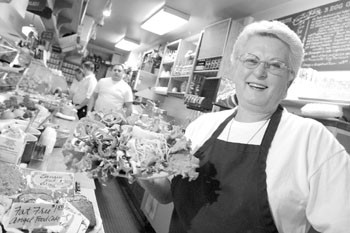
Grilling

0

Some Like It Hot

Reflections of a grill grrrl

By Gretchen Giles

Is it wise to trust–let alone consume–a food whose recipe reminds: “If you have enough clean cat-food cans, everyone can have a dessert”? Should the word “dump” ever be part of your menu litany? Are gas grills, as has been averred, truly proof that Satan walks this earth? Should that electric cord be so close to that swimming pool? And finally, how long do you cook that lettuce?

These are but a few of the urgent questions being mulled by home barbecuers the world over as the season peels off its last sweater for the bare-shouldered, sweat-laced, smoke-infused shrug that is summer. Out of the kitchens we pour, eager to reconnect with our most primal roots, to hail the ancient story of the Homo sapiens, a genetic history that can be shortly sketched by the sight of one frustrated cook in a humorously decorated apron poking a resistant piece of burned meat over a smoldering, uneven flame.

If your memories match mine, that cook is sometimes called Dad, and the nonpoking hand firmly clutches a gin. If you further share my wispy, WASP-y grasp of yesteryear, you were college-aged before you realized that food could be barbecued without gin. At which point you naturally enough considered: But why would you want to?

(You may also have reeled at the adult knowledge that barbecued chicken isn’t always black. Out of the Garden are we thus all eventually expelled.)

Meat–resistant, burned, gin-drenched, or otherwise–is these days by far the least of our grillable possibilities. Perhaps throwing a few burgers or dogs on the fire is OK for the kids. Perhaps. The last group of youths for whom I performed this mom-magic looked wiltingly down on their plates, shifted uncomfortably, and nudged each other until one politely inquired about marinated portobellos. It was, of course, the last children’s beach party I’ll ever throw without having a hip flask handy.

Nowadays, when preparing to roast outdoor foodstuffs of the burgers-and-dogs variety for adult company, that burger had better be a Boursin inside-out burger with the imported French cheese spooned delicately into a pocket of ground sirloin; that dog must either have some intricate Eastern European lineage or be stuffed full of chicken-basil/dried-tomato/pine-nut plug. And don’t even consider grabbing a bag of that white-flour-bun crap off the shelves. Oiled focaccia rolls infused with rosemary are acceptable, as is seeded artisan sourdough. They may be found at the bakery. If there’s a rainbow anywhere on the packaging, your pot of culinary gold–and indeed your very reputation–is in desperate straits.

Today’s modern barbecuer can purchase shiny new machinery to cook everything from pizza to pasta to baked Alaska to pancakes to fruit to, yep, lettuce–outside, in the elements, over a heat source, just like great-great-great-grandma used to do. Whether GGGGM would embrace such a miracle can’t be fathomed, but as long as there is a perfectly good kitchen inside, running water and all, one imagines her heading straight for the house.

For whereas women may have the vote, men still have the grill–or they at least appear to foot the grill bill. Advertising copy and images for the latest barbecues relentlessly feature a hirsute and apronless midlevel executive manfully standing over skewers ‘n’ steaks by the pool while a blonde woman just past her youth adoringly prepares cold drinks in the background. Mint sprigs, needless to say, abound.

Curiously, fire itself seems to be passé. The Char-Broil company leads the non-ignition pack in introducing an electric model called the Patio Bistro. Smartly sized so that wheelchair-bound folks can easily access it, the Patio Bistro’s ad copy masculinely boasts that it also has a built-in cooler–“Perfect for some cold ones!”

Connected umbilically to your poolside outlets, the PB handily brings all the hassle and mess of full-blown kitchen cookery outside. But unlike that unstable little Hibachi often bestowed on people’s patios, the Patio Bistro also has a large work counter, a dishwasher-safe cutting board, and a temperature gauge to take the usual gin-soaked professionalism out of guessing outdoor cooking times.

The Big Easy, another of Char-Broil’s products, is a large, friendly lug of a ‘cue, appearing to have a smiling face and little chub wings as hood handle and side counters, respectively. This Naw’lins-positive steel-and-ceramic good buddy is replete with a griddle for those barbecued morning pancakes we so crave and has an insert for use in frying foods. How hot do the coals have to be in order to fry foods? One unprofessional opinion: very damned hot. Want some fries with that pancake? Everyone in bathing suits stand back, the grease spits a little.

(An informal survey of the incredibly well-attended barbecuing topic on the online community the Well proves that gas grills are really better left unmentioned. They evidently range from the crappy to the really crappy to the live-with-it sigh of moderately crappy. Makes a person proud of the rust-ravaged Webber stoutly faring in the shed.)

While new-fangled grills can do everything short of producing wedding cakes, there remains a frivolous holiday air to them. No one really wants to wander out in a bathrobe, fire up the barbie, and get that oatmeal going. They’d rather be sitting bleary with GGGGM in the kitchen watching the coffee automatically make itself while the cereal nukes away in the microwave.

But lunch and dinner benefit nicely from the huge technological strides that have been made in the name of heating things up. Many home cooks take pride in pulling at least a portion of every course off the grill for summer guests. Appetizers? Please, have a grilled artichoke with garlicky aioli. Save room for the prosciutto-wrapped shrimp! Salad? Allow me to whip up a vaguely Asian sauce with soy, ginger, sesame oil, white wine, and brown sugar, drizzle a head of firm, clean romaine leaves with it, and baste over low flames for 15 minutes. Pizza? Don’t send out; I’ll smack a pie right on the coals here using a specially perforated heat-resistant pan. Don’t you know, pizza is the new ‘cue.

Dessert? Um, have an apple.

Like breakfast, dessert is that which the new age of barbecuing should neglect but won’t. Traditional stoves, refrigerators, freezers, and pastry shops already do it well enough, never using cleaned cat-food cans or the word “dump” to achieve greatness. But as with so many other misguided American endeavors, dessert is nonetheless broached upon the grill and sometimes even eaten. Those few treats that simply call for grilled apricots or peaches doused in yummy liqueur and topped with ice cream retain their dignity. Those that call for a package of cake mix and cans of pie filling do not.

Taking your cleaned cat-food can, fill the bottom with pie filling goo-stuff to about 3/4 of the rim. Sprinkle cake mix atop it, and dot with butter. Don’t, warns the gastronome who offered this recipe on the Internet, mix them up! Place over hot coals, cover, and bake until golden. Tra-la!–it’s a dump.

On the other hand, some foods are raised to glamorous new levels by being fired up for dessert. Shunned by the incurious when raw for its somewhat sticky, grainy, vaguely sexual connotations, the homely fig is celebrated when barbecued. Whether stuffed with cream cheese or slathered in honey, figs suddenly join a hip elite when hot. So too does pineapple, that ’50s staple of romantic je ne sais quoi.

While most of us enjoy the swift thwack of this fruit fresh, the cooked stuff sadly joins a ham-slab dinner in dim, distasteful, red-eyed-gravy memory. But grill that taste of the tropics with a dab of buttered brown sugar and it suddenly becomes the J.Lo of the plate, dancing saucily on the tongue with just a hint of last night’s steak sluicing the taste buds.

All of which is frankly enough to make one simply long for the plain old pleasures of a burger or dog. Please pass the chipotle plum ketchup.

From the June 27-July 3, 2002 issue of the North Bay Bohemian.

© Metro Publishing Inc.

“The Box Show”

0

Box of Reign

Gallery Route One artists think inside the box

By Gretchen Giles

On a hot, early-June Sunday, the great-nephew of the last Russian tsar merrily stands smack in the middle of the road, wearing an oversized cardboard box. A silly hat tops his head, and the home-picked geraniums decorating the sharp angle of his shoulders bravely withstand wilting as he practices his tin whistle. Around him, overheated princesses in floral dresses and sticky nylons fan themselves, a horse delicately lifts its tail to soil the ground, and someone driving a car fueled solely by cooking oil puffs by, leaving the rancid smell of old popcorn behind.

It’s Western Weekend in Point Reyes Station, and the parade has begun. Flanked by environmental activists in front and preschool gardeners behind, the artists collected in support of Gallery Route One begin their dancing in the street.

Three of them, wearing cardboard boxes so large that they require foam padding to support their wearers’ shoulders and assistance to be lifted on, twirl in practiced formation. Stopping on cue, they spell out their message to the sprightly tune of a Romanoff’s whistle. Twirl one: The. Twirl two: Box. Twirl three: Show.

A documentary-film crew swarms in, the director holding a microphone to the bearded face of an Englishman in a fetching girl-group wig and golden beads. “How do you feel?” she shouts.

“Great!” comes the lusty reply.

No reason not to feel great: guerrilla marketing has come to West Marin, bringing with it the power of PBS, a riotous art auction and exhibit, and perhaps a book deal. The Russian royal lineage was there already.

Now in its fourth year, “The Box Show” fundraiser for Gallery Route One, an artists’ cooperative with 21 members, began for 2002 in far more humble circumstances than its zany parade formation might indicate. Working literally for weeks and making (he should know) 32,000 right angle cuts with his table saw, gallery member Nick Corcoran eventually turned a high pile of plain pine shelving into 150 wooden boxes. Over 400 people wanted one, a lottery was held, and the lucky 150 recipients–artists, nonartists, and children–tottered off in May to contemplate their bare pine “canvases.”

Each exactly the same when they left–unembellished, sized in repetitive dimensions to perhaps fit a small pair of women’s shoes, laboriously glued and fitted into place–these unassuming containers have recently arrived back at the gallery in 150 completely different guises.

Some, for example, are now lamps. Others have morphed into thickly painted tables. One holds a live goldfish; another, an inset of papier-mâché goldfish. One is totally shellacked with junk mail, while another is now an elegantly copper-sheeted home altar; many are mossed and feathered as sweetly as fairy homes. Arte á Porter sports a thickly organic painting on wheels, replete with handy carrying handle. One is covered in zinc; another with baseball cards. This one was completely shredded and rebuilt in wood shards as Porcu Pine; that one was hacked into indifferent pieces and tied up with string, albeit lovely, hand-batiked silk string.

Corcoran himself carefully cut his up into 100 slices and reweaved it, like a children’s craft project with Popsicle sticks, into a new, boxy semblance. “I call it Basket Case,” he laughs. “After making all of these boxes, you like a little revenge.”

But revenge is hardly the motive. An annual fundraiser that last year netted this small, nonprofit cooperative over $14,000, “The Box Show” is actually something of a phenomenon: a 30-minute documentary film is being made on the 2000 exhibit for PBS, and there are rumblings of a “Box Show” book in the works.

“The hook is the versatility,” Corcoran explains. “Everyone starts out at the exact same point. We have professional artists who have been [making art] for 50 years, and we have people who have never made a piece of artwork in their lives. It’s a great leveling.”

Corcoran hit on the idea four years ago when someone gave him 50 small boxes. He thought of distributing them to artists for decoration but realized that the resulting raffle wouldn’t net much. “It was a series of small incidents,” he says, that brought him instead to make 111 same-sized containers that year. He did 120 the next year, and as demand has grown, so too has the silent auction and the number of boxes made. “I thought that I was going to do it for one year, and now it looks like I’ll be doing it for the rest of my life,” he chuckles.

Corcoran’s partner, artist Betty Woolfolk, is among the original cofounders of Gallery Route One, which celebrates its 20th anniversary next year. “People got tired of dealing with the galleries in the city, and also there just weren’t enough venues for artists,” she says, explaining the gallery’s origins.

Boasting a rigorous screening committee that ensures high artistic standards, Gallery Route One is something of an oddity, placed as it is in the wilds near a national seashore. “We wanted to have a professional exhibition area set in a rural area,” Woolfolk under-scores. “We have international shows. We’ve had a show of artists from Hungary and a show with artists from the Soviet Union where all the work had to be carried out [of the country] by the artists. We had a show of San Quentin inmates’ work before it was cool to do that–and it was a really powerful show. We’re trying to bring interesting exhibits to the community that you might otherwise have to go into San Francisco to see.”

Vickisa, a gallery member who prefers not to use a surname, gushes, “It’s an epic gallery; I’m really thrilled to be part of it. You can actually talk about art.”

With strong impetus from Inverness artist Mary Eubank, another cofounder, the gallery has moved beyond its original mission. Now it’s also a nonprofit space devoted to highlighting the environmental concerns of the area’s sensitive ecosystem and to providing art-in-the-schools programs for West Marin children. And if the notion of worms wiggling across a table of dirt–as conceived by area school children for next fall’s exhibition on sustainable agriculture–is your cup of cylindrical invertebrates, all the better.

Filmmaker Victoria Lewis learned about the work of the gallery after befriending Andrew Romanoff, he of the geraniums and whistle, while working on her 1997 film about his great-uncle, The Mystery of the Last Tsar. Remaining friendly, Romanoff brought Lewis to the 2000 “Box Show” exhibit.

“I’d never seen anything like that,” Lewis confesses by phone from her San Francisco office. “It was mind food to me, and it just hit me so hard. I thought it would be a great premise for a film.” So did PBS, which is assisting her in concept and funding, promising to air the finished product possibly late next year.

A former art-school student whose interest instead veered into film, Lewis is particularly impressed by the concept that “artists can be problem solvers for a community.” She contacted all 120 exhibitors of the 2000 show and interviewed “anyone who would answer the phone,” asking them not only about their boxes but also about their lives. Some 25 artists were then selected for in-depth interviews, agreeing to recreate their 2000-era work for her camera. When the film is finished, she estimates that she’ll have further whittled that number down to six or seven featured artists. “I could do a silent film and the boxes alone would be captivating,” she declares.

Featuring a clay doll on a bed of champagne glasses, her large, red heart dangling ickily from the ceiling, Vickisa’s box is titled When Your Heart Is Being Ripped Out . . . You Need Some Anesthetic. She strives to explain the attraction of “The Box Show.”

“The show encompasses high art and low art, so there’s something for everyone. You can go to galleries and you won’t like everything, but there’s something here you’ll like, guaranteed.”

‘The Box Show’ exhibits at Gallery Route One, 11101 Hwy. 1, Pt. Reyes Station, closing with a live auction on Sunday July 28, from 3 to 5pm. Gallery hours are Wednesday-Monday, 11am to 5pm. Free. 415.663.1347.

From the June 27-July 3, 2002 issue of the North Bay Bohemian.

© Metro Publishing Inc.

Hartford Insurance

0

Reaping the Benefits: Michael Allen, general manager of SEIU’s Local 707 office, is looking into Hartford’s slow action on claims.

Late to the Gate

County workers face problems with Hartford

By Joy Lanzendorfer

Sherry Smith expected to be getting long-term disability by now. It’s been six months since the Sonoma County worker went off work for medical reasons, and yet she still has no answer from the county’s insurance carrier, Hartford Insurance, about her claim.

“I’ve been out of work since Dec. 18, and I’ve had no income since Feb. 11,” she told the Sonoma County Board of Supervisors on June 11 while choking back tears. “I have spent thousands of my own money on medical bills, and I don’t know what I’ll do without income in the next six months.”

Smith says that she’s done everything that Hartford has required, including sending certified letters regarding her condition, and still she’s seen no response to her claim. No one at the company would even return her calls until she threatened to report them to the California Department of Insurance. Even then, no one had an answer on when and if she would start receiving benefits.

Smith was one of several members of the local Service Employees International Union to speak to the board about Hartford Insurance. Ann Delaney, who has worked for the county since 1977, also had trouble with Hartford. Her applications were lost and then misfiled, she says, and her complaints generally ignored. While waiting for her claim to come through, she faced numerous hardships, including the death of her cat, for whom Delaney was unable to afford veterinary care.

The SEIU, which represents Sonoma County government employees, has become increasingly concerned about the Hartford situation, according to Michael Allen, general manager of SEIU’s Local 707 office.

“We have a significant number of people who may have to file for bankruptcy or lose their dwellings because of Hartford,” he told the board. “The county thought workers were going to receive better benefits through this company, but they haven’t.”

The speakers asked the board to switch to a new carrier and to impose financial penalties of up to $10,000 against Hartford.

The speakers’ complaints were passed on to Marcia Chadbourne, Sonoma County risk manager. She says part of the problem stems from a shorter waiting period–60 days instead of the usual 90 or 180 days that most insurers require people to wait before they receive benefits. Because the time is shorter, workers have less time to provide the many necessary documents Hartford requires, which can cause delays in receiving benefits. But, she says, Hartford also has a problem with timely responses.

“We’ve evaluated the situation, and the county acknowledges that there are some problems with Hartford,” says Chadbourne. “The Joint Labor-Management Committee is going to begin looking for a new carrier.”

The board isn’t likely to enforce financial penalties, however, because Hartford has met its contractual obligation to make decisions on 80 percent of the claims filed by day 45 of the 60-day waiting period, explains Chadbourne.

Hartford has had similar problems in the past with other customers. In fact, according to Allen, 170 lawsuits were filed against Hartford for similar situations, and the Department of Insurance has cited them. A consumer-oriented website called Fight Bad-faith Insurance Companies (www.badfaithinsurance.org) lists Hartford as the No. 1 bad-faith insurance company, claiming that it has the “highest number of bad-faith-related complaints and lawsuits.” Hartford had no comment.

The numbers don’t help people like Smith and Delaney, who find themselves in limbo, with no income and no way to work.

“At this point, we are gathering information and seeking legal advice,” says SEIU field representative Maria Peluso. “We may look into lawsuits against all the parties involved.”

From the June 27-July 3, 2002 issue of the North Bay Bohemian.

© Metro Publishing Inc.

Glassy-Winged Sharpshooter

0

Damage Control

Poisoning the glassy-winged sharpshooter means poisoning you

By Tara Treasurefield

They’ll be in there immediately with synthetic pesticides,” says Lowell Downey. “Before they even give us notice, they’re in there.” Just home from the hospital after minor surgery, Downey has taken Vicodin to dull the excruciating pain in his belly. It takes a long, long time for him to put a sentence together, and even longer to get the words out of his mouth. But he has a clear message, and it comes through. “Today I can’t get up out of my bed. I wouldn’t be able to leave if they came here and sprayed my property. That’s what it will be like for people who are bedridden.”

Cofounder of People Opposed to Insecticide Spraying on Neighborhoods, Downey is a leading critic of the California Department of Food and Agriculture’s approach to protecting vineyards from the glassy-winged sharpshooter. The insect, which carries Pierce’s disease–a malady deadly to grape vines–has already infested much of Southern California. At present, the best that agricultural commissioners in the sunny Southland can hope for is damage control. But in Northern California, the goal is to eradicate the insect before it takes hold. Because the sharpshooter thrives in hot weather, the threat of an infestation in the North Bay is increasing with rising summer temperatures. Tempers are rising too, as there are clear signs that sooner or later agents of the Pierce’s Disease Control Program will use synthetic pesticides around North Bay residents who prefer to avoid them.

To keep the sharpshooter out of vineyards, agricultural commissioners in 15 California counties have sprayed synthetic pesticides in residential areas and public places, sometimes over the objections of property owners and residents. This practice, known as forced spraying, has the full support of both the CDFA and Governor Gray Davis, who recently gave his blessings to it.

In March, the CDFA released a draft environmental impact report on the Pierce’s Disease Control Program. The public comment period ran from March through May, and the report will be finalized at the end of June. According to this document, no significant impacts result from spraying possible carcinogens and other toxic chemicals in residential neighborhoods, on organic farms, and at schools and parks.

EDAW, an environmental consulting firm in San Francisco, helped the CDFA prepare the report and reach its conclusion that the pesticide spraying program has no significant impacts. Molly Scarborough, environmental planner at EDAW, says that the “level of significance is determined through the experience of the experts in the field, in relationship to what the [California Environmental Quality Act] requirements are. The conclusions in the report resulted from the analysis that was done.”

Nick Frey, executive director of the Sonoma County Grape Growers Association, believes that the conclusions of the environmental impact report are reasonable. “You have to look at it in the context of relativity,” he says. “This program would be small and would have small use of pesticides, whether they’re synthetic or not.”

But Downey sees it differently. “It boggles my mind that this [report] draft is so hideous on every level,” he says. “They have taken every [organic] alternative and discounted it on an individual basis. They didn’t look at the entire spectrum of alternatives working together.” The report also ignores Downey’s request that the CDFA prohibit the use of synthetic pesticides around the most vulnerable, such as the elderly, sick people unable to get up, and children. “[This report] gives agricultural commissioners throughout the state standing to ignore people who request the use of alternatives,” he says.

Downey makes it clear that his quarrel is with the CDFA and the governor, not with small family farmers. His parents were born on farms, and his aunts and uncles were farmers. Downey’s mother died of leukemia when he was eight, and Parkinson’s disease killed his father. After walking through a cornfield, one of Downey’s uncles nearly died of pesticide exposure. Downey’s other aunts and uncles died of non-Hodgkin’s lymphoma, cancer, and other diseases that have been linked to pesticides.

“I can’t say that pesticides are the reason my uncles, aunts, and parents died, and why other family members suffered and died of various illnesses and diseases,” Downey says. “But it seems to me that it’s pretty unusual that there’s so much of it among farmers. I also don’t believe that our government should violate us in this manner. It’s just plain wrong and, in my book, evil to forcibly spray pesticides. This should be a no-brainer to the governor, who’s running for re-election. People don’t want forced spraying.”

Shepherd Bliss, organic farmer and founding member of No Spray Action Network in Sonoma County, is also concerned about the implications of the environmental impact report. “It’s a prescription for the worst kind of terrorism: state terrorism,” he says. “The people who are going to suffer are those who are trying to garden organically or who are trying to care for a family member who is compromised.”

Downey and Bliss are not alone in their opinion of the report. More than 50 environmental groups charge that the draft report violates several mandatory requirements of the California Environmental Quality Act. To get their claims into the record–as groundwork for a lawsuit–they signed a 17-page letter that describes violations to the act in detail.

A major concern of critics is the report’s conclusion that spraying pesticides on organic farms would have little impact. The report reasons that though spraying on an organic farm would invalidate its organic certification, which takes three years to obtain, the loss is not significant because it would be temporary. Sonoma County Agricultural Commissioner John Westoby explains why this isn’t as strange as it may seem. “If an organic farm is treated during an eradication with a nonorganic material, they would lose their organic status for that year, but not for the next year,” he says.

But Brian Leahy, president of California Certified Organic Farmers, says that forcing pesticides on an organic farmer is like forcing a recovering alcoholic to drink. “On organic farms, you slowly build up beneficial insects. You’re trying to get your system back in balance. [Synthetic pesticides] would throw it off again.”

Organic agriculture has been growing at the rate of 20 percent each year for more than ten years. A $78 million industry in 1978, it’s now worth $8 billion nationwide. But because only I percent of California agriculture is organic, the loss of even one farm to the war against the sharpshooter would be significant, says Leahy. In addition, any synthetic pesticides the state forces on organic farmers may increase pollution in rivers and streams; endanger fish, birds, humans and other species; and hurt grocers that sell organic foods and consumers that buy them.

Ned Hill, president of the Sonoma Valley Vintners and Growers Alliance, says that he has no objection to organic alternatives. “[But] having the insect around–not just for grape growers but for the environment as a whole–is unacceptable,” he says. “If people can do it with organic alternatives, that’s fine. We [just] don’t want to live with the insect.”

Nick Frey feels the same way. He reasons that doing whatever it takes to eradicate small sharpshooter infestations will eliminate the need for massive spraying to eradicate larger infestations. If the CDFA and the agricultural commissioner decide that forced spraying is necessary, Frey won’t object. Until then, he’ll support those who want to avoid synthetic pesticides. “I still remain optimistic that you can use conventional products on those properties where people give you permission and use alternatives elsewhere.”

Westoby says that if the sharpshooter infests an organic farm, he’ll apply a certified organic repellent, such as kaolin clay, to move the insects to the foliage around the farm, and spray them with synthetic pesticides there. He’ll take a similar approach for residents who prefer alternatives.

Even so, Jay Van Rein, information officer at the CDFA, says, “If you have an urgent infestation, one that’s immediately threatening a crop, the agricultural commissioner may go in [with synthetic pesticides] right away.” That doesn’t sit right with Clarence Jenkins, owner of Madrone Vineyards in Sonoma. He has mixed feelings about forced spraying. “Being a property owner, that’s a tough decision. It’s just another deal where the government’s coming in and doing things. [But] I know in certain areas, guys are losing so many vines and it becomes a family issue. It’s real tough.”

Health professionals also question the justice of forced spraying on private property and public places, and question the CDFA’s finding that no one is likely to receive a high enough dose of the poison to be affected. Gail Dubinsky, M.D., in Sebastopol points out that there’s really no way to predict how much contact children would have with treated foliage. In addition, she says, “No one knows the cumulative effects of low exposures over time.”

Though the CDFA relies heavily on synthetic pesticides, it has made some space for predatory wasps from Mexico. The Santa Clara County agricultural commissioner is using the wasps along with Admire, the brand name of a pesticide called imidacloprid, to control a sharpshooter infestation in Cupertino. Imidacloprid is a potential groundwater contaminant, but as chemicals go, it’s comparatively benign. Then again, it’s also comparatively new. Susan Kegley, Ph.D., staff scientist at Pesticide Action Network, says, “We didn’t know about the hazards with DDT until 10 or 20 years had passed.”

While he views synthetic pesticides as a short-term solution at best, Bob Scowcroft, executive director of the Organic Farming Research Foundation, sympathizes with the CDFA and the wine industry. “Maybe one of the benefits that will come out of this is that urban and suburban consumers will better understand the challenges that all farmers face,” he says. “You fight long and hard just to save your house, and when the research institutions can only deliver a chemical solution, you’re going to think long and hard about not using it. Urban and rural residents need to understand the stress that comes with that.”

It’s possible that the Pierce’s Disease Control Program and draft report would have a different look if the people who developed them had a greater investment in organic farming, environmental protection, and human health. Gallo Winery is the only organic farming/environmental representative on the CDFA’s ongoing Pierce’s disease advisory task force. The remaining 15 members of the task force, appointed by CDFA secretary Bill Lyons, represent agribusiness, the wine industry, government agencies, and university scientists, who receive a significant amount of financial support from pesticide and biotech manufacturers.

Nonetheless, organic alternatives are gaining ground. The University of California Extension in Kern County advocates Surround to protect vineyards from the sharpshooter. This is the brand name of kaolin clay, the organic repellent that Agricultural Commissioner John Westoby plans to use in Sonoma County. Gary Puterka, research entomologist with the USDA, says that “in Kern County, we compared three biweekly applications of Surround to six weekly applications of conventional insecticides [including Lorsban and carbaryl]. Surround did better or as well over a six-week period in depressing [the sharpshooter] in grapes. The problem with insecticides is that you spray and kill them out one day, and they’re back two days later. With Surround, the residue remains effective for weeks.”

Because Surround is primarily a repellent, the USDA recommends mixing it with an insecticide to get both quick knockdown and protection from future infestation. An organic alternative, says Puterka, is to mix organic insecticidal soap or neem oil in the tank with Surround. In addition, kaolin clay alone sometimes kills the insect. “If you have nymphs hatch out on a kaolin treated plant, they usually end up dying. Adults often die too,” says Puterka.

Kaolin clay may be the long-awaited solution to the standoff between grape growers and opponents of forced spraying, as Puterka says that the obvious place to use it is in vineyards. However, the CDFA hasn’t approved kaolin clay for use against the sharpshooter, and even if it had, the program only covers the costs of treatments in residential areas and public places, not vineyards. Though Surround costs less than synthetic pesticides, it would be an added expense for growers, and they may not want to pay it.

Another issue is that kaolin clay, used as an additive in toothpaste, Kaopectate, and sunscreen, turns everything white. Some grape growers don’t want white vineyards.

Ralph Zingaro of Bioscape Inc. in Petaluma is the one and only pest-control adviser in the North Bay willing to help concerned residents control the sharpshooter with organic alternatives. He joins Puterka in advocating the use of kaolin clay, especially on vineyards. “We’re looking for something that’s safe and effective. Let’s just take a vote of all the people in the county. Would they rather be sprayed with toothpaste or poison?

“[Clearly], the organic alternatives are better,” says Zingaro. “Not only do they work better on the insect, but the insects will never build resistance to them. With the chemicals, we’re going to create a super sharpshooter with them. What’s the worst thing that can happen with Surround? Everybody will have bright teeth. I’d rather see that then have a whole bunch of the other stuff.”

In the meantime, Leahy says that the California Certified Organic Farmers is monitoring and influencing the political situation, supporting preparations for legal action, and keeping members informed. “It’s time to say, ‘Hey, this isn’t working! You can’t spray nature out of existence, unless you take us out too.’ We’re starting to get a critical mass of people saying that they don’t buy the argument that because it’s good for this particular special interest, it’s OK to compromise their health and the environment. People don’t buy that argument anymore.”

One thing is certain, says Downey. “I have a four-year-old son. There’s no way that I’m going to allow anybody to forcibly spray pesticides in his yard or around him.”

From the June 27-July 3, 2002 issue of the North Bay Bohemian.

© Metro Publishing Inc.

Sharon Boorstin

Sharon Boorstin examines the ties that bind in 'Let Us Eat Cake' By Sara Bir Light and pleasing as angel's food, Sharon Boorstin's Let Us Eat Cake is a food memoir that's shorter on meaty substance than it is on heartfelt sweetness. Former restaurant critic for the Los Angeles...

Open Mic

Visiting Castro's Cuba the legal way By Christian Kallen Castro is the devil," said the baggage handler at Miami International Airport when I told him where we were going. "He is ruining my country." The baggage handler looked to be about 40, which means he had probably never been to "his...

Sparks

Sparks, Flying Sparks lights a fire under tired old vegetarian cooking By Davina Baum With all the mad cowboys and fast-food nationalists singing the gospel of knowing your food, it makes sense that vegetarianism should be getting its just desserts by way of increased food awareness. Meat--whether it's grass-fed...

Literary Trends

The God of Literary Trends The language of culture, writ large on bookstore shelves By Noy Thrupkaew You know, you really should be looking for the next Arundhati Roy." I plucked at the phone cord wrapped around my neck, sighed, and said, "Oh, absolutely." It was 1998, and...

Kitka

Voices Rising: Popular Eastern European choral group Kitka perform at COPIA in September. Balkanizing the Bay Balkan folk dance draws a crowd By Sam Hurwitt They're drawn to the Berkeley dance barn Ashkenaz like pilgrims to Mecca. On any other night they could be there to learn Cajun,...

‘Scooby Doo’

Rroo's There? Matthew Lillard and his digitally-animated co-star hunt ghosts in 'Scooby Doo.' Geek Rage Pushing the buttons of the King of Television trivia Take my advice: never upset a geek. I am sitting here with the phone pressed to my ear, an ear that has...

Grilling

Some Like It Hot Reflections of a grill grrrl By Gretchen Giles Is it wise to trust--let alone consume--a food whose recipe reminds: "If you have enough clean cat-food cans, everyone can have a dessert"? Should the word "dump" ever be part of your menu litany? Are gas grills, as has...

“The Box Show”

Box of Reign Gallery Route One artists think inside the box By Gretchen Giles On a hot, early-June Sunday, the great-nephew of the last Russian tsar merrily stands smack in the middle of the road, wearing an oversized cardboard box. A silly hat tops his head, and the home-picked geraniums decorating...

Hartford Insurance

Reaping the Benefits: Michael Allen, general manager of SEIU's Local 707 office, is looking into Hartford's slow action on claims. Late to the Gate County workers face problems with Hartford By Joy Lanzendorfer Sherry Smith expected to be getting long-term disability by now. It's been six months since...

Glassy-Winged Sharpshooter

Damage Control Poisoning the glassy-winged sharpshooter means poisoning you By Tara Treasurefield They'll be in there immediately with synthetic pesticides," says Lowell Downey. "Before they even give us notice, they're in there." Just home from the hospital after minor surgery, Downey has taken Vicodin to dull the excruciating pain in his...
11,084FansLike
4,446FollowersFollow
6,928FollowersFollow


