
Amos Klausner

0

Photograph by Michael Amsler

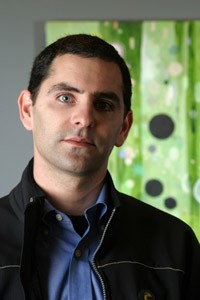
Forward Looking: MOCA director Amos Klausner.

Pushing the Envelope

New MOCA director Amos Klausner tests the boundaries

By Gretchen Giles

Emerging from his office on a recent afternoon, Amos Klausner is full of apologies. While hands are still being shaken, he apologizes for being dressed in utterly clean work boots, crisp laundered jeans and a new-looking plaid work shirt. Dressed down for the day to help install an auction exhibit, he’s not, he explains good-humoredly, in his “design” clothes, the sharp monotone ensembles and excellent shoes that mark such of his ilk–those mad for the clean, spare lines of the contemporary aesthetic.

Hired last November as the new director of the Museum of Contemporary Art (MOCA), Klausner, 33, also apologizes for the root canal that made him unable to attend a caterer’s meeting the day before, necessitating a small break in this day’s interview to discuss mushroom fondue sticks with a chef. But as any reporter knows, such a small break requires absolutely no apology. Let the unfettered snooping begin!

But snooping in Klausner’s boxlike office upstairs in the corporate aerie of Santa Rosa’s Luther Burbank Center reveals few surprises, though one wonders how a man with such a modern bent can stand working most of the day in such dreary surroundings, his window’s view being of the dumpsters below. It makes sense, though, that Klausner, having just finished a five-year stint as the director of the San Francisco chapter of the American Institute of Graphic Arts, would decorate his walls with oversized posters emphasizing cleanly drawn jazz artists and Dutch aesthetic sensibilities.

There is a neat stack of books on the Mexican-born painter Enrique Chagoya, a Stanford art professor due for a one-man exhibit at the MOCA later this year. The addresses of local newspapers are modestly taped to Klausner’s computer monitor, and the schedules for his museum’s exhibition slate occupy one wall.But a long piece of butcher paper stuck to the back of his door does prompt interest. There, furiously scrawled in colored markers, is a compelling list. Established environmental artists Andy Goldsworthy and James Turrell are joined with such art-world luminaries as Robert Motherwell, Cindy Sherman, Basquiat, Ann Hamilton and about 30 others, most of whom have never exhibited in the North Bay before.

“Oh, that’s a list that Gay and I drew up,” Klausner explains upon returning from his caterer’s meet. The “Gay” he means is Gay Dawson, the former executive director of the MOCA who stepped down from the rigors of fundraising and administration to the more pleasant position of museum curator last year. “She gets to have all the fun,” he agrees with a chuckle. Klausner’s job of running a museum, overseeing the proposed erection of a new 5,000-square-foot exhibition space and raising $5.5 million in capitol to fuel it all may be pleasant, but it certainly isn’t easy.

Perhaps compounding such difficulty is the fact that Klausner is poised to take the MOCA in an entirely new direction.


Established in 1982 as the California Museum of Art, the exhibition space at the LBC has since changed its name twice, morphing from the optimistic grandness that the “California” in its name evoked to the more regional title of Sonoma Museum of Visual Arts–a moniker easily confused with the Sonoma Valley Museum of Art–to the simplicity of the current MOCA. Like the vagaries of its name, the institution has struggled for years to establish and maintain a focus. Should it show only North Bay artists, should it collect and curate, should it establish itself as an European-style kunsthalle, should the exhibitions be of national scope or confined to the Bay Area, should the artists be mostly established or emerging or even amateur, depending on the exhibition?

Financing and space limitations have dictated many of the museum’s decisions. With little funding for insurance, shipping and security, and with no reliable temperature controls for its current space, there will never be a Rembrandt gracing the walls at the LBC. But under Dawson’s guidance, the museum has shown emerging and midcareer contemporary artists whom many North Bay residents might not otherwise know. Bay Area artists Deborah Oropallo and Lucy Puls were introduced to area viewers; the great abstract jazz painter Mike Henderson is a familiar; and New York’s innovative Two Palms Press helped to showcase work by artists such as Chuck Close. Moreover, almost every exhibition of national or Bay Area scope has had an element tying it to the work of artists from the North Bay.

Under Klausner’s leadership, that final element looks to be on the wane. “We’ve supported local artists for the last 20 years,” he says, settling into his chair. “If my budget were balanced, if people knew what we were, we’d keep doing it at the same level. But it’s not and they don’t. The museum has always been very good at supporting North Bay artists.

“Will it continue?” he asks rhetorically. “Yes. At the same level? No.”Instead, Klausner means to reposition the museum’s exhibitions to emphasize the universalities of excellent design, even if that means finding itself sometimes in contrast to the individual challenges of the fine-art experience.

“We’ve decided that we need to change the nature of the content to reflect the nature of the museum. It’s a move away from local to state, national and international,” he says. This decision is prompted in great part by the museum’s need to fundraise toward the building of its new $2.5 million exhibition space, an ambitious structure designed by Oakland architect Douglas Burnham that recently won a Best Unbuilt Design award for 2004 by the San Francisco chapter of the American Institute of Architects. Figuring that if he builds it, they will come, Klausner hopes to attract visitors beyond the North Bay to a destination museum experience by 2010. Such art tourists are savvy, and, Klausner says, “We have to provide an experience that meets certain standards that these visitors have come to expect.”

To that end, marketing research has been launched, the museum staff learning that Bay Area patrons like photography and politically charged art. Enter the politically charged paintings of Enrique Chagoya, exhibiting this summer, and the moody dramatics of San Francisco photographer Todd Hido, slated for December.

In order to better serve the greatly underserved Latino community, MOCA has asked Chagoya to give a lecture delivered solely in Spanish. Additionally, former U.S. Biennale representative Ann Hamilton may produce a small show of maquettes and other symbols of her intelligent installation work for the MOCA in 2006.

Klausner has also been in touch with painter Richard Diebenkorn’s widow, Phyllis, and is hoping that this Healdsburg resident will consent to show some of her husband’s works on paper next year. Diebenkorn’s more famous paintings are too delicate and valuable for the temperature-insensitive, low-security environment the MOCA currently inhabits. That, Klausner determines, will change with the new museum structure.

“Our goal is to slowly ramp up to the names that are on that list,” he says, pointing at the back of his office door. While heading to that goal, Klausner intends to showcase arts not normally found at the MOCA, including ceramics and plain old great examples of good design. Having worked as the architecture and design forum coordinator at the San Francisco MOMA for two years, Klausner clearly hopes to reproduce that institution’s important design exhibits on a smaller scale in Santa Rosa.

“Destination architecture is not enough,” he says. “It’s what’s on the inside that sells, and while architecture and design are a tough sell, people expect to enter a certain experience when they enter a museum. How do you integrate this with painting and sculpture?” he asks with his characteristic rhetorical bent. “Well, cultural indicators are not pointing at painting and sculpture. It’s the things we use everyday that interest us.

“My feeling is that objects will be so much more important than the fine arts to the next generation. In this new world, where we are all networked together, the fact that we share an item,” he gestures with his pen as example, “is much more valuable than one thing existing alone [as with a piece of sculpture]. It doesn’t mean that what the fine arts are doing isn’t important, but there’s an equality between designing objects and the fine arts, and we have to accept it. They each comment on each other in equally valuable ways.”

Klausner’s more immediate future concerns spreading the word about his museum. Living with his wife in San Rafael for the past decade, he himself was unaware of the MOCA. “A lot of people don’t know we’re here,” he says with a smile. “My goal is to make people aware of who we are and what we do. We’re building something from scratch, and that’s exciting.

“The future of the museum,” he continues with evident relish, “is to reflect the accepted currents within the community. Our goal is not to buck the trend, but we do intend to push the borders.”

The MOCA launches a new series of monthly Thursday-night lectures by Bay Area architects with CCS Architecture founder Cass Calder Smith on May 5 at 7pm. MOCA, at the LBC, 50 Mark West Springs Road, Santa Rosa. $5-$10. 707.527.0297.

From the April 27-May 4, 2005 issue of the North Bay Bohemian.
© Metro Publishing Inc.

Free Mind Media

0

Photograph by Elizabeth Seward

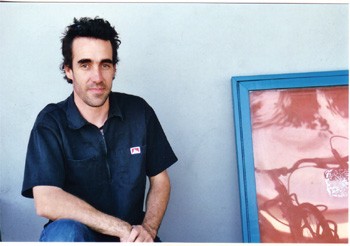
Unbound: Free Mind Media member Ben Saari has helped to open an ‘infospace’ that shares less-than-conservative books and ideas.

Room for Dissent

Free Mind Media offers young radicals space to explore views

By Gabe Meline

Sonoma County is known for a good deal of peace-loving activism, but the activity centered around the newly formed Free Mind Media center is shaping up to be anything but average–or, for that matter, especially peaceful.

High on the list of things that will define success for the new all-volunteer community space: “Getting infiltrated by law enforcement within a year,” says Ben Saari.

He’s not kidding.

Over the past three years, Saari and a group of approximately 50 other volunteer-members have been stockpiling supplies, holding meetings, carting around thousands of books and staging benefit performances with the goal of finding a public space to rent as a headquarters for radical political activism in Santa Rosa. On May Day, that goal will be realized when Free Mind Media opens its doors to the public.

Located on Pacific Avenue in a modest building previously occupied by the Sonoma County Peace and Justice Center, Free Mind Media is a decidedly radical “infospace,” a combination bookstore, community meeting center, Internet cafe and lending library. A look around the freshly renovated space in the weeks before its grand opening reveals bookshelves packed with notable free thinkers ranging from Faludi to Franken, Goldman to Guthrie, Chomsky to Cometbus. The books share space alongside zines with titles like Stolen Sharpie Revolution, as well as instructional videos for street protest. Filling a magazine rack rescued from the county dump are periodicals such as Anarchy and, for the more environmentally minded, Green Anarchy.

An antique antenna perches atop one bookshelf, and, indeed, the atmosphere buzzes with frequency. Already, the space has hosted meetings for Food Not Bombs, the ACLU, Critical Mass and Copwatch. Future meetings are slated for others unable to work around the Peace and Justice Center’s heavily booked schedule–for example, a group of high school students who are mounting opposition to Rancho Cotate High School’s high-profile Conservative Club.

Although similar infospaces in major urban areas openly declare political affiliations (“Either anarchists or socialists,” quips Saari, “and never the twain shall meet”), the political climate at Free Mind is wide open. “We’ve got people all over the left side of the political spectrum, and people who don’t even identify as part of the political spectrum, they just wanna see good things happen,” says Saari.

Youth seems to be a uniting factor. On one recent night, most of the volunteer-members arriving for a planning meeting are under the age of 25. “I still haven’t really grown up yet,” says the 34-year-old Saari, who sings in the local hardcore punk band Black Box and routinely answers to his old punk nickname, A-Head. “Some people who are ‘political’ spend a lot of time consciously trying to grow up. I really think that radical social change, if it’s gonna happen, has to be led by young people.”

Saari stops to consider this point. “That’s not to say that old people are stupid and have no new ideas, but the people in our society who have the free time, and who are looked at to lay the groundwork for the future, are young people.”

Nevertheless, Saari has done a considerable amount of growing up himself. Twelve years ago, he stopped drinking and doing drugs (“It was sort of a life-or-death thing”), and suddenly found himself with the time and energy to focus on being more politically active, a desire instilled in him at an early age.

“I grew up around parents who talked about the difference between the way the world is and the way they thought the world could be from pretty much the time I could talk,” he explains. “That gave me a different worldview than a lot of other people.”

“And the other thing is that I was a drunk teenage fuckup, and I found punk rock,” he testifies, “which, through the haze, reinforced all these ideas that I got introduced to when I was a kid.”

As the meeting convenes, two members huddle over their iBooks and compare methods for downloading streaming audio files of This American Life. Another group discusses the municipal code regarding spitting in public. Photos of volunteers remodeling the space, only recently refurnished, are passed around.

“I think this is the first meeting where we’ve all sat in chairs,” jokes member Amber Manfree. Each of the 14 members gathered state their name and how they are feeling (“I’m Caitlin, and we raised $70 today and I’m excited!”). Regular daily operations are duly discussed, including scheduling availability and the operation of a recently donated cash register (“Can anyone program it? Do we even want to use it?”).

One member, Robert Edmonds, has good news. “I found where to send the rent check to, so we have that worked out,” he announces, adding that insurance coverage has also been taken care of. Securing insurance for a militant group space is difficult. “Several underwriters rejected us,” Edmonds reports, “and several mainstream companies like State Farm rejected us. Branded: radical.”

A woman in a green vest bursts through the front door carrying three fruit trees wrapped in burlap. “Where should I put these?” she asks. She is from a group called Common Vision, a Mendocino County group that plants trees throughout the state. The organization’s truck is parked outside for the night, hooked up to an extension cord running from the building.

On a planting tour of local schools, the volunteer arborist plans to place heirloom peach and apple trees outside the building. “I’ll try to get some drummers to come out,” she tells the group. “We do a lot of West African drum and dance to keep ourselves connected to our culture and to our earth.”

Politeness rules the meeting as members never interrupt each other, instead sitting quietly in small, orange kindergarten chairs with raised hands, waiting to speak. Requests for a motion’s approval are met not with shouts but with sparsely murmured mmm-hmmms, sounding more like the assentations of schoolchildren in trouble than the affirmations of revolutionaries.

There’s more than one way to voice opinions, notes Manfree. “I think the bathroom’s going to be designated for graffiti before too long.”

Earlier in the day, a passing drunk stopped in to ask if the space was a “clubhouse” for liberals. “‘Cause I’m a conservative, and I don’t want you guys trying to take my guns away,” he proclaimed. Member Patrick Cadell calmly assured the interrogator that Free Mind was not after his guns and suggested that the man “rock on.” The drunk left.

“I have a friend who wants this book about the history of women in punk rock,” says a member in a black fedora, “and it seems like it would be right up our alley. Are we going to be able to special order books for people?”

This raises the painstaking issue of sorting out the collective’s many books. “We shouldn’t be pulling out and setting aside the crap,” one member says. “We don’t want to exhaust our stock of good books.” The room responds with more scattered mmm-hmmms.

“I think that when we make decisions about what is crap and what is sellable, it should be subject to review by at least two members,” someone suggests, which doesn’t exactly cause a stir.

“Sometimes, it’s obvious what’s crap,” utters another voice, breaking the room’s silence. “Like if we somehow wind up with a book about Oprah.”

Nearly everyone in this room has been working around the clock, and as the two-hour meeting winds down, the group formerly known as Free Mind Media Guild looks ready for a good night’s sleep. Someone mentions the group’s updated website, FreeMindMedia.org, and asks, “So are we just Free Mind Media now? Did we drop the ‘Guild’?”

“Yeah, it’s just too Renaissance Faire,” someone mutters.

“It conjures images of a 20-sided die,” sneers Saari.

But there’s dissent in the ranks. “Fuck that,” declares Cadell, “I’m still answering the phone with ‘Guild.'”

After the meeting, a few members remain into the late hours, talking ambitiously of the prospects for Free Mind Media, three long years in planning. Saari expands on his definition for success and how he hopes it will impact the community at large.

“Essentially, we aim to have a more active radical edge to the political and cultural scene in Sonoma County,” he says determinedly. “I think that there’s a wealth of great ideas from really talented people in Sonoma County, but there’s a huge shortage of them doing something about it, loudly, in public.”

From the April 27-May 4, 2005 issue of the North Bay Bohemian.
© Metro Publishing Inc.

Briefs

0

Briefs

Global Exchange

It’s no secret that America has lost respect abroad. Waging a preemptive war for no apparent reason hasn’t done a lot to build up our reputation. The Stamford, Connecticut-based Academic Year in America seeks to improve our standing with the rest of the world with its Future Leaders Exchange Program (FLEX) and the Partnership for Learning Youth Exchange and Study Program (YES). “Foreign exchange students who participate in FLEX and YES programs can come to Santa Rosa to live with host families, attend school, engage in activities to learn about American society and values, and help educate Americans about their own countries and cultures,” the organization states. To learn more about participating in the programs, contact Keli Rising at 800.322.4678.

411 on the 420

Santa Rosa City Council members may want to think twice if they’re contemplating a total ban on the city’s three medical cannabis dispensaries. On Monday, Oakland-based medical marijuana advocacy organization Americans for Safe Access (ASA) filed suit against the city of Fresno for doing just that. “The permanent ban on dispensing, enacted by Fresno and a handful of other cities in California is an unlawful barrier to medical marijuana,” says ASA legal campaign director Kris Hermes. “Without the means of growing it themselves or finding a caregiver to do it for them, dispensing collectives may be a patient’s only legal option for obtaining medical marijuana.” The lawsuit states that in enacting the ban, Fresno is violating SB 420, which the California Legislature passed in 2003 in order to clarify the Compassionate Use Act passed by voters in 1997. The ASA warns that other cities that have enacted bans on cannabis clubs, including San Rafael, may face similar litigation.

Recognizing Rippey

Former three-term Napa County Supervisor and lifelong environmental activist Mike Rippey received the Redwood Chapter of the Sierra Club’s Earl Thollander Environmental Award on April 23. In the 1980s, Rippey helped lead the fight to stop Solano County from developing farmland and later spearheaded successful voter referendums that prevented the establishment of landfills near Lynch and American canyons. Rippey lost the Fifth District supervisor seat in the March 2004 primary in a close election. He later challenged the results in court and lost ( Bohemian, Aug. 4, 2004).

From the April 27-May 4, 2005 issue of the North Bay Bohemian.

© Metro Publishing Inc.

Swirl n’ Spit

0

Swirl n’ Spit
Tasting Room of the Week

Sausal Winery

By Heather Irwin

Lowdown: Driving into Sausal amidst wandering dogs, unfamiliar driveways that launch off in foreign directions and unfenced front yards with families watching you drive by, it’s easy to feel like you’ve taken a wrong turn and ended up in a remote country subdivision rather than a winery. There aren’t many signs or promotional hullabaloo directing you toward the tasting room. Rather, the cats greet you at the front steps, joined perhaps by a taster or two who arrived a few minutes earlier and staked out the lone picnic table.

Sausal’s the kind of quintessential family-run operation that’s been in the business for generations, creating simple, everyday wine for simple, everyday folks. It’s a nice, off-the-beaten path detour that harks back to a long-lost time when wines were made for family and friends‹not mass produced for an international palate. Plus, you can pet the kitties.

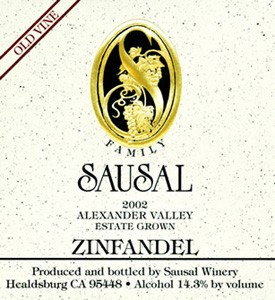
Mouth value: When wine comes with a disclaimer, as was the case with the 2002 Sausal Blanc ($7), it’s best to pass. Described by the staff as being for “people who don’t like reds,” it was almost an apology. Stick with what Sausal does best: Zinfandel. The nonvintage Cellar Cats Red ($12) is an agreeable picnic sort of wine dedicated to the tasting room’s beloved felines. Most of the other Zinfandels we tasted, mostly ’02 vintages ranging from ($18 to $26), were all a bit tight, but they had nice characteristics of mineral and briar that made for approachable, if not always outstanding, wines.

Don’t miss: The family’s patriarch, Abele Ferrari, held the patents to a number of winemaking machines, including a stem crusher he manufactured in Healdsburg. You can see diagrams and copies of the patents in the tasting room.

Spot: Sausal Winery, 7370 Hwy. 128, Healdsburg. Open daily, 10am-4pm. Regular tastings are free. 707.433.5136.

From the April 27-May 4, 2005 issue of the North Bay Bohemian.
© Metro Publishing Inc.

News of the Food

0

News of the Food

All in the Pot

By Gretchen Giles

Known for its award-winning red varietals–most notably its insanely yummy Zinfandels–Quivira Vineyards can add another newsworthy bit to its scrapbook. In addition to boasting an impressive collection of historical cartography explaining the claiming of the New World as well as any text book, and as well as its justly lauded innovative creek restoration program, Quivira has also just completed its transition to a 100 percent solar operation. A biodynamic agricultural outfit that aims to trifle as little with natural rhythms as possible, choosing instead to work in tandem with the interconnectedness of the earthly world, Quivira now generates all of the energy that it needs to produce some 25,000 cases of wine a year just from that nice, big star gravity has roped us to. We raise a glass to that, indeed. . . .

Speaking of swirling, the Napa Downtown Association aims to entice more resident tourists (that’s us) to the town center with a new discounted winetasting card. Costing just $15, the Taste Napa Downtown card allows aficionados to sample wines at 10 different tasting rooms and wine bars for just 10 cents a throw. Participating venues include Bounty Hunter–which really only exists in order to celebrate the rare, the difficult and the far-flung grape-made libations–as well as Back Room Wines, COPIA, Robert Craig Wine Cellars, Wineries of Napa Valley and others. The Taste Napa Downtown card also offers discounts on bottle purchases and a free admission to COPIA, which at $12.50 pretty much pays for the card. . . .

And hey, following the sinuous flow here, COPIA presents its own Linda Carucci in a full day of cooking demonstrations and discussion about her newest tome, Cooking School Secrets for Real World Cooks (Chronicle Books; $22.95) on Saturday, April 30, all the day long. Carucci, COPIA’s Julia Child Curator of Food Arts and a longtime cooking-school teacher with her own East Bay educational kitchen, will discuss the problems and pleasures of testing recipes, and demonstrate for the home chef Cordon Bleu techniques previously hush-hushed and now laid bare for anyone to know. There will be book signings through out the day as well. For details, call 707.259.1600. . . .

Speaking of kitchens and Napa and next Saturday (man, the segues!), the Kitchens in the Vineyards tour is slated for Saturday, April 30, from 9:30 am to 4:30pm. Benefiting the Music in the Vineyards chamber-music festival held each August, this self-guided tour has got legal and lovely voyeurism down, replete as it is with food. Peek into the dining areas, kitchens, gardens and great rooms of five Napa Valley homes, where area chefs and cookbook authors will be slaving and toiling to churn out gorgeous plates of fine-dining-type food. Tickets are $45-$50. For details, call 707.258.5559. . . .

On the opposite end of the spectrum from fine dining but right in line with good works (and there is one located in Napa), the Northern California Chinese food chain Panda Express aims to help the Oakland Zoo raise some $35,000 to support its effort to open a giant panda sanctuary and research facility. The zoo plans to bring two guest pandas to its spread for a 10-year “visit” from China. Eat for the giants the last Thursday of the month April through June, beginning April 28 at 5pm, and Panda Express will donate 20 percent of the net proceeds to the zoo. The company already supports the nonstop feeding habits of a giant panda, Pei-Pei, living in China. There are five Panda Express locations in the North Bay.

From the April 27-May 4, 2005 issue of the North Bay Bohemian.

© Metro Publishing Inc.

The Byrne Report

The Byrne Report

Cable Fist

WHEN THE AMERICANS invaded Iraq in March 2003, my wife and I became so sickened by the blood and lies on television that we decided to kill the messenger. I called the local cable monopoly, Comcast Corp., and had the TV signal disconnected, keeping the broadband Internet connection–thinking to save a few bucks in the bargain.

Nope. The next bill was the same. Turns out that my rate was based on bundling television and broadband. We were to be penalized for unhooking the government propaganda network. Enraged, I had Comcast reconnect the TV signal. We put the beastly machine in a closet and have not watched it since.

I recently became re-enraged by Comcast, when it banned all FM radio from its cable pipe, including KPFA and National Public Radio–stations that run programming somewhat critical of Corporate America. We don’t have enough room on our teeny tiny broadband for FM radio, Comcast claimed, as it made way for more Clear Channel drivel.

I wanted to register a complaint, but where to go? Whereas cable TV and telephone are semiregulated, cable modem Internet is not regulated by anybody–not the local government, not the California Public Utilities Commission (CPUC), not the Federal Communications Commission. Despite the fact that broadband uses the same cables that television and telephone electrons travel, web flow is not considered to be an “intrastate telecommunications service,” but an “interstate information service.”

The U.S. Supreme Court is currently considering whether broadband should be regulated. Today, however, Comcast, which grossed $20 billion last year, can jack up its Internet fees at will, deliver its trademark poor quality service and charge a premium for slightly upgrading the sputtering technology.

It is slicing up the cable market with erstwhile competitors–such as Time Warner, Disney, Microsoft, Sprint and Liberty Media International–without eliciting a single antitrust fart out of the Bushies. Market concentration, as usual, is proving fatal to the notion that “free enterprise” promotes technological innovation.

According to the May/June issue of Foreign Affairs, the broadband service provided to most U.S. homes is “among the slowest, most expensive and least reliable in the developed world.” Internet expert Thomas Bleha reports that “nearly all Japanese have access to high-speed broadband with an average connection speed 16 times faster than in the United States–for only about $22 a month.” In Japan, Internet connections can whiz along at 40 megabytes per second. Much of the U. S. slugs along at 1.5 megs per second. In the North Bay, Comcast recently upgraded residential customers to 4 megs. But if you want 6 megs–which in much of Asia is molasses–you have to fork over another $10 per month to the cable monopoly.

There are reasons why Comcast, the largest cable provider in America, appears to be deliberately retarding progress. Bleha comments: “Cheap, high-speed broadband would lead to widespread use of Internet telephones and thus threaten the phone companies’ lucrative voice-telephone business.” Comcast provides 1.2 million customers with relatively expensive cable voice telephone.

Bleha continues, “And more inexpensive broadband would multiply outside video and movie offerings and endanger the cable companies’ profitability.” In the North Bay, potential high-speed Internet-delivery competitors are excluded from Comcast’s unregulated cable modem infrastructure.

Commenting on the Foreign Affairs article, a spokesperson for the National Cable and Telecommunications Association, an industry trade group based in Washington, D.C., said that Asian countries are more advanced than the United States because “their population is very heavily concentrated in urban areas, and broadband development is subsidized by the government.” Of course, neither Santa Rosa nor San Francisco are fully connected to broadband, so that first argument is fatuous. As for the government subsidy, according to Comcast’s 2004 annual report, the federal government allowed Comcast’s $50.6 billion acquisition of AT&T in 2002 to “be structured as a tax-free transaction to Comcast Holdings and AT&T.”

That sounds like government subsidy to me. Not to mention that zero regulation is a form of subsidy, in that profit-dripping rates are set by cartels without government oversight.

CPUC commissioner Geoffrey Brown told me there are anticonsumer trends in cable Internet: gradual consolidation with fewer players; dismantling of state authority and preemption of price regulation; elimination of customer-protection rules.

Brown sees that the telecommunications giants, like SBC Communications, and the cable guys, like Comcast, are struggling to combine traditional telecommunications, like telephony, with Internet protocol as a way to escape all regulation.

Forever.

From the April 27-May 4, 2005 issue of the North Bay Bohemian.

© Metro Publishing Inc.

Real Estate and Romance

Loads of Potential: Men might come and go, but a house is forever.

I Married My House

Adventures in real estate and romance

By Jill Koenigsdorf

When I was in my 30s, I fell in love. Of course, it was not the first time it had happened, but this fellow was the first one, even at my advanced age, that I could imagine doing all the “grown up” things with, if one defines grown up as getting married, buying a house and starting a family. Happily, he too could imagine it, so on New Year’s Day, during the El Niño floods of 1997, we dodged breaking dykes in the Central Valley as we sped to Yosemite to stand under an umbrella on the top of a rock to be joined in matrimony by the cowboy-boot-wearing Pastor John Paris, a romantic name, I felt, and one that boded well.

There are little water spots on some of the photos of this elopement, and they give the photos a prismy, ’60s-album-cover quality. Pastor Paris was the first to tell us that it’s “good luck to get married on a rainy day,” but he was not the last. Alas, he was wrong.

Perhaps our problem was not the rain, but the fact that we did everything in the “wrong” order. First, we tried to get pregnant, then we bought a house together, without having ever lived together, and then we got married. Oddly enough, the buying of the house proved to be the most traumatic and weighty of these three decisions.

It all had seemed like a swell idea. Fresh-faced, full of hope and in love, we had set forth in Berkeley to buy our first home and, by golly, we had enough for a down payment on a domicile that could cost as much as $180,000. Surely, we thought, a more-than-ample budget.

Almost immediately, we became well-acquainted with the phrases “Fixer-upper,” “Just needs some TLC,” “Will shine for the right owner,” “Loads of potential,” “Carpenter’s dream!” Our house was beginning to sound like the way a friend describes an unpopular kid in high school that she’s trying to fix up for a date. Rotting floorboards; abundant, giddy termites; crack dealers on the corner; bedrooms the size of a single bed; warped floorboards; mildew; trash in the streets–all of these were somehow summed up by our real estate agent in one word: “Character!”

Defeated and wondering if we should move to Kansas, we decided to give it a rest for a while. We still were not even living together; I was in Berkeley and he was in Sonoma, and I loved going to visit him up there on the weekends.

One Sunday, I grabbed the real estate section and looked at the North Bay listings. I own a business in Oakland, and it was sheer folly to even contemplate living so far away from my job. But there was one listing, right in Sonoma, with a pool and a third of an acre for $200,000. This is how warped buying a house here is, even in 1997: When the maximum you can afford is $180,000, you start thinking that $200,000 isn’t so much more.

“Let’s at least go look at it,” I urged. He thought I was not thinking things through, and of course he was right, but I took one look at the 40-year-old lilac bushes and the studio I could write in and the huge garage he could use as his shop and the view of Sonoma Mountain and the pool and the porches, and all logical thought took flight like the yellow finches chortling in a tree in the backyard. We sat by the pool holding hands, palms sweaty and hearts racing. “It’s crazy,” he said. “You’d be driving two hours a day for work! Right now you can walk to your shop.”

I look back on that decision now, to when our bond was strong and we were full of conviction that we could make anything work, and wonder if the repercussions of buying the house–all that time apart; my living essentially part-time where I worked and part-time with my husband; his feeling an ebbing desire to work on the place because that’s what he had to do all day at his job–contributed both to his decision to return to grad school and his realization that he didn’t really want to have children after all. Can a house do all that?

He’s moved on now, and I find myself a member of the growing ranks of a new real estate phenomenon: the single homeowner. Between 1994 and 2002, the number of single women owning homes climbed from 13.9 million to 17.5 million. And those are just the figures for singletons. Only 4.2 million divorcees owned homes in ’94 compared to 6 million now; there were 6.7 million widows owning then, close to 8 million now. I guess we female homeowners are a force to be reckoned with. Still, there is the pesky fallout of that accomplishment: isolation.

Given that one in five homes bought today is purchased by a single woman, and given that she has only one income, it must be assumed that these figures are referring to first-time female buyers of homes in suburban, family-oriented communities. There is even an alarming blog site concerning the influx of single women in such communities, where they are seen as being somehow threatening to the neighborhood. “They want our husbands and babies!” one poster wailed, to which a single woman paying her own mortgage retorted, “It’s more like we don’t want to rent.”

Statistics reckon that in order to own a home, many people in the Bay Area commute up to four hours. The average median price for a home in 2005 in any of the nine Bay Area counties is $556,000, more than half a million dollars for a single-family home, not a mansion. The average price in 1995 was $293,000, still no white elephant sale.

Furthermore, committing to homemaking alone crimps one’s style romantically. Days off are often spent engrossed in such activities as mowing. Sometimes it feels as if everyone in the town of Sonoma has married their high school sweethearts, and the grocery story is a sort of constant class reunion. Everything closes around 8:30pm. “That’s why they call it Slownoma,” jokes another divorced friend who is devoted to her house.

Six months after my divorce, I began dating Daniel, but since his daughter was moving out to attend college, and since he had no desire to go back to renting, he found that for $30,000 he could own a wee house with some woods around it in a depressed logging town in Southern Washington. He seems convinced that the influx of people his age in the same position as himself will transform his town into a thriving, arty community, despite an abundance of churches and taverns and a distinct dearth of cafes. Personally, I get listless when too many days pass without sunshine. We cross state lines now and then to have reunions and share our tales of home improvement, but neither of us is likely to change our address.

Given how much of my heart and soul I have put into my little home over the past eight years, I guess I should just face facts: I have married my house. But with all the flux of the Bay Area, all the moving and juggling and comings and goings dictated by relationships and income and jobs, maybe having a haven, a comfortable shelter that is the one constant in one’s life, isn’t such a bad thing. Maybe I’m part of a phenomenon that reflects some sage observation Katherine Hepburn made years ago: The best way for two people in love to live together is as neighbors.

From the April 27-May 4, 2005 issue of the North Bay Bohemian.

© Metro Publishing Inc.

Briefs

0

Briefs

Out of the Woods

As Pepper Spray Trial III gets underway in San Francisco, it’s worth noting that environmental activism isn’t just a lifestyle in Humboldt County–sometimes it’s a matter of life and death. Back in 1997, eight members of North Coast Earth First! were pepper-sprayed by Humboldt County Sheriff’s Department officers–some activists had the burning, toxic substance swabbed directly into their eyes with Q-tips–and are seeking compensation for damages in federal court for the third time, after the first two trials ended in hung juries. Yet the so-called Pepper Spray 8 got off lucky, relatively speaking. In 1998, an angry logger felled a tree that struck and killed North Coast Earth First! activist David “Gypsy” Chain. Last month, North Coast Earth First! activist Shunka Wakan filed a criminal homicide complaint against Maxxam-owned Pacific Lumber for Gypsy’s death, calling for Humboldt County officials to reopen the investigation. “I believe that David Chain’s death was no mere accident,” says Wakan. “Reopening the investigation would reveal both an act of violence, on behalf of Maxxam/Pacific Lumber, and a blatant cover-up, on behalf of the former sheriff, district attorney and homicide detective.” When Humboldt County activists aren’t being assaulted by local law-enforcement officials and/or angry loggers, they occasionally pull off major victories, such as the State Water Resource Control Board’s recent issuance of a stay against Pacific Lumber’s timber harvest plans in the Freshwater Creek area near Eureka. The timber plans were approved last month in Santa Rosa by the North Coast Regional Water Control Board. The stay was requested by the Sierra Club, Humboldt County’s Environmental Protection Information Center and the Humboldt Watershed Council.

Stamp of Disapproval

Singularly named Guerneville stamp artist Harley is ecstatic that last week the U.S. Secret Service dropped in on “Axis of Evil: The Secret History of Sin,” an exhibit of provocative, politically charged stamp art at Chicago’s Columbia College that includes Harley’s work as well as that of North Bay artists Tim Mancusi and Qursad Karatos.

“I think it’s terrific publicity,” says Harley in all earnestness.

Apparently, some patrons had taken umbrage with a stamp in the show that depicted President George W. Bush with a revolver pointed at his head, and called the Secret Service. The piece was titled “Patriot Act.” The agents requested names and addresses of artists participating in the show, but were told the information wasn’t available, according to the Chicago Sun-Times. “It’s just another part of the great march backwards we’re engaged in,” says Harley.

From the April 20-26, 2005 issue of the North Bay Bohemian.

© Metro Publishing Inc.

‘Miss Congeniality 2: Armed and Fabulous’

0

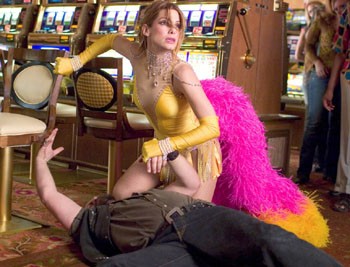
Krav Maga Mama: Sandra Bullock proves to be more than congenial.

Fight Night

Harley Jane Kozak gets a kick out of ‘Miss Congeniality 2’

By David Templeton

In its ongoing quest for the ultimate postfilm conversation, Talking Pictures takes interesting people to interesting movies.

Harley Jane Kozak does not go to the movies much anymore, not unless the movie features animated fish or fluffy day-glo animals. She tells me this as we take our seats in the sprawling Metreon theater complex in San Francisco, where I am about to treat the L.A-based author, actress and mother of three to an afternoon matinee of Miss Congeniality 2: Armed and Fabulous. So movie-deprived has Kozak been, that when the Metreon throws no less than eight high-volume previews at us (everything from Monster-in-Law and The Longest Yard to Fever Pitch and The Sisterhood of the Traveling Pants), my guest is fairly delirious with joy.

“I guess it’s just a reflection on how long it’s been since I went to a movie that wasn’t made by Pixar, but I found all the trailers to be really exciting,” Kozak laughs, cradling a cup of coffee after the show. “Just the idea that I was sitting in a movie theater watching trailers was exciting. It’s been so long.”

It’s been even longer since Kozak made a movie, having put her career on hold to raise her kids. Though she has recently accepted a small part in an independent horror film called Sorrows End (“It’s two days of work and my head implodes. How could I say no to that?” ), after years in the business, with prominent parts in such movies as Arachnophobia, Parenthood, When Harry Met Sally, Dark Planet and The Amy Fisher Story (Drew Barrymore version), Kozak says she’s happy enough taking a break to be a mom.

Of course, she also writes books.

Her genre-blending mystery novels, Dating Dead Men and her latest, Dating Is Murder (Doubleday; $19.95), follow the adventures of Wollie Shelley, a stunning, crime-fighting graphic artist with serious dating issues. They are part action-adventure, part romantic-comedy and part mystery-thriller-cultural-commentary.

“I like books and movies that are stitched together from different genres,” she explains. “So of course I loved Miss Congeniality 2.”

For those who missed the trailer, it stars Sandra Bullock in the follow-up to her 2000 hit about tough, fashion-challenged FBI agent Gracie Hart. The first one was a romantic comedy, as agent Hart gradually falls for another agent played by Benjamin Bratt. In the sequel, Bratt is gone, and so is any hint of romance. This one is a buddy-comedy in which Hart is paired with an even tougher agent, played by Ray‘s Regina King, and the two take turns walloping the bejeezus out of each other on the way to becoming best friends.

“I liked this one better than the first one,” Kozak says. “But then, I’ve never seen the first one all in the way through because I always catch it on TV while I’m folding laundry or something.”

“It was really obvious to me,” she continues, “that this film is one of those cross-genre films. It marries a lot of the conventions of action-adventure with most of the elements of romantic comedy. And that’s exactly what I’m playing around with in my books. How far can you stretch the various genres? What can you take out or sneak in without turning them into a completely different genre? What I loved was that they took a romantic comedy and just removed the romance. And it worked.”

The other thing she enjoyed about Miss Congeniality 2 was the realistic female-on-female butt-kicking. It turns out that Kozak is a student of Krav Maga, a form of martial arts taught in Israel to the army and to law enforcement. It’s become very popular in Hollywood, and in her latest book, Kozak’s leading lady attends a hilarious Krav Maga class.

“Krav Maga is essentially street fighting,” Kozak explains. “I took an introductory class, and I loved it so much I signed up for a year. That was two years ago, so now I’m, like, a yellow belt.”

“Street fighting?” I ask. “That’s what–punching and kicking?”

“Punching and kicking, yeah,” she smiles. “Putting people in choke holds. Breaking fingers. Gouging out eyes. Fun stuff like that.”

“So the stuff Sandra Bullock and Regina King do to each other in Miss Congeniality 2, you can do all that?”

“I can,” she says, happily. “That’s why I loved those scenes so much. I loved what those women were doing to each other. I really wanted to have the pause and replay. Someday, I’ll get the DVD of this, so I can watch them beat each other up over and over.

“What can I say?” she shrugs merrily, “I’ve been deprived. But it really was fun to watch.”

From the April 20-26, 2005 issue of the North Bay Bohemian.

© Metro Publishing Inc.

Swirl n’ Spit

0

Swirl n’ Spit
Tasting Room of the Week

Murphy Goode Winery

By Heather Irwin

Lowdown: As much as I think certain wineries need to be publicly spanked into improving their tasting-room staff, there are a few that really need to be lauded for doing a pretty darn spectacular job. And not just because they happen to recognize me, or my credit card.

Last Sunday, I strolled into Murphy Goode less than 20 minutes before closing time. Even at that late hour, when everyone’s ready to call it quits, it was quite possibly one of the most perfect tasting-room experiences I’ve ever had.

It wasn’t because it was the best wine I’ve ever had, though I ended up buying three bottles. And it wasn’t the most impressive tasting room I’ve ever seen. Simple and dominated mostly by the bar, Murphy Goode relies less on selling schwag and more on the wine and its staff to make the sale. While our pourer didn’t appear to possess some godlike knowledge of wine, he seemed like a guy who liked wine, liked to talk about it, liked to chat with people who asked intelligent (and not so intelligent) questions and, most importantly, liked his job. Add that to the wine, and perfection is nigh.

Mouth value: Some of the most recognizable wines in Murphy Goode’s label are the Tin Roof series. These value-priced screw-top pours (usually under $7) are great for parties, but you’d do well to skip ahead to really get a sense of some of the better wines. Murphy Goode is best known for its outstanding Fume Blanc ($12). Though its actually just a fancy name for Sauvignon Blanc, the Fume is briefly oak-fermented, giving it a deeper, more vanilla-like characteristic in addition to the melon and fruit flavors Sauvignon Blanc is known for.

Also made from Sauvignon Blanc grapes is the Deuce ($19), which is both steel- and oak-fermented, then malolactically fermented. What all that means is that instead of just a crisp, fruit-forward flavor, you get a softer, creamier finish with a little more depth. Think of it as the difference between sorbet and gelato. Murphy Goode is also strong with its reds, with a stable of Pinot Noir, solid Zins, Merlots and Cabs, in addition to the rather unique Alexander Valley Petit Verdot. Usually used as a blending grape, Verdot’s inky color is a beauty in the glass. The best of the bunch was the Brenda Block Cabernet ($26), a limited-production wine with lots of dark cherry and chocolate flavors in the glass.

Five second snob: Most people think of the dry, puckery Sauvignon Blanc grape as being almost exclusively steel-fermented. To keep the flavor really crisp, many vintners don’t let the grape touch oak. But when young wines are exposed to oak–especially new oak–they pick up the smoky, sometimes toasty flavor of the oak, giving it depth and a more California Chardonnay-like characteristic.

Spot: Murphy Goode Winery, 4001 Hwy. 128, Geyserville, Open daily, 10:30am to 4pm. Regular tastings are free. 707.431.7644.

From the April 20-26, 2005 issue of the North Bay Bohemian.

© Metro Publishing Inc.

Amos Klausner

Photograph by Michael AmslerForward Looking: MOCA director Amos Klausner.Pushing the EnvelopeNew MOCA director Amos Klausner tests the boundariesBy Gretchen Giles Emerging from his office on a recent afternoon, Amos Klausner is full of apologies. While hands are still being shaken, he apologizes for being dressed in utterly clean work boots, crisp laundered jeans and a new-looking plaid work shirt....

Free Mind Media

Photograph by Elizabeth SewardUnbound: Free Mind Media member Ben Saari has helped to open an 'infospace' that shares less-than-conservative books and ideas.Room for DissentFree Mind Media offers young radicals space to explore viewsBy Gabe MelineSonoma County is known for a good deal of peace-loving activism, but the activity centered around the newly formed Free Mind Media center is shaping...

Briefs

BriefsGlobal Exchange It's no secret that America has lost respect abroad. Waging a preemptive war for no apparent reason hasn't done a lot to build up our reputation. The Stamford, Connecticut-based Academic Year in America seeks to improve our standing with the rest of the world with its Future Leaders Exchange Program (FLEX) and the Partnership for Learning Youth...

Swirl n’ Spit

Swirl n' SpitTasting Room of the WeekSausal WineryBy Heather IrwinLowdown: Driving into Sausal amidst wandering dogs, unfamiliar driveways that launch off in foreign directions and unfenced front yards with families watching you drive by, it's easy to feel like you've taken a wrong turn and ended up in a remote country subdivision rather than a winery. There aren't many...

News of the Food

News of the FoodAll in the PotBy Gretchen GilesKnown for its award-winning red varietals--most notably its insanely yummy Zinfandels--Quivira Vineyards can add another newsworthy bit to its scrapbook. In addition to boasting an impressive collection of historical cartography explaining the claiming of the New World as well as any text book, and as well as its justly lauded innovative...

The Byrne Report

The Byrne ReportCable Fist WHEN THE AMERICANS invaded Iraq in March 2003, my wife and I became so sickened by the blood and lies on television that we decided to kill the messenger. I called the local cable monopoly, Comcast Corp., and had the TV signal disconnected, keeping the broadband Internet connection--thinking to save a few bucks in the...

Real Estate and Romance

Loads of Potential: Men might come and go, but a house is forever.I Married My HouseAdventures in real estate and romance By Jill KoenigsdorfWhen I was in my 30s, I fell in love. Of course, it was not the first time it had happened, but this fellow was the first one, even at my advanced age, that I could...

Briefs

BriefsOut of the WoodsAs Pepper Spray Trial III gets underway in San Francisco, it's worth noting that environmental activism isn't just a lifestyle in Humboldt County--sometimes it's a matter of life and death. Back in 1997, eight members of North Coast Earth First! were pepper-sprayed by Humboldt County Sheriff's Department officers--some activists had the burning, toxic substance swabbed directly...

‘Miss Congeniality 2: Armed and Fabulous’

Krav Maga Mama: Sandra Bullock proves to be more than congenial.Fight NightHarley Jane Kozak gets a kick out of 'Miss Congeniality 2'By David TempletonIn its ongoing quest for the ultimate postfilm conversation, Talking Pictures takes interesting people to interesting movies.Harley Jane Kozak does not go to the movies much anymore, not unless the movie features animated fish or fluffy...

Swirl n’ Spit

Swirl n' SpitTasting Room of the WeekMurphy Goode WineryBy Heather IrwinLowdown: As much as I think certain wineries need to be publicly spanked into improving their tasting-room staff, there are a few that really need to be lauded for doing a pretty darn spectacular job. And not just because they happen to recognize me, or my credit card.Last Sunday,...
11,084FansLike
4,606FollowersFollow
6,928FollowersFollow