
Bennett Valley House

0

Sounds Good Music.2005
Grace Notes
A Loop Is a Loop Is a Loop
Just Plain Bob
Sublime Spindles
Bye Bye BVH
U Love 2 Swoon
Pukemeisters
Young Tree Grows
What Is Hip?


End of an Era

Bidding goodbye to the Bennett Valley House

By Gabe Meline

A whirlwind of activity surrounds the Bennett Valley House this week, which for the past 10 years has been a beacon to the underground community in Santa Rosa and a sacred venue for independent music.

The name “Bennett Valley House” is a double misnomer; it’s not actually in Bennett Valley and, even more importantly, its walls cannot be accurately described as supporting a mere house. For a decade, the BVH has served as an example of successful communal living, a center for political activism and a safety net for displaced youth. Over the years, this modest rental had become a community institution.

In the midst of all this activity, live music has been presented here since the mid-’90s, and in an era of increasing trepidation about house shows, the BVH has stood as a symbol of freedom for underground music.

As unpredictable as the shows at the BVH were, a typical visit would reveal some familiar scenes: all the good places to lock your bike were always already taken; you could be sure to meet someone changing guitar strings on the front porch; the living room would be scattered with people, drum parts and books, with someone cooking up rice and vegetables in the kitchen; you could find iced beer in the laundry basin; the smokers would congregate on the back porch, and a fire pit, always burning, would heat the backyard.

For every reason that bands play in commercial venues–to make money, to gain exposure, to stroke egos–there are equal and opposite reasons they play elsewhere. The BVH shows aimed to create a spirit of community, a feeling of togetherness and shared experience; even if the house was packed and the bands were great, the evening could still be deemed a failure.

Some of the most successful shows in this spirit were small, with songs and stories exchanged between performers who may very well never meet again. Earlier this year, a Vermont-based banjo and guitar duo called the Shiftless Rounders stopped by on a nationwide tour to perform with Devil Makes Three, an up-and-coming bluegrass trio from Santa Cruz. About 30 people showed up.

At larger shows, the house proved too small to contain its occupants. In 1995, Edaline and the Conspiracy crammed into the living room, and onlookers had to watch from the front yard. In 2002, a San Francisco band called the Mall played. It was so crowded, there was no use even trying to squeeze in the front door. At times, even the music itself has had to move outside; acoustic shows in the backyard garden were not unheard of.

With few exceptions, the house coexisted with its visitors and surroundings amazingly well. Cops showed up at the BVH only a scant handful of times but never issued tickets; sometimes they just told the band to turn it down a bit. Similarly, traveling bands nearly always treated the house with respect and chipped in on morning chores after staying the night.

You could never tell what you would see at the BVH, and that’s what made the shows so special there. Puppets have acted out songs by Neutral Milk Hotel. Daryl Scariot, playing solo in the kitchen, once rattled off all 65 agonizing lines of Elvis Costello’s “I Want You” with heart-stopping emotional precision. At one show, the singer for a hardcore band called Empire of Shit stripped naked and, after berating the crowd, convinced some audience members to strip naked too.

Being a communal house, there never was an assigned duty among residents to book shows. The make-it-up-as-you-go schedule filled up when someone knew a touring band passing through town or if someone at the house was moving out or having a birthday.

But it’s all come to a sudden end. After 10 years of allowing a vibrant community existence, the owner of the Bennett Valley House is placing it on the red-hot real estate market. As the current residents pack up, there will be a few final shows happening at the BVH along with some special ceremonies. Everyone is uttering the same phrase: It’s the end of an era.

Nevertheless, things have a way of coming full circle. On the night the BVH got its eviction notice, a party over in Rincon Valley that was packed with young people listening to three explosive new bands could be heard from seven houses away. Screaming high school students bounced off the walls, the abrasive crackle of the music rattled the windows and the band’s friends sang along to all the indecipherable lyrics.

With the passing of the Bennett Valley House, someone had better rent a house to these kids soon. A fallen tradition is in need of revival.

From the June 1-7, 2005 issue of the North Bay Bohemian.

© Metro Publishing Inc.

Skitzo

0


Mom Is So Proud: Sonoma County’s own Lance Ozanix pukes antifreeze upon a willing woman’s spacious bosom.

Duke of Hurl

Skitzo lead singer pukes his way to minor stardom

By R. V. Scheide

In Petaluma’s Phoenix Theater, where notorious North Bay heavy metal band Skitzo have just taken to an impromptu stage set up in the cramped lobby, there is essentially one question on the minds of the local headbangers encircling the power trio: When will Skitzo lead singer Lance Ozanix throw up?

“They’re playing two sets, so he’ll probably save it for last,” says one teenage metalhead knowingly.

That’s important and useful information, considering that at some point during the evening, Lance will likely guzzle down two liters of ethylene glycol, the toxic, chartreuse-colored liquid more popularly known as automobile antifreeze, which he will then regurgitate and spew upon the audience.

Lance is one of those rare individuals who can vomit on command. He discovered this talent at the tender age of seven, inspired by both the onstage blood-spitting of Kiss bass player Gene Simmons and Linda Blair’s experiments with pea soup in The Exorcist. A lifelong Healdsburg resident, Lance began puking professionally at 13, and though he never imagined he’d still be disgorging for dollars at age 38, the show, as they say, must go on.

Sounds Good Music.2005
Grace Notes
A Loop Is a Loop Is a Loop
Just Plain Bob
Sublime Spindles
Bye Bye BVH
U Love 2 Swoon
Pukemeisters
Young Tree Grows
What Is Hip?

“I don’t know how we take this abuse,” Lance admits in the Skitzo van before the night’s show. “It just kind of drags us along.”

There have been times, of course, when people have suggested that the show shouldn’t go on. Although Lance’s retching has been a Skitzo trademark from the very beginning back in 1985, when the band’s self-titled EP stirred up Europe’s heavy-metal scene, music has always been the group’s primary focus. In the late 1980s, with a couple of successful national tours under their belt, Skitzo were attracting major-label interest. During recording sessions for their fourth album, Derrangus, the rest of the musicians in the band begged Lance to stop.

“If you don’t stop puking, we’re gonna quit,” they told him.

“OK, I’ll quit,” he replied. “But mark my words, our audience will dwindle.”

Sure enough, after Lance ceased hurling, the crowds of 500 to 600 kids who turned up at Skitzo shows shrank to half that size. Lance once again began guzzling antifreeze and vomiting on fans, but it was too late. The momentum Skitzo had built was lost, and his renewed ralphing succeeded only in alienating the few audience members who remained.

A less visionary performer might have packed it all in right then, but Lance saw the sliver lining surrounding the pools of his greenish-yellow vomit. As the 1990s dawned in America, a new cultural age beckoned, defined by what might be called the “offending gesture,” epitomized by TV programs such as MTV’s Beavis and Butt-head and wildly popular shock-radio jocks like Howard Stern.

Nothing, it seemed, was too outrageous to say or do to an audience, and on TV programs such as Ripley’s Believe It or Not! and Jerry Springer, “Barf Boy” Lance and Skitzo found a new home–and legions of new fans. As the Clinton presidency took hold, Lance realized that the nation’s transformation was complete.

“After Clinton took office, women wanted to be puked on,” he recalls fondly.

“It was great for our show.”

This is not merely the vainglorious venting of some vile vomiteer (although the reader can’t be blamed for thinking that). The sad and astonishing truth is that women, and a good number of men for that matter, do seem to enjoy being puked upon, as documented on hundreds of occasions in Skitzo’s cult-classic DVD, Vomitorium. See Lance vomit on the voluptuous woman’s breasts. See Lance exchange egesta with that week’s bass player. See Lance train an audience member to puke on command. Vomitorium is quite possibly the most bilious film ever made, and as the liner notes warn, “bulimics or those with heart conditions need not view this DVD.”

Back at the Phoenix, as Skitzo–currently featuring Nate Clark on bass, Noah Smith on drums and Lance on lead vocals and guitar–tear into the second set, the amps compress the air, the floor shakes and the audience levitates, heads jerking back and forth in the familiar, trademark headbanging motion. This is old-school mid-1980s speed metal, à la Slayer, Exodus and Death Angel, and in the close confines of the Phoenix lobby, the atmosphere is nearly explosive.

In particular, Smith’s tiny drum kit seems like it might fly apart any second; his thunderous acceleration is awe-inspiring. Clark’s a large boy who fits his Warlock bass guitar well, dashing across the cramped stage with the grace of a ballerina. Lance frets his gold Ibanez guitar (“Whiteboy” says the sticker on it) with an index finger as the rest of his fingers seem to dislocate, reaching impossible distances down the neck even as he steps up to the mic to emit with a reptilian snarl: “On hallowed ground, the evil rises! / Swallowed souls of blackened blood ignited!”

It’s a little ditty called “Curse of the Phoenix” off Skitzo’s upcoming release, Heavy Shit, and it pays homage to this very venue, where tonight metalheads young and old, male and female, have gathered to hear such young guns as Hostility and Outrage roast the main stage, and maybe, if they’re lucky, catch a little bit of Lance Ozanix’s vomit in the lobby.

Beyond the question of why Lance does what he does (after screening Vomitorium, the answer is clear: It’s the chicks!), there’s the question of how he does it. According to health experts, consuming ethylene glycol in large amounts can result in nausea, convulsions, slurred speech, disorientation, heart and kidney problems and even death. Lance has already had his gall bladder removed in an incident related to his professional puking. How does he get all that green stuff down and back up again without keeling over?

“Basically, I go behind the drum riser during the drum solo at the end of the set and just swig it down,” he shrugs before the show, indicating the two-liter jug of antifreeze propped in the corner of the van. After he pukes, he retires backstage with a toothbrush and some Listerine to purge. “It’s not so toxic as long as I get it out of my system quickly.” He adds that “encores can be a bitch” since they can delay the final flush to a perilous degree. Nevertheless, Lance is still alive and retching.

“Some people are born with cast-iron stomachs,” confides a former Skitzo drummer. “Lance was born with a radiator.”

See if Lance gives it up when Skitzo play on the bill with Beautiful Ashes and Potential Threat at Pete’s 881 on Saturday, June 11. 721 Lincoln Ave., San Rafael. Call for details, 415.453.5888.

From the June 1-7, 2005 issue of the North Bay Bohemian.
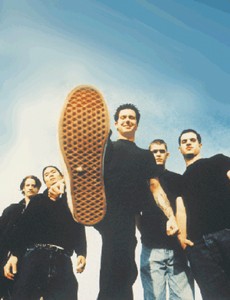
© Metro Publishing Inc.

What Is Hip?

0


Bottoms Up: Unwritten Law lost their street cred when they used Christina Aguilera’s songwriter on their latest.

What Is Hip?

Finding out what’s cool by stealing from your employer

By Jeff Latta

Earlier this spring, I stumbled across a paradise hidden in the offices of the North Bay Bohemian. Before me were rows and rows of compact discs that record labels had sent for review. “See anything you like?” the editor asked. What followed was a blizzard of music “borrowing,” the likes of which had not been seen since Napster’s hijacking heyday.

But one question kept popping up as I critically perused the shelves: Why did these people want their music reviewed by us? Then it hit me: alternative publications are cool, and for music to be successful it must be considered cool. So the artists and record labels send their most cutting-edge material to the journalistic authority on what is hip. My mission was now clear: grab all the recently released discs I could to discover what record companies consider cutting-edge.

In the spirit of information, I share the result of my Herculean labors.

Crap Stew

The first thing I learned was that a lot of acts–particularly those on major labels–try really hard to be cool. The most obvious example is Unwritten Law’s new album, Here’s to the Mourning (Lava/Atlantic). A mainstay on the independent punk scene before joining up with a major label in an effort to tap into that sweet Blink-182 cash, Unwritten Law now attempt to mix punk with countless other disparate ingredients to form a style best termed “crap stew.”

Their latest release features enough programming, slick pop tricks and overproduced jock-metal elements to make even classical music fans yearn for the days of the Ramones’ stripped-bare revolution. And when a punk band enlists the help of the same songwriter that Pink and Christina Aguilera use, they officially lose any and all street cred.

It is no surprise that major label Interscope, which sent more review copies than anyone else, managed to provide the best examples of attempted cool. For three such Interscope bands, the path to the cutting edge is, oddly enough, to become more accessible. Queens of the Stone Age simplified their signature stoner metal to a much more straightforward rock sound for their latest disc, Lullabies to Paralyze. It still satisfies, but not quite in the same way as their older, more varied material.

Then there’s Will Smith, grasping at the bass-heavy boredom of TRL rap with Lost and Found, all while ironically talking about how different he is from all the other rappers. Stick with making cuddly movies, Fresh Prince, leave the bland hip-hop to professionals like Nelly. And You Will Know Us by the Trail of Dead . . . used to find it difficult to get radio play, perhaps due to their eight-minute opuses of jangling, jarring experi-metal. For their new release, Worlds Apart, the band wrote shorter, simpler and more straightforward songs to create a sound more akin to new-era Modest Mouse than the Trail of old.

Sounds Good Music.2005
Grace Notes
A Loop Is a Loop Is a Loop
Just Plain Bob
Sublime Spindles
Bye Bye BVH
U Love 2 Swoon
Pukemeisters
Young Tree Grows
What Is Hip?

Clothes Make the Man . . . Suck

Another group that tried hard–really, really hard–to capture cool are Bay Area artists Rubbersidedown with their new release, ZeroFighter (V4 Records). These heading-over-the-hill mid-tempo rockers employ tough facial expressions and well-placed bottles of Jack Daniels to appear as stylish as possible on their album art. But it’s pretty difficult to look trendy when playing severely dated Gin Blossoms-style ’90s rock that sounds like it could be the soundtrack to a Beverly Hills, 90210 episode.

Still, the most horrifying example of crafting an image has to be the River City Rebels. These sexist grease monkeys offer generic punk-ish rockabilly peppered with gratuitous sexual imagery and themes. Whatever minor musical talent that may shine on Hate to Be Loved (Victory) is overshadowed by the group’s badly tattooed, overly eyelined, hyper-sexed appearance.

After all this posing and posturing from the bigger acts, many of the lesser-known artists and their no-frills ideals are like a breath of fresh air. The bluegrass stylings of Chatham County Line’s Route 23 (Yep Roc), for instance, are intricate and engaging. The group utilizes a four-part harmony to create a sound that is dense and layered. But the award for least image-conscious act has to go to Great Girl’s Blouse, who adorn their self-released EP 14741 with a casual picture of the group seated on a bench. The band’s music is diverse to an extent, experimenting with a grrl-rock format to create powerful folk with unexpected range.

Invention Takes Flight

Perusing my stacks, I was surprised to find not one but two releases from a little-known label, Grey Flight Recordings. The first was from an inventive group called Respira. Their five-song recording This Is Not What You Had Planned tinkers with the standard emo formula of bands like Saves the Day to come up with soulful and powerfully sung rock performed in a wide variety of styles and moods. Unfortunately, the other Grey Flight offering, Irradio, made no such attempts at reinventing the indie rock wheel. Their formulaic, Fugazi-inspired Make-Up for the Inaugurated is maddeningly repetitive and grows increasingly irritating as the disc plays on.

State of the State of Things

Were the albums sent to the Bohemian truly the cream of the cool crop, the cutting edge? For popular music’s sake, I hope the answer is a resounding no. But another question must also be asked. What is a large music conglomerate’s definition of cool?

Is it whatever’s popular or is it what goes against the grain? More often than not, the major-label music seemed to be a combination of the two.

As the counterculture grows more mainstream, more groups will alter their sound for the masses, as Trail of Dead do.

But the best bands will always be the ones that don’t even try. Before I began stealing off the shelves, I never would have guessed that, from a stack of the latest releases across all genres of the music, the coolest groups would be a traditional bluegrass band and an unknown indie rock act on an unknown indie rock label. It appears that naked honesty, raw emotion and being true to one’s self–that’s what is cool.

From the June 1-7, 2005 issue of the North Bay Bohemian.
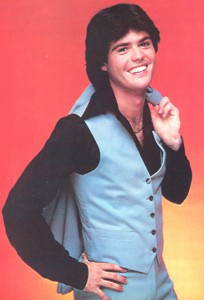
© Metro Publishing Inc.

Bob

0


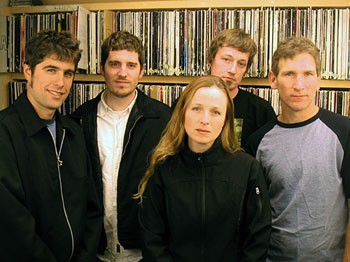
Donny!: From Judas Priest to Donny Osmond, mono-monikered radio runs the gamut.

Name Game

The KNOB goes Bobbing for listeners

By Bruce Robinson

For those who’ve always wanted to be on a first-name basis with a local radio station, meet Bob. Well, actually he’s not a station, exactly, just a format. And he’s got a lot of company, all across North America: Jack is the most common name, but there’s also Sam, Dave, Ben, Ed, Charlie, Mike, Max, Doug and the sole female representative, Alice.

“I think it’s hilarious that people think a brand-new format only has to be one name to be a winner,” laughs independent media observer and investor Robert Unmacht. He sees the mono-monikered station as “just oldies aimed at 35- to 45-year-old” listeners. Conventional oldies stations, which concentrate on music from the 1950s and ’60s, now attract listeners in the “55-plus” age group, Unmacht adds.

By whatever name, these stations are trying to court listeners by reversing the trend toward ever tighter play lists that has stifled commercial radio for at least a decade. “Many Jack stations are playing more than a thousand songs, whereas in format radio, the numbers tend to be much smaller,” often 350 or less, explains Fred Jacobs, founder of the national radio consulting firm Jacobs Media.

“The oft-asked question in format radio is, ‘Does that song fit the format?’ Jack really blows that all up,” he continues. “The essence of Jack is to create train wrecks, songs that don’t really go together very well, which creates that element of surprise and unpredictability, which makes them sound very different from format stations, which is what they’re going for.

“But there may come a point when hearing Judas Priest into Donny Osmond gets tiresome, if not completely annoying,” he assents.

Sounds Good Music.2005
Grace Notes
A Loop Is a Loop Is a Loop
Just Plain Bob
Sublime Spindles
Bye Bye BVH
U Love 2 Swoon
Pukemeisters
Young Tree Grows
What Is Hip?

One of the earliest manifestations of this now-burgeoning trend, Alice, spread from Denver to five other markets, including San Francisco. But it wasn’t until Bob hit town last June that Sonoma County got familiar with the first-name format. Found at 96.7-FM on the dial, the format was “flipped,” in industry jargon, from “the Tool,” a hard-rock channel that was in turn preceded by a much softer classic-rock format. The former call letters, KTOL, were also dumped as part of the Bob-ification of the station to the punchier (and rhyming) KNOB.

KNOB is one of four Santa Rosa stations owned by Sinclair Communications (not the ultraconservative television group), which also has various stations in Norfolk, Va., and Austin, Texas, including a Bob-FM in each market. Although the format was first created at a station in Vancouver, B.C., Bob in Norfolk “was the first one in the United States, which launched just before we did,” says Dean Kattari, operations manager for Sinclair’s Santa Rosa stations. “We were definitely first in the pool.”

That’s confirmed in a recent analysis by Paul Wright in the online newsletter Mediaguide, which points to a pair of Jacks in Dallas and Denver as the very first in the country. By early May, Wright tallied 20 such stations, and more are climbing on every week.

Kattari claims that Bob draws from a music library of some 3,000 songs, “nine or 10 times what a standard radio station has.” Not all are played equally. “We rest a lot of things” to keep them fresh, he adds. Still, that pales next to sister station KRSH 95.9-FM, which may have 4,000 to 5,000 songs available at any given time.

With the Bob format shared among three Sinclair stations, “everything kind of starts out there in Norfolk,” Kattari says, “but we do some tweaking here to make it more California-friendly. San Francisco is completely different than being on the East Coast, so the ’60s and ’70s stuff is tailored to what was a hit here.”

Bob’s slogan, “We play anything,” is perilously close to Jack’s “We play what we like,” which in turn has become the slightly derisive catch-all used by some radio programmers to describe the Bob/Jack stations. That underscores the considerable commonalities among these stations, even as each tries to offer its own version of the concept. Fred Jacobs cracks that rather than Bob and Jack being akin to Coke and Pepsi, “it’s more like Taurus and Sable,” the Ford/Mercury automotive clones.

“The Jack folks would tell you that there’s a lot of difference between their package and everybody else’s,” adds former Billboard radio editor Sean Ross, “but what’s at the center is pretty much the same: rock for women, songs you haven’t heard on the radio for years and a variety of relatively safe music as a hook.”

KRCB news director Bruce (Robinson) first took to the airwaves as a 16-year-old jock in 1968.

From the June 1-7, 2005 issue of the North Bay Bohemian.
© Metro Publishing Inc.

‘Achtung, Baby’

0

Sounds Good Music.2005
Grace Notes
A Loop Is a Loop Is a Loop
Just Plain Bob
Sublime Spindles
Bye Bye BVH
U Love 2 Swoon
Pukemeisters
Young Tree Grows
What Is Hip?


The Real Thing

One album, one band–a love letter

By Hannah Strom-Martin

Forget Britney and her clones. It’s rock and roll, thank God, not pop, that is the voice of sensuality in the modern age. Moreover, in rock, sexuality is religion. When we talk about rock “gods” what we’re really speaking to is rock’s uncanny ability to channel the divine force of creativity directly through the pelvis.

And no one knows this better than U2.

If there is a soundtrack for love and sex in the eye of the millennium, then it’s Achtung, Baby. The 1991 album by the Irish supergroup is not only the best thing they’ve ever done, it’s one for the ages. In 12 ass-kicking tracks, it explores every possible aspect of sexual/romantic love: the darks, the lights and the pesky grays. Ever had a lover who ate your heart directly off your sleeve? This album understands. While never losing sight of the pitfalls that love can wreak on a perfectly decent human being, Achtung, Baby also sees love as a direct conduit to God, alluding to its divine source through song titles (“Mysterious Ways”), lyrics and musical arrangements that take their cues from gospel, soul and classical requiem.

From the crunchy, empowered opener “Zoo Station” to the unsettling conclusion of “Love Is Blindness,” Bono and the boys explore love in an unflinchingly poetic light. Here is the celestial swoon of sexual consummation, the hot sweat of lust, the tragic opera of unrequited desire and the dark depression of self-delusion, all rendered as big and loud as human drama itself.

This is the album that brought us “One,” the bittersweet, soaring ballad of sensual union that Rolling Stone rightly named one of the top 100 songs of all time. Bono’s gift for poetry has never been more poignant or breathtaking than when he asks his lover if she’s come back “to play Jesus to the lepers in your head.” The Edge’s guitar had never tugged so many heartstrings. It’s a song whose themes most bands haven’t the brains to juggle: both the story of a relationship teetering on the brink of destruction and an affirmation that all will be well if two hearts act as one. It offers no reassurances. On any other album, it would be the glittering centerpiece; on Achtung, Baby, it’s just one jewel among many.

Like love, the songs on Achtung, Baby are a boiling mix of the sacred and the profane, the ideal and the cynical. The sex-on-a-stick preening of “Even Better Than Real Thing” swaggers around Bono’s coy lyrics as he cajoles his hesitant lover. But any chance that this is your straightforward rock seduction goes flying out the window once he kicks into the refrain: “You’re the real thing, / Yeah, the real thing, / Even better than the real thing.” The backup vocals soar wordlessly, like saints abandoning themselves to the rapture, but there’s something off-putting in this last line.

If this sweeping orchestra of sex isn’t “the real thing,” then what is? Is our protagonist a spurned man, merely settling to ease his pain? Or has he really obtained sexual enlightenment? Bono isn’t telling.

Some songs, however, are a blatant slap in the face. “Who’s Gonna Ride Your Wild Horses?” finds the band apparently making music in a postapocalyptic junkyard, the hollow, broken sound of the Edge’s guitar howling through the blasted terrain of unsatisfied desire. “So Cruel” tackles the mind games of a one-sided relationship and the masochistic co-dependency that leads to its destruction. Both songs seem written for our overanalytical age, chronicles of our own painful self-awareness and our helplessness to do anything about it. As flawed as the relationship in “So Cruel” is, Bono can’t help but “need her like a drug.” The music of Achtung, Baby, full of ironic string sections and tinny blasts of static from the heart of darkness, concurs–and it confirms the sharpness of love when wielded by the hands of a drama queen.

Yet there is also hope to be found. In “Ultraviolet (Light My Way),” Bono compares love to “a light bulb hanging over my bed,” giving strength when it is most needed. “Tryin’ to Throw Your Arms Around the World,” while allowing that “a woman needs a man / Like a fish needs a bicycle,” also soothes the romantic turmoil of the rest of the album by promising “Woman, I will.” In fact, even in the self-delusion of “Even Better Than the Real Thing,” the celestial soaring of Bono’s voice is affirmation enough.

Yeah, love is a right mess, but by God, taking a shot at ecstasy is worth it.

From the June 1-7, 2005 issue of the North Bay Bohemian.
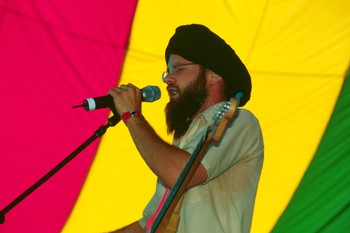
© Metro Publishing Inc.

Grace Notes

0

Sounds Good Music.2005
Grace Notes
A Loop Is a Loop Is a Loop
Just Plain Bob
Sublime Spindles
Bye Bye BVH
U Love 2 Swoon
Pukemeisters
Young Tree Grows
What Is Hip?


Grace Notes

Introducing the creamy goodness of our first annual all-music guide

In honor of the first annual North Bay Music Awards (the NORBAYs), a celebratory bash for the community slated for Friday, June 10, we in editorial have decided to throw a party of our own, right here in these pages. Just as it’s great fun to celebrate design, literature, comestibles, best ofs and other items that fall firmly under the heading of “special,” we’ve always wanted to roll up the rugs and do a special all-music issue.

(Those with long memories might recall that we’d evidently–and curiously–also once wanted to do . Resigning to the irrational and irresistible is such pleasure.)

And as for parties, what do we know? From an editor’s point of view, there’s nothing like rounding up eight writers, assigning them the broadest of all topics and then watching them do exactly what they want to do for prompting the donning of paper hats, the forking up of cake and the hanging of streamers. Add a full club and concert calendar, and see the editor enjoy a sad, little editor tingle as the corks pop.

Who, for example, would have guessed that Hannah Strom-Martin, who ordinarily writes rather loftily on literature in these pages, would instead pen a thousand steaming words of love poetry to the band U2 and their 14-year-old release Achtung, Baby? You think that you don’t want to read about the past? You’re wrong; you do when it’s this delicious.

The ever-marvelous Ms. Sara Bir checks in on her newest fave, 20 Minute Loop, as they load the van in San Rafael to take off on a tour patterned loosely after Meriweather Lewis’ alleged 1806 troubling of the natives. Endless fanny jokes later (never agree to play a club called Hiney’s), the sideways lyricism of the group shines through.

Radio veteran Bruce Robinson, who got his start at age 16 as a jock at KWYO in booming Sheridan, Wyoming, reports on the new and slightly chilling phenomenon of the mono-monikered radio station. BOB-FM, which many parents will recognize as being that “Turn Your Knob” station that the household teenager has newly programmed into the car radio, originates its cool quotient from Canada. Indeed.

Meanwhile, Gabe Meline takes us on a backward-looking tour of the Bennett Valley House, an experiment in communal living that’s been successful for over a decade but this week falls victim to the ordinary glory of the hot!hot!hot! real estate market. Karl Byrn introduces us to Pa Spindle and his entire Spindle family, a group of avant-ambient popsters wholly unrelated and delightfully difficult to pin down.

R. V. Scheide spends an informative evening with Lance Ozanix of Skitzo, the puke-positive rocker who’s staked a career on antifreeze and vomit. Chris Peck looks at the musical and ethical values that make an independent record label a success, even in the mega-biz of the music industry. And Jeff Latta uses the Bohemian‘s own cache to carry away an armload of new discs that just might define the new kewl in cool. (Dear, good music gods, please say it ain’t so.)

And such sweet pie is just for starters. Plan to join us at the first annual NORBAY awards, a night of nonstop live music, awards, food, drink and fun as we celebrate the North Bay’s vibrant and eclectic musical community together under the stars. NORBAY winners will be announced in the June 15 issue. You don’t wanna wait that long.

And hey, thanks for coming to this party.

–Gretchen Giles

From the June 1-7, 2005 issue of the North Bay Bohemian.

© Metro Publishing Inc.

20 Minute Loop

0


Thinking Man’s Band: 20 Minute Loop use wordplay to get to deeper human truths.

Word Pop

20 Minute Loop spin stories of interior life

By Sara Bir

The Dictionary Story, originally called the arbilexicon, is a kind of reverse Mad Libsâ„¢, in which a conventional number of words randomly selected from a dictionary–usually ten–serve as the springboard for a short story; that is to say, the words chosen at random must be used in the body of the story.
–20 Minute Loop

The title of 20 Minute Loop’s third and most recent album, Yawn + House = Explosion (Fortune), is derived from a dictionary story. But everything in this band’s world eventually evolves–or devolves–into a story. Stories are 20 Minute Loop’s stock in trade.

The first adventure of 20 Minute Loop’s Midwest tour (dubbed the Meriwether Lewis Trail of Madness, in which they–kind of–retrace Lewis’ alleged 1806 journey to scare the natives) began before they even pulled out of the parking lot of their San Rafael rehearsal studio. Their rental van turned out to be a smaller model than the one they had reserved, presenting a new angle to the already formidable challenge of fitting five musicians’ equipment, the musicians themselves and dozens of homemade cookies into one overly cozy vehicle. Over the next several weeks, they will go on to conquer exotic, uncharted locales such as Laramie, Wyoming, and Hiney’s in El Paso, Texas, a venue the band have already mythologized as a sort of Hooter’s featuring butts instead of boobs.

Though their collective sense of humor can at times run through such sophomoric shallows, the music of 20 Minute Loop is complex, literate pop that’s often threaded with a dark undercurrent. The band’s beginnings go back to 1997, when vocalist and songwriter Greg Giles began playing music under numerous less catchy monikers. Kelly Atkins joined up soon after, forming what would become the musical and lyrical core of the group. Guitarist Joe Ostrowski came onboard in 1998, and bassist Nils Erickson and drummer Mike Romano settled in after a small handful of other musicians had come and gone. Initially a North Bay band, 20 Minute Loop are now more accurately a Bay Area one, with members in Marin, San Francisco and the East Bay.

Critics have often trotted out XTC and Pixies comparisons when describing 20 Minute Loop. I’ll happily do that as well: 20 Minute Loop sound as much like the Pixies as Donovan does Slayer (though I did once hear Kelly tear up an impromptu cover of AC/DC’s “Back in Black”). The band’s dense, twisting arrangements, Kelly’s punctuating keyboards, and the vocal do-si-do of Kelly and Greg frame lyrics embedded with impressionistic inner monologues of characters at turning points, on the brink of arguments or just coming out of them. It’s the kind of stuff that sounds absurd when read typed out as lyrics, but which the band pull off uncannily in song.

Sounds Good Music.2005
Grace Notes
A Loop Is a Loop Is a Loop
Just Plain Bob
Sublime Spindles
Bye Bye BVH
U Love 2 Swoon
Pukemeisters
Young Tree Grows
What Is Hip?

Taking a break from the puzzle of van loading, Kelly and Greg tell of the inspiration for Yawn + House = Explosion: 11-year-old Sophia, a friend of the band and the blonde lass who appears tenderly embracing chickens on the CD cover. It turns out that Sophia is quite the wordsmith, too. “Sophia likes to write dictionary stories–the title of our album came from one of her dictionary stories,” says Greg. “I sort of commissioned her to do all of the artwork for our lyrics, to write them out. Paid her 100 bucks. We just wanted to make the whole thing look like it was the product of her mind.”

“To an 11-year-old, 100 bucks is a lot of money,” says Kelly. “When she’s 20, she’ll be like, ‘What the hell? They paid me $100 for this?'”

There has been nearly a four-year gap between Yawn and the band’s previous album, Decline of Day. Their former drummer left shortly before they had planned to start recording basic tracks in his studio, where they had recorded the first two records. “At the time, it felt like the most horrible thing in the world, but it’s all worked out fine,” Kelly explains. “We ended up having to find a drummer, teach him all of the songs and then get to a point where we felt we could record. It took six to eight months just to do that. Then we started recording basics.”

“We didn’t just go into a studio for a few weeks; we recorded the basics at a conventional studio, put that on a tape and we did everything else with ProTools in people’s apartments–and Nils was the de facto producer,” Greg clarifies.

“Which was great, because it gave us a lot of flexibility,” Kelly adds. “[The album] got more flushed out.”

Or, as Greg puts it, “We put in more bells and whistles.” Not literally, of course, but Yawn + House = Explosion does include more synthesizers and, on several songs, horns, which Nils arranged. There’s also their first recorded cover ever, an appropriately feverish version of Hüsker Dü’s “I’ll Never Forget You.”

“I think we’ve just gotten more intuitive with each other,” Kelly says. “Don’t you think,” she asks Greg, “we’ve kind of grown more as a unit?”

“No, I don’t think so,” he says, laughing. “We’ve become contrarian.”

Undeterred, Kelly continues. “I think that we’ve had much more time to get comfortable with each other’s strengths and weaknesses.” Such growth undoubtedly continues on the tour. In a post to the band’s message board from the road, Nils describes the seating arrangement in the van as “carving out Hobbit holes.” Yet another great way to deepen a band’s connectivity. The 20 Minute Loop that return to the Bay Area will be an even stronger 20 Minute Loop, with Hiney’s of El Paso under their belt and even more stories to tell.

Welcome 20 Minute Loop home at their next show, Sunday, June 19, at Cafe du Nord in San Francisco. Write your own dictionary story, and peruse fans’ dictionary stories, on 20 Minute Loop’s website, www.20minuteloop.com.

From the June 1-7, 2005 issue of the North Bay Bohemian.

© Metro Publishing Inc.

Groundation

0


Photograph by Pablo C. Leites

Each One Teach Two: Groundation lead singer Harrison Stafford doubles as a record exec on the band’s Young Tree label.

Groundation Up

Young Tree Records branches out

By Chris Peck

Major record labels are merging, record sales are hurting, 70 percent of the nation’s airwaves are controlled by the Clear Channel megacorp and no semblance of inspiring music can be found within the mainstream arena. At a time like this, who could possibly want to get involved in the music industry? Musicians, that’s who.

The above description fits the founders of Young Tree Records perfectly. The label formed with the 1999 release of Sebastopol-based reggae band Groundation’s first album, also called Young Tree. Two out of three of the label’s principle members are directly involved with Groundation: Harrison Stafford is the lead singer of the band; Kris Dilbeck was head engineer on the group’s earlier recordings. Newly hired marketing manager David Alima is the label’s first full-time employee.

Now what started as a vehicle for Groundation has expanded into a broader entity. Beginning with the January reissue of Pablo Moses’ reggae classic Pave the Way, the label is now releasing new and back-catalogue recordings by other legendary Jamaican musicians. Rather than just put out North Bay hits, its mission is to “preserve the history and integrity of reggae music.”

“It really comes down to releasing music that we feel would speak to people on a conscious level, and not so much what would speak to people on a mainstream level,” says Kris Dilbeck. “We’re concerned about album sales, of course, but we’re not thinking, ‘Let’s put something out that’s a factory-guaranteed sell.’ We want to put out music that’s great.”

Sounds Good Music.2005
Grace Notes
A Loop Is a Loop Is a Loop
Just Plain Bob
Sublime Spindles
Bye Bye BVH
U Love 2 Swoon
Pukemeisters
Young Tree Grows
What Is Hip?

The benefit for Groundation in having their own label is that their core values become a non-negotiable, built-in feature of how they do business. Nearly all their music is recorded on analogue equipment (virtually unheard of today); Young Tree’s advance payments are delivered to artists without delay; new releases are recorded without an outside record producer; and the packaging is always at collectors’-item level. There is a sense that Young Tree didn’t want to cut certain corners that undoubtedly would have been cut had they connected with a major label.

The story of Young Tree is encouraging for new indie labels that may be intimidated by the complexities of the industry. “This whole company has started completely from the ground up,” Dilbeck says. “Harrison and I said ‘Let’s do this!’ without knowing how to do it. As I’ve told these guys before, we’ve fallen flat on our faces a hundred times, and we’re still here doing it, and it keeps getting better and bigger every time. And that’s how we learn.”

The label’s first step into a higher level was the release of Groundation’s 2001 release Each One Teach One. “Young Tree started with selling in local record stores on consignment,” Dilbeck says. “We didn’t get distribution until Each One Teach One came out. We had Ras Michael and Marcia Higgs on that album as featured artists, and because of those names, we were able to obtain national distribution.” But even with the added star power of these legendary guests, it was still something of a coup to win a deal.

“We put a package together and sent it out to distributors,” says Stafford, “but these companies wanted to work with a label with a big catalogue, who’d be releasing 10 albums a year. We had two albums total. But a local distributor in San Rafael called City Hall Records happened to be wanting to sign one more record label, and liked the album a lot. They said, ‘Yeah, we want to take this thing on, and after we sign Young Tree Records, we aren’t gonna be looking for any other record labels,’ so we got in there. And it’s great because it’s local. If we ever have any problems, we can drive down to San Rafael and knock on the door.”

Only a very unique label can win distribution with such a small catalogue and hardly any clout. Some might perceive the label’s ethics as a burden, but in fact it is its ethics that make the conditions right for the music. The industry is flooded with independent labels, so consequently, standing out is the way to succeed. And what better way to differentiate yourself than by putting music first?

From the June 1-7, 2005 issue of the North Bay Bohemian.

© Metro Publishing Inc.

News of the Food

0

News of the Food

Getting Real

By R. V. Scheide

I‘ll be honest. Father’s Day depresses me. Yet another manufactured holiday designed to guilt-trip me into laying half a sawbuck on Hallmark. This year, it’s actually worse than that. Pops and I have been fighting lately–we just can’t seem to agree on the need for or lack thereof of nuclear power–so he ain’t getting nothing. And my daughter? Well, she’s not returning my calls for who knows what reason, so I guess I ain’t getting nothing either. Just a hump of trouble and a sack of woe, that’s what’s in it for me. I’m whining, and I detest whiners. Why can’t I be a real man, like K. Kofi Moyo?

Moyo is the entrepreneurial genius behind Real Men Cook for Charity, the largest national Father’s Day event in the United States. The event was founded in Chicago on Father’s Day 16 years ago by Moyo and his wife, Yvette. The idea was to celebrate the unsung heroes of Chicago’s African American community–the “real men” who actually keep their families together, hold down responsible jobs and, when they’re not too busy changing their own oil or scraping and painting the house, are whipping up some cultural delicacy in the kitchen.

I use the word delicacy with some delicacy, as most of the recipes in Moyo’s recently released Real Men Cook: Rites, Rituals, and Recipes for Living (Fireside; $22.95) can hardly be called delicate. “Soulful” would be a more apt description of these submissions from the various real men Moyo has met over the years. They’re the kind of heavy-handed guys who measure meat by the pound, not the ounce, which probably explains the Real Men Cook prostate cancer awareness video available at www.realmencook.com.

The first thing that caught my eye was Arthur E. Teele’s recipe for Miami conch fritters, which calls for, as a primary ingredient, “four pounds fresh conch, diced.” A conch, of course, is one of those shells you see native islanders blowing on in movies, but we’re talking about the meat inside. Where in the hell are you supposed to get four pounds of fresh conch meat? Simple, friend. Simply log on to the Gamby’s Lobster and Stone Crab Shack website (www.freshfloridastonecrab.com), where you’ll find five pounds of conch selling for $115, shipping included.

Herein lies the beauty of the Real Men Cook concept, for food is definitely the one common denominator that unites all men, even fathers and sons. You see, my dad just happens to be a stone crab freak, and maybe if I send him some fresh crustacean via Gamby’s website, I can straighten him out on this nuclear-power thing.

Now, if my daughter will just call, it’ll be one happy freakin’ Father’s Day.

From the June 1-7, 2005 issue of the North Bay Bohemian.

© Metro Publishing Inc.

Briefs

0

Briefs

Two Buck Upchuck

In a decision that came as a shock to absolutely no one except possibly Fred Franzia, maverick winemaker and mastermind behind the $1.99 Charles Shaw label–popularly known as “Two Buck Chuck”–the state appeals court in Sacramento ruled that the wine may not use the word “Napa” on the label unless at least 75 percent of the grapes in it come from Napa County. The decision pleased Linda Reiff, executive director for the Napa Valley Vintners Association, which represents the region’s winemakers. “Our mission is basic, but important: if it says Napa on the label, it better be Napa in the bottle,” she says. “It’s been a long haul, but this decision is confirmation we’re on the right path. Three times in a row the courts have supported truth in labeling and protected consumers.”

Growers Go GMO

The Sonoma County Grape Growers Association has joined a coalition of ag-related organizations that are opposing a November ballot measure that seeks to ban genetically modified organisms (GMOs) in the county. Organizations opposing the ban now include the Sonoma County Farm Bureau, the United Winegrowers of Sonoma County, the Sonoma-Marin Cattlemen and Cattlewomen associations and the Western United Dairymen, all of which have united beneath a single umbrella organization called the Family Farmers Alliance. However, the appearance of unanimity among family farmers propagated by the alliance is an illusion, says Daniel Solnit, campaign coordinator for GE-Free Sonoma County. “I can guarantee you none of those organizations have polled their members to see how they individually feel about GMOs,” Solnit says. “The truth is, farmers are divided on the issue.” Just how divided will be determined on Nov. 7.

Playing Bridge

The retrofit of the Richmond-San Rafael Bridge, scheduled to be completed in May, has been extended through August, the California Department of Transportation said last week. The delay is just the latest snafu in a project that, according to a state Legislative Analysts Office report released in March, has seen cost estimates rise 178 percent, from $329 million to $914 million, between 1997 and 2004.

–R. V. Scheide

From the June 1-7, 2005 issue of the North Bay Bohemian.

© Metro Publishing Inc.

Bennett Valley House

Sounds Good Music.2005Grace NotesA Loop Is a Loop Is a LoopJust Plain BobSublime SpindlesBye Bye BVHU Love 2 SwoonPukemeistersYoung Tree GrowsWhat Is Hip?End of an EraBidding goodbye to the Bennett Valley House By Gabe MelineA whirlwind of activity surrounds the Bennett Valley House this week, which for the past 10 years has been a beacon to the underground community...

Skitzo

Mom Is So Proud: Sonoma County's own Lance Ozanix pukes antifreeze upon a willing woman's spacious bosom.Duke of HurlSkitzo lead singer pukes his way to minor stardomBy R. V. ScheideIn Petaluma's Phoenix Theater, where notorious North Bay heavy metal band Skitzo have just taken to an impromptu stage set up in the cramped lobby, there is essentially one question...

What Is Hip?

Bottoms Up: Unwritten Law lost their street cred when they used Christina Aguilera's songwriter on their latest. What Is Hip?Finding out what's cool by stealing from your employerBy Jeff LattaEarlier this spring, I stumbled across a paradise hidden in the offices of the North Bay Bohemian. Before me were rows and rows of compact discs that record labels had...

Bob

Donny!: From Judas Priest to Donny Osmond, mono-monikered radio runs the gamut. Name GameThe KNOB goes Bobbing for listenersBy Bruce RobinsonFor those who've always wanted to be on a first-name basis with a local radio station, meet Bob. Well, actually he's not a station, exactly, just a format. And he's got a lot of company, all across North America:...

‘Achtung, Baby’

Sounds Good Music.2005Grace NotesA Loop Is a Loop Is a LoopJust Plain BobSublime SpindlesBye Bye BVHU Love 2 SwoonPukemeistersYoung Tree GrowsWhat Is Hip?The Real ThingOne album, one band--a love letter By Hannah Strom-MartinForget Britney and her clones. It's rock and roll, thank God, not pop, that is the voice of sensuality in the modern age. Moreover, in rock, sexuality...

Grace Notes

Sounds Good Music.2005Grace NotesA Loop Is a Loop Is a LoopJust Plain BobSublime SpindlesBye Bye BVHU Love 2 SwoonPukemeistersYoung Tree GrowsWhat Is Hip?Grace Notes Introducing the creamy goodness of our first annual all-music guideIn honor of the first annual North Bay Music Awards (the NORBAYs), a celebratory bash for the community slated for Friday, June 10, we in editorial...

20 Minute Loop

Thinking Man's Band: 20 Minute Loop use wordplay to get to deeper human truths.Word Pop20 Minute Loop spin stories of interior life By Sara BirThe Dictionary Story, originally called the arbilexicon, is a kind of reverse Mad Libsâ„¢, in which a conventional number of words randomly selected from a dictionary--usually ten--serve as the springboard for a short story; that...

Groundation

Photograph by Pablo C. LeitesEach One Teach Two: Groundation lead singer Harrison Stafford doubles as a record exec on the band's Young Tree label.Groundation UpYoung Tree Records branches out By Chris PeckMajor record labels are merging, record sales are hurting, 70 percent of the nation's airwaves are controlled by the Clear Channel megacorp and no semblance of inspiring music...

News of the Food

News of the FoodGetting RealBy R. V. ScheideI'll be honest. Father's Day depresses me. Yet another manufactured holiday designed to guilt-trip me into laying half a sawbuck on Hallmark. This year, it's actually worse than that. Pops and I have been fighting lately--we just can't seem to agree on the need for or lack thereof of nuclear power--so he...

Briefs

BriefsTwo Buck Upchuck In a decision that came as a shock to absolutely no one except possibly Fred Franzia, maverick winemaker and mastermind behind the $1.99 Charles Shaw label--popularly known as "Two Buck Chuck"--the state appeals court in Sacramento ruled that the wine may not use the word "Napa" on the label unless at least 75 percent of the...
11,084FansLike
4,606FollowersFollow
6,928FollowersFollow