Swirl n’ Spit

0

Swirl n’ Spit

Ledson Winery

By Heather Irwin

Lowdown: During the late 1990s, Sonoma County architecture-watchers were abuzz about the building of that hulking grey “starter castle,” as my grandmother liked to call it. For years, the enormous Kenwood building was in various states of construction, and it was anyone’s guess as to who was building it and, well, why?

The mystery was resolved as construction finally came to completion and the Ledson family decided to turn what was to be a family home–a really, insanely big family home even by wine country standards–into a winery. Spurred on by the quality of the Merlot grapes growing in their front yard and Steve Ledson’s own admission that maybe, just perhaps, he’d bitten off a little more than he could chew in designing the family home, the winery was born.

Mouth value: Merlot is what Ledson is most known for. Its pricy 1997 Estate Merlot Reserve ($425) has been repeatedly lauded in the wine press. But the far more affordable 2002 Estate Merlot ($38) isn’t at all shabby, with a complexity and character found all too rarely in Merlots. The Sonoma County Pinot Noirs (’02, $32; ’01, $28) are also strong contenders, exemplifying the softness and subtlety that is characteristic of nearly all the Ledson wines. And while subtlety is agreeable in a Pinot, it’s less so in a Cabernet. Or the somewhat flabby ’04 Sauvignon Blanc. Ledson’s whites are saved, however, by an unoaked ’04 Chardonnay that is crisper than a new $10 bill and twice as entertaining. Finishing up with the ’04 Orange Muscat ($18) is a requirement during the summer months–cool, clean and dripping with flavor, yet without the cough-syrup quality of so many dessert wines.

Don’t miss: Sneak a peek at the details of the home as you walk through. From the vaulted ceilings to the intricate wood carving and mosaics, no detail went unnoticed by the contractor/designer owner.

Spot: Ledson Winery and Vineyards, 7335 Sonoma Hwy., Kenwood. Open daily, 10am to 5pm. $5 tasting fee. 707.537.3810.

From the June 8-14, 2005 issue of the North Bay Bohemian.

© Metro Publishing Inc.

‘Ecotopia’


Eww-topia: The wide-eyed sentimentality of ‘Ecotopia’ still–strangely–translates today.

Eco Cult

Revisiting ‘Ecotopia’ 30 years later

By Pat Joseph

In the afterword to the 30th anniversary edition of his 1975 novel Ecotopia, author Ernest Callenbach writes, ‘Looking back, it seems clear that Ecotopia was the first attempt to portray a sustainable society, and that this, more than its modest literary merit, explains its durability.’ Sadly, there is no false humility in that statement.

Ecotopia is ostensibly about a secessionist Northwest–Northern California, Oregon and Washington–founded on ecological principles. In this independent land, cars are abolished, everybody recycles and sewage is turned to fertilizer. More fundamentally, Ecotopia is a ‘stable-state’ society, where old notions of economic progress are retired and ‘biological stasis’ becomes the ultimate goal. That sounds good, as far as it goes; however, the vision is weighed down by so much extraneous cultural baggage–Marxism, paganism, free love, ritual warfare, communal living, abortion on demand, legalized drugs, gamelan orchestras–that readers coming to Ecotopia for the first time will find both more and less than they bargained for.

The story is narrated by William Weston, a New York journalist, by way of his notebooks and–the first filed by an American reporter from inside the breakaway republic in 20 years. Weston’s stranger-in-a-strange-land observations are, by turns, ludicrously detailed (he dutifully reports that electric carving knives are unknown in Ecotopia) and impossibly obtuse. Few novels can survive that kind of thing; yet, somehow, Ecotopia has thrived, having now sold nearly a million copies in nine languages. Were it otherwise, there would be no sense in reissuing the book–nor, indeed, in reviewing it–except perhaps as a cultural artifact. But even today, the novel is assigned reading for college courses in political science and environmental studies. Callenbach boasts that his book was an inspiration to the founders of the German Green Party, and Judi Bari’s Mendocino chapter of Earth First! was named after it. Whatever else you might say about Ecotopia, it can’t be dismissed as a relic.

The novel stands in sharp contrast to another enduring eco-classic from 1975, Ed Abbey’s wildly successful (and also Earth First!-inspiring) The Monkey Wrench Gang. As a writer, Abbey was in another league, but his sensibilities were also a world apart. While the two books share a deep disdain of so-called progress, Abbey’s eco-saboteurs aimed to merely throw a wrench in the works of industrial civilization while Callenbach conjured a model society–a City on a Hill, so to speak–where humans could live in balance with nature. As Callenbach recently told the San Francisco Chronicle, ‘Then, as now, people didn’t have easy hope, and Ecotopia served as a beacon.’

Therein lies both its appeal and its fatal weakness, for while Callenbach dared, at least, to envision human history as something other than a forced march to oblivion, his characters, stuck as they are within the utopian framework, seem like little more than the self-satisfied minions of the newly dawned Aquarius. Abbey’s desert rats may be doomed, but at least they’re heroic. The citizens of Callenbach’s republic, by contrast, display an eerie sameness that makes all human interaction in the book seem unsettlingly artificial, as if the body-snatchers had already left behind only pod people.

This is not to say that the residents of this sovereignty don’t argue or act up. They do. Callenbach takes pains, in fact, to show us that the good people of Ecotopia are unrestrained in their emotions. One illustration of this involves a plate of cold eggs in a restaurant. When the indignant recipient of the tepid huevos raises a stink, the aggrieved customer and the offended cook square off in front of the other diners. The drama ends not in bitterness or violence, however, but in hugs and tears and ‘many little smiles all around.’ Ecotopians don’t so much interact as role-play; it’s life as group therapy.Speaking of roles, free love has a starring one in Callenbach’s vision. His lucky narrator enjoys wild romps in forest shrines, anonymous threesomes in tents, even sex with the lovely and obliging nurse who tends to him in the hospital. (As porn clichés go, the Naughty Nurse has to be right up there with the Lusty Librarian.)

As for the sticky issue of race, blacks have voluntarily segregated themselves. Oakland thus becomes Soul City, an Afro-centric enclave where businesses are ‘more naturally collectivist than in the white areas’ and which is a ‘heavy exporter of music and musicians, novels and movies and poetry.’ Natch. Native Americans are at once prominent and scarce in Ecotopia; that is, they exist only as part of the idealized, pre-Columbian past, as noble savages. As such, Ecotopians are free to play Indian: they happily adopt faux-native names and hunt with bow and arrow; they say things like, ‘You’d never catch an Indian wearing a watch.’

The evil of warfare has been ritualized as a way of dissipating its awful power and relegating it to the safe, if frightening, confines of ceremony. The scene, as Callenbach paints it, is unbridled neo-primitivism, complete with all the props: chanting, cauldrons filled with potions, face paint. All that’s missing from the Tarzan fantasy are grass skirts and bones protruding from the nose. The charade ends when Weston is ritually speared in the side–the wound that lands him in the sexual-healing ward.

Before he can return home to New York, Weston is abducted on the orders of the president of Ecotopia, Vera Allwen. His benevolent captors spirit him away to a hot springs. There, steaming in the baptismal waters, the last of his intellectual resistance–his ‘objective pseudo-think,’ as he disparages it in his journal–melts away, and at long last, he is reborn. The scene ends as things inevitably do in Ecotopia: with hugs and tears and everyone ‘obviously very pleased with themselves.’

Callenbach has called his book ‘politics fiction’ (as opposed to science fiction), but he’s wide of the mark there. Aside from the occasional whiff of authoritarianism, there are no politics to speak of here. How could there be? The Ecotopian worldview is of such a cultish consistency, after all, that politics are superfluous. Moreover, in this Rousseauian world, people are all basically good. Evil is in exile, banished to the old world beyond the borders. With no need of politics, neither are there politicians. Allwen, the president, is really more of a high priestess, the therapist-in-chief. Weston notes with some alarm that his long-awaited meeting with her is ‘almost like a psychiatric interview’ and later, after his conversion, reflects that she ‘must have seen what was going on in my mind when I didn’t know it myself.’ Yeah, almost like Jim Jones. What the ending of Ecotopia makes clear, finally, is that Callenbach’s story is a religious parable, a Pilgrim’s Progress for the deep-ecology set. It’s a cult classic in the fullest sense.

If Callenbach is embarrassed by any of this 30 years on, he gives no indication in the new afterword. ‘Being the author of Ecotopia,’ he writes from his home in Berkeley, ‘has been like being the parent of a talented child.’ Fair enough. Parents should be proud of their offspring. But the rest of us ought to be a little more objective.

From the June 8-14, 2005 issue of the North Bay Bohemian.

© Metro Publishing Inc.

Coastwalk

0

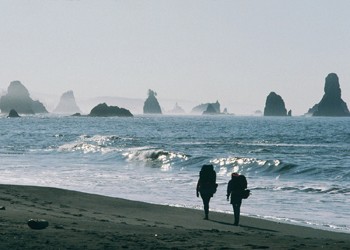
Populist Power: Nature’s beauty doesn’t only belong to the rich.

Love of Sea

Coastwalk reminds us that the ocean belongs to everyone

By R. V. Scheide

By the law of nature these things are common to mankind–the air, running water, the sea, and consequently the shores of the sea. No one, therefore, is forbidden to approach the seashore . . .
–The Justinian Institutes, A.D. 535

They want to take the ocean from us: Billionaires like media mogul David Geffen whose enormous egos are matched only by their oversized seaside mansions. The oil-addicted petrochemical and automobile industries, already using the coming energy crisis as an excuse to pursue more offshore drilling. These and other like them would undo 15 centuries of common law, first established by the Roman Emperor Justinian, that declare the oceans and their shores belong to all of us.

Even as multimillion dollar homes in Laguna Beach slide off their precarious cliffside perches into the sea, the perverted propagandists of private property are hard at work attempting to undo the one act of legislation that has so far prevented unbridled development of the California coast. Later this summer, the California Supreme Court will rule on a case brought by developers and a property rights lawyer that could usher in the demise of the California Coastal Commission, established by the will of the California people in 1972 and later reinforced by the state Legislature.

Reminding people of the need to protect public access to California’s 1100 miles of coastline is the primary mission of the nonprofit organization Coastwalk, explains executive director Richard Nichols.

“Under the state constitution, the public has a right to access state tidelands,” Nichols says, seated in his Sebastopol office. “The problem is, you can’t always get to the shore if the land is privately owned. You can be on the beach in the most exclusive enclave in the world, but you can only get there by boat.” Since its inception in 1984, Coastwalk has made increasing access to California’s shoreline by foot its number one priority.

“The beginning goes beyond us,” Nichols says, discussing the Sonoma County origins of Proposition 20, the “Save Our Coast” initiative that brought the Coastal Commission into being in 1972. “It started with the whole business at Sea Ranch [the development on the northern Sonoma Coast that now features more than 1500 luxury homes]. When that was proposed, a lot of people realized that 10 miles of the shoreline was going to be closed off to the public.”

One of those people was legendary Sonoma County activist Bill Kortum, veteran of battles against the proposed Bodega Head nuclear power plant and Warm Springs Dam. With Sea Ranch, the honor system established by previous coastal property owners–in which anyone wishing to cross private property to access the beach could deposit a dollar in red boxes set up for that purpose–would be abolished. The Sonoma County activists joined forces with people such as Lew Reid, principal author of Proposition 20, forming the statewide Coastal Alliance organization and turning to state lawmakers for help.

“They tried to get the Legislature to pass an access act,” Nichols remembers. “The Legislature wouldn’t do it.” The Coastal Alliance took their cause to the people, and despite well-funded opposition, Proposition 20 passed with 55 percent of the vote.

It was a heady victory, and others were to follow. In 1980, the Legislature passed the Bane Bill, which required Sea Ranch to provide public access to the shoreline with five trails or “vertical easements” leading to the beach. (Today, there are six public access trails at Sea Ranch.) It was in the early 1980s that the idea that would eventually become Coastwalk was hatched, Nichols says, by Bill Kortum and Tom and Vivian McFarling.

“Bill saw that we still had a need for promoting access,” he says. “The idea was to get 1,000 people together and hike down the Sonoma County coastline. Tom and Vivian decided to do a hiking and camping trip with 70 people. This was only going to be a one-time deal, but everybody had too much fun.”

Nichols and his wife met the McFarlings shortly after that first outing and quickly became hooked on the concept. In 1984, Coastwalk was formed, offering groups guided, week-long hiking and camping trips along the California coast for a modest fee. By 1994, Coastwalk featured outings in all 15 of California’s coastal counties, from the Oregon to the Mexican borders. Nichols estimates some 500 people participated in the organization’s 23 outings last year. The cost is relatively inexpensive, Nichols says, when compared to the prices charged by for-profit adventure touring companies offering similar excursions.In addition to conducting guided hikes, Coastwalk has also published two volumes of Hiking the California Coastal Trail (Bored Feet/Coastwalk; $18) and next year hopes to begin installing signage on trails in all 15 coastal counties.

Coastwalk uses the funds it collects from the hikes and its publications, along with charitable donations and grants from organizations such as the Coastal Conservancy, to further its primary mission: increasing public access to California’s coastline. While significant barriers to public access remain–including private property, military bases and the shoreline’s ever-shifting geography–progress is being made, Nichols says. Recent good news includes the public acquisition of 13 miles of shoreline from Hearst Ranch in the San Simeon area and a few miles of shoreline from Stornetta Ranch near the Point Arena lighthouse on the Mendocino coast.

“We’re going to be able to put in two-and-a-half miles of coast trail there,” says Nichols, who is one of the few hikers who has ever traversed or “through-hiked” the two-thirds of California’s 1200 mile-long coastal trail system that is currently passable.

Indeed, for advocates of public coastal access, things seem to be looking up. Last month, after years of legal squabbling, billionaire David Geffen was forced to provide access to the beach in front of his sprawling Malibu estate, the first new access granted in Malibu in 20 years.

Still, much hinges on the California Supreme Court decision due later this summer. If the forces of private property and development prevail, the Justinian Institutes that first established the concept of the commons so long ago, along with the California Coastal Commission, which provides the access the public presently enjoys today, could literally become things of the past.

Interested in taking a hike? Coastwalk offers five guided coastal hiking/camping trips within easy traveling distance for North Bay residents: Mendocino County, June 12-18; Sonoma County family trip, July 13-16; Sonoma County Coastwalk, July 25-30; Marin County Coastal Parks, July 18-23; and San Francisco Bay Wilderness Areas, Aug. 1-6. For pricing and more information, call 800.550.6854 or log on to www.coastwalk.org.

From the June 8-14, 2005 issue of the North Bay Bohemian.

© Metro Publishing Inc.

Ashtray

0


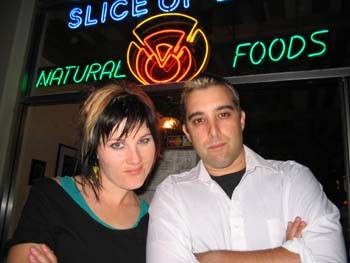
Troopers: Sarah-Jane Andrew and Dave Wiseman of Ashtray bravely endure an evening as faux hippies.

Phish Phry

Ashtray explores its inner hippie

By Gabe Meline

It’s 2:35am and I have just spent the evening trying to convert the singers of a punk band into hippies.

It was useless, of course, but I had to give it a shot. It all started with a song titled “D.R.H.” on Ashtray’s new album, White Sugar Is The Devil (Pandacide). I quote: “We’re friends with the animals, we’re friends with the trees. / We are the flower children, we even love the bees. / We follow Phish around and we followed the Dead. / We’re Dirty Rotten Hippies / We need a bullet in the head!”

The song goes on about gurus, hummus, hemp clothing and incense, culminating in a litany of rage: “Fuck Haight-Ashbury! Fuck Burning Man! Fuck Jerry Garcia! Fuck Sebastopol! Fuck Birkenstocks! Fuck Drum Circles! Fuck the Dirty Rotten Hippies!”

It’s like, what’s with the harsh vibes, man?

OK, even if you think hippies are misguided and annoying, and even if you hate jam bands and patchouli, and even if you really wish that hippies could get their act together enough to be a cultural force instead of a shadowy caricature of a bygone era, you have to admit that Ashtray might be going a little bit overboard here.

So I decide to get to the bottom of things and throw Ashtray into the fray. I’ll drag them around to some hippie hangouts and see how they fare–who knows, maybe even get them to see eye-to-eye with hippies a little bit.

We start with Whole Foods Market in Sebastopol, as gruff singer Dave Wiseman portends, “to face our worst fears and nightmares.” The evening’s first challenge is to find, among the yoga pants and braided beards, some sort of hippie product that the singers of Ashtray can actually condone. To incite their support, they’re each given $5 to spend–not exactly a big budget for Whole Foods, but Ashtray comes through.

Fellow vocalist Sarah-Jane Andrew is overwhelmed in the homeopathic aisle by $10 sponges and $18 lubricant, but settles on some Persimmon Rose Geranium Deodorant. “But I don’t think it’s going to be very effective,” she complains. “It tells you to clean your armpits before you put it on.”

Wiseman heads to the meat department before embarking on a vain search for Robitussin. Ultimately he decides on the most sensible hippie-punk compromise: a bottle of hemp beer (“Alcohol is the great equalizer”). He still has $1.50 left to spend, and incredibly, we convince him to get a shot of wheatgrass juice.

Wiseman slams down the vile drink, winces in pain, goes next door and throws up.Things are not getting off to a very good start, and it only gets worse. See, among Ashtray’s top targets for abuse are vegetarians and vegans (see “Vegan Song” from White Sugar), and alas, our dinner tonight is at a natural foods restaurant which boasts an animal-product-free menu.

“Does that mean they’re just using vegetables?” asks Wiseman. “What’s the point?”

“Yeah, this place is fucked up,” adds Andrew. “Look at this: ‘Zenburger. It’s zensational!'”

Nearby, two women discuss the upcoming Harmony Festival and life in the Colorado Rockies between cell phone conversations. A guy in a ponytail and a pair of Seven jeans walks by and smiles at Andrew. New Age piano music drips from the speakers.

When our food arrives, the singers for Ashtray dig in to a pair of vegetarian burgers, complete with fake bacon and soy cheese, and I can’t believe my eyes.The reviews, however, are not good. “These taste like fries I found in the trash,” says Andrew of her fat-free side order. She attempts to explain the weird yellow substance accompanying her Nutburger, while Wiseman, still a little rocky from the wheatgrass, valiantly stomachs his entire sandwich.

“Disgusting,” he proclaims. “Never again.”

We walk around town for a while and peek into store windows, eliciting more dismay. “Oh God, yoga, chakra, shells, a book about fairies?” Wiseman groans. There’s books with subtitles like Chart Your Own Course Of Healing And Spiritual Awakening and Concentrated Wisdom For Juicy Women.

“I don’t know, apparently there’s a goddess inside of me,” says Andrew, “and I’m supposed to get in touch with it.”

One of Ashtray’s features as a band is the lost art of Not Taking Yourself So Seriously, and Andrew and Wiseman are having such a good time wandering the streets of Sebastopol, deconstructing all the terrible, billowy outfits, that it seems their famous hippie- and vegan-hating might be a front.

I decide to press my luck. We hop in the car and drive back to Santa Rosa, and I press “play” on the carefully planned surprise cassette in the car stereo: the Grateful Dead’s 1968 album Anthem of the Sun. “No!” Wiseman cries. “The worst of all! Hippie music!”

“How do you dance to this?” asks Andrew. “I feel like I should be swimming underwater, that’s how this music makes me feel.”

But is there any way, I ask, that you could see yourself getting into the groove?

“The groove of this?!” Wiseman shouts. “Hell no! Have you heard our album?”After endless interrogation about hippies, the dam needs to crack at some point, and it does–right after a rant about the Doors. It’s Wiseman who breaks first, heaping praise on Ken Kesey and his Merry Pranksters who were, in his words, “the true, original, real hippies. They were actually a bunch of cool, rebellious people who took everything to the next level.”

Subsequently, Andrew starts raving about Mario Savio, the late founder of the free speech movement at UC Berkeley. I think we’ve almost reached an accord, and when we crack open some Pabst Blue Ribbon in the parking lot outside a reggae show, it feels like all is well.

But the truce doesn’t last long. As soon as we start watching the reggae band inside, Andrew and Wiseman are finally and completely steamrolled. They stand stunned, arms folded, only sporadically bemused. There may be just so much the singers of a punk band can take, and this reggae band, right here, is the saturation point.

It’s time to call it a night. The band is actually pretty tight, but Ashtray is having none of it. What’s more, there aren’t hardly any actual hippies here to make fun of, and most importantly, there’s more PBR out in the car.

Ashtray’s CD release show for ‘White Sugar Is The Devil’ is scheduled for Thursday, June 9, at the Phoenix Theater. Also playing are the Epoxies, Monkey and Kato. 201 Washington St., Petaluma. 8pm. $8. 707.762.3565.

From the June 8-14, 2005 issue of the North Bay Bohemian.

© Metro Publishing Inc.

Trash Talk

0

What a Dump!: California’s goal is to someday have zero waste.

Zero Tolerance

From rethinking recycling to reconsidering our relationship to trash, the zero-waste movement challenges conventional wisdom

By Jordan E. Rosenfeld

A guaranteed conversation-stopper, the topic–and indeed, the reality–of garbage is not going to go away any time soon. Moreover, there are a number of widely held public assumptions that impede progress toward that elusive goal which garbologists refer to as “zero waste.”

Assumption one: Garbage is one of those facts of life that falls in with other inevitabilities like death and taxes. Human beings are a consumptive lot, and the byproducts of all that consumption have to go somewhere.

Assumption two: Garbage companies do us all a great service by whisking away the nasty byproducts of our lives and hauling them off to those big holes in the ground euphemistically referred to as “landfills.”

Assumption three: Recycling is enough.

After all, it’s good for the bottle, it’s good for the can. Well, not exactly.

Members of a growing movement of garbage activists–environmental consultants, members of solid waste task forces, those who oversee the flow of garbage and a few concerned ordinary citizens–are pushing the zero-waste agenda in both the public and political arenas. They ask nothing less of us than to reexamine our assumptions about garbage–before it buries us alive.

In fact, zero waste is one of California’s latest goals. The state’s Integrated Waste Management Board believes we must “redefine the concept of waste in our society. In the past, waste was considered a natural byproduct of our culture. Now, it is time to recognize that proper resource management, not waste management, is at the heart of reducing waste sent to landfills.”

Does Garbage Exist?

Paul Palmer is the author of the book Getting to Zero Waste, having coined the phrase in the ’80s. Possessing a Ph.D. in chemistry from Yale, Palmer ran a chemical recycling business called Zero Waste Systems for 10 years in Berkeley before becoming the movement’s greatest proponent.

“You talk to people, and they’ll tell you that garbage has always been and always will be,” Palmer explains by telephone from his Sebastopol home. “How do they know that? There’s no scientific analysis that says this, they just have a gut feeling, because the garbage industry is so powerful. The definition of garbage is something that has no owner, and is unwanted by someone. By EPA standards, once something becomes a waste, it can never be used again. That means if I throw away a drum of perfectly good chemical solvent, it becomes waste.”

The public’s acceptance of garbage is a form of brainwashing by a multibillion-dollar industry with a powerful lobby, Palmer says, because we don’t want to have to think about our waste.

“Garbage companies are little more than truckers driving material to holes in the ground and burying it,” he insists. “If you had to build a system today from scratch where excess commodities had to be dealt with, no intelligent person would come up with the idea of digging a hole in the ground and dumping it. We have a social condition that is insane.

“Why do we continue to do it?” he asks rhetorically. “Because there is an industry that has learned to make money at it, and it has conditioned us to accept it.”

Money Pits

Waste Management Inc. is a global corporation that earns $10 billion annually and owns over 300 landfills nationwide, including the Redwood Landfill in Novato. According to a report posted online by the watchdog organization Corporate Accountability International, “Waste Management, Inc., exerts enormous influence at every level of government, including federal agencies such as the EPA.”

In 1996, Waste Management had at least 197 lobbyists in 40 states and 34 at the federal level. The corporation has been accused by the San Diego district attorney of “practices designed to gain influence over government officials,” and has paid millions of dollars in fines for violations and class action lawsuit settlements around the country for charges ranging from contamination to fraud.

There are two kinds of landfill operations: publicly owned and privately owned. Redwood Landfill is private. Dumps generate income by collecting a payment known as a “tipping fee” for every load of garbage dropped at their site, a term derived literally from the idea that a dump truck tips as it off-loads.

Redwood Landfill charges a tipping fee of $44 per ton. In 2004, the dump took in a reported 359,000 tons of trash and nearly $16 million in revenue. Since it is privately owned, Redwood only has to concern itself with dump operations. The county of Marin pays for hauling and any additional services. Neither Redwood nor Waste Management Inc. responded to repeated phone calls from the Bohemian to comment on this story.

In contrast, Sonoma County’s public landfill, Sonoma Central, is owned and operated by the county, and all fees must be approved by the board of supervisors. Central charges $42 per ton, and took in approximately 385,000 tons of refuse in 2004. According to Ken Wells, the integrated waste manager for Sonoma County, the public dump’s income is spent monitoring garbage stored around the county; maintaining the system of transfer stations used to move garbage from one location to another; educating the public; and on various other expenditures.

“The public-sector model, which we follow, says that the landfill is a resource owned by the community to be conserved and to last as long as possible,” he says by phone from his Santa Rosa office. “The private perspective is that the landfill is a profit center, and they want to maximize the profit out of their investment by filling it up as fast as possible and building another one. I sometimes doubt how truly the privately owned landfills believe in waste-reduction rules.”

Redwood, which borders the Petaluma River on one side, is expected to fill up by 2019, if it does not expand beyond its present boundaries. However, environmentalists, Novato residents and the Novato City Council have contested the proposed expansion, which would increase the dump’s capacity by 50 percent and extend its life to 2037. The dump’s environmental impact report process is currently in its second revision.

Cynthia Barnard, an environmental health specialist with Marin County Environmental Health Services, which issues permits for landfill expansions in concurrence with the state’s waste-management board, believes environmental groups tend to paint the Redwood Landfill negatively in order to support their own agenda. Still, she admits that, compared to the public model, the privately owned dump is “a different world” in terms of operation. “We work with the landfill, but we’re not in their think tank; they’re not running ideas by us beforehand,” she says.

Meanwhile, the publicly owned Sonoma Central Landfill is also filling up, and will begin diverting a good portion of its waste to Redwood beginning this September. Last summer, midway through Sonoma Central’s second phase of site expansion, groundwater contamination was discovered below the dump’s liner.

Though the contaminated water was not discharged to any drinking-water supplies and the problem was corrected, the North Coast Regional Water Quality Control Board decided to halt the expansion, leaving Sonoma Central in a bind. By the time the water board reviews the corrections and approves further expansion, Sonoma Central will have exceeded its current capacity.

Immediate action was necessary. After studying the options, the Sonoma County Board of Supervisors voted to ship waste to Vallejo’s Potrero Hills Landfill and to Redwood for the next three to five years. The decision has met with mixed response.

“There are a number of people who feel that shipping our garbage out of county is putting the responsibility on other counties,” says waste management consultant Portia Sinnott, a member of the Sonoma County task force on solid waste. “Sonoma has one of the best landfills in California–it’s state-of-the-art. Exporting out of county doesn’t guarantee that the landfills we’ll be using are any better. All landfills have problems; it is an inexact science. Even the EPA acknowledges this.”

Wells agrees that shipping out of county is not the ideal choice, but says that there was neither time nor money to pursue other options, such as increasing mandatory recycling levels to 70 percent, diverting construction and demolition debris from entering the landfill, or even enacting bans on creating new landfills in the county.

“We have a policy that says we’ll take care of our own garbage, and the board’s decision clearly works against that attitude,” says Wells. “I’m disappointed that we got to this point and couldn’t negotiate with the water board for expansion sooner. Even more important to some people is the $15 million we’ll be paying out of county each year we ship our waste out.”

But he adds, “I want to be clear that we will be going ahead with the expansion eventually.”

Even though Redwood promotes recycling, there is concern in the zero-waste camp that corporate-owned dumps whose parent companies have lobbyists in Washington have less incentive to reduce waste than public landfills.

“They do what they have to, but they aren’t working creatively on waste-management solutions,” Wells says.

Still, on the long road toward zero waste, whether a dump is public or private may matter less than cultural attitudes toward garbage. Paul Palmer notes that the term “landfill” appeared out of the PR ether in the last 20 years, replacing the more repulsive but realistic “dump.” And as long as the public sees weekly garbage pick-up as a right, and a convenient one at that, changes may be slow to come.

Radical Refuse

In Palmer’s ideal model, dumps would be shut down and all garbage-hauling companies put out of business, forcing society and individuals to come up with creative solutions to waste problems. At the same time, he fears that society has become so reliant on the garbage industry that expecting radical change may be unrealistic. He feels the problem needs to be addressed at the manufacturing level, beginning with design. Palmer envisions large filling stations with thousands of spigots or bins, like a large grocery store minus all the packaging. Consumers would bring their own packages and simply refill them.

“The most important thing about any commodity is its function, not the material it’s composed of,” he says. “So you want to reuse the function of the bottle by refilling it.”

Like Palmer, Ken Wells feels that the United States could make great strides in waste reduction by relying less on dumps, and holding manufacturers responsible for the waste that their products create.

“Unfortunately, we’re a consuming society where the people with the big bucks are writing the laws,” Wells says. “One of the problems is something known as ‘externalities.’ For instance, you may remember those little shoes for kids with lights in them. The first year they were made, they contained mercury-based batteries. When those shoes were [discarded], they were hazardous waste. But what did the manufacturer have to pay for dealing with that waste? Zero. The manufacturer externalized the cost of disposing of this product on to the public. The solid-waste industry was left holding the bag. In Europe and Canada, manufacturers don’t get away with that. They’re responsible for the entire process.”

Reaching this state of responsibility requires legislation that would encourage manufacturers, through the use of economic penalties and incentives, to design responsible products. But because the garbage lobby exerts such tremendous influence over local, state and federal legislatures, Well avers that it will actually “take campaign finance reform” to effect real change.

Reduce Reuse Rethink

Wells and other garbage activists are hopeful that public-information campaigns will help produce a shift in attitudes on behalf of the public, politicians and industry. Reaching zero waste means rethinking everything, even in such areas as recycling, where the public has only been coaxed aboard relatively recently.

It’s not that recycling doesn’t make a difference; it does–a big difference. Wells points out that in Sonoma County, only 15 percent of the waste stream was recycled in 1990. By 2003, 55 percent was recycled. But 55 percent is not enough. The California Integrated Waste Management Board recently upped its recycling-rate target to 75 percent, aiming in the long term to reach 100 percent.

However, it may be difficult to motivate the public to recycle more than it currently is, according to Portia Sinnott. In fact, Sinnott believes that recycling as it currently exists may not bring us any closer to zero waste, because by the time a person recycles a bottle or can, it’s only one step away from being garbage.

“Recycling and zero waste are not the same things,” she says. “Recycling is a form of managing discards at the tail end of the process. In some cases, people feel more comfortable consuming more simply because they recycle.”

The next step up from recycling is reuse, which means investing in commodities that are reusable–and then actually convincing people to reuse them.Paul Palmer helps make the distinction. “What we know as recycling is the lowest possible form of reuse,” he says. “Recycling means you create a waste and then, at the last minute, when you have no other choice, you try to find a new home for it in its degraded condition. When you break a bottle, you lose 98 percent of its value because all you’ve got now is broken glass; you throw away all the resources that went into making it, the labor and time and money.” He suggests that we stop manufacturing products that lend themselves to easy disposal and treat such commodities differently, so that a glass bottle gets reused long before it ever gets smashed.

“Another thing we’ve got to do is make products much more repairable,” he adds. “One of the specific recommendations I make in my book is to offer the blueprints of products on the Internet so that people can fix things themselves. Information is key.

“Right now there is no infrastructure for taking responsibility,” he continues. “Everyone has just glommed on to the scheme, the ‘out’ of throwing stuff away. ‘I don’t care’ is the essence of an irresponsible society.”

The Institute for Local Self-Reliance, a Washington, D.C.-based organization that promotes sustainable communities, encourages grassroots groups to petition local governments for “extended producer responsibility” legislation that will hold manufacturers legally responsible for the disposal of their products.

In the meantime, Wells says that Sonoma County will continue to work on educating the public. “Generally people want to do the right thing, and more often than not, if you give them the information and the opportunity, they will,” he says. “As for the business sector, it pretty much comes down to the bottom line. Save them money, and they’ll do the right thing.”

From the June 8-14, 2005 issue of the North Bay Bohemian.

© Metro Publishing Inc.

System of a Down

0


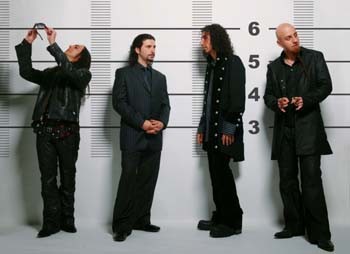
Line-Up: System Of A Down releases half of this year’s good news.

Thrash Mental

Has SOAD made the album of the year?

By Karl Byrn

As an album-of-the-year candidate for the tumultuous 12 months of 2001, System Of A Down’s outspoken metal classic Toxicity was hard to beat. The album was notable in part for the track “Chop Suey!” perhaps the most visible song banned from the Clear Channel Communications radio network in the wake of the 9-11 tragedy. At the time, the song’s desperate martyr imagery was considered too specific, almost suspect coming from a band whose members are American-born Armenians. But the moment demanded music that was conflicted and intense, and ultimately, Toxicity established SOAD as multi-platinum selling metal leaders.

Does System Of A Down’s latest disc Mesmerize (Sony) have what it takes to contend for 2005’s album of the year? We won’t know the answer until this fall, when the band releases Hypnotize, the second half of a two-disc set they’ve chosen to release separately rather than together. This maneuver counters rock’s prevailing mode for double album releases–i.e., issuing two separate albums at the same time, as folk-pop hero Conor Oberst did earlier this year. Mesmerize is only half the story, and with a disc package that opens backwards, there’s some evident intent to confound the fans.

Nonetheless, Mesmerize does find System Of A Down at an interesting intersection of metal trends. Current heavy rock seems compelled to be either hyper-technical and difficult, or hyper-emotional and accessible. The spastic noise-punk of hardcore acts like the Blood Brothers and Space Tourists is music that’s purposefully complicated. Bands like Shadows Fall and Mastodon are following a strict Iron Maiden-like level of progressive musicianship. But if you prefer sentiments and intimacy, there’s the heartache of yearning “emo-metal” bands like Killswitch Engage and Thursday.

These tendencies are in bloom on 2005’s important heavy rock releases. The Mars Volta explore a diverse prog-metal that explodes with passion on their Latin-flavored rock-opera Frances the Mute (Universal). Industrial-goth god Trent Reznor is more open and direct than ever on [With_Teeth] (Interscope), his re-emergence with his band Nine Inch Nails. Mainstream supergroup Audioslave’s sophomore disc Out Of Exile (Interscope) pursues a post-grunge thoughtfulness. Dancing between these trends is Queens of the Stone Age’s Lullabies to Paralyze (Interscope), a disc too consciously art-punk to be too technical or too real.

System Of A Down does it all. Mesmerize features their trademark odd sound, where violent stop-on-a-dime tempo and rhythm changes are organically crossbred with Eastern European melodic roots. By now, their abrupt musical shifts are about more then convoluted riffs; more importantly, song sections are divided into emotional contrasts. In the same way grunge played loud against soft dynamics, SOAD plays wacky brittleness against imploring empathy. Much of the credit for these precision flailings goes to vocalist Serj Tankian, whose delivery shifts from tweaker Hobbit to raging bullroarer to sad poet as suddenly as the riffs change.

Heavy rock is finally running parallel to this spastic/sublime duality, and rock in general is finding the topical passion SOAD has always offered. On Mesmerize, they’ve already begun shifting their pointed ire from institutions to the politics of human behavior. The disc opens with two substantial anti-war jabs, but works its way to two concluding strikes against an easy target, Hollywood. They’re attacking–and grieving over–a collapse of ideals.

Hypnotize will have to be the better half of Mesmerize/Hypnotize to make the set a championship “album” of 2005. At the year’s near-halfway point, though, the anti-war pile driver “B.Y.O.B” is certainly up for song of the year. The song’s thrashing shifts include the uncomfortably bluesy refrain “Everybody’s going to the party, have a real good time / Dancing in the desert, blowing up the sunshine.” Then, the band wails out three questions, but only two have answers. “Why don’t presidents fight the war?” is a silly question, and “Why do they always send the poor?” is a question whose answer is stunningly obvious. But the unsettling yet plainspoken question “Where the fuck are you?” is where System Of A Down offers a challenge aimed to outlast the trends.

From the June 8-14, 2005 issue of the North Bay Bohemian.

© Metro Publishing Inc.
Briefs

0

Briefs

Gallo’s Humor

Welcome to the topsy-turvy world of winemaking. One week, Gallo of Sonoma plays local hero, donating $150,000 to Santa Rosa Junior College, earning the right to name the planned instructional winery to be built on the JC’s Shone Farm near Forestville. The next week, the pesky United Farm Workers of America are reminding people that Gallo of Sonoma has refused to meet the union’s “modest demands for decent wages, benefits, fair treatment and just working conditions” and that all Gallo wines will be subject to a national boycott endorsed by the UFW and the AFL-CIO beginning June 14. It’s enough to drive a person to drink. Something fortified, please, like Gallo’s soon-to-be-boycotted Thunderbird.

Bubble Trouble

It’s taken more than a year, but the mainstream media is finally catching up with the Bohemian on the issue of the Bay Area’s potential housing bubble ( April 14, 2004). Last month, Federal Reserve Chairman Alan Greenspan warned what wannabe home buyers in the North Bay have known for years–that home prices nationwide are outstripping the income of middle class wage earners. That was enough to cause many commentators to recall Greenspan’s “irrational exuberance” comment from 1996, in spite of which investors continued throwing good money after bad until the inevitable stock market crash in 2000. In the past week, both the Santa Rosa Press Democrat and the San Francisco Chronicle have run housing bubble articles in the wake of Greenspan’s recent comment. If the tone of these articles is any indication–“A housing bubble ready to pop” was the headline of the Chronicle‘s recent Sunday editorial–the end of the red-hot housing market may be at hand. You read it here first, of course.

Nation’s Legacy

How will soon-to-be-termed-out Sixth District Assemblyman Joe Nation fare in his battle against incumbent Rep. Lynn Woolsey in the Democratic primary for the Sixth Congressional District next spring? There’s a clue or two to be found at representativevoter.org, website for the Voters for Representative Government (VRG), a North Bay-based organization seeking to inform voters on the race to replace Nation in the state Assembly. “Throughout his tenure, Nation consistently raised huge amounts of money from PACS and almost no money from individuals,” VRG states. “In our view, his legislative goals have reflected the priorities of his contributors.” Say it ain’t so, Joe!

–R. V. Scheide

From the June 8-14, 2005 issue of the North Bay Bohemian.

© Metro Publishing Inc.
Swirl n’ Spit

0

Swirl n’ Spit

Mayo Family Winery

By Heather Irwin

Lowdown: Here’s the honest truth, from me to you: There are only so many glasses of wine you can taste in a day before they all start tasting pretty much the same. I remember hearing some wine snob announce loudly as he walked up to a tasting bar, “My palate is just shot, darling”–true enough, after three, four wineries, if you’re really trying to discern differences.

That’s where food comes in. Because, honestly, unless you’re downing a bottle of Boones Farm on a rooftop (and I’m not saying that I have, often), the point of wine is to pair it with food. Fabulously.

And Mayo gets that. They’ve just opened a reserve tasting room in the Sonoma Valley where chef Billy Oliver mans the tasting bar and a small kitchen. The idea is to have a leisurely sit-down with a tasting of things like goat cheese and summer squash roulade with your Sauvignon Blanc. Not just gulp it down at the bar and take off.

The whole thing takes about a half-hour, and the bites are small. This isn’t lunch. The experience will cost you $20, but for seven tiny courses and some of the valley’s best reserve wines, that’s a pretty reasonable asking price.

Mouth value: Mayo Family is dedicated to single-vineyard wines. That means not simply mixing many batches of grapes into a big hopper and seeing what turns out. It’s about the much ballyhooed term “terroir,” which refers to the essence of a place, whether or not it has lots of minerals, or is on a sunny slope, or gets the unique coastal fog that its neighbors don’t. Among Mayo’s wines and pairings are a crisp, unwooded 2004 Sauvignon Blanc from Napa Valley ($20) that is the essence of summer, paired with the earthiness of goat cheese; a sunny, round 2003 Viognier from Russian River Valley ($30) paired with lavender-pistachio-crusted prosciutto and Crenshaw melon; and a 2003 Merlot paired with a coffee-marinated lamb chop, which brings out the subtle nature of this delicate Merlot.

Don’t miss: Check out the original Mayo tasting room, just down the road toward Sonoma where you can get some of the nonreserve wines. While tasty, you’ll appreciate your reserve experience even more.

Spot: Mayo Family Winery Reserve Tasting Room, 9200 Sonoma Highway, Kenwood. 707.833.5504.

From the June 1-7, 2005 issue of the North Bay Bohemian.

© Metro Publishing Inc.

The Spindles

0

Sounds Good Music.2005
Grace Notes
A Loop Is a Loop Is a Loop
Just Plain Bob
Sublime Spindles
Bye Bye BVH
U Love 2 Swoon
Pukemeisters
Young Tree Grows
What Is Hip?


Hidden Meanings

The Spindles’ urgent subtleties

By Karl Byrn

Words can be tricky, especially in rock ‘n’ roll. Along with lyrical twists, signifiers like band names, stage names, genres and titles often merit a closer look. Words can confirm or confound our impressions of music, but they can also point to the essence of the art.

Consider Sonoma County’s indie rock band the Spindles. Calling them “indie rock” isn’t quite right, and more specific indie-rock descriptors like “alt-country,” “slowcore” or “nouveau folk” aren’t accurate either. Does one perhaps call them “avant-ambient pop balladeers”? The band prefer a description they once heard from a booking agent: “a Northern California acoustic sensibility with a simmering undercurrent of power-pop energy.”

Coalmine likes that description. Coalmine Spindle, that is. Coalmine is his real name, or at least the name he uses in the real world. He’s the bandleader and songwriter for a family of musical Spindles: Syd Spindle on drums, Spalding Spindle (Jamie Voss of Cropduster) on bass, Sergeant Spindle (Henry Nagle of One Horse Town) on pedal steel guitar, Stella Spindle on accordion and Sari Spindle on backup vocals. The name game might seem like a gimmick, but it opens mysteries and pinpoints clues to the band’s identity more effectively than any indie-rock category names. A spindle might imply something fragile or childlike, but the Spindles are sturdy and serious. A coalmine might be a dark and suffocating place, but Coalmine is colorful and open.

The Spindles’ identity is clear and cohesive on their soon-to-be released debut, The Enclosed I.P.O. (Creepy-Sleepy Records), recorded at their West County studio. Their initial public offering features a whimsical blend of somber ballads and sprightly pop-rock shuffles, sometimes delicately splashed with pedal steel and accordion, sometimes left stark. Coalmine’s songs are full of loneliness and desire, and the band support them with careful musical nuances. Though the sound is subtle, the Spindles’ favorite word for their style is “urgent”; not urgent in a hyper pop-punk way, but urgent in a demanding-to-be-heard way. Coalmine says the urgency is emotional, and adds, “We’re really trying to put across what we’re singing.”

As a writer, Coalmine, who holds a degree in psychology from Sonoma State University, is certainly aware of the power of words. His lyrics sometimes make reference to reading and writing, one line confessing that “my vagrancy and my humility / I’ve lifted from something I read.” He sings softly but sharpens his lines by clutching syllables, sometimes stretching them for more emotion; as he sings on one line, “My voice is hoarse, / But my throat is free.”

“The songs are important to me. I’m trying to say something,” Coalmine says, commenting that he gets irritated when clubgoers chatter during the songs. He can’t go more than two weeks without writing songs, and since recording The Enclosed I.P.O., he’s already penned enough material for a follow-up.

The Spindles and their subtleties indeed hold more than meets the eye. If Coalmine is the serious artist focused on the integrity of his work, drummer Syd Spindle is his foil as the rock ‘n’ roll jokester. The two started the Spindles as a guitar/drum duo after they had some success in San Francisco with the band Sterno Sound. Syd enjoys wisecracks, joking that it’s all about the babes, calling the band “rock ‘n’ roll soldiers” even though “we’re the roll in rock ‘n’ roll.” Where Coalmine’s tastes tend toward such songwriter rock as Elliott Smith, the Smiths and Bright Eyes, Syd is all about Detroit proto-punks the Stooges and the MC5.

Syd is a serious artist, too, a painter, even though he’s colorblind. When describing Sergeant’s pedal steel sound, Syd says the guitarist “has the palette of colors of an impressionist.” Coalmine finds inspiration in the emotions of Syd’s paintings. He points out a small sunset scene, in which Syd has sunlight sweeping over rooftops. The piece makes him imagine an old Italian villa, with rows of terra cotta tiled roofs. But he also sees something more there. Perhaps somewhere in those rows of quaint houses may live the woman who has caused all the loneliness in his songs. And he hopes she’s living a beautiful life. It’s a great lesson of the Spindles music that meanings can be hidden between the lines and that with words and art, you should always dig deeper.

The Spindles play the Stumptown Brewery on Sunday, June 5. 15045 River Road, Guerneville. 4pm. Free. 707.869.0705.

From the June 1-7, 2005 issue of the North Bay Bohemian.

© Metro Publishing Inc.
Confessions of a Java Jockey

0

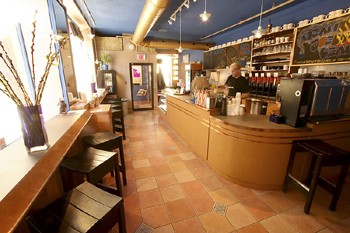
Position of Power: Administering caffeine to thirsty addicts is heady work.

Confessions of a Java Jockey

A day in the life of a barista

By Ella Lawrence

Ol’ Spitfire is acting up again. During its 6am reassembly, the espresso machine begins to make ungodly clanking noises before suddenly spewing espresso grinds through its basket straight at my eyes. It’s a little temperamental in the mornings. Screaming maniacally over in the corner, the other caffeine-producing monster, Curtis the Urn, shoots steam three feet into the air. Curtis spurts out six gallons of coffee at a time, which we usually sell before our shop has even been open for a half-hour.

I don’t even need to drink coffee anymore; the steam from our urn holds enough caffeine to make me buggy-eyed. Of course, that doesn’t stop me from slammin’ the espresso.

As is the case every morning, we grind 12 pounds of coffee (iced, decaf, French roast and house coffee) for Curtis to brew. We arrange the pastries artistically, fill six thermoses with half-and-half (I’ve developed a hatred for the smell of rich dairy products) and set up the chairs out front. Now, with 10 minutes to kill before opening, we sit outside with an espresso and a cigarette, and discuss recent marriages of old high school friends.

Often, the first customer of the day is already waiting outside in the dark. If it’s someone we like, we’ll go back inside to open the doors; if not, they have to wait until we’ve finished our smoke.

Today, our first customer is Big Gay Mike, and we rush to open the door. Big Gay Mike comes in once before his morning workout and once afterwards for a nonfat café au lait and a plain bagel with cream cheese. His dog, Ed, gets half of the bagel. Big Gay Mike has a T-shirt with Ed’s picture on it, and several large portraits of the pooch adorn the walls of his home.

Big Gay Mike is our absolute favorite customer because he always listens to our dating woes and offers tips on which expensive restaurants we should get our dates to take us to. He also likes to bake, and he often brings us decadent brownies and peanut butter concoctions.

As Big Gay Mike and Ed are leaving, Mr. Cappuccino Man comes in for a capp in his own mug. He always gives us his newspaper when he’s finished so that we can do the crossword. Yesterday, Mr. Cappuccino Man, a portrait photographer, brought Laura a poster-sized photograph that he took of her last week for her birthday.

I went with Laura to Mr. Cappuccino Man’s house for the photo shoot because we don’t really trust our customers. All kinds of coffee drinkers come into the shop, from briefcase-toting yuppies to homeless heroin addicts who use our bathroom as a quiet place to shoot up. But whatever their position in life, a large majority of our regular customers are weird.

We’ve developed certain coping strategies, the main one being, “Don’t mess with people’s coffee.” Customers can turn ugly as pit bulls guarding a bone if they fear something’s different about their usual caffeinated beverage.

At 7:30am, Construction Ken and his little daughter come in for a 20-ounce mocha with whip and a small hot chocolate. Construction Ken says he’ll bring us abalone pearls for our navel piercings the next time he dives. We’ve heard it all before, although Construction Ken is the cutest of all the customers who hit on us.

Actually, the constant attention–romantic and otherwise–can get tedious. A co-worker’s pet peeve is that she’s “a prisoner behind the counter! I’m not a freakin’ bartender, you know!” Oh, but you are, my dear. Our bar’s just more socially acceptable than the kind where patrons wind up face down on the floor at closing time.

Cowboy Dave is our next customer, and today he’s feeling spry. He does a tap dance for me as I hand him his small house coffee. Around 9am, the pack begins to trickle in. We’ve got a used-car salesman, his girlfriend, a social worker, a chef and a few unemployed construction workers who hang around from eight to 10 hours a day, drinking French roast and smoking cigarettes. They get refills once an hour.

My co-worker Saul compares our coffee to “a crackhead in a prom dress, because it looks classy and glamorous, but when you take off the prom dress, you see that it’s just crack.”

Sometimes we get an in-your-face look at more serious addictions; it’s not much fun, for instance, to have to clean up used hypodermic needles from the bathroom floor.

That said, working in a coffee shop is the best kind of service-industry job. Customers are nicer to baristas than to other people who wait on them because we’re like drug dealers; we give them what they need and make them feel good, so they’re grateful. Plus, we stand on a raised platform so we look down on all of the sleepy customers. It’s a position of power.

During slow times, we java jockeys do a lot of caffeine-induced philosophizing–and no small amount of gossiping. Who is Saul trying to sleep with this week and how old is she? But mostly, we talk about the customers.

Our shop collects scads of loons. We’ve dubbed one nut the Babbler, for obvious reasons. He’s a contractor who was going to install new outdoor seating, and he thought this made him our new best friend. After the Babbler had been hanging around eight hours a day for about two weeks, Saul was the only person who’d respond to his constant conversational overtures. The rest of us would stare vaguely off into the distance, which didn’t keep him completely at bay, but at least kept him from becoming overexcited.

Today, Saul took his break and went out front to skateboard. That’s when the day took a strange turn. While doing a trick, Saul accidentally broke his board in half. Upon seeing the board snap, the Babbler began to jump up and down, excited to try a new sort of glue. He pulled out a multitool to remove the wheels. Saul took over the job because the Babbler wasn’t having much luck dismantling the wheels. But the tool suddenly slipped out of Saul’s hand, and the Babbler lunged forward, screaming, “Nooooooo!”

Then he grabbed Saul and tried to stab him with the tool. All of the regulars and employees (we usually hang around out front on our days off) stood up and restrained the Babbler while he screamed threats at Saul. After that, the Babbler was expelled from the shop.

We like to use our right to refuse service, though we usually save the job of giving the bum’s rush to unruly customers for Laura because it’s her favorite part about being assistant manager.

Yesterday, two of our most aggressive customers, Beavis and Butt-Head, drew swastikas on the foreheads of all of the Arab-looking meditation yogis tacked up on our bulletin board. Brandon erased the swastikas, leaving the poor yogis with permanently scrubbed white foreheads.

When the mullet-headed duo come in for their caramel mochas this morning, Brandon and I are working the counter. Butt-Head swaggers up to the register and orders, Beavis sniggering away at his shoulder. I look down from my position of power and say, “OK, but you have to promise not to draw any more swastikas on our yogis.”

Butt-Head stars at me and sputters, “What? What! Who said this? I’ll sue you for slander, you bitch! You can’t accuse me of this in front of all these people! I’ll have my lawyer sue you personally for all you’re worth!”

For my $7 an hour, sue away, buddy. I reply, “Two of my co-workers saw you drawing swastikas on our bulletin board yesterday. I don’t find that cool, and I’d like to ask you to refrain from doing that in the future.”

After listening to Butt-Head berate me for a few more minutes, Brandon repeats what had happened yesterday. At this, Butt-Head becomes even more aggressive and demands that Brandon step outside and settle the dispute with his fists. Butt-Head weighs over 200 pounds and has a prior grudge against Brandon for “disrespectin’ his woman” (direct quote) while serving her a vanilla latte a few months back.

Hearing Butt-Head threaten Brandon with fisticuffs, I get angry and tell the cretin to leave the store immediately. He finally takes off, spewing a volley of curses over his shoulder on the way out the door and concluding with this insult, directed triumphantly at me: “You’re so confused, you don’t even know what color your hair is!” (Within the last month, my hair has gone from poppy to vermilion to Atlantic blue.)

The next customer in line comes up to order his 20-ounce coffee. This guy, another big construction-worker type with a few teeth missing, leans over confidentially and whispers, “I think your hair’s real pretty.”

Big Gay Mike’s response to the confrontation is more insightful: “Why are such big, strong men ordering such wussy drinks?”

I later ask Brandon how he was able to simply stand by Ol’ Spitfire and take all that profanity in silence, and he replies, “I just looked at him and sort of took satisfaction in knowing how much smarter than him I am.”

Ah, another fulfilling day at the shop. During the afternoon slump, we’ll face off with each other and chug espresso shots until we get sick, then we’ll race around cleaning and organizing, like the caffeine addicts we truly are.

From the June 1-7, 2005 issue of the North Bay Bohemian.

© Metro Publishing Inc.
Swirl n’ Spit

Swirl n' SpitLedson Winery By Heather IrwinLowdown: During the late 1990s, Sonoma County architecture-watchers were abuzz about the building of that hulking grey "starter castle," as my grandmother liked to call it. For years, the enormous Kenwood building was in various states of construction, and it was anyone's guess as to who was building it and, well, why?The mystery...

‘Ecotopia’

Eww-topia: The wide-eyed sentimentality of 'Ecotopia' still--strangely--translates today.Eco CultRevisiting 'Ecotopia' 30 years later By Pat JosephIn the afterword to the 30th anniversary edition of his 1975 novel Ecotopia, author Ernest Callenbach writes, 'Looking back, it seems clear that Ecotopia was the first attempt to portray a sustainable society, and that this, more than its modest literary merit, explains its...

Coastwalk

Populist Power: Nature's beauty doesn't only belong to the rich.Love of SeaCoastwalk reminds us that the ocean belongs to everyoneBy R. V. ScheideBy the law of nature these things are common to mankind--the air, running water, the sea, and consequently the shores of the sea. No one, therefore, is forbidden to approach the seashore . . .--The Justinian...

Ashtray

Troopers: Sarah-Jane Andrew and Dave Wiseman of Ashtray bravely endure an evening as faux hippies. Phish PhryAshtray explores its inner hippieBy Gabe MelineIt's 2:35am and I have just spent the evening trying to convert the singers of a punk band into hippies.It was useless, of course, but I had to give it a shot. It all started with a...

Trash Talk

What a Dump!: California's goal is to someday have zero waste. Zero ToleranceFrom rethinking recycling to reconsidering our relationship to trash, the zero-waste movement challenges conventional wisdomBy Jordan E. RosenfeldA guaranteed conversation-stopper, the topic--and indeed, the reality--of garbage is not going to go away any time soon. Moreover, there are a number of widely held public assumptions that impede...

System of a Down

Line-Up: System Of A Down releases half of this year's good news.Thrash MentalHas SOAD made the album of the year?By Karl ByrnAs an album-of-the-year candidate for the tumultuous 12 months of 2001, System Of A Down's outspoken metal classic Toxicity was hard to beat. The album was notable in part for the track "Chop Suey!" perhaps the most visible...

Briefs

BriefsGallo's HumorWelcome to the topsy-turvy world of winemaking. One week, Gallo of Sonoma plays local hero, donating $150,000 to Santa Rosa Junior College, earning the right to name the planned instructional winery to be built on the JC's Shone Farm near Forestville. The next week, the pesky United Farm Workers of America are reminding people that Gallo of Sonoma...

Swirl n’ Spit

Swirl n' SpitMayo Family Winery By Heather IrwinLowdown: Here's the honest truth, from me to you: There are only so many glasses of wine you can taste in a day before they all start tasting pretty much the same. I remember hearing some wine snob announce loudly as he walked up to a tasting bar, "My palate is just...

The Spindles

Sounds Good Music.2005Grace NotesA Loop Is a Loop Is a LoopJust Plain BobSublime SpindlesBye Bye BVHU Love 2 SwoonPukemeistersYoung Tree GrowsWhat Is Hip?Hidden MeaningsThe Spindles' urgent subtletiesBy Karl ByrnWords can be tricky, especially in rock 'n' roll. Along with lyrical twists, signifiers like band names, stage names, genres and titles often merit a closer look. Words can confirm or...

Confessions of a Java Jockey

Position of Power: Administering caffeine to thirsty addicts is heady work.Confessions of a Java Jockey A day in the life of a baristaBy Ella LawrenceOl' Spitfire is acting up again. During its 6am reassembly, the espresso machine begins to make ungodly clanking noises before suddenly spewing espresso grinds through its basket straight at my eyes. It's a little temperamental...
11,084FansLike
4,606FollowersFollow
6,928FollowersFollow


