Artists at Work, Marin’s Rancho Roots and History Impresarios

0

Sausalito

Artists at Work

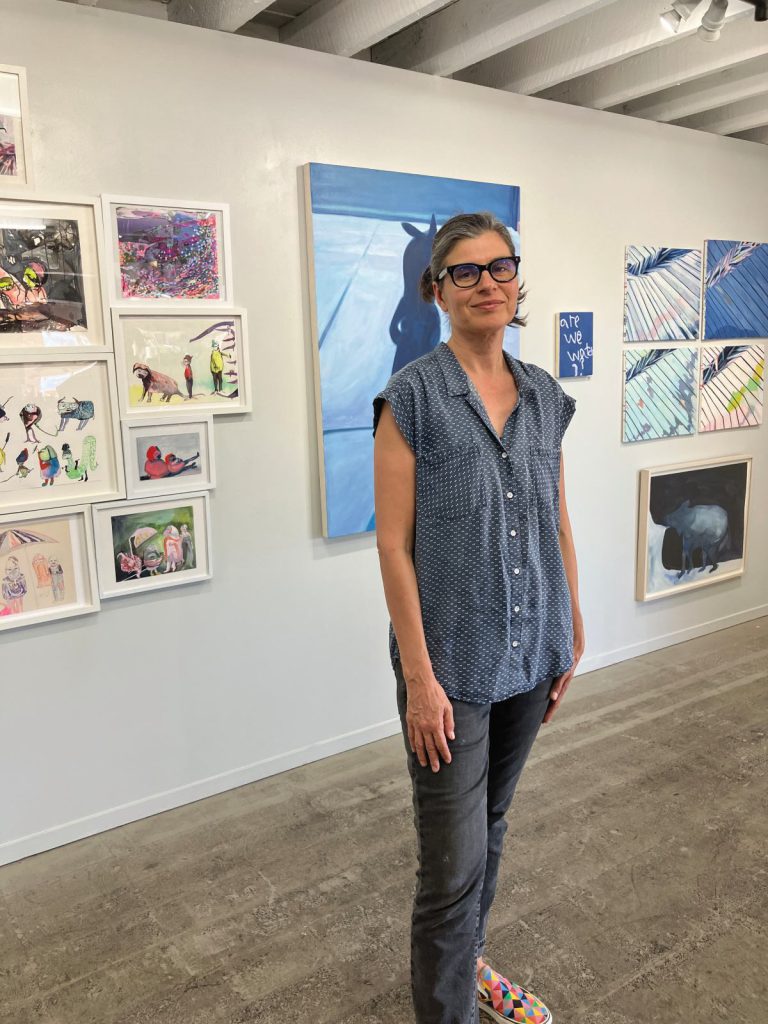
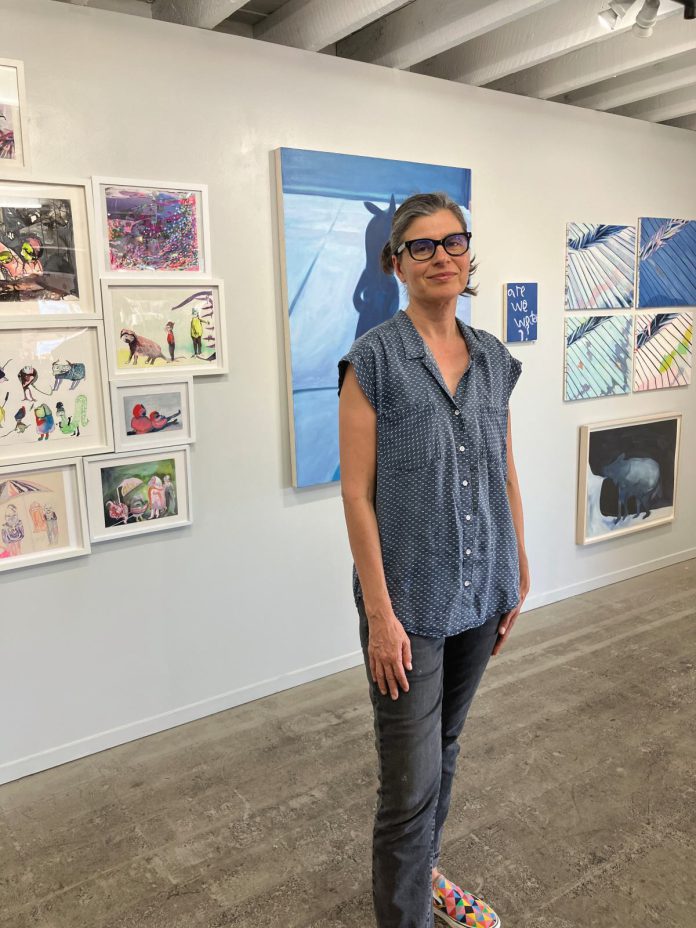
ICB ART kicks off the year by throwing open the doors to one of Sausalito’s most quietly industrious creative hubs. Artists at Work offers a rare, behind-the-scenes look inside the historic ICB Building, where more than 60 artists—working across painting, sculpture, photography, ceramics, textiles and beyond—invite the public into their studios while the work is actually happening. Spread across three floors of waterfront space, the event lets visitors wander, ask questions and watch ideas take shape in real time, from experiments that almost work to pieces ready to go home with a new owner. Offered just twice a year, Artists at Work is part open studio, part cultural field trip and part reminder that Sausalito’s art scene is very much a living, working organism. 11am–5pm, Saturday, Jan. 24, ICB Building, 480 Gate 5 Rd., Sausalito. Free admission; free parking; all ages welcome. More info at icbart.com.

San Rafael

Rancho Roots

Marin History Museum opens the doors to a deeper layer of local history with Rancho Roots: The Californio Legacy in Marin, a new bilingual exhibition that traces the enduring influence of Spanish and Mexican settlers who established ranchos across Marin County in the early 19th century. Through artifacts, storytelling and hands-on interactive displays, the exhibition explores how Californios shaped the region’s land use, agriculture, place names and cultural identity—threads that still run through Marin’s farms and communities today. 11am–3pm, Saturday, Jan. 24, Marin History Museum, 1125 B St., San Rafael. Free.

Sonoma

Gold on the Roof

History gets theatrical—and a little supernatural—inside the Buena Vista Winery legendary Bubble Lounge with Gold on the Roof, the latest installment from Sonoma History Cabaret. Created and performed by local history impresarios George Webber and CW Bayer, the show summons Zoltar the Magnificent, a spiritualist armed with Andronico Vallejo’s mystical guitar, who attempts to clear the afterlife reputation of Count Agoston Haraszthy, Buena Vista’s famously controversial founder. Accused of embezzlement in life and apparently still stewing over it in death, the count returns to help uncover the “real” culprit—through means both historical and hilariously theatrical. Admission includes a glass of Champagne, sparkling wine or white wine, with additional pours available. 4–5pm, Saturday, Jan. 24, Buena Vista Historical Winery, 18000 Old Winery Rd., Sonoma. $75.

Petaluma

Flow and Form

Usher Gallery opens its 2026 exhibition calendar with Explorations in Flow and Form, a joint show pairing the intuitive abstractions of Catrina Walker and Nicole Mathers. Though distinct in process, both artists work from a place of movement and responsiveness—letting material, gesture and repetition guide the work rather than fixed imagery. The opening reception invites viewers to meet the artists, with live music by Jethro Jeremiah alongside light refreshments and wine. It’s a community-forward evening that reflects the gallery’s emphasis on local voices and exploratory practice. 5–8pm, Saturday, Jan. 24, Usher Gallery, 1 Petaluma Blvd. N., Petaluma. Free. More info at ushergallerypetaluma.com.

Freedom From Fear: What We Can Do Here and Now

This is the third and final piece of a three-part series on ongoing issues with U.S. Immigration and Customs Enforcement as it reaches into our areas. -–Editor

Part 3: Fear Is Control

“Freedom from fear” was the fourth of four freedoms defining democracy President Franklin D. Roosevelt framed in his rally cry to fight fascist conquest from without. It is openly debated whether America is now fighting a fascist takeover from within.

It may be debated, but only because the would-be dictators of the world will always disguise their plays for power in the mock forms of democratic legality (e.g., declaring a fake emergency, attacking political rivals through trumped-up legal charges or holding rigged elections).

But there can be no disguising the fear. Fear is how authoritarians maintain control, how they keep the people head down and silent—hardworking, obsequious, compliant. In any country in the world, the questions, “Do you fear the president?,” “Do you fear the government?” and “Do you fear the police?” cut through the political lies to the truth.

Wherever one stands on the political spectrum running blue, purple, red, there can be no doubt that in America a great fear is rising.

Fighting Fear Itself

“Power, not panic” is the slogan with which “immigrant defense coordinator” Gina Garibo signs off every email. I was always relieved to see it. In the process of my research, I met a great many professionals, protesters and volunteers just like Gina, “Esteban” and “Marisol.” Some are working openly. And some are working in the new underground resistance. 

They are part of a great mobilization of people gathering around a strategic arc of methods for confronting ICE terror. It is a thrilling thing to witness, but still much more support is needed if they are to succeed. “Expanded capacity” is the watchword among these groups.

Trump’s “Big Beautiful Bill” passed last summer by a cowed millionaire’s Congress that doubled the ICE budget to $80 billion. A crash recruitment drive is setting targets to recruit another 18,000 officers to the president’s private police force (The Economist, “Trumpforce”).

California is a “sanctuary state” with the highest percentage of undocumented people in the U.S. (7%). It is governed by one of Trump’s strongest opponents now and in the 2028 election—democratic Gov. Gavin Newsom. California is going to be heavily targeted. ICE will return to San Francisco. “It’s going to get a lot worse before it gets better,” “Esteban” told me when we first met at the “American nostalgia” diner.

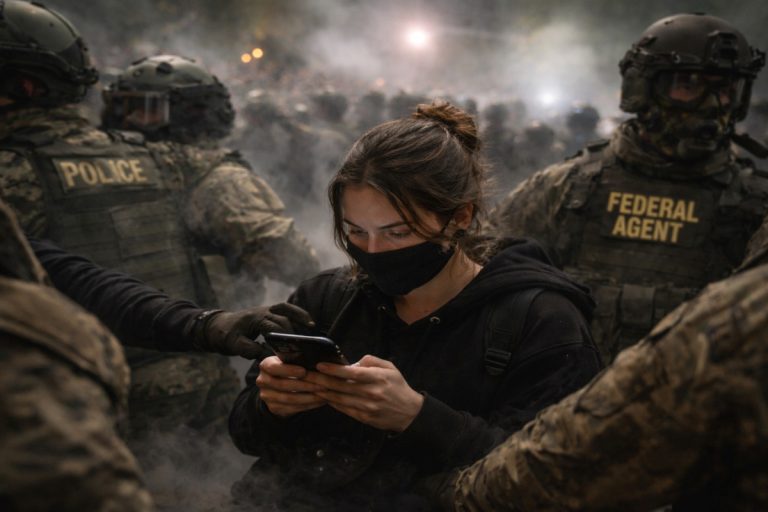
The activists I spoke to invite our readers to look at these elements of their adapting strategy and try to find their part in it. Whether our readers are motivated by the fight for immigrants’ human rights and dignity, or to fight for the rights of the poor, minority rights, anti-racism, the fight against the billionaires, public safety, national security, or by the preservation of our constitutional rights, these activists urge them to find their part in this fight. ICE is now the flashpoint in the fight against fear. Use these terms and names to begin one’s own research. Be brave; be unafraid. Fight.

Sanctuary States, Counties and Cities

Sanctuary declarations are based in constitutional law which except state and local officials in assisting in the enforcement of federal laws. The phrase “sanctuary” relates these laws to a religious tradition of sacred sanctuaries for the oppressed, amplifying moral outrage at their violation. Ultimately, they are a local declaration of passive non-cooperation with ICE—with no necessary commitment to resistance or to assistance to those who are fighting.

Putting Pressure on Elected Officials

Claudia Rios Manzo, the program director of the Sacramento F.U.E.L., a network of organizations for immigrants, recommended this key piece. Ask elected representatives what they are doing to actively support our undocumented neighbors. Through funding and partnerships, local government can support those actively fighting ICE terror for all of us. Help them be brave; even U.S. senators feel unsafe in this terror.

Boycotts

Conscientious consumerism quietly remains one of our most powerful political tools. In this way, the people can lead powerful corporations that have no morality but will always follow the money like cattle. Don’t buy from the corporations that have contributed to Trump in the last year or have contracts to supply ICE. If one has stocks in these companies—dump them.

Marches

Along with local chapters of No Kings, a host of local and national groups are organizing a wide range of non-violent protests across the Bay Area. There are many calendars—I suggest the calendar at actiontogetherwest.org. I would also recommend Gene Sharp’s “Methods of Non Violent Action.” Boycotts and marches are just two of the 198 methods of resistance listed in its pages.

Be Out

This part of resistance was advised by activists, especially for Latinos and for persons of color. It is advice for all the communities that feel targeted by this administration (such as LGBTQ persons):

Be safe. Take care of oneself. And to the extent that it is consistent with safety (in one’s personal assessment), be out. Continue to go out—show one’s face; be loud; take one’s place; be proud. Gather. Dance. Live lives as free people. It is a political act. It is effective resistance. They want people to hide, and hide who they are. Be out.

Allies are advised to recognize, honor and support this everyday courage.

Talk About These Issues

Use platforms to keep these issues out in front. Have conversations with friends and family. Continue to educate oneself.

Print and Digitally Distribute Red Cards / Tarajetas Rojas

These index cards, available in 56 languages, have been prepared by the influential Immigrant Legal Resource Center. They have constitutionally protected immigrant rights printed on one side, and a script for talking to ICE agents on the other.

Keep the Number of One’s Local Rapid Response Network on One’s Phone

These networks collect and verify crowdsourced ICE sightings in one’s area and send trained legal monitors to observe and document ICE activity and arrests.

Look up “California Rapid Response Networks” to find one’s local network. And read up on how to identify ICE—false alarms fan the fear.

Train to Be a Legal Observer

Abigail [redacted], a legal observer for rapid response, suggested going to a training by one’s local network without commitment and “make your own assessment of personal risk” after. Some trainees may choose to become rapid responders, others to participate in “adopt-a-school” or “adopt-a-day labor site” programs or be observers at community events that might be targeted. Still other trainees become public sources of good information.

Besides adding to the safety of our immigrant friends and neighbors, observers’ video documentation discourages rights abuses by ICE agents, helps identify detained persons for family and becomes evidence in deportation hearings.

If One Is an Attorney, Consider Volunteering

There are corresponding rapid response networks for defense attorneys. Contact the Immigrant Legal Resource Center or one’s local rapid response network to learn more.

Volunteer

Donate time and skills to local immigrant rights groups. And also do the same for the food banks, community free clinics and homeless shelters, community of service providers that supply their very limited social safety net.

Donate

Donate money to those same local and national organizations. I will add that there is a special moral obligation on the part of employers in industries that have benefitted from hard-worked and cheap immigrant labor to donate. Immigrants have given to us; now it is time to give back.

Check in With Neighbors

Immigrant communities are fragmenting; families are isolated and scared right now. People of color are intimidated. Abigail [reacted] had this further piece of advice: “Reach out to each other. If you happen to know they are undocumented, offer to pick up their groceries. Let them know that you are on their side.” 

Meet these people and build community. Force does indeed check force, but ultimately, communal love is the power that fights fear directly. And most assuredly, love wins.

CODA

After our intense interviews with the farm workers, “Esteban” wanted to show “Marisol” and me his grandfather’s old wooden plow by way of refreshment. “He fed 10 children with that plow,” “Esteban” said with pride.

It made me think, once again, how fundamentally similar working class Mexicans and Americans are (they are rural, independent, truck driving, beer and barbecue loving, church-going family people, wanting only to work a square deal and for the government to leave them in peace).

At one point on our walk over crunching gravel, a sudden impulse made “Esteban” stop in his tracks and pull out his phone. “I didn’t show you this, ‘Marisol,’” he said. It was a video, now five years old, of two of his grandchildren, then aged three and five. They are in their PJs in a playroom before a keyboard. Together, they sing a song for him—grandpa. “Don’t Worry, Be Happy,” they sing in their small piping voices. “I watch it a lot these days,” said “Esteban.” And not for the first or second time that day, we cried together.

Learn more. Click or type this link: linktr.ee/iceterrorANDamericandemocracy.

Family Legend: Gabriel Fraire’s ‘Pancho Villa’ to Run on Raven Stage

Local drama takes another step forward with the next play at the Raven Performing Arts Theater in Healdsburg, Who Will Dance with Pancho Villa? But the production, which opens on Jan. 22 for an eight-performance run, is hardly new. 

Gabriel Fraire and his brother, John, wrote the play more than 30 years ago; it had its first off-Broadway performance in New York in 1994.

“This was our first collaboration,” said Healdsburg resident Gabriel Fraire. “My brother is  actually the theater fan. He was living in Manhattan and told me that if a couple of Mexicans wrote a play about their Mexican family history, he was sure he could find a producer.”

Though John Fraire has moved on to another career as a university administrator, older brother Gabriel Fraire (he’s 77, oldest of six) is still a writer, with several novels to his credit, plus poems, screenplays and newspaper work. He was editor of the Windsor Times for several years, and a Healdsburg Tribune columnist. His local history book, I Remember Healdsburg, is available at the Healdsburg Museum, and his other works are on his website at gabrielfraire.com. 

He and his wife, Karen, have lived in California since 1975, when they realized they had no reason to stay in the Midwest.“We were living on a farm in Illinois, doing that back-to-the-earth, self-sufficient stuff,” he recalled. “We didn’t have a lot of money. In the winter, we had to close down all the rooms and live out of one room. Finally one day, I just said to her, ‘We could live anywhere. We don’t have to live in the cold.’”

That cold was more than the climate. “When we lived in Illinois, we were considered a mixed-race couple. Our landlord at the time told all the neighbors, ‘Oh, Karen is such a nice girl. Too bad she had to marry out of her race,’” Gabriel Fraire said.

“But soon as we came over the mountains and drove down into California, oh my goodness,” he remembered. “Mixed-race couples, blended children; you know, it didn’t seem to be a big deal. And for the first time in my life I felt like, wow, we can just walk the street and not be thought inferior.”

Who Will Dance with Pancho Villa? was the Fraire brothers’ first produced play, quickly followed by Cesar Died Today, staged in 1997 at Brooklyn College. That latter play was produced at the Raven just three years ago—it concerns a Latino family’s reactions to the death of Cesar Chavez—and was directed by Oscar Montelongo. Initially tabbed to direct again, he had to leave this production after several weeks of rehearsal and was replaced by Jenna Dolcini.

Though the original play contained some dancing, Fraire noted, it has been pumped up for this production with the involvement of the Ballet Folklórico Legado de Mi Alegría of Cloverdale. They perform as dancing spirits, intertwined through the play, who help remind the main character—a young man called simply Chicano—of the joy of dancing.

Several of the actors are returning from the Cesar Died Today production, including Windsor Mayor Rosa Reynoza, who again plays the family matriarch. There’s also a father-son team on stage, Juan Vera and Gabriel Vera, but Fraire is most excited by the performance of Ismael Ramos in the lead.

“This kid is a great actor,” the playwright said. “He goes back and forth from Rohnert Park to L.A. I just hope he gets a shot in TV or movies because his facial expressions are so effective.”

Those unfamiliar with the legend of Pancho Villa will be brought up to speed by visual effects on the stage’s screen. The Mexican revolutionary, guerrilla leader and politician occupies a significant role in northern Mexico’s culture, so much so that three cast members of the Raven production claim some link to the charismatic guerilla.

The audience for the play will be seated on the stage itself, with actors and dancers performing in their midst, as it were. “I am doing most non-musicals with the audience onstage from now on; it’s a much more intimate and I think rewarding experience for the audience and the actors,” said Steven David Martin, the Raven Players’ artistic director.

“You know, the really important thing for both John and I about doing theater is that we want young Latinos to see that they can be a part of theater, that they can join theater—that it’s not an exclusive club,” said Fraire.

Though the Players tried to fill the cast with Latino actors, they weren’t entirely successful. “One reason, of course, is that Latinos don’t have the spare time to volunteer for community theater. Most of the Latinos I know have two jobs or a job and a family to care for,” Fraire said.

He verbalized a fact that remains increasingly obvious, even if unpopular to say: “As a person of color, we live a different life in America.”

‘Who Will Dance with Pancho Villa?’ will be staged Thursdays through Sundays from Jan. 22 through Jan. 31 (a Feb. 1 matinee has been cancelled). Curtain time 7pm; Sunday matinees 2pm. Tickets available at raventheater.org.

‘FeBREWary’ Reloaded, Santa Rosa’s ‘Beer Passport’ Keeps the City Flowing

Sure, January is the month of resolutions, including the month-long challenge, “Dry January.” But it’s next month, locally-known as “FeBREWary,” that taps both civic pride and the dollars averted by abstinence. 

“Dry January is not necessarily a great thing for the economy locally,” observed Janelle Meyers, vice president of marketing & communications for Visit Santa Rosa, during a recent interview on The Drive on 95.5 FM. “It’s also the slow season around here for our hotels,” she said, adding that hotels are the main funding source for Visit Santa Rosa.

Hence, the Beer Passport. Launched a decade ago by Visit Santa Rosa’s advisory board, the program was created to encourage overnight stays, spotlight local breweries and give people a reason to circulate during the quietest stretch of the year. Now celebrating its 10th year, the Beer Passport is back to beckon visitors and locals alike. 

With its concentration of independent breweries that rivals much larger metros, Santa Rosa is no beer backwater. Sure, “Wine Country” may sometimes eclipse brews as a brand concept, but the fact is beer consumption far outpaces wine at the statewide level. Though the available data is only as granular as the state level, according to a California Department of Tax and Fee Administration summary, beer made up about 46.9 % of total alcohol consumption in the state, while wine was about 23.2 %—almost double wine’s share. Add to that, Santa Rosa was recognized by USA Today’s Readers’ Choice Awards as a “Top 10 Beer City.”

This year’s FeBREWary introduces its most significant update yet: a new app-based Beer Passport platform that replaces the old QR-code system with geo-location check-ins, digital badges and real-time interaction. “It works like social media,” said Christopher Kren-Mora, Visit Santa Rosa’s events and community engagement manager. “You’ll be able to see other people on the platform, the badges they earn and the progress they’re making.”

The mechanics are simple. Participants save the passport to their phone, visit participating locations and check in on-site using geofencing or a tagged photo. Points accumulate. Rewards unlock. Finish the passport and one earns a commemorative medal that doubles as a bottle opener. “Everybody wins eventually,” Kren-Mora said. “It’s a marathon, not a race.”

Moreover, the beer-borne business traffic feeds directly into Santa Rosa’s economic engine. Visit Santa Rosa is funded largely through hotel occupancy taxes, meaning that every overnight stay helps support city services. “The program was designed for economic development,” Kren-Mora said, “to bring people downtown, get them into breweries and encourage them to stay.”

And the promotion isn’t just for tourists—locals are heartily encouraged to steep themselves in their local beer culture. Participation in 2026 spans the breadth of Santa Rosa’s beer ecosystem, including Russian River Brewing Company, Moonlight Brewing Company, HenHouse Brewing Company, Lagunitas Brewing Company, Cooperage Brewing Company, Shady Oak Brewing Company, OLD CAZ BEER, CUVER Belgian Brewers, Beer Baron Bar & Kitchen, and Wilibees Wine & Spirits.

FeBREWary launches Feb. 1 but runs year-round, resetting annually. Ten years in, the Santa Rosa Beer Passport is that rare opportunity for private residents to turn pints into public works. 

For more information, visit bit.ly/srbeer26. Must be 21+.

Won’t Get Fooled Again: Nu Journalism in the Age of AI

In the media game, AI is eating our lunch. “I think we might reach 90% of online content generated by AI by 2025,” said Nina Schick, an adviser and AI thought leader, in a recent Yahoo Finance Live appearance. “I believe that the majority of digital content is going to start to be produced by AI.”

Well, now it’s 2026, and Schick is probably right.

Which brings us to an old, half-forgotten term that suddenly feels timely again: Parajournalism. The word comes courtesy of Dwight Macdonald, who, opining in the New York Review of Books in 1965, described it as a “bastard form, having it both ways, exploiting the factual authority of journalism and the atmospheric license of fiction.”

To which I reply—channeling the surrealist Man Ray in Midnight in Paris—“Exactly correct—you inhabit two worlds—so far I see nothing strange.”

There’s no point in re-litigating a 60-year-old press club brawl. But in an era of fake news, alternative facts and the accelerating prevalence of generative AI in what we read, the individual experience—on the ground, in the moment or at the bar—is more necessary than ever. Not as a replacement for facts, but as a reminder that facts do not arrange themselves into meaning without a human consciousness doing the work.

This hybrid practice eventually became better known as New Journalism, and its celebrated practitioners—Tom Wolfe, Hunter S. Thompson, Joan Didion, Gay Talese, among them—made a persuasive case that voice, presence and subjectivity weren’t bugs but features.

And this was nothing new—not then, not now. Subjective reportage goes back at least as far as Mark Twain, if not the Gospels. The Rashomon-esque tension between truth and fact is ancient. But what felt novel in the 1960s and ’70s feels necessary again now. As Sari Azout writes in her essay, The End of Productivity, “AI can produce infinite amounts of content; quantity is its game. Quality, intention, taste, originality, vision—that’s where we come in.” Voice and individual creativity, she argues, will be the new currency of success.

Agreed. And journalism is where this distinction may matter most. As AI flattens language into competent sameness, what rises in value is the writer’s lived experience—not just where we were and what happened, but why we care.

Critics have argued that New Journalism is what happened when journalism got high on its own supply and started talking about itself. It favors narrative, attitude and texture over the fantasy of pure objectivity—a Zen-like pursuit that’s admirable but impossible, subject as we are to subjectivity. Precisely the point, and why it’s salient today. AI doesn’t have subjectivity. It has no personal experience, no capacity to be there. It doesn’t have fingerprints or singular folds in its brain. It can seem like it’s everywhere at once when, in fact, it’s nowhere.

It’s not you or me. Sure, it can produce a credible simulacrum of my voice and style. (Basic tenet: Why use a five-cent word when one can expense a 50-cent word to the publisher?) But pastiche does not perception make.

Which is how I’ve come to propose my own modest contribution to the journalism lexicon: Nu Journalism—it’s like nü metal, but without the pretentious umlaut. New boss, same as the old boss, but with contemporary branding to differentiate the era.

In a landscape flooded with machine-made content, the human voice matters more. We can’t compete with AI on speed or scale, but we can compete on meaning. And that’s a game we humans are still very much equipped to win. Do this right, and writing in the first person might keep us from writing as the last person.

Daedalus Howell sends arts and media newsletters from dhowell.com.

The Don, Making an American Mafioso

It is quite surprising that, for nearly 10 years, millions of people continue to spell MAGA incorrectly. Please let me explain that the correct spelling of MAGA is M-A-F-I-A. 

The leader of this mafia is unequivocally “The Don.” Throughout these years, The Don has relied essentially on the same strategy. 

He, himself, does not directly perform the mafia’s violent and murderous acts. Like all Dons, he gets others—in his case, the Proud Boys, the Oath Keepers, the January 6th insurrectionists, and more recently, ICE and the U.S. military—to perform the acts that he orders. He has violated his oath to faithfully execute the laws of the United States nearly every day he has been in office.

Inside The Don’s world, there are only two possible positions: One is either on his side, or one is the enemy. Like all mob bosses, The Don’s primary weapon is extortion. His pattern of interaction is that he initiates conflict by making massive threats, then sadistically stomps his foot on his opponent’s neck, followed by a superficial retreat, claiming he is willing to negotiate. 

There is one critical factor that distinguishes The Don’s criminal operations from many other mafia organizations: Despite the exception of his unrelenting secretive and corrupt business maneuvers, he generally conducts most of his criminal behaviors openly in public.

The open display of his criminal behavior has a paradoxical effect on the public. Millions of Americans reason that The Don’s criminal behaviors must not be illegal because, if they were illegal, he would be arrested. But The Don is not arrested, in part, because he has successfully corrupted nearly the entire American judicial system. 

There will be a day when this M-A-F-I-A boss is gone. However, the longer The Don sits in that White House office, the greater the destruction to life and the planet. It is a moral duty of every American to stop this criminal.

Alan Kanner, Ph.D., is a psychologist in Amherst, MA. 

Caviar Dreams: Chef Jesse Mallgren Sets the Table

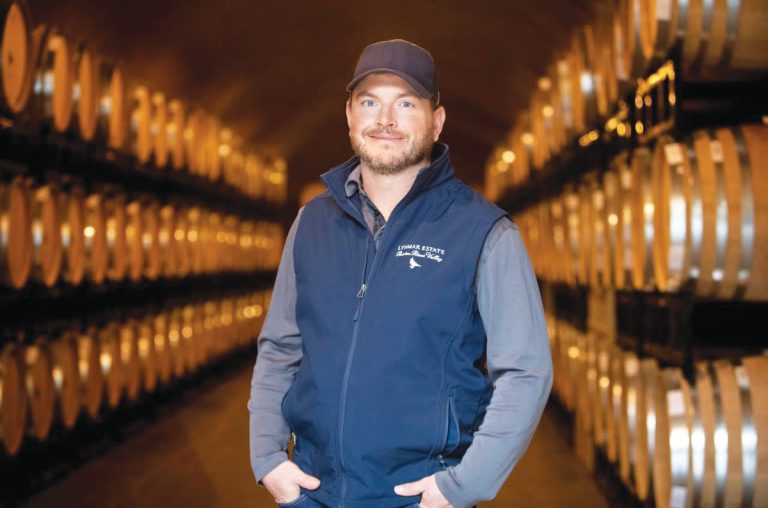
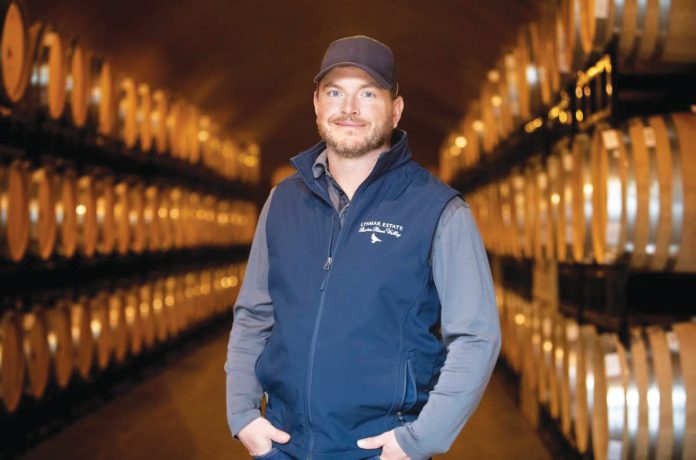
Chef Jesse Mallgren spent 13 years as the Michelin Star-winning executive chef at Healdsburg’s Madrona Manor (now The Madrona Hotel). 

In the culinary world, 13 years is a lifetime, an esteemed prelude for Mallgren’s current role as executive chef at Jordan Vineyard & Winery. 

He has a vast “playground” to work with at the 1,200-acre estate, where he utilizes produce from their onsite garden, honey from the winery’s apiaries and forages for ingredients from the property. 

All of this goes into the culinary-driven, wine-paired experiences one can enjoy at Jordan, on tours and tastings, at full lunches or even during a daily breakfast at their Chateau Suites. Mallgren also puts together menus for special events like the upcoming Caviar Tasting at Vista Point on Valentine’s Day weekend. 

An exclusive Chef’s Reserve Caviar by Tsar Nicoulai will be served with blinis made with Jordan Chardonnay yeast, all paired with beautiful wines, of course.

Amber Turpin: How did you get into this work?

Jesse Mallgren: I’m continually inspired by memories of my childhood, watching my mother cook dishes that came alive with global, exotic flavors. That early exposure sparked my passion for the culinary arts. Along the way, I was fortunate to learn from mentors like Gary Danko and Jeremiah Tower, whose guidance helped shape both my skills and confidence in the kitchen. Before joining Jordan, that journey led me from serving as chef de cuisine at Aspen’s Syzygy to becoming executive chef at Madrona Manor in 1999.

Did you ever have an ‘aha’ moment with a certain beverage? If so, tell us about it.

It was an older Bordeaux that truly changed the way I thought about wine. I was 23, working at Stars with Jeremiah Tower, and although I can’t recall the exact bottle, I know it was from the 1970s. Experiencing how beautifully a wine could evolve over time completely shifted my perspective.

What is your favorite thing to drink at home?

I love variety, so it’s usually a different cocktail every night. Rum one evening, bourbon the next. I’m always looking for inspiration and follow more than 20 cocktail-focused Instagram accounts to keep things fresh.

Where do you like to go out for a drink?

Anywhere with a great view, especially if it overlooks the ocean. The setting is just as important as what’s in the glass.

If you were stuck on a desert island, what would you want to be drinking (besides fresh water)?

Coffee, with just a splash of whole milk.

Jordan Vineyard & Winery, 1474 Alexander Valley Rd., Healdsburg. 707.431.5250. jordanwinery.com

Your Letters, Jan. 21

Forever Young

In reference to “Don’t Get Old,” Jan. 14, 2026, in my house, when it comes to age, the word old is verboten. If you think you’re old, then you will be old. On the other hand, growing older is a mathematical equation that can’t be controlled. One plus one plus one will always equal three.

Soon, I will be 73, and my wife will be 70. I have had fourth-stage cancer on my liver, hepatitis, Hepatitis C, and a few years back, my leg became so infected they wanted to take it (they didn’t). My wife has lupus, kidney disease and a bad back; some days it’s difficult for her to even sit up.

That said, on our next birthdays, we will be turning 16. Life is tough enough, not knowing what’s from one day to the next, what’s coming down the pike, so in our house, there’s just no other way to go about it. Sixteen it is.

Never quit; never give in to the age thing. Make them drag you out of this world kicking and screaming. Long live date nights, dancing and loud music. Long live sex, rock & roll and….

David Dale
Sonoma Valley

Nabob Kabob

Elon Musk’s disastrous changes at X (such as rolling back content moderation policies and creator payouts) have turned it into a platform where the right mainly argues with the extreme right. Now, even right-wingers are perturbed by how popular bigotry and conspiracy theories are becoming on X, as feuds and controversies erupt there and shake the GOP. 

Now, this I do not understand. The GOP/MAGA-“not so” right wing wanted this. Now they’re saying there are too many nattering nabobs of negativism?

Gary Sciford
Santa Rosa

Free Will Astrology, Jan. 21-26

0

ARIES (March 21-April 19): Master astrologer Steven Forrest understands you Aries people well. He says that the riskiest strategy you can pursue is to constantly seek safety. It’s crucial for you to always be on the lookout for adventure. One of your chief assignments is to cultivate courage—especially the kind of brave boldness that arises as you explore unknown territory. To rouse the magic that really matters, you must face your fears regularly. The coming months will be an ideal time for you to dive in and celebrate this approach to life.

TAURUS (April 20-May 20): You are an ambassador from the material world to the realm of spirit—and vice versa. One of your prime assignments is the opposite of what the transcendence-obsessed gurus preach. You’re here to prove that the flesh is holy, pleasure is a form of prayer and the senses are portals to the divine. When you revel in earthy delights, when you luxuriate in rich textures and tastes and scents, you’re not being “attached” or “unspiritual.” You’re enacting a radical sacred stance. Being exuberantly immersed in the material world isn’t a mistake to overcome but a blessing to savor. May you redouble your subversive work of treating your body as a cathedral and sensual enjoyments as sacraments.

GEMINI (May 21-June 20): Everything that’s meant for you is trying to find its way to you. Here’s the problem: It can’t deliver the goods if you’re in constant motion. The boons trying to reach you are circling, waiting for a stable landing spot. If you keep up the restless roaming, life might have to slow you down, even stop you, so you’ll be still enough to embody receptivity. Don’t wait for that. Pause now. Set aside whatever’s feeding your restlessness and tune into the quiet signal of your own center. The moment you do, bounties will start arriving.

CANCER (June 21-July 22): Artist Louise Bourgeois said, “I am what I do with my hands.” I will adapt this declaration for your use, Cancerian: You are what you do with your feelings. You are the structures, sanctuaries and nourishment you create from the raw material of your sensitivity. It’s one of your superpowers. I understand that some people mistake emotional depth for passive vulnerability. They assume that feeling everything means doing nothing. But you prove that bias wrong. You are potentially a master builder. You can convert the flood waters of emotion into resources that hold, protect and feed. I hope you will do this lavishly in the coming weeks.

LEO (July 23-Aug. 22): Admiring writers often say that the Balinese people have no traditional word for “art.” Making things beautiful is woven into everyday life, as if everything should be done as beautifully as possible. I aspire to carry out this approach myself: infusing ordinary actions with the same care I’d bring to writing a story or song. Washing dishes, answering emails and walking to the store: All are eligible for beauty treatment. I highly recommend this practice to you in the coming weeks, Leo. It’s true that you’re renowned for your dramatic gestures, but I believe you also have an underutilized talent for teasing out glory from mundane situations. Please do that a lot in the coming weeks. For starters, make your grocery list a poem.

VIRGO (Aug. 23-Sept. 22): Some American Indigenous cultures have “potlatch” ceremonies. These are elaborate gift-giving rituals where hosts gain prestige by generously and freely bestowing their riches on others. Circulating wealth, instead of hoarding it, is honored and celebrated. Is that economically irrational? Only if you believe that the point of resources is individual accumulation rather than community vitality. Potlatch operates on a different logic: The purpose of having stuff is to make having stuff possible for others. I invite you to make that your specialty in the coming months. Assume that your own thriving depends on the flourishing of those around you.

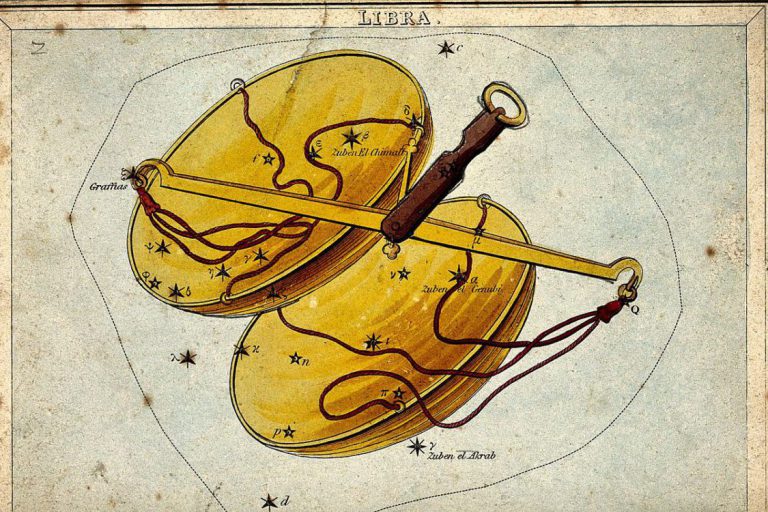
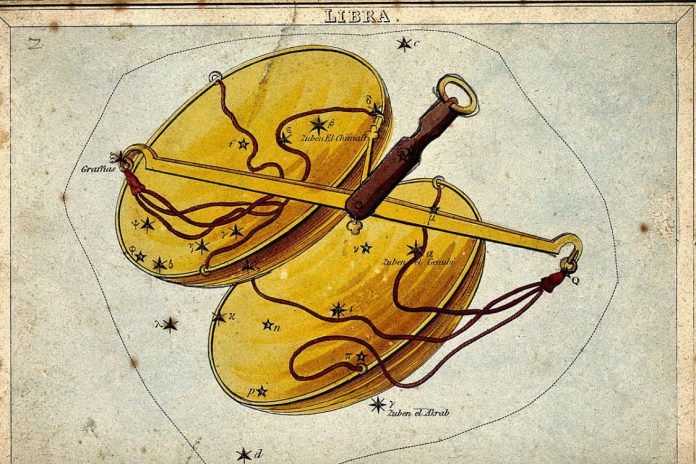
LIBRA (Sept. 23-Oct. 22): Sufi poet Rumi wrote about a “treasure in ruins.” He meant that what we’re searching for may be hidden in places where we would rather not look. Your life isn’t in ruins, Libra, but I suspect you may have been exploring exciting locations while shunning mundane ones that actually hold your answers. What do you think? Is that possible? Just for fun, investigate the neglected, ignored and boring places. Try out the hypothesis that a golden discovery awaits you in some unfinished business or a situation you feel an aversion to. 

SCORPIO (Oct. 23-Nov. 21): In 1839, Scorpio artist Louis Daguerre perfected the daguerreotype, an early version of photography. The images were so detailed that you could count the threads in a subject’s clothing. Alas, they required minutes of perfect stillness to capture. To prevent blurring and distortion, people held their breath, fixed their gaze and avoided fidgeting. Your power metaphor for the coming weeks, Scorpio, is this: the long exposure. The vivid truths in your life will reveal themselves only if you give them more time than you’re used to. So please resist the temptation to leap into action. Be willing to let every process fully develop. Don’t push the pace beyond what yields clarity. Linger on the threshold until all the details sharpen.

SAGITTARIUS (Nov. 22-Dec. 21): As I have promised you a million times, I will NEVER exaggerate. And though you may wonder if the statements I’m about to make are excessive and overblown, I assure you they are not. The fact is, dear Sagittarius, that everything you have always wanted to enhance and upgrade about togetherness is now possible to accomplish, and will continue to be for months to come. If you dare to dismantle your outmoded beliefs about love and deep friendship—every comforting myth, every conditioned response, every inherited instinct—you will discover new dimensions of intimacy that could inspire you forever.

CAPRICORN (Dec. 22-Jan. 19): In Renaissance painting, chiaroscuro refers to the use of strong contrasts between light and dark. It’s a technique that enhances the sense of depth.​ I believe your life may be in an intense chiaroscuro phase. As your joys grow bright, your doubts appear darker. As your understanding deepens, your perplexity mounts. Is this a problem? I prefer to understand it as an opportunity. For best results, study it closely. Maybe your anxiety is showing you what you care about. Perhaps your sadness is a sign of your growing emotional power. So find a way to benefit from the contrasts, dear Capricorn. Let shadows teach you how to fully appreciate the illumination.

AQUARIUS (Jan. 20-Feb. 18): You are a spy from the future. Thank you for your service. I love to see your boldness as you smuggle innovative ideas into a present that may or may not be ready for them. Your feelings of alienation are sometimes uncomfortable, but they are crucial to the treasure you offer us. You see patterns others miss because you refuse to be hypnotized by consensus reality. Keep up the excellent work, please. May you honor your need to tinker with impossibilities and imagine alternatives to what everyone else imagines is inevitable. You are proof that we don’t have to accept inherited structures as inevitable.

PISCES (Feb. 19-March 20): Your unconscious mind is extra communicative, dear Pisces. Hooray. Take advantage. Pay attention to weird images in dreams and songs that linger in your head. Be alert for seemingly random thoughts as they surface. Bypassing logic, your deep psyche is trying to show you ripe secrets and provocative hints. Your duty is to be receptive. So keep a journal or recording device by your bed. Notice which memories rise up out of nowhere. Be grateful for striking coincidences. These are invitations to tune in to meaningful feelings and truths you’ve been missing.

Freedom From Fear and the Tactical Side of Terror

This is the second of a three-part series on ongoing issues with U.S. Immigration and Customs Enforcement as it reaches into our areas. –Editor

Part 2: True designs of the administration

Let me be emphatic; all undocumented immigrants have committed a crime. They have all broken immigration law. All of the undocumented immigrants I spoke to frankly admitted this.

And almost all of them also expressed a real desire for immigration reform.  That surprised me—at first. Although, on second thought, they would almost certainly benefit from any rationalized system—which would necessarily recognize their indispensable importance to the U.S. economy. 

In all justice, it might trigger a second amnesty—like that signed into law by President Ronald Regan in 1986, granting 3 million undocumented immigrants a path to citizenship. People who have served here in our hardest jobs for 20 years have earned it. Call it sweat equity.

Reform is badly needed. But Donald Trump’s new ICE is not the reform we need. 

Surprisingly, it is not even effective at arresting the undocumented for deportation. “You’re not going to arrest illegal immigrants by marching down the street in full battle regalia,” Jason Houser, a former ICE chief-of-staff, is quoted as saying (The Economist, “Trumpforce,” Nov. 15, 2025).

Given the real danger and dire poverty of their counties of departure, ICE terror is unlikely to inspire mass “reverse immigration” either. As bad as things are, none of the people I spoke to spoke of fleeing. They spoke of hiding.

But mass deportation doesn’t appear to be the real objective of Trump’s terror campaign. It is doubtful that the Republican Party’s billionaire and trillionaire donor class or its millionaire Congress would ever allow for the mass deportation of 11 million undocumented workers—even if it were logistically or politically possible. They wouldn’t—their wealth and status depends on the mass exploitation of immigrant labor. 

A showy surge in immigration arrests, emphasizing terror tactics, and the production of salacious anti-immigrant propaganda would deliver all the emotional “satisfaction” of Trump’s “build a wall” campaign promise, while actually deepening America’s economic status quo. 

Thoroughly terrorized, the remaining mass of undocumented workers would be less visible in the public sphere, more silent and more compliant in their own exploitation. They would become much less political—and much more profitable. That is precisely the effect this deportation campaign is having, and I would argue, that is its intended aim. It fits the facts, and it fits all the political requirements. It fits.

Moving Targets

But it’s worse—much worse than that. Seemly, by design, the target of this terror is wider in its scope than undocumented immigrants. The target appears to be “all brown people” in America. 

During a much needed break between our interviews, I asked my translator, “Marisol,” whether she felt targeted by ICE herself. A second-generation Mexican-American and an elected public official, she should feel safe. By way of answer, “Marisol” related a bitter joke to me, which illustrates how the campaign has been widely perceived in the Latin-American community. “ICE agents use ‘the brown bag test.’ They hold a brown bag to your face, and if the color matches—bam, you’re an illegal. Off you go to Alligator Alcatraz,” she said.

“Are you afraid?” is a question I asked all the Latino U.S. citizens I spoke to for this article. I quote “Marisol” because her answer is representative.

She spoke to me of the waves of fear within this American community touched off by each made-for-TV raid. The last and the biggest wave came when it seemed San Francisco would be next. That fear is still rippling and reverberating throughout the Bay Area. The chill is on. 

There are still prominent Latino events in her district—she showed me photos from a Mexican rodeo the week before on her phone—but there are fewer now. And being out in the community now involves second guessing, precautions, some bravery—and political defiance. Many are choosing to keep their heads down.

To test the prevalence of the belief that ICE was using promiscuous, “brown paper bag” racial profiling, I asked a sample of Americans of Afghani, Indian, Egyptian, Brazilian, Filipino, Black, Chinese and Native descent. By degrees of severity, they all felt targeted by Trump’s ICE campaign—perhaps they would be harassed by gunmen at CVS or their status challenged. Several related ICE to the end of DEI visibility and their erasure from American history curricula.

The anxiety, isolation, concealment and dread now seeping through Black, Brown, Native and Asian communities—under pressure from a predominantly white enforcement apparatus answering to a white government that treats them as criminal—gives Trump’s open-ended mass deportation campaign the character of a white supremacist restoration in America. One abetted by billionaires seeking even greater economic power over us.

“National minorities” are the broad target … for now. By pretext of immigration reform, Trump now commands his own secretive police force operating throughout the country. It can target individual opponents or it can create economic and political chaos in whole regions. “Which political opponent, community or state in America will be targeted next?” was a live wire theme running through our taut private conversations. It is a question all Americans should be asking now.  By pretext of the law, it could be anyone. 

I, reader, am a white man. But I am also a journalist. Will armed presidential police bring a trumped-up charge of “aiding and abetting alien enemies” to my door? Who isn’t economically involved with illegal immigrants? Who hasn’t said a disparaging thing against Trump?

REMEMBER The recent Santa Rosa protest came on the heels of the shooting of Renee Good, the Minneapolis driver shot and killed by ICE agent Jonathan Ross. Photos by Bill Clark/Pro Bono Photo.

American Fascism

Whether white nationalist restoration is the express design or an approved byproduct, that is the outcome, and it tracks with what we’ve seen and what we know of an administration that canceled the observation of Juneteenth (marking the end of slavery in America).

This article is a table—crunch the numbers:

In this new, muscular ICE, there is now, for the first time in the history of America, a large national police force that answers solely to the president. 

There are no democratic checks or limits to this new presidential power.

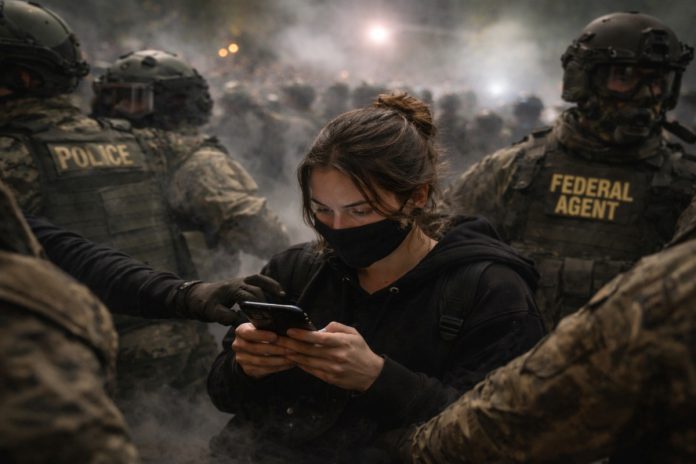
All the qualities and characteristics of this force appear chosen and calibrated to inspire terror. It is secretive and non-transparent to review. Its arresting officers are masked, armored, anonymous—often refusing to give their names or show their badges. They are heavily armed, militarized, aggressive—often violent; they are dismissive of Miranda rights, dismissive of warrants. 

They violate declared sanctuaries, homes, schools, hospitals and churches.

They attack peaceful protestors.They stage political propaganda. They claim immunity from prosecution. 

They strike in lightning raids at any location in the nation. Their deployment has been heavily partisan, a tool not for law, but for the consolidation of political power.

With charges of violating immigration law, they frequently carry trumped up charges of the most monstrous kind—rape, murder, treason. They dehumanize the most vulnerable among us.

They disappear people—that is their work. By a pattern that appears to be a policy, they often fail to inform families of these disappearances or their judicial process—family members just “disappear,” fanning the terror.

They disappear people into a dark judicial process that frequently violates human rights and international norms of due process before the law—some of our most important checks against tyranny.

They are linked with barbaric secret prisons.

By its practical effects, their mission takes on a white supremacist cast, suggesting a limited form of racial cleansing through forced removal and the political and economic subordination of nonwhites broadly through terror.

This is not a historical metaphor or a rhetorical flourish; the newly reformed ICE is being operated as an authoritarian secret police force. They are acting like Gestapo—albeit Gestapo adapted to a modern American context of ubiquitous smart phones, steroidal militarism, social media obsession, show biz politics, billionaire aristocracy, and stars and stripes iconography. If their use and tactical pattern is allowed to harden into the new normal, the United States will have crossed the line into a white supremacist police state.

Finally, of the one who wields this enormous power, Donald Trump—the billionaire president: ICE’s arbitrary and vindictive commander-in-chief is sustained by a nascent cult of personality; his crushing policies flatten institutional checks and exaggerate existing economic and racial hierarchies to concentrate power in his own hands. 

He behaves in openly authoritarian ways, seeking to terrorize his many political opponents.  He has already tried to overturn the result of one presidential election he lost, and his allies have spoken openly about seeking an unconstitutional third term. In ICE, he now has his terror weapon.

Their tactical masks are off, reader. In the scale and spectacle of this “mass deportation campaign,” the Trump administration’s intentions can no longer be disguised. If judged only by the all pervading fear, this is fascism—fascism in a new form, fitted to a new era. At the end of 24 interviews, the only question that remained to me was “Will the fascists win this time?” 

It’s time to take our gloves off.

Next week, Part 3: Fighting Fear.

Learn more: linktr.ee/iceterrorANDamericandemocracy.

Artists at Work, Marin’s Rancho Roots and History Impresarios

Crush features North Bay art and cultural events.
Sausalito Artists at Work ICB ART kicks off the year by throwing open the doors to one of Sausalito’s most quietly industrious creative hubs. Artists at Work offers a rare, behind-the-scenes look inside the historic ICB Building, where more than 60 artists—working across painting, sculpture, photography, ceramics, textiles and beyond—invite the public into their studios while the work is actually happening....

Freedom From Fear: What We Can Do Here and Now

Fear is how authoritarians maintain control, how they keep the people head down and silent.
This is the third and final piece of a three-part series on ongoing issues with U.S. Immigration and Customs Enforcement as it reaches into our areas. -–Editor Part 3: Fear Is Control “Freedom from fear” was the fourth of four freedoms defining democracy President Franklin D. Roosevelt framed in his rally cry to fight fascist conquest from without. It is openly...

Family Legend: Gabriel Fraire’s ‘Pancho Villa’ to Run on Raven Stage

Local drama takes another step forward with the next play at the Raven Performing Arts Theater in Healdsburg, Who Will Dance with Pancho Villa? But the production, which opens on Jan. 22 for an eight-performance run, is hardly new.  Gabriel Fraire and his brother, John, wrote the play more than 30 years ago; it had its first off-Broadway performance in...

‘FeBREWary’ Reloaded, Santa Rosa’s ‘Beer Passport’ Keeps the City Flowing

Now celebrating its 10th year, the Beer Passport is back to beckon visitors and locals alike.
Sure, January is the month of resolutions, including the month-long challenge, “Dry January.” But it’s next month, locally-known as “FeBREWary,” that taps both civic pride and the dollars averted by abstinence.  “Dry January is not necessarily a great thing for the economy locally,” observed Janelle Meyers, vice president of marketing & communications for Visit Santa Rosa, during a recent interview...

Won’t Get Fooled Again: Nu Journalism in the Age of AI

In the media game, AI is eating our lunch.
In the media game, AI is eating our lunch. “I think we might reach 90% of online content generated by AI by 2025,” said Nina Schick, an adviser and AI thought leader, in a recent Yahoo Finance Live appearance. “I believe that the majority of digital content is going to start to be produced by AI.” Well, now it’s 2026,...

The Don, Making an American Mafioso

Daedalus Howell, editor of the Pacific Sun and the North Bay Bohemian. considers April Fool's Day a celebration of humanity.
It is quite surprising that, for nearly 10 years, millions of people continue to spell MAGA incorrectly. Please let me explain that the correct spelling of MAGA is M-A-F-I-A.  The leader of this mafia is unequivocally “The Don.” Throughout these years, The Don has relied essentially on the same strategy.  He, himself, does not directly perform the mafia’s violent and murderous...

Caviar Dreams: Chef Jesse Mallgren Sets the Table

After 13 years as the Michelin Star-winning executive chef at Healdsburg’s Madrona Manor, Jesse Mallgren’s current role is executive chef at Jordan Vineyard & Winery.
Chef Jesse Mallgren spent 13 years as the Michelin Star-winning executive chef at Healdsburg’s Madrona Manor (now The Madrona Hotel).  In the culinary world, 13 years is a lifetime, an esteemed prelude for Mallgren’s current role as executive chef at Jordan Vineyard & Winery.  He has a vast “playground” to work with at the 1,200-acre estate, where he utilizes produce from...

Your Letters, Jan. 21

Forever Young In reference to “Don’t Get Old,” Jan. 14, 2026, in my house, when it comes to age, the word old is verboten. If you think you’re old, then you will be old. On the other hand, growing older is a mathematical equation that can’t be controlled. One plus one plus one will always equal three. Soon, I will be...

Free Will Astrology, Jan. 21-26

Free Will Astrology
ARIES (March 21-April 19): Master astrologer Steven Forrest understands you Aries people well. He says that the riskiest strategy you can pursue is to constantly seek safety. It’s crucial for you to always be on the lookout for adventure. One of your chief assignments is to cultivate courage—especially the kind of brave boldness that arises as you explore unknown...

Freedom From Fear and the Tactical Side of Terror

Given the real danger and dire poverty of undocumented immigrants' countries of departure, ICE terror is unlikely to inspire mass “reverse immigration."
This is the second of a three-part series on ongoing issues with U.S. Immigration and Customs Enforcement as it reaches into our areas. –Editor Part 2: True designs of the administration Let me be emphatic; all undocumented immigrants have committed a crime. They have all broken immigration law. All of the undocumented immigrants I spoke to frankly admitted this. And almost all...
11,084FansLike
4,606FollowersFollow
6,928FollowersFollow