
High Voltage

0

music & nightlife |

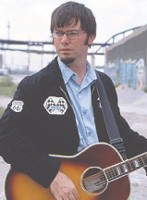
Front man: Jay Farrar of Son Volt and Uncle Tupelo hasre-energized Americana music.

By Greg Cahill

‘Feels like driving around in a slow hearse,” Son Volt head honcho Jay Farrar laments on “Slow Hearse,” the spooky elegy that kicks off the band’s new CD, The Search. It’s a masterful song. Farrar repeats that one line over and again for over two minutes accompanied by little more than a haunting upright piano and a backward-tracked electric guitar, and he never sounds maudlin.

Then the band bursts into “The Picture,” soul horns blaring in stark contrast to Farrar’s bleak lyrics about war, governmental indifference and the saving grace of mercy.

The slow hearse careens through the detritus of a crumbling empire.

The explosive rock sonics belie the jaunty alt-country Farrar helped pioneer during the late ’80s in the seminal Americana band Uncle Tupelo and a decade ago in the first incarnation of Son Volt. Ask him about this follow-up to Son Volt’s brilliant 2005 comeback album Okemah and the Melody of Riot, and the conversation turns to soundscapes and musical styles and the cohesiveness of the band he reconstituted after legal wrangling waylaid the original lineup two years ago.

“Overall, The Search is more reflective of the growing coalescence of the band and of the members playing off of each other,” he explains during a phone interview from a rehearsal studio a short distance from his St. Louis home. “I think Okemah was more reflective of the political turmoil that is going on around us,” he adds. “The political slant to the songs is still there. But I didn’t want it to be the real focus for this record. Even though there are some topical themes, I tried to steer away from that. But it still pops up in songs like ‘The Picture.'”

As one-third of the seminal alt-country outfit Uncle Tupelo, Farrar tapped both the hillbilly spirit and Neil Young’s Zuma-vintage grunge, fusing the simple heartfelt sentiments of traditional music with the fire of punk. Their angst-ridden twang informed the band’s 1990 debut No Depression, which took its title from an old Appalachian spiritual and lent its name to the rootsy Americana sound that characterized the alt-country movement as well as the Seattle magazine that still chronicles its biggest stars.

The band recorded four albums, including 1993’s masterwork Anodyne, before parting acrimoniously. After its 1994 split, Uncle Tupelo’s members formed two more revered underground bands: Farrar and drummer Mike Heidern spun off the tradition-bound Son Volt, while Jeff Tweedy enlisted the rest of the band to form the experimental pop band Wilco.

The following year, joined by the brothers Jim and Dave Boquist and fueled by Farrar’s soul-searing electric guitar work, Son Volt released their critically acclaimed debut Trace. It captured Farrar’s raw, dark side. Two more albums followed before the band members soured on each other. Farrar went on a hiatus. In 2001, he reemerged with his solo debut, Sebastopol, releasing three more solo projects in the next three years, mostly under the radar.

In 2005, he reunited the original Son Volt lineup to record “Sometimes” for the Alejandro Escovedo tribute album Por Vida. A new CD project appeared likely, but the old animosities resurfaced.

“The other guys decided they only wanted to talk through their lawyers,” Farrar recalls.

So he recruited a new band: guitarist Brad Rice of the Backsliders, bassist Andrew DuPlantis of the Meat Puppets and drummer Dave Bryson of Damnation A.D. Amid the backdrop of the mounting bloodshed in Iraq and the shame of the neglected Gulf Coast, Okemah and the Melody of Riot struck a chord, thanks to such anti-Bush fare as “Jet Pilot” and “Endless War.”

The All Music Guide lauded the results as Farrar’s best since Trace.

The Search, augmented by Eric Heywood on pedal-steel guitar and Derry deBorja on organ, builds on those themes of political strife and social isolation. It’s not so much a concept album as a pungent distillation of the melancholy and longing that inhabit so many of Farrar’s best songs. Some are autobiographical, some are character sketches, some are observational tomes. But all tell of road-weary travelers searching for meaning amid broken dreams, political turmoil and social tumult.

Call them reports from the heartland, glimpsed from a slow hearse.

Son Volt perform Saturday, March 31, at the Mystic Theatre. Magnolia Electric Company open. 21 Petaluma Blvd. N., Petaluma. 9pm. $20; 18 and over. 707.765.2121.




FIND A MUSIC REVIEW

Prognosis

0

March 28-April 3, 2007

Rock’s recent retro styles, like neo-garage and neo-dance punk, typically have short shelf lives. An intriguing exception is the new prog-rock. Many current acts are following the old-school prog-rock ideals of complex song suites, Medieval and sci-fi references, and masterful musicianship. The results vary wildly, as neo-prog pursues creative choices independent of the classical and troubadour models of early British prog.

But the success of neo-prog troubles me. I swore off progressive rock 30 years ago. I loved first-generation classical (or “art”) rock as an intellectual ’70s teen, but later in college, my exploration of punk, oldies, country and jazz led to quick trips to used record shops with tired Emerson Lake & Palmer LPs. Immersed in the Clash, Hank Williams and Sonny Rollins, I learned that the Moody Blues, minus symphonic backing, were as insipid as a pair of clean white socks.

Punk threw prog into a state of cultural shame, marked by Johnny Rotten’s infamous “Fuck Pink Floyd” T-shirt. But prog never really died, living on through the cool ’80s hits of Canadian rockers Rush, and through ’90s jam bands like Phish, Umphrey’s McGee and Moe. Alt-rock leaders Radiohead are full of prog elements. The original prog albums, the Beatles’ Sgt. Pepper’s Lonely Hearts Club Band and the Beach Boys’ Pet Sounds, continue to be huge influences on the micro-instrumentation of current indie rock.

What have new prog acts learned from 30 years of choices? The fallacy of original prog was its assumption that fanciful, sophisticated European music is superior music, coupled with the erroneous illusion that there’s superior depth in lyrics about wizards and space travelers that use words like “whilst” and “thee.” New prog, more often with American or world roots, achieves results not with the length of songs or intricacy of themes, but with a solid emotional core.

The Mars Volta, for example, create a Latin space-metal that holds some of prog’s best and worst traits. Meandering? Obtuse? Yup, just like Pink Floyd, Yes and Genesis. But also like those originals, the Mars Volta occasionally show a flair for tight rock structure and can pull snappy moments from their swirling void. Singer Cedric Bixler-Zavala is often close to the emotive Peter Gabriel of early Genesis, an aching, overachieving, very human presence elevating music that’s less complex than it seems.

A more complete and balanced example of neo-prog is Portland’s theatrical alt-rockers the Decemberists. On their acclaimed 2006 disc The Crane Wife, the band play conventional melodic indie rock, but also employ prog basics to stir emotion. Their Bach-rock keyboard triads and historical tales aren’t ponderous or exhibitionist, but instead highlight a very human core.

New prog-rock headbangers use less obvious prog DNA, but do show the lesson learned from heroes King Crimson and Jethro Tull that prog can escape lightweight whimsy with healthy doses of gnarly noise. Thrashers Mastodon are supremely technical, and Swedish death-metallers Opeth paint dark Nordic sagas with extended concepts. A compelling enigma in heavy prog is Porcupine Tree, who mutate with every disc, sounding first like driving grunge and then like spacy Krautrock.

Prog’s worst traits, like lack of focus and faux grandeur, have surfaced in two popular acts, emo-rockers Coheed and Cambria and Bay Area chamber-folk sensation Joanna Newsom. Coheed and Cambria are a decent emo band, but showed inane self-importance naming their 2005 concept album Good Apollo, I’m Burning Star IV, Volume One: From Fear Through the Eyes of Madness. Newsom’s sophomore disc Ys, with five songs that range in length from nine to 17 minutes, has a yearning, playful warmth, but her drawn-out subtlety seems like a plane that circles the runway without ever taking off.

The final worth of neo-prog is its validation of the album as an art form at the very moment when the album per se is out of favor. This is more important than any change in prog’s musical genetics. I just wish neo-proggers wouldn’t waste so much of those albums committing the sins of their fathers.


Shoulda, Coulda, Woulda

0

March 28-April 3, 2007

It’s not often that regret is uttered from the rebellious mouth of maverick Neil Young, but his new release Live at Massey Hall 1971 mustered just a bit. “This is the album that should have come out between After the Gold Rush and Harvest,” the Bridge School founder said recently. “My producer was adamant that this should be the record. As I listen to this today, I can see why.”

This repudiation of the beloved Harvest album may seem outrageous, but it’s definitely warranted. The solo Toronto set–the yin to Live at Fillmore East‘s blistering yang–is a stunning, intimate portrait of the icon as a young Canuck on the cusp of becoming a household name (and the CSNY ingredient to truly watch). Armed with just a guitar, piano and his emotive, nasally whine, Young moves effortlessly through early favorites like “Helpless,” whose first line receives cheers from the hometown crowd, reminding us Bay Area residents of our mere surrogacy.

Although the legend seems not to have changed much in 36 years–from the ecological concerns of “Love in Mind” to his photographer scolding after a straightforward “Tell Me Why”–the then 25-year-old seems slightly less grizzled than his modern-day reputation. He actually responds to a call for “Down by the River” with a devastating off-the-cuff acoustic version and closes his set with a rollicking, clap-along “Dance Dance Dance.” This is helped in no small part by his palpable comfort in front of his countrymen, to whom Young confides throughout the show, most poignantly expressing simple joy at being back home before launching into a tragically fresh “Ohio.”

Of course, the not-yet-released classics are Massey Hall highlights, with the Harvest songs deposed from their ivory towers and revitalized through their infantile context. It’s thrilling to hear “The Needle and the Damage Done” without applause during the opening riff but including his sad lament on colleagues who’d recently succumbed to heroin addiction. And no better is the spirit of excavation symbolized than waiting through the ever-bland “A Man Needs a Maid” to bask in a few bars of the rare piano version of “Heart of Gold.”

Though not as pristine in quality as the audio disc, the included DVD vastly improves upon Fillmore East‘s awkward pans of still photos by tastefully combining grainy live footage with stock footage and Young’s home videos, which include footage of the actual “Old Man.” While a recent brush with mortality may sadly be the reason for this massive retrospective undertaking, it’s comforting that the Neil Young archives are being helmed by Young himself–not posthumously. Consider the anticipation for the box set this fall officially on high.


News Briefs

March 28-April 3, 2007

Burning wine

Mark S. Anderson, 58, of Sausalito, was arrested March 16 on charges that he torched a wine warehouse in Vallejo in October 2005, destroying more than $200 million worth of high-quality vintages. Anderson’s clients paid a monthly fee to store their wine in his warehouse. A federal grand jury recently indicted Anderson on charges that he sold his clients’ wine without their permission then attempted to conceal the embezzlement by burning down his Wines Central warehouse on Mare Island. According to federal officials, the building held bottles from more than 90 wineries and 40 collectors. Anderson’s 19 federal charges included one count of arson, with a maximum statutory penalty of seven to 20 years, and nine counts of mail fraud, with up to 10 years for each count.

On the death of . . .

Press releases are statements sent to the media in the hopes of prompting a story, preferably a favorable one. The California governor’s office releases a veritable flood of these missives, ranging anywhere from two to 20 or more in a single day. They outline Arnold’s daily schedule, boast of legislation he’s signed, name his nominees to statewide posts and proclaim his views on an apparently limitless range of topics. Slipped in quietly between the photo ops and corrections to the corrections of the latest list of appointees are the ones titled, “Gov. Schwarzenegger Issues Statement on Death of” which go on to name a Twentynine Palms marine, a Bakersfield soldier, a Hemet sailor. Each contains a quote, purportedly from the governor. “Maria and I join all Californians in expressing our gratitude for Lance Corporal Timberman’s noble sacrifice. Harry served with profound patriotism to protect and preserve our nation’s cherished way of life. We offer our prayers for his family’s healing as they cope with his painful loss.” “Private First Class Garcia lost his life in his pursuit to deliver freedom to the oppressed. Alberto honorably served our nation with bravery and selflessness. Maria and I pray for Alberto’s family, friends and fellow soldiers as they mourn the loss of a loved one.” “Lance Corporal Howey embodied ultimate selflessness. Blake bravely served our nation’s armed forces and sacrificed his own life in his determination to bring freedom to the oppressed. Maria and I extend our condolences to Blake’s family, friends and fellow Marines.” Designed to be picked up by hometown newspapers praising fallen heroes, no two quotes are alike. Who writes them? A high-level press secretary or a faceless bureaucrat? Does the governor actually read them before they go out, or are they just one more facet of the perpetual-motion press office?


Caffeine World

0

March 28-April 3, 2007


Greg Grabow wasn’t an underdog in the Western Regional Barista Competition (WRBC) until a pear actually leaped out of his blender. Later, he clarified that it actually wasn’t even his blender.

On St. Patrick’s Day–the second of the three-day event–Grabow and 28 other contestants from California gathered at the Petaluma Sheraton to compete with coffee. The winner automatically qualifies for a slot in the semifinals at the U.S. Barista Championship in Long Beach, and eventually the top barista from each participating country will duke it out at the eighth annual World Barista Championships scheduled for Tokyo this summer. Ethiopia is one of the newest countries to join this international mocha melee.

The WRBC had taken over the hotel’s Blue Heron Ballroom, and the atmosphere inside was charged. Of course, everyone was amped up on caffeine, distributed at the back of the room by independent coffee companies pulling free shots for the masses on “the fourth machine.” This was an extra La Marzocco FB80, identical to the three espresso machines used in competition, but solely dedicated to keeping the audience buzzed.

Baristas and those who came to support them, paparazzi, journalists and spectators formed a line along the back perimeter of the ballroom and waited patiently for their espressos and cappuccinos; the line reminded one of enthusiastic parishioners falling in to take communion. Throughout the weekend, the queue stayed strong as attendees went back multiple times.

The legions of baristas in attendance sported enough tattoos to wallpaper a small cafe. The ink patterned their pasty skin, made paler by ubiquitous jet-black hair. From time to time, these young baristas took breaks, sprawling on the sidewalk outside like deep-sea creatures exposed to the sun for the first time.

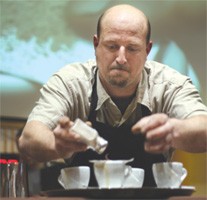
It was amid this coffee-crazed atmosphere that Grabow, a roaster at Barking Dog in Sonoma, took his place as contestant number 28 behind one of three coffee bars at the front of the room. In a nod to the growing popularity of barista competitions as a bona fide, if burgeoning, spectator sport, video of each competitor’s presentation was simultaneously projected onto a large movie screen. In previous years, the competition had been compared to watching someone do her taxes.

Grabow, like his peers, would prepare 12 drinks–espresso, cappuccino and a signature drink of his own devising–for each of four sensory judges (technical judges are also present but don’t taste) and in just 15 minutes. Like the floor routines in Olympic gymnastics, the competition is set to music of the contestant’s choice. Grabow, who had rehearsed his verbal presentation while making bean deliveries out of his Subaru hatchback, introduced the spectators and judges to his musical choice from the Dreamgirls soundtrack. “I might be white,” he told the judges and the audience, “but I’ve still got some soul.” The audience responded favorably, and he was off to a good start.

In practice sessions, he had tried adding cilantro, but found that it was too pungent. Trying to come up with a better recipe, the answer finally came to him one night. “I literally had a dream about one of my co-workers telling me that I should use a pear or an apple,” he said afterwards. He liked the results. Thus, the pear frappacato was born.

But during competition, while pouring the frappacato from the blender into the last of the four glasses, Grabow suffered a major spill.

Later he described what happened. “The pear flew out of the pitcher,” he said, pausing after each word as if trying to wrap his mind around the unforeseen phenomenon. Then, he giggled hysterically. The judges, who award points on everything from flavor to presentation, would surely dock points for a frappacato-covered pear making its way onto the bar.

It was an unfortunate turn of events for Grabow, who had been perfecting the frappacato for three weeks. Daily, he had visited Sonoma thrift stores in search of appropriate glassware; among other things, contestants must supply their own cups, saucers and coffee beans. If he was a bit frazzled during competition, it might have been because he’d lost his keys that morning among all those extra sets of glassware (which he termed “understudies”).

Prior to his coffee career, Grabow spent 20 years as a musical theater actor in San Francisco. The experience steadied him on Saturday, and when the pear went flying, horror registered on his face for just an instant. “My nerves of steel served me well today,” he said, noting that he’s had props fall and people accidentally drop him onstage before. “But it’s very nerve-wracking, especially when you’re doing work with your hands. Because when you’re singing and acting onstage, you can shake. It’s OK to shake–people are sitting 20 feet away from you. As long as you can hit the high notes, there are no problems. When you’re serving to four people and you’re shaking when you’re setting the drinks down, you watch your rosette go from a rosette to a blob of white foam.” It had taken Grabow months to master the rosette, now his favored cappuccino artwork.

Later that evening, the six finalists were announced. Grabow wasn’t one of them, but he didn’t seem to mind. Not everyone took the news so evenly; just after the announcement, sobbing was heard in the women’s bathroom.

On day three, the audience spilled over the chairs into the flanks of the ballroom, and the lineup for free coffee from the fourth machine had grown. Grabow and many of the other baristas who hadn’t made it into the finals had come to watch. In between competitors, the emcee joked that the coffee paparazzi had become a problem. Could they please stand at least 10 feet away from the contestants? It wasn’t likely.

Of the six remaining candidates, only two were from the Bay Area: Chris Baca and Crystal Yeaw both represented Ritual Coffee Roasters in San Francisco. Coffee Klatch in San Dimas had sent two contenders, including the owner’s daughter, Heather Perry, who had won the U.S. Barista Championship in 2003 and was back at the WRBC hoping to win it for the fourth year in a row. Los Angeles barista Eton Tsuno was also back again after taking home third last year, and WRBC newcomer Kyle Glanville of Intelligentsia seemed to have a good shot, given his company’s reputation in the industry. Though Chicago-based, Intelligentsia’s first West Coast store is slated to open in Los Angeles in the coming months.

Unlike the day before, the WRBC finalist competition was highly polished, right down to Perry’s French manicure looming large on the projection screen.

Tsuno’s miso-flavored umami espresso was the most unusual of the signature drinks, and his disarmingly carefree personality seemed like it might win over the judges. By contrast, Perry’s performance was slick, although her signature drink, which involved creating a “faux crema” by pulling an espresso shot over a mixture of raw egg and brown sugar and then floating it atop a “cloud” of citrus-zested cream, seemed divine. Kyle Glanville’s Mineola tangelo and cream reduction with espresso also seemed like it could be a winner. It was anybody’s guess.

The announcement of winner was late, because, the audience was told, the scores were so close that the judges had to re-tally all the scores. In the end, Perry won it again. She beat out Glanville by a mere 2.5 points out of 1,000. The difference reportedly came down to spillage. Although there had been no flying pears in this round, both contestants had spilled some liquid, and apparently, the judges determined that Glanville’s spill was slightly more egregious.

“In a coffee competition that is similar to the Olympics, every photo finish opportunity counts,” said Grabow afterwards. “One does the best they can and lets the grounds fall where they will.”

Quick dining snapshots by Bohemian staffers.

Winery news and reviews.

Food-related comings and goings, openings and closings, and other essays for those who love the kitchen and what it produces.

Recipes for food that you can actually make.

Wine Tasting

0

“Wow,” quoth the raven. I’d always been unnecessarily confused by Imagery Estate. Something to do with art, that I got. But I had to visit the winery to sort it all out. Located on the site of the short-lived Sonoma Mountain Brewery, Imagery Estate results from a 20-year collaboration between winemaker Joe Benziger and artist Bob Nugent, who created the first label and curates the series. The concept: Commission unique artwork from contemporary artists for each release of often uncommon varietal wines. The wine gets drunk. The art goes on the gallery wall. Not so complicated after all.

Although the bar was generously staffed with attentive pourers, we circled a while before landing amid the hubbub of the Sunday-afternoon crowd. First, we inspected the assemblage of souvenir merchandise, including Imagery posters, coasters, geegaws and baubles. The sight of pink baseball caps almost ruined the experience for me, but the gallery proved more highbrow. Chief among amusements was spotting the signature Parthenon that appears in each label, sometimes cleverly hidden in the design.

At last we felt ready. Imagery offers $5 regular and $10 reserve tastings. A sincere interest sufficed to dissolve the five-taste limit. Our young pourer was helpful and charming, but a little tricky on the whites. She introduced 2004 White Burgundy ($27) as an unoaked, fresh and fruity style of Chardonnay. Curiously, it was just the opposite: old cheese, musty oak. Corked? She thoughtfully swirled with us and didn’t look displeased. The 2005 Viognier ($26) lacked both floral aromas and stone fruit taste, which Miss Contrary informed us was a varietal characteristic.

We all fared better with reds. The strawberry jam-scented 2006 Pinot Meunier ($22) made an enticing rosé; I’d cellar it for, oh, about 20 minutes in the freezer before popping it on a warm evening. The promising-looking 2003 Taylor Vineyard Zinfandel ($42) didn’t deliver as much as the licorice-fruity 2004 Lagrein ($40). What’s a Lagrein? Take a stroll down the informative “varietal walk” on the grounds to find out.

In a flash of food-pairing inspiration, I was confident that the 2004 Sangiovese ($27), tart with high cherry notes, would drink swell with seafood pasta. The 2003 Malbec ($34) was a tad dry, but perfect in every other way, if Malbec’s candied cherry/rubber tire combo appeals to you. Those partial to richer wines might check out the violet-scented 2003 Petit Verdot ($38) and the 2004 Petite Sirah ($42), a hearty soup of dried fruit and blackberry with a touch of sweetness that carries it easily over the tongue.

Lastly, out came the chocolates and the “port slippers.” The 2005 Petite Sirah Port ($34) is served from delicate glassware that looks like an antique, well, pipe of some kind. One sips and inhales the aroma from a little bowl held close under the nose. Alas, I’d spent the first part of the day scrubbing moldy walls, and all I could smell was the bleach on my hands, so I traded the slipper for a regular glass.

Imagery Estate Winery, 14335 Hwy. 12, Glen Ellen. Tasting room open daily 10am to 4:30pm; after Memorial Day, until 5:30pm. 707.935.4515.

View All

Letters to the Editor

March 21-27, 2007

Ag rag

(March 7) presented some misleading information when referring to our Sebastopol farm, Laguna Farm, and we’d like to comment. First, Jonah Raskin makes the increasingly common error of confusing the words “certified organic” and “organic” (he stated that our farm was not organic). Laguna Farm has chosen to drop our organic certification in the face of rising bureaucratic costs and lowered standards (following the implementation of the National Organic Program in 2002), but that does not mean that our standards have changed; in fact, we now refer to our methods as being “beyond organic,” because they exceed those of national certification. This error reinforces the bureaucratic notion that if a produce item isn’t certified, it isn’t organic–a regrettable concept.

While we certainly understand the need for certification in situations where the consumer doesn’t have access to the producer, there is a much bigger picture involved here.

There is another petty error that Raskin made that probably doesn’t need to be printed, but it’s also regrettable: he stated that I “[don’t] hide the fact that [my] parents gave [me] the land and that [I don’t] have a mortgage to pay.” In fact, my parents still own the land and we do pay them a sizable rent. This is regrettable in that readers will get the impression that at least one farm in Sonoma County doesn’t have an overhead–wishful thinking and a marvelous idea, but unfortunately not true.

Scott Mathieson, Laguna Farm, Sebastopol

Poisoned air?

On Monday, March 12, I went out to walk my dog. The air outside was so bad that I had to go back inside. The sky was clear and there was no wind that morning. I know from past year’s experience that on still mornings the farmers are out spraying. They are not allowed to spray on windy days.

I felt so bad that day I could hardly function. Other people I know also remarked how nasty the air was that day. It was not just around my house, but all around town.

When I’m housebound by the air, I always think about all the people out doing their daily work. People don’t tend to consider how chemicals in the air can affect their thinking and emotions. I worry about bad decisions made, arguments and depression caused by what’s in the air.

That day, I was so out of it I kept having this repetitive thought: “It’s legal to kill people with pesticide in this county.” Later, when my mind cleared, I felt like that was a stupid thought.

The next morning, I heard a Sebastopol resident describing the very strange behavior of wild birds at her house that Monday morning.

Then I found out about the young boy who was shot to death by the cops that same morning, and that he only had a pocketknife on him.

It made me think about my repetitive thought. Maybe it was not so stupid. I could not help but wonder if the air had been clean that morning, would things have turned out differently? Did whatever was in the air affect judgement?

In this county, we are not privy to how much is being sprayed until long after the fact. We should know when all the farmers are spraying.

Denise Lebel, Sebastopol

May as well ask as anything

We just wrote senators Feinstein and Boxer asking that they please only vote for a supplementary budget that includes language dictating a withdrawal from Iraq by the end of 2007 and requiring congressional authorization for any military action against Iran.

Although there may be pressure to weaken the Supplemental War Appropriations bill, they can push for the kind of brave and principled stances that will bring our troops home.

Remember that “supporting the troops” means bringing them home, not keeping them in the middle of an Iraqi civil war or bogging them down in a larger regional war in Iran. Real support for the troops means making sure that no more of them die for a war we never should have gotten into. Have you heard the reports from the Iraqi people on BBC? We urge your readers to write them, too.

Barby and Vic Ulmer, Saratoga

Senator Dianne Feinstein
United States Senate
331 Hart Senate Office Building
Washington, DC 20510

Senator Barbara Boxer
1700 Montgomery St., Suite 240
San Francisco, CA 94111

Please give Feinstein the Boho‘s best regards . . .


Ask Sydney

March 21-27, 2007

Dear Sydney, how do I get rid of a stalker without moving, changing my name or changing my appearance? I have a problem with attracting needy men who, after being rejected by me, turn into stalkers. They won’t leave me alone no matter how mean, nice, rude, beautiful, ugly, stinky, dirty, bad or good I am. They come to my work, corner me in the hallway outside of work, follow me to my car. They never leave me in peace. I’ve changed my name, cut and dyed my hair, changed my style of clothes, even my car. I’ve just moved for the last time, and won’t change anything about myself ever again! Help!–Serial Stalkee

Dear Stalked: You’ve just moved to a new place, and it’s not too late to change this pattern. Go forward into your new town with confidence that you will never be stalked again. First, examine why this keeps happening. Do you find yourself attracted to men who are predisposed to stalking? Are there some commonalities that you can map? Some stalker characteristics? Or are these otherwise “normal” guys who just freak out when they meet you, as if you exude some kind of “stalk me” scent? Pay close attention to your interactions with people, especially to potentially needy men, and see if you can adjust your interactions from the very beginning so as to better avoid another bad situation. This is not to say you bring this on yourself. No one deserves to be so disrespected. But there is the reality that when you are interacting with another person, the only one you can really control is yourself. Take a self-defense class, if you haven’t already. Make all potential dates pass through a rigorous screening process. Make it known from the very beginning that you are not a victim (practice looking tough in the mirror). Don’t have sex with anyone until you trust them. And in this new town, insist on having relationships with people who have your best interests in mind.

Dear Sydney, in response to (Ask Sydney, March 7), this woman can either be part of the problem or part of the solution. The only way she can have any genuine influence on her children’s relationship is to mend her relationship with her own sister and parents. To attempt to influence her children, without “living” the very thing that she is attempting to espouse, will be thoroughly conflicting and, without a doubt, will further alienate her children from each other and from her. She is creating the likelihood that her immediate family relations will breakdown further because she is not doing her very best to resolve her own serious conflicts. The only means for her to feel better is to deal with the reality of the situation and her contribution to it (without blame or guilt). Many wonderful and powerful gifts are on the outside of resolving issues like these, and “magic” can be experienced in a way that wouldn’t be otherwise available had these normal and perfectly determinable challenges not existed in the first place. I hope this is received as it is intended, which is to offer a new perspective and a bit of insight.–Another Take on It

Dear AT: My assumption is that if “Family Meltdown” has been unable to reconcile with her family members, there must be a reason for it. Ideally, you’re right: it would be most helpful if she could provide her children with a solid foundation of familial love, setting a good example and perhaps cashing in on a holiday meal or two. It is also true, as you say, that some of the challenges we face make us stronger. But challenges can still be pretty shitty, and the reality is that some people end up with family that in no way, shape or form deserves to be labeled as such. If this is the case for FM, then there might be nothing she can do to change things. For her sake, I hope that this is not the case and that she will read your letter and realize that there is another way to go about making things better.

Dear Sydney, what’s going on with the calls I keep getting from someone in India trying to get me to sign up for some credit card? They’ve started using non-Indian names, like “Tom Smith” or “Shelly Davis” when they introduce themselves. Every time I get a call, I feel ashamed to even be living in a country where companies feel like I won’t accept a credit card deal from someone with an Indian name! Like if the telemarketer says his name is Joe, I’ll think he’s calling from Iowa. Every time I get one of these calls, I want to apologize to the person, and tell them that even though I don’t want the card, I would like to support them in using their real name, and that if there’s a petition going around, I’d sign it. Is there anything I can do about this? Am I the only one disgusted?–Embarrassed American

Dear Citizen: The first step in dealing with this name-changing business, which I agree is offensive and embarrassing, is to ask your telemarketer for a U.S. address where you can write to the company. Send a note, explaining that you will never accept a credit card offer from a company that forces its employees to adopt new names. The only way to instigate change is to make your voice heard. Recently, I was told by a telemarketer from India that she would need to record our conversation in order to help fight “the war on terror.” I told her that I didn’t believe in the war on terror and apologized for my country. She seemed confused, and our conversation went nowhere. Maybe it was the connection. Next time I receive such a call, I’ll write as well. That makes two letters the company will receive, which is at least a start.

No question too big, too small or too off-the-wall.


Talking Trash

0

the arts | visual arts |

By Brett Ascarelli

Without knowing anything about Tim Gaudreau, one can surmise a fairly accurate picture of the man simply by looking at his trash. Based on his discarded Ben and Jerry’s ice cream cartons, Stonyfield Farm yogurt cups and old hiking boots, this man is crunchy. He likely owns a cat (Scoop Away carton), is conversant with current technologies (computer monitor, CDs), gets lucky often enough (Trojan packages), is a yuppie (disposable coffee cup, Asian takeout carton, Snapple bottles) and is artsy (can of spray glue or paint). Contrary to how it may appear, we actually haven’t been digging into other people’s garbage to sniff out news. No, we were actually invited to look at this guy’s trash, and so are you.

It turns out that Tim Gaudreau isn’t just artsy; he’s actually a bona fide artist. His new work, “Self Portrait as Revealed by Trash: 365 Days of Photographing Everything That I Throw Out,” is on view at Gallery Route One March 23 through April 29. For this fragmented and indirect self portrait, he whittled over 5,000 photographs of all the individual items he tossed out from April 2004 to March 2005 down to a sampling of roughly 60 of the most representative objects. Besides bravely baring his personality through these photos, Gaudreau, a New Hampshire-based artist who believes that artistic work should be relevant to society, wants for his piece to communicate a green message above all.

“What are the consequences,” he asks, “to this American throwaway culture where, if it’s out of sight, it’s out of mind? I don’t think that we get away with it: we eat, drink and breathe these plastic cups long after the dump truck makes its weekly run.”

Over the course of documenting his trash, Gaudreau was so horrified by the number of bottles and cups he drank through every day (five), that he says “there came a point where I couldn’t bear to admit throwing out another one.” He started bringing his own mug to the coffee shop, mixing his own sports drinks and drinking tap instead of bottled water. He’s calculated that with these reforms, he’ll be saving over the course of his lifetime some 78,000 bottles from ever being manufactured and tossed.

“Self Portrait as Revealed by Trash” exhibits from Friday, March 23, at Gallery Route One, 11101 Hwy. 1, Point Reyes. See Openings for details. 415.663.1347.


View All


Museums and gallery notes.


Reviews of new book releases.


Reviews and previews of new plays, operas and symphony performances.


Reviews and previews of new dance performances and events.

Wish it were a rumor

0

music & nightlife |

By Brett Ascarelli

Like the rest of us, Mick Fleetwood goes to Costco. But unlike the rest of us, he has his own label to promote there–and it’s not a record label.

Tell me lies, tell me sweet little lies. If only this were a lie. No, friends, the percussionist and founding member of classic-rock behemoth Fleetwood Mac has joined the ranks of other celebrities from Larry Bird to Lorraine Bracco to Fess Parker to create his own wine brand: Mick Fleetwood Private Cellar. Reisling rings like a bell through the night. Wait, no. It’s Rhiannon, damn it. Rhiannon rings . . .

Rolling out the label in 2001, Fleetwood has just partnered with Costcos in the North Bay to sell his Chardonnay, Cabernet Sauvignon and Sauvignon Blanc, all from 2005, along with Petite Sirah and Merlot from 2004.

Die-hard Mac fans, don’t despair. The good news is that the wine has gotten good reviews; in fact, the Wall Street Journal drily named it “Best Wine by a Living Musician.” Fleetwood sources the grapes from various vineyards in California and Washington, and leaves the production and bottling up to already established wineries, like Lucas & Lewellen in Santa Barbara.

After selling some 19 million copies of Rumours (which, by the way, was partly recorded in Sausalito), Fleetwood is still riding that train, even after the career change. It’s hard to stomach a publicity photo of him dressed in the Rumours cover outfit and photoshopped onto an image of a warmly lit underground wine cellar. If you don’t love me now, you will never love me again. Poignant, but quite honestly, Mick, we can’t commit yet.

Mick Fleetwood will be trapped at the following Costcos on the following days; Friday, March 23, at Costco, 1900 Santa Rosa Ave., Santa Rosa, 11am-2pm, 707.578.3775, then later that day at Costco, 5901 Redwood Drive, Rohnert Park, 3pm-6pm, 707.540.9110, and finally on Saturday, March 24, at Costco, 300 Vintage Way, Novato. 415.899.8539. All events free–if you’re a member.


FIND A MUSIC REVIEW

High Voltage

music & nightlife | Front man: Jay Farrar of Son...

Prognosis

March 28-April 3, 2007Rock's recent retro styles, like neo-garage and neo-dance punk, typically have short shelf lives. An intriguing exception is the new prog-rock. Many current acts are following the old-school prog-rock ideals of complex song suites, Medieval and sci-fi references, and masterful musicianship. The results vary wildly, as neo-prog pursues creative choices independent of the classical and troubadour...

Shoulda, Coulda, Woulda

March 28-April 3, 2007 It's not often that regret is uttered from the rebellious mouth of maverick Neil Young, but his new release Live at Massey Hall 1971 mustered just a bit. "This is the album that should have come out between After the Gold Rush and Harvest," the Bridge School founder said recently. "My producer was adamant that this...

News Briefs

March 28-April 3, 2007 Burning wine Mark S. Anderson, 58, of Sausalito, was arrested March 16 on charges that he torched a wine warehouse in Vallejo in October 2005, destroying more than $200 million worth of high-quality vintages. Anderson's clients paid a monthly fee to store their wine in his warehouse. A federal grand jury recently indicted Anderson on charges...

Caffeine World

March 28-April 3, 2007Greg Grabow wasn't an underdog in the Western Regional Barista Competition (WRBC) until a pear actually leaped out of his blender. Later, he clarified that it actually wasn't even his blender.On St. Patrick's Day--the second of the three-day event--Grabow and 28 other contestants from California gathered at the Petaluma Sheraton to compete with coffee. The winner...

Wine Tasting

"Wow," quoth the raven. I'd always been unnecessarily confused by Imagery Estate. Something to do with art, that I got. But I had to visit the winery to sort it all out. Located on the site of the short-lived Sonoma Mountain Brewery, Imagery Estate results from...

Letters to the Editor

March 21-27, 2007Ag rag (March 7) presented some misleading information when referring to our Sebastopol farm, Laguna Farm, and we'd like to comment. First, Jonah Raskin makes the increasingly common error of confusing the words "certified organic" and "organic" (he stated that our farm was not organic). Laguna Farm has chosen to drop our organic certification in the face...

Ask Sydney

March 21-27, 2007 Dear Sydney, how do I get rid of a stalker without moving, changing my name or changing my appearance? I have a problem with attracting needy men who, after being rejected by me, turn into stalkers. They won't leave me alone no matter how mean, nice, rude, beautiful, ugly, stinky, dirty, bad or good I am. They...

Talking Trash

the arts | visual arts | By Brett Ascarelli...

Wish it were a rumor

music & nightlife | By Brett Ascarelli ...
11,084FansLike
4,606FollowersFollow
6,928FollowersFollow