Finding Themselves

0

February 21-27, 2007

Item number eight in the 12 steps to a better understanding of the band Dropping Daylight reads, and I quote, “They played with Papa Roach and Jason Mraz a couple days apart and emerged from the week confused about their place in this world.”

That about sums it up.

This Midwest sensation has played hundreds of shows from small clubs to the outdoor arenas of last years’ Vans Warped Tour and still remain unsure as to their personality.

Formed by two brothers, Sebastian and Seth Davin, and their high school chums, Dropping Daylight was originally named Sue Generis, a play on the Latin phrase meaning “without equals.” Their piano-based guitar rock seemed a little less than the named inferred, so a more appropriate title, Dropping Daylight, was adopted when the boys signed to Octone Records. They toured with a range of bands like Motion City Soundtrack, Say Anything and Breaking Benjamin still without a concrete understanding, so they made a record.

Their debut full length album, Brace Yourself, released last summer after two EPs, is stuffed with anthems and power chords set behind Sebastian Davin’s classically trained piano and smooth vocals. Brace Yourself is a catchy and addictive pop record with solid songs throughout. They drive harder than label mates Maroon 5 but are sometimes compared with a hardcore Ben Folds. As it is, Dropping Daylight have been struggling to identify themselves separately from other post hardcore projects that have recently been wearing a thin welcome. The combination of piano ballads underneath the forceful angry lyrics concerning our political leaders and their girlfriends, Dropping Daylight have been tugging at the heartstrings of pre teens everywhere. It’s too bad their Feb. 23 show at the Last Day Saloon is 21 and over only.

Their spot on the national SnoCore tour with Army of Anyone gives them a one-day break to play Santa Rosa’s Last Day Saloon as a warmup for Slim’s the following day. Anyone wanting to feel the high school vibe once again is welcome to rock along.

Dropping Daylight appears on Friday, Feb. 23, at the Last Day Saloon. Burden Brothers open. 120 Fifth St., Santa Rosa. 9pm. $5-$7. 707.545.2343.


Art School Confidential

0

Reeding & riting: Among complaints of racism and copyright infringement, AI officials decried the terrible grammar of the school mag.

By Brett Ascarelli

Until recently, Robert Ovetz, Ph.D., held two jobs. He worked as an environmental advocate for the Sea Turtle Restoration Project in Marin and he taught environmental science, world conflict and cultural studies as an adjunct instructor at the Art Institute of California San Francisco (AI), a school for the commercial arts. His scholarship in sea turtles dovetailed with the school’s Eco Club, so he served as its faculty adviser for two years. During that time, he says that the Eco Club got new bike racks installed in front of the school, had the bookstore bring in a sandwich vendor where before there had been only vending machines and vastly expanded the school’s recycling program. In the spring of last year, the school gave him his second positive review and pay raise. But he says that in December, school officials told him that they wouldn’t return him to the classroom for the following quarter. Ovetz, 40, thinks he was fired because he criticized the school’s decision to censor a magazine, Mute/Off, that students in his cultural studies class published as an assignment last quarter.

Hoping to give students a broader perspective on media-making, Ovetz explains the magazine assignment by phone from his Mill Valley home. “The students could pick whatever topics they wanted, as long as they were related to cultural studies. I left everything up to them–how it would be designed, promoted and produced. I just played a role as the facilitator.” The assignment also required wide distribution of the magazine to the AI community.

The students decided to write about film and society, video games, green living and the impact of consumerism on children and fashion. Toward the end of the quarter, they distributed some 500 copies of Mute/Off around the school. But the next day, Ovetz found only five copies of the magazine after searching the campus.

“The students were unanimous and thought the magazine had essentially been censored,” says Ovetz, adding someone had reportedly removed a copy of the magazine from the hands of a student who was in the middle of reading it. Ovetz claims that the school has a history of censoring student art, from a sculpture of an alien that one visitor claimed looked like a vagina to a sculpture of an African American breaking out of his chains. Ovetz also says that last quarter, a photo featuring toast with a milky substance and a condom was removed from the student exhibition “Taboos.” With reference to the sculptures, AI president Jim Campbell says he thinks they were simply cycled out of the student gallery after three months on display; he confirms that the toast photo was pulled.

After Ovetz discovered that Mute/Off copies were missing, he wrote an e-mail to the Dean of Academic Affairs, Caren Meghreblian, Ph.D., to find out if she knew anything about their disappearance. She responded to him that the school had chosen to remove the magazines “as a precautionary measure.” She cited potential copyright violations. (Mute/Off featured an Adbusters-style collage of corporate logos over which “Organized Crime” had been stamped.) The dean also wrote that one piece might be seen as “racially offensive.”

“[The dean] obviously didn’t read the article to the end,” says Ovetz, who thinks she was referring to a short story written by Simone Mitchell, an African American student in the class. Mitchell, 27, had been studying game art and design, and his story describes a group of three men who call each other “nigga,” steal cars, rape a woman and randomly shoot people. At the very end of the piece, the reader learns that the three gangsters are actually video game characters, played by three wealthy, suburban white kids.

Speaking by phone from his Daly City home, Mitchell says that a video game, Unreal Tournament 2004, that AI uses in its game design curriculum features “lots of people getting killed, blood everywhere and pretty much everything I described in my piece is right there. If you play it online, people make those sorts of [racist] comments all the time.”

Campbell says he hasn’t personally seen that game, but that review processes are ongoing at the school. Despite this, he notes, “We try to give our faculty academic freedom in the classroom and try not to censor their lesson plans or the materials that they use to deliver their lesson plans.”

In the student handbook, AI reserves the right not to display student work that may be objectionable. “There is a process to go through to be able to post work of any kind of the campus,” says Campbell. He says postings must reinforce what is being learned on campus–in other words, students and faculty can’t necessarily go around posting their personal work. He also says the review process is important, because sometimes work that might be appropriate for students may not be appropriate for younger audiences visiting the campus.

AI spokesperson Gigi Gallinger-Dennis explains, “In an effort to ensure compliance with AI processes and procedures, [Mute/Off] was removed from circulation, pending further review. And so to follow procedures, we collected the magazine, had it reviewed and then redistributed it after a full review by our legal counsel.”

Gallinger-Dennis says that the school will continue to review student work, but she says the school will make more information about the review process available this quarter so that students can “make sure they are in compliance.”

Does the First Amendment protect students from censorship?

Not according to Oakland’s First Amendment Project staff attorney David Greene. He says that private universities don’t have to uphold First Amendment rights, because they aren’t government actors. “Subsidized loans don’t make a private university a government actor,” adds Greene, who is also one of the lawyers representing Josh Wolf, the freelance journalist in jail for refusing to turn over his video footage of a 2005 street protest to the court.

However, censorship may violate the Leonard Law, a free speech law unique to California. “The Leonard Law prohibits a private, post-secondary school from disciplining a student [for exercising First Amendment rights],” says Greene. “The law doesn’t indicate whether the removal of a student publication would be discipline. I think it should be.”

Does AI see censorship as punishment? “No,” says James Campbell, “I guess we don’t. But we didn’t end up censoring the work anyway. I think we have the right to a review period.” He points out that despite some faculty who protested that Mute/Off was embarrassingly ungrammatical, AI still allowed it to be redistributed in its entirety.

Campbell also says that AI may start workshops for students and faculty to discuss what it means “to be an artist in today’s commercial world. With that freedom comes responsibility.” He points out that students who attend AI are going into “commercial-type environments, not fine arts.”

Once these students enter the professional world, Campbell says their work will be subject to review by the company they work for. “They need to understand the ramifications that go with their freedom of expression,” he says. “[These limitations are] not necessarily set by us, but by the commercial world at large.”

About a week after the magazine was picked up by the school, Ovetz says that the dean and the head of the liberal studies department declined to rehire him for the spring quarter. “They told me there was some issue of some conflicts with some other staff,” says Ovetz. “That was their reason. I find that to be disingenuous because of the two previous positive reviews and pay raises.”

As for Ovetz’s firing, AI will not discuss personnel matters, but the president assures that his firing had nothing to do with Mute/Off‘s content or circulation.

Ovetz has since won a James Madison Freedom of Information Award for speaking out.


Fear of Food

0

February 21-27, 2007

I once worked at a sausage cart in the park of an affluent city neighborhood. After my first day, I walked over to the alcoholic homeless men who hung out on the park’s benches to offer them a bag of baguettes we had left over. “No thanks, honey,” said one of the lounging bums. “Outside of white sugar, white flour is the worst thing for you.” His friend on a nearby bench nodded in grave agreement.

Coming from someone who was slowly but surely drinking himself into oblivion, that’s quite a bold statement. I admired the resolve of the homeless men, but their execution of a well-balanced diet was deeply flawed; their meals were mostly liquid, and vodka, their liquid of choice, provides little in the way of vitamins, fiber or minerals.

Many of us make similar, if less severe, dietary choices every day. We recognize what is good for us, but fail to implement it in our lifestyle. Are we stupid, lazy, greedy? Partly. But mostly we’re afraid. Our dysfunctional industrial food chain both numbs and overwhelms us, especially when we take in conflicting claims from splashy snack-food advertisements (eating poorly is fun!), health-nut magazine articles (eating poorly is fatal!) and confusing government recommendations (eating well is complicated!). We’re afraid of food, and it’s our fault.

Last month, the Center for Science in the Public Interest’s Nutrition Action! newsletter issued a list called “Ten Foods You Should Never Eat!” The list zeroed in on such naughty goodies as Mrs. Fields milk chocolate and walnut cookies, chipotle chicken burritos and Dove ice cream. Mrs. Fields was attacked for having “six teaspoons of sugar per cookie.” Interesting.

A 12-ounce can of Coca-Cola has the equivalent of about 10 teaspoons of sugar, but Coke’s not on the list. In fact, dozens of foods could easily be on the CSPI’s list; every grocery store crawls with them, lurking in the snack aisle and under the fry-buffet heat lamps at the deli.

Ultimately, pointing out ultra-specific “danger foods” accomplishes little except to prove how our society responds to easy shocks and fast payoffs. The CSPI’s list is the sort of thing someone e-mails to co-workers or talks about with friends over a Saturday-night plate of riblets at Applebee’s. “Did you know that Pepperidge Farm Original Flaky Crust roasted chicken pot pie is the worst thing you can eat?” It makes great gossip, and it’s a quick way to feel like you make fine nutritional choices simply because there’s not a box of Pepperidge Farm chicken pot pie in your freezer at home.

But we don’t like to hear it, perhaps because the good news about food is not very flashy. The CSPI’s alternatives to the 10 worst foods are mostly whole foods, like citrus, wild salmon and sweet potatoes; it’s like comparing apples to oranges, or, rather, Frito Lay’s light potato chips to oranges. You can’t say “Don’t eat potato chips, eat roasted butternut squash instead,” even though roasted butternut squash is delicious. Snack cravings don’t work that way. Cravings are about crunchy, salty, sweet–now!

Junk food tastes good sometimes. It’s the edible equivalent of American Idol and Gwen Stefani songs. Despite what billions of dollars of advertising and prominent displays at grocery stores tell you, that’s what we need to understand junk food is for–for sometimes, not all of the time. The occasional McDonald’s won’t kill you; lots of McDonald’s kills you.

Actually, it’s the choice to eat lots of fast food that kills us. And we are the ones who make that choice. For all of the blaming going on, there’s one person who is in charge of what goes into your mouth: you.

So where did we go wrong? In his much-discussed Jan. 28 New York Times Magazine article “Unhappy Meals,” Michael Pollan points to what he calls “nutritionism,” the system of scientists researching the impact of an isolated nutritional component and the press pouncing on the findings to get a story. Pollan argues that because nutrients don’t exist in a vacuum–they exist in food, and therefore are part of our larger, very complex lifestyle–such studies are inherently flawed and can misdirect our choices. A study concludes to eat less fat, so we cut down on fat; a study says to eat more omega fatty acids, so we drink flaxseed oil; a study says that flaxseed oil supplements can actually harm us, so we dump out our flaxseed oil.

What Pollan does not say is that we’re the ones dumb enough to believe every AP article and every investigative report on 20/20. When did we lose the ability to think for ourselves? When we got scared. By pointing out the dangers in food, we don’t create logic; we create confusion and fear. We know that heavily processed food is bad for us, because we can see the results with our own eyes, but we still eat it, because facing our fear of food is too daunting.

Instead of thinking about food as medicine or poison–something we are rewarded or punished for eating–we need to think of it as food. Food that comes from plants and animals, not factories and drive-throughs and laboratories.

And that’s where one group, who are sadly not in control of what they put in their bodies, comes in: kids. Parents and schools feed kids, and many of them do it badly. Kids love junk food, especially when so much of it is designed to appeal to them. Kids are too young to be accountable for all of the decisions they make, but they are old enough to be taught how to eat. That education used to happen from living life, from helping to prepare meals and sitting down with the family to share them; it was intrinsic knowledge. Now it’s not–food is an entertainment choice, a way to kill time, a thing that takes too long to make from scratch–and they’ve learned that from us.

We need to compromise, and there’s not much of that going on. Big Brother does not compromise. Two major cities–New York and Philadelphia–have banned trans fats. The intent to protect citizens is noble, but will it accomplish anything? Maybe the solution is to stress eating well, not to simply remove one of the things that make people unwell.

Small pockets of activists are doing just that, empowering people with knowledge and decision-making skills. Food Not Bombs feeds vegetarian meals to homeless people (hope they’re skipping the white flour); farmers markets are going up in blighted urban areas without local access to grocery stores; and programs like Alice Waters’ Edible Schoolyard, which teaches kids where food comes from because they grow it themselves, are blooming. It’s not much, but it’s something.

Of course, to look at it from a strictly pragmatic perspective, regulating what people can and cannot eat could save our country tons of money. All of this type II diabetes and heart disease is expensive, and we fat taxpayers wind up footing some of the bill. It’s an extreme measure for a situation that, every day, is more extreme itself.

Americans love to blame other people for things. We’re fat, and it’s the fault of agribusiness or fast food or the government or my family who never taught me to eat right. People grow up and become adults and make their own choices. The tools to eat well are there for them. Are we really that stubborn and ignorant? I guess so.

I’m not afraid of food. It won’t kill me; it keeps me alive, because I eat to live and not vice versa. Every time that we polarize the role of food in our lives, we further tear apart the natural order of things. To end the cycle, we need to give fear the middle finger and eat like human beings. The first step is to think for our own bodies, our own selves.

Quick dining snapshots by Bohemian staffers.

Winery news and reviews.

Food-related comings and goings, openings and closings, and other essays for those who love the kitchen and what it produces.

Recipes for food that you can actually make.

Goodbye, Mr. Chip

0

music & nightlife |

By Bruce Robinson

I first met Chip Dunbar at my wedding; he was in the band, of course. But as our paths intersected from time to time over the subsequent years–around town, at concerts where he was onstage or a fellow audience member, and even traveling together for a day at MacWorld in San Francisco–I became one of the countless folks whose lives he brightened.

Yes, Chip touched a lot of people, and not just with his music. The local master of the mandolin–and linchpin of a series of highly regarded local acoustic ensembles including the Eclecti-Cats, HiJinks and Terra Nova–was also known in separate but overlapping circles as an inspiring teacher, a knowledgeable guru and impassioned advocate for the Mac and an enthusiastic full-court basketball player.

Chip died abruptly and unexpectedly while walking near his Sebastopol home on Nov. 26, apparently from a persistent heart condition. An informal memorial on Dec. 2 drew far more friends than the Sebastopol Community Center Annex could hold, and featured the first public performance of the Mighty Chiplings, a group of his young students who did their teacher proud.

The youthful Chiplings are just part of the roster of local talent who will celebrate Dunbar’s life and musical legacy in a memorial concert on Saturday, Feb. 24, at the New College in Santa Rosa. They will be joined by a long list of Chip’s musical associates, including the Ruminators, Solid Air, Don Coffin, Ted Dutcher and Ellen Silver, Modern Hicks, Caren Armstrong, Kevin Russell and the Elder Chiplings. Chip’s wife and longtime musical compatriot (she played at the wedding, too) Sara Winge will also perform. Chip is shown above, far left, with Russell and Dutcher.

“He leaves behind a musical legacy matched only by the great Jim Bozzio or the amazing Kate Wolf,” says Russell, who most recently played with Dunbar in Under the Radar. “Chip was a brilliant sound engineer, songwriter and band leader; an enormously important figure in the Sonoma County music scene and a virtuoso human being.”

He is, and will continue to be, missed.

An Evening of Music Honoring Chip Dunbar is scheduled for Saturday, Feb. 24, at the New College. 99 Sixth St., Santa Rosa. 8pm. $10 donation. 707.824.1858.


FIND A MUSIC REVIEW

Ask Sydney

February 21-27, 2007

Dear Sydney, for the first time in our eight-and-a-half year relationship, my boyfriend told me (during a fight) that I wasn’t trying hard enough in bed. I’m totally crushed, and even though we have since made up, I still don’t want to touch him. I thought we had a good sex life. Seriously. I was happy with it. How am I supposed to get over this. Do I just pretend it never happened? Try to jazz it up a little? What the fuck?–Jilted

Dear Jilted: This is the first time in eight-and-a-half years that he has said something about your sex life to hurt your feelings? Not bad, but it sounds like he blew your clean streak in a moment of frustration and anger. It’s possible, now that your argument is over, that he wishes he hadn’t said it, and maybe he didn’t even mean it in the first place. Maybe he was just in the throes of an “I’m an unsatisfied horny dude” funk. Chances are, if you feel pretty good about your sex life, that he does, too. Tell him that he hurt your feelings, and that you want to discuss the situation further now that you aren’t arguing anymore. Find out what he meant when he said you weren’t trying hard enough. That’s a pretty pathetic thing to say to someone you care about, so if he’s going to bother saying it at all, he better explain himself. Maybe there’s something he wants from you, but he’s been afraid to ask, or maybe he’s just a dick. You’ll have to probe the situation further before you come to any big conclusions about it. Just don’t pretend it didn’t happen. There are some things that one does not forget easily, and sexual slights are definitely up there in the realm of the unforgettable.

Dear Sydney, does it seem like people are more freaked out about the end of the world than they used to be? It seems like everywhere I go, someone is making a bad joke about global warming or predicting a killer earthquake or saying that Californian is going to fall into the ocean or moaning that it doesn’t really matter because we’re all going to get cancer anyway. It’s depressing is what it is, and to be perfectly honest, I’m starting to feel a little bit more neurotic. What am I supposed to do? Not reading the paper just isn’t enough anymore.–Freaking Out

Dear Freaking: Humans have been predicting doom, death and destruction since we became evolved enough to wield clubs, and, for the most part, we’ve been right. Life can be alarmingly short and painful. But despite pestilence, war and despair, the human race has yet to disappear altogether. Actually, life on this planet has greatly improved. Living before the invention of anesthetic, purified water and the Internet just wasn’t that much fun.

But despite these improvements, things haven’t been quite the same ever since the new millennium. True, the earth didn’t end as predicted on the stroke of midnight, but that doesn’t mean it still won’t. There seems to be this sense that we are living on borrowed time, and that no amount of stocking up on toilet paper and batteries is going to help. Add to this the general discord caused by the fact that we are at war, and it’s no wonder that you feel as if you are surrounded by naysayers. You probably are.

But what can a person do about it? We live on a chunk of spinning rock that’s suspended in space, and consequently, we could be annihilated at any moment by a mammoth meteor shower, just like the dinosaurs. Even under the best of circumstances, this fact alone is enough to make even the most stable among us feel a little insecure. So don’t read the paper; don’t participate in any jokes about global warming, you’ll only encourage them. Once a day, try to find the time to sit with your eyes closed and listen to one of your favorite songs. Also, though death is still inevitable, it might make you feel better to buy a Prius–this seems to be working for everybody else.

Dear Sydney, do you believe in the concept of soul mates? I’m wondering how you would even define what a soul mate is. There was a time when I thought I knew, but I’m not so sure anymore. Maybe I’ve been looking for something that doesn’t even exist.–Disillusioned

Dear Disillusioned: The official definition of “soul mate” is a person with whom one has a strong affinity. An affinity is a natural liking or attraction for someone. That’s all. So, sure, I believe in soul mates! But dictionary definitions aside, who we consider to be soul-mate material is entirely open to personal interpretation. Life is far too unpredictable to be able to nail down love. Love moves elusively, and demands an outstanding level of commitment, and it is this commitment more than anything else that creates the sort of connection people so often desperately want.

Whether or not your own personal version of a soul mate exists is dependent on your list of expectations, as well as a host of other things, such as luck, personal fortitude and patience, to name just a few. The longer the list, the more stringent your expectations; the more damaged your heart, then the more difficult it will be. So while you shouldn’t give up searching, you might want to reconsider your definitions. Our experiences shape our understanding of things, so why not accept that your vision of what a soul mate should be might need to shift as well?

No question too big, too small or too off-the-wall.


Morsels

February 21-26, 2007

Fed up with plastic-tasting fast food or frozen meals that include everything but taste? Prefer to buy locally, and to know how your food is processed? Want your food choices to be good tasting, good for you and good for the environment and economy? Listen to short but illuminating presentations on the principles and concerns underlying the Slow Food movement in a four-day, four-part series from 7am to 7:15am starting Tuesday, Feb. 27, on Sonoma County radio KRSH 95.9-FM (also online at www.krsh.com/listen.html.)

“This is a way for us to let the public know that there is an organization working on sustainable-food issues and connecting people with the farmers who are producing their food,” explains Laura Martin, co-leader of the Russian River Slow Food Conviviums. She’s also the wife of Larry Martin, governor for seven NorCal Slow Food Conviviums and the radio series’ first speaker. He’ll give an overview of the Slow Food movement, and why people should care about what they eat. Laura adds, “There are a lot of people who may be living the values of Slow Food without knowing there’s a Slow Food organization or what it does. The radio series allows us to reach out beyond our general membership.”

Daniel Imhoff, author of The Food Fight–A Citizen’s Guide to the Farm Bill, will be featured on Wednesday, Feb. 28, discussing the crucial federal legislation that has widespread impact on our food, health and environment. He’ll be followed on Thursday, March 1, by Mendocino County rancher and grass-fed meat distributor Mac Magruder, whose topic will be “Slaughterhouse Hoo-hah.” The radio series wraps up on Friday, March 2, with Rick Theis, founder of the Institute for Ecology and the Economy. A long-time Slow Food leader and environmentalist, Theis will discuss slow food and sustainability–activism, consumerism and environmentalism.

Quick dining snapshots by Bohemian staffers.

Winery news and reviews.

Food-related comings and goings, openings and closings, and other essays for those who love the kitchen and what it produces.

Recipes for food that you can actually make.

The Byrne Report

February 21-27, 2007

I have reported recently in these pages the history of United States senator Dianne Feinstein’s 2001-2005 conflict of interest due to her husband Richard C. Blum’s former stake in two war contractors, URS and Perini corporations. Unfortunately, the senator is not the only one in her family with an ethics problem. In March 2002, Gov. Gray Davis appointed Blum to a 12-year term as a regent of the University of California. For the next three years, both URS and Perini benefited from construction contracts awarded by the Regents.

A “conflict of interest” is defined as using a governmental position for personal gain. But since the laws governing official ethics are written by people who often have actual or potential conflicts, they are packed with loopholes and are basically unenforceable. So if you’re waiting for Feinstein or Blum to be indicted, dream on. Nevertheless, we serve history by documenting such trespasses.

In 1992, former regent Willis Harman enthused to the San Jose Mercury News about the pleasures of appointment because “this is definitely a great club to belong to, because the majority of members travel in fairly high circles. Through them, you tend to meet others in high financial, business and society circles.” The current crop of regents is full of such politically savvy business folks as Gov. Arnold Schwarzenegger’s personal financial adviser and longtime business partner Paul Wachter. Blum was a genuine catch for the club, which, it turns out, was already doing business with him.

In May 2001, URS announced the award of “a contract from the University of California at Los Angeles to perform construction-management services for the $150 million replacement project for Santa Monica Hospital.” URS, which designs and sells advanced weaponry, also held a $125 million design and construction contract at UC’s Los Alamos nuclear weapons lab. So URS had substantial interests in UC capital projects when Blum, its principal owner, became a “decider” on construction planning and awarding contracts.

Perini was similarly situated. When Blum became a regent, the construction firm of Rudolph & Sletten was midway through building dorms and a dining hall for UC San Diego under a contract with the Regents. After Blum’s appointment, the Lawrence Berkeley National Laboratory, which is managed by the Regents, hired Rudolph & Sletten as the construction manager and general contractor for a $48 million nanotech laboratory, the Molecular Foundry.

(Construction management and general contracting are not normally awarded to the same firm, as the construction manager is supposed to oversee general contracting costs. By the nanolab’s dedication in March 2006, the project had gone over budget by $4 million.)

On Oct. 4, 2005, Perini Corp. announced the acquisition of Rudolph & Sletten while it was still building the Regent’s nanolab. It paid $53 million cash for the $700 million-a-year construction firm. Shortly thereafter, Blum divested his Perini stock at a substantial profit.

Back to URS: On May 26, 2005, 50 UC Berkeley students interrupted a meeting of the Regents to protest the Blum-URS-Los Alamos conflict of interest. Nevertheless, UC’s general counsel ruled that Blum’s ownership of a university contractor while a sitting regent was not a conflict–which is illogical but not surprising given that the regents have a long history of tolerating ethical conundrums. But the Los Alamos and Santa Monica Hospital deals were only part of Blum’s ethical problems. Public records available at the UC Berkeley Facilities Services website show that, after Blum joined the board, URS wrote portions of the Long Range Development Plan for UC Berkeley: the sections on hydrology, air quality and hazardous materials. These construction projects will change the face of the campus and cost hundreds of millions of dollars through 2020.

In an expensive act of privatizing a governmental function, Blum’s URS was hired by the Regents on July 29, 2005, to provide “program management services” for the development of a $200 million Southeast Campus Integrated Project, which includes a seismic retrofit of Memorial Stadium and a substantial expansion of the Haas School of Business. The university delegated URS to manage the planning, design, contracting and construction of the mammoth project for an initial fee of $4.5 million. So far, according to a UC Berkeley spokesperson, URS has been paid $1.7 million.

In November 2005, Blum resigned from the URS board of directors and also divested his investment firm of about $220 million in URS stock. In April 2006, the Feinstein-Blum family made a $15 million “gift” to UC Berkeley. The expanded business school is slated to house the Richard C. Blum Center for Developing Economies, which will encourage students to study the effects of global poverty upon political radicalism.

Words fail me.

or


‘Grace’ Notes

February 21-27, 2007

The hymn “Amazing Grace” is a musical jinx, in many ways worse than “A Whiter Shade of Pale.” Melodically monotonous, fantastically ill-omened, it’s as essential to disasters as makeshift shrines with teddy bears and Mylar balloons. And it has been a key to the success of depressing movies for decades. If you hear an a cappella version on the soundtrack, you can judge that the audience really got hit with it. Still, “Amazing Grace” is utterly democratic. It sounds neither better nor worse performed by an operatic soprano or a band of kilted Scotsmen with bagpipes.

The latter is the performance that closes the film Amazing Grace, perhaps in honor of an especially strange novelty hit of the late 1960s, the last time that bagpipes made the Top 40. We learn from the film Amazing Grace that the dirge was composed by a sack-clothed penitent, half-mad from remorse. Ah, but was it the guilt that unhinged him, or the song itself?

In fact, Amazing Grace has the song’s history as its sideline. That story is used to hold together a rambling biopic, shuffling back and forth in time. Its era is the turn of the 1800s. Its subject is the immortal William Wilberforce (Ioan Gruffudd, never better), the MP who devoted his frail health to stamping out the British slave trade. Stricken with stomach troubles and opium addiction–par for the course in those days, when inebriation was all over Parliament–Wilberforce was still an activists’ activist.

Director Michael Apted assures us that very socially unsuitable people always make reform. Yet the scenes of flower-child transcendentalists–Wilberforce wriggling in a pasture, staring at the clouds–is a heavy cross for the mean to bear. “I, find God? I think he found me,” says Wilberforce. Such was the Romantic era–the rise of the Individual marked by moments that are still embarrassing 200 years later.

These cringe-inducing moments–William’s courtship with Romola Garai has a few of them–never seriously interfere with the progress of a richly staged, engrossing film about a well-spoken, politically complex era. The casting is happy throughout. The estimable Bill Paterson plays a Scots MP with some money in the slave trade; Ciaran Hinds is a dour Tory ringleader; Toby Jones as the decadent, wizened duke of Clarence. And Rufus Sewell plays Thomas Clarkson, one of those political hot-heads every more moderate activist has to have behind him.

Director Apted doesn’t have to explain the character of the minister George Fox; he lets Michael Gambon’s molting periwig and air of sated slumber do it all. Best of all is Albert Finney as John Newton, the composer of “Amazing Grace” and other light airs. Newton was a former slave ship captain, who lived like a hermit in penitence.

When it comes time to tell of the way Africa was chained and raped, Apted trusts the gentleness of the audience. He gives us the horror, as Shakespeare would have. Rather than looking into it, we look into its reflection, into the stricken face of a shamed man whose misery is still audible in the tragic notes of that gloomy old song.

‘Amazing Grace’ opens at theaters everywhere on Friday, Feb. 23.


New and upcoming film releases.

Browse all movie reviews.

Costume Dramas

0

February 21-27, 2007

It’s Oscar time again. Time for betting pools and debates over who should win what. Meryl Streep is now the most nominated actor in Academy history. Peter O’Toole may finally break his record losing streak. And with Dreamgirls holding eight nominations, Beyoncé will no doubt be singing all the nominated songs. Again.

But while everyone squabbles over the big races, there is at least one category that no one will pay any attention to, despite its being perhaps the most interesting and dynamic category on the list: the best costume category.

When Francis Ford Coppola was making his epic (some say catastrophic) Bram Stoker’s Dracula, he was famously quoted as saying, “We will let the costumes be the set.” Denied the funds to film on location in London, Coppola collaborated with costume designer Eiko Ishioka to create a series of stunning costumes that suggested the worlds their paltry budget could not. Ishioka’s designs went on to win the best costumes Oscar in 1993, and perhaps no set of costumes has ever encapsulated the philosophy behind costume design with such success.

Today, Ishioka’s Dracula designs remain some of the most unique ever put on film: Dracula’s long scarlet train from the opening scenes or his golden death shroud (based on Klimt’s The Kiss) from the closing; Lucy’s outrageously weird wedding dress (based on an Australian frilled lizard); Mina’s luscious red ball gown. Coppola had envisioned a hypererotic, nearly operatic fever dream of blood and sex, and with Ishioka at his side, he got his wish tenfold. Combined with the high saturation of color–reds, golds, blues and greens–the result is what one young reviewer from our very own Raven Theater called “eye candy for the damned.”

Yet, as Ishioka seems uncannily aware, it is not enough for costumes be pretty.

Behind each fold of skirt or embroidered lapel is an encoded message, a foreshadowing, a reflection of character. For example, the costumes for Winona Ryder’s character, Mina, were all done in pale, pretty blues and greens, their soft colors and high necks meant to reflect her virginal nature. Mina’s donning of the blood-red dress for an illicit encounter with Dracula not only suggests her corruption, but foreshadows that she will soon become a vampire. Red in Dracula is always very important. The armor Dracula wears in the prologue is red (and wolf-shaped!), foreshadowing his coming damnation. As Lucy descends into vampirism, her costumes become more and more orange.

This, then, is the world of the costumer, an amazing realm of ideas and textures that must come together to serve the director’s unique vision. And then, of course, you have to be historically accurate.

The Academy has notoriously favored historical costume design. In the past 20 years, nearly all the best costume winners have been for historical epics: Gladiator, Memoirs of a Geisha, Titanic, Moulin Rouge. Paying homage to the past is a key element for the costumer designing for a historical piece. Three-time Oscar nominee Ann Roth, a woman who has designed costumes for over a hundred feature films, including The Village, The Talented Mr. Ripley (one of her nominations) and Cold Mountain, rightly won her 1997 Oscar for her work on The English Patient for helping to create its look of utter realism.

Combining newly made costumes with actual 1930s vintage clothing (all the soldier and nurse uniforms, for example, were the real deal), Roth captured the period dead on. Her palette of earthy browns, pristine whites and sky-shade blues, making the actors look like a part of their desert environment, allowed them to become the living embodiments of the movie’s central themes: sweeping naturalism and geography without borders.

Of course, some of the more interesting award winners have managed to be historically accurate while adding their own unique twists. Moulin Rouge‘s designer, Angus Straithie, introduced neon green and pink petticoats to its pop-rock cast of Parisian Can-Can girls, serving director Baz Luhrmann’s unforgettable acid-trip vision of the 1800s. Sandy Powell, winner in 1998 for Shakespeare in Love, livened up the Bard by endowing him with a unique doublet-style leather jacket.

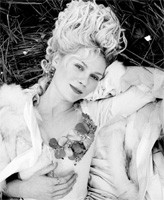
Up for an Oscar this year, Milena Canonero’s designs for Sofia Coppola’s opulent Marie Antoinette are incredibly period but with a deliberately candy-colored palette meant to reflect Coppola’s vision of the young queen’s “candy and cake” world. Canonero, my pick to win, was nominated in 1990 for her work on Dick Tracy and is a master of using color to get under the skin of the character. As you can learn from the wonderfully detailed production notes at the Marie Antoinette website, the movie’s sour Comtesse de Noailles, played by Judy Davis, is deliberately dressed in a series of lemon-colored dresses to reflect her acidic nature.

The iconic Marie Antoinette herself enjoys re-vamped Versailles fashion, her color palette often taking its cue from the 1980s: hot pinks, vivid greens, bright blues. It’s an ingenious choice considering the paralells Coppola’s film draws between the culture of these outrageously wealthy 1700s teenagers and the decadent culture of her own youth. And whatever jaded critics might say of the film itself, there is no denying that the collaboration between Coppola and Canonero has created one of the most visually remarkable films of all time.

An even greater challenge for the costumer is to create costumes for a world that does not exist. After the first two installments of the series had been nominated but passed up for the Oscar in 2002 and 2003, The Lord of the Rings: The Return of the King finally won the best picture Oscar in 2004, and no one saw fit to give Peter Jackson, who invited several of the cast and crew up on stage with him, a standing ovation. The three trailblazing films are the most woefully underappreciated achievement in the history of cinema, their allegedly light-weight subject matter belying the herculean efforts of the filmmakers to bring the fantastic story to the screen with realism and integrity.

Ngila Dickson’s costumes tell all that is needed to know about the seriousness and care with which the whole sprawling production was undertaken, never mind the millions of handmade props, weapons and textiles that Jackson’s army of glassblowers, blacksmiths and weavers engineered in order to create, from scratch, a world the likes of which has never been seen on the silver screen before and probably will never be seen again.

For starters, because of the lengthy shooting schedule and anticipated wear and tear of the frequent action scenes, Dickson had to make every costume 10 times. Ten times for the actor, 10 times for the stunt double and (because the film is largerly concerned with three-foot-tall hobbits) 10 times for the size double. Next, she had to create clothing that would portray the culture of the character. Dwarves, for example, a very utilitarian species, were completely different from the the ethereal elves, their costumes using heavier motifs and square shapes, while the elves had longer flowing lines and sinuous motifs reminiscient of the natural world they worshipped.

Using historical bases, Dickson’s designs have a realism that allows the viewer to completely believe in the fantastic setting and its diverse cultures. The Viking-themed Rohirrim look as if they’ve wandered the plains of their homeland for a millennia. The hobbits’ clothing, loosely based on 1700s garb, reflects their life of comfort and leisure. In order to give the actors an added feeling of realism, Dickson went as far as to create authentic underwear for several characters, even though the garment would never be seen by the camera. Buttons were hand-carved, often sporting designs too small to ever show up onscreen. Pure-white wizards’ robes were frayed and faded by hand to make them look as if they’d been worn for hundreds of years.

Props master and designer Richard Taylor, who shared the resulting Oscars with Dickson, created thousands of suits of armor for the various armies of Middle Earth, each reflecting the values and beliefs of the cultures wearing them. The scarifying Uruk-Hai had heavy armor on their front side but little on their back because, as Taylor gleefully announces on the DVD extras, “They’d never run away from a fight!” King Theoden, played by Bernard Hill, wore a suit of armor so authentic it contained intricately hand-tooled leather on both the front and interior of his breastplate. In an interview on the extended edition of The Two Towers, Hill reveals that this detail alone made him feel like a king.

Compared with the struggles of the costumer to provide character, context, authenticity and symbolism to their work, the prized method acting of the Hollywood elite begins to look a bit tired. Just like method actors, though, the best costumers create full-fleshed characters we remember forever. From Ann Roth’s desert romantics to Dickson’s world that never was, costuming remains one of the most compelling aspects of making movies. Between the snores brought on by teary speeches and thank-yous to the director’s dog, maybe this year we can remember that.

The 79th Academy Awards screen on Sunday, Feb. 26.


New and upcoming film releases.

Browse all movie reviews.

Avant Marin

0

February 21-27, 2007

There was much initial buzz and bliss when it was announced last fall that Jasson Minadakis had been hired to replace outgoing Marin Theater Company artistic director Lee Sankowich. Much Googling was done. Mistakes were made regarding the spelling of his name. The founder and director of the Cincinnati Shakespeare Festival and most recently the artistic director of the Actor’s Express Theater Company in Atlanta, Ga., Minadakis (frequently described as “friendly” and “intense”) is the guy about whom Atlanta’s Creative Loafing newsweekly recently said, while lamenting the mighty M’s departure from their city, “As a director, he’s proved masterful at ramping up onstage tension as far as it can go–and then ramping it up some more.”

Indeed, Minadakis is renowned for selecting heavy-duty subject matter and then directing the hell out of it, and he has a fondness for developing brand-new material. Reportedly, the creative and critical highlight of Minadakis’ time at Actor’s Express was his staging of Love Jerry, an original musical about a pedophile.

As MTC works its way through a theatrical season that was already mostly planned out before he showed up, a lot of people have been holding their breath, given Minadakis’ reputation, waiting for their first chance to see him work first-hand as a director. Unfortunately, he won’t direct his first full play until the season-closing run of Sandra Deer’s The Subject Tonight Is Love, and that doesn’t hit the boards till May.

The good news is that MTC has a little thing they call NuWerkz, a series of staged readings of new works by up-and-coming playwrights, and as his first official directorial effort at MTC, Minadakis will be directing February’s portion of the series, a suitably intense-sounding play titled Telescopes, by Mat Smart.

In an alternative universe, an assortment of interrelated lighthouse keepers are all battling a weird and frightening illness. Their own prejudices and social imprinting are challenged when a self-described “healer,” someone they’ve been programmed to mistrust, is suddenly shipwrecked near their home. Minadakis’ workshop staging of the piece will get a two-day run Sunday-Monday, Feb. 25-26, on MTC’s 99-seat Second Stage. Until May, this will have to stand as our first sampling of the legendary Minadakis intensity.

Also in Marin, the off-the-cuff thespians who comprise the Bay Area Playback Theater plan a one-night stand at the Larkspur Cafe Theater on Saturday, Feb. 24. The troupe employ their own brand of improvisational performance, eliciting personal true stories from their audience members and then transforming those tales, abracadabra-like, into theatrical-historical-comical performance-based thingamajigs, blending movement, music and dramatic spoken word. It’s like those improv shows where audience members shout out plot lines and literary genres, only in this case, people shout out the plots of their lives. Sometimes, the Playback folks turn the stories into epic myths, other times they simply reenact them in ways that can be funny, powerful or both.

Playback theater, as a genre, has been building since the 1970s, and there are several groups in California that use the basic concept in different ways. Bay Area Playback Theater–which usually features some combination of the actors Sylvia Israel, Marti Holtz, Marcy Dubova, Joanne Brauman, Benny Buettner, Linda Scaparotti, Duncan Silvester and Martin Masters–is focused on the notion that when we see our own stories played back to us, we can have a better appreciation of the significant ebb and flow of our lives. If that doesn’t happen, of course, at least it’s usually pretty entertaining.

Larkspur Theater Cafe, 500 Magnolia Ave., Larkspur. Playback Theater begins at 8pm. $20. 415.924.6107. www.larkspurcafetheatre.com. Marin Theatre Company stages ‘Telescopes’ Feb. 25-26. 397 Miller Ave., Mill Valley. 7:30pm. Free; suggested $10 donation. 415.388.5208. www.marintheatre.org.


Museums and gallery notes.

Reviews of new book releases.

Reviews and previews of new plays, operas and symphony performances.

Reviews and previews of new dance performances and events.

Finding Themselves

February 21-27, 2007 Item number eight in the 12 steps to a better understanding of the band Dropping Daylight reads, and I quote, "They played with Papa Roach and Jason Mraz a couple days apart and emerged from the week confused about their place in this world."That about sums it up. This Midwest sensation has played hundreds of shows from...

Art School Confidential

Reeding & riting: Among complaints of racism and copyright...

Fear of Food

February 21-27, 2007I once worked at a sausage cart in the park of an affluent city neighborhood. After my first day, I walked over to the alcoholic homeless men who hung out on the park's benches to offer them a bag of baguettes we had left over. "No thanks, honey," said one of the lounging bums. "Outside of white...

Goodbye, Mr. Chip

music & nightlife | By Bruce Robinson ...

Ask Sydney

February 21-27, 2007 Dear Sydney, for the first time in our eight-and-a-half year relationship, my boyfriend told me (during a fight) that I wasn't trying hard enough in bed. I'm totally crushed, and even though we have since made up, I still don't want to touch him. I thought we had a good sex life. Seriously. I was happy with...

Morsels

February 21-26, 2007 Fed up with plastic-tasting fast food or frozen meals that include everything but taste? Prefer to buy locally, and to know how your food is processed? Want your food choices to be good tasting, good for you and good for the environment and economy? Listen to short but illuminating presentations on the principles and concerns underlying the...

The Byrne Report

February 21-27, 2007I have reported recently in these pages the history of United States senator Dianne Feinstein's 2001-2005 conflict of interest due to her husband Richard C. Blum's former stake in two war contractors, URS and Perini corporations. Unfortunately, the senator is not the only one in her family with an ethics problem. In March 2002, Gov. Gray Davis...

‘Grace’ Notes

February 21-27, 2007The hymn "Amazing Grace" is a musical jinx, in many ways worse than "A Whiter Shade of Pale." Melodically monotonous, fantastically ill-omened, it's as essential to disasters as makeshift shrines with teddy bears and Mylar balloons. And it has been a key to the success of depressing movies for decades. If you hear an a cappella version...

Costume Dramas

February 21-27, 2007It's Oscar time again. Time for betting pools and debates over who should win what. Meryl Streep is now the most nominated actor in Academy history. Peter O'Toole may finally break his record losing streak. And with Dreamgirls holding eight nominations, Beyoncé will no doubt be singing all the nominated songs. Again.But while everyone squabbles over the...

Avant Marin

February 21-27, 2007There was much initial buzz and bliss when it was announced last fall that Jasson Minadakis had been hired to replace outgoing Marin Theater Company artistic director Lee Sankowich. Much Googling was done. Mistakes were made regarding the spelling of his name. The founder and director of the Cincinnati Shakespeare Festival and most recently the artistic director...
11,084FansLike
4,446FollowersFollow
6,928FollowersFollow