High Voltage

0

music & nightlife |

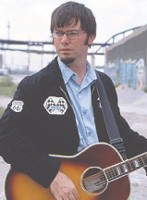
Front man: Jay Farrar of Son Volt and Uncle Tupelo hasre-energized Americana music.

By Greg Cahill

‘Feels like driving around in a slow hearse,” Son Volt head honcho Jay Farrar laments on “Slow Hearse,” the spooky elegy that kicks off the band’s new CD, The Search. It’s a masterful song. Farrar repeats that one line over and again for over two minutes accompanied by little more than a haunting upright piano and a backward-tracked electric guitar, and he never sounds maudlin.

Then the band bursts into “The Picture,” soul horns blaring in stark contrast to Farrar’s bleak lyrics about war, governmental indifference and the saving grace of mercy.

The slow hearse careens through the detritus of a crumbling empire.

The explosive rock sonics belie the jaunty alt-country Farrar helped pioneer during the late ’80s in the seminal Americana band Uncle Tupelo and a decade ago in the first incarnation of Son Volt. Ask him about this follow-up to Son Volt’s brilliant 2005 comeback album Okemah and the Melody of Riot, and the conversation turns to soundscapes and musical styles and the cohesiveness of the band he reconstituted after legal wrangling waylaid the original lineup two years ago.

“Overall, The Search is more reflective of the growing coalescence of the band and of the members playing off of each other,” he explains during a phone interview from a rehearsal studio a short distance from his St. Louis home. “I think Okemah was more reflective of the political turmoil that is going on around us,” he adds. “The political slant to the songs is still there. But I didn’t want it to be the real focus for this record. Even though there are some topical themes, I tried to steer away from that. But it still pops up in songs like ‘The Picture.'”

As one-third of the seminal alt-country outfit Uncle Tupelo, Farrar tapped both the hillbilly spirit and Neil Young’s Zuma-vintage grunge, fusing the simple heartfelt sentiments of traditional music with the fire of punk. Their angst-ridden twang informed the band’s 1990 debut No Depression, which took its title from an old Appalachian spiritual and lent its name to the rootsy Americana sound that characterized the alt-country movement as well as the Seattle magazine that still chronicles its biggest stars.

The band recorded four albums, including 1993’s masterwork Anodyne, before parting acrimoniously. After its 1994 split, Uncle Tupelo’s members formed two more revered underground bands: Farrar and drummer Mike Heidern spun off the tradition-bound Son Volt, while Jeff Tweedy enlisted the rest of the band to form the experimental pop band Wilco.

The following year, joined by the brothers Jim and Dave Boquist and fueled by Farrar’s soul-searing electric guitar work, Son Volt released their critically acclaimed debut Trace. It captured Farrar’s raw, dark side. Two more albums followed before the band members soured on each other. Farrar went on a hiatus. In 2001, he reemerged with his solo debut, Sebastopol, releasing three more solo projects in the next three years, mostly under the radar.

In 2005, he reunited the original Son Volt lineup to record “Sometimes” for the Alejandro Escovedo tribute album Por Vida. A new CD project appeared likely, but the old animosities resurfaced.

“The other guys decided they only wanted to talk through their lawyers,” Farrar recalls.

So he recruited a new band: guitarist Brad Rice of the Backsliders, bassist Andrew DuPlantis of the Meat Puppets and drummer Dave Bryson of Damnation A.D. Amid the backdrop of the mounting bloodshed in Iraq and the shame of the neglected Gulf Coast, Okemah and the Melody of Riot struck a chord, thanks to such anti-Bush fare as “Jet Pilot” and “Endless War.”

The All Music Guide lauded the results as Farrar’s best since Trace.

The Search, augmented by Eric Heywood on pedal-steel guitar and Derry deBorja on organ, builds on those themes of political strife and social isolation. It’s not so much a concept album as a pungent distillation of the melancholy and longing that inhabit so many of Farrar’s best songs. Some are autobiographical, some are character sketches, some are observational tomes. But all tell of road-weary travelers searching for meaning amid broken dreams, political turmoil and social tumult.

Call them reports from the heartland, glimpsed from a slow hearse.

Son Volt perform Saturday, March 31, at the Mystic Theatre. Magnolia Electric Company open. 21 Petaluma Blvd. N., Petaluma. 9pm. $20; 18 and over. 707.765.2121.


FIND A MUSIC REVIEW

Caffeine World

0

March 28-April 3, 2007


Greg Grabow wasn’t an underdog in the Western Regional Barista Competition (WRBC) until a pear actually leaped out of his blender. Later, he clarified that it actually wasn’t even his blender.

On St. Patrick’s Day–the second of the three-day event–Grabow and 28 other contestants from California gathered at the Petaluma Sheraton to compete with coffee. The winner automatically qualifies for a slot in the semifinals at the U.S. Barista Championship in Long Beach, and eventually the top barista from each participating country will duke it out at the eighth annual World Barista Championships scheduled for Tokyo this summer. Ethiopia is one of the newest countries to join this international mocha melee.

The WRBC had taken over the hotel’s Blue Heron Ballroom, and the atmosphere inside was charged. Of course, everyone was amped up on caffeine, distributed at the back of the room by independent coffee companies pulling free shots for the masses on “the fourth machine.” This was an extra La Marzocco FB80, identical to the three espresso machines used in competition, but solely dedicated to keeping the audience buzzed.

Baristas and those who came to support them, paparazzi, journalists and spectators formed a line along the back perimeter of the ballroom and waited patiently for their espressos and cappuccinos; the line reminded one of enthusiastic parishioners falling in to take communion. Throughout the weekend, the queue stayed strong as attendees went back multiple times.

The legions of baristas in attendance sported enough tattoos to wallpaper a small cafe. The ink patterned their pasty skin, made paler by ubiquitous jet-black hair. From time to time, these young baristas took breaks, sprawling on the sidewalk outside like deep-sea creatures exposed to the sun for the first time.

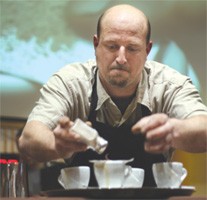
It was amid this coffee-crazed atmosphere that Grabow, a roaster at Barking Dog in Sonoma, took his place as contestant number 28 behind one of three coffee bars at the front of the room. In a nod to the growing popularity of barista competitions as a bona fide, if burgeoning, spectator sport, video of each competitor’s presentation was simultaneously projected onto a large movie screen. In previous years, the competition had been compared to watching someone do her taxes.

Grabow, like his peers, would prepare 12 drinks–espresso, cappuccino and a signature drink of his own devising–for each of four sensory judges (technical judges are also present but don’t taste) and in just 15 minutes. Like the floor routines in Olympic gymnastics, the competition is set to music of the contestant’s choice. Grabow, who had rehearsed his verbal presentation while making bean deliveries out of his Subaru hatchback, introduced the spectators and judges to his musical choice from the Dreamgirls soundtrack. “I might be white,” he told the judges and the audience, “but I’ve still got some soul.” The audience responded favorably, and he was off to a good start.

In practice sessions, he had tried adding cilantro, but found that it was too pungent. Trying to come up with a better recipe, the answer finally came to him one night. “I literally had a dream about one of my co-workers telling me that I should use a pear or an apple,” he said afterwards. He liked the results. Thus, the pear frappacato was born.

But during competition, while pouring the frappacato from the blender into the last of the four glasses, Grabow suffered a major spill.

Later he described what happened. “The pear flew out of the pitcher,” he said, pausing after each word as if trying to wrap his mind around the unforeseen phenomenon. Then, he giggled hysterically. The judges, who award points on everything from flavor to presentation, would surely dock points for a frappacato-covered pear making its way onto the bar.

It was an unfortunate turn of events for Grabow, who had been perfecting the frappacato for three weeks. Daily, he had visited Sonoma thrift stores in search of appropriate glassware; among other things, contestants must supply their own cups, saucers and coffee beans. If he was a bit frazzled during competition, it might have been because he’d lost his keys that morning among all those extra sets of glassware (which he termed “understudies”).

Prior to his coffee career, Grabow spent 20 years as a musical theater actor in San Francisco. The experience steadied him on Saturday, and when the pear went flying, horror registered on his face for just an instant. “My nerves of steel served me well today,” he said, noting that he’s had props fall and people accidentally drop him onstage before. “But it’s very nerve-wracking, especially when you’re doing work with your hands. Because when you’re singing and acting onstage, you can shake. It’s OK to shake–people are sitting 20 feet away from you. As long as you can hit the high notes, there are no problems. When you’re serving to four people and you’re shaking when you’re setting the drinks down, you watch your rosette go from a rosette to a blob of white foam.” It had taken Grabow months to master the rosette, now his favored cappuccino artwork.

Later that evening, the six finalists were announced. Grabow wasn’t one of them, but he didn’t seem to mind. Not everyone took the news so evenly; just after the announcement, sobbing was heard in the women’s bathroom.

On day three, the audience spilled over the chairs into the flanks of the ballroom, and the lineup for free coffee from the fourth machine had grown. Grabow and many of the other baristas who hadn’t made it into the finals had come to watch. In between competitors, the emcee joked that the coffee paparazzi had become a problem. Could they please stand at least 10 feet away from the contestants? It wasn’t likely.

Of the six remaining candidates, only two were from the Bay Area: Chris Baca and Crystal Yeaw both represented Ritual Coffee Roasters in San Francisco. Coffee Klatch in San Dimas had sent two contenders, including the owner’s daughter, Heather Perry, who had won the U.S. Barista Championship in 2003 and was back at the WRBC hoping to win it for the fourth year in a row. Los Angeles barista Eton Tsuno was also back again after taking home third last year, and WRBC newcomer Kyle Glanville of Intelligentsia seemed to have a good shot, given his company’s reputation in the industry. Though Chicago-based, Intelligentsia’s first West Coast store is slated to open in Los Angeles in the coming months.

Unlike the day before, the WRBC finalist competition was highly polished, right down to Perry’s French manicure looming large on the projection screen.

Tsuno’s miso-flavored umami espresso was the most unusual of the signature drinks, and his disarmingly carefree personality seemed like it might win over the judges. By contrast, Perry’s performance was slick, although her signature drink, which involved creating a “faux crema” by pulling an espresso shot over a mixture of raw egg and brown sugar and then floating it atop a “cloud” of citrus-zested cream, seemed divine. Kyle Glanville’s Mineola tangelo and cream reduction with espresso also seemed like it could be a winner. It was anybody’s guess.

The announcement of winner was late, because, the audience was told, the scores were so close that the judges had to re-tally all the scores. In the end, Perry won it again. She beat out Glanville by a mere 2.5 points out of 1,000. The difference reportedly came down to spillage. Although there had been no flying pears in this round, both contestants had spilled some liquid, and apparently, the judges determined that Glanville’s spill was slightly more egregious.

“In a coffee competition that is similar to the Olympics, every photo finish opportunity counts,” said Grabow afterwards. “One does the best they can and lets the grounds fall where they will.”

Quick dining snapshots by Bohemian staffers.

Winery news and reviews.

Food-related comings and goings, openings and closings, and other essays for those who love the kitchen and what it produces.

Recipes for food that you can actually make.

Shoulda, Coulda, Woulda

0

March 28-April 3, 2007

It’s not often that regret is uttered from the rebellious mouth of maverick Neil Young, but his new release Live at Massey Hall 1971 mustered just a bit. “This is the album that should have come out between After the Gold Rush and Harvest,” the Bridge School founder said recently. “My producer was adamant that this should be the record. As I listen to this today, I can see why.”

This repudiation of the beloved Harvest album may seem outrageous, but it’s definitely warranted. The solo Toronto set–the yin to Live at Fillmore East‘s blistering yang–is a stunning, intimate portrait of the icon as a young Canuck on the cusp of becoming a household name (and the CSNY ingredient to truly watch). Armed with just a guitar, piano and his emotive, nasally whine, Young moves effortlessly through early favorites like “Helpless,” whose first line receives cheers from the hometown crowd, reminding us Bay Area residents of our mere surrogacy.

Although the legend seems not to have changed much in 36 years–from the ecological concerns of “Love in Mind” to his photographer scolding after a straightforward “Tell Me Why”–the then 25-year-old seems slightly less grizzled than his modern-day reputation. He actually responds to a call for “Down by the River” with a devastating off-the-cuff acoustic version and closes his set with a rollicking, clap-along “Dance Dance Dance.” This is helped in no small part by his palpable comfort in front of his countrymen, to whom Young confides throughout the show, most poignantly expressing simple joy at being back home before launching into a tragically fresh “Ohio.”

Of course, the not-yet-released classics are Massey Hall highlights, with the Harvest songs deposed from their ivory towers and revitalized through their infantile context. It’s thrilling to hear “The Needle and the Damage Done” without applause during the opening riff but including his sad lament on colleagues who’d recently succumbed to heroin addiction. And no better is the spirit of excavation symbolized than waiting through the ever-bland “A Man Needs a Maid” to bask in a few bars of the rare piano version of “Heart of Gold.”

Though not as pristine in quality as the audio disc, the included DVD vastly improves upon Fillmore East‘s awkward pans of still photos by tastefully combining grainy live footage with stock footage and Young’s home videos, which include footage of the actual “Old Man.” While a recent brush with mortality may sadly be the reason for this massive retrospective undertaking, it’s comforting that the Neil Young archives are being helmed by Young himself–not posthumously. Consider the anticipation for the box set this fall officially on high.


Duo Vision

0

music & nightlife |

By Gabe Meline

In 1998, then-27-year-old Brad Mehldau recorded a very elegant rendition of “Exit Music (For a Film),” sourced from Radiohead’s then-recent opus OK Computer. It exploded Mehldau’s visibility, turned a young generation on to jazz, and summarily overshadowed his entire repertoire. To fuel public demand, more Radiohead songs followed, along with introspective interpretations of Nick Drake, George Harrison and Paul Simon.

That Mehldau is an iconoclast is a generally accepted, though largely untrue, point of view owing mostly to his flirtation with non-jazz idioms (the first time Mehldau performed in the Bay Area, he appeared at a small club specializing mostly in hip-hop). What unfortunately has gotten lost is Mehldau’s own intricate compositional skill and heroic ability to infuse deserving beauty into hoary, sentimental tunes (“Young at Heart,” “Someone to Watch Over Me,” “Secret Love”). Like Sonny Rollins, he lets melody be the judge, even while pleading insanity on the stand.

The pianist recently teamed up with electric-fusion guitarist Pat Metheny for an eponymous release, Metheny/Mehldau, to explore the simplicity of harmonic invention as one half of a pair. Though Mehldau hates being compared to Bill Evans–even going so far as to explain why in the liner notes to his albums–any piano/guitar duet in the realm of jazz must be weighed against the two albums of infinite treasure that Evans made with guitarist Jim Hall, Undercurrent and Intermodulation. Amazingly, Metheny and Mehldau capture the same telepathic brilliance as their predecessors, and for the most part their intimate work together is breathtaking; Metheny’s compulsion for guitar effects pollutes only a small percentage of the dialogue.

Mehldau has found rare time for collaboration outside of his trio with bassist Larry Grenadier and drummer Jeff Ballard, and a four-man follow-up, Quartet, arrived last month as no surprise. It is just as much a rewarding listen as Metheny/Mehldau, if slightly less voyeuristic, and points further toward the hope that Mehldau’s fantastic talent will eventually dilute his reputation as “the Radiohead guy.”

Brad Mehldau and Pat Metheny appear with Larry Grenadier and Jeff Ballard this Tuesday, March 27, at the Napa Valley Opera House. 1030 Main St., Napa. $55. 707.226.7372.


FIND A MUSIC REVIEW

Talking Trash

0

the arts | visual arts |

By Brett Ascarelli

Without knowing anything about Tim Gaudreau, one can surmise a fairly accurate picture of the man simply by looking at his trash. Based on his discarded Ben and Jerry’s ice cream cartons, Stonyfield Farm yogurt cups and old hiking boots, this man is crunchy. He likely owns a cat (Scoop Away carton), is conversant with current technologies (computer monitor, CDs), gets lucky often enough (Trojan packages), is a yuppie (disposable coffee cup, Asian takeout carton, Snapple bottles) and is artsy (can of spray glue or paint). Contrary to how it may appear, we actually haven’t been digging into other people’s garbage to sniff out news. No, we were actually invited to look at this guy’s trash, and so are you.

It turns out that Tim Gaudreau isn’t just artsy; he’s actually a bona fide artist. His new work, “Self Portrait as Revealed by Trash: 365 Days of Photographing Everything That I Throw Out,” is on view at Gallery Route One March 23 through April 29. For this fragmented and indirect self portrait, he whittled over 5,000 photographs of all the individual items he tossed out from April 2004 to March 2005 down to a sampling of roughly 60 of the most representative objects. Besides bravely baring his personality through these photos, Gaudreau, a New Hampshire-based artist who believes that artistic work should be relevant to society, wants for his piece to communicate a green message above all.

“What are the consequences,” he asks, “to this American throwaway culture where, if it’s out of sight, it’s out of mind? I don’t think that we get away with it: we eat, drink and breathe these plastic cups long after the dump truck makes its weekly run.”

Over the course of documenting his trash, Gaudreau was so horrified by the number of bottles and cups he drank through every day (five), that he says “there came a point where I couldn’t bear to admit throwing out another one.” He started bringing his own mug to the coffee shop, mixing his own sports drinks and drinking tap instead of bottled water. He’s calculated that with these reforms, he’ll be saving over the course of his lifetime some 78,000 bottles from ever being manufactured and tossed.

“Self Portrait as Revealed by Trash” exhibits from Friday, March 23, at Gallery Route One, 11101 Hwy. 1, Point Reyes. See Openings for details. 415.663.1347.


View All


Museums and gallery notes.


Reviews of new book releases.


Reviews and previews of new plays, operas and symphony performances.


Reviews and previews of new dance performances and events.

Ask Sydney

March 21-27, 2007

Dear Sydney, how do I get rid of a stalker without moving, changing my name or changing my appearance? I have a problem with attracting needy men who, after being rejected by me, turn into stalkers. They won’t leave me alone no matter how mean, nice, rude, beautiful, ugly, stinky, dirty, bad or good I am. They come to my work, corner me in the hallway outside of work, follow me to my car. They never leave me in peace. I’ve changed my name, cut and dyed my hair, changed my style of clothes, even my car. I’ve just moved for the last time, and won’t change anything about myself ever again! Help!–Serial Stalkee

Dear Stalked: You’ve just moved to a new place, and it’s not too late to change this pattern. Go forward into your new town with confidence that you will never be stalked again. First, examine why this keeps happening. Do you find yourself attracted to men who are predisposed to stalking? Are there some commonalities that you can map? Some stalker characteristics? Or are these otherwise “normal” guys who just freak out when they meet you, as if you exude some kind of “stalk me” scent? Pay close attention to your interactions with people, especially to potentially needy men, and see if you can adjust your interactions from the very beginning so as to better avoid another bad situation. This is not to say you bring this on yourself. No one deserves to be so disrespected. But there is the reality that when you are interacting with another person, the only one you can really control is yourself. Take a self-defense class, if you haven’t already. Make all potential dates pass through a rigorous screening process. Make it known from the very beginning that you are not a victim (practice looking tough in the mirror). Don’t have sex with anyone until you trust them. And in this new town, insist on having relationships with people who have your best interests in mind.

Dear Sydney, in response to (Ask Sydney, March 7), this woman can either be part of the problem or part of the solution. The only way she can have any genuine influence on her children’s relationship is to mend her relationship with her own sister and parents. To attempt to influence her children, without “living” the very thing that she is attempting to espouse, will be thoroughly conflicting and, without a doubt, will further alienate her children from each other and from her. She is creating the likelihood that her immediate family relations will breakdown further because she is not doing her very best to resolve her own serious conflicts. The only means for her to feel better is to deal with the reality of the situation and her contribution to it (without blame or guilt). Many wonderful and powerful gifts are on the outside of resolving issues like these, and “magic” can be experienced in a way that wouldn’t be otherwise available had these normal and perfectly determinable challenges not existed in the first place. I hope this is received as it is intended, which is to offer a new perspective and a bit of insight.–Another Take on It

Dear AT: My assumption is that if “Family Meltdown” has been unable to reconcile with her family members, there must be a reason for it. Ideally, you’re right: it would be most helpful if she could provide her children with a solid foundation of familial love, setting a good example and perhaps cashing in on a holiday meal or two. It is also true, as you say, that some of the challenges we face make us stronger. But challenges can still be pretty shitty, and the reality is that some people end up with family that in no way, shape or form deserves to be labeled as such. If this is the case for FM, then there might be nothing she can do to change things. For her sake, I hope that this is not the case and that she will read your letter and realize that there is another way to go about making things better.

Dear Sydney, what’s going on with the calls I keep getting from someone in India trying to get me to sign up for some credit card? They’ve started using non-Indian names, like “Tom Smith” or “Shelly Davis” when they introduce themselves. Every time I get a call, I feel ashamed to even be living in a country where companies feel like I won’t accept a credit card deal from someone with an Indian name! Like if the telemarketer says his name is Joe, I’ll think he’s calling from Iowa. Every time I get one of these calls, I want to apologize to the person, and tell them that even though I don’t want the card, I would like to support them in using their real name, and that if there’s a petition going around, I’d sign it. Is there anything I can do about this? Am I the only one disgusted?–Embarrassed American

Dear Citizen: The first step in dealing with this name-changing business, which I agree is offensive and embarrassing, is to ask your telemarketer for a U.S. address where you can write to the company. Send a note, explaining that you will never accept a credit card offer from a company that forces its employees to adopt new names. The only way to instigate change is to make your voice heard. Recently, I was told by a telemarketer from India that she would need to record our conversation in order to help fight “the war on terror.” I told her that I didn’t believe in the war on terror and apologized for my country. She seemed confused, and our conversation went nowhere. Maybe it was the connection. Next time I receive such a call, I’ll write as well. That makes two letters the company will receive, which is at least a start.

No question too big, too small or too off-the-wall.


Wish it were a rumor

0

music & nightlife |

By Brett Ascarelli

Like the rest of us, Mick Fleetwood goes to Costco. But unlike the rest of us, he has his own label to promote there–and it’s not a record label.

Tell me lies, tell me sweet little lies. If only this were a lie. No, friends, the percussionist and founding member of classic-rock behemoth Fleetwood Mac has joined the ranks of other celebrities from Larry Bird to Lorraine Bracco to Fess Parker to create his own wine brand: Mick Fleetwood Private Cellar. Reisling rings like a bell through the night. Wait, no. It’s Rhiannon, damn it. Rhiannon rings . . .

Rolling out the label in 2001, Fleetwood has just partnered with Costcos in the North Bay to sell his Chardonnay, Cabernet Sauvignon and Sauvignon Blanc, all from 2005, along with Petite Sirah and Merlot from 2004.

Die-hard Mac fans, don’t despair. The good news is that the wine has gotten good reviews; in fact, the Wall Street Journal drily named it “Best Wine by a Living Musician.” Fleetwood sources the grapes from various vineyards in California and Washington, and leaves the production and bottling up to already established wineries, like Lucas & Lewellen in Santa Barbara.

After selling some 19 million copies of Rumours (which, by the way, was partly recorded in Sausalito), Fleetwood is still riding that train, even after the career change. It’s hard to stomach a publicity photo of him dressed in the Rumours cover outfit and photoshopped onto an image of a warmly lit underground wine cellar. If you don’t love me now, you will never love me again. Poignant, but quite honestly, Mick, we can’t commit yet.

Mick Fleetwood will be trapped at the following Costcos on the following days; Friday, March 23, at Costco, 1900 Santa Rosa Ave., Santa Rosa, 11am-2pm, 707.578.3775, then later that day at Costco, 5901 Redwood Drive, Rohnert Park, 3pm-6pm, 707.540.9110, and finally on Saturday, March 24, at Costco, 300 Vintage Way, Novato. 415.899.8539. All events free–if you’re a member.


FIND A MUSIC REVIEW

Letters to the Editor

March 21-27, 2007

Ag rag

(March 7) presented some misleading information when referring to our Sebastopol farm, Laguna Farm, and we’d like to comment. First, Jonah Raskin makes the increasingly common error of confusing the words “certified organic” and “organic” (he stated that our farm was not organic). Laguna Farm has chosen to drop our organic certification in the face of rising bureaucratic costs and lowered standards (following the implementation of the National Organic Program in 2002), but that does not mean that our standards have changed; in fact, we now refer to our methods as being “beyond organic,” because they exceed those of national certification. This error reinforces the bureaucratic notion that if a produce item isn’t certified, it isn’t organic–a regrettable concept.

While we certainly understand the need for certification in situations where the consumer doesn’t have access to the producer, there is a much bigger picture involved here.

There is another petty error that Raskin made that probably doesn’t need to be printed, but it’s also regrettable: he stated that I “[don’t] hide the fact that [my] parents gave [me] the land and that [I don’t] have a mortgage to pay.” In fact, my parents still own the land and we do pay them a sizable rent. This is regrettable in that readers will get the impression that at least one farm in Sonoma County doesn’t have an overhead–wishful thinking and a marvelous idea, but unfortunately not true.

Scott Mathieson, Laguna Farm, Sebastopol

Poisoned air?

On Monday, March 12, I went out to walk my dog. The air outside was so bad that I had to go back inside. The sky was clear and there was no wind that morning. I know from past year’s experience that on still mornings the farmers are out spraying. They are not allowed to spray on windy days.

I felt so bad that day I could hardly function. Other people I know also remarked how nasty the air was that day. It was not just around my house, but all around town.

When I’m housebound by the air, I always think about all the people out doing their daily work. People don’t tend to consider how chemicals in the air can affect their thinking and emotions. I worry about bad decisions made, arguments and depression caused by what’s in the air.

That day, I was so out of it I kept having this repetitive thought: “It’s legal to kill people with pesticide in this county.” Later, when my mind cleared, I felt like that was a stupid thought.

The next morning, I heard a Sebastopol resident describing the very strange behavior of wild birds at her house that Monday morning.

Then I found out about the young boy who was shot to death by the cops that same morning, and that he only had a pocketknife on him.

It made me think about my repetitive thought. Maybe it was not so stupid. I could not help but wonder if the air had been clean that morning, would things have turned out differently? Did whatever was in the air affect judgement?

In this county, we are not privy to how much is being sprayed until long after the fact. We should know when all the farmers are spraying.

Denise Lebel, Sebastopol

May as well ask as anything

We just wrote senators Feinstein and Boxer asking that they please only vote for a supplementary budget that includes language dictating a withdrawal from Iraq by the end of 2007 and requiring congressional authorization for any military action against Iran.

Although there may be pressure to weaken the Supplemental War Appropriations bill, they can push for the kind of brave and principled stances that will bring our troops home.

Remember that “supporting the troops” means bringing them home, not keeping them in the middle of an Iraqi civil war or bogging them down in a larger regional war in Iran. Real support for the troops means making sure that no more of them die for a war we never should have gotten into. Have you heard the reports from the Iraqi people on BBC? We urge your readers to write them, too.

Barby and Vic Ulmer, Saratoga

Senator Dianne Feinstein
United States Senate
331 Hart Senate Office Building
Washington, DC 20510

Senator Barbara Boxer
1700 Montgomery St., Suite 240
San Francisco, CA 94111

Please give Feinstein the Boho‘s best regards . . .


The Byrne Report

March 21-27, 2007

It was a balmy evening in late February at the Sausalito Cruising Club. Inside the shiplike restaurant, a political organizing group called Democracy for America-Marin was holding a forum, “presenting evidence of a direct link between breast cancer and the environment.” About a hundred people, mostly women, attended the informative event.

The panel sported an array of environmental experts, including Barbara Brenner of Breast Cancer Action, Deborah Raphael of San Francisco’s Department of the Environment, two Marin County supervisors and several activists, among them, Peter Coyote, the movie actor. Although the speakers focused on the chemical causes of breast cancer, many other cancers were implicated in the sad story of how our watery bodies are infused with toxic cocktails mixed from 100,000 industrial chemicals.

Coyote was vastly entertaining. The lanky baritone actor, who drove a vegetable-oil-combusting car to the Cruising Club, addressed the question of why people living in green-leafed, ocean-breeze-swept, affluent Marin County should care about the environmental degradation of less fortunate demographic zones. He recounted, “A wise old Indonesian peasant once told me the tale of a goose with two necks, one short and one long. The mouth on the long neck was able to reach the greenest and cleanest of leaves and find the healthiest of bugs to eat. The short neck ate only poison filth lying on the ground. The goose died, of course. Here in Marin, we are the long-neck goose.”

Coyote went on to excoriate our corporate-run government for putting the profit of capitalists before the health of the planet. “It will only get worse before it gets better,” he remarked. “It makes me feel homicidal, and I am a practicing Buddhist for 32 years.”

Brenner made a PowerPoint presentation showing the correlation between cancer and xenoestrogens, which are industrial chemicals that mimic estrogen in our bodies. These compounds are found in many household cleaning products, pesticides, herbicides and ubiquitously licked, sucked and fondled plastic artifacts, including chewable toys tendered to infants. Brenner presented State of Evidence, a collection of facts, scientifically informed essays and political analysis produced by Breast Cancer Action and the Breast Cancer Fund, both headquartered in San Francisco. I learned from this zine that professional journalists are at a particularly high risk for contracting the Big C. Yipes!

Other at-risk groups include dental hygienists, librarians, farmworkers, social workers, nurses and radiologic technologists. Mammograms, which are ionizing radiation, can cause breast cancer. The fatty tissue of most newborn babies is laced with carcinogenic chemical traces; eating barbecued meat is a very bad idea; certain brands of sunscreen can ignite skin cancers. The appendix of the report lists hundreds of chemical sources of cancerous pain, including urethane, the cancer-curing pharmaceutical tamoxifen, alcoholic beverages and (sigh) wood dust.

Raphael’s presentation was sharp. She talked about how San Francisco has legislated use of the precautionary principle, which means not asking if a possibly unhealthy product or chemical substance is legal or safe, but asking if it is necessary and, if not, banning it. San Francisco did that with plastic grocery bags and immediately got hit with a lawsuit by the American Chemistry Council. “They want to keep their right to put known carcinogens in teething rings,” says Raphael.

Activist Sandy Ross spoke about the struggle to mandate integrated pest management in Marin, which would use the precautionary principle to regulate the use of insecticides. Trade groups from the agricultural industry oppose this reasonable approach, naturally. Their friends in the California Legislature passed a law that allows state agencies to preempt local environmental-protection ordinances in favor of the state’s looser standards. Plus, federal law tends to preempt state environmental rules–and we all know what Bush-Cheney did to environmental protections at the federal level: eviscerated them. Worse, the pollution-loving World Trade Organization has the power to preempt the scarred stumps of those castrated protections.

Marin County supervisors Susan Adams and Charles McGlashan were articulate and greenish. Adams bragged about wetland restoration and getting rid of junk-food vending machines in county offices. Those are steps forward, but too little and too late to save us. McGlashan, who has worked with the Natural Step Foundation, was more profound. He laid out several principles for fixing our world. Do not pull anything out of the earth’s crust that does not belong in the biosphere, like coal, oil, mercury, etc., he counseled. If you must, keep it contained in closed loops. Allow no artificial chemicals to build up in the biosphere. Keep habitats natural by not pushing nature away. Create an equitable society.

Those laudable goals will require the long necks to do more than invest in socially responsible mutual funds, which was one of the solutions proffered by Coyote. I wonder what our short-necked brethren have to offer?

or


Deadly Force

0

Photograph by Michael Amsler
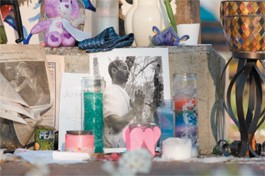
Memento: An informal memorial in Sebastopol’s Plaza features a photo of Jeremiah in meditation pose.

By Peter Byrne

On March 12, Jeremiah Chass, a 16-year-old teenage boy, was shot and killed in the driveway of his Sebastopol home by Sonoma County deputy sheriffs. The sudden violence of his death has not only traumatized the Chass family, but the local community as well. Close to a thousand people attended a Sebastopol memorial for Chass on March 17. Mixed with expressions of grief by young and old alike was a resolve to find out exactly what had happened.

The morning after Chass’ death, his parents, Mark and Yvette Chass, asked two close friends to visit them. In person, the shocked couple told Beth Pisani and her husband, Marc Ripley, about the circumstances surrounding their son’s killing. Pisani and Ripley have a six-year-old son, Tyler, who is close friends with and a classmate to the Chass’ youngest son. Pisani says she has received Yvette Chass’ blessing to talk on the record about the tragic event.

The Chass’ account as told to Pisani and Ripley differs from inconsistent narratives released by the Santa Rosa Police Department and Sonoma County Sheriff-Coroner Bill Cogbill. Pressing questions about whether or not deadly force was used unnecessarily remain unanswered because law-enforcement officials have so far refused to release 911 tapes of the event. Like many other people, Pisani and Ripley are concerned that important facts and analysis are missing from both official and press accounts.

According to Pisani and Ripley, on the morning of Monday, March 12, Jeremiah Chass suffered a psychotic breakdown after a period of declining mental health. His frightened parents called Sonoma County emergency services for help in restraining him. Deputy Sheriff John Misita arrived on the scene at 8:43am, followed a few minutes later by another deputy, John Ryan. What the two white deputies saw upon arrival was a white couple (Yvette and Mark) and a white child (their six-year-old son Isaiah Chass) and a severely agitated black man (Jeremiah) with a jackknife. Instead of backing off and verbally de-escalating the situation as first responders are trained to do, the deputies attacked, reportedly using pepper spray, a baton and fists. It appears that the paranoiac, frightened Jeremiah kicked at least one deputy in the face, drawing blood.

What is not disputed is that the deputies shot him multiple times.

Pisani says, “When I talked to Mark early in the morning on the day after it happened, when he called to see if we could take Isaiah to be with Tyler for a while, I asked him, through my tears, if excessive force had been used. He replied, ‘Yes, no question.’

“I talked to Yvette on Thursday about speaking to the Bohemian,” Pisani continues. “Reiterating conversations we had before about racism in our county, and our personal experience with it, Yvette said, ‘The truth has to come out.’ I asked her if she thought that racism influenced what happened. She said, ‘Yes.’ Yvette says that she forgives the deputies. She is a very spiritual person.”

The Chass’ attorney, Eric Safire, underscored that Pisani and Ripley do not speak for his clients, who remain in seclusion, and declined to comment for this article.

Jeremiah Chass was known as a peaceful, loving, philosophical, articulate teenager. He was a vegan. He enjoyed the study of physics and mathematics. Along with his mother, he had a strong spiritual practice, which included meditation and chanting. His simple, meticulously organized bedroom was adorned with prayer flags and a poster of Mahatma Gandhi.

Born to a Caucasian mother and an African-American father who died when he was a small child, Jeremiah was a fan of Ladysmith Black Mambazo. He had recently chatted with a member of the a cappella chorus from South Africa after a concert. The group’s music inspired him to save money by performing odd jobs for neighbors so that he could travel to South Africa after he graduated from high school.

Marc Ripley, a general contractor, admired Jeremiah, who occasionally worked for him. “I was impressed with his maturity,” Ripley says. “The way he held himself. We had many philosophical discussions. He smiled a lot; he was happy, he was very present.”

Being close to Jeremiah, Ripley was able to see that the youngster had changed over the past few months. Ripley says that Jeremiah seemed to be retreating from reality, disassociating from the present even when surrounded by the adoring children he coached in soccer.

Last Presidents Day weekend, Pisani and her mother’s group, including Yvette, made an overnight trip with their respective first-graders to Monterey to visit the aquarium and lounge on the beach. Jeremiah accompanied them. “On the drive down, Jeremiah meditated most of the time. He quietly held his hands in his lap, thinking,” Pisani remembers. When one of the moms asked him what he was pondering, Jeremiah replied that he was working to integrate his scientific and spiritual sides, developing an equation of unity, acceptance, love and peace.

During the last few months, Ripley and Pisani say, Jeremiah ate and drank very little and lost a lot of weight. They attributed it, in part, to his asceticism and principled, minimalist approach to living in a materialist society. “He was self-disciplined, on a spiritual path of purity,” says Pisani, who is a registered nurse, adding that both she and Yvette, who works as an occupational therapist, were increasingly concerned about Jeremiah’s well-being. “Yvette reached out to friends, brainstorming about what is normal behavior for teenagers and what is not. At the same time, she had a lot of faith in him and who he was. They had deep conversations about what he was thinking. They were very connected.”

On Sunday, March 11, Pisani and Ripley saw Jeremiah at Tyler’s soccer game. “His parents were checking in with him during the game, patting him on the back, chatting with him,” says Pisani. Jeremiah had decided to allow the team to “self-coach.” He had appointed one child as team captain, and he purposefully stayed out of the game. “I looked over at him and he was not agitated, but absent,” Ripley recalls.

“Yvette believes that for Jeremiah the line between his two worlds [the spiritual and the physical] was becoming less defined,” says Pisani.

After the soccer game, Jeremiah went home with his parents. That was the last time that his friends saw him alive.

According to Pisani and Ripley, Yvette started making telephone calls to mental health specialists after the game on Sunday. She gathered information from five different healthcare professionals. Given Jeremiah’s increasingly bizarre behavior, she was advised to admit him to emergency care if she felt it was an unsafe situation. She made the decision to wait until Monday morning. She stayed with him all night. He woke up once in an agitated state. She sat with him and calmed him down.

In the morning, he showered and dressed. Yvette told him she was taking him to see a doctor. He did not want to get into the family minivan. He did not seem to recognize his parents. His usually fluid speech emerged as broken, disconnected. He began talking about irrelevant things. He talked about army boots. He asked for ice cream (a friend of his had recently told him he needed to eat more dairy products to gain weight). He went back into the house to get an It’s-It.

When he came back out of the house, he was clutching a Leatherman (a small multipurpose tool with folding pliers, screwdriver, can opener and several jack knives). He had a two-inch blade open as he advanced toward the minivan in which Isaiah sat, waiting in the front seat. Yvette was scared. She got in the driver’s side to use the power locks–too late.

When Jeremiah got into the front, Isaiah leapt into the back seat. Jeremiah followed and sat on his brother; he did not hold him at knife-point. According to the informed narrative of Pisani and Ripley, Jeremiah sat on Isaiah and yelled out a death threat. He did not seem to know his brother’s name. Isaiah told him, “You do not want to kill me, Bud.” Mark Chass began madly clicking through the phone book on his cell phone, looking for preprogrammed emergency service numbers. He dialed what he thought was the fire department, asking for manpower and medics to help him subdue Jeremiah.

Yvette began singing and chanting to Jeremiah–meditation chants that they often did together with their spiritual group–trying to bring him back to reality, to connect with him, to show him who she was.

When Deputy Misita arrived, Mark was struggling with all his strength to hold his son down inside the minivan. Mark had pinned Jeremiah’s Leatherman-holding hand to the seat. According to Pisani and Ripley’s account, Misita waded right in and tackled Jeremiah. He may have used pepper spray on the teenager, but the Chasses did not mention the use of that weapon. Struggling, Jeremiah probably kicked the deputy in the face, causing bloodshed.

When the second deputy arrived, Yvette motioned him to stay back. He reportedly said, “No, that’s my partner!” and moved in with his baton. In the confusion, Isaiah had escaped from the minivan and was screaming in meltdown. Yvette took him into the house. Still struggling with his son in the minivan, Mark heard a shot.

Mark told Pisani and Ripley that he turned to a deputy and said, “Is that a pellet gun?” Then he turned toward Jeremiah and saw his chest was open with blood gushing and his eyes rolling back inside his head.

A preliminary autopsy press release notes that Jeremiah was shot in his chest, right arm, right leg and left knee, suffering what the Sheriff’s department terms “lethal injuries” to his heart, left lung and arteries. The release does not report on non-lethal injuries Jeremiah may have incurred during the altercation. The final autopsy report being prepared under the supervision of Sheriff-Coroner Cogbill is not scheduled to be released for 90 days.

This is not the first time that Deputy Misita has had a questionable encounter with a mentally distressed person. The deputy’s nose and thumb were broken near Two Rock in June 2005 after he had a physical tangle with a man whose mother had called to have his mental state evaluated. According to the sheriff’s report on the incident, Misita pepper-sprayed the subject because “he reached for his pocket.”

As with Jeremiah, it was reported that the pepper spray had “no effect,” and that it was “unfortunate [that] Deputy Misita was not equipped with a TASER.” Nor did Misita have his TASER–which law-enforcement protocol requires to be used in these situations–with him when he confronted Jeremiah.

At 9am, paramedics who had apparently been parked at the bottom of the driveway during the fracas pronounced Jeremiah dead. Santa Rosa police arrived to take charge of the “violent crime” scene. The Chass’ nightmare was just beginning. Mark, Yvette and Isaiah were transported to the Santa Rosa police station without being told by officers that they had the options of not going to the station and not being questioned. The police took the Chass’ cell phones. At the station, they were held for several hours and interrogated. The police asked if they could interview six-year-old Isaiah. Mark refused. While the shocked, grieving family was being interrogated, police investigators swept through their house, removing computers, medical record files, soccer game schedules and the individual doses of daily vitamins for each family member that sat in a row on a kitchen counter.

The day after Jeremiah was killed, the Chasses asked Pisani and Ripley to take Isaiah to be with Tyler for a few hours. Looking to make some sense of the tragedy, Pisani says that as she was driving the two children to her home, Isaiah told his friend what had happened to his brother in excruciating detail.

“Jeremiah is not going to be jumping on the trampoline with us anymore,” Isaiah concluded.

“Why not?” Tyler asked.

“Because he is dead,” Isaiah responded.

“No, he is not dead,” Tyler said. “His soul is still with us, as his spirit.”

“So now he is flying free with God,” Isaiah mused.

“I believe good people go to heaven,” Tyler said. “Bad people just die.”


High Voltage

music & nightlife | Front man: Jay Farrar of Son...

Caffeine World

March 28-April 3, 2007Greg Grabow wasn't an underdog in the Western Regional Barista Competition (WRBC) until a pear actually leaped out of his blender. Later, he clarified that it actually wasn't even his blender.On St. Patrick's Day--the second of the three-day event--Grabow and 28 other contestants from California gathered at the Petaluma Sheraton to compete with coffee. The winner...

Shoulda, Coulda, Woulda

March 28-April 3, 2007 It's not often that regret is uttered from the rebellious mouth of maverick Neil Young, but his new release Live at Massey Hall 1971 mustered just a bit. "This is the album that should have come out between After the Gold Rush and Harvest," the Bridge School founder said recently. "My producer was adamant that this...

Duo Vision

music & nightlife | By Gabe Meline ...

Talking Trash

the arts | visual arts | By Brett Ascarelli...

Ask Sydney

March 21-27, 2007 Dear Sydney, how do I get rid of a stalker without moving, changing my name or changing my appearance? I have a problem with attracting needy men who, after being rejected by me, turn into stalkers. They won't leave me alone no matter how mean, nice, rude, beautiful, ugly, stinky, dirty, bad or good I am. They...

Wish it were a rumor

music & nightlife | By Brett Ascarelli ...

Letters to the Editor

March 21-27, 2007Ag rag (March 7) presented some misleading information when referring to our Sebastopol farm, Laguna Farm, and we'd like to comment. First, Jonah Raskin makes the increasingly common error of confusing the words "certified organic" and "organic" (he stated that our farm was not organic). Laguna Farm has chosen to drop our organic certification in the face...

The Byrne Report

March 21-27, 2007It was a balmy evening in late February at the Sausalito Cruising Club. Inside the shiplike restaurant, a political organizing group called Democracy for America-Marin was holding a forum, "presenting evidence of a direct link between breast cancer and the environment." About a hundred people, mostly women, attended the informative event. The panel sported an array of...

Deadly Force

Photograph by Michael Amsler Memento: An informal memorial in Sebastopol's...
11,084FansLike
4,446FollowersFollow
6,928FollowersFollow