Dreja Vu

0

music & nightlife |

Fresh Faces: The Yardbirds keep up their energy by training new generations of super-guitarists.

By Bruce Robinson

Everyone knows the famous guitarists who first gained prominence with the Yardbirds way back in the mid-1960s–Eric Clapton, Jeff Beck and Jimmy Page–but you have to be a hardcore fan of the hugely influential group to name any of its other members.

That doesn’t bother Chris Dreja, the group’s founding rhythm guitarist. “The Yardbirds have always been known for very extraordinary guitar players,” he relates amiably by phone from his home outside of London. “We’re probably on our sixth player at the moment.”

That would be 22-year-old Ben King, who will fire up the frets when the reconstituted Yardbirds end a U.S. club tour that brings them to Petaluma April 7. Dreja calls him “an extraordinary young protégé, [who] has a great feel for the music. He reminds me of a young [Jeff] Beck, when I first came across Beck back in the ’60s.”

Rounding out the current edition of the band are drummer and co-founder Jim McCarty, Detroit-based bassist and vocalist John Idan and harmonica player Billy-Boy Miskimmin (formerly of Nine Below Zero). “We’ve worked very hard at re-establishing the band in recent years,” Dreja says. “In fact, Jim and I have had the band on the road now almost twice as long as the original Yardbirds were.”

This lineup is also featured on the newest Yardbirds release, Live at B.B. King Blues Club, recorded in July 2006. “It has a lot of the high energy of our music,” Dreja comments. “When you get up onstage, you play that music, and the energy just stems from the songs.”

The original Yardbirds also made their reputation as a powerful live act; their first album, Five Live Yardbirds, cut with Clapton in 1964, was a collection of American blues and R&B songs that showcased the band’s emerging penchant for the “rave-ups”–extended instrumental explorations building to a cathartic final chorus–that became the blueprint for countless subsequent blues-based groups.

Still, Slowhand soon departed, and a new guitar slinger was needed. “We originally asked Jimmy Page, but he was very busy doing session work,” Dreja recalls, “and he actually recommended Jeff Beck,” who was then in a little-known band called the Tridents. But not for long.

“This has always been a band that creates music where guitar players can ‘stretch their limbs,’ if you like,” Dreja reflects, “and also at that point we were on the cusp of having a very big hit with a song called ‘For Your Love.’ So I think Jeff jumped at the chance.”

Beck’s tumultuous 18-month tenure proved to be the Yardbirds’ creative pinnacle. He was an eager experimenter in the studio, where the band wove Middle Eastern shadings into hit songs like “Still I’m Sad” and “Over, Under Sideways, Down,” and a fierce improviser onstage, as captured in a scene of the Yardbirds performing in the 1966 film Blow Up.

The rumbling surge of “Shapes of Things” that same year signaled the band’s breakthrough into potent pop psychedelia, blazing another trail that many others would follow. That song remains one of Dreja’s two favorites, along with “Happenings Ten Years Time Ago,” the only record on which both Beck and Page, his eventual replacement, appear together. It’s easily the band’s most adventurous, heavily produced track and turned out to be the Yardbirds’ last record to make the American charts, peaking at number 30.

“When we wrote and recorded it, it was a bit of a failure in terms of a single,” Dreja admits. “I think it was a little bit ahead of its time, maybe too avant-garde for the period. But now it’s a very well-received part of our repertoire.”

As the psychedelic era unfurled, the Yardbirds were already scattered, looking on as their collective influence far outstripped the band’s active life. “The Yardbirds were always a band that broke all the rules,” Dreja muses. “On the one hand, it was a sort of pop band, had sort of pop hit records. But it also had a very underground side to it as well, a melancholic side. It was a bit of a cult band in many ways.”

Revisiting that music 35 years later, Dreja concludes, “I’ve come back to it very much refreshed. We have a great catalogue to play, you know, but the main thing is there is not only a new audience, but an older audience as well that is very, very affectionate toward this music and the Yardbirds.”

The Yardbirds play the last gig of their California tour before leaving for Europe on Saturday, April 7. Local faves the Sorentinos open. Mystic Theater, 23 Petaluma Blvd. N., Petaluma. 8pm. $25; 18 and over. 707.763.2121.


FIND A MUSIC REVIEW

Proto-Modernist

0

the arts | visual arts |

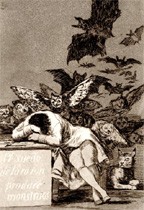
Reason of dreams: Goya’s ‘Sleep of Reason’ etching raises monsters.

By Brett Ascarelli

It wasn’t until 1983 that contemporary artist Enrique Chagoya touched a Goya print for the first time. He wasn’t surprised that it touched him right back. “You see the aquatint,” Chagoya explains, “and you see the super-fine lines that Goya did. It blows your mind.”

Goya, the Spanish painter and etcher, made modern art during the 18th and 19th centuries, well before what we commonly think of as modernism splashed into the shared psyche. Among his best-known paintings are The Third of May 1808, which depicts the French brutally gunning down a Spanish rebellion. But the artist also carved his mordant point of view onto copper plates, producing thousands of impressions that have since worked their way into the consciousnesses of a host of modern artists–among them, Chagoya.

“With Goya,” says Chagoya, speaking by phone from his San Francisco home, “I just imagine someone who’s very frustrated with his times, maybe someone who’s very angry with his society. I just wish I could have met him.”

Although meeting face-to-face is a chronological impossibility, the works of Goya and Chagoya will spend nearly two months together, from April 14 to June 10, when the Sonoma Valley Museum of Art (SVMA) exhibits the entire set of Goya’s Los Caprichos rare first-edition etchings. Chagoya’s eight-etching response, “Return to Goya’s Caprichos,” and a 1920s drawing by Edward Hagedorn will round out the exhibit, as will selected examples from some of Goya’s other graphical bodies of work, including Disasters of War.

A major coup for the SVMA, this very sexy and passionate exhibit was only able to happen because a lot of unsexy things did. The museum, whose mission statement includes a commitment to showing world-class art, had to start planning for this exhibit two years ago. Thanks to a major renovation completed in 2004, the museum now has a lot of very dry, very procedural assets–namely, precise control over lighting levels and environmental factors–that are often requisite for a show of this caliber, as with the Rodin exhibit that came through in 2004. “It’s not a cheap exhibit,” laughs SVMA director Lia Transue, noting that the museum was obliged to pay a participation fee to get the exhibit and shell out for an extra insurance rider. This will be the show’s sixth stop on its international tour.

Goya created the 80-piece edition Los Caprichos, or The Caprices, at the very end of the 1700s as a flinty sociopolitical commentary on the rude vices of his native Spain. The dark, finely etched prints go beyond just depicting the usual religious sins of vanity and greed, and also deal with provincial suspicions and elaborate an unearthly culture of monsters and witchcraft. A diabolical province of humans, beasts and in-betweens emerge from the shadowy prints in dramatic chiaroscuro. Shawls shroud downcast women, causing them to resemble faceless grim reapers; sharply dressed donkeys read books; winged monsters clip each other’s toenails. While many of his contemporaries had latched on to the beautiful muck of romanticism, a movement that stretched from the late 18th century to the early 19th century, Goya was drawing his nightmares and lamenting the passage of the Enlightenment.

Art historians argue about the facts of Francisco José de Goya y Lucientes’ life. What we don’t know, for example, is why, when his body was exhumed in Bordeaux to be repatriated some seven decades after he died, there were two skeletons in his grave, but just one skull. We also don’t know the exact circumstances around Los Caprichos. Why did he sell them at a scent and liquor shop in Madrid instead of at a more traditional bookstore? And why did he withdraw thousands of the prints from the market, just after releasing them? Was it because they were too dangerous, as some art historians think, or because they were a commercial flop?

In print number 43 of Los Caprichos, Goya portrays himself asleep at a desk with bats and owls circling his head and the inscription “El sueño de la razon produce monstrous.” Did he mean “The sleep of reason produces monsters” or “The dreams of reason produce monsters?”

We do know some facts. He was born in Fuendetodos, Spain, in 1746, to a moderately wealthy family. He grew up in Zaragoza, Spain, and his nascent artistic inclination was at first denied outlet; the Spanish Royal Academy for painting rejected him twice. Finally, he placed second in a painting competition in Rome, and at 25, painted a cupola in Zaragoza. He began studying under Francisco Bayeu y Subias, who was a member of the Royal Academy of San Fernando in Madrid, and with Bayeu’s help, began drawing cartoons that would be turned into tapestries for Spain’s rulers through the Royal Tapestry Workshop.

At 37, Goya’s career officially launched when he painted the portrait of the king’s friend. Climbing the courtly ladder, he did more and more portraiture for the aristocracy and the royal family. But in 1792, an intense and prolonged fever left him deaf. While he had already showed a critical eye before his illness, the deafness only intensified it, shutting him into a solitude that incubated the ideas for Los Caprichos.

“He was a genius before,” says Robert Flynn Johnson, who wrote the exhibition commentaries and is also chief curator of the Legion of Honor’s Achenbach Collection. “But cutting him off of the world completely–if you want to get a sense, turn on Jay Leno at night but without the sound. You’ll see gestures and mugging. Goya’s whole world became a visible world without audio. Goya’s imagination and his already slightly bitter sensibility was heightened by this isolation.”

In the prints, Goya criticized what he saw as Spain’s backward practices, ranging from how men and women manipulate and abuse each other, to the uselessness of the nobility and the waywardness of the clergy. Only the poor were exempt from Goya’s discerning eye, but not the illogical superstitions that they held dear.

Goya released Los Caprichos in 1799, but they weren’t popular. Of some 300 sets, he only sold 27. “It’s like me,” Johnson, who has a fondness for making analogies, says, “making up a set of prints antagonistic to hunters and then trying to sell them to members of the hunters association. Quite frankly, he was biting the hand that fed him.” Most likely realizing that he would never be able to publish critical prints again, Goya nevertheless continued to etch, making three subsequent portfolios that were only published posthumously.

The same year he released Los Caprichos, Goya was appointed as the court’s foremost painter. This was remarkable. “It’s like if Howard Stern,” reflects Johnson, “were the chief of protocol at the Bush White House and was still doing his radio program.” Adeptly moving in and out of the two worlds, Goya had the chutzpah to schmooze for his living, then turn around and pan the society in his etchings.

“Nobody since Goya,” says Johnson, “has done a better or more thorough laying out [society, religion, social interaction and war] in visual art since that time. Since Goya, the only equivalent of his great war prints are photography–there are no paintings, drawings or sculpture that can compare.”

But social critique had occupied printmakers since the invention of the process, so what makes Goya so unique? “Before Goya,” says Johnson, “art was descriptive of the external world. If you were to describe an internal world, it was either a world of Christian sensibility or mythology. Goya made it possible for one to make visible one’s own personal, inner demons, disattached from religion or superstition. So Goya is the first great pre-Freudian Freudian artist, who allows the inner self to be made visible. That is a very important building block in the history of modern art.”

After Caprichos, Napoleon invaded Spain and brought the unenlightened chaos of the French Revolution with him. Goya continued painting whomever was in power. But by 1814, Spain had gone topsy-turvy, with the new monarch reinstating the Inquisition and trashing the country’s Constitution. Goya found himself out of a job.

Between 1810 and 1820, Goya made the Disasters of War series of 85 etchings and retreated to his country house, nicknamed the Quinta del Sordo, or the Deaf Man’s House. There, he made what are now referred to as his “Black Paintings,” which inspired the expressionists over a hundred years later. Among the black paintings are the gory Saturn Devouring His Son, titled after Goya’s death, but probably representing Spain’s civil strife, rather than mythology. Eventually, the conflicting political allegiances that Goya had pledged over the years made him unpopular, and he died in exile in Bordeaux.

(Even after his death, his prints still weren’t immune to the mercurial politics of Spain. Franco actually put his own stamp on the Goya prints that were hanging in the Prado.)

“Goya’s focus toward the end of his life,” says art history professor and di Rosa Preserve curator Michael Schwager, “was on expressing his own emotions and basically making paintings for himself without regard to who might see them or want them. This wasn’t something many artists did before Goya, and it became one of the hallmarks of modernism–art for art’s sake.”

More hellish than bats?: Chagoya’s response to Goya’s ‘Dream.’

Some two centuries separate the master painter from Enrique Chagoya, known for his subversive, cartoony and collaged images. Yet, the two artists are connected. One of the quirkier links is that Goya’s name is embedded in Chagoya’s, something which the contemporary artist plays with when signing his Goya-inspired prints: “Cha Goya.”

As a kid growing up in Mexico, Chagoya, who immigrated to the United States, in 1977, had read books about Goya but had never actually felt a Goya in real life. But while taking Johnson’s history of printmaking class at the Legion of Honor, Chagoya got to handle some of the original prints. Inspired, Chagoya made a modern-day takeoff on one of them, Against the Common Good, which features a demon writing in a book. Copying Goya’s technique, Chagoya made an etching that mirrored the original print, but instead of incising the old demon’s face, he replaced it with Ronald Reagan.

The pastiche was a hit in class. Johnson bought one for himself for $40 and purchased another for the Achenbach collection. Now, the L.A. County Museum, the National Museum of American Art and the Whitney Museum of American Art own Chagoya’s work, and his prints sell for thousands of dollars.

Driven to the Caprichos by the 1990s farcical political scene, Chagoya re-rendered Goya’s prints to include Jerry Falwell, who railed against the “gay” purple Teletubby, and Jesse Helms, who pushed the NEA to stop giving grants to individual artists because the NEA-funded artist Andres Serrano’s Piss Christ was too much to bear for the religious right. To Chagoya, these events and policies were as unenlightened and superstitious as those Goya depicted, so the modern artist inserted Falwell and Helms into Goya’s print of two devils giving each other a pedicure.

Targeting xenophobia and other evils, Chagoya made prints that updated Goya’s demons. The spooky bats and owls that Goya etched in print 43 of Caprichos, for example, aren’t scary to a modern sensibility. “Bats are good for agriculture,” says Chagoya, “and eat tons of insects–they’re the most organic pesticides. The owls are endangered species and people love them.”

So instead, Chagoya depicted Tomahawk missiles and Apache helicopters. “Imagine Baghdad under fire,” Chagoya says, “and you don’t know where to hide for a whole night, weeks, months, years. That’s worse than any bat or devil. We’re worse than any devil cheating you to get your soul to Hell. In this case, you send people to Hell, whether or not you have any thought. To me that’s Hell. And to me that’s the sleep of reason today.”

The Los Caprichos exhibits April 14 through June 10 at the Sonoma Valley Museum of Art, 551 Broadway, Sonoma. On April 12, Robert Flynn Johnson lectures on “Francisco Goya; His Modern Sensibility,” at 4:30pm. $10-$15. On May 11, art historian Ann Wiklund presents “The Paintings of Goya: From a Terrible Truth to Madness” at 7pm. Free. Hours: Wednesday through Sunday, from 11am to 5pm. $5-$8; Sunday, free. 707.939.7862.


View All


Museums and gallery notes.


Reviews of new book releases.


Reviews and previews of new plays, operas and symphony performances.


Reviews and previews of new dance performances and events.

Hyphy Overload

0

music & nightlife |

By Gabe Meline

With Heroes in the City of Dope, the Bay Area’s Zion I and the Grouch have teamed up to make a lasting album of solid beats and heady, pensive lyrics. Shocking, then, that unlike so many of its independent hip-hop kinfolk, it’s also bolstered by commercial accessibility instead of intentional obscurity. The Grouch (an anchor of the revered indie hip-hop crew Living Legends for the past 10 years) has always been creative enough, but his sometimes stunted lines have lacked a certain je ne sais quoi. Teaming with Zion I has loosened his rhythm and roped in the tendency to exaggerate his r’s into urr’s.

The songs, especially “Hit ‘Em,” with Mistah Fab, and “Make U Fly,” with Esthero, belong on mix tapes worldwide. Live, both acts are dynamic, and there’s no telling how hot things will get when they perform this Saturday, April 7, at the Phoenix Theater. (In a royally whack move by an outside promoter, $15 advance tickets are only available on MySpace at www.myspace.com/xienhow; it’s $20 at the door.) 201 Washington Blvd., Petaluma. 8pm. 707.762.3565. . . .

What becomes of the Bay Area rap groups of yesteryear after all but one of the members have been murdered? In the case of RBL Posse, responsible for such early 1990s classics as “Don’t Gimme No Bammer Weed” and “Bounce to This,” apparently you still play shows. Even though integral member Mr. Cee was the victim of a drive-by in 1996 and third member Hitman was shot in the head while driving in 2003, this Saturday’s Super Hyphy 16 nonetheless advertises “RBL Posse,” which can only mean what’s left of the seminal group: Black C, who better find a damn good replacement for Cee’s tight verses on “Blue Bird.”

Black C’s down near the bottom of a lineup topped by Yukmouth and Tech N9ne, but he has good company in the form of the Jacka, a Richmond rapper currently floating on the success of the recent album Jack of All Trades as well as last year’s curiously titled joint, Shower Posse. Bring the body wash and loofah sponge at Super Hyphy 16 this Saturday, April 7, at the Sonoma County Fairgrounds. 1350 Bennett Valley Road, Santa Rosa. Advance tickets are $27. 707.545.4200.


FIND A MUSIC REVIEW

How to Lose a Hospital

0

Could, maybe, perhaps: Despite broad public worry, Sutter’s closure might cause a consolidation in North Bay healthcare that could benefit us all.

By Lois Pearlman

Santa Rosa is about to lose its only publicly owned hospital, and maybe that won’t be such a bad thing.

Finally bringing to a close a 14-year-long goodbye, Sutter Medical Center of Santa Rosa is planning to shut the county-owned facility, formerly known as Community Hospital, and turn its patients over to Santa Rosa Memorial Hospital. A letter to the Sonoma County Board of Supervisors sets a closure date of January 2008.

Hemorrhaging money to the tune of about $6 million a year and facing a daunting $300 million state-mandated retrofit, Sutter says it can no longer operate the facility. The county owns the hospital and Sutter operates it under the 20-year Health Care Access Agreement that deadlines in 2016.

Under the agreement, Sutter Health, headquartered in Sacramento, provides a variety of services for both insured and uninsured patients. These include acute hospital care, outpatient surgery, an emergency room, a residency program, a full range of women’s reproductive care, “charity” care, sexual-assault exams, inpatient care for county jail inmates and alcohol-rehab patients, Medi-Cal managed care, HIV/AIDS services and quarantine.

Last year, Sutter told the county it was in negotiations with Santa Rosa Memorial to turn this patient load over to that Catholic-affiliated hospital. In November, the county responded with a request for specifics about how Memorial would meet the requirements of the agreement.

This might seem like déjà vu to residents who witnessed the turmoil in the mid-1990s when the county decided it could no longer afford to run Community Hospital and solicited healthcare corporations to take over the hospital’s operations. At that time, the county had been losing an average of about $2 million a year running Community as an independent facility, although some contended that the losses were in depreciation rather an actual cash flow and the hospital was really netting a small profit.

Citing “economy of scale” as the goal, the county said it was time to turn the hospital over to a medical chain that would be better able to cut costs and would also have the traction to negotiate more favorable deals with the insurance companies.

Initially three companies–Sutter, St. Joseph Health System, which owns Memorial, and Columbia HCA–vied to run Community. When the dust settled, only Sutter, a not-for-profit company with about two dozen hospitals, was still in the running.

“They were confident that they were a system that would have the power to negotiate better reimbursements,” recalls county supervisor Tim Smith.

But things did not go as Sutter had expected. According to physicians, Sutter has done an excellent job of running the county’s hospital, medically speaking, but it has failed to reverse the downward financial spiral. During the same period, Santa Rosa Memorial has progressed from operating in the red to earning a $16 million profit in 2005.

“Memorial has not always been profitable,” explains public-relations spokesman Kevin Andrus. “David Amin [the hospital’s CEO from 1999 to 2005] really turned things around for us over the course of a few years.”

Mitch Proaps, a marketing and communications manager for Sutter, attributes much of this disparity to the inequitable distribution of Medi-Cal and charity patients between Sutter and the rest of the county’s hospitals.

“Sutter cares for the lion’s share of indigent and Medi-Cal patients in the county,” he says, explaining that Memorial serves a high enough percentage of privately insured and Medicare patients to pay for its indigent care losses.

Now healthier than ever, Memorial is back on the radar screen for taking over the county’s healthcare mandates. In a letter of intent, Memorial has said it would assume all of the services Sutter now offers under its agreement with the county, except “certain women’s reproductive services.”

In order to provide these services, Memorial plans to add 80 additional acute-care beds, 12 intensive-care unit beds and 19 emergency stations, and more parking spaces. Proaps says that it also expects to purchase the 69-bed Warrack Hospital from Sutter, “reconfigure it to meet the community needs” and to build a new urgent-care center that would serve 35,000 emergency-room patients per year who don’t require advanced care. Memorial expects to complete all this construction by January 2008.

Sutter’s residency program, the only one in the county, would continue under a consortium that includes Memorial, the for-profit Kaiser Permanente and the Southwest Community Health Center.

According to Proaps, Memorial’s expanded facilities should be enough to provide for both hospitals’ patient loads because neither of the facilities is operating at full capacity. Currently, Sutter fills about 51 percent of its patient beds, and Memorial comes in at 60 percent. In fact, all of the county’s hospitals are being underutilized, with Proaps estimating some as low as 35 percent or 40 percent capacity.

Still, county supervisors say they have many unanswered questions about Sutter’s proposal. And one of the main sticking points is Memorial’s inability to provide “certain women’s reproductive services”–specifically, sterilization on demand and abortion–because it is a Catholic institution.

While there are many other medical facilities in the county that offer early-term abortions, as well as sterilization and contraception care, only acute-care hospitals can provide a safe setting for late-term abortions, according to Mary Szecsey, executive director of the West County Health Centers.

Szecsey is also concerned that Memorial does not perform tubal ligations–female sterilization–following delivery unless it is a medical necessity. This is the best time for women to have their tubes tied to prevent additional pregnancies, according to Szecsey. “It is not good medical care to have to go somewhere else,” she says.

And, although Memorial says it provides the “morning after” emergency contraception, Szecsey questions whether women can count on this being an option because it is technically against the religious directives that govern how healthcare is dispensed at Memorial.

Despite these thorny issues, some experts believe Sutter’s impending closure could have a silver lining for Sonoma County’s troubled healthcare system.

“The best thing that’s come out of this is that people are now talking with each other, not just the clinics and the small district hospitals, but everybody,” Szecsey says.

According to Szecsey and other local experts, hospitals are only necessary for acute care, and there are a lot of other places patients can go for everything from bad colds to knee surgery.

“We are focusing on people getting the right care in the right place at the right time,” she says.

A healthcare impact report compiled for county supervisors revealed that only 9 percent to 25 percent of patients who come to local emergency rooms are being admitted to the hospital. That means the majority of emergency room patients could probably receive the help they need at one of the county’s federally funded healthcare clinics, which offer low-cost and charity care.

And with new, less invasive technologies requiring less recovery time, some 70 percent of surgeries, nationwide, could be done more safely and cost effectively at outpatient surgery centers, according to Ken Alban of HealthSouth Surgery Center in Santa Rosa.

“The major benefit for patients who are not ‘sick’ is that there is less chance of infection and other complications,” he says.

HealthSouth, which opened in 1982, is the county’s first multi-specialty surgery center. Most of the other outpatient surgery facilities in the county specialize in a specific area, such as eye, gastro-intestinal or plastic surgery.

Alban said there were 300 outpatient surgery centers in the country when HealthSouth opened, and now there are some 5,000. That makes these freestanding centers at least one of the solutions for a health care system that is losing physicians and nurses, placing an enormous financial burden on uninsured or underinsured patients and failing to meet many of the needs of both the poor and the middle class.

But this is the long conversation that will continue past the deadline Sutter has set for divesting itself of the county hospital. For the time being, the county is focusing on what will happen to its hospital and patients in the short term.

The Sonoma County Board of Supervisors has scheduled a public meeting for Tuesday, April 17, in its chambers at 5:30pm, to consider Sutter and Memorial’s proposal.


Morsels

0

March 28-April 3, 2007

When life gives you lemons, make lemonade. When you live in California and life brings ridiculously cold temperatures that severely damage three-quarters of your state’s citrus crop, make something else.

What’s a culinarian with a penchant for the piquant to do? The bright color, flavor and aroma of lemons and limes carry us through dreary winter days when pickings are slim elsewhere in the produce aisle. And while a gin and tonic falls flat without a squeeze of lime and a cheesecake fails to sing without the tiny but important addition of lemon zest, all is not lost.Those who prefer to eat foods from local soil can take refuge in verjus, which can be found right here in our vine-studded backyard. The Romans used verjus (or vertjus, “green juice”), the juice of unripe grapes, as early as the first century. During the Middle Ages, it was an important ingredient in the spice-laden sauces that the era’s upper classes preferred; The Viandier of Taillevent, a French cookery book written in the late 14th century, refers to verjus 12 times.

Verjus is unfermented and different from vinegar, whose tang comes from acetic acid. Milder, fruitier verjus shares the same acid base (malic and tartaric acid) with wine, and therefore pairs better with wines than vinegar. Whisk verjus in vinaigrettes, use it to deglaze pan sauces or add it to spritzy cocktails and aperitifs. Try Geyserville-based Terra Sonoma Food Company’s Verjus, Fusion Foods’ Napa Valley Verjus and Anderson Valley’s Navarro Vineyards’ 2006 Chardonnay Verjus.

Hopefully, the next citrus harvest will rebound, but until then, buck the trends of supply and demand with an open mind and a little creativity. To quote Stephen Stills, “If you can’t be with the one you love, honey, love the one you’re with.”

A Not-Lemon Primer
The zing of acid comes in many more forms than lemon and limes–some commonplace, some exotic.

Verjus: Verjus is much milder than vinegar and pairs well with wine. Use it to deglaze pan sauces, in vinaigrettes or in cocktails and aperitifs.
Japanese Rice Vinegar: Less harsh than typical vinegars, with a clean, straightforward flavor, rice wine vinegar is wonderful in vinaigrettes or just sprinkled on stir-fries. Look for unseasoned rice vinegar at Asian markets and grocery stores.
Red or White Wine: We’ve all made sauces with red and white wine. Don’t forget the wonderful flavors and aroma of wine as it reduces in a pan with shallots and fresh herbs.
Lemon Balm: The leaves of this member of the mint family can be tossed with salads, cooked with seafood and poultry, added to stuffings or steeped with tisanes.
Lemon Verbena: Lemon verbena can be used in many dishes that call of lemon zest. Garnish iced tea and cocktails with this green herb, or finely chop it and fold into fruit salads.
Hibiscus Blossom: When steeped in boiling water, the dried blossom of the hibiscus plant saturated the liquid with a stunning ruby hue and a puckery tartness. Use hibiscus in teas, cocktails, jellies and syrups.
Pineapple: Chop a less-sweet variety and add to salsas and relishes or Latin American and Southeast Asian-style stews.
Buttermilk: Add to creamy dips and salad dressings and cold soups.
Plastic Limes and Lemons Full of Reconstituted Juice: Ha ha, just kidding.

Quick dining snapshots by Bohemian staffers.

Winery news and reviews.

Food-related comings and goings, openings and closings, and other essays for those who love the kitchen and what it produces.

Recipes for food that you can actually make.

Gore of Babylon

0

March 28-April 2, 2007

Imagine you’re seeing it as a preview on the latest Harry Potter DVD: In graphic, lingering, close-up, a man’s fingers are sawn off. His tongue is cut in half, length-wise, with a pair of bloody scissors. After several minutes of intensely detailed footage, his face is peeled off, his wildly darting eyes showing the audience unambiguously that he is still alive despite being mutilated beyond anything any human being should ever have the misfortune to endure.

Who watches this stuff?

As it turns out, everyone. I certainly did, though completely against my will. The footage in question came from a trailer for the upcoming direct-to-video release of Asylum Entertainment Company’s film Freakshow. It was tacked to the beginning of a fantasy adventure film that any parent might have grabbed off the shelf at Blockbuster, thinking to placate their Dungeons and Dragons-loving pre-teen with a direct-to-video rip-off of Dragonheart.

One minute my boyfriend and I were anticipating a laughably bad sword and sorcery film, the next, we were puking our guts out. As I told him later, after the shock treatment and primal-scream therapy had taken affect, the filmmakers might as well have come into our home and re-enacted the “squeal like a pig” scene from Deliverance using the two of us as a collective Ned Beatty.

Among other things, I am a horror writer. I own a copy of Hellraiser and love to freak myself out by watching it alone, late at night, when my boyfriend is out of town. I grew up watching Full Metal Jacket and Apocalypse Now. I began reading Stephen King at age 10. No one could accuse me of being a wimp, but this preview was so disturbing, so unnecessarily vivid in its depiction of gore and suffering, Pinhead would have wet himself. I found I had turned into a representative for Concerned Parents in a matter of seconds.

Who the hell thought it was OK to tack this wretched thing onto my Z-flick cheapie, I wanted to know. It would have been one thing if I rented The Faces of Death or The Texas Chainsaw Massacre (although this still wouldn’t have prepared me for the level of violence I was subjected to); it was quite another entirely when it popped out at me on a rental which, while unrated, was clearly being marketed as a teen-centric rip-off of Eragon. Due to the poor quality of the DVD, I didn’t even have the option of hitting the fast-forward button once I realized I was the unwitting renter of Pandora’s box. Fast forward couldn’t help you. I couldn’t look away.

Outraged and violated, I wrote every single movie agency I could think of, starting with an angry letter to Asylum Entertainment itself. It went unanswered, of course. Blockbuster’s corporate offices sent me a form letter as if to say, “Thanks for complaining! No, we won’t pay for your therapy!” The two video clerks I ranted to at the Blockbuster store who are just trying to make a living told me that only the corporate people can decide to pull material from their shelves. And no one seemed to quite believe me when I told them this was the horror equivalent of Backdoor Sluts 15.

But then, we are living in America in the 21st century, a time when movie violence has never been more sadistic. Thanks to films like the Saw franchise, which revels in the minutiae of torture without retribution, and director Eli Roth’s Hostel, which, while allowing its torture victims revenge, doesn’t feel any guilt about showing extended footage of a girl’s eye being melted out with a blowtorch (and then cut off), a new term has been coined in the annals of horror: “torture porn” or, even more charmingly, “gorno.”

Horror isn’t just a chilly scare in the dark anymore. It is rapidly becoming a genre that strives to outdo its own acts of sadism. Each successive Saw movie is worse than the last in more ways than one. Its signature booby-traps get increasingly more creative, more bloody, more intense. Its characters, devoid of any human qualities, are mere meat-puppets, irredeemable narcissists who exist merely to be flayed, stabbed, burned or otherwise mutilated for the enjoyment of an audience eager for more and more exciting examples of painful death. If there is any doubt that America is becoming a nation of sadists, one merely has to look at the Saw franchise’s record-breaking ticket sales, or the fact that a sequel to Hostel, the most feel-bad movie of 2006, was greenlighted.

The Hostel sequel is particularly troubling. Having seen director Eli Roth’s previous installment (“presented” as it was by Quentin Tarantino), as well as his popular and darkly funny freshman effort Cabin Fever, I can at least say that his work has artistic merit. Unlike the noncharacters in Saw, the people in Hostel are characters we care about, making their grisly fates all the more disturbing as they plead with hacksaw wielding maniacs to spare their young lives.

The end of the first Hostel even contains a satisfying and just revenge scene where the victim at last turns on his tormentor, dispatching him while the audience rightly cheers. Roth’s vision of horror is strangely moral in this respect. Still, with the advent of Hostel 2, the rise of gorno (a term Roth vociferously rejects but which was nonetheless coined specifically to describe his body of work) as an American film genre can no longer be denied.

Gorno is, like porn, an extreme depiction, in film or photography, of parts of the body–in this case, a body that is being tortured to death. It is characterized by intimate, lingering shots of blood, and often inspires the same sort of chemical reaction in the body that one gets, far more pleasantly, from watching or engaging in sex. Filmmakers like Roth use horror to get your blood racing, and they succeed very well. Who wouldn’t get some sort of horrific thrill from watching a young man’s Achilles tendons being abruptly severed in intimate closeup? This is (hopefully) an experience so far beyond our own we can’t help but be fascinated.

Sex and death are often a delicious pairing, but with the rise of films like Hostel, there has been a disconnect in the American psyche. At some point, we turned the forbidden thrill of grisly death into something sexually titillating. It’s as if we have done with porn all together, exchanging the same-old-same-old penetration of the phallus with the penetration of the knife. Why else would a Hostel sequel starring an all-female cast of torture victims be getting such an anticipatory buzz? The sick thrill of mutilation is paired with a comely group of helpless females, the trailer showing one of them bound to a chair, bare-armed and screaming.

If there is any doubt that Roth and his ilk are successfully blurring the line between sex and death into an all-encompassing, sick-thrill tank, you have only to look at the teaser poster for the movie which shows an obscene close up of mutilated pink flesh strongly suggestive of a vagina. Viewing the poster online at work could easily get you fired, though whether this is because it suggests to employers that you are a psycho killer or a pervert is up for grabs.

In this climate, where men and women both are being reduced to pornographic objects by filmmakers and brutally dispatched for the entertainment of (at best) a numb and (at worst) sadistically minded audience, is it any wonder one deeply troubled horror author’s cry for help is universally ignored? The sort of sickness I bore witness to on the Freakshow trailer has become the norm. My angry letters net no response.

A corporate entertainment distributor like Blockbuster will hardly be interested in stopping the spread of the very footage that has earned it so many billions of dollars. A trip to Blockbuster reveals that most of its new releases are B-flick slasher films from the vaults of direct-to-video companies like Asylum Entertainment. The covers of these releases, such as The Pumpkin Killer, with its mutilated face staring out in some grotesque invitation, have become the new porn. It is no longer surprising that audiences are getting off on gore, but usually one has a choice over whether they are exposed to it. I had no choice. And as much as I love Pinhead and the gang, there is a point at which the guts stop being interesting and start becoming a warning sign of a vast national sickness.

And if I’m going to be ambushed in my own home by intense pornography I didn’t sign up for, then I pray to God that next time, the thing that gets me is Backdoor Sluts 15.

PS: After I submitted this article for publication I did, in fact, receive an answer to one of my emails.Ý David Rimawi, the North American Marketing and Sales Director for Asylum Entertainment expressed genuine concern over the preview for Freakshow and said that, as Asylum is trying to branch out to a more general audience, he would take my suggestionsÝabout makingÝsuchÝfootage harder to access to heart.Ý I thank him for having a soul.


New and upcoming film releases.

Browse all movie reviews.

The Byrne Report

March 28-April 3, 2007

The March 12 slaying of 16-year-old high school student Jeremiah Chass by sheriff’s deputies dominated front-page headlines of the Santa Rosa Press Democrat for a week. Seldom have I witnessed such inept and slanted journalism.

It is perhaps explained by noting that Press Democrat publisher Bruce Kyse sits on the board of directors of the Santa Rosa Chamber of Commerce, a politically powerful organization that regularly privileges the protection of corporate profits over the protection of the populace.

The day after Chass was gunned down in a violation of protocols for handling mentally decompensating people by two combative deputies, editor Pete Golis’ headline was “Deputies Kill Teen Suspect.” Of what was the lad suspected? Of being a teenager? Of being a bank robber? Of being black?

This and subsequent articles through March 26 failed to report on several extraordinarily newsworthy facts, including that Chass was of African-American descent and looked black, and that the two deputies who shot him eight times at point blank range are white. Nor did the Chamber-affiliated newspaper report that the Chass family, including their six-year-old son, were interrogated for hours after the shooting as if they were criminals, but without the presence of an attorney. Nor did that newspaper of record mention that, before the body was cold, the police pawed through the Chass’ home, seizing computers, personal papers and even their vitamins.

Kyse and Golis’ March 14 headline read: “Report: Officers Tried to Disarm Teen.” The article identified one of the deputies as sheriff’s medal-of-valor winner John Misita, but failed to note that Misita had beaten up another decompensating man in similar circumstances in June 2005, as reported by the Press Democrat‘s sister paper, the Petaluma Argus-Courier. In an interview, reporter Jeremy Hay, who wrote several of the breaking news stories, says he knew about Misita’s background but decided not to include it. He said that several of his colleagues have asked him why Chass’ race has not been mentioned, stating, “I do not have an answer to that legitimate question.”

In general, the Press Democrat stories have relied heavily upon contradictory law-enforcement versions of the event that are not demonstrably backed up by the 911 tapes that police have stubbornly refused to release, or by non-law enforcement witnesses. The most likely explanation of why the tapes are being kept from the public is because Santa Rosa police investigators and the sheriff and district attorney Stephan Passalacqua are intent upon avoiding a wrongful-death lawsuit. Hence, they would like to blame the victim for his own demise rather than the deputies’ professional incompetence, as might be revealed by the tapes.

In the March 15 story–“Sharp Questions for Police in Sebastopol Teen’s Death”–Hay quotes a retired local police chief, who, fearing “political” retaliation, asked for anonymity. He observes that the deputies failed to use options to de-escalate the situation and did not need to kill Chass.

On March 16, the paper countered this criticism with “Police: Teen an Immediate Threat.” Sheriff Capt. Dave Edmonds was given a platform to accuse the anonymous chief of “speculation” and “misportrayal of known facts.” The rest of reporter Paul Payne’s story was a recital of “facts” from the point of view of the sheriff’s department. Columnist Chris Coursey chimed in with what became the official mantra: “The truth is, we won’t know the facts of the shooting of Jeremiah Chass for many months.” Don’t ask, don’t tell.

Saturday, March 17, was Chass’ memorial service. The headline? “Sheriff: Deputies Saved Others from Potential Harm.” Fully one-fifth of the front page was filled with a photo of Sheriff-Coroner Bill Cogbill. The sheriff-centered story submerged the first public statement by mother Yvette Chass, who said, “We are concerned that parts of the story have been left out, and that renders the reader with an inaccurate impression of events.” Chass’ statement should have been the headline, not Cogbill’s spin. The Kyse-Golis editorial: “Because of the confusion . . . there may never be answers to all the questions raised by this horrific incident.”

The same story reported that the “results of an autopsy” on Chass had been released. How Orwellian. The incomplete summary of the autopsy, written by the sheriff’s department, did not mention blunt force and other injuries suffered by Chass as the deputies beat and choked and pepper-sprayed him. As part of what appears to be an official cover-up abetted by the Press Democrat, Kyse and Golis’ writers have consistently neglected to mention that the sheriff is also the coroner and, as such, he is in charge of supervising the autopsy. This is an obvious conflict of interest, since the sheriff’s department is supposedly under investigation by fellow law officers and the autopsy is a potentially damning piece of evidence.

How about this headline, gentlemen? “Sheriff and Police Department Cover Up Facts About Chass Killing.”

To read Byrne’s account of the Chass case, click .

or


Letters to the Editor

March 28-April 3, 2007

So much to grieve for

I want to thank you for publishing than other media sources (“Deadly Force,” March 21).

I also want to convey my shock and anger at how the situation was handled by our officers. Ask any social worker: this kind of case is not as unusual as we might think and if the right de-escalation techniques are utilized, it can be resolved without the use of violence. I am shocked at the absence of any these techniques and, at the least, the lack of a TASER, which could have prevented this violence. The most appalling and inexcusable aspect of this situation was the officers’ intent to kill. This, I am sure, was not their intention initially, but when the gun went off it was.

I am outraged at the violence used and lack of forethought put into this situation by the officers in question. I call upon our community to demand the Sheriff’s Department and social services put measures in place to ensure that this will not happen again. I ask of all of us, how can we hold our teenagers in a way that helps them through their pain?

I grieve for the loss of Jeremiah, his deep caring, who he was becoming and what we have lost. I grieve for his mother, father and brother who cared for him so tenderly. There is no way to understand the depth of their pain. But I have this to say to them: Know that your community, friends and strangers alike are standing behind you in this painful time. I also grieve for the officers who felt there was no other way out of the situation but the use of extreme violence. This says something about our society. Lastly, I grieve for the presence of violence everywhere in our world and how it shatters people’s lives daily.

Melissa Patterson, Sebastopol

Knowing psychotic breaks

Thank you for the information the mass media did not provide regarding the shooting of Jeremiah Chass. It is a sad and true thing–it sounds like Jeremiah was having a psychotic break, probably in relation to schizophrenia. Schizophrenia is a brain chemistry imbalance, it has a genetic disposition and sometimes stressors bring it on. Clinically, it occurs in males between ages of 17 and 26, and generally later in females.

I know this because my son had a similar psychotic break when he was 18 years old. There is no warning, just a withdrawal that leaves you hoping it is an adolescent thing. My son has paranoid schizophrenia. On the night he broke, he was hearing voices and believed he was being watched, that there were cameras everywhere. He left the house at 3am. We were quick at it and the cops brought him back. These cops were good; we warned them about his break. Unlike Jeremiah, we made it to the hospital.

The public needs education about schizophrenia. It is not a rare thing. One out of 100 get this illness; 10 percent commit suicide. Mine is not the only family in Sonoma County with this. There are many of us, all silent because of the stigma. These people are sick, not crazy or good for a laugh. Have compassion. There is no cure. My son is not who he was, but I live for the times when I can see him. He has lost all his friends; he was college-bound but can no longer sit through one class. Please educate parents and friends and, most especially, the police. They did everything wrong in treating a delusional break and escalated his psychosis. The poor child. Please make his death worth something.

Ginny Breeland, Rohnert Park

Dept. of ‘Best of’ Nonsense

Ah, (March 21), what a delightful treat for the editorial staff! Ah, Best Of, that tricky slinky monster of an issue that results in nothing but smiles and kisses all around the edit room. Ah, Best Of, the largest single source of errors in any given year. Dear sweet Best Of, which always demands that I file a couple of apologetic paragraphs like the following, perhaps resulting in some new nonsense. Ah, Best Of!

To wit, Rileystreet (Readers’ Choice, Best Art Supply Store, Sonoma County) is found by telephone at 707.526.2416, not whatever numeric nonsense we printed.

Those trying to track down the quackery of history had better aim a little farther north than that nonsense we reported in “Best Historical Leftover” (Writers’ Picks, Culture). The fading sign for Dr. Pierce’s Medical Discovery is just north of the Geyserville exit off of Highway 101, d’oh–not the Guerneville exit. G-words, go figure . . .

Also in the hallowed halls of Readers’ Choice Culture, please know that the Raven Players won Honorable Mention for Best Theater Troupe (Sonoma County), not whatever nonsense we originally printed. And while theater is being sussed, it is in fact the Summer Repertory Theater at Santa Rosa Junior College taking the trophy for Best Theater Troupe (Readers’ Choice, Sonoma County), not any other soy-inked nonsense we might have strewn about.

Meanwhile, in the all-important Brewpub category (Readers’ Choice, Food & Drink, Marin County), Rafter’s is actually found at 812 Fourth St., San Rafael, not that other nonsense we erroneously reported.

If there’s any nonsense of which we are still blissfully unaware, please write to Dept. of Hari-Kari, care of ed****@******an.com, and we’ll do our best to ignore it until next week. Apologies to those whose information we fouled. But that’s the great thing about Best Of–there’s always next year!

The Ed.
Dept. of Doughnuts, xanax, yoga and weeping


Ask Sydney

March 28-April 3, 2007

Dear Sydney, my girlfriend and I have been together for a long time. We’d be married by now if it was legal (that’s a different issue!). Everything was going OK, with the usual ups and downs, until my ex-girlfriend moved back into town. I went out to lunch with her, and it brought up all kinds of intense feelings. Now I’m a wreck. I keep wanting to hang out with her. Worst of all, I’ve been having dreams about her, and let’s just say that she’s never wearing any clothes. I don’t know what to do. Do I tell her I can’t be friends now that we’re living in the same town again? That seems so pathetic, but I’m afraid that any other option would be disastrous. I feel like a stalker.–Haunted

Dear Haunted: Ask yourself if the monogamous relationship that you currently share with your gal is something that you could live without? Take some time to be by yourself, somewhere away from the noise of daily life, where you can really spend time thinking. Wherever you go to think, bring a notebook and pen. Write out the details of your dreams, just to get them out of your system. Make a list of the reasons you love your partner and the reasons you don’t. Write down everything you remember about your dreamy ex-girlfriend. Was she really that great? If she was, then why did you break up?

After you’re done, rip up everything you’ve written into tiny pieces and throw it into an anonymous garbage can. The only way you’ll feel free to really write what’s on your mind is if you know it’s going to be destroyed afterward, so go ahead and destroy it. (Just don’t light it on fire, though satisfying, that could be dangerous if you’re “thinking” out of doors.) Even after this ritual, it’s quite possible that you will choose to make things difficult for yourself by pursuing this rekindled relationship. And maybe there’s a reason for that. It’s just hard to know, and the more careful you are and the slower you take it, the less you will have to regret in the long run. It’s easy to make a fool of yourself over unexpected desires. Save yourself the trauma; write it all down and throw it away instead.

Dear Sydney, I am an animal lover. But can you go too far? What should one give up for the life of an animal? I have a financially destitute friend who moves in with me from time to time and brings her cats. I already have three cats, which the same friend gave me. There are now seven cats and her guinea pig in my house. I had to pay for a $300 surgery at Christmas when two of the cats got in a fight. Then another one of the cats showed symptoms of sickness about a month ago. This one has stress-induced colitis and resulting pancreatitis. Determining the ailment took many tests and a long stay at the animal hospital. My friend gave her last $600 to the vet. Now, she’s asking me for $400 more because the vet won’t let the cat come home unless the entire bill is paid. Furthermore, they are charging over $100 per day to board the cat until she comes up with the rest of the money. Suddenly, I see my friend as an addicted cat-spendy. I’ve begun to think what little extra space one less cat could gain. But my friend, who is a very bad money manager, is weeping bitterly over the possibility of losing Mr. Fluff. So what am I to do? Is it time for me to start sleeping in my car at night for the sake of Mr. Fluff and the shyster vet? Or should I put my foot down in favor of fiscal responsibility?–Bummed

Dear Bummed: These cats are not your responsibility. Just because you are kind enough to let your friend stay with you when she has nowhere else to go does not mean that you should be held responsible for the financial care of her animals. Unfortunately, by paying the vet bill during the holidays, you set an unfair precedent for yourself. If you did it for the other cats, how can you now abandon Mr. Fluff? If you do choose to save Mr. Fluff, you will be out 400 bucks, but you will also relieve yourself of the burden of being Mr. Fluff’s inadvertent murderer. Do you really want to be known as the guy who killed Mr. Fluff? Something like that could follow you for a long time. This is not to say that you have to save Mr. Fluff, but if you don’t, there may be physiological consequence.

Clearly, the issue here is not your willingness or lack thereof to save an animal, but your inability to provide yourself with clear boundaries. Someone else’s seven cats and one guinea pig in your house is too much. You need to set very clear parameters about the number of pets you are willing to take on along with your human guest. And if you do save Mr. Fluff, make it abundantly clear that you will no longer take any financial responsibility for future vet bills and that you will not be emotionally responsible for the well-being of her animals any longer.

Sydney, love your column! You give thoughtful, sensitive and sensible advice in an all-too-crazy world. My comment is just a suggestion, triggered by. I, too, have had problems with the father of my child and for many years could not even be civil to him. Another unrelated problem got me desperate enough to ask for help from a very alternative friend. That is when I discovered the emotional freedom technique. It is an acupressure technique that can clear emotional issues far faster than any other I have tried (and I’ve tried a lot). Best of all, the info on how to do it is free. Check out www.emofree.com for a free download of the manual. A demo is available at www.creatavision.com to get you started even faster. Try it and see if you like it.

Oh yeah, about my ex. He is still a worthless drunk who may or may not ever grow up, but that is water under the bridge. When I do see him, I can be civil. When he does something stupid, hey, that’s his life. The kid is grown up and neither one of us needs him any more. Keep up the good work! –Fogey

Dear Fogey: Thanks for the tip and the encouragement! I’ve never heard of this technique, but, hey, not being above a little residual anger myself, I’ll be sure and check it out. In the mean time, I’m including your letter here so that “Holding On” can have a look if she feels inspired. And congratulations on surviving co-parenting with your sense of humor intact. That’s no easy feat. Take yourself out to dinner. You deserve it.

No question too big, too small or too off-the-wall.


Not Anne Frank

0

March 28-April 3, 2007


Pardon the overworked metaphor, but playwright-novelist Davide Wiltse’s The Good German is like a certain type of very expensive wine. It initially presents itself as pleasant and interesting but not exceptional, and then begins changing textures and flavors, revealing layer after layer of sensorial secrets the longer you hold it on your tongue.

In director Kent Nicholson tidily gripping, intensely acted production at the Marin Theatre Company, this viticultural comparison is especially apt. By the time the lights go down on Wiltse’s intoxicating, philosophically complex drama about a frightened Jewish publisher being hidden from the Nazis by a mildly anti-Semitic chemistry teacher, you will certainly know you’ve experienced something theatrically above-average, if slightly dry and out of reach. But I suggest that it is only after you’ve pondered and discussed the play that you are likely to truly begin enjoying it.

The penultimate show in MTC’s impressive 40th season (wrapping up in May with Sandra Deer’s The Subject Tonight Is Love), The Good German treads the familiar ground of other rise-of-Nazism dramas, from Goodrich and Hackett’s The Diary of Anne Frank to Tony Kushner’s A Bright Room Called Day. This is material that has been revisited over and over since Hitler was found in his bunker and the truth of his horrific final solution was revealed to the world.

There is a tendency, among writers, to work on an audience’s emotions when telling the story of regular folks caught up in the rise of anti-Semitism in Europe. Such plays typically focus on the human toll of the Holocaust, showing the cost in lives and psyches that is the result of so much evil unleashed at once in the world. It is not hard to create gripping drama when describing the plight of an innocent girl trapped in a secret room or of activist artists giving in to fear and intimidation as their numbers slowly diminish.

In The Good German, Wiltse does something far more difficult: he gives us four “good” people, and within 15 minutes kills off the only one who is identifiably good, the kind-hearted Gretel (Anne Darragh), gunned down following an underground meeting of anti-Nazi activists. In fact, one of the first lines delivered by the caustic chemistry professor Karl (solidly played by Warren David Keith), is “I’m not easy to like.” Indeed.

Proudly antagonistic and fond of offering offensive philosophical observations, Karl is a testy tangle of selfish indifference and grudging human decency. The same could be said for Herr Braun (Brian Herndon), whom Gretel agrees to harbor after his home and business are burned down with his wife and children inside.

Simultaneously enraged and terrified, Braun despises Karl for his casual put-downs of Jews (“One grows fond of a dog in six weeks; Jews evidently take longer”) but is far more concerned about Karl’s low-level Nazi Party friend Siemi (Darren Bridgett, in a gripping, standout performance), an unstable man who grieves for his country while slowly embracing the very madness that engulfs it.

One point that is made repeatedly is that the German Jews, faced with abuse and deportation and extermination, seem unwilling to fight for their lives. As the play unfolds, it narrows its focus to the causes and costs of inaction, the excuses and rationalizations that lock it in place, and the messy, ragged results once one is finally forced into action. Cruelty can be attractive, and goodness, struggling to survive a growing evil, can’t always be pretty. As Gretel says early on, “It’s what you do in the end that counts, not how gracefully you do it.”

In Wiltse’s intelligent, aggressively unsentimental script, the characters discuss these matters through elegant, attractively quotable debates. Throughout, the characters never stray into black-and-white simplicity, and a refreshing, open-eyed cynicism remains at work at all times, as when one character drily concludes, “Tolerance is just good manners.” In the end, The Good German refuses to wrap things up with easy or comforting answers, and those unsolved questions–unnerving and irritating as a splinter beneath the skin–may stick around long after the final fade to black.

‘The Good German’ runs Tuesday-Sunday through April 15 at the Marin Theatre Company. March 28 at noon, preshow talk; at 1pm, matinee; at 6pm, singles night reception. Tuesday and Thursday-Saturday at 8pm; Wednesday at 7:30pm; Sunday at 2pm and 7pm; April 14 at 2pm. Marin Theatre Company, 397 Miller Ave., Mill Valley. $19-$47; Tuesday, pay what you can. 415.388.5208.


Museums and gallery notes.

Reviews of new book releases.

Reviews and previews of new plays, operas and symphony performances.

Reviews and previews of new dance performances and events.

Dreja Vu

music & nightlife | Fresh Faces: The Yardbirds keep...

Proto-Modernist

the arts | visual arts | Reason of dreams:...

Hyphy Overload

music & nightlife | By Gabe Meline ...

How to Lose a Hospital

Could, maybe, perhaps: Despite broad public worry, Sutter's closure...

Morsels

March 28-April 3, 2007 When life gives you lemons, make lemonade. When you live in California and life brings ridiculously cold temperatures that severely damage three-quarters of your state's citrus crop, make something else.What's a culinarian with a penchant for the piquant to do? The bright color, flavor and aroma of lemons and limes carry us through dreary winter days...

Gore of Babylon

March 28-April 2, 2007Imagine you're seeing it as a preview on the latest Harry Potter DVD: In graphic, lingering, close-up, a man's fingers are sawn off. His tongue is cut in half, length-wise, with a pair of bloody scissors. After several minutes of intensely detailed footage, his face is peeled off, his wildly darting eyes showing the audience unambiguously...

The Byrne Report

March 28-April 3, 2007The March 12 slaying of 16-year-old high school student Jeremiah Chass by sheriff's deputies dominated front-page headlines of the Santa Rosa Press Democrat for a week. Seldom have I witnessed such inept and slanted journalism. It is perhaps explained by noting that Press Democrat publisher Bruce Kyse sits on the board of directors of the Santa...

Letters to the Editor

March 28-April 3, 2007So much to grieve forI want to thank you for publishing than other media sources ("Deadly Force," March 21). I also want to convey my shock and anger at how the situation was handled by our officers. Ask any social worker: this kind of case is not as unusual as we might think and if...

Ask Sydney

March 28-April 3, 2007 Dear Sydney, my girlfriend and I have been together for a long time. We'd be married by now if it was legal (that's a different issue!). Everything was going OK, with the usual ups and downs, until my ex-girlfriend moved back into town. I went out to lunch with her, and it brought up all kinds...

Not Anne Frank

March 28-April 3, 2007Pardon the overworked metaphor, but playwright-novelist Davide Wiltse's The Good German is like a certain type of very expensive wine. It initially presents itself as pleasant and interesting but not exceptional, and then begins changing textures and flavors, revealing layer after layer of sensorial secrets the longer you hold it on your tongue. In director Kent...
11,084FansLike
4,446FollowersFollow
6,928FollowersFollow