Cosmetic Damage

0

May 2-8, 2007

Spring Fashion:

We all want to be healthy; we want be good to the environment and ourselves. Yet in our ever more health conscious society, a surprising the number of people cover themselves with unhealthful toxins every day. Of course, you’d never do that. Would you?

Most likely, you do. You may not know it, but an astonishing number of personal care products are full of unhealthy chemicals, including proven carcinogens. The brands of highest concern include, but definitely aren’t limited to, Chanel, Banana Boat, Revlon, Clairol and Gillette. But there are alternatives. Over 500 brands, including Burt’s Bees and the Body Shop, have signed a pledge to replace harmful or dangerous ingredients with more healthful alternatives.

This sort of voluntary action is needed because little is being done in America to regulate the cosmetics industry. The Marin-based youth coalition Teens for Safe Cosmetics (TSC), which recently held a prom-themed protest against unsafe products, says that the European Union has already banned more than a thousand chemicals from cosmetics due to health concerns, while the United States has only deemed nine ingredients potentially damaging enough to ban them. Right now, one in three of our personal-care products includes possible carcinogens, and only 11 percent of the more than 10,500 chemicals used in them have been tested for safety.

Last fall, the California legislature passed SB 1379, which requires cosmetic companies to provide a list of potentially damaging ingredients to the Department of Health Services for review. But while the state program is still getting up to speed, the Environmental Working Group, a team of experts who investigate and expose health and environmental threats, is acting. They have posted ingredient lists and “safety scores” for most brands of cosmetics on their website at www.ewg.org. Among the top things they warn against are mercury, thimerosal, lead acetate, formaldehyde, toluene and petroleum distillates.

Conjuring up images of dead frogs and scalpels, formaldehyde is not exactly reminiscent of lovely scented bathroom products. But in addition to being a preservative, formaldehyde also functions as a disinfectant and a germicide, and can therefore be found in commercial soaps, deodorants and shampoos, among other things. Not only is formaldehyde a suspected carcinogen, it may also trigger asthma and damage DNA.

Two other pervasive ingredients are sodium laureth and sodium laurel sulfate, which TSC avers can “alter skin structure, allowing other chemicals to penetrate deep into the skin increasing the amount of other chemicals that reach the bloodstream.” Both compounds are found in just about all types of makeup as well as many other products. And, as a short-hand, anything that lists “fragrance” as an ingredient may be using that as a façade for harmful ingredients. But label scanning won’t always protect you; companies are known to leave off some ingredients or disguise them by only printing their Latin names.

One new alternative to conventional cosmetic chemistry is mineral makeup, which uses naturally occurring minerals as the basis for the products. Not only is mineral makeup free of toxic chemicals, it provides protection from the sun and can even include customized levels of moisturization or oil control.

With conventional makeup, says Tara Voight, owner of the Always Pampered salon in Novato, “women are trying to cover up instead of work with their skin.” Instead, she advocates using mineral makeup, which doesn’t clog pores and can be customized to complement your skin.

Voight, who has been working in the skincare business for 14 years, is such a believer in the benefits of mineral makeup that she has developed her own line. She says creating high-quality mineral makeup is just a matter of practice, and her long-term goal for her line is to “make one better than the rest.”

The cost of these products is greater than their drugstore counterparts, with blush and powders ranging from $25 to $45 and lipsticks and eye shadows somewhere between $20 and $25.

For Voight, assisting her clients in making the changeover is a source of satisfaction. “It’s great to see people out of their ugly eye shadow and into something better,” she smiles. And it is not only an aesthetic improvement, Voight says, “it makes them feel better too.”

Is feeling and looking better worth the extra effort? It would certainly seem that way. According to TSC, breast cancer rates are rising rapidly and “sperm counts among men throughout the industrialized world” have already fallen by 50 percent in only 50 years. To reverse these ominous trends, they suggest you “demand your stores stock your favorite safe products, contact manufacturers directly and urge them to replace hazardous ingredients with safe alternatives, or write your state and local officials urging them to support and initiate safe cosmetics legislation.”

Or we could just allow the great cosmetic chemical cover-up to continue.

Always Pampered, 818 Grant Ave., Novato. 415.899.8445. To learn more about Teens for Safe Cosmetics, go to www.teens4sc.org.


Crowded House

0

May 2-8, 2007

Jimmy Tamborello has always gotten by with a little help from his friends. It seems that every project the electro-mastermind behind Figurine and the Postal Service has worked on is packed full of the 21st-century indie-rock elite. Dumb Luck, the new album from his Dntel project, is no different, gathering a glittering crew of guest vocalists and musicians to contribute.

His most famous collaborator, Ben Gibbard–the voice that made the Postal Service’s Give Up a hit and the “other” album for Death Cab for Cutie fans to own–is conspicuously missing. But Dumb Luck continues to offer Tamborello’s signature blend of sparse yet warm and whimsical electronic textures that convey a sense of the state between sleep and consciousness. The title track kicks off the album, with Tamborello himself speak-singing like Lou Reed over a melody fighting through the synthesized haze, before Sufjan Stevens-like choruses blend with acoustic strumming.

This trend continues throughout the album, with instrumentation shifting with each verse while retaining cohesion, proving the meticulous five years it took to record was worth it and making a quantum leap over 2001’s more uniformly Eno-like Life Is Full of Possibilities. Highlights include the slow crawling “Rock My Boat,” which evokes late-era Massive Attack, especially with Mia Doi Todd’s ethereal singing. Of course, the superstar spots also satisfy, especially “Breakfast in Bed,” where Conor Oberst returns the favor to Tamborello (who programmed Bright Eyes’ “Take It Easy”) with another gorgeously intimate warbling romantic lament over a propulsive synth slide.

Most impressive is the organic sense pervading Dumb Luck that extends far beyond the live drums and guitar accompaniment to all of Tamborello’s pulses, blips, bottle taps and jingling keys. The nicest surprise is the cohesion even in the midst of the varying vocalists, something owed entirely to Tamborello’s soulful (yes, really) programming. While electronic music may arguably be the hardest genre in which to establish one’s recognizable identity, Tamborello’s sense of musicianship seems to have sealed the deal.


Wine Tasting

0


The story of the vine is a story of human migration. From Gaul to Botany Bay, Vitis vinifera has been planted wherever the shock troops of Western civilization landed. Missionaries brought the good grape along with their good word, followed by ordinary people seeking opportunity. California’s would-be “state grape” (if not for our Austrian immigrant governor’s veto), Zinfandel, arrived anonymously from some European backwater, its name bowdlerized as if by an indifferent ellis island agent and became an iconic equal of the “noble” grapes. Meanwhile, Italians who labored in the vineyards in the 1800s founded their own. even now, local families are realizing the dream, becoming among the first Mexican-American winery owners since General Mariano Vallejo. What’s that, it’s Cinco de Mayo this week? What a coincidence!

It seems like every new winery can disinter some Italian great-grandpa to provide an illusion of hands-in-the-dirt continuity. Robledo Family Winery is the real deal. Reynaldo Robledo Sr. emigrated from Michoacan in 1968 and worked his way up from field hand, eventually founding a vineyard-management company and recently building the winery. A small army of his children run all aspects of the family business, which uses their heritage in a way that’s both proud and savvy.

Yet the empire-building Robledos did not go over the top with their tasting room. Entry is via a plain service door. The middle of the barrel room, where Luis Robledo or his twin brother welcome visitors, is decorated with family portraits and Mexican art. The background music: ranchero, of course. Because of the stool seating, there’s no elbow-war claustrophobia at the bar. a big tour group that arrived before me was safely seated at a table.

The first taste offered is the 2005 Sauvignon Blanc ($16), which is such a delicious standout of ripe melon fruit, finishing sweet and round, that it overshadowed the pleasant and balanced but more neutral-tasting Pinot Blanc and Pinot Grigio. The 2003 Pinot Noir ($32) is made in a tight, fresh style, pomegranate fruit without the tartness. The 2003 Merlot ($29) shows 18 months in American oak, but the wood is saturated in dense, chewy fruit and an intoxicating brandy cordial aroma, while the equally structured 2002 Reserve ($36) is less interesting. The distinctive 2003 Chardonnay ($30) may be redolent of nacho cheese, but it could have been power of suggestion. The 2004 “Los Braceros” Red Blend ($30) is a robust brew of blackberry and parching tannins, demanding the heartiest barbecue available. What about zesty Zinfandel, notable in its absence, typically paired with spicy cuisine? Luis says the Zin’s coming. Mañana.

Robledo Family Winery, 21901 Bonness Road, Sonoma. Tasting room is open daily; Monday-Saturday, 10am to 5pm; Sunday, 11am to 4pm. Tasting fee, $5-$10. on Saturday, May 5, the winery hosts a Cinco de Mayo celebration from noon to 3pm. $40-$55; RSVP required. 707.939.6903. a winemakers diner at Noona’s Bar and Grill follows that night at 7pm. 2233 Larkspur Landing Circle, Larkspur. $85; reservations necessary. 415.464.8711.


View All

Cackling Sonic Emissions

0

May 2-8, 2007

Pointy and squawky is what the Brooklyn-via-Ohio trio Pterodactyl are all about, and their name aptly evokes their cackling sonic emissions. Live, Pterodactyl project a jerky energy that’s at once off-kilter and magnetic; they sweat a lot, play fast and trade off vocal duties which run from coyly restrained to screamo. These guys switch without warning but stop on a dime.

Though that intensity doesn’t translate as strongly on their new eponymous CD (issued by Brah, the label curated by fellow Brooklynites and musical soul mates Oneida), it’s still a rewarding listen. “Polio” barrels ahead like a bullet train besieged by robots, though the album’s highlight is its gloriously tense closing song, “Esses,” which creeps along quietly as nonsense lyrics about letters (“I stepped onto esses / Resting on two aitches / Lessons from the exes . . .”) sung in a barely contained whisper, then gains a sinister edge and culminates into an ominous crescendo that threatens to explode but never actually does.

It would be interesting to see Pterodactyl share a bill with Sonoma County’s own Archeopteryx, whose output is even more compact and frantic. It’s not often that you have a musical showdown between two audio assaults named after extinct flying reptile-like creatures; the audience might wind up having seizures! We should perhaps be thankful that thousands of miles separate these two bands.


Sand Trap

May 2-8, 2007

In a monster movie, you have to root for whatever has a face. The face you carry out of Spider-Man 3–which features a couple of monsters–belongs to Thomas Haden Church. His Flint Marko is an escaped convict who falls into a particle accelerator and becomes an animated sand heap. He can rise to the size of a small mountain or turn his fist into concrete sledgehammers, and the tabloids call him Sandman.

Wherever he goes, Marko is always trying to warn people not to get in his way or they’ll get hurt. And in his ever-dissolving hand he carries a locket with the picture of his sick child, whom he’s trying to help with the loot from the robberies he commits. These Spider-Man movies used to be proof that you could make a CGI spectacle and not lose the sense of structure; Church is all the structure this movie has, and he keeps going missing.

Spider-Man himself undergoes a transformation; as in Superman III, the superhero turns bad. A bloblike piece of extraterrestrial matter slithers aboard Peter Parker (Tobey Maguire) and makes him vengeful and arrogant; it grows on him and turns his suit black. Where Superman got drunk and flicked peanuts against a bar mirror at supersonic speed, Parker turns bad the way a dweeb might–he combs his hair forward and macks on the girls coming down the street. He flips his hips and rolls his package at them and shows up his poor long-suffering girlfriend, MJ (Kirsten Dunst), with a new girl, Gwen (Bryce Dallas Howard).

All the regulars come back for their usual bits. Director Sam Raimi, a Three Stooges fan, restages a vintage Moe Howard routine with J. K. Simmons as J. Jonah Jameson. This time “America’s most respected newspaper editor” is nursing his blood pressure with a trayful of pharmaceuticals. Rosemary Harris, looking more spry than in the last outing, returns as Aunt May to set Peter on the moral railing off of which he keeps jumping. Discovering that Sandman was the triggerman in the death of Uncle Ben, Peter is swept by vengeance. And so is Harry Osborne Jr. (James Franco), heir to the armory of the Green Goblin. He goes flying, and pretty soon the mixed metaphors do too, as Spider-Man tries to learn not to be bent by revenge while carrying out the vigilante’s trade.

Raimi has claimed he considered breaking this film into two movies, and this rambling story is forced into one but still looks like two. The most extraneous part of the script is an evil man-spider called Venom, a creature who has all of Spidey’s powers, in addition to fangs and claws. Topher Grace plays Eddie Brock, a glad-handing plagiarist photographer who picks up Peter’s alien parasite. Where Peter is a benign spider, Venom is more like a tarantula. He has no aim more ambitious than to kill Spider-Man. There’s rarely a good way to link up a conspiracy of supervillains, but the scene of the Sandman and Venom meeting in an alley is the worst planned of anything in these three movies.

Spider-Man 3 is an anxious film. It tries to top the other two by tripling up the villains, instead of giving us a new facet of Parker. Rather than becoming arrogant and silly, wouldn’t it have made more sense if Parker became a muttering obsessive, brooding over the police scanner?

Spider-Man 3 has heart, yes, but its head is spinning, a sequel deeply confused and finally unnecessary. The climax is a tag-team wrestling match between costumed heroes and villains, with a public cheering on the violence. And here, Church’s solemn grief dissolves; the Sandman turns from a tragic fugitive to faceless flying debris, an image of that sandstorm that still traps our soldiers.

‘Spider-Man 3’ opens everywhere on Friday, May 4.


New and upcoming film releases.

Browse all movie reviews.

Conscious Clothing

0

May 2-8, 2007

Spring Fashion:

It’s the right size, perfect style, great color and at a rock-bottom price. What could possibly be wrong with this fashion find? Well, where was it made? And by whom? Under what conditions? Out of what types of materials? Those are all questions that Santa Rosa resident Chrissy Kaufman asks before she buys.

“People who really love clothing and love shoes and love makeup need to be the ones who speak up and not fall into [thinking] that you have to walk around in oversized hemp socks to promote earth awareness,” Kaufman asserts. “You can look great and know that you’re spreading compassion and righteousness.”

A jewelry and fashion designer–she co-founded Sunmoon Company of Sebastopol, which contracts directly with Bali craftsman to manufacture jewelry–Kaufman tries to tread lightly in all areas of her life, including her clothing. She looks for tags showing a name or photo of the person who made the item, or labels indicating it wasn’t mass-produced in a sweatshop halfway around the world. She patronizes thrift stores and small boutiques whose owners’ know the origins of their stock, and she makes a lot of her own clothes.

And yet, occasionally, Kaufman will find something beautifully well-made in a chain-owned department or discount store and–despite all her good intentions–she’ll buy it. “Sometimes I’m still just a plain old consumer,” she admits, “and I want something that’s cute.”

Which means having a fashion conscience isn’t an all-or-nothing situation. Even a little bit of awareness can go a long way toward making things better.

“It would make a difference with a capital D if mainstream America was thinking about this,” Kaufman explains. “We can make a huge dent if we were each just a little more careful. There’s tremendous potential for change.”

Awareness of that potential is crucial, says Candi Smucker, co-owner of Baksheesh fair trade stores in Sonoma and Healdsburg (a St. Helena location opens later this month). “Fair trade” means the weavers, seamstresses and others artisans are guaranteed to earn a living wage in their country. Smucker says it’s possible to develop a healthy fashion conscience in small, do-able increments.

“The first step is to just read the label,” Smucker explains. “It doesn’t mean buy it or don’t buy it; it just means educate yourself about where it’s from.”

Next, ask the sales clerk what the company’s policy is on clothing made in a particular country. “The clerk won’t know,” Smucker adds wryly. “If you’re really into it, ask who in the company would know. And if you’re really, really into it, don’t buy it.”

Like Kaufman, Smucker patronizes thrift stores and smaller shops with direct ties to the clothing makers. “That might mean I spend more, like at Silk Moon in Sebastopol, which has beautiful silk pieces from Southeast Asia. For the quality they’re a wonderful bargain.”

She won’t but anything labeled “Made in China,” because the Chinese government doesn’t allow independent verification of workplace conditions. This eliminates more than half the items in most stores. “Shoes are a real problem,” Smucker laughs.

Never buying “Made in China” items may be a symbolic action, but it’s an important one to Smucker.

“Every time I make a purchase, I am contributing to justice–or injustice,” she says. “How I spend my money affects people. That realization haunts me, but I cannot allow it to paralyze me. Instead, it motivates and empowers me to find new ways to make all trade fair trade. If each of us as consumers ask for this, it can happen.”

One of the for-profit companies turning that ideal into a reality is the Santa Rosa-based Indigenous Designs, a pioneering natural-fiber wholesale clothing company that has been offering fair trade, sweatshop-free, organic and sustainable fashions for 14 years. The company works with 275 cooperatives just in Peru alone, and most of the workers are women, says Scott Leonard, the company’s co-founder and CEO.

“It makes such a difference in these people’s lives to be paid fairly and to have part of their destiny, their livelihood in their control,” Leonard says. “People have literally risen out of a poverty situation and are now providing education and a better family life.”

All Indigenous Designs apparel is made of environmentally sensitive or low-impact materials, right down to the natural dyes. The fabric is organically grown cotton blended with quality silks or tencel, a cellulose fiber made with wood pulp from sustainably harvested trees.

“When we set out 14 years ago, we wanted to show that you could do the right thing and still be profitable,” Leonard recalls. “We have been very successful.”

The company’s designs have draped models strutting down New York runways and are available in a number of mainstream catalogues as well as Whole Foods stores from British Columbia to San Diego, and other retailers nationwide.

“We’re in the fashion business,” Leonard says emphatically. “First and foremost, we have to keep our eye on looking good. The days of wearing frumpy organics are long gone. You have to make a clear fashion statement, you need to look good, you need to be comfortable and also be fair-trade and organic at the same time.”

He agrees with Kaufman and Smucker that consumers can make a big difference by simply being more mindful and aware.

“Respect your own purchasing power,” he advises. “It makes such a big difference.”


Wardrobe Hackers

0

May 2-8, 2007

Spring Fashion:

This May, some 30,000 people will descend upon the San Mateo fairgrounds to participate in a grand, silicon-imbued expo of Information Age inventions. Anticipating the human deluge, organizers of this second-ever Maker Faire have already booked two extra hotels for guests and have doubled its physical area from last year to max out all available 48 acres of the fairgrounds.

Akin to Burning Man (but with less nudity and more microchips), this year’s fair offers such attractions as a fully operational, 65-square-foot, 25,000-pound version of the retro Mousetrap board game; a track where gear-heads can race modified power tools; and the Neverwas Haul, a steam-powered engine that propels a three-story Victorian house instead of a train car.

Pleased with the fair’s success so far, organizers have been shopping the concept around, hoping to expand it into other cities. Already, it will unfold in a second venue, Austin, Texas, for the first time this year. “We’re always planning and plotting,” says Maker Faire director and Occidental resident Sherry Huss, who mentions that New York, Dublin and Berlin may be next.

A project of the Sebastopol-based tech conference and publishing giant O’Reilly Media, the fair was designed to augment O’Reilly’s popular DIY magazines Make and Craft. While Make appeals to hardcore hackers who, for example, want to learn how to make a music amplifier out of a Ritz crackers box, Craft teaches its readers how to knit kimonos and needle-felt the form of a lemon. Despite their wildly different subject matter, the two magazines surprisingly share much of the same editorial staff. Likewise, the fair–which, coincidentally, means “to make or to do” in French–encourages two normally opposing realms, art/craft and science/engineering to flourish alongside one another and, whenever possible, cross-pollinate. For the sartorially inclined, this translates as wardrobe hacking.

At last year’s fair, Diana Eng, a former contestant on Bravo’s reality show Project Runway (see the ), and her collaboration partner, Emily Albinski, were the featured designers of a fashion show in which models sporting science-fair-project-meets-haute-couture strutted down the catwalk. Popping their hips, they wore scarves patterned from the Fibonacci sequence and illuminated jewelry strung together from fuses. One model even sported a jewelry set that functioned as a radio. Tuning in somehow with a knob on the necklace, she grooved to the miniature speakers dangling from her ears. The techiest creation of all was a hoodie featuring a built-in camera that Eng and Albinski had programmed to snap pictures as the wearer’s heart-rate increased, so that only scenes that excited the wearer got recorded.

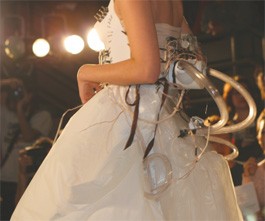
But the highlight was a white dress that the pair had collaborated on in school and was later picked up for the cover of I.D. magazine. Affixed to the bodice, a vacuum pack inflated the bottom portion of the dress, turning it into a voluminous and wispy skirt.

This year, Eng returns to the Maker Faire to work Yahoo.com’s booth. Last October, she, Albinski and another collaborative partner, Audrey Roy, won a Yahoo-sponsored hack competition in which they were given 24 hours to repurpose the company’s code for a creative project. They took apart a Nokia phone, hooked it up to a pedometer and built the whole contraption into a purse, which they called “Blogging in Motion.” Every time the purse’s human component walks 20 steps, the camera takes a shot, which is then uploaded in real time to the photo-sharing website Flickr.com with the exact GPS coordinates of the shot. From there, the information gets posted on a blog, and at the end of the jaunt, you can retrace your footsteps–or at least 5 percent of them–virtually. The purse will be available at their booth for fairgoers to borrow. A large screen will show the photos, only adding to the weird visual overstimulation.Lower tech DIY fashionistas need not feel unwelcome, however. In a hearty nod to those who prefer needle and thread to zeros and ones, the Maker Faire hosts its gigantic Swap-O-Rama-Rama, in which a heap of worn-out duds morphs into a crazily creative runway show.

This is how it works: Stuff your closet’s rejects into a bag. Deposit the bag at the swap with zillions of rejects from other people’s closets. Sift through the communal wardrobe and–la!–one man’s trash is another man’s trousers. You can stop there and end up with free clothes or attend one of many design workshops, like “Shine-On! Light Up Purse,” then zoom around to different stations to refashion your finds under the guidance of a local designer (Darryl Hannah turned someone else’s cast-off garment into a slip dress last year). Some of the most modest options include turning T-shirts into dresses or revitalizing a dusty pair of pants by adding bell-bottom panels, but many swapsters will wax wackier.

Swap-O-Rama-Rama is the brainchild of free spirit Wendy Tremayne, 39. One of Tremayne’s other notable contributions to society was the institution of New York’s first coed naked yoga class, which she created in 2005, she says, “as an offering to the [local] nudist community.”

Speaking by phone from her new home in Truth or Consequences, N.M., Tremayne explains that she hit upon the idea of the swap during a year of self-imposed barter. “When you’re living outside of currency,” she explains, “you have to get really creative. How am I going to see a dentist?” Despite that limitation, she still wanted to keep “abundance” in her life and started holding small clothing swaps in her apartment. After a year-and-a-half, the swaps outgrew her small space, so she held her first public Swap-O-Rama-Rama at a community center on the Lower East Side. Five hundred people came.

Since then, some 30 to 40 cities, including those as far-flung as Jerusalem, have hosted such swaps, and Tremayne estimates that the total number of participants falls in the six-figure range. Closer to home, the Alchemy Swap in Santa Rosa is slated for May 6 (see tag info).

Among past swap workshops, DIY-ers have learned how to make a handbag out of a bra, how to compost clothing, how to iron garbage bags into usable textiles and how to make jewelry out of Legos and board game pieces. This week, the sixth swap to sweep New York will feature a workshop on how to use a washboard. “I let anyone,” says Tremayne, “who has any ideas about extending the life of a textile through some creative process teach a workshop.”

Harboring such a relaxed attitude, Tremayne decided not to copyright or franchise her wildly popular swap. “If I wanted the world to actually change,” she explains, “into a world I’d like to live in, I decided the best way to do that would be to give this idea away. Better to have a good idea and give it away like a hot potato so you can make room for the next one.”

Licensing her event instead as a Creative Commons project, Tremayne now functions as a trainer for communities who want to host their own swaps. She also sees herself as the project’s gatekeeper to prevent the corporate sector from co-opting it. After all, one of the main points of the swap is to “deconstruct the consumer” and piece back together communities that she feels marketing departments have fractured into artificial demographics so they can be easily targeted. One way she accomplishes this is by forbidding mirrors at the swap. This forces people to strike up conversation: they have to turn to each other to find out how they look.

“I’m less excited by what people are making and more about the fact that they’re making something,” says Tremayne, who won’t even bother to pack clothes for her upcoming trip to California, where she’s co-producing the Maker Faire’s swap. She’s counting on finding plenty to wear right there.Cheap, sustainable and creative, the refashioning subculture is building a substantial following, especially in San Francisco boutiques, where remade clothing often gets a rack–or in the case of Miranda Caroligne Burns, gets its own boutique.

Burns has run her own boutique, Miranda Caroligne, in the Mission, since 2005. Every piece in the store is one-of-a-kind, and instead of labeling her clothes with traditional sizes, Burns makes alterations for each customer. “I prefer people to try things on,” she says by phone, “and make a judgment about how they feel and how they look, rather than having that be dependent on an arbitrary number.”

From time to time, Burns uses fabric scraps from the ends of cloth bolts, but usually she just relies on pre-existing garments for her creative raw materials. “I have a lot of people trying to tempt me,” she says, “to go fabric shopping with them in L.A., but it just doesn’t make sense for what I do.”

Making an unusual analogy between the lives of clothes and the lives of people, Burns sees refashioning as a way to reflect the course of human learning experiences, which she likens to “the bumps and bruises and stains and holes that happen to your in life.”

Burns, 32, will be on-hand at the Maker Faire swap to lead a workshop, “Running with Scissors,” which she explains is “how to trick out old button-downs and chop them up to make accessories from the collar and cuffs.” Her book, Reconstructing Clothes for Dummies (Wiley), hits stands this August.

Another designer at the swap is Hope Meng, 30, who will help man the CPR (“Clothes Perfected through Refashioning”) booth. Co-owner of Stitch Lounge, a sewing center in San Francisco’s Hayes Valley, Meng has also jumped on the refashioning publishing bandwagon. In fact, her book, Sew Subversive: Down & Dirty DIY for the Fabulous Fashionista (Tauton; $14.95), which she co-wrote with her business partners Melissa Rannels and Melissa Alvarado, has been so successful in the eight months since it came out that the release of a follow-up book, The Subversive Seamster, is already scheduled for September.

Meng estimates that at least every week she gets an e-mail asking whether Stitch Lounge is planning to franchise. (She and her partners haven’t decided yet.)

“At this point, I think refashioning isn’t an infant anymore,” Meng says in a phone interview. “It’s in its teenage years.”

In a moment of reflection, Meng adds, “It’s like our generation’s wearable art. It’s like the new thing for people these days, and I think it’s here to stay.”

The Maker Faire rolls out every conceivable stop, including the Bizarre Bazaar of 75 craftspeople selling their wares, on Saturday-Sunday, May 19-20, at the San Mateo Fairgrounds, 2495 S. Delaware St. $2.50-$15. For full schedule, see www.makerfaire.com. Alchemy Craft, featuring Sonoma County’s indie designers, makers and their handmade goods, benefits the California Parenting Institute on Sunday, May 6, at Chops DeMeo Teen Center. Featured artists include Todd Barricklow, Jill Bliss, Michelle Feileacan and any more. 509 Adams St., Santa Rosa. 1pm-4pm. 707.843.1171.The Design and Industry Department of San Francisco State University hosts its 18th annual student design exhibition, Technê, crafting through concept, Tuesday-Friday, May 15-18, at the SF State Cesar Chavez Student Center, Jack Adams Hall, San Francisco. http://design.sfsu.edu/techne.

At a mere 23, Diana Eng is already a self-proclaimed C-list celebrity. But dwelling in stardom’s lower echelons is probably a good thing; jadedness, for one, has yet to come knocking for her autograph. Once, while riding the New York City subway, Eng caught a glimpse of herself in an ad. To the embarrassment of an acquaintance sitting beside her, Eng flat-out screamed, “Look, there’s me!” A couple weeks after the subway incident, she scored an invite to Heidi Klum’s Halloween Party. Sporting a dress that glowed, Eng went as a lightning bug.

Often seen in spectacles and less often in an MIT sweatshirt from her brother, Eng’s claim to fame is incorporating science-geek technology into her fashion designs. This ability earned her a spot on season two of Bravo’s fashion-design reality show, Project Runway. “I was like the nerdy person on the show,” she admits, speaking by phone from her New York City apartment.

A graduate of the prestigious Rhode Island School of Design, Eng majored in apparel design but her interest in technology–she has been programming since she was eight–inspired her designs to take a futuristic direction. For her study abroad program, she flew to England to study mechanical engineering and then applied this science to her thesis project: a collection of convertible clothing, like the old reversible garments, but more nuanced and fluid.

In her senior year at college, Eng noticed a small flyer advertising tryouts for Project Runway on the school bulletin board. “I figured, New York is pretty close by, so I just went,” she explains in a voice that sounds like she’s always smiling. Thousands of applicants had the same thought. About a month later, she received a voice-mail on her cell phone from Tim Gunn, who acts as a mentor to the show’s contestants, telling her the good news. After that, she was whisked away for Project Runway and missed her graduation.

“The first day,” says Eng, who was one of 16 contestants, “you’re super self-conscious, but then you get used to it, because the cameras are always there”–even, she soon discovered, when you’re sleeping. Eng recalls sleeping once during filming and awakening to find five men standing above her with their cameras, preparing to shoot her day’s first moments. Naturally, she screamed. The reveille footage didn’t make it on air.

Hosted by Klum, Project Runway requires the contestants to design and construct a bevy of garments, usually with draconian time constraints; competitors often only have 24 hours to make a project. In addition to being understandably sleep-deprived, the young fashion designers were pretty nice to each other, unlike in most reality shows where one gets the sense that whoever says the cattiest things gets a bonus. Not so on Project Runway, where there wasn’t even any sabotage.

“Chloe really looked out for me a lot,” says Eng of the season’s eventual winner, someone with whom she still keeps in touch. “I never really wore makeup before I was on the show. . . . We figured if I was going to be on TV, I should at least cover all my zits.”

Eng made it through about half of the show before she was eliminated during the Banana Republic Challenge in the sixth round. Trying to play to her audience, she’d toned down her traditionally conceptual and “out there” approach to design; instead, she made an uncharacteristically conservative outfit, which, she now thinks, turned out to be “way too conservative.”

Magic Powers

Eng now works for a large New York fashion corporation–she can’t divulge the name, other than it’s not Versace–as part of its research and development team. It may seem unusual for a clothing company to have such a science-geared department, but little by little Fashion Avenue is merging with Silicon Valley. One reason why, Eng says, is that companies like H&M can copy designers’ clothes so fast that both the knockoffs and the originals hit the stores almost simultaneously. To protect themselves, designers are beginning to research fabrics imbued with special properties–anti-odor, anti-bacterial, anti-wrinkle, vitamin-enriched, skin-softening and even silverized (supposedly, the metallic thread has health benefits)–which are harder to replicate.

According to Eng, the trend goes the other way, too. She reports that technology companies like Motorola and Phillips are hiring design R&D teams to think up ways to incorporate their technologies into fashion. Intel has even hired Harper’s Bazaar contributing editor Mary Alice Stephenson for advice on how to bridge the digital-runway divide.

Even so, most of this fashion technology refitting is still at least a few minutes away from being fully realized. Eng says the biggest challenge with this burgeoning business is creating things that people can relate to. At this point, most of the technologies aren’t exactly ready to wear. For the average person, the prototypes can seem quite alien. “That means if you design something to be successful in the mainstream,” says Eng, “it has to make sense and be a great design–people have to be able say, ‘I can see why you used that technology.'”

The new, tiny iPod that can clip onto your shirt is Eng’s idea of just such a triumph. Wait, iPod as fashion? She sees it as sort of an accessory. “It kind of fits into the fashion thing,” says Eng. “Fashion is like the impression that you want to give to other people about yourself. If you have an iPod, then people think good, iPod-y things about you.”

Recently, Eng made a chef’s jacket that uses thermochromatic ink to expose a pattern when it gets hot. But why is she so turned on by the junction of fashion and technology? “Because it’s so new,” says Eng, “I might be able to define what fashion and technology are. It doesn’t have like a pre-set thing of what it can be.”

Diana Eng will be at the Maker Faire Saturday-Sunday, May 19-20. Find out more about her on www.dianaeng.com.

–B.A.


Crazy for Tryin’

0

Among the treasure trove of insanity that is in George Jones’ autobiography I Lived to Tell It All is the County Music Hall of Famer’s open admission that for years he suffered from hearing incessant voices inside his head. Two voices, to be exact: an old man who had no name, and a duck, whom Jones named Deedoodle. The old man and Deedoodle the duck would get in long, vicious arguments, distracting Jones so completely that at one point in 1979, blasted on booze and coke, he sang an entire concert in the voice of Deedoodle the duck.

A live recording is not known to exist, but if so, the Omni Recording Corporation would surely and desperately pay top dollar for it.

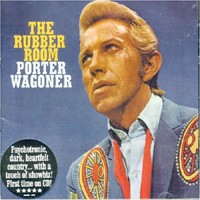
Licensing and reissuing classic but way-the-hell-out-there country music is the label’s forte, its maiden release having been a spotlight on Henson Cargill, who drawled not about those country standbys of loose women and lost love but, rather, Adolph Eichmann and the stupidity of the space race. Omni has also recently, and rightfully, honored the demented genius of four-time Grammy-winning gospel singer Porter Wagoner with a collection entitled The Rubber Room: The Haunting Poetic Songs of Porter Wagoner, 1966&–1977. Its title track is a reverb-drenched portrait of Wagoner’s real-life psych ward, built with mirrors and cushions on every surface, a personal sanctuary where his static head noise could be cleared by writing songs of varying lunacy.

Three musically distinct songs are threaded in and out of each other in “George Leroy Chickashea” to create a country-soul powwow hodgepodge that concerns a man who pleads with God to let him die because he is part black; Wagoner even sings a love song to his own bones. But what’s entrancing is Wagoner’s pure sincerity with even the most hermetic material. Alcohol-induced dementia could be to blame, as evidenced by songs like “The Bottom of the Bottle” and “Wino” (the kitschy sound effect of a desperate alcoholic rummaging through trash cans begins and ends the song).

Wagoner is presented on the CD’s cover resplendent in full country regalia in a vibrant blue suit by famed designer Nudie Cohn and sporting a Murray’s Pomade pompadour that could knock over a building. But he’s loosened his tie and, his face covered in sweat, is looking upward with a mixture of captivation and horror on his salted face.

Alcohol was not Wagoner’s only problem in life; many of his trials stemmed from a genuine desire to do good at a time when the country-music establishment refused to recognize his vision. (Wagoner once caused a Southern-conservative ruckus by bringing his friend James Brown along as his guest to the Grand Ole Opry, and he defied gender roles by performing with an all-female backing band.)

But Wagoner’s reputation will probably always be linked to his crumbled relationship with duet partner Dolly Parton, whom he discovered and featured on his long-running TV series, The Porter Wagoner Show—especially since country-music couples, at least before the days of CMT, chronicled their ups and downs on vinyl rather than camera.

After their split in 1974, Parton fought with Wagoner for years over songwriting royalties, but Wagoner’s penchant for songs in which an adulteress ruins a man may hint at some personal tumult as well, an unhinged depression that saw the performer turning over the years more and more to the comforts of religion instead of the stage.

So where is Porter Wagoner now?

The corner of Broadway and Fifth in Nashville is informally known as “Legends Corner.” Within blocks of the Ryman Auditorium, the Ernest Tubb Record Shop, the Grand Ole Opry and the Country Music Hall of Fame, the faces of country-music legends come alive in the intersection’s sculptures and murals. But on a recent visit, the likeness of Porter Wagoner is nowhere to be found. Furthermore, I asked the people passing by here in the very heart of Country Music USA about Porter Wagoner; it only resulted in shrugs and blank stares. The fact that, after a 50-year career and huge success as a gospel singer, “Mr. Grand Ole Opry” is so vastly unrecognized is probably the impetus for his recent signing to Anti- Records, a label that has shown an affinity for forgotten performers of great talent, like Mavis Staples, Merle Haggard and Ramblin’ Jack Elliott.

Wagonmaster, the Anti album due in June, will not top Billboard’s country charts. But with engaging songwriting and with Wagoner in perfect voice, it will at least redeem him from the nutball status so sweetly suggested by The Rubber Room. These days, his insanity has taken form in the guise of different outside characters, most notably the poor songwriter featured in “Committed to Parkview” in a song composed by Johnny Cash in 1981 for Wagoner and immediately lost—until now. In economic rhyme, the tune chronicles the denizens of the mental ward with a sympathy for inmates that is pure Cash; Wagoner delivers it impeccably. Both men had spent time there.

Other mental states abound. “Albert Erving” chronicles a man who keeps a portrait of a nonexistent woman hanging on his wall, and “Be a Little Quieter” is an admonition to imaginary sounds. Both signal an overcoming of whatever anguish dulled Wagoner’s pen throughout much of the last two decades, and, aided by producer Marty Stuart’s top-notch band, the 79-year-old singer sounds more alive than ever. Paced like a stage show, replete with introductions and instrumental breakdowns, Wagonmaster is a hoot of a listen from an American original.

Is Wagoner the craziest of them all? Not by a long shot. Once, while Wagoner was using a bathroom stall, a he felt a hand reach around his groin and yank at his penis, twisting it and pulling it mid-urination. Shocked, he spun around. Who do you think stood before him, fucked up out of his gourd? You guessed it: George Jones.

Letters to the Editor

May 2-8, 2007

Sad commentary

Although more than a month has passed since 16-year-old was shot to death by Sonoma County deputy sheriffs, the legacy of this tragedy lives on. Yesterday, as we drove by several sheriff’s cars pulled over on the side of the road, my daughter said, “They’re probably shooting someone.”

No longer does she believe that the police officer is her friend. Instead, the lesson she learned last month is “Beware of the police because they’re dangerous–even to kids who need help.”

What a sad commentary on our society.

Lisa Shulman, Sebastopol

We knew that one would provoke

So is “thrilled” that the five Roman Catholic Supreme Court Justices have colluded to bow to the dictates of the Pope in Rome rather than follow the law and precedents established under the Constitution of the United States (Letters, April 25). So-called partial-birth abortion, a misnomer invented by the anti-choice movement for its inflammatory effect, is in reality named “intact dilation and extraction.” As a surgical procedure, it is inherently bloody and this rarely used procedure involves the destruction of the fetus, including the evacuation of the brain and the crushing of the skull, in order to remove the fetus from the birth canal. Time will tell whether Ms. Magnell will be equally thrilled if a dead or dying fetus is jammed in her birth canal, threatening her future fertility or even her life and she is unable to be served legally by physicians, thanks to this decision by the religious fanatics on the Supreme Court.

Jay Williamson, Santa Rosa

Thanks from the climate

On behalf of the Climate Protection Campaign, I want to thank all who attended the April meeting regarding the Community Climate Action Plan. This plan is Sonoma’s blueprint to reduce greenhouse gas emissions 25 percent below 1990 levels by 2015. Additionally, thank you to the Bohemian for its coverage of the event. Well over 200 people came to the Finley Community Center in Santa Rosa to learn about the plan, find out how to get involved and discuss how to foster the public will to ensure we hit our bold target.

In the coming months, the Climate Protection Campaign will develop a set of recommended actions to meet our goal. These recommendations will be developed and evaluated by community representatives and local experts, and will be presented to the public and local governments in late summer and early fall. While everyone knows Sonoma County alone cannot mitigate a global phenomenon like climate change, the Climate Protection Campaign intends to do something locally that is so inspiring that we become a model for other communities everywhere. Join us. You are part of the solution.

R. Alden Feldon, Project Manager, Climate Protection Campaign

Vegan’s view

Finally, the conversation on global warming has advanced from debate and question to the scientific reality that human activity is warming the planet. As we look for personal solutions to our everyday impact, most think of driving less or turning off the lights more. What we don’t realize is that we have a far greater impact every time we eat.

The United Nations recently released a report (“Livestock’s Long Shadow”) revealing that factory farming has a greater impact on global warming than all the world’s transportation combined! Raising not only the 1.5 billion cows worldwide, but pigs, poultry, goats and other species are putting tremendous strain on our atmosphere.

Animal agriculture emits a combination of greenhouse gases. Methane, which affects global warming 23 times faster than carbon dioxide, is produced in the cow’s digestion and released into the atmosphere through flatulence. Nitrous oxide, found to be 300 times more potent then carbon dioxide, is emitted from the mountains of excrement on the factory farm. Excessive energy is wasted with automated milking machines, feeders, lighting and the intensively mechanized slaughterhouse. Add to that the destruction of the rainforest for grazing and growing feed for animals, and you have a recipe for catastrophic damage to the atmosphere.

Eating meat is the equivalent of driving an SUV. A vegetarian diet is like driving a midsize, car and a completely plant-based diet (vegan) is like riding a bike. Can’t afford a Prius? Grab a veggie burger with soy cheese instead.

Hope Bohanec, Santa Rosa

Kurtz is ishmael

Ahoy, mateys! on yet another mystery of the deep (“Here There Be Monsters,” March 14). Weird to get hungry, disgusted and intrigued all from one article. Kind of like Moby Dick meets Apocalypse Now. Nice! Keep up the good ink!

Marina Andriola, Bodega Bay


News Briefs

May 2-8, 2007

Plasma problems

Rare problems with blood transfusions are prompting collection centers to limit or eliminate plasma donations from women. However, officials emphasize that female blood donors are still desperately needed. Once collected, blood is usually broken down into one or more of its components: plasma, platelets and red blood cells. Recent research indicates that plasma from women who have been pregnant may contain antibodies that contribute to transfusion-related acute lung injury, an uncommon but serious complication of blood transfusions. Dr. Nora Hirschser of the Blood Centers of the Pacific, with a coverage area that includes Marin and Napa counties, says the organization is asking female donors if they’ve been pregnant and male donors if they’ve ever had a transfusion. If the answer is yes, instead of preparing the plasma for transfusions it’s used to create vaccines, albumin or immunoglobulins, which are blood derivatives used to treat various diseases. At Blood Bank of the Redwoods in Sonoma County, plasma is now being accepted only from male donors. Both blood centers encourage women to continue donating red blood cells and platelets. “The main product that we transfuse to our patients is red blood cells. That is key for us,” Hirschser explains. “We are always in need of more blood donors. It’s important that women continue donating.” Blood Bank of the Redwoods spokesman Scott Ferguson concurs. “There’s always a constant need for blood products, so we need everybody to come in and donate. We don’t want to discourage women.” Potential donors in Marin or Napa should call 1.888.393.GIVE; in Sonoma County it’s 1.800.425.6634.

Cable profits

Comcast–the Philadelphia-based megacorporation that provides cable, Internet and phone service throughout the North Bay and, indeed, almost all areas nationwide–is having an exceptionally good year. Its first quarter profits were $847 million compared to $466 million for the same period last year, or an incredibly healthy 80 percent increase. It’s true some of that remarkable profit upsurge was sparked by a $300 million one-time gain from dissolving a partnership with Time Warner Cable Inc., but the company credited the rest of its good fortune to its “Triple Play” promotion, bundling digital cable, Internet access and phone service into one discount-priced package. “We are just getting started capitalizing on the Triple Play opportunity,” enthuses Comcast chairman and CEO Brian L. Roberts. Comcast is one of several cable providers scrambling to win subscribers from telephone companies through aggressive marketing techniques. In the first quarter of this year, Comcast added 644,000 new digital cable subscribers. Its total revenue was $7.4 billion, up from $5.6 billion.


Cosmetic Damage

May 2-8, 2007Spring Fashion: We all want to be healthy; we want be good to the environment and ourselves. Yet in our ever more health conscious society, a surprising the number of people cover themselves with unhealthful toxins every day. Of course, you'd never do that. Would you?Most likely, you do. You may not know it, but an...

Crowded House

May 2-8, 2007 Jimmy Tamborello has always gotten by with a little help from his friends. It seems that every project the electro-mastermind behind Figurine and the Postal Service has worked on is packed full of the 21st-century indie-rock elite. Dumb Luck, the new album from his Dntel project, is no different, gathering a glittering crew of guest vocalists and...

Wine Tasting

Cackling Sonic Emissions

May 2-8, 2007 Pointy and squawky is what the Brooklyn-via-Ohio trio Pterodactyl are all about, and their name aptly evokes their cackling sonic emissions. Live, Pterodactyl project a jerky energy that's at once off-kilter and magnetic; they sweat a lot, play fast and trade off vocal duties which run from coyly restrained to screamo. These guys switch without warning but...

Sand Trap

May 2-8, 2007In a monster movie, you have to root for whatever has a face. The face you carry out of Spider-Man 3--which features a couple of monsters--belongs to Thomas Haden Church. His Flint Marko is an escaped convict who falls into a particle accelerator and becomes an animated sand heap. He can rise to the size of a...

Conscious Clothing

May 2-8, 2007Spring Fashion: It's the right size, perfect style, great color and at a rock-bottom price. What could possibly be wrong with this fashion find? Well, where was it made? And by whom? Under what conditions? Out of what types of materials? Those are all questions that Santa Rosa resident Chrissy Kaufman asks before she buys."People who...

Wardrobe Hackers

May 2-8, 2007Spring Fashion: This May, some 30,000 people will descend upon the San Mateo fairgrounds to participate in a grand, silicon-imbued expo of Information Age inventions. Anticipating the human deluge, organizers of this second-ever Maker Faire have already booked two extra hotels for guests and have doubled its physical area from last year to max out all...

Crazy for Tryin’

Among the treasure trove of insanity that is in George Jones' autobiography I Lived to Tell It All is the County Music Hall of Famer's open admission that for years he suffered from hearing incessant voices inside his head. Two voices, to be exact: an old man who had no name, and a duck, whom Jones named Deedoodle. The...

Letters to the Editor

May 2-8, 2007Sad commentaryAlthough more than a month has passed since 16-year-old was shot to death by Sonoma County deputy sheriffs, the legacy of this tragedy lives on. Yesterday, as we drove by several sheriff's cars pulled over on the side of the road, my daughter said, "They're probably shooting someone."No longer does she believe that the police...

News Briefs

May 2-8, 2007 Plasma problemsRare problems with blood transfusions are prompting collection centers to limit or eliminate plasma donations from women. However, officials emphasize that female blood donors are still desperately needed. Once collected, blood is usually broken down into one or more of its components: plasma, platelets and red blood cells. Recent research indicates that plasma from women who...
11,084FansLike
4,446FollowersFollow
6,928FollowersFollow