Tough Row to Hoe

0

August 1-7, 2007

From the crest of a small incline at the edge of a field, verdant rows of radicchio, spinach, cilantro and kale line up, knitting the fertile earth with their tender roots. Beyond this field are groves of trees, and then more acres of farmland, which stop only at the edge of the expanse of the Pacific Ocean. Here at Route 1 Farms, where due reverence is given to harmony and diversity, it is hard to imagine a life more peaceful or purposeful. But it is a life of service and dedication, and a hard life for many.

In his 26 years as a farmer, Jeff Larkey has scrimped, sweated and performed virtual magic to make Route 1’s finances work each year. He’s never received the kind of government assistance that, say, corn farmers in Iowa get; the Farm Bill, a $200 billion&–plus piece of legislation that lumbers through Congress every five years, has bypassed fruit and vegetable farmers like him each time while doling out billions to commodities growers. So Larkey’s managed on his own.

Self-sufficiency is an admirable trait, but over the years advocates of small family farms and “specialty crops”—bureaucratese for fruits and vegetables—have begun pushing for changes in the Farm Bill and the food system overall, arguing that the current system is unfair not just to small farmers or growers from California but to everyone who eats.

This year, for the first time, the change could start to happen. In the coming days, the House of Representatives will take up the 2007 Farm Bill, a version of which passed in committee last month. The $280 billion bill approved last week by the House includes a lot of big-ticket items, including the food stamp program, but tucked into it is a provision that never before existed: $1.6 billion worth of mandated government spending on the promotion, marketing, research and growing of fruits and vegetables over the next five years.

The bulk of farming subsidies—$40 billion in the version passed last week—goes to commodity growers who farm just five crops: corn, soy, wheat, rice and cotton, with corn being the largest. The effect these have on the environment and human health is serious and getting worse. In the aisles of the grocery chains, one finds that the majority of food offered is highly processed, preserved, high in fats, sugars and calories, and endowed with scant nutritive value—and most contains some form of commodity byproduct such as corn syrup. Ultimately, the people who end up eating the most of these government-subsidized commodity crop byproducts are children and the poor.

Ironically, while the USDA places a heavy emphasis on fruits and vegetables in the diet, and California produces over 50 percent of the nation’s specialty crops, the state’s growers have typically received less than 5 percent of all agricultural subsidies.

In response to a growing sense of crisis in public health and in farming, a number of advocacy groups—including the Community Alliance for Family Farmers (CAFF)—banded together under the umbrella of the California Coalition for Food and Farming (CCFF). The CCFF has been pressing for fundamental changes in the Farm Bill to address such concerns as conservation, support of local food movements, nutrition programs, organic farming support and subsidy reform. So far, progress looks mixed on the group’s ambitious agenda.

Kari Hamerschlag, a policy analyst for the CCFF, says that while this version of the Farm Bill is an improvement over previous iterations, any reports of victory are highly exaggerated.

“A lot of headlines are touting what a great thing this is for California, and it’s overstated,” she says. “Specialty crop groups and legislators are trying to paint this as a big win for California, but it’s just a drop in the bucket. If you look at the overall Farm Bill, where the bulk of it is going, we have $40 billion that is still going to commodity payments. And so when you put that in perspective, it’s still incredibly imbalanced.”

Hamerschlag rattles off some other disappointing outcomes: The CCFF asked for $25 million in mandatory funding each year to promote farmers markets; the committee mandated $5 million, with a bump to $10 million in a few years. The group wanted $60 million for a value-added producer grant program to help small farmers turn their peaches into peach jam, for example; the program got $20 million. The Organic Transition Program, which helps conventional growers make the move into organics, got no mandated funding at all; neither did the Community Food Project Grant Program, in which fresh foods are delivered door-to-door in low-income communities to improve nutrition and give small farmers a new market.

And the list goes on.

Many remain very disappointed by one aspect of the Farm Bill headed now for the Senate: its approach to conservation. Good ecological practices all require more labor and therefore a financial commitment that many farmers are not able to meet. Stewardship programs designed to compensate farmers for good practices have been written into the Farm Bill since 1985. But without mandatory funding, they’re susceptible to cuts each year.

Stewardship programs are not just underfunded; they’re oversubscribed. In 2004, three out of every four farmers and ranchers applying to participate in Farm Bill conservation programs were rejected due to lack of funds, according to the Sustainable Agriculture Coalition.

The demand is clearly there, so the current version of the Farm Bill retains conservation programs. But it shifts resources to big livestock farmers and away from specialty crop farmers.

Judith Redmond, co-owner of Full Belly Farm in Yolo County and president of the CAFF, sees something she likes in this Farm Bill, and it’s not what one might expect to hear from an organic farmer with sterling lefty credentials. She likes the fact that it relies on market forces.

“You could look at this as one step away from those traditional subsidies where the check goes directly to the farmer, and instead what they’re trying to do is encourage the public to perhaps eat more California fruits and vegetables using various mechanisms,” Redmond says. “The important programs in this $1.5 billion try to build the market for those crops, which is in some ways a much healthier way to support those fruit and vegetable farmers. It’s indirect, but it doesn’t make those farmers welfare recipients. Those farms have to sink or swim on the basis of their quality.”

Quick dining snapshots by Bohemian staffers.

Winery news and reviews.

Food-related comings and goings, openings and closings, and other essays for those who love the kitchen and what it produces.

Recipes for food that you can actually make.

Diaspora

0

August 1-7, 2007

In 2001, six men gathered together around the fire of a refugee camp in the West African Republic of Guinea to make music together. Their home of Sierra Leone had been torn apart by civil war, their lives displaced, their future uncertain. They began playing instruments, channeling their experience into song and singing together under an evening sky: “You left your country to seek refuge in another man’s land . . . / Living like a refugee / Is not easy.”

So begins the debut album from Sierra Leone’s Refugee All-Stars, Living Like a Refugee, and it’s a thrilling moment for the listener; on the album, actually recorded in the camp, one hears the chirping of a cricket and the indistinct background sounds of night. The music is damn good, and those with no available space next to their copy of Paul Simon’s Graceland should start clearing the shelf; Living Like a Refugee covers the gamut from reggae, juju, dancehall, hip-hop and folk, often blurring the genres and emerging with a disc that’s fresh and, considering the circumstances of its inception, actually quite fun.

The Refugee All-Stars, a widely acclaimed documentary film about the group’s courage and determination gained through music to overcome the frontline atrocities of war, comes out on DVD this month, but the All-Stars have been touring extensively throughout the world and, lucky for us, stop by Petaluma in an exclusive Bay Area appearance this Friday. In the past year, the group have been featured on NPR’s Talk of the Nation and, in one of modern music’s weirder collaborations, teamed up with Aerosmith to record “Give Peace a Chance” for the smash-hit Instant Karma: The Amnesty International Campaign to Save Darfur CD. But the best way to experience the Refugee All-Stars’ tales of strife and redemption is in person, as multiple singers and dancers recount a life that hardly any of us could imagine living.

Sierra Leone’s Refugee All-Stars perform on Friday, Aug. 3, at the Mystic Theatre. 23 Petaluma Blvd. N., Petaluma. 9pm. $20. 707.765.2121.


Letters to the Editor

August 1-7, 2007

Fair Unfair?

Each year, Sonoma County Democrats sponsor a booth at the Sonoma County fair to register citizens to vote, provide information about candidates for public office and share our political beliefs with anyone interested. Volunteers from our party travel from throughout the county to staff the booth in Grace Pavilion and have open and honest communications with fairgoers.

But each year, these volunteers are harassed or intimidated by certain fair employees who disagree with our opinions. They are often subjected to demands to remove certain bumper stickers from view or to not hand out bumper stickers at all. Some fair managers have personally threatened to remove self-deemed objectionable bumper stickers or even close down our booth should we not comply.

However, our Republican counterparts seem free to display and distribute controversial material with such offensive slogans as “Ted Kennedy’s Car Has Killed More People Than My Gun” at their booth just two rows over from the Democratic Party site.

Democrats alone should not be subjected to the thought police of the county fair and their hypocritical application of rules to exhibitors. Fair officials need to apply these standards equally to all exhibitors, and not favor one political affiliation or set of beliefs over another.

Terry Allan Elverum, Sonoma County Democratic Central Committee

Let the Fur Fly

Our agency has a front row seat to see the revolving door of recidivism and its effects on the community. Hence, our mission statement: “To break the cycle of crime, violence and delinquency in our community.”

Two local children are accused of having set a trapped kitten on fire. The kitten was given a second chance and a name, Adam. The two children have names, faces and life stories—just like Adam does. We do not know what the two children’s stories are, and yet we imagine they could be trapped in difficult circumstances themselves. Picture what might be the hurts, frustrations and disappointments that underscore the lives of any young people who cause lethal harm to innocent and helpless victims.

Clearly, here is an opportunity for our partnerships to offer healing for the cause of the condition rather than seek vengeance for its symptoms. Our community has the tools to train these children to see themselves and other beings in a nonviolent, more compassionate light. It does not make sense to bind ourselves to the concept of retribution when, in truth, rehabilitation can be more productive. The children should be given a second chance, also.

Kate Jenkins, executive director, Friends Outside In Sonoma County

Yow

When was the last time Sara Bir actually wrote about something relevant to the North Bay? More and more I feel like I’m reading a 14-year-old girl’s Myspace blog ( July 18). I hear more about her boyfriend or eating habits than about anything going on locally. Does this belong in the local arts and entertainment category? What a waste.

Gerry Stumbaugh, Santa Rosa

Double Yow

I rarely write to a publication, but you bring out the critic in me. Your article about Barry Eisler ( July 18) was the poorest excuse for front-page coverage I have ever read. When you choose a topic or personage, think about the many people who will pick up the paper for no other reason than to learn something. It seemed like an interesting article to me, one at least warranting the paper I would be disposing afterward, but I was wrong. Not only was the article boring, but the last line said it all: “If I hadn’t been born, these books would never have been written. And that’s a great feeling.”

What, Barry? To have been born? I wouldn’t call this printable. At least not in my book!

Carolyn Robbins, San Rafael

Strangely, we welcome letters extolling all the many different ways in which we suck, particularly when we agree upon the odoriferous whiff of suckiness. Close readers saw that we apologized for in the July 18 issue (Table of Contents). Summer doldrums and took their terrible toll that week. We’ll try not to suck so bad in the future!


Hits and Miss

0

August 1-7, 2007

Every Tuesday marks not only the arrival of new releases in record stores, but the arrival of the weekly All Music new releases e-newsletter. As a music critic, I enjoy looking over this list of new albums because it reminds me of how many current bands I’ve never heard of, as well as how many long-established artists I know nothing about.

But the list is inevitably frustrating, because half of the new releases are, upon closer examination, actually reissues of old albums or repackaged anthologies of once-obscure recordings or anticlimactic greatest hits collections. Dabblers, rejoice: this summer, your wait for Lil’ O’s Greatest Hits, the Monster Magnet 20th Century Masters: Millennium Collection and yet another The Best of Air Supply is over.

Knowing that Monster Magnet have been around long enough to earn a greatest hits package by default makes me feel old, which generates the majority of my greatest hits resentment. Otherwise, I like greatest hits collections; they are the single-serving cereal box variety packs of the music world—colorful samplers for day-trippers, toe-dippers and the generally clueless, and they make life easier, though not necessarily more rewarding.

Sooner or later, musicians ranging from massively influential to marginally successful come out with greatest hits discs. These releases create not only another way for record companies to make money from music that’s just sitting around fully formed; it’s also a handy way for unsure would-be fans to get a feel for a band without getting overwhelmed, plunking down $100 to acquire a box set or risking the crapshoot of blindly selecting a dud of an album (imagine exploring a curiosity about Neil Young by purchasing, say, Trans).

What is a hit, anyway? The most severe definition is a song whose massive popularity was such that it scored a spot on the Billboard chart. Thus, Foghat’s Greatest Hits could conceivably be a single with “Slow Ride” on one side and “Slow Ride” on the other.

Just for fun, I counted the number of greatest hits packages in my collection of CDs; their percentage was far from small. I currently own two greatest hits each by Loretta Lynn and the Monkees, and three by Gordon Lightfoot. The majority, though, are long gone, cassette tapes that are either mildewing in Mom and Dad’s basement or just plain evaporated into the ether of youth. Ownership of such collections are (or, by now, were) nearly rites of passage; how else do you account for The Eagles: Their Greatest Hits (1971-1975) being the third bestselling album of all time?

(Ramones Mania is likewise indispensable. I own all of the albums the Ramones ever recorded, but I still enjoy listening to Ramones Mania, which, in 30 songs arranged in seemingly random order, tidily outperforms other, more inclusive Ramones collections.)

The weakness of greatest hits is that they inevitably wind up under-representing at least one aspect of a musician’s career. The trusty All Music e-newsletter announced Social Distortion’s Greatest Hits several weeks ago, an event that made me simultaneously nostalgic and miffed. Social Distortion have been around for nearly 30 years, and the band’s Greatest Hits collection offers 10 songs. That’s a paltry 3.33 songs per decade! And there’s only one selection from their career opus, Somewhere Between Heaven and Hell, one of the best rock albums of the 1990s. This is not a matter of opinion. By law, a greatest hits collection by any nonsucky band should have at least 20 songs on it.

Greatest hits do well for artists whose careers were built on the strength of singles rather than albums, which was rather typical of pop music before the late 1960s. Despite my own great fondness for Herman’s Hermits, I must admit that owning their greatest hits and nothing else will get you by in life just fine—unless there’s a life-altering forgotten fluke of a song buried far too deep in the Herman’s Hermits canon for a casual, barely committed half-fan to discover.

And that’s the rub of greatest hits—you never know what you are missing. An obsessive collector might see greatest hits as a populist waste of time, but if you think about it, it’s the greatest hits that are elitist—they only include the hits! And how can you have a greatest hits of Elvis? The Beatles? Billie Holiday? Johnny Cash? And, by now, Mariah Carey? These people are just too damn popular, with too much longevity, to whittle down to 10 or 12 or even 20 songs. Monster Magnet, maybe not so, but they are all now neighbors in the land of greatest hits—and as long as people still buy recorded music and a Billboard chart still exists, they will have plenty of company.


Gorillas in the Midst

0

August 1-7, 2007

As descriptive as the band’s name is, it’s definitely not sufficient to describe the sound of Sleepytime Gorilla Museum, who return to the Phoenix Theater this Thursday. Since their inception in 1999–from the ashes of Idiot Flesh–the quintet have actually honored their piles of instruments with music that evades pigeonholing.

The band’s latest album alone, the just-released In Glorious Times, brings us everything from The Wall-like chants (“Puppet Show”) and guitar-funk freakouts (“Ossuary”) to sparse plodders (“Salt Crown”) and demonic metal (“Helpless Corpses Enactment”). With rare instruments like the lute and custom-made pieces (like the Viking Rowboat) created by bassist Dan Rathbun, the band unsurprisingly rejects descriptors like “prog” and “avant-garde” in favor of being known simply as “entertainers.”

The Oakland group’s live shows are equally eclectic. In the band members’ own words, a Sleepytime concert is “a costumed festival of hyperventilating self-derangement, which has yet to include much of a puppet show, but has included human performers of varying stiffness.” Incorporating spoken word-recitations, dance troupes and, yes, puppets, the shows are mind-freaking performance-art experiences that make the term “rock show” contextually impotent.

Though their gothic garb and faux onstage rallies may bring to mind shock-rock bands like Gwar or even Marilyn Manson, Sleepytime Gorilla Museum transcend these comparisons by the sheer commitment to their image and accompanying “movement.” Known as “Rock Against Rock,” it is largely informed by Dadaism and futurism, with a credo of “No Humans Allowed.” No wonder Sleepytime claim their first show had an audience of one banana slug. Whether or not the band are the next Devo, they sure put on a hell of a show for any species.

Sleepytime Gorilla Museum play on Thursday, Aug. 2, at the Phoenix Theater. Stolen Babies open. 201 Washington St., Petaluma. 9pm. $15. 707.762.3565.


White Shark Autumn

0

August 1-7, 2007


Life in the food chain gets boring when you’re king. We’ve got a world of lesser beings to cook for dinner, but we’re simply starved for danger and run-ins with carnivores. That’s why we like to imagine that we live in a world of monsters. We raise hype over mountain lions in the suburbs, bears in the vineyards, coyotes in the city and killer bees in the air—and it’s so thrilling to imagine that all of them want to devour us.

But the most enduring of our imagined enemies may be the great white shark, Carcharodon carcharias, the star of Jaws and the aggressor in nearly every serious shark-human encounter recorded in California.

White sharks have killed 10 people in the state since 1900: four in the 1950s, three in the 1980s, one in the 1990s, and two in the new millennium. Just over a hundred unprovoked attacks were reported during the 20th century along the West Coast. The conclusion? The ocean is a safe place to pass the hours. Still, the hype created when a shark attacks a person—like that of the kayaker bitten on the bow of his boat two weeks ago off the San Mateo coast—far surpasses that of all the car deaths, gun deaths and nicotine deaths that can fit into a busy California afternoon. Shark attacks awe some people and terrify others, and for some, they even fire up the urge to go swimming—in a cage, that is.

“I hate to say it, but it’s often when the first attack happens that our season starts,” says James Moskito, expedition leader with Shark Diving International, an Emeryville-based service that leads boat trips to the Farallon Islands, where clients enter the water in shark-proof cages to enjoy a close-up view of one of the most notorious predators in the world. Several companies in California operate in this small niche of “adventure” tourism. Equipped with 50- to 100-foot-long cruisers furnished for luxury, these companies take paying customers from around the world on one-day or multiday trips to various shark holes. Most notable are Isla Guadalupe, 160 miles off the coast of Baja California and accessible to the port of San Diego, and our own Farallon Islands, 26 miles west of Marin and world-famous for its high density of white sharks, which gather there to feed on California sea lions and elephant seals.

Shark Diving International leads cage-diving trips aboard the 56-foot Superfish during the autumn months, when white sharks gather most densely at the guano-covered archipelago. Chumming—dispensing blood and flesh into the water to attract sharks and other fish—was banned in California waters several years ago, largely due to the complaints of surfers, who feared that the activity could spark higher levels of aggression in sharks and incite them to attack when they otherwise wouldn’t.

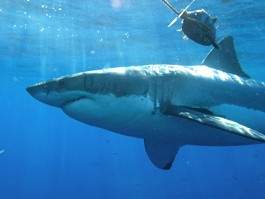
The crew of the Superfish resorts to using a decoy to gain the attention of the sharks. At a slow putter, they drag a hemp-fiber bundle fashioned to resemble a sea lion behind the boat, and most days it draws one or more sharks into the vicinity of the boat. When a shark is spotted following the decoy, the motor is cut and the crew deploys several floating cages into the water. The clients, in wetsuits, hop into the open hatches while a crew member pulls the decoy still closer toward the boat, bringing the shark with it and giving customers the sight of a lifetime: an adult white shark appearing out of the blue gloom and passing just yards away, at ease in its own element. The water at the Farallons offers an average visibility of 20 feet—though it may be as clear as 50—and even those onboard the boat may get a stellar view of the big fish.

“Our hope through doing this is that people will gain an appreciation of the sharks and the lives they lead,” says Moskito. “If we educate people, then the more involved they’ll be in white shark protection. You can’t protect something if you know nothing about it.”

Shark Museum Massacre

Researchers believe with good evidence that white sharks are extremely susceptible to overfishing. One of the clearest textbook cases of overexploitation comes from 1982 at the Farallon Islands, where a commercial fisherman named Mike McHenry, gutting fish after a day’s work, found himself in the company of several large sharks. McHenry put aside his fillet knife and went promptly to work. He rigged up his hydraulic winch with a cable and a sturdy baited hook and proceeded to haul in five adult white sharks in a single evening.

“The observed number of attacks on pinnipeds at the Islands dropped off the charts,” says Burr Heneman, director of Commonweal, an organization in Bolinas dedicated to the health of humans and of wild ecosystems. Years passed before the rate of attacks on pinnipeds returned to normal levels. “That was a pretty good indication of their vulnerability.”

McHenry never sold the sharks, but instead froze them with the plan of establishing a brilliant shark “museum.” John McCosker, chair of aquatic biology with the California Academy of Sciences and a white shark researcher since 1978, visited the super-cooled facility during the filming of a BBC documentary shortly after McHenry landed the sharks.

“It was heartbreaking,” McCosker recalls. “There they were, propped up and hanging from the ceiling. It was unbelievable. I understood where he was coming from—he was a commercial fisherman—but you realize walking into a scene like that, all the ecological damage that was done; it wasn’t just a few dead fish. It trickles way down the food chain, and for years to come. It broke my heart.”

In 1993, conservationists pursued legislation to protect white sharks by law from fishermen. Surprisingly, those who statistically faced the greatest danger of being attacked by or otherwise interacting with white sharks—Northern California surfers, recreational SCUBA and breath-hold divers and commercial urchin and abalone divers—supported the measure most vehemently, while divers and water-goers in Southern California expressed on the whole far less interest in prohibiting the killing of white sharks.

“That was interesting, seeing who wanted to protect the sharks and who didn’t,” says Heneman. “Generally, people who were most likely to encounter them were the most supportive, and there was a really dramatic geographic break between Northern and Southern California.”

Crazy Like the Fox

Such data demonstrates that white sharks, for all their power, teeth and potential danger, inspire a curious camaraderie between themselves and the people who spend time in the water with them. Australian Rodney Fox survived one of the world’s most publicized and horrific shark attacks in 1963 while spearfishing off of Aldinga Beach, south of Adelaide. Today, he is an active shark conservationist and one of the great white shark’s better friends in the world. Fox was attacked from below and behind near the end of a breath-held dive. The great white bit him around the torso and dragged him underwater before releasing him and allowing the bleeding and internally wounded diver to struggle to the surface. A boat took him to shore and surgery a short while later saved his life. Doctors believe Fox’s wetsuit helped keep him in one piece during transport. The photos of the massive, bleeding underarm wound and the subsequent semicircular healed scar—with its 462 stitch marks—are among the most famous and memorable in shark-attack image galleries.

“After the attack, I decided I wanted to go have a look at the sharks and see for myself if I could go back in the water,” Fox recently recalled by phone from his home Down Under. He went snorkeling just three months after the attack. “I saw lots of glimmering, imaginary sharks coming at me from all directions.”

Obviously still shaken, Fox took to diving with an explosive-tipped spear and killed a few small sharks with the weapon. “I was keen to prove to myself that I could overcome these animals,” he says.

In 1965, Alf Dean—then a world-famous shark hunter and fisherman—and photographer Ron Taylor invited Fox and two other well-known shark-attack survivors, Henri Bource and Brian Rodger, on a fishing-filmmaking expedition. For the multiday occasion, Fox designed and built the first shark cage, and he, Bource and Rodger would use it to get a face-to-face view of the animal that had nearly killed each of them earlier that decade. In the meantime, Dean reeled in shark after shark on his heavy fishing tackle, and Fox remembers with repulsion the blood and gore that accumulated on the deck of the boat.

“We chummed up a bunch of sharks and he reeled in five between 11 and 15 feet. There was nothing to it. They didn’t jump or fight. It was like pulling in a dead cow, and I remember asking Alf, ‘Well, now what do we do with them?’ He said we could each have a jaw or some teeth, and then they were to be just dumped back in the water. I looked around and thought, ‘There’s just got to be a better way to get to know these creatures.'”

So Fox pushed the shark-cage concept and turned it into a business and a personal conquest. He went on to regain his own trust of the sea and of sharks while leading thousands of people on extraordinary shark-viewing excursions in Australia and South Africa. Fox, in fact, led the early-1990s campaign in Australia to protect great whites from hunters. He has meanwhile participated in the making of over a hundred films and documentaries about great whites, and in more ways than one, Fox would not be who he is today without the great white shark.

Tons of Fun

Sportfishing for these animals is now illegal virtually everywhere, but it was once big business in ports like Montauk, Long Island, Durban, South Africa, and many towns in Australia. The activity gained popularity in the 1950s as boat captains took paying customers to sea, spilled a few barrels of pulped whale flesh into the water, strapped their clients into fighting chairs and hooked them into the biggest fish of their lives.

In 1933, a 998-pound white shark landed in New Jersey was recorded as the largest fish ever landed on rod-and-reel. Author Zane Grey set his own record in 1936 with a 1,036-pound tiger shark caught near Sydney. The records accelerated as fishermen refined their techniques and equipment. From the Atlantic to the Pacific to the Indian Oceans, anglers targeted white sharks, bettering each other as they hit the 1,500- to 3,000-pound marks. Eventually, in 1988, the notorious captain Frank Mundus of Montauk hooked a client into a 3,427-pounder, still considered one of the largest fish ever landed with a rod and reel, though the record books discount it on a line-weight technicality. Beyond the rod and reel, the largest great white ever measured came from Cuba. It was caught in 1945 using a bait-rigged oil drum left floating at sea overnight. The big fish was 21 feet long and reportedly weighed over 7,000 pounds.

South Africa, all of Australia and much of the Eastern Seaboard now prohibit the take of white sharks both commercially and recreationally, and the impact that the era of great white sportfishing had on the global population is unknown. California’s own protective measure went into effect on Jan. 1, 1994, when great whites were granted a several-year hiatus from persecution. Three years after that initial passage, the fine print was modified to forever protect the species in state waters, which are estimated to support just several hundred great white sharks, according to Heneman. Population estimates, however, are not easily determined.

“This isn’t a schooling fish,” says the Academy of Science’s McCosker. “They don’t come up to breathe like gray whales. We unfortunately know very little about them and we have almost no idea how many are in the ocean.”

White Shark Cafe

Markings on white sharks’ dorsal fins distinguish the fish from one another in the same way that fingerprints are unique to individual people. Using close-up photos of sharks’ dorsal fins, California researchers with the nonprofit Tagging of Pacific Pelagics (TOPP) project are hoping to produce an accurate regional population estimate.

TOPP is simultaneously involved in a long-term shark-tagging program. Salvador Jorgensen, a research associate with the Monterey Bay Aquarium and Stanford University, and Barbara Block of Stanford University are currently leading the endeavor. Using satellite tags implanted with a harpoon into the base of the sharks’ dorsal fins, Jorgenson and Block have tagged over 90 white sharks off the Northern California coast since 1999. The tags remain embedded in the fish for 30 to 90 days, recording each shark’s movements and activity, before breaking off and floating to the surface where they can be retrieved. The researchers have discovered that California’s great whites very predictably linger for the late summer and fall around pinniped rookeries, such as those at Año Nuevo, the Farallons and the Point Reyes National Seashore, before departing and traveling 2,000 miles southwest to a relatively featureless swath of ocean between Baja California and Hawaii. Dubbed the “white shark cafe,” this region may serve as a breeding ground or a feeding ground; researchers don’t know.

“We call it the ‘white shark cafe’ because we are still not sure if they go there to find some food or perhaps find a mate,” said Jorgensen. “A cafe is somewhere you might go to do either.”

During their cross-ocean forays, the sharks frequently make descents to more than 1,500 feet beneath the surface, though the researchers do not know why. The sharks remain at the “cafe” for several months before coming straight back to California, often returning to the exact same rookeries year after year. Studies in the southern hemisphere have observed similar migration patterns. One individual was tracked swimming between South Africa and Australia in the course of a year.

Since 1969, scientists with the Point Reyes Bird Observatory (PRBO) have perched on the summit of the Farallons’ Southeast Island, studying the water with binoculars. From there, they have observed annual shark-pinniped predatory interactions at a rate of a dozen to over 50 per season. The frequency of attacks increased throughout the 1970s and 1980s, possibly in response to increasing marine mammal populations, but on occasion, following the killing of a shark at the island (usually by a fisherman, though orcas killed a 12-footer in 1997), decreased attack rates have followed. Concerned that pinniped populations could rise out of control if great whites vanished from state waters, the PRBO helped lead the way toward the species’ protection.

Meanwhile, just yards away, entrepreneurs in the cage-diving business work their own gig of introducing landlubbers to the thrill of great whites. However, companies like Shark Diving International, which boasts a trip success rate of 85 percent, walk a fine line between education and entertainment, and not everyone agrees with the merits of the local cage-diving business.

“I think everyone ought to do it at some point, because it’s such a wonderful experience,” says McCosker. “But not here. Not at places like the Farallon Islands, where there’s a long-term study in progress. There’s been such an investment of time in understanding the behavior of sharks here in their natural habitat, and it’s so important not to interfere with that. If people want to dive with sharks, the best thing to do is go to Guadalupe Islands off of Mexico or to South Africa. Thank goodness chumming has been banned, but towing around different shapes behind the boat to attract sharks is likely affecting the sharks’ behavior.”

Commonweal’s Heneman agrees.

“I think it’s unfortunate that there’s this conflict among people who all love these sharks. The problem is, there’s at least 25 years of research data out there when the sharks were not being influenced by people. Now that they are being influenced by people, we still don’t necessarily know how the diving may affect the sharks.”

But Moskito sees the business as an important form of public exposure.

“We are totally pro-shark. If we knew this kind of activity hurt sharks in any way, we’d stop. Basically, we just want to take people out and together enjoy this part of nature. We hope that we’re only helping to improve the public image of sharks.

“Anyway,” he adds, “researchers use shark decoys just as much as we do.”

All parties in this fairly lighthearted dispute are, at least, friends of the shark, and no biologist will deny that cage-diving is 10 steps up in sophistication from the thrill-seeking business of white shark sportfishing.

“We know so much better now that there really is no excuse anymore for that kind of behavior,” McCosker says.

By-catch in commercial industries still impacts white sharks, and this biggest of predatory fish still winds up in shark fin soup. Many experts believe that, while possibly declining, great white populations worldwide are in better shape than in the days of rampant recreational fishing, yet a population estimate is likely a long way off as research groups continue to gather data.

“It seems that in California their numbers are increasing,” says Heneman. “We base that simply on the number of attacks observed on seals and sea lions at places like the Farallons. Otherwise, we don’t know much about them except that there aren’t a lot.”

Moskito, who suspects that great whites are very slowly disappearing, says that nearly every shark he has observed at the Farallons has been an adult of 12 to 18 feet. Only on rare occasions do small ones appear. Those rare babies are the thrill of the season.

“The big sharks are amazing things, but I get more and more excited these days about the small sharks. It’s like, ‘Wow! These guys are reproducing. They’re surviving out there!'”

For information on cage-diving expeditions with Shark Diving International, visit www.seesharks.com.


He’s (Still) the Man

0

August 1-7, 2007

It hasn’t exactly generated a media blitz, but 1967 is notable not only for the blossoming of the Summer of Love, but also the concert debut at the Newport Folk Festival of singer-songwriter Leonard Cohen. Why does that matter 40 years down the road? Though his most recent recordings have been uneven at best, the 72-year-old Cohen continues to satisfy music lovers with a stout draft of what Dostoevsky delighted in calling “the stinking brew” of human emotions.

The subject of a recent award-winning film documentary and a new reissue series, Cohen remains a cult figure whose melancholy, folksy songs blend cutting barbs and finely crafted melodies, sex and suicide, Biblical imagery and a dry, dark sense of humor, all sung in a slow confessional tone.

It was folksinger Judy Collins who discovered Cohen, already a celebrated poet; the Boston Globe once likened him to James Joyce. Over the past four decades, his recording career has had its share of ups and downs. He once even chucked it altogether to live in a Zen monastery.

Yet Cohen’s mystique has never dimmed.

The 1980s British Goth band Sisters of Mercy lifted their name from one of his songs. His haunting ballad “Suzanne” has been covered by everyone from Collins to Neil Diamond. In 1988, pop diva Jennifer Warnes recorded the critically acclaimed Cohen tribute album Famous Blue Raincoat, spurring one of Cohen’s periodic comebacks. The album has just been reissued as an expanded 20th-anniversary edition. It features Cohen singing duets with Warnes and boasts several knockout performances. While the disc’s overly pristine 1980s production values can sound dated, Warnes’ unaffected vocals shine as she embraces this deeply emotional material. Add four bonus tracks and this new anniversary edition is well worth searching out.

But Warnes’ homage wasn’t the only project to help resuscitate Cohen’s career at the time.

In 1990, Allan Moyle’s movie Pump Up the Volume introduced Cohen to a new generation of fans. That quirky film starred Christian Slater as Hard Harry, a lonesome teen-turned-DJ who operated a pirate radio station from the garage of his parents’ suburban home. Harry spun a lot of early punk platters and, oddly enough, opened his nightly broadcasts with the twisted title track from Cohen’s 1988 comeback album I’m Your Man, which featured the acid-tongued lament to the music industry “Tower of Song.”

Now Cohen’s back yet again.

He has popped up as producer and co-composer of the new Anjani CD/ DVD set Blue Alert, featuring the sultry Hawaiian singer-songwriter Anjani Thomas, who sang backup on Cohen’s 1984 masterwork “Hallelujah.” Anjani draws undeserved comparisons to Madeleine Peyroux and this disc never soars the way Warnes’ tribute does. The Anjani recording arrived on the eve of a new evening-length concert work, Book of Longing, composed by Phillip Glass and based on Cohen’s poetry. It premiered on June 1 in Toronto and also was staged in early June at Spoleto Festival USA in South Carolina.

The prickly poetry that launched Cohen’s career was never deemed “pleasant”; it always had an unsettling edge. In April, Columbia/Legacy reissued brilliantly remastered versions of his first three albums: 1967’s Songs of Leonard Cohen, 1969’s Songs from a Room and 1971’s Songs of Love and Hate, classic folk-based recordings that were snapped up hungrily at the time of their release by the angst-ridden offspring of the dying American Dream.

Of course, Cohen’s latest comeback owes a debt of gratitude to Lian Lunson’s exceptional 2005 film documentary Leonard Cohen: I’m Your Man, which interspersed interviews with the reclusive singer-songwriter talking about his life and art, with concert footage of U2, Nick Cave, Rufus Wainwright, Teddy Thompson and others performing Cohen’s songs. The film, newly released on DVD, and an accompanying CD soundtrack are a testament to the enduring nature of Cohen’s material.

If I’m Your Man and all these other releases leave you pining for even more, seek out the now out-of-print CD I’m Your Fan, the 1991 Cohen tribute that gathered R.E.M., Velvet Underground co-founder John Cale, the Pixies, Nick Cave and the Bad Seeds, That Petrol Emotion, Lloyd Cole and a bevy of Brit-pop acts, performers who were still in diapers when Cohen began exploring the dark and corrupt regions of the soul. It’s yet one more brick in the artist’s mounting tower of songs.


Bring on the Funk

0

August 1-7, 2007

Among the sea of retro-funk bands cropping up lately, none has strutted such manic decontrol onstage as the Bay Area’s own Honeycut. Chops and attitude are a must in funk, and Honeycut sprinkle both with that added, vital ingredient: sweat. Led by Bart Davenport, a jack-of-all-trades Bay Area musician who fronted the Kinks-ish retro band the Loved Ones (and who has collaborated with both country renegades and hip-hop DJs), the band don’t get down by the books; you’re likely to hear slivers of classic songwriting puncturing Honeycut’s pounding groove, which is a welcome change from the repetitious vamping of less inspired trend-hoppers. Above all, the full-body workout is the band’s ace; if we could somehow call up Joanie Greggains and talk her into reviving Morning Stretch for a new generation, Honeycut would be the ideal studio band.

This weekend’s warmup calisthenics come by way of A Pack of Wolves, a neo-disco duo comprising former members of Girls in Suede but unencumbered by any of that band’s penchant for quirky time signatures. Along with the constant buzz of the accessory laptop, the two fill a primitive dance prescription that sounds eternally futuristic; even 10 years from now, I suspect that people will hear A Pack of Wolves and label them as “the sound of tomorrow.” The key is simplicity. Eden Mazzola’s thumping beats could be sampled for the next series of DFA 12-inch singles, and the guitar hooks of Cesco Catania are crisply streamlined in a way his earlier band never was. Add the Win Butler-esque vocals of Catania and a dedicated workload (a two-week tour follows this weekend’s show), and you’ve got a band to look out for.

Special mention must be made also of Judah Nagler, who appears playing acoustically with Ashley Allred (last week’s Arcadia model). Everyone’s been wondering what’s happening with Nagler’s currently hibernating outfit Velvet Teen of late, but seeing him stripped down should render the question less urgent–with the reassurance that the magic lies in the craftsman, and not necessarily the tools. Nagler’s always got a stovetop of new songs simmering at any given time, but this weekend, to sate our hunger, he’ll delve into the Velvet Teen songbook for some long-unheard classics.

Honeycut, A Pack of Wolves, Judah Nagler and Vision of a Dying World perform on Friday, Aug. 3, at the Phoenix Theater. 201 E. Washington St., Petaluma. 8pm. $13. 707.762.3565.


Pushing the Limits

0

August 1-7, 2007

California politics might appear sunny at the moment, with Gov. Arnold Schwarzenegger buddying up with Assembly Speaker Fabian Nuñez for family dinners and touring the country as the nation’s pre-eminent post-partisan and global-warming governor.

But dark clouds are gathering. The sources of the storm? There are two: a dispute over whether state legislators will be able to serve additional terms; and a struggle over whether the hand-drawn, dinosaur-shaped districts the two major political parties designed in 2001 to deliver defeat-proof elections will survive.

In short, term limits and redistricting. Which are now, thanks to intense political jockeying, conjoined.

Why? Because if term limits aren’t modified, nearly every experienced California legislator, from Nuñez on down, will be termed out of office in either 2008 or 2010. They want more time.

But Schwarzenegger has signaled that he’ll support term limits loosening only if he gets a redrawing of districts. Not only statewide legislative ones, but congressional—which differ slightly in boundaries—as well. That’s redistricting that voters have already repeatedly turned down, most recently in November 2004.

And the sides are digging in. On June 26, all 19 Republican members of the House sent Schwarzenegger a letter demanding that all California congressional districts be redrawn as part of any deal. That in turn set off House Speaker Nancy Pelosi, who, freshly triumphant from 34 hard-fought statewide Democratic congressional victories, wants things to remain as they are.

Thus the battle has taken on national proportions, with even editorialists of the Washington Post and USA Today weighing in. And national groups have not been able to resist getting involved.

Conservative Virginia-based group U.S. Term Limits (USTL) sued Attorney General Jerry Brown over ballot summary language he’d written for a term limits-loosening measure now being circulated statewide for February’s primary ballot. Sacramento County Superior Court judge Gail Ohanesian ruled against USTL on May 25, writing, “I may well have written this ballot title and summary differently,” but declaring that Brown’s language was “not false or misleading.” USTL, which took the case to the Court of Appeals, lost there on June 29 and says it’s throwing in the towel.

Meanwhile, an arm of USTL has taken on another terms-extension proponent, state Senate president Don Perata, filing a complaint with the California Fair Political Practices Commission over how he’s been spending his approximately $1 million campaign war chest.

Compounding these challenges are questionable charges from the left that the campaign is compromising its legislative goals.

The assembly’s public safety committee, for example, appeared ready last month to approve a bill opening police officers’ discipline records to public scrutiny statewide, when the bill—already approved by the state Senate—suddenly died.

It turns out that just prior, Police Officers Association president John Sites had e-mailed legislators stating that police “adamantly oppose this legislation” and that “if it is passed, we will move quickly to oppose any term-limit reform.” The L.A. Times immediately characterized the police’s action as “union thuggery” and assemblymembers’ response as “cowardice.”

Then there’s the incident last month in which Nuñez, a former labor organizer, quietly gave up his longstanding demand that Indian casinos put in writing guaranteed neutrality toward union organizers in newly approved facilities, settling for verbal guarantees. Jack Gribbon of hotel workers union UNITE-HERE declared the group “outraged,” and threatened to sponsor a ballot measure asking its members to both overturn the new gaming agreements and oppose any term-loosening measure as well.

Meanwhile, on the other side of the deal, four redistricting-related bills—two in the Assembly and two in the state Senate—have survived committee hearings, but differ significantly in content. Assemblyman John Laird says it’s an “open question” whether a package will be hammered together by Sept. 27, the last date for anyone to qualify initiatives for the Feb. 5 primary.

“Everyone’s trying to get the budget finished so we can move on to healthcare, which we actually might accomplish this year, and then come other matters,” Laird says. On the other hand, pointing out that “we’re not due to go out of session until Sept. 14,” Laird sees plenty of time to put together a redistricting initiative.

And what of suspicions that politicos want loosened term limits badly enough to change votes? “Well, they would be nice, but I’m not going to do something I wouldn’t otherwise do, like suddenly support costly new dams in the Central Valley,” he says. “No one’s going to sell their souls for this.”


The Byrne Report

August 1-7, 2007

On July 1, my son Miles and I were at the Sonoma County dump throwing away our only television. It had been sitting, unused, in a closet, since Miles was born five years ago, because television-watching retards the emergence of empathy and intellect. Miles intelligently gravitated to the dump store where he found a brass pot! And simultaneously browsing through junked paperbacks, I spotted one of my favorite novels, The Omen by David Seltzer.

Randomly opening The Omen, which is about the childhood of the Antichrist, Damien Thorn, I read: “Now democracy was fading . . . from Laos to Lebanon, brother had turned against brother, fathers against children; school buses and marketplaces exploded daily . . . coupled with worldwide famine and the disintegration of international economic structure. . . . The Devil’s child will arise from the world of politics.” More timely than ever, that Omen, thought I.

When The Omen first appeared 1976, innocent readers did not know that a nonmetaphorical Damien, born to a wealthy ruling class American family, was already being groomed to become a powerful avatar at the dawn of the new millennium.

Rising from the world of politics, this real-life spawn of Satan was trained in the use of hellish powers to foment environmental havoc, war without end, torture, famine, infanticide and superprofits for corporate covens.

That evening, The Omen tucked into back pocket, I trundled over to Toby’s Feed Barn in Point Reyes Station to hear a presentation by political linguist and evolutionary psychologist George Lakoff. The event benefited Mainstreet Moms, a woman-run voting rights organization. Several hundred folks filled the barn to capacity, hanging on to Lakoff’s words, hoping for guidance in these troubled times. And he is definitely worth listening to: with humor and logic, he dissected the psycho-linguistic methods used to hypnotize television-staring Americans into smiling upon the phony War on Global Terror, the suspension of the Constitution, the reversal of the historic Supreme Court decision in 1954 that desegregated public schools, and the hollowing out of the domestic economy by weapons merchants.

“Every time you curse Bush’s name, it is because he has accomplished what he wanted to get done. He is unbelievably competent,” Lakoff observed.

Lakoff runs the Rockridge Institute in Berkeley, a progressive think tank dedicated to reframing public debate. He has authored many readable books, including the 2004 political classic Don’t Think of An Elephant!, in which he explained that there are two basic types of family structures, authoritarian or nurturing. The authoritarian family is patriarchal, disciplinary and necrotic, while the other is empathetic, empowering and viable. We each have elements of these duel family values imprinted upon our brains; this results in a schizophrenic political culture. But evolution favors the nurturing culture over the fear-crazed, wounding culture, Lakoff asserts.

Contrary to the false doctrine that human beings and our social systems are successfully governed by the actions of rational, self-interested individuals and groups, the quality of empathy is, in reality, the foundation of our biological success, Lakoff says. It is hardwired by evolution into the brain and it is pleasurable.

Empathy explains the successful evolution of human societies more efficiently, Lakoff asserts, than does the “survival of the fittest” cliché. Species (and nations) do not so much compete against each other as they adapt themselves into environmental niches. Based on Darwin’s true analysis of branching speciation, evolutionary biology shows us that our unconsciously experienced but constantly computing neural networks are more interested in motivating cooperative and peaceful solutions to problems than in promoting capitalist competition and imperialist wars. Our 21st-century technologies are not being put to best use because the militarized socioeconomic system that developed these technologies does not recognize altruism as a progressive force in human development—quite the opposite.

Lakoff’s forte is explaining how politically loaded words such as “freedom,” “democracy” and “environment” can be manipulated to mean one thing to “nurturing” liberals and something else entirely to “authoritarian” conservatives. This is a bit simplistic and begs the question of class struggle, but Lakoff is correct that we need to rescue our gestalt from the capitalist psych-machine so it can support humane, not military, adventures. He urges the Democratic Party not to continue its god-awful pandering to demonic Pentagonism, but to reframe the public debate in order to stimulate specific areas of the brain in conservatives that can chemically induce empathy and, consequently, enhance the possibility that the needs of all people will eventually subsume the extraordinarily limited agendas of political parties and religions.

Personally, I am not going to count on Satan’s handmaiden, the Democratic Party, to save us from President Damien the Second. I fear that a lasting exorcism will require stronger medicine. When dealing with the Antichrist, stern measures are warranted. Let’s start with impeachment.

or


Tough Row to Hoe

August 1-7, 2007From the crest of a small incline at the edge of a field, verdant rows of radicchio, spinach, cilantro and kale line up, knitting the fertile earth with their tender roots. Beyond this field are groves of trees, and then more acres of farmland, which stop only at the edge of the expanse of the Pacific Ocean....

Diaspora

August 1-7, 2007 In 2001, six men gathered together around the fire of a refugee camp in the West African Republic of Guinea to make music together. Their home of Sierra Leone had been torn apart by civil war, their lives displaced, their future uncertain. They began playing instruments, channeling their experience into song and singing together under an evening...

Letters to the Editor

August 1-7, 2007Fair Unfair?Each year, Sonoma County Democrats sponsor a booth at the Sonoma County fair to register citizens to vote, provide information about candidates for public office and share our political beliefs with anyone interested. Volunteers from our party travel from throughout the county to staff the booth in Grace Pavilion and have open and honest communications with...

Hits and Miss

August 1-7, 2007 Every Tuesday marks not only the arrival of new releases in record stores, but the arrival of the weekly All Music new releases e-newsletter. As a music critic, I enjoy looking over this list of new albums because it reminds me of how many current bands I've never heard of, as well as how many long-established artists...

Gorillas in the Midst

August 1-7, 2007 As descriptive as the band's name is, it's definitely not sufficient to describe the sound of Sleepytime Gorilla Museum, who return to the Phoenix Theater this Thursday. Since their inception in 1999--from the ashes of Idiot Flesh--the quintet have actually honored their piles of instruments with music that evades pigeonholing. The band's latest album alone, the just-released...

White Shark Autumn

August 1-7, 2007Life in the food chain gets boring when you're king. We've got a world of lesser beings to cook for dinner, but we're simply starved for danger and run-ins with carnivores. That's why we like to imagine that we live in a world of monsters. We raise hype over mountain lions in the suburbs, bears in the...

He’s (Still) the Man

August 1-7, 2007It hasn't exactly generated a media blitz, but 1967 is notable not only for the blossoming of the Summer of Love, but also the concert debut at the Newport Folk Festival of singer-songwriter Leonard Cohen. Why does that matter 40 years down the road? Though his most recent recordings have been uneven at best, the 72-year-old Cohen...

Bring on the Funk

August 1-7, 2007 Among the sea of retro-funk bands cropping up lately, none has strutted such manic decontrol onstage as the Bay Area's own Honeycut. Chops and attitude are a must in funk, and Honeycut sprinkle both with that added, vital ingredient: sweat. Led by Bart Davenport, a jack-of-all-trades Bay Area musician who fronted the Kinks-ish retro band the Loved...

Pushing the Limits

August 1-7, 2007 California politics might appear sunny at the moment, with Gov. Arnold Schwarzenegger buddying up with Assembly Speaker Fabian Nuñez for family dinners and touring the country as the nation's pre-eminent post-partisan and global-warming governor.But dark clouds are gathering. The sources of the storm? There are two: a dispute over whether state legislators will be able to serve...

The Byrne Report

August 1-7, 2007On July 1, my son Miles and I were at the Sonoma County dump throwing away our only television. It had been sitting, unused, in a closet, since Miles was born five years ago, because television-watching retards the emergence of empathy and intellect. Miles intelligently gravitated to the dump store where he found a brass pot! And...
11,084FansLike
4,606FollowersFollow
6,928FollowersFollow