Ask Sydney

May 16-22, 2007

Dear Sydney, I’m friends with two people who are in an intimate relationship. I recently found out that one of them has been “hanging out” with some new guy. My girlfriend asked me not to say anything to my other friend, who is being cheated on, about this situation. But I know that if he knew about it, he would not be happy and would not consider me to be a true friend if I had not told him what I now know. I consider both of these people to be my good friends and feel pissed off to be put in this situation. What should I do?–Anonymous

Dear Anonymous: Think of the situation from a reversed perspective. Would you want your friend to tell you if you were the one being deceived? There are plenty of people who believe what goes on between two people in a relationship is their business and theirs alone. But you’re probably right, and if you say nothing, you run the risk, when your friend finds out, that he will feel betrayed by your silence.

Instead of going directly to your friend, first discuss the situation with the cheater of the party. Express your frustration with the situation and give her the chance to share her point of view. Just be aware, there’s something distinctly rotten about getting involved in another couple’s dysfunctions. Most of us have enough of our own without dealing with anybody else’s. So don’t make this your business unless you’re prepared to suffer the inevitably nasty consequences.

In the future, consider discussing this potential issue with your other close friends. Ask them how they would like you to deal with the situation should it come up. Think of it like the writing of a will; it may seem unnecessary at the time, but there’s nothing wrong with being prepared. Maybe your friends will tell you, “Don’t tell me, I don’t want to know,” or maybe they’ll say, “You better tell me, or else.” In either case, at least then you never have to worry about being put in this predicament again. When it comes up next time, you’ll know exactly what’s expected of you, and then you can act accordingly! It would behoove most of us to be trained in “affair” etiquette, thereby eliminating the chances that we may inadvertently exacerbate the situation, hurt a friend by omission or say the wrong thing.

Dear Sydney, I have a new boss at my old office, and I run hot and cold about staying with him or not. He’s a nice guy and all, it’s just that I worked for my last employer for 17 years and it’s hard for me to accept change. I’m just not as happy now as I used to be. I applied for a different job at a local clinic, and they may be offering me a position, but it would mean a $3 an hour pay cut. I talked to my daughter about it and she said for me to ask Sydney, so here I am. My gut feeling is to stay where I am, but I’m not sure. Since the new job would be at a clinic run by the state, they offer good benefits, but what I’m really concerned about is retirement, and I think there will be a retirement plan offered to me where I am now. At the new clinic this might not be the case. What would you do?–Itching to Quit

Dear Itching: A $3 an hour pay cut is significant enough to be taken seriously. I’d look at my finances very carefully before making any sort of sudden change. I might quit anyway, but at least then I wouldn’t be shocked when my first paycheck came. Decide if you can afford and are willing to live on about $400 less per month. Then ask yourself, what makes you think the new place will be better? How unhappy are you in your current position? If you current job makes you very unhappy, and you can live without the $400, then ask the new place what their retirement packages look like. Just remember, if the difficulty lies in your inability to accept change, as you suggest in your letter, then an entirely new job may not bring you the sense of security you’re seeking. Changing jobs is a big decision, and you’re right to take it seriously, but ultimately it’s your overall well-being that is the most important–more important than $3 an hour, benefits or retirement. Try not to forget, therefore, to wager your contentment into the final calculations.

Dear Sydney, my dog had puppies and my 21-year-old son wants one. He lives in an apartment where he signed a lease that said no pets, but he says that he talked to the property owner and he said that it would be OK. My son got a cat a few years ago, and it’s been living at my house for two years now because he didn’t want to keep on moving the cat around, so he left him here. My fear is that when he gets tired of the puppy, it will be at my house too, and he denies this every time I try to talk to him about it. He doesn’t want me to talk to his property owner, but I don’t want one of my puppies to have a confusing life, and I’m not sure if it’s really OK. I’m a ridiculous compulsive animal lover. What do you think? He’s very upset (the fact that I am giving a puppy to his older sibling does not help), and he hasn’t been speaking to me for the last five days over it.–Confused

Dear Confused: To whom you give your puppies is completely up to you. You’re under no obligation. Having a dog is a huge responsibility, and you, above most others, are in the primary position to be able to assess your son’s level of preparedness. Don’t hold the cat against him, however, when making your decision. The cat was two years ago, and just because he has an abandoned cat in his closet (as so many of us do), doesn’t mean he’ll do the same with a dog. Make a checklist of the qualities he will have to demonstrate in order to be considered as a puppy owner. First, does he really have permission from his landlord? If you can’t trust him to be honest about this, then your probably can’t trust him with a dog. Second, does he have enough space for a dog? Third, does he have a schedule that can accommodate training? Fourth, does he have enough income to pay for food and vet bills? If he passes all four points, then give him a chance. If he doesn’t, then stand your ground. If he wants a dog that bad, he can always get one somewhere else, and as for his sister getting one, well, I imagine she must have passed your rigorous inspection. Too bad he has yet to do the same.

‘Ask Sydney’ is penned by a Sonoma County resident. There is no question too big, too small or too off-the-wall. Inquire at www.asksydney.com.

No question too big, too small or too off-the-wall.


Wine Tasting

0


Well, the final issue of Wine X magazine is still hanging on to the shelf, doing its fresh best even as it fades away. What killed the electric wine magazine? Was it the big money wineries, so unhip as to snub an upstart magazine that merely trashed them in its mission statement? Or do we blame the demographically targeted twenty-something consumers, maybe a little too hip on being hooked with a caricature of themselves?

Yet to hit the wine road these days, it would seem that the grand campaign to electrify twenty-something consumers has succeeded, even while its chief cheerleaders falter. To get a sense of how wine’s flowing through the pulse of generations X and beyond, I naturally looked to the must-be spot for the anti-wine snob–but it’s also temporarily out of service.

Roshambo Winery is only a victim of its own success. The facility sold, but the old hands at rock-paper-scissors central are building a new estate winery. In the meantime, a Roshambus wanders the byways, or you can track its product down in a new wine lounge that claims the “Generation” and ditches the “X.”

Generation Wines is improbably located in a Windsor industrial park. Opened in fits and starts over the past year, owner Ryan O’Harren says it’s now good to go five days a week. Generation is a multilabel tasting bar and wine shop, selling locals like Fanucchi and imports like Australian Barossa Valley Shiraz. There’s sofa seating and a tiki-style bar made of recycled sorghum stalks. An iPod mix plays in the background, Air thrown in with cha-cha-cha. O’Harren readily owns that he’s aiming to welcome a young crowd, but joint’s style is not painfully hip, and his affable mien make it chill, as the young folks say.

Generation currently offers two tasting flights, Bonneau and Roshambo, for $7 each. Pours are not stinted, and the fee is refunded with purchase. Here’s your chance to sample Roshambo’s 2002 “the Reverend” Zinfandel ($22), burly and brambly, and the 2005 “Justice” Syrah, which lays down licorice over sweaty leather, the aroma of roasted coffee beans wafting down the street.

Bonneau hits the spot with the 2004 Chardonnay Catherine’s Vineyard ($28), smelling almost of glinting gold with refined woodsiness and lemon honey. Bonneau’s got two disparate Zinfandels, brewer’s yeast and white pepper on the one hand–the 2005 Egret Zinfandel ($15)–and solid jam flavor on the other, the 2005 Shenandoah Valley Zinfandel ($28). Add in some light food that O’Harren says is in future plans, and what’s not to like about going a little out of the way in Windsor?

Generation Wines, 810 DenBeste Court, Suite 103 (at Conde Lane), Windsor. Open Tuesday-Saturday, 11am to 6pm, or by appointment. 707.836.9401.


View All

Cracklin’ Blues

0

May 16-22, 2007

At age 85, Jimmy McCracklin has met them all, played with them all, survived them all. Or something close to that. Given all his achievements, there are still some firsts left for McCracklin–his performance in Santa Rosa on May 20, for example, will be his first in Sonoma County.

McCracklin was born in Arkansas, but his music is steeped in a sound that was prevalent in the smoky, late-night juke joints of Oakland and Richmond in the 1940s and ’50s. It contains a lot of the boogie-woogie piano he learned as a boy from Walter Davis, with a heavy portion of rhythm and blues.

During an interview at his home in Richmond, four gold records on the wall reflected the early afternoon sun. With his eyes receding into the past, he spoke of meeting Big Mama Thornton at Peacock Records in Houston during the early ’50s and bringing her to California where she stayed with him and his wife for a long time because “she had no peoples out here.”

In 1958, McCracklin was in Chicago, where he remembers “working dead-end jobs, walking around for three weeks carrying this song I wrote.” He took it to Chess Records where it climbed to No. 7 on Billboard‘s charts, leading to an appearance on Dick Clark’s American Bandstand, a first for a blues artist. “Dance records started poppin’ out like hell after that,” he says.

McCracklin estimates that he wrote “about nine out of every 10-and-a-half” of the songs he recorded. His compositions have been covered by the Beatles, Jerry Garcia and Janis Joplin. Otis Redding and Carla Thomas took the squabble of his song “Tramp” high up the charts in 1967.

McCracklin has recorded over 30 albums but recognition has been sluggish. In April, he received a Hall of Fame trophy at the Bay Area Black Music Awards. On his piano at home are keys to the cities of Oakland, Richmond and Sacramento. There’s a picture of him at the White House with Ronald Reagan and one with former Oakland mayor Jerry Brown.

Looking forward on this sunny afternoon, McCracklin talked about his band–three horns, a guitar, bass and drums–and Sweet Nectar, a vocal group consisting of his three daughters. They have all been with him a long time. “I got to have my old band,” he said, “I like to sound like I did.”

McCracklin beamed. “I still love to play. I ain’t never stopped. Once I stop, I’m through with it.”

Jimmy McCracklin appears on Sunday, May 20, at the Last Day Saloon. Bill Noteman and the Rockets open; Bill Bowker hosts as a live radio show. 120 Fifth St., Santa Rosa. 6pm. $15. 707.545.2343.


The Byrne Report

May 16-22, 2007

The election of a neoconservative president in France has prompted thousands of worried French people to demonstrate and riot. On May 9, the Santa Rosa Press Democrat reported on that important situation with a tiny blurb on page three. The bulk of the daily newspaper’s front page that day burbled on about a women-only roller derby. Turning away from this journalistic doodle, I found solace, yet again, in the wisdom of C. Wright Mills’ 1956 study of American society, The Power Elite. Still fresh, Mills describes the social structure of our sad nation. He remarks that politicians and “warlords” rely upon advertising-news media to dull our senses with trivia, thereby diverting our attention from examining the cause of political upheavals.

In depicting the rise of a military-corporate-political complex, Mills notes, “Very little of what we think we know of the social realities of the world have we found out first-hand. Most of ‘the pictures in our heads’ we have gained from the media–even to the point where we often do not really believe what we see before us until we read about it in the paper.”

It is almost a truism to remark that a “news” story must be packaged in advertisements before a quasi-literate populace will find it credible. According to Mills, though, our very system of governance is based upon false advertising: “Americans cling to the idea that the government is a sort of automatic machine, regulated by the balancing of competing interests.”

He goes on to show that the Democratic and Republican parties are two sides of the same military-industrial bullet and that “in the absence of policy differences of consequences between the major parties, the professional party politician must invent themes about which to talk.” Hence, the media focuses on what amounts to differences in hairstyles while ignoring evidence that the executive and legislative branches (aided by the judiciary) are nothing but rich men’s clubs.

Mills included prominent sociologists as members of this elite group, saying that intellectuals often find “it is much safer to celebrate civil liberties than to defend them [or] to use them in a politically effective way.” Without the aid of public-relations fog cheerfully generated by professional liberals, observed Mills, the war machine would sputter out.

This brings us to liberal sociologist Alan Wolfe, who wrote the afterword to my Oxford University Press edition of The Power Elite in 2000. Ironically, Wolfe is a card-carrying member of the liberal wing of the power elite. He writes opinionated blather for the New York Times, Foreign Affairs, the Atlantic Monthly and The New Republic, and teaches political science and religion at Boston College. He gets lots of grant money to write books about the “crisis of American democracy,” praising it as an inherently healthy system of checks and balances, rather than as what it is: a plutocracy, a government by and for the wealthy. According to Wolfe’s afterword:

  • “Mills’ prediction that both the economy and the political system of the United States would come to be ever more dominated by the military is not borne out by the historical developments since his time.”
  • “Domestic political support for a large and permanent military establishment in the United States, in short, can no longer be taken for granted.”

  • “[T]oday the ideological differences between Republicans and Democrats are severe.”
  • Desiring to know if Bush’s global war on poor people has changed the professor’s historical assessment of Mills, I called Wolfe up for a chat. He “retracted” his pre-9-11 analysis that domination of politicians by the corporate-military sector is on the wane. But he says that the military establishment is more “nuanced” than the weapons and energy executives running the “dishonest” Bush-Cheney administration. Many generals, Wolfe says, were unhappy that the president did not send enough troops to do the job in Iraq.

    This is also the retrospective spin that many liberals use to distance themselves from the quagmire they helped to initiate. Wolfe says that he perceives the two-party system as “healthy.” He optimistically looks toward the Democrats to pull America out of the fire of Iraq. In short, he still denies Mills’ thesis that an American power elite, or militarized ruling class, calls the shots to facilitate corporate profit-seeking.

    I could not help asking the wonky Wolfe if he remembered the RAND Corporation’s Anthony Downs’ Economic Theory of Democracy, written in 1957. Downs said, famously, “In a two-party system, it is rational for each party to encourage voters to be irrational by making its platform vague and ambiguous.” Familiar with Downs’ essay, Wolfe said that the electoral triumphs of Republicans has required the Democrats to move to the “middle of the road.” But isn’t that what Mills . . .

    Fuhgeddaboutit. Let’s go to the roller derby!

    or


    News Briefs

    May 16-22, 2007

    Leasing the Lotto?

    Paying down the state’s debt without raising taxes was Gov. Arnold Schwarzenegger’s mantra as he unveiled his revised May budget on Monday, but privatization was the underlying theme. Schwarzenegger suggested selling the state-created EdFund, which guarantees student loans, and proposed eventually leasing out the state lottery to generate more income. “We have to recognize that there is a lot more money in the private sector than in the public sector,” the governor said, stressing that public-private partnerships are the wave of the future.

    He didn’t suggest immediate changes to the lottery. “This will take a lot of time to negotiate,” Schwarzenegger added, noting that many other states’ lotteries are run more efficiently and generate a lot more income than California’s state-operated version. “I think we can do much better and could therefore afford many more things and pay off our long-term debt.” The Governor assured that lottery funds for students would still be protected and acknowledged that since California’s voters approved the lottery in its present form, there could be legal hurdles to having it run by a private company. “I’m not a legal expert, but if they decide the people need to vote on it, then we will need to put it on the ballot.”

    Other budget items include saving $40 million by eliminating the Williamson Act, which protects agricultural lands, and rescinding automatic cost of living increases for seniors and disabled people. The governor’s revised budget is “mean-spirited,” charges Assembly Speaker Fabin Nûñez, D-Los Angeles. “At a time of record prosperity, it punishes low- and middle-income families that are working hard and playing by the rules.” Richard Stapler of Nûñez’s office adds that legislators will need details about selling the EdFund and leasing out the lottery. “We have lots of questions,” Stapler says. “Specifically on the EdFund, the overriding concern is how this will turn out for students. We have a great many questions about both proposals, and we will be fully vetting them in legislative hearings.”

    Stapler adds, “It will be interesting to see exactly what the governor is planning.”


    Life of a Marriage

    0

    May 16-22, 2007


    Jason Robert Brown’s immensely popular modern musical The Last Five Years was conceived as a show that could be staged with very little space and with very few actors–two, to be exact–one male, one female. As cash-strapped theater companies constantly beat the bushes for clever ways to do more with less, the notion of a two-human musical with a five-person orchestra–especially one that has generated a kind of rabid, CD show-tune cult of young people who swap Years bloggings and repeatedly listen to the original cast recording the way some people read spiritual texts–has to be attractive. With this in mind, it comes as no shock that the mighty Sonoma County Repertory Theater, considering which show to present as its first-ever musical, would end up anointing The Last Five Years as the chosen one.

    It is also no surprise that the Rep, after choosing Years, would dare to take the beloved but never-before-seen-in-the-North-Bay musical and turn it all sideways, with noted director Ken Sonkin making significant changes to the way the show has always been staged.

    “In terms of directing, the way I approach a show is as a storyteller,” says Sonkin, who was recently appointed to the theater department of the University of San Francisco. Seen last year as Teach in the Rep’s production of American Buffalo, Sonkin has directed several shows at Cornell College in Iowa, and has acted and directed with American Conservatory Theatre in San Francisco, the Berkeley Rep, the Marin Shakespeare Festival and many others. An acclaimed magician, he was also director for three years at the Theatre Artists Institute in San Jose. “I love to tell stories onstage,” Sonkin says. “So whether it’s a large-scale show or small-scale show, I look for ways to bring the story to life in as engaging a way as possible, and the thing that engages me, as a storyteller, is the interaction between people.”

    So how does an interaction-is-key philosophy work in a show in which the main characters never interact? As constructed by Brown, The Last Five Years traces the five-year relationship of a young, modern, married New York couple, Jamie and Catherine, but does so in a series of music-centered scenes alternately told by the two characters. To make things even more interesting, Jamie tells his stories in chronological order, beginning with their first meeting and ending with the dissolution of the relationship, while Catherine tells the same story in reverse order, beginning just after the breakup and working backward toward the beginning. They share one duet only, meeting in the middle of their story to sing at their wedding.

    In the Rep’s version of the play–featuring Alice Grindling and Robert K. Dornaus III as the likable but doomed couple–Jamie and Cathy still take turns, but as they play their way through various stages of their relationship, Sonkin finds ways of bringing those memories to life using both actors. When Cathy sings about an event that occurred between her and Jamie, the scene comes more fully to life with Jamie playing his part onstage, instead of through Cathy simply working the stage as she sings.

    “This way,” says Sonkin, “we get to see the relationship, the love and romance, the dysfunction and the unraveling, instead of just hearing about it through beautiful music. This is live theater; it’s not a concert. I’ve found ways to make it even more theatrical.”

    This production not only marks the Rep’s first dabbling in the world of musicals, it is also the first time the company has launched a co-production, working with Santa Rosa’s Sixth Street Playhouse, which will host the same show with the same cast and director in its newer, larger theater space next November.

    “I don’t plan to make any significant changes when we move to the bigger space,” Sonkin says. “Maybe Jamie and Cathy’s apartment will get a little bigger, but not too big. This is New York, after all, and New York apartments are small.”

    ‘The Last Five Years’ runs Thursday-Sunday, May 18-June 24, at the Sonoma County Repertory Theatre. Thursday-Saturday at 8pm; Sunday at 2pm. 104 N. Main St., Sebastopol. $15-$20; Thursday, pay what you can. Opening night is sold-out. 707.823.0177.


    Museums and gallery notes.

    Reviews of new book releases.

    Reviews and previews of new plays, operas and symphony performances.

    Reviews and previews of new dance performances and events.

    First Bite

    0

    May 16-22, 2007

    Some locations just seemed cursed. Even when a good restaurant opens in a particular building, you know it’s only a matter of time until it goes down. That’s how I’ve felt about the little roadhouse on Bodega Highway about three miles west of Sebastopol. In the dozen years I’ve lived in western Sonoma County, I’ve watched a procession of restaurants rise and fall on this spot.

    When Two Crows, an upscale diner, opened on the site about three months ago, I assumed it would suffer the same fate. But I had lunch there last weekend and now fully expect this establishment to succeed on the strength of its flavorful food, friendly service and warm ambiance.

    From the moment you walk into Two Crows it just feels good. The place is cozy and homey; there are only seven or eight tables out front (a couple more in the back) and a few seats at the counter. A friend and I arrived shortly after noon on a recent Saturday and were bathed by the sounds of a live harp played by a young man in the corner of the front room. The hardwood floors were immaculate and softened by a bouquet of fresh tulips on the counter.

    The woman who waited on us was genuinely kind and patiently explained which soup was cream-based and which was vegan. She recommended a butternut squash soup with pinto beans, corn and tomato that had clean, bright flavors; you could clearly taste each ingredient because the soup wasn’t overwhelmed by spices.

    The falafel plate ($10; includes the soup starter) had a light tahini dressing and came with some less traditional condiments: a yogurt sauce and a cilantro-mint chutney. My friend had a pumpkin-seed mole chicken burrito with mango salsa ($12; includes side salad of fresh greens, diced cooked beets and carrot matchsticks), which was tasty though a bit bland. And when you’re spending $12 for a burrito, you’d like the amount of chicken to be a bit more generous. The tap beer selection ($3.50 a pint) includes Moonlight’s Death and Taxes, Anderson Valley’s Boont Amber, and local suds from Lagunitas and Ace Cider.

    In the end, we were very satisfied because the food was vibrantly alive and the service was attentive but not invasive. We’ve heard from friends who go there almost every weekend that Two Crows shines even more brightly at brunch. I plan to return sometime for breakfast, and feel confident, despite the checkered history of the location, that Two Crows will endure for years to come.

    Two Crows Roadhouse, open Thursday through Sunday for breakfast and lunch; breakfast served until noon. 9890 Bodega Hwy., Sebastopol, 707.829.5898.


    Quick-and-dirty dashes through North Bay restaurants. These aren’t your standard “bring five friends and order everything on the menu” dining reviews.

    Kiss My Grits

    May 16-22, 2007

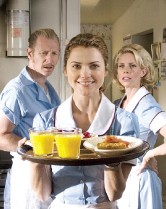
    When Adrienne Shelly’s film Waitress wafted its way to Sundance, part of its divine afflatus was due to the director and writer’s tragic murder. Let’s overlook that matter for a second. For a little movie, it’s overproduced like crazy; this working-class waitress lives in a Craftsman bungalow house 600 large couldn’t buy. As the Deep South, Southern California gives its worst performance in years–it looks rich, it looks dry, it looks white, it looks secular, it looks like a movie set, even in the exteriors. Pull back from the scenery and the art direction, though, and note the essence of this patronizing fairy tale.

    The way Shelly lays it out, the waitress Jenna (Keri Russell) is a country girl, a pie-baking sweetie at Joe’s Pie Cafe whose answer for any of life’s predicaments is to invent a new dessert. As in Like Water for Chocolate and many movies since, cooking interludes interrupt the action, as Jenna conceives of different pies with zany names: “I Hate My Husband Pie” and “Baby Screaming Its Head Off in the Middle of the Night and Ruining My Life Pie.”

    At the beginning of the film, Jenna has just flunked a pregnancy test. It’s all because her estranged husband, Earl (Jeremy Sisto), got her drunk and had his way with her. Jenna won’t even think of doing what you might want to do if you’re pregnant and you don’t want to be, you don’t like babies in general and you hate your husband. Shelly sweeps that possibility off the table with the abruptness of a waitress clearing the way for a packed dinner rush. We’re meant to admire Jenna’s gumption for going through with it, deciding to link herself for life with a man she hates by having a baby she doesn’t want. In this, she has emotional support from her two sassy colleagues, played with the archness of a brace of drag queens.

    Becky is Cheryl Hines, looking exactly like a tennis-playing Beverly Hills housewife trying to drawl like a Southerner. The late Shelly herself plays Dawn, a blonde mouse with eyeglasses. Dawn has a date who starts stalking her (“You won’t be able to get rid of me,” he promises). It’s a mark of this movie’s sexual politics that she ends up falling for him because he’s so devoted.

    Meanwhile, Jenna starts up a heedless, passionate affair with the town’s new ob-gyn, Dr. Pomatter (Nathan Fillion), despite Earl’s insane jealousy. How happy can you be when you’re sleeping with a married doctor who has all the social power and mobility while you’re waiting tables with a second-trimester belly and cracking ankles? Adrienne Shelly may have been a wonderful person and a good mother, but she had about as much comprehension of being a waitress as Marie Antoinette had of being a milkmaid.

    Maybe I’m being too literal about Waitress, which might have a grain of emotional truth under the pink and sugar-coated surface. During pregnancy, some women fall in hate with their husbands; by contrast, their obstetricians have all the answers, aren’t worrying about money and the future, and make no personal demands. (Sisto’s toneless pleading for sex–“Please. Please. Please. Please”–got a laugh from the women in the audience. Glad they were amused.)

    Sisto is a monotonous, street-crazy type of actor who exhausted his range on Six Feet Under, and Earl is such a vicious, infantile bastard that Jenna looks even more foolish for sticking it out. On the surface, this movie seems to be a fantasy about a woman persisting, but she’s really waiting for a chance for rescue; the movie is a long celebration of diminished expectations relieved by geezer ex machina (Andy Griffith).

    Being nice about the circumstances under which this film arrives–and overlooking its derivative, televisionistic qualities–might be a kindness to a dead artist, but it’s not doing the living any favors. This stale old pastry has all the originality of a convenience-store berry pie.

    ‘Waitress’ opens Friday, May 18, at the Rialto Lakeside Cinemas, 551 Summerfield Road, Santa Rosa. 707.525.4840.


    New and upcoming film releases.

    Browse all movie reviews.

    Smart-Ass Sage

    0

    May 16-22, 2007

    While the gifted white rapper isn’t quite as rare a beast as it used to be, it is still a singular animal that could win battle rap contests while sporting a Metallica T-shirt; that could float effortlessly between the worlds of poetry slams and underground hip-hop shows; and that could maintain any measure of credibility while spitting lines referencing Choose Your Own Adventure books. But then again, there truly is no other artist in music today quite like Sage Francis, who dropped his latest album, Human the Death Dance, this month through Epitaph Records.

    Fans of Francis know that, even at his worst, he indulges the cleverest of clever wordplay. Human the Death Dance is no exception. His lyrics are conversational, approachable, intellectual and easy to relate to. They even add a multitude of layers to his albums; every time you listen to one, you catch a different witty metaphor or personal anecdote buried within. For the instrumental half of the equation, his beats are electric, energetic and eclectic. “Got Up This Morning” is country-fied, “Black Out on White Night” sports a plaintive string section and “Call Me Francois” brings a ’70s B-movie sci-fi sound. The beats inform the mood as much as the lyrics, moods that run the gamut from playful to somber. Throughout whatever stylistic detour the album takes, Francis keeps it all together with his emotionally honest and singular style of lyricism.

    Human the Death Dance isn’t hip-hop meant just for people who love hip-hop; it’s hip-hop for people who love poetry, for people who love honesty and, finally, for people who love music.


    Music for the Eye

    0

    the arts | visual arts |

    Photograph by Michael Amsler
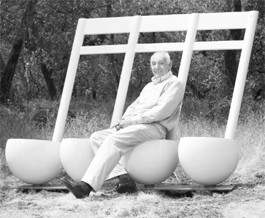
    Noteworthy: Paradise Ridge owner Dr. Walter Byck relaxes on Robert Ellison’s musical sculpture.

    By Gretchen Giles

    ‘There’s just one more thing,” sculptor Nicolas van Krijdt intones into the Bohemian‘s editorial voicemail system. “And it’s important. I started out wondering what my sculptures would sound like if I tried making music from them, and now I’m using music to make sculptures from the sound itself. OK then, thanks.”

    Taken at face value, those are not complex sentences. None of the words is overly long or has elaborate Latinate roots. The syllable count doesn’t soar above three. But the concepts that van Krijdt regularly wrestles with and that he will be performing from at the Paradise Ridge Sculpture Garden on May 20 are indeed complex, if not particularly Latinate or multisyllabic.

    As one of 15 sculptors participating in Paradise Ridge’s new annual round of outdoor installations, this year titled “Prelude,” van Krijdt has hung 16 of his steel or parchment paper vessels from a stand of trees in vintner Walter Byck’s five-acre pygmy oak grove high above Santa Rosa. Reminiscent of open pea pods, the vessels also resemble small boats and range in size from eight feet to four feet in length, and from 100 pounds to four pounds in heft.

    One vessel in particular is special. Made of steel, it is strung down the middle with a length of airplane wire that crosses a fret-like structure and can be tuned. Under the ministrations of a cello bow, the vessel is played, making a high, mournful sound that retains the uncanny brightness of metal.

    Recording ambient sounds onsite at Paradise Ridge for the past three months, van Krijdt has composed a site-specific sound sculpture for the grove that he will perform at the opening reception and as he sees fit over the next year. He is also hoping to put it in mp3 form on the winery’s website so that visitors can download it and listen as they walk around. “The whole idea is for the [sound sculpture] to be a subtle amplification of what’s here,” van Krijdt says, standing in the grove and gesturing to the leaves, branches, breeze, birds, wildflowers, moss. “The way that these pieces move around, I’m loving the minute composition of the movements.”

    In the past, van Krijdt has done such art as walk a particular arrondissement in Paris recording the sounds, marking his audio path on an ordinary French map and then creating a musical chart from the aural cartography that matches the map with the sounds. The result is a uniquely three-dimensional musical composition that carries a nearly palpable heft.

    For this piece, titled 16 Vessels, 28 Trees, van Krijdt has used the movement of the vessels as they sway from branches and limbs as markers to help him create a musical chart from which he plays and improvises. “When a classical pianist gives a recital, he or she will have the music in front of them, but they don’t mostly read it; it’s there for reference,” van Krijdt explains. “In my case, the notation becomes part of the art. It does the same thing for me as traditional musical notes do for traditional musicians.

    “I invented my own instrument and my own way to write the music, and it’s not,” he laughs, “out of laziness!”

    Actually, finding a lazy man at Paradise Ridge would be something of a feat. On a recent Friday morning, Petaluma sculptor Edwin Hamilton is riding an earth mover replete with crane and two assistants, placing several tons’ worth of stone objects in a southeast corner of the grove while Santa Rosa sculptor Riis Burwell pours a cement pad that Gale Wagner will use to support his massive antiwar sculpture at the front of the grove. Paradise Ridge owner Dr. Walter Byck, a man blessed with unstoppable energy, grins broadly.

    “It’s the most frightening, furious creature,” he says, describing Wagner’s piece, “and it’s perched on the Washington Monument. It’s scary and it’s wonderful.” Other artists participating in this rotation include Albert Dicrutallo, John DeMarchi, Dan Dykes, Robert Ellison, Michael Hayden, Bruce Johnson, Kristina Lucas, Michael Maes, John Pashilk and Bryan Tedrick.

    With his winery celebrating its 13th anniversary by unveiling a newly renovated tasting area and handsome outdoor layout, this is the 12th cycle of annual art shows for the sculpture grove. This year, it will be renamed to honor Byck’s late wife, Marijke Byck-Hoenselaars, who shared his great passion for outdoor art.

    This year’s “Prelude” collection points to another future, that of the Green Music Center (GMC), under construction and sparking controversy over cost at Sonoma State University. Byck has donated Asia, Bruce Johnson’s totemic redwood archway originally crafted to honor Fountaingrove founding vintner Kanaye Nagasawa, to the GMC, where it will, he hopes, become as iconic of the new music center as it has been of Paradise Ridge for the past decade.

    Though the GMC won’t be open for another year and a half at the earliest, Byck says that he decided to preview, essentially, what a sculpture garden on the SSU campus could look like. “Much of this might end up being part of the first exhibit,” he says. “Some of the pieces have to do with music or performance. Over the years, I’ve given a lot of tours of the grove and had a lot of opportunities to think about what gives people pleasure when they look at art. In part, ‘Prelude’ is what I think that the GMC should consider for its sculpture garden, pieces that interact with people who are coming to a concert; the art should enhance the experience just as much as a clean restroom does,” he smiles. “Having sculpture onsite is the most cost-effective way to add enjoyment to an experience. Surprising, provocative sculpture–it doesn’t necessarily have to be musical.”

    Rightfully proud, Byck admits that this is the first time that he’s curated an entire art rotation in the sculpture grove himself. “I’m so lucky. It seems like I’m a great curator,” he says, “but I really just have great friends.”

    ‘Prelude’ kicks off with a winery reception and performance of ’16 Vessels, 28 Trees’ on Sunday, May 20. Winery open house from 11am to 3pm; artist reception and performance, 3pm to 5pm. Paradise Ridge Winery, 4545 Thomas Lake Harris Drive, Santa Rosa. Free. 707.528.9463.


    View All


    Museums and gallery notes.


    Reviews of new book releases.


    Reviews and previews of new plays, operas and symphony performances.


    Reviews and previews of new dance performances and events.

    Ask Sydney

    May 16-22, 2007 Dear Sydney, I'm friends with two people who are in an intimate relationship. I recently found out that one of them has been "hanging out" with some new guy. My girlfriend asked me not to say anything to my other friend, who is being cheated on, about this situation. But I know that if he knew about...

    Wine Tasting

    Cracklin’ Blues

    May 16-22, 2007 At age 85, Jimmy McCracklin has met them all, played with them all, survived them all. Or something close to that. Given all his achievements, there are still some firsts left for McCracklin--his performance in Santa Rosa on May 20, for example, will be his first in Sonoma County.McCracklin was born in Arkansas, but his music is...

    The Byrne Report

    May 16-22, 2007The election of a neoconservative president in France has prompted thousands of worried French people to demonstrate and riot. On May 9, the Santa Rosa Press Democrat reported on that important situation with a tiny blurb on page three. The bulk of the daily newspaper's front page that day burbled on about a women-only roller derby. Turning...

    News Briefs

    May 16-22, 2007 Leasing the Lotto?Paying down the state's debt without raising taxes was Gov. Arnold Schwarzenegger's mantra as he unveiled his revised May budget on Monday, but privatization was the underlying theme. Schwarzenegger suggested selling the state-created EdFund, which guarantees student loans, and proposed eventually leasing out the state lottery to generate more income. "We have to recognize that...

    Life of a Marriage

    May 16-22, 2007Jason Robert Brown's immensely popular modern musical The Last Five Years was conceived as a show that could be staged with very little space and with very few actors--two, to be exact--one male, one female. As cash-strapped theater companies constantly beat the bushes for clever ways to do more with less, the notion of a two-human musical...

    First Bite

    May 16-22, 2007Some locations just seemed cursed. Even when a good restaurant opens in a particular building, you know it's only a matter of time until it goes down. That's how I've felt about the little roadhouse on Bodega Highway about three miles west of Sebastopol. In the dozen years I've lived in western Sonoma County, I've watched a...

    Kiss My Grits

    May 16-22, 2007When Adrienne Shelly's film Waitress wafted its way to Sundance, part of its divine afflatus was due to the director and writer's tragic murder. Let's overlook that matter for a second. For a little movie, it's overproduced like crazy; this working-class waitress lives in a Craftsman bungalow house 600 large couldn't buy. As the Deep South, Southern...

    Smart-Ass Sage

    May 16-22, 2007While the gifted white rapper isn't quite as rare a beast as it used to be, it is still a singular animal that could win battle rap contests while sporting a Metallica T-shirt; that could float effortlessly between the worlds of poetry slams and underground hip-hop shows; and that could maintain any measure of credibility while spitting...

    Music for the Eye

    the arts | visual arts | Photograph by Michael...
    11,084FansLike
    4,446FollowersFollow
    6,928FollowersFollow