Winery profile: Papapietro-Perry

0


On every attempt to visit to this winery, some limousine or touring van pulls up and a big group swarms the tasting room. It’s either bad luck on my part or an indication of the winery’s critical success and popularity. Perhaps people just find it pleasing to say “Papapietro-Perry Pinot.”

Founded in 1998, the boutique winery is the fruition of a decades-long passion for wine. Ben Papapietro and Bruce Perry met in the newspaper business, made premium garage wine for some time and went commercial starting with 75 cases, picking up gold medals ever since. Named among the top 30 Pinot Noir producers by the Wine Spectator, Papapietro-Perry consistently score in the 90s. And they produce Zinfandel. Tasting here looks like a promising prospect.

So this time, after taking a walk around the Timbercrest Farms block, we brave the crowds to stand for a while at the oak barrel stave and copper-topped bar, behind which glimmer the distinctive bronze-printed bottles. Upon receiving a taste of something unnamed, I fetch my companion who, not one for chattering crowds, is enjoying the afternoon sun and Dry Creek Valley panorama on the patio. The tasting fee is $5 for four pours of four wines, making it easy to choose among them. A fifth, the 2005 Russian River Valley, Pommard Clones Pinot Noir ($68), was tantalizingly offered to look at. It’s available for tasting if one first signs up for the wine club, the three tiers and other details which are explained at length. Pours are slim, and comparing my notes to theirs on the 2005 Leras Family Vineyards RRV Pinot Noir ($48), I am puzzled. I had scribbled, “Tight, clean and varietal, feral vegetation; astringent, with little fruit center of interest”; their notes read, “Velvety on the palate with rich flavors of cherry, cassis and hints of strawberry giving way to earthy minerals, spice and toast . . . with a long, persistent fruit-driven aftertaste.” But none of the verbiage matters; this and most of the 2005 Pinots are sold-out.

Papapietro-Perry makes Zinfandel in the style of its Pinot, and the tart and spicy cherry aspects of the 2005 Russian River Valley Elsbree Vineyard Zinfandel ($36) show a refreshing restraint and balance. Our host explains that this is the result of their vinting practices, something about cold soaks replacing high-temperature fermentations that result in those high-alcohol big Zins. While that is complete nonsense, understand that they are naturally a bit frazzled by the crowds at the end of the weekend. It’s all just words, anyway, and words, as we learned from another tasting room this year, are funny things. I won’t eat my words–but I will swirl and spit them. All in all, we weren’t particularly partial to Papapietro-Perry Pinot, although it is clear that the wine is well-crafted and fine. Everybody says so.Papapietro Perry, 4791 Dry Creek Road, Healdsburg, at Timbercrest Farms. Tasting room open daily, 11am to 4:30pm. $5 fee. 707.433.0422.


View All

White Collar Guffaws

0

10.10.07

You got your Kings, your Queens, your Redneck and your Blue Collar comedy tours, so why not the middle-class white guys from the suburbs, too? After all, the only ones laughing at them with any regularity are their wives and kids; clearly the audience could be wider than just that seated at the dinner table.

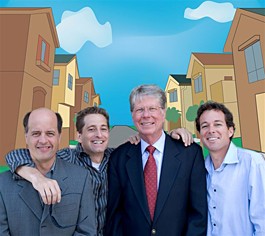
Enter the Suburban Comedy Tour. Featuring four decades of college-educated white guys—Andrew Norelli (28), Dave Burleigh (36), Mickey Joseph (46) and Ken Koskella (over 50)—this troupe focus their comedic foibles on the backyard, the bedroom, the kitchen table, the neighbor’s house, the soccer field and other places frequented by the suburban family.

Koskella, a former CEO who retired early but remains exactly the kind of executive who will simply call a journalist up if he thinks that an interview is warranted, has wanted to do comedy since he was a kid. Now that he can afford such, Koskella hired someone to teach him how to write sketches and perform standup. He soon found that audiences in theaters, as opposed to drunkards in comedy clubs, reacted favorably to his schtick about spending his kids’ inheritance and dealing with the cop who lives next door. Reading the Wall Street Journal one day, he came upon an item stating that today’s suburbans like to stay in the suburbs when they have fun, and not venture to the urban wilds. Why not, he wondered, give them exactly that?

Almost two years later, the Suburban Comedy Tour swings through what should be its spiritual home, Rohnert Park, on Saturday, Oct. 13. “We don’t particularly set aside the show for just suburban humor,” Koskella assures warmly. “It’s really about ourselves.”

Spreckels Performing Arts Center, 5409 Snyder Lane, Rohnert Park. 8pm. $21&–$24. 707.588.3400.


Museums and gallery notes.

Reviews of new book releases.

Reviews and previews of new plays, operas and symphony performances.

Reviews and previews of new dance performances and events.

Letters to the Editor

September 26 – October 3, 2007

ICE-breaker

I was interested to see this article (“Yo Soy el Army,” Aug. 29) finally published, having worked months ago with the author, Deborah Davis, to correct some of the misinformation that she had initially been given by others. I’m disappointed, however, to see many factual inaccuracies in the final version.

Among the most egregious errors is the repeated reference to ICE, or Immigration and Customs Enforcement, being responsible for military naturalization applications. In fact, military personnel file their citizenship applications with the same agency as every other citizenship applicant: the United States Citizenship and Immigration Services (USCIS). USCIS is not ICE. ICE is responsible for deporting immigrants, not naturalizing them, and no one files citizenship applications with ICE.

The process for applying for citizenship has been well-publicized on the Internet and in military units, and there’s a brochure that explains the process on the USCIS website.

USCIS also recently publicized its new hotline for helping military personnel with their immigration and citizenship applications. Rather than relying on the inaccurate information contained in your article, I suggest contacting a good immigration attorney or at least the hotline.

Lt. Col. Margaret Stark, Professor of military law, West point

Nothing Escapes Peta

We are rightfully outraged by visiting Iranian president Mahmoud Ahmadinejad’s taunting denial of the Holocaust. Yet at every meal, we deny the daily abuse and slaughter of millions of cows, pigs, and other innocent, feeling animals in U.S. factory farms and slaughterhouses.

There is no life before death for these animals. From birth, they are caged, crowded, deprived, drugged and mutilated. At the slaughterhouse, they are frequently dismembered, skinned or scalded, while fully conscious. Although 93 percent of consumers condemn such abuses, no state or federal law prevents them.

Like the “good Germans” of the 1940s, we have a fair idea of what goes on behind those walls, but we reject any reality checks. We fear that the truth might offend our sensibilities and perhaps even force us to change our diet.

This is why, on Oct. 2 (Gandhi’s birthday), 400 communities in all 50 states and two dozen other countries observed World Farm Animals Day with public education events. The purpose was to expose and memorialize the tragic use of animals for food and to promote an animal-free diet.

So the next time we are outraged by Ahmadinejad’s taunts or other injustices, let’s refuse to subsidize animal cruelty with our food dollars. Let’s observe our own World Farm Animals Day every day at the supermarket.

Steven Alderson, Santa Rosa

Girl Power

The Bohemian rocks! A big thank you from the members of Connections: A Forum for Women in Business, for getting out the info for our third annual gala fundraiser Sept. 11 that benefited the Circle of Sisters self-esteem-building girl’s programs (girl power!), local women’s shelters, and additionally provides funds to set up a new SSU scholarship fund.

Thanks again from Connections, the most fun women’s nonprofit organization in the North Bay.

Ilona Lea, Public Relations Director

Riverine

The Sonoma County Water Agency (SCWA) is seeking millions of dollars from the Bureau of Reclamation to build a huge pipe and pumping network in order to export treated wastewater from their contractor cities to southern Sonoma and Napa valleys for more agricultural irrigation. This would put added demands on SCWA water sources, including the Eel River, to supply new growth rather than maximize the reuse of treated wastewater to first displace potable water demands for landscaping, toilets, industrial and commercial uses.

Senate bill 1472 (Feinstein, Boxer) and HR 236 (Thompson, Woolsey) are funding bills requested by SCWA for this purpose, and they have already been heard in subcommittees in both the House and Senate. Friends of the Eel River urges you to write to Sen. Bingamen, D-N.M., expressing your opposition, as soon as possible: Sen. Jeff Bingaman, Chairman, Senate Energy and Natural Resources Committee, 703 Hart Senate Office Building, Washington, D.C., 20510.

Ellen Komp, Friends of the Eel River, Redway

The Ed.,
Covered in cardboard cuts and odd bits of tape


‘Peanuts’ Fashion

10.03.07

Last month, sinewy models swarmed into midtown Manhattan’s Bryant Park for fall fashion week. High-stepping it down temporary runways, their skinny shoulders bore the velvety weight—of the nation’s most important style event. But in at least one tent, the mood was anything but heavy.

In fact, this particular show began with a model hoofing it down in a sexy yellow number by Isaac Mizrahi. The dress looked vaguely familiar, its short hem sporting the iconic brown zigzag pattern on Charlie Brown’s T-shirt.

A few minutes later, another model strutted down the catwalk in a belted black frock. Sophisticatedly sucking her thumb—if such a thing is possible—the model wore as her key accessory a grayish scarf-cum-security-blanket slung over her shoulder, Linus-style. The comic-strip backdrop and Vince Guaraldi soundtrack made it unmistakable. This show was the fashion world’s homage to “Peanuts.”

Fittingly, Jeannie Schulz attended this first-ever MetLife Snoopy in Fashion show. “Snoopy was back [stage], greeting people and hugging people both before and after the show,” she said. “The models are all business, but Frederique [the Victoria’s Secret supermodel] had her daughter in the show, and her daughter loved it,” Schulz said.

On Oct. 6, the stylish effects from the show will be on view at the Charles M. Schulz Museum and Research Center in Santa Rosa. Among the attractions are five couture gowns, including the Mizrahi dress, sketches, video documentation of the shows and interviews.

Shuttled straight from New York, the garments recently arrived in a FedEx truck to Santa Rosa. Speaking together by phone from the Schulz Museum, curator Jane O’Cain and marketing director Gina Huntsinger described the experience.

“It was like Christmas,” O’Cain gushed.

“In a really nice house!” Huntsinger interjected.

“It took a morning to unpack them,” said O’Cain, who noted that each garment had been swaddled first in an interior dry-cleaning bag, then a garment bag, then bubble wrap and finally an outer box. Unlike their boxy ancestors, these outfits were body-conscious and elegant. Sex appeal and Charlie Brown? That’s a combination that only the psychiatrist’s booth might be able to explain.

O’Cain and Huntsinger’s faux Christmas morning includes a full-length sequined gown and tulle cloak that Laura Bennett (a finalist on season three of Bravo’s Project Runway) had designed, somehow inspired by Pig Pen; an exuberant wedding dress by the hip duo Heatherette; Pamella Roland’s shiny red and white blouse evoking Peppermint Patty; and a fairy princess take on Sally by the Broadway actress Kristin Chenoweth.

Had they tried anything on?

“I think there was one dress I could have probably gotten one leg into,” joked O’Cain.

So what if high-fashion seems incongruous in the North Bay. Just the opposite happened in New York, when Huntsinger, who had been observing backstage, prepared to change in time for the show. She couldn’t find her dress, a sale purchase from Macy’s. (“Cuz what do suburban housewives wear to a New York fashion show?” she asked. “She’s not really a suburban housewife,” O’Cain interrupted.) Huntsinger eventually wrapped herself in a sheet and found her dress. Someone had hung it on a rack of clothes the models wear during the show.

Sponsored by MetLife, the fashion show benefits Dress for Success, which helps disadvantaged women prepare for the job market, when the couture fashions are auctioned off on eBay this month. We’re just thankful that the Snoopy samples aren’t going directly to these job seekers. Wearing Betsey Johnson’s teensy-weensy “Peanuts” dress to an interview might give the wrong impression.

Snoopy in Fashion’ is on view Oct. 6&–Nov. 9 at the Charles M. Schulz Museum, 2301 Hardies Lane, Santa Rosa. 707.579.4452. While you’re there, peek in the gift shop to see some examples of high fashion’s first marriage to ‘Peanuts.’ In 1984, Vivienne Westwood, Bill Blass and others designed little wearables for Snoopy and Belle plush animals. Bidding on this fall’s designer creations runs through Wednesday, Oct. 31, on eBay to benefit Dress for Success.


DJ Shadow at Mill Valley’s Village Music

0

10.03.07


On Sunday night, amid the cavorting and eulogizing at Village Music’s closing party, DJ Shadow cues up a 45—”You’ve Made Me So Very Happy.” An appropriate send-off for John Goddard’s 50-year reign behind the counter of his Mill Valley record store, it also marks the final stretch of a unique spinning streak for the world-renowned musician.

“I just wanted to spend as much time here, and absorb as much as I could,” Shadow says, explaining his high-profile decision to spin records every day during Village Music’s final month. “I had a great time here,” he says, “and that means a lot to me.”

At a quarter to midnight, Village Music fills with diehard customers awaiting the store’s final moments, catching a last glimpse of history. Between handshakes and autograph requests, Shadow unsleeves a 45 of “I Second That Emotion” onto the turntable and drops the needle, keeping solemnity at bay.

Shadow (whose legal name is Josh Davis) first shopped these aisles in 1991, but it wasn’t until years later that he and Goddard made a deeper connection. One day, Goddard mentioned the best band he’d ever seen were Baby Huey and the Babysitters, a group legendary in the world of sample-based hip-hop. “I think he thought it was unusual, too,” Shadow says, explaining a kindred link, “that someone my age would even know who Baby Huey was.”

Shadow rifles through records, plays a novelty Doors medley and watches as half the store starts to sing along in the exact sort of communal experience that record stores were once known for. Strangers share stories, serving up potluck red beans and rice; at one point, a blues jam erupts, featuring customers and former employees spontaneously bemoaning the store’s closure. Someone encourages Shadow to sing a verse; he smiles and quietly shakes his head.

“I will miss this store very much,” he attests, just before the Champagne toasts and final goodbyes. Goddard cranks the manual cash register for the last few customers as the Mickey Mouse phone rings intermittently. Someone comes by asking to hear a Cornell Hurd record, and Shadow throws it on while the night winds down at his beloved hometown record store.

“In the last year, I’ve been to every continent on the planet buying records,” he says gratefully, “and I can honestly say that there’s no other place like this.”


Gaia Hotel and Spa Napa Valley

10.03.07

I almost always leave later than I plan to, with too little gas in the car. Now here I sit, stuck in traffic, unable to crawl forward or to switch lanes, my tiny car engulfed in the shadow of a truck that is hauling two stories’ worth of calves. This is how I make my way to Gaia Napa Valley Hotel and Spa, the world’s first Gold LEED Certified (Leadership in Energy and Environmental Design) hotel and spa: having had no lunch, late for an appointment, the tank almost on E and seriously considering vegetarianism. The smell emanating from the cattle truck is strong, and the adrenaline-filled eyes of the calves seek me out through the manure-covered holes in the sides of the truck, as if to say, “You, meat eater! This is your fault.”

Running on fumes, I at last reach my destination, the town of American Canyon in Napa County. Due to two accidents on Highway 29, I have had plenty of time to take in the local scenery, and while American Canyon may harbor some hidden nooks of beauty, they are not readily apparent. Maybe if there were some trees, anything, a bush even, this strip of wasteland would be more palatable, but as it is, there is little to see that one might want to call home about.

Once inside Gaia, however, I am soothed. If anything, the lack of natural beauty outside serves to emphasize the sensation of relief once one is embraced by the hotel walls. Thank God, I find myself thinking, I’m not out there anymore.

Being Gold LEED Certified means that the hotel is designed and operated following strict guidelines for environmental sustainability. The building materials have been harvested responsibly, and/or recycled; the paints, coatings, adhesives and sealants are low VOC (volatile organic compound); recycled tiles and granite are used throughout; and the large koi pond is filled with recycled water from the premises. As finishing touches, Gaia uses chemical-free landscaping practices, environmentally friendly cleaning products, bulk soap and shower dispensers, and, as a testament to its mission, provides a copy of Al Gore’s Inconvenient Truth in addition to the Gideon Bible in every room.

Despite all of these details, Gaia just looks like a nice hotel, but once I start poking around, I discover an array of green innovations. For instance, the bathrooms, the lobby and the upstairs areas are lit by skylights that act as little portholes to the outside world, filled with glass prisms that reflect down sunlight. In the lobby, three computer screens keep a constant measure of the hotel’s water and electricity use and CO2 emissions. Next to every trash can is a recycle can. The drought-resistant landscaping promises visual riches in the years to come. The Gaia restaurant, though not yet complete, promises to provide local and organic foods. The hotel linens are exclusively cotton, and down comforters, as opposed to polyester throws, grace the beds.

Spa manager Kate Riley gives me a tour of the premises, and then we discuss the ultimate reason for my visit, the spa. Riley tells me her vision of creating a wellness retreat using only the purest ingredients possible and providing the highest quality service. She envisions Spa Gaia as a place where locals and travelers will be able to take the time to care for themselves. To this end, locals (which to Riley means anyone living in the North Bay) can purchase a yearly pass that provides a 15 percent to 20 percent discount on all spa services, along with use of the pool, the unforgettable seven-headed shower and the steam room.

I am given a robe, a pair of slippers and led into one of the massage rooms. Here, I am lulled almost to sleep while I receive a combination of massage and a Thai coconut scrub. This was the first scrub I’ve ever had in my life, and I only get a massage about once every three years, which, considering how wound up I am, is pretty sad. (The last time I was lulled to sleep anytime before midnight was when I rode the public transit for a previous Green Zone column.)

As the treatment began, I could feel Riley’s words, combined with the massage therapist’s hands, working their voodoo, and I soon found myself thinking, “I deserve this. Poverty should not be allowed to get in the way of me and my spa treatments. It’s just not right.”

The truth is, I am not one who can usually afford to go to spas—no matter how green, no matter the locals discount—and receive body treatments. Yet here I am, getting my back scrubbed with some sort of organic, freshly prepared coconut concoction, and suddenly all of the bad things shrink away: the staring calves, the gas station attendant who didn’t want to give me my change, the shock of arriving at the world’s first Gold LEED Certified hotel only to find it so awkwardly placed. None of this matters anymore, and as I lay there, soft music floating out of a speaker, warm unbleached cotton towels draped around my neck and over my eyes, I am filled with a temporary sense of serenity that whispers in my inner ear: You should start doing this every month.

Just charge it.

Gaia Napa Valley Hotel and Spa, 3600 Broadway, American Canyon. 707.674.2100. To contact Spa Gaia directly, call 707.674.0168.


News Briefs

10.03.07

Smile, Santa Rosa! You’re on camera. Surviellance in the North Bay.

For future reference, don’t pick your nose in downtown Santa Rosa—even if no one else is in sight. Buoyed by the success of last year’s undercover sting operation using mobile cameras, the Santa Rosa Police Department recently received the go-ahead to install eight permanent cameras in and around Old Courthouse Square. “The areas that we will be videotaping are public areas,” says Santa Rosa Police captain Tom Schwedhelm. “The Supreme Court has ruled that there is no expectation of privacy in a public area.”

However, access to the live camera feed (seen on monitors in dispatching) and to the resulting tapes will be limited. “We’re very sensitive to this issue,” Schwedhelm responds when asked about the “Big Brother” aspect of the project. “We don’t want to invade anyone’s privacy, but there are some police concerns in the downtown area. We want to make it a safer place, and this will enhance our ability to do that.” He adds, “I firmly believe this is a very efficient use of our tax dollars.” The project’s total budget is $150,000; the eight cameras are expected to cost $3,000 to $7,000 each for a total of no more than $56,000. They should be installed by the end of this year.

Santa Rosa already has two cameras in its transit mall and several in its parking garages. The Petaluma Downtown Association is installing eight cameras, using a system with a capacity for 12. The goal, says association executive director Maire McCusker, is to prevent vandalism and protect property. Installation is planned for November.

A number of schools throughout the North Bay use surveillance cameras; many operate only after school or on weekends, to prevent or record acts of vandalism. Other campuses use them during school hours as well, but only review the tapes after an incident. A spokeswoman for the city and county of Napa and the city of American Canyon said those municipalities do not use surveillance cameras in public locations. Neither does the county of Marin. The city of San Rafael has live cameras in some high-traffic intersections, but not in predominantly pedestrian public areas.

One community that has embraced surveillance cameras in a big way is Ripon, near Modesto. This city of approximately 14,500 people and 28 police officers spent more than $500,000 in 2005 for an extensive mesh network with 54 cameras. “It’s been a pretty good deterrent for us,” says Lt. Ed Ormonde. “People pretty much know that there’s going to be a camera nearby if they’re committing a crime.”


Stage preview: SRJC’s New Season

0

10.13.07

It was violent, it was shocking, it was overflowing with this amazing and beautiful Spanglish language—from beginning to end it was completely, totally irresistible!”

Leslie McCauley, department chair of the Santa Rosa Junior College theater arts program, is describing the first time she read the script for Luis Alfaro’s Electricidad, which was published in its entirety in the pages of American Theater magazine last year. The play, set in the barrio of Los Angeles, is based on the Greek myth of Electra, in which two abandoned siblings, Electra and her brother Orestes, conspire to kill their royal mother and her lover in revenge for the murder of their father. In Alfaro’s version, Electra (Angela Favreau, above) is an angry young chola, the language is a lyrical mix of Spanish and English, and, yes, the big, bad mama gets what’s coming to her.

It’s a bold start to the theater arts season at SRJC, where attention-grabbing kick-offs have become something of a tradition. Last year, the season commenced with Stephen Adly Guirgis’ controversial The Last Days of Judas Iscariot. The rest of this season’s plays bear a similar knack for aggressively spreading modern-day attitudes across classical or historical settings. Following Electricidad is Elton John and Tim Rice’s rock ‘n’ roll adaptation of Verdi’s epic love-and-death opera Aida. On Broadway, the John-Rice version, produced by the Walt Disney folks, dazzled audiences and offended parents, who assumed the Disney brand meant a lack of sex, political intrigue, murder and suicide pacts. “It’s so big,” McCauley laughs, “possibly the most ambitious musical we’ve ever attempted, but if you don’t keep pushing yourself, you grow stale.”

In January, the season continues with another relatively new and potentially challenging play, Jim Leonard’s Anatomy of Gray, in which a small, God-fearing village is thrown into a panic of fear and suspicion when a mysterious plague descends that seems to be killing only the most righteous, Christ-loving citizens. In March, Wendy Wisely directs Dale Wasserman’s popular tragicomic version of One Flew Over the Cuckoo’s Nest, and the season concludes with Jon Jory’s new adaptation of Jane Austen’s Pride and Prejudice.

“It’s a brilliant adaptation,” says McCauley of Pride, “set very simply, and told through a series of scenes that take place within the context of an 19th century dance party. It is consistent with a season that presents wonderful, important old stories in new, original ways.”

Electricidad runs Oct. 5&–6 and 10&–14 at the Burbank Auditorium, SRJC campus, 1501 Mendocino Ave., Santa Rosa. Wednesday&–Saturday at 8pm; matinee, Oct. 13&–14 at 2pm. $5&–$15. 707.527.4343.


Museums and gallery notes.

Reviews of new book releases.

Reviews and previews of new plays, operas and symphony performances.

Reviews and previews of new dance performances and events.

Opinion: Marin Countywide Plan

0

On Sept. 11, the Marin County Board of Supervisors unanimously agreed to include maps in the countywide plan with proposed trails through working ranches and farms without landowner permission. The plan calls for 126 miles of new trails. There are already 840 miles of public trails in the county, and the proposed trails in the plan put an unrealistic burden on ranchers.

It mattered not that environmental groups, including the Environmental Action Committee of West Marin, Sierra Club and Marin Audubon, spoke against the proposed trails. It mattered not that the 50 or so ranchers present spoke out against trails through their land. Not one person spoke in favor of having trails go through working ranches and farms.

Public access through working agricultural properties can disrupt operations, introduce animal disease, degrade sensitive wildlife habitat, increase the chances of theft and vandalism and could lead to insurance claims against landowners if accidents occur.

The majority of the supervisors seemed inclined to remove the language in the plan that would allow the county to obtain public trails through eminent domain. However, District 4 supervisor Steve Kinsey insisted that the language remain in the plan, as he did not want to tie the hands of future supervisors. What is a rancher to think of that?

If the county wants to dedicate a trail, the threat of eminent domain hangs over ranchers heads like a guillotine.

All who testified were against the trails, for one reason or another. So why do we have ranch trails on maps for inclusion in the Marin countywide plan? Who wants them? And more to the point, how is the decision made to approve something that most people are strongly opposed to?

One argument made by Supervisor Kinsey was that the 1994 plan included many of these trails, so they had to include them. In this case, we wonder why we have an update to the countywide plan at all. If a part of the plan does not make good sense, is this not the time to remove or change it?

There is another way. We support voluntary agreements between the county and agricultural producers on a case-by-case basis, the proverbial willing seller and willing buyer. If a rancher wants to dedicate a loop trail on his property, great, but his neighbors should not be pressured into dedicating a trail as well, no matter how many trails it would link up.

We support improved trail access for Marin’s citizens, but it shouldn’t come at the expense of local farmers and ranchers, especially when we have better trail access in Marin County than any other in the Bay Area.

We ask the supervisors to re-examine the county’s approach to improving trail access in Marin County. Please remove the proposed trails going through ranch and farmland from the maps unless approved by the landowners, and change planning direction toward a system that encourages voluntary trail easement dedication rather than coercion.

At the Sept. 11 meeting, the Board of Supervisors chose to ignore the public’s overwhelming opposition to the county trails plan. We ask them to listen more closely and reconsider their decision.

If you agree that the trail maps should only show trails that landowners have agreed to and that all agreements should be voluntary, please contact the Board of Supervisors at 3501 Civic Center Drive, Room 329, San Rafael, CA 94903, bo*@*********ca.us or call 415.499.7331.

Remember, we will only get the plan we want if we ask for it.

Mike Gale is the president of the Marin County Farm Bureau. Frederick Smith is the executive director of the Environmental Action Committee of West Marin. The Bohemian welcomes feedback. Write ed****@******an.com. The Byrne Report returns next week.


News: Young Men’s Ultimate Weekend

0

Photograph by Richard Quinn
Stand up, line up and shut up: Marin’s Mark Schillinger introduces the radical notion that young men are already just fine as they are.

First came the women’s movement, followed by the men’s movement, the first seeking to redress generations of inequality and oppression, the second working to salve the emotional wounds and role confusions caused by decades of newly empowered women telling jokes about how men are just the worthless piece of skin at the end of a penis.

While no one was looking, the men’s movement and the women’s movement had a baby (lots of them, actually), and that exuberant burst of tentative, testosterone-powered hollering and soulful wailing you hear is the sound of that offspring taking its first complicated steps away from the nest and out into the world. Call it the boys’ movement (there’s a girls’ movement too, but that’s another story), and you’d better cover your ears, because the freshly unleashed howl that all those young men are making—the whoops and hollers of socially orphaned boys morphing uneasily and unstoppably into manhood—is about to get much, much louder.

“For years, young men have been in a state of crisis because their needs have not been met, and they have not been properly instructed in how to become young men,” says Dr. Mark Schillinger, a San Rafael chiropractic physician and the founder of the Young Men’s Ultimate Weekend, a rapidly expanding rites-of-passage program designed to encourage mentorship of teens and to initiate young men into adulthood with a sense of integrity, respect, energy and community involvement.

“We’ve tried and failed,” explains Schillinger, “to control young men’s impulses and force them to be good, well-behaved boys, and when they’ve acted out, we’ve tried to control that behavior with psychological procedures that don’t always work, like talk therapy. If we are going to be effective in getting our young men to be respectable and responsible adults, to be responsible for their own youthful energies, then we have to start from a position of respecting them, recognizing that there is nothing wrong with them, that they are already free and enlightened, that being male is not a liability, that testosterone is not a disease.”

The first Young Men’s Ultimate Weekend (www.ymuw.org) was held in Marin County in 2000, and now Schillinger oversees several similar weekends all over the state (the next weekend takes place in Fairfax the weekend of Oct. 19–21). According to Schillinger, YMUW is visible evidence of a powerful national trend in which boys, after years of societal neglect, are benefiting from an increased focus on their healthy transition into manhood. In August, a provocative cover story in Time magazine made the case that generations of boys have suffered from a kind of national disregard, a situation that, according to Time, is now finally being corrected.

“It is men’s obligation to initiate young men, to pass down to them their role in society, which is to make the world safe and secure—that’s the primary role of the male, and it has been for thousands of years,” Schillinger says. “Initiating young men is not just some nice thing to do; we’re saying it’s a necessary thing to do. When a community is safe and secure, when the world is safe and secure, then all men and all women are free to creatively express who they are.

“This is not coming from some chauvinistic perspective. Not even close! We tell these boys that men and women are absolutely equal, but we express ourselves in very different ways, and that’s OK. We are saying that it’s the job of the men to make the world safe and it’s the job of the older men, the mentors, to initiate the young men to do that in their place when they are gone.”

Impressed by a similar initiation event he witnessed in Canada in the late 1990s, Schillinger, a single parent of two grown children, organized the original 2000 YMUW in part so that his own son would have the opportunity to express his fears and concerns about becoming a man, to witness examples of older men expressing their emotions and to learn basic leadership skills he would need for responsible male adulthood. At that first weekend, Schillinger and a core group of mentors—all YMUW mentors must now undergo a thorough training process—developed what Schillinger calls the R.I.G.H.T. Way. R.I.G.H.T (and, yes, that’s been trademarked) stands for “Respect, Intelligence, Gallantry, Humor and True.”

While some assume that the YMUW is aimed at “at-risk” boys, low-income or otherwise “troubled” kids who’ve been referred by the authorities, Schillinger says that the average attendee of the weekend—and there have been thousands over the last seven years—is your average young man, age 13–20. Many of them come from stable families with modest to high incomes.

“The thing is, in our society, every young man needs to be initiated into adulthood, not just the boys whose parents think they have problems. All children are at risk, and every boy needs men who are not his parents to organize an initiation. These kids are bursting with energy they are told to suppress, stewing in a bath of testosterone they don’t know how to handle, bursting with feeling and emotions that are too big for them and certainly too big for their parents. I’ve traveled all around the world. I’ve watched how other cultures initiate their young men, and the parents are never around when that initiation thing is going down. It is done by the wider community in which the young man lives.”

With the YMUW, boys are initiated by experienced older males who know what they are going through and who are trained and prepared to give those boys a weekend crammed with the one thing they most crave: the unconditional respect of adults, especially elder males.

The heart of the YMUW is the initiation ritual itself, a “ceremony of grieving,” which takes place at a bonfire near midnight on the second night. The initiation has come to be known as the Hundred Man Ceremony, because of the presence of a large number of men from the surrounding community. The initiation allows each boy to individually express everything he is angry, sad or unhappy about, and to grieve loudly and openly, with as much intensity as necessary, for the losses and sorrows he has known and to mourn the end of his childhood.

“It’s all very Lord of the Rings–ish,” Schillinger laughs, “but I can’t tell you how powerful it is to watch these young men be welcomed into manhood by this ring of men, to watch boys stepping up to adulthood and changing into responsible, respectful men right before our eyes.”

Perhaps the most significant part of the weekend occurs the next day, when Schillinger meets with the attendees’ parents, charging them to try to see their sons with new eyes.

Says Schillinger, “I always tell them, the mothers and fathers who’ve come to pick up their kids, ‘Your sons have just gone through a life-changing experience. This wasn’t easy. Can you look past the boys they’ve been and respect them for the men they are? They are only 20 or 30 years younger than you, and in a 15-billion-year-old universe, that ain’t very much. Can you stop making your kid your therapist, can you stop taking out your life frustrations on them, can you model what is right for you all the time? Can you inspire them to live the right life?’

“Young men want to make their communities and their families and their world safe,” he continues. “They have been suffering because society, in general, has come to look down on young men, viewing them as potentially dangerous, as lazy, as stupid. So why are we so surprised when our sons start acting that way?”

Schillinger, who sees YMUW as the blueprint for a kind of alternative Boy Scouts that he predicts will be developed over the next decade, and who plans to launch a Young Women’s Ultimate Weekend in 2008, believes that these structured initiations are just one more sign that the days in which boys were left to fend for themselves, or to find their own initiation though gangs, drugs or violence, are coming to an end. It’s up to the adults, he says, to force themselves to see the man in the boy, and to make a conscious effort to give the young men of their communities the benefit of their own experiences.

“Young men don’t need to be fixed,” he says. “They need to be told that they are already fixed, that they are fine, that there is nothing wrong with them. Young men today need to feel that they are worthy of respect—because they are.”

To learn more about the upcoming Young Men’s Ultimate Weekend, to inquire about volunteering, or to ask about joining the ritual as one of the ‘hundred men,’ visit www.ymuw.org or call 800.719.9302.


White Collar Guffaws

10.10.07You got your Kings, your Queens, your Redneck and your Blue Collar comedy tours, so why not the middle-class white guys from the suburbs, too? After all, the only ones laughing at them with any regularity are their wives and kids; clearly the audience could be wider than just that seated at the dinner table.Enter the Suburban Comedy Tour....

Letters to the Editor

September 26 - October 3, 2007ICE-breakerI was interested to see this article ("Yo Soy el Army," Aug. 29) finally published, having worked months ago with the author, Deborah Davis, to correct some of the misinformation that she had initially been given by others. I'm disappointed, however, to see many factual inaccuracies in the final version. Among the most...

‘Peanuts’ Fashion

10.03.07Last month, sinewy models swarmed into midtown Manhattan's Bryant Park for fall fashion week. High-stepping it down temporary runways, their skinny shoulders bore the velvety weight—of the nation's most important style event. But in at least one tent, the mood was anything but heavy.In fact, this particular show began with a model hoofing it down in a sexy yellow...

DJ Shadow at Mill Valley’s Village Music

10.03.07On Sunday night, amid the cavorting and eulogizing at Village Music's closing party, DJ Shadow cues up a 45—"You've Made Me So Very Happy." An appropriate send-off for John Goddard's 50-year reign behind the counter of his Mill Valley record store, it also marks the final stretch of a unique spinning streak for the world-renowned musician."I just wanted to...

Gaia Hotel and Spa Napa Valley

10.03.07 I almost always leave later than I plan to, with too little gas in the car. Now here I sit, stuck in traffic, unable to crawl forward or to switch lanes, my tiny car engulfed in the shadow of a truck that is hauling two stories' worth of calves. This is how I make my way to Gaia Napa...

News Briefs

10.03.07 Smile, Santa Rosa! You're on camera. Surviellance in the North Bay.For future reference, don't pick your nose in downtown Santa Rosa—even if no one else is in sight. Buoyed by the success of last year's undercover sting operation using mobile cameras, the Santa Rosa Police Department recently received the go-ahead to install eight permanent cameras in and around Old...

Stage preview: SRJC’s New Season

10.13.07"It was violent, it was shocking, it was overflowing with this amazing and beautiful Spanglish language—from beginning to end it was completely, totally irresistible!" Leslie McCauley, department chair of the Santa Rosa Junior College theater arts program, is describing the first time she read the script for Luis Alfaro's Electricidad, which was published in its entirety in the pages...

News: Young Men’s Ultimate Weekend

Photograph by Richard Quinn Stand up, line...
11,084FansLike
4,606FollowersFollow
6,928FollowersFollow