News Briefs

09.12.08

Rehab Rumble

New residents were scheduled to move into Sausalito’s Alta Mira Hotel on Sept. 10, sparking opposition from neighbors and officials who said they weren’t notified about the change. Owners Michael and Ray Blatt are converting the hotel and adjacent homes into a drug and alcohol rehabilitation center, due to open with 18 beds this month; 30 more will follow. Monthly charges to stay there are expected to run $42,000&–$48,000. Under state law, facilities with six or fewer beds are licensed without local review. The Blatts obtained permits for eight contiguous sites, each with six beds. Together, they form a 48-unit rehab center, which neighbors charge is too large. The city of Sausalito has hired a San Francisco law firm to pursue legal opposition. “We just think this is a perversion of the law by the developer,” says Sausalito mayor Mike Kelly. About 200 people showed up at a Sept. 6 meeting sponsored by state Sen. Carole Migden. According to a spokeswoman, Migden has contacted the attorney general about stopping the project and is also drafting legislation to limit the number of rehab sites in one neighborhood.

Timber Plan Delayed

The Bohemian Club continues to pursue approval of a timber-management plan allowing logging of up to 1 million board-feet annually from the Bohemian Grove near Monte Rio. As reported in these pages July 4, club officials contend that their plan will reduce the hazardous fire danger. Opponents argue that it will have the opposite effect. The plan was tentatively scheduled for a meeting in August, but that has been pushed forward until mid or late October while officials review endangered species information. “It’s just taking time get the work done,” explains state employee Ron Pape, who’s overseeing the approval process. A Sept. 5 letter from State Assemblymember Patty Berg urges officials to deny the club’s application.

Red Tape Rescue

The County of Napa recently upped its budget from $60,000 to $140,000 for Maximus Inc., a consultancy firm assisting the county in its bid for more than $5 million in federal funds for damages sustained during the 2005 New Year’s Eve flooding. Maximus offers expertise in navigating the application and approval process. The County of Napa has already received some money, but is seeking $1.9 million for applications that are currently in the second appeal process, and another $3.9 million in which federal cost estimates were significantly lower than those by county engineer.


Ill Communication

0

09.29.07


When outside of the North Bay, being a Bohemian writer means constantly illuminating others with comparisons to the SF Weekly or other familiar alternative weeklies. So when I received an e-mail from the Beastie Boys’ management inviting me to participate in their latest promotional roundtable interview, I was skeptical but also intrigued. A new Beastie Boys album is an event, but this time they’re promoting The Mix-Up, their first album devoid of samples and consisting entirely of instrumentals, funky interludes previously only served up in small doses alongside more pleasing hip-hop tracks on their past discs.

I naturally started researching for what would surely be a White House&–style press conference. The three Jewish kids from New York who’ve been part of virtually every important musical movement in my lifetime, from early ’80s hardcore and rap music’s commercial ascension to the socially conscious, genre-bending, pseudo-DIY aesthetic of the “alternative” ’90s. The guys who went from hedonistic, frat-boy pranksters to the ultra-hip, China-boycotting Bob Geldofs of my generation. The group that persist as the best head-bobbing reminder of punk and rap’s closely knit origins–I mean, these guys made Paul’s Boutique, for God’s sake!

And so, armed with over a dozen well-constructed questions, I strolled into a hotel off Market Street ready. I felt confident–until I walked in the room.

Instead of a mob of journalists, just a few were seated at a tiny boardroom table. For all my self-assurance, I had planned on at least a little anonymity. After some pleasant chitchat with the others, in walked the Beastie Boys. Other than assorted crow’s feet, smile lines and gray hair, they still look quite youthful. I tried hard to bury my starstruck feelings as Mike D poured himself a glass from the same I pitcher I had just used!

As the interview got underway, it seemed more like a comedy routine than a press conference, with Michael “Mike D” Diamond, Adam “Ad-Rock” Horowitz and Adam “MCA” Yauch giving smart-alecky, bullshit answers to questions about the Rock and Roll Hall of Fame and other artists sampling their music. They were relaxed and talkative with the journalists and each other, joshing as if they were sitting on a brownstone stoop back east. Then it was my turn.

It seemed with the Tibetan Freedom Concerts and your work with Milarepa in the late ’90s that there was a momentum in this country in regards to human rights issues, especially in China. How do you feel that the state of it is today, a decade later?

(The longest pause in history. Crickets chirping.)

Ad-Rock (sullen): I don’t know. That’s an honest answer.

(Long pause)

Mike D (hesitant): I’m going to try it. Definitely it seems like . . . um . . . it’d be nice if human rights were focused on, especially in the consumer process that we all go through.

So have you guys gotten involved in things like fair trade?

Mike D: I don’t know if we’re more involved . . . although I do support it. (Long pause)

Ad-Rock: Dude, you killed the mood with that whole thing.With this comment, laughter returned to the room for a moment before MCA, the group’s resident Buddhist and creative force behind their Tibetan causes, expressed some disillusionment with his benefit work.

“The first year or two that we did the concerts, you’d call up the artists and ask them to play, and they were really enthusiastic about it,” he said. “Come the fifth year, they’d be like, ‘Oh no, here comes that call again.’ And in terms of the media, too, it started to get redundant. I think our culture so much just wants something new.”

Then it was right back to the tomfoolery, with the Beasties riffing whether or not eBay patronage is technically thrift store shopping, hassling a friend of their publicist who just wanted to sit in (“What exactly are your credentials?”) before embarking on a five-minute discussion on the Knicks’ chances this year. When talking of dream collaborations, they mentioned magician Criss “Mindfreak” Angel before feigning admiration for another popular artist. “I enjoy artists like Sting,” MCA deadpanned. “I mean, I don’t know his music, but his fashion sense . . .”

The activism question had been a chore for them, so I thought I’d ask about The Mix-Up, which hadn’t yet been discussed. This one couldn’t miss.

Some people affectionately refer to the new album as ‘porno music.’ What do you guys think of that?

MCA (immediately): Are you the Debbie Downer of this . . . (Laughter throughout the room.)

Ad-Rock: So, you go from human rights to porno?

Mike D: I think that we’re a very sexy group, and I’m glad that people want to celebrate us that way.

Are you guys trying to prove anything as musicians with this album?

MCA: Ouch.

Ad-Rock: Are we still on the pornography thing?

MCA: It just seemed like a good idea at the time, you know.

Ad-Rock: Yeah, I don’t think we’re good enough to try to prove anything like that.

MCA: We were just trying to make some shit that sounds cool to us and see if anyone else is feeling it.

(Long pause.)

Ad-Rock: But I like pornography.

MCA (to Ad-Rock): You’re a huge fan of the whole genre?

Ad-Rock: Yeah, it’s wide open, you know.

I guess I bummed the Beastie Boys out and insulted their musical talent. As a journalist, I felt wonderful. As a fan, not so great.

Later that night at UC Berkeley’s Greek Theatre, their triangular chemistry translated to the more familiar call-and-response in classics like “Shake Your Rump” and the party anthem “Brass Monkey,” a highlight for the mostly college-aged crowd. Like the Beastie’s best albums, their show was a seamless blend of hip-hop, punk and instrumental lounge-funk. Although The Mix-Up is a bold new step for the group, it was hard to ignore the mad rush for the restrooms and beer stands every time the men broke out their instruments. It’s no wonder they saw the need for the “gala” instrumental show at the much-smaller Warfield Theatre the night before.

As I sipped my first Beastie beer ever purchased with a real ID, wondering why anyone would invite journalists from all over the Bay Area just to dodge their questions for kicks, the closing number seemed to offer a clue. A familiar refrain was building and building until audience and band screamed at full volume, “Listen, all y’all, it’s a sabotage!” I guess the Beastie Boys never have stopped pulling pranks on people. And what an enjoyable prank it was.


A Changing Landscape

0

Photograph by Edward Troxell
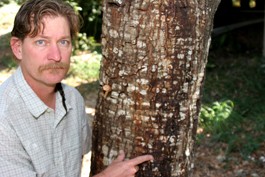
Case in Point : Biologist Brock Dolman underscores the tell-tale weeping black signs of SOD on his property.

By Patricia Lynn Henley

A few years ago, Michael Kelley realized that the hillsides on his 20-acre property near Rio Nido were covered with brown tan oak bushes and trees–dead ones or those that were quickly dying.

“They looked like they got spray-painted overnight,” Kelley recalls. “It was kind of creepy. They looked like they’d been hit with the evil witch’s magic wand.”

Two months ago, he made a routine hike around his place to see how things were doing. Two treasured oaks, which had appeared to be fine a month earlier, had succumbed to sudden oak death (SOD).

“It was our most amazing place. We called it the ‘lost world,'” Kelley says of the portion of his property that he and his wife always show to agile visitors able to make the 20-minute trek. “Now the two–not the tallest but the grandest–trees are suddenly dead.”

There’s not much Kelley can do but watch, wait and haul out the dead.

“We’re not kids anymore, and it’s tough going up these hills with chainsaws and taking trees down,” he sighs. “It’s a slow process, and I don’t think our progress is keeping up with the spread of the disease.”Kelley realizes that the land around him is undergoing a fundamental change. “We’re moving into a new look around here. I don’t know what it’s going to be, really.”

Kelley is one of nearly a hundred people who gathered in Occidental on Aug. 18 for a community meeting about SOD. They listened to experts explain what’s known about a disease that has killed more than 1 million trees in California since it was first detected in the early 1990s, and they aired their own worries and SOD-related problems.

Sudden oak death is fatal to tan oaks and coast live oaks, among other species. The microorganism that causes it can thrive on more than 105 host species and is often spread through water runoff from the California bay laurel. The disease has hit particularly hard in the North Bay’s redwood fog belt, especially after wet springs in 2005 and 2006 created prime conditions for the organism.

“It was kind of the perfect storm as far as spreading the pathogen. There have been tons of new infection, tons of new die-off as a result of those two wet springs,” says Katie Palmieri, spokeswoman for the California Oak Mortality Task Force.

Known as Phytophthora ramorum, the SOD organism is currently found in 14 coastal California counties. Its spores travel through water. The wet conditions of recent years haven’t prompted its discovery in new counties, but they did intensify its presence in existing locations, including Napa and Marin.

“In some areas, the infection rates are even higher than they were at the original infection time, which was large,” Palmieri says.She adds that everyone needs to be involved in stopping the spread of SOD, which was recently found inside Santa Rosa city limits. “There’s no magic fence that stops it from moving from one location to another.”

The disease has hit in a relatively small area of Oregon, where officials tried to eradicate the problem by extensive tree removal. “What they’ve found so far is that they’ve really knocked it back hard, but they still find it in the soil,” says Lisa Bell, Sonoma County’s SOD coordinator. “As of now, even the most radical eradication efforts haven’t worked.”Although Napa is infected, it has not been hit as hard as Marin and Sonoma counties. “So far, what we have found is that it tends to be on the west.

For those who are aware of the signs, the North Bay is undergoing a fundamental change. Just as Dutch elm disease altered the Eastern states, sudden oak death may be permanently revamping our local landscape, says Marin County forester Kent Julin.”We’re going to see a shift in the kind of forest that we have. It’s kind of like a slow-moving wildfire that will change the character of the forest.” In the process, it’s also raising the risk of actual fire.

“It has never been more dangerous than it is right now,” Julin adds. “We’re in a place where we have a lot of standing dead material in the forest. As that falls on the ground and decays, the fire danger diminishes, but right now we have standing dead trees with dead leaves on them that are highly flammable.”

On the 19,000 acres managed by the Marin Municipal Water District, there are areas of tan oaks with a 100 percent die-off rate, says spokesperson Carl Sanders. It’s not possible to remove them all, so the district is focusing on areas that pose the biggest safety risk.

“We’ve certainly lost a number of significant heritage live oaks around our facilities and roads that it’s been heartbreaking to have to remove,” Sanders says. “We’ve had to take down numerous trees that were 100 to 200 years old last year. It’s a shame to have to see these big old trees that have to be dropped.”

There are also a lot of dead trees a little farther north, says Bell. “The effects of those wet springs is what we’re probably seeing now in the field, which is a lot of mortality, especially in the West [Sonoma] County. But this pathogen is so new, the patterns are just being discovered.”

Intensive research is being done. Researchers have pinpointed the chemical Agrifos as a potential preventative treatment, but there is no cure.

Working to prevent infection in a single tree by using the chemical Agrifos is similar to using chemotherapy, says Brock Dolman, a biologist with the Occidental Arts and Ecology Center. “If you would like to save a charismatic individual tree, and it’s not already in an advanced stage of disease, it’s possible to apply this protocol and save an individual tree.”

But the problem is much larger than that. “We’re very much struggling with how do we manage the whole ecosystem, and we have some special trees that we don’t want to see die. How much do you do for one tree?”

Dolman lives on 80 acres in western Sonoma County as part of the 11-member Sowing Circle LLC. In the last month, they’ve spent almost $10,000 to have a professional arborist remove dead trees on their property.

“In the last two or three years, I’d say maybe 90 percent of the large tan oaks on our property have died,” Dolman says. He estimates that about 50 percent of their coast live oaks are showing advanced SOD symptoms.The spread of SOD shouldn’t really be a surprise to anyone, Dolman says, citing the extensive impact people have had on local woodlands in the last 100 to 200 years. “It doesn’t take much in a system that’s already weakened.”The Sowing Circle are considering using Agrifos to save some of the larger trees, and are experimenting with a special compost tea blend to add nutrients and other organisms to woodland soils in an effort to improve the overall forest health. Results have been mixed, but they keep trying.

“We’re witnessing more and more trees being infected and more and more trees dying,” Dolman says. “I think we’re all feeling deeply challenged by having to sit and watch basically an epidemic moving through this ecosystem.”

An SOD meeting is slated for Oct. 20 at Santa Rosa’s Finley Center; Phone 707.565.6070.

Forest Stewardship workshops with SOD information are scheduled Sept. 29 in the Mark West Creek watershed and Oct. 13 near Occidental. Phone 530.224.4902. Details about SOD are online at www.suddenoakdeath.org.


Seeds of Wonder

0

09.12.07

Wherever they are coming from, Jesca Hoop’s new album promises listeners the unexpected. Those unfamiliar with Jesca’s music will probably think, “Gee, this is pretty weird,” while North Bay folk who recall her days with Majesty’s Monkey five or six years ago may think “Wow, this is pretty normal.”

You put Kismet on for the first time and hear “Summetime” (no, not that “Summetime”), which begins with a chorus of Jescas performing the vocal equivalent of sun salutations. But then the chorus commences what can only be described as a gorgeous yodel, the drums come in, and then the song abruptly steps down from sun-kissed bliss into a brief foray into sultry and sticky territory. It’s at once very slick and very unusual.

Hoop’s voice changes shape from song to song—sometimes it has an innocent, girlish quality, while other times she’s diabolically seductive. And sometimes she just sings, such as “Love Is All We Have,” one of Kismet‘s quieter moments. “Seed of Wonder” is Kismet‘s highlight and is perhaps the best distillation of what makes Hoop’s songs so innovative. With nothing but a guitar, percussion and a mass of Hoop’s overdubbed vocals, “Seed of Wonder” treads on Americana folk ballad territory, hip-hop, and Kurt Weil cabaret. With a mess of changes and coming out of nowhere, it’s a song that’s eating its own tail, structurally; you can never figure out where it’s coming from or going to, and therein lies its appeal.

Tom Waits comparisons are going to be unavoidable for Hoop, considering her background, and “Money” is probably the song that will be singled out as most Waitsian, with its Rain Dogs guitar sound. The understated “Silverscreen” begins as a sweet little old-timey ditty, but shifts into territory with just the right edge of menace; it’s both pretty and creepy.

Listeners craving more wackadoo material may be initially crestfallen, but not all of Kismet’s more straightforward material is Kismet’s lush closer, “Love and Love Again” is flush with the swoon of a golden age Broadway tune.

The strongest and most distinctive unifying aspect of Kismet is Hoop’s vocal phrasing, which is not jazzy or improvisational so much as utterly in tune with her creative nerve center; she sustains notes when you expect no notes, and she bundles lyrics up in small spaces when you expect her to stretch them out. Words come out of her in a way that often defies prevailing logic, but, in the context of her music, sounds perfectly natural. You get the sense that no one could sing these songs but her.

It’s going to be interesting to see what audience responds most to Hoop. Though a good chunk of its material is wildly inventive, Kismet is not the kind of record that indie rock critics stumble over themselves to champion; meanwhile, some of Kismet‘s more straightforward songs would not be out of place on adult contemporary radio. Where does this place Hoop? Her talent and singularity are palpable on Kismet, and one can’t help but wonder what she has up her sleeve for the future.


Fully Launched

0

09.12.07


In the movie version of To Kill a Mockingbird, there’s a moment late in the film where Miss Maudie Atkinson tells Scout and Jem, “There are some men in this world who are born to do our unpleasant jobs for us.” She’s talking about the lawyer Atticus Finch, whose job includes standing up to the prejudices and intolerance of the racially divided town of Maycomb.

Those same words could also apply to Sam, who works in a basement taking phone reservations at a popular New York restaurant in Becky Mode’s hysterically funny one-actor play Fully Committed. His is a job that involves juggling bad-mannered and demanding customers, withstanding an onslaught of condescension and petty cruelty, assuaging the egos of the manic-depressive maitre d’ and the passive-aggressive owner-chef, and occasionally cleaning up soiled restrooms, all while squeezing reservations into a calendar that is completely booked–excuse me, “fully committed”–for weeks and weeks. By the end of the 90-minute play, poor Sam has earned his place among men like Atticus Finch and the other unsung heroes who must toil and sweat and say nice things to rude people every day of their lives.

Unlike Atticus Finch, however, Sam–to use the vernacular of New York basement dwellersis– fucking hilarious. Played on alternate nights by actors Dan Saski and Justin Scheuer, Sam is a marvelous theatrical invention whom we get to watch evolve and grow over the course of a single busy pre-Christmas day in which the struggling and discouraged would-be actor finds himself manning the phones all alone and ultimately discovering a grain of self-determination that he didn’t know he had.

What is marvelous about the script is that the actor playing Sam is also required to play all the characters he talks to on the phone or on the restaurant’s intercom. On opening night, Scheuer was the actor in the hot seat, morphing seamlessly from Sam to the chef to the haughty Mrs. Van Deveere (whose husband may have invented Saran Wrap) to the pestering gay assistant of a famous actress (“No female waitstaff at the table, please!”), back to Sam and so on.

Much of the humor is broad, but a great deal of it is subtle; Sam, as played by Scheuer, always answers the phone with the same measured reading of “Good morning, reservations, can you hold please?” no matter what has just occurred or how flustered and overwhelmed he feels, a schtick that just gets funnier and funnier as the show proceeds. Even Atticus Finch, who knows a thing or two about thankless jobs, would be amused.

Very nicely directed–with a strong sense of humor and humanity–by Argo Thompson (who played the part of Sam in a popular Actors Theatre production of the play in 2002), this production of Fully Committed is more than a first-rate staging of a very funny play. It also marks the beginning of a new phase in the evolution of the Sixth Street Playhouse, which now adds the small 99-seat studio theater, built next door to the larger G. K. Hardt Theatre (recently named for a late benefactor). /p>

The studio, which will remind regular theatergoers of the wonderful black-box Actors Theatre space at the old Luther Burbank Center, will be Sixth Street’s “experimental” area, where smaller, edgier, less-mainstream works will be staged as part of the new annual Studio Series. After Committed, the studio will offer the world premiere of Robert Reich’s Public Exposure, a David Mamet festival and Heather Raffo’s Nine Parts of Desire.

Committed is a good choice to inaugurate the new theater space, in part because Actors Theatre had such success with it in the past. If the rest of the season is as good as the start, we can look forward to some very interesting theater from the creative forces at the studio.

Fully Committed‘ runs Friday&–Sunday through Sept. 29. Friday&–Saturday at 8pm; Sunday at 2pm. Studio Theatre, Sixth Street Playhouse, 52 W. Sixth St., Santa Rosa. $12&–$18. Phone 707.523.4185.


Museums and gallery notes.

Reviews of new book releases.

Reviews and previews of new plays, operas and symphony performances.

Reviews and previews of new dance performances and events.

Algae Action

09.12.07

Nestled within the dry and brittle grasses of my yard, there is a green patch of earth, unexpectedly lush with a thick swath of large, leafed comfrey, towering borage and leggy peppermint. I don’t water this part of my yard; it just is this way. Lately, however, it’s been extra lush, suspiciously so for late summer, and so last week I bent down to feel the soil with my fingers. It was wet to the touch. There is no longer any mystery regarding where my wastewater goes. Shower water, bath water, dish water, washing-machine water, toilet water–it must all be right here, under a mini NorCal jungle.

I live outside city limits, but what about everyone else? Where does their wastewater go? Naturally, when I heard through the green vine that a Sonoma State University professor, a local green builder and the director for project development for the city of Santa Rosa have teamed up to install an experimental algae wastewater scrubber at Santa Rosa’s Laguna Treatment Plant, I simply had to go there.

Through a triad of interviews, I learned that there is a lot that happens to water once it goes to the Laguna Treatment Plant. It is filtered and treated, oxygenated, treated again and practically annihilated until it becomes, for all practical purposes, comparably innocuous. Next up, the water sits nestled in a 40-acre lake, where it oxygenates some more. Then it gets portioned off to farmers who irrigate their fields and wineries with it, or is piped to the Geysers–around 11 million gallons of it per day–where it is eventually converted into 85 megawatts of electricity per year. Oh, and sometimes, when the rains come, just a little bit of it, a sip, is let off into a couple of local waterways. No more then 5 percent. But still.

Though nearly half of the world’s population would find the finished product that comes out of the city’s Laguna Treatment Plant drinkable, the North Coast Regional Water Quality Control Board thinks this is not good enough. The treated wastewater, and we’re talking about up to 21 million gallons per day, still contains excess nutrients, nitrogen and phosphorous, predominately, that promote unwanted growth of plants in waterways, not to mention the entry of heavy metals into our ecosystems.

To help solve this problem, Dr. Michael Cohen, professor of biology at SSU, along with the help of graduate student Catherine Hare, have been studying the ability of algae to remove pollutants from treated wastewater. Dell Tredinnick, director of project developments for the city of Santa Rosa, looks specifically for green projects that can make, or at least save, money for the city. This is his job, and he’s obviously good at it, because when Dr. Cohen’s proposal crossed his desk, he approved the funding to build an experimental algae scrubber at the treatment plant.

Cohen had already been working for some time on a trial system at SSU, but in order for the project to grow, he needed a larger facility and ready access to treated wastewater. Contractor Bob Duckworth, a graduate of SSU’s green building program who specializes in energy-efficient building and design, was also fascinated by the possibilities of this project, and eager to team up with Cohen in order to make the algae scrubber a viable reality.

I met Duckworth at the treatment plant after work, ready to take on the visual challenge of witnessing millions of gallons of Santa Rosa’s finest. The sight of a lovely little brown duck, floating on the surface of one of the treatment pools, was indeed memorable, but not as memorable as what Duckworth showed me next. Contrary to the large processing reservoirs I first observed, the six shallow, algae-filled ponds are surprisingly full of life, and not in a creepy way like with the duck.

Duckworth explained how the treated wastewater flowing into the ponds is first dechlorinated through an oxygenation process and then fed, via a diagonal pattern, from pond to pond, all the while being scrubbed of toxins by algae and duckweed. Small fish dart just below the surface, and a couple of dragonflies dipped and swerved. I’ve probably swum in worse.

Over the next year, Cohen and his colleagues will study the system, test the water and vary the plant life in order to establish whether or not this could be the next best thing since the flushing toilet. As an added incentive, the harvested algae could be converted into biofuel, for the city’s fleet of work trucks, and into methane to fuel the treatment plant.

Ever the enthusiast, I asked Bob if I might be able to put a small-scale algae scrubber in my yard. The system would be an improvement over what I have going on now, and there’s something strangely soothing about the algae scrubbers–all of this revolting wastewater being transformed into something with fishes in it. It feels a little Zen. But Duckworth shook his head. This is not a science experiment meant to help a single person with a foundering leach field; it’s an experiment designed to help save the world.

Want to see it for yourself? Thirty-minute tours of Santa Rosa’s Laguna Wastewater Treatment Plant are available by appointment. 4300 Llano Road, Santa Rosa. Phone 707.543.3350


Black Stallion Winery

0

09.12.07

Napa Valley’s newest winery is a short trot north of Napa on the Silverado Trail. Its stonework facade is reminiscent of Old California, olive trees line the drive, parking is amply provided and the entrance is framed with palm trees that have stately stood for the past several months, at least. Inside, guests may warm themselves by the massive fireplace or commiserate in the wine-club room, where members can look out windows at the rest of us.

The wraparound tasting bar, in the midst of the high-ceilinged hall, can host dozens at a time. The highlight, of course, is visible from the road, bookended by great wooden cellar doors: a striking statue of a black stallion rearing up on its hind legs, nose pointed skyward, its mane crackling electrically, its hindquarters, round as grapes, thrust in the general direction of Rutherford.

In Napa, if you build it, they will come. This place isn’t even on Napa’s most well-traveled road, but already tourists are decanting in droves from cars and limousines. Their kids run laps around the tasting bar, tugging on parents’ sleeves, demanding that things be bought. On a recent holiday weekend, the staff was too preoccupied to be especially attentive, but for a winery with a production of only 3,200 cases, its instant popularity is puzzling. (Perhaps it appeals to everyone who never had a pony. Personally, I came because the press release promised a “petting vineyard.”)

In times past, the property was the site of the Silverado Horseman’s Center. Hence, the theme. It’s owned by a pair of Midwest liquor-distribution barons who hired a capable winemaker and envision it to be a retail-destination winery.

Black Stallion’s Napa Valley wines (produced offsite for now) are quite good. A whiff of the 2004 Sauvignon Blanc ($18) suggested white peach and honeydew melon. It hits the palate full and round, leaving a bit astringent. The 2004 Carneros Chardonnay ($26) has a nutty pecan-pie aroma, is sweet and full and light on the butter, and flinty or steely toward the finish line. The 2005 “Painted Pony” Rosé ($18) is an extracted style, a dry, chewy pink wine, and I won’t argue with their own notes concerning the “hibiscus blossom and rose petal.”

The 2004 Syrah ($36) has appealing, sweet aromas of caramelized oak, raspberry drizzle and vodka, with a curious plasticity on the lips. The 2002 Cabernet Sauvignon ($45) has a complex aroma of red leather, cassis and county fair, supple on the tongue while having a sturdy tannic bite.

We purchased a bottle of the Pinot Grigio ($22). The tasting fee is understood in light of the crush of visitors and the small production. But the practice not to apply the fee ($20 for two) toward a wine purchase is shocking for us Sonoma folk, something akin to selling horsemeat. However, inquiring about the usual tasting-fee waiver and announcing our status as locals produced a fee waiver by our thoughtful if overwhelmed host. Try your luck, and remember–you didn’t hear it from this horse’s mouth.


Black Stallion Winery

Address: 4089 Silverado Trail, Napa

Phone: 707.253.1400

Hours: Open daily 10am to 5pm. Tasting fee $10, four tastes

Quick dining snapshots by Bohemian staffers.

Winery news and reviews.

Food-related comings and goings, openings and closings, and other essays for those who love the kitchen and what it produces.

Recipes for food that you can actually make.

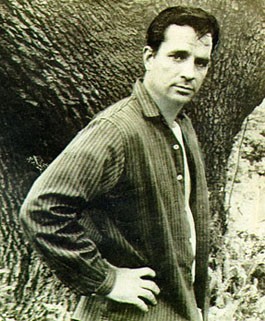
Lit: Jack Kerouac’s ‘On the Road’ turns 50

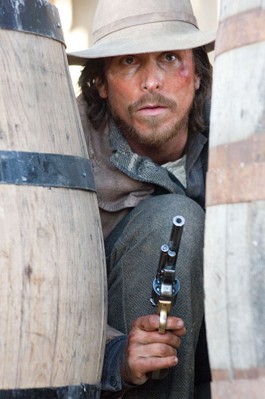
Review: ‘3:10 to Yuma’

September 12-18, 2007

After the success of Walk the Line, director James Mangold tries to make 3:10 to Yuma a Western to end all Westerns. This is a strategy that’s been tried before (in 1969, for instance, in a little movie called Once Upon a Time in the West). If 3:10 is a hit, it will be because of the power of the Western theme itself, and not because of the social commentary and bric-a-brac with which Mangold loads this film.

Debt-harried, maimed Civil War vet Dan Evans (Christian Bale) is ranching an arid patch in southern Arizona. As the film begins, his barn is burned by regulators from the Southern Pacific railroad who want him to sell out his property. Evans doesn’t shoot the marauders, which seems like weakness to his chafing adolescent son Will (Logan Lerman), a 14-year-old intoxicated by dime novels. Evans has no room for adventure, though, with his youngest son gasping with tuberculosis. But then he has to face the disappointment of his weary wife Alice (maybe they should have found someone wearier than Gretchen Mol). Having to raise some money fast, Evans is forced to herd his scrawny cattle into town.

Nearby, the actual stuff of dime novels is playing out. The fearsome Ben Wade (Russell Crowe), armed with a pistol nicknamed “the Hand of God,” has engineered a robbery of the Wells Fargo stagecoach. His psycho lieutenant Charlie Prince (Ben Foster) helps to shoot the survivors. Among them is the hired gun Byron McElroy (Peter Fonda), who was protecting the coach’s gold.

Evans and Will stumble onto the crime scene; Wade and his bandits help themselves to the rancher’s horses. Though gut-shot at close range, McElroy survives the attack. After a quick operation from the town’s veterinarian (Alan Tudyk of Serenity, droll as always), Evans aids in Wade’s capture.An unsteady posse heads out: one crippled, broken rancher; one bespectacled horse doctor; one high-handed weakling of a Southern Pacific executive (Dallas Roberts); and one wounded lawman. They escort Wade to the railhead at Contention, to ship him off on the 3:10 train to the territorial prison at Yuma. Wade’s armed and dangerous gang is at large, ready to spring him during the trip across the Apache-haunted open country.

Novelist Elmore Leonard’s story fueled the original version of this, a minor but efficient oater of 1957 in which Glenn Ford played the thoroughly evil robber and Van Heflin was the desperate rancher who helped round him up.

I interviewed Elmore Leonard once, and asked him why he’d stopped writing Westerns. Leonard said that, in his opinion, the Westerns dried up because of firepower itself. Once audiences had heard automatic weapons, they were less interested in six-shooters. Well, Mangold has that avenue covered, and the final shootout in 3:10 to Yuma is a 101-gun salute, with most of a plywood town of Contention getting splintered.

Just as Vietnam intruded into Westerns from 1965 to the early 1980s, so Mangold stirs in a bit of Iraq: an Abu Ghraib torture sequence and Evans’ disillusionment speech&–he lost his leg in a war that decided nothing and got paid chump-change from the government for the honor.All this is distracting enough, but there’s also too much identification build-up between the two protagonists; Wade is even shown as a Renaissance man, getting philosophical and doing little pencil sketches in between murders. Yet there’s enough of the basic pleasure of the Western so that much of 3:10 to Yuma works and certainly comes at the right time. This has been called the cinematic summer of “bromance” (to use Dave Carnie’s word to describe Knocked Up, Superbad, Chuck and Larry, etc.), and Crowe and Bale’s moral duel is a crowd-pleasing ending. Ultimately, the last line in 3:10 to Yuma ought to be the one Joanne Dru delivered in Red River: “Anybody with half a mind would know you two love each other.”

‘3:10 to Yuma’ opens everywhere on Friday, Sept. 7.


New and upcoming film releases.

Browse all movie reviews.

Profile: Mountain Goats record in Cotati

0

music & nightlife |

Photograph by Derek Goodwin

By Gabe Meline

Although it may not register as much of a blip on the general population’s radar, it nonetheless gives a palpitating kick to announce that the Mountain Goats have been recording in our very own backyard at Cotati’s Prairie Sun studios. To select in-the-know fans of the excellent band, this promises two things: a new album by the band’s prolific songsmith John Darnielle, and, more importantly, a chance to spot him out cruising the produce section of Oliver’s Market. Mountain Goats fans are diehards and wouldn’t be above out-and-out stalking.

Darnielle’s outstanding talents first came my way in the form of Tallahassee, a richly rewarding theme album about a down-and-out couple who buy a ramshackle Florida cottage in which to drink themselves to death. With an incisive knack for painting situational imagery, Darnielle crafts a world halfway between Raymond Carver and Joni Mitchell, singing in a detached, perceptive clip about the ultimate tragedy of faded love. It came out five years ago and still reveals new, sparkling intricacies with each listen.

I caught up with Darnielle in the middle of recording, and though it was hard to refrain from asking him obsessive questions about his new songs, I needn’t have worried; Darnielle’s “very superstitious” about talking about recording sessions while they’re happening. As yet untitled, this is the band’s third album recorded at Prairie Sun, and along with sheer familiarity, Darnielle cites the secluded farm life at the venerable Cotati compound as a recurring attraction. “It’s rural, which I value—I don’t want distractions when I’m working,” he says. “I’m not a very social dude, I fear.”

Opting instead to spend his free hours plowing through War and Peace (“A considerably better read than its reputation would suggest”), it’s safe to say Darnielle won’t be slamming whiskey sours and dancing on the pool tables at Red’s Recovery Room anytime soon, and come to think of it, that’s probably a relief to fans of his bookish charm and understated insight. “I’m guessing a lot of people like to relax and get loose when they’re done with a day’s work,” he says, “but I like to try and keep my eyes on the road for 10 days straight.”

No Washoe House? No Tradewind’s?

“I went to In-N-Out Burger once for a grilled cheese sandwich,” Darnielle offers, divulging the one temptation of the outside world with a siren song strong to lure him away from his 10-ton Tolstoy. “You may laugh,” he admits, “but until you’re an expatriate Californian, you don’t really know what you’re missing.”


FIND A MUSIC REVIEW

News Briefs

09.12.08 Rehab RumbleNew residents were scheduled to move into Sausalito's Alta Mira Hotel on Sept. 10, sparking opposition from neighbors and officials who said they weren't notified about the change. Owners Michael and Ray Blatt are converting the hotel and adjacent homes into a drug and alcohol rehabilitation center, due to open with 18 beds this month; 30 more will...

Ill Communication

09.29.07When outside of the North Bay, being a Bohemian writer means constantly illuminating others with comparisons to the SF Weekly or other familiar alternative weeklies. So when I received an e-mail from the Beastie Boys' management inviting me to participate in their latest promotional roundtable interview, I was skeptical but also intrigued. A new Beastie Boys album is an...

A Changing Landscape

Photograph by Edward Troxell Case in Point : Biologist...

Seeds of Wonder

09.12.07Wherever they are coming from, Jesca Hoop's new album promises listeners the unexpected. Those unfamiliar with Jesca's music will probably think, "Gee, this is pretty weird," while North Bay folk who recall her days with Majesty's Monkey five or six years ago may think "Wow, this is pretty normal."You put Kismet on for the first time and hear "Summetime"...

Fully Launched

09.12.07In the movie version of To Kill a Mockingbird, there's a moment late in the film where Miss Maudie Atkinson tells Scout and Jem, "There are some men in this world who are born to do our unpleasant jobs for us." She's talking about the lawyer Atticus Finch, whose job includes standing up to the prejudices and intolerance of...

Algae Action

09.12.07 Nestled within the dry and brittle grasses of my yard, there is a green patch of earth, unexpectedly lush with a thick swath of large, leafed comfrey, towering borage and leggy peppermint. I don't water this part of my yard; it just is this way. Lately, however, it's been extra lush, suspiciously so for late summer, and so last...

Black Stallion Winery

09.12.07Napa Valley's newest winery is a short trot north of Napa on the Silverado Trail. Its stonework facade is reminiscent of Old California, olive trees line the drive, parking is amply provided and the entrance is framed with palm trees that have stately stood for the past several months, at least. Inside, guests may warm themselves by the massive...

Review: ‘3:10 to Yuma’

September 12-18, 2007After the success of Walk the Line, director James Mangold tries to make 3:10 to Yuma a Western to end all Westerns. This is a strategy that's been tried before (in 1969, for instance, in a little movie called Once Upon a Time in the West). If 3:10 is a hit, it will be because of the...

Profile: Mountain Goats record in Cotati

music & nightlife | Photograph by Derek Goodwin ...
11,084FansLike
4,446FollowersFollow
6,928FollowersFollow