The Green Zone

10.17.07

I discovered my first issue of The Pharmakon while cleaning at the coffee shop where I work. Some people collect stamps, others collect marbles. I collect zines. After only a cursory glance, I could tell that The Pharmakon had much more to offer me than mere padding for my collection. I took the copy back to the front counter and began to browse through it between helping customers. The Pharmakon did more to ignite my imagination and inspire me to take place in community action than any of the caffeine that I had thus far imbibed that morning. Thus began my relationship with The Pharmakon, a monthly publication launched this past June, the creation of Josh Stithem and Bite the Hand Productions.

The Pharmakon creates a beautiful balance between art and community, education and environment. From the last few issues, I have learned about a sustainable beekeeping workshop, Sonoma County Food Not Bombs, Free Mind Media and its community garden, the Tea Room (where one can go to discuss grassroots activism), how to build my own composting bin, the Sonoma County Conservation Action and its Know Your Neighbor program (which helps to connect people in order to protect our environment), the SMART Train, Harvest for the Hungry, a biodiesel workshop and much more.

I contacted Josh, who graciously agreed to give me a tour of The Pharmakon publishing quarters: his house in Santa Rosa. Josh’s home is a living example of what The Pharmakon encourages: community, environmental stewardship and art. He and his roommates have transformed what was once a weed-ridden patch of dirt surrounded by sidewalk into a mini, ecologically sound swathe of gardener’s paradise. They plan to put a community bulletin board on the corner; I suggest a solar-operated espresso machine. Josh tells me that the Pharmakon is motivated by the written word and exists as a place for people to find information and make connections.

In order to explore this idea of connection and community further, I decide to investigate one positive action that I would not have known about had I not picked up a copy of Josh’s zine. Do I make my own mead? Attend an event at Free Mind Media? Or do I check out Monday Night Mass? For the sake of this column and bicyclists everywhere, I leave Josh to his band practice and commit to experiencing what is rumored to be the most successful Critical Mass bike ride this side of the Golden Gate.

Nica Poznanovich is self-proclaimed Queen Bee and coordinator of Monday Night Mass, a weekly event that regularly draws some 50 riders who depart from Santa Rosa’s Community Market around 9:30pm. The bicyclists travel together through the streets via an ever-changing route. Unlike other Critical Mass rides, Monday Night Mass is not a protest but, rather, a chance to be an empowered bicyclist in an environment where you know you will be safe, surrounded and never stranded. This is a chance to make new friends, travel the streets by moonlight and learn to navigate Santa Rosa free from the confines of a carbon-spewing hunk of metal. All levels of riders are welcomed.

(A week after our conversation, Nica was hit by a car while riding her bicycle through Santa Rosa. She was not too badly hurt, but badly enough that she had to miss out on a Monday Night Mass, and she never misses Monday Night Mass.)

Despite Nica’s conspicuous absence, everyone I meet is notably friendly. I could have showed up on a pink bicycle with training wheels, steamers and a banana seat and been welcomed with open arms. As it is, I show up with no bike at all and skulk about, staring at everyone and taking notes, and still every bicyclist I come across is nice to me. One rider tells me she bought her bike for 10 bucks and encourages me to look for one on Craigslist or at the dump. Another rider arrives with a large speaker he pulls on a cart behind his bike. He has a portable CD player strapped across his chest in a holster of sorts. The system slows him down a bit, he admits, especially around turns, but is worth it for obvious reasons.

Some riders tinker with their bikes and fill tires, while others pore over a map of Santa Rosa and discuss their route for the evening. Someone is dispatched to Nica’s house to fetch the walkie-talkies, and friendly debates begin as to what is the safest route to take (apparently Fourth Street is no good, what with a rough right turn near Safeway and a blind turn where Pacific hits Fourth) and where they should stop for check-ins and refueling (Aroma Roasters and a taqueria on Sebastopol Avenue are universally agreed upon).

As I watch the bikers roll into the parking lot of Community Market, singly, in twos and in threes, I want to go with them. Even I—petrified of riding near cars, afraid of dogs and generally not even close to fit enough to peddle up a hill—feel a deep longing stir within my chest. I want to get a bike, and when I do, I know exactly where I am going to go riding.

When I get home, I pull out my August issue of The Pharmakon. I turn to page 19 and read: “Do it yourself, find a bike, fix a bike.”

For information on ‘The Pharmakon’ contact Josh Stithem at th**********@***il.com. For information on Monday Night Mass, contact ni*****@***il.com.


Jive 14

0

10.17.07

The notion that the war—any war, all wars—will end and that there will come a lucid day when peace reigns struck quite a chord with our readers. Over 50 writers took the challenge, submitting visions of the war’s last day that ranged from a ho-hum date between two mismatched singles to a weary woman taking out the garbage on a hot morning to the preordained rise of Britney the Great. The Mayan calendar figured inordinately as did (in lesser profusion) fishing rods, flashing armor and colostomy bags. These were a gas to read.

Special shout-outs belong to those writers whose work wracked the judging team most, including Isaac Lefkowitz, Kevin MacGregor Scott, Kristy Cardinal, Luis Guzman, Trevor McCabe and Robert Feuer, whose final line, “Like everything else that had happened in my life, the end of the war was a big dud,” makes us chuckle every time we read it.

As we do every year, we conclude the Java Jive with a party, this year slated for Wednesday, Oct. 24, at 6pm at our new offices: 847 Fifth St., Santa Rosa. This free event is open to the public and we’d love to welcome you to this reading of the Jive winners. Now that we’ve begun imagining the day the war ended, such fantasy has become irresistible. Here’s to it one day being stuff of headlines, not fiction.

—Gretchen Giles

OK with That

SHE LOOKED AS GOOD in her husband’s old sweatshirt as she would have looked naked. She’d probably have still been naked, except it was one of those snappy California days, and she was trying to save on the gas bill.

“Want some coffee?”

“No,” I said. “I used to like it, but now it gives me the shakes.”

“Getting old.”

“Not that old.”

“I guess not. But 30 feels . . . I don’t know. I never figured I’d be with anybody 30. But I kinda like it. You’re OK.”

“Thanks.”

“Don’t mention it.” She went toward the kitchen, the sweatshirt riding high. I heard her making coffee for herself.

I rolled over and put my back up against the pillow that was propped on the headboard.

She came back a few minutes later with that ugly Japanese mug of hers in her hand and sat down on the edge of the bed.

“You think we should be doing this?” I could tell it wasn’t a genuine question, just something she thought she should be asking.

“I wanted to. You wanted to. He’s not here. He may never be here. It happened. It’ll probably happen again. You OK with that?”

“I guess so.”

“You still hearing from him?”

“He e-mails. Once in awhile. Tells me all the shit that’s going on over there. It sounds awful, but it’s been going on so long, and I just can’t deal with it anymore.”

“No ‘loyal army wife’ and all that.”

“Can’t do it. I just can’t do it.”

“Feel guilty?”

“Don’t feel anything.”

“So it’s over?”

“Yeah, it’s probably over.”

She put down the coffee mug, slipped off the sweatshirt and tossed it on the floor next to my shoe.

“I think I feel sorrier for the poor bastard than you do,” I said, pulling her down on top of me.

“Yeah,” she said, “you probably do. You probably do.”

—Charles Martell

Three Stories

THE DAY THE WAR ENDED, Joe McCullough took down the American flag from the stanchion on his porch and rehung it upside down. His wife, Evelyn, following him onto the porch, stood silently before the flag, her face contorting with a smoldering anger that consumed her insides. She suddenly issued a loud bellow, like a sick dog, and viciously attacked the flag. Joe grabbed her. “Honey, don’t,” he said. She bolted into the house, found the 8-by-10 photo, framed in glass, of her son’s platoon posing with George W. Bush in front of the new American embassy in Baghdad during the final year of his presidency.

Dozens of proud, weary, ill-fated soldiers. Evelyn confronted the photo in her hands, trembling. She lifted the frame over her head, poised to hurl it to the floor. Joe barreled through the doorway and held her arms aloft until she collapsed, grief-stricken, in his arms.

One hour ago, news of the end of the war had reached them. The crumpled letter on the coffee table informed them that young Charlie McCullough, their only child, was killed two days ago just outside the Green Zone, about 12 miles from the site of the new embassy.

In the White House, there was unbridled chaos. Public sentiment finally swayed the war’s architects, and the reins of assumed power were handed to the Iraqis. Prepared for this day, the Americans would not be denied their foothold; with the war officially over, the new U.S. embassy could be completed.

The Iraqi company constructing the 100-acre compound, unfazed by the war or who won it, vowed that U.S. taxpayers would not be charged more than the estimated $600 million price tag. And despite well-documented malfeasance and incompetence and an enraged “fringe element” of protesters, administration officials counted on patriotic fervor to sway public sentiment toward completion of this monumental U.S. stronghold Not far from the site of the embassy, two cousins, Ahmed and Muzzafar, reunited in the shade of a burned-out schoolhouse surrounded by concertina wire. They passed a dusty bottle of cheap wine. They had grown up together, but with opposing political and religious backgrounds. Despite these differences, they agreed it was good fortune that they had survived the American occupation. They were aware, however, that despite the official end to this war, centuries-old civil unrest would crystallize simmering resentments and recriminations into deeper hatred and endless acts of insane martyrdom.

“Remember our last day of school here, Ahmed,” Muzzafar declared. “One bomb came so close, I couldn’t hear for a week.”

“Right,” Ahmed said. “But I praised the Americans to Allah for saving me from this shithole school.”

They looked around at where they sat. The irony was not lost on them as they grimly toasted the end of the war.

—Bob Klein

The Bunkers of Graceland

WHEN I RECEIVED the news, I took Sabrina in my arms and ran to the truck, kissing her cheeks as we bounced. “What is it, Daddy, why are you crying, where are we going?”

“Mama’s coming home tonight, baby. We’re gonna round up dinner.” I sped down the street as Sabrina sang her mother’s name, “Mama, Julia, Mommy!”

The news had spread, and the charcoal and beer were ecstatically hauled out in carts. The lines were up the aisles, but no one complained, knees trembling in anticipation, nesting for heroes with candles and sponges. We collected the ingredients for Julia’s favorite meal, king salmon and macaroni. Rolling to the express line, staring wide-eyed at the paper’s headline: “Mission: In Hole, Stop Digging.” Grabbing our groceries, we returned to the truck and flipped on the radio. Mariachi music blared; screaming horns and rapturously strummed guitars shook the cabin. Sabrina laughed and clutched the macaroni. She turned the dial to hear a resolute president declare something about “drinking ice tea in a burning building.” Snickering, the president drew a few more words, interrupted by static. “When the house is floodin’, get a bucket!” I think it was static, it could have been counsel. Sabrina, unmoved by presidential speeches, shut off the radio and went back to singing Mama’s melody.

As we turned off College Avenue onto Humboldt Street, she pointed in wonder at the assembly of crisp American flags flying from the houses. “I remember those from when Mama left.” Without wincing, I replied, “Mama and her friends left because they love America. America’s bringing them home, because America loves them back. Those flags remind us, honey, they connect us to each other.” Good riddance to my last dutiful rationalization; I didn’t need any more. Tonight, Julia would thaw her faithful heart on our wedded bed, fresh from the bunker.

Pulling into our driveway, Sabrina unbuckled her seatbelt and leaped out of the parked truck. She ran upstairs to her mother’s study, jumped on a chair and took the Stars and Stripes from the wall, making sure the flag didn’t touch the ground, as her mother had taught her. “OK, sweetheart, let’s hang it out on the porch.” The sun was setting, the street aflame with candles and fevered conversation. Barbecue smoke billowed into the night sky, wafting the smell of grilled beef and vegetables over fences and rooftops.

After the flag was hung, we went inside and played Julia’s favorite album, Paul Simon’s Graceland. Sabrina turned the stereo up until the windows rattled. “Bet Mama can hear this!” she hollered. Moving to the stirring rhythm, my body trembled for Julia as I squeezed lemon on the salmon. Outside, bottle rockets and Roman candles burst and thundered through the air with the shouts and roars of peace. I almost fainted, watching the fish crackling as it sizzled on the frying pan, the starry night exploding, as Sabrina spun in circles playing her plastic harmonica, waiting for our queen to arrive.

—Michael Harper

Dammit

“Dammit.” She cursed as the hot coffee spilled across the chipped formica. She rushed to the small bathroom, nearly slipping on the still-wet tile, into the shower stall, and grabbed a towel. Returning to the other room, she sopped up the steaming coffee that was now dripping off the countertop onto the already stained carpet below. Righting the cup, she poured a second from the motel room’s coffeemaker and dutifully stirred in the requisite pink packs of sweetener. First sip, ugh.

She walked to the other side of the bed and pulled open the heavy curtain. She lowered herself onto the edge of the bed and stared blankly out at the rain that was drowning the D.C. expressway in a sea of wet and oil, trash and fallen leaves. In the early-morning dimness, the fluid flowing across the roads looked strikingly like the coffee that had dripped off the counter moments earlier. Rush hour was just gearing up, cars splashing through the runoff crossing the expressway’s onramp. Just another fall morning in just another northeast city. Thousands of commuters, one to each car, staring straight ahead as they steered their way through the rainy mess.

From down the hallway, she could hear the sounds of children. “Come on, give it back. Casey, it’s mine. Give it back ! Mom, he’s going to get it all wet! Mom!”

“Oh jeez, Sydney, you’re such a baby. Here, take it back!”

The voices rose in volume until they were just outside her door. A knock.

“Mom, you ready?”

She got up slowly and opened the door to see Jodi and the kids standing just inside the drip line of the awning that covered the second-story walkway. Sydney’s towhead gleamed even in the gloom of the rainy dawn. She reached out a tiny hand and pulled her gently out the doorway.

“Time to go, Momma, come on.”

Turning silent, the four of them walked under a huge black umbrella toward the rental car.

Jodi guided the nondescript four-door as it splashed its way down the expressway’s onramp, and they joined the sea of commuter fish heading south.

Two miles down the freeway, they exited. The car weaved its way along the riverside road, and they merged north, heading through a roundabout.

Suddenly, the businessmen in the car next to them began cheering, one punched the air above his head with his fist and started clapping. A car several ahead of them in the traffic honked its horn. Other cars passing in the opposite direction had passengers in various states of obvious celebration.

“Mom?”

“Turn on the radio.”

After shuffling the dial through several hip-hop stations and a Spanish language talk show, they caught the special report, already in progress:

“. . . is underway. Completion is expected by the end of the month, and no forces are expected to remain. Chancellor Merkel, commenting at the G7 summit in Geneva, stated it was an action long overdue. Other world leaders indicated their overwhelming support. Again, we report that the president has announced the immediate withdrawal of U.S. troops from Iraq and Afghanistan. This comes following the . . .”

She turned the radio off and looked over to her daughter-in-law in the driver’s seat.

Jodi sobbed silently as she steered under the stone archway of Arlington Cemetery.

—Lori Lynne M. Brundick

Dedicated to my stepbrother, Scott W. Dyer, who was killed in Afghanistan on Oct. 11, 2006, and to the rest of his squadron who are still in Afghanistan. Too late for Scott. Too late for so many. Peace be with you all.

The Great Sunset Skirmish

HAD I KNOWN it would be the last time I’d put on my buddy’s extra Army jacket, I might’ve said something. The Coleman canteen carving a crevice into my neck, I took my makeshift weapon made from plastic yellow tubes, and followed my friend into the surrounding woods of the park.

The sweltering sun beat down upon a semi hauling Syrah in the late October air. I crept, carefully trying not to let my shoes come down on the dry leaves.

“We hafta be silent,” my friend said. He was older than me and faster than me, so I followed him as the commander of the unit. We waited beneath a young redwood tree, eyeing the opposite hedgerow for enemies.

“Hey, who we fightin’?” I asked him.

“Germans,” he answered.

“No, we fought them a long time ago,”

I countered.

“Iraq?” he offered.

“No, they’re like really fighting them, out in the Gulf,” I said.

“Well, we could play Vietnam?” he said. The sun was beginning to drift beyond the Mayacamas. I knew I’d get the call home soon.”No, how ’bout Norway?” I asked. I guess it seemed random enough to be true.”Works for me,” he said.

“Over there! Blitttitiitititiratataratom!” My mouth and gun erupted in strafing fire, knocking down the Norwegians’ initial attack.

“Hey, my gun’s a rocket launcher too, look. Pishowwwwwboom! Got ’em!” he yelled.

We beat the first wave back, and the second fell without a problem. But when the third wave hit, my friend was pierced by a shot from a sniper off the rooftops in the neighborhood nearby.

“I’m hit!” he shrieked.

Blitititititishisihshishsi!” I held down my trigger and continued to fight as dusk crept on us like a crook casing a cottage.

“Geoff, Joey! Time to come home!” Geoff’s mom yelled.

“Cease fire,” he said.

“I’ll see ya tomorrow,” I told him.

But I didn’t see him the next day. And the day after that, we would play Whiffle all day. The rest of the week was spent playing more Whiffle and Rollerblading.

Soon after this, we began middle school. There was no more time for war. Postschool activities became more grownup-like, but boring. “Hanging” out at the park, really not doing a goddamn thing.

In the months following, Geoff was too popular, and he had a girlfriend, and the thought of him playing make-believe war was almost embarrassing. I had gotten into video games more than I would’ve liked to, and the girls laughed at me for being heavy.

Had I known that day was the last, I would’ve said something. “Good luck in life. I’m sure gonna miss this.” Something. But I didn’t, and just like soldiers in a real war, that last skirmish beneath the autumn sunset halted and took with it what once was my childhood.

—Tyler Brown


Letters to the Editor

10.17.07

Right on, Sister!

Right on, sister! (“My Two Breasts,” Hannah Strom-Martin, Oct. 3). Give the lie to our society, where we have compartmentalized our sexuality to the point where sex is no longer an interaction between two humans, but rather a virtual reality mediated by the mass media, where it’s OK to watch (only if it’s on a screen) and never to touch.

Pornography is the expression of sexual repression. The fact that it abounds when we can’t even talk publicly about sex, let alone show a little cleavage, is all you need to know. The Victorians hid their sexuality, as they did their porn, in the proverbial closet. We hide our pornography, like Poe’s purloined letter, in open view, while our basic sexuality—which is, after all, what makes us human, the human need to touch and be touched, to love and be loved—we hide deep within our minds (or our computers). It apparently only comes out at night when the moon is full or, like Dr. Jekyll, when we’ve jacked ourselves up on some inhibition-busting joy juice.

Then, of course, there are those few fortunate among us who have been bitten one night by a beautiful, sexy, vampire.

David Magdalene Windsor

Woe is me, I’m a 36-c

I’m a great fan of the Bohemian, but I have to comment on “My Two Breasts.” Having grown up not so thin but with a flat chest, I painfully learned at an early age that women with cleavage were much more attractive to the opposite sex. Perhaps it’s the anatomical mimicry of a butt-crack right there below the enticement of red lipstick. Whatever it is, it sends millions of women into surgery to have two sacks of foreign material attached to their chest walls.

What was left in my mind after reading the article was how desperate the writer was about getting her breasts noticed: “By the way, did you know I have large breasts? Oh, what a problem they are! I have the same body as Britney Spears! Did I forget to tell you I have large breasts? Woe is me, I’m a 36-C. In case you missed it in every paragraph, I have large breasts and I love to wear tight camisoles and spaghetti-strap tank tops. That’s because my breasts are so large.

Yes, they sure are big.”

Was that a personal ad or a bit of Monty Python&–esque humor? It’s pretty much the most ridiculous article I’ve ever seen in your paper.

Norma Cronind Petaluma

Now, now, Norma, let’s remember the advice of our first breast basher (Letters, Oct. 10) and play nice.

Trail Rail

Regarding trails in rural areas (Open Mic, Oct. 3), Marin County adopted its first trail plan in 1984. It created a vision that is gradually being realized of a trail network throughout the county. The plan has been valuable in securing grants and donations to open new trails that people use every day for their exercise and enjoyment. The plan has never forced any property owner to open his land to the public.

Claims that trail users spread animal disease or hurt agriculture are ridiculous. Where is the evidence? There are public trails in agricultural lands all over the country and throughout the Bay Area. In Marin County, trail users on Mt. Burdell, Bolinas Ridge, Pt. Reyes and Loma Alta mingle peacefully with cattle that seem just as contented as those on lands closed to public trails. If animals are spreading disease, isn’t it more likely that it is the deer, foxes and turkeys (or ranch hands) who roam freely over the land 24 hours a day than hikers on a trail?

As to liability, California’s Recreational Use Statute protects landowners against injury claims by visitors and also provides funds to defend against such claims—which have never been successfully prosecuted since this provision was created.

So what is behind this issue? I believe it is motivated by a few—mainly gentleman farmers and escapees from the urban world—who are happy to have the rest of us support their rural lifestyle with subsidies and tax breaks, but who do not ever want us anywhere around their private preserves.

Bill Long Novato


Change-Making

0

10.17.07

“Bioneers” is a word coined to mean pioneering and innovative people who focus on practical and visionary solutions for restoring the planet’s threatened systems. Bioneers look to nature for instructions for how to live on Earth in a healthy way that lasts, in concert with natural principles such as diversity, kinship, reciprocity, food webs and community. The event is designed to explore, connect, discover and celebrate.

Now in its 18th year, this event usually sells out with over 3,000 participants. Do to overwhelming interest, the Bioneers have bloomed, now serving 18 satellite conferences in Alaska, Iowa, New York and beyond with a live feed from the Marin conference, slated for Oct. 19&–21. The morning plenary speeches are beamed from the Marin Center into the other places, which have their own local programs in the afternoon. Ten thousand people are projected to attend the various Bioneers gatherings this year.

Far from its progressive fringe beginnings, last year’s conference was covered by the New York Times, and many of the Bioneers featured prominently in Leonardo DiCaprio’s documentary The 11th Hour.

Among this year’s keynoters are author Alice Walker (above), transformation expert Byron Katie speaking on what she has simply come to call “the Work,” playwright Eve Ensler on the continued evolution and importance of her groundbreaking Vagina Monologues and author Edward Tick on “Modern War’s Devastation and Healing.” North Bay presenters include journalist Mark Dowie, the OAEC’s resident biologist Brock Dolman, ethnobotanist Kat Harrison, psychiatrist Jean Shinoda Bolen and members of Farms Not Arms, a national group of activist farmers and veterans with a strong Petaluma chapter.

The organizers of Bioneers, who are based in Santa Fe, N.M., seek to inspire educate and connect. Many prominent groups co-sponsor the event, which also has numerous media partners.

Bioneers Conference runs Friday&–Sunday, Oct. 19&–21, at the Marin Center, 10 Avenue of the Flags, San Rafael. www.bioneers.org.


Museums and gallery notes.

Reviews of new book releases.

Reviews and previews of new plays, operas and symphony performances.

Reviews and previews of new dance performances and events.

Wine Tasting Room of the Week

0


Just west of the bustle of Santa Rosa on a Sunday drive, it is clear that autumn has quickly followed the first few days of rain. Leaves speckle the road, the roses of a roadside memorial glow red in the slanted light and shadows cross the road in the midafternoon. Farther west, traffic thins, save for a flatbed truck stacked with heaping bins of Chardonnay grapes careening down Graton Road to beat the next rain. In these hills where pioneering Russian orchardists encroached on the great Spanish land grants, the apples now give ground to grapevines. The road passes through a little valley green with vineyards, surrounded by redwoods, overlooked by Marimar Torres Estate.

Representing a Spanish winemaking dynasty, Don Miguel Torres brought along daughter Marimar on a California visit in the 1960s. She later made it her home. With support from the family business, Marimar, also a food writer, built the winery in 1993. It’s well laid out: there are bright yellow walls, blue-framed windows, a courtyard fountain and flowers spill out on the walkway to the tasting room above the steep, hand-farmed vineyards.

The tasting room is inspired by a Catalonian farmhouse kitchen, with decor selected from the region, and wines are presented on the central dining table. Despite the Iberian heritage, the wines are strictly Burgundian. The 2006 “Acero” Chardonnay, Don Miguel Vineyard ($29) is named for the Spanish word for “steel,” contrary to the trend towards “roble,” but in keeping with the countertrend against oaked Chardonnay. Yet the aroma is butterscotch, the acidity lemon-lime, the fruit fresh.

From the home vineyard named for Torres’ late father, the 2004 Don Miguel Estate Pinot Noir ($39) is a concentrated Pinot, with rich black cherry fruit balanced between tartness and solid tannin (like a fine Tempranillo?) with something of a smoky, vanilla note. The 2004 Estate Pinot Noir ($45), from a newer vineyard overlooking Freestone and named for matriarch Doña Margarita, is, if it can be believed, more feminine. A hint of strawberry peeks out over dark cherry aroma, subtly perfumed with allspice or clove. The mouth-feel is rich, refined; the tannin supple, without vegetal character save for an afterthought of rhubarb. This is among the best Pinots I’ve tasted in the past year.

Although I’ve been partial to more rustic Russian River valley operations, the picture-perfect Marimar Estate is not a bad stop for locals on a Sunday drive. There’s a feeling of a private tasting at a little-discovered, tucked-away location. The only other folks who showed up during my visit were locals who immediately found one degree of separation with the host and struck up a conversation. Spain’s Prince Felipe has already visited—in 1994—but you can still beat the crowds in this winery’s springtime. Marimar Estate, 11400 Graton Road, Sebastopol. Open 11am to 4pm. No tasting fee; tours by appointment. 707.823.4365.


View All

First Bite

0

10.17.07

Editor’s note: First Bite is a new concept in restaurant writing. This is not a go-three-times, try-everything-on-the-menu report; rather, this is a quick snapshot of a single experience. We invite you to come along with our writers as they—informed, intelligent eaters like yourselves—have a simple meal at an area restaurant, just like you do.

It was barely 6:15 on a Tuesday evening, and Bruno’s on Fourth was packed. Since opening this summer in the former Rubix space on the edge of downtown Santa Rosa, it’s been a popular haunt for diners craving upscale American comfort staples like flat-iron steak and fries, pulled pork with slaw and jalapeño aioli and macaroni-ham casserole.

Yet with only about a dozen tables, plus seating for another half-dozen at the bar that fronts the kitchen, the cottage-like cafe doesn’t take reservations for parties of less than six. By some sly fate, however, my group of three arrived mere minutes before the crush. We scored not just a table, but the best one in the house, a cozy little number featuring a built-in window seat that offers a birds-eye view of the partially open kitchen and the boisterous hubbub of fellow diners.

We also tripped upon a great discovery: among the half-pound cheeseburgers and wedge BLT salads, chef-owner Rich Bruno, formerly of the Bohemian Club and Chateau Souverain, is putting out some inspired, high-end dishes worthy of a more important restaurant. We’d been munching on crusty-edged, meltingly-soft-inside bread and butter, sipping a citrusy ’05 Matua New Zealand Sauvignon Blanc ($6.50), and commenting on how well an ice-cold Hank’s root beer ($2.50) goes with Bruno’s crisp calamari ($8.50), when our waitress brought our second appetizer, rock salt-roasted prawns ($10.95).The calamari had been very good, a generous serving of meaty knots and chewy tentacles in a crisp, salty batter alongside mildly sweet tartar and a zippy horseradish cocktail sauce. Terrific bar food to pair with a beer. But the prawns were the stunning stuff of fine dining, bringing a big bowl of light, creamy shrimp bisque floating with juicy chunks of tomato, handfuls of fresh herbs and four perfect crustaceans that had been roasted in rock salt so that crystals still clung here and there. By the time the entrées arrived, we’d sopped the dish dry with bread.Fish and chips ($14.95) were a solid favorite, with a puffy, friendly Mrs. Paul’s&–like beer batter and mounds of skinny fries. An evening’s special of pot roast ($15.95) was satisfying, too, the meat mounded on thick mashed potatoes with mushroom gravy, carrots and zucchini. A bit more slow cooking to tenderize the meat, more butter in the potatoes, and this dish would really have shined. The lamb shank ($19.95), however, was stellar. Braised to fall-off-the-bone tenderness and slathered in a wonderfully rich Port reduction over mashed potatoes, it was a delicious bargain.

American comfort food means excessive desserts, and Bruno’s brownie ($5.95) fit the bill nicely, stuffing two enormous fudge slabs around vanilla ice cream under a flood of caramel, chocolate sauce and walnuts.

It’s impossible to not be charmed by the first-rate, reasonably priced Bruno’s. The crowds lining up at the door have figured it out: Go often, and get there early.

Bruno’s on Fourth. Open Tuesday through Friday for lunch and dinner, Saturday for dinner, and Sunday for brunch. 1226 Fourth St., Santa Rosa. 707.569.8222.


Quick-and-dirty dashes through North Bay restaurants. These aren’t your standard “bring five friends and order everything on the menu” dining reviews.

Local Lit

Nothing Left to Lose

0

10.17.07

Before anything else, there’s that voice. That sad, knowing timbre. A voice so hard and heavy, so gritted with experience, that Kris Kristofferson really only has to say one word to convey the wholeness of his being: “Hello.”

If there were a way to make his voice jump off the page, to make the world hear what it sounds like when Kristofferson picks up the phone and ekes out a wearily inviting “Hello,” then this whole column would be over right now. Everything that anyone needs to know about the singer, songwriter and actor is lingering in the rough edges of his 71-year-old voice: the weight of experience, the dedication of intent, the acceptance of the inevitable. And still, the trace of invitation, “Hello,” as in, “I have talked to a million people in my lifetime, but now I am talking to you and I want to hear want you have to say because we are both human beings and we are in this together.”

For proof, catch Kristofferson when he plays Napa’s Lincoln Theater on Oct. 21. Or pick up This Old Road, Kristofferson’s latest, which is the closest thing to being in a living room and hearing someone play songs just for you this side of Johnny Cash’s first American Recordings album. Stark, intimate and wholly mortal, it’s the honest representation of an honest man singing about life, love, the world and the war with a passion rarely evinced in people half his age. “Just me ‘n’ a guitar ‘n’ a harmonica,” he explains from his home in Hawaii, “and we did it in about an hour and a half, I promise you.”

An hour and a half. For an entire album. Unheard of.

There’s “Pilgrim’s Progress,” where Kristofferson wonders if he’s young enough to believe in revolution, “Wild American,” where he celebrates the outspokenness of Steve Earle, Waylon Jennings and John Trudell. Or the heaviest of all, “In the News,” a plea for peace that careens uncontrolled into a global outcry for the tragedy of war, even quoting God himself: “Not in my name, not on my ground / I want nothing but the ending of the war.”

“Since I’ve been writing songs, primarily for a livin,’ I’ve always just tried to be as honest as I can,” Kristofferson says, mindful of the division in country music over the Iraq War. “It’s made me hard to market in the country market sometimes, but I can’t really worry about alienation.

“If you have that position where you can affect people’s lives,” he continues, “I think it’s your responsibility to do it. Anyway, they haven’t got a whole lot of time to ruin my career. Because getting at this end of the road, I really feel like there’s very little to keep me from saying what I mean.”

Asked if he sees any foreseeable end to the Iraq War, Kristofferson immediately answers no. “I can’t see us getting out of this mess now,” he says. “We’ve become like the Romans or something—a little overextended in our empire. And, geez, we can never make it up to those people in Iraq. We did exactly the worst thing we could’ve done. There’s not a person who could say they’re better off today.”

It’s for stances like this that Kristofferson’s been saddled with labels like “Country Music’s Hippie” or the “Leftist Outlaw.” He laughs off such misfired descriptors, chalks them up to having a beard before it was acceptable in Nashville. Then, in a deep tone redolent of long, gnarled nights and too many memories, he lays out the way he’d actually like to be remembered.

“I would like to be thought of,” he intones, “as a creative human being. One who worked with the tools he was given, as well as he can, and followed his responsibilities on doing what he thinks is right.”

Kristofferson was born in 1936, and in his early life he played football, attended Oxford and flew helicopters for a living. He joined the Army, ascended to the rank of captain, and then resigned to focus on becoming a songwriter. His family thought he was crazy. He probably was.

Moving to Nashville, he got hired as the janitor for Columbia Studios when Bob Dylan was recording Blonde on Blonde. “He sat at the piano all by himself,” Kristofferson recalls, having watched through the windows the night Dylan came up with the 11-minute “Sad-Eyed Lady of the Lowlands,” “in the biggest empty studio they had there at Columbia, with his dark glasses, and he would write on that song all night long . . . it was incredible.” As the peon doing cleanup, Kristofferson says that he would never have bothered Dylan, and the two didn’t speak through the entire session.

Johnny Cash must have been more approachable, because between emptying ashtrays and moving microphones, Kristofferson pitched songs to Cash in the studio hallways. After looking up his home address, he even flew his helicopter into Cash’s yard to hand the Man in Black some fresh demo tapes. Eventually one of them stuck: “Sunday Mornin’ Comin’ Down,” a lonesome narrative of getting through a strung-out day.

It started a long, close friendship between the two as they both struggled with the renegade life, the country-music establishment and the missteps they took around each other. “I did things that I’m sure pissed Johnny Cash off,” Kristofferson says without elaborating, “but still, he defended me in a country magazine that had devoted almost a whole issue to what a bad representative of country music I was.”

Cash was right, at least in chart terms. “Sunday Mornin’ Comin’ Down” hit No. 1, and Kristofferson’s songs have now been recorded by over 500 musicians, many of them huge hits: “Help Me Make It Through the Night,” “For the Good Times” and “Me and Bobby McGee,” best known as a posthumous hit for Janis Joplin. Kristofferson and Joplin dated until her untimely death in 1970. He swears he never gets tired of performing the song, adding that “by the time I get to the end, I’m thinking a lot about Janis. And I’m thinking, now, how freedom is just another word for nothin’ left to lose.

“There is a freedom in accepting the fact that there is a difference at this end of the road,” he says. “I’ve watched a lot of my friends and heroes, like Johnny Cash and Waylon, I’ve watched ’em slip and fall. And be gone. And it’s gonna happen to all of us. So I think the acceptance of it gives you a freedom to be less critical of yourself when you make mistakes and to not be so hard on others.”

Kris Kristofferson performs Sunday, Oct. 21, at Lincoln Theater, 100 California Drive, Yountville. 5pm. $45&–$65. 707.944.1300.


Passing It Along

0

10.17.07

There was no huge domestic musical upbringing that turned Steve Earle into an alt-country-rock maverick. His big early influence was a nonfamilial mentor, the legendary songwriter Townes Van Zandt. But Earle’s present-day family sure does take a fancy to country roots and indie style. His sister Stacey Earle and wife Allison Moorer both have their own recording and touring careers, and now son Justin Townes Earle (above) is on tour supporting his own self-produced, folksy debut EP Yuma.

The younger Earle may seem like a chip off the old man’s acoustic-but-tough block, but father and son are quite different. Justin’s smooth, unhurried vocals contrast with dad’s persistent rugged drawl, while Steve’s political outspokenness is apparently not a gene that got passed down. Earle Jr. instead writes softer, simpler portraits that often have the feel and structure of old-time parlor music. The lilting “You Can’t Leave” would make a sweet album track for any classic or current country act.

Justin’s songwriting is still in a formative stage; Yuma‘s title track tells a sad modern suicide tale that shoots for sympathy, yet the young writer stalls in his role as observer. Justin also shows little need for dad’s hard-rocking eclecticism. His MySpace page conspicuously lists the Replacements, Tom Waits and Elvis Costello as influences ahead of dad, but Yuma is entirely a solo acoustic work. Expect a bigger chip off the old block when it’s time for Justin’s full-length debut.

Steve Earle may have taken cues from Justin on his latest disc, Washington Square Serenade. Compared to his usual standards, the disc is drastically less topical, largely less incisive and rocking, though no less questing and varied. After releasing nearly an album per year since emerging from rehab in 1994 (a stretch that many critics and fans believe holds his best work), Earle took a few years off to marry Moorer and enjoy the domestic bliss heard on new songs like “Days Aren’t Long Enough” and “Sparkle and Shine.” Even the gospel-shuffle “Jericho Road,” which promises Earle’s classic human-interest deconstruction of America’s Middle East foibles, isn’t pointedly political.

Still, his edge is there in the hard urban folk-blues mix and in keen writing such as “Down Here Below,” where he imagines a hawk circling over midtown Manhattan to note that “all us mortals struggle so.” He later sings “When the war is over / And the union’s strong / I won’t sing no more angry songs,” no doubt wise enough to know that too much mellowing is premature.


Dinner’s a Party

0

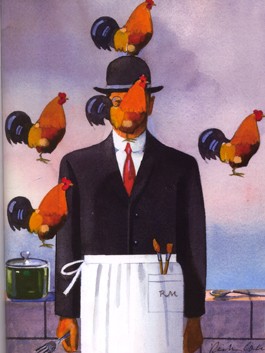
Illustration by Dick Cole
‘René Magritte Faces a flock of falling fowl’: . . . is actually an Asian chicken-wing recipe in SVMA’s whimsical cookbook.

Those of us who have spent upwards of 14 years daily repeating the admonition “Please put your napkin in your lap” know that dinner is not just one great big hullabaloo of happiness. The whole togetherness and healthy-food stuff apart, dinner with children is generally a large-plate affair featuring the ongoing boredom of the same lessons daily learned and just as daily forgotten.

But for a certain strata of adults—those, say, who dandle grandchildren briefly before handing them back or those who haven’t yet seen the dark side of a baby’s dewy soul—dinner is often a time of gosh-darn conversation that never once touches upon the placement of napkins. What’s better, it can be composed of little more than a collection of jewel-like small plates that need pay little consideration to balance between protein, carb and leafy green.

Two new local cookbooks just published celebrate the adult pleasures of the gustatory interlude, replete with wine recommendations. From the dandling-before-handing-back side of things comes the Sonoma Valley Museum’s delightful hometown giggle ‘Sonoma Palette: Appetizers’ ($19.95). Because something’s always going on with the robustly active SVMA, it comes as no surprise that the museum regularly hosts a Sunday afternoon art history class taught by retired Rhode Island School of Design professor Dr. Gregor Goethals.

Post-learning discussion was initially handled over wine and cheese, a tradition that soon grew to include homemade appetizers of all kinds. Now numbering 85 students, the art history class decided to take the next natural step and publish its hot app creations. The resulting book is entirely whimsical, featuring full-page illustrations that are smartly humorous riffs on the great masters whose work the students study before uncorking and tucking in.

All of this good fun supports benevolence toward the recipes themselves, which are a perfect foil to any food nostalgia pangs. Gelatin is called for three times, hearts of palm cans are opened twice, cream of mushroom soup makes a brief appearance and mayonnaise figures in an unconscionable way. But isn’t that how a certain generation steadied themselves for another round of martinis, and isn’t this all actually really yummy? Absolutely, only these days the grownups are drinking lots of great Sonoma Valley wines.

For the pre-dewy-baby’s-soul set, there’s ‘Small Plates, Perfect Wines: Creating Little Dishes with Big Flavors’ (Andrews McMeel; $16.95) by Napa writer (and former Bohemian contributor) Lori Narlock. Narlock teams up with the seemingly ubiquitous Kendall-Jackson winery, they of the recent Sonoma County Museum photography art show and coffee-table book, to make artful small meals that work perfectly with wine. This clean, easy-to-understand book, designed by Fairfax resident Jennifer Barry, is based on the way people are eating in restaurants today, sharing several small plates to make an exciting meal with differing textures and flavor profiles.

Chapters are organized from salads to vegetables to seafood to meat and poultry to desserts, with an introduction by K-J winemaker Randy Ullom that provides clear, sensible tips for food and wine pairings (for example, acidic foods can make wine taste flat because the wine’s own acid is masked). When serving several small plates, Narlock and Ullom suggest serving two- to three-ounce pours of several different wines that match each dish best. And if it all seems too hard figuring Zin from Syrah and Viognier from Pinot Grigio, Ullom reminds, “Chardonnay and Pinot Noir are irresistible to wine and food lovers alike.” Amen.

Small Comfort

Many of the recipes that Narlock has developed would be just as toothsome served up in greater quantity. With the recent rains, we found ourselves longing to smell and serve this lovely autumn fare.

Braised Chicken with Swiss Chard

1 large bunch Swiss chard

2 slices bacon, diced

6 chicken thighs

kosher salt and freshly ground pepper

1 carrot, scrubbed and diced

1 stalk celery, diced

1 shallot, minced

3 thyme sprigs

1/2 c. dry red wine

1 c. chicken stock

1 tbsp. Dijon mustard

2 tbsp. unsalted butter

3 tbsp. Italian parsley, minced

Strip leaves from the chard, reserving the stems. Trim away bottom of the stems and cut into 1/2-inch slices. Sliver leaves into 1-inch pieces. Set aside.

In a skillet just large enough to hold all the chicken pieces in a single layer, fry the bacon over medium-low heat, until crisp. Drain to paper towels. Increase heat to medium-high. Season the chicken liberally with salt and pepper to taste and add to the skillet, skin side down. Turn and cook until browned on each side. Transfer to plate and keep warm.

Add the chard stalks to the skillet and cook until softened, about 3 minutes.

Using a slotted spoon, transfer the stalks to a plate. Add the carrot, celery, half of the shallot and the thyme to the skillet. Cook until vegetables are softened. Add the wine and cook until it is almost completely reduced. Add the stock and bring to a boil. Return the chicken, skin side up. Cover and reduce heat to medium. Cook until chicken is done. Transfer chicken to a plate.

Remove the thyme from the pan and whisk in the mustard. Stir in the Swiss chard leaves, cook until wilted. Add the chard stalks, the butter and 2 tablespoons of the parsley. Season with salt and pepper to taste. Heat through.

Distribute the greens evenly among six shallow bowls and place a piece of chicken atop each. Sprinkle bacon and remaining parsley atop, and serve.


SEARCH AVAILABLE RESERVATIONS & BOOK A TABLE

View All


Quick dining snapshots by Bohemian staffers.


Winery news and reviews.


Food-related comings and goings, openings and closings, and other essays for those who love the kitchen and what it produces.


Recipes for food that you can actually make.

The Green Zone

10.17.07 I discovered my first issue of The Pharmakon while cleaning at the coffee shop where I work. Some people collect stamps, others collect marbles. I collect zines. After only a cursory glance, I could tell that The Pharmakon had much more to offer me than mere padding for my collection. I took the copy back to the front counter...

Jive 14

10.17.07The notion that the war—any war, all wars—will end and that there will come a lucid day when peace reigns struck quite a chord with our readers. Over 50 writers took the challenge, submitting visions of the war's last day that ranged from a ho-hum date between two mismatched singles to a weary woman taking out the garbage on...

Letters to the Editor

10.17.07Right on, Sister!Right on, sister! ("My Two Breasts," Hannah Strom-Martin, Oct. 3). Give the lie to our society, where we have compartmentalized our sexuality to the point where sex is no longer an interaction between two humans, but rather a virtual reality mediated by the mass media, where it's OK to watch (only if it's on a screen) and...

Change-Making

10.17.07"Bioneers" is a word coined to mean pioneering and innovative people who focus on practical and visionary solutions for restoring the planet's threatened systems. Bioneers look to nature for instructions for how to live on Earth in a healthy way that lasts, in concert with natural principles such as diversity, kinship, reciprocity, food webs and community. The event is...

First Bite

10.17.07Editor's note: First Bite is a new concept in restaurant writing. This is not a go-three-times, try-everything-on-the-menu report; rather, this is a quick snapshot of a single experience. We invite you to come along with our writers as they—informed, intelligent eaters like yourselves—have a simple meal at an area restaurant, just like you do.It was barely 6:15 on a...

Local Lit

Nothing Left to Lose

10.17.07Before anything else, there's that voice. That sad, knowing timbre. A voice so hard and heavy, so gritted with experience, that Kris Kristofferson really only has to say one word to convey the wholeness of his being: "Hello."If there were a way to make his voice jump off the page, to make the world hear what it sounds like...

Passing It Along

10.17.07There was no huge domestic musical upbringing that turned Steve Earle into an alt-country-rock maverick. His big early influence was a nonfamilial mentor, the legendary songwriter Townes Van Zandt. But Earle's present-day family sure does take a fancy to country roots and indie style. His sister Stacey Earle and wife Allison Moorer both have their own recording and touring...

Dinner’s a Party

Illustration by Dick Cole 'René Magritte Faces a flock of falling fowl': . ....
11,084FansLike
4,446FollowersFollow
6,928FollowersFollow